
TOPIC : Thrombophilia testing- when and what to do?
SPEAKER : Dr. Pritish Chandra Patra
Hypercoagulable states
• Who should be tested ?
• When to test ?
• Why test ?
• What to test ?
• How to treat ?
• How long to treat ?
Circulatory stasis
Virchow’s triad
• Immobility
• Central lines
• PICC lines
• Inherited
• Factor V Leiden (FVL) mutation (F5 G1691A)
• Prothrombin gene mutation (F2 G20210A)
• Protein C (PC) deficiency
• Protein S (PS) deficiency
• Antithrombin (AT) deficiency
• Rare- elevated F VIII, dysfibrinogenemia
• Acquired
• Antiphospholipid syndrome (APS)
• Paroxysmal nocturnal hemoglobinuria (PNH)
• Myeloproliferative neoplasms (MPN)
• JAK2 mutation in the absence of an MPN phenotype
• Malignancy
• Drugs- OCP, chemotherapy
• Pregnancy
• Trauma, Surgery
Virchow’s triad
Interactions of multiple factors
• Pregnancy
• Puerperium
• Cancer
• Inflammatory conditions
• Obesity
Case 1
• 26 yr female
• on estrogen based OCP
• presents with
• new onset left lower limb DVT
• No prior history of clots
• No family history of clots
• No surgery
• No long-distance car travel
• 19 yr female
• College student
• presents with
• new onset unprovoked left
lower limb DVT
• No prior history of clots
• No surgery
• No long-distance car travel
• Mother had DVT in her 30’s
• Uncle had DVT in his 40’s
Case 2
• 65 yr old man
• Pain abdomen  Portal vein
thrombosis
• Hb-13, TLC- 8000, Plt- 6.5L
• Past h/o- migraine- 1yr, burning of
fingers- 1 yr
Case 3
Prevalence of inherited thrombophilia
Name Prevalence (%)
Factor V Leiden 12-40
Prothrombin gene mutation 6-18
Deficiency of AT, Prot- C, Prot- S 5-15
Risk of thrombosis
Risk factor Relative risk
General population 1
Factor V Leiden- Heterozygous 5
Prothrombin gene- Heterozygous 5
Protein C 10
Protein S 10
AT 15-20
Factor V Leiden- Homozygous 60-80
OCP 4-5
Hetero FVL + OCP 30-35
Pregnancy & Post Partum 5-10
Croles FN et al. Risk of venous thrombosis in antithrombin deficiency: systematic review and bayesian meta-analysis. Semin Thromb Hemost. 2018;44(4):315–26.
Gindele R et al. Clinical and laboratory characteristics of antithrombin deficiencies: a large cohort study from a single diagnostic center. Thromb Res. 2017;160:119–28.
Excess procoagulant
• ? increase the risk of thrombosis
• A meta-analysis of 12 GWAS for VTE (Arachchillage et al, 2019)
• linked to thrombosis
• Variants in F2, F5, F11, and FGG (fibrinogen gamma chain)
• Elevation of VWF and FVIII
• Relevance in routine clinical practice- not clear
• MEGA case-control study of VTE (Rietveld et al, 2019)
• FVIII: Odds Ratio- 16.0 (CI: 9.7–26.3)
• Interaction of heritable and acquired influences on FVIII activity
• Variability in levels over time
• ? Role in management- in thrombosis or asymptomatic family members
Routine testing of coagulation factors to assess the risk of thrombosis- not recommended
Deepa J. Arachchillage et al. Thrombophilia testing: A British Society for Haematology Guideline. Br J Haematol. 2022;198:443–458.
O
Deficiency of natural anticoagulants
• AT deficiency: 15 x risk
• Heterozygous PC or PS deficiency: 5-7 x risk
• PC, PS deficiency >> Risk of thrombus >> FVL, PTG mutation
• PC, PS deficiency << Prevalence << FVL, PTG mutation
• Testing: Plasma activity >> molecular testing
• Multiple different genetic variants
• Acquired causes of deficiencies should always be considered
• Test only if it will impact clinical management
• Test if
• VTE at <50 years of age
• spontaneous or weak provoking factors
• 1st degree relative at young age
• Test for deficiencies of physiological anticoagulants- only after 3 months of anticoagulation for acute thrombosis
Deepa J. Arachchillage et al. Thrombophilia testing: A British Society for Haematology Guideline. Br J Haematol. 2022;198:443–458.
P
• Warfarin
• Vit K deficiency
• CLD
• DIC
• Heparin
• Etc…
Jean M. Connors. Thrombophilia Testing and Venous Thrombosis. N Engl J Med 2017;377:1177-87
Factor V Leiden, Prothrombin gene mutation
• Most tested genetic variants predisposing to VTE
• FVL mutation
• Present in about 5% of Europeans
• Rare elsewhere
• Prothrombin gene mutation
• Present in 1%-2% of Europeans
• Rare or absent in other ethnic populations
• Result in increased risks for 1st VTE: 3-5x (Saemundsson Y et al, 2013)
Genetic testing to predict a first episode of venous thrombosis- not recommended
Deepa J. Arachchillage et al. Thrombophilia testing: A British Society for Haematology Guideline. Br J Haematol. 2022;198:443–458.
O
Acquired genetic traits
• Incidence of thrombosis- 10% (Kelly RJ et al, 2015)
• Neutrophil clone size correlates best with
thrombosis risk
• Cumulative 10-year incidence of thrombosis
• Clone size >50%- 34.5%
• Clone size <50%- 5.3%
• PV, ET, PMF (15-30% incidence) (Landolfi R, 2008)
• 2/3rd arterial & 1/3rd venous
• Thrombosis often precedes disease recognition
• JAK2 mutation may precede frank MPN
• JAK2 mutation with normal CBC
• Thromboses in PNH and MPN- can occur anywhere in the venous or arterial systems
• Usually in unusual sites-
• Splanchnic Vein Thrombosis (SVT)- portal vein (PVT), mesenteric vein (MVT), splenic vein & hepatic vein/
Budd–Chiari syndrome (BCS)
• Cerebral Venous Sinus thrombosis (CVST)
• Thrombosis at unusual site-
• Abnormal CBC (cytopenia, abnormal Red Cell indices), hemolysis- test for PNH
• Abnormal CBC s/o MPN- test for MPN panel (JAK2 V617F, JAK2 exon 12, CALR, MPL mutation)
• Normal CBC with SVT or CVST- test for JAK 2 mutation
Deepa J. Arachchillage et al. Thrombophilia testing: A British Society for Haematology Guideline. Br J Haematol. 2022;198:443–458.
MPN
PNH
P
P
P
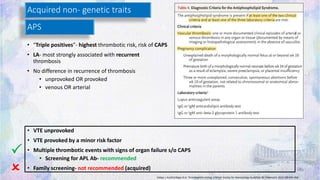
• “Triple positives”- highest thrombotic risk, risk of CAPS
• LA- most strongly associated with recurrent
thrombosis
• No difference in recurrence of thrombosis
• unprovoked OR provoked
• venous OR arterial
• VTE unprovoked
• VTE provoked by a minor risk factor
• Multiple thrombotic events with signs of organ failure s/o CAPS
• Screening for APL Ab- recommended
• Family screening- not recommended (acquired)
Deepa J. Arachchillage et al. Thrombophilia testing: A British Society for Haematology Guideline. Br J Haematol. 2022;198:443–458.
Acquired non- genetic traits
P
O
APS
Recurrence of VTE & long term anticoagulation
• FVL, PTG mutation- not associated with recurrent VTE Vs controls (Méan M et al 2017)
• AT deficiency (Ensor J et al 2016)
• Recurrent VTE: 2-4x
• PC, PS deficiency (Vossen CY et al 2005)-
• Annual risk of recurrent VTE without long-term anticoagulation
• 5.1% in PC deficiency
• 6.5% in PS deficiency
• Seems to be significant but utility is limited
• In 1st episode of VTE
• Testing not recommended (per se)- to decide duration of anticoagulation
• Testing not recommended- in 1st degree relatives
• Can be done in 1st degree relatives- specific circumstances
Deepa J. Arachchillage et al. Thrombophilia testing: A British Society for Haematology Guideline. Br J Haematol. 2022;198:443–458.
D-dimer
Heritable
thrombophilia
Long-term
anticoagulation
Low +ve O
High -ve P
• D-dimer- (Palareti et al, 2003, Boutitie et al, 2011)
• DASH score (D-dimer, Age, Sex, Hormonal therapy) (Tosetto A et al, 2012)
• Vienna prediction model (Eichinger S et al, 2010)
• HERDOO2 score (Hyperpigmentation, Edema, Redness, D-dimer, Old age, Obesity) (Rodger MA et al, 2008)
P
P
O
• Portal / Mesenteric /
Splenic / Hepatic
• 19% of SVT preceded the diagnosis
of PNH
• 15-30%- MPN
• PNH & MPN have specific treatment
Unusual site thrombosis- testing for
heritable thrombophilia ?
• Incidence <5%
• Test only if the thrombotic event
occurs in the absence of a clear risk
factor at a young age (<50 years)
• Other causes ruled out
• <1% of all strokes
• 85% have risk factors- OCP,
pregnancy
• Rare- APS, MPN, PNH, vasculitis,
infections, malignancy, trauma,
surgery
• In the absence of a clear risk factor,
they need long-term
anticoagulation & routine testing for
heritable thrombophilia is not
required
Retinal Vein Occlusion
(RVO)
Cerebral Venous Sinus Thrombosis
(CVST)
Splanchnic Vein Thrombosis
(SVT)
• No e/o association with
heritable thrombophilia
• APS is significantly associated with
APS LA & triple positive
• Hernández JL et al, 2020
• 10% APS Vs 4.5 % control
Thrombosis PVT BCS
AT 3.9% 2.3%
PC 5.6% 3.8%
PS 2.6% 3.0%
Thrombosis at
unusual site
Deepa J. Arachchillage et al. Thrombophilia testing: A British Society for Haematology Guideline. Br J Haematol. 2022;198:443–458.
Thrombosis at unusual site- unprovoked
• Abnormal CBC (cytopenia, abnormal Red Cell indices), hemolysis- test for PNH
• Abnormal CBC s/o MPN- test for MPN panel (JAK2 V617F, JAK2 exon 12, CALR, MPL mutation)
• Normal CBC with SVT or CVST- test for JAK 2 mutation
• Testing for heritable thrombophilia- recommended- if age <45yrs in absence of other common causes
• APL Ab
• RVO (Retinal Vein Occlusion)- APL Ab
P
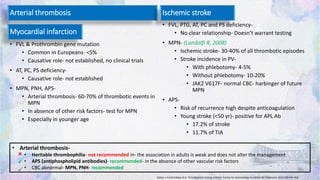
Arterial thrombosis
• FVL & Prothrombin gene mutation
• Common in Europeans- <5%
• Causative role- not established, no clinical trials
• AT, PC, PS deficiency-
• Causative role- not established
• MPN, PNH, APS-
• Arterial thrombosis- 60-70% of thrombotic events in
MPN
• In absence of other risk factors- test for MPN
• Especially in younger age
Ischemic stroke
• FVL, PTG, AT, PC and PS deficiency-
• No clear relationship- Doesn’t warrant testing
• MPN- (Landolfi R, 2008)
• Ischemic stroke- 30-40% of all thrombotic episodes
• Stroke incidence in PV-
• With phlebotomy- 4-5%
• Without phlebotomy- 10-20%
• JAK2 V617F- normal CBC- harbinger of future
MPN
• APS-
• Risk of recurrence high despite anticoagulation
• Young stroke (<50 yr)- positive for APL Ab
• 17.2% of stroke
• 11.7% of TIA
• Arterial thrombosis-
• Heritable thrombophilia- not recommended in- the association in adults is weak and does not alter the management
• APS (antiphospholipid antibodies)- recommended- in the absence of other vascular risk factors
• CBC abnormal- MPN, PNH- recommended
Myocardial infarction
O
P
P
Deepa J. Arachchillage et al. Thrombophilia testing: A British Society for Haematology Guideline. Br J Haematol. 2022;198:443–458.
Pediatric VTE
• CVAD associated VTE
• Pediatric >50% & Neonatal
>90%
Neonatal VTE
• Neonatal VTE
• >90% are CVAD related
• Rest are multifactorial
• Doesn’t warrant testing
Neonatal
purpura fulminans
• Heritable thrombophilia association-
• Severe deficiency of PC, PS
• Homozygous or combined
heterozygous deficiency of PC,
PS or AT
• Homozygous AT deficiency
• FVL or PTG mutation- low-risk
• Extensive unexplained thrombosis
• APS
• Neonates & children with purpura fulminans- test urgently for Protein C & S deficiency
• Neonatal stroke- heritable thrombophilia screening is not routinely recommended
• Children or neonate- test for heritable thrombophilia
• Extensive, unprovoked, recurrent thrombus
• Family h/o VTE- 1st degree relative
• Neonates with multiple unexplained thrombosis
• Clinical evidence s/o CAPS- test for antiphospholipid antibodies
Deepa J. Arachchillage et al. Thrombophilia testing: A British Society for Haematology Guideline. Br J Haematol. 2022;198:443–458.
P
O
P
P
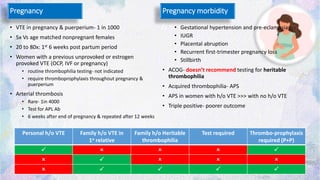
Pregnancy
• VTE in pregnancy & puerperium- 1 in 1000
• 5x Vs age matched nonpregnant females
• 20 to 80x: 1st 6 weeks post partum period
• Women with a previous unprovoked or estrogen
provoked VTE (OCP, IVF or pregnancy)
• routine thrombophilia testing- not indicated
• require thromboprophylaxis throughout pregnancy &
puerperium
• Arterial thrombosis
• Rare- 1in 4000
• Test for APL Ab
• 6 weeks after end of pregnancy & repeated after 12 weeks
Pregnancy morbidity
• Gestational hypertension and pre-eclampsia
• IUGR
• Placental abruption
• Recurrent first-trimester pregnancy loss
• Stillbirth
• ACOG- doesn’t recommend testing for heritable
thrombophilia
• Acquired thrombophilia- APS
• APS in women with h/o VTE >>> with no h/o VTE
• Triple positive- poorer outcome
Personal h/o VTE Family h/o VTE in
1o relative
Family h/o Heritable
thrombophilia
Test required Thrombo-prophylaxis
required (P+P)
P O O O P
O P O O O
O P P P P
• Pregnancy-
• Testing for AT deficiency- may be considered in pregnant women with a known family history of this deficiency
or evidence of heparin resistance.
• In women with a history of unprovoked VTE- testing for APL Ab should be performed outside pregnancy
• Recurrent pregnancy loss
• Testing for heritable thrombophilia- not recommended
• Testing for APS- should be done- avoid during pregnancy
P
P
Back to the cases
Case 1 Case 2 Case 3
• 26 yr female
• on estrogen based OCP
• new onset left lower limb DVT
• No prior/family history of clots
• No h/o surgery
• No long-distance car travel
• Her sister is planning for pregnancy
• 19 yr female
• College student
• new onset unprovoked left
lower limb DVT
• No prior history of clots
• No surgery
• No long-distance car travel
• Mother had DVT in her 30’s
• Uncle had DVT in his 40’s
• 65 yr old man
• Pain abdomen  Portal vein
thrombosis
• No CLD, Splenomegaly- 2cm
• Hb-13, TLC- 8000, Plt- 6.5L
• Past h/o- migraine- 1yr, burning of
fingers- 1 yr
To test
• BM aspiration & biopsy
• MPN mutation panel
• JAK2 exon 14 & 12, CALR, MPL
To test
• After 3 months of anticoagulation
• 2 weeks of stopping drugs
• Mutation of FVL, PTG
• Deficiency of PC, PS, AT
To test/ ?may not test  indefinite
• After 3 months of anticoagulation
• 2 weeks of stopping drugs
• Mutation of FVL, PTG
• Deficiency of PC, PS, AT
Summary
• Provoking factor- strong, weak, unprovoked
• Family h/o- 1st degree, young age <50, h/o HT
• Site- venous, artery, unusual site
• CBC
Case 2
Case 1 Case 3
Jean M. Connors. Thrombophilia Testing and Venous Thrombosis. N Engl J Med 2017;377:1177-87
Thank You

Thrombophilia testing.pptx

  • 1.
    TOPIC : Thrombophiliatesting- when and what to do? SPEAKER : Dr. Pritish Chandra Patra
  • 2.
    Hypercoagulable states • Whoshould be tested ? • When to test ? • Why test ? • What to test ? • How to treat ? • How long to treat ?
  • 3.
    Circulatory stasis Virchow’s triad •Immobility • Central lines • PICC lines • Inherited • Factor V Leiden (FVL) mutation (F5 G1691A) • Prothrombin gene mutation (F2 G20210A) • Protein C (PC) deficiency • Protein S (PS) deficiency • Antithrombin (AT) deficiency • Rare- elevated F VIII, dysfibrinogenemia • Acquired • Antiphospholipid syndrome (APS) • Paroxysmal nocturnal hemoglobinuria (PNH) • Myeloproliferative neoplasms (MPN) • JAK2 mutation in the absence of an MPN phenotype • Malignancy • Drugs- OCP, chemotherapy • Pregnancy • Trauma, Surgery Virchow’s triad
  • 4.
    Interactions of multiplefactors • Pregnancy • Puerperium • Cancer • Inflammatory conditions • Obesity
  • 5.
    Case 1 • 26yr female • on estrogen based OCP • presents with • new onset left lower limb DVT • No prior history of clots • No family history of clots • No surgery • No long-distance car travel • 19 yr female • College student • presents with • new onset unprovoked left lower limb DVT • No prior history of clots • No surgery • No long-distance car travel • Mother had DVT in her 30’s • Uncle had DVT in his 40’s Case 2 • 65 yr old man • Pain abdomen  Portal vein thrombosis • Hb-13, TLC- 8000, Plt- 6.5L • Past h/o- migraine- 1yr, burning of fingers- 1 yr Case 3
  • 6.
    Prevalence of inheritedthrombophilia Name Prevalence (%) Factor V Leiden 12-40 Prothrombin gene mutation 6-18 Deficiency of AT, Prot- C, Prot- S 5-15 Risk of thrombosis Risk factor Relative risk General population 1 Factor V Leiden- Heterozygous 5 Prothrombin gene- Heterozygous 5 Protein C 10 Protein S 10 AT 15-20 Factor V Leiden- Homozygous 60-80 OCP 4-5 Hetero FVL + OCP 30-35 Pregnancy & Post Partum 5-10 Croles FN et al. Risk of venous thrombosis in antithrombin deficiency: systematic review and bayesian meta-analysis. Semin Thromb Hemost. 2018;44(4):315–26. Gindele R et al. Clinical and laboratory characteristics of antithrombin deficiencies: a large cohort study from a single diagnostic center. Thromb Res. 2017;160:119–28.
  • 7.
    Excess procoagulant • ?increase the risk of thrombosis • A meta-analysis of 12 GWAS for VTE (Arachchillage et al, 2019) • linked to thrombosis • Variants in F2, F5, F11, and FGG (fibrinogen gamma chain) • Elevation of VWF and FVIII • Relevance in routine clinical practice- not clear • MEGA case-control study of VTE (Rietveld et al, 2019) • FVIII: Odds Ratio- 16.0 (CI: 9.7–26.3) • Interaction of heritable and acquired influences on FVIII activity • Variability in levels over time • ? Role in management- in thrombosis or asymptomatic family members Routine testing of coagulation factors to assess the risk of thrombosis- not recommended Deepa J. Arachchillage et al. Thrombophilia testing: A British Society for Haematology Guideline. Br J Haematol. 2022;198:443–458. O
  • 8.
    Deficiency of naturalanticoagulants • AT deficiency: 15 x risk • Heterozygous PC or PS deficiency: 5-7 x risk • PC, PS deficiency >> Risk of thrombus >> FVL, PTG mutation • PC, PS deficiency << Prevalence << FVL, PTG mutation • Testing: Plasma activity >> molecular testing • Multiple different genetic variants • Acquired causes of deficiencies should always be considered • Test only if it will impact clinical management • Test if • VTE at <50 years of age • spontaneous or weak provoking factors • 1st degree relative at young age • Test for deficiencies of physiological anticoagulants- only after 3 months of anticoagulation for acute thrombosis Deepa J. Arachchillage et al. Thrombophilia testing: A British Society for Haematology Guideline. Br J Haematol. 2022;198:443–458. P • Warfarin • Vit K deficiency • CLD • DIC • Heparin • Etc…
  • 9.
    Jean M. Connors.Thrombophilia Testing and Venous Thrombosis. N Engl J Med 2017;377:1177-87
  • 10.
    Factor V Leiden,Prothrombin gene mutation • Most tested genetic variants predisposing to VTE • FVL mutation • Present in about 5% of Europeans • Rare elsewhere • Prothrombin gene mutation • Present in 1%-2% of Europeans • Rare or absent in other ethnic populations • Result in increased risks for 1st VTE: 3-5x (Saemundsson Y et al, 2013) Genetic testing to predict a first episode of venous thrombosis- not recommended Deepa J. Arachchillage et al. Thrombophilia testing: A British Society for Haematology Guideline. Br J Haematol. 2022;198:443–458. O
  • 11.
    Acquired genetic traits •Incidence of thrombosis- 10% (Kelly RJ et al, 2015) • Neutrophil clone size correlates best with thrombosis risk • Cumulative 10-year incidence of thrombosis • Clone size >50%- 34.5% • Clone size <50%- 5.3% • PV, ET, PMF (15-30% incidence) (Landolfi R, 2008) • 2/3rd arterial & 1/3rd venous • Thrombosis often precedes disease recognition • JAK2 mutation may precede frank MPN • JAK2 mutation with normal CBC • Thromboses in PNH and MPN- can occur anywhere in the venous or arterial systems • Usually in unusual sites- • Splanchnic Vein Thrombosis (SVT)- portal vein (PVT), mesenteric vein (MVT), splenic vein & hepatic vein/ Budd–Chiari syndrome (BCS) • Cerebral Venous Sinus thrombosis (CVST) • Thrombosis at unusual site- • Abnormal CBC (cytopenia, abnormal Red Cell indices), hemolysis- test for PNH • Abnormal CBC s/o MPN- test for MPN panel (JAK2 V617F, JAK2 exon 12, CALR, MPL mutation) • Normal CBC with SVT or CVST- test for JAK 2 mutation Deepa J. Arachchillage et al. Thrombophilia testing: A British Society for Haematology Guideline. Br J Haematol. 2022;198:443–458. MPN PNH P P P
  • 12.
    • “Triple positives”-highest thrombotic risk, risk of CAPS • LA- most strongly associated with recurrent thrombosis • No difference in recurrence of thrombosis • unprovoked OR provoked • venous OR arterial • VTE unprovoked • VTE provoked by a minor risk factor • Multiple thrombotic events with signs of organ failure s/o CAPS • Screening for APL Ab- recommended • Family screening- not recommended (acquired) Deepa J. Arachchillage et al. Thrombophilia testing: A British Society for Haematology Guideline. Br J Haematol. 2022;198:443–458. Acquired non- genetic traits P O APS
  • 13.
    Recurrence of VTE& long term anticoagulation • FVL, PTG mutation- not associated with recurrent VTE Vs controls (Méan M et al 2017) • AT deficiency (Ensor J et al 2016) • Recurrent VTE: 2-4x • PC, PS deficiency (Vossen CY et al 2005)- • Annual risk of recurrent VTE without long-term anticoagulation • 5.1% in PC deficiency • 6.5% in PS deficiency • Seems to be significant but utility is limited • In 1st episode of VTE • Testing not recommended (per se)- to decide duration of anticoagulation • Testing not recommended- in 1st degree relatives • Can be done in 1st degree relatives- specific circumstances Deepa J. Arachchillage et al. Thrombophilia testing: A British Society for Haematology Guideline. Br J Haematol. 2022;198:443–458. D-dimer Heritable thrombophilia Long-term anticoagulation Low +ve O High -ve P • D-dimer- (Palareti et al, 2003, Boutitie et al, 2011) • DASH score (D-dimer, Age, Sex, Hormonal therapy) (Tosetto A et al, 2012) • Vienna prediction model (Eichinger S et al, 2010) • HERDOO2 score (Hyperpigmentation, Edema, Redness, D-dimer, Old age, Obesity) (Rodger MA et al, 2008) P P O
  • 14.
    • Portal /Mesenteric / Splenic / Hepatic • 19% of SVT preceded the diagnosis of PNH • 15-30%- MPN • PNH & MPN have specific treatment Unusual site thrombosis- testing for heritable thrombophilia ? • Incidence <5% • Test only if the thrombotic event occurs in the absence of a clear risk factor at a young age (<50 years) • Other causes ruled out • <1% of all strokes • 85% have risk factors- OCP, pregnancy • Rare- APS, MPN, PNH, vasculitis, infections, malignancy, trauma, surgery • In the absence of a clear risk factor, they need long-term anticoagulation & routine testing for heritable thrombophilia is not required Retinal Vein Occlusion (RVO) Cerebral Venous Sinus Thrombosis (CVST) Splanchnic Vein Thrombosis (SVT) • No e/o association with heritable thrombophilia • APS is significantly associated with APS LA & triple positive • Hernández JL et al, 2020 • 10% APS Vs 4.5 % control Thrombosis PVT BCS AT 3.9% 2.3% PC 5.6% 3.8% PS 2.6% 3.0% Thrombosis at unusual site Deepa J. Arachchillage et al. Thrombophilia testing: A British Society for Haematology Guideline. Br J Haematol. 2022;198:443–458.
  • 15.
    Thrombosis at unusualsite- unprovoked • Abnormal CBC (cytopenia, abnormal Red Cell indices), hemolysis- test for PNH • Abnormal CBC s/o MPN- test for MPN panel (JAK2 V617F, JAK2 exon 12, CALR, MPL mutation) • Normal CBC with SVT or CVST- test for JAK 2 mutation • Testing for heritable thrombophilia- recommended- if age <45yrs in absence of other common causes • APL Ab • RVO (Retinal Vein Occlusion)- APL Ab P
  • 16.
    Arterial thrombosis • FVL& Prothrombin gene mutation • Common in Europeans- <5% • Causative role- not established, no clinical trials • AT, PC, PS deficiency- • Causative role- not established • MPN, PNH, APS- • Arterial thrombosis- 60-70% of thrombotic events in MPN • In absence of other risk factors- test for MPN • Especially in younger age Ischemic stroke • FVL, PTG, AT, PC and PS deficiency- • No clear relationship- Doesn’t warrant testing • MPN- (Landolfi R, 2008) • Ischemic stroke- 30-40% of all thrombotic episodes • Stroke incidence in PV- • With phlebotomy- 4-5% • Without phlebotomy- 10-20% • JAK2 V617F- normal CBC- harbinger of future MPN • APS- • Risk of recurrence high despite anticoagulation • Young stroke (<50 yr)- positive for APL Ab • 17.2% of stroke • 11.7% of TIA • Arterial thrombosis- • Heritable thrombophilia- not recommended in- the association in adults is weak and does not alter the management • APS (antiphospholipid antibodies)- recommended- in the absence of other vascular risk factors • CBC abnormal- MPN, PNH- recommended Myocardial infarction O P P Deepa J. Arachchillage et al. Thrombophilia testing: A British Society for Haematology Guideline. Br J Haematol. 2022;198:443–458.
  • 17.
    Pediatric VTE • CVADassociated VTE • Pediatric >50% & Neonatal >90% Neonatal VTE • Neonatal VTE • >90% are CVAD related • Rest are multifactorial • Doesn’t warrant testing Neonatal purpura fulminans • Heritable thrombophilia association- • Severe deficiency of PC, PS • Homozygous or combined heterozygous deficiency of PC, PS or AT • Homozygous AT deficiency • FVL or PTG mutation- low-risk • Extensive unexplained thrombosis • APS • Neonates & children with purpura fulminans- test urgently for Protein C & S deficiency • Neonatal stroke- heritable thrombophilia screening is not routinely recommended • Children or neonate- test for heritable thrombophilia • Extensive, unprovoked, recurrent thrombus • Family h/o VTE- 1st degree relative • Neonates with multiple unexplained thrombosis • Clinical evidence s/o CAPS- test for antiphospholipid antibodies Deepa J. Arachchillage et al. Thrombophilia testing: A British Society for Haematology Guideline. Br J Haematol. 2022;198:443–458. P O P P
  • 18.
    Pregnancy • VTE inpregnancy & puerperium- 1 in 1000 • 5x Vs age matched nonpregnant females • 20 to 80x: 1st 6 weeks post partum period • Women with a previous unprovoked or estrogen provoked VTE (OCP, IVF or pregnancy) • routine thrombophilia testing- not indicated • require thromboprophylaxis throughout pregnancy & puerperium • Arterial thrombosis • Rare- 1in 4000 • Test for APL Ab • 6 weeks after end of pregnancy & repeated after 12 weeks Pregnancy morbidity • Gestational hypertension and pre-eclampsia • IUGR • Placental abruption • Recurrent first-trimester pregnancy loss • Stillbirth • ACOG- doesn’t recommend testing for heritable thrombophilia • Acquired thrombophilia- APS • APS in women with h/o VTE >>> with no h/o VTE • Triple positive- poorer outcome Personal h/o VTE Family h/o VTE in 1o relative Family h/o Heritable thrombophilia Test required Thrombo-prophylaxis required (P+P) P O O O P O P O O O O P P P P
  • 19.
    • Pregnancy- • Testingfor AT deficiency- may be considered in pregnant women with a known family history of this deficiency or evidence of heparin resistance. • In women with a history of unprovoked VTE- testing for APL Ab should be performed outside pregnancy • Recurrent pregnancy loss • Testing for heritable thrombophilia- not recommended • Testing for APS- should be done- avoid during pregnancy P P
  • 20.
    Back to thecases Case 1 Case 2 Case 3 • 26 yr female • on estrogen based OCP • new onset left lower limb DVT • No prior/family history of clots • No h/o surgery • No long-distance car travel • Her sister is planning for pregnancy • 19 yr female • College student • new onset unprovoked left lower limb DVT • No prior history of clots • No surgery • No long-distance car travel • Mother had DVT in her 30’s • Uncle had DVT in his 40’s • 65 yr old man • Pain abdomen  Portal vein thrombosis • No CLD, Splenomegaly- 2cm • Hb-13, TLC- 8000, Plt- 6.5L • Past h/o- migraine- 1yr, burning of fingers- 1 yr To test • BM aspiration & biopsy • MPN mutation panel • JAK2 exon 14 & 12, CALR, MPL To test • After 3 months of anticoagulation • 2 weeks of stopping drugs • Mutation of FVL, PTG • Deficiency of PC, PS, AT To test/ ?may not test  indefinite • After 3 months of anticoagulation • 2 weeks of stopping drugs • Mutation of FVL, PTG • Deficiency of PC, PS, AT
  • 21.
    Summary • Provoking factor-strong, weak, unprovoked • Family h/o- 1st degree, young age <50, h/o HT • Site- venous, artery, unusual site • CBC Case 2 Case 1 Case 3 Jean M. Connors. Thrombophilia Testing and Venous Thrombosis. N Engl J Med 2017;377:1177-87
  • 22.