MALIGNANCY
ASSOCIATED ANEMIA
Dr Pritish Chandra Patra
Associate Professor
Department of Clinical Hematology
IMS & SUM Hospital, Bhubaneswar
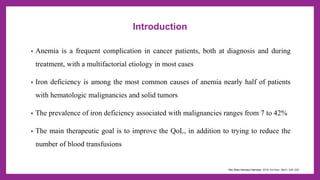
Introduction
• Anemia is a frequent complication in cancer patients, both at diagnosis and during
treatment, with a multifactorial etiology in most cases
• Iron deficiency is among the most common causes of anemia nearly half of patients
with hematologic malignancies and solid tumors
• The prevalence of iron deficiency associated with malignancies ranges from 7 to 42%
• The main therapeutic goal is to improve the QoL, in addition to trying to reduce the
number of blood transfusions
Rev Bras Hematol Hemoter. 2016 Oct-Dec; 38(4): 325–330.
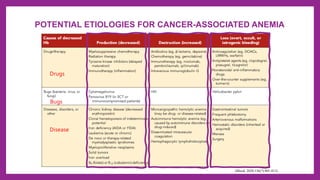
POTENTIAL ETIOLOGIES FOR CANCER-ASSOCIATED ANEMIA
(Blood. 2020;136(7):801-813)
Drugs
Bugs
Disease
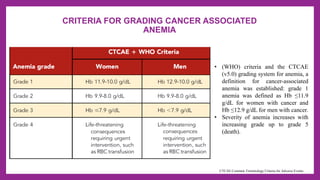
CRITERIA FOR GRADING CANCER ASSOCIATED
ANEMIA
• (WHO) criteria and the CTCAE
(v5.0) grading system for anemia, a
definition for cancer-associated
anemia was established: grade 1
anemia was defined as Hb ≤11.9
g/dL for women with cancer and
Hb ≤12.9 g/dL for men with cancer.
• Severity of anemia increases with
increasing grade up to grade 5
(death).
CTCAE Common Terminology Criteria for Adverse Events
DIAGNOSIS OF CANCER-ASSOCIATED ANEMIA
• Definition: We define anemia as cancer-associated anemia when it results from
malignancy or its treatment
• The most widely available and frequently used tests to assess iron status are
• Serum Ferritin & Transferrin Saturation (TSAT %)
• TSAT%= [ Serum iron / TIBC (Total iron binding capacity)] x 100
• Ferritin- acute phase reactant- may be falsely elevated in cancers
• Ferritin is a biomarker of total body iron stores, and low ferritin is a reliable indicator of
absolute iron deficiency
(Blood. 2020;136(7):801-813)
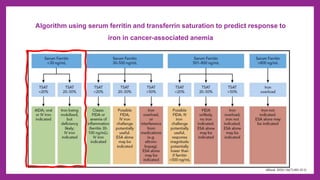
Algorithm using serum ferritin and transferrin saturation to predict response to
iron in cancer-associated anemia
(Blood. 2020;136(7):801-813)
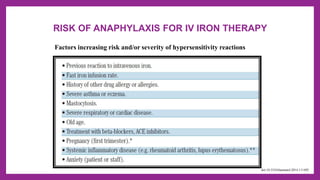
RISK OF ANAPHYLAXIS FOR IV IRON THERAPY
Factors increasing risk and/or severity of hypersensitivity reactions
doi:10.3324/haematol.2014.111492
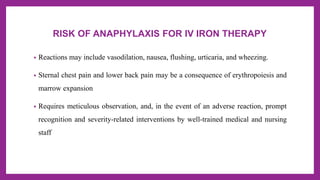
RISK OF ANAPHYLAXIS FOR IV IRON THERAPY
• Reactions may include vasodilation, nausea, flushing, urticaria, and wheezing.
• Sternal chest pain and lower back pain may be a consequence of erythropoiesis and
marrow expansion
• Requires meticulous observation, and, in the event of an adverse reaction, prompt
recognition and severity-related interventions by well-trained medical and nursing
staff
HYPERSENSITIVITY REACTIONS RISK
MINIMIZATION AND MANAGEMENT
• Hypersensitivity reactions may occur in anyone given IV iron, and it is essential that every
effort is made to prevent these being poorly managed if they occur, whether due to
inadequate facilities or staff being undertrained
• The following factors require attention before and during any IV iron infusion.
• Location
• Personnel
• Patient
• Administration of intravenous iron
ALGORITHM
OUTLINING
GRADING AND
MANAGEMENT OF
ACUTE
HYPERSENSITIVITY
REACTIONSTO
INTRAVENOUS
IRON INFUSIONS
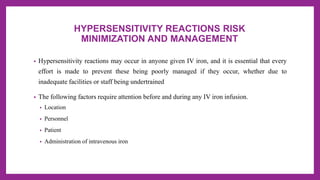
PATIENT MONITORED AFTER IV IRON THERAPY
• Monitor monthly
• CBC
• Iron studies (Ferritin, TSAT%)
• Phosphate levels (if FCM is used): hypophosphatemia typically resolves within 3-6 wks
• Repeat IV iron treatment if
• AIDA returns
• Ferritin plateaus and declines to <100 ng/mL
• TSAT remains <20%
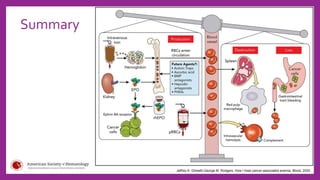
Summary
Jeffrey A. Gilreath,George M. Rodgers, How I treat cancer-associated anemia, Blood, 2020
Conclusion
• Cancer-associated anemia leads to poor quality of life in patients with cancer
• Possible mechanisms of cancer-associated anemia are decreased erythropoiesis,
increased destruction, and blood loss
• Strategy should be first identifying all contributing causes before treatment is
considered
• Severe adverse events due to IV iron administration are exceedingly rare but should
not be ignored
Malignancy Associtaed Anemia.pptx

Malignancy Associtaed Anemia.pptx

  • 1.
    MALIGNANCY ASSOCIATED ANEMIA Dr PritishChandra Patra Associate Professor Department of Clinical Hematology IMS & SUM Hospital, Bhubaneswar
  • 2.
    Introduction • Anemia isa frequent complication in cancer patients, both at diagnosis and during treatment, with a multifactorial etiology in most cases • Iron deficiency is among the most common causes of anemia nearly half of patients with hematologic malignancies and solid tumors • The prevalence of iron deficiency associated with malignancies ranges from 7 to 42% • The main therapeutic goal is to improve the QoL, in addition to trying to reduce the number of blood transfusions Rev Bras Hematol Hemoter. 2016 Oct-Dec; 38(4): 325–330.
  • 3.
    POTENTIAL ETIOLOGIES FORCANCER-ASSOCIATED ANEMIA (Blood. 2020;136(7):801-813) Drugs Bugs Disease
  • 4.
    CRITERIA FOR GRADINGCANCER ASSOCIATED ANEMIA • (WHO) criteria and the CTCAE (v5.0) grading system for anemia, a definition for cancer-associated anemia was established: grade 1 anemia was defined as Hb ≤11.9 g/dL for women with cancer and Hb ≤12.9 g/dL for men with cancer. • Severity of anemia increases with increasing grade up to grade 5 (death). CTCAE Common Terminology Criteria for Adverse Events
  • 5.
    DIAGNOSIS OF CANCER-ASSOCIATEDANEMIA • Definition: We define anemia as cancer-associated anemia when it results from malignancy or its treatment • The most widely available and frequently used tests to assess iron status are • Serum Ferritin & Transferrin Saturation (TSAT %) • TSAT%= [ Serum iron / TIBC (Total iron binding capacity)] x 100 • Ferritin- acute phase reactant- may be falsely elevated in cancers • Ferritin is a biomarker of total body iron stores, and low ferritin is a reliable indicator of absolute iron deficiency (Blood. 2020;136(7):801-813)
  • 6.
    Algorithm using serumferritin and transferrin saturation to predict response to iron in cancer-associated anemia (Blood. 2020;136(7):801-813)
  • 7.
    RISK OF ANAPHYLAXISFOR IV IRON THERAPY Factors increasing risk and/or severity of hypersensitivity reactions doi:10.3324/haematol.2014.111492
  • 8.
    RISK OF ANAPHYLAXISFOR IV IRON THERAPY • Reactions may include vasodilation, nausea, flushing, urticaria, and wheezing. • Sternal chest pain and lower back pain may be a consequence of erythropoiesis and marrow expansion • Requires meticulous observation, and, in the event of an adverse reaction, prompt recognition and severity-related interventions by well-trained medical and nursing staff
  • 9.
    HYPERSENSITIVITY REACTIONS RISK MINIMIZATIONAND MANAGEMENT • Hypersensitivity reactions may occur in anyone given IV iron, and it is essential that every effort is made to prevent these being poorly managed if they occur, whether due to inadequate facilities or staff being undertrained • The following factors require attention before and during any IV iron infusion. • Location • Personnel • Patient • Administration of intravenous iron
  • 10.
  • 11.
    PATIENT MONITORED AFTERIV IRON THERAPY • Monitor monthly • CBC • Iron studies (Ferritin, TSAT%) • Phosphate levels (if FCM is used): hypophosphatemia typically resolves within 3-6 wks • Repeat IV iron treatment if • AIDA returns • Ferritin plateaus and declines to <100 ng/mL • TSAT remains <20%
  • 12.
    Summary Jeffrey A. Gilreath,GeorgeM. Rodgers, How I treat cancer-associated anemia, Blood, 2020
  • 13.
    Conclusion • Cancer-associated anemialeads to poor quality of life in patients with cancer • Possible mechanisms of cancer-associated anemia are decreased erythropoiesis, increased destruction, and blood loss • Strategy should be first identifying all contributing causes before treatment is considered • Severe adverse events due to IV iron administration are exceedingly rare but should not be ignored

Editor's Notes

  • #7 Algorithm using serum ferritin and transferrin saturation to predict response to iron in cancer-associated anemia. Green boxes indicate benefits of IV iron therapy. Yellow boxes indicate that an iron trial may be beneficial. Red boxes indicate that iron should not be given. Patients with TSAT ,20% and inflammation elevating the serum ferritin (up to 100 ng/mL) will likely respond in a manner similar to that of classic AIDA; patients with ferritin.100 ng/mL may exhibit slightly lower Hb responses.