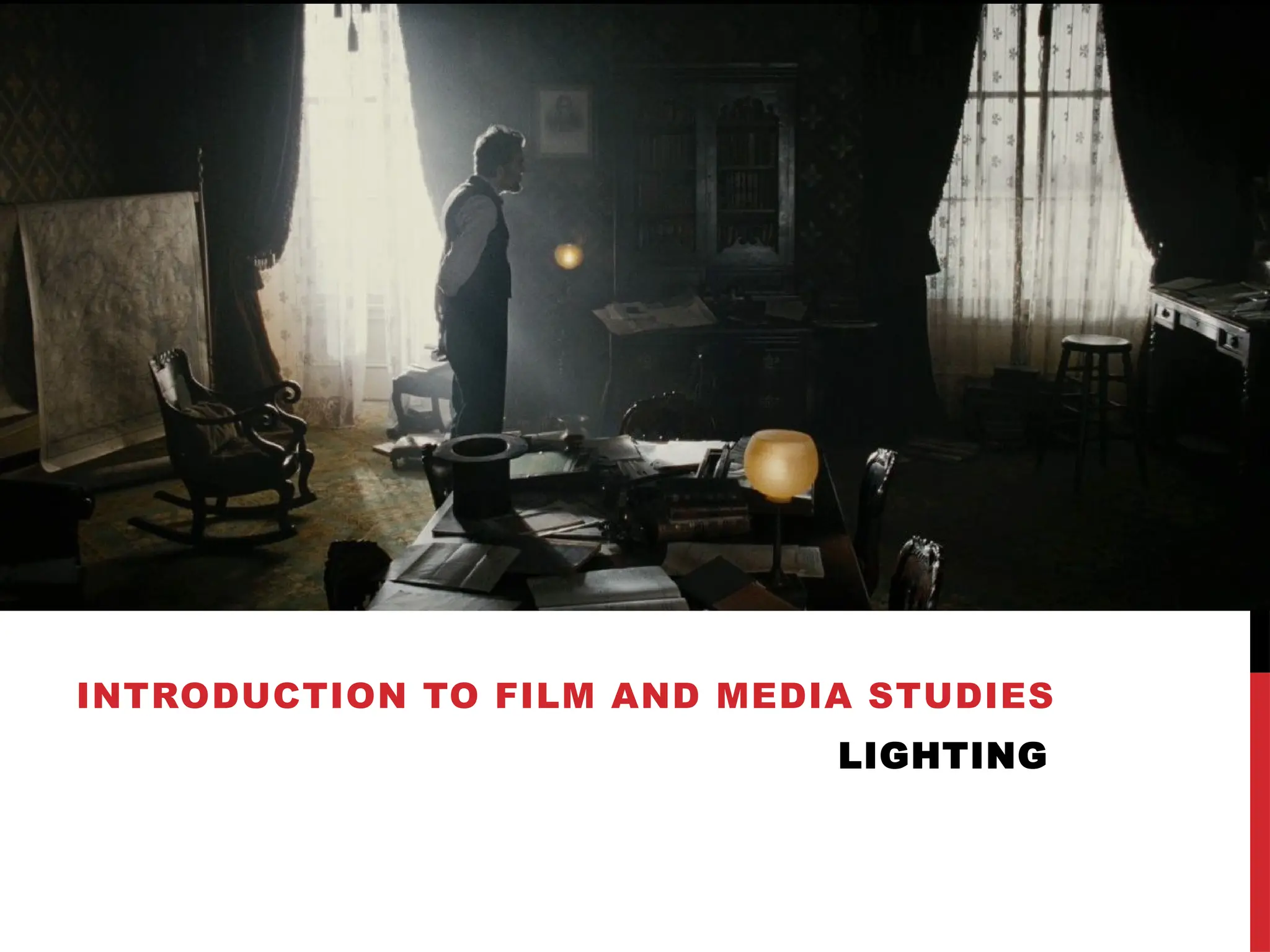
Introductory film studiesis less concerned with the technical
aspects of film lighting than the expressive results of
creative lighting. Your goal at this point is to begin to
appreciate the way in which the effect of lighting choices
bears meaning.
When considering lighting, we need to identify HOW the
director is creating the effect and then analyze that effect’s
meaning. To do so, you need some BASIC background on
the techniques of lighting.
3.
THREE-POINT
LIGHTING
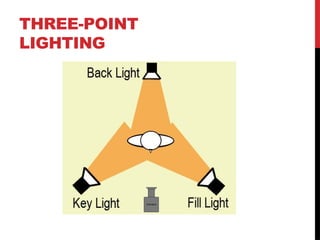
This is themost basic lighting setup. It consists of a KEY
LIGHT, a FILL LIGHT, and a BACKLIGHT. The KEY LIGHT
aims directly at the subject –most likely the main character
or object in the shot – and is the brightest light source for the
shot. The FILL LIGHT is a softer light, and is usually placed
opposite the key light; the fill light cuts down on shadows
created by the bright key light. The BACKLIGHT shines
behind the subject or object, separating him, her, or it from
the background –in other words, enhancing the sense of
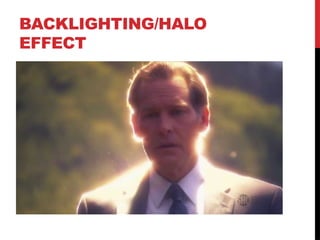
depth in the shot. BACKLIGHTING sometimes creates a halo
effect around a character’s head, particularly at the edge of
the hair.
FILL LIGHT
In television,film, stage, or photographic lighting, a FILL LIGHT
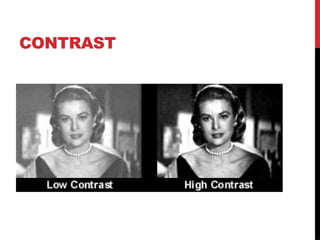
(often simply called a FILL) may be used to reduce the contrast
of a scene to match the dynamic range of the recording media
and record the same amount of detail typically seen by eye in
average lighting and considered normal. From that baseline of
normality using more or less FILL will make shadows seem
lighter or darker than normal, which will cause the viewer to
react differently, by inferring both environmental and mood clues
from the tone of the shadows. Basically, a FILL is a light used to
eliminate or soften shadows caused by the main source of
illumination.
The positioning of the FILL affects the overall appearance of the
lighting pattern.
6.
KEY LIGHT
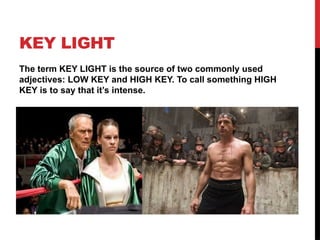
The termKEY LIGHT is the source of two commonly used
adjectives: LOW KEY and HIGH KEY. To call something HIGH
KEY is to say that it’s intense.
7.
HIGH-KEY LIGHTING
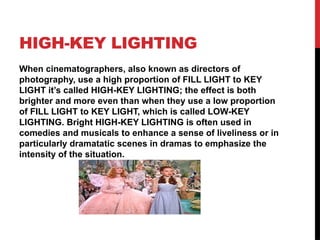
When cinematographers,also known as directors of
photography, use a high proportion of FILL LIGHT to KEY
LIGHT it’s called HIGH-KEY LIGHTING; the effect is both
brighter and more even than when they use a low proportion
of FILL LIGHT to KEY LIGHT, which is called LOW-KEY
LIGHTING. Bright HIGH-KEY LIGHTING is often used in
comedies and musicals to enhance a sense of liveliness or in
particularly dramatatic scenes in dramas to emphasize the
intensity of the situation.
8.
LOW-KEY LIGHTING
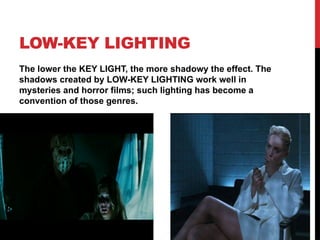
The lowerthe KEY LIGHT, the more shadowy the effect. The
shadows created by LOW-KEY LIGHTING work well in
mysteries and horror films; such lighting has become a
convention of those genres.
9.
HIGH AND LOWKEY
COMBINATION
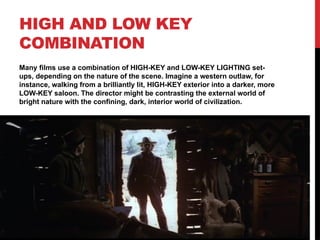
Many films use a combination of HIGH-KEY and LOW-KEY LIGHTING set-
ups, depending on the nature of the scene. Imagine a western outlaw, for
instance, walking from a brilliantly lit, HIGH-KEY exterior into a darker, more
LOW-KEY saloon. The director might be contrasting the external world of
bright nature with the confining, dark, interior world of civilization.
10.
BACKLIGHTING
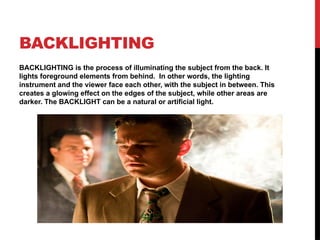
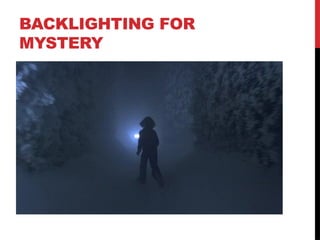
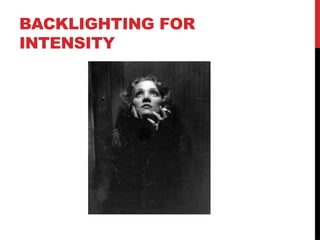
BACKLIGHTING is theprocess of illuminating the subject from the back. It
lights foreground elements from behind. In other words, the lighting
instrument and the viewer face each other, with the subject in between. This
creates a glowing effect on the edges of the subject, while other areas are
darker. The BACKLIGHT can be a natural or artificial light.
BACKGROUND LIGHT
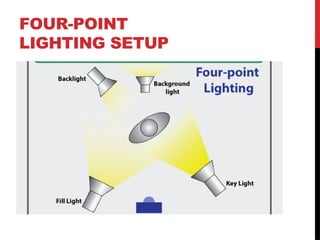
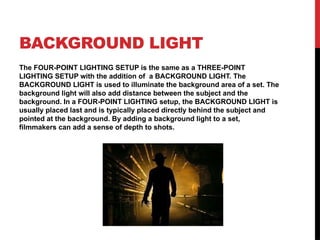
The FOUR-POINTLIGHTING SETUP is the same as a THREE-POINT
LIGHTING SETUP with the addition of a BACKGROUND LIGHT. The
BACKGROUND LIGHT is used to illuminate the background area of a set. The
background light will also add distance between the subject and the
background. In a FOUR-POINT LIGHTING setup, the BACKGROUND LIGHT is
usually placed last and is typically placed directly behind the subject and
pointed at the background. By adding a background light to a set,
filmmakers can add a sense of depth to shots.
16.
TOP LIGHTING
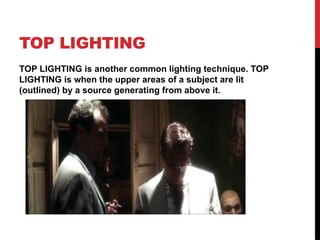
TOP LIGHTINGis another common lighting technique. TOP
LIGHTING is when the upper areas of a subject are lit
(outlined) by a source generating from above it.
17.
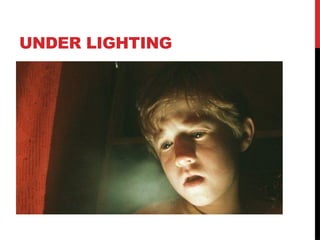
UNDER LIGHTING
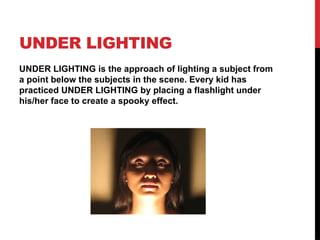
UNDER LIGHTINGis the approach of lighting a subject from
a point below the subjects in the scene. Every kid has
practiced UNDER LIGHTING by placing a flashlight under
his/her face to create a spooky effect.
DISCUSSING
LIGHTING
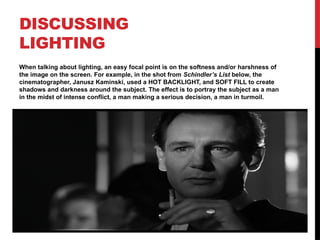
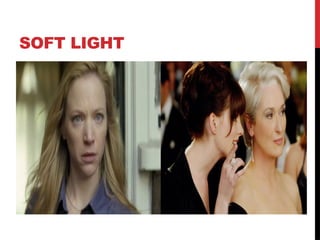
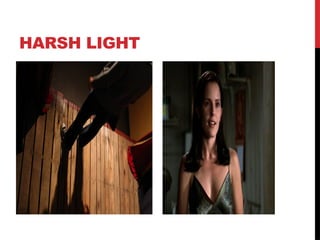
When talking aboutlighting, an easy focal point is on the softness and/or harshness of
the image on the screen. For example, in the shot from Schindler’s List below, the
cinematographer, Janusz Kaminski, used a HOT BACKLIGHT, and SOFT FILL to create
shadows and darkness around the subject. The effect is to portray the subject as a man
in the midst of intense conflict, a man making a serious decision, a man in turmoil.
DISCUSSING
LIGHTING
When commenting onthe lighting in a film, here are a few
questions to consider:
How sharp is the shadow?
What is the angle of the light?
What is the distance of the light? How does it add depth?
How bright is the light?
What color is the light?
How many lights are there and how do they contrast?
Is there soft or harsh lighting overall?
How/Where does the lighting change?
24.
SOURCE MATERIAL
Sikov, Ed.Film Studies, An Introduction. Columbia University
Press. New York. 2010. Print