T H O U G H T S O N
S TA R T U P S
Peter Wang
Physics ’99
CTO, Co-Founder
Continuum Analytics
H O W I G O T H E R E ( B R I E F LY )
S TA R T I N G C O N T I N U U M
F O X & H E D G E H O G
• “Knowing many things” vs “Know one thing”
• Imagine an physics student circa 2016 goes back in
time to 1200 AD.  She is going to be amazing across a
number of different things: architecture, weapons
engineering, calendar and timekeeping, etc.
• Does she know many things, or just a few things?
If you know just a few deep things, and you
know how to apply them to real world scenarios,
then you are done.
A F E W T H I N G S
C R E D I T & R I S K
• Don’t think in terms of money or currency.  That’s like only
reasoning about frictionless pulleys and massless ropes and
perfectly round billiard balls.
• In the real world, the major dynamics are overwhelmingly
governed by the forces of risk.  
• *After* those dynamics shake out, then tactical and operational
concerns involve money and movement of currency.
• Convexity & human risk aversion
• https://en.wikipedia.org/wiki/Risk_aversion
• Framing is very important!!
B E I N G S M A R T, G E T T I N G S M A R T E R
• In school, we are encouraged to do our best, we are
graded on a curve and compared to each other
• In the real world, there are a zillion different grading
systems. And we tend to value what we’re good at.
• For most of us, that’s “being smart”
• Always be learning, and never apologize for being
smart.
• BUT: strongly avoid being the smartest person in the
room.
B E E X C I T E D T O L E A R N
• Optimize your own intelligence AND your ego and self-validation
loop so that you can stand to be in a room of much, much smarter
people and be legitimately excited about all that you might learn
from them.
• That kind of openness, if genuine, is incredibly attractive to other
smart people who are legit.
• The poseurs and the insecure people - the ones who are going to
bring a lot of ego and a lot of static - actually tend to filter out.
 They intuitively feel threatened by it.
• Openness is not vulnerability! Openness is an invitation to engage.
G E T T I N G Y E L L E D AT
VA L I D AT I O N & S O C I A L C U R R E N C Y
• Downweight the social component in your self-
validation
• Social validation is scarce by design!
• Our primate/mammalian brainstems crave hierarchy
and social status signaling
• necessary evil when searching for mates and
acquiring social power
• a rabbit hole and a distraction if you want to build
something great or do something truly creative
L E A D E R S H I P
Some of you may be leaders.
But all of you must lead purposeful lives.
If you want to build a ship, don't drum up the men to
gather wood, divide the work and give orders. Instead,
teach them to yearn for the vast and endless sea.

-- Antoine de St. Exupery
S TA R T W I T H W H Y
• Don’t mistake How or What for Why
• Much, much easier to write business books on How.
• But the most important question for an entrepreneur is:
Why?
T H E O N E T H I N G
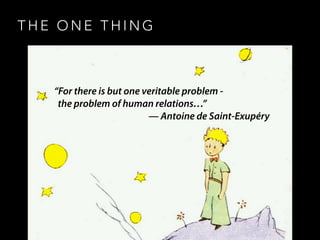
“For there is but one veritable problem -
the problem of human relations…”

— Antoine de Saint-Exupéry
U N D E R S TA N D I N G P E O P L E
• Understand yourself.
• Understand others.
• Understand interactions.
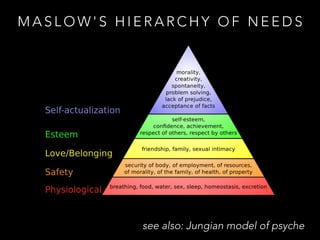
U N D E R S TA N D I N G Y O U R S E L F
see also: Jungian model of psyche
M A S L O W ' S H I E R A R C H Y O F N E E D S
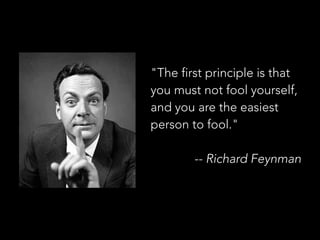
"The first principle is that
you must not fool yourself,
and you are the easiest
person to fool."
-- Richard Feynman
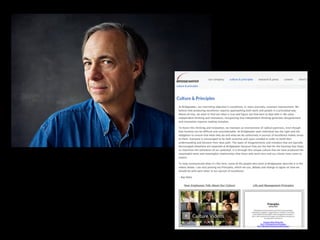
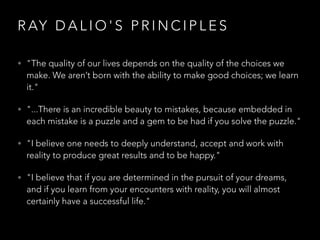
R AY D A L I O ' S P R I N C I P L E S
• "The quality of our lives depends on the quality of the choices we
make. We aren’t born with the ability to make good choices; we learn
it."
• "...There is an incredible beauty to mistakes, because embedded in
each mistake is a puzzle and a gem to be had if you solve the puzzle."
• "I believe one needs to deeply understand, accept and work with
reality to produce great results and to be happy."
• "I believe that if you are determined in the pursuit of your dreams,
and if you learn from your encounters with reality, you will almost
certainly have a successful life."
R AY D A L I O ' S P R I N C I P L E S
• Most of the impediments to success are emotional.
Ego is the biggest single one, though not all of them are
due to ego. ... you can probably get what you want out
of life if you can suspend your ego and take a no-
excuses approach to achieving your goals with open-
mindedness, determination and courage.
• Everyone has weaknesses. The main difference between
unsuccessful and successful people is that unsuccessful
people don’t find and address them, and successful
people do.
P U R P O S E
• Purpose is the why
• Purpose drives and sustains mission, which is the how
• Teams are motivated and sustained by missions.
Find. Your. Purpose.
U N D E R S TA N D I N G O T H E R S
" W H AT I L E A R N E D I N M Y 2 0 S "
• "No one actually knows what they're doing"
• "Most people in the world basically want the same
things"
• "Most of the differences that we hold to be so
significant are accidental byproducts of geography and
history"
• "Judge people not by who they are, but what they do"
(Mark Manson)
“ S U M O F L I T T L E T H I N G S ”
• “The sum of little things matter much more than the big
things.”
• It's a trap to think about "the one big thing" or "the top 3
things" or whatever.
• And it's because when we are young, we are still far away
from the action of those "Big things”.
• Up close, those big things are just a hundred thousand little
things that must be quietly maintained over long periods of
time, with little fanfare.
" T H E W O R L D D O E S N ' T C A R E A B O U T Y O U "
• You'll stop worrying what others think about you when you
realize how seldom they do
• Everything we are and everything we do will one day be
forgotten. It will be as if we never even existed. "This too shall
pass."
• This is actually really good news. It means you can do a lot of
stupid things and people will forget and forgive you for it. (But
they will remember your acts of unkindness much, much longer.)
• This means there is no reason not to be the person that you
want to be.
C O M M U N I C AT I O N
Language is not a broadcast; it is an interaction.
Always consider your audience and how they will
understand your words and their intrinsic susceptibility
to your message.
R E L AT I O N S H I P S
• The worst things happen when people forget that
communication is only possible in the context of a
relationship. Without a relationship to set the context,
the *exact same words* mean completely different
things.
• If you don’t have a relationship (or can’t relate) to
someone, then you can’t communicate with them.
END OF STORY.
R E L AT I O N S H I P S
• Internet flame wars are the very best examples of this.
Almost every single public communication system now
facilitates the flow of words, without requiring or
vetting for an interaction context or relationship.
• It’s super easy to caricature other people on the
basis of our reading of their words.
P U R P O S E
• Relationships, between individuals and between
entities, are most fruitful when they are grounded in
purpose.
• Creates fundamental alignment and trust.
• Be highly wary of entering into deep relationships
when you don’t understand why the other party is
involved at all.
T R U T H U N D E R T H E C U R V E
• Oftentimes people with an engineering mindset will have a desire
to optimize for “truth” - this is especially true in the context of an
argument or presentation, when there is the need to blend
persuasion, education, and inspiration.  They will optimize for
Education, pushing hard on truth and accuracy.  This misses the fact
that reaching Peak Accuracy is a different thing then maximizing
“Information under the curve”.
• To really communicate a lot of information, you have to take people
on a journey.  It has to start off accessible and engaging, and then
by the time they reach some height, the total amount of context
and information they’ve absorbed is far greater than the information
under the delta-function peak of accuracy.
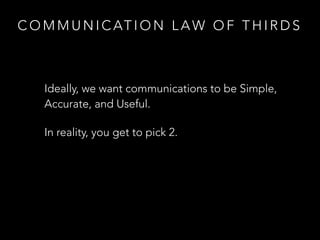
C O M M U N I C AT I O N L A W O F T H I R D S
Ideally, we want communications to be Simple,
Accurate, and Useful.
In reality, you get to pick 2.
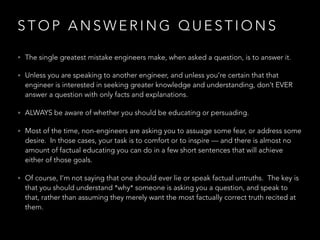
S T O P A N S W E R I N G Q U E S T I O N S
• The single greatest mistake engineers make, when asked a question, is to answer it.
• Unless you are speaking to another engineer, and unless you’re certain that that
engineer is interested in seeking greater knowledge and understanding, don’t EVER
answer a question with only facts and explanations.
• ALWAYS be aware of whether you should be educating or persuading.
• Most of the time, non-engineers are asking you to assuage some fear, or address some
desire.  In those cases, your task is to comfort or to inspire — and there is almost no
amount of factual educating you can do in a few short sentences that will achieve
either of those goals.
• Of course, I’m not saying that one should ever lie or speak factual untruths.  The key is
that you should understand *why* someone is asking you a question, and speak to
that, rather than assuming they merely want the most factually correct truth recited at
them.
L O O K I N G F O R T H E U N S E E N
• Inverting the negative: instead of asking “how do I become
the best” (because it can be hard to evaluate what’s
“best”), instead ask “how can I avoid these following bad
outcomes which I definitely know I don’t want”.
• Another example: Quora question about “which language
has best prospects”, someone answered with a view about
“which has most untapped potential”.  Very refreshing.
• “If the power positions were inverted, what would I
demand, that is not currently being demanded of me?”
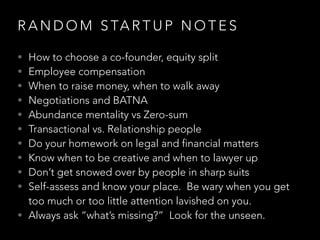
R A N D O M S TA R T U P N O T E S
• How to choose a co-founder, equity split
• Employee compensation
• When to raise money, when to walk away
• Negotiations and BATNA
• Abundance mentality vs Zero-sum
• Transactional vs. Relationship people
• Do your homework on legal and financial matters
• Know when to be creative and when to lawyer up
• Don’t get snowed over by people in sharp suits
• Self-assess and know your place. Be wary when you get
too much or too little attention lavished on you.
• Always ask “what’s missing?” Look for the unseen.
F U R T H E R R E A D I N G
• Antoine de St. Exupery
• Ray Dalio’s Principles
• Charlie Munger; Poor Charlie’s Almanack
• Farnam Street Blog
W H AT H AV E I L E A R N E D
I N T H E L A S T 6 M O N T H S ?
• Communications “stress-energy tensor” exists within
organizations – We grew too fast last year, exceeding the
breakdown voltage
• Coaching & mentoring
• Expectations management
• Managing up - and being managed up to
• Nature abhors a vacuum; without a prevailing narrative,
people will create their own

Thoughts on Business & Startups

  • 1.
    T H OU G H T S O N S TA R T U P S Peter Wang Physics ’99 CTO, Co-Founder Continuum Analytics
  • 3.
    H O WI G O T H E R E ( B R I E F LY )
  • 4.
    S TA RT I N G C O N T I N U U M
  • 9.
    F O X& H E D G E H O G • “Knowing many things” vs “Know one thing” • Imagine an physics student circa 2016 goes back in time to 1200 AD.  She is going to be amazing across a number of different things: architecture, weapons engineering, calendar and timekeeping, etc. • Does she know many things, or just a few things? If you know just a few deep things, and you know how to apply them to real world scenarios, then you are done.
  • 10.
    A F EW T H I N G S
  • 11.
    C R ED I T & R I S K • Don’t think in terms of money or currency.  That’s like only reasoning about frictionless pulleys and massless ropes and perfectly round billiard balls. • In the real world, the major dynamics are overwhelmingly governed by the forces of risk.   • *After* those dynamics shake out, then tactical and operational concerns involve money and movement of currency. • Convexity & human risk aversion • https://en.wikipedia.org/wiki/Risk_aversion • Framing is very important!!
  • 12.
    B E IN G S M A R T, G E T T I N G S M A R T E R • In school, we are encouraged to do our best, we are graded on a curve and compared to each other • In the real world, there are a zillion different grading systems. And we tend to value what we’re good at. • For most of us, that’s “being smart” • Always be learning, and never apologize for being smart. • BUT: strongly avoid being the smartest person in the room.
  • 13.
    B E EX C I T E D T O L E A R N • Optimize your own intelligence AND your ego and self-validation loop so that you can stand to be in a room of much, much smarter people and be legitimately excited about all that you might learn from them. • That kind of openness, if genuine, is incredibly attractive to other smart people who are legit. • The poseurs and the insecure people - the ones who are going to bring a lot of ego and a lot of static - actually tend to filter out.  They intuitively feel threatened by it. • Openness is not vulnerability! Openness is an invitation to engage.
  • 14.
    G E TT I N G Y E L L E D AT
  • 15.
    VA L ID AT I O N & S O C I A L C U R R E N C Y • Downweight the social component in your self- validation • Social validation is scarce by design! • Our primate/mammalian brainstems crave hierarchy and social status signaling • necessary evil when searching for mates and acquiring social power • a rabbit hole and a distraction if you want to build something great or do something truly creative
  • 16.
    L E AD E R S H I P Some of you may be leaders. But all of you must lead purposeful lives. If you want to build a ship, don't drum up the men to gather wood, divide the work and give orders. Instead, teach them to yearn for the vast and endless sea.
 -- Antoine de St. Exupery
  • 17.
    S TA RT W I T H W H Y • Don’t mistake How or What for Why • Much, much easier to write business books on How. • But the most important question for an entrepreneur is: Why?
  • 18.
    T H EO N E T H I N G “For there is but one veritable problem - the problem of human relations…”
 — Antoine de Saint-Exupéry
  • 19.
    U N DE R S TA N D I N G P E O P L E • Understand yourself. • Understand others. • Understand interactions.
  • 20.
    U N DE R S TA N D I N G Y O U R S E L F
  • 21.
    see also: Jungianmodel of psyche M A S L O W ' S H I E R A R C H Y O F N E E D S
  • 22.
    "The first principleis that you must not fool yourself, and you are the easiest person to fool." -- Richard Feynman
  • 24.
    R AY DA L I O ' S P R I N C I P L E S • "The quality of our lives depends on the quality of the choices we make. We aren’t born with the ability to make good choices; we learn it." • "...There is an incredible beauty to mistakes, because embedded in each mistake is a puzzle and a gem to be had if you solve the puzzle." • "I believe one needs to deeply understand, accept and work with reality to produce great results and to be happy." • "I believe that if you are determined in the pursuit of your dreams, and if you learn from your encounters with reality, you will almost certainly have a successful life."
  • 25.
    R AY DA L I O ' S P R I N C I P L E S • Most of the impediments to success are emotional. Ego is the biggest single one, though not all of them are due to ego. ... you can probably get what you want out of life if you can suspend your ego and take a no- excuses approach to achieving your goals with open- mindedness, determination and courage. • Everyone has weaknesses. The main difference between unsuccessful and successful people is that unsuccessful people don’t find and address them, and successful people do.
  • 26.
    P U RP O S E • Purpose is the why • Purpose drives and sustains mission, which is the how • Teams are motivated and sustained by missions. Find. Your. Purpose.
  • 27.
    U N DE R S TA N D I N G O T H E R S
  • 29.
    " W HAT I L E A R N E D I N M Y 2 0 S " • "No one actually knows what they're doing" • "Most people in the world basically want the same things" • "Most of the differences that we hold to be so significant are accidental byproducts of geography and history" • "Judge people not by who they are, but what they do" (Mark Manson)
  • 30.
    “ S UM O F L I T T L E T H I N G S ” • “The sum of little things matter much more than the big things.” • It's a trap to think about "the one big thing" or "the top 3 things" or whatever. • And it's because when we are young, we are still far away from the action of those "Big things”. • Up close, those big things are just a hundred thousand little things that must be quietly maintained over long periods of time, with little fanfare.
  • 31.
    " T HE W O R L D D O E S N ' T C A R E A B O U T Y O U " • You'll stop worrying what others think about you when you realize how seldom they do • Everything we are and everything we do will one day be forgotten. It will be as if we never even existed. "This too shall pass." • This is actually really good news. It means you can do a lot of stupid things and people will forget and forgive you for it. (But they will remember your acts of unkindness much, much longer.) • This means there is no reason not to be the person that you want to be.
  • 32.
    C O MM U N I C AT I O N Language is not a broadcast; it is an interaction. Always consider your audience and how they will understand your words and their intrinsic susceptibility to your message.
  • 33.
    R E LAT I O N S H I P S • The worst things happen when people forget that communication is only possible in the context of a relationship. Without a relationship to set the context, the *exact same words* mean completely different things. • If you don’t have a relationship (or can’t relate) to someone, then you can’t communicate with them. END OF STORY.
  • 34.
    R E LAT I O N S H I P S • Internet flame wars are the very best examples of this. Almost every single public communication system now facilitates the flow of words, without requiring or vetting for an interaction context or relationship. • It’s super easy to caricature other people on the basis of our reading of their words.
  • 35.
    P U RP O S E • Relationships, between individuals and between entities, are most fruitful when they are grounded in purpose. • Creates fundamental alignment and trust. • Be highly wary of entering into deep relationships when you don’t understand why the other party is involved at all.
  • 36.
    T R UT H U N D E R T H E C U R V E • Oftentimes people with an engineering mindset will have a desire to optimize for “truth” - this is especially true in the context of an argument or presentation, when there is the need to blend persuasion, education, and inspiration.  They will optimize for Education, pushing hard on truth and accuracy.  This misses the fact that reaching Peak Accuracy is a different thing then maximizing “Information under the curve”. • To really communicate a lot of information, you have to take people on a journey.  It has to start off accessible and engaging, and then by the time they reach some height, the total amount of context and information they’ve absorbed is far greater than the information under the delta-function peak of accuracy.
  • 37.
    C O MM U N I C AT I O N L A W O F T H I R D S Ideally, we want communications to be Simple, Accurate, and Useful. In reality, you get to pick 2.
  • 38.
    S T OP A N S W E R I N G Q U E S T I O N S • The single greatest mistake engineers make, when asked a question, is to answer it. • Unless you are speaking to another engineer, and unless you’re certain that that engineer is interested in seeking greater knowledge and understanding, don’t EVER answer a question with only facts and explanations. • ALWAYS be aware of whether you should be educating or persuading. • Most of the time, non-engineers are asking you to assuage some fear, or address some desire.  In those cases, your task is to comfort or to inspire — and there is almost no amount of factual educating you can do in a few short sentences that will achieve either of those goals. • Of course, I’m not saying that one should ever lie or speak factual untruths.  The key is that you should understand *why* someone is asking you a question, and speak to that, rather than assuming they merely want the most factually correct truth recited at them.
  • 39.
    L O OK I N G F O R T H E U N S E E N • Inverting the negative: instead of asking “how do I become the best” (because it can be hard to evaluate what’s “best”), instead ask “how can I avoid these following bad outcomes which I definitely know I don’t want”. • Another example: Quora question about “which language has best prospects”, someone answered with a view about “which has most untapped potential”.  Very refreshing. • “If the power positions were inverted, what would I demand, that is not currently being demanded of me?”
  • 40.
    R A ND O M S TA R T U P N O T E S • How to choose a co-founder, equity split • Employee compensation • When to raise money, when to walk away • Negotiations and BATNA • Abundance mentality vs Zero-sum • Transactional vs. Relationship people • Do your homework on legal and financial matters • Know when to be creative and when to lawyer up • Don’t get snowed over by people in sharp suits • Self-assess and know your place. Be wary when you get too much or too little attention lavished on you. • Always ask “what’s missing?” Look for the unseen.
  • 41.
    F U RT H E R R E A D I N G • Antoine de St. Exupery • Ray Dalio’s Principles • Charlie Munger; Poor Charlie’s Almanack • Farnam Street Blog
  • 42.
    W H ATH AV E I L E A R N E D I N T H E L A S T 6 M O N T H S ? • Communications “stress-energy tensor” exists within organizations – We grew too fast last year, exceeding the breakdown voltage • Coaching & mentoring • Expectations management • Managing up - and being managed up to • Nature abhors a vacuum; without a prevailing narrative, people will create their own