Personal
Growth and
Development
Chapter 6
Chapter Overview
 Personal development—receptiveness to change
 Making behavior modification work for you
 Understanding yourself
 Understanding others/Respecting differences
 Assessment of your strengths and areas for
improvement
 Developing your communication skills
 Leadership and Teamwork
 Mental and physical wellness
 Motivating Yourself
Personal Development
Receptiveness to Change
Personal Total Quality Management (TQM)
Strive to change, grow, and improve yourself
continuously in every area that impacts your
effectiveness
Student Development
Areas in which you need to grow, change, or
develop to achieve your goal of receiving
your B.S. degree in engineering
Value Judgments Applied
to Our Actions
Actions
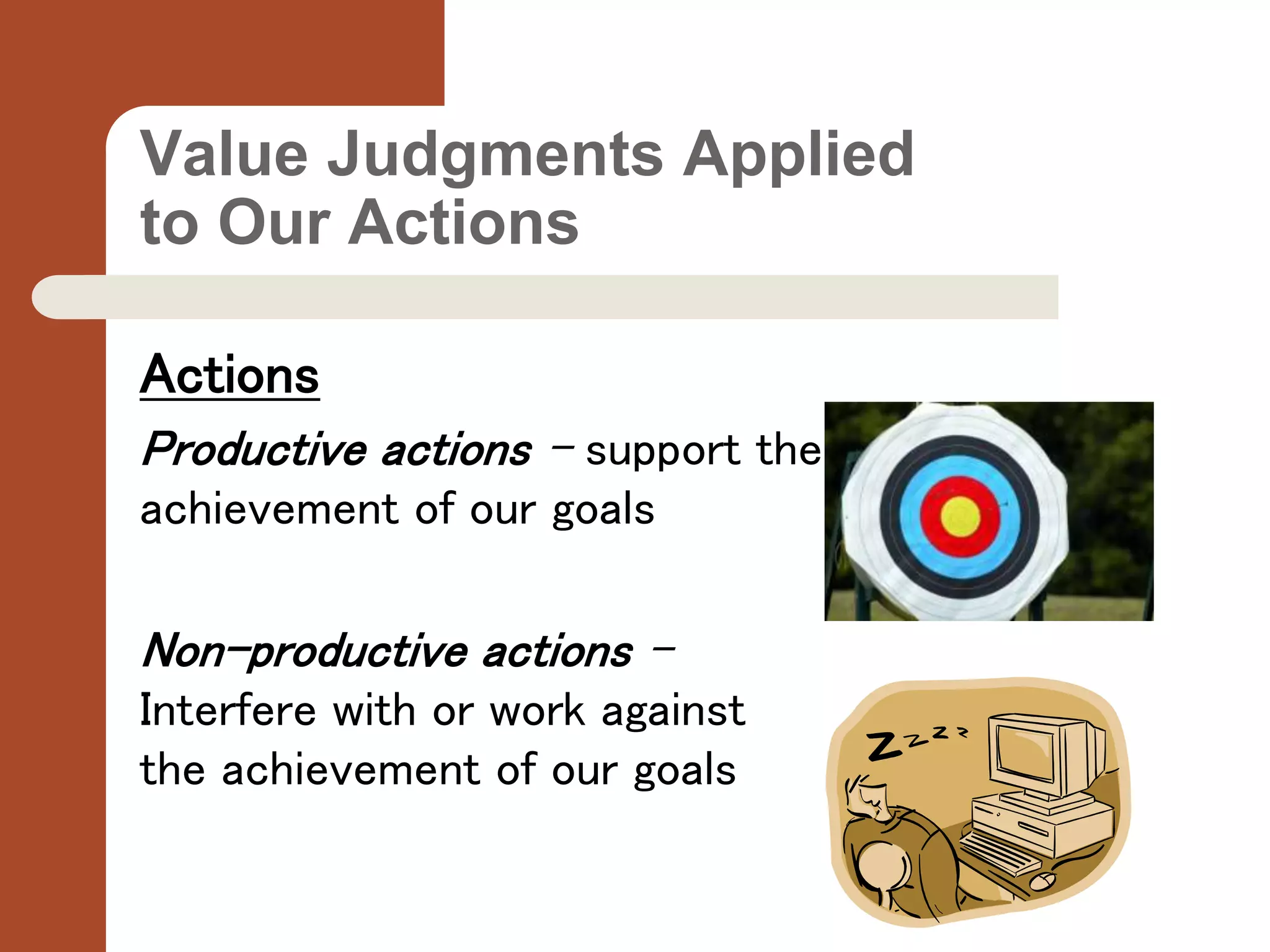
Productive actions – support the
achievement of our goals
Non-productive actions –
Interfere with or work against
the achievement of our goals
Value Judgments Applied
to Our Thoughts
Thoughts
Positive thoughts - result in our choosing of
productive actions
Negative thoughts – result in our choosing of
non-productive actions
Value Judgments Applied
to Our Feelings
Feelings
Positive feelings – produce positive thoughts,
which in turn lead to productive actions
Negative feelings – produce negative
thoughts, which in turn lead to non-productive
actions
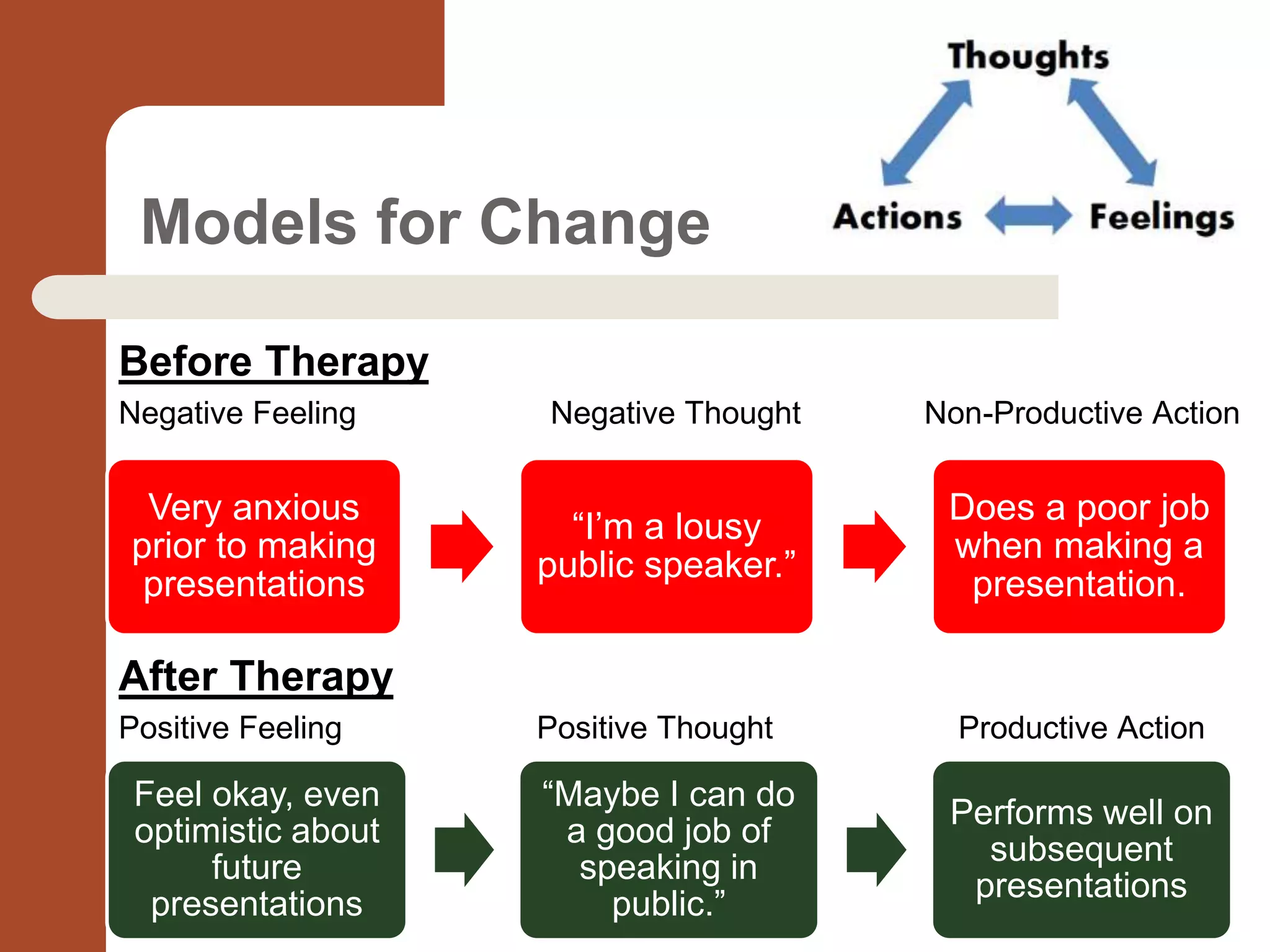
Feel okay, even
optimistic about
future
presentations
“Maybe I can do
a good job of
speaking in
public.”
Performs well on
subsequent
presentations
Very anxious
prior to making
presentations
“I’m a lousy
public speaker.”
Does a poor job
when making a
presentation.
Models for Change
Before Therapy
Negative Feeling Negative Thought Non-Productive Action
After Therapy
Positive Feeling Positive Thought Productive Action
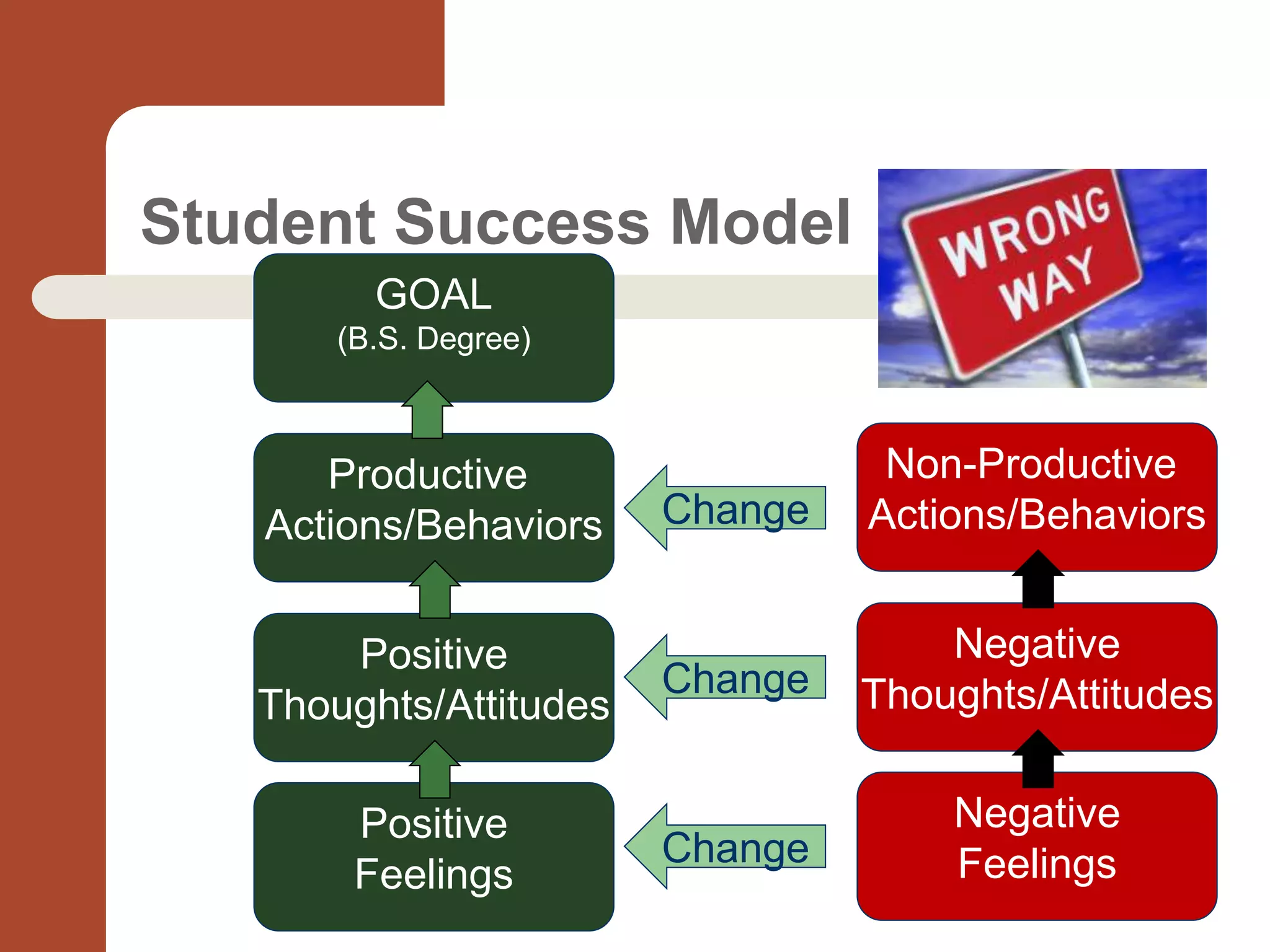
Student Success Model
Non-Productive
Actions/Behaviors
Negative
Thoughts/Attitudes
Negative
Feelings
Productive
Actions/Behaviors
Positive
Thoughts/Attitudes
Positive
Feelings
Change
Change
Change
GOAL
(B.S. Degree)
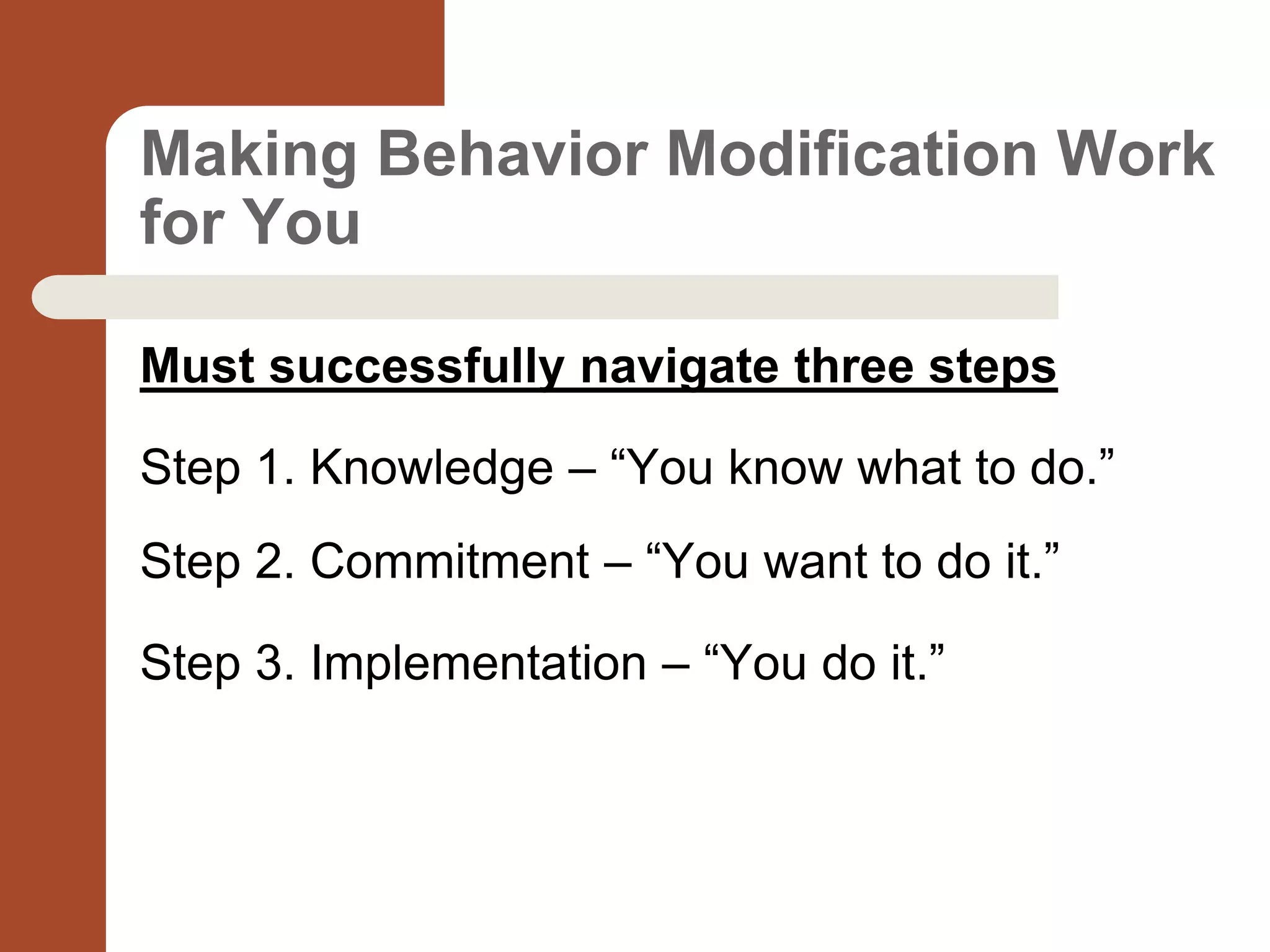
Making Behavior Modification Work
for You
Must successfully navigate three steps
Step 1. Knowledge – “You know what to do.”
Step 2. Commitment – “You want to do it.”
Step 3. Implementation – “You do it.”
Step 1. Knowledge
“You know what to do.”
 Devote significant time and energy to studying
 Master the material presented in each class period
 Study collaboratively with other students
 Review notes, read text, attempt problems prior to
each lecture
 Interact regularly with professors outside of classroom
 Immerse yourself in the academic environment of the
institution
 Participate actively in student organizations
 …
 See Chapters 3, 4 and 5
Step 2. Commitment
“You want to do it.”
 Knowledge alone is no guarantee
– Smoking causes cancer, everybody knows it, but
why are some people still smoking?
 A commitment to do something is an attitude
 Become conscious of your attitudes
 Change negative attitudes that obstruct your
growth
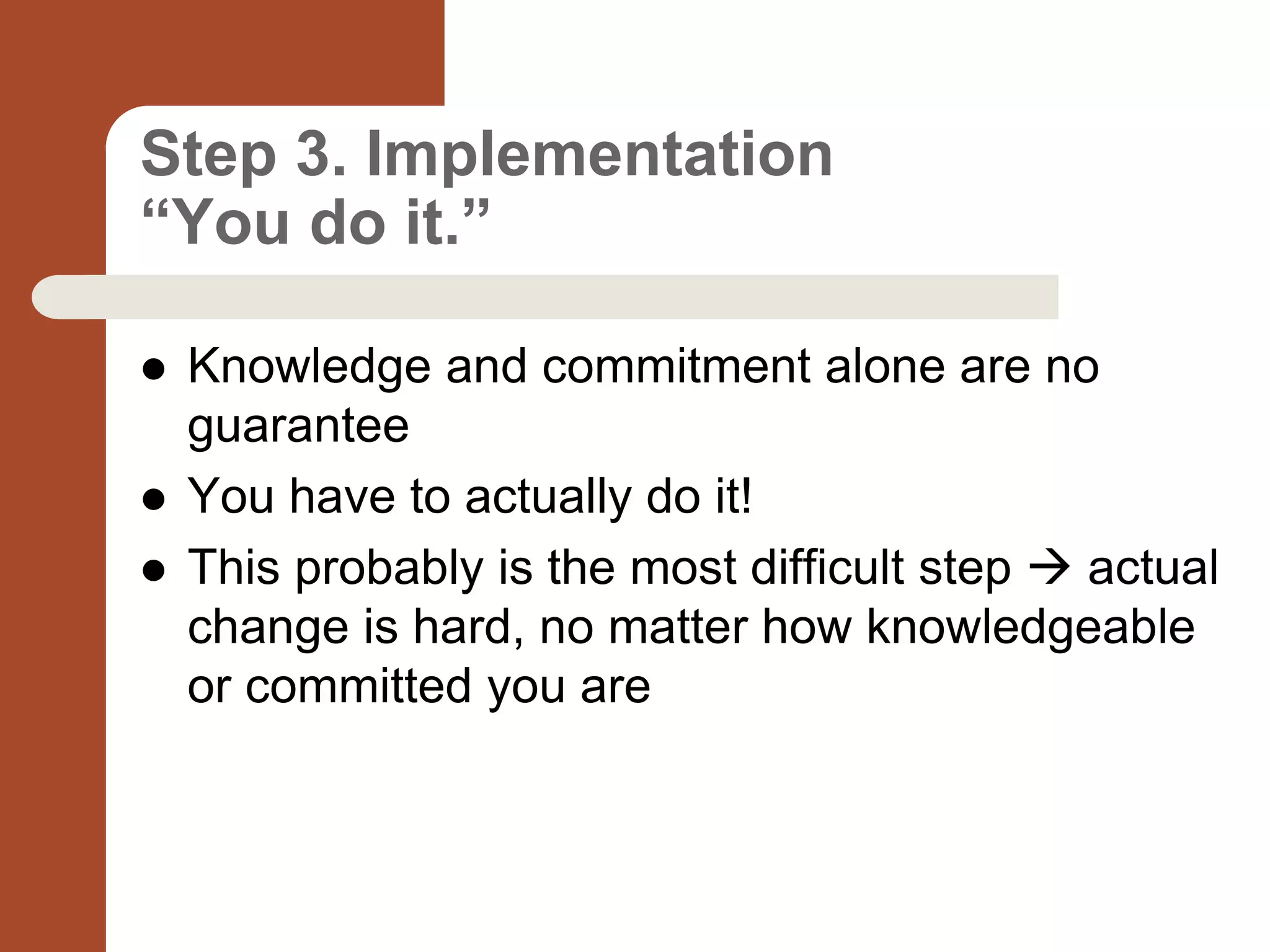
Step 3. Implementation
“You do it.”
 Knowledge and commitment alone are no
guarantee
 You have to actually do it!
 This probably is the most difficult step  actual
change is hard, no matter how knowledgeable
or committed you are
Barriers to Choosing
Productive Actions
 Current behaviors satisfy some need or want
that you have
 Have difficulty choosing to do things you don’t
find easy or enjoyable
 Afraid to study because if you do and still fail, it
will reflect on your ability
 Prefer to blame your failure on people or
factors external to yourself
“The Common Denominator of
Success” – Albert E.N. Gray
 Successful [people] are influenced by the
desire for pleasing results. [They] have a
purpose strong enough to make them form the
habit of doing things they don’t like to do in
order to accomplish the purpose they want to
accomplish.
 Failures are influenced by the desire for
pleasing methods and are inclined to be
satisfied with such results as can be obtained
by doing things they like to do.
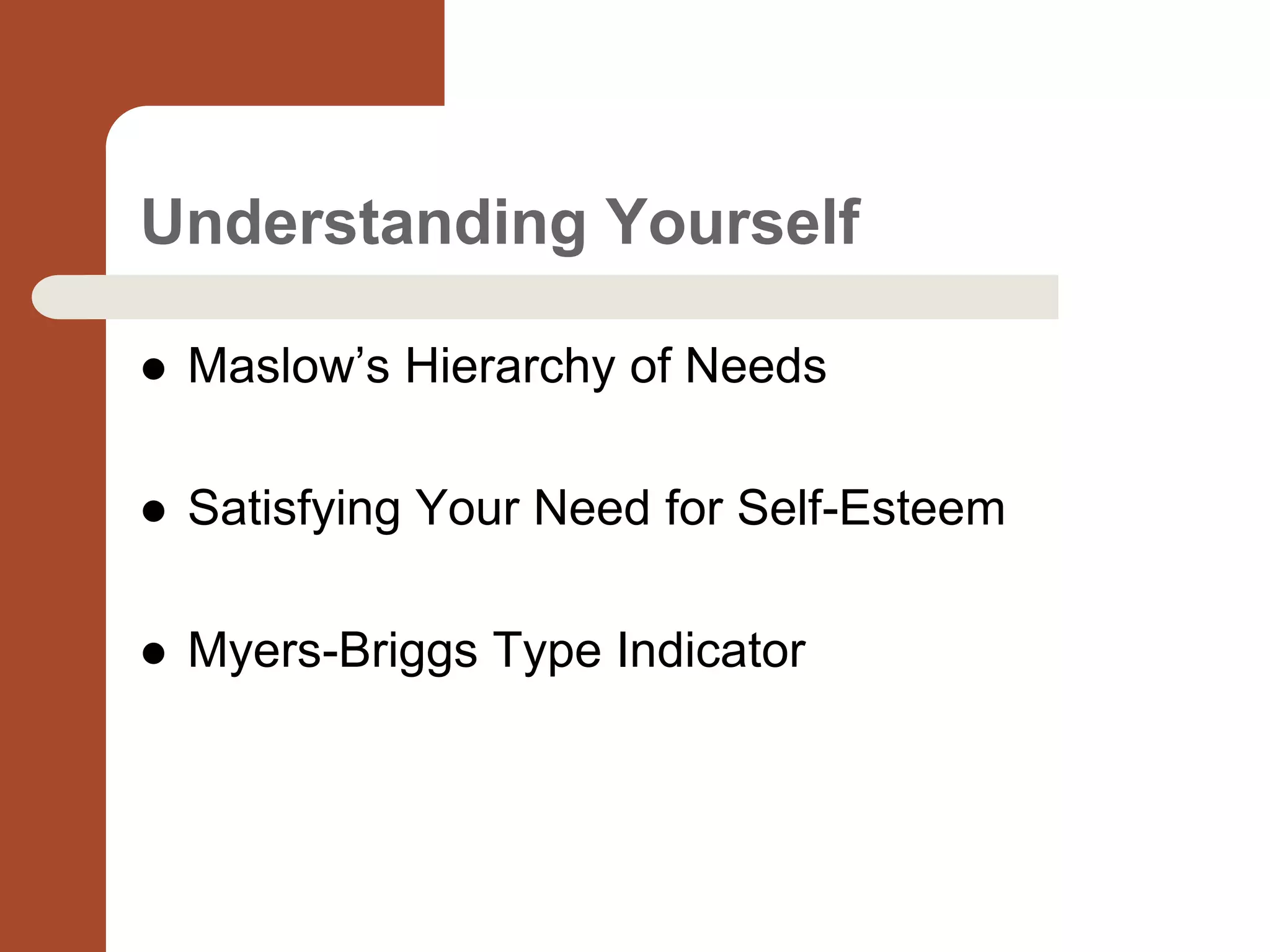
Understanding Yourself
 Maslow’s Hierarchy of Needs
 Satisfying Your Need for Self-Esteem
 Myers-Briggs Type Indicator
Maslow’s Hierarchy of Needs
“Needs” vs. “Wants”
Needs are things that you must have, things that
are essential.
Wants are things that you desire.
Don’t let unnecessary wants
distract you from academic success.
Self-Esteem
Self-esteem is:
Appreciating my own worth and importance
and having the character to be accountable for
myself and to act responsibly toward others
Self-esteem is made up of two components:
 Self-efficacy – your sense of competence
 Self-respect – your sense of personal worth
Self-Esteem
 It is important to have both self-efficacy and
self-respect.
– If you feel competent but not worthy, you may
accomplish a great deal, but you will lack the
capacity to enjoy it.
 Your college years provide a unique
opportunity for you to enhance your self-
esteem by building both your self-efficacy and
your self-respect.
Myers-Briggs Type Indicator
 E-Extrovert or I-Introvert
 S-Sensing or N-Intuiting
 T-Thinking or F-Feeling
 J-Judging or P-Perceiving
Most frequent types among engineering
students:
ISTJ followed by ESTJ, INTJ, INTP, and ENTJ
Benefits of Knowing Your
Personality Type and Learning Styles
 Guide you in creating your own learning
experience to meet your needs
 Guide you in selecting the engineering job
functions you are most suited for
 Assist you in appreciating your own
uniqueness
 Assist you in appreciating the uniqueness of
others
Understanding Others/Respecting
Differences
 Differences in personality types and learning styles
 Ethnic and gender differences
A stereotype is a fixed conception of a person or a
group that allows for no individuality
 Stereotyping is unnecessary and unfair
 Improving your effectiveness in cross-cultural
communication
Explicit and Implicit Bias
 A bias is a prejudice you hold against another person
 Explicit biases are prejudices you consciously hold,
you are aware of them
 Implicit biases are prejudices you unconsciously hold,
you are not aware of them
 Everybody holds unconscious biases as a result of our
upbringing, social environment, cultural exposure and
beliefs
 The good news is that implicit biases can be changed
– Become aware of your implicit biases, see resources in the
textbook
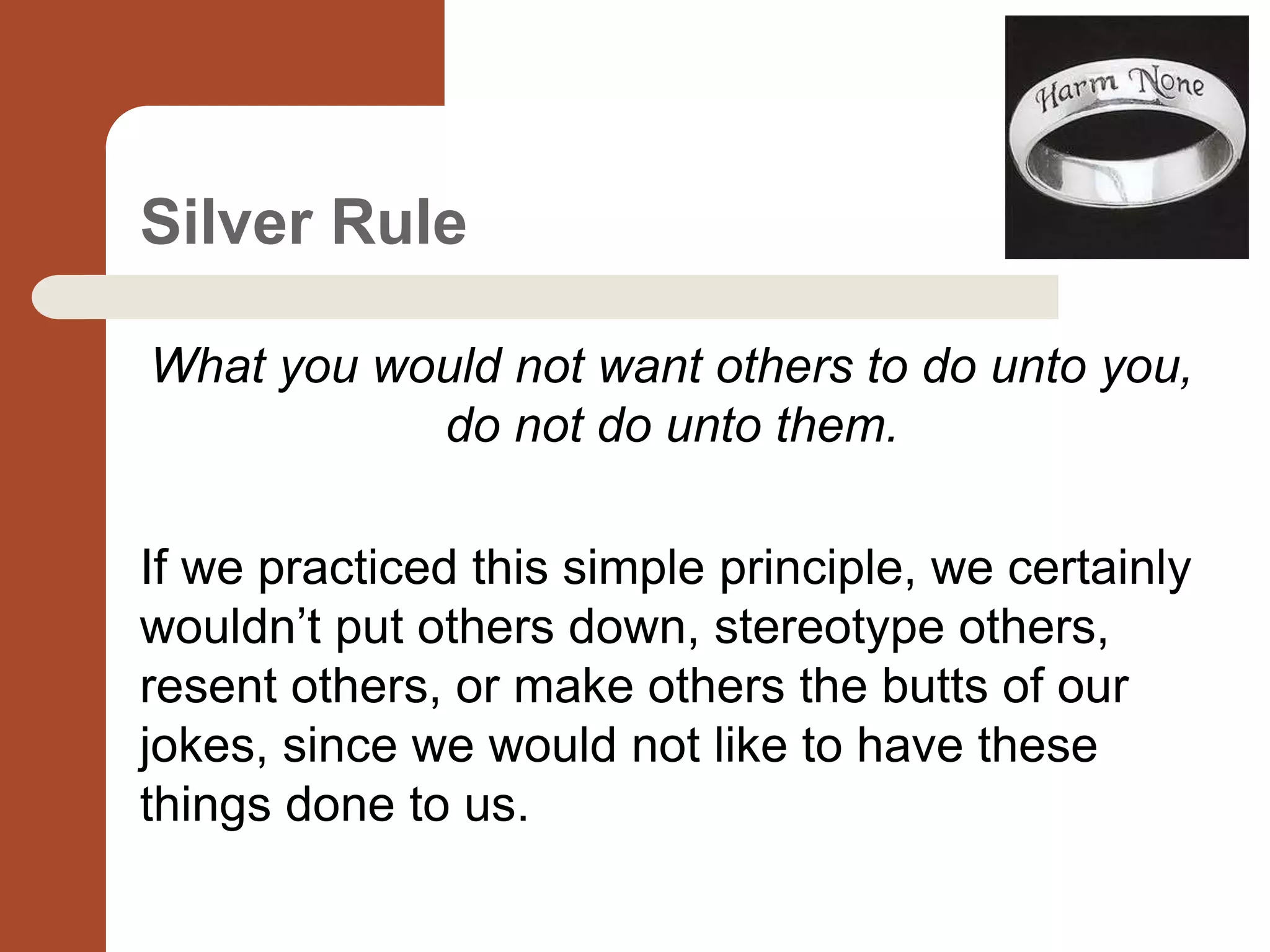
Silver Rule
What you would not want others to do unto you,
do not do unto them.
If we practiced this simple principle, we certainly
wouldn’t put others down, stereotype others,
resent others, or make others the butts of our
jokes, since we would not like to have these
things done to us.
Assessment of Your Strengths and
Areas for Improvement
 Assessment based on attributes model
 Assessment based on employment model
 Assessment based on Astin’s Student
Involvement Model
Rate yourself on a scale of 0 to 10
on each item listed
Personal Development
Plans
 Identify areas for improvement
 Prioritize them in order of importance
 Choose several items to work on
 Create a personal development (action) plan
Developing Your
Communication Skills
 Importance of communication skills in
engineering
 Employers want more
 Developing a positive attitude
 Developing a plan to improve your
communication skills
Writing Demands of an Engineer
 Letters, memoranda, and e-mail correspondence
 Design specifications
 Requests for proposals (RFPs)
 Proposals submitted in response to RFPs
 Contracts, patents, and other government
documents
 Written progress reports
 Technical reports
 Publications in professional engineering journals
 Written performance evaluations of subordinates
 …
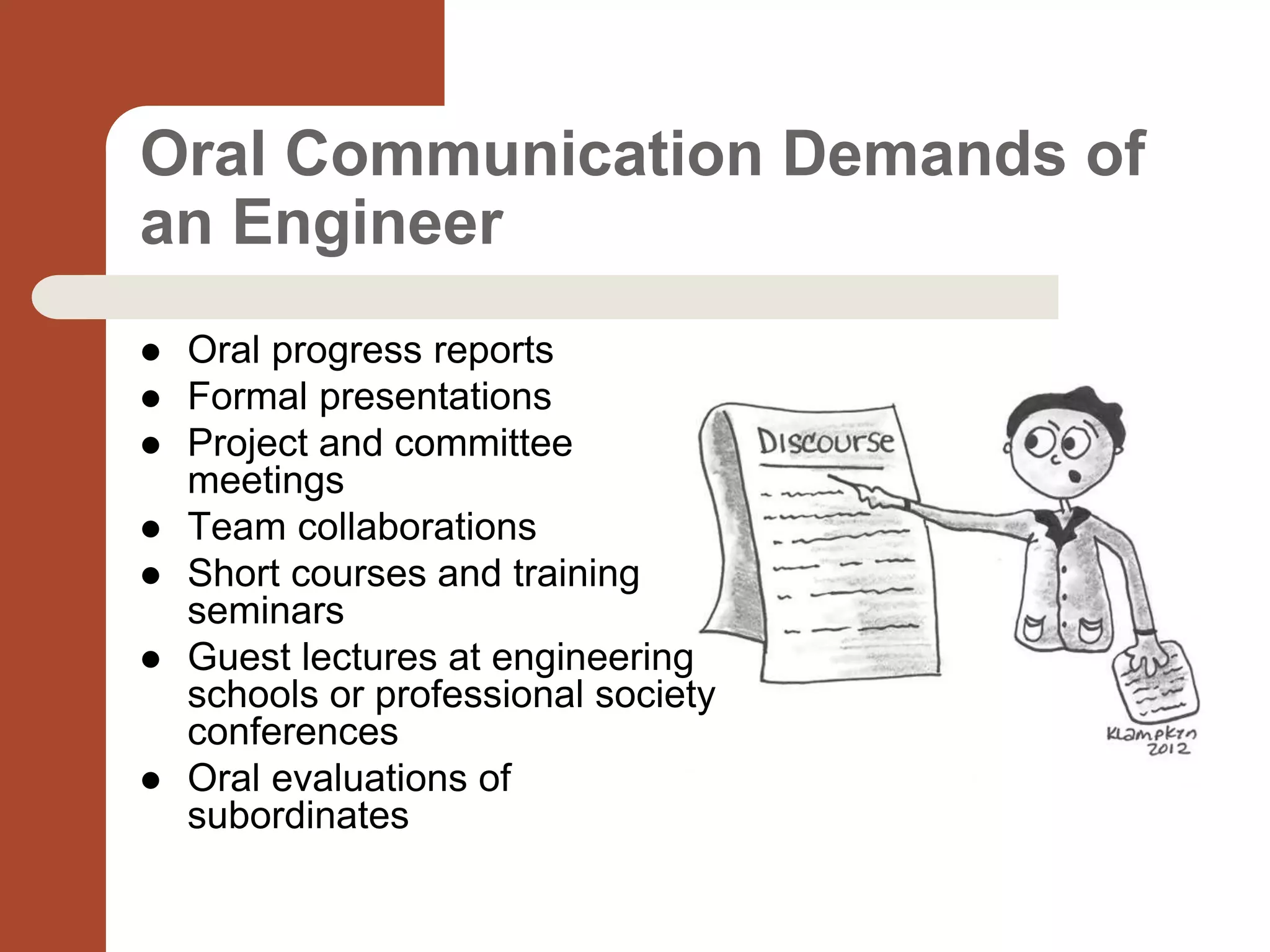
Oral Communication Demands of
an Engineer
 Oral progress reports
 Formal presentations
 Project and committee
meetings
 Team collaborations
 Short courses and training
seminars
 Guest lectures at engineering
schools or professional society
conferences
 Oral evaluations of
subordinates
Employers Want More
National survey of over 1,000 engineering employers
revealed that industry’s #1 concern was:
To give engineering students more
instruction in written and oral
communication.
Most important attribute of an early-career engineering
professional:
To communicate effectively in a variety of
different ways, methods, and media.
Develop a Plan to Improve Your
Communication Skills
 Take courses in oral and written
communications
 Look for opportunities to write (keep a journal,
write a poem or short story, send e-mails)
 Read – anything and everything (newspaper,
magazines, technical journals, novels)
 Look for opportunities to speak (student
organizations, high school class, regular class)
Leadership and Teamwork
 Definition – Team is two or more people who
interact regularly and coordinate their work to
accomplish a mutual objective
 Nothing of significance is ever achieved by an
individual acting alone
Ability to function effectively on a team
whose member together provide leadership,
create a collaborative and inclusive
environment, establish goals, plan tasks, and
meet objectives.
Example of
Teamwork
Principles of Teamwork
Purpose Trust/Reliance
Synergy Discipline
Cooperation Focus
Roles Values
Difficulty Leadership
Motivation Morale
Weakest Link Planning and resources
Attitude Decision-making
Attributes of an Effective Team
Leader
 Willingness to lead and take charge
 Ability to keep the team focused on its purpose
 Ability to set goals, priorities, and standards of
performance
 Proficiency at being a team builder
 Ability to plan appropriately/accordingly
 Able to run productive meetings
 Ability to communicate effectively
 Ability to promote harmony and inspire trust
 Ability to foster high levels of performance by team
members
Leadership Styles
 Autocratic – Leader makes decisions
independently with little input from team
members.
 Democratic – Leader offers guidance but also
encourages strong participation from team
members.
 Laissez-Faire – Leaders offer little guidance
and leave decision-making up to team
members.
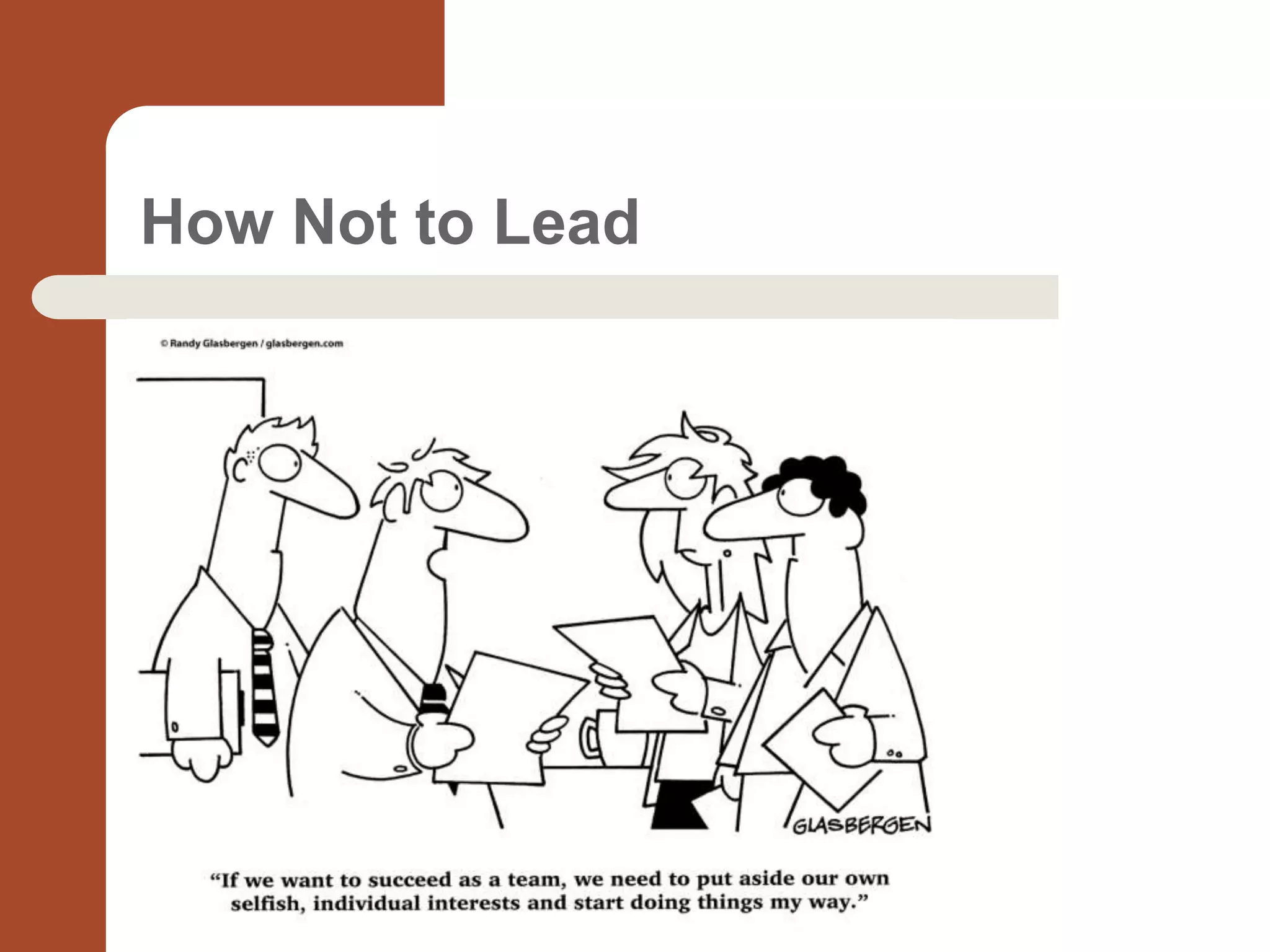
How Not to Lead
Characteristics of an Effective
Team Member
 Supports and helps the team leader succeed
 Understands and supports the team mission,
purpose, and goal
 Subordinates self-interest on behalf of the team’s
purpose
 Welcomes being a member of the team and works
to get to know and build trust with other team
members
 Communicates openly and honestly
Characteristics of an Effective
Team Member, cont.
 Respects differences and diversity in team
members
 Works to elicit the ideas of others; listens to
understand others’ points of view
 Views conflict as useful and necessary; works
toward consensus
 Is reliable; follows through on tasks; meets
deadlines
 Is willing to work hard, often “beyond the call of
duty,” for the success of the team
Stages of Team Development
Stage 1 – Forming
Stage 2 – Storming
Stage 3 – Norming
Stage 4 – Performing
Stage 5 - Adjourning
Mental and Physical Wellness
 Tips for good health
 Balancing work and play
 Managing stress
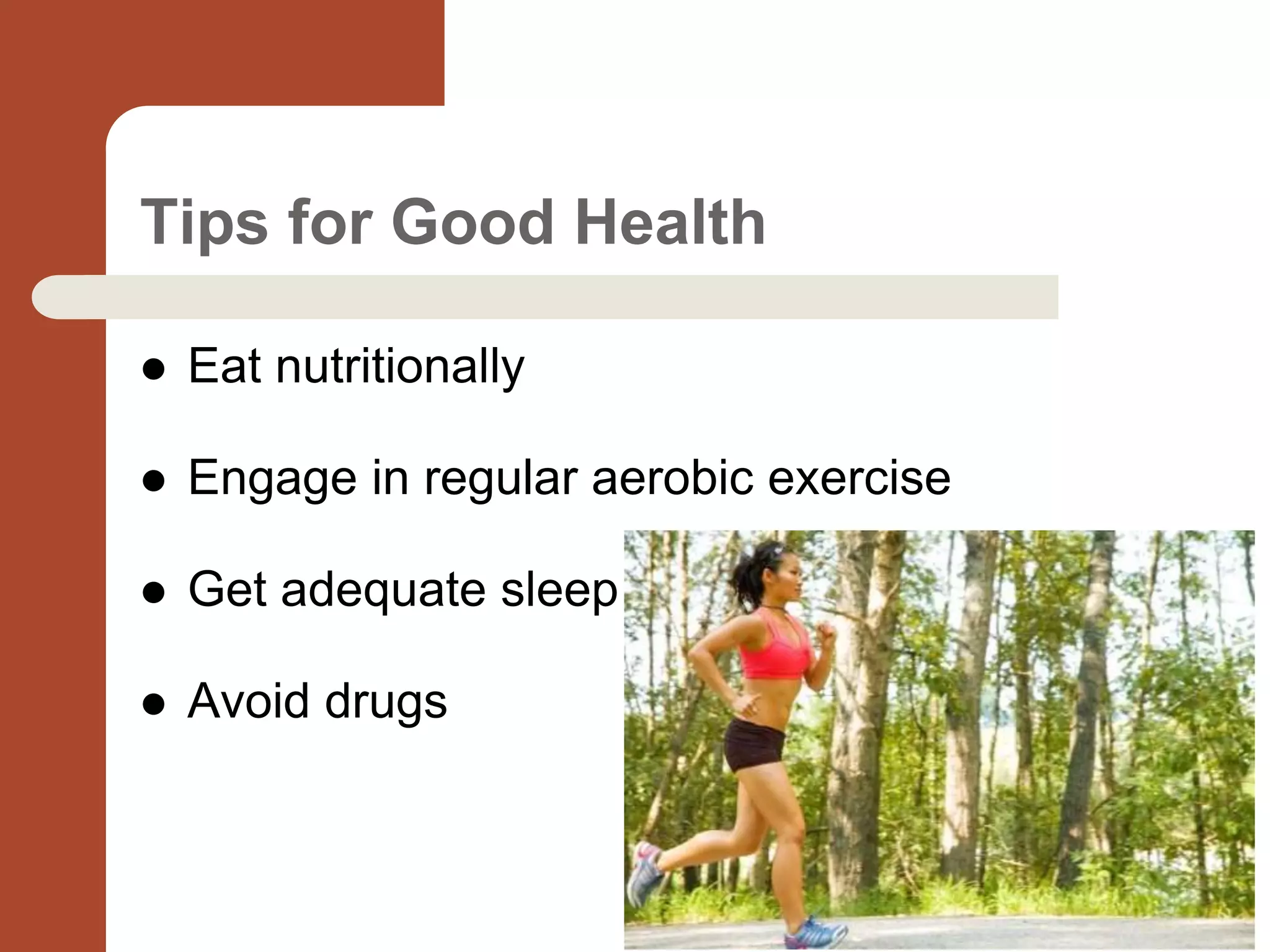
Tips for Good Health
 Eat nutritionally
 Engage in regular aerobic exercise
 Get adequate sleep
 Avoid drugs
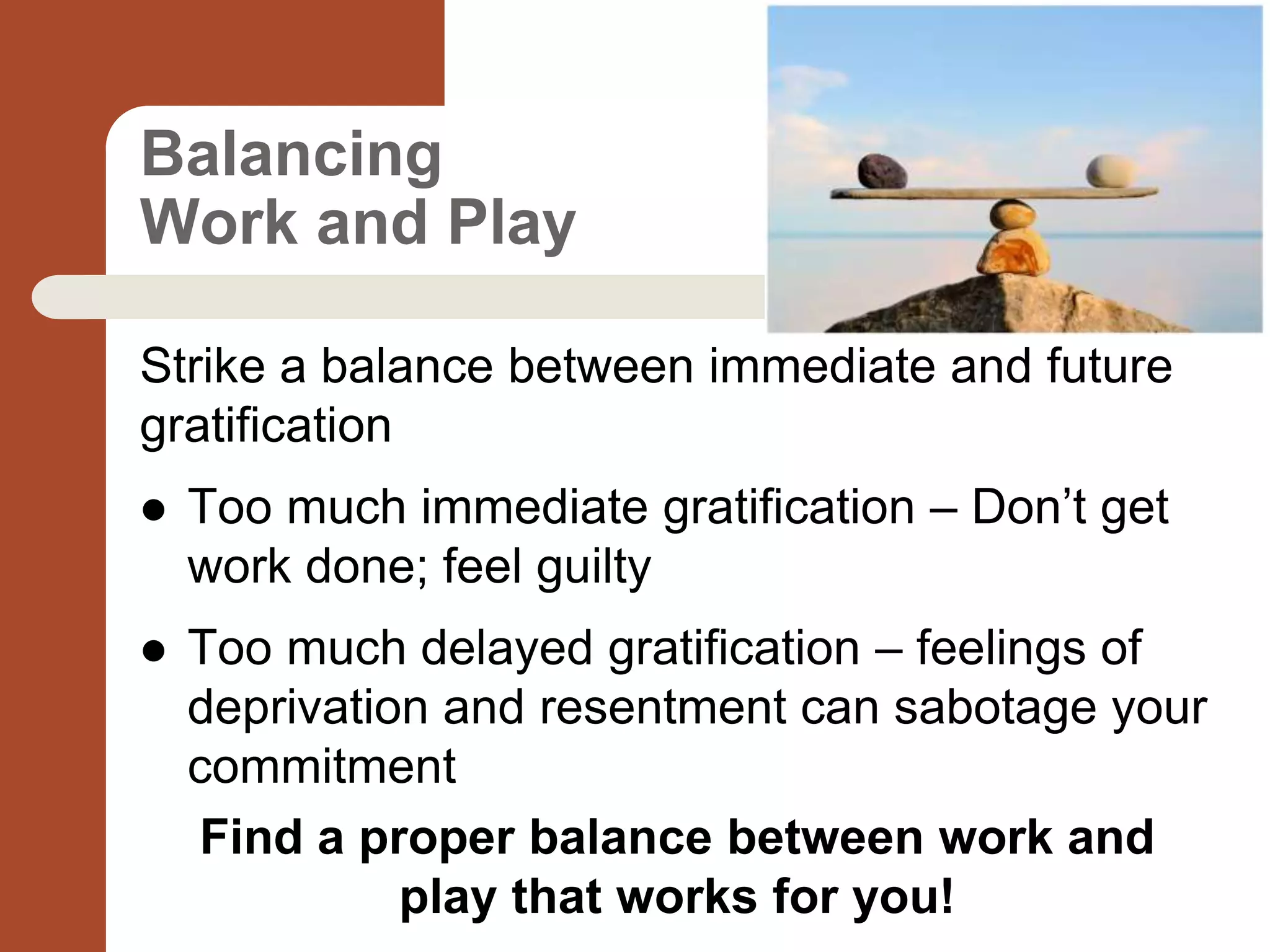
Balancing
Work and Play
Strike a balance between immediate and future
gratification
 Too much immediate gratification – Don’t get
work done; feel guilty
 Too much delayed gratification – feelings of
deprivation and resentment can sabotage your
commitment
Find a proper balance between work and
play that works for you!
Rethinking Stress
“The Upside of Stress” by McGonigal
If you believe stress is bad for you, it will be.
Rethink stress – view is as a good thing:
 Heart pounding  Strength and energy provided
by your heart for the task ahead
 Breathing heavier  More oxygen for your body
(and brain)
 People with stress in their lives tend to have more
meaning in their lives
 Embracing stress and anxiety can help your
performance
Managing Stress
 Eustress – Positive form of stress. Can
motivate individuals to attain high levels of
performance
 Distress – Negative form of stress. Can
distract you from being the best that you can
be.
Learn strategies for coping
with and managing stress
Motivating Yourself
 “No deposit, No return”
 Jesse Jackson’s “Excel”
Message
– Do your personal best!
 Inspirational and
Motivational Quotes
 Power of Positive Thinking
Group Discussion Exercise
Positive Aspects of College
In your group, brainstorm a list of the positive
aspects of being a college student. Then discuss
each item.
Select a leader to keep the discussion on topic and a
recorder to write down and report out on what was
learned
Alternate Group Discussion
Importance of Attitude
"The longer I live, the more I realize the impact of attitude on life. Attitude to
me, is more important than facts. It is more important than the past, than
education, than money, than circumstances, than failures, than successes,
than what other people think or say or do. It is more important than
appearance, giftedness, or skill. It will make or break a company, a church, a
home.
The remarkable thing is we have a choice every day regarding the attitude
we will embrace for that day. We cannot change our past. We cannot
change the fact that people will act in a certain way. We cannot change the
inevitable. The only thing we can do is play the one string we have, our
attitude.
I am convinced that life is 10% what happens to me and 90% how I react to
it. And so it is with you. We are in charge of our Attitudes."
Select a leader to keep the discussion on topic and a recorder
to write down and report out on what was learned

Chapter 6

  • 1.
  • 2.
    Chapter Overview  Personaldevelopment—receptiveness to change  Making behavior modification work for you  Understanding yourself  Understanding others/Respecting differences  Assessment of your strengths and areas for improvement  Developing your communication skills  Leadership and Teamwork  Mental and physical wellness  Motivating Yourself
  • 3.
    Personal Development Receptiveness toChange Personal Total Quality Management (TQM) Strive to change, grow, and improve yourself continuously in every area that impacts your effectiveness Student Development Areas in which you need to grow, change, or develop to achieve your goal of receiving your B.S. degree in engineering
  • 4.
    Value Judgments Applied toOur Actions Actions Productive actions – support the achievement of our goals Non-productive actions – Interfere with or work against the achievement of our goals
  • 5.
    Value Judgments Applied toOur Thoughts Thoughts Positive thoughts - result in our choosing of productive actions Negative thoughts – result in our choosing of non-productive actions
  • 6.
    Value Judgments Applied toOur Feelings Feelings Positive feelings – produce positive thoughts, which in turn lead to productive actions Negative feelings – produce negative thoughts, which in turn lead to non-productive actions
  • 7.
    Feel okay, even optimisticabout future presentations “Maybe I can do a good job of speaking in public.” Performs well on subsequent presentations Very anxious prior to making presentations “I’m a lousy public speaker.” Does a poor job when making a presentation. Models for Change Before Therapy Negative Feeling Negative Thought Non-Productive Action After Therapy Positive Feeling Positive Thought Productive Action
  • 8.
  • 9.
    Making Behavior ModificationWork for You Must successfully navigate three steps Step 1. Knowledge – “You know what to do.” Step 2. Commitment – “You want to do it.” Step 3. Implementation – “You do it.”
  • 10.
    Step 1. Knowledge “Youknow what to do.”  Devote significant time and energy to studying  Master the material presented in each class period  Study collaboratively with other students  Review notes, read text, attempt problems prior to each lecture  Interact regularly with professors outside of classroom  Immerse yourself in the academic environment of the institution  Participate actively in student organizations  …  See Chapters 3, 4 and 5
  • 11.
    Step 2. Commitment “Youwant to do it.”  Knowledge alone is no guarantee – Smoking causes cancer, everybody knows it, but why are some people still smoking?  A commitment to do something is an attitude  Become conscious of your attitudes  Change negative attitudes that obstruct your growth
  • 12.
    Step 3. Implementation “Youdo it.”  Knowledge and commitment alone are no guarantee  You have to actually do it!  This probably is the most difficult step  actual change is hard, no matter how knowledgeable or committed you are
  • 13.
    Barriers to Choosing ProductiveActions  Current behaviors satisfy some need or want that you have  Have difficulty choosing to do things you don’t find easy or enjoyable  Afraid to study because if you do and still fail, it will reflect on your ability  Prefer to blame your failure on people or factors external to yourself
  • 14.
    “The Common Denominatorof Success” – Albert E.N. Gray  Successful [people] are influenced by the desire for pleasing results. [They] have a purpose strong enough to make them form the habit of doing things they don’t like to do in order to accomplish the purpose they want to accomplish.  Failures are influenced by the desire for pleasing methods and are inclined to be satisfied with such results as can be obtained by doing things they like to do.
  • 15.
    Understanding Yourself  Maslow’sHierarchy of Needs  Satisfying Your Need for Self-Esteem  Myers-Briggs Type Indicator
  • 16.
  • 17.
    “Needs” vs. “Wants” Needsare things that you must have, things that are essential. Wants are things that you desire. Don’t let unnecessary wants distract you from academic success.
  • 18.
    Self-Esteem Self-esteem is: Appreciating myown worth and importance and having the character to be accountable for myself and to act responsibly toward others Self-esteem is made up of two components:  Self-efficacy – your sense of competence  Self-respect – your sense of personal worth
  • 19.
    Self-Esteem  It isimportant to have both self-efficacy and self-respect. – If you feel competent but not worthy, you may accomplish a great deal, but you will lack the capacity to enjoy it.  Your college years provide a unique opportunity for you to enhance your self- esteem by building both your self-efficacy and your self-respect.
  • 20.
    Myers-Briggs Type Indicator E-Extrovert or I-Introvert  S-Sensing or N-Intuiting  T-Thinking or F-Feeling  J-Judging or P-Perceiving Most frequent types among engineering students: ISTJ followed by ESTJ, INTJ, INTP, and ENTJ
  • 21.
    Benefits of KnowingYour Personality Type and Learning Styles  Guide you in creating your own learning experience to meet your needs  Guide you in selecting the engineering job functions you are most suited for  Assist you in appreciating your own uniqueness  Assist you in appreciating the uniqueness of others
  • 22.
    Understanding Others/Respecting Differences  Differencesin personality types and learning styles  Ethnic and gender differences A stereotype is a fixed conception of a person or a group that allows for no individuality  Stereotyping is unnecessary and unfair  Improving your effectiveness in cross-cultural communication
  • 23.
    Explicit and ImplicitBias  A bias is a prejudice you hold against another person  Explicit biases are prejudices you consciously hold, you are aware of them  Implicit biases are prejudices you unconsciously hold, you are not aware of them  Everybody holds unconscious biases as a result of our upbringing, social environment, cultural exposure and beliefs  The good news is that implicit biases can be changed – Become aware of your implicit biases, see resources in the textbook
  • 24.
    Silver Rule What youwould not want others to do unto you, do not do unto them. If we practiced this simple principle, we certainly wouldn’t put others down, stereotype others, resent others, or make others the butts of our jokes, since we would not like to have these things done to us.
  • 25.
    Assessment of YourStrengths and Areas for Improvement  Assessment based on attributes model  Assessment based on employment model  Assessment based on Astin’s Student Involvement Model Rate yourself on a scale of 0 to 10 on each item listed
  • 26.
    Personal Development Plans  Identifyareas for improvement  Prioritize them in order of importance  Choose several items to work on  Create a personal development (action) plan
  • 27.
    Developing Your Communication Skills Importance of communication skills in engineering  Employers want more  Developing a positive attitude  Developing a plan to improve your communication skills
  • 28.
    Writing Demands ofan Engineer  Letters, memoranda, and e-mail correspondence  Design specifications  Requests for proposals (RFPs)  Proposals submitted in response to RFPs  Contracts, patents, and other government documents  Written progress reports  Technical reports  Publications in professional engineering journals  Written performance evaluations of subordinates  …
  • 29.
    Oral Communication Demandsof an Engineer  Oral progress reports  Formal presentations  Project and committee meetings  Team collaborations  Short courses and training seminars  Guest lectures at engineering schools or professional society conferences  Oral evaluations of subordinates
  • 30.
    Employers Want More Nationalsurvey of over 1,000 engineering employers revealed that industry’s #1 concern was: To give engineering students more instruction in written and oral communication. Most important attribute of an early-career engineering professional: To communicate effectively in a variety of different ways, methods, and media.
  • 31.
    Develop a Planto Improve Your Communication Skills  Take courses in oral and written communications  Look for opportunities to write (keep a journal, write a poem or short story, send e-mails)  Read – anything and everything (newspaper, magazines, technical journals, novels)  Look for opportunities to speak (student organizations, high school class, regular class)
  • 32.
    Leadership and Teamwork Definition – Team is two or more people who interact regularly and coordinate their work to accomplish a mutual objective  Nothing of significance is ever achieved by an individual acting alone Ability to function effectively on a team whose member together provide leadership, create a collaborative and inclusive environment, establish goals, plan tasks, and meet objectives.
  • 33.
  • 34.
    Principles of Teamwork PurposeTrust/Reliance Synergy Discipline Cooperation Focus Roles Values Difficulty Leadership Motivation Morale Weakest Link Planning and resources Attitude Decision-making
  • 35.
    Attributes of anEffective Team Leader  Willingness to lead and take charge  Ability to keep the team focused on its purpose  Ability to set goals, priorities, and standards of performance  Proficiency at being a team builder  Ability to plan appropriately/accordingly  Able to run productive meetings  Ability to communicate effectively  Ability to promote harmony and inspire trust  Ability to foster high levels of performance by team members
  • 36.
    Leadership Styles  Autocratic– Leader makes decisions independently with little input from team members.  Democratic – Leader offers guidance but also encourages strong participation from team members.  Laissez-Faire – Leaders offer little guidance and leave decision-making up to team members.
  • 37.
  • 38.
    Characteristics of anEffective Team Member  Supports and helps the team leader succeed  Understands and supports the team mission, purpose, and goal  Subordinates self-interest on behalf of the team’s purpose  Welcomes being a member of the team and works to get to know and build trust with other team members  Communicates openly and honestly
  • 39.
    Characteristics of anEffective Team Member, cont.  Respects differences and diversity in team members  Works to elicit the ideas of others; listens to understand others’ points of view  Views conflict as useful and necessary; works toward consensus  Is reliable; follows through on tasks; meets deadlines  Is willing to work hard, often “beyond the call of duty,” for the success of the team
  • 40.
    Stages of TeamDevelopment Stage 1 – Forming Stage 2 – Storming Stage 3 – Norming Stage 4 – Performing Stage 5 - Adjourning
  • 41.
    Mental and PhysicalWellness  Tips for good health  Balancing work and play  Managing stress
  • 42.
    Tips for GoodHealth  Eat nutritionally  Engage in regular aerobic exercise  Get adequate sleep  Avoid drugs
  • 43.
    Balancing Work and Play Strikea balance between immediate and future gratification  Too much immediate gratification – Don’t get work done; feel guilty  Too much delayed gratification – feelings of deprivation and resentment can sabotage your commitment Find a proper balance between work and play that works for you!
  • 44.
    Rethinking Stress “The Upsideof Stress” by McGonigal If you believe stress is bad for you, it will be. Rethink stress – view is as a good thing:  Heart pounding  Strength and energy provided by your heart for the task ahead  Breathing heavier  More oxygen for your body (and brain)  People with stress in their lives tend to have more meaning in their lives  Embracing stress and anxiety can help your performance
  • 45.
    Managing Stress  Eustress– Positive form of stress. Can motivate individuals to attain high levels of performance  Distress – Negative form of stress. Can distract you from being the best that you can be. Learn strategies for coping with and managing stress
  • 46.
    Motivating Yourself  “Nodeposit, No return”  Jesse Jackson’s “Excel” Message – Do your personal best!  Inspirational and Motivational Quotes  Power of Positive Thinking
  • 47.
    Group Discussion Exercise PositiveAspects of College In your group, brainstorm a list of the positive aspects of being a college student. Then discuss each item. Select a leader to keep the discussion on topic and a recorder to write down and report out on what was learned
  • 48.
    Alternate Group Discussion Importanceof Attitude "The longer I live, the more I realize the impact of attitude on life. Attitude to me, is more important than facts. It is more important than the past, than education, than money, than circumstances, than failures, than successes, than what other people think or say or do. It is more important than appearance, giftedness, or skill. It will make or break a company, a church, a home. The remarkable thing is we have a choice every day regarding the attitude we will embrace for that day. We cannot change our past. We cannot change the fact that people will act in a certain way. We cannot change the inevitable. The only thing we can do is play the one string we have, our attitude. I am convinced that life is 10% what happens to me and 90% how I react to it. And so it is with you. We are in charge of our Attitudes." Select a leader to keep the discussion on topic and a recorder to write down and report out on what was learned