CAS Series:
“Fetal Thorax”
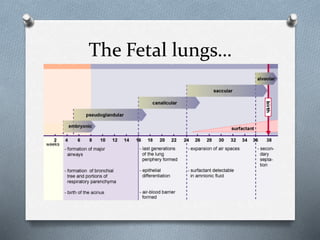
The Fetal lungs…
5 stages of human lung
development:
1. Embryonic Stage
Langman’s Medical Embryology. 12th edition
5 stages of human lung
development:
1. Embryonic Stage
2. Pseudoglandular Stage
5 stages of human lung
development:
1. Embryonic Stage
2. Pseudoglandular Stage
3. Canalicular Stage
5 stages of human lung
development:
1. Embryonic Stage
2. Pseudoglandular Stage
3. Canalicular Stage
4. Saccular stage
5 stages of human lung
development:
1. Embryonic Stage
2. Pseudoglandular Stage
3. Canalicular Stage
4. Saccular stage
5. Alveolar Stage
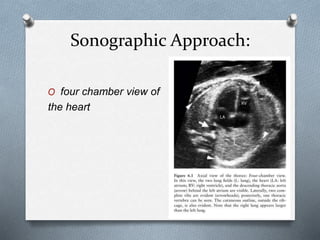
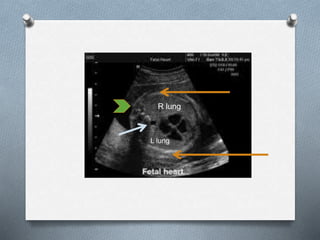
Sonographic Approach:
O four chamber view of
the heart
R lung
L lung
Lung Lesions
Lung Hypoplasia
O Incomplete or defective development of
the lung resulting in overall reduced size
due to reduced numbers or size of acini
O Factors required for adequate
development of the Lungs:
a. sufficient amniotic fluid volumes
b. adequate thoracic space size
c. normal breathing movements
d. normal fluid within the lung
Lung Hypoplasia
O Thoracic dimensions assesed by
measuring the TC/AC ratio and cardio-
thoracic ratio
O Decreased dimensions correlate with
Lung Hypoplasia
***TC/AC ratio NV >0.8
CT ratio NV <0.5
Lung Hypoplasia
O most cases of pulmonary hypoplasia
occur secondary to congenital anomalies
or secondary to pregnancy complications
while some can be a primary event
CCAM of the Lung
O Congenital Cystic Adenomatoid
Malformation
O Benign hamartomatous or dysplastic
tumor
O Overgrowth of terminal bronchioles
resulting to a reduced number of alveoli
CCAM of the Lung
O 25% of all congenital lung masses
O 1 in 25,000 live births
O >95% occur in 1 lobe or segment
CCAM of the Lung
O 3 Categories:
Type I Type II Type III
2-10 cm cyst 0.5 - 2 cms cyst <2 cms cyst
Variable sized cyst Uniform sized cysts Appear solid
Compresses the
normal
parenchyma
Evenly distributed
and blends w/ the
normal
parenchyma
Small cystic or solid
type
CCAM of the Lung
O Additional Subtypes:
Type 0 Type IV
Acinar dysplasia or
agenesis
Large peripheral cyst of the
distal acinus lined
predominantly with alveolar
type cells
CCAM of the Lung
O Prenatal Classification based on
Ultrasound Findings:
Macrocystic Microcystic
Single or multiple cysts >/=
5 mm in diameter
<5mm diameter cysts
Seen on ultrasound as
cysts
Solid hyperechogenic mass
due to numerous acoutic
interfaces
Favourable prognosis Poorer prognosis
CCAM of the Lung
O depending on the size of the lesion,
esophageal compression may occur
resulting to subsequent polyhydramnios
O Its natural history is unpredictable
because some may grow or regress
CCAM of the Lung
Longitudinal Section
CCAM of the Lung
Sagittal Section Transverse Image
CCAM of the Lung
Complications:
If with Associated findings like:
Mediastinal shift
Polyhydramnios
Presence of Hydrops
Will determine prognosis. Once Hydrops
100% mortality.
CCAM of the Lung
Prognosis:
- Unilateral Type I CCAM (Large cystic type) if
with no Polyhydramnios and Hydrops
GOOD Prognosis
- Poorer prognosis even if unilateral if with
associated features such as:
large sized cysts
polyhydramnios
fetal hydrops
mediastinal shift
associated anomalies
Bronchopulmonary
Sequestration (BPS)
O masses of non functioning lung tissue
that do not have a connection to the
normal tracheobronchial tree and is
supplied by an anomalous systemic artery
O normally situated in the lower lobes
Bronchopulmonary
Sequestration (BPS)
Intralobar Extralobar
Blood Supply: aortic branch Thoracic and abdominal
aorta
Venous drainage:
Pulmonary veins
Systemic veins
(hemiazygous, azygous
vein)
More common Less common
Abnormal segment of lung
tissue shares visceral
pleural covering of the
normal lung
Discrete accesory lobe with
its own pleural covering
Less associated with other
anomalies
More associated with other
anomalies e.g CDH
Bronchopulmonary
Sequestration (BPS)
O Other findings associated with Extralobar
category:
O typically found in the left thorax (65-90%) or
w/in or below the diaphragm (10-15%)
O associated more with male fetuses than
female (4:1 ratio)
Bronchopulmonary
Sequestration (BPS)
Bronchopulmonary
Sequestration (BPS)
Bronchopulmonary
Sequestration (BPS)
O Prognosis:
O generally GOOD
O pleural effusions and subsequently fetal
hydrops may develop
Bronchopulmonary
Sequestration (BPS)
O Management:
O Close monitoring
O early delivery may be contemplated after 32-
33 weeks AOG
O thoracoamniotic shunting or thoracocentesis
can be considered in associated pleural
effusions and fetal hydrops
Congenital High Airway
Obstruction Syndrome (CHAOS)
complete or near complete obstruction of
the upper airway
obstructed flow of fetal lung fluid
& elevated intratracheal pressure
Distension of the tracheobronchial tree and
lung expansion
Congenital High Airway
Obstruction Syndrome (CHAOS)
Thinning of alveolar walls
Reduction of Type II Pneumocytes
Decreased Surfactant
Decreased venous return
Non Immune Hydrops
Congenital High Airway
Obstruction Syndrome (CHAOS)
Findings of:
 Large hyperechoic lungs,
 flattened or inverted diaphragm
 dilated airways distal to the obstruction
 fetal ascites or hydrops
Other Lung Abnormalities:
O Congenital Lobar Emphysema
- Obstructed bronchus leading to progressive
hyperexpansion of the lung parenchyma
- Right, middle and upper lobes most commonly
affected
- Hard to detect on ultrasound since cellular and
fluid composition of affected lobe very similar
to normal lung upon examination
Other Lung Abnormalities:
O Bronchogenic cysts
- From abnormal budding of the ventricular
diverticulum
- Focal cystic duplication of the
tracheobronchial tree
- Few milliliters to >5 cm
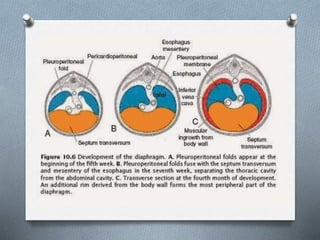
Fetal Diaphragm
O embryonic development end around 8th
week of conception
O Development consists of fusion from 4
elements:
1. Septum Transversum- anterior central
tendon
2. Pleuroperitoneal membrane-
dorsolateral portions
3. Esophageal mesentery- dorsal crura
4. Thoracic Intercostal muscles
Fetal Diaphragm
O dome shaped partition between the
thoracic and abdominal cavities
O Allows passage of organs, vessels, and
nerves from the thoracic into the
abdominal cavity
O On UTZ: smooth hypoechoic line between
the lungs and liver or spleen
Congenital Diaphragmatic
Hernia
O a development
defect of the
diaphragm that
allows abdominal
viscera to
herniate into the
chest
(Insert CDH gross
Picture)
Congenital Diaphragmatic
Hernia
O Incidence:
1:2000-5000 live births
8 % of all major congenital anomalies
mortality nearing 70%
 Etiology:
Failure of closure of Pleuroperitoneal canal
at 8-12 weeks
Congenital Diaphragmatic
Hernia
Congenital Diaphragmatic
Hernia
Congenital Diaphragmatic
Hernia
O Sonographic Features:
1. Absence of gastric bubble in its normal
position
2. Displacement of the heart across the
mediastinum towards the right
3. Bowel and liver in the left chest
4. Presence of the stomach adjacent to the
heart
Congenital Diaphragmatic
Hernia
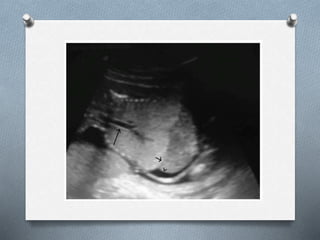
Congenital Hydrothorax
O a.k.a. Pleural effusions
O may be associated with generalized
edema and ascites or may occur in
isolation
O chylothorax is the most common cause
O rare (incidence of 1 in 15,000
pregnancies)
O Complications arise by the degree of fluid
accumulation
O mediastinal compression with reduced
fetal swallowing
O Polyhydramnios
Congenital Hydrothorax
O Prenatal Management:
a. Conservative management
b. antenatal thoracocentesis
c. pleuroamniotic shunting
Congenital Hydrothorax

Thorax 00

  • 1.
  • 2.
  • 3.
    5 stages ofhuman lung development: 1. Embryonic Stage
  • 4.
  • 6.
    5 stages ofhuman lung development: 1. Embryonic Stage 2. Pseudoglandular Stage
  • 8.
    5 stages ofhuman lung development: 1. Embryonic Stage 2. Pseudoglandular Stage 3. Canalicular Stage
  • 10.
    5 stages ofhuman lung development: 1. Embryonic Stage 2. Pseudoglandular Stage 3. Canalicular Stage 4. Saccular stage
  • 12.
    5 stages ofhuman lung development: 1. Embryonic Stage 2. Pseudoglandular Stage 3. Canalicular Stage 4. Saccular stage 5. Alveolar Stage
  • 14.
    Sonographic Approach: O fourchamber view of the heart
  • 15.
  • 17.
  • 18.
    Lung Hypoplasia O Incompleteor defective development of the lung resulting in overall reduced size due to reduced numbers or size of acini O Factors required for adequate development of the Lungs: a. sufficient amniotic fluid volumes b. adequate thoracic space size c. normal breathing movements d. normal fluid within the lung
  • 19.
    Lung Hypoplasia O Thoracicdimensions assesed by measuring the TC/AC ratio and cardio- thoracic ratio O Decreased dimensions correlate with Lung Hypoplasia ***TC/AC ratio NV >0.8 CT ratio NV <0.5
  • 20.
    Lung Hypoplasia O mostcases of pulmonary hypoplasia occur secondary to congenital anomalies or secondary to pregnancy complications while some can be a primary event
  • 22.
    CCAM of theLung O Congenital Cystic Adenomatoid Malformation O Benign hamartomatous or dysplastic tumor O Overgrowth of terminal bronchioles resulting to a reduced number of alveoli
  • 23.
    CCAM of theLung O 25% of all congenital lung masses O 1 in 25,000 live births O >95% occur in 1 lobe or segment
  • 24.
    CCAM of theLung O 3 Categories: Type I Type II Type III 2-10 cm cyst 0.5 - 2 cms cyst <2 cms cyst Variable sized cyst Uniform sized cysts Appear solid Compresses the normal parenchyma Evenly distributed and blends w/ the normal parenchyma Small cystic or solid type
  • 25.
    CCAM of theLung O Additional Subtypes: Type 0 Type IV Acinar dysplasia or agenesis Large peripheral cyst of the distal acinus lined predominantly with alveolar type cells
  • 26.
    CCAM of theLung O Prenatal Classification based on Ultrasound Findings: Macrocystic Microcystic Single or multiple cysts >/= 5 mm in diameter <5mm diameter cysts Seen on ultrasound as cysts Solid hyperechogenic mass due to numerous acoutic interfaces Favourable prognosis Poorer prognosis
  • 27.
    CCAM of theLung O depending on the size of the lesion, esophageal compression may occur resulting to subsequent polyhydramnios O Its natural history is unpredictable because some may grow or regress
  • 28.
    CCAM of theLung Longitudinal Section
  • 29.
    CCAM of theLung Sagittal Section Transverse Image
  • 30.
    CCAM of theLung Complications: If with Associated findings like: Mediastinal shift Polyhydramnios Presence of Hydrops Will determine prognosis. Once Hydrops 100% mortality.
  • 31.
    CCAM of theLung Prognosis: - Unilateral Type I CCAM (Large cystic type) if with no Polyhydramnios and Hydrops GOOD Prognosis - Poorer prognosis even if unilateral if with associated features such as: large sized cysts polyhydramnios fetal hydrops mediastinal shift associated anomalies
  • 32.
    Bronchopulmonary Sequestration (BPS) O massesof non functioning lung tissue that do not have a connection to the normal tracheobronchial tree and is supplied by an anomalous systemic artery O normally situated in the lower lobes
  • 33.
    Bronchopulmonary Sequestration (BPS) Intralobar Extralobar BloodSupply: aortic branch Thoracic and abdominal aorta Venous drainage: Pulmonary veins Systemic veins (hemiazygous, azygous vein) More common Less common Abnormal segment of lung tissue shares visceral pleural covering of the normal lung Discrete accesory lobe with its own pleural covering Less associated with other anomalies More associated with other anomalies e.g CDH
  • 34.
    Bronchopulmonary Sequestration (BPS) O Otherfindings associated with Extralobar category: O typically found in the left thorax (65-90%) or w/in or below the diaphragm (10-15%) O associated more with male fetuses than female (4:1 ratio)
  • 35.
  • 36.
  • 37.
    Bronchopulmonary Sequestration (BPS) O Prognosis: Ogenerally GOOD O pleural effusions and subsequently fetal hydrops may develop
  • 38.
    Bronchopulmonary Sequestration (BPS) O Management: OClose monitoring O early delivery may be contemplated after 32- 33 weeks AOG O thoracoamniotic shunting or thoracocentesis can be considered in associated pleural effusions and fetal hydrops
  • 39.
    Congenital High Airway ObstructionSyndrome (CHAOS) complete or near complete obstruction of the upper airway obstructed flow of fetal lung fluid & elevated intratracheal pressure Distension of the tracheobronchial tree and lung expansion
  • 40.
    Congenital High Airway ObstructionSyndrome (CHAOS) Thinning of alveolar walls Reduction of Type II Pneumocytes Decreased Surfactant Decreased venous return Non Immune Hydrops
  • 41.
    Congenital High Airway ObstructionSyndrome (CHAOS) Findings of:  Large hyperechoic lungs,  flattened or inverted diaphragm  dilated airways distal to the obstruction  fetal ascites or hydrops
  • 43.
    Other Lung Abnormalities: OCongenital Lobar Emphysema - Obstructed bronchus leading to progressive hyperexpansion of the lung parenchyma - Right, middle and upper lobes most commonly affected - Hard to detect on ultrasound since cellular and fluid composition of affected lobe very similar to normal lung upon examination
  • 44.
    Other Lung Abnormalities: OBronchogenic cysts - From abnormal budding of the ventricular diverticulum - Focal cystic duplication of the tracheobronchial tree - Few milliliters to >5 cm
  • 45.
    Fetal Diaphragm O embryonicdevelopment end around 8th week of conception O Development consists of fusion from 4 elements: 1. Septum Transversum- anterior central tendon 2. Pleuroperitoneal membrane- dorsolateral portions 3. Esophageal mesentery- dorsal crura 4. Thoracic Intercostal muscles
  • 47.
    Fetal Diaphragm O domeshaped partition between the thoracic and abdominal cavities O Allows passage of organs, vessels, and nerves from the thoracic into the abdominal cavity O On UTZ: smooth hypoechoic line between the lungs and liver or spleen
  • 48.
    Congenital Diaphragmatic Hernia O adevelopment defect of the diaphragm that allows abdominal viscera to herniate into the chest (Insert CDH gross Picture)
  • 49.
    Congenital Diaphragmatic Hernia O Incidence: 1:2000-5000live births 8 % of all major congenital anomalies mortality nearing 70%  Etiology: Failure of closure of Pleuroperitoneal canal at 8-12 weeks
  • 50.
  • 51.
  • 52.
    Congenital Diaphragmatic Hernia O SonographicFeatures: 1. Absence of gastric bubble in its normal position 2. Displacement of the heart across the mediastinum towards the right 3. Bowel and liver in the left chest 4. Presence of the stomach adjacent to the heart
  • 53.
  • 54.
    Congenital Hydrothorax O a.k.a.Pleural effusions O may be associated with generalized edema and ascites or may occur in isolation O chylothorax is the most common cause O rare (incidence of 1 in 15,000 pregnancies)
  • 55.
    O Complications ariseby the degree of fluid accumulation O mediastinal compression with reduced fetal swallowing O Polyhydramnios
  • 56.
    Congenital Hydrothorax O PrenatalManagement: a. Conservative management b. antenatal thoracocentesis c. pleuroamniotic shunting
  • 57.

Editor's Notes

  • #3 In comparison with the development of the other organs the prenatal development of the lungs occupies a special position. The lungs as breathing organs are unnecessary for intrauterine existence. Nevertheless, they must be developed to such an extent that they are immediately ready to function following birth. This explains why the entire development extends from the embryonic period through the fetal period up to birth (and even afterwards). During intrauterine life, the lungs are nevertheless an important source of amniotic fluid.
  • #5 By the end of the 4th week of life, during the embryonic stage of lung development, the respiratory diverticulum/lung bud (caudal end of the laryngotracheal groove grows caudally foming the primitive trachea
  • #6 2 lateral outpocketings which are the lung buds. By the end of the 5th week, each of the lung bud enlarges forming the right and the left main bronchus By the end of the 6th week, all bronchopulmonary segments have been formed
  • #8 During this stage, there is repeated dichotomous branching of the main bronchus, forming (CLICK) three secondary bronchi on the right and two secondary bronchi on the left.. These in turn will become the conducting airways By the 16th week, (CLICK) the tracheobronchial tree has been formed
  • #10 (At 16-28 weeks, the gas exchanging portion of the lungs are formed and vascularized, this is when the secondary bronchioles divide continously into smaller canals.) During the canalicular period Each terminal bronchiole divides into 2 or more respiratory bronchioles. It is also the time when capillaries will start to establish close contact
  • #12 a.k.a terminal sac period. These ducts would later end in terminal sacs a.k.a. primitive alveoli surrounded by flat alveolar cells wherein surrounding capillaries come in close contact. By the end of the 7th month, sufficient numbers of mature alveolar sacs and capillaries are present to guarantee adequate gas exchange, granting the premature infant to be able to survive
  • #14 Starts from 36 weeks to term. Further thinning of the blood gas barrier, increase production of surfactant, and progressive branching of the respiratory airways leading to alveolar production
  • #15 To be able to determine presence of normal thoracic anatomy, assesment / measurement of the thoracic circumference at the level of the four chamber view of the heart should be obtained. Key view for the assessment of intrathoracic fetal anatomy
  • #16 Fundamental plane where heart and lung are assessed On this view, the ff structures can, and should be assessed: Thoracic outline- consisting of 2 displayed ribs and overlying soft tissues and skin. The ribs should be uniformly echogenic, continously smooth, with convex contour and encircle 2/3 of the thoracic area. Two lungs: which occupies 2/3 of the thoracic area. The normal lungs appear symmetric and homogenous with medium level echogenicity increasing gradually as gestation progresses. Echogenicity is slightly increased compared with the liver. Right lung slightly larger than the left. The lungs should abut the thoracic cage with no hypoechoic space in between. Thoracic aorta; lying in the pre vertebral area just left of the midline behind the left atrium One thoracic vertebra: on the midline posteriorly
  • #17 This is the axial view of the chest. Its shape is almost circular. The ribs are shown to be uniformly echogenic smooth with convex contour and again encircling 2/3 of the chest wall. The figure B or image B shows where the thoracic circumference should be measured, which is along the outer rib contour excluding the skin and soft tissue.
  • #19 Deficiency on any of these factors may lead to pulmonary hypoplasia
  • #21 Secondary to congenital anomalies: CDH (most common); Bronchopulmonary sequestration; Extrathoracic causes: intraabdominal masses; abdominal ascites Pregnancy complications: oligohydramnios
  • #23 Hamartoma – benign focal malformation that resembles a neoplasm in the tissue of its origin Occurs during the pseudoglandular period resulting to expansion of conducting airways and peripheral lung tubules and acinar tubules
  • #26 With this classification designation of CCAM be changed to Congenital Pulmonary Airway Malformation owing to the fact that only three of the five types were cystic and only one type (type 3) adenomatoid
  • #27 Microcystic: difficult to ID normal parenchyma on affected side
  • #28 Hamartoma – benign focal malformation that resembles a neoplasm in the tissue of its origin Occurs during the pseudoglandular period resulting to expansion of conducting airways and peripheral lung tubules and acinar tubules
  • #29  Large cystic lesion on the right hemithorax
  • #30 In the sagittal section depicted by the arrows, the CCAM is located at the posterior chest inferior to the heart Second image shows the transverse view of the same fetus, arrowhead points to the gastric bubble, showing the extent of the lesion situated at the left lung
  • #34 Intralobar accounts for 75% of pulmonary sequestrations
  • #36 Abn echogenic lung lobe at basal area of the right chest Demonstrated on coronal view Cross sectional view Doppler done to establish the lobe directy supplied by the vessels from the aorta These are images of an intralobar category
  • #37 Markers: extralobar sequestration with aberrant blood supply (arrow)
  • #40 CHAOS is usually a constellation of findings which arise due to obstruction of the upper airway tract. Causes of obstruction: laryngeal atresia; stenosis; laryngeal cyst; tracheal atresia or stenosis
  • #41 CHAOS is usually a constellation of findings which arise due to obstruction of the upper airway tract. Causes of obstruction: laryngeal atresia; stenosis; laryngeal cyst; tracheal atresia or stenosis
  • #43 Upper airway causing dilated trachea; large echogenic lungs, inverted diaphragm and fetal ascites
  • #46 Fetal embryonic development occur between 8-12 weeks of development. Ventrally from the septum transversum (most impt component) which forms the anterior central tendon the pleuroperitoneal membrane fuses with the dorsal mesentery of the esophagus and the dorsal portion of the septum transversus, forming the dorsolateral portions to separate the thoracic and abdominopelvic cavities (primitive diaphragm). Esophageal mesentery froming the dorsal crura And the thoracic intercostal muscles(body wall)
  • #50 Causes: >>>> either by primary diaphragmatic defect with secondary migration of abdominal organs into the thoracic cavity or defect in the fusion of the 4 components
  • #51 Almost all of the hernias occur in the posterolaterally located Bochdalek foramen, which characteristically involve the left side. Morgagni hernias occur in the anteromedial retrosternal part of the diaphragm as a result of the maldevelopment of the septum tranversum
  • #53 … gastric bubble not seen in the abdomen but beside the heart in the thoracic cavity
  • #54 … gastric bubble not seen in the abdomen but beside the heart in the thoracic cavity
  • #55 Hydrothorax is the accumulation of fluid in the pleural space. It can be primary or secondary, and unilateral or bilateral. At diagnosis, it is bilateral in about 75% of the cases and is already associated with fetal hydrops in 60-65% (1, 2). If isolated, it is commonly due to congenital primary chylothorax, with an estimated incidence of 1/10.000-15.000 pregnancies (1, 2)
  • #56 After the diagnosis of fetal hydrothorax, the optimal antenatal management is controversial since some fetuses may not be significantly compromised, whereas others may develop hydrops or die at birth from pulmonary hypoplasia. Therefore, the decision to treat, deliver prematurely or follow conservatively can be difficult.
  • #57 Thoracocentesis to aspirate the pleural fluid was first proposed as a treatment of primary fetal hydrothorax in 1982 (20). It is performed under continuous ultrasound guidance using a 20-gauge needle inserted percutaneously. The main drawback of thoracocentesis is that in the majority of cases it is usually followed by rapid re-accumulation of the effusion within 24-48 hours, necessitating repeated taps.