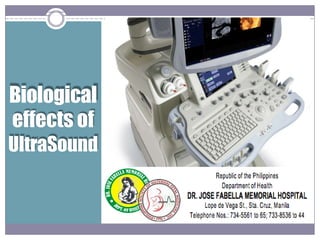


Biological
effects of
UltraSound
INTRODUCTION
UTZ - HIGH FREQUENCY MECHANICAL WAVE
above human hearing range (>20,000 Hz)
produced by converting ELECTRIC  MECHANICAL energy
BIO-EFFECTS of UTZ – potential BIO consequences
due to interaction b/n UTZ waves & scanned tissues
Concern on:
• biological effects on susceptible structures (fetal tissues)
• No human studies available to establish its effects
• Use of higher acoustic outputs
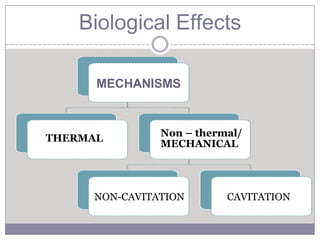
Biological Effects
MECHANISMS
THERMAL
Non – thermal/
MECHANICAL
NON-CAVITATION CAVITATION
THERMAL EFFECTS
DEFINITION: Temperature w/in a medium
HOW: SONIC energy absorbed & converted  HEAT
FACTORS TO CONSIDER
1. ACOUSTIC characteristics
• POWER -rate of E transmission Transducer to Medium (mW)
• INTENSITY-rate of E flow through an area (mW/cm2)
Spatial-Peak Temporal Average Intensity (ISPTA)
2. TISSUE characteristics
• Heat generation
• Heat loss
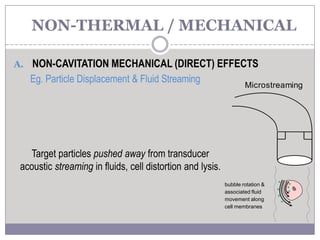
A. NON-CAVITATION MECHANICAL (DIRECT) EFFECTS
Eg. Particle Displacement & Fluid Streaming
Target particles pushed away from transducer
acoustic streaming in fluids, cell distortion and lysis.
bubble rotation &
associated fluid
movement along
cell membranes
Microstreaming
NON-THERMAL / MECHANICAL
B. CAVITATION
DEFINITION: activity of small gas bodies
w/in tissues in the presence of UTZ waves
HOW: Regions of compression &
rarefaction created in a medium 
Pressure &  formation & size of
gas bodies  STABLE or grow to critical
size then collapse INERTIAL/TRANSIENT
 E generated  mechanical effects …
FACTOR TO CONSIDER:
ACOUSTIC PRESSURE (Mpa)
NON-THERMAL / MECHANICAL
STABLE : bubbles oscillating with sound beam.
EFFECT: mechanical damage
membrane rupture
cell lysis.
TRANSIENT : very rapid expansion & violent collapse.
creating high temp. & pressure  release of free radicals
EFFECT: genetic damage in vitro
TYPES OF CAVITATION
Some reported fetal effects of US exposure:
Delayed speech, dyslexia, growth restriction,& non-right-
handedness.
EPIDEMIOLOGIC STUDIES
“…no definite causal association to Fetal Growth & development”
IN VITRO CELL STUDIES
“…no biologic effects even at intensities exceeding those
produced by diagnostic UTZ machines”
ANIMAL STUDIES
“…no biologic effects at usual diagnostic levels”
Information regarding
UTZ BIOEFFECTS
BUT up to date there is insufficient justification
to conclude that there is a causal relationship
between diagnostic US & long-term adverse fetal
effects THEREFORE exposure to UTZ during
pregnancy appears to be safe
LIMITATION: most studies included were when
Acoustic outputs were LOWER and under strict
regulation
Information regarding
UTZ BIOEFFECTS
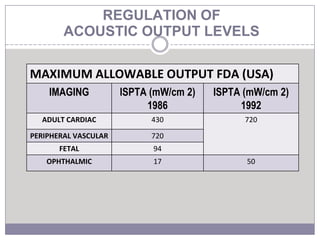
MAXIMUM ALLOWABLE OUTPUT FDA (USA)
IMAGING ISPTA (mW/cm 2)
1986
ISPTA (mW/cm 2)
1992
ADULT CARDIAC 430 720
PERIPHERAL VASCULAR 720
FETAL 94
OPHTHALMIC 17 50
REGULATION OF
ACOUSTIC OUTPUT LEVELS
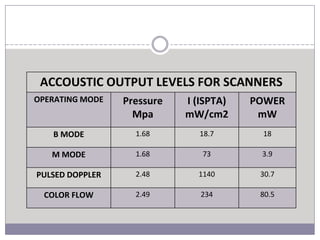
ACCOUSTIC OUTPUT LEVELS FOR SCANNERS
OPERATING MODE Pressure
Mpa
I (ISPTA)
mW/cm2
POWER
mW
B MODE 1.68 18.7 18
M MODE 1.68 73 3.9
PULSED DOPPLER 2.48 1140 30.7
COLOR FLOW 2.49 234 80.5
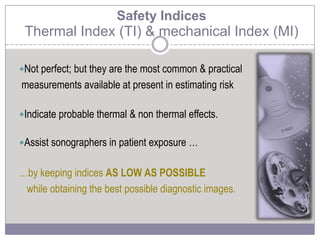
Safety Indices
Thermal Index (TI) & mechanical Index (MI)
Not perfect; but they are the most common & practical
measurements available at present in estimating risk
Indicate probable thermal & non thermal effects.
Assist sonographers in patient exposure …
…by keeping indices AS LOW AS POSSIBLE
while obtaining the best possible diagnostic images.
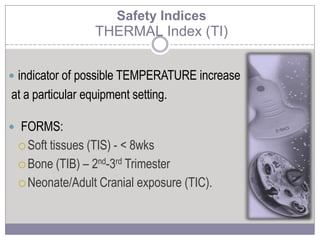
 indicator of possible TEMPERATURE increase
at a particular equipment setting.
 FORMS:
 Soft tissues (TIS) - < 8wks
 Bone (TIB) – 2nd-3rd Trimester
 Neonate/Adult Cranial exposure (TIC).
Safety Indices
THERMAL Index (TI)
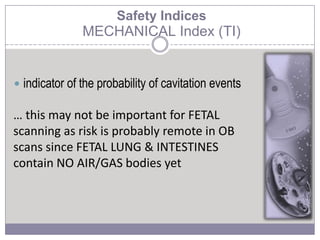
 indicator of the probability of cavitation events
… this may not be important for FETAL
scanning as risk is probably remote in OB
scans since FETAL LUNG & INTESTINES
contain NO AIR/GAS bodies yet
Safety Indices
MECHANICAL Index (TI)
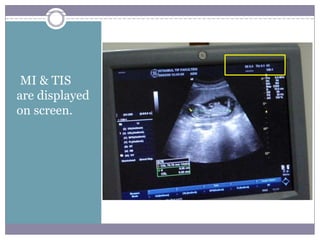
•MI & TIS
are displayed
on screen.
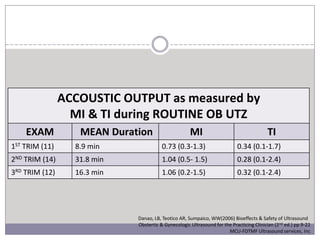
ACCOUSTIC OUTPUT as measured by
MI & TI during ROUTINE OB UTZ
EXAM MEAN Duration MI TI
1ST TRIM (11) 8.9 min 0.73 (0.3-1.3) 0.34 (0.1-1.7)
2ND TRIM (14) 31.8 min 1.04 (0.5- 1.5) 0.28 (0.1-2.4)
3RD TRIM (12) 16.3 min 1.06 (0.2-1.5) 0.32 (0.1-2.4)
Danao, LB, Teotico AR, Sumpaico, WW(2006) Bioeffects & Safety of Ultrasound
Obstertic & Gynecologic Ultrasound for the Practicing Clinician (2nd ed.) pp 9-22
MCU-FDTMF Ultrasound services, Inc
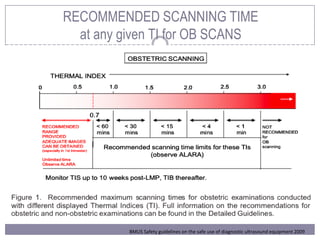
RECOMMENDED SCANNING TIME
at any given TI for OB SCANS
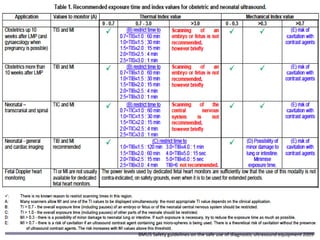
BMUS Safety guidelines on the safe use of diagnostic ultrasound equipment 2009
SOGC (2005)
UTZ should only be used when BENEFIT OUTWEIGHS RISK
Exposure should be As Low As Reasonably Achievable
DWELL TIME & OUTPUT CONTROL
Dx UTZ device should comply w/ ODS (MI & TI)
Avoid Pulsed/Color doppler in 1st trimester
SATEMENTS ON
CLINICAL SAFETY OF UTZ
ISUOG (2003)
ODS is accepted as most practical/understandable in estimating RISK
M MODE / B MODE is safe in all stages of pregnancy
DOPPLER use should be with VALID indication
requiring a knowledgeable Operator
1st TRIMESTER has the highest risk of damage
Exposure & acoustic output should be kept at the LOWEST possible
consistent with obtaining Dx information ,
limited to MEDICALLY indicated procedures rather than entertainment
SATEMENTS ON
CLINICAL SAFETY OF UTZ
AIUM (1997)
“There is NO CONFIRMED BIO EFFECT on patients/instrument operators caused by
EXPOSURES from DIAGNOSTIC UTZ INSTRUMENTS.
Although the possibility exists that such BIO EFFECTs may be Identified in the future
Current DATA indicate that the BENEFITS to patients on the prudent use of Diagnostic UTZ
OUTWEIGH RISKS if any that may be present “
SATEMENTS ON
CLINICAL SAFETY OF UTZ
DO NOT hesitate to use DIAGNOSTIC UTZ when the situation warrants
FAMILIARIZATION w/ the equipment to know the OPERATING MODES & CONTROL
SETTINGS will result to HIGH/LOW acoustic INTENSITIES
Know & recognize the controls to adjust acoustic POWER
Decreased EXPOSURE TIME by decreasing REPEAT SCANS
avoid a stationary transducer in contact w/ patient = DWELL TIME unless warranted
… keep indices AS LOW AS POSSIBLE
while obtaining the best possible diagnostic images
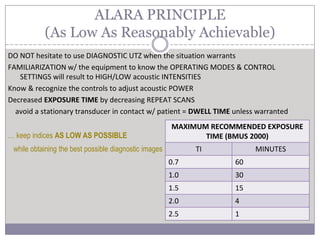
ALARA PRINCIPLE
(As Low As Reasonably Achievable)
MAXIMUM RECOMMENDED EXPOSURE
TIME (BMUS 2000)
TI MINUTES
0.7 60
1.0 30
1.5 15
2.0 4
2.5 1
“UTZ machine MANUFACTURERS are expected to design
their equipment so as to deliver the lowest possible
acoustic exposure consistent w/ diagnostic expectations
of that equipment.
HOWEVER, user awareness & responsibility are major
elements in ensuring patient safety during UTZ
examinations”
Danao, LB, Teotico AR, Sumpaico, WW(2006) Bioeffects & Safety of Ultrasound
Obstertic & Gynecologic Ultrasound for the Practicing Clinician (2nd ed.) pp 9-22
MCU-FDTMF Ultrasound services, Inc
THANK YOU
UTZ BIOEFFECTS

UTZ BIOEFFECTS

  • 1.
  • 2.
    INTRODUCTION UTZ - HIGHFREQUENCY MECHANICAL WAVE above human hearing range (>20,000 Hz) produced by converting ELECTRIC  MECHANICAL energy BIO-EFFECTS of UTZ – potential BIO consequences due to interaction b/n UTZ waves & scanned tissues Concern on: • biological effects on susceptible structures (fetal tissues) • No human studies available to establish its effects • Use of higher acoustic outputs
  • 3.
    Biological Effects MECHANISMS THERMAL Non –thermal/ MECHANICAL NON-CAVITATION CAVITATION
  • 4.
    THERMAL EFFECTS DEFINITION: Temperaturew/in a medium HOW: SONIC energy absorbed & converted  HEAT FACTORS TO CONSIDER 1. ACOUSTIC characteristics • POWER -rate of E transmission Transducer to Medium (mW) • INTENSITY-rate of E flow through an area (mW/cm2) Spatial-Peak Temporal Average Intensity (ISPTA) 2. TISSUE characteristics • Heat generation • Heat loss
  • 5.
    A. NON-CAVITATION MECHANICAL(DIRECT) EFFECTS Eg. Particle Displacement & Fluid Streaming Target particles pushed away from transducer acoustic streaming in fluids, cell distortion and lysis. bubble rotation & associated fluid movement along cell membranes Microstreaming NON-THERMAL / MECHANICAL
  • 6.
    B. CAVITATION DEFINITION: activityof small gas bodies w/in tissues in the presence of UTZ waves HOW: Regions of compression & rarefaction created in a medium  Pressure &  formation & size of gas bodies  STABLE or grow to critical size then collapse INERTIAL/TRANSIENT  E generated  mechanical effects … FACTOR TO CONSIDER: ACOUSTIC PRESSURE (Mpa) NON-THERMAL / MECHANICAL
  • 7.
    STABLE : bubblesoscillating with sound beam. EFFECT: mechanical damage membrane rupture cell lysis. TRANSIENT : very rapid expansion & violent collapse. creating high temp. & pressure  release of free radicals EFFECT: genetic damage in vitro TYPES OF CAVITATION
  • 8.
    Some reported fetaleffects of US exposure: Delayed speech, dyslexia, growth restriction,& non-right- handedness. EPIDEMIOLOGIC STUDIES “…no definite causal association to Fetal Growth & development” IN VITRO CELL STUDIES “…no biologic effects even at intensities exceeding those produced by diagnostic UTZ machines” ANIMAL STUDIES “…no biologic effects at usual diagnostic levels” Information regarding UTZ BIOEFFECTS
  • 9.
    BUT up todate there is insufficient justification to conclude that there is a causal relationship between diagnostic US & long-term adverse fetal effects THEREFORE exposure to UTZ during pregnancy appears to be safe LIMITATION: most studies included were when Acoustic outputs were LOWER and under strict regulation Information regarding UTZ BIOEFFECTS
  • 10.
    MAXIMUM ALLOWABLE OUTPUTFDA (USA) IMAGING ISPTA (mW/cm 2) 1986 ISPTA (mW/cm 2) 1992 ADULT CARDIAC 430 720 PERIPHERAL VASCULAR 720 FETAL 94 OPHTHALMIC 17 50 REGULATION OF ACOUSTIC OUTPUT LEVELS
  • 11.
    ACCOUSTIC OUTPUT LEVELSFOR SCANNERS OPERATING MODE Pressure Mpa I (ISPTA) mW/cm2 POWER mW B MODE 1.68 18.7 18 M MODE 1.68 73 3.9 PULSED DOPPLER 2.48 1140 30.7 COLOR FLOW 2.49 234 80.5
  • 12.
    Safety Indices Thermal Index(TI) & mechanical Index (MI) Not perfect; but they are the most common & practical measurements available at present in estimating risk Indicate probable thermal & non thermal effects. Assist sonographers in patient exposure … …by keeping indices AS LOW AS POSSIBLE while obtaining the best possible diagnostic images.
  • 13.
     indicator ofpossible TEMPERATURE increase at a particular equipment setting.  FORMS:  Soft tissues (TIS) - < 8wks  Bone (TIB) – 2nd-3rd Trimester  Neonate/Adult Cranial exposure (TIC). Safety Indices THERMAL Index (TI)
  • 14.
     indicator ofthe probability of cavitation events … this may not be important for FETAL scanning as risk is probably remote in OB scans since FETAL LUNG & INTESTINES contain NO AIR/GAS bodies yet Safety Indices MECHANICAL Index (TI)
  • 15.
    •MI & TIS aredisplayed on screen.
  • 16.
    ACCOUSTIC OUTPUT asmeasured by MI & TI during ROUTINE OB UTZ EXAM MEAN Duration MI TI 1ST TRIM (11) 8.9 min 0.73 (0.3-1.3) 0.34 (0.1-1.7) 2ND TRIM (14) 31.8 min 1.04 (0.5- 1.5) 0.28 (0.1-2.4) 3RD TRIM (12) 16.3 min 1.06 (0.2-1.5) 0.32 (0.1-2.4) Danao, LB, Teotico AR, Sumpaico, WW(2006) Bioeffects & Safety of Ultrasound Obstertic & Gynecologic Ultrasound for the Practicing Clinician (2nd ed.) pp 9-22 MCU-FDTMF Ultrasound services, Inc
  • 17.
    RECOMMENDED SCANNING TIME atany given TI for OB SCANS BMUS Safety guidelines on the safe use of diagnostic ultrasound equipment 2009
  • 18.
    BMUS Safety guidelineson the safe use of diagnostic ultrasound equipment 2009
  • 19.
    SOGC (2005) UTZ shouldonly be used when BENEFIT OUTWEIGHS RISK Exposure should be As Low As Reasonably Achievable DWELL TIME & OUTPUT CONTROL Dx UTZ device should comply w/ ODS (MI & TI) Avoid Pulsed/Color doppler in 1st trimester SATEMENTS ON CLINICAL SAFETY OF UTZ
  • 20.
    ISUOG (2003) ODS isaccepted as most practical/understandable in estimating RISK M MODE / B MODE is safe in all stages of pregnancy DOPPLER use should be with VALID indication requiring a knowledgeable Operator 1st TRIMESTER has the highest risk of damage Exposure & acoustic output should be kept at the LOWEST possible consistent with obtaining Dx information , limited to MEDICALLY indicated procedures rather than entertainment SATEMENTS ON CLINICAL SAFETY OF UTZ
  • 21.
    AIUM (1997) “There isNO CONFIRMED BIO EFFECT on patients/instrument operators caused by EXPOSURES from DIAGNOSTIC UTZ INSTRUMENTS. Although the possibility exists that such BIO EFFECTs may be Identified in the future Current DATA indicate that the BENEFITS to patients on the prudent use of Diagnostic UTZ OUTWEIGH RISKS if any that may be present “ SATEMENTS ON CLINICAL SAFETY OF UTZ
  • 22.
    DO NOT hesitateto use DIAGNOSTIC UTZ when the situation warrants FAMILIARIZATION w/ the equipment to know the OPERATING MODES & CONTROL SETTINGS will result to HIGH/LOW acoustic INTENSITIES Know & recognize the controls to adjust acoustic POWER Decreased EXPOSURE TIME by decreasing REPEAT SCANS avoid a stationary transducer in contact w/ patient = DWELL TIME unless warranted … keep indices AS LOW AS POSSIBLE while obtaining the best possible diagnostic images ALARA PRINCIPLE (As Low As Reasonably Achievable) MAXIMUM RECOMMENDED EXPOSURE TIME (BMUS 2000) TI MINUTES 0.7 60 1.0 30 1.5 15 2.0 4 2.5 1
  • 23.
    “UTZ machine MANUFACTURERSare expected to design their equipment so as to deliver the lowest possible acoustic exposure consistent w/ diagnostic expectations of that equipment. HOWEVER, user awareness & responsibility are major elements in ensuring patient safety during UTZ examinations” Danao, LB, Teotico AR, Sumpaico, WW(2006) Bioeffects & Safety of Ultrasound Obstertic & Gynecologic Ultrasound for the Practicing Clinician (2nd ed.) pp 9-22 MCU-FDTMF Ultrasound services, Inc
  • 24.