Option B: Obedience to Authority: Cause and Effect. First, read
Stanley Milgram’s classic article on his infamous ‘shock’
experiments in the 1960’s. Follow this up by watching Obeying
or Resisting Authority: A Psychological Retrospective,
available via the Films on Demand section of the Ashford
University Library. Read Chapter 7: Power and Politics. Then,
address each of the following questions.
· What specific factors would cause people to continue to shock
other people, past the perceived thresholds of extreme pain,
unconsciousness, or even death?
· Provide three different explanations for this behavior,
utilizing the three perspectives we have learned so far: the
anthropological, political, and sociological perspectives.
· In other words, to what specific causal factor would an
anthropologist attribute this behavior? What about a political
scientist? A sociologist?
Be sure to provide concrete examples from the text and from
your own research. In crafting your response, you must make
reference to at least two sources beyond the textbook or the
assigned documentary
Below are links that will help compete assignment along with
chapter 7
http://www.apa.org/research/action/order.aspx
https://simplypsychology.org/milgram.html
https://youtu.be/fxiWkTCjMmY
CHAPTER 7: Power and Politics
Learning Objectives
After reading this chapter, students will be able to:
Describe the discipline of political science and explain
what it is concerned with.
Define democracy.
Describe the kind of democracy that exists in the United
States.
List the branches of the U.S. government.
Explain the source of each branch’s power and how that
power is exercised.
Politics, Political Science, and Government Power
A distinguished American political scientist, Harold Lasswell,
defined politics as “who gets what, when, and how.” “The study
of politics,” he said, “is the study of influence and the
influential. The influential are those who get the most of what
there is to get. . . . Those who get the most are the elite; the rest
are mass.”1 He went on to define political science as the study
of “the shaping and sharing of power.” Admittedly, Lasswell’s
definition of political science is very broad. Indeed, if we
accept Lasswell’s definition of political science as the study of
power, then political science includes cultural, economic,
social, and personal power relationships—topics that we have
already discussed in chapters on anthropology, economics,
sociology, and psychology.
politics
the study of power
Although some political scientists have accepted Lasswell’s
challenge to study power in all its forms in society, most limit
the definition of political science to the study of government
and how individuals influence government action. This chapter
focuses primarily on the study of government and how
individuals influence government action in the United States.
political science
the study of government and how individuals influence
government action
What distinguishes government power from the power of other
institutions, groups, and individuals? The power of government,
unlike that of other institutions in society, is distinguished by
(1) the legitimate use of physical force and (2) coverage of the
whole society rather than only segments of it. By legitimate, we
mean the right or power of the government to exercise
authority. By physical force, we mean that the government can
legitimately compel action, sometimes through law enforcement
agencies and sometimes through the threat of punishment,
including incarceration. Because government decisions extend
to the whole of society and because only government can
legitimately use physical force, government has the primary
responsibility for maintaining order and for resolving
differences that arise between segments of society. Thus,
government must regulate conflict by establishing and enforcing
general rules by which conflict is to be carried on in society, by
arranging compromises and balancing interests, and by
imposing settlements that the parties in the dispute must accept.
In other words, government lays down the “rules of the game”
in conflict and competition between individuals, organizations,
and institutions within society.
government power
the legitimate use of force; coverage of the whole society
Democracy means individual participation in the decisions that
affect one’s life, often through voting. Here Egyptian soldiers
stand guard as voters leave a polling station in Cairo in 2011,
the first Egyptian elections held after the popular uprising that
ousted long-time dictator Hosni Mubarak from power.
The Meaning of Democracy
Ideally, democracy means individual participation in the
decisions that affect one’s life. In traditional democratic theory,
popular participation has been valued as an opportunity for
individual self-development. Responsibility for governing one’s
own conduct develops character, self-reliance, intelligence, and
moral judgment—in short, dignity. Even if a benevolent king
could govern in the public interest, the true democrat would
reject him.2
democracy
individual participation in the decisions that affect one’s life
Procedurally, popular participation was to be achieved through
majority rule and respect for the rights of those with a minority
view. Self-development means self-government, and self-
government can be accomplished only by encouraging each
individual to contribute to the creation of public policy and by
resolving conflicts over public policy through majority rule.
Minorities who had had the opportunity to influence policy but
whose views had not succeeded in winning majority support
would accept the decisions of majorities. In return, majorities
would permit minorities to attempt openly to win majority
support for their views. Freedom of speech and press, freedom
to dissent, and freedom to form opposition parties and
organizations are essential to ensure meaningful individual
participation.
John Locke and the Idea of Limited Government
Oftentimes, majority rule and respect for the rights of
minorities occurs by limiting the power of the government
through a social contract. Constitutionalism is the belief that
government power should be limited. A fundamental ideal of
constitutionalism—“a government of laws and not of men”—
suggests that those who exercise government authority are
restricted in their use of it by a higher law. A constitution
governs government.
constitutionalism
the belief that government power should be limited
A famous exponent of the idea of constitutional government was
the English political philosopher John Locke (1632–1704).
Perhaps more than anyone else, Locke inspired the political
thought of our nation’s founders in that critical period of
American history in which the new nation won its independence
and established its constitution. Locke’s ideas are written into
both the Declaration of Independence and the Constitution of
the United States.
According to Locke, all people possess natural rights. These
rights are not granted by government but derive from human
nature itself. Governments cannot deprive people of their
“unalienable rights to life, liberty, and property.” People are
rational beings, capable of self-government and able to
participate in political decision making. Locke believed that
human beings formed a contract among themselves to establish
a government in order to better protect their natural rights,
maintain peace, and protect themselves from foreign invasion.
natural rights
rights are not granted by government but derive from human
nature itself
Because government was instituted as a contract to secure the
rights of citizens, government itself could not violate individual
rights. If government did so, it would dissolve the contract
establishing it. Revolution, then, was justified if government
was not serving the purpose for which it had been set up.
However, according to Locke, revolution was justified only
after a long period of abuses by government, not over any minor
mismanagement.
A social contract is the idea (not an actual written contract) that
people consent to be governed and voluntarily give up some of
their liberties so that the remainder of their liberties can be
protected. For example, in the United States, people enjoy the
right of freedom of speech, but this right is limited: One cannot
exercise freedom of speech if it means joking to airport security
personnel about bringing a bomb onboard an aircraft. But this
rule protects people from the inconvenience of more delayed
flights if security had to identify and search the bags of every
prankster.
social contract
the idea that people consent to be governed and in doing so
agree to give up some of their liberties so that the remainder of
their liberties can be protected
The social contract that established government made for safe
and peaceful living and for the secure enjoyment of one’s life,
liberty, and property. Thus, the ultimate legitimacy of
government derived from a contract among the people
themselves and not from gods or kings. It was based on the
consent of the governed. To safeguard their individual rights,
the people agree to be governed.
Thomas Jefferson eloquently expressed Lockean ideals in the
Declaration of Independence:
We hold these truths to be self-evident, that all men are created
equal, that they are endowed by their Creator with certain
unalienable Rights, that among these are Life, Liberty, and the
pursuit of Happiness. That to secure these rights, Governments
are instituted among Men, deriving their just powers from the
consent of the governed.
Democratic Ideals of Liberty and Equality
The underlying value of democracy is individual dignity. In the
Declaration of Independence, Thomas Jefferson wrote that
human beings, by virtue of their existence, are entitled to life,
liberty, and the pursuit of happiness. Government control over
the individual should be kept to a minimum; this means the
removal of as many external restrictions, controls, and
regulations on the individual as possible without infringing on
the freedom of other citizens.3
Another vital aspect of classic democracy is a belief in the
equality of all people. The Declaration of Independence
expresses the conviction that “all men are created equal.” The
founders believed in equality before the law, notwithstanding
the circumstances of the accused. Although the founders’ view
of who was equal was limited—women and racial minorities
were not afforded the same political rights as white males—the
notion of equality informed early American political life.
Eventually, the idea of equality has come to mean that a person
is not to be judged by social position, sex, economic class,
creed, or race. Many early democrats also believed in political
equality, that is, equal opportunity to influence public policy.4
Political equality is expressed in the concept of “one person,
one vote.”
Over time, the notion of equality has also come to include
equality of opportunity in all aspects of American life—social,
educational, and economic, as well as political—and to
encompass employment, housing, recreation, and public
accommodations. All people are to have equal opportunity to
develop their individual capacities to their natural limits.
In summary, democratic thinking involves the following ideas:
Popular participation in the decisions that shape the lives
of individuals in a society, including consent of the governed
Limited government formed by a social contract, which
establishes the right of revolution if the government
consistently tramples the rights of individuals
Government by majority rule, with recognition of the
rights of minorities to try to become majorities; these rights
include the freedoms of speech, press, assembly, and petition,
and the freedom to dissent, to form opposition parties, and to
run for public office
A commitment to individual dignity and the preservation
of the liberal values of liberty and property
A commitment to equal opportunity for all to develop their
individual capacities
Power and the American Constitution
A constitution establishes government authority. It sets up
government bodies (such as the House of Representatives, the
Senate, the presidency, and the Supreme Court in the United
States). It grants them powers, determines how their members
are to be chosen, and prescribes the rules by which they make
decisions. Constitutional decision making is deciding how to
decide, that is, it is deciding on the rules for policy making. It
is not policy making itself. Policies will be decided later,
according to the rules set forth in the Constitution.5
constitution
the establishment of government authority; the creation of
government bodies, granting their powers, determining how
their members are selected, and prescribing the rules by which
government decisions are to be made; considered basic or
fundamental, a constitution cannot be changed by ordinary acts
of government bodies
A constitution cannot be changed by the ordinary acts of
government bodies; change can come only through a process of
general popular consent. The U.S. Constitution, then, is superior
to ordinary laws of Congress, orders of the president, decisions
of the courts, acts of the state legislatures, and regulations of
the bureaucracies. Indeed, the Constitution is “the supreme law
of the land.”
Constitutionalism: Limiting Government Power
As we noted, constitutions govern government. To place
individual freedoms beyond the reach of government and
beyond the reach of majorities, a constitution must truly limit
and control the exercise of authority by government. It does so
by setting forth individual liberties that the government—even
with majority support—cannot violate. In the United States,
many of these individual liberties can be found in the first ten
amendments to the Constitution.
The Bill of Rights
The U.S. Constitution contains many specific written
restrictions on government power. The original text of the
Constitution that emerged from the Philadelphia Convention in
1787 did not contain a Bill of Rights—a listing of individual
freedoms and restrictions on government power. The nation’s
founders originally argued that a specific listing of individual
freedoms was unnecessary because the national government
possessed only enumerated powers; the power to restrict free
speech or press or religion was not an enumerated power, so the
national government could not do these things. But Anti-
Federalists (who did not favor ratifying the Constitution and
argued for states’ rights) in the state ratifying conventions were
suspicious of the power of the new national government.6 They
were not satisfied with the mere inference that the national
government could not interfere with personal liberty; they
wanted specific written guarantees of fundamental freedoms.
The Federalist supporters of the new Constitution agreed to add
a Bill of Rights as the first ten amendments to the Constitution
in order to win ratification in the state conventions. This is why
our fundamental freedoms—speech, press, religion, assembly,
petition, and due process of law—appear in the Constitution as
amendments (Table 7-1).
Bill of Rights
the first ten amendments to the U.S. Constitution listing
individual freedoms and restrictions on government power
Anti-Federalists
those who argued against ratification of the U.S. Constitution;
they were wary of a strong national government and favored
states’ rights
Federalists
advocates for ratification of the U.S. Constitution
TABLE 7-1: THE BILL OF RIGHTS
The Bill of Rights limits the power of government by
proscribing what it cannot do, and it also specifies some
individual rights citizens enjoy. In recommending the rights to
be included in the Bill of Rights, James Madison chose from
among more than two hundred suggestions.* That the rights he
selected still have applicability today is a testament to his
forethought and understanding of human nature and the nature
of governments.
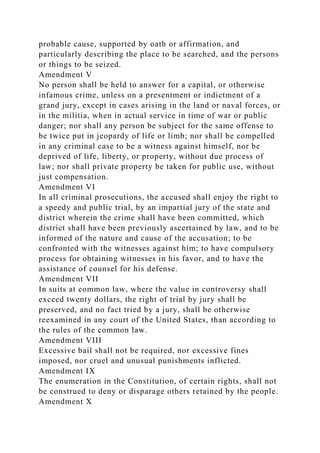
Amendment I
Congress shall make no law respecting an establishment of
religion, or prohibiting the free exercise thereof; or abridging
the freedom of speech, or of the press; or the right of the people
peaceably to assemble, and to petition the government for a
redress of grievances.
Amendment II
A well regulated militia, being necessary to the security of a
free state, the right of the people to keep and bear arms, shall
not be infringed.
Amendment III
No soldier shall, in time of peace be quartered in any house,
without the consent of the owner, nor in time of war, but in a
manner to be prescribed by law.
Amendment IV
The right of the people to be secure in their persons, houses,
papers, and effects, against unreasonable searches and seizures,
shall not be violated, and no warrants shall issue, but upon
probable cause, supported by oath or affirmation, and
particularly describing the place to be searched, and the persons
or things to be seized.
Amendment V
No person shall be held to answer for a capital, or otherwise
infamous crime, unless on a presentment or indictment of a
grand jury, except in cases arising in the land or naval forces, or
in the militia, when in actual service in time of war or public
danger; nor shall any person be subject for the same offense to
be twice put in jeopardy of life or limb; nor shall be compelled
in any criminal case to be a witness against himself, nor be
deprived of life, liberty, or property, without due process of
law; nor shall private property be taken for public use, without
just compensation.
Amendment VI
In all criminal prosecutions, the accused shall enjoy the right to
a speedy and public trial, by an impartial jury of the state and
district wherein the crime shall have been committed, which
district shall have been previously ascertained by law, and to be
informed of the nature and cause of the accusation; to be
confronted with the witnesses against him; to have compulsory
process for obtaining witnesses in his favor, and to have the
assistance of counsel for his defense.
Amendment VII
In suits at common law, where the value in controversy shall
exceed twenty dollars, the right of trial by jury shall be
preserved, and no fact tried by a jury, shall be otherwise
reexamined in any court of the United States, than according to
the rules of the common law.
Amendment VIII
Excessive bail shall not be required, nor excessive fines
imposed, nor cruel and unusual punishments inflicted.
Amendment IX
The enumeration in the Constitution, of certain rights, shall not
be construed to deny or disparage others retained by the people.
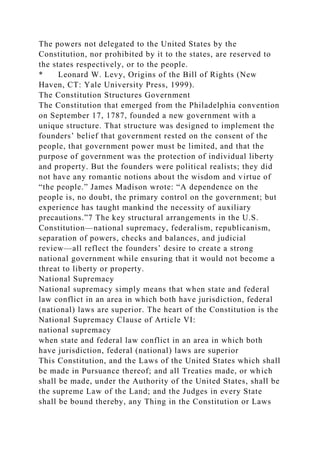
Amendment X
The powers not delegated to the United States by the
Constitution, nor prohibited by it to the states, are reserved to
the states respectively, or to the people.
* Leonard W. Levy, Origins of the Bill of Rights (New
Haven, CT: Yale University Press, 1999).
The Constitution Structures Government
The Constitution that emerged from the Philadelphia convention
on September 17, 1787, founded a new government with a
unique structure. That structure was designed to implement the
founders’ belief that government rested on the consent of the
people, that government power must be limited, and that the
purpose of government was the protection of individual liberty
and property. But the founders were political realists; they did
not have any romantic notions about the wisdom and virtue of
“the people.” James Madison wrote: “A dependence on the
people is, no doubt, the primary control on the government; but
experience has taught mankind the necessity of auxiliary
precautions.”7 The key structural arrangements in the U.S.
Constitution—national supremacy, federalism, republicanism,
separation of powers, checks and balances, and judicial
review—all reflect the founders’ desire to create a strong
national government while ensuring that it would not become a
threat to liberty or property.
National Supremacy
National supremacy simply means that when state and federal
law conflict in an area in which both have jurisdiction, federal
(national) laws are superior. The heart of the Constitution is the
National Supremacy Clause of Article VI:
national supremacy
when state and federal law conflict in an area in which both
have jurisdiction, federal (national) laws are superior
This Constitution, and the Laws of the United States which shall
be made in Pursuance thereof; and all Treaties made, or which
shall be made, under the Authority of the United States, shall be
the supreme Law of the Land; and the Judges in every State
shall be bound thereby, any Thing in the Constitution or Laws
of any State to the Contrary notwithstanding.
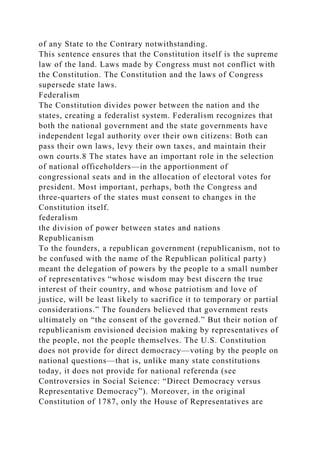
This sentence ensures that the Constitution itself is the supreme
law of the land. Laws made by Congress must not conflict with
the Constitution. The Constitution and the laws of Congress
supersede state laws.
Federalism
The Constitution divides power between the nation and the
states, creating a federalist system. Federalism recognizes that
both the national government and the state governments have
independent legal authority over their own citizens: Both can
pass their own laws, levy their own taxes, and maintain their
own courts.8 The states have an important role in the selection
of national officeholders—in the apportionment of
congressional seats and in the allocation of electoral votes for
president. Most important, perhaps, both the Congress and
three-quarters of the states must consent to changes in the
Constitution itself.
federalism
the division of power between states and nations
Republicanism
To the founders, a republican government (republicanism, not to
be confused with the name of the Republican political party)
meant the delegation of powers by the people to a small number
of representatives “whose wisdom may best discern the true
interest of their country, and whose patriotism and love of
justice, will be least likely to sacrifice it to temporary or partial
considerations.” The founders believed that government rests
ultimately on “the consent of the governed.” But their notion of
republicanism envisioned decision making by representatives of
the people, not the people themselves. The U.S. Constitution
does not provide for direct democracy—voting by the people on
national questions—that is, unlike many state constitutions
today, it does not provide for national referenda (see
Controversies in Social Science: “Direct Democracy versus
Representative Democracy”). Moreover, in the original
Constitution of 1787, only the House of Representatives are
elected directly by voters in the states. Members of the Senate
were elected by state legislatures; not until the ratification of
the Seventeenth Amendment in 1913 would voters directly elect
their U.S. senators. The president is elected by “electors”
(chosen in a way prescribed by state legislatures) and the U.S.
Supreme Court and other federal judges are appointed by the
president with the consent of the Senate.
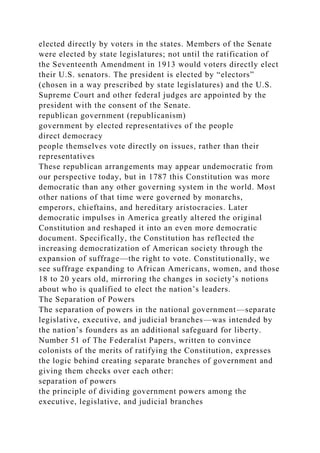
republican government (republicanism)
government by elected representatives of the people
direct democracy
people themselves vote directly on issues, rather than their
representatives
These republican arrangements may appear undemocratic from
our perspective today, but in 1787 this Constitution was more
democratic than any other governing system in the world. Most
other nations of that time were governed by monarchs,
emperors, chieftains, and hereditary aristocracies. Later
democratic impulses in America greatly altered the original
Constitution and reshaped it into an even more democratic
document. Specifically, the Constitution has reflected the
increasing democratization of American society through the
expansion of suffrage—the right to vote. Constitutionally, we
see suffrage expanding to African Americans, women, and those
18 to 20 years old, mirroring the changes in society’s notions
about who is qualified to elect the nation’s leaders.
The Separation of Powers
The separation of powers in the national government—separate
legislative, executive, and judicial branches—was intended by
the nation’s founders as an additional safeguard for liberty.
Number 51 of The Federalist Papers, written to convince
colonists of the merits of ratifying the Constitution, expresses
the logic behind creating separate branches of government and
giving them checks over each other:
separation of powers
the principle of dividing government powers among the
executive, legislative, and judicial branches
Ambition must be made to counteract ambition. . . . It may be a
reflection on human nature, that such devices should be
necessary to control the abuses of government. But what is
government itself, but the greatest of all reflections on human
nature? If men were angels, no government would be necessary.
If angels were to govern men, neither external nor internal
controls on government would be necessary. In framing a
government which is to be administered by men over men, the
great difficulty lies in this: you must first enable the
government to control the governed; and in the next place
oblige it to control itself.9
In practical terms, this has meant that the power to create,
administer, and judge the laws has rested with the legislative,
executive, and judicial branches, respectively.
Checks and Balances
Each of the major decision-making bodies of American
government possesses important checks and balances (Figure 7-
1) over the decisions of the others. No bill can become law
without the approval of both the House and the Senate. The
president shares in legislative power through the veto and the
responsibility of the office to “give to the Congress information
of the State of the Union, and recommend to their consideration
such measures as he shall judge necessary and expedient.” The
president also can convene sessions of Congress. But the
president’s powers to make appointments and treaties are shared
by the Senate. Congress also can override executive vetoes.
checks and balances
the principle whereby each branch of the government exercises
a check on the actions of the others, preventing too great a
concentration of power in any one person or group of persons
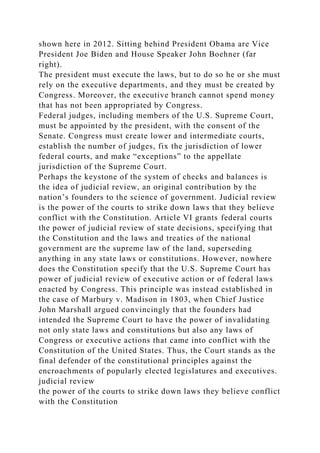
FIGURE 7-1: CHECKS AND BALANCES IN THE U.S.
GOVERNMENT
The president shares legislative power by setting the
congressional agenda through his State of the Union address,
shown here in 2012. Sitting behind President Obama are Vice
President Joe Biden and House Speaker John Boehner (far
right).
The president must execute the laws, but to do so he or she must
rely on the executive departments, and they must be created by
Congress. Moreover, the executive branch cannot spend money
that has not been appropriated by Congress.
Federal judges, including members of the U.S. Supreme Court,
must be appointed by the president, with the consent of the
Senate. Congress must create lower and intermediate courts,
establish the number of judges, fix the jurisdiction of lower
federal courts, and make “exceptions” to the appellate
jurisdiction of the Supreme Court.
Perhaps the keystone of the system of checks and balances is
the idea of judicial review, an original contribution by the
nation’s founders to the science of government. Judicial review
is the power of the courts to strike down laws that they believe
conflict with the Constitution. Article VI grants federal courts
the power of judicial review of state decisions, specifying that
the Constitution and the laws and treaties of the national
government are the supreme law of the land, superseding
anything in any state laws or constitutions. However, nowhere
does the Constitution specify that the U.S. Supreme Court has
power of judicial review of executive action or of federal laws
enacted by Congress. This principle was instead established in
the case of Marbury v. Madison in 1803, when Chief Justice
John Marshall argued convincingly that the founders had
intended the Supreme Court to have the power of invalidating
not only state laws and constitutions but also any laws of
Congress or executive actions that came into conflict with the
Constitution of the United States. Thus, the Court stands as the
final defender of the constitutional principles against the
encroachments of popularly elected legislatures and executives.
judicial review
the power of the courts to strike down laws they believe conflict
with the Constitution
CONTROVERSIES IN SOCIAL SCIENCE: Direct
Democracy versus Representative Democracy
Democracy means popular participation in government. (The
Greek roots of the word mean “rule by the many.”) But “popular
participation” can have different meanings. To our nation’s
founders, who were quite ambivalent about the wisdom of
democracy, it meant that the voice of the people would be
represented in government. Representational democracy means
the selection of government officials by vote of the people in
periodic elections open to competition in which candidates and
voters can freely express themselves.
Direct democracy means that the people themselves can initiate
and decide policy questions by popular vote. The founders were
profoundly skeptical of this form of democracy. The U.S.
Constitution has no provision for direct voting by the people on
national policy questions. It was not until over one hundred
years after the U.S. Constitution was written that widespread
support developed in the American states for direct voter
participation in policy making. Direct democracy developed in
states and communities, and it is to be found today only in state
and local government.
Initiative and Referendum
The initiative is a form of direct democracy whereby a specific
number or percent of voters, through the use of petition, may
have a proposed state constitutional amendment or state law
placed on the ballot for adoption or rejection by the electorate
of a state. This process bypasses the legislature and allows
citizens to both propose and adopt laws and constitutional
amendments.
The referendum is a device by which the electorate must
approve citizen initiatives or decisions of the legislature before
these become law or become part of the state constitution. Most
states require a favorable referendum vote for a state
constitutional amendment. Referenda on state laws may be
submitted by the legislature (when legislators want to shift
decision-making responsibility to the people), or referenda may
be demanded by popular petition (when the people wish to
change laws passed by the legislature).
Arguments for Direct Democracy
Proponents of direct democracy make several strong arguments
on behalf of the initiative and referendum devices.
Direct democracy enhances government responsiveness and
accountability. The threat of a successful initiative and
referendum drive—indeed, sometimes the mere circulation of a
petition—encourages officials to take the popular actions.
Direct democracy allows citizen groups to bring their
concern directly to the public. For example, taxpayer groups
have been able through the initiative and referendum devices to
place their concerns on the public agenda.
Direct democracy stimulates debate about policy issues. In
elections with important referendum issues on the ballot,
campaigns tend to be more issue oriented.
Direct democracy stimulates voters’ interest and improves
election-day turnout. Controversial issues on the ballot—the
death penalty, abortion, gun control, taxes, gay rights, a ban on
racial preferences, and so on—bring out additional voters.
Arguments for Representative Democracy
Opponents of direct democracy, from our nation’s founders to
the present, argue that representative democracy offers far
better protection for individual liberty and the rights of
minorities than direct democracy. The founders constructed a
system of checks and balances not so much to protect against
the oppression of a ruler but to protect against the tyranny of
the majority. Opponents of direct democracy echo many of the
founders’ arguments:
Direct democracy encourages majorities to sacrifice the
rights of individuals and minorities. This argument supposes
that voters are generally less tolerant than elected officials.
Voters are not sufficiently informed to cast intelligent
ballots on many issues. Many voters cast their vote in a
referendum without ever having considered the issue before
going into the polling booth.
A referendum does not allow consideration of alternative
policies or modifications or amendments to the proposition set
forth on the ballot. In contrast, legislators devote a great deal of
attention to writing, rewriting, and amending bills and seeking
out compromises among interests.
Direct democracy enables special interests to mount
expensive initiative and referendum campaigns. Although
proponents of direct democracy argue that these devices allow
citizens to bypass legislatures dominated by special-interest
groups, in fact, only a fairly well-financed group can mount a
statewide campaign on behalf of a referendum issue.
SOURCE: See Thomas E. Cronin, Direct Democracy
(Cambridge, MA: Harvard University Press, 1989).
Federalism and the Growth of Power in the Federal Government
Since the founding of the United States, the power of the
national government has increased significantly.10 Major
developments in the history of American federalism have
contributed to this increase in national power.
Expansion of Implied National Power
Chief Justice John Marshall added immeasurably to national
power in McCulloch v. Maryland (1819) when he broadly
interpreted the “necessary and proper” clause of Article I,
Section 8, of the Constitution, which states that the Congress
has the power “to make all laws necessary and proper for
carrying into Execution the foregoing powers, and all other
Powers vested in this Constitution in the Government of the
United States . . . .” Marshall asserted powers for the federal
government that were not explicitly expressed in the
Constitution. In approving the establishment of a national bank
(a power not specifically delegated to the national government
in the Constitution), Marshall wrote:
Let the end be legitimate, let it be within the scope of the
Constitution, and all means which are appropriate, which are
plainly adopted to that end, which are not prohibited but
consistent with the letter and the spirit of the Constitution, are
constitutional.11
Since then, the “necessary and proper” clause has been called
the “implied powers” clause or even the “elastic” clause,
suggesting that the national government can do anything not
specifically prohibited by the Constitution. Given this tradition,
the courts are unlikely to hold an act of Congress
unconstitutional simply because no formal constitutional grant
of power gives Congress the power to act.
The Civil War as a Victory for Federalism
Although we often view the Civil War as a war about slavery,
the war also was the nation’s greatest crisis in federalism. A
key question decided by the war was whether a state has the
right to oppose federal action by force of arms. The same issue
was at stake when, to enforce desegregation, the federal
government sent troops to Little Rock, Arkansas, in 1957; to
Oxford, Mississippi, in 1962; and to Tuscaloosa, Alabama, in
1963. In these confrontations, it was clear that the federal
government held the military advantage.
Growth of Interstate Commerce
The growth of national power under the interstate commerce
clause is also an important development in American
federalism. The Industrial Revolution created a national
economy governable only by a national government. Yet, until
the 1930s, the U.S. Supreme Court placed many obstacles in the
way of government regulation of the economy. Finally, in
National Labor Relations Board v. Jones & Laughlin Steel
Corporation (1937), the Supreme Court recognized the principle
that Congress could regulate production and distribution of
goods and services for a national market under the interstate
commerce clause. As a result, the national government gained
control over wages, prices, production, marketing, labor
relations, and all other important aspects of the national
economy. Today, we can see government regulation of interstate
commerce in our everyday lives, whether in the minimum wages
paid by employers or the federal regulations on workplace
conditions.
Federal Civil Rights Enforcement
Over the years, the U.S. Supreme Court has built a national
system of civil rights based on the Fourteenth Amendment,
ratified after the Civil War: “No State shall . . . deprive any
person of life, liberty, or property, without due process of law;
nor deny to any person within its jurisdiction the equal
protection of the laws.” In early cases, the Supreme Court held
that the general guarantee of liberty in the first phrase (the due
process clause) prevents state and local governments from
interfering with free speech, press, religion, and other personal
liberties. Later, particularly after Brown v. Board of Education
of Topeka in 1954, the Court also used the equal protection
clause to prohibit state and local government officials from
denying equality of opportunity.
Federal Grants-in-Aid
The federal government also exerts power through the use of
money. The income tax (established in 1913) gave the federal
government the authority to raise large sums of money, which it
spent for the “general welfare,” as well as for defense.
Gradually, the federal government expanded its power in states
and communities by use of grants-in-aid. During the Great
Depression of the 1930s, the national government used its
taxing and spending powers in a number of areas formerly
reserved to states and communities. Congress began grants-in-
aid programs to states and communities for public assistance,
unemployment compensation, employment services, child
welfare, public housing, urban renewal, highway construction,
and vocational education and rehabilitation.
grants-in-aid
payments of funds from the national government to state or
local governments, usually with conditions attached to their
uses
Today, federal grants-in-aid might pay for more police officers
in your town, the creation of a bike path in your county,
textbooks in your public schools, or highway improvement
programs in your state. Table 7-2 shows the number of
governments that exist in the United States. Nearly every
government receives federal monies to provide services, though
oftentimes these monies are channeled through the states to
counties, municipalities, and school and special districts.
TABLE 7-2: THE NUMBER OF GOVERNMENTS IN THE
UNITED STATES TODAY
Federal (national) government
1
State governments
50
County governments
3,043
Municipal and township governments
36,011
School districts
13,051
Special Services districts*
37,381
SOURCE: www.census.gov//govs/cog/GovOrgTab03ss.html.
* Includes governments that administer natural resources,
fire protection services, or housing and community
development.
Federalism Today
Today, federal grants-in-aid are the principal source of federal
power over states and communities. Nearly one-quarter of all
state and local government revenues are from federal grants.
These grants almost always come with detailed conditions
regarding how the money can be used. Categorical grants
specify particular projects or particular individuals eligible to
receive funds; block grants provide some discretion to state or
local officials in using the money for a particular government
function, such as law enforcement. Federal grant money is
distributed in hundreds of separate programs, but welfare
(including Temporary Assistance for Needy Families, or TANF)
and health (including Medicaid) account for nearly two-thirds
of federal aid money.
Federal mandates, which are requirements issued by the national
government that state and local governments must comply with,
also centralize power in Washington. The federal government
often passes laws requiring state and local governments to
perform functions or undertake tasks that Congress deems in the
public interest. Many of these federal mandates are “unfunded,”
that is, Congress does not provide any money to carry out these
mandated functions or tasks even though they impose costs on
states and communities. For example, environmental protection
laws passed by Congress require local governments to provide
specified levels of sewage treatment, and the Americans with
Disabilities Act requires state and local governments to build
ramps and alter curbs in public streets and buildings.
federal mandate
a requirement issued by the national government with which
state and local governments must comply
Devolution?
Over the years, various efforts have been made to return power
to states and communities. President Ronald Reagan was
partially successful in his “New Federalism” efforts; many
categorical grant programs were consolidated into block grants
with greater discretion given to state and local governments.
In recent decades, Congress has considered the devolution of
some government responsibilities from the national government
to the states and their local governments. So far, welfare cash
assistance is the only major federal program to “devolve” back
to the states. Since Franklin D. Roosevelt’s New Deal, with its
federal guarantee of cash Aid to Families with Dependent
Children (AFDC), low-income mothers and children had
enjoyed a legal “entitlement” to welfare payments. Welfare
reform in 1996, however, increased the power of state
government by devolving responsibility for determining
eligibility to the state. This is a major change in federal social
welfare policy (see Chapter 11) and may become a model for
future shedding of federal entitlement programs.
devolution
the transfer of federal programs to state and local governments
During the George W. Bush administration, some evidence
indicates a trend away from devolution and toward increased
federal involvement, particularly in education policy. The
federal No Child Left Behind Act has created a vast array of
federal mandates that local school districts must comply with to
continue to receive federal funding. Some of these
requirements, including mandatory yearly assessment testing of
students, have been met with criticism by teachers and
administrators. Nonetheless, the act represents a radical
departure from the devolutionary trend of previous
administrations.
Power and the Branches of the Federal Government
The changes in federalist relations and the increase in size of
the national government have necessarily resulted in changes in
the powers of the branches of the federal government—the
Congress, the presidency, and the judiciary. When the founders
drafted the Constitution, the powers of the Congress were quite
strong, while their fear of a tyrannical king-type leader made
them limit the powers of the presidency. The powers of the
judiciary were barely defined. Over the years, the powers of all
three branches of government have grown considerably, both
because of circumstance and because of the authority exerted by
individuals who have served in these branches.
Presidential Power
Americans look to their president for “greatness.” Great
presidents are those associated with great events—George
Washington with the founding of the nation, Abraham Lincoln
with the preservation of the Union, Franklin D. Roosevelt with
the nation’s emergence from economic depression and victory in
World War II (see Focus: “Rating the Presidents”). People tend
to believe that the president is responsible for “peace and
prosperity” as well as “change.” They expect their president to
present a “vision” of America’s future and to symbolize the
nation.
Providing National Leadership
The president personifies American government for most
people.12People expect the president to act decisively and
effectively to deal with national problems. They expect the
president to be compassionate—to show concern for problems
confronting individual citizens. The president, while playing
these roles, is the focus of public attention and is the nation’s
leading celebrity. Presidents receive more media coverage than
any other person in the nation, for everything from their policy
statements to their favorite foods.
The nation looks to the president for leadership. The president
has the capacity to mobilize public opinion, to communicate
directly with the American people, to offer direction and
reassurance, and to advance policy initiatives in both foreign
and domestic affairs.
One source of presidential power is being viewed favorably by
the American people. Presidential popularity is an important
asset in giving presidents power and providing national
leadership. Popular presidents cannot always transfer their
popularity into power in the way of policy successes, but
popular presidents usually have more success than unpopular
presidents. Presidential popularity is regularly tracked in
national opinion polls. Over the years, national surveys have
asked the American public the following: “Do you approve or
disapprove of the way the current president is handling his
job?” (see Focus: “Explaining Presidential Approval Ratings”).
Generally, presidents have been more successful in providing
leadership in both foreign and domestic affairs when they have
enjoyed high approval ratings.
Managing Crises
In time of crisis, the American people look to their president to
take action, to provide reassurance, and to protect the nation
and its people. For example, when the economic crisis hit in
2008, expectations were high for President Barack Obama, who
had just been elected president. It is the president, not the
Congress or the courts, who is expected to speak on behalf of
the people in time of national triumph and tragedy. The
president also gives expression to the nation’s sadness in
tragedy and strives to help the nation go forward. For example,
in the aftermath of September 11, 2001, then–President George
W. Bush addressed the nation and also attended memorial
services where he performed in a ceremonial capacity as the
nation’s “chief mourner.” The president also gives expression to
the nation’s pride in victory. The nation’s heroes are welcomed
and its championship sports teams are feted in the White House
Rose Garden.
Providing Policy Leadership
The president is expected to set policy priorities for the nation.
Most policy initiatives originate in the White House and various
departments and agencies of the executive branch and then are
forwarded to Congress with the president’s approval.
Presidential programs are submitted to Congress in the form of
messages, including the president’s annual State of the Union
Address to Congress and the Budget of the United States
Government, which the president presents each year to
Congress.
As a political leader, the president is expected to mobilize
political support for policy proposals. It is not enough for the
president to send policy proposals to Congress. The president
must rally public opinion, lobby members of Congress, win
legislative battles, and perhaps even fend off judicial challenges
to policy proposals. Take, for example, President Obama’s
reform of the nation’s health care system. In addition to
fighting a scathing battle to get the measure passed in Congress,
President Obama had to court the public on this matter and fend
off legal challenges that questioned the constitutionality of the
new law. To avoid being perceived as weak or ineffective,
presidents must get their key legislative proposals through
Congress. Presidents use the threat of a veto to prevent
Congress from passing bills that they oppose; when forced to
veto a bill, they fight to prevent an override of the veto. The
president thus is responsible for “getting things done” in the
policy arena.
Managing the Economy
The American people hold the president responsible for
maintaining a healthy economy, or for fixing a damaged one.
Presidents are blamed for economic downturns, whether or not
government policies had anything to do with market conditions.
The president is expected to “Do something!” in the face of
high unemployment, declining personal income, high mortgage
rates, rising inflation, or even a stock market crash. Herbert
Hoover in 1932, Gerald Ford in 1976, Jimmy Carter in 1980,
and George H. W. Bush in 1992—all incumbent presidents
defeated for reelection during recessions—learned the hard way
that the general public holds the president responsible for hard
economic times. Presidents must have an economic strategy to
stimulate the economy—tax incentives to spur investments,
spending proposals to create jobs, and plans to lower interest
rates. In today’s economy, they must also develop programs to
improve America’s international competitiveness. Presidents
also manage the economy through their appointment of the
Federal Reserve Board, as is discussed in Chapter 8.
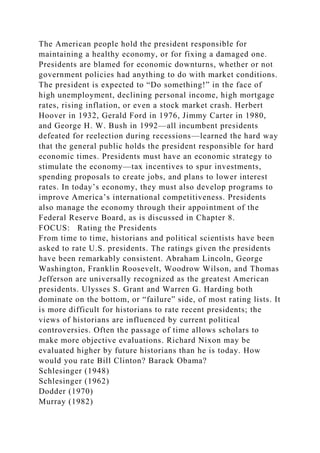
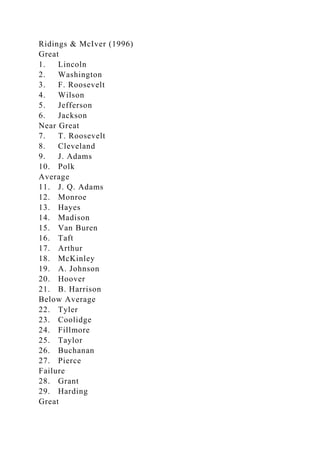
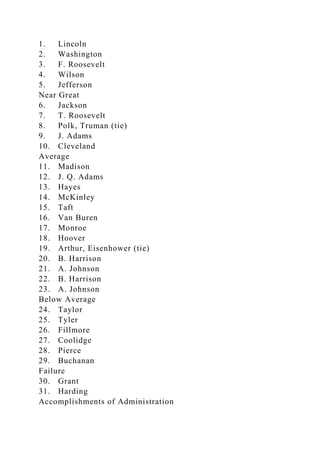
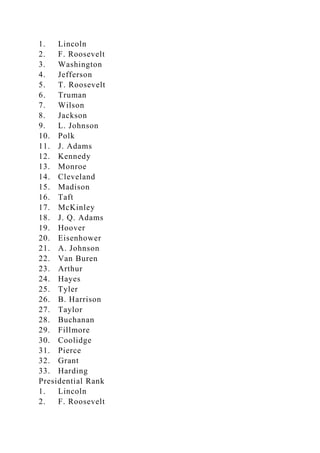
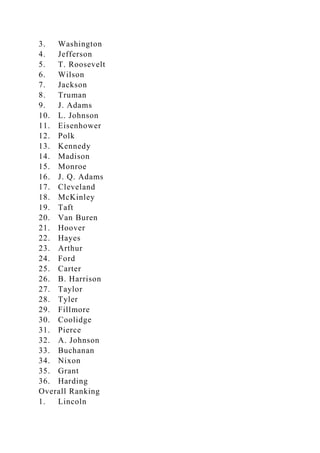
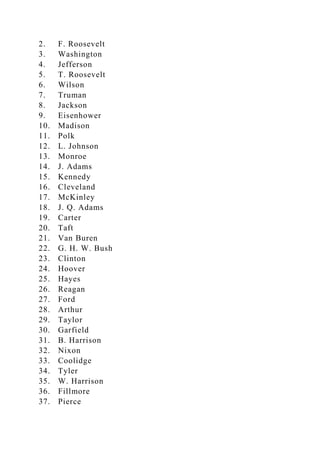
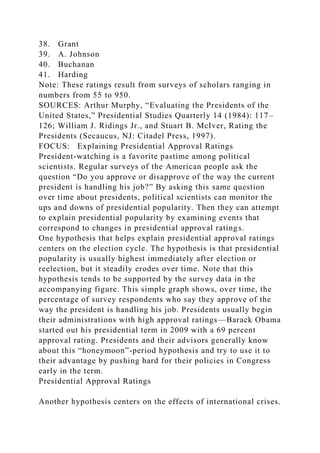
FOCUS: Rating the Presidents
From time to time, historians and political scientists have been
asked to rate U.S. presidents. The ratings given the presidents
have been remarkably consistent. Abraham Lincoln, George
Washington, Franklin Roosevelt, Woodrow Wilson, and Thomas
Jefferson are universally recognized as the greatest American
presidents. Ulysses S. Grant and Warren G. Harding both
dominate on the bottom, or “failure” side, of most rating lists. It
is more difficult for historians to rate recent presidents; the
views of historians are influenced by current political
controversies. Often the passage of time allows scholars to
make more objective evaluations. Richard Nixon may be
evaluated higher by future historians than he is today. How
would you rate Bill Clinton? Barack Obama?
Schlesinger (1948)
Schlesinger (1962)
Dodder (1970)
Murray (1982)
Ridings & McIver (1996)
Great
1. Lincoln
2. Washington
3. F. Roosevelt
4. Wilson
5. Jefferson
6. Jackson
Near Great
7. T. Roosevelt
8. Cleveland
9. J. Adams
10. Polk
Average
11. J. Q. Adams
12. Monroe
13. Hayes
14. Madison
15. Van Buren
16. Taft
17. Arthur
18. McKinley
19. A. Johnson
20. Hoover
21. B. Harrison
Below Average
22. Tyler
23. Coolidge
24. Fillmore
25. Taylor
26. Buchanan
27. Pierce
Failure
28. Grant
29. Harding
Great
1. Lincoln
2. Washington
3. F. Roosevelt
4. Wilson
5. Jefferson
Near Great
6. Jackson
7. T. Roosevelt
8. Polk, Truman (tie)
9. J. Adams
10. Cleveland
Average
11. Madison
12. J. Q. Adams
13. Hayes
14. McKinley
15. Taft
16. Van Buren
17. Monroe
18. Hoover
19. Arthur, Eisenhower (tie)
20. B. Harrison
21. A. Johnson
22. B. Harrison
23. A. Johnson
Below Average
24. Taylor
25. Tyler
26. Fillmore
27. Coolidge
28. Pierce
29. Buchanan
Failure
30. Grant
31. Harding
Accomplishments of Administration
1. Lincoln
2. F. Roosevelt
3. Washington
4. Jefferson
5. T. Roosevelt
6. Truman
7. Wilson
8. Jackson
9. L. Johnson
10. Polk
11. J. Adams
12. Kennedy
13. Monroe
14. Cleveland
15. Madison
16. Taft
17. McKinley
18. J. Q. Adams
19. Hoover
20. Eisenhower
21. A. Johnson
22. Van Buren
23. Arthur
24. Hayes
25. Tyler
26. B. Harrison
27. Taylor
28. Buchanan
29. Fillmore
30. Coolidge
31. Pierce
32. Grant
33. Harding
Presidential Rank
1. Lincoln
2. F. Roosevelt
3. Washington
4. Jefferson
5. T. Roosevelt
6. Wilson
7. Jackson
8. Truman
9. J. Adams
10. L. Johnson
11. Eisenhower
12. Polk
13. Kennedy
14. Madison
15. Monroe
16. J. Q. Adams
17. Cleveland
18. McKinley
19. Taft
20. Van Buren
21. Hoover
22. Hayes
23. Arthur
24. Ford
25. Carter
26. B. Harrison
27. Taylor
28. Tyler
29. Fillmore
30. Coolidge
31. Pierce
32. A. Johnson
33. Buchanan
34. Nixon
35. Grant
36. Harding
Overall Ranking
1. Lincoln
2. F. Roosevelt
3. Washington
4. Jefferson
5. T. Roosevelt
6. Wilson
7. Truman
8. Jackson
9. Eisenhower
10. Madison
11. Polk
12. L. Johnson
13. Monroe
14. J. Adams
15. Kennedy
16. Cleveland
17. McKinley
18. J. Q. Adams
19. Carter
20. Taft
21. Van Buren
22. G. H. W. Bush
23. Clinton
24. Hoover
25. Hayes
26. Reagan
27. Ford
28. Arthur
29. Taylor
30. Garfield
31. B. Harrison
32. Nixon
33. Coolidge
34. Tyler
35. W. Harrison
36. Fillmore
37. Pierce
38. Grant
39. A. Johnson
40. Buchanan
41. Harding
Note: These ratings result from surveys of scholars ranging in
numbers from 55 to 950.
SOURCES: Arthur Murphy, “Evaluating the Presidents of the
United States,” Presidential Studies Quarterly 14 (1984): 117–
126; William J. Ridings Jr., and Stuart B. McIver, Rating the
Presidents (Secaucus, NJ: Citadel Press, 1997).
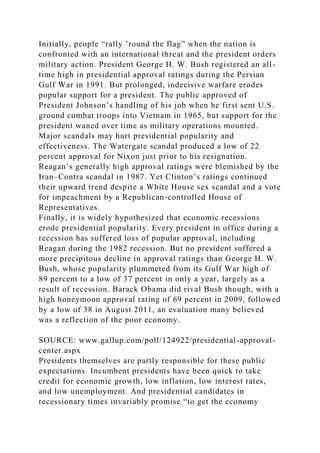
FOCUS: Explaining Presidential Approval Ratings
President-watching is a favorite pastime among political
scientists. Regular surveys of the American people ask the
question “Do you approve or disapprove of the way the current
president is handling his job?” By asking this same question
over time about presidents, political scientists can monitor the
ups and downs of presidential popularity. Then they can attempt
to explain presidential popularity by examining events that
correspond to changes in presidential approval ratings.
One hypothesis that helps explain presidential approval ratings
centers on the election cycle. The hypothesis is that presidential
popularity is usually highest immediately after election or
reelection, but it steadily erodes over time. Note that this
hypothesis tends to be supported by the survey data in the
accompanying figure. This simple graph shows, over time, the
percentage of survey respondents who say they approve of the
way the president is handling his job. Presidents usually begin
their administrations with high approval ratings—Barack Obama
started out his presidential term in 2009 with a 69 percent
approval rating. Presidents and their advisors generally know
about this “honeymoon”-period hypothesis and try to use it to
their advantage by pushing hard for their policies in Congress
early in the term.
Presidential Approval Ratings
Another hypothesis centers on the effects of international crises.
Initially, people “rally ’round the flag” when the nation is
confronted with an international threat and the president orders
military action. President George H. W. Bush registered an all-
time high in presidential approval ratings during the Persian
Gulf War in 1991. But prolonged, indecisive warfare erodes
popular support for a president. The public approved of
President Johnson’s handling of his job when he first sent U.S.
ground combat troops into Vietnam in 1965, but support for the
president waned over time as military operations mounted.
Major scandals may hurt presidential popularity and
effectiveness. The Watergate scandal produced a low of 22
percent approval for Nixon just prior to his resignation.
Reagan’s generally high approval ratings were blemished by the
Iran–Contra scandal in 1987. Yet Clinton’s ratings continued
their upward trend despite a White House sex scandal and a vote
for impeachment by a Republican-controlled House of
Representatives.
Finally, it is widely hypothesized that economic recessions
erode presidential popularity. Every president in office during a
recession has suffered loss of popular approval, including
Reagan during the 1982 recession. But no president suffered a
more precipitous decline in approval ratings than George H. W.
Bush, whose popularity plummeted from its Gulf War high of
89 percent to a low of 37 percent in only a year, largely as a
result of recession. Barack Obama did rival Bush though, with a
high honeymoon approval rating of 69 percent in 2009, followed
by a low of 38 in August 2011, an evaluation many believed
was a reflection of the poor economy.
SOURCE: www.gallup.com/poll/124922/presidential-approval-
center.aspx
Presidents themselves are partly responsible for these public
expectations. Incumbent presidents have been quick to take
credit for economic growth, low inflation, low interest rates,
and low unemployment. And presidential candidates in
recessionary times invariably promise “to get the economy
moving again.”
Managing the Government
As the chief executive of a mammoth federal bureaucracy with
2.8 million civilian employees, the president is responsible for
implementing policy—that is, for achieving policy goals. Policy
making does not end when a law is passed. Policy
implementation involves issuing orders, creating organizations,
recruiting and assigning personnel, disbursing funds, overseeing
work, and evaluating results. It is true that the president cannot
perform all these tasks personally. But the ultimate
responsibility for implementation—in the words of the
Constitution, “to take Care that the Laws be faithfully
executed”—rests with the president. Or as the sign on Harry
Truman’s desk put it: “The Buck Stops Here.”
The Global President
Nations strive to speak with a single voice in international
affairs; for the United States, the global voice is that of the
president. As commander-in-chief of the armed forces of the
United States, the president is a powerful voice in foreign
affairs.14 Efforts by Congress to speak on behalf of the nation
in foreign affairs and to limit the war-making power of the
president have been generally unsuccessful. It is the president
who orders American troops into combat. It is the president’s
finger that rests on the nuclear trigger.
As the “leader of the free world” the president of the United
States has the unique ability to make an imprint not only on the
United States’ foreign policy, but also on the entire
international political environment. For example, during the
George W. Bush administration, U.S. foreign policy was shaped
by the notion that a “clash of civilizations” characterized
relations between the United States and many Muslim nations,
while the Obama presidency stressed a more conciliatory
relationship with these countries (see Chapter 14 for further
discussion of U.S. foreign policy under these presidents).
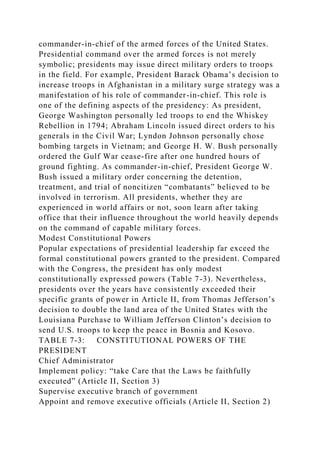
Commander-in-Chief
Global power derives primarily from the president’s role as
commander-in-chief of the armed forces of the United States.
Presidential command over the armed forces is not merely
symbolic; presidents may issue direct military orders to troops
in the field. For example, President Barack Obama’s decision to
increase troops in Afghanistan in a military surge strategy was a
manifestation of his role of commander-in-chief. This role is
one of the defining aspects of the presidency: As president,
George Washington personally led troops to end the Whiskey
Rebellion in 1794; Abraham Lincoln issued direct orders to his
generals in the Civil War; Lyndon Johnson personally chose
bombing targets in Vietnam; and George H. W. Bush personally
ordered the Gulf War cease-fire after one hundred hours of
ground fighting. As commander-in-chief, President George W.
Bush issued a military order concerning the detention,
treatment, and trial of noncitizen “combatants” believed to be
involved in terrorism. All presidents, whether they are
experienced in world affairs or not, soon learn after taking
office that their influence throughout the world heavily depends
on the command of capable military forces.
Modest Constitutional Powers
Popular expectations of presidential leadership far exceed the
formal constitutional powers granted to the president. Compared
with the Congress, the president has only modest
constitutionally expressed powers (Table 7-3). Nevertheless,
presidents over the years have consistently exceeded their
specific grants of power in Article II, from Thomas Jefferson’s
decision to double the land area of the United States with the
Louisiana Purchase to William Jefferson Clinton’s decision to
send U.S. troops to keep the peace in Bosnia and Kosovo.
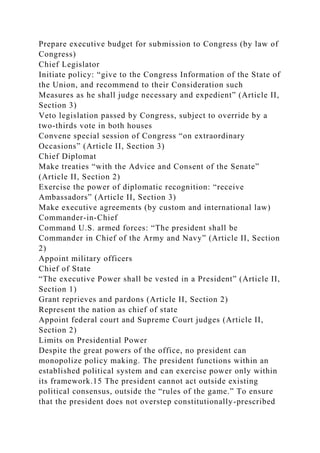
TABLE 7-3: CONSTITUTIONAL POWERS OF THE
PRESIDENT
Chief Administrator
Implement policy: “take Care that the Laws be faithfully
executed” (Article II, Section 3)
Supervise executive branch of government
Appoint and remove executive officials (Article II, Section 2)
Prepare executive budget for submission to Congress (by law of
Congress)
Chief Legislator
Initiate policy: “give to the Congress Information of the State of
the Union, and recommend to their Consideration such
Measures as he shall judge necessary and expedient” (Article II,
Section 3)
Veto legislation passed by Congress, subject to override by a
two-thirds vote in both houses
Convene special session of Congress “on extraordinary
Occasions” (Article II, Section 3)
Chief Diplomat
Make treaties “with the Advice and Consent of the Senate”
(Article II, Section 2)
Exercise the power of diplomatic recognition: “receive
Ambassadors” (Article II, Section 3)
Make executive agreements (by custom and international law)
Commander-in-Chief
Command U.S. armed forces: “The president shall be
Commander in Chief of the Army and Navy” (Article II, Section
2)
Appoint military officers
Chief of State
“The executive Power shall be vested in a President” (Article II,
Section 1)
Grant reprieves and pardons (Article II, Section 2)
Represent the nation as chief of state
Appoint federal court and Supreme Court judges (Article II,
Section 2)
Limits on Presidential Power
Despite the great powers of the office, no president can
monopolize policy making. The president functions within an
established political system and can exercise power only within
its framework.15 The president cannot act outside existing
political consensus, outside the “rules of the game.” To ensure
that the president does not overstep constitutionally-prescribed
boundaries, both the Congress and the courts provide checks on
the president, as described earlier in this chapter. So presidents
may face a Congress that overrides a presidential veto, or fails
to confirm judicial appointments; or a Court that declares a
presidential action unconstitutional.
Electing the President
The 2008 presidential election proved to be historical, with
Barack Obama succeeding in his quest to become the first
African American elected president of the United States. Obama
came to be the Democratic nominee for the presidency via
another historic contest: He and Sen. Hillary Rodham Clinton
vied for their party’s nomination, each seeking to make history
(she attempted to be the first woman major party nominee and
U.S. president). Obama won the Democratic nomination with a
well-organized and well-financed campaign that targeted young
and first-time primary voters, and made savvy use of new
technologies, including social networking sites like Facebook
and MySpace.
These technologies would prove even more important in the
2012 contest between Obama and Republican Governor Mitt
Romney. That year, we saw both campaigns rely on technology
as tool of campaigning. The Republicans and Democrats each
used the Internet and cellular technology to communicate with
voters, mobilize supporters, organize their campaigns, and to
raise money.
While the 2012 election was groundbreaking in terms of the
campaigns’ use of technology, back in the year 2000 another
dramatic election took place. That year, Americans were given a
dramatic reminder that the president of the United States is not
elected by nationwide popular vote but rather by a majority of
votes in the Electoral College. In most states, electors are
chosen in winner-take-all system, whereby the candidate who
receives the most popular votes wins all of that states’ electoral
votes. This system typically serves to exaggerate the popular
margin of victory. But in 2000, Democrat Al Gore won 500,000
more votes nationwide (out of over 100 million cast) than his
opponent Republican George W. Bush. But Bush won a majority
of the states’ electoral votes—271 to 267—the narrowest margin
in modern American history. And Florida’s crucial 25 electoral
votes were decided by the U.S. Supreme Court more than a
month after election day.
The Electoral College
The U.S. Constitution provides that the president will be chosen
by the majority of the number of “electors” chosen by the
states. Article II says “Each state shall appoint, in such Manner
as the Legislature thereof may direct, a Number of Electors,
equal to the whole Number of Senators and Representatives to
which the State may be entitled in the Congress . . .” This
means that each state gets a number of electors to the Electoral
College equal to the size of their congressional delegation. Each
state’s congressional delegation is composed of two U.S.
senators and a number of members of the House of
Representatives based on the state’s population. Although the
number of each state’s electors is equal to the size of their
congressional delegation, the members of Congress themselves
are not the actual electors. The number of members of the
House of Representatives is determined every ten years after the
U.S. census is taken. Thus, the number of electoral votes of
each state is subject to change after each ten-year census. The
Twenty-Third Amendment granted three electoral votes to the
District of Columbia even though it has no voting members in
Congress. Winning the presidency requires winning enough
states to garner at least 270 of the 538 total electoral votes.
The U.S. Constitution specifically gives state legislatures the
power to determine how electors in their states are to be chosen.
By 1840 the spirit of Jacksonian democracy (see Chapter 6) had
inspired state legislatures to allow the voters of their states to
choose slates of presidential electors pledged to vote for one or
another party’s presidential and vice-presidential candidates.
The slate that wins a plurality of the popular vote in a state
(more than any other slate, but not necessarily a majority) casts
all of the state’s votes in the Electoral College.
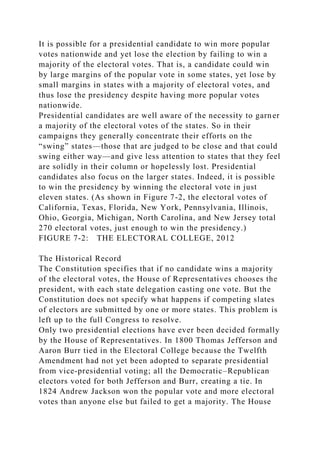
It is possible for a presidential candidate to win more popular
votes nationwide and yet lose the election by failing to win a
majority of the electoral votes. That is, a candidate could win
by large margins of the popular vote in some states, yet lose by
small margins in states with a majority of electoral votes, and
thus lose the presidency despite having more popular votes
nationwide.
Presidential candidates are well aware of the necessity to garner
a majority of the electoral votes of the states. So in their
campaigns they generally concentrate their efforts on the
“swing” states—those that are judged to be close and that could
swing either way—and give less attention to states that they feel
are solidly in their column or hopelessly lost. Presidential
candidates also focus on the larger states. Indeed, it is possible
to win the presidency by winning the electoral vote in just
eleven states. (As shown in Figure 7-2, the electoral votes of
California, Texas, Florida, New York, Pennsylvania, Illinois,
Ohio, Georgia, Michigan, North Carolina, and New Jersey total
270 electoral votes, just enough to win the presidency.)
FIGURE 7-2: THE ELECTORAL COLLEGE, 2012
The Historical Record
The Constitution specifies that if no candidate wins a majority
of the electoral votes, the House of Representatives chooses the
president, with each state delegation casting one vote. But the
Constitution does not specify what happens if competing slates
of electors are submitted by one or more states. This problem is
left up to the full Congress to resolve.
Only two presidential elections have ever been decided formally
by the House of Representatives. In 1800 Thomas Jefferson and
Aaron Burr tied in the Electoral College because the Twelfth
Amendment had not yet been adopted to separate presidential
from vice-presidential voting; all the Democratic–Republican
electors voted for both Jefferson and Burr, creating a tie. In
1824 Andrew Jackson won the popular vote and more electoral
votes than anyone else but failed to get a majority. The House
chose John Quincy Adams over Jackson, causing a popular
uproar and ensuring Jackson’s election in 1828. In addition, in
1876 the Congress was called on to decide which electoral
results from the Southern states to validate; a Republican
Congress chose to validate enough Republican electoral votes to
allow Republican Rutherford B. Hayes to win, even though
Democrat Samuel Tilden had won more popular votes. Hayes
promised the Democratic southern states that in return for their
acknowledgment of his presidential claim, he would end the
military occupation of the South.
In 1888 the Electoral College vote failed to reflect the popular
vote. Benjamin Harrison received 233 electoral votes to
incumbent president Grover Cleveland’s 168, even though
Cleveland won about 90,000 more popular votes than Harrison
(with fewer states in the union, there were fewer members of
the House of Representatives and electors in the Electoral
College). Cleveland was elected for a second time in 1892, the
only president to serve two nonconsecutive terms.
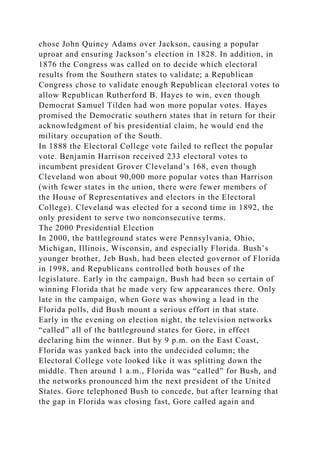
The 2000 Presidential Election
In 2000, the battleground states were Pennsylvania, Ohio,
Michigan, Illinois, Wisconsin, and especially Florida. Bush’s
younger brother, Jeb Bush, had been elected governor of Florida
in 1998, and Republicans controlled both houses of the
legislature. Early in the campaign, Bush had been so certain of
winning Florida that he made very few appearances there. Only
late in the campaign, when Gore was showing a lead in the
Florida polls, did Bush mount a serious effort in that state.
Early in the evening on election night, the television networks
“called” all of the battleground states for Gore, in effect
declaring him the winner. But by 9 p.m. on the East Coast,
Florida was yanked back into the undecided column; the
Electoral College vote looked like it was splitting down the
middle. Then around 1 a.m., Florida was “called” for Bush, and
the networks pronounced him the next president of the United
States. Gore telephoned Bush to concede, but after learning that
the gap in Florida was closing fast, Gore called again and
withdrew his concession. For the second time, the television
networks pulled Florida back into the “Too Close to Call”
column.
The Count Continues
The morning after election day, it was clear that Gore had won
the nationwide popular vote. But the Electoral College outcome
depended on Florida’s 25 electoral votes. Bush’s lead in
Florida, after several machine recounts and the count of
absentee ballots, was 930 votes out of 6 million cast in that
state.
Armies of lawyers descended on Florida. The Gore campaign
demanded hand recounts of the votes in the state’s three most
populous and Democratic counties—Miami-Dade, Broward (Fort
Lauderdale), and Palm Beach. Bush’s lawyers argued that the
hand counts in these counties were late, unreliable, subjective,
and open to partisan bias. Gore’s lawyers argued that the Palm
Beach “butterfly” ballot was confusing (the Gore–Lieberman
punch hole was positioned third instead of second under
Bush/Cheney; Pat Buchanan’s punch hole was positioned
second). They also argued that partially detached and indented
“chads” (small perforated squares in the punch cards that should
fall out when the voter punches the ballot) should be inspected
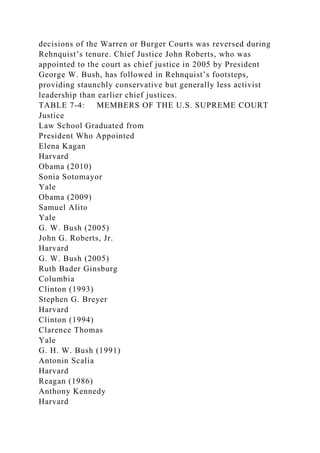
to ascertain the “intent” of the voter.
A President Chosen by the Supreme Court
Gore formally protested the Florida vote, expecting that his
protest would eventually be decided by the Florida Supreme
Court, with its seven Democratic-appointed justices. And,
indeed, by a four-to-three vote the Florida high court agreed. It
ordered a hand recount of all “undervotes” in the state—ballots
that failed to register a presidential selection on machines—to
determine the “intent” of the voter.
However, Bush appealed to the U.S. Supreme Court, arguing
that the Florida Supreme Court had overreached its authority
under the U.S. Constitution when it substituted its own deadline
for the deadline enacted by the state’s legislature. (Article II,
Section 1, declares that “Each State shall appoint [presidential
electors] in such Manner as the Legislature thereof may direct. .
. .”) Bush’s lawyers also argued that without specific standards
to determine the “intent” of the voter, different vote counters
would use different standards (counting or not counting chads
that were “dimpled,” “pregnant,” “indented,” and so on).
Without uniform rules, such a recount would violate the equal
protection clause of the Fourteenth Amendment.
In Bush v. Gore, the U.S. Supreme Court agreed (by a seven-to-
two vote) that the Florida court had created “constitutional
problems” involving the equal protection clause, and the Court
ordered (by a five-to-four vote) that the hand count be ended
altogether. The effect of the decision was to reinstate the
Florida secretary of state’s certification of Bush as the winner
of Florida’s 25 electoral votes and consequently the winner of
the Electoral College vote for president by the narrowest of
margins—271 to 267.
For the first time in the nation’s history, a presidential election
was decided by the U.S. Supreme Court. Perhaps only the
Supreme Court possesses sufficient legitimacy in the mind of
the American public to bring about a resolution to the closest
presidential electoral vote in history.
The Power of the Courts
The founders of the United States viewed the federal courts as
the final bulwark against threats to individual liberty. Since
Marbury v. Madison first asserted the U.S. Supreme Court’s
power of judicial review over congressional acts, the federal
courts have struck down more than eighty congressional laws
and uncounted state laws that they believed conflicted with the
Constitution.
Judicial review and the right to interpret the meaning and
decide the application of the Constitution and laws of the
United States are great sources of power for judges.16
Key Court Decisions
Some of the nation’s most important policy decisions have been
made by courts rather than by executive or legislative bodies.
The federal courts took the lead in eliminating racial
segregation in public life, ensuring the separation of church and
state, defining relationships between citizens and law enforcers,
and guaranteeing voters equal voice in government. Today, the
federal courts grapple with the most controversial issues facing
the nation: abortion, affirmative action, the death penalty,
religion in schools, the rights of criminal defendants, and so on.
Courts are an integral component of America’s government
system, for sooner or later most important policy questions are
brought before them.17
Democracy and the U.S. Supreme Court
The undemocratic nature of judicial review has long been
recognized in American politics. Nine Supreme Court justices—
who are not elected to office, whose terms are for life, and who
can be removed only for “high crimes and misdemeanors”—
possess the power to void the acts of popularly elected
presidents, Congresses, governors, and state legislators. Why
should the views of an appointed court about the meaning of the
Constitution prevail over the views of elected officials?
Presidents and members of Congress are sworn to uphold the
Constitution, and it can reasonably be assumed they do not pass
laws that they believe to be unconstitutional. Why should the
Supreme Court have judicial review of the decisions of these
bodies?
The answer appears to be that the founders distrusted both
popular majorities and elected officials who might be
influenced by popular majorities. They believed that
government should be limited so it could not attack principle
and property, whether to do so was the will of the majority or
not. So the courts were deliberately insulated against popular
majorities; to ensure their independence, judges were not to be
elected but appointed for life terms. Only in this way, the
writers of the Constitution believed, would they be sufficiently
protected from the masses to permit them to judge courageously
and responsibly. Insulation is, in itself, another source of
judicial power.
Judicial Restraint
The power of the courts, especially the U.S. Supreme Court, is
limited only by the justices’ own judicial philosophy. The
doctrine of judicial restraint argues that because justices are not
popularly elected, the Supreme Court should defer to the
decisions of Congress and the president unless their actions are
in clear conflict with the plain meaning of the Constitution.
Former Justice Felix Frankfurter once wrote, “The only check
upon our own exercise of power is our own sense of self-
restraint. For the removal of unwise laws from the statute
books, appeal lies not with the Courts but to the ballot and to
the processes of democratic government.”18 One should not
confuse the wisdom of a law with its constitutionality; the
courts should decide only the constitutionality of laws, not the
wisdom or fairness.
judicial restraint
judges should defer to the decision of elected representatives
unless it is in clear conflict with the plain meaning of the
Constitution
A related limitation on judicial power is the principle of stare
decisis, which means the issue has already been decided in
earlier cases. Reliance on precedent is a fundamental notion in
law; it gives stability to the law. If every decision ignored past
precedents and created new law, no one would know what the
law is from day to day.
stare decisis
reliance on precedent to give stability to the law
Judicial Activism
However, much of the history of the Supreme Court has been
one of judicial activism, not restraint. The dominant philosophy
of the Supreme Court under Chief Justice Earl Warren (1953–
1969) was that judges should interpret the meaning of the
Constitution to fit the needs of contemporary society. By
viewing the Constitution as a broad and flexible document, the
nation can avoid new constitutional amendments and still
accomplish changes in society. Precedents can be overturned as
society grows and changes.
judicial activism
judges may interpret the meaning of the Constitution to fit the
needs of contemporary society
Judicial activism was reflected in the Supreme Court’s famous
Brown v. Board of Education of Topeka decision in 1954 that
declared that racially segregated schools violated the equal
protection clause of the Fourteenth Amendment. This decision
contradicted the legal precedent that had been set in 1857 when
the Court ruled in the Dred Scott decision that “separate but
equal” facilities did not violate the equal protection clause.
The Supreme Court’s power to interpret the Constitution means
that the legacy of a president’s appointments to the Court may
be felt for decades. Today’s Supreme Court includes Sonia
Sotomayor, Stephen Breyer, Samuel Alito, Elena Kagan;
(seated) Clarence Thomas, Antonin Scalia, Chief Justice John
Roberts, Anthony Kennedy, and Ruth Bader Ginsburg.
The Supreme Court also overturned precedent in requiring that
the states apportion their legislatures so as to guarantee equal
voter representation in Baker v. Carr in 1962. It struck down
long-established practices of prayer and Bible reading in public
schools in Engle v. Vitale, also in 1962. The Court under Earl
Warren also greatly expanded the rights of criminal defendants.
The Supreme Court under President Richard Nixon’s appointee,
Chief Justice Warren Burger (1969–1986), was only slightly
less activist. The Court’s 1973 decision in Roe v. Wade,
invoking privacy rights in declaring that abortion was a
constitutional right of women, was perhaps the most sweeping
reinterpretation of individual liberty in the Court’s history.
Presidents Ronald Reagan and George H. W. Bush sought to
strengthen the doctrine of judicial restraint in their
appointments to the Supreme Court (Table 7-4). Chief Justice
William Rehnquist (first appointed to the Court by President
Nixon in 1971, elevated to chief justice by President Reagan in
1986, and served as chief justice until his death in 2005) was
less activist than his predecessors. However, none of the major
decisions of the Warren or Burger Courts was reversed during
Rehnquist’s tenure. Chief Justice John Roberts, who was
appointed to the court as chief justice in 2005 by President
George W. Bush, has followed in Rehnquist’s footsteps,
providing staunchly conservative but generally less activist
leadership than earlier chief justices.
TABLE 7-4: MEMBERS OF THE U.S. SUPREME COURT
Justice
Law School Graduated from
President Who Appointed
Elena Kagan
Harvard
Obama (2010)
Sonia Sotomayor
Yale
Obama (2009)
Samuel Alito
Yale
G. W. Bush (2005)
John G. Roberts, Jr.
Harvard
G. W. Bush (2005)
Ruth Bader Ginsburg
Columbia
Clinton (1993)
Stephen G. Breyer
Harvard
Clinton (1994)
Clarence Thomas
Yale
G. H. W. Bush (1991)
Antonin Scalia
Harvard
Reagan (1986)
Anthony Kennedy
Harvard
Reagan (1988)
In 2009, with the retirement of Associate Justice David Souter,
as shown in Table 7-4, Barack Obama became the first
Democrat to appoint a member of the Supreme Court in 15
years. He appointed the third woman and first Latina to serve on
the Court, Sonia Sotomayor. In 2010, he also would appoint
Elena Kagan to the Court, succeeding Justice John Paul Stevens.
Obama’s predecessor, George W. Bush, was able to appoint
both Chief Justice Roberts and Associate Justice Samuel Alito,
because of the death of Rehnquist and the retirement of Sandra
Day O’Connor, who was the first woman to serve on the
Supreme Court. President Clinton’s appointments of Ruth Bader
Ginsburg (the second woman to serve on the Court) and Stephen
Breyer strengthened the moderate to liberal voice of the
Supreme Court, while Bush appointees Roberts and Alito swung
the court back to right. Obama’s appointments of Sotomayor
and Kagan add a more liberal voice.
The Powers of Congress
What are the powers of Congress in the American political
system? The Congress is a bicameral, or two-chambered body.
The upper house, called the U.S. Senate, consists of 100
members, with each state electing two senators. The lower
house, called the U.S. House of Representatives, consists of 435
members, each of whom represents a congressional district. The
number of House seats allocated to each state depends on that
state’s population.
bicameral
a two-chambered body
Policy proposals are usually initiated outside Congress; it is the
role of Congress to respond to proposals from the president,
executive agencies, and interest groups. Congress does not
merely ratify or “rubber-stamp” decisions; it plays an
independent role in the policy-making process. But this role is
essentially a deliberative one in which Congress accepts,
modifies, or rejects the policies initiated by others. Congress
functions as an arbiter rather than an initiator of public policy.
Many of the decisions that Congress makes, or powers it
exercises, emanate from the powers granted to it explicitly in
the U.S. Constitution (see Table 7-5). We can see that the
Constitution grants Congress many powers outright. But
Congress also has powers not explicitly listed in the
Constitution. These powers, called implied powers, come from
the Supreme Court’s interpretation of the “necessary and proper
clause” of the Constitution in Marbury v. Madison. And while
the powers of the federal government in general expanded
because of the Marbury decision, Congress’s power increased
greatly because of this interpretation. The necessary and proper
clause has meant that the Congress has a great deal of power,
and can act in passing laws concerning matters that the founders
could not even imagine.
TABLE 7-5: CONSTITUTIONAL POWERS GRANTED TO
CONGRESS
Judicial Powers
Establish federal courts
Punish counterfeiters
Punish illegal acts on the high seas
Economic Powers
Impose taxes
Establish import tariffs
Borrow money
Regulate interstate commerce
Coin and print money, determine the value of currency
National Security Powers
Declare war
Raise and regulate national armed forces
Call up and regulate state national guard
Suppress insurrections
Repel invasions
Regulatory Powers
Establish standards of weights and measures
Regulate copyrights and patents
Administrative Powers
Establish procedures for naturalizing citizens
Establish post offices
Govern the District of Columbia
implied powers
congressional powers coming from the Supreme Court’s
interpretation of the “necessary and proper clause”
Domestic Affairs
Congress is more influential in domestic affairs than it is in
foreign and military affairs. The Constitution grants presidents
greater authority in foreign affairs, whereas Congress
traditionally has exercised more authority in the domestic
policy realm. Citing their own expertise and views, or the views
of their constituents, members of Congress are more likely to
reject presidential proposals regarding business, labor,
agriculture, education, welfare, urban affairs, civil rights,
taxation, and appropriations. The president and executive
departments must go to Congress for needed legislation and
appropriations. Congressional committees can exercise power in
domestic affairs by giving or withholding the appropriations
and the legislation that these executive agencies want.
Foreign and Military Affairs
In the Constitution, the president and Congress share power
over foreign and military affairs. The president is “Commander
in Chief of the Armed Forces,” but Congress “declares war.”
The president “sends and receives ambassadors” and “makes
treaties,” but the Senate must confirm appointments and “advise
and consent” to treaties. Nevertheless, strong presidents have
generally led the nation in both war and peace (see the Case
Study in Chapter 6, “The Vietnam War: A Political History”).
Until the Vietnam War, no congressional opposition to
undeclared war was evident. But military failure and public
opposition to the war in Vietnam led Congress to try to curtail
the war power of the president. Congress passed the
controversial War Powers Act in 1973 over a weakened
President Nixon’s veto. The act specifies that if the president
sends U.S. troops into combat, this must be reported to
Congress within forty-eight hours. American forces can remain
in a combat situation for only sixty days unless Congress by
specific legislation authorizes their continued engagement. The
act also states that Congress can withdraw troops at any time by
passing a resolution in both houses, and the president cannot
veto a resolution.
War Powers Act
Congress’s effort to limit presidential war-making power
Congressional Elections
The founders’ views of the House and Senate are also reflected
in the structure of congressional elections. Members of the
House of Representatives, the branch of government designed to
be closest to the people, are elected every two years in even-
numbered years (2012, 2014, and so on). Originally, the
Constitution required that members of the U.S. Senate were
chosen by state legislators, but this structure was changed with
ratification of the Seventeenth Amendment to the Constitution
in 1913, which mandated popular elections of senators. Thus,
members of the U.S. Senate serve six-year terms, with one-third
of the Senate elected every two years. One of the best predictors
of a candidate’s chances of success in a congressional election
is incumbency, or whether the person running for office already
holds that office: On average, about 95 percent of incumbent
members of the House of Representatives running for re-
election win, and about 88 percent of their Senate counterparts
do.
incumbency
when the person running for office already holds that office
Reapportionment
There are circumstances, however, when the impact of
incumbency can be mitigated. Typically, this occurs in election
years after reapportionment and redistricting. Reapportionment
(sometimes called apportionment) is the process of allocating
seats in the House of Representatives to each state based upon
changes in their population since the last census. Every ten
years, in the year ending in zero (2010, 2020, and so on), the
federal government conducts a census counting the number of
people throughout the country. If the state’s population changes
significantly, it may gain or lose seats in the House of
Representatives.
reapportionment
the process of allocating seats in the House of Representatives
to each state based upon changes in their population since the
last census
Redistricting
Redistricting, the redrawing of congressional district boundaries
within each state, is based on the reapportionment from the
census. Because the composition of a congressional district can
change after reapportionment and redistricting, this process can
mitigate the impact of incumbency. Frequently, the greatest
changes in the composition of the House of Representatives
occur in election years ending in 2 (2012, 2022, and so on), the
first elections that incorporate the changes from
reapportionment and redistricting. When states lose seats, the
result is that an incumbent member of Congress is likely to lose
a seat. When states gain seats, there is an open seat in which a
new member of Congress can be elected.
redistricting
the redrawing of congressional district boundaries within each
state
Power and Political Behavior in the United States
Although power certainly rests in the three branches of
government, the exercise of power is not limited to elected or
appointed officials. Indeed, every day, ordinary Americans have
the opportunity to exercise political power in a wide variety of
ways. Popular participation in the political system is the very
definition of democracy. Individuals in a democracy may
Run for public office.
Participate in marches and demonstrations.
Make financial contributions to political candidates and
causes.
Attend political meetings, speeches, and rallies.
Write letters to public officials and newspapers.
Join, form, or belong to organizations that support or
oppose particular candidates and take stands on public issues.
Wear political buttons and place bumper stickers on their
cars.
Attempt to influence friends while discussing candidates
and issues.
Vote in elections.
Follow an issue or campaign in the mass media.
This list of activities constitutes a ranking of the forms of
political participation, in inverse order of their frequency.
Figure 7-3 shows graphically the percentage of people who
engage in the various activities. Each form of political
participation is an attempt by individuals to exert some power
over government—to have their voice heard. The effectiveness
of these efforts varies according to the context in which the
behavior occurs. The activities at the beginning of the list
require greater expenditure of time and energy and greater
personal commitment; consequently, far fewer people engage in
those activities, as we can see in Figure 7-3. Fully one-third of
the population is politically apathetic: They do not vote, and
they are largely unaware of and indifferent to the political life
of the nation.
FIGURE 7-3: PERCENT OF PEOPLE WHO PARTICIPATE IN
VARIOUS POLITICAL ACTIVITIES
Source: Brigid Callahan Harrison, Jean Wahl Harris and Susan
Tolchin. American Democracy Now. (McGraw-Hill Publishers,
2008).
Voter Turnout
Voter turnout is greatest in presidential elections, but even in
those contests turnout is only about 50 to 55 percent of eligible
people. “Off-year” congressional elections—congressional
elections held in years in which there is no presidential
election—attract only 35 to 40 percent of eligible people to the
polls. Yet in these off-year contests, the nation chooses all of
its U.S. representatives, one-third of its U.S. senators, and
about one-half of its governors. Local government elections—
for mayor, council members, school board, and so forth—
frequently attract only one-quarter to one-third of eligible
voters.
Nonvoting
Who votes and who doesn’t?19 Some groups of people are more
likely to vote than others. Education appears to be the most
important determinant of voter turnout. It may be that schooling
promotes an interest in politics, instills the ethic of citizen
participation, or gives people a better awareness of public
affairs and an understanding of the role of elections in a
democracy. Education is associated with a sense of confidence
and political efficacy—the feeling that one can indeed have a
personal impact on public affairs.
political efficacy
the feeling that one can indeed have a personal impact on public
affairs
Age is another factor affecting voter participation. While
nonvoting is greatest among those who are 18 to 21 years old,
voter participation by young people has increased over the past
several presidential elections. In fact, in the 2008 presidential
election, the turnout rate among those aged 18–29 rivaled the
record-setting turnout rate of 1974, the presidential election that
followed the United States granting 18- to 21-year-olds the right
to vote. Why are young people less likely to vote? Many
political scientists note that young people are less likely to own
property or be settled in a community, and therefore may feel
less connection to local and even national politics. Others assert
that young people have more distractions; more demands on
their time in schooling, work, or new family responsibilities. In
contrast, older Americans are politically influential in part
because elected officials know they turn out at the polls, and
both public policy and political campaigns respond to their
preferences.
High-income people are more likely to vote than are low-
income people. Most of this difference is a product of the fact
that high-income people are more likely well educated and
older. Poor people, however, may also feel alienated from the
political system. The poor may lack a sense of political
efficacy—they may feel they have little control over their own
lives, let alone over public affairs. Or the poor may simply be
so absorbed in the problems of life that they have little time or
energy to spend on registering and voting.
Historically, race was a major determinant of nonvoting. Black
voter turnout, especially in the South, was markedly lower than
white voter turnout. But today, blacks and whites at the same
educational and income levels register and vote with the same
frequency. The greatest racial disparity in voter turnout is
between Hispanics and non-Hispanic voters. Low voter
participation by Hispanics may be a product of language
differences, late cultural assimilation, or noncitizenship status.
The Voter Decides
Perhaps no other area of political science has been investigated
so thoroughly—by political candidates, campaign strategists,
and political scientists—as the reasons behind the voters’
choices at the polls.20 Voters cast ballots for and against
candidates for a variety of reasons, including their party
affiliation, their membership in social and economic groups,
their positive and negative evaluations of the images of the
candidates, their view of the goodness or badness of the times
(especially the economy), and sometimes even the positions of
the candidates on important issues.
Although party ties have weakened somewhat over time, party
affiliation remains an important influence over voter choice.
People who identify themselves as Democrats or Republicans
usually vote for their party’s candidate. Membership in various
social, economic, and demographic groups also affects voting;
for example, African American voters and women voters
regularly are more likely to support to Democratic candidates
than whites or men.
Candidates spend a great deal of time and money during a
campaign trying to project a favorable image of themselves (or
a negative image of their opponent) through television and the
press (see Focus: “Media Power: The Presidential Debates”).
Challengers attack the record of incumbents seeking re-election,
holding them responsible for anything bad that happened during
their term, especially any weaknesses that developed in the
economy. Incumbents are more likely to be re-elected when the
nation enjoys “peace and prosperity.” Relatively few voters cast
their ballot exclusively on a particular policy position of a
candidate although some “hot-button” issues—health care
reform or economy, for example—influence the choice of some
voters.
Political Parties in the United States
Democracy is ultimately based on majority rule, and one
function of political parties is to put majorities together.
Political parties organize voters for effective political
expression at the polls. Voters, in turn, use party labels to help
them identify the general political viewpoints of the
candidates.21 Political parties are the most important voter cue
because they provide voters with a tool that screens candidates
to ensure that the candidate’s view loosely reflects the party
ideology and voters perceive the parties as having different
strengths (see Research This!) . And so, to the extent that a
voter holds a cohesive ideology, parties provide that voter with
a convenient, time-saving mechanism to evaluate every
candidate standing for office.
FOCUS: Media Power: The Presidential Debates
Presidential debates attract more viewers than any other
campaign activity. Debates allow people to directly compare the
responses of each candidate. Even if issues are not really
discussed in depth, people see how presidential candidates react
as human beings under pressure.
The Kennedy–Nixon Debates
Televised presidential debates began in 1960 when John F.
Kennedy and Richard M. Nixon confronted each other on a bare
stage before an America watching on black-and-white television
sets. Nixon was the vice president in the popular presidential
administration of Dwight Eisenhower; he was also an
accomplished college debate team member. He prepared for the
debates as if they were college debates, memorizing facts and
arguments. But he failed to realize that image triumphs over
substance on television. Nixon was shifty eyed and clearly in
need of a shave or more makeup to hide his pronounced “five
o’clock shadow.” By contrast, Kennedy was handsome, cool,
and confident. Television viewers preferred the glamorous
young Kennedy. The polls shifted in Kennedy’s direction after
the debate, and he won in a very close general election. Nixon
blamed his makeup man.
The Carter–Ford Debates
President Lyndon Johnson avoided debating in 1964, and Nixon,
having learned his lesson, declined to debate in 1968 and 1972.
Thus, televised presidential debates did not resume until 1976,
when incumbent President Gerald Ford, perceiving that he was
behind in the polls, agreed to debate challenger Jimmy Carter.
Ford made a series of verbal slips—saying, for example, that
the nations of Eastern Europe were free from Soviet domination.
Carter was widely perceived as having “won” the debates, and
he went on to victory in the general election.
The Reagan–Carter and Reagan–Mondale Debates
It was Ronald Reagan who demonstrated the true power of
television. Reagan had lived his life in front of a camera. Carter
talked rapidly and seriously about programs, figures, and
budgets. But Reagan was master of the stage; he was relaxed,
confident, joking. He appeared to treat the president of the
United States as an overly aggressive, impulsive younger man,
regrettably given to exaggeration (“There you go again”). When
the debate was over, it was clear to most viewers that Carter had
been bested by a true professional in media skills.
However, in the first of two televised debates with Walter
Mondale in 1984, Reagan’s skills of a lifetime seemed to desert
him. He stumbled over statistics and groped for words. His poor
performance raised the only issue that might conceivably defeat
him—his age. The president had looked and sounded old.
In preparation for the second debate, Reagan decided, without
telling his aides, to lay the perfect trap for his questioners.
When asked about his age and capacity to lead the nation, he
responded with a serious deadpan expression to a hushed
audience and waiting America: “I want you to know that I will
not make age an issue in this campaign. I am not going to
exploit for political purposes [pause] my opponent’s youth and
inexperience.” The studio audience broke into uncontrolled
laughter. Even Mondale had to laugh. With a classic one-liner,
the president buried the age issue and won not only the debate
but also the election.
The Bush–Dukakis Debates
In 1988 Michael Dukakis ensured his defeat with a cold,
detached performance in the presidential debates, beginning
with the very first question. When CNN anchor Bernard Shaw
asked, “Governor, if Kitty Dukakis were raped and murdered,
would you favor an irrevocable death penalty for the killer?”
The question demanded an emotional reply. Instead, Dukakis
responded with an impersonal recitation of his stock positions
on crime, drugs, and law enforcement. George H. W. Bush
seized the opportunity to establish an intimate, warm, and
personal relationship with the viewers: “I do believe some
crimes are so heinous, so brutal, so outrageous . . . I do believe
in the death penalty.” Voters responded to Bush, electing him.
The Clinton–Bush–Perot Debates
The three-way presidential debates of 1992 drew the largest
television audiences in the history of presidential debates. In
the first debate, Ross Perot’s Texas twang and down-home
folksy style stole the show. But it was Bill Clinton’s smooth
performance in the second debate, with its talk-show format,
that seemed to wrap up the election. Ahead in the polls, Clinton
appeared at ease walking about the stage and responding to
audience questions with sympathy and sincerity. By contrast,
George H. W. Bush appeared stiff and formal and somewhat ill
at ease with the “unpresidential” format.
The Clinton–Dole Debates
A desperate Bob Dole, running twenty points behind, faced a
newly “presidential” Bill Clinton in their two 1996 debates.
(Perot’s poor standing in the polls led to his exclusion.) Dole
tried to counter his image as a grumpy old man in the first
encounter; his humor actually won more laughs from the
audience than the president’s more stately comments. Dole
injected more barbs in the second debate, complaining of
“ethical problems in the White House” and repeating the mantra
“I keep my word,” suggesting that Clinton did not. But Clinton
remained cool and comfortable, ignoring the challenger and
focusing on the nation’s economic health. Viewers, most of
whom were already in Clinton’s court, judged him the winner of
both debates.
The Bush–Gore Debates
Separate formats were agreed upon for three debates—the
traditional podium, a conference table, and a town-hall setting.
Vice President Al Gore was assertive, almost to the point of
rudeness, but both candidates focused on policy differences
rather than personal attacks. Viewers gave Gore the edge in
these debates, but they found George W. Bush more likable.
Bush appeared to benefit more in the post-debate polls. An
estimated 47 million people watched the first debate, and
viewership fell to 36 million for the second and third debates.
Most observers rated the single vice-presidential debate
between Dick Cheney and Joe Lieberman as friendlier and more
informative than the Bush–Gore encounters.
The Bush–Kerry Debates
A thirty-two-page document agreed to by both the Kerry and
Bush campaigns defined the terms of the three presidential
debates in 2004. The first debate, sponsored by the Miccosukee
Tribe of Indians of Florida, was held at the University of
Miami, Florida. This debate, which had a standard debate
format, focused on issues concerning foreign policy and
homeland security. The second debate, held at Washington
University in St. Louis, Missouri, was a town-hall style debate;
the third debate, held at Arizona State University in Tempe,
Arizona, had the same format as the first but focused on
domestic policy issues.
Before these debates, the reputations of the candidates—
President George W. Bush as not particularly well spoken and
Senator John Kerry as a well-spoken intellectual—shaped the
expectations of their debate performances. Indeed, many in the
Bush camp appeared to be lowering expectations of the
president. Public opinion polls after the debates indicated that
most Americans who watched the debates believed that Kerry
had won each debate, but that Bush held his own against Kerry,
putting in a respectable performance.
The Obama–McCain Debates
The 2008 presidential debates were billed as the opportunity for
the voters to see the differences between the youthful
Democratic Senator Barack Obama and the experienced
Republican Senator John McCain. In the end, however, neither
candidate committed gaffes significant enough to discredit his
candidacy. Three debates were scheduled, two hosted by
moderators who posed questions to the candidates, and one a
town hall format debate.
Assessing the first debate, CBS News polls revealed that most
people thought Obama had won (40 percent) or that it was a
draw (38 percent). In the second debate, many questioned
whether Obama would succeed in getting his message across in
the town hall format. He did, according to a CNN poll, which
showed that 50 percent of viewers thought he had won.
Controversial during this debate was McCain’s use of the term
“that one” to refer to Obama. During the third presidential
debate, McCain used “Joe the Plumber” as the example of
someone who would wind up paying more taxes under Obama’s
proposal. Despite the attacks, most viewers said they believed
Obama had won.
The Obama-Romney Debates
The candidates split the debates. In the first presidential debate,
an assertive Mitt Romney challenged President Obama’s record
on the economy, and Obama’s response was largely viewed as
dispassionate. In the second debate, Obama was more
commanding and was viewed by most as having won. The third
debate, which centered on foreign policy, was largely viewed as
a draw.
Because American parties are necessarily rather loose coalitions
of interests, they do not command the total loyalty of every
officeholder elected under a party’s banner. The fact that
candidates run under a Republican or Democratic label does not
clearly indicate where they will stand on every public issue, but
party labels offer a general idea of where candidates fall on the
ideological continuum. Even so, these coalitions do have
considerable cohesion and historical continuity. The party label
discloses the coalition of interests and the policy views with
which candidates have generally associated themselves. At the
least, the party label tells more about a candidate’s politics than
would a strange name, with no party affiliation, on the ballot.
Especially in two-party systems, such as we have in the United
States, parties also structure the choice of candidates for public
office and thus relieve voters of the task of choosing among
dozens of contending candidates on election day. The
preliminary selecting and narrowing of candidates, by
conventions and primary elections, are indispensable in a large
society.
Political parties educate voters about the candidates and the
issues that are important in a given election. After educating
voters, parties also mobilize the masses, through get-out-the-
vote efforts.
Political parties help define the major problems and issues
confronting society. In attempting to win a majority of the
voters, parties inform the public about the issues facing the
nation. The comparisons that parties make during political
campaigns have an important educational value: Voters come to
“know” the opposing candidates for public office, and the
problems of national interest are spotlighted.
Finally, the party out of office performs an important function
for democratic government by providing a loyal opposition.
That is, members of the party that is out of government can be
counted on to provide criticism of actions and policies made by
the party in government, thus providing a valuable “check” on
those in government. Moreover, the very existence of a
recognized party outside the government helps make criticism
of government legitimate and effective.
Differences between Democrats and Republicans
It is sometimes argued that there are few significant differences
between the two main American parties. It is not uncommon in
European nations to find authoritarian parties competing with
democratic parties, capitalist parties with socialist parties,
Catholic parties with secular parties, and so on. However,
within the context of American political experience, the
Democratic and Republican Parties can be clearly
differentiated. There are at least three ways in which to discern
the differences: (1) by examining differences in the coalitions
of voters supporting each party, (2) by examining differences in
the policy views of the leaders in each party, and (3) by
examining differences in the voting records of the
representatives and senators of each party.
In ascertaining party differences according to support from
different groups of voters, we must note first that major groups
are seldom wholly within one party or the other. For example,
in presidential elections, all major social groups divide their
votes between the parties. Yet differences between the parties
are revealed in the proportions of votes given by each major
group to each party (see “Sex,” “Race,” and “Religion” in Table
7-6). Thus, the Democratic Party receives a disproportionate
amount of support from Catholics, Jews, African Americans,
women, lower-income groups, blue-collar workers, union
members, and big-city residents. The Republican Party receives
disproportionate support from Protestants, whites, men, higher-
income groups, professionals and managers, white-collar
workers, nonunion members, and rural and small-town
residents.
TABLE 7-6: VOTING BY GROUPS IN RECENT
PRESIDENTIAL ELECTIONS
SOURCE: Based on data from the Gallup Poll surveys and voter
exit polls, 2000, and CNN polls, 2004, 2008, 2012.
RESEARCH THIS!
Periodically the Gallup Organization asks poll respondents their
views on the capabilities of the Democratic and Republican
parties. The data shown in this table indicates that there are
some similarities and some differences in the perceived
strengths of the parties.
Applies %
Does not apply %
Can bring about the changes this country needs
Democrats
50
47
Republicans
48
48
Has mostly honest and ethical members in Congress
Democrats
45
50
Republicans
42
52
Looks out for the country’s long-term future as well as current
problems
Democrats
52
44
Republicans
53
43
Has a clear plan for solving the country’s problems
Democrats
33
62
Republicans
32
63
Is able to manage the federal government effectively
Democrats
39
56
Republicans
42
52
SOURCE: www.gallup.com/poll/24655/Party-Images.aspx#3
YOUR ANALYSIS:
1. Based on the data shown, where do Democrats’ strengths
lie? Republicans?
2. In which categories do voters evaluate the parties most
similarly?
3. Are there differences between the parties? How do you
think that impacts the parties’ electability?
Differences in Views of Party Leaders
The second way of discerning Democratic and Republican Party
differences involves an examination of the political opinions of
the leaders of each party. Political scientists have studied party
differences by presenting a series of policy questions to the
delegates to the Democratic and Republican National
Conventions. They have found substantial differences of
opinion between Democratic and Republican leaders on
important public issues. In general, Democratic party leaders
are more “progressive” and attempt to elevate the poor and
underprivileged by using redistributive policies, and Republican
leaders emphasize personal responsibility and a more laissez
faire government.22 During the administration of President
George W. Bush, the Republican Party’s ideology did undergo a
significant change with the dominance of neoconservative
Republicans (see Chapter 3 for further discussion of the role of
ideology).
Party Differences in Congressional Voting
The third indication of party differences in the United States is
the roll-call voting behavior of the representatives and senators
of each party on controversial issues. About half of all roll-call
votes in Congress are party votes, votes in which a majority of
Democrats oppose a majority of Republicans. Party votes occur
most frequently on well-publicized, high-conflict issues. Party
voting also occurs on presidential recommendations, with the
president’s party in Congress supporting the president’s
position and the opposition party opposing it. Bipartisan votes,
those roll calls in which party majorities are found on the same
side, usually occur on less-publicized, low-conflict issues. On
many issues, voting follows party lines during roll calls on
preliminary amendments but swings to a bipartisan vote on the
final legislation. This occurs when the parties disagree on
certain aspects of a bill but compromise on its final passage.
Power and American Government
Although it is clear that the government exercises a great deal
of power over its citizens, it is important to remember that
legitimate governments derive their power from those citizens,
in the form of consent of the governed. In addition, democracies
offer up a multitude of ways for citizens to impact the
government and policies. Some forms of participation cost little
in terms of time or energy; other forms of participation, like
running for public office, involve serious commitment and
lifestyle change. As with other forms of power described in this
text, political power is distributed unevenly in the United
States. Those who are economically powerful are more likely to
be politically powerful, but political power does offer
opportunities for average citizens to exercise power.
CHAPTER SUMMARY
The power of government, unlike that of other institutions
in society, is distinguished by the legitimate use of physical
force and coverage of the whole society rather than only
segments of it.
Ideally, democracy means individual participation in the
decisions that affect one’s life. Procedurally, popular
participation was to be achieved through majority rule and
respect for the rights of those with a minority view. Oftentimes,
majority rule and respect for the rights of minorities occurs by
limiting the power of the government through a social contract,
a form of constitutionalism.
The U.S. Constitution sets up government bodies,
including the House of Representatives, the Senate, the
presidency, and the Supreme Court in the United States. It
grants them powers, determines how their members are to be
chosen, and prescribes the rules by which they make decisions.
The separation of powers in the national government—
separate legislative, executive, and judicial branches—was
intended by the nation’s founders as an additional safeguard for
liberty
Since the founding of the United States, the power of the
national government has increased significantly. Major
developments in the history of American federalism, including
Marbury v. Madison, the Civil War, the growth in interstate
commerce, the use of federal law to enforce civil rights laws,
and federal grants-in-aid, have contributed to this increase in
national power.
Today, federal grants-in-aid are the principal source of
federal power over states and communities. Nearly one-quarter
of all state and local government revenues are from federal
grants.
The roles that a president must perform include managing
crisis, providing policy leadership, managing the economy and
the government, and acting as global leader and commander-in-
chief.
The founders of the United States viewed the federal
courts as the final bulwark against threats to individual liberty.
Since Marbury v. Madison first asserted the U.S. Supreme
Court’s power of judicial review over congressional acts, the
federal courts have struck down more than eighty congressional
laws and uncounted state laws that they believed conflicted with
the Constitution.
The Congress is a bicameral, or two-chambered body. The
upper house, called the U.S. Senate, consists of 100 members,
with each state electing two senators. The lower house, called
the U.S. House of Representatives, consists of 435 members,
each of whom represents a congressional district. The number of
House seats allocated to each state depends on that state’s
population.
Although power certainly rests in the three branches of
government, the exercise of power is not limited to elected or
appointed officials. Indeed, every day, ordinary Americans have
the opportunity to exercise political power in a wide variety of
ways, including running for public office and voting in
elections, but there are many other ways for individuals to
participate in political life.
Political parties organize voters for effective political
expression at the polls. Voters, in turn, use party labels to help
them identify the general political viewpoints of the candidates.
(Harrison 165-209)
Harrison, Brigid C. Power and Society: An Introduction to the
Social Sciences, 13th Edition. Cengage Learning, 20130115.
VitalBook file.
The citation provided is a guideline. Please check each citation
for accuracy before use.
Scanned by CamScanner

Option B Obedience to Authority Cause and Effect. First, read St.docx

  • 1.
    Option B: Obedienceto Authority: Cause and Effect. First, read Stanley Milgram’s classic article on his infamous ‘shock’ experiments in the 1960’s. Follow this up by watching Obeying or Resisting Authority: A Psychological Retrospective, available via the Films on Demand section of the Ashford University Library. Read Chapter 7: Power and Politics. Then, address each of the following questions. · What specific factors would cause people to continue to shock other people, past the perceived thresholds of extreme pain, unconsciousness, or even death? · Provide three different explanations for this behavior, utilizing the three perspectives we have learned so far: the anthropological, political, and sociological perspectives. · In other words, to what specific causal factor would an anthropologist attribute this behavior? What about a political scientist? A sociologist? Be sure to provide concrete examples from the text and from your own research. In crafting your response, you must make reference to at least two sources beyond the textbook or the assigned documentary Below are links that will help compete assignment along with chapter 7 http://www.apa.org/research/action/order.aspx https://simplypsychology.org/milgram.html https://youtu.be/fxiWkTCjMmY CHAPTER 7: Power and Politics Learning Objectives After reading this chapter, students will be able to: Describe the discipline of political science and explain what it is concerned with. Define democracy.
  • 2.
    Describe the kindof democracy that exists in the United States. List the branches of the U.S. government. Explain the source of each branch’s power and how that power is exercised. Politics, Political Science, and Government Power A distinguished American political scientist, Harold Lasswell, defined politics as “who gets what, when, and how.” “The study of politics,” he said, “is the study of influence and the influential. The influential are those who get the most of what there is to get. . . . Those who get the most are the elite; the rest are mass.”1 He went on to define political science as the study of “the shaping and sharing of power.” Admittedly, Lasswell’s definition of political science is very broad. Indeed, if we accept Lasswell’s definition of political science as the study of power, then political science includes cultural, economic, social, and personal power relationships—topics that we have already discussed in chapters on anthropology, economics, sociology, and psychology. politics the study of power Although some political scientists have accepted Lasswell’s challenge to study power in all its forms in society, most limit the definition of political science to the study of government and how individuals influence government action. This chapter focuses primarily on the study of government and how individuals influence government action in the United States. political science the study of government and how individuals influence government action What distinguishes government power from the power of other institutions, groups, and individuals? The power of government, unlike that of other institutions in society, is distinguished by (1) the legitimate use of physical force and (2) coverage of the whole society rather than only segments of it. By legitimate, we mean the right or power of the government to exercise
  • 3.
    authority. By physicalforce, we mean that the government can legitimately compel action, sometimes through law enforcement agencies and sometimes through the threat of punishment, including incarceration. Because government decisions extend to the whole of society and because only government can legitimately use physical force, government has the primary responsibility for maintaining order and for resolving differences that arise between segments of society. Thus, government must regulate conflict by establishing and enforcing general rules by which conflict is to be carried on in society, by arranging compromises and balancing interests, and by imposing settlements that the parties in the dispute must accept. In other words, government lays down the “rules of the game” in conflict and competition between individuals, organizations, and institutions within society. government power the legitimate use of force; coverage of the whole society Democracy means individual participation in the decisions that affect one’s life, often through voting. Here Egyptian soldiers stand guard as voters leave a polling station in Cairo in 2011, the first Egyptian elections held after the popular uprising that ousted long-time dictator Hosni Mubarak from power. The Meaning of Democracy Ideally, democracy means individual participation in the decisions that affect one’s life. In traditional democratic theory, popular participation has been valued as an opportunity for individual self-development. Responsibility for governing one’s own conduct develops character, self-reliance, intelligence, and moral judgment—in short, dignity. Even if a benevolent king could govern in the public interest, the true democrat would reject him.2 democracy individual participation in the decisions that affect one’s life Procedurally, popular participation was to be achieved through majority rule and respect for the rights of those with a minority
  • 4.
    view. Self-development meansself-government, and self- government can be accomplished only by encouraging each individual to contribute to the creation of public policy and by resolving conflicts over public policy through majority rule. Minorities who had had the opportunity to influence policy but whose views had not succeeded in winning majority support would accept the decisions of majorities. In return, majorities would permit minorities to attempt openly to win majority support for their views. Freedom of speech and press, freedom to dissent, and freedom to form opposition parties and organizations are essential to ensure meaningful individual participation. John Locke and the Idea of Limited Government Oftentimes, majority rule and respect for the rights of minorities occurs by limiting the power of the government through a social contract. Constitutionalism is the belief that government power should be limited. A fundamental ideal of constitutionalism—“a government of laws and not of men”— suggests that those who exercise government authority are restricted in their use of it by a higher law. A constitution governs government. constitutionalism the belief that government power should be limited A famous exponent of the idea of constitutional government was the English political philosopher John Locke (1632–1704). Perhaps more than anyone else, Locke inspired the political thought of our nation’s founders in that critical period of American history in which the new nation won its independence and established its constitution. Locke’s ideas are written into both the Declaration of Independence and the Constitution of the United States. According to Locke, all people possess natural rights. These rights are not granted by government but derive from human nature itself. Governments cannot deprive people of their “unalienable rights to life, liberty, and property.” People are rational beings, capable of self-government and able to
  • 5.
    participate in politicaldecision making. Locke believed that human beings formed a contract among themselves to establish a government in order to better protect their natural rights, maintain peace, and protect themselves from foreign invasion. natural rights rights are not granted by government but derive from human nature itself Because government was instituted as a contract to secure the rights of citizens, government itself could not violate individual rights. If government did so, it would dissolve the contract establishing it. Revolution, then, was justified if government was not serving the purpose for which it had been set up. However, according to Locke, revolution was justified only after a long period of abuses by government, not over any minor mismanagement. A social contract is the idea (not an actual written contract) that people consent to be governed and voluntarily give up some of their liberties so that the remainder of their liberties can be protected. For example, in the United States, people enjoy the right of freedom of speech, but this right is limited: One cannot exercise freedom of speech if it means joking to airport security personnel about bringing a bomb onboard an aircraft. But this rule protects people from the inconvenience of more delayed flights if security had to identify and search the bags of every prankster. social contract the idea that people consent to be governed and in doing so agree to give up some of their liberties so that the remainder of their liberties can be protected The social contract that established government made for safe and peaceful living and for the secure enjoyment of one’s life, liberty, and property. Thus, the ultimate legitimacy of government derived from a contract among the people themselves and not from gods or kings. It was based on the consent of the governed. To safeguard their individual rights, the people agree to be governed.
  • 6.
    Thomas Jefferson eloquentlyexpressed Lockean ideals in the Declaration of Independence: We hold these truths to be self-evident, that all men are created equal, that they are endowed by their Creator with certain unalienable Rights, that among these are Life, Liberty, and the pursuit of Happiness. That to secure these rights, Governments are instituted among Men, deriving their just powers from the consent of the governed. Democratic Ideals of Liberty and Equality The underlying value of democracy is individual dignity. In the Declaration of Independence, Thomas Jefferson wrote that human beings, by virtue of their existence, are entitled to life, liberty, and the pursuit of happiness. Government control over the individual should be kept to a minimum; this means the removal of as many external restrictions, controls, and regulations on the individual as possible without infringing on the freedom of other citizens.3 Another vital aspect of classic democracy is a belief in the equality of all people. The Declaration of Independence expresses the conviction that “all men are created equal.” The founders believed in equality before the law, notwithstanding the circumstances of the accused. Although the founders’ view of who was equal was limited—women and racial minorities were not afforded the same political rights as white males—the notion of equality informed early American political life. Eventually, the idea of equality has come to mean that a person is not to be judged by social position, sex, economic class, creed, or race. Many early democrats also believed in political equality, that is, equal opportunity to influence public policy.4 Political equality is expressed in the concept of “one person, one vote.” Over time, the notion of equality has also come to include equality of opportunity in all aspects of American life—social, educational, and economic, as well as political—and to encompass employment, housing, recreation, and public accommodations. All people are to have equal opportunity to
  • 7.
    develop their individualcapacities to their natural limits. In summary, democratic thinking involves the following ideas: Popular participation in the decisions that shape the lives of individuals in a society, including consent of the governed Limited government formed by a social contract, which establishes the right of revolution if the government consistently tramples the rights of individuals Government by majority rule, with recognition of the rights of minorities to try to become majorities; these rights include the freedoms of speech, press, assembly, and petition, and the freedom to dissent, to form opposition parties, and to run for public office A commitment to individual dignity and the preservation of the liberal values of liberty and property A commitment to equal opportunity for all to develop their individual capacities Power and the American Constitution A constitution establishes government authority. It sets up government bodies (such as the House of Representatives, the Senate, the presidency, and the Supreme Court in the United States). It grants them powers, determines how their members are to be chosen, and prescribes the rules by which they make decisions. Constitutional decision making is deciding how to decide, that is, it is deciding on the rules for policy making. It is not policy making itself. Policies will be decided later, according to the rules set forth in the Constitution.5 constitution the establishment of government authority; the creation of government bodies, granting their powers, determining how their members are selected, and prescribing the rules by which government decisions are to be made; considered basic or fundamental, a constitution cannot be changed by ordinary acts of government bodies A constitution cannot be changed by the ordinary acts of government bodies; change can come only through a process of general popular consent. The U.S. Constitution, then, is superior
  • 8.
    to ordinary lawsof Congress, orders of the president, decisions of the courts, acts of the state legislatures, and regulations of the bureaucracies. Indeed, the Constitution is “the supreme law of the land.” Constitutionalism: Limiting Government Power As we noted, constitutions govern government. To place individual freedoms beyond the reach of government and beyond the reach of majorities, a constitution must truly limit and control the exercise of authority by government. It does so by setting forth individual liberties that the government—even with majority support—cannot violate. In the United States, many of these individual liberties can be found in the first ten amendments to the Constitution. The Bill of Rights The U.S. Constitution contains many specific written restrictions on government power. The original text of the Constitution that emerged from the Philadelphia Convention in 1787 did not contain a Bill of Rights—a listing of individual freedoms and restrictions on government power. The nation’s founders originally argued that a specific listing of individual freedoms was unnecessary because the national government possessed only enumerated powers; the power to restrict free speech or press or religion was not an enumerated power, so the national government could not do these things. But Anti- Federalists (who did not favor ratifying the Constitution and argued for states’ rights) in the state ratifying conventions were suspicious of the power of the new national government.6 They were not satisfied with the mere inference that the national government could not interfere with personal liberty; they wanted specific written guarantees of fundamental freedoms. The Federalist supporters of the new Constitution agreed to add a Bill of Rights as the first ten amendments to the Constitution in order to win ratification in the state conventions. This is why our fundamental freedoms—speech, press, religion, assembly, petition, and due process of law—appear in the Constitution as amendments (Table 7-1).
  • 9.
    Bill of Rights thefirst ten amendments to the U.S. Constitution listing individual freedoms and restrictions on government power Anti-Federalists those who argued against ratification of the U.S. Constitution; they were wary of a strong national government and favored states’ rights Federalists advocates for ratification of the U.S. Constitution TABLE 7-1: THE BILL OF RIGHTS The Bill of Rights limits the power of government by proscribing what it cannot do, and it also specifies some individual rights citizens enjoy. In recommending the rights to be included in the Bill of Rights, James Madison chose from among more than two hundred suggestions.* That the rights he selected still have applicability today is a testament to his forethought and understanding of human nature and the nature of governments. Amendment I Congress shall make no law respecting an establishment of religion, or prohibiting the free exercise thereof; or abridging the freedom of speech, or of the press; or the right of the people peaceably to assemble, and to petition the government for a redress of grievances. Amendment II A well regulated militia, being necessary to the security of a free state, the right of the people to keep and bear arms, shall not be infringed. Amendment III No soldier shall, in time of peace be quartered in any house, without the consent of the owner, nor in time of war, but in a manner to be prescribed by law. Amendment IV The right of the people to be secure in their persons, houses, papers, and effects, against unreasonable searches and seizures, shall not be violated, and no warrants shall issue, but upon
  • 10.
    probable cause, supportedby oath or affirmation, and particularly describing the place to be searched, and the persons or things to be seized. Amendment V No person shall be held to answer for a capital, or otherwise infamous crime, unless on a presentment or indictment of a grand jury, except in cases arising in the land or naval forces, or in the militia, when in actual service in time of war or public danger; nor shall any person be subject for the same offense to be twice put in jeopardy of life or limb; nor shall be compelled in any criminal case to be a witness against himself, nor be deprived of life, liberty, or property, without due process of law; nor shall private property be taken for public use, without just compensation. Amendment VI In all criminal prosecutions, the accused shall enjoy the right to a speedy and public trial, by an impartial jury of the state and district wherein the crime shall have been committed, which district shall have been previously ascertained by law, and to be informed of the nature and cause of the accusation; to be confronted with the witnesses against him; to have compulsory process for obtaining witnesses in his favor, and to have the assistance of counsel for his defense. Amendment VII In suits at common law, where the value in controversy shall exceed twenty dollars, the right of trial by jury shall be preserved, and no fact tried by a jury, shall be otherwise reexamined in any court of the United States, than according to the rules of the common law. Amendment VIII Excessive bail shall not be required, nor excessive fines imposed, nor cruel and unusual punishments inflicted. Amendment IX The enumeration in the Constitution, of certain rights, shall not be construed to deny or disparage others retained by the people. Amendment X
  • 11.
    The powers notdelegated to the United States by the Constitution, nor prohibited by it to the states, are reserved to the states respectively, or to the people. * Leonard W. Levy, Origins of the Bill of Rights (New Haven, CT: Yale University Press, 1999). The Constitution Structures Government The Constitution that emerged from the Philadelphia convention on September 17, 1787, founded a new government with a unique structure. That structure was designed to implement the founders’ belief that government rested on the consent of the people, that government power must be limited, and that the purpose of government was the protection of individual liberty and property. But the founders were political realists; they did not have any romantic notions about the wisdom and virtue of “the people.” James Madison wrote: “A dependence on the people is, no doubt, the primary control on the government; but experience has taught mankind the necessity of auxiliary precautions.”7 The key structural arrangements in the U.S. Constitution—national supremacy, federalism, republicanism, separation of powers, checks and balances, and judicial review—all reflect the founders’ desire to create a strong national government while ensuring that it would not become a threat to liberty or property. National Supremacy National supremacy simply means that when state and federal law conflict in an area in which both have jurisdiction, federal (national) laws are superior. The heart of the Constitution is the National Supremacy Clause of Article VI: national supremacy when state and federal law conflict in an area in which both have jurisdiction, federal (national) laws are superior This Constitution, and the Laws of the United States which shall be made in Pursuance thereof; and all Treaties made, or which shall be made, under the Authority of the United States, shall be the supreme Law of the Land; and the Judges in every State shall be bound thereby, any Thing in the Constitution or Laws
  • 12.
    of any Stateto the Contrary notwithstanding. This sentence ensures that the Constitution itself is the supreme law of the land. Laws made by Congress must not conflict with the Constitution. The Constitution and the laws of Congress supersede state laws. Federalism The Constitution divides power between the nation and the states, creating a federalist system. Federalism recognizes that both the national government and the state governments have independent legal authority over their own citizens: Both can pass their own laws, levy their own taxes, and maintain their own courts.8 The states have an important role in the selection of national officeholders—in the apportionment of congressional seats and in the allocation of electoral votes for president. Most important, perhaps, both the Congress and three-quarters of the states must consent to changes in the Constitution itself. federalism the division of power between states and nations Republicanism To the founders, a republican government (republicanism, not to be confused with the name of the Republican political party) meant the delegation of powers by the people to a small number of representatives “whose wisdom may best discern the true interest of their country, and whose patriotism and love of justice, will be least likely to sacrifice it to temporary or partial considerations.” The founders believed that government rests ultimately on “the consent of the governed.” But their notion of republicanism envisioned decision making by representatives of the people, not the people themselves. The U.S. Constitution does not provide for direct democracy—voting by the people on national questions—that is, unlike many state constitutions today, it does not provide for national referenda (see Controversies in Social Science: “Direct Democracy versus Representative Democracy”). Moreover, in the original Constitution of 1787, only the House of Representatives are
  • 13.
    elected directly byvoters in the states. Members of the Senate were elected by state legislatures; not until the ratification of the Seventeenth Amendment in 1913 would voters directly elect their U.S. senators. The president is elected by “electors” (chosen in a way prescribed by state legislatures) and the U.S. Supreme Court and other federal judges are appointed by the president with the consent of the Senate. republican government (republicanism) government by elected representatives of the people direct democracy people themselves vote directly on issues, rather than their representatives These republican arrangements may appear undemocratic from our perspective today, but in 1787 this Constitution was more democratic than any other governing system in the world. Most other nations of that time were governed by monarchs, emperors, chieftains, and hereditary aristocracies. Later democratic impulses in America greatly altered the original Constitution and reshaped it into an even more democratic document. Specifically, the Constitution has reflected the increasing democratization of American society through the expansion of suffrage—the right to vote. Constitutionally, we see suffrage expanding to African Americans, women, and those 18 to 20 years old, mirroring the changes in society’s notions about who is qualified to elect the nation’s leaders. The Separation of Powers The separation of powers in the national government—separate legislative, executive, and judicial branches—was intended by the nation’s founders as an additional safeguard for liberty. Number 51 of The Federalist Papers, written to convince colonists of the merits of ratifying the Constitution, expresses the logic behind creating separate branches of government and giving them checks over each other: separation of powers the principle of dividing government powers among the executive, legislative, and judicial branches
  • 14.
    Ambition must bemade to counteract ambition. . . . It may be a reflection on human nature, that such devices should be necessary to control the abuses of government. But what is government itself, but the greatest of all reflections on human nature? If men were angels, no government would be necessary. If angels were to govern men, neither external nor internal controls on government would be necessary. In framing a government which is to be administered by men over men, the great difficulty lies in this: you must first enable the government to control the governed; and in the next place oblige it to control itself.9 In practical terms, this has meant that the power to create, administer, and judge the laws has rested with the legislative, executive, and judicial branches, respectively. Checks and Balances Each of the major decision-making bodies of American government possesses important checks and balances (Figure 7- 1) over the decisions of the others. No bill can become law without the approval of both the House and the Senate. The president shares in legislative power through the veto and the responsibility of the office to “give to the Congress information of the State of the Union, and recommend to their consideration such measures as he shall judge necessary and expedient.” The president also can convene sessions of Congress. But the president’s powers to make appointments and treaties are shared by the Senate. Congress also can override executive vetoes. checks and balances the principle whereby each branch of the government exercises a check on the actions of the others, preventing too great a concentration of power in any one person or group of persons FIGURE 7-1: CHECKS AND BALANCES IN THE U.S. GOVERNMENT The president shares legislative power by setting the congressional agenda through his State of the Union address,
  • 15.
    shown here in2012. Sitting behind President Obama are Vice President Joe Biden and House Speaker John Boehner (far right). The president must execute the laws, but to do so he or she must rely on the executive departments, and they must be created by Congress. Moreover, the executive branch cannot spend money that has not been appropriated by Congress. Federal judges, including members of the U.S. Supreme Court, must be appointed by the president, with the consent of the Senate. Congress must create lower and intermediate courts, establish the number of judges, fix the jurisdiction of lower federal courts, and make “exceptions” to the appellate jurisdiction of the Supreme Court. Perhaps the keystone of the system of checks and balances is the idea of judicial review, an original contribution by the nation’s founders to the science of government. Judicial review is the power of the courts to strike down laws that they believe conflict with the Constitution. Article VI grants federal courts the power of judicial review of state decisions, specifying that the Constitution and the laws and treaties of the national government are the supreme law of the land, superseding anything in any state laws or constitutions. However, nowhere does the Constitution specify that the U.S. Supreme Court has power of judicial review of executive action or of federal laws enacted by Congress. This principle was instead established in the case of Marbury v. Madison in 1803, when Chief Justice John Marshall argued convincingly that the founders had intended the Supreme Court to have the power of invalidating not only state laws and constitutions but also any laws of Congress or executive actions that came into conflict with the Constitution of the United States. Thus, the Court stands as the final defender of the constitutional principles against the encroachments of popularly elected legislatures and executives. judicial review the power of the courts to strike down laws they believe conflict with the Constitution
  • 16.
    CONTROVERSIES IN SOCIALSCIENCE: Direct Democracy versus Representative Democracy Democracy means popular participation in government. (The Greek roots of the word mean “rule by the many.”) But “popular participation” can have different meanings. To our nation’s founders, who were quite ambivalent about the wisdom of democracy, it meant that the voice of the people would be represented in government. Representational democracy means the selection of government officials by vote of the people in periodic elections open to competition in which candidates and voters can freely express themselves. Direct democracy means that the people themselves can initiate and decide policy questions by popular vote. The founders were profoundly skeptical of this form of democracy. The U.S. Constitution has no provision for direct voting by the people on national policy questions. It was not until over one hundred years after the U.S. Constitution was written that widespread support developed in the American states for direct voter participation in policy making. Direct democracy developed in states and communities, and it is to be found today only in state and local government. Initiative and Referendum The initiative is a form of direct democracy whereby a specific number or percent of voters, through the use of petition, may have a proposed state constitutional amendment or state law placed on the ballot for adoption or rejection by the electorate of a state. This process bypasses the legislature and allows citizens to both propose and adopt laws and constitutional amendments. The referendum is a device by which the electorate must approve citizen initiatives or decisions of the legislature before these become law or become part of the state constitution. Most states require a favorable referendum vote for a state constitutional amendment. Referenda on state laws may be submitted by the legislature (when legislators want to shift decision-making responsibility to the people), or referenda may
  • 17.
    be demanded bypopular petition (when the people wish to change laws passed by the legislature). Arguments for Direct Democracy Proponents of direct democracy make several strong arguments on behalf of the initiative and referendum devices. Direct democracy enhances government responsiveness and accountability. The threat of a successful initiative and referendum drive—indeed, sometimes the mere circulation of a petition—encourages officials to take the popular actions. Direct democracy allows citizen groups to bring their concern directly to the public. For example, taxpayer groups have been able through the initiative and referendum devices to place their concerns on the public agenda. Direct democracy stimulates debate about policy issues. In elections with important referendum issues on the ballot, campaigns tend to be more issue oriented. Direct democracy stimulates voters’ interest and improves election-day turnout. Controversial issues on the ballot—the death penalty, abortion, gun control, taxes, gay rights, a ban on racial preferences, and so on—bring out additional voters. Arguments for Representative Democracy Opponents of direct democracy, from our nation’s founders to the present, argue that representative democracy offers far better protection for individual liberty and the rights of minorities than direct democracy. The founders constructed a system of checks and balances not so much to protect against the oppression of a ruler but to protect against the tyranny of the majority. Opponents of direct democracy echo many of the founders’ arguments: Direct democracy encourages majorities to sacrifice the rights of individuals and minorities. This argument supposes that voters are generally less tolerant than elected officials. Voters are not sufficiently informed to cast intelligent ballots on many issues. Many voters cast their vote in a referendum without ever having considered the issue before going into the polling booth.
  • 18.
    A referendum doesnot allow consideration of alternative policies or modifications or amendments to the proposition set forth on the ballot. In contrast, legislators devote a great deal of attention to writing, rewriting, and amending bills and seeking out compromises among interests. Direct democracy enables special interests to mount expensive initiative and referendum campaigns. Although proponents of direct democracy argue that these devices allow citizens to bypass legislatures dominated by special-interest groups, in fact, only a fairly well-financed group can mount a statewide campaign on behalf of a referendum issue. SOURCE: See Thomas E. Cronin, Direct Democracy (Cambridge, MA: Harvard University Press, 1989). Federalism and the Growth of Power in the Federal Government Since the founding of the United States, the power of the national government has increased significantly.10 Major developments in the history of American federalism have contributed to this increase in national power. Expansion of Implied National Power Chief Justice John Marshall added immeasurably to national power in McCulloch v. Maryland (1819) when he broadly interpreted the “necessary and proper” clause of Article I, Section 8, of the Constitution, which states that the Congress has the power “to make all laws necessary and proper for carrying into Execution the foregoing powers, and all other Powers vested in this Constitution in the Government of the United States . . . .” Marshall asserted powers for the federal government that were not explicitly expressed in the Constitution. In approving the establishment of a national bank (a power not specifically delegated to the national government in the Constitution), Marshall wrote: Let the end be legitimate, let it be within the scope of the Constitution, and all means which are appropriate, which are plainly adopted to that end, which are not prohibited but consistent with the letter and the spirit of the Constitution, are constitutional.11
  • 19.
    Since then, the“necessary and proper” clause has been called the “implied powers” clause or even the “elastic” clause, suggesting that the national government can do anything not specifically prohibited by the Constitution. Given this tradition, the courts are unlikely to hold an act of Congress unconstitutional simply because no formal constitutional grant of power gives Congress the power to act. The Civil War as a Victory for Federalism Although we often view the Civil War as a war about slavery, the war also was the nation’s greatest crisis in federalism. A key question decided by the war was whether a state has the right to oppose federal action by force of arms. The same issue was at stake when, to enforce desegregation, the federal government sent troops to Little Rock, Arkansas, in 1957; to Oxford, Mississippi, in 1962; and to Tuscaloosa, Alabama, in 1963. In these confrontations, it was clear that the federal government held the military advantage. Growth of Interstate Commerce The growth of national power under the interstate commerce clause is also an important development in American federalism. The Industrial Revolution created a national economy governable only by a national government. Yet, until the 1930s, the U.S. Supreme Court placed many obstacles in the way of government regulation of the economy. Finally, in National Labor Relations Board v. Jones & Laughlin Steel Corporation (1937), the Supreme Court recognized the principle that Congress could regulate production and distribution of goods and services for a national market under the interstate commerce clause. As a result, the national government gained control over wages, prices, production, marketing, labor relations, and all other important aspects of the national economy. Today, we can see government regulation of interstate commerce in our everyday lives, whether in the minimum wages paid by employers or the federal regulations on workplace conditions. Federal Civil Rights Enforcement
  • 20.
    Over the years,the U.S. Supreme Court has built a national system of civil rights based on the Fourteenth Amendment, ratified after the Civil War: “No State shall . . . deprive any person of life, liberty, or property, without due process of law; nor deny to any person within its jurisdiction the equal protection of the laws.” In early cases, the Supreme Court held that the general guarantee of liberty in the first phrase (the due process clause) prevents state and local governments from interfering with free speech, press, religion, and other personal liberties. Later, particularly after Brown v. Board of Education of Topeka in 1954, the Court also used the equal protection clause to prohibit state and local government officials from denying equality of opportunity. Federal Grants-in-Aid The federal government also exerts power through the use of money. The income tax (established in 1913) gave the federal government the authority to raise large sums of money, which it spent for the “general welfare,” as well as for defense. Gradually, the federal government expanded its power in states and communities by use of grants-in-aid. During the Great Depression of the 1930s, the national government used its taxing and spending powers in a number of areas formerly reserved to states and communities. Congress began grants-in- aid programs to states and communities for public assistance, unemployment compensation, employment services, child welfare, public housing, urban renewal, highway construction, and vocational education and rehabilitation. grants-in-aid payments of funds from the national government to state or local governments, usually with conditions attached to their uses Today, federal grants-in-aid might pay for more police officers in your town, the creation of a bike path in your county, textbooks in your public schools, or highway improvement programs in your state. Table 7-2 shows the number of governments that exist in the United States. Nearly every
  • 21.
    government receives federalmonies to provide services, though oftentimes these monies are channeled through the states to counties, municipalities, and school and special districts. TABLE 7-2: THE NUMBER OF GOVERNMENTS IN THE UNITED STATES TODAY Federal (national) government 1 State governments 50 County governments 3,043 Municipal and township governments 36,011 School districts 13,051 Special Services districts* 37,381 SOURCE: www.census.gov//govs/cog/GovOrgTab03ss.html. * Includes governments that administer natural resources, fire protection services, or housing and community development. Federalism Today Today, federal grants-in-aid are the principal source of federal power over states and communities. Nearly one-quarter of all state and local government revenues are from federal grants. These grants almost always come with detailed conditions regarding how the money can be used. Categorical grants specify particular projects or particular individuals eligible to receive funds; block grants provide some discretion to state or local officials in using the money for a particular government function, such as law enforcement. Federal grant money is distributed in hundreds of separate programs, but welfare (including Temporary Assistance for Needy Families, or TANF) and health (including Medicaid) account for nearly two-thirds of federal aid money. Federal mandates, which are requirements issued by the national
  • 22.
    government that stateand local governments must comply with, also centralize power in Washington. The federal government often passes laws requiring state and local governments to perform functions or undertake tasks that Congress deems in the public interest. Many of these federal mandates are “unfunded,” that is, Congress does not provide any money to carry out these mandated functions or tasks even though they impose costs on states and communities. For example, environmental protection laws passed by Congress require local governments to provide specified levels of sewage treatment, and the Americans with Disabilities Act requires state and local governments to build ramps and alter curbs in public streets and buildings. federal mandate a requirement issued by the national government with which state and local governments must comply Devolution? Over the years, various efforts have been made to return power to states and communities. President Ronald Reagan was partially successful in his “New Federalism” efforts; many categorical grant programs were consolidated into block grants with greater discretion given to state and local governments. In recent decades, Congress has considered the devolution of some government responsibilities from the national government to the states and their local governments. So far, welfare cash assistance is the only major federal program to “devolve” back to the states. Since Franklin D. Roosevelt’s New Deal, with its federal guarantee of cash Aid to Families with Dependent Children (AFDC), low-income mothers and children had enjoyed a legal “entitlement” to welfare payments. Welfare reform in 1996, however, increased the power of state government by devolving responsibility for determining eligibility to the state. This is a major change in federal social welfare policy (see Chapter 11) and may become a model for future shedding of federal entitlement programs. devolution the transfer of federal programs to state and local governments
  • 23.
    During the GeorgeW. Bush administration, some evidence indicates a trend away from devolution and toward increased federal involvement, particularly in education policy. The federal No Child Left Behind Act has created a vast array of federal mandates that local school districts must comply with to continue to receive federal funding. Some of these requirements, including mandatory yearly assessment testing of students, have been met with criticism by teachers and administrators. Nonetheless, the act represents a radical departure from the devolutionary trend of previous administrations. Power and the Branches of the Federal Government The changes in federalist relations and the increase in size of the national government have necessarily resulted in changes in the powers of the branches of the federal government—the Congress, the presidency, and the judiciary. When the founders drafted the Constitution, the powers of the Congress were quite strong, while their fear of a tyrannical king-type leader made them limit the powers of the presidency. The powers of the judiciary were barely defined. Over the years, the powers of all three branches of government have grown considerably, both because of circumstance and because of the authority exerted by individuals who have served in these branches. Presidential Power Americans look to their president for “greatness.” Great presidents are those associated with great events—George Washington with the founding of the nation, Abraham Lincoln with the preservation of the Union, Franklin D. Roosevelt with the nation’s emergence from economic depression and victory in World War II (see Focus: “Rating the Presidents”). People tend to believe that the president is responsible for “peace and prosperity” as well as “change.” They expect their president to present a “vision” of America’s future and to symbolize the nation. Providing National Leadership The president personifies American government for most
  • 24.
    people.12People expect thepresident to act decisively and effectively to deal with national problems. They expect the president to be compassionate—to show concern for problems confronting individual citizens. The president, while playing these roles, is the focus of public attention and is the nation’s leading celebrity. Presidents receive more media coverage than any other person in the nation, for everything from their policy statements to their favorite foods. The nation looks to the president for leadership. The president has the capacity to mobilize public opinion, to communicate directly with the American people, to offer direction and reassurance, and to advance policy initiatives in both foreign and domestic affairs. One source of presidential power is being viewed favorably by the American people. Presidential popularity is an important asset in giving presidents power and providing national leadership. Popular presidents cannot always transfer their popularity into power in the way of policy successes, but popular presidents usually have more success than unpopular presidents. Presidential popularity is regularly tracked in national opinion polls. Over the years, national surveys have asked the American public the following: “Do you approve or disapprove of the way the current president is handling his job?” (see Focus: “Explaining Presidential Approval Ratings”). Generally, presidents have been more successful in providing leadership in both foreign and domestic affairs when they have enjoyed high approval ratings. Managing Crises In time of crisis, the American people look to their president to take action, to provide reassurance, and to protect the nation and its people. For example, when the economic crisis hit in 2008, expectations were high for President Barack Obama, who had just been elected president. It is the president, not the Congress or the courts, who is expected to speak on behalf of the people in time of national triumph and tragedy. The president also gives expression to the nation’s sadness in
  • 25.
    tragedy and strivesto help the nation go forward. For example, in the aftermath of September 11, 2001, then–President George W. Bush addressed the nation and also attended memorial services where he performed in a ceremonial capacity as the nation’s “chief mourner.” The president also gives expression to the nation’s pride in victory. The nation’s heroes are welcomed and its championship sports teams are feted in the White House Rose Garden. Providing Policy Leadership The president is expected to set policy priorities for the nation. Most policy initiatives originate in the White House and various departments and agencies of the executive branch and then are forwarded to Congress with the president’s approval. Presidential programs are submitted to Congress in the form of messages, including the president’s annual State of the Union Address to Congress and the Budget of the United States Government, which the president presents each year to Congress. As a political leader, the president is expected to mobilize political support for policy proposals. It is not enough for the president to send policy proposals to Congress. The president must rally public opinion, lobby members of Congress, win legislative battles, and perhaps even fend off judicial challenges to policy proposals. Take, for example, President Obama’s reform of the nation’s health care system. In addition to fighting a scathing battle to get the measure passed in Congress, President Obama had to court the public on this matter and fend off legal challenges that questioned the constitutionality of the new law. To avoid being perceived as weak or ineffective, presidents must get their key legislative proposals through Congress. Presidents use the threat of a veto to prevent Congress from passing bills that they oppose; when forced to veto a bill, they fight to prevent an override of the veto. The president thus is responsible for “getting things done” in the policy arena. Managing the Economy
  • 26.
    The American peoplehold the president responsible for maintaining a healthy economy, or for fixing a damaged one. Presidents are blamed for economic downturns, whether or not government policies had anything to do with market conditions. The president is expected to “Do something!” in the face of high unemployment, declining personal income, high mortgage rates, rising inflation, or even a stock market crash. Herbert Hoover in 1932, Gerald Ford in 1976, Jimmy Carter in 1980, and George H. W. Bush in 1992—all incumbent presidents defeated for reelection during recessions—learned the hard way that the general public holds the president responsible for hard economic times. Presidents must have an economic strategy to stimulate the economy—tax incentives to spur investments, spending proposals to create jobs, and plans to lower interest rates. In today’s economy, they must also develop programs to improve America’s international competitiveness. Presidents also manage the economy through their appointment of the Federal Reserve Board, as is discussed in Chapter 8. FOCUS: Rating the Presidents From time to time, historians and political scientists have been asked to rate U.S. presidents. The ratings given the presidents have been remarkably consistent. Abraham Lincoln, George Washington, Franklin Roosevelt, Woodrow Wilson, and Thomas Jefferson are universally recognized as the greatest American presidents. Ulysses S. Grant and Warren G. Harding both dominate on the bottom, or “failure” side, of most rating lists. It is more difficult for historians to rate recent presidents; the views of historians are influenced by current political controversies. Often the passage of time allows scholars to make more objective evaluations. Richard Nixon may be evaluated higher by future historians than he is today. How would you rate Bill Clinton? Barack Obama? Schlesinger (1948) Schlesinger (1962) Dodder (1970) Murray (1982)
  • 27.
    Ridings & McIver(1996) Great 1. Lincoln 2. Washington 3. F. Roosevelt 4. Wilson 5. Jefferson 6. Jackson Near Great 7. T. Roosevelt 8. Cleveland 9. J. Adams 10. Polk Average 11. J. Q. Adams 12. Monroe 13. Hayes 14. Madison 15. Van Buren 16. Taft 17. Arthur 18. McKinley 19. A. Johnson 20. Hoover 21. B. Harrison Below Average 22. Tyler 23. Coolidge 24. Fillmore 25. Taylor 26. Buchanan 27. Pierce Failure 28. Grant 29. Harding Great
  • 28.
    1. Lincoln 2. Washington 3.F. Roosevelt 4. Wilson 5. Jefferson Near Great 6. Jackson 7. T. Roosevelt 8. Polk, Truman (tie) 9. J. Adams 10. Cleveland Average 11. Madison 12. J. Q. Adams 13. Hayes 14. McKinley 15. Taft 16. Van Buren 17. Monroe 18. Hoover 19. Arthur, Eisenhower (tie) 20. B. Harrison 21. A. Johnson 22. B. Harrison 23. A. Johnson Below Average 24. Taylor 25. Tyler 26. Fillmore 27. Coolidge 28. Pierce 29. Buchanan Failure 30. Grant 31. Harding Accomplishments of Administration
  • 29.
    1. Lincoln 2. F.Roosevelt 3. Washington 4. Jefferson 5. T. Roosevelt 6. Truman 7. Wilson 8. Jackson 9. L. Johnson 10. Polk 11. J. Adams 12. Kennedy 13. Monroe 14. Cleveland 15. Madison 16. Taft 17. McKinley 18. J. Q. Adams 19. Hoover 20. Eisenhower 21. A. Johnson 22. Van Buren 23. Arthur 24. Hayes 25. Tyler 26. B. Harrison 27. Taylor 28. Buchanan 29. Fillmore 30. Coolidge 31. Pierce 32. Grant 33. Harding Presidential Rank 1. Lincoln 2. F. Roosevelt
  • 30.
    3. Washington 4. Jefferson 5.T. Roosevelt 6. Wilson 7. Jackson 8. Truman 9. J. Adams 10. L. Johnson 11. Eisenhower 12. Polk 13. Kennedy 14. Madison 15. Monroe 16. J. Q. Adams 17. Cleveland 18. McKinley 19. Taft 20. Van Buren 21. Hoover 22. Hayes 23. Arthur 24. Ford 25. Carter 26. B. Harrison 27. Taylor 28. Tyler 29. Fillmore 30. Coolidge 31. Pierce 32. A. Johnson 33. Buchanan 34. Nixon 35. Grant 36. Harding Overall Ranking 1. Lincoln
  • 31.
    2. F. Roosevelt 3.Washington 4. Jefferson 5. T. Roosevelt 6. Wilson 7. Truman 8. Jackson 9. Eisenhower 10. Madison 11. Polk 12. L. Johnson 13. Monroe 14. J. Adams 15. Kennedy 16. Cleveland 17. McKinley 18. J. Q. Adams 19. Carter 20. Taft 21. Van Buren 22. G. H. W. Bush 23. Clinton 24. Hoover 25. Hayes 26. Reagan 27. Ford 28. Arthur 29. Taylor 30. Garfield 31. B. Harrison 32. Nixon 33. Coolidge 34. Tyler 35. W. Harrison 36. Fillmore 37. Pierce
  • 32.
    38. Grant 39. A.Johnson 40. Buchanan 41. Harding Note: These ratings result from surveys of scholars ranging in numbers from 55 to 950. SOURCES: Arthur Murphy, “Evaluating the Presidents of the United States,” Presidential Studies Quarterly 14 (1984): 117– 126; William J. Ridings Jr., and Stuart B. McIver, Rating the Presidents (Secaucus, NJ: Citadel Press, 1997). FOCUS: Explaining Presidential Approval Ratings President-watching is a favorite pastime among political scientists. Regular surveys of the American people ask the question “Do you approve or disapprove of the way the current president is handling his job?” By asking this same question over time about presidents, political scientists can monitor the ups and downs of presidential popularity. Then they can attempt to explain presidential popularity by examining events that correspond to changes in presidential approval ratings. One hypothesis that helps explain presidential approval ratings centers on the election cycle. The hypothesis is that presidential popularity is usually highest immediately after election or reelection, but it steadily erodes over time. Note that this hypothesis tends to be supported by the survey data in the accompanying figure. This simple graph shows, over time, the percentage of survey respondents who say they approve of the way the president is handling his job. Presidents usually begin their administrations with high approval ratings—Barack Obama started out his presidential term in 2009 with a 69 percent approval rating. Presidents and their advisors generally know about this “honeymoon”-period hypothesis and try to use it to their advantage by pushing hard for their policies in Congress early in the term. Presidential Approval Ratings Another hypothesis centers on the effects of international crises.
  • 33.
    Initially, people “rally’round the flag” when the nation is confronted with an international threat and the president orders military action. President George H. W. Bush registered an all- time high in presidential approval ratings during the Persian Gulf War in 1991. But prolonged, indecisive warfare erodes popular support for a president. The public approved of President Johnson’s handling of his job when he first sent U.S. ground combat troops into Vietnam in 1965, but support for the president waned over time as military operations mounted. Major scandals may hurt presidential popularity and effectiveness. The Watergate scandal produced a low of 22 percent approval for Nixon just prior to his resignation. Reagan’s generally high approval ratings were blemished by the Iran–Contra scandal in 1987. Yet Clinton’s ratings continued their upward trend despite a White House sex scandal and a vote for impeachment by a Republican-controlled House of Representatives. Finally, it is widely hypothesized that economic recessions erode presidential popularity. Every president in office during a recession has suffered loss of popular approval, including Reagan during the 1982 recession. But no president suffered a more precipitous decline in approval ratings than George H. W. Bush, whose popularity plummeted from its Gulf War high of 89 percent to a low of 37 percent in only a year, largely as a result of recession. Barack Obama did rival Bush though, with a high honeymoon approval rating of 69 percent in 2009, followed by a low of 38 in August 2011, an evaluation many believed was a reflection of the poor economy. SOURCE: www.gallup.com/poll/124922/presidential-approval- center.aspx Presidents themselves are partly responsible for these public expectations. Incumbent presidents have been quick to take credit for economic growth, low inflation, low interest rates, and low unemployment. And presidential candidates in recessionary times invariably promise “to get the economy
  • 34.
    moving again.” Managing theGovernment As the chief executive of a mammoth federal bureaucracy with 2.8 million civilian employees, the president is responsible for implementing policy—that is, for achieving policy goals. Policy making does not end when a law is passed. Policy implementation involves issuing orders, creating organizations, recruiting and assigning personnel, disbursing funds, overseeing work, and evaluating results. It is true that the president cannot perform all these tasks personally. But the ultimate responsibility for implementation—in the words of the Constitution, “to take Care that the Laws be faithfully executed”—rests with the president. Or as the sign on Harry Truman’s desk put it: “The Buck Stops Here.” The Global President Nations strive to speak with a single voice in international affairs; for the United States, the global voice is that of the president. As commander-in-chief of the armed forces of the United States, the president is a powerful voice in foreign affairs.14 Efforts by Congress to speak on behalf of the nation in foreign affairs and to limit the war-making power of the president have been generally unsuccessful. It is the president who orders American troops into combat. It is the president’s finger that rests on the nuclear trigger. As the “leader of the free world” the president of the United States has the unique ability to make an imprint not only on the United States’ foreign policy, but also on the entire international political environment. For example, during the George W. Bush administration, U.S. foreign policy was shaped by the notion that a “clash of civilizations” characterized relations between the United States and many Muslim nations, while the Obama presidency stressed a more conciliatory relationship with these countries (see Chapter 14 for further discussion of U.S. foreign policy under these presidents). Commander-in-Chief Global power derives primarily from the president’s role as
  • 35.
    commander-in-chief of thearmed forces of the United States. Presidential command over the armed forces is not merely symbolic; presidents may issue direct military orders to troops in the field. For example, President Barack Obama’s decision to increase troops in Afghanistan in a military surge strategy was a manifestation of his role of commander-in-chief. This role is one of the defining aspects of the presidency: As president, George Washington personally led troops to end the Whiskey Rebellion in 1794; Abraham Lincoln issued direct orders to his generals in the Civil War; Lyndon Johnson personally chose bombing targets in Vietnam; and George H. W. Bush personally ordered the Gulf War cease-fire after one hundred hours of ground fighting. As commander-in-chief, President George W. Bush issued a military order concerning the detention, treatment, and trial of noncitizen “combatants” believed to be involved in terrorism. All presidents, whether they are experienced in world affairs or not, soon learn after taking office that their influence throughout the world heavily depends on the command of capable military forces. Modest Constitutional Powers Popular expectations of presidential leadership far exceed the formal constitutional powers granted to the president. Compared with the Congress, the president has only modest constitutionally expressed powers (Table 7-3). Nevertheless, presidents over the years have consistently exceeded their specific grants of power in Article II, from Thomas Jefferson’s decision to double the land area of the United States with the Louisiana Purchase to William Jefferson Clinton’s decision to send U.S. troops to keep the peace in Bosnia and Kosovo. TABLE 7-3: CONSTITUTIONAL POWERS OF THE PRESIDENT Chief Administrator Implement policy: “take Care that the Laws be faithfully executed” (Article II, Section 3) Supervise executive branch of government Appoint and remove executive officials (Article II, Section 2)
  • 36.
    Prepare executive budgetfor submission to Congress (by law of Congress) Chief Legislator Initiate policy: “give to the Congress Information of the State of the Union, and recommend to their Consideration such Measures as he shall judge necessary and expedient” (Article II, Section 3) Veto legislation passed by Congress, subject to override by a two-thirds vote in both houses Convene special session of Congress “on extraordinary Occasions” (Article II, Section 3) Chief Diplomat Make treaties “with the Advice and Consent of the Senate” (Article II, Section 2) Exercise the power of diplomatic recognition: “receive Ambassadors” (Article II, Section 3) Make executive agreements (by custom and international law) Commander-in-Chief Command U.S. armed forces: “The president shall be Commander in Chief of the Army and Navy” (Article II, Section 2) Appoint military officers Chief of State “The executive Power shall be vested in a President” (Article II, Section 1) Grant reprieves and pardons (Article II, Section 2) Represent the nation as chief of state Appoint federal court and Supreme Court judges (Article II, Section 2) Limits on Presidential Power Despite the great powers of the office, no president can monopolize policy making. The president functions within an established political system and can exercise power only within its framework.15 The president cannot act outside existing political consensus, outside the “rules of the game.” To ensure that the president does not overstep constitutionally-prescribed
  • 37.
    boundaries, both theCongress and the courts provide checks on the president, as described earlier in this chapter. So presidents may face a Congress that overrides a presidential veto, or fails to confirm judicial appointments; or a Court that declares a presidential action unconstitutional. Electing the President The 2008 presidential election proved to be historical, with Barack Obama succeeding in his quest to become the first African American elected president of the United States. Obama came to be the Democratic nominee for the presidency via another historic contest: He and Sen. Hillary Rodham Clinton vied for their party’s nomination, each seeking to make history (she attempted to be the first woman major party nominee and U.S. president). Obama won the Democratic nomination with a well-organized and well-financed campaign that targeted young and first-time primary voters, and made savvy use of new technologies, including social networking sites like Facebook and MySpace. These technologies would prove even more important in the 2012 contest between Obama and Republican Governor Mitt Romney. That year, we saw both campaigns rely on technology as tool of campaigning. The Republicans and Democrats each used the Internet and cellular technology to communicate with voters, mobilize supporters, organize their campaigns, and to raise money. While the 2012 election was groundbreaking in terms of the campaigns’ use of technology, back in the year 2000 another dramatic election took place. That year, Americans were given a dramatic reminder that the president of the United States is not elected by nationwide popular vote but rather by a majority of votes in the Electoral College. In most states, electors are chosen in winner-take-all system, whereby the candidate who receives the most popular votes wins all of that states’ electoral votes. This system typically serves to exaggerate the popular margin of victory. But in 2000, Democrat Al Gore won 500,000 more votes nationwide (out of over 100 million cast) than his
  • 38.
    opponent Republican GeorgeW. Bush. But Bush won a majority of the states’ electoral votes—271 to 267—the narrowest margin in modern American history. And Florida’s crucial 25 electoral votes were decided by the U.S. Supreme Court more than a month after election day. The Electoral College The U.S. Constitution provides that the president will be chosen by the majority of the number of “electors” chosen by the states. Article II says “Each state shall appoint, in such Manner as the Legislature thereof may direct, a Number of Electors, equal to the whole Number of Senators and Representatives to which the State may be entitled in the Congress . . .” This means that each state gets a number of electors to the Electoral College equal to the size of their congressional delegation. Each state’s congressional delegation is composed of two U.S. senators and a number of members of the House of Representatives based on the state’s population. Although the number of each state’s electors is equal to the size of their congressional delegation, the members of Congress themselves are not the actual electors. The number of members of the House of Representatives is determined every ten years after the U.S. census is taken. Thus, the number of electoral votes of each state is subject to change after each ten-year census. The Twenty-Third Amendment granted three electoral votes to the District of Columbia even though it has no voting members in Congress. Winning the presidency requires winning enough states to garner at least 270 of the 538 total electoral votes. The U.S. Constitution specifically gives state legislatures the power to determine how electors in their states are to be chosen. By 1840 the spirit of Jacksonian democracy (see Chapter 6) had inspired state legislatures to allow the voters of their states to choose slates of presidential electors pledged to vote for one or another party’s presidential and vice-presidential candidates. The slate that wins a plurality of the popular vote in a state (more than any other slate, but not necessarily a majority) casts all of the state’s votes in the Electoral College.
  • 39.
    It is possiblefor a presidential candidate to win more popular votes nationwide and yet lose the election by failing to win a majority of the electoral votes. That is, a candidate could win by large margins of the popular vote in some states, yet lose by small margins in states with a majority of electoral votes, and thus lose the presidency despite having more popular votes nationwide. Presidential candidates are well aware of the necessity to garner a majority of the electoral votes of the states. So in their campaigns they generally concentrate their efforts on the “swing” states—those that are judged to be close and that could swing either way—and give less attention to states that they feel are solidly in their column or hopelessly lost. Presidential candidates also focus on the larger states. Indeed, it is possible to win the presidency by winning the electoral vote in just eleven states. (As shown in Figure 7-2, the electoral votes of California, Texas, Florida, New York, Pennsylvania, Illinois, Ohio, Georgia, Michigan, North Carolina, and New Jersey total 270 electoral votes, just enough to win the presidency.) FIGURE 7-2: THE ELECTORAL COLLEGE, 2012 The Historical Record The Constitution specifies that if no candidate wins a majority of the electoral votes, the House of Representatives chooses the president, with each state delegation casting one vote. But the Constitution does not specify what happens if competing slates of electors are submitted by one or more states. This problem is left up to the full Congress to resolve. Only two presidential elections have ever been decided formally by the House of Representatives. In 1800 Thomas Jefferson and Aaron Burr tied in the Electoral College because the Twelfth Amendment had not yet been adopted to separate presidential from vice-presidential voting; all the Democratic–Republican electors voted for both Jefferson and Burr, creating a tie. In 1824 Andrew Jackson won the popular vote and more electoral votes than anyone else but failed to get a majority. The House
  • 40.
    chose John QuincyAdams over Jackson, causing a popular uproar and ensuring Jackson’s election in 1828. In addition, in 1876 the Congress was called on to decide which electoral results from the Southern states to validate; a Republican Congress chose to validate enough Republican electoral votes to allow Republican Rutherford B. Hayes to win, even though Democrat Samuel Tilden had won more popular votes. Hayes promised the Democratic southern states that in return for their acknowledgment of his presidential claim, he would end the military occupation of the South. In 1888 the Electoral College vote failed to reflect the popular vote. Benjamin Harrison received 233 electoral votes to incumbent president Grover Cleveland’s 168, even though Cleveland won about 90,000 more popular votes than Harrison (with fewer states in the union, there were fewer members of the House of Representatives and electors in the Electoral College). Cleveland was elected for a second time in 1892, the only president to serve two nonconsecutive terms. The 2000 Presidential Election In 2000, the battleground states were Pennsylvania, Ohio, Michigan, Illinois, Wisconsin, and especially Florida. Bush’s younger brother, Jeb Bush, had been elected governor of Florida in 1998, and Republicans controlled both houses of the legislature. Early in the campaign, Bush had been so certain of winning Florida that he made very few appearances there. Only late in the campaign, when Gore was showing a lead in the Florida polls, did Bush mount a serious effort in that state. Early in the evening on election night, the television networks “called” all of the battleground states for Gore, in effect declaring him the winner. But by 9 p.m. on the East Coast, Florida was yanked back into the undecided column; the Electoral College vote looked like it was splitting down the middle. Then around 1 a.m., Florida was “called” for Bush, and the networks pronounced him the next president of the United States. Gore telephoned Bush to concede, but after learning that the gap in Florida was closing fast, Gore called again and
  • 41.
    withdrew his concession.For the second time, the television networks pulled Florida back into the “Too Close to Call” column. The Count Continues The morning after election day, it was clear that Gore had won the nationwide popular vote. But the Electoral College outcome depended on Florida’s 25 electoral votes. Bush’s lead in Florida, after several machine recounts and the count of absentee ballots, was 930 votes out of 6 million cast in that state. Armies of lawyers descended on Florida. The Gore campaign demanded hand recounts of the votes in the state’s three most populous and Democratic counties—Miami-Dade, Broward (Fort Lauderdale), and Palm Beach. Bush’s lawyers argued that the hand counts in these counties were late, unreliable, subjective, and open to partisan bias. Gore’s lawyers argued that the Palm Beach “butterfly” ballot was confusing (the Gore–Lieberman punch hole was positioned third instead of second under Bush/Cheney; Pat Buchanan’s punch hole was positioned second). They also argued that partially detached and indented “chads” (small perforated squares in the punch cards that should fall out when the voter punches the ballot) should be inspected to ascertain the “intent” of the voter. A President Chosen by the Supreme Court Gore formally protested the Florida vote, expecting that his protest would eventually be decided by the Florida Supreme Court, with its seven Democratic-appointed justices. And, indeed, by a four-to-three vote the Florida high court agreed. It ordered a hand recount of all “undervotes” in the state—ballots that failed to register a presidential selection on machines—to determine the “intent” of the voter. However, Bush appealed to the U.S. Supreme Court, arguing that the Florida Supreme Court had overreached its authority under the U.S. Constitution when it substituted its own deadline for the deadline enacted by the state’s legislature. (Article II, Section 1, declares that “Each State shall appoint [presidential
  • 42.
    electors] in suchManner as the Legislature thereof may direct. . . .”) Bush’s lawyers also argued that without specific standards to determine the “intent” of the voter, different vote counters would use different standards (counting or not counting chads that were “dimpled,” “pregnant,” “indented,” and so on). Without uniform rules, such a recount would violate the equal protection clause of the Fourteenth Amendment. In Bush v. Gore, the U.S. Supreme Court agreed (by a seven-to- two vote) that the Florida court had created “constitutional problems” involving the equal protection clause, and the Court ordered (by a five-to-four vote) that the hand count be ended altogether. The effect of the decision was to reinstate the Florida secretary of state’s certification of Bush as the winner of Florida’s 25 electoral votes and consequently the winner of the Electoral College vote for president by the narrowest of margins—271 to 267. For the first time in the nation’s history, a presidential election was decided by the U.S. Supreme Court. Perhaps only the Supreme Court possesses sufficient legitimacy in the mind of the American public to bring about a resolution to the closest presidential electoral vote in history. The Power of the Courts The founders of the United States viewed the federal courts as the final bulwark against threats to individual liberty. Since Marbury v. Madison first asserted the U.S. Supreme Court’s power of judicial review over congressional acts, the federal courts have struck down more than eighty congressional laws and uncounted state laws that they believed conflicted with the Constitution. Judicial review and the right to interpret the meaning and decide the application of the Constitution and laws of the United States are great sources of power for judges.16 Key Court Decisions Some of the nation’s most important policy decisions have been made by courts rather than by executive or legislative bodies. The federal courts took the lead in eliminating racial
  • 43.
    segregation in publiclife, ensuring the separation of church and state, defining relationships between citizens and law enforcers, and guaranteeing voters equal voice in government. Today, the federal courts grapple with the most controversial issues facing the nation: abortion, affirmative action, the death penalty, religion in schools, the rights of criminal defendants, and so on. Courts are an integral component of America’s government system, for sooner or later most important policy questions are brought before them.17 Democracy and the U.S. Supreme Court The undemocratic nature of judicial review has long been recognized in American politics. Nine Supreme Court justices— who are not elected to office, whose terms are for life, and who can be removed only for “high crimes and misdemeanors”— possess the power to void the acts of popularly elected presidents, Congresses, governors, and state legislators. Why should the views of an appointed court about the meaning of the Constitution prevail over the views of elected officials? Presidents and members of Congress are sworn to uphold the Constitution, and it can reasonably be assumed they do not pass laws that they believe to be unconstitutional. Why should the Supreme Court have judicial review of the decisions of these bodies? The answer appears to be that the founders distrusted both popular majorities and elected officials who might be influenced by popular majorities. They believed that government should be limited so it could not attack principle and property, whether to do so was the will of the majority or not. So the courts were deliberately insulated against popular majorities; to ensure their independence, judges were not to be elected but appointed for life terms. Only in this way, the writers of the Constitution believed, would they be sufficiently protected from the masses to permit them to judge courageously and responsibly. Insulation is, in itself, another source of judicial power. Judicial Restraint
  • 44.
    The power ofthe courts, especially the U.S. Supreme Court, is limited only by the justices’ own judicial philosophy. The doctrine of judicial restraint argues that because justices are not popularly elected, the Supreme Court should defer to the decisions of Congress and the president unless their actions are in clear conflict with the plain meaning of the Constitution. Former Justice Felix Frankfurter once wrote, “The only check upon our own exercise of power is our own sense of self- restraint. For the removal of unwise laws from the statute books, appeal lies not with the Courts but to the ballot and to the processes of democratic government.”18 One should not confuse the wisdom of a law with its constitutionality; the courts should decide only the constitutionality of laws, not the wisdom or fairness. judicial restraint judges should defer to the decision of elected representatives unless it is in clear conflict with the plain meaning of the Constitution A related limitation on judicial power is the principle of stare decisis, which means the issue has already been decided in earlier cases. Reliance on precedent is a fundamental notion in law; it gives stability to the law. If every decision ignored past precedents and created new law, no one would know what the law is from day to day. stare decisis reliance on precedent to give stability to the law Judicial Activism However, much of the history of the Supreme Court has been one of judicial activism, not restraint. The dominant philosophy of the Supreme Court under Chief Justice Earl Warren (1953– 1969) was that judges should interpret the meaning of the Constitution to fit the needs of contemporary society. By viewing the Constitution as a broad and flexible document, the nation can avoid new constitutional amendments and still accomplish changes in society. Precedents can be overturned as society grows and changes.
  • 45.
    judicial activism judges mayinterpret the meaning of the Constitution to fit the needs of contemporary society Judicial activism was reflected in the Supreme Court’s famous Brown v. Board of Education of Topeka decision in 1954 that declared that racially segregated schools violated the equal protection clause of the Fourteenth Amendment. This decision contradicted the legal precedent that had been set in 1857 when the Court ruled in the Dred Scott decision that “separate but equal” facilities did not violate the equal protection clause. The Supreme Court’s power to interpret the Constitution means that the legacy of a president’s appointments to the Court may be felt for decades. Today’s Supreme Court includes Sonia Sotomayor, Stephen Breyer, Samuel Alito, Elena Kagan; (seated) Clarence Thomas, Antonin Scalia, Chief Justice John Roberts, Anthony Kennedy, and Ruth Bader Ginsburg. The Supreme Court also overturned precedent in requiring that the states apportion their legislatures so as to guarantee equal voter representation in Baker v. Carr in 1962. It struck down long-established practices of prayer and Bible reading in public schools in Engle v. Vitale, also in 1962. The Court under Earl Warren also greatly expanded the rights of criminal defendants. The Supreme Court under President Richard Nixon’s appointee, Chief Justice Warren Burger (1969–1986), was only slightly less activist. The Court’s 1973 decision in Roe v. Wade, invoking privacy rights in declaring that abortion was a constitutional right of women, was perhaps the most sweeping reinterpretation of individual liberty in the Court’s history. Presidents Ronald Reagan and George H. W. Bush sought to strengthen the doctrine of judicial restraint in their appointments to the Supreme Court (Table 7-4). Chief Justice William Rehnquist (first appointed to the Court by President Nixon in 1971, elevated to chief justice by President Reagan in 1986, and served as chief justice until his death in 2005) was less activist than his predecessors. However, none of the major
  • 46.
    decisions of theWarren or Burger Courts was reversed during Rehnquist’s tenure. Chief Justice John Roberts, who was appointed to the court as chief justice in 2005 by President George W. Bush, has followed in Rehnquist’s footsteps, providing staunchly conservative but generally less activist leadership than earlier chief justices. TABLE 7-4: MEMBERS OF THE U.S. SUPREME COURT Justice Law School Graduated from President Who Appointed Elena Kagan Harvard Obama (2010) Sonia Sotomayor Yale Obama (2009) Samuel Alito Yale G. W. Bush (2005) John G. Roberts, Jr. Harvard G. W. Bush (2005) Ruth Bader Ginsburg Columbia Clinton (1993) Stephen G. Breyer Harvard Clinton (1994) Clarence Thomas Yale G. H. W. Bush (1991) Antonin Scalia Harvard Reagan (1986) Anthony Kennedy Harvard
  • 47.
    Reagan (1988) In 2009,with the retirement of Associate Justice David Souter, as shown in Table 7-4, Barack Obama became the first Democrat to appoint a member of the Supreme Court in 15 years. He appointed the third woman and first Latina to serve on the Court, Sonia Sotomayor. In 2010, he also would appoint Elena Kagan to the Court, succeeding Justice John Paul Stevens. Obama’s predecessor, George W. Bush, was able to appoint both Chief Justice Roberts and Associate Justice Samuel Alito, because of the death of Rehnquist and the retirement of Sandra Day O’Connor, who was the first woman to serve on the Supreme Court. President Clinton’s appointments of Ruth Bader Ginsburg (the second woman to serve on the Court) and Stephen Breyer strengthened the moderate to liberal voice of the Supreme Court, while Bush appointees Roberts and Alito swung the court back to right. Obama’s appointments of Sotomayor and Kagan add a more liberal voice. The Powers of Congress What are the powers of Congress in the American political system? The Congress is a bicameral, or two-chambered body. The upper house, called the U.S. Senate, consists of 100 members, with each state electing two senators. The lower house, called the U.S. House of Representatives, consists of 435 members, each of whom represents a congressional district. The number of House seats allocated to each state depends on that state’s population. bicameral a two-chambered body Policy proposals are usually initiated outside Congress; it is the role of Congress to respond to proposals from the president, executive agencies, and interest groups. Congress does not merely ratify or “rubber-stamp” decisions; it plays an independent role in the policy-making process. But this role is essentially a deliberative one in which Congress accepts, modifies, or rejects the policies initiated by others. Congress functions as an arbiter rather than an initiator of public policy.
  • 48.
    Many of thedecisions that Congress makes, or powers it exercises, emanate from the powers granted to it explicitly in the U.S. Constitution (see Table 7-5). We can see that the Constitution grants Congress many powers outright. But Congress also has powers not explicitly listed in the Constitution. These powers, called implied powers, come from the Supreme Court’s interpretation of the “necessary and proper clause” of the Constitution in Marbury v. Madison. And while the powers of the federal government in general expanded because of the Marbury decision, Congress’s power increased greatly because of this interpretation. The necessary and proper clause has meant that the Congress has a great deal of power, and can act in passing laws concerning matters that the founders could not even imagine. TABLE 7-5: CONSTITUTIONAL POWERS GRANTED TO CONGRESS Judicial Powers Establish federal courts Punish counterfeiters Punish illegal acts on the high seas Economic Powers Impose taxes Establish import tariffs Borrow money Regulate interstate commerce Coin and print money, determine the value of currency National Security Powers Declare war Raise and regulate national armed forces Call up and regulate state national guard Suppress insurrections Repel invasions Regulatory Powers Establish standards of weights and measures Regulate copyrights and patents Administrative Powers
  • 49.
    Establish procedures fornaturalizing citizens Establish post offices Govern the District of Columbia implied powers congressional powers coming from the Supreme Court’s interpretation of the “necessary and proper clause” Domestic Affairs Congress is more influential in domestic affairs than it is in foreign and military affairs. The Constitution grants presidents greater authority in foreign affairs, whereas Congress traditionally has exercised more authority in the domestic policy realm. Citing their own expertise and views, or the views of their constituents, members of Congress are more likely to reject presidential proposals regarding business, labor, agriculture, education, welfare, urban affairs, civil rights, taxation, and appropriations. The president and executive departments must go to Congress for needed legislation and appropriations. Congressional committees can exercise power in domestic affairs by giving or withholding the appropriations and the legislation that these executive agencies want. Foreign and Military Affairs In the Constitution, the president and Congress share power over foreign and military affairs. The president is “Commander in Chief of the Armed Forces,” but Congress “declares war.” The president “sends and receives ambassadors” and “makes treaties,” but the Senate must confirm appointments and “advise and consent” to treaties. Nevertheless, strong presidents have generally led the nation in both war and peace (see the Case Study in Chapter 6, “The Vietnam War: A Political History”). Until the Vietnam War, no congressional opposition to undeclared war was evident. But military failure and public opposition to the war in Vietnam led Congress to try to curtail the war power of the president. Congress passed the controversial War Powers Act in 1973 over a weakened President Nixon’s veto. The act specifies that if the president sends U.S. troops into combat, this must be reported to
  • 50.
    Congress within forty-eighthours. American forces can remain in a combat situation for only sixty days unless Congress by specific legislation authorizes their continued engagement. The act also states that Congress can withdraw troops at any time by passing a resolution in both houses, and the president cannot veto a resolution. War Powers Act Congress’s effort to limit presidential war-making power Congressional Elections The founders’ views of the House and Senate are also reflected in the structure of congressional elections. Members of the House of Representatives, the branch of government designed to be closest to the people, are elected every two years in even- numbered years (2012, 2014, and so on). Originally, the Constitution required that members of the U.S. Senate were chosen by state legislators, but this structure was changed with ratification of the Seventeenth Amendment to the Constitution in 1913, which mandated popular elections of senators. Thus, members of the U.S. Senate serve six-year terms, with one-third of the Senate elected every two years. One of the best predictors of a candidate’s chances of success in a congressional election is incumbency, or whether the person running for office already holds that office: On average, about 95 percent of incumbent members of the House of Representatives running for re- election win, and about 88 percent of their Senate counterparts do. incumbency when the person running for office already holds that office Reapportionment There are circumstances, however, when the impact of incumbency can be mitigated. Typically, this occurs in election years after reapportionment and redistricting. Reapportionment (sometimes called apportionment) is the process of allocating seats in the House of Representatives to each state based upon changes in their population since the last census. Every ten years, in the year ending in zero (2010, 2020, and so on), the
  • 51.
    federal government conductsa census counting the number of people throughout the country. If the state’s population changes significantly, it may gain or lose seats in the House of Representatives. reapportionment the process of allocating seats in the House of Representatives to each state based upon changes in their population since the last census Redistricting Redistricting, the redrawing of congressional district boundaries within each state, is based on the reapportionment from the census. Because the composition of a congressional district can change after reapportionment and redistricting, this process can mitigate the impact of incumbency. Frequently, the greatest changes in the composition of the House of Representatives occur in election years ending in 2 (2012, 2022, and so on), the first elections that incorporate the changes from reapportionment and redistricting. When states lose seats, the result is that an incumbent member of Congress is likely to lose a seat. When states gain seats, there is an open seat in which a new member of Congress can be elected. redistricting the redrawing of congressional district boundaries within each state Power and Political Behavior in the United States Although power certainly rests in the three branches of government, the exercise of power is not limited to elected or appointed officials. Indeed, every day, ordinary Americans have the opportunity to exercise political power in a wide variety of ways. Popular participation in the political system is the very definition of democracy. Individuals in a democracy may Run for public office. Participate in marches and demonstrations. Make financial contributions to political candidates and causes. Attend political meetings, speeches, and rallies.
  • 52.
    Write letters topublic officials and newspapers. Join, form, or belong to organizations that support or oppose particular candidates and take stands on public issues. Wear political buttons and place bumper stickers on their cars. Attempt to influence friends while discussing candidates and issues. Vote in elections. Follow an issue or campaign in the mass media. This list of activities constitutes a ranking of the forms of political participation, in inverse order of their frequency. Figure 7-3 shows graphically the percentage of people who engage in the various activities. Each form of political participation is an attempt by individuals to exert some power over government—to have their voice heard. The effectiveness of these efforts varies according to the context in which the behavior occurs. The activities at the beginning of the list require greater expenditure of time and energy and greater personal commitment; consequently, far fewer people engage in those activities, as we can see in Figure 7-3. Fully one-third of the population is politically apathetic: They do not vote, and they are largely unaware of and indifferent to the political life of the nation. FIGURE 7-3: PERCENT OF PEOPLE WHO PARTICIPATE IN VARIOUS POLITICAL ACTIVITIES Source: Brigid Callahan Harrison, Jean Wahl Harris and Susan Tolchin. American Democracy Now. (McGraw-Hill Publishers, 2008). Voter Turnout Voter turnout is greatest in presidential elections, but even in those contests turnout is only about 50 to 55 percent of eligible people. “Off-year” congressional elections—congressional elections held in years in which there is no presidential election—attract only 35 to 40 percent of eligible people to the
  • 53.
    polls. Yet inthese off-year contests, the nation chooses all of its U.S. representatives, one-third of its U.S. senators, and about one-half of its governors. Local government elections— for mayor, council members, school board, and so forth— frequently attract only one-quarter to one-third of eligible voters. Nonvoting Who votes and who doesn’t?19 Some groups of people are more likely to vote than others. Education appears to be the most important determinant of voter turnout. It may be that schooling promotes an interest in politics, instills the ethic of citizen participation, or gives people a better awareness of public affairs and an understanding of the role of elections in a democracy. Education is associated with a sense of confidence and political efficacy—the feeling that one can indeed have a personal impact on public affairs. political efficacy the feeling that one can indeed have a personal impact on public affairs Age is another factor affecting voter participation. While nonvoting is greatest among those who are 18 to 21 years old, voter participation by young people has increased over the past several presidential elections. In fact, in the 2008 presidential election, the turnout rate among those aged 18–29 rivaled the record-setting turnout rate of 1974, the presidential election that followed the United States granting 18- to 21-year-olds the right to vote. Why are young people less likely to vote? Many political scientists note that young people are less likely to own property or be settled in a community, and therefore may feel less connection to local and even national politics. Others assert that young people have more distractions; more demands on their time in schooling, work, or new family responsibilities. In contrast, older Americans are politically influential in part because elected officials know they turn out at the polls, and both public policy and political campaigns respond to their preferences.
  • 54.
    High-income people aremore likely to vote than are low- income people. Most of this difference is a product of the fact that high-income people are more likely well educated and older. Poor people, however, may also feel alienated from the political system. The poor may lack a sense of political efficacy—they may feel they have little control over their own lives, let alone over public affairs. Or the poor may simply be so absorbed in the problems of life that they have little time or energy to spend on registering and voting. Historically, race was a major determinant of nonvoting. Black voter turnout, especially in the South, was markedly lower than white voter turnout. But today, blacks and whites at the same educational and income levels register and vote with the same frequency. The greatest racial disparity in voter turnout is between Hispanics and non-Hispanic voters. Low voter participation by Hispanics may be a product of language differences, late cultural assimilation, or noncitizenship status. The Voter Decides Perhaps no other area of political science has been investigated so thoroughly—by political candidates, campaign strategists, and political scientists—as the reasons behind the voters’ choices at the polls.20 Voters cast ballots for and against candidates for a variety of reasons, including their party affiliation, their membership in social and economic groups, their positive and negative evaluations of the images of the candidates, their view of the goodness or badness of the times (especially the economy), and sometimes even the positions of the candidates on important issues. Although party ties have weakened somewhat over time, party affiliation remains an important influence over voter choice. People who identify themselves as Democrats or Republicans usually vote for their party’s candidate. Membership in various social, economic, and demographic groups also affects voting; for example, African American voters and women voters regularly are more likely to support to Democratic candidates than whites or men.
  • 55.
    Candidates spend agreat deal of time and money during a campaign trying to project a favorable image of themselves (or a negative image of their opponent) through television and the press (see Focus: “Media Power: The Presidential Debates”). Challengers attack the record of incumbents seeking re-election, holding them responsible for anything bad that happened during their term, especially any weaknesses that developed in the economy. Incumbents are more likely to be re-elected when the nation enjoys “peace and prosperity.” Relatively few voters cast their ballot exclusively on a particular policy position of a candidate although some “hot-button” issues—health care reform or economy, for example—influence the choice of some voters. Political Parties in the United States Democracy is ultimately based on majority rule, and one function of political parties is to put majorities together. Political parties organize voters for effective political expression at the polls. Voters, in turn, use party labels to help them identify the general political viewpoints of the candidates.21 Political parties are the most important voter cue because they provide voters with a tool that screens candidates to ensure that the candidate’s view loosely reflects the party ideology and voters perceive the parties as having different strengths (see Research This!) . And so, to the extent that a voter holds a cohesive ideology, parties provide that voter with a convenient, time-saving mechanism to evaluate every candidate standing for office. FOCUS: Media Power: The Presidential Debates Presidential debates attract more viewers than any other campaign activity. Debates allow people to directly compare the responses of each candidate. Even if issues are not really discussed in depth, people see how presidential candidates react as human beings under pressure. The Kennedy–Nixon Debates Televised presidential debates began in 1960 when John F. Kennedy and Richard M. Nixon confronted each other on a bare
  • 56.
    stage before anAmerica watching on black-and-white television sets. Nixon was the vice president in the popular presidential administration of Dwight Eisenhower; he was also an accomplished college debate team member. He prepared for the debates as if they were college debates, memorizing facts and arguments. But he failed to realize that image triumphs over substance on television. Nixon was shifty eyed and clearly in need of a shave or more makeup to hide his pronounced “five o’clock shadow.” By contrast, Kennedy was handsome, cool, and confident. Television viewers preferred the glamorous young Kennedy. The polls shifted in Kennedy’s direction after the debate, and he won in a very close general election. Nixon blamed his makeup man. The Carter–Ford Debates President Lyndon Johnson avoided debating in 1964, and Nixon, having learned his lesson, declined to debate in 1968 and 1972. Thus, televised presidential debates did not resume until 1976, when incumbent President Gerald Ford, perceiving that he was behind in the polls, agreed to debate challenger Jimmy Carter. Ford made a series of verbal slips—saying, for example, that the nations of Eastern Europe were free from Soviet domination. Carter was widely perceived as having “won” the debates, and he went on to victory in the general election. The Reagan–Carter and Reagan–Mondale Debates It was Ronald Reagan who demonstrated the true power of television. Reagan had lived his life in front of a camera. Carter talked rapidly and seriously about programs, figures, and budgets. But Reagan was master of the stage; he was relaxed, confident, joking. He appeared to treat the president of the United States as an overly aggressive, impulsive younger man, regrettably given to exaggeration (“There you go again”). When the debate was over, it was clear to most viewers that Carter had been bested by a true professional in media skills. However, in the first of two televised debates with Walter Mondale in 1984, Reagan’s skills of a lifetime seemed to desert him. He stumbled over statistics and groped for words. His poor
  • 57.
    performance raised theonly issue that might conceivably defeat him—his age. The president had looked and sounded old. In preparation for the second debate, Reagan decided, without telling his aides, to lay the perfect trap for his questioners. When asked about his age and capacity to lead the nation, he responded with a serious deadpan expression to a hushed audience and waiting America: “I want you to know that I will not make age an issue in this campaign. I am not going to exploit for political purposes [pause] my opponent’s youth and inexperience.” The studio audience broke into uncontrolled laughter. Even Mondale had to laugh. With a classic one-liner, the president buried the age issue and won not only the debate but also the election. The Bush–Dukakis Debates In 1988 Michael Dukakis ensured his defeat with a cold, detached performance in the presidential debates, beginning with the very first question. When CNN anchor Bernard Shaw asked, “Governor, if Kitty Dukakis were raped and murdered, would you favor an irrevocable death penalty for the killer?” The question demanded an emotional reply. Instead, Dukakis responded with an impersonal recitation of his stock positions on crime, drugs, and law enforcement. George H. W. Bush seized the opportunity to establish an intimate, warm, and personal relationship with the viewers: “I do believe some crimes are so heinous, so brutal, so outrageous . . . I do believe in the death penalty.” Voters responded to Bush, electing him. The Clinton–Bush–Perot Debates The three-way presidential debates of 1992 drew the largest television audiences in the history of presidential debates. In the first debate, Ross Perot’s Texas twang and down-home folksy style stole the show. But it was Bill Clinton’s smooth performance in the second debate, with its talk-show format, that seemed to wrap up the election. Ahead in the polls, Clinton appeared at ease walking about the stage and responding to audience questions with sympathy and sincerity. By contrast, George H. W. Bush appeared stiff and formal and somewhat ill
  • 58.
    at ease withthe “unpresidential” format. The Clinton–Dole Debates A desperate Bob Dole, running twenty points behind, faced a newly “presidential” Bill Clinton in their two 1996 debates. (Perot’s poor standing in the polls led to his exclusion.) Dole tried to counter his image as a grumpy old man in the first encounter; his humor actually won more laughs from the audience than the president’s more stately comments. Dole injected more barbs in the second debate, complaining of “ethical problems in the White House” and repeating the mantra “I keep my word,” suggesting that Clinton did not. But Clinton remained cool and comfortable, ignoring the challenger and focusing on the nation’s economic health. Viewers, most of whom were already in Clinton’s court, judged him the winner of both debates. The Bush–Gore Debates Separate formats were agreed upon for three debates—the traditional podium, a conference table, and a town-hall setting. Vice President Al Gore was assertive, almost to the point of rudeness, but both candidates focused on policy differences rather than personal attacks. Viewers gave Gore the edge in these debates, but they found George W. Bush more likable. Bush appeared to benefit more in the post-debate polls. An estimated 47 million people watched the first debate, and viewership fell to 36 million for the second and third debates. Most observers rated the single vice-presidential debate between Dick Cheney and Joe Lieberman as friendlier and more informative than the Bush–Gore encounters. The Bush–Kerry Debates A thirty-two-page document agreed to by both the Kerry and Bush campaigns defined the terms of the three presidential debates in 2004. The first debate, sponsored by the Miccosukee Tribe of Indians of Florida, was held at the University of Miami, Florida. This debate, which had a standard debate format, focused on issues concerning foreign policy and homeland security. The second debate, held at Washington
  • 59.
    University in St.Louis, Missouri, was a town-hall style debate; the third debate, held at Arizona State University in Tempe, Arizona, had the same format as the first but focused on domestic policy issues. Before these debates, the reputations of the candidates— President George W. Bush as not particularly well spoken and Senator John Kerry as a well-spoken intellectual—shaped the expectations of their debate performances. Indeed, many in the Bush camp appeared to be lowering expectations of the president. Public opinion polls after the debates indicated that most Americans who watched the debates believed that Kerry had won each debate, but that Bush held his own against Kerry, putting in a respectable performance. The Obama–McCain Debates The 2008 presidential debates were billed as the opportunity for the voters to see the differences between the youthful Democratic Senator Barack Obama and the experienced Republican Senator John McCain. In the end, however, neither candidate committed gaffes significant enough to discredit his candidacy. Three debates were scheduled, two hosted by moderators who posed questions to the candidates, and one a town hall format debate. Assessing the first debate, CBS News polls revealed that most people thought Obama had won (40 percent) or that it was a draw (38 percent). In the second debate, many questioned whether Obama would succeed in getting his message across in the town hall format. He did, according to a CNN poll, which showed that 50 percent of viewers thought he had won. Controversial during this debate was McCain’s use of the term “that one” to refer to Obama. During the third presidential debate, McCain used “Joe the Plumber” as the example of someone who would wind up paying more taxes under Obama’s proposal. Despite the attacks, most viewers said they believed Obama had won. The Obama-Romney Debates The candidates split the debates. In the first presidential debate,
  • 60.
    an assertive MittRomney challenged President Obama’s record on the economy, and Obama’s response was largely viewed as dispassionate. In the second debate, Obama was more commanding and was viewed by most as having won. The third debate, which centered on foreign policy, was largely viewed as a draw. Because American parties are necessarily rather loose coalitions of interests, they do not command the total loyalty of every officeholder elected under a party’s banner. The fact that candidates run under a Republican or Democratic label does not clearly indicate where they will stand on every public issue, but party labels offer a general idea of where candidates fall on the ideological continuum. Even so, these coalitions do have considerable cohesion and historical continuity. The party label discloses the coalition of interests and the policy views with which candidates have generally associated themselves. At the least, the party label tells more about a candidate’s politics than would a strange name, with no party affiliation, on the ballot. Especially in two-party systems, such as we have in the United States, parties also structure the choice of candidates for public office and thus relieve voters of the task of choosing among dozens of contending candidates on election day. The preliminary selecting and narrowing of candidates, by conventions and primary elections, are indispensable in a large society. Political parties educate voters about the candidates and the issues that are important in a given election. After educating voters, parties also mobilize the masses, through get-out-the- vote efforts. Political parties help define the major problems and issues confronting society. In attempting to win a majority of the voters, parties inform the public about the issues facing the nation. The comparisons that parties make during political campaigns have an important educational value: Voters come to “know” the opposing candidates for public office, and the problems of national interest are spotlighted.
  • 61.
    Finally, the partyout of office performs an important function for democratic government by providing a loyal opposition. That is, members of the party that is out of government can be counted on to provide criticism of actions and policies made by the party in government, thus providing a valuable “check” on those in government. Moreover, the very existence of a recognized party outside the government helps make criticism of government legitimate and effective. Differences between Democrats and Republicans It is sometimes argued that there are few significant differences between the two main American parties. It is not uncommon in European nations to find authoritarian parties competing with democratic parties, capitalist parties with socialist parties, Catholic parties with secular parties, and so on. However, within the context of American political experience, the Democratic and Republican Parties can be clearly differentiated. There are at least three ways in which to discern the differences: (1) by examining differences in the coalitions of voters supporting each party, (2) by examining differences in the policy views of the leaders in each party, and (3) by examining differences in the voting records of the representatives and senators of each party. In ascertaining party differences according to support from different groups of voters, we must note first that major groups are seldom wholly within one party or the other. For example, in presidential elections, all major social groups divide their votes between the parties. Yet differences between the parties are revealed in the proportions of votes given by each major group to each party (see “Sex,” “Race,” and “Religion” in Table 7-6). Thus, the Democratic Party receives a disproportionate amount of support from Catholics, Jews, African Americans, women, lower-income groups, blue-collar workers, union members, and big-city residents. The Republican Party receives disproportionate support from Protestants, whites, men, higher- income groups, professionals and managers, white-collar workers, nonunion members, and rural and small-town
  • 62.
    residents. TABLE 7-6: VOTINGBY GROUPS IN RECENT PRESIDENTIAL ELECTIONS SOURCE: Based on data from the Gallup Poll surveys and voter exit polls, 2000, and CNN polls, 2004, 2008, 2012. RESEARCH THIS! Periodically the Gallup Organization asks poll respondents their views on the capabilities of the Democratic and Republican parties. The data shown in this table indicates that there are some similarities and some differences in the perceived strengths of the parties. Applies % Does not apply % Can bring about the changes this country needs Democrats 50 47 Republicans 48 48 Has mostly honest and ethical members in Congress Democrats 45 50 Republicans 42 52 Looks out for the country’s long-term future as well as current problems Democrats 52 44 Republicans 53
  • 63.
    43 Has a clearplan for solving the country’s problems Democrats 33 62 Republicans 32 63 Is able to manage the federal government effectively Democrats 39 56 Republicans 42 52 SOURCE: www.gallup.com/poll/24655/Party-Images.aspx#3 YOUR ANALYSIS: 1. Based on the data shown, where do Democrats’ strengths lie? Republicans? 2. In which categories do voters evaluate the parties most similarly? 3. Are there differences between the parties? How do you think that impacts the parties’ electability? Differences in Views of Party Leaders The second way of discerning Democratic and Republican Party differences involves an examination of the political opinions of the leaders of each party. Political scientists have studied party differences by presenting a series of policy questions to the delegates to the Democratic and Republican National Conventions. They have found substantial differences of opinion between Democratic and Republican leaders on important public issues. In general, Democratic party leaders are more “progressive” and attempt to elevate the poor and underprivileged by using redistributive policies, and Republican leaders emphasize personal responsibility and a more laissez faire government.22 During the administration of President
  • 64.
    George W. Bush,the Republican Party’s ideology did undergo a significant change with the dominance of neoconservative Republicans (see Chapter 3 for further discussion of the role of ideology). Party Differences in Congressional Voting The third indication of party differences in the United States is the roll-call voting behavior of the representatives and senators of each party on controversial issues. About half of all roll-call votes in Congress are party votes, votes in which a majority of Democrats oppose a majority of Republicans. Party votes occur most frequently on well-publicized, high-conflict issues. Party voting also occurs on presidential recommendations, with the president’s party in Congress supporting the president’s position and the opposition party opposing it. Bipartisan votes, those roll calls in which party majorities are found on the same side, usually occur on less-publicized, low-conflict issues. On many issues, voting follows party lines during roll calls on preliminary amendments but swings to a bipartisan vote on the final legislation. This occurs when the parties disagree on certain aspects of a bill but compromise on its final passage. Power and American Government Although it is clear that the government exercises a great deal of power over its citizens, it is important to remember that legitimate governments derive their power from those citizens, in the form of consent of the governed. In addition, democracies offer up a multitude of ways for citizens to impact the government and policies. Some forms of participation cost little in terms of time or energy; other forms of participation, like running for public office, involve serious commitment and lifestyle change. As with other forms of power described in this text, political power is distributed unevenly in the United States. Those who are economically powerful are more likely to be politically powerful, but political power does offer opportunities for average citizens to exercise power. CHAPTER SUMMARY The power of government, unlike that of other institutions
  • 65.
    in society, isdistinguished by the legitimate use of physical force and coverage of the whole society rather than only segments of it. Ideally, democracy means individual participation in the decisions that affect one’s life. Procedurally, popular participation was to be achieved through majority rule and respect for the rights of those with a minority view. Oftentimes, majority rule and respect for the rights of minorities occurs by limiting the power of the government through a social contract, a form of constitutionalism. The U.S. Constitution sets up government bodies, including the House of Representatives, the Senate, the presidency, and the Supreme Court in the United States. It grants them powers, determines how their members are to be chosen, and prescribes the rules by which they make decisions. The separation of powers in the national government— separate legislative, executive, and judicial branches—was intended by the nation’s founders as an additional safeguard for liberty Since the founding of the United States, the power of the national government has increased significantly. Major developments in the history of American federalism, including Marbury v. Madison, the Civil War, the growth in interstate commerce, the use of federal law to enforce civil rights laws, and federal grants-in-aid, have contributed to this increase in national power. Today, federal grants-in-aid are the principal source of federal power over states and communities. Nearly one-quarter of all state and local government revenues are from federal grants. The roles that a president must perform include managing crisis, providing policy leadership, managing the economy and the government, and acting as global leader and commander-in- chief. The founders of the United States viewed the federal courts as the final bulwark against threats to individual liberty.
  • 66.
    Since Marbury v.Madison first asserted the U.S. Supreme Court’s power of judicial review over congressional acts, the federal courts have struck down more than eighty congressional laws and uncounted state laws that they believed conflicted with the Constitution. The Congress is a bicameral, or two-chambered body. The upper house, called the U.S. Senate, consists of 100 members, with each state electing two senators. The lower house, called the U.S. House of Representatives, consists of 435 members, each of whom represents a congressional district. The number of House seats allocated to each state depends on that state’s population. Although power certainly rests in the three branches of government, the exercise of power is not limited to elected or appointed officials. Indeed, every day, ordinary Americans have the opportunity to exercise political power in a wide variety of ways, including running for public office and voting in elections, but there are many other ways for individuals to participate in political life. Political parties organize voters for effective political expression at the polls. Voters, in turn, use party labels to help them identify the general political viewpoints of the candidates. (Harrison 165-209) Harrison, Brigid C. Power and Society: An Introduction to the Social Sciences, 13th Edition. Cengage Learning, 20130115. VitalBook file. The citation provided is a guideline. Please check each citation for accuracy before use.
  • 67.