Conservation Agriculture
by
Alemayehu Mengistu
for postgraduate program
E-mail:- alemayehumengistu@yahoo.com
Pasture , Forage and Range scientist
I. Conservation Agriculture
I Introduction
•Over 85% of the Ethiopians depend on farming for
subsistence and livelihood.
•Stagnation and declining of land productivity in the
country is increasing
•This has translated to chronic food and feed insecurity
and growing poverty
•In addition, households and communities are increasingly
vulnerable and their major resource-land-can no longer
sustain them.
•This will automatically call the need for the proper use of
“Conservation Agriculture” which will contribute more to
Natural Resource Management
Natural Resources Management
• Natural resources management ensures that resources are
properly cared for and wisely managed
• It conserves soil and water, so that the land can produce
food and feed etc for many generations.
• It works with nature and farmers etc
• It looks at the climate, rainfall, soil, vegetation, plants,
animals and microorganisms etc.
• It will guide/ lead farmers to decide on the best use of
agriculture /farming/ for producing high yield while
conserving the land and its resources
• The way to achieve natural resources management is by
observing nature and then using nature to do the hard work
for farmers.
• For this, Permaculture system which creates systems in the
agricultural /farming/ land to provide with food and feed for the
least amount of work is fund to be an appropriate system
• On the other hand if farmers misuse Nature, they will starve
themselves and others.
• Misuse of nature /land/ will lead to the creation of marginal
lands.
• There fore Conservation Agriculture is one of the many ways
that aims to achieve Natural Resources Management wisely, care
fully and properly.
2. Conservation Agriculture
• It is one of the tool for promoting sustainable
agriculture through the proper care and wise use
of natural resources management
• Its aim is to produce high stable yield of
agricultural products reducing production cost,
maintaing and conserving soil and water; and
other resources – flora, fauna and micro
organisms.
• It is a win-win situation to achieve sustainable
natural resources management and improve food
security and support livelihood.
2.1 Goals :-
Eradicate extreme poverty and hunger
• Ensure environmental sustainable
• Develop partnership for development
2.2 Three basic principles
• Respect the land and its resources (flora, fauna and micro
organisms) and use for the purpose to which its is suited
• Conserve and maintain resources, water and soil – keep alive
• Farming in harmony with nature
• Practice integrated /holistic/ farming and husbandry system
2.3 Why we start to use to:-
• Produce high yield /Biomass/
• Reduce cost
• Takes /needs/ less work
2.4 Challenges
• Changes of mind
• Land tenure
• Finance /inputs/ and extension supports etc
• Areas /agro-ecological zones/ to apply
• Semi-arid lands
• Sub-humid and humid areas
• Where labour is scarce
• Densely populated areas
• On good soil, rain fall /potential areas/ etc
3. Land /soil/ cover
• Plant cover protects the land /sol and micro organism/ that
live in it from heat of the sun and impacts of rain etc to
produce food and feed.
• Plant cover materials are the food for the soil and micro
organism etc.
• There fore, soil and micro organism has life, which needs to b
fed and feed others – if they are healthy
3.1 How to choose the right plant cover
• Choose multi purpose plant types for food, feed and
other uses, like:-
• Edible seed and vegetables
• For soil and water conservation
• For animal feeds
• For fire wood, fencing and construction etc
• Weed suppression
• Medicines etc.
3.2 Sources of planting materials
• Cutting, seedlings and seeds
• Research institutes and extension services
• Wild sources
• Farmers groups
• Seed saless and farm supply stores
• Grown your own
3.3 Where to plant - /areas / systems/
• Inter cropping
• Rely cropping
• Sequential planting
• Strip on bunds
• Gulley areas
• Strip exclusion areas
• Protected areas etc.
3.4 Challenges for maintaining land /soil cover
• Semi arid areas – shortage of rain
• use grasses, legumes, trees, shrubs and crop residues etc.
• Rats and pests:- destroy plant /crop/
• Rotate plant/ crop, use of rat-trap, and poison etc
• Termites – resulted with bare ground /poor soil cover/
• cover the soil surface by vegetative materials
• use smoke and opportunistic use of flood
• poising etc
• Fire – damage plant and the soil cover
• use prescribed fire
• avoid uncontrolled fire
• establish bylow and educate farmers
• Livestock – overgrazing affect land cover
• planting around farm places and protected ares
• utilization of other feed resources to reduce grazing pressure
• Information – basic knowledge and information is need to
maintain land /soil/ cover
4.0 Conserving soil and water
4.1 The need to conserve
•to protect the soil
•to hold the soil structure stays intact
•less run-off
4.2 Soil and water conservation measures
• Countour and cut off ditches
• Gulley treatment
• Grass strip
• Stone lives
• Level contour bunds
• Bench terraces etc
4.3 Water harvesting
4.3.1 Uses
• More water with the soil
• Less evaporation
• Better use of seasons rainfall
• High water concentrates
4.3.2 Water management techniques includes
• Broad bed, furrows
• Flooding
• Planting basins or pitting
• Permanent strips
• Contour bunds and catchments strips
• Roof catchments
• Road catchments
• Half moon micro catchment
• Intensive use of irrigation from river and lakes etc through pipe, furrows, flood
and basin system
5. Benefit
• Soil and water and other natural resources will be conserved
and become more available and provide health to flora, and
funa and microorganism
• Earn more money and improve like – style
• Reduce erosion
• Clean environment, provide safe and clean water and air
• Produce new products
• Stimulate markets and growth in the locality and community
• Help to make global weather patterns more reliable
6 Dissemination and Promotion
• Training
• Extension
• Farmers field schools
• Farmers champions
• Farmers to farmers extension
• Farmers organizations
• School, churches, and market areas etc
• Sharing experiences
• Farming as business
• Multiple stake holders partnership
• Entrepreneurs
• Policy support
• Promoting research
• Changing curricula
• Building conservation based agriculture within the farming
system
• To become more farmers centered with full interests
• Collaboration of NGO’s etc and
• Facilitate farmers fields schools
• Involvement in policy and advocacy systems
7. Conservation Agriculture and People
• Conservation agriculture is affected by two issues:-
• The different roles and special needs of women and men
• How culture beliefs affects people’s willingness to consider
conservation agriculture
• It provides opportunities for special group of people:- it shows
how it can:
• Help families in the challenges of HIV/ AIDS
• Help farmers with physical disabilities
• Provide incentive for young to stay in farming
• It provides techniques and information on how to do and where
to do it and benefit to interested people, like:-
 Grass root players :- farmers, extension workers, and input
suppliers etc
 Others interested in conservation agriculture: agriculture
researchers, policy makers, NGOs, trainers, teachers, and
students etc.
8. Opportunities
• It provide opportunities to conserve, manage and utilize biological
resource (flora, fauna and microorganisms)
• It appeals to all categories of farmers:-
• Small – scale subsistence farmers to High – tech commercial farmers
• It can be used in all most climates and soils where it is possible to grow,
and manage.
• It is the best-bet entry point to support food security programme,
eradicate poverty and improve the livelihood of people
• On the other hand, it erect an exit strategy to combat desertification,
environmental destruction and global warming to make global weather
patterns more reliable
• It appeals to general and public and national leaders as a policy to
promote and approve
9. The Way Forward
• Conservation agriculture is a holistic and multidisciplinary
system
• It relates with other key areas that farmers are concerned
with:
• Socio-economics issues,
• Culture and traditions; and
• Marketing etc
• Conservation agriculture is not a single set of techniques –
there is no one “best practice”, multifunctional practices are
highly needed.
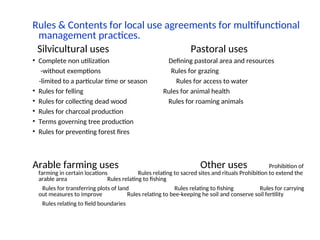
Rules & Contents for local use agreements for multifunctional
management practices.
Silvicultural uses Pastoral uses
• Complete non utilization Defining pastoral area and resources
-without exemptions Rules for grazing
-limited to a particular time or season Rules for access to water
• Rules for felling Rules for animal health
• Rules for collecting dead wood Rules for roaming animals
• Rules for charcoal production
• Terms governing tree production
• Rules for preventing forest fires
Arable farming uses Other uses Prohibition of
farming in certain locations Rules relating to sacred sites and rituals Prohibition to extend the
arable area Rules relating to fishing
Rules for transferring plots of land Rules relating to fishing Rules for carrying
out measures to improve Rules relating to bee-keeping he soil and conserve soil fertility
Rules relating to field boundaries
Management Practices for Conservation
Agricultural
• The inventory range on current Management practices on agricultural
based livelihoods-- on crops, livestock, forestry and agro forestry and
natural resources conservation and management is presented below:
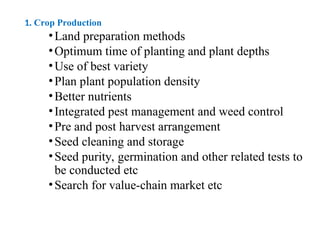
1. Crop Production
•Land preparation methods
•Optimum time of planting and plant depths
•Use of best variety
•Plan plant population density
•Better nutrients
•Integrated pest management and weed control
•Pre and post harvest arrangement
•Seed cleaning and storage
•Seed purity, germination and other related tests to
be conducted etc
•Search for value-chain market etc
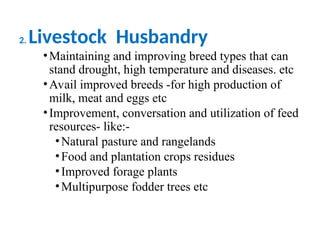
2. Livestock Husbandry
•Maintaining and improving breed types that can
stand drought, high temperature and diseases. etc
•Avail improved breeds -for high production of
milk, meat and eggs etc
•Improvement, conversation and utilization of feed
resources- like:-
•Natural pasture and rangelands
•Food and plantation crops residues
•Improved forage plants
•Multipurpose fodder trees etc
•Animal health services to be practiced
like;
•Prevention
•Control
•Treatment
•Use of indigenous medicine etc
3. Forestry and Agro-forestry
•Management practices include;
•Homestead wood lot/tree crops/
•Natural plantation
•Plantations for timber
•Non-timber forest plantation
•Multi-purpose trees for agro-forestry
systems etc.
4. Natural resources, Conservation and Management
•Major practices focus on;
•Rain water harvesting
•Use of irrigation
•Efficient- water utilization
•Efficient soil fertility and nutrient
management
•soil and water conservation
•Water shed and catchment areas development
etc
Scaling Up
•As stated above, the management practices is highly considered at
research stations and extensive development areas; and beyond at
farmers field etc
• adaption practices and management needs to be verified at on farm researcher station (OFRS) and
at farmers training center (FTCs); and beyond
• Then after, scaling up could be executed and shared experiences to other similar agro- ecological
conditions
• Therefore, efforts on scaling up will be crucial in moving forward in the implantation of the
management practices.
•Conservation Agriculture
It provide opportunities for farmers to choose
Many different technologies
that best suit their situation with proper
management practices
Thank You
Alemayehu Mengistu
E-mail: alemayehumengistu@yahoo.com
•Ethiopia

3. conservation agriculture lecture note.ppt

  • 1.
    Conservation Agriculture by Alemayehu Mengistu forpostgraduate program E-mail:- alemayehumengistu@yahoo.com Pasture , Forage and Range scientist
  • 2.
    I. Conservation Agriculture IIntroduction •Over 85% of the Ethiopians depend on farming for subsistence and livelihood. •Stagnation and declining of land productivity in the country is increasing •This has translated to chronic food and feed insecurity and growing poverty •In addition, households and communities are increasingly vulnerable and their major resource-land-can no longer sustain them. •This will automatically call the need for the proper use of “Conservation Agriculture” which will contribute more to Natural Resource Management
  • 3.
    Natural Resources Management •Natural resources management ensures that resources are properly cared for and wisely managed • It conserves soil and water, so that the land can produce food and feed etc for many generations. • It works with nature and farmers etc • It looks at the climate, rainfall, soil, vegetation, plants, animals and microorganisms etc. • It will guide/ lead farmers to decide on the best use of agriculture /farming/ for producing high yield while conserving the land and its resources • The way to achieve natural resources management is by observing nature and then using nature to do the hard work for farmers.
  • 4.
    • For this,Permaculture system which creates systems in the agricultural /farming/ land to provide with food and feed for the least amount of work is fund to be an appropriate system • On the other hand if farmers misuse Nature, they will starve themselves and others. • Misuse of nature /land/ will lead to the creation of marginal lands. • There fore Conservation Agriculture is one of the many ways that aims to achieve Natural Resources Management wisely, care fully and properly.
  • 5.
    2. Conservation Agriculture •It is one of the tool for promoting sustainable agriculture through the proper care and wise use of natural resources management • Its aim is to produce high stable yield of agricultural products reducing production cost, maintaing and conserving soil and water; and other resources – flora, fauna and micro organisms. • It is a win-win situation to achieve sustainable natural resources management and improve food security and support livelihood.
  • 6.
    2.1 Goals :- Eradicateextreme poverty and hunger • Ensure environmental sustainable • Develop partnership for development 2.2 Three basic principles • Respect the land and its resources (flora, fauna and micro organisms) and use for the purpose to which its is suited • Conserve and maintain resources, water and soil – keep alive • Farming in harmony with nature • Practice integrated /holistic/ farming and husbandry system 2.3 Why we start to use to:- • Produce high yield /Biomass/ • Reduce cost • Takes /needs/ less work
  • 7.
    2.4 Challenges • Changesof mind • Land tenure • Finance /inputs/ and extension supports etc • Areas /agro-ecological zones/ to apply • Semi-arid lands • Sub-humid and humid areas • Where labour is scarce • Densely populated areas • On good soil, rain fall /potential areas/ etc
  • 8.
    3. Land /soil/cover • Plant cover protects the land /sol and micro organism/ that live in it from heat of the sun and impacts of rain etc to produce food and feed. • Plant cover materials are the food for the soil and micro organism etc. • There fore, soil and micro organism has life, which needs to b fed and feed others – if they are healthy
  • 9.
    3.1 How tochoose the right plant cover • Choose multi purpose plant types for food, feed and other uses, like:- • Edible seed and vegetables • For soil and water conservation • For animal feeds • For fire wood, fencing and construction etc • Weed suppression • Medicines etc.
  • 10.
    3.2 Sources ofplanting materials • Cutting, seedlings and seeds • Research institutes and extension services • Wild sources • Farmers groups • Seed saless and farm supply stores • Grown your own 3.3 Where to plant - /areas / systems/ • Inter cropping • Rely cropping • Sequential planting • Strip on bunds • Gulley areas • Strip exclusion areas • Protected areas etc.
  • 11.
    3.4 Challenges formaintaining land /soil cover • Semi arid areas – shortage of rain • use grasses, legumes, trees, shrubs and crop residues etc. • Rats and pests:- destroy plant /crop/ • Rotate plant/ crop, use of rat-trap, and poison etc • Termites – resulted with bare ground /poor soil cover/ • cover the soil surface by vegetative materials • use smoke and opportunistic use of flood • poising etc • Fire – damage plant and the soil cover • use prescribed fire • avoid uncontrolled fire • establish bylow and educate farmers
  • 12.
    • Livestock –overgrazing affect land cover • planting around farm places and protected ares • utilization of other feed resources to reduce grazing pressure • Information – basic knowledge and information is need to maintain land /soil/ cover 4.0 Conserving soil and water 4.1 The need to conserve •to protect the soil •to hold the soil structure stays intact •less run-off
  • 13.
    4.2 Soil andwater conservation measures • Countour and cut off ditches • Gulley treatment • Grass strip • Stone lives • Level contour bunds • Bench terraces etc 4.3 Water harvesting 4.3.1 Uses • More water with the soil • Less evaporation • Better use of seasons rainfall • High water concentrates
  • 14.
    4.3.2 Water managementtechniques includes • Broad bed, furrows • Flooding • Planting basins or pitting • Permanent strips • Contour bunds and catchments strips • Roof catchments • Road catchments • Half moon micro catchment • Intensive use of irrigation from river and lakes etc through pipe, furrows, flood and basin system
  • 15.
    5. Benefit • Soiland water and other natural resources will be conserved and become more available and provide health to flora, and funa and microorganism • Earn more money and improve like – style • Reduce erosion • Clean environment, provide safe and clean water and air • Produce new products • Stimulate markets and growth in the locality and community • Help to make global weather patterns more reliable
  • 16.
    6 Dissemination andPromotion • Training • Extension • Farmers field schools • Farmers champions • Farmers to farmers extension • Farmers organizations • School, churches, and market areas etc • Sharing experiences • Farming as business • Multiple stake holders partnership • Entrepreneurs • Policy support • Promoting research • Changing curricula • Building conservation based agriculture within the farming system
  • 17.
    • To becomemore farmers centered with full interests • Collaboration of NGO’s etc and • Facilitate farmers fields schools • Involvement in policy and advocacy systems
  • 18.
    7. Conservation Agricultureand People • Conservation agriculture is affected by two issues:- • The different roles and special needs of women and men • How culture beliefs affects people’s willingness to consider conservation agriculture • It provides opportunities for special group of people:- it shows how it can: • Help families in the challenges of HIV/ AIDS • Help farmers with physical disabilities • Provide incentive for young to stay in farming • It provides techniques and information on how to do and where to do it and benefit to interested people, like:-  Grass root players :- farmers, extension workers, and input suppliers etc  Others interested in conservation agriculture: agriculture researchers, policy makers, NGOs, trainers, teachers, and students etc.
  • 19.
    8. Opportunities • Itprovide opportunities to conserve, manage and utilize biological resource (flora, fauna and microorganisms) • It appeals to all categories of farmers:- • Small – scale subsistence farmers to High – tech commercial farmers • It can be used in all most climates and soils where it is possible to grow, and manage. • It is the best-bet entry point to support food security programme, eradicate poverty and improve the livelihood of people • On the other hand, it erect an exit strategy to combat desertification, environmental destruction and global warming to make global weather patterns more reliable • It appeals to general and public and national leaders as a policy to promote and approve
  • 20.
    9. The WayForward • Conservation agriculture is a holistic and multidisciplinary system • It relates with other key areas that farmers are concerned with: • Socio-economics issues, • Culture and traditions; and • Marketing etc • Conservation agriculture is not a single set of techniques – there is no one “best practice”, multifunctional practices are highly needed.
  • 21.
    Rules & Contentsfor local use agreements for multifunctional management practices. Silvicultural uses Pastoral uses • Complete non utilization Defining pastoral area and resources -without exemptions Rules for grazing -limited to a particular time or season Rules for access to water • Rules for felling Rules for animal health • Rules for collecting dead wood Rules for roaming animals • Rules for charcoal production • Terms governing tree production • Rules for preventing forest fires Arable farming uses Other uses Prohibition of farming in certain locations Rules relating to sacred sites and rituals Prohibition to extend the arable area Rules relating to fishing Rules for transferring plots of land Rules relating to fishing Rules for carrying out measures to improve Rules relating to bee-keeping he soil and conserve soil fertility Rules relating to field boundaries
  • 22.
    Management Practices forConservation Agricultural • The inventory range on current Management practices on agricultural based livelihoods-- on crops, livestock, forestry and agro forestry and natural resources conservation and management is presented below:
  • 23.
    1. Crop Production •Landpreparation methods •Optimum time of planting and plant depths •Use of best variety •Plan plant population density •Better nutrients •Integrated pest management and weed control •Pre and post harvest arrangement •Seed cleaning and storage •Seed purity, germination and other related tests to be conducted etc •Search for value-chain market etc
  • 24.
    2. Livestock Husbandry •Maintainingand improving breed types that can stand drought, high temperature and diseases. etc •Avail improved breeds -for high production of milk, meat and eggs etc •Improvement, conversation and utilization of feed resources- like:- •Natural pasture and rangelands •Food and plantation crops residues •Improved forage plants •Multipurpose fodder trees etc
  • 25.
    •Animal health servicesto be practiced like; •Prevention •Control •Treatment •Use of indigenous medicine etc
  • 26.
    3. Forestry andAgro-forestry •Management practices include; •Homestead wood lot/tree crops/ •Natural plantation •Plantations for timber •Non-timber forest plantation •Multi-purpose trees for agro-forestry systems etc.
  • 27.
    4. Natural resources,Conservation and Management •Major practices focus on; •Rain water harvesting •Use of irrigation •Efficient- water utilization •Efficient soil fertility and nutrient management •soil and water conservation •Water shed and catchment areas development etc
  • 28.
    Scaling Up •As statedabove, the management practices is highly considered at research stations and extensive development areas; and beyond at farmers field etc • adaption practices and management needs to be verified at on farm researcher station (OFRS) and at farmers training center (FTCs); and beyond • Then after, scaling up could be executed and shared experiences to other similar agro- ecological conditions • Therefore, efforts on scaling up will be crucial in moving forward in the implantation of the management practices.
  • 29.
    •Conservation Agriculture It provideopportunities for farmers to choose It provide opportunities for farmers to choose Many different technologies Many different technologies that best suit their situation with proper that best suit their situation with proper management practices management practices
  • 30.
    Thank You Alemayehu Mengistu E-mail:alemayehumengistu@yahoo.com •Ethiopia