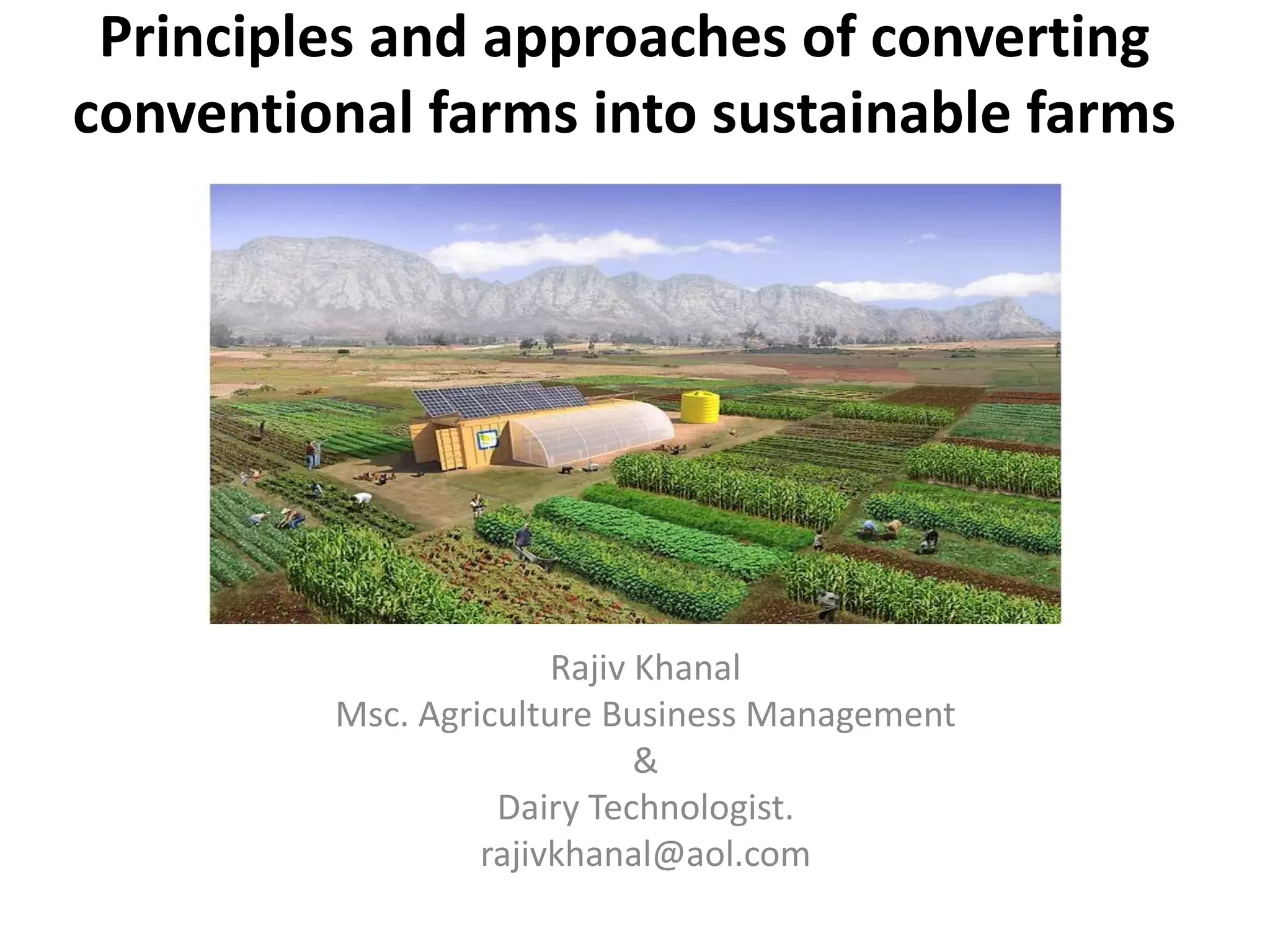
Principles and approaches of converting
conventional farms into sustainable farms
Rajiv Khanal
Msc. Agriculture Business Management
&
Dairy Technologist.
rajivkhanal@aol.com
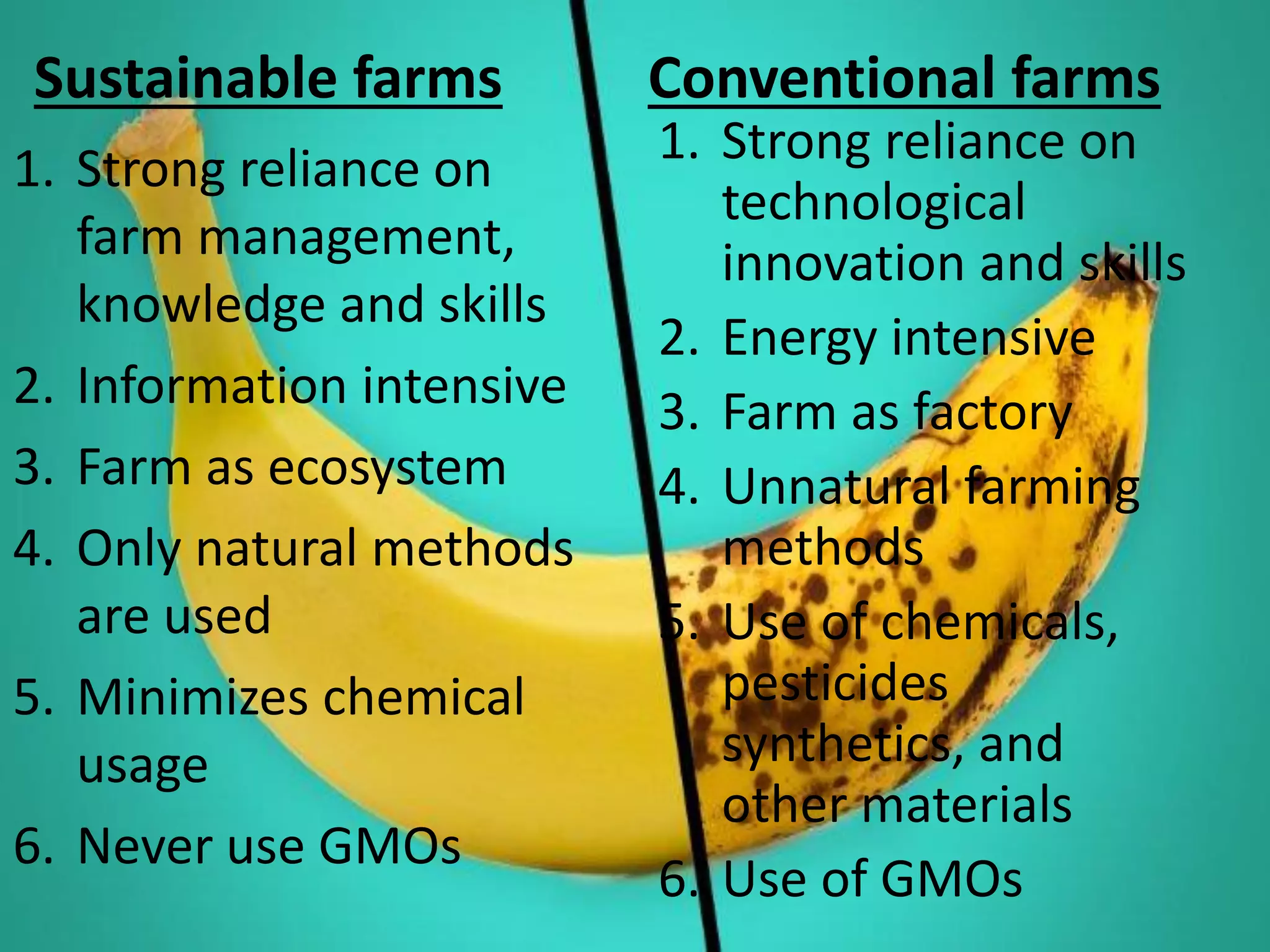
Sustainable farms
1. Strong reliance on
farm management,
knowledge and skills
2. Information intensive
3. Farm as ecosystem
4. Only natural methods
are used
5. Minimizes chemical
usage
6. Never use GMOs
Conventional farms
1. Strong reliance on
technological
innovation and skills
2. Energy intensive
3. Farm as factory
4. Unnatural farming
methods
5. Use of chemicals,
pesticides
synthetics, and
other materials
6. Use of GMOs
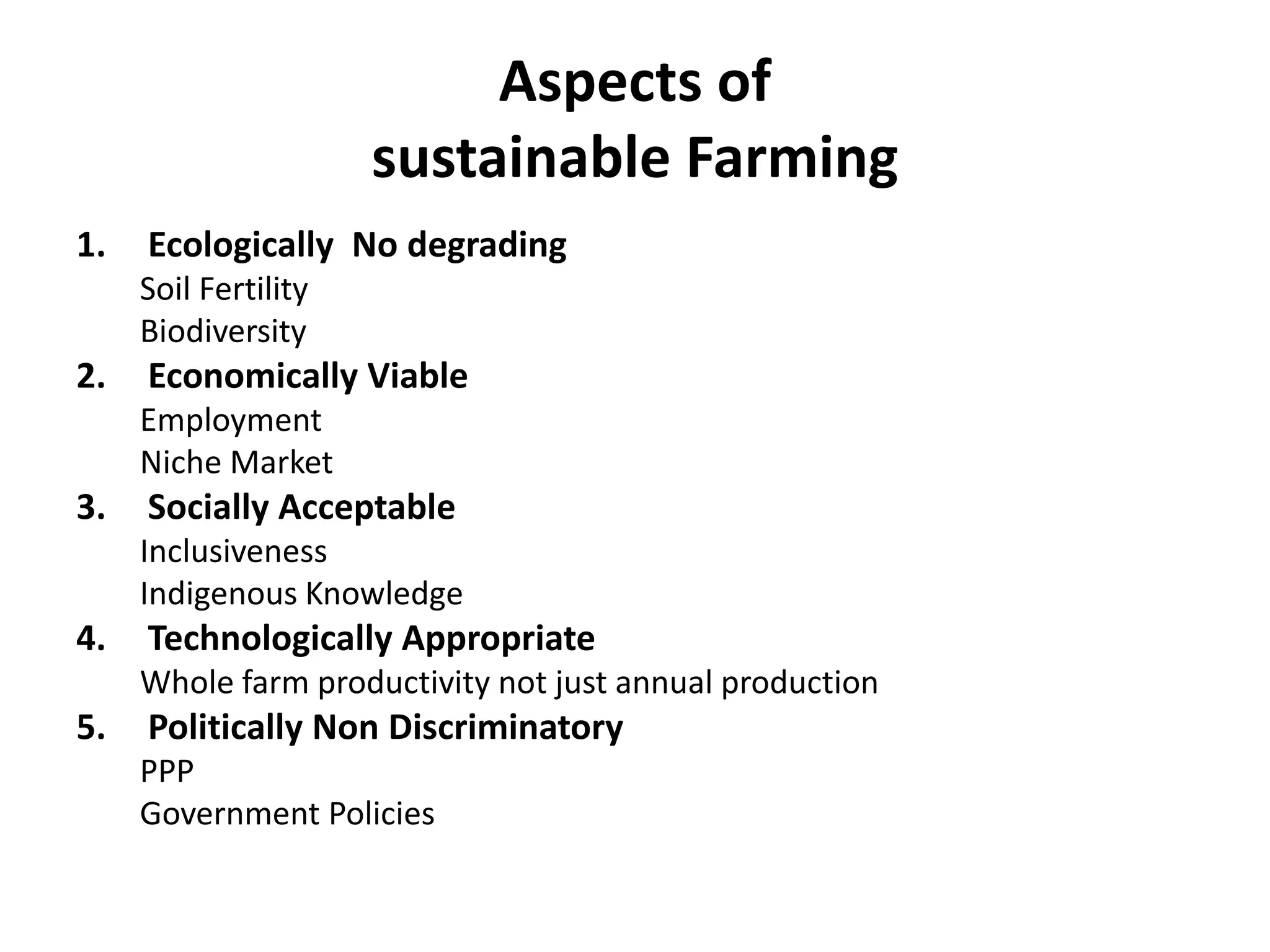
Aspects of
sustainable Farming
1. Ecologically No degrading
Soil Fertility
Biodiversity
2. Economically Viable
Employment
Niche Market
3. Socially Acceptable
Inclusiveness
Indigenous Knowledge
4. Technologically Appropriate
Whole farm productivity not just annual production
5. Politically Non Discriminatory
PPP
Government Policies
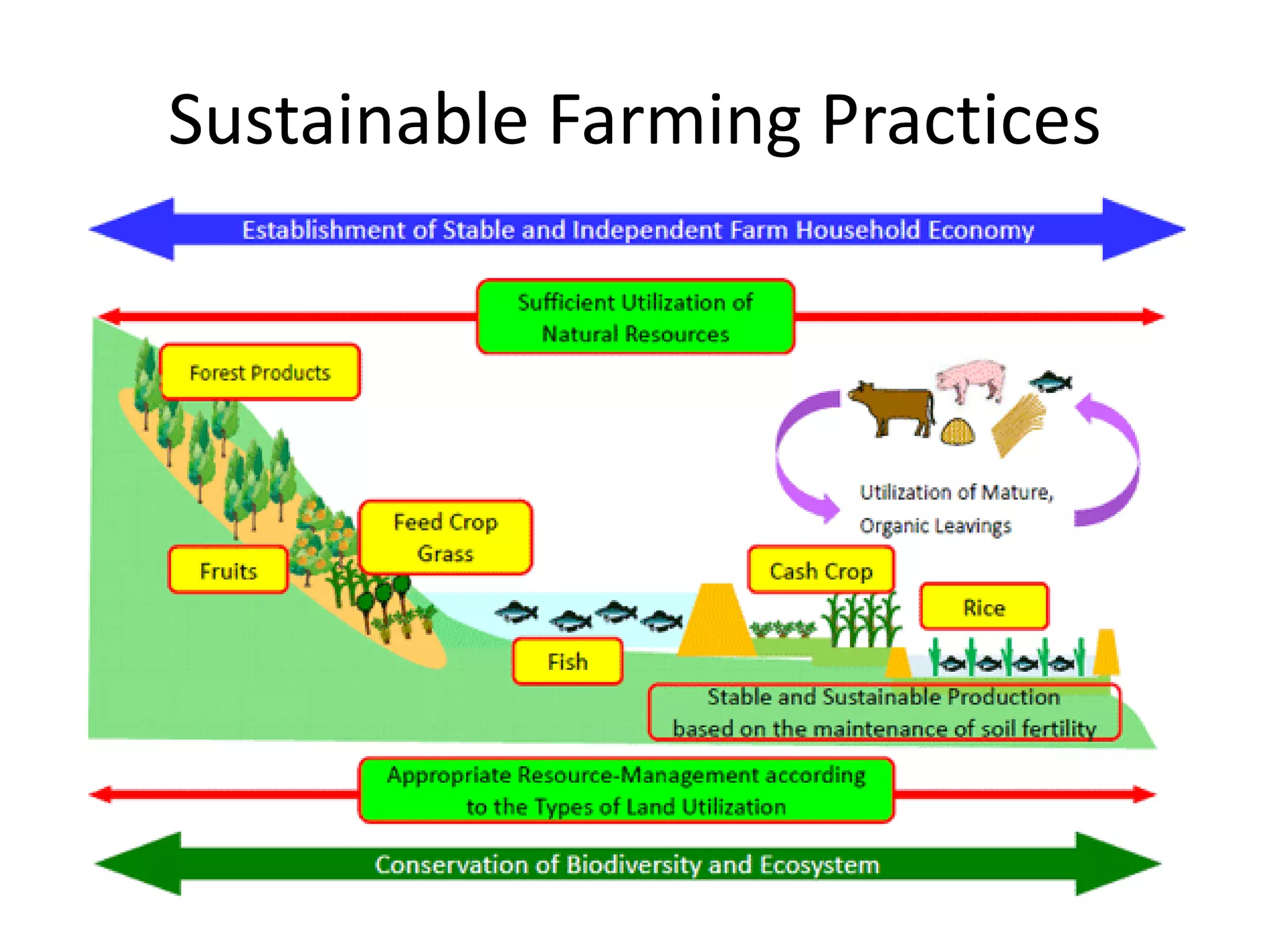
Sustainable Farming Practices
Principle of Sustainable Farm
• Improving efficiency in the use of resources
– Modifying current practices improve the productivity Conserve,
protect and enhance natural resources
• Protect and improve rural livelihoods, equity and social well-being
– Reduce negative impacts and enhance the status of natural resources.
• Enhanced flexibility of people, communities and ecosystems
– access to and control of productive resources, and addressing the
gender gap
• Enhanced flexibility of people, communities and ecosystems is key
to sustainable agriculture
– Extreme weather events, market volatility and civil conflict impair the
stability of agriculture.
• Responsible and effective governance mechanisms
– Balance between private and public sector initiatives, as well as
accountability, equity, transparency and the rule of law.
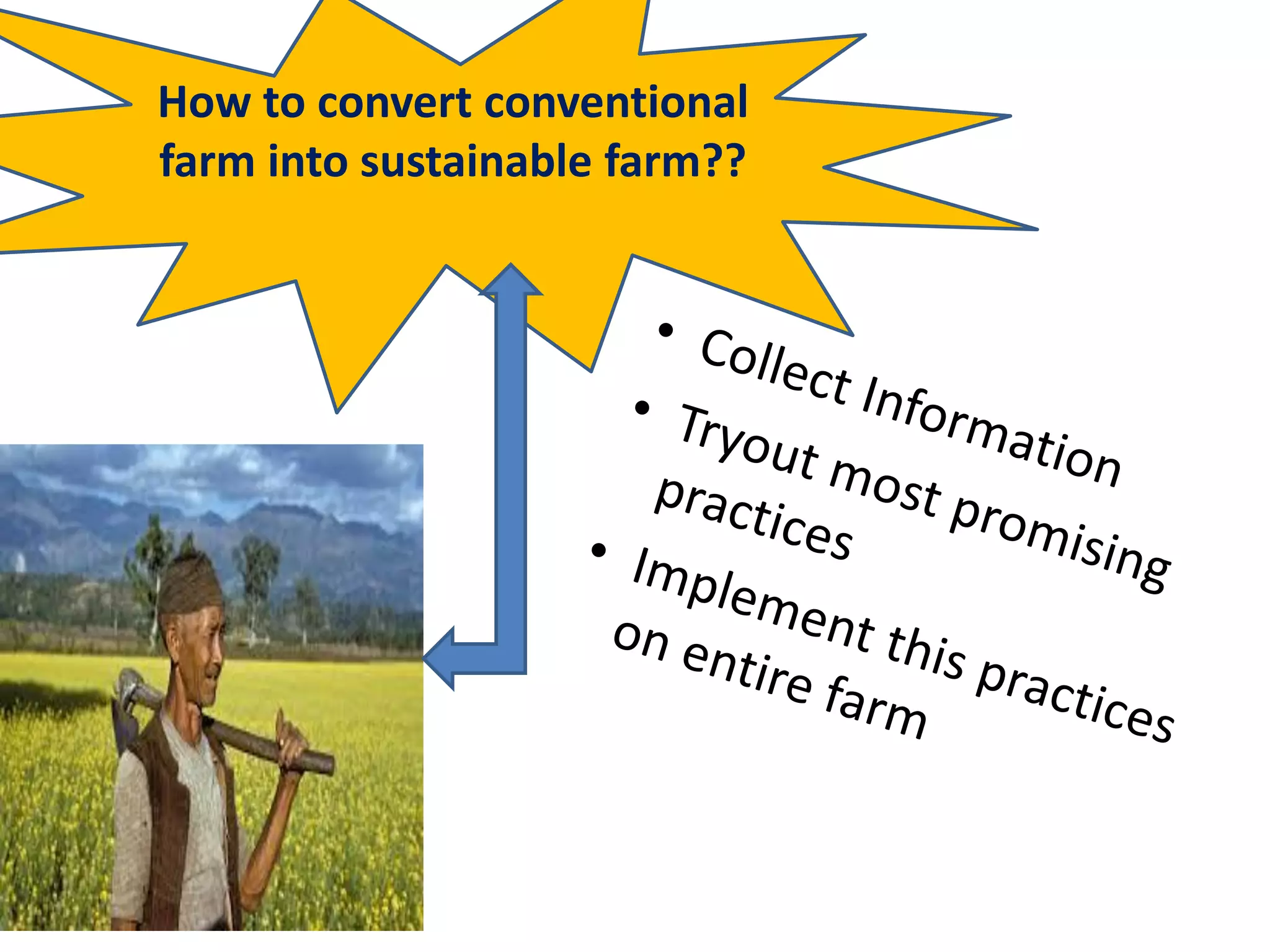
How to convert conventional
farm into sustainable farm??
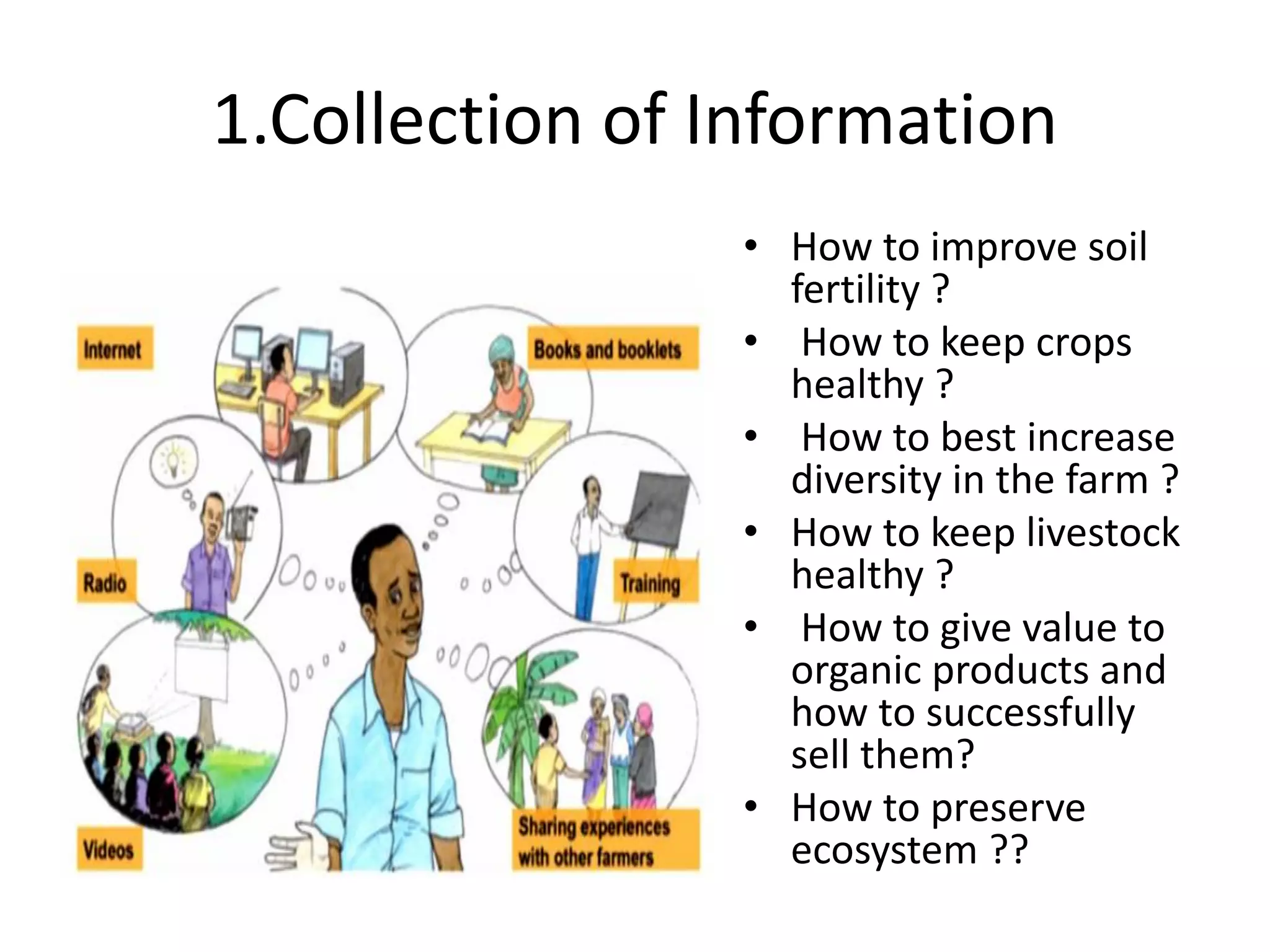
1.Collection of Information
• How to improve soil
fertility ?
• How to keep crops
healthy ?
• How to best increase
diversity in the farm ?
• How to keep livestock
healthy ?
• How to give value to
organic products and
how to successfully
sell them?
• How to preserve
ecosystem ??
2. Tryout most promising practices
Sustainable practices
1. Make use of Renewable
Energy Sources
2. Integrated pest management
3. Crop Rotation
4. Avoid Soil Erosion
5. Natural Pest Eliminators
6. Managed Grazing
7. Better Water Management
8. Cover Crops
Plan Component
1. Defined objectives
2. Resource inventory
3. Yield projections
4. Financial plan
5. Timetable for
conversion
6. Monitoring
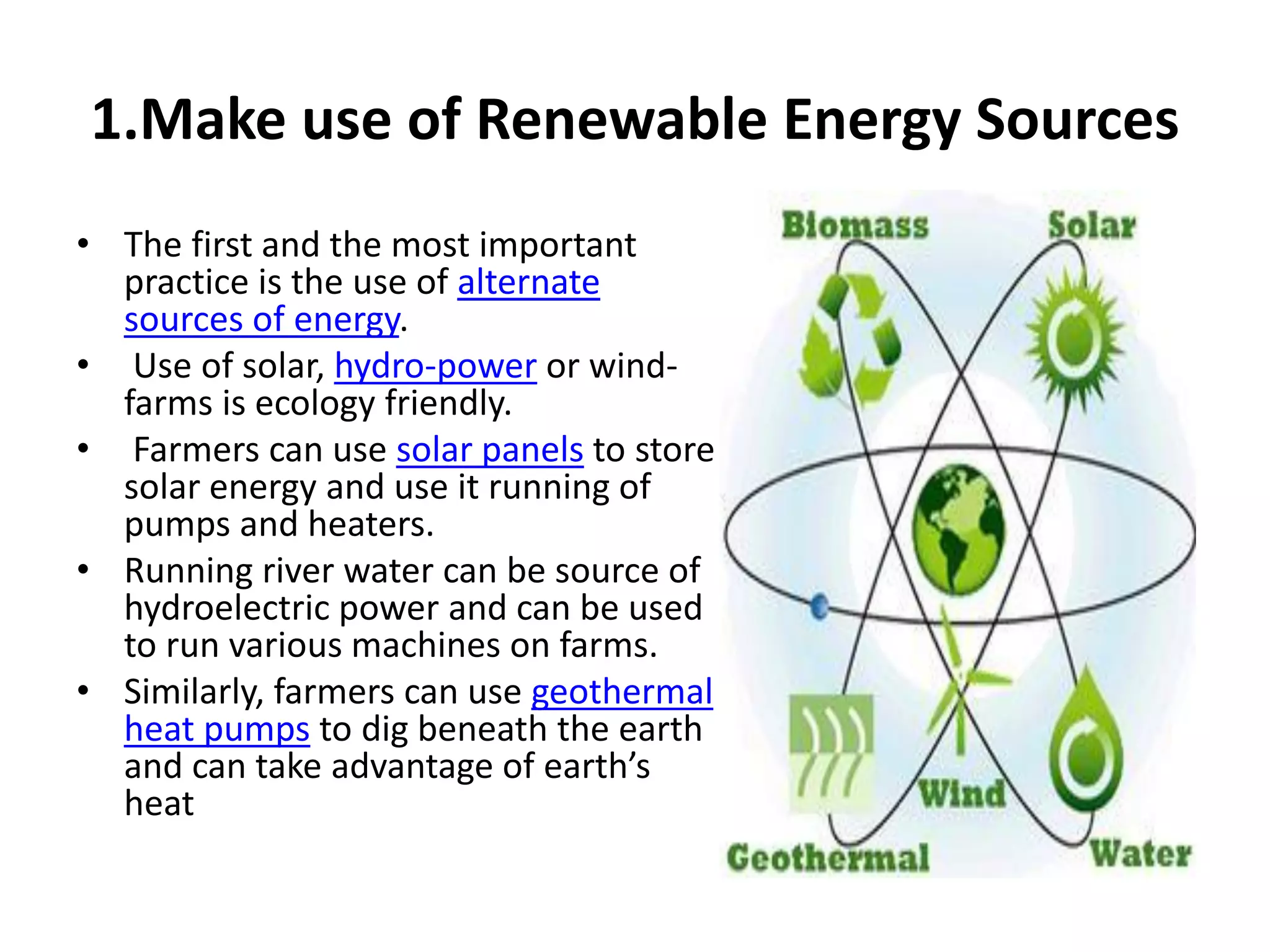
1.Make use of Renewable Energy Sources
• The first and the most important
practice is the use of alternate
sources of energy.
• Use of solar, hydro-power or wind-
farms is ecology friendly.
• Farmers can use solar panels to store
solar energy and use it running of
pumps and heaters.
• Running river water can be source of
hydroelectric power and can be used
to run various machines on farms.
• Similarly, farmers can use geothermal
heat pumps to dig beneath the earth
and can take advantage of earth’s
heat
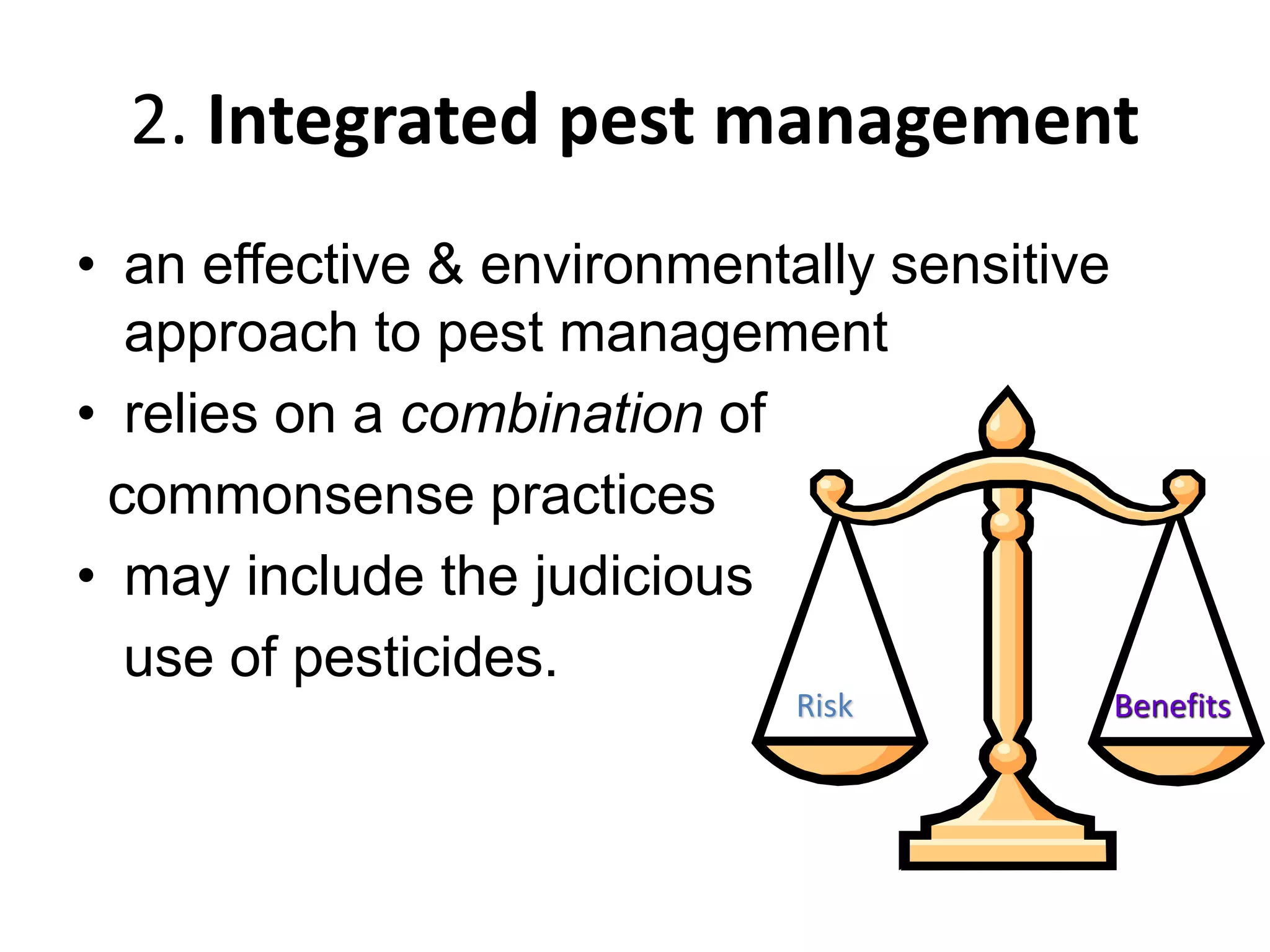
2. Integrated pest management
• an effective & environmentally sensitive
approach to pest management
• relies on a combination of
commonsense practices
• may include the judicious
use of pesticides.
Risk Benefits
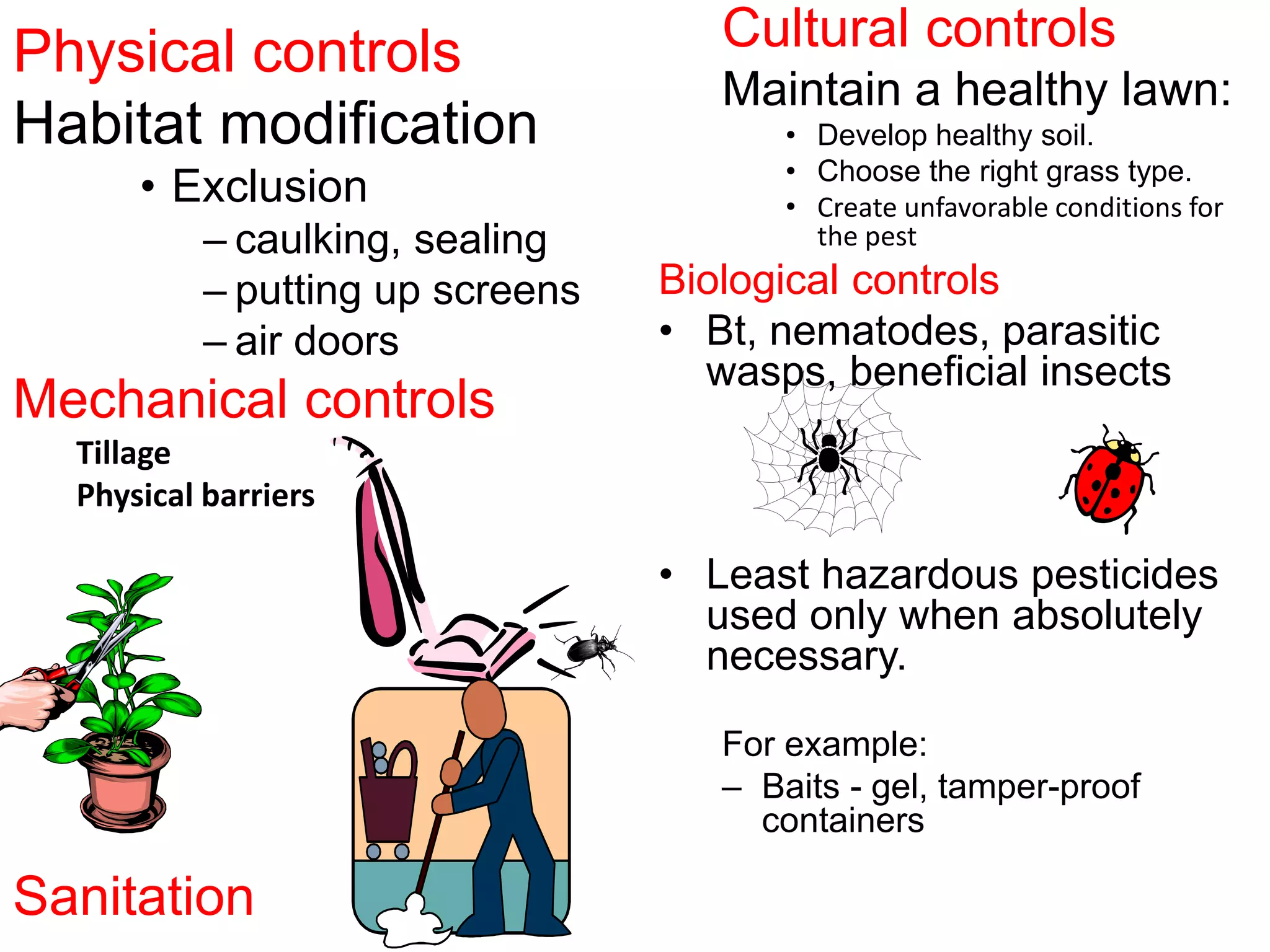
Physical controls
Habitat modification
• Exclusion
– caulking, sealing
– putting up screens
– air doors
Mechanical controls
Tillage
Physical barriers
Sanitation
Cultural controls
Maintain a healthy lawn:
• Develop healthy soil.
• Choose the right grass type.
• Create unfavorable conditions for
the pest
Biological controls
• Bt, nematodes, parasitic
wasps, beneficial insects
• Least hazardous pesticides
used only when absolutely
necessary.
For example:
– Baits - gel, tamper-proof
containers
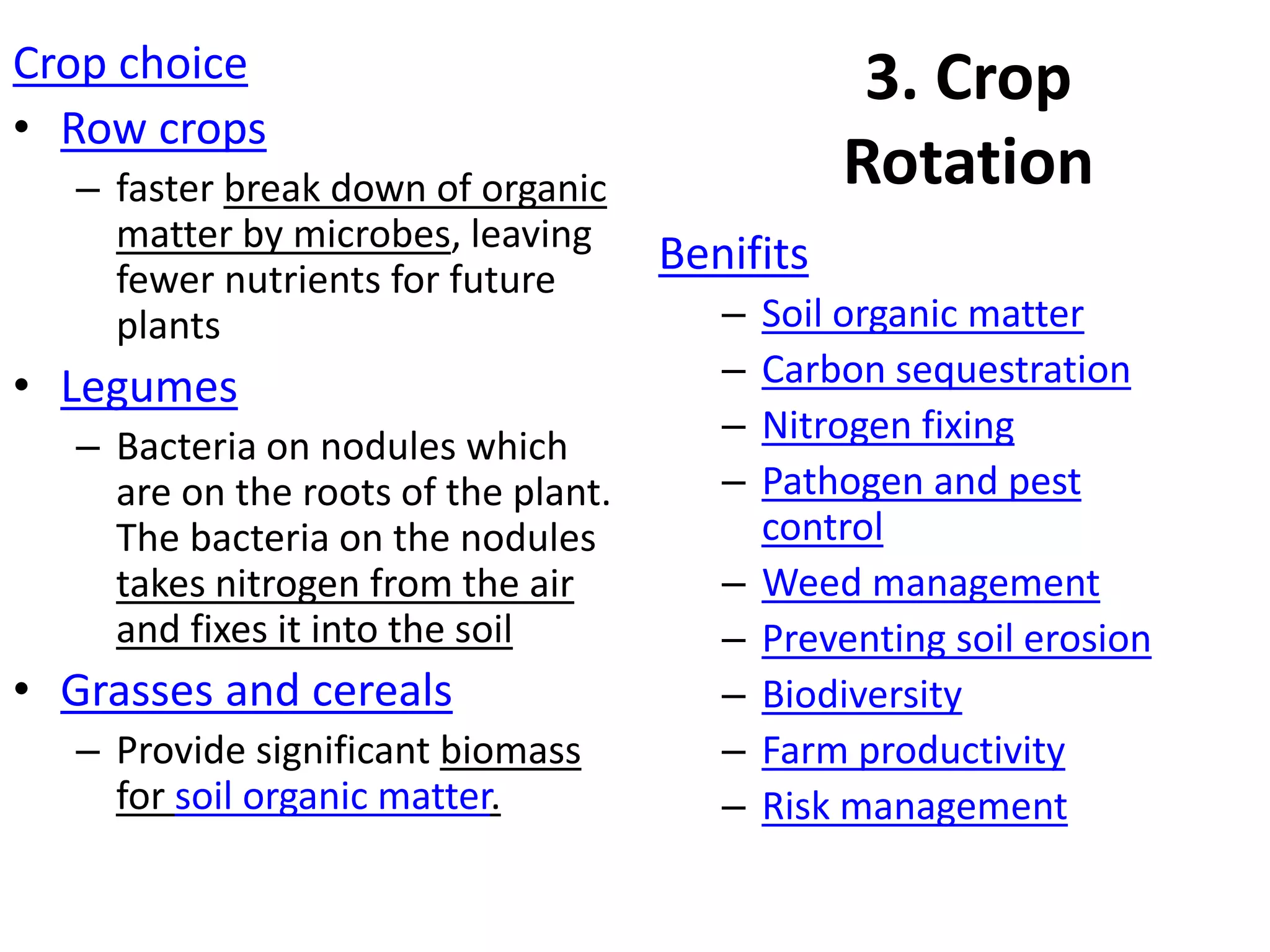
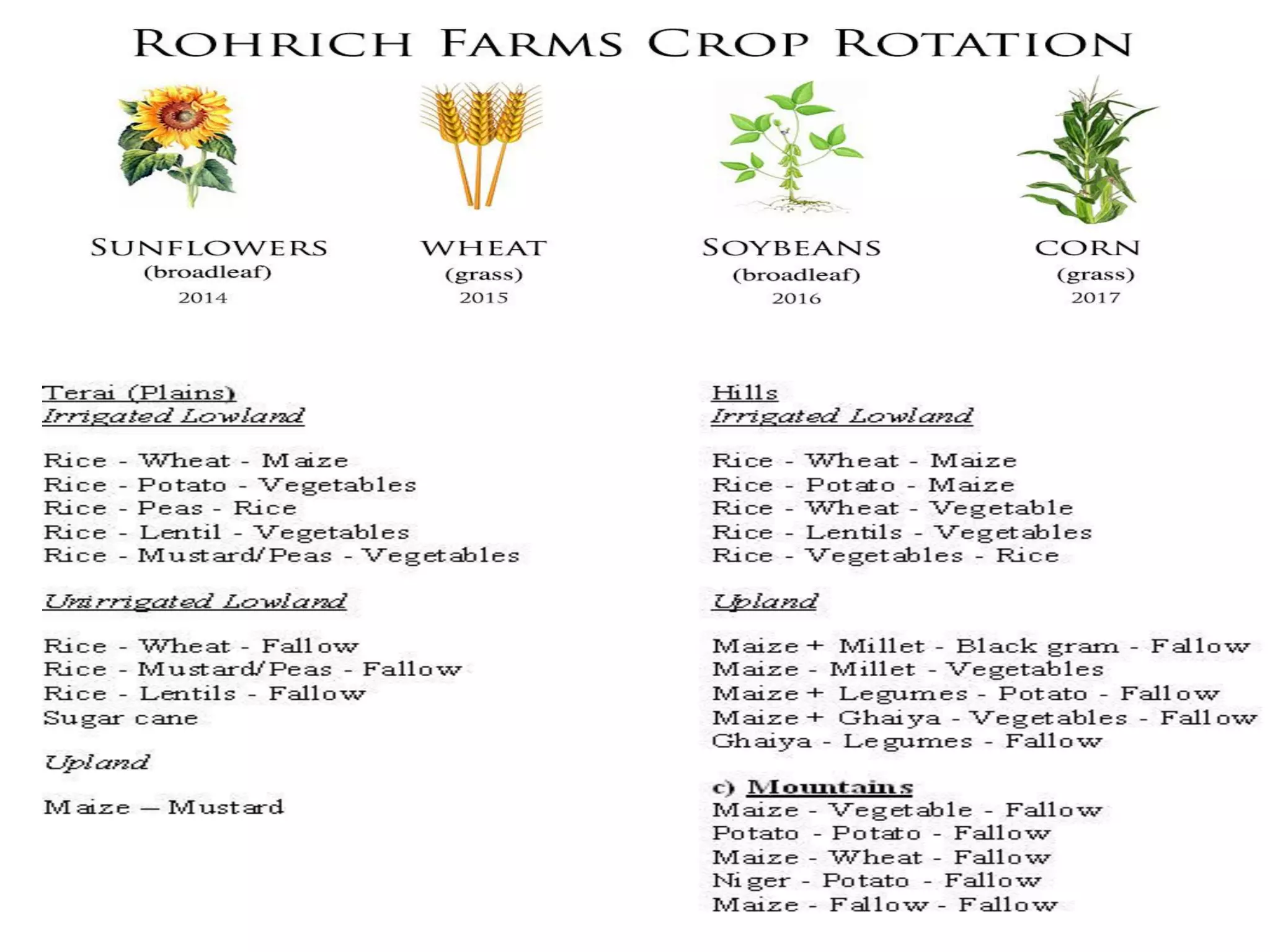
3. Crop
Rotation
Crop choice
• Row crops
– faster break down of organic
matter by microbes, leaving
fewer nutrients for future
plants
• Legumes
– Bacteria on nodules which
are on the roots of the plant.
The bacteria on the nodules
takes nitrogen from the air
and fixes it into the soil
• Grasses and cereals
– Provide significant biomass
for soil organic matter.
Benifits
– Soil organic matter
– Carbon sequestration
– Nitrogen fixing
– Pathogen and pest
control
– Weed management
– Preventing soil erosion
– Biodiversity
– Farm productivity
– Risk management
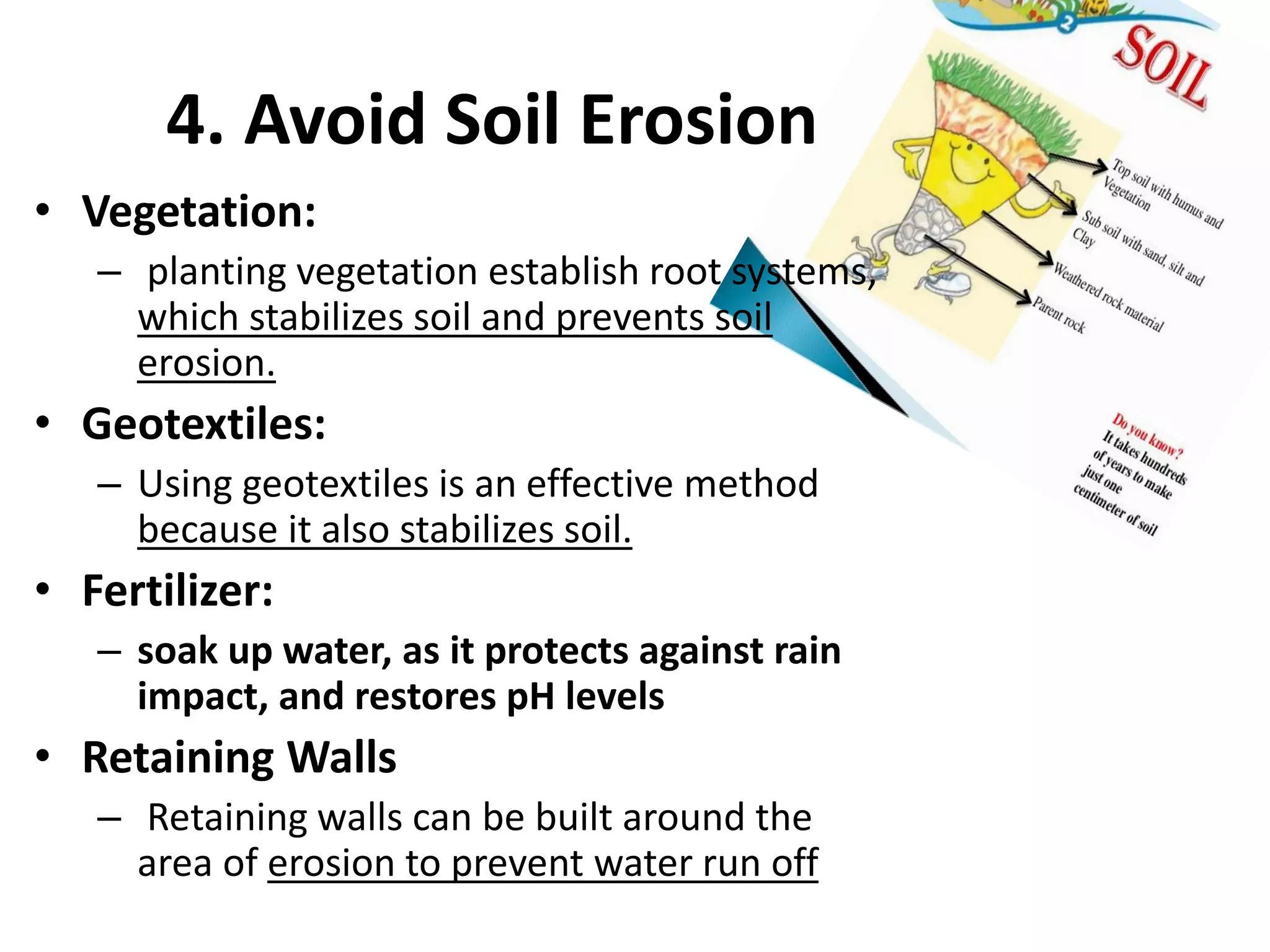
4. Avoid Soil Erosion
• Vegetation:
– planting vegetation establish root systems,
which stabilizes soil and prevents soil
erosion.
• Geotextiles:
– Using geotextiles is an effective method
because it also stabilizes soil.
• Fertilizer:
– soak up water, as it protects against rain
impact, and restores pH levels
• Retaining Walls
– Retaining walls can be built around the
area of erosion to prevent water run off
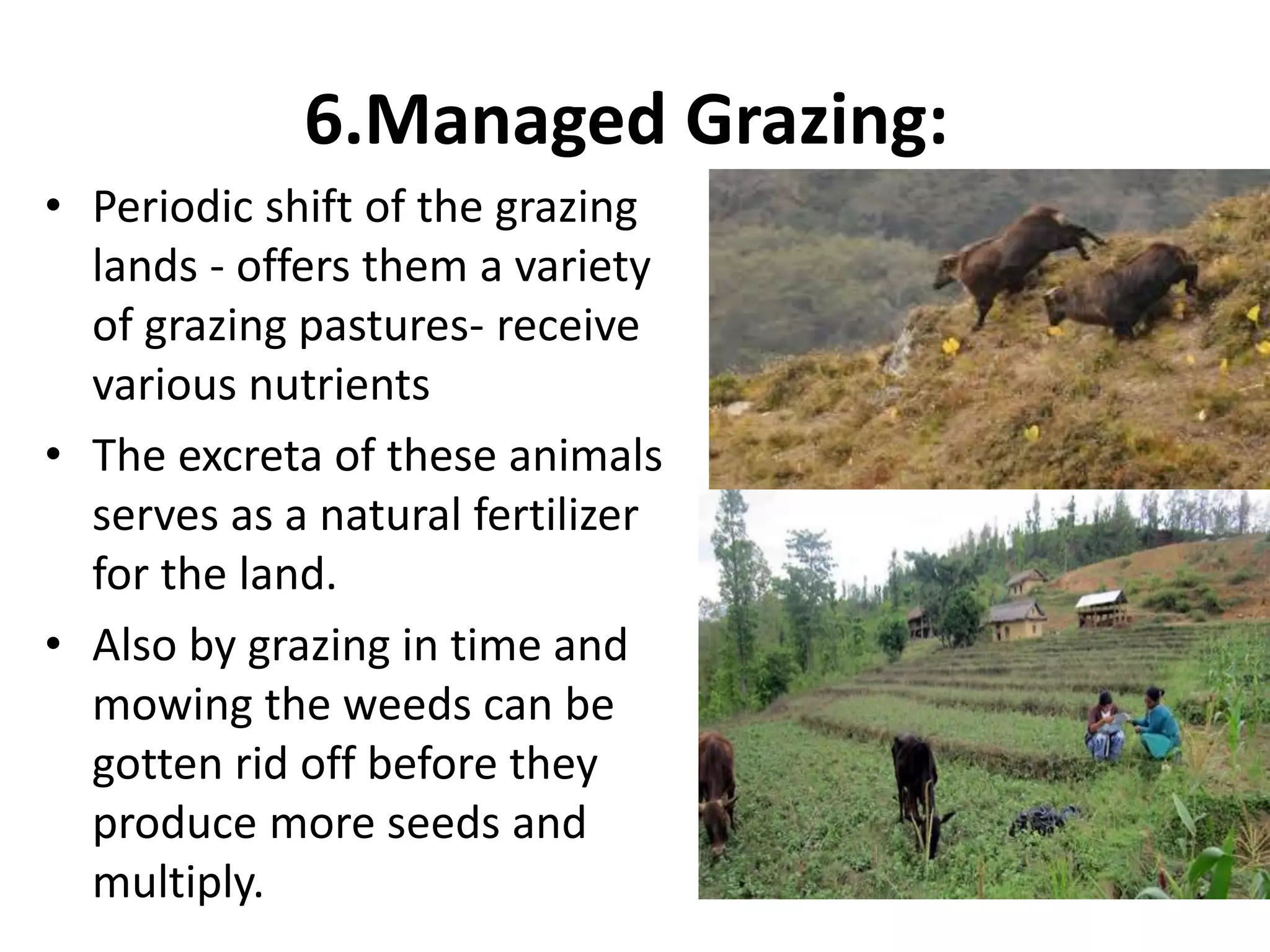
6.Managed Grazing:
• Periodic shift of the grazing
lands - offers them a variety
of grazing pastures- receive
various nutrients
• The excreta of these animals
serves as a natural fertilizer
for the land.
• Also by grazing in time and
mowing the weeds can be
gotten rid off before they
produce more seeds and
multiply.
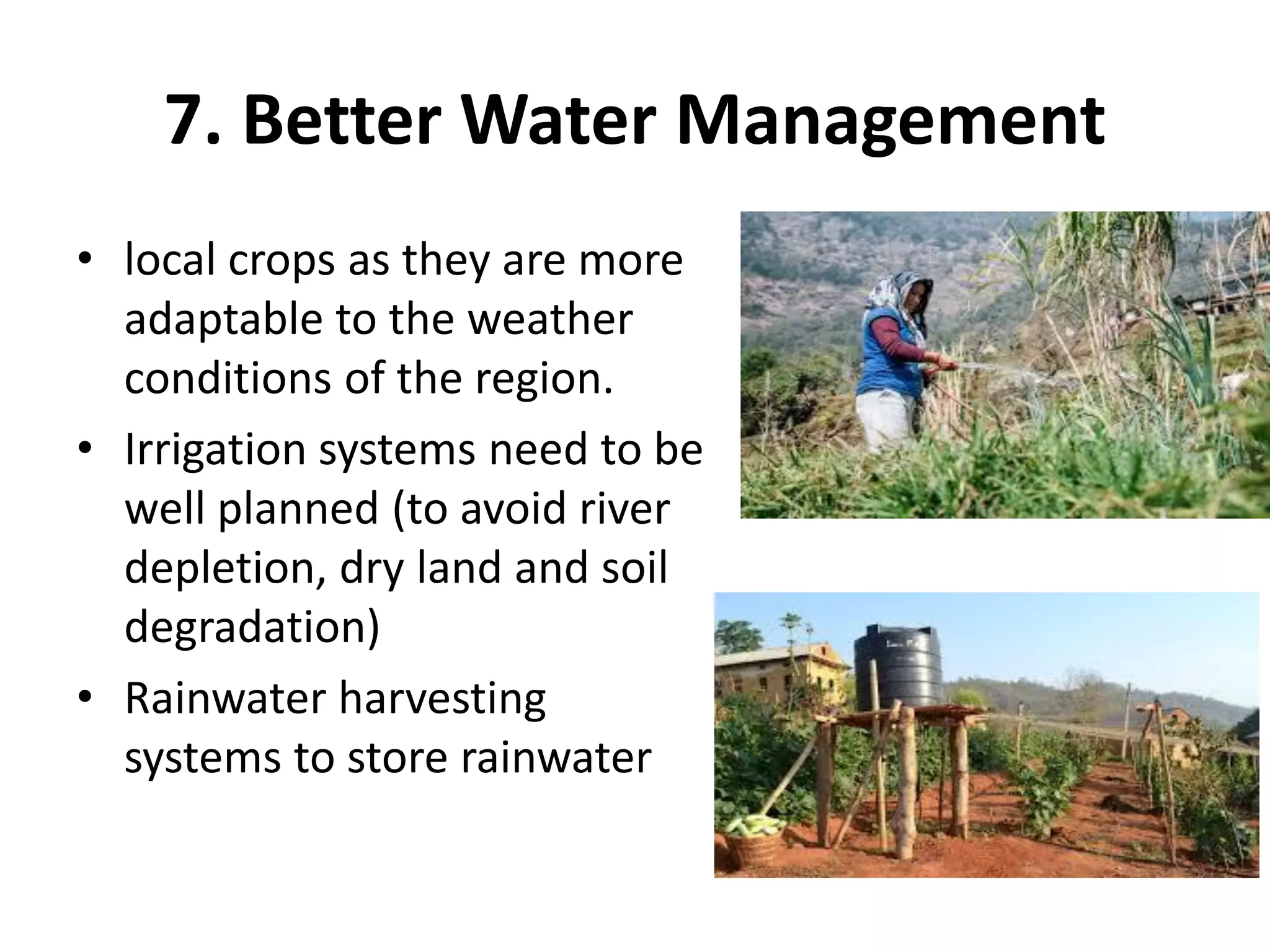
7. Better Water Management
• local crops as they are more
adaptable to the weather
conditions of the region.
• Irrigation systems need to be
well planned (to avoid river
depletion, dry land and soil
degradation)
• Rainwater harvesting
systems to store rainwater
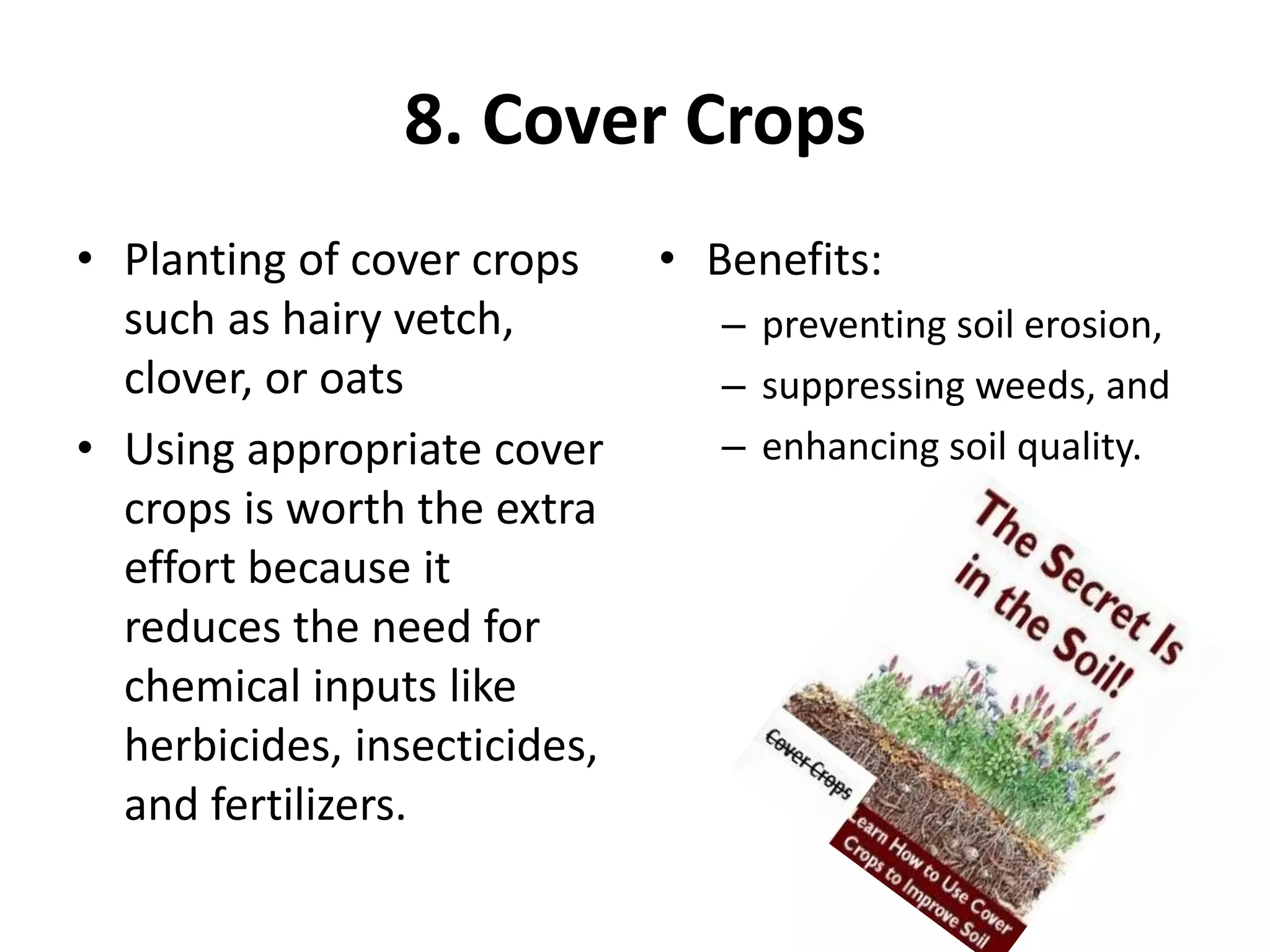
8. Cover Crops
• Planting of cover crops
such as hairy vetch,
clover, or oats
• Using appropriate cover
crops is worth the extra
effort because it
reduces the need for
chemical inputs like
herbicides, insecticides,
and fertilizers.
• Benefits:
– preventing soil erosion,
– suppressing weeds, and
– enhancing soil quality.
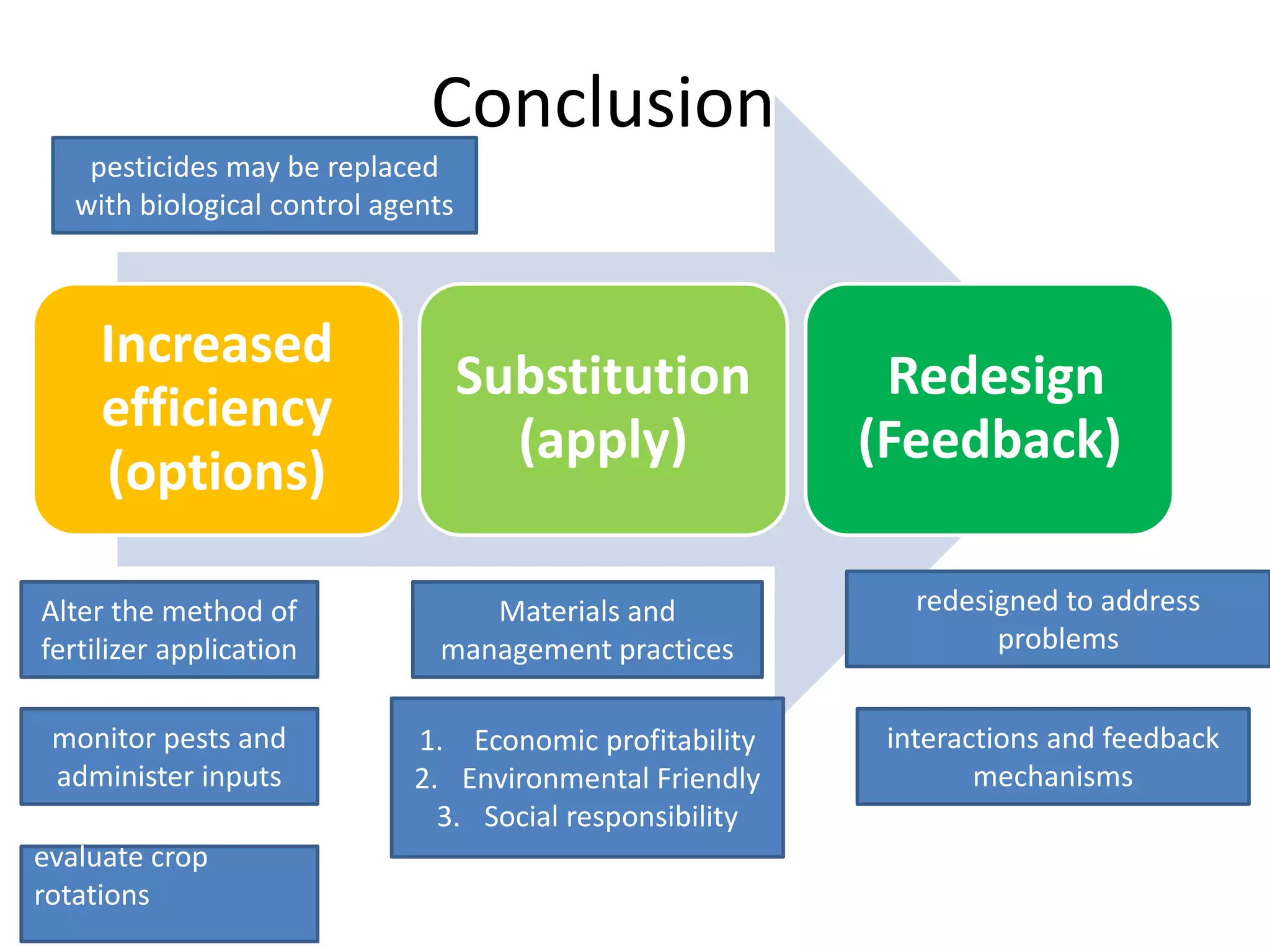
Conclusion
Increased
efficiency
(options)
Substitution
(apply)
Redesign
(Feedback)
Alter the method of
fertilizer application
monitor pests and
administer inputs
evaluate crop
rotations
Materials and
management practices
1. Economic profitability
2. Environmental Friendly
3. Social responsibility
pesticides may be replaced
with biological control agents
redesigned to address
problems
interactions and feedback
mechanisms
Principles and approaches of converting conventional farms into sustainable farms rajiv khanal

Principles and approaches of converting conventional farms into sustainable farms rajiv khanal

  • 1.
    Principles and approachesof converting conventional farms into sustainable farms Rajiv Khanal Msc. Agriculture Business Management & Dairy Technologist. rajivkhanal@aol.com
  • 2.
    Sustainable farms 1. Strongreliance on farm management, knowledge and skills 2. Information intensive 3. Farm as ecosystem 4. Only natural methods are used 5. Minimizes chemical usage 6. Never use GMOs Conventional farms 1. Strong reliance on technological innovation and skills 2. Energy intensive 3. Farm as factory 4. Unnatural farming methods 5. Use of chemicals, pesticides synthetics, and other materials 6. Use of GMOs
  • 3.
    Aspects of sustainable Farming 1.Ecologically No degrading Soil Fertility Biodiversity 2. Economically Viable Employment Niche Market 3. Socially Acceptable Inclusiveness Indigenous Knowledge 4. Technologically Appropriate Whole farm productivity not just annual production 5. Politically Non Discriminatory PPP Government Policies
  • 4.
  • 5.
    Principle of SustainableFarm • Improving efficiency in the use of resources – Modifying current practices improve the productivity Conserve, protect and enhance natural resources • Protect and improve rural livelihoods, equity and social well-being – Reduce negative impacts and enhance the status of natural resources. • Enhanced flexibility of people, communities and ecosystems – access to and control of productive resources, and addressing the gender gap • Enhanced flexibility of people, communities and ecosystems is key to sustainable agriculture – Extreme weather events, market volatility and civil conflict impair the stability of agriculture. • Responsible and effective governance mechanisms – Balance between private and public sector initiatives, as well as accountability, equity, transparency and the rule of law.
  • 6.
    How to convertconventional farm into sustainable farm??
  • 7.
    1.Collection of Information •How to improve soil fertility ? • How to keep crops healthy ? • How to best increase diversity in the farm ? • How to keep livestock healthy ? • How to give value to organic products and how to successfully sell them? • How to preserve ecosystem ??
  • 8.
    2. Tryout mostpromising practices Sustainable practices 1. Make use of Renewable Energy Sources 2. Integrated pest management 3. Crop Rotation 4. Avoid Soil Erosion 5. Natural Pest Eliminators 6. Managed Grazing 7. Better Water Management 8. Cover Crops Plan Component 1. Defined objectives 2. Resource inventory 3. Yield projections 4. Financial plan 5. Timetable for conversion 6. Monitoring
  • 9.
    1.Make use ofRenewable Energy Sources • The first and the most important practice is the use of alternate sources of energy. • Use of solar, hydro-power or wind- farms is ecology friendly. • Farmers can use solar panels to store solar energy and use it running of pumps and heaters. • Running river water can be source of hydroelectric power and can be used to run various machines on farms. • Similarly, farmers can use geothermal heat pumps to dig beneath the earth and can take advantage of earth’s heat
  • 10.
    2. Integrated pestmanagement • an effective & environmentally sensitive approach to pest management • relies on a combination of commonsense practices • may include the judicious use of pesticides. Risk Benefits
  • 11.
    Physical controls Habitat modification •Exclusion – caulking, sealing – putting up screens – air doors Mechanical controls Tillage Physical barriers Sanitation Cultural controls Maintain a healthy lawn: • Develop healthy soil. • Choose the right grass type. • Create unfavorable conditions for the pest Biological controls • Bt, nematodes, parasitic wasps, beneficial insects • Least hazardous pesticides used only when absolutely necessary. For example: – Baits - gel, tamper-proof containers
  • 12.
    3. Crop Rotation Crop choice •Row crops – faster break down of organic matter by microbes, leaving fewer nutrients for future plants • Legumes – Bacteria on nodules which are on the roots of the plant. The bacteria on the nodules takes nitrogen from the air and fixes it into the soil • Grasses and cereals – Provide significant biomass for soil organic matter. Benifits – Soil organic matter – Carbon sequestration – Nitrogen fixing – Pathogen and pest control – Weed management – Preventing soil erosion – Biodiversity – Farm productivity – Risk management
  • 14.
    4. Avoid SoilErosion • Vegetation: – planting vegetation establish root systems, which stabilizes soil and prevents soil erosion. • Geotextiles: – Using geotextiles is an effective method because it also stabilizes soil. • Fertilizer: – soak up water, as it protects against rain impact, and restores pH levels • Retaining Walls – Retaining walls can be built around the area of erosion to prevent water run off
  • 15.
    6.Managed Grazing: • Periodicshift of the grazing lands - offers them a variety of grazing pastures- receive various nutrients • The excreta of these animals serves as a natural fertilizer for the land. • Also by grazing in time and mowing the weeds can be gotten rid off before they produce more seeds and multiply.
  • 16.
    7. Better WaterManagement • local crops as they are more adaptable to the weather conditions of the region. • Irrigation systems need to be well planned (to avoid river depletion, dry land and soil degradation) • Rainwater harvesting systems to store rainwater
  • 17.
    8. Cover Crops •Planting of cover crops such as hairy vetch, clover, or oats • Using appropriate cover crops is worth the extra effort because it reduces the need for chemical inputs like herbicides, insecticides, and fertilizers. • Benefits: – preventing soil erosion, – suppressing weeds, and – enhancing soil quality.
  • 18.
    Conclusion Increased efficiency (options) Substitution (apply) Redesign (Feedback) Alter the methodof fertilizer application monitor pests and administer inputs evaluate crop rotations Materials and management practices 1. Economic profitability 2. Environmental Friendly 3. Social responsibility pesticides may be replaced with biological control agents redesigned to address problems interactions and feedback mechanisms