

Thinking
Cycles of Development
Prepared By
Manu Melwin Joy
Research Scholar
School of Management Studies
CUSAT, Kerala, India.
Phone – 9744551114
Mail – manu_melwinjoy@yahoo.com
Kindly restrict the use of slides for personal purpose.
Please seek permission to reproduce the same in public
forms and presentations.
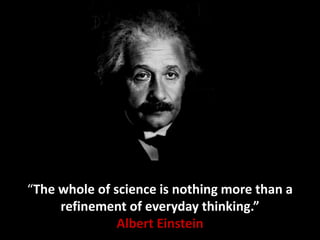
“The whole of science is nothing more than a
refinement of everyday thinking.”
Albert Einstein
Cycles of development
Stage 3
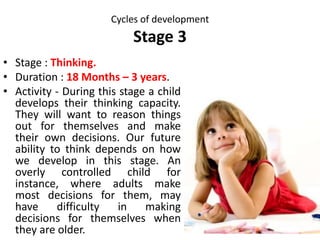
• Stage : Thinking.
• Duration : 18 Months – 3 years.
• Activity - During this stage a child
develops their thinking capacity.
They will want to reason things
out for themselves and make
their own decisions. Our future
ability to think depends on how
we develop in this stage. An
overly controlled child for
instance, where adults make
most decisions for them, may
have difficulty in making
decisions for themselves when
they are older.
Cycles of development
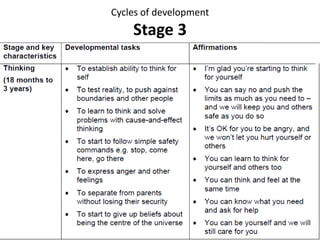
Stage 3
Cycles of development
Stage 3
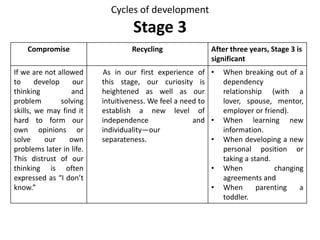
Compromise Recycling After three years, Stage 3 is
significant
If we are not allowed
to develop our
thinking and
problem solving
skills, we may find it
hard to form our
own opinions or
solve our own
problems later in life.
This distrust of our
thinking is often
expressed as “I don’t
know.”
As in our first experience of
this stage, our curiosity is
heightened as well as our
intuitiveness. We feel a need to
establish a new level of
independence and
individuality—our
separateness.
• When breaking out of a
dependency
relationship (with a
lover, spouse, mentor,
employer or friend).
• When learning new
information.
• When developing a new
personal position or
taking a stand.
• When changing
agreements and
• When parenting a
toddler.
Cycles of development
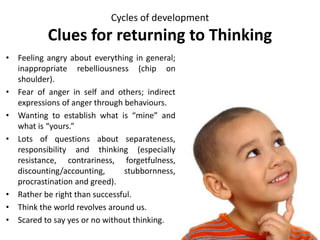
Clues for returning to Thinking
• Feeling angry about everything in general;
inappropriate rebelliousness (chip on
shoulder).
• Fear of anger in self and others; indirect
expressions of anger through behaviours.
• Wanting to establish what is “mine” and
what is “yours.”
• Lots of questions about separateness,
responsibility and thinking (especially
resistance, contrariness, forgetfulness,
discounting/accounting, stubbornness,
procrastination and greed).
• Rather be right than successful.
• Think the world revolves around us.
• Scared to say yes or no without thinking.
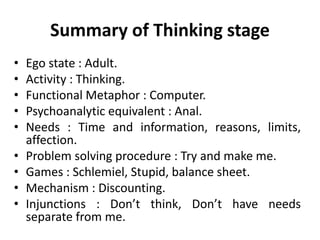
Summary of Thinking stage
• Ego state : Adult.
• Activity : Thinking.
• Functional Metaphor : Computer.
• Psychoanalytic equivalent : Anal.
• Needs : Time and information, reasons, limits,
affection.
• Problem solving procedure : Try and make me.
• Games : Schlemiel, Stupid, balance sheet.
• Mechanism : Discounting.
• Injunctions : Don’t think, Don’t have needs
separate from me.
References
Thank You
Other TA topics available on slideshare
1. Strokes - http://www.slideshare.net/manumjoy/strokes-24081607.
2. Games People Play - http://www.slideshare.net/manumjoy/psychological-
games-people-play.
3. Structural Analysis - http://www.slideshare.net/manumjoy/the-ego-state-model.
4. What is TA? - http://www.slideshare.net/manumjoy/what-ta-is
5. Cycles of Development - http://www.slideshare.net/manumjoy/cycles-of-
developement-pamela-levin-transactional-analysis.
6. Stages of Cure - http://www.slideshare.net/manumjoy/stages-of-cure.
7. Transactions - http://www.slideshare.net/manumjoy/transactions-33677298.
8. Time Structuring - http://www.slideshare.net/manumjoy/time-structuring.
9. Life Position - http://www.slideshare.net/manumjoy/life-position.
10. Autonomy - http://www.slideshare.net/manumjoy/autonomy-33690557.
11. Structural Pathology - http://www.slideshare.net/manumjoy/structural-pathology.
12. Game Analysis - http://www.slideshare.net/manumjoy/game-analysis-33725636.
13. Integrated Adult - http://www.slideshare.net/manumjoy/integrated-adult.
14. Stroke Economy - http://www.slideshare.net/manumjoy/stroke-economy-
33826702.

Thinking - Cycles of developement

  • 1.
  • 2.
    Prepared By Manu MelwinJoy Research Scholar School of Management Studies CUSAT, Kerala, India. Phone – 9744551114 Mail – manu_melwinjoy@yahoo.com Kindly restrict the use of slides for personal purpose. Please seek permission to reproduce the same in public forms and presentations.
  • 3.
    “The whole ofscience is nothing more than a refinement of everyday thinking.” Albert Einstein
  • 4.
    Cycles of development Stage3 • Stage : Thinking. • Duration : 18 Months – 3 years. • Activity - During this stage a child develops their thinking capacity. They will want to reason things out for themselves and make their own decisions. Our future ability to think depends on how we develop in this stage. An overly controlled child for instance, where adults make most decisions for them, may have difficulty in making decisions for themselves when they are older.
  • 5.
  • 6.
    Cycles of development Stage3 Compromise Recycling After three years, Stage 3 is significant If we are not allowed to develop our thinking and problem solving skills, we may find it hard to form our own opinions or solve our own problems later in life. This distrust of our thinking is often expressed as “I don’t know.” As in our first experience of this stage, our curiosity is heightened as well as our intuitiveness. We feel a need to establish a new level of independence and individuality—our separateness. • When breaking out of a dependency relationship (with a lover, spouse, mentor, employer or friend). • When learning new information. • When developing a new personal position or taking a stand. • When changing agreements and • When parenting a toddler.
  • 7.
    Cycles of development Cluesfor returning to Thinking • Feeling angry about everything in general; inappropriate rebelliousness (chip on shoulder). • Fear of anger in self and others; indirect expressions of anger through behaviours. • Wanting to establish what is “mine” and what is “yours.” • Lots of questions about separateness, responsibility and thinking (especially resistance, contrariness, forgetfulness, discounting/accounting, stubbornness, procrastination and greed). • Rather be right than successful. • Think the world revolves around us. • Scared to say yes or no without thinking.
  • 8.
    Summary of Thinkingstage • Ego state : Adult. • Activity : Thinking. • Functional Metaphor : Computer. • Psychoanalytic equivalent : Anal. • Needs : Time and information, reasons, limits, affection. • Problem solving procedure : Try and make me. • Games : Schlemiel, Stupid, balance sheet. • Mechanism : Discounting. • Injunctions : Don’t think, Don’t have needs separate from me.
  • 9.
  • 10.
  • 11.
    Other TA topicsavailable on slideshare 1. Strokes - http://www.slideshare.net/manumjoy/strokes-24081607. 2. Games People Play - http://www.slideshare.net/manumjoy/psychological- games-people-play. 3. Structural Analysis - http://www.slideshare.net/manumjoy/the-ego-state-model. 4. What is TA? - http://www.slideshare.net/manumjoy/what-ta-is 5. Cycles of Development - http://www.slideshare.net/manumjoy/cycles-of- developement-pamela-levin-transactional-analysis. 6. Stages of Cure - http://www.slideshare.net/manumjoy/stages-of-cure. 7. Transactions - http://www.slideshare.net/manumjoy/transactions-33677298. 8. Time Structuring - http://www.slideshare.net/manumjoy/time-structuring. 9. Life Position - http://www.slideshare.net/manumjoy/life-position. 10. Autonomy - http://www.slideshare.net/manumjoy/autonomy-33690557. 11. Structural Pathology - http://www.slideshare.net/manumjoy/structural-pathology. 12. Game Analysis - http://www.slideshare.net/manumjoy/game-analysis-33725636. 13. Integrated Adult - http://www.slideshare.net/manumjoy/integrated-adult. 14. Stroke Economy - http://www.slideshare.net/manumjoy/stroke-economy- 33826702.