Prepared by Eduard Scholtz
Chief Executive Officer
STRATEGIC CONVERSATION
As we let go of the machine models of work, we begin to step back and
see ourselves in new ways, to appreciate our wholeness, and to design
organizations that honor and make use of the totality of who we are.
- Margaret J. Wheatley, Leadership and the New Science
A society in which people lead good lives is likely to be one where there is high
mutual understanding, where people automatically pick up signals and
nuances, where they understand and respect how another person relates to a
third.
Strategy is made and implemented by human beings. It works when they
work well together, and fails when they don’t. Collaboration is vital.
Connectivity is the key for leveraging human talent and skill. Technology just offers a
smart new set of tools for leveraging human talent and skills.
- Geoff Mulgan, Director of a London–based think-tank called Demos
Companies, like families, are complex and unpredictable. They disappoint us
when we try to place a ‘veil of simplistic sentimentality’ over them. The people
within them act in strange and often toxic ways. Individuals may be lazy, devious
and dishonest. Many revel in playing politics. Teamwork is a wonderful idea,
but due to various interpersonal problems and personal agendas, teams remain
fragile and come apart for the slightest reason.
STRATEGIC CONVERSATION
“You have your way. I have
my way. As for the right
way, the correct way, and
the only way, -- it does not
exist.”
~Friedrich Nietzsche
WHY TO KILL SNAKES
• Ross Perot sold Electronic Data Systems in 1984 to GM
for $ 2.5bn (single largest shareholder in GM)
• Appoint to board of GM
• Very outspoken and board offer him $750000 to resign
• Fortune magazine interview Perot said ”We’ve got to
nuke the system”
• He believes if you see a snake you kill it, GM however
would hire snake consultant, establish committee on
snakes and discuss for years, if snake don’t bite
anybody yet they will allow it the crawl on the factory
floor and hibernate.
WE HAVE TO NUKE THE CURRENT ECONOMIC DEVELOPMENT /
TRANSFORMATION SYSTEM, IT IS NOT WORKING
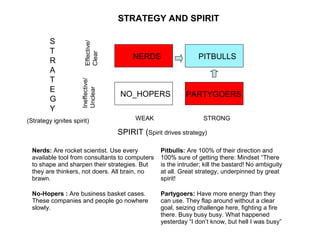
NERDS PITBULLS
PARTYGOERSNO_HOPERS
SPIRIT (Spirit drives strategy)
S
T
R
A
T
E
G
Y
WEAK STRONG
Ineffective/
Unclear
Effective/
Clear
Nerds: Are rocket scientist. Use every
available tool from consultants to computers
to shape and sharpen their strategies. But
they are thinkers, not doers. All brain, no
brawn.
Pitbulls: Are 100% of their direction and
100% sure of getting there: Mindset “There
is the intruder; kill the bastard! No ambiguity
at all. Great strategy, underpinned by great
spirit!
No-Hopers : Are business basket cases.
These companies and people go nowhere
slowly.
Partygoers: Have more energy than they
can use. They flap around without a clear
goal, seizing challenge here, fighting a fire
there. Busy busy busy. What happened
yesterday “I don’t know, but hell I was busy”
STRATEGY AND SPIRIT
(Strategy ignites spirit)
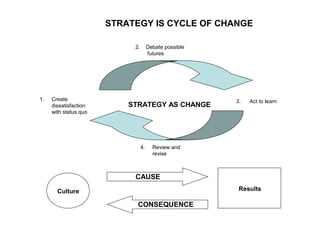
STRATEGY IS CYCLE OF CHANGE
1. Create
dissatisfaction
with status quo
2. Debate possible
futures
3. Act to learn
4. Review and
revise
STRATEGY AS CHANGE
Culture Results
CAUSE
CONSEQUENCE
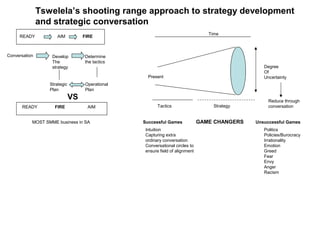
Tswelela’s shooting range approach to strategy development
and strategic conversation
READY AIM FIRE
Develop
The
strategy
Determine
the tactics
Conversation
Strategic
Plan
Operational
Plan
READY AIMFIRE
VS
MOST SMME business in SA
Degree
Of
Uncertainty
Time
Present
Tactics Strategy
Reduce through
conversation
GAME CHANGERS Unsuccessful GamesSuccessful Games
Politics
Policies/Burocracy
Irrationality
Emotion
Greed
Fear
Envy
Anger
Racism
Intuition
Capturing extra
ordinary conversation
Conversational circles to
ensure field of alignment
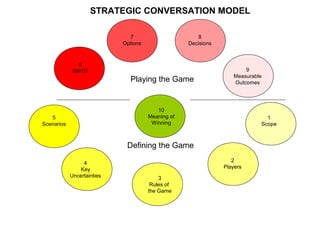
1
Scope
2
Players
3
Rules of
the Game
4
Key
Uncertainties
5
Scenarios
6
SWOT
7
Options
8
Decisions
9
Measurable
Outcomes
10
Meaning of
Winning
Defining the Game
Playing the Game
STRATEGIC CONVERSATION MODEL
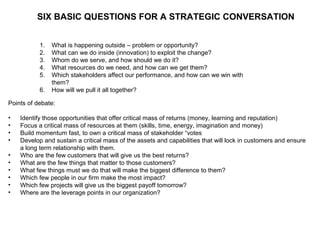
SIX BASIC QUESTIONS FOR A STRATEGIC CONVERSATION
1. What is happening outside – problem or opportunity?
2. What can we do inside (innovation) to exploit the change?
3. Whom do we serve, and how should we do it?
4. What resources do we need, and how can we get them?
5. Which stakeholders affect our performance, and how can we win with
them?
6. How will we pull it all together?
Points of debate:
• Identify those opportunities that offer critical mass of returns (money, learning and reputation)
• Focus a critical mass of resources at them (skills, time, energy, imagination and money)
• Build momentum fast, to own a critical mass of stakeholder “votes
• Develop and sustain a critical mass of the assets and capabilities that will lock in customers and ensure
a long term relationship with them.
• Who are the few customers that will give us the best returns?
• What are the few things that matter to those customers?
• What few things must we do that will make the biggest difference to them?
• Which few people in our firm make the most impact?
• Which few projects will give us the biggest payoff tomorrow?
• Where are the leverage points in our organization?
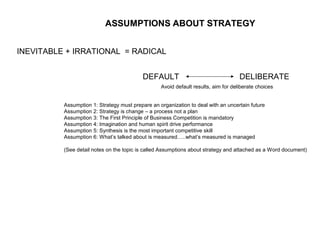
INEVITABLE + IRRATIONAL = RADICAL
DEFAULT DELIBERATE
Avoid default results, aim for deliberate choices
ASSUMPTIONS ABOUT STRATEGY
Assumption 1: Strategy must prepare an organization to deal with an uncertain future
Assumption 2: Strategy is change – a process not a plan
Assumption 3: The First Principle of Business Competition is mandatory
Assumption 4: Imagination and human spirit drive performance
Assumption 5: Synthesis is the most important competitive skill
Assumption 6: What’s talked about is measured…..what’s measured is managed
(See detail notes on the topic is called Assumptions about strategy and attached as a Word document)

STRATEGIC CONVERSATION

  • 1.
    Prepared by EduardScholtz Chief Executive Officer STRATEGIC CONVERSATION As we let go of the machine models of work, we begin to step back and see ourselves in new ways, to appreciate our wholeness, and to design organizations that honor and make use of the totality of who we are. - Margaret J. Wheatley, Leadership and the New Science
  • 2.
    A society inwhich people lead good lives is likely to be one where there is high mutual understanding, where people automatically pick up signals and nuances, where they understand and respect how another person relates to a third. Strategy is made and implemented by human beings. It works when they work well together, and fails when they don’t. Collaboration is vital. Connectivity is the key for leveraging human talent and skill. Technology just offers a smart new set of tools for leveraging human talent and skills. - Geoff Mulgan, Director of a London–based think-tank called Demos Companies, like families, are complex and unpredictable. They disappoint us when we try to place a ‘veil of simplistic sentimentality’ over them. The people within them act in strange and often toxic ways. Individuals may be lazy, devious and dishonest. Many revel in playing politics. Teamwork is a wonderful idea, but due to various interpersonal problems and personal agendas, teams remain fragile and come apart for the slightest reason. STRATEGIC CONVERSATION
  • 3.
    “You have yourway. I have my way. As for the right way, the correct way, and the only way, -- it does not exist.” ~Friedrich Nietzsche
  • 4.
    WHY TO KILLSNAKES • Ross Perot sold Electronic Data Systems in 1984 to GM for $ 2.5bn (single largest shareholder in GM) • Appoint to board of GM • Very outspoken and board offer him $750000 to resign • Fortune magazine interview Perot said ”We’ve got to nuke the system” • He believes if you see a snake you kill it, GM however would hire snake consultant, establish committee on snakes and discuss for years, if snake don’t bite anybody yet they will allow it the crawl on the factory floor and hibernate. WE HAVE TO NUKE THE CURRENT ECONOMIC DEVELOPMENT / TRANSFORMATION SYSTEM, IT IS NOT WORKING
  • 5.
    NERDS PITBULLS PARTYGOERSNO_HOPERS SPIRIT (Spiritdrives strategy) S T R A T E G Y WEAK STRONG Ineffective/ Unclear Effective/ Clear Nerds: Are rocket scientist. Use every available tool from consultants to computers to shape and sharpen their strategies. But they are thinkers, not doers. All brain, no brawn. Pitbulls: Are 100% of their direction and 100% sure of getting there: Mindset “There is the intruder; kill the bastard! No ambiguity at all. Great strategy, underpinned by great spirit! No-Hopers : Are business basket cases. These companies and people go nowhere slowly. Partygoers: Have more energy than they can use. They flap around without a clear goal, seizing challenge here, fighting a fire there. Busy busy busy. What happened yesterday “I don’t know, but hell I was busy” STRATEGY AND SPIRIT (Strategy ignites spirit)
  • 6.
    STRATEGY IS CYCLEOF CHANGE 1. Create dissatisfaction with status quo 2. Debate possible futures 3. Act to learn 4. Review and revise STRATEGY AS CHANGE Culture Results CAUSE CONSEQUENCE
  • 7.
    Tswelela’s shooting rangeapproach to strategy development and strategic conversation READY AIM FIRE Develop The strategy Determine the tactics Conversation Strategic Plan Operational Plan READY AIMFIRE VS MOST SMME business in SA Degree Of Uncertainty Time Present Tactics Strategy Reduce through conversation GAME CHANGERS Unsuccessful GamesSuccessful Games Politics Policies/Burocracy Irrationality Emotion Greed Fear Envy Anger Racism Intuition Capturing extra ordinary conversation Conversational circles to ensure field of alignment
  • 8.
  • 9.
    SIX BASIC QUESTIONSFOR A STRATEGIC CONVERSATION 1. What is happening outside – problem or opportunity? 2. What can we do inside (innovation) to exploit the change? 3. Whom do we serve, and how should we do it? 4. What resources do we need, and how can we get them? 5. Which stakeholders affect our performance, and how can we win with them? 6. How will we pull it all together? Points of debate: • Identify those opportunities that offer critical mass of returns (money, learning and reputation) • Focus a critical mass of resources at them (skills, time, energy, imagination and money) • Build momentum fast, to own a critical mass of stakeholder “votes • Develop and sustain a critical mass of the assets and capabilities that will lock in customers and ensure a long term relationship with them. • Who are the few customers that will give us the best returns? • What are the few things that matter to those customers? • What few things must we do that will make the biggest difference to them? • Which few people in our firm make the most impact? • Which few projects will give us the biggest payoff tomorrow? • Where are the leverage points in our organization?
  • 10.
    INEVITABLE + IRRATIONAL= RADICAL DEFAULT DELIBERATE Avoid default results, aim for deliberate choices ASSUMPTIONS ABOUT STRATEGY Assumption 1: Strategy must prepare an organization to deal with an uncertain future Assumption 2: Strategy is change – a process not a plan Assumption 3: The First Principle of Business Competition is mandatory Assumption 4: Imagination and human spirit drive performance Assumption 5: Synthesis is the most important competitive skill Assumption 6: What’s talked about is measured…..what’s measured is managed (See detail notes on the topic is called Assumptions about strategy and attached as a Word document)