1
Attention is the behavioural
and cognitive process of
selectively concentrating
on some information,
while ignoring other
perceivable information
A world
of infinite
content
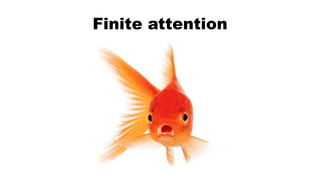
Finite attention
Types of attention
Sustained /
Selective
Types of attention
Divided
to draw attention to something,
to turn towards
advertere
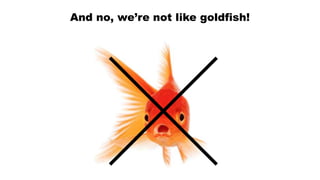
And no, we’re not like goldfish!
Newsworks and PwC study on attention
Multiple data sources:
Bespoke nationally representative study
amongst adults 18+ in Great Britain
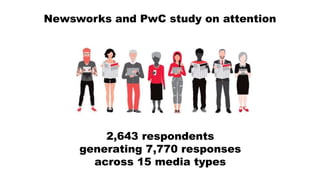
2,643 respondents
generating 7,770 responses
across 15 media types
Newsworks and PwC study on attention
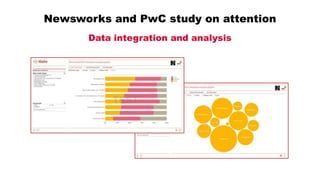
Data integration and analysis
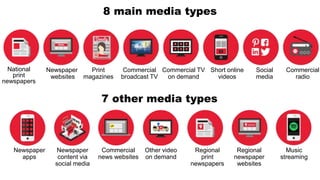
8 main media types
National
print
newspapers
Newspaper
websites
Commercial
broadcast TV
Commercial
radio
Print
magazines
Commercial TV
on demand
Social
media
Short online
videos
Newspaper
content via
social media
Other video
on demand
Regional
newspaper
websites
Commercial
news websites
Regional
print
newspapers
Music
streaming
Newspaper
apps
7 other media types
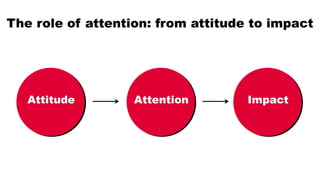
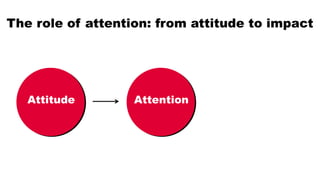
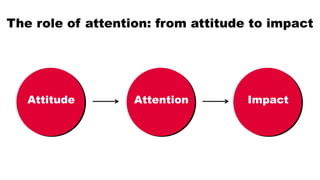
The role of attention: from attitude to impact
Attitude ImpactAttention
The role of attention: from attitude to impact
Attitude
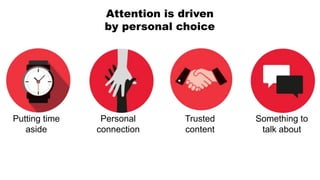
Attention is driven
by personal choice
Putting time
aside
Personal
connection
Something to
talk about
Trusted
content
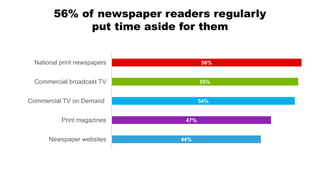
56% of newspaper readers regularly
put time aside for them
44%
47%
54%
55%
56%
Newspaper websites
Print magazines
Commercial TV on Demand
Commercial broadcast TV
National print newspapers
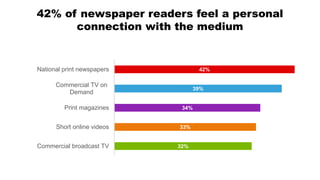
42% of newspaper readers feel a personal
connection with the medium
32%
33%
34%
39%
42%
Commercial broadcast TV
Short online videos
Print magazines
Commercial TV on
Demand
National print newspapers
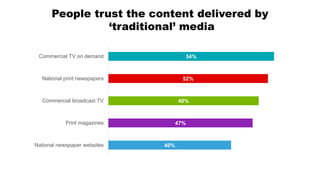
People trust the content delivered by
‘traditional’ media
40%
47%
49%
52%
54%
National newspaper websites
Print magazines
Commercial broadcast TV
National print newspapers
Commercial TV on demand
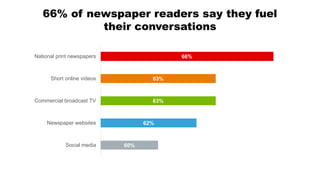
66% of newspaper readers say they fuel
their conversations
60%
62%
63%
63%
66%
Social media
Newspaper websites
Commercial broadcast TV
Short online videos
National print newspapers
The role of attention: from attitude to impact
Attitude Attention Impact
Time spent
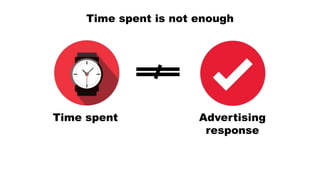
Time spent is not enough
Time spent Advertising
response
From time spent to quality time:
the attention equation
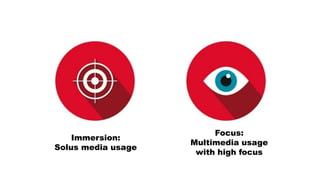
Immersion:
Solus media usage
Focus:
Multimedia usage
with high focus
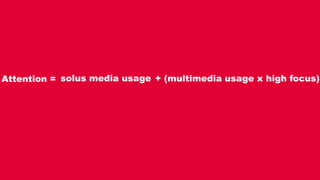
Attention = + (multimedia usage x high focus)solus media usage
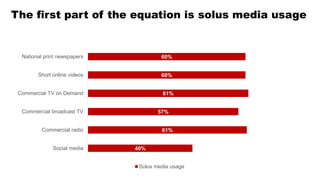
The first part of the equation is solus media usage
40%
61%
57%
61%
60%
60%
Social media
Commercial radio
Commercial broadcast TV
Commercial TV on Demand
Short online videos
National print newspapers
Solus media usage
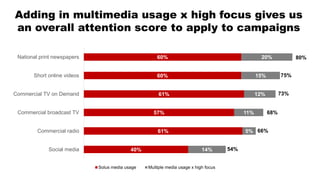
Adding in multimedia usage x high focus gives us
an overall attention score to apply to campaigns
40%
61%
57%
61%
60%
60%
14%
5%
11%
12%
15%
20%
Social media
Commercial radio
Commercial broadcast TV
Commercial TV on Demand
Short online videos
National print newspapers
Solus media usage Multiple media usage x high focus
80%
75%
73%
68%
66%
54%
The role of attention: from attitude to impact
Attitude ImpactAttention
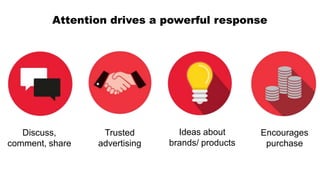
Attention drives a powerful response
Discuss,
comment, share
Encourages
purchase
Trusted
advertising
Ideas about
brands/ products
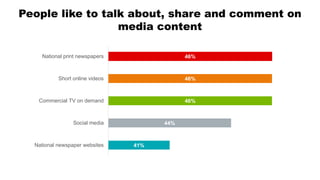
People like to talk about, share and comment on
media content
41%
44%
46%
46%
46%
National newspaper websites
Social media
Commercial TV on demand
Short online videos
National print newspapers
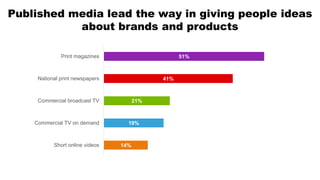
Published media lead the way in giving people ideas
about brands and products
14%
19%
21%
41%
51%
Short online videos
Commercial TV on demand
Commercial broadcast TV
National print newspapers
Print magazines
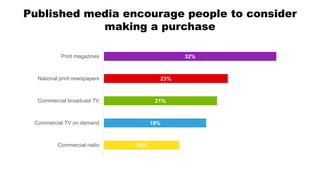
Published media encourage people to consider
making a purchase
14%
19%
21%
23%
32%
Commercial radio
Commercial TV on demand
Commercial broadcast TV
National print newspapers
Print magazines
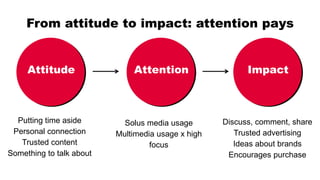
From attitude to impact: attention pays
Attitude
Putting time aside
Personal connection
Trusted content
Something to talk about
Attention
Solus media usage
Multimedia usage x high
focus
Impact
Discuss, comment, share
Trusted advertising
Ideas about brands
Encourages purchase
From attitude to impact: attention pays
37
Thank you for your attention
Contacts
Sam Tomlinson
Partner, PwC
E: sam.tomlinson@uk.pwc.com
T: +44 (0) 20 7804 0726
M: +44 (0) 7811 453 111
This publication has been prepared for general guidance on matters of interest only, and does not constitute professional advice. You should not act upon the
information contained in this publication without obtaining specific professional advice. No representation or warranty (express or implied) is given as to the
accuracy or completeness of the information contained in this publication, and, to the extent permitted by law, Newsworks and PricewaterhouseCoopers LLP
(including its members, employees and agents) do not accept or assume any liability, responsibility or duty of care for any consequences of you or anyone else
acting, or refraining to act, in reliance on the information contained in this publication or for any decision based on it.
© 2016 Newsworks and PricewaterhouseCoopers LLP. All rights reserved. In this document, “PwC” refers to the UK member firm, and may sometimes refer to the
PwC network. Each member firm is a separate legal entity. Please see www.pwc.com/structure for further details.
Denise Turner
Insight Director, Newsworks
E: denise.turner@newsworks.org.uk
T: +44 (0) 20 7839 8935
M: +44 (0) 7817 078 081

The battle for attention

  • 1.
  • 2.
    Attention is thebehavioural and cognitive process of selectively concentrating on some information, while ignoring other perceivable information
  • 3.
  • 4.
  • 5.
  • 6.
  • 9.
    to draw attentionto something, to turn towards advertere
  • 10.
    And no, we’renot like goldfish!
  • 11.
    Newsworks and PwCstudy on attention Multiple data sources: Bespoke nationally representative study amongst adults 18+ in Great Britain
  • 12.
    2,643 respondents generating 7,770responses across 15 media types Newsworks and PwC study on attention
  • 13.
    Newsworks and PwCstudy on attention Data integration and analysis
  • 14.
    8 main mediatypes National print newspapers Newspaper websites Commercial broadcast TV Commercial radio Print magazines Commercial TV on demand Social media Short online videos Newspaper content via social media Other video on demand Regional newspaper websites Commercial news websites Regional print newspapers Music streaming Newspaper apps 7 other media types
  • 15.
    The role ofattention: from attitude to impact Attitude ImpactAttention
  • 16.
    The role ofattention: from attitude to impact Attitude
  • 17.
    Attention is driven bypersonal choice Putting time aside Personal connection Something to talk about Trusted content
  • 18.
    56% of newspaperreaders regularly put time aside for them 44% 47% 54% 55% 56% Newspaper websites Print magazines Commercial TV on Demand Commercial broadcast TV National print newspapers
  • 19.
    42% of newspaperreaders feel a personal connection with the medium 32% 33% 34% 39% 42% Commercial broadcast TV Short online videos Print magazines Commercial TV on Demand National print newspapers
  • 20.
    People trust thecontent delivered by ‘traditional’ media 40% 47% 49% 52% 54% National newspaper websites Print magazines Commercial broadcast TV National print newspapers Commercial TV on demand
  • 21.
    66% of newspaperreaders say they fuel their conversations 60% 62% 63% 63% 66% Social media Newspaper websites Commercial broadcast TV Short online videos National print newspapers
  • 22.
    The role ofattention: from attitude to impact Attitude Attention Impact
  • 23.
  • 24.
    Time spent isnot enough Time spent Advertising response
  • 25.
    From time spentto quality time: the attention equation
  • 26.
  • 27.
    Attention = +(multimedia usage x high focus)solus media usage
  • 28.
    The first partof the equation is solus media usage 40% 61% 57% 61% 60% 60% Social media Commercial radio Commercial broadcast TV Commercial TV on Demand Short online videos National print newspapers Solus media usage
  • 29.
    Adding in multimediausage x high focus gives us an overall attention score to apply to campaigns 40% 61% 57% 61% 60% 60% 14% 5% 11% 12% 15% 20% Social media Commercial radio Commercial broadcast TV Commercial TV on Demand Short online videos National print newspapers Solus media usage Multiple media usage x high focus 80% 75% 73% 68% 66% 54%
  • 30.
    The role ofattention: from attitude to impact Attitude ImpactAttention
  • 31.
    Attention drives apowerful response Discuss, comment, share Encourages purchase Trusted advertising Ideas about brands/ products
  • 32.
    People like totalk about, share and comment on media content 41% 44% 46% 46% 46% National newspaper websites Social media Commercial TV on demand Short online videos National print newspapers
  • 33.
    Published media leadthe way in giving people ideas about brands and products 14% 19% 21% 41% 51% Short online videos Commercial TV on demand Commercial broadcast TV National print newspapers Print magazines
  • 34.
    Published media encouragepeople to consider making a purchase 14% 19% 21% 23% 32% Commercial radio Commercial TV on demand Commercial broadcast TV National print newspapers Print magazines
  • 35.
    From attitude toimpact: attention pays Attitude Putting time aside Personal connection Trusted content Something to talk about Attention Solus media usage Multimedia usage x high focus Impact Discuss, comment, share Trusted advertising Ideas about brands Encourages purchase
  • 36.
    From attitude toimpact: attention pays
  • 37.
    37 Thank you foryour attention
  • 38.
    Contacts Sam Tomlinson Partner, PwC E:sam.tomlinson@uk.pwc.com T: +44 (0) 20 7804 0726 M: +44 (0) 7811 453 111 This publication has been prepared for general guidance on matters of interest only, and does not constitute professional advice. You should not act upon the information contained in this publication without obtaining specific professional advice. No representation or warranty (express or implied) is given as to the accuracy or completeness of the information contained in this publication, and, to the extent permitted by law, Newsworks and PricewaterhouseCoopers LLP (including its members, employees and agents) do not accept or assume any liability, responsibility or duty of care for any consequences of you or anyone else acting, or refraining to act, in reliance on the information contained in this publication or for any decision based on it. © 2016 Newsworks and PricewaterhouseCoopers LLP. All rights reserved. In this document, “PwC” refers to the UK member firm, and may sometimes refer to the PwC network. Each member firm is a separate legal entity. Please see www.pwc.com/structure for further details. Denise Turner Insight Director, Newsworks E: denise.turner@newsworks.org.uk T: +44 (0) 20 7839 8935 M: +44 (0) 7817 078 081

Editor's Notes

  • #3 But what is attention? The academic definition of attention (sometimes described as vigilance) is the behavioural and cognitive process of selectively concentrating on some information, while ignoring other perceivable information.
  • #4 That seems at odds with the general view of attention in the world of communications today. We live in a world of infinite content. The amount of content existing in the world has long since dwarfed any individual’s ability to consume it. Thinkers from times as diverse as Aristotle, Da Vinci, Milton and Leibnitz have all been credited as the ‘last man to have read everything’.
  • #5 Infinite content, but our attention is finite – and getting even more so it would seem. Faris Yakob in his book Paid Attention defines attention as ‘slippery’ And if you believe a study by Microsoft Canada released last year it is very slippery indeed - according to the report the average human attention span is declining – down from 12 sec in 2000 to 8 seconds in 2013. Goldfish, meanwhile, are believed to have an attention span of nine seconds.
  • #6 So which is right? Academia does agree that there are different types of attention. On the one hand we have sustained and selective attention – prolonged focus or maintaining attention regardless of distracting stimuli around
  • #7 On the other hand we have alternating and divided attention - switching between tasks, or completing two or more tasks simultaneously is also suggested as one in other reports) It is a widely accepted notion in the communications world that divided attention is the norm, and sustained attention is on the wane. But actually, divided attention is actually better described as alternating attention – even if you think you are doing two things at once, you are in reality switching between the two, even if those switches are infinitesimally small and multiple times in a second. The result is that the information selected is imperfect. Some of the information is lost when attention is divided as we only have limited attentional resources. The harder the tasks, and the more of them there are at any one time, the more of such “mental effort” is drawn from the attention pool. When the available capacity is less than that required for completion of a task, failures are more frequent. When tasks are easier or fewer, there is less demand on this limited resource. There is an added cost in accuracy or reaction time (usually takes much longer) when you attempt to perform two tasks at once.

  • #8 A good example is driving – at the beginning each task behind the wheel requires a lot of effort and attention which is no longer the case as the driving experience increases and the actions become more automated. This is why some people eventually start to multitask behind the wheel. However, it is very risky as performing two tasks at once (texting and driving) slowers the reaction time, performance of both tasks and thus increases the risk of an accident. Thus, overall, you can’t perform well two tasks at once.
  • #10 Does attention matter? As an aside, the word ‘advertising’ is derived from the Latin advetere which means to draw attention to something (literally to turn towards) Attention only matters if you believe it plays an important role in how advertising works. There are many different models of how advertising works, but two of the most prevalent – and apparently contradictory) are: Robert Heath’s theory of low involvement processing suggests you don’t need attention at all (echoes a maxim from Marshal McLuhan ‘Ads are not meant for conscious consumption. They are intended as subliminal pills for the subconscious in order to exercise an hypnotic spell’. On the other hand we have the engagement model, suggesting that successful brands are ones that develop deeper relationships with consumers, that invite them to a dialogue, offering them additional content and experiences. In an attention-starved world, this model is about earning attention. The problem is that in this ever-optimised digital world, engagement has become less about earning attention and more about short-term metrics, about clicks, views, viewability, about dwell time, and eyes on content. These two models are not contradictory, but rather complementary. As Robert Heath himself stated, there is a need for both low involvement processing of and highly engaged receptivity to advertising. Some channels will be better at delivering the former, and some the latter.
  • #11 And just to reassure you we are indeed capable of active attention – we’re definitely not worse off than goldfish! University of Aberdeen attention researcher Søren K. Andersen says that it’s vital to distinguish between what people choose to do when there’s no reason for them to focus, and what they’re capable of doing when focusing is the point. People might find it pleasant to flick from one activity to another when that’s an option, but are still perfectly capable of putting their minds to concentrating when the situation requires it - Emphasis on choice. We’re going to talk today about the importance of active attention, which channels deliver it, and the role it plays in today’s communications. To that end we are focusing on media where there is believed to be a lot of multitasking with other media and also on those where we can explore the relationship between attention to the content and attention on the advertising in or around it.
  • #12 For this study we carried out a national survey across GB, to find out the true attention of consumers of different types of media. We then prepared and combined several data sources into the results, including three key industry benchmarks – Touchpoints, Comscore and Chartbeat.
  • #13 Our study on attention consisted of a bespoke nationally representative study amongst adults 18-75 in Great Britain. We triangulated and corroborated the findings with industry sources including TouchPoints, Comscore and Chartbeat. The data was then integrated and analysed in PwC’s proprietary Halo too, allowing for detailed interrogation of the findings. The bespoke study had a sample of 2,643 respondents aged 18-75. They were asked about their regular media consumption, across 15 different types of media. Each respondent answered more detailed questions about 3 of the media types, giving us a large and robust base of responses for each media type.
  • #14 Data integration and analysis was performed in PwC’s Halo analytics tool. Newsworks have access so if you have further queries on the data please do ask either Newsworks or PwC
  • #15 Importantly given the blurring of the lines between content and platform, we made sure to include content across platforms in the media types we looked at. So you’ll see for instance that we cover print, websites and content via social media for newspapers, and broadcast and catch up for TV. We will focus today on the main media types, but detail is available on the others We focused on regular consumers of each media type We also looked at the magazine apps, but the sample of regular users was too small to analyse the data We didn’t look at cinema because media multitasking doesn’t apply in the same way (despite the rise in the use of phones in the cinema!) We didn’t look at outdoor because the ads there tend to be not surrounded by other media, and we were interested in the relationship between attention to the content and attention to the advertising different experience,
  • #16 We believe that attention plays a central role in communications today, and drives advertising response. But what is it that drives attention? What makes people devote attention to content and is there a relationship between that and advertising? We explored a series of attitudes ranging from the time people devote, the rewards they get, the trust they have, the social currency they get from the content Personal connection Content worth paying for Exclusive content Putting time aside Fresh perspective Content worth talking about Makes my life better / inspires me Trust in content
  • #17 We believe that attention plays a central role in communications today, and drives advertising response. But what is it that drives attention? What makes people devote attention to content and is there a relationship between that and advertising? We explored a series of attitudes ranging from the time people devote, the rewards they get, the trust they have, the social currency they get from the content Personal connection Content worth paying for Exclusive content Putting time aside Fresh perspective Content worth talking about Makes my life better / inspires me Trust in content
  • #18 We found a clear relationship between personal choice and attention. The act of putting time aside is more likely to drive attention, the relationship people have with the content , the trust they have in the content and social currency that the content provides. All four correlate strongly with attention.
  • #19 Looking at the top performers here, we can see for ‘putting time aside’ that national print newspapers score highest among regular consumers of each media type. The scores here are the percentage of regular consumers of each medium who agree with the statement “I regularly put time aside for….”
  • #20 And the same is true for personal connection. This attitude does tent to vary by different audience groups, so print magazines for instance perform better for women than men.
  • #22 With so much content out there, newspapers still have an important role to play in fuelling the conversation, with people agreeing that they give them something to talk about.
  • #24 So we know what drives people to give their attention to content. But what do we mean by attention? Over the years there has been a belief that it is the amount of time you devote to content, and there has been a push to equate advertising money with time spent. However lately that argument has been on the wane – and even Sir Martin Sorrell at Adweek last week reiterated that there is much more to advertising response than just time spent. He talked about engagement, some kind of deeper connection and involvement that people have with the content and the media.
  • #25  In our research, we did first look at time spent. We were able to prove that time spent does not correlate with any of advertising trust, relevance, recall, ideas generation or encouragement to purchase
  • #26 So instead we looked at defining quality time, where people give their attention to the content they are consuming, whether that be for a long time, or just a few minutes. Given we know it’s not enough just to reach people, you need to catch their attention, We wanted to create an attention equation, a way of applying an attention factor to the reach that a campaign delivers.
  • #27 Given what we know about attention from academia, we looked at two ways of defining attention. Thinking back to our sustained and selective attention, we looked firstly at solus media usage, where there is no other media being consumed. This is defined as people’s usual behavior for that medium for regular consumers. Secondly, we looked at alternating attention, where regular consumers are usually using multiple media and looked at their level of focus. We asked people whether their focus was on the first or the second medium and what level of focus they gave to the first medium – high, medium or low
  • #28 Our attention equation is made up of these two components. So how is the attention factor derived (for regular consumers): Solus media usage plus multimedia usage x high focus Each media has a percentage out of 100, which is made up of two components: the proportion of regular consumers for whom this is usually a solus medium + those who are multi-tasking but usually make this medium their priority.
  • #31 So to recap: Attitudes correlate strongly with attention (attitudes being: putting time aside / personal connection / trusted content / something to talk about) Attention correlates strongly with ad impact (attention being primarily solus media use) See next slide for impac
  • #32 Impact ranges from content response (discuss, comment, share) to an advertising response (trusted; generates ideas about brands/products; encourages me to consider making a purchase)
  • #33 With so much content out there, newspapers still have an important role to play in fuelling the conversation, with people agreeing that they give them something to talk about.
  • #34 With so much content out there, newspapers still have an important role to play in fuelling the conversation, with people agreeing that they give them something to talk about.
  • #35 With so much content out there, newspapers still have an important role to play in fuelling the conversation, with people agreeing that they give them something to talk about.