The Yellow Palm
Robert Minhinnick
Themes and Ideas
• The writer is talking about war within 3 religions – Jews,
Christians & Muslims.
• He is saying that the war between Christians, Muslims, and
Jews in Palestine is killing the true nature of these religions,
but at the same time that there is still hope of change.
• He is also talking about Baghdad and how the city and it’s
people are crumbling under the conflict.
• At the end he is weighing up if the city is in balance, or if it’s
going to rise or fall.
Structure
• Ballad of 6 6-line stanzas
• It alternates between short and long iambic lines
• Abcbdb rhyme scheme
• 10 syllables in “as I made my way down Palestine
Street”
• All have a similar amount of syllables in each
stanza
• lines interchange between long and short line
length.
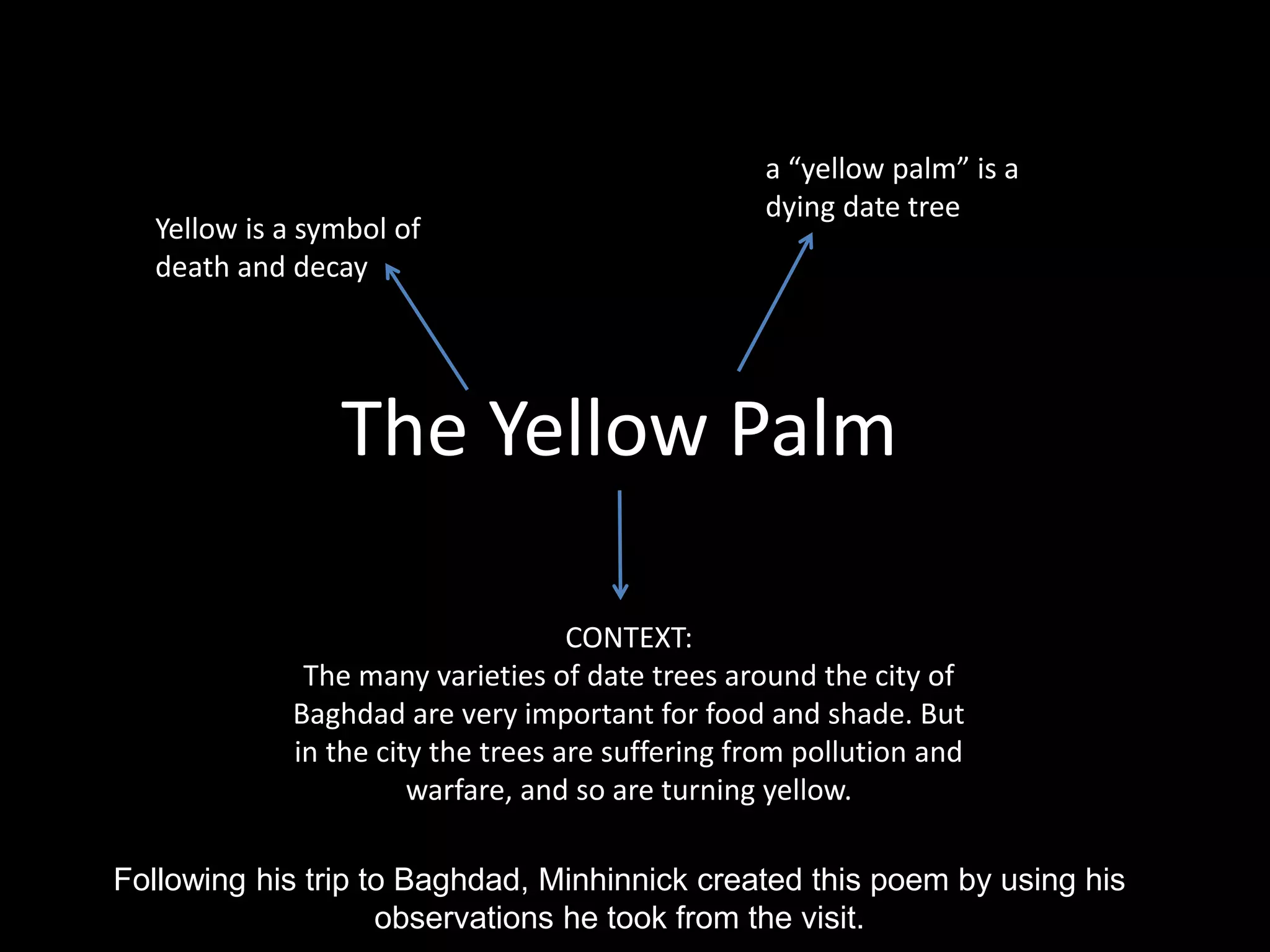
The Yellow Palm
Yellow is a symbol of
death and decay
CONTEXT:
The many varieties of date trees around the city of
Baghdad are very important for food and shade. But
in the city the trees are suffering from pollution and
warfare, and so are turning yellow.
a “yellow palm” is a
dying date tree
Following his trip to Baghdad, Minhinnick created this poem by using his
observations he took from the visit.
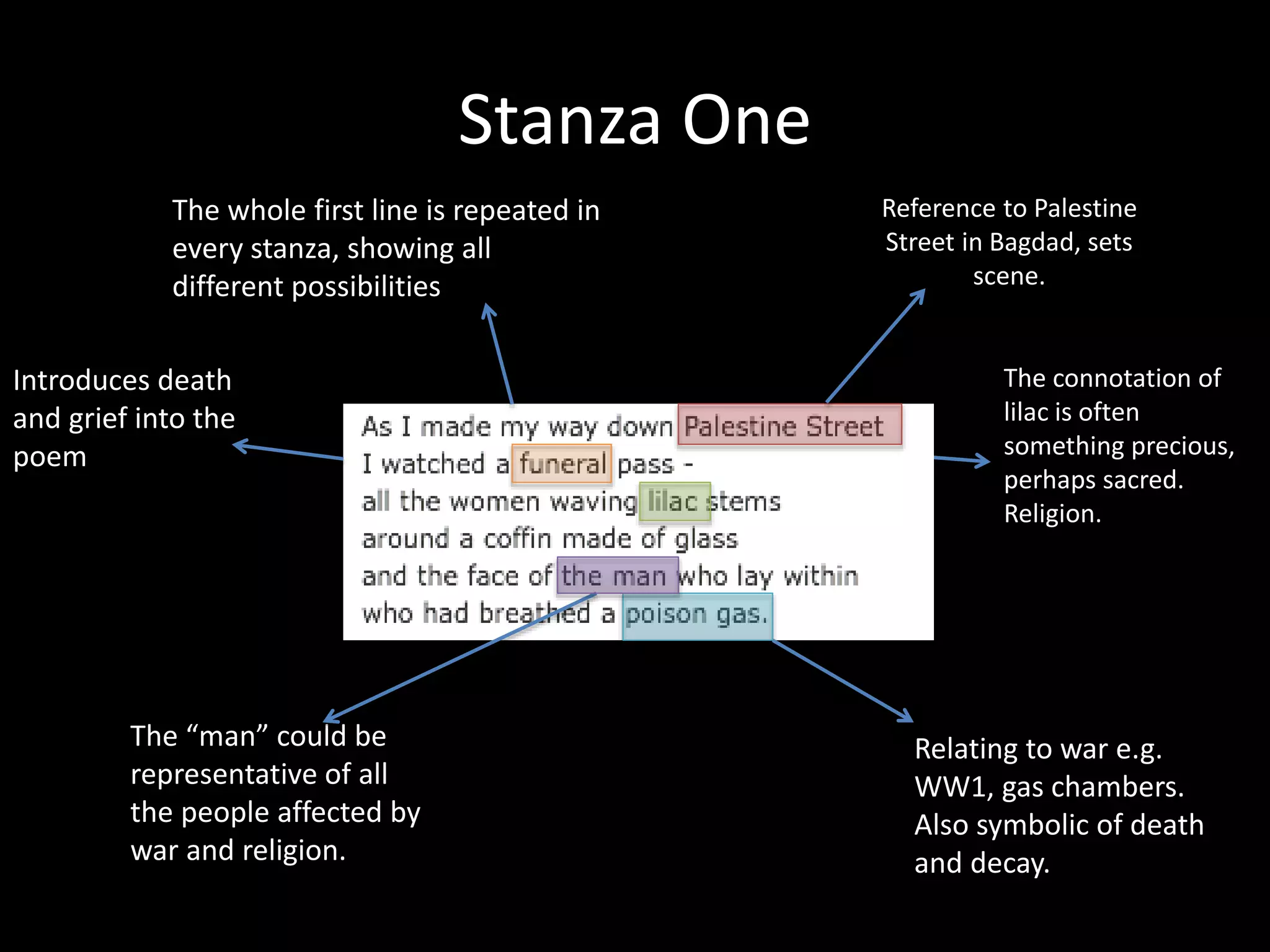
Stanza One
Reference to Palestine
Street in Bagdad, sets
scene.
The whole first line is repeated in
every stanza, showing all
different possibilities
Introduces death
and grief into the
poem
The connotation of
lilac is often
something precious,
perhaps sacred.
Religion.
Relating to war e.g.
WW1, gas chambers.
Also symbolic of death
and decay.
The “man” could be
representative of all
the people affected by
war and religion.
Stanza Two
All relating to religion.
The devout nature
of the people of
Baghdad is being
ruined by warfare. The supposed sanctuary of
the mosque is being violated
by bloodshed.
May not be literal, may be a
metaphor.
“Golden” here relates to the splendor of the
mosque and therefore religion, but is also
close to yellow so may show how religion is
tied into war.
Despair of the
muezzin represents
how religion in
Baghdad is breaking
apart.
Stanza Three
recalls Saddam Hussein’s threat
to America if they
invaded Iraq in the Gulf War/
generally referring to the big
war.
Act of generosity rewarded
with threatening gesture.
Metaphor.
Alliteration. May be ghosts of war.
Even the soldiers are presented as
victims. May also show they are
blind to the truth.
“Pressed” shows its not just a light
action. Hope of working together for
the good of the country/helping each
other out.
Stanza Four
Hint of irony, that the city
is supposedly living in
peace, which the sun
doesn’t respect.
personification, the city
is under attack from the
sun
The sun is yellow,
again relating to
death and decay.
Imagery. Shows that this land can
be fertile and beautiful again and
despite all of the violence
No people, just description.
Focusing on nature – sun,
river.
Use of “lifts” and
“down” are
contradictory.
Stanza Five
Metaphor for
the missile.
Poet wants us to see what the
children of god (beggar child)
are becoming. (used to war)
Deliberate image of innocence, with cruel
irony in the fact that the child ‘blessed’ the
apparently magical flying bomb with a
‘smile’, emphasising these are peaceful and
innocent people, ruined by war.
Alliteration of
the ‘s’ words.
Stanza Six
Reaches up to
accept what fruit
he can get from his
religion
Begins by celebrating the
beauty and bounty of the city;
ends in chilling ambiguity,
suggesting the alternative
paths for the future of
Baghdad
Salaam means
peace so it seems
that the child
wants to
embrace peace.
alliteration.
Yellow is again
repeated – death
and decay.
The fact the fruit falls could show either that
religion is collapsing (the tree is so dead the
dates just fall off), or that he accepts
religion/religion accepts him/gives hope.
Language
• The author uses repetition and alliteration –
this highlights the problems that war has on
the people and religion.
• Colours are used such as “golden”, “lilac” and
“yellow” – show the city to be colorful but
whenever mentioned something bad goes
with it e.g. lilac stems around a coffin.
Voice
• The poem is narrated by the writer, Robert
Minhinnick, and is supposed to represent his
visit to Bagdad and what he saw whilst
walking down Palestine street.
• There are no opinions – it is what is happening
through his eyes although it’s not literal.
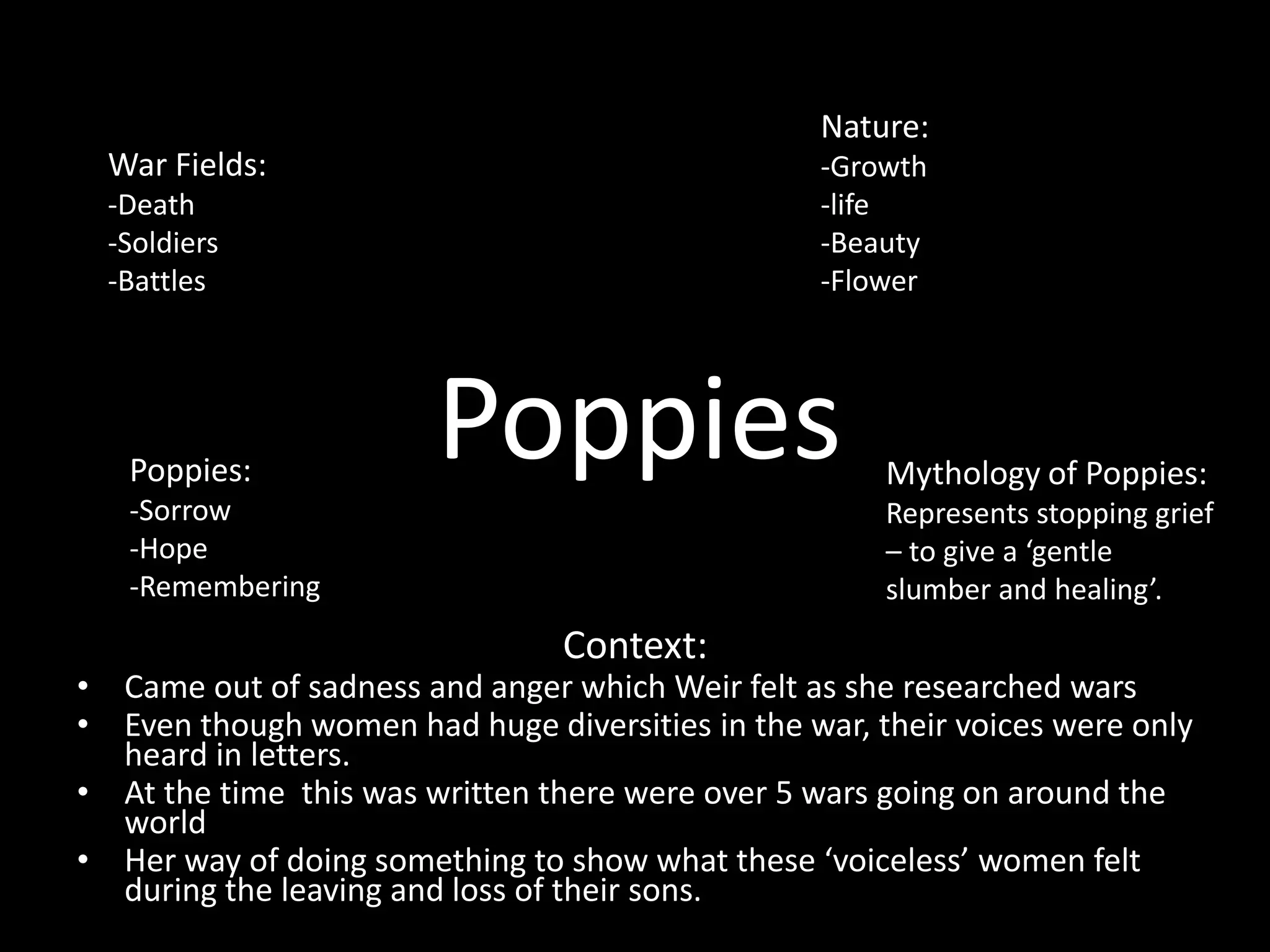
Poppies
Jane Weir
Themes and Ideas
• ‘Poppies’ is a poem written in a mother’s perspective as her
son leaves to go to war.
• Throughout it, we are shown some of her overwhelming
emotions such as love and anxiety.
• These emotions are shown within images of conflict – such as
the fallen soliders – and the idea of someone leaving – the
start of school, leaving for war, dying in battle.
• It describes how the mother remembers times with her son,
saying goodbye, and finally morning his death, all of which we
are shown with strong imagery used in it.
• You could argue the end of the poem is suggesting that peace
would make the world a better place - like her son, the world
is missing innocence.
Poppies
Context:
• Came out of sadness and anger which Weir felt as she researched wars
• Even though women had huge diversities in the war, their voices were only
heard in letters.
• At the time this was written there were over 5 wars going on around the
world
• Her way of doing something to show what these ‘voiceless’ women felt
during the leaving and loss of their sons.
War Fields:
-Death
-Soldiers
-Battles
Nature:
-Growth
-life
-Beauty
-Flower
Poppies:
-Sorrow
-Hope
-Remembering
Mythology of Poppies:
Represents stopping grief
– to give a ‘gentle
slumber and healing’.
Structure
•4 Stanzas
•No particular rhyming scheme expect one line.
(Nose and Eskimos)
• Iambic Pentameter – makes it more realistic
like a conversation the mother is having.
•One enjambment is used – (stanza 2 to 3) – it
has the effect of keeping the poem flowing
without having a usual rhyming scheme.
Stanza 1
Three days before Armistice Sunday
and poppies had already been placed
on individual war graves. Before you left,
I pinned one onto your lapel, crimped petals,
spasms of paper red, disrupting a blockade
of yellow bias binding around your blazer
The poem focuses
on a specific
unnamed victim –
the son of the
mother who is the
narrator
‘Blockage’ –
could be a
recollection of a
memory from
war, this
continues with
the idea of
uniform as a
‘blazer’
Strong word –
Hints at pain from war?
Pain that the mother feels?
Automatically indicates
the theme of war, then
Poppies symbolising
Remembering those who
have gone and/or died to war.
Stanza 2
Sellotape bandaged around my hand,
I rounded up as many white cat hairs
as I could, smoothed down your shirt’s
upturned collar, steeled the softening
of my face. I wanted to graze my nose
across the tip of your nose, play at
being Eskimos like we did when
you were little. I resisted the impulse
to run my fingers through the gelled
blackthorns of your hair. All my words
flattened, rolled, turned into felt
The normal object of sellotape reminds of
family life – but then the word ‘bandaged’
reminds of war hinting
at pain once again.
Alliteration of three
sibilants (‘s’
sounds) could be
highlighting the
mother restraining
her emotions .
Alternatively the ‘s’
sounds are soft
which could
represent the way
a mother is soft
and kind with her
son.
Playfulness of the
rhyme is carefree and
shows how the mother
is more happy when
remembering her son.
Only use of ‘we’;
elsewhere
a very separate ‘I’
and ‘you’ is used –
this stanza is more
personal to the
mother and son.
Metaphor of her
feelings. The process
of felt making can be applied to her crushed, compacted
and intense feelings she is holding in because of his death.
Stanza 3
slowly melting. I was brave, as I walked
with you, to the front door, threw
it open, the world overflowing
like a treasure chest. A split second
and you were away, intoxicated.
After you’d gone I went into your bedroom,
released a song bird from its cage.
Later a single dove flew from the pear tree,
and this is where it has led me,
skirting the church yard walls, my stomach busy
making tucks, darts, pleats, hat-less, without
a winter coat or reinforcements of scarf, gloves.
Irony – usually it’s
the son/soldier who
is brave leaving
home, but this focus
the purpose of the
author to write it in
the mothers view
and how emotional
it was for her.
The Enjambment could be linking the stanzas
together, or perhaps emphasises
The harshness of the separation she went
through losing
her son. E.g. it
makes you
take a breath
which could link
to crying.
Shows him
leaving quickly
from home and
also the
abruptness of
death (both to
the deceased
and the news
for the
mother).
Sense of emotional
release like tears
from her heart;
This is a contrast
with earlier
restraint (‘steeled’,
‘resisted’)
Suggestive of graveyard
Another military image highlighting how she
feels vulnerable as she lists her inner feelings
using describing words for material to do so.
Stanza 4
On reaching the top of the hill I traced
the inscriptions on the war memorial,
leaned against it like a wishbone.
The dove pulled freely against the sky,
an ornamental stitch. I listened, hoping to hear
your playground voice catching on the wind.
A sensory image,
seeking comfort
from someone -
maybe a hug from
her son?
The Simile, the shape leant against
memorial, could perhaps characterise the two
halves of the wishbone joining to come
together representing the mother and the son
together again.
Finishes the poem leaving an innocent image in the
readers mind – showing the mother seeking
reassurance or comfort for her loss. The innonence
could be telling the reader that the reality is that
‘people’ who died in war were really mother’s sons
who which they felt love and loss for when they left
for war.
The metaphor of a
dove suggests that
she thinks peace
would make the
world a better
place. (Connotation
of dove is peace
and freedom –
‘freely’)
Another link to
texture, the
‘stitch’ could be
the memories
holding the
mother and
son together.
Language
Textures: Featured strongly in the poem such as the metaphor
of ‘felt’ - emotions have been packed and pressed
together.
‘tucks, darts, pleats’
‘ornamental stitch’ at the end of the poem ties this
together. Represent the strong bond that a mother has
with her son.
Juxtaposition: Weir juxtaposes military images with domestic
ones, e.g. ‘blockade’ and a ‘blazer’ – could represent a
school uniform and innocence compared to strict control
of war and uniform.
‘sellotape’ and then ‘bandaged’.
Emotive Language: Stereotyping an emotional women sharing
her feelings?
Voice
•The narrator of the poem is a woman, representing a
mother of a solider who has died at war.
•Tone – This therefore means that the poem is an elegy
(sorrowful, mournful poem or text). Showing sadness
and despair which derives from her memories.
•The poem is written in the past tense which adds to
the sense of loss, as well as being in first person it
makes the poem seem even more real for reader and
feeling the loss that the mother has felt for her son.
Do you have any questions?
Thank you for listening…

The Yellow Palm & Poppies

  • 1.
  • 2.
    Themes and Ideas •The writer is talking about war within 3 religions – Jews, Christians & Muslims. • He is saying that the war between Christians, Muslims, and Jews in Palestine is killing the true nature of these religions, but at the same time that there is still hope of change. • He is also talking about Baghdad and how the city and it’s people are crumbling under the conflict. • At the end he is weighing up if the city is in balance, or if it’s going to rise or fall.
  • 3.
    Structure • Ballad of6 6-line stanzas • It alternates between short and long iambic lines • Abcbdb rhyme scheme • 10 syllables in “as I made my way down Palestine Street” • All have a similar amount of syllables in each stanza • lines interchange between long and short line length.
  • 4.
    The Yellow Palm Yellowis a symbol of death and decay CONTEXT: The many varieties of date trees around the city of Baghdad are very important for food and shade. But in the city the trees are suffering from pollution and warfare, and so are turning yellow. a “yellow palm” is a dying date tree Following his trip to Baghdad, Minhinnick created this poem by using his observations he took from the visit.
  • 5.
    Stanza One Reference toPalestine Street in Bagdad, sets scene. The whole first line is repeated in every stanza, showing all different possibilities Introduces death and grief into the poem The connotation of lilac is often something precious, perhaps sacred. Religion. Relating to war e.g. WW1, gas chambers. Also symbolic of death and decay. The “man” could be representative of all the people affected by war and religion.
  • 6.
    Stanza Two All relatingto religion. The devout nature of the people of Baghdad is being ruined by warfare. The supposed sanctuary of the mosque is being violated by bloodshed. May not be literal, may be a metaphor. “Golden” here relates to the splendor of the mosque and therefore religion, but is also close to yellow so may show how religion is tied into war. Despair of the muezzin represents how religion in Baghdad is breaking apart.
  • 7.
    Stanza Three recalls SaddamHussein’s threat to America if they invaded Iraq in the Gulf War/ generally referring to the big war. Act of generosity rewarded with threatening gesture. Metaphor. Alliteration. May be ghosts of war. Even the soldiers are presented as victims. May also show they are blind to the truth. “Pressed” shows its not just a light action. Hope of working together for the good of the country/helping each other out.
  • 8.
    Stanza Four Hint ofirony, that the city is supposedly living in peace, which the sun doesn’t respect. personification, the city is under attack from the sun The sun is yellow, again relating to death and decay. Imagery. Shows that this land can be fertile and beautiful again and despite all of the violence No people, just description. Focusing on nature – sun, river. Use of “lifts” and “down” are contradictory.
  • 9.
    Stanza Five Metaphor for themissile. Poet wants us to see what the children of god (beggar child) are becoming. (used to war) Deliberate image of innocence, with cruel irony in the fact that the child ‘blessed’ the apparently magical flying bomb with a ‘smile’, emphasising these are peaceful and innocent people, ruined by war. Alliteration of the ‘s’ words.
  • 10.
    Stanza Six Reaches upto accept what fruit he can get from his religion Begins by celebrating the beauty and bounty of the city; ends in chilling ambiguity, suggesting the alternative paths for the future of Baghdad Salaam means peace so it seems that the child wants to embrace peace. alliteration. Yellow is again repeated – death and decay. The fact the fruit falls could show either that religion is collapsing (the tree is so dead the dates just fall off), or that he accepts religion/religion accepts him/gives hope.
  • 11.
    Language • The authoruses repetition and alliteration – this highlights the problems that war has on the people and religion. • Colours are used such as “golden”, “lilac” and “yellow” – show the city to be colorful but whenever mentioned something bad goes with it e.g. lilac stems around a coffin.
  • 12.
    Voice • The poemis narrated by the writer, Robert Minhinnick, and is supposed to represent his visit to Bagdad and what he saw whilst walking down Palestine street. • There are no opinions – it is what is happening through his eyes although it’s not literal.
  • 13.
  • 14.
    Themes and Ideas •‘Poppies’ is a poem written in a mother’s perspective as her son leaves to go to war. • Throughout it, we are shown some of her overwhelming emotions such as love and anxiety. • These emotions are shown within images of conflict – such as the fallen soliders – and the idea of someone leaving – the start of school, leaving for war, dying in battle. • It describes how the mother remembers times with her son, saying goodbye, and finally morning his death, all of which we are shown with strong imagery used in it. • You could argue the end of the poem is suggesting that peace would make the world a better place - like her son, the world is missing innocence.
  • 15.
    Poppies Context: • Came outof sadness and anger which Weir felt as she researched wars • Even though women had huge diversities in the war, their voices were only heard in letters. • At the time this was written there were over 5 wars going on around the world • Her way of doing something to show what these ‘voiceless’ women felt during the leaving and loss of their sons. War Fields: -Death -Soldiers -Battles Nature: -Growth -life -Beauty -Flower Poppies: -Sorrow -Hope -Remembering Mythology of Poppies: Represents stopping grief – to give a ‘gentle slumber and healing’.
  • 16.
    Structure •4 Stanzas •No particularrhyming scheme expect one line. (Nose and Eskimos) • Iambic Pentameter – makes it more realistic like a conversation the mother is having. •One enjambment is used – (stanza 2 to 3) – it has the effect of keeping the poem flowing without having a usual rhyming scheme.
  • 17.
    Stanza 1 Three daysbefore Armistice Sunday and poppies had already been placed on individual war graves. Before you left, I pinned one onto your lapel, crimped petals, spasms of paper red, disrupting a blockade of yellow bias binding around your blazer The poem focuses on a specific unnamed victim – the son of the mother who is the narrator ‘Blockage’ – could be a recollection of a memory from war, this continues with the idea of uniform as a ‘blazer’ Strong word – Hints at pain from war? Pain that the mother feels? Automatically indicates the theme of war, then Poppies symbolising Remembering those who have gone and/or died to war.
  • 18.
    Stanza 2 Sellotape bandagedaround my hand, I rounded up as many white cat hairs as I could, smoothed down your shirt’s upturned collar, steeled the softening of my face. I wanted to graze my nose across the tip of your nose, play at being Eskimos like we did when you were little. I resisted the impulse to run my fingers through the gelled blackthorns of your hair. All my words flattened, rolled, turned into felt The normal object of sellotape reminds of family life – but then the word ‘bandaged’ reminds of war hinting at pain once again. Alliteration of three sibilants (‘s’ sounds) could be highlighting the mother restraining her emotions . Alternatively the ‘s’ sounds are soft which could represent the way a mother is soft and kind with her son. Playfulness of the rhyme is carefree and shows how the mother is more happy when remembering her son. Only use of ‘we’; elsewhere a very separate ‘I’ and ‘you’ is used – this stanza is more personal to the mother and son. Metaphor of her feelings. The process of felt making can be applied to her crushed, compacted and intense feelings she is holding in because of his death.
  • 19.
    Stanza 3 slowly melting.I was brave, as I walked with you, to the front door, threw it open, the world overflowing like a treasure chest. A split second and you were away, intoxicated. After you’d gone I went into your bedroom, released a song bird from its cage. Later a single dove flew from the pear tree, and this is where it has led me, skirting the church yard walls, my stomach busy making tucks, darts, pleats, hat-less, without a winter coat or reinforcements of scarf, gloves. Irony – usually it’s the son/soldier who is brave leaving home, but this focus the purpose of the author to write it in the mothers view and how emotional it was for her. The Enjambment could be linking the stanzas together, or perhaps emphasises The harshness of the separation she went through losing her son. E.g. it makes you take a breath which could link to crying. Shows him leaving quickly from home and also the abruptness of death (both to the deceased and the news for the mother). Sense of emotional release like tears from her heart; This is a contrast with earlier restraint (‘steeled’, ‘resisted’) Suggestive of graveyard Another military image highlighting how she feels vulnerable as she lists her inner feelings using describing words for material to do so.
  • 20.
    Stanza 4 On reachingthe top of the hill I traced the inscriptions on the war memorial, leaned against it like a wishbone. The dove pulled freely against the sky, an ornamental stitch. I listened, hoping to hear your playground voice catching on the wind. A sensory image, seeking comfort from someone - maybe a hug from her son? The Simile, the shape leant against memorial, could perhaps characterise the two halves of the wishbone joining to come together representing the mother and the son together again. Finishes the poem leaving an innocent image in the readers mind – showing the mother seeking reassurance or comfort for her loss. The innonence could be telling the reader that the reality is that ‘people’ who died in war were really mother’s sons who which they felt love and loss for when they left for war. The metaphor of a dove suggests that she thinks peace would make the world a better place. (Connotation of dove is peace and freedom – ‘freely’) Another link to texture, the ‘stitch’ could be the memories holding the mother and son together.
  • 21.
    Language Textures: Featured stronglyin the poem such as the metaphor of ‘felt’ - emotions have been packed and pressed together. ‘tucks, darts, pleats’ ‘ornamental stitch’ at the end of the poem ties this together. Represent the strong bond that a mother has with her son. Juxtaposition: Weir juxtaposes military images with domestic ones, e.g. ‘blockade’ and a ‘blazer’ – could represent a school uniform and innocence compared to strict control of war and uniform. ‘sellotape’ and then ‘bandaged’. Emotive Language: Stereotyping an emotional women sharing her feelings?
  • 22.
    Voice •The narrator ofthe poem is a woman, representing a mother of a solider who has died at war. •Tone – This therefore means that the poem is an elegy (sorrowful, mournful poem or text). Showing sadness and despair which derives from her memories. •The poem is written in the past tense which adds to the sense of loss, as well as being in first person it makes the poem seem even more real for reader and feeling the loss that the mother has felt for her son.
  • 23.
    Do you haveany questions? Thank you for listening…