POWER AND
CONFLICT
POETRY
Mr S Cox
ABOUT:This booklet is designed to support you through the study of poetry for your English Lessons.
The work in this booklet can be used in a number of ways: a regular homework, revision aid,
class resource or even just a catch up material if you have missed a topic.
One thing this booklet is not however, is a quick fix. The exercises and information in this
booklet are not made so you can just skip through or answer a few questions and then move
on. If you do not read the instructions you will find that the work is not always correct and if
you do not take the time to answer carefully in full sentences you will probably find that you
don’t practise your ability to answer questions as effectively as you would like.
The keys to success in English are:
1-Read lots, it honestly helps (there are studies into this and everything)
2-Start early, if you leave it all to the end you wont give it time to settle in your mind, the
things you are probably best at are those you practise every day for years, English is the same.
3-Work hard, it is no use just being smart because if you expect to coast through on your
intelligence you may be disappointed, and if not in your GCSE’s then your A levels or Degree,
trust me when I say it comes back to haunt you!
Best of luck!
By the way, you may see this logo and colourful boxes on many of the
pages you work through. This is your questions or thinking points that
come with each topic, you should make sure you take the time to do
these properly and label your work appropriately. If you work in a
book or on paper then you should always make sure there is a clear
topic title, page number and question number so it is easy to know
where you are working from.
The works included in this booklet have been heavily influenced by the work of other teachers and academics. The textual samples are from the
Power and Conflict Cluster from the AQA Anthology and the creator of this booklet claims no credit for any of the textual extracts.
CONTENTS:
1– KEY TERMS
2– OZYMANDIUS
3– LONDON
4– PRELUDE (EXTRACT)
5– MY LAST DUCHESS
6– CHARGE OF THE LIGHT BRIGADE
7– EXPOSURE
8– STORM ON THE ISLAND
9– BAYONET CHARGE
10– REMAINS
11– POPPIES
12– WAR PHOTOGRAPHER
13–TISSUE
14–THE EMIGREE
15– CHECKING OUT ME HISTORY
16– KAMIKAZE
17–THEMES, STRUCTURE AND REVISION
SUGGESTION:
Although power points can be useful we have steered away here. Any of these resources of information can be
copied over to a slide, but try and avoid repeating information for the sake of it, if they are watching a slide they are
not watching you. It may be useful to include key video and images for help with context or readings but these are
all additional elements which will fit your own teaching/learning style.
TEACHING AND LEARNING
AKA: How to make the most of this
booklet in class as a teacher and a stu-
dent, some general teaching ideas and
structures you could follow.
There is more than one way to skin a cat, this booklet can be
used to fit whatever you want, you can teach from or simply
make it an online revision or cover tool, whatever, here are some
ideas of how you can incorporate it into your lesson.
LOOKING AT THE POEMS:
Depending on the size of the poem and the lesson it would make sense that they can take more than one lesson to explore.
A good way to structure the work over those lessons are:
STARTERS: Initially mind maps or key images to explore what students already understand of context to do with the
poem, another helpful tool is to look at certain lines in isolation (either as a group or in pairs) to see what students think
this shows about the poem. Later lessons can involve quick recaps and pop quizzes to remind students of key quotes,
themes or technical features
DEVELOPMENT: It is advised before showing or relying too heavily on the information in the book to get students to
begin by looking at the poem and annotating themselves. Additional annotations can be worked through in groups or a
class with direction, weaker groups could be given key terms to look for or lines to explore and thus guide their
learning.
It is then recommended (ideally on the next page in their book/folder) to summarise context, themes and structure (as we
do in the booklet), to allow students to access revision notes in their own words.
REINFORCE: Call it a plenary if you will but to show something has sunk in I would recommend they evaluate/
summarise the poem producing PEE paragraphs to support their findings. This could be through a given direction or
simply asking “explore 3 ways this poem shows power/conflict”
LOOKING AT THEMES/STRUCTURE
Towards the back of the booklet, poems are linked by theme of structural styles to help students build on their
understanding as well as compare and contrast,
STARTERS: Initially they could be given give words/themes and be asked to pick the 3 poems they would link here and
why, weaker groups could simply give 1-2. Recapping poems is also useful and students can try and talk for 30-60 seconds
on a poem, whoever can get closest without repeating ideas wins.
DEVELOPMENT: It is advised to summarise how the poems (those given or which you decide) fit the themes, It would be
useful to find 3/4 quotes for each poem based around those themes, this will allow students to quickly revise key poems and
ideas.
REINFORCE: Each theme/structural element has a sample task where students are advised to treat it like an exam. They
should do a standard 4-6 paragraph essay with introduction and conclusion. At this point it is also useful to look at the exam
mark scheme and really apply students knowledge to what they are being asked to perform.
ASSESSMENT OBJECTIVES
If you are using AQA, your work will be assessed on these objectives, that means you should always aim to haave
work which shows them off. They all get marks but not all the same amount, so AO1 and AO2 will get you in the
region of 80% of your poetry marks.
AO1: Read, understand and respond to texts. Students should be able to:
• maintain a critical style and develop an informed personal response
• use textual references, including quotations, to support and illustrate interpretations.
AO2: Analyse the language, form and structure used by a writer to create meanings and effects,
using relevant subject terminology where appropriate.
AO3: Show understanding of the relationships between texts and the contexts in which they
were written.
AO4: Use a range of vocabulary and sentence structures for clarity, purpose and effect, with
accurate spelling and punctuation
MARK SCHEME
A Sample of the mark scheme from AQA on the poetry question highlights the following.
Level 6 (Top Level)
At the top of the level, a candidate’s response is likely to be a critical, exploratory, well-structured comparison. It takes a conceptualised ap-
proach to the full task supported by a range of judicious references. There will be a fine-grained and insightful analysis of language and form
and structure supported by judicious use of subject terminology. Convincing exploration of one or more ideas/perspectives/contextual fac-
tors/interpretations.
The levels contain similar criteria but the standard differs as they decrease.
Level 6 : Convincing, critical analysis and exploration
Level 5 : Thoughtful, developed consideration
Level 4 : Clear understanding
Level 3 : Explained, Structured comments
Level 2 : Supported, relevant comments
Level 1 : Simple Explicit commentd
THAT MEANS THE EXAMINER WILL EXPECT YOU TO:
 Compare and contrast in every paragraph
 Give relevant examples/quotes
 Don’t just explain what happens, explain why
 Give more than 1 idea about possible meanings
 Use accurate language to discuss devices/structure
In order for work to be level 5/6 it needs to be convincing and thoughtful, that means you need to LEARN and
UNDERSTAND the poems and what they are about, anything less than a solid understanding will not help, and if
you don't revisit the poems regularly your work is more likely to sound uncertain or confused.
Remember, English is about style as well as substance.
GLOSSARY OF DEVICES
SOUNDS
Alliteration– Words beginning with same letter sounds to create a notably emphasis on words “dark dreary
dreams”
Assonance– Like alliteration, the sounds of assonance come from within the word rather than the start “Fearful
tears of misery” (emphasis on the e-a-s sounds)
Consonance– Consonant sounds at the end of words “wet set of regrets”
Cacophony– Harsh sounds in order to make a discordant sound. “dark knuckles wrapping across bricks” (often
Ks, Ts, Cks).
Onomatopoeia– Words which sound like the effect they describe “splash, slap, crack”
Repetition– Repeating words over a verse, stanza or poem to draw focus and add emphasis.
Rhyme– Words with similar ending sounds creating a music like effect or flow “theme/stream/dream”
Rhythm– Organisation of words to create a noticeable sound or pace, not necessarily musical but with a clear
‘beat’. Can include the structure of the work and is often measured in syllables.
Pattern Name Example
– / Iamb/Iambic invite
/ – Trochee/Trochaic deadline
– – / Anapest/Anapestic to the beach
/ – – Dactyl/Dactylic frequently
/ / Spondee/Spondaic true blue
There are five basic rhythms and the amount of them [known as feet], can make different meters (pentameter is 5
of the pattern monometer would be just 1, triameter 3 etc)
MEANINGS AND LINGUISTIC DEVICES
Allegory– Something symbolic, an allegory can often be a story that represents larger things, like the tortoise
and the hare.
Allusion- Referring to something well known, nowadays that could be a celebrity but it could be anything that
fits the context of the poem (Shakespeare will make very old allusions we may not understand).
Ambiguity/Ambiguous– A word or idea meaning more than one thing to provoke thought.
Analogy– Compare something unfamiliar with something familiar to help people understand.
Cliché– Something which is used a great amount and becomes expected or even cheesy, “raining cats and dogs”.
Connotation/Connote– The associations with a word e.g. Rose—Love and Passion.
Contrast– Closely placed ideas which are opposites or very different. ‘He had cold eyes but a warm heart’
Denotation/Denote– The literal definition fo something without reading too deeply into it.
Euphemism– Where something distasteful is said in a more acceptable way ‘she is at peace’- she is dead
Hyperbole– An over the top exaggeration for effect.
Irony– Deliberate use of a false or misleading statement in such a way that the truth is apparent. “Wow dead flow-
ers, what I always wanted…”
Metaphor– Direct comparison of two things. States one thing is or acts as another without using words ‘like’
or ‘as’
Oxymoron– two words placed together with differing meanings to create a new meaning ‘bitter sweet’
Paradox– A situation or statement which contradicts itself. ‘the taller I get the shorter I become’.
Personification– Describing an inanimate object or animal with human qualities.
Pun– using words with multiple meanings while intending both, often used for comic effect.
Simile– Comparing two or more objects with words ‘like’ or ‘as’
ARRANGEMENT/ STRUCTURE
Verse– A line of a poem, needn't be a complete sentence.
Stanza- A collection of verses similar to a paragraph, separated from other stanzas.
Rhetorical Question– A Question intended to provoke thought without expecting an answer.
Rhyme Scheme– Regular or irregular (does it follow a pattern or not) popular examples are alternate rhymes
abab, cross rhyme abba, or couplets aabb. Rhyme scheme often depicted by letters abcd to help follow.
Enjambment– A sentence or on-going piece of text carried over verses or stanzas to continue the spoken ef-
fect without pause.
Form– Open (no real pattern of rhyme or length), closed (follows a specific form or pattern), couplets (pairs of rhyming
lines), quatrains (stanzas of 4 lines, often rhyming), blank verse (iambic pentameter with not consistent rhyme).
Fixed Forms– Some examples include Sonnets (3 quatrains and a couplet), Ballads (large poems in quatrains often
telling a story)
Pathetic Fallacy– Using weather or environment to reflect the themes and contexts of the poem, e.g. a horror
genre may involve a dark and stormy night, joyful poems may use a sunny meadow etc.
Foreshadowing– Content in the poem which gives an indication of the direction the poem will take, allows
people to guess what will happen or the poet to prepare the reader.
IMAGERY/TONE
Sensory Imagery– where the language is used to evoke the senses (sight, smell, touch, taste, sound), can often
include tactile (touch based) or musical (sound based) language.
Synaesthesia– The overlapping and blending of senses ’he had a soft smile’ or ’she had a fiery voice’
Tone/Mood– The way a poem or speaker is intended to sound, often suggested by the topic, content and struc-
ture. This can be very subjective and is often determined by looking at the poem in its entirety.
REMEMBER:
In order to get good grades you need to use a real range of these in everything you write about poetry. If you
don’t you cannot gain higher levels, its as simple as that. Even if you understand the poem, you need to show
you can apply the language and therefore the skills to explore this.
In your book build a glossary of the most common of these as well as any others you come across.
Ozymandias
I met a traveller from an antique land
Who said: "Two vast and trunkless legs of stone
Stand in the desert. Near them, on the sand,
Half sunk, a shattered visage lies, whose frown,
And wrinkled lip, and sneer of cold command,
Tell that its sculptor well those passions read
Which yet survive, stamped on these lifeless things,
The hand that mocked them and the heart that fed:
And on the pedestal these words appear:
'My name is Ozymandias, king of kings:
Look on my works, ye Mighty, and despair!'
Nothing beside remains. Round the decay
Of that colossal wreck, boundless and bare
The lone and level sands stretch far away."
Percy Bysshe Shelly
POEM: OZYMANDIAS
‘Mock’ as in to make a model of, but
also to make fun of, this is a Pun
because of the double meaning.
Antique suggests the place is old and steeped in
history, but also it may be out of date and old
fashioned.
The statue is barely standing, the rest is ruined
and missing. Suggesting that it is being eaten
away by time and the desert, a futile struggle
to survive where nobody is around to care.
Shattered visage-: Broken face, it is
unrecognisable, a statue to someone
and we can no longer tell who, has no
purpose anymore.
Cold command, sneer: suggests Ozymandias’
character as powerful and arrogant ironic now
there is nothing left. Synaesthesia.
The tone, indicated by the exclamation is
strong and authoritative, irony is that nobody is
listening.
Colossal, meaning vast or huge, is a
metaphor for his ego rather than the
statue.
The lone and level sands outlast the statue,
juxtaposed to the power and ego of the
statue.
Sands are also iconic of time.
If you want to help your understanding you could:
-Look up more information about Ozymandias and the statue of Ramesses II.
-Read the poem aloud and consider the different tones in the poem.
Context:
Written by Shelly in a collection in 1819, it was inspired by the recent unearthing of
part of a large statue of the Egyptian Pharoah, Ramesses II. The Egyptian Pharaohs like
Ramesses believed themselves to be gods in mortal form and that their legacy would
last forever. The reference to the stone statue is likely a direct reference to the
statues and sculptures like the one which was unearthed, which the ancient Egyptians
made.
On the base of the statue is written (translated) "King of Kings am I, Osymandias. If
anyone would know how great I am and where I lie, let him surpass one of my works."
TheStatueofRamesseswhichnowsitsin
theLondonMuseumStructure: Written in a sonnet with loose iambic pentameter. Iambic pentameter is pairs (iams, of sounds da-dum)
with 5 (pentameter, think of pent like in pentagon) in a line making 10 syllables overall.
Sonnets were generally popular romantic or love poems, perhaps this being a love poem about Ozymandias, a joke about the
rulers ego. Or simply to capture the romantic and exotic tone of a lost legend.
The Rhyme scheme is irregular, perhaps symbolic of the broken statue itself, no longer perfect.
Themes:
Looking at power and conflict we can imagine Ozymandias as a powerful ruler who sees himself as a ‘king of kings’, perhaps a
great warrior and one of the most powerful men in the world.
The poem is almost being ironic, pointing out that now all that remains is an arrogant boast on a ruined statue. Perhaps the
poet feels sorry for him or is laughing at his expense. Either way it looks about the inevitable downfall of all rulers and tyrants,
and how nothing, not even power, lasts forever.
Allegory:
The statue in the poem, broken and falling apart in the desert with nobody to care is an allegory of Ozymandias and of every
powerful man or woman, the idea that they will also drift away until they are just another grain of sand.
BY THE END OF THIS YOU SHOULD KNOW:
HIGHER MARKS LOWER MARKS
-The poem is a ironic memorial to the ego of a ancient Phar-
aoh
-The statue is an allegory for the eventual end of power that
everyone must suffer, especially the proud
-Power, like the statue is lost to the sands which in turn rep-
resent time
-The poem is about the statue of a long dead king
-The statue is breaking down, this shows how people are
forgetting the dead king
-Power does not last forever
Space for your notes:
……………………………………………………………………………………………….
……………………………………………………………………………………………….
……………………………………………………………………………………………….
……………………………………………………………………………………………….
……………………………………………………………………………………………….
………………………………………………………………………………………………..
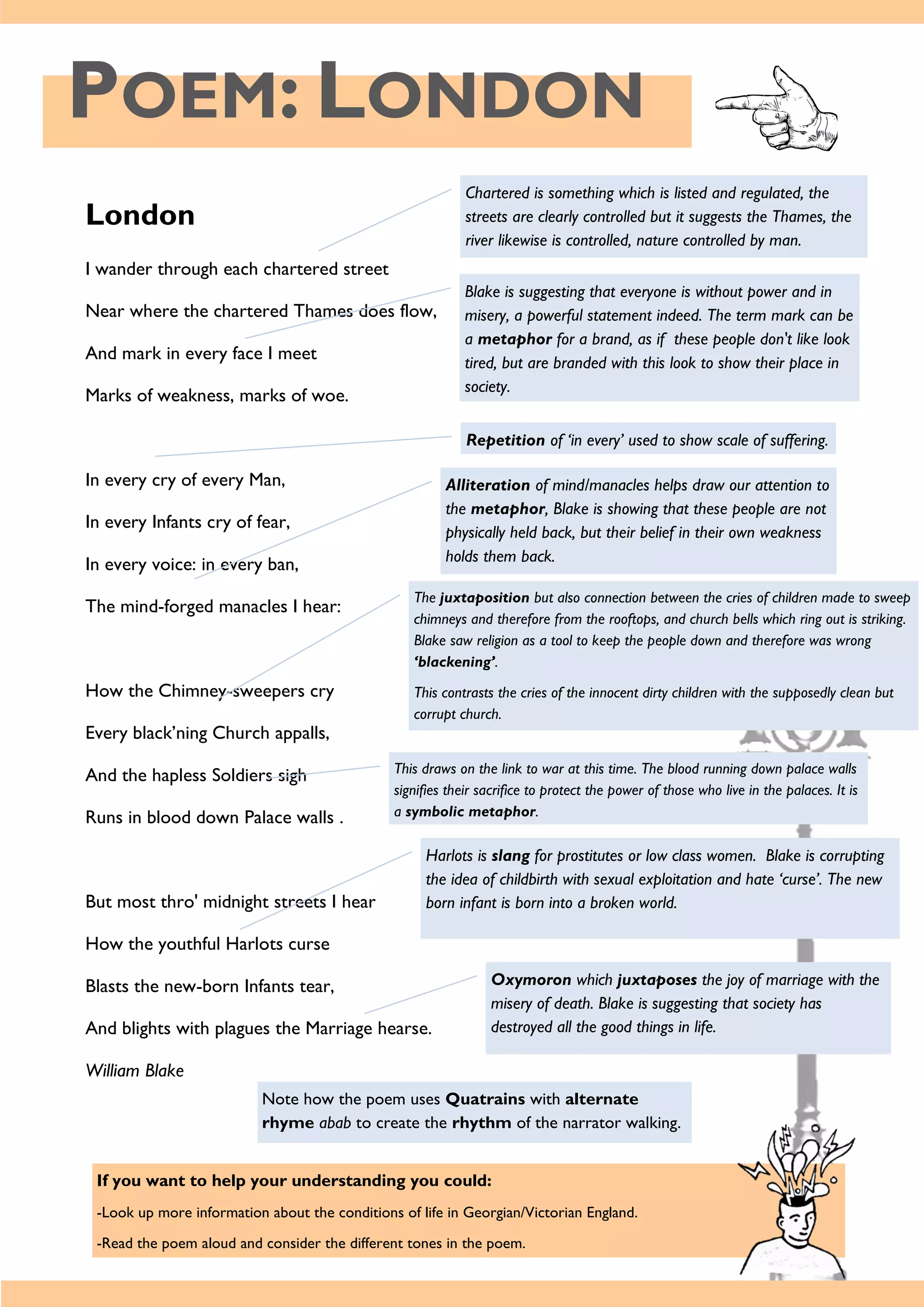
POEM: LONDON
London
I wander through each chartered street
Near where the chartered Thames does flow,
And mark in every face I meet
Marks of weakness, marks of woe.
In every cry of every Man,
In every Infants cry of fear,
In every voice: in every ban,
The mind-forged manacles I hear:
How the Chimney-sweepers cry
Every black’ning Church appalls,
And the hapless Soldiers sigh
Runs in blood down Palace walls .
But most thro' midnight streets I hear
How the youthful Harlots curse
Blasts the new-born Infants tear,
And blights with plagues the Marriage hearse.
William Blake
Chartered is something which is listed and regulated, the
streets are clearly controlled but it suggests the Thames, the
river likewise is controlled, nature controlled by man.
Blake is suggesting that everyone is without power and in
misery, a powerful statement indeed. The term mark can be
a metaphor for a brand, as if these people don't like look
tired, but are branded with this look to show their place in
society.
Repetition of ‘in every’ used to show scale of suffering.
Alliteration of mind/manacles helps draw our attention to
the metaphor, Blake is showing that these people are not
physically held back, but their belief in their own weakness
holds them back.
The juxtaposition but also connection between the cries of children made to sweep
chimneys and therefore from the rooftops, and church bells which ring out is striking.
Blake saw religion as a tool to keep the people down and therefore was wrong
‘blackening’.
This contrasts the cries of the innocent dirty children with the supposedly clean but
corrupt church.
This draws on the link to war at this time. The blood running down palace walls
signifies their sacrifice to protect the power of those who live in the palaces. It is
a symbolic metaphor.
Harlots is slang for prostitutes or low class women. Blake is corrupting
the idea of childbirth with sexual exploitation and hate ‘curse’. The new
born infant is born into a broken world.
Oxymoron which juxtaposes the joy of marriage with the
misery of death. Blake is suggesting that society has
destroyed all the good things in life.
If you want to help your understanding you could:
-Look up more information about the conditions of life in Georgian/Victorian England.
-Read the poem aloud and consider the different tones in the poem.
Note how the poem uses Quatrains with alternate
rhyme abab to create the rhythm of the narrator walking.
Context:
William Blake was a poet in Victorian/Georgian England, he wrote a selection of poems in his
anthologies songs of innocence and experience, most of those poems had a counterpart.
The Experience poems were often more bitter or cynical whereas the innocence poems
were often naïve and simple. London is one of the few without a counterpart.
The poem is set during a time in England where there was poverty, child labour and a horrific
war with France. Women had no rights, death rates from disease and malnutrition were high
and the industrial revolution has resulted in many large oppressive factories. Blake’s poems
often railed against these and how London, arguably the greatest city in the world at that
time, was so dirty and corrupt.
Blake'santhologycontainingbothsetsof
Themes:
Looking at power and conflict this is a poem which is more about the lack of power and abuse of power. The poem is set in
the capital of the most powerful country in the world and yet words like ‘manacles’ suggest slavery while the soldiers sigh ‘runs
in blood down palace walls’ a clear contrast between those with power and those without.
Revolution and People Power:
During this time France had thrown off and executed their king. The People’s revolution was
meant to show that all men are equal and have power. In Britain, a country with an old
monarchy and aristocracy, this was scary. Blake is perhaps supporting revolution, asking people
to throw off the ‘manacles’ of their belief that they should be told what to do.
Space for your notes:
……………………………………………………………………………………………….
……………………………………………………………………………………………….
……………………………………………………………………………………………….
……………………………………………………………………………………………….
……………………………………………………………………………………………….
Structure: Written in four stanzas with an regular alternate scheme. This may reflect the regular walking pace of the
narrator as he walks around London. The last line in each stanza tends to deliver a powerful statement which sums up the rest
of the stanza. Stanza 1 focusses on misery, Stanza 2 on peoples refusal to stand tall, Stanza 3 about the way people are
sacrificed for the rich and powerful, Stanza 4 how all this poverty is corrupting everything good about family and life.
BY THE END OF THIS YOU SHOULD KNOW:
HIGHER MARKS LOWER MARKS
-The poem is an ironic look at misery in the greatest city in
the world.
-Blake’s views are revolutionary for the time, challenging the
idea that man is worth more than slavery.
-Blake challenges the establishment in their ‘palaces 'and
‘churches’ which are marked by the blood and blackening of
good people.
-The poem is about the misery of life in London.
-The poet is upset at the loss of joy and innocence.
-People in power are living on the pain of others.
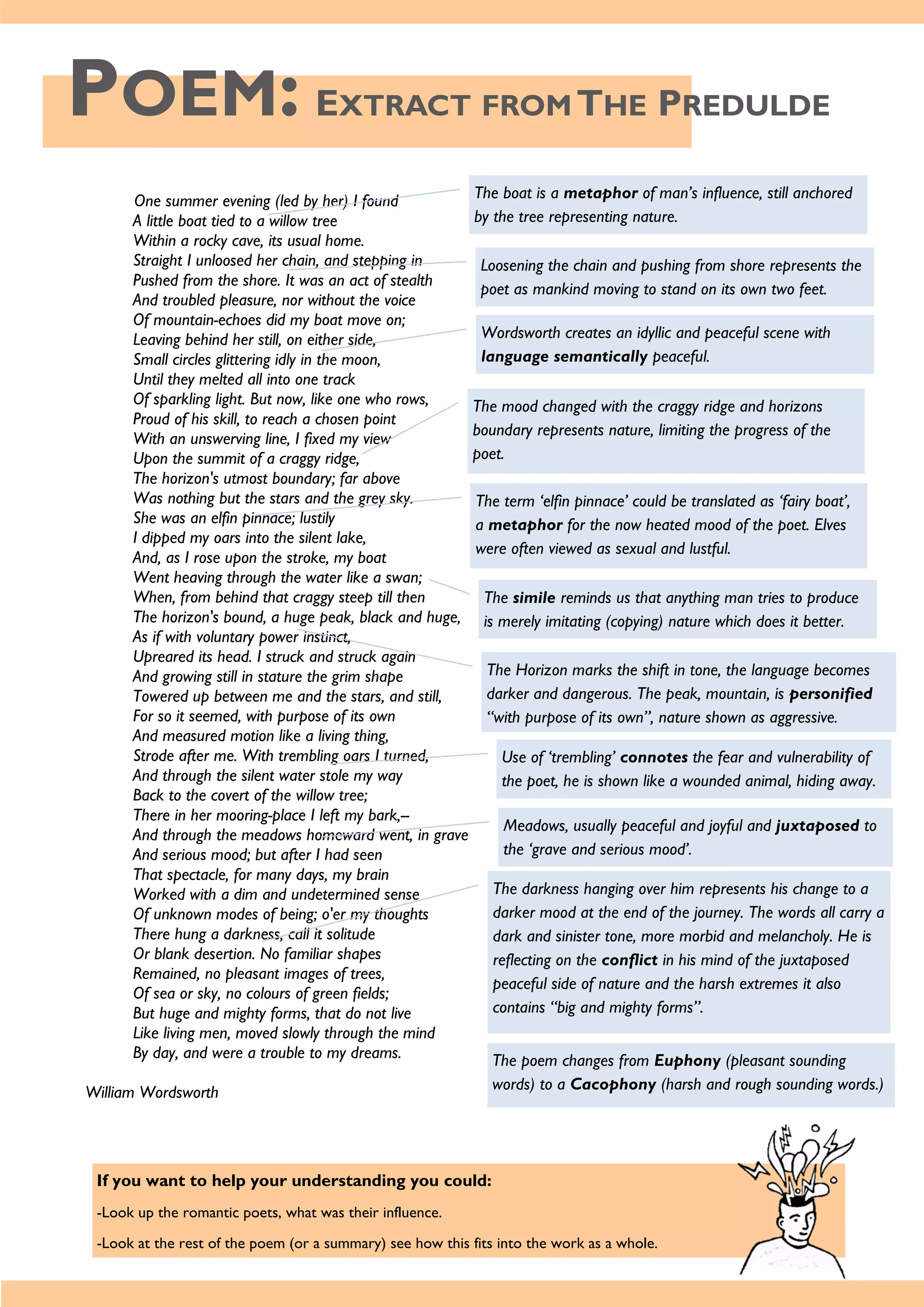
POEM: EXTRACT FROM THE PREDULDE
If you want to help your understanding you could:
-Look up the romantic poets, what was their influence.
-Look at the rest of the poem (or a summary) see how this fits into the work as a whole.
One summer evening (led by her) I found
A little boat tied to a willow tree
Within a rocky cave, its usual home.
Straight I unloosed her chain, and stepping in
Pushed from the shore. It was an act of stealth
And troubled pleasure, nor without the voice
Of mountain-echoes did my boat move on;
Leaving behind her still, on either side,
Small circles glittering idly in the moon,
Until they melted all into one track
Of sparkling light. But now, like one who rows,
Proud of his skill, to reach a chosen point
With an unswerving line, I fixed my view
Upon the summit of a craggy ridge,
The horizon's utmost boundary; far above
Was nothing but the stars and the grey sky.
She was an elfin pinnace; lustily
I dipped my oars into the silent lake,
And, as I rose upon the stroke, my boat
Went heaving through the water like a swan;
When, from behind that craggy steep till then
The horizon's bound, a huge peak, black and huge,
As if with voluntary power instinct,
Upreared its head. I struck and struck again
And growing still in stature the grim shape
Towered up between me and the stars, and still,
For so it seemed, with purpose of its own
And measured motion like a living thing,
Strode after me. With trembling oars I turned,
And through the silent water stole my way
Back to the covert of the willow tree;
There in her mooring-place I left my bark,--
And through the meadows homeward went, in grave
And serious mood; but after I had seen
That spectacle, for many days, my brain
Worked with a dim and undetermined sense
Of unknown modes of being; o'er my thoughts
There hung a darkness, call it solitude
Or blank desertion. No familiar shapes
Remained, no pleasant images of trees,
Of sea or sky, no colours of green fields;
But huge and mighty forms, that do not live
Like living men, moved slowly through the mind
By day, and were a trouble to my dreams.
William Wordsworth
The boat is a metaphor of man’s influence, still anchored
by the tree representing nature.
Loosening the chain and pushing from shore represents the
poet as mankind moving to stand on its own two feet.
Wordsworth creates an idyllic and peaceful scene with
language semantically peaceful.
The mood changed with the craggy ridge and horizons
boundary represents nature, limiting the progress of the
poet.
The term ‘elfin pinnace’ could be translated as ‘fairy boat’,
a metaphor for the now heated mood of the poet. Elves
were often viewed as sexual and lustful.
The simile reminds us that anything man tries to produce
is merely imitating (copying) nature which does it better.
The Horizon marks the shift in tone, the language becomes
darker and dangerous. The peak, mountain, is personified
“with purpose of its own”, nature shown as aggressive.
Use of ‘trembling’ connotes the fear and vulnerability of
the poet, he is shown like a wounded animal, hiding away.
Meadows, usually peaceful and joyful and juxtaposed to
the ‘grave and serious mood’.
The darkness hanging over him represents his change to a
darker mood at the end of the journey. The words all carry a
dark and sinister tone, more morbid and melancholy. He is
reflecting on the conflict in his mind of the juxtaposed
peaceful side of nature and the harsh extremes it also
contains “big and mighty forms”.
The poem changes from Euphony (pleasant sounding
words) to a Cacophony (harsh and rough sounding words.)
Context:
William Wordsworth was a romantic poet, we don’t mean he wrote love poems, but he wrote poems about the world we
live in which challenged people and the way they thought at the time. During this time ‘epic’ poems of large length were
common, as were poems which looked at the world and man’s place within it. This extract is from a much larger poem, it
looks at the spiritual and moral development of a man growing up.
Themes:
The poem is quite hard to relate to conflict and power. However there is a sense of conflict between man and nature where
nature is eventually shown to be more powerful in the end.
Boating along:
During the poem the setting is of a journey in a boat. The journey represents a more
spiritual journey and it becomes more rough and hostile along the way. At first, nature is
shown at peace with the poet, later as it gets darker and he tries to reach the horizon it
becomes harsh and predatory, putting man back in his place.
Space for your notes:
……………………………………………………………………………………………….
……………………………………………………………………………………………….
……………………………………………………………………………………………….
……………………………………………………………………………………………….
……………………………………………………………………………………………….
Structure: Written as part of a much larger piece. This section is 44 lines in blank verse (no real structure). The work
is in iambic pentameter to give it a consistent pace.
As the poem progresses the journey the poet is on becomes rougher and words like ‘and’ are repeated to give it a breathless
pace and feel.
BY THE END OF THIS YOU SHOULD KNOW:
HIGHER MARKS LOWER MARKS
-The poem symbolically uses the journey on the river to
mirror the poets own spiritual journey of reflection.
-The poet is structured to show the contrast of the serene
and peaceful start where we works with nature, to the dark
and disturbing battle with nature shown from when he tries
to control his journey through rowing.
-The conflict between man and nature is caused by mans
attempt to manipulate nature, nature still contains a power
and majesty beyond mankind's ability to command.
-The poem is about a journey on the river.
-The poet is at peace but by the end of the journey he
becomes troubled.
-The journey helps show how mankind is a part of nature but
does not rule over it.
Mountain:
“a huge peak, black and huge, As if with voluntary power instinct, Upreared its head.”
The mountain is shown in the poem like a great angry entity and represents the full might
and power of nature. It seems to take offense at the poet going too far or too ‘lustily’. You
could imagine it like a game of ‘chicken’ where the poet is rowing toward the mountain,
the closer he gets the more menacing it appears before he backs away.
POEM: MY LAST DUCHESS
FERRARA
That’s my last Duchess painted on the wall,
Looking as if she were alive. I call
That piece a wonder, now; Fra Pandolf’s hands
Worked busily a day, and there she stands.
Will’t please you sit and look at her? I said
“Fra Pandolf” by design, for never read
Strangers like you that pictured countenance,
The depth and passion of its earnest glance,
But to myself they turned (since none puts by
The curtain I have drawn for you, but I)
And seemed as they would ask me, if they durst,
How such a glance came there; so, not the first
Are you to turn and ask thus. Sir, ’twas not
Her husband’s presence only, called that spot
Of joy into the Duchess’ cheek; perhaps
Fra Pandolf chanced to say, “Her mantle laps
Over my lady’s wrist too much,” or “Paint
Must never hope to reproduce the faint
Half-flush that dies along her throat.” Such stuff
Was courtesy, she thought, and cause enough
For calling up that spot of joy. She had
A heart—how shall I say?— too soon made glad,
Too easily impressed; she liked whate’er
She looked on, and her looks went everywhere.
Sir, ’twas all one! My favour at her breast,
The dropping of the daylight in the West,
The bough of cherries some officious fool
Broke in the orchard for her, the white mule
She rode with round the terrace—all and each
Would draw from her alike the approving speech,
Or blush, at least. She thanked men—good! but thanked
Somehow—I know not how—as if she ranked
My gift of a nine-hundred-years-old name
With anybody’s gift. Who’d stoop to blame
This sort of trifling? Even had you skill
In speech—which I have not—to make your will
Quite clear to such an one, and say, “Just this
Or that in you disgusts me; here you miss,
Or there exceed the mark”—and if she let
Herself be lessoned so, nor plainly set
Her wits to yours, forsooth, and made excuse—
E’en then would be some stooping; and I choose
Never to stoop. Oh, sir, she smiled, no doubt,
Whene’er I passed her; but who passed without
Much the same smile? This grew; I gave commands;
Then all smiles stopped together. There she stands
As if alive. Will’t please you rise? We’ll meet
The company below, then. I repeat,
The Count your master’s known munificence
Is ample warrant that no just pretense
Of mine for dowry will be disallowed;
Though his fair daughter’s self, as I avowed
At starting, is my object. Nay, we’ll go
Together down, sir. Notice Neptune, though,
Taming a sea-horse, thought a rarity,
Which Claus of Innsbruck cast in bronze for me!
Robert Browning
Possessive pronoun the speaker is laying claim to her as a possession,
she is used to better show off his control and power.
The portrait above, largely believed to be the last Duchess.
He is making an allusion to a famous artist of the time. The suggestion is that he
values the name of the artist more than the Duchess it is a painting of.
He is showing his power in the bracketed aside by suggesting that he is giving the
messenger a rare privilege to see the Duchess in this way, exercising his control. In fact
the irony is that he needs to show off.
If they ‘durst’: If they dare, he is showing off his power again and how others fear him.
He implies that people believed it was not only him who could make her happy
(though he couldn’t) the ‘spot’ is a pun between a mark, showing her face had some
joy in it, but also spot as in a small amount, she was not happy. Hints he was jealous.
Sinister tone, ‘dies along her throat’ the words are also semantically linked to
murder ‘die’ and ‘throat’.
He is trying to be polite, using a rhetorical question to indicate a lighter tone to
the conversation, in fact he is trying to avoid showing his jealousy and rage, at
conflict with himself.
He is angry that she would find the same level of joy in the expensive gifts he bought her and
the cheap or simple gifts of the poor or nature. Angry at his lack of control. He juxtaposes the
two things though the irony is that his are without sincerity.
Exclamation and change of structure, the verse is broken with caesuras to show
his rising anger. He is losing control, his personality now angry when it was calm.
The poet is ironically mocking how vain the Duke is, he cares more about his
heritage and cannot understand that she did not see that as important.
Here he clearly states how even if he was good with words and could ask her to stop giving
everyone else so much attention, he would choose never to stoop so low. He is showing his
believed power as above asking for things from women. Ironically she is in control.
The use of semicolons gives a sense of finality to the statements. It is suggesting she
was killed on his request. This is the culmination of the conflict in the relationship.
Euphemism to suggest the fact she was killed?
Her in a painting satisfies him as much as she did in real life, as a possession. The
question shows a change of tone to return to the civil and polite way in the start.
This helps give the poem a circular structure.
Dowry, money paid by the brides parents. Suggests he is more interested in the money
than his planned future bride. It is sinister as is again suggests a repeat in his actions.
Munificence means generosity. He is counting on being given the money.
As with the start he uses an allusion to another famous artist in order to show off his
wealth and power. It is used to show how he quickly forgets about his dead wife who
he was previously claimed to be so devoted to. Ironic as he has just also been talking
about how devoted he will be to his new wife. Gives the poem a circular structure.
If you want to help your understanding you could:
-Look up a bit more information on Duke Alfonso of Ferrara, see if it helps you understand the character.
-The poem is better as a speech, imagine yourself as a self centred rich man, how does it sound to read it aloud.
Context:
Robert Browning was a poet in the 19th century. The son of a wealthy bank clerk, he didn't fit in as
much in London society, he left the country and went to Italy to marry fellow poet Elizabeth Barrett
because of her over protective father. As a result they were both familiar with over controlling
patriarchs in the family as well as Italy itself.
The poem is loosely based on the Duke of Ferrara and is written from his perspective, talking to a
messenger about arranging his next marriage. The assumption being that he was dissatisfied with his
former wife and had her killed.
Themes:
The idea of Power and Conflict is shown in the way the speaker (the Duke of Ferrara) is showing off his power and also
suggesting the control he had over the Duchess’s life. There is also conflict between who he presents or wants himself to be
and who he really is as a character.
Structure:
The poem is an example of dramatic monologue (a speech given by one character). It uses a large number of pauses
(caesuras) in the poem along with lines that flow into one another (enjambment) in order to try and capture the tone of
the speaker talking away to the messenger and adding in tangents (small opinions and asides). The poem uses rhyming
couplets and iambic pentameter this reflects the style of romantic poets at the time, despite how this poem is much
more sinister and dark. It is another façade for the Duke of Ferrara’s character. You will note he is the only character that
speaks despite the fact he is talking to someone, he never lets them speak.
Space for your notes:
……………………………………………………………………………………………….
……………………………………………………………………………………………….
……………………………………………………………………………………………….
……………………………………………………………………………………………….
……………………………………………………………………………………………….
BY THE END OF THIS YOU SHOULD KNOW:
HIGHER MARKS LOWER MARKS
-The poem is a dramatic monologue with the Duke of
Ferrara arranging his new marriage but getting swept up
talking about his former wife.
-The change in tone is used to show the sinister undertones
and power struggle in the relationship, he is the only one
truly at conflict here.
-The poet ironically shows that his man is rich and educated
yet a fool in matters of love and honesty, both powerful and
-The poem is spoken by a Duke and talks about his last wife.
-He is normally polite but the more talks about her, the more
he becomes jealous.
-We see that he is a powerful rich man but was in fact he
could not control his wife, he was at conflict even though she
was not trying to anger him.
AlfonsoDukeofFerrara
POEM: CHARGE OF THE LIGHT BRIGADE
If you want to help your understanding you could:
-Look up more information about the Crimean war.
-There are a number of good clips showing charges and films made of this poem, watch some to
help capture the feel the poem is aiming for of glory and danger.
I
Half a league, half a league,
Half a league onward,
All in the valley of Death
Rode the six hundred.
“Forward, the Light Brigade!
Charge for the guns!” he said.
Into the valley of Death
Rode the six hundred.
II
“Forward, the Light Brigade!”
Was there a man dismayed?
Not though the soldier knew
Someone had blundered.
Theirs not to make reply,
Theirs not to reason why,
Theirs but to do and die.
Into the valley of Death
Rode the six hundred.
III
Cannon to right of them,
Cannon to left of them,
Cannon in front of them
Volleyed and thundered;
Stormed at with shot and shell,
Boldly they rode and well,
Into the jaws of Death,
Into the mouth of hell
Rode the six hundred.
IV
Flashed all their sabres bare,
Flashed as they turned in air
Sabring the gunners there,
Charging an army, while
All the world wondered.
Plunged in the battery-smoke
Right through the line they broke;
Cossack and Russian
Reeled from the sabre stroke
Shattered and sundered.
Then they rode back, but not
Not the six hundred.
V
Cannon to right of them,
Cannon to left of them,
Cannon behind them
Volleyed and thundered;
Stormed at with shot and shell,
While horse and hero fell.
They that had fought so well
Came through the jaws of Death,
Back from the mouth of hell,
All that was left of them,
Left of six hundred.
VI
When can their glory fade?
O the wild charge they made!
All the world wondered.
Honour the charge they made!
Honour the Light Brigade,
Noble six hundred!
Alfred Lord Tennyson
League is about 3 miles, shows how
far they have on their journey. Also
can show quality, that they are not
up to the challenge ahead. Double
meaning.
Valley of Death is a biblical allusion
to show the horror of what they now
face, connotation of hell.
Repetition to build the tension
and drag out the charge.
Repetition of ‘theirs’ and ‘six
hundred’ objectifies them as a
symbol rather than just men. Also
helps tone becomes more solemn to
show impending doom.
Cannon link to war and conflict,
demonstrate how the odds are
against them. Repetition to show
scale of guns against them.
‘Boldly’ contrast with the scale of
odds against them, emphasises
futility. Sibilance to imply the
swiftness of the charge.
Personifies death, used to
exaggerate the futility and bravery of
soldiers that they are going to die, but
do so boldly.
Sabres: swords, the flash is the sun
shining off the metal but also a
metaphor for the glory they showed
in their bravery which, like a flash, is
short.
Exaggerate (hyperbole) the scale of
the mistake.
Cossack and Russian, the enemy.
Here the poet is showing how the
enemy were not the equal of the
British, however there were more of
them. Consonance to shattered and
sundered ‘-ered’ to emphasise
devastation.
Changes the tone by inserting the
word ‘not’ implies the six hundred
have mostly died.
Repetition from before, gives
the poem a parallel to mirror
the charge, now they are
running away.
Glorify the poet make the men
more like symbols of bravery
than real men.
Mirrors the third stanza to
emphasise the bravery and loss.
Rhetorical question. The
poet does not seem sad that
these men died but rather is
more concerned with their glory.
The imperative, ordering
people to give their respect
when many questioned the
charge. The Poet is showing how
the soldiers themselves should
be honoured, even if the decision
to charge may have been wrong.
The poem suggesting that hero's have been made from this conflict.
He is clear to show their bravery and strength (power) by escaping
the clutches of death and ‘jaws of hell’.
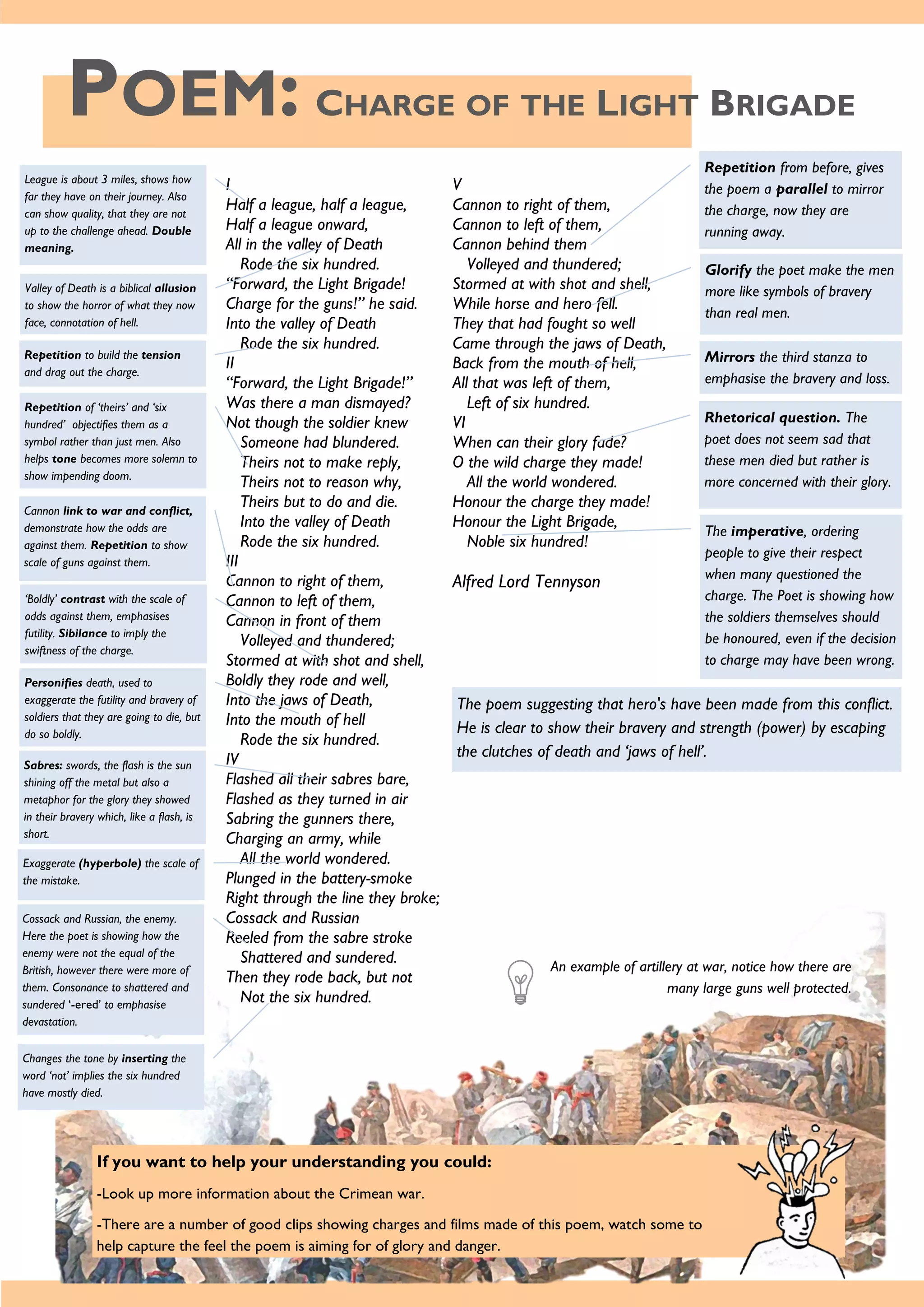
An example of artillery at war, notice how there are
many large guns well protected.
Themes:
The poem is about war, life and death, sacrifice and folly. It naturally links to conflict and is effective at showing peoples views
on war of the time. The poem also contains a lot of reference to biblical/religious ideas as well as bravery and fear.
Space for your notes:
……………………………………………………………………………………………….
……………………………………………………………………………………………….
……………………………………………………………………………………………….
……………………………………………………………………………………………….
……………………………………………………………………………………………….
Structure: Written in dimeter and dactylic. Basically that means there are two (di-) stresses in each line, that means
two beats or syllables which you read with a bit more force. The syllables after are then unstressed. So when there are six
syllables you would read it ONE-two-three, ONE-two-three. The drop in stress is perhaps to show the sudden charge and
then collapse, or the sound of horses galloping.
The poem is divided into 6 stanzas and uses a lot of repetition. Some of this is to show the different stages of the battle but
also give it a structure. It has a very military rhyme and can be similar to the sound of marching drums of horse hooves. This is
used to reflect the military nature of the conflict in the poem.
BY THE END OF THIS YOU SHOULD KNOW:
HIGHER MARKS LOWER MARKS
-The repetition within the poem helps capture the galloping
military rhythm. This indicates the conflict and power building
through the poem itself.
-The poet is clearly distinguishing between the bravery of the
men and the foolish ‘blunder’ of the orders and suggests the
six hundred should be seen as heroes.
-The military language is mixed with religious allusion to
suggest an epic scale, emphasising the risk and bravery.
-The poem repeats a lot to remind us the charge and then
the retreat.
-The poet thinks the men are brave calling them ‘heros’
-The poem is full of violence shown through the use of
language like ‘sabres’ and ‘cannons.’
Context:
The Crimean war saw British troops fighting in Russia. At this time, while there
were basic guns and cannons, people would still also fight or horses, to rush in and
attack before they could reload or stop them. However the light brigade were very
lightly equipped, more for scouting or attacking from the back or sides rather than
charging straight in.
During a battle, a miscommunication sent the light brigade charging head first into the
cannons of the other side, it was a huge catastrophe and many died. It showed to the British that even mistakes can happen. The men were
respected for following orders, even though they knew they may be wrong. Some however have criticised the way they blindly followed
orders. Lord Tennyson was the poet who was asked to write about their glorious sacrifice.
Paintingofthelightbrigade
Valley of Death:
The Christian prayer, ‘The Lords Prayer’ contains the line “though I may walk through the valley of
death”. This phrase being used in the poem is used to show the scale of importance and give the
poem and epic quality.
POEM: EXPOSURE
If you want to help your understanding you could:
-Look at some of Owen’s other poems or the work of Sassoon, how do they talk of war?
-Do some research into trench conditions, see if you can find how many died from disease and cold.
Our brains ache, in the merciless iced east winds that knife us...
Wearied we keep awake because the night is silent...
Low drooping flares confuse our memory of the salient...
Worried by silence, sentries whisper, curious, nervous,
But nothing happens.
Watching, we hear the mad gusts tugging on the wire.
Like twitching agonies of men among its brambles.
Northward incessantly, the flickering gunnery rumbles,
Far off, like a dull rumour of some other war.
What are we doing here?
The poignant misery of dawn begins to grow...
We only know war lasts, rain soaks, and clouds sag stormy.
Dawn massing in the east her melancholy army
Attacks once more in ranks on shivering ranks of gray,
But nothing happens.
Sudden successive flights of bullets streak the silence.
Less deadly than the air that shudders black with snow,
With sidelong flowing flakes that flock, pause and renew,
We watch them wandering up and down the wind's nonchalance,
But nothing happens.
Pale flakes with lingering stealth come feeling for our faces -
We cringe in holes, back on forgotten dreams, and stare, snow-dazed,
Deep into grassier ditches. So we drowse, sun-dozed,
Littered with blossoms trickling where the blackbird fusses.
Is it that we are dying?
Slowly our ghosts drag home: glimpsing the sunk fires glozed
With crusted dark-red jewels; crickets jingle there;
For hours the innocent mice rejoice: the house is theirs;
Shutters and doors all closed: on us the doors are closed -
We turn back to our dying.
Since we believe not otherwise can kind fires burn;
Now ever suns smile true on child, or field, or fruit.
For God's invincible spring our love is made afraid;
Therefore, not loath, we lie out here; therefore were born,
For love of God seems dying.
To-night, His frost will fasten on this mud and us,
Shrivelling many hands and puckering foreheads crisp.
The burying-party, picks and shovels in their shaking grasp,
Pause over half-known faces. All their eyes are ice,
But nothing happens.
Wilfred Owen
Personification of the weather described as ‘merciless’ and attacking them
‘knife us’ this is unexpected as we expect the fight to be between soldiers.
Sibilance the hissing s sound capture the noise of wind, it sounds both
lonely but also biting.
The man made weapons are likened through metaphor to natural
objects, showing mans war is a cheap imitation of nature.
Rhetorical question highlights the hopelessness of soldiers and war.
Contrast/oxymoron, dawn is meant to be hopeful and positive, not miserable.
Now the rain is personified, nothing happens repeated to emphasise
the helplessness of the soldiers who are beyond help.
Harsh assonance and consonance of s and t sounds link weather with
gunfire and therefore conflict and pain.
Now the snow is described with alliteration to emphasise the f sounds
and highlight the cold heavy blanketing of the weather. The wind’s
‘nonchalance’ implies the weather sees the soldiers as beneath it and weak.
Man is animalised, likened to scared animals, rabbits in holes.
Showing that before nature man is just an animal.
Rhetorical Question shows the confusion of soldiers. Conditions are so
bad they can no longer tell what is normal anymore.
Metaphor frozen blood described as jewels, poet sees men's lives as
valuable and ultimately wasted.
So broken and hurt are the men that they feel abandoned and lose faith in
God “our love is made afraid”. Contrasts/juxtaposes the battlefield with
garden of Eden. Tone is one of betrayal and despair.
Use of scattered punctuation slows the pace, we can imagine the soldier
finally succumbing to exposure and dyeing.
Metaphor ice as in cold and dead but also dead and empty, without soul.
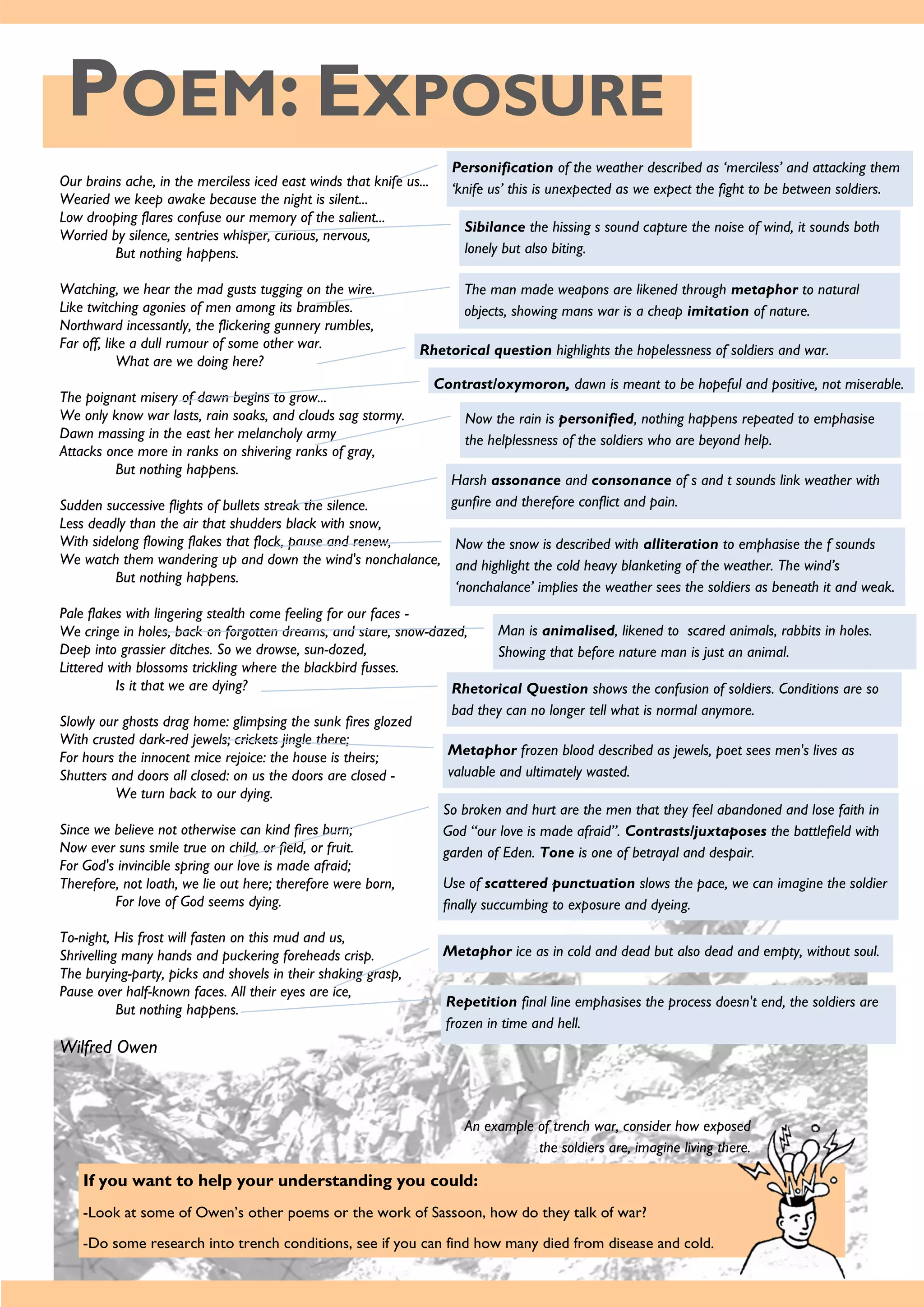
An example of trench war, consider how exposed
the soldiers are, imagine living there.
Repetition final line emphasises the process doesn't end, the soldiers are
frozen in time and hell.
Themes:
The poem itself is based on war and so links to conflict. The poem itself is about the
weather and conditions of living in the trenches rather than any fighting. It is more a poem
about the conflict between man and nature. This is extremely relevant because man
has created machines that can launch explosive shells for miles and destroy the landscape,
and yet, nature can still do more harm than any of it.
Space for your notes:
……………………………………………………………………………………………….
……………………………………………………………………………………………….
……………………………………………………………………………………………….
……………………………………………………………………………………………….
……………………………………………………………………………………………….
Structure: The poem uses a large amount of ellipses, caesuras and repetition to create an on-going sense of
waiting and boredom. The poem is made of eight stanzas with a consistent use of a half line to end. This reinforces the sense
of stasis or sameness throughout the poem that nothing is happening. There is use of para-rhyme showing words which
appear to rhyme yet sound wrong when read to create the sense of unsettledness in the poem the soldiers are feeling. Owen
also uses a huge amount of onomatopoeia and alliteration in the poem to emphasise the atmosphere and the sound of
weather.
BY THE END OF THIS YOU SHOULD KNOW:
HIGHER MARKS LOWER MARKS
-The poem defies the convention of war and looks at the weather assaulting
the soldiers, not another army. This is to highlight the unknown horrors of
war to people at home.
-The poet uses repetition and a consistent structure to create the static tone
of the poem. The lack of change adds to the tone of despair.
-The alliteration is used to create a sense of atmosphere to the weather and
to draw parallels to the violence of war and weather.
-The poem talks about soldiers suffering in
bad weather.
-The poet feels sadness and helplessness that
these men are without hope and nothing is
changing.
-The poet uses a lot of alliteration and pauses
in the poem to make it drag out and help us
imagine the weather conditions.
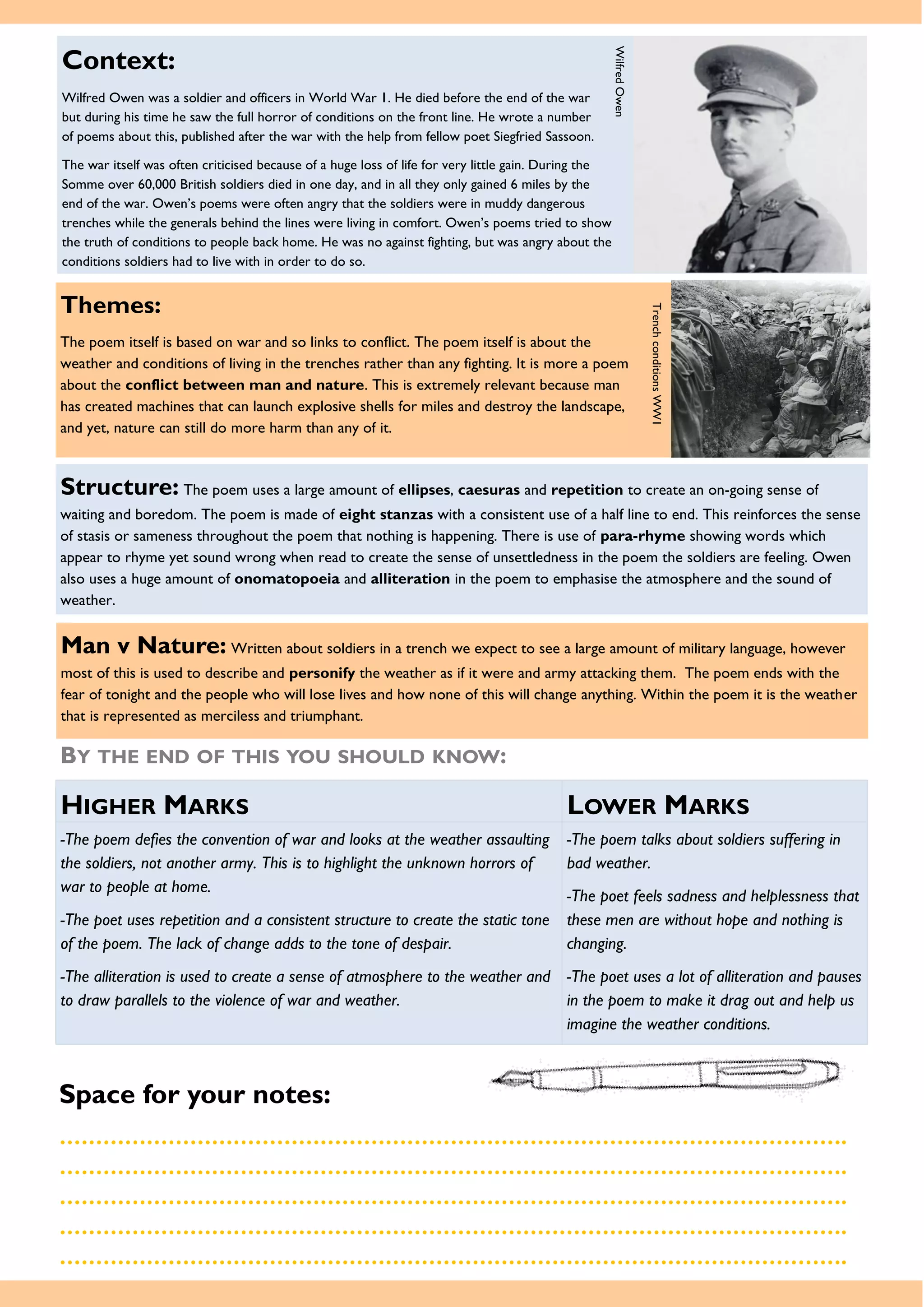
Context:
Wilfred Owen was a soldier and officers in World War 1. He died before the end of the war
but during his time he saw the full horror of conditions on the front line. He wrote a number
of poems about this, published after the war with the help from fellow poet Siegfried Sassoon.
The war itself was often criticised because of a huge loss of life for very little gain. During the
Somme over 60,000 British soldiers died in one day, and in all they only gained 6 miles by the
end of the war. Owen’s poems were often angry that the soldiers were in muddy dangerous
trenches while the generals behind the lines were living in comfort. Owen’s poems tried to show
the truth of conditions to people back home. He was no against fighting, but was angry about the
conditions soldiers had to live with in order to do so.
WilfredOwen
TrenchconditionsWW1Man v Nature: Written about soldiers in a trench we expect to see a large amount of military language, however
most of this is used to describe and personify the weather as if it were and army attacking them. The poem ends with the
fear of tonight and the people who will lose lives and how none of this will change anything. Within the poem it is the weather
that is represented as merciless and triumphant.
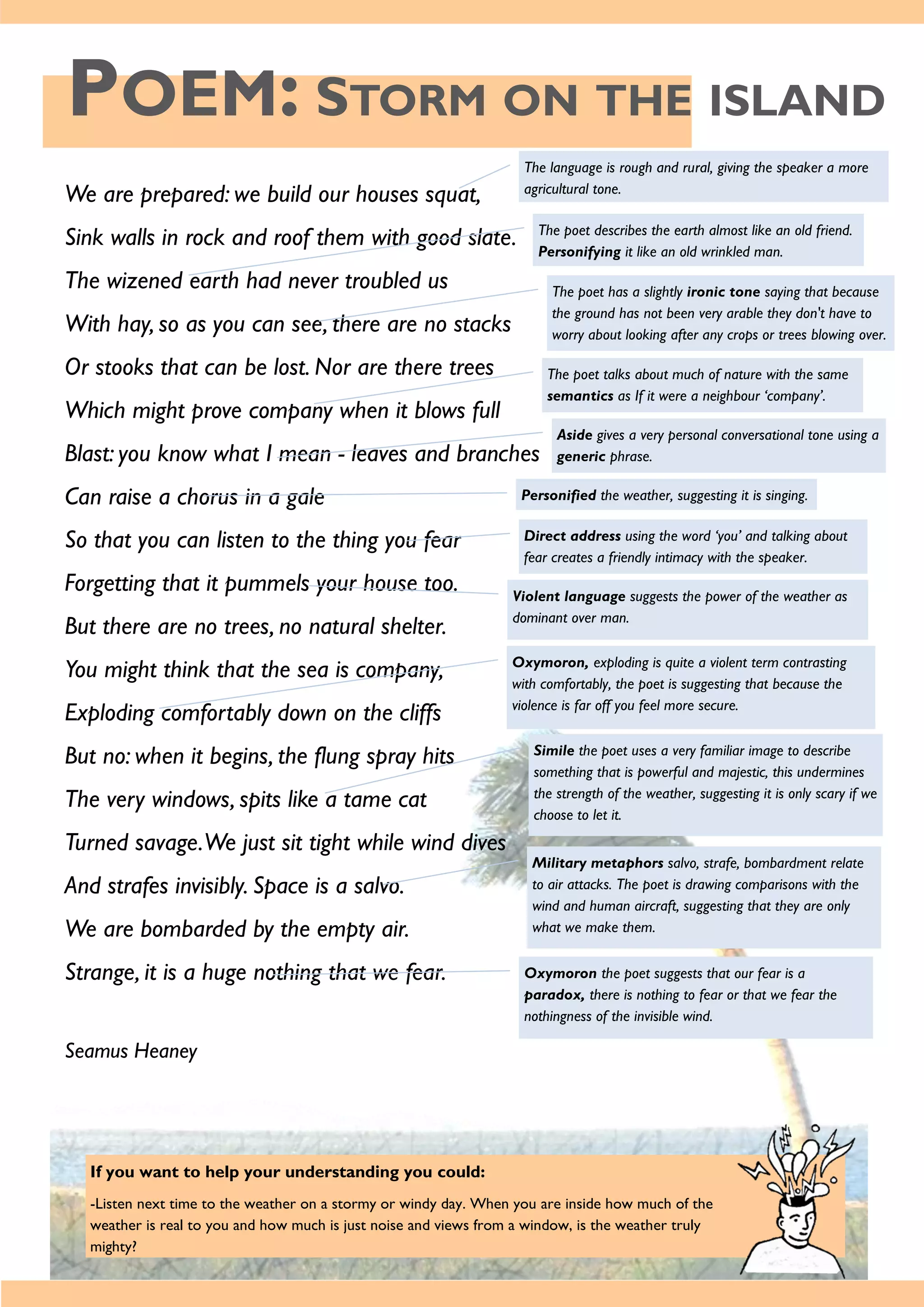
POEM: STORM ON THE ISLAND
If you want to help your understanding you could:
-Listen next time to the weather on a stormy or windy day. When you are inside how much of the
weather is real to you and how much is just noise and views from a window, is the weather truly
mighty?
We are prepared: we build our houses squat,
Sink walls in rock and roof them with good slate.
The wizened earth had never troubled us
With hay, so as you can see, there are no stacks
Or stooks that can be lost. Nor are there trees
Which might prove company when it blows full
Blast: you know what I mean - leaves and branches
Can raise a chorus in a gale
So that you can listen to the thing you fear
Forgetting that it pummels your house too.
But there are no trees, no natural shelter.
You might think that the sea is company,
Exploding comfortably down on the cliffs
But no: when it begins, the flung spray hits
The very windows, spits like a tame cat
Turned savage.We just sit tight while wind dives
And strafes invisibly. Space is a salvo.
We are bombarded by the empty air.
Strange, it is a huge nothing that we fear.
Seamus Heaney
The language is rough and rural, giving the speaker a more
agricultural tone.
The poet describes the earth almost like an old friend.
Personifying it like an old wrinkled man.
The poet has a slightly ironic tone saying that because
the ground has not been very arable they don't have to
worry about looking after any crops or trees blowing over.
The poet talks about much of nature with the same
semantics as If it were a neighbour ‘company’.
Aside gives a very personal conversational tone using a
generic phrase.
Personified the weather, suggesting it is singing.
Direct address using the word ‘you’ and talking about
fear creates a friendly intimacy with the speaker.
Violent language suggests the power of the weather as
dominant over man.
Oxymoron, exploding is quite a violent term contrasting
with comfortably, the poet is suggesting that because the
violence is far off you feel more secure.
Simile the poet uses a very familiar image to describe
something that is powerful and majestic, this undermines
the strength of the weather, suggesting it is only scary if we
choose to let it.
Military metaphors salvo, strafe, bombardment relate
to air attacks. The poet is drawing comparisons with the
wind and human aircraft, suggesting that they are only
what we make them.
Oxymoron the poet suggests that our fear is a
paradox, there is nothing to fear or that we fear the
nothingness of the invisible wind.
Themes:
The poem looks at the conflict between nature and man and peoples fear of the weather. However the poet also points out
that the fears are really rather small in the grand scheme. There is also a hint of war and conflict in the way the weather is
described with “bombardment” and “salvo”.
Space for your notes:
……………………………………………………………………………………………….
……………………………………………………………………………………………….
……………………………………………………………………………………………….
……………………………………………………………………………………………….
……………………………………………………………………………………………….
………………………………………………………………………………………………..
Structure: The poem is in blank verse with 19 lines. There are 5 feet (10 syllables) in each line. The verses are
unrhymed and it gives it a very conversational tone. This is added to by the use of asides ‘you know what I mean’. The poem is
in present tense to suggest the storm is occurring at the time. The poem uses a great deal of enjambment to help add to the
conversational tone.
BY THE END OF THIS YOU SHOULD KNOW:
HIGHER MARKS LOWER MARKS
-The cottage represents safety and calm and behind its walls
the violence of the weather is undermined. It reflects a
conflict between nature and man.
-The poet is able to communicate a sense of calm
friendliness using asides and very recognisable imagery to
describe the attack of the weather.
-The poets suggestion of fear challenges the allocation of
power, that we only give power top what we fear if we let it.
-The poem is about a cottage in a storm being attacked by
the weather.
-The poet is friendly and speaking in a very calm
conversational way to the reader.
-The poet shows that sometimes what we fear is not worth
being afraid of.
Context:
Seamus Heaney was a poet in Ireland, he grew up in a farming community and many of his
poems were about very normal and homely subjects. He uses a large number of
agricultural and natural images in his work as metaphors for human nature..
The poem is set around a story of a small isolated cottage near the sea in a storm and the
exposure to the elements.
Smallisolatecottage
Fear:
The poem ends with “it is a huge nothing that we fear”, the suggestion is not just about the weather but also potentially many
things. As a Irish Catholic, religion is a big element in Heaney’s life. He humbles the weather into very human terms unlike
other poems which fear it’s might. In many ways he is also humbling the idea of God. Reducing his power into a ‘huge nothing’.
The suggestion of fear is that power is only there if you let the other thing scare you. Behind his walls and well prepared, he
doesn't need to fear and so the weather (and god) lose power.
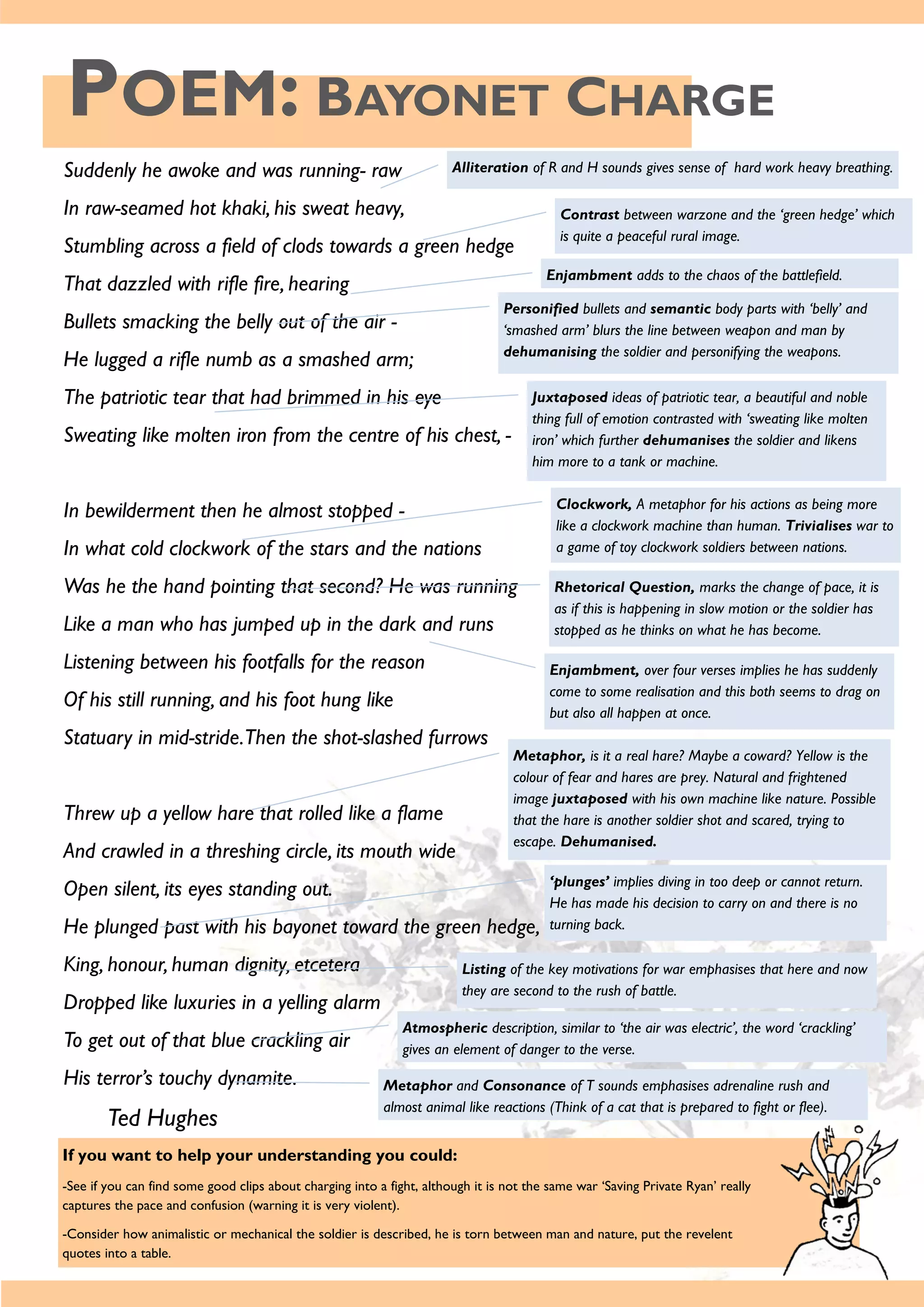
POEM: BAYONET CHARGE
Suddenly he awoke and was running- raw
In raw-seamed hot khaki, his sweat heavy,
Stumbling across a field of clods towards a green hedge
That dazzled with rifle fire, hearing
Bullets smacking the belly out of the air -
He lugged a rifle numb as a smashed arm;
The patriotic tear that had brimmed in his eye
Sweating like molten iron from the centre of his chest, -
In bewilderment then he almost stopped -
In what cold clockwork of the stars and the nations
Was he the hand pointing that second? He was running
Like a man who has jumped up in the dark and runs
Listening between his footfalls for the reason
Of his still running, and his foot hung like
Statuary in mid-stride.Then the shot-slashed furrows
Threw up a yellow hare that rolled like a flame
And crawled in a threshing circle, its mouth wide
Open silent, its eyes standing out.
He plunged past with his bayonet toward the green hedge,
King, honour, human dignity, etcetera
Dropped like luxuries in a yelling alarm
To get out of that blue crackling air
His terror’s touchy dynamite.
Ted Hughes
If you want to help your understanding you could:
-See if you can find some good clips about charging into a fight, although it is not the same war ‘Saving Private Ryan’ really
captures the pace and confusion (warning it is very violent).
-Consider how animalistic or mechanical the soldier is described, he is torn between man and nature, put the revelent
quotes into a table.
Alliteration of R and H sounds gives sense of hard work heavy breathing.
Contrast between warzone and the ‘green hedge’ which
is quite a peaceful rural image.
Enjambment adds to the chaos of the battlefield.
Personified bullets and semantic body parts with ‘belly’ and
‘smashed arm’ blurs the line between weapon and man by
dehumanising the soldier and personifying the weapons.
Juxtaposed ideas of patriotic tear, a beautiful and noble
thing full of emotion contrasted with ‘sweating like molten
iron’ which further dehumanises the soldier and likens
him more to a tank or machine.
Clockwork, A metaphor for his actions as being more
like a clockwork machine than human. Trivialises war to
a game of toy clockwork soldiers between nations.
Rhetorical Question, marks the change of pace, it is
as if this is happening in slow motion or the soldier has
stopped as he thinks on what he has become.
Enjambment, over four verses implies he has suddenly
come to some realisation and this both seems to drag on
but also all happen at once.
Metaphor, is it a real hare? Maybe a coward? Yellow is the
colour of fear and hares are prey. Natural and frightened
image juxtaposed with his own machine like nature. Possible
that the hare is another soldier shot and scared, trying to
escape. Dehumanised.
‘plunges’ implies diving in too deep or cannot return.
He has made his decision to carry on and there is no
turning back.
Listing of the key motivations for war emphasises that here and now
they are second to the rush of battle.
Atmospheric description, similar to ‘the air was electric’, the word ‘crackling’
gives an element of danger to the verse.
Metaphor and Consonance of T sounds emphasises adrenaline rush and
almost animal like reactions (Think of a cat that is prepared to fight or flee).
Themes:
The poem clearly is set around conflict in that it is a soldier rushing out of the trenches on the attack. However the poem also
looks at ideas like transformation, humanity and nature (in the form of the yellow hare and green hedge). In the poem the
solider is almost more machine or animal than human and this is reflected in the power themed words used to describe him.
Space for your notes:
……………………………………………………………………………………………….
……………………………………………………………………………………………….
……………………………………………………………………………………………….
……………………………………………………………………………………………….
……………………………………………………………………………………………….
………………………………………………………………………………………………..
Structure: There are three stanzas and the work is largely blank verse with no set structure. In part the different lines help
show the pace of the charge, sometimes fast, sometimes stumbling. Towards the end it picks up speed, perhaps as he approaches his
destination or doom. The poet uses a lot of enjambment and caesuras to give a bizarre and erratic speed to the poem. This helps again
give a structure to the speed of the charge but also the confusion and intensity of the battle with explosions and gunfire as well as the
jumbled thoughts of the soldier.
BY THE END OF THIS YOU SHOULD KNOW:
HIGHER MARKS LOWER MARKS
-The poem explores a soldiers charge through a mix of
physical and emotional exploration.
-The language of the poem seems to juxtapose natural
animal images and human machine, they are at conflict.
-The mix of caesura and enjambment in the poem adds a
chaotic tone to show the confusion of war and the inner
turmoil of the soldier.
-The poem is about a soldier going over the trenches to
attack.
-There is a mix of language which talks about the soldier as
a machine but also being quite like an animal.
-The structure of the poem is a mix of fast and slow to show
the confusion of fighting.
Context:
The poem is about a nameless soldier going over the top in the trenches. Soldiers
would have bayonets attached to the end of their rifles and would use them to stab
enemy soldiers. The nameless soldier in the poem seems to become more a
weapon than a man, rushing toward the enemy. It is not clear at the end whether
he dies but there is definitely a change in him. His actions are very raw and primal,
much like an animal, suddenly pausing, preparing to react. The poet, Ted Hughes,
was a former RAF serviceman and includes a great amount of natural and historical ideas
in his poems and he often looks at man’s impact on nature.
SoldiersbayonettrainingMan or Mouse (Hare?):
There are parts of this poem which make us think more of a hunt or animals than humanity. The charge
to the ‘green hedge’ seems to be more the action of an animal bolting in a field rather than soldiers
charging a trench. The inclusion of the yellow hare is also powerful, we see the soldier in a moment of
confusion, not sure why he is there and what he is doing, the hare seems to spur him on, either because
he does not want to be a coward or because it reflects a brief moment of man and nature connecting
before war once again breaks it.
AHare
POEM: REMAINS
If you want to help your understanding you could:
-Look up PTSD (Post traumatic stress disorder), what are some of the stories and experiences of sufferers,
how has it changed their life and how can this be related to the speaker in the poem?
-Go through the poem and highlight the words and phrases which help show the speakers tone.
On another occasion, we got sent out
to tackle looters raiding a bank.
And one of them legs it up the road,
probably armed, possibly not.
Well myself and somebody else and somebody else
are all of the same mind,
so all three of us open fire.
Three of a kind all letting fly, and I swear
I see every round as it rips through his life –
I see broad daylight on the other side.
So we’ve hit this looter a dozen times
and he’s there on the ground, sort of inside out,
pain itself, the image of agony.
One of my mates goes by
and tosses his guts back into his body.
Then he’s carted off in the back of a lorry.
End of story, except not really.
His blood-shadow stays on the street, and out on patrol
I walk right over it week after week.
Then I’m home on leave. But I blink
and he bursts again through the doors of the bank.
Sleep, and he’s probably armed, and possibly not.
Dream, and he’s torn apart by a dozen rounds.
And the drink and the drugs won’t flush him out –
he’s here in my head when I close my eyes,
dug in behind enemy lines,
not left for dead in some distant, sun-stunned, sand-
smothered land
or six-feet-under in desert sand,
but near to the knuckle, here and now,
his bloody life in my bloody hands.
Simon Armitage
Anecdotal language, matter of fact tone, suggests this is one of
many events.
Colloquialism, slang ‘legs it’=run off. Used to give realistic tone to the
voice of the speaker.
Aside ‘possibly not’ undermines severity of the
statement, if he was not armed should he have
been shot? He has the power to decide.
Analogy, soldiers described as cards in Poker, a game of
luck. Emphasis that everything about this was just chance.
Graphic Hyperbole used to demonstrate the lack of
glory or honour in this killing, it is not pretty but still very
matter of fact..
Dehumanised ‘looter’ ‘sort of inside out’ makes the
victim appear more of an object than what was
moments ago a living breathing person.
Colloquialism, ‘mate’ almost makes this appear like a night
out with the lads, like a social event.
The nature of what is happening, a violent killing is
juxtaposed to the relaxed way he talks about the event.
Metaphor for the memory of the man
and events. Blood connotes death,
shadow connoting lingering memory.
Repetition from the start to show that this is
the thought replaying in his mind and he is
racked with guilt. He now feels powerless.
Cliché ‘flush’ common term to get rid of something
unwanted, this is no longer a matter of war but
everyday life.
Analogy, describes the memory like a hostile soldier in
his mind, where he cannot get him.
Sibilance, smothered, six, sand: gives the
impression of a sinister dream/nightmare like
state.
Pun, bitter/dark humour bloody meaning covered in blood but
also an expression of anger/hate. The soldier is at conflict with this
dead man, but more with his own mind. Ends the poem with a
sense of despair and open ended., no resolution.
Themes:
The poem is originally set in a warzone and naturally looks at conflict in a direct way. However it also looks heavily at the after effects of
conflict and the long term effects it has on the people involved. Power is partly shown in this as well, firstly the soldiers power over life and
death but later the power over their own memory and experiences. Mental health and morality are also key in this.
Structure: The poem is written in 8 stanzas, the last of which is a couplet which leaves the poem on a dramatic end
note. It does not rhyme and the poem is a monologue, using very conversational asides and syntax to structure the
sentences into a very conversational tone “end of story, not really”. There is also a lot of enjambment and caesura used to
emphasises the natural speech patterns of the speaker. Another key factor in this poem is the use of colloquialism (slang)
and personal pronouns to give it a sense of realism, “One of my mates,”.
There is a loose set of rhymes in the poem, often internal and used to give an almost childish aspect to the horror of the
warzone. It perhaps suggests how numb this soldier is to what is happening.
BY THE END OF THIS YOU SHOULD KNOW:
HIGHER MARKS LOWER MARKS
-The poem explores the events in a soldiers life which in turn
trigger PTSD, it is worth noting the memory hurts him more
than the event itself.
-The colloquial nature of the speakers voice is used to
create a sense of heightened realism to the piece.
-The poet suggests a conflict in the speakers mind, an
avoidance of the reality of what happened which haunts him.
-The poem looks at the experiences of a soldier at war and
how he suffers from the memory.
-The poem uses a lot of slang to show the tone of the
speaker.
-The way he talks about what happened and the actual
content of what happened don't seem to match up.
Space for your notes:
……………………………………………………………………………………………….
……………………………………………………………………………………………….
……………………………………………………………………………………………….
……………………………………………………………………………………………….
……………………………………………………………………………………………….
………………………………………………………………………………………………..
Context:
The poem is written from the perspective of a soldier stationed in Iraq or Afghanistan (or any
warzone really). They are on patrol and fire on some bank robbers. One of the looters appeared
to possibly have a gun so they open fire. The rest of the poem is looking at the fact the solider,
even long after this event, cannot leave the memory behind and carries this dead man with him in
his mind.
Post traumatic stress and mental illness is very common in soldiers who struggle to come to
terms with some part of their duty, normally a horrific memory of killing or being in danger which
gives them nightmares and panic attacks as well as depression and sometimes suicidal tendencies.
Simon Armitage is a famous UK poet who is known for being very direct in his work. His recent
poems have looked at the experiences of war and soldiers.
Numb:
The speaker in the poem (the soldier) appears to be numb to the horror of the experience of war, most of the horrific images of death and
killing are juxtaposed to the casual nature of the way the soldier speaks, using slang and clichés. In part this reflects a conflict in himself, the
way he sees these events and how they affect him, but also his way of trying to maintain control, by trivialising the whole experience.
POEM: POPPIES
If you want to help your understanding you could:
-Look at the work and background of the Royal Legion and Poppy appeal, what impact have they
had on people?
Three days before Armistice Sunday
and poppies had already been placed
on individual war graves. Before you left,
I pinned one onto your lapel, crimped petals,
spasms of paper red, disrupting a blockade
of yellow bias binding around your blazer.
Sellotape bandaged around my hand,
I rounded up as many white cat hairs
as I could, smoothed down your shirt's
upturned collar, steeled the softening
of my face. I wanted to graze my nose
across the tip of your nose, play at
being Eskimos like we did when
you were little. I resisted the impulse
to run my fingers through the gelled
blackthorns of your hair.All my words
flattened, rolled, turned into felt,
slowly melting. I was brave, as I walked
with you, to the front door, threw
it open, the world overflowing
like a treasure chest.A split second
and you were away, intoxicated.
After you'd gone I went into your bedroom,
released a song bird from its cage.
Later a single dove flew from the pear tree,
and this is where it has led me,
skirting the church yard walls, my stomach busy
making tucks, darts, pleats, hat-less, without
a winter coat or reinforcements of scarf, gloves.
On reaching the top of the hill I traced
the inscriptions on the war memorial,
leaned against it like a wishbone.
The dove pulled freely against the sky,
an ornamental stitch. I listened, hoping to hear
your playground voice catching on the wind.
Jane Weir
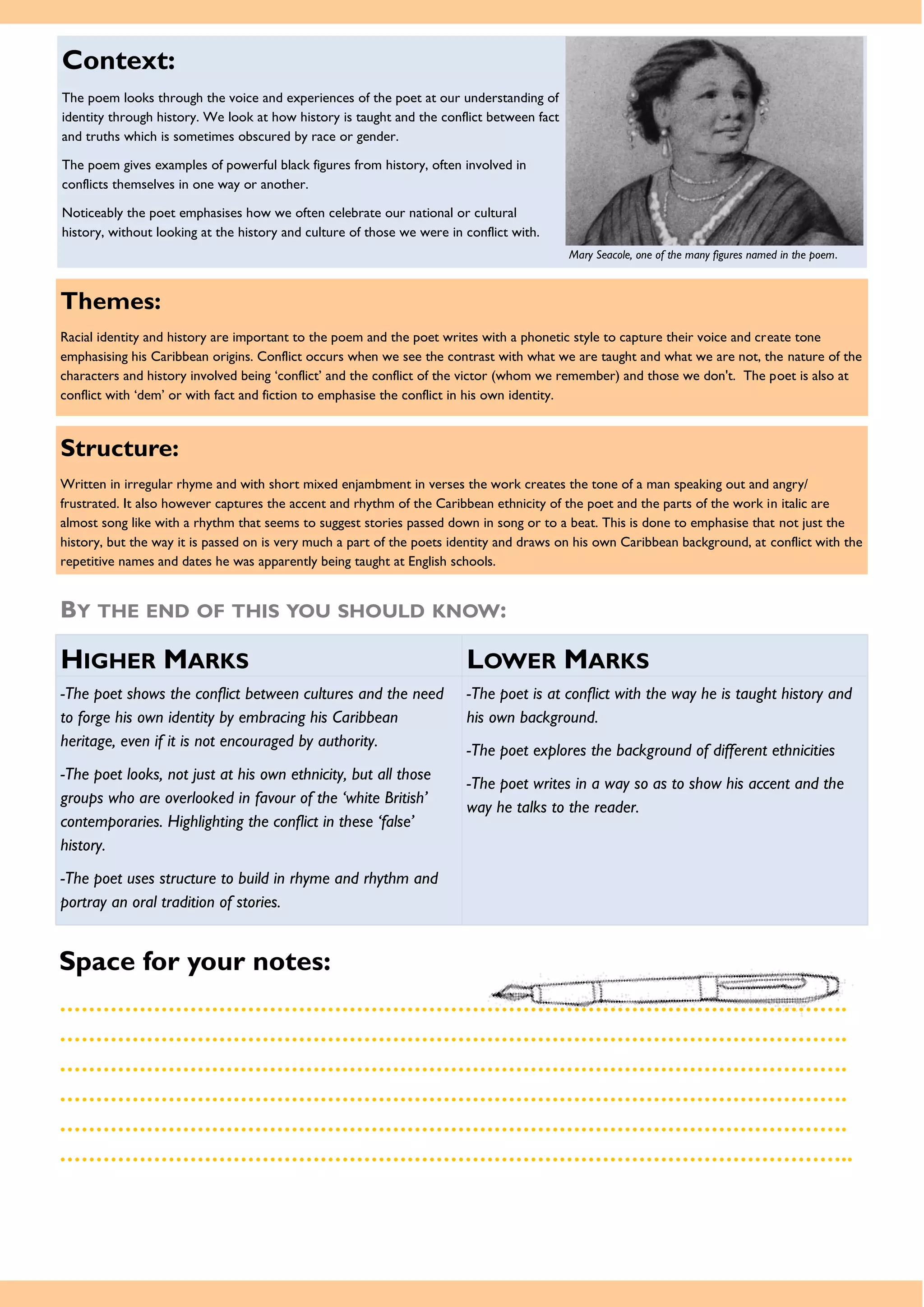
Symbolism The poppy has symbolic links to violence, death and memory.
It is quite foreboding in this poem.
Pronouns “I” and “Your” used to emphasises the intimacy and closely of
the speaker and subject.
Blockade Military reference to blocking, perhaps of emotion. Alliteration
also used with bias, binding, blunder emphasise bustle, mothering over her son.
Familiar noun/military metaphor The reference to sellotape is quite a
familiar homely image, ‘bandaged’ can be used to imply wound or injury/harm.
Sibilance, The words ‘steeled, shirt, softening’ etc. gives a calm tone to the
scene described in the poem.
Aside, the personal anecdote creates a sense of intimacy and human
realism in the speakers voice. Juxtaposed with the military side of her son.
Metaphor, a reference to the shortened hair stubble required in the
military and how aggressive it makes her son appear to her.
Power of three, reflects the way the mother is tongue tied and doesn't
know what to say, she is proud of her son but also doesn't want him to go.
Symbolic, idea of throwing the door open and setting her son free. The
door represents her own acceptance of his choice.
Simile, suggests how attractive the world appears to her son and also her
aspiration for him to have opportunities.
Metaphor, connotes that he is like a beautiful caged creature and needs
to be set free. Implies that she understands this includes free to make
mistakes and be harmed.
Vague Pronoun, contains double meaning, this as in the location
but also the situation, suggests that ‘this’ is her sons death, she cannot
bear to speak the words. Implies pain.
Listing, implies the awkward feeling of the mother, trying to
distract herself from grief.
Physical senses, implies the intimacy between mother and son,
connotes the tactile hypersensitivity and jumbled emotions.
Caesura, breaking down the verses, implies the choking
back tears.
Themes:
The poem looks partially at conflict because of the nature of the son going to war, however it looks at conflict more from the
perspective of those it leaves behind and the emotions of families. It is a behind the scenes view of conflict rather than
addressing the conflict itself. There is also a level of conflict in the mothers emotions, pride, fear, sadness.
Space for your notes:
……………………………………………………………………………………………….
……………………………………………………………………………………………….
……………………………………………………………………………………………….
……………………………………………………………………………………………….
……………………………………………………………………………………………….
………………………………………………………………………………………………..
Structure: Written as a monologue in 4 stanzas and no rhyme scheme. The stanzas are structured along events in the
life of mother and child. 1st the mother looks back at remembrance day and the idea of the poppy which has helped trigger the
memory. 2nd the mother talks about helping her son get ready and seeing him off. 3rd the poem explores the emptiness that is
left in his absence, finally the mother feels drawn to a war memorial bringing the story back to where it started, yet now with
no son around. The suggestion of the dove being that he has died. The poem uses a lot of enjambment and familiar nouns to
enhance the idea of natural tone and the mothers voice.
BY THE END OF THIS YOU SHOULD KNOW:
HIGHER MARKS LOWER MARKS
-The relationship in the poem provides a deeper level of
empathy and the conflict between what was and what now is
the relationship.
-The poem uses a range of devices to capture the speakers
sad and reflective tone.
-The poems uses contrasting language and ideas to
emphasise the conflict and turmoil of the Mother.
-The poem looks at the relationship of Mother and Son.
-The poem uses very natural monologue style to give it a very
easy to understand tone.
-The poem mixes language to do with war along with those
that create a sense of home life.
Context:
The poem looks at a mother of a son who has grown up and gone to war. The poem
contains many clues that this is a more modern conflict, however the poem ends at the
memorial, suggesting the son died at war or has at least not yet returned home and is now
missed by the mother who fears the worst.
The poem is based very heavily around the idea of Poppies as memorials and therefore the
idea of memory. The poem flashes back to key moments of the life of the mother and son.
The poem also contains a range of emotions. There is genuine sadness but also pride. The
poem doesn't seem to comment heavily on the war itself.
Poppyappealpoppybadges
War and Peace:
There is a huge contrast with some of the imagery of the poem, sometimes linking to violence “blackthorns of your
hair”/”Blockade” and the more peaceful homely images “released a song bird”/”play at being Eskimos”. This contrast
emphasises the conflicting emotions in the mother.
POEM: WAR PHOTOGRAPHER
If you want to help your understanding you could:
-Look at a range of war photography and photographers, see if you can get an insight into the kind
of people they are and the work they do, also look at photo developing in dark rooms.
In his dark room he is finally alone
with spools of suffering set out in ordered rows.
The only light is red and softly glows,
as though this were a church and he
a priest preparing to intone a Mass.
Belfast. Beirut. Phnom Penh. All flesh is grass.
He has a job to do. Solutions slop in trays
beneath his hands, which did not tremble then
though seem to now. Rural England. Home again
to ordinary pain which simple weather can dispel,
to fields which don’t explode beneath the feet
of running children in a nightmare heat.
Something is happening. A stranger’s features
faintly start to twist before his eyes,
a half-formed ghost. He remembers the cries
of this man’s wife, how he sought approval
without words to do what someone must
and how the blood stained into foreign dust.
A hundred agonies in black and white
from which his editor will pick out five or six
for Sunday’s supplement. The reader’s eyeballs prick
with tears between the bath and pre-lunch beers.
From the aeroplane he stares impassively at where
he earns his living and they do not care.
Carol Ann Duffy
Finally, suggests he is constantly haunted by his experiences., this allows him escape.
Sibilance, emphasises the dark nature of the photos and their content.
Connotations with blood and violence, the red light and glow can also
symbolise a womblike safe place.
Juxtapose the idea of church with the warzones listed, this also
emphasises scale of horror he has seen.
Metaphor emphasises the scale of death and fragility of life, suggests
that this life is as meaningless to people at home as mowing the lawn.
Irony he had a steady hand taking the photos, in danger. But now at
home in safety he trembles. Hints that he is suffering PTSD.
Stereotyping the typical British highlight of weather, contrasting
with the events in warzone. Juxtaposes the dull stability of home.
Couplet places emphasises on the vulnerability and danger.
Caesura changes tone and builds tension.
Double meaning the photo itself is taking form, however
the subject themselves may have been in pain, twisting.
Metaphor shows the still faint origins of the photo but
also implies that the subject may well now be dead.
Personal Pronoun ‘he’ emphasises a namelessness, that he is
one of many, but also a sense of detachment and guilt in the tone.
Adjective emphasis on the fact it is far away, can be read bitterly, as
though why should the fact it is foreign make a difference.
Pun dark humour, bitter. Black and white in the newspapers
but also emphasis on the morality, war is black and white.
Juxtaposes ‘tears’ with the very comfortable images of
‘bath’ and ‘pre lunch beers’. Can be read almost angrily, their
tears are meaningless and this is a small pause in their life,
not of worth to them.
‘Impassive’ without emotion, he feels numb/helpless.
Collective pronoun creates accusation-like tone. Final lines
emphasise his resentment.
Themes:
The poem looks at conflict in the sense that he has taken photos of war and fighting. However there is also conflict between
the warzone and ‘Rural England’, the poet is trying to emphasise how out of touch people are about the truth of war, as well as
how it is more a business or bit of gossip rather than life changing and destructive.
Space for your notes:
……………………………………………………………………………………………….
……………………………………………………………………………………………….
……………………………………………………………………………………………….
……………………………………………………………………………………………….
……………………………………………………………………………………………….
………………………………………………………………………………………………..
Structure: Written in 4 stanzas the poem features rhyming couplets interspaced with non rhyming lines. The regular
structure can represent the order he is giving to the chaos in his photos, perhaps also the almost mechanical process he is
going through and putting that distance between himself and the context.
The poem is written as a narrative, leading us through the act of the photographer processing his photos, this again helps
create a sense of detachment or even cynicism about what this action reflects, that people suffer and lose lives and the end
result to us is a few pictures chosen for the newspapers.
BY THE END OF THIS YOU SHOULD KNOW:
HIGHER MARKS LOWER MARKS
-The poem contrasts rural England with warzones to
emphasise the gulf between the public and the warzones,
thus emphasising their detachment and his.
-Bitterness and regret is conveyed in key rhyming couplets
and sections to highlight his difficulty dealing with the
experiences.
-The ordered structure reflects the precision of his job which
contrasts strongly with the chaos of his experiences.
-The poem talks about a man back in England thinking
about the photos he took in warzones.
-The man in the poem is bitter about how people see war.
-The poem uses structure to show how he tries to make
sense of his experiences.
Context:
The poem is written about a war photographer who has returned home and is developing
his photos. The process of developing old style film photos is rather unusual for many to
understand today. Old style film is very sensitive to light, so it must be done in a dark
room lit with red light. The photo itself is developed using chemicals which slowly bring
out the photo, it is then hung to dry. All of this can create quite a sinister atmosphere,
red light, surrounding by hanging photos and chemical smells.
The poem is also looking at the contrast between the war zones and safety of being back
home and the way people just do not understand the truth, after all a single photo cannot
show everything.
War photographers do a very dangerous job, many are killed and injured as they must get
in harms way to get the photos they are after.
Amoderndaywarphotographer.
POEM: TISSUE
If you want to help your understanding you could:
“Treat the earth well: it was not given to you by your parents, it was loaned to you by your children. We do not
inherit the Earth from our Ancestors, we borrow it from our Children.”- Consider this quote in relation to the poem.
Paper that lets the light
shine through, this
is what could alter things.
Paper thinned by age or touching,
the kind you find in well-used books,
the back of the Koran, where a hand
has written in the names and histories,
who was born to whom,
the height and weight, who
died where and how, on which sepia date,
pages smoothed and stroked and turned
transparent with attention.
If buildings were paper, I might
feel their drift, see how easily
they fall away on a sigh, a shift
in the direction of the wind.
Maps too. The sun shines through
their borderlines, the marks
that rivers make, roads,
railtracks, mountainfolds,
Fine slips from grocery shops
that say how much was sold
and what was paid by credit card
might fly our lives like paper kites.
An architect could use all this,
place layer over layer, luminous
script over numbers over line,
and never wish to build again with brick
or block, but let the daylight break
through capitals and monoliths,
through the shapes that pride can make,
find a way to trace a grand design
with living tissue, raise a structure
never meant to last,
of paper smoothed and stroked
and thinned to be transparent,
turned into your skin.
Imtiaz Dharker
Enjambment, creates on-
going monologue tone.
Metaphor/Double meaning Tissue
both as paper but also living tissue and skin.
Symbolic, suggest hope,
positive tone.
Tactile, language, suggests a
very familiar concept.
Koran, symbolic of culture and
religion and also emphasising a
major conflict in modern society
and the perceived war on
Islam.
Juxtaposes to something done
on machine, continues tactile.
Emphasis on ‘history’ as
central to the theme., emphasis
that this has been handed down.
Sepia meaning faded or
yellowed with age. Suggestion of
handed down.
Tactile verbs suggest this is not
so much a religious book but a
treasured heirloom and
connection to family.
Metaphor a paper structure
would drift, but also ‘drift’ as in
purpose, what they stand for.
What they are for.
Transient verbs, reflect
movement and change.
Personified with ‘sigh’.
Suggests it is a good thing that
they are could be changeable.
They adjust ‘with the wind’
winds of change.
Listing, encompasses the man
and nature made aspects of the
world and how the ‘sun shines’
representing hope and how
transparent these things become
rather than the permanent
object we see them to be.
Metaphor the familiar and everyday image of
groceries represent larger scale socio
economics. Our reliance on money and
material wealth.
Flying Kites connotes a childlike
innocence and ease. Suggesting
perhaps that if we changed our
approach to material ownership we
would regain that childhood peace
of mind.
Symbolic not just of someone who
designs buildings but also anyone who
makes anything. Metaphor for us all.
Enjambment, and semantics of written
script listed here gives a tone of
excitement and exploration.
Pathetic fallacy , gives the hopeful
aspect to the message of the poem
through the reuse of light and shining.
Personify , pride given a form,
suggestion that we, or society as a
whole is this ‘pride’.
Biblical reference, suggestive of the
bigger picture and a sense of spiritual
fulfilment. Suggests that we could be
building things that improve our life, not
hold us back.
Metaphor, for people or society.
Ominous, can be an allusion to the
horrors of war and terrorism. 9/11, Berlin
wall?
Repetition from stanza 3, reminding
us of the tactile intimacy of the book but
now on a larger scale.
Direct address, suggesting that instead
of being at conflict with the world around
us we create a sense of ownership and
shared identity.
Themes:
The poem looks at conflict in terms of destruction and politics particularly, it hints that we make our own conflict by holding
on too tight to power and control and actually the need to relax and remember we are all human.
Space for your notes:
……………………………………………………………………………………………….
……………………………………………………………………………………………….
……………………………………………………………………………………………….
……………………………………………………………………………………………….
……………………………………………………………………………………………….
………………………………………………………………………………………………..
Structure: The poem is written as an on-going monologue with some internal rhyme through the poem (though with
no real pattern to it). It uses enjambment to create a very human and calm tone. The poem starts looking at the joy of simple
things like well used paper and wonders what the world would be like if it had the same qualities. The final part of the poem is
both hopeful and a warning. Against pride but in favour of growth and acceptance.
BY THE END OF THIS YOU SHOULD KNOW:
HIGHER MARKS LOWER MARKS
-The poet explores the characteristics of tissue and applies it
to a world at conflict with the people who have made it.
-The poet addresses some of the larger issues; greed, pride
etc and how we have built our world around them, at odds
with our own existence.
-The poem is a parable in nature as it suggests there is a
spiritual fulfilment in passing on ownership and letting things
pass when they have filled their purpose.
-The poet looks at how the world would be different if it had
more shared qualities with tissues.
-The poet looks at some of the big problems in the world
through metaphors.
-The poem is hopeful and often talks about sun and shining
to give it a positive tone despite asking people to let go of
things.
Context:
Imtiaz Dharker is a poet and film maker, she has Pakistani origins and was raised in
Glasgow. A great number of her poems look at issues such as religion, terrorism
and global politics/identity. As a result her work can be difficult to grasp.
The poem is written from the point of view of someone today looking out at the
conflict and troubles of the modern world; destruction, war and politics, money
and wealth as well as issues like terrorism and identity. The poem remarks how
nothing is meant to last, that it would be better not to hold too tightly to that and
instead we should be willing to let go and pass things on in their time to be
remade.
In short, that the world would be better if it shared more qualities with ‘tissue’.
ImtiazDharkerPoetandFilmMaker
Koran, Buildings, Maps and Grocery slips:
These objects are symbols of wider issues in the world, notably religion, structures of power like the twin towers but also the
major cities and landmarks of various nations, maps represent borders of countries and the divides in politics and culture while
grocery slips could represent the influence of money and wealth on society, for better or worse. The poet wonders what
would the world be like if these things were more like the tissue.
POEM: THE ÉMIGREE
If you want to help your understanding you could:
-Look at the description of the city and divide examples into the modern and memory city. What are
the differences and how must if feel for the speaker to try and fit both those identities together?
There once was a country… I left it as a child
but my memory of it is sunlight-clear
for it seems I never saw it in that November
which, I am told, comes to the mildest city.
The worst news I receive of it cannot break
my original view, the bright, filled paperweight.
It may be at war, it may be sick with tyrants,
but I am branded by an impression of sunlight.
The white streets of that city, the graceful slopes
glow even clearer as time rolls its tanks
and the frontiers rise between us, close like waves.
That child’s vocabulary I carried here
like a hollow doll, opens and spills a grammar.
Soon I shall have every coloured molecule of it.
It may by now be a lie, banned by the state
but I can’t get it off my tongue. It tastes of sunlight.
I have no passport, there’s no way back at all
but my city comes to me in its own white plane.
It lies down in front of me, docile as paper;
I comb its hair and love its shining eyes.
My city takes me dancing through the city
of walls. They accuse me of absence, they circle me.
They accuse me of being dark in their free city.
My city hides behind me. They mutter death,
and my shadow falls as evidence of sunlight.
Carol Rumens
Elipses, creates a caesura, indicating flashback or exploration
of past memories..
Pathetic Fallacy, this concept of sunlight creates a positive
image which juxtaposes her understanding as an adult.
Aside, draws distinction between experience and what the speaker has heard.
Metaphor, the idea of the city as a souvenir, shiny and
unrealistic. Shallow as her childhood memories.
Personify the city to create the sense that it has been infected but
can recover, almost hopeful yet deluded idea.
Connotation branded often conveys sense of marked for wrongness, repetition of sunlight..
Connotation, of innocence and purity.
Personify, time to emphasises its relentless and destructive nature..
Juxtaposes, aggressive imagery ’frontiers’ with the purity of nature
‘waves’.
Metaphor, linking the memory of the city with tiny traces, to
emphasise the value and preciousness of the memory.
Synaesthesia, the blur between taste and vision, the jumbling of
senses in order to show the confusion of memories and emphasises
with repetition the clearly flawed but joyous nature of the memory.
Personify, expanding the metaphor, perhaps suggesting that others
have also fled, bringing with them the culture of her ‘city’ the ‘white’
links to this surreal and innocent quality.
Metaphor, emphasises the open and emptiness but also the vulnerability.
Personify, she treats the memory with almost child like tenderness, reflects
her own memories of childhood linked to the city.
The reconciling with her past memory and current understanding,
though her past she tries to view the present. Her past city identified
as ‘dancing’ the modern one as with ‘walls’ Juxtaposing identities.
Repetition, of ‘accuse’ gives a sinister identity to the oppression of the new
city
Contrast, of darkness and light used to show the speaker coming to terms
with the two separate identities.
Themes:
The poem has a deep sense of conflict in terms of emotions and memory, the poet is torn between her childhood memory and her adult
understanding. This also reflects in the form of the city itself today which has become a hostile totalitarian place. The concept of a city can
be a metaphor for memories and growth in general, progression from childhood to maturity.
Space for your notes:
……………………………………………………………………………………………….
……………………………………………………………………………………………….
……………………………………………………………………………………………….
……………………………………………………………………………………………….
……………………………………………………………………………………………….
………………………………………………………………………………………………..
Structure:
The poem follows a three stanza structure with repetitive elements such as the idea of ‘sunlight’. The opening of the poem
seems to encompass the speaker trying to capture the memory, the second stanza builds on the details of this, fleshing out the
city in her mind, finally the poem seems to veer towards an idea of facing up to the modern dark place her city of memory has
become. A large amount of imagery is used within the poem to try and capture the concept of the city, including
personification, though much of this is deliberately vague.
The poem does not have a particularly consistent structure or any use of rhyme, this perhaps encapsulate the still uncertain
understanding of the speaker about her city, this is further enhanced by some of the unusual and unnatural links between ideas
and choice of metaphors. The poem uses enjambment to create a flowing pace to the work of a narrative speaker.
BY THE END OF THIS YOU SHOULD KNOW:
HIGHER MARKS LOWER MARKS
-The speakers view of the city is idyllic and with confused
metaphors linked with positive natural images.
-The speaker is struggling to reconcile the two identities of
the city, however this causes conflict within the speaker.
-The city is personified as reflects the nature of herself, her
own personality and growth.
-The poem looks at a childhood memory of a city
-The speaker struggles to understand how the city has
changed.
-The city can represent growth and change in identity with all
people.
Context:
The poem explores the memory of the poet and their experiences in a far off city
they spent time in as a child. The poet is looking at this city through the eyes of a
child and the happy memories she had, she compares these to the truths she
knows as an adult which is much harsher.
Emigree relates to the word emigrate, the idea that a person goes and settles in
another country, sometimes not feeling welcome to return.
The poet bases many of the ideas on modern examples of emigration from countries like Russia or the Middle East where people are fleeing
corruption and tyranny, or those countries change in their absence to some from of dictatorship.
Amoderndaywarphotographer.
POEM: CHECKING OUT ME HISTORY
Dem tell me
Dem tell me
Wha dem want to tell me
Bandage up me eye with me own history
Blind me to me own identity
Dem tell me bout 1066 and all dat
dem tell me bout Dick Whittington and he cat
But Toussaint L’Ouverture
no dem never tell me bout dat
Toussaint
a slave
with vision
lick back
Napoleon
battalion
and first Black
Republic born
Toussaint de thorn
to de French
Toussaint de beacon
of de Haitian Revolution
Dem tell me bout de man who discover de balloon
and de cow who jump over de moon
Dem tell me bout de dish ran away with de spoon
but dem never tell me bout Nanny de maroon
Nanny
see-far woman
of mountain dream
fire-woman struggle
hopeful stream
to freedom river
Dem tell me bout Lord Nelson and Waterloo
but dem never tell me bout Shaka de great Zulu
Dem tell me bout Columbus and 1492
but what happen to de Caribs and de Arawaks too
Dem tell me bout Florence Nightingale and she lamp
and how Robin Hood used to camp
Dem tell me bout ole King Cole was a merry ole soul
but dem never tell me bout Mary Seacole
From Jamaica
she travel far
to the Crimean War
she volunteer to go
and even when de British said no
she still brave the Russian snow
a healing star
among the wounded
a yellow sunrise
to the dying
Dem tell me
Dem tell me wha dem want to tell me
But now I checking out me own history
I carving out me identity
John Agard
If you want to help your understanding you could:
-Explore the background of these characters and their legacy related to conflict.
-Look at oral traditions of history around the world.
-Read the poem out with a drum beat (table?) to capture the rhythm.
Repetition,
suggests constant
barrage of learning
by rote without
insight.
Restrictive verbs,
create idea that the
version of events
given to them is
harmful.
Mixing, fact and
fiction in order to
create sense of
confusion.
Pronoun, ‘dem’ to
represent a faceless
body, general dislike
of authority.
Short verse and
irregular rhyme
creates an almost
drum beat. This can
reflect the Caribbean
traditions of music
and verbal passing
on of stories.
The stanza also looks
at a conflict
orientated character
indicated by words
such as ‘battalion’,
‘thorn’ and
‘revolution’.
Juxtaposed myth v
reality to indicate in
part that fact or
fiction, they all have
the same relevance to
the speaker because
they do not reflect
their culture or
heritage.
Rhyme helps build
the sense of rhythm
and pace, in part as if
the poet is getting
riled up the further
he goes.
Natural imagery
suggests the power
of this figure and also
the very different
ways we look at
figures, perhaps
suggesting a cultural
emphasises with
environment we lack
in our own history.
Contrast famous
white ethnic figures
with ethnic minority
contemporaries.
Emphasises the one
sided nature of our
education, draws in
conflict.
Natural imagery
metaphors ‘healing star’
to create an almost
mythological character.
Reinforces the idea of
oral rote learning and
passing down of history
and culture.
The way these historical
characters are described
is also more vivid and
passionate.
Violent metaphor.
Expresses the resistance
and need to create
something which cannot
be removed/ wont fade.
Repetition of ‘dem’
also a monosyllabic
pronoun, almost a drum
beat.. Highlights the
conflict between ‘dem’
and ‘I’.
Inaccurate terms
being used in order to
emphasise the lack of
interest in the history
‘dem’ tell the poet.
Themes:
Racial identity and history are important to the poem and the poet writes with a phonetic style to capture their voice and create tone
emphasising his Caribbean origins. Conflict occurs when we see the contrast with what we are taught and what we are not, the nature of the
characters and history involved being ‘conflict’ and the conflict of the victor (whom we remember) and those we don't. The poet is also at
conflict with ‘dem’ or with fact and fiction to emphasise the conflict in his own identity.
Space for your notes:
……………………………………………………………………………………………….
……………………………………………………………………………………………….
……………………………………………………………………………………………….
……………………………………………………………………………………………….
……………………………………………………………………………………………….
………………………………………………………………………………………………..
Structure:
Written in irregular rhyme and with short mixed enjambment in verses the work creates the tone of a man speaking out and angry/
frustrated. It also however captures the accent and rhythm of the Caribbean ethnicity of the poet and the parts of the work in italic are
almost song like with a rhythm that seems to suggest stories passed down in song or to a beat. This is done to emphasise that not just the
history, but the way it is passed on is very much a part of the poets identity and draws on his own Caribbean background, at conflict with the
repetitive names and dates he was apparently being taught at English schools.
BY THE END OF THIS YOU SHOULD KNOW:
HIGHER MARKS LOWER MARKS
-The poet shows the conflict between cultures and the need
to forge his own identity by embracing his Caribbean
heritage, even if it is not encouraged by authority.
-The poet looks, not just at his own ethnicity, but all those
groups who are overlooked in favour of the ‘white British’
contemporaries. Highlighting the conflict in these ‘false’
history.
-The poet uses structure to build in rhyme and rhythm and
portray an oral tradition of stories.
-The poet is at conflict with the way he is taught history and
his own background.
-The poet explores the background of different ethnicities
-The poet writes in a way so as to show his accent and the
way he talks to the reader.
Context:
The poem looks through the voice and experiences of the poet at our understanding of
identity through history. We look at how history is taught and the conflict between fact
and truths which is sometimes obscured by race or gender.
The poem gives examples of powerful black figures from history, often involved in
conflicts themselves in one way or another.
Noticeably the poet emphasises how we often celebrate our national or cultural
history, without looking at the history and culture of those we were in conflict with.
Mary Seacole, one of the many figures named in the poem.
POEM: KAMIKAZE
If you want to help your understanding you could:
-Look at the history behind pearl harbour and the Japanese code of Bushido, see how they link con-
textually to the poem.
Her father embarked at sunrise
with a flask of water, a samurai sword
in the cockpit, a shaven head
full of powerful incantations
and enough fuel for a one-way
journey into history
but half way there, she thought,
recounting it later to her children,
he must have looked far down
at the little fishing boats
strung out like bunting
on a green-blue translucent sea
and beneath them, arcing in swathes
like a huge flag waved first one way
then the other in a figure of eight,
the dark shoals of fishes
flashing silver as their bellies
swivelled towards the sun
and remembered how he
and his brothers waiting on the shore
built cairns of pearl-grey pebbles
to see whose withstood longest
the turbulent inrush of breakers
bringing their father’s boat safe
– yes, grandfather’s boat – safe
to the shore, salt-sodden, awash
with cloud-marked mackerel,
black crabs, feathery prawns,
the loose silver of whitebait and once
a tuna, the dark prince, muscular, dangerous.
And though he came back
my mother never spoke again
in his presence, nor did she meet his eyes
and the neighbours too, they treated him
as though he no longer existed,
only we children still chattered and laughed
till gradually we too learned
to be silent, to live as though
he had never returned, that this
was no longer the father we loved.
And sometimes, she said, he must have wondered
which had been the better way to die.
Beatrice Garland
Imagery, Japan was also
known as the land of the
rising sun, linking the
character to his culture
and duty.
Aside changes font to suggest the
daughter, speaking to the children,
emphasise individual/personal
account of history, at odds with
our views of these nameless pilots.
Listing, creates a sense
of intimacy with the pilot
of simplicity which
juxtaposes the
metaphorical ‘journey
into history’ of his flight.
Aside, used to give a
sense of individualism to
this nameless pilot and
relaxed tone to the piece,
contrasts the conflict of
the context.
Simile, emphasises the
attractive temptation of
the life below him.
Contrasts with his ‘journey
into history’, symbolises
his inner conflict.
Symbolic Figure of 8 ∞
the infinity symbol,
repetitive cycle and
feeling trapped by his
destiny.
The fish represent the
aircraft, the ‘flash of
silver’ metaphor for
their honour and glory.
Symbolic of death and
remembrance.
Represents inner
turmoil and conflict,
questioning the strength
to defy fate and the
pressure on him to do his
duty.
Sibilance shows the ocean wave
sounds. Symbolic of the tide,
which like him, returns.
Listing of the catch
on the boat connotes
the childhood joys
and innocence which
are darkened by the
events of the pilot’s
life. The inclusion of
the tuna and the
metaphor forebodes
the darker end to
the poem.
Pronoun leaves him
nameless as though ashamed
or difficult to name him.
Aside undermines the
enormity of the event with
matter of fact tone.
Learned implies the behaviour is not
natural and was forced upon her, that
she now realises and regrets this.
Punctuation used the dramatically
emphasise the ‘loved’ and created
empathy.
Highlights conflict , emphasises that he
died in the eyes of his family. There is a
tone of regret and sympathy at his
situation, he had no way out.
The fish represent people like the pilot,
they are caught in the net of mankind but
even without it they are stuck in their
same old patterns, emphasises futility.
Futility people, like the sand, will
eventually succumb to fate/nature.,
but he seeks to hang on for as long
as he can, but what is the point?
The fish represent the pilots and
his fate is linked with theirs,
eventually they will be caught.
Ambiguity.
Themes:
The poem is set in a time and topic of conflict, however the real conflict is between the rules of a society ‘honour’ in Japanese culture, and
the will to survive and return to a family. The conflict is particularly profound because there appears to be no right answer and the pilot dies,
one way or another, in the eyes of his family, if not in body, the poem explores the futility of trying to avoid your own fate/destiny.
Space for your notes:
……………………………………………………………………………………………….
……………………………………………………………………………………………….
……………………………………………………………………………………………….
……………………………………………………………………………………………….
……………………………………………………………………………………………….
………………………………………………………………………………………………..
Structure: The poem changes to italic/font during the penultimate stanzas and a previous line to indicate the change of speaker,
from the narrator/translator to the daughter it appears as if the daughter is passing on the story to her own children and the narrator is
explaining this process.
The final couplet hits home the themes of the poem quite dramatically in a very sombre tone but does not offer opinion, challenging the
reader to come to their own decision.
The consistent structure uses quite regular syllable patterns drifting up and down in length, this gives the poem a tone of nostalgia, but also
the rhythm of the waves which can represent a helplessness, that things will happen, whatever you do, he will still ‘die’ in one way or
another. The use of asides and calm rural language juxtaposes the setting of war, giving the poem a much more personal scope on a major
event.
BY THE END OF THIS YOU SHOULD KNOW:
HIGHER MARKS LOWER MARKS
-The poem contrasts the narrator and daughters voices in
order to build a more personal and human tone to the poem
as well as the pilots story.
-The poem explores the futility of trying to avoid ones own
origins and roots, be it natural or man made.
-The use of rural fishing imagery contrasts the war based
context and links the pilot to the fish inevitably caught and
subject to fate.
-The poem changes between the voice of the narrator ad the
daughter of the pilot.
-The poem shows the pilots hope to avoid death, only to be
‘dead’ to his family.
-The poem uses a range of fishing and sea like language to
show the conflict between nature and man, and how he tries
to fight this.
Context:
The poem is set around the events of a kamikaze pilot flying to war and then turning back before it
was too late. Kamikaze pilots were expected to use up all their weapons and then suicide by flying
into their targets as a final act of destruction. It was considered a great honour in Japan to die for
your country. The pilot in this poem returns home and is rejected by his family forever after, his
own wife refusing to speak to him.
The poem is written both from a narrator and the daughter of the pilot. The narrator explains the
events, almost translating the story, while the speaker gives a first person account of how they
excluded her father.
The poet questions at the end which death would have been better, to die as a kamikaze pilot
young or to grow old with a family who shut you out.
Kamikazepilotbeforemission.
THEMES: NATURE
A number of the poems explore the power of nature and often define it as being against man. Sometimes it is shown as
more powerful, whereas in others it is limited or more in our own minds. Man versus nature is generally an easy way to
show conflict with lots of personification and language devices to explore. It is also worth considering where the poet believes
the power finally lies.
Storm on the Island: The poem looks at a small manmade structure being battered by a storm, it deliberately
emphasises the conflict between man and nature. Within the poem the speaker adds ‘it is a huge nothing we fear’
suggesting that it is Man who has the power and comes off better from this conflict.
Remember to look at:: The harsh imagery used to portray the weather and its power. The contrast with the
calm tone of the speaker/poem which undermines this power, the weather simply doesn't scare him now.
Extract from The Prelude: The poem uses a journey through nature to show the allegorical development of
the narrator, at first he is at one with nature and it is peaceful, however when he tries to take control and direct
his journey up the river, nature (shown through the large dark mountain) challenges him until he backs down. This
poem can show conflict but emphasises mans place IN nature and as a part of it, nature remains all powerful.
Remember to look at:: How the mountain is portrayed “huge peak, black and huge”, the building of tension as
the poem progresses to show power and conflict between man and nature.
Exposure: Owen describes the weather as an attacking army with regular personification. Of all the poems this
one most clearly shows man at war with nature and losing. It compares well with other poems because it has a
range of easily accessed devices and structural elements, don't get caught into the trap of trying to say everything
though.
Remember to look at:: The way sibilance and assonance is used to bring the weather to life in a harsh aggressive
form. The personification of weather and its association with military language.
You could also look at some of the nature elements found in Bayonet Charge showing the soldier as more machine,
destroying the calm of nature. Or Ozymandius and how the desert reclaims the statue and all he has made.
TASK:
Compare and Contrast the way two poems of your choice explore the power of nature.
Answer in approximately 500 words or 1-2 pages. Marks are awarded for the exploration of
language, structure and purpose as well as appropriate spelling grammar and relevance to the
question.
You could answer this question in a number of ways, you could compare the military language used
to describe nature in ‘Storm on the Island’ and ‘Exposure’ or the idea of fear in ‘Storm on the
Island’ and ‘Extract from a Prelude’, finally you could explore the way weather is personified in
these poems, particularly ‘Exposure’ and ‘Prelude’.
It will be very easy to say everything about the poems, but remember the last two in particular are
big, you only need 2-3 strong points and quotes from each so look at what is most relevant to the
question. Religious imagery and faith in Exposure is lovely but is it relevant? Does the allegory of
growth in Prelude need much more than a line in your intro?
THEMES: PRIDE/GLORY
A number of the poems explore characters and events which capture a sense of pride and glory but also
sometimes even shame. The conflict between what people want and what is, is very powerful and the poets are
often sending a message about the price of vanity or corruption.
Ozymandius: A very straightforward poem, Ozymandius was proud and built many monuments to himself, now
they are almost all faded away, what did his pride achieve and does power ever truly last?
Remember to look at: The use of irony or puns which undermine Ozymadius’ statement, The poets emphasis
on emptiness and the way his power all seems reduced to dust.
My Last Duchess: Here the speaker is clearly proud and arrogant and seeks to display the power, however in
doing so he also displays his own insecurities and we are left wondering if he was ever truly in control.
Remember to look at: The use allusion to display material wealth, the use of ambiguity which ironically reveals
more to the audience than he realises and actually undermines his ‘power’ as he cannot bring himself to say it.
Charge of the Light Brigade: Here the poet repeats ideas of glory and honour to show the ‘power’ of the light
brigade, however the poem shows the conflict with these hellish images of darkness and war which decimate
them. The poem is both a celebration and warning of blind glory, regret a the lives lost needlessly.
Remember to look at: The use of repetitive elements which give the poem pace and build to a climax, the reli-
gious imagery of ‘valley of death’ that contrasts with the soldiers and builds conflict.
London: A hard one to explore here. It contrasts with most the poems. London, the supposed capital of the
world and title of the poem is shown as a dark twisted place of misery, brought on by the abuse of power by
those in the ‘palaces’ or ‘churches’.
Remember to look at: The use of symbolic language to suggest the wrongness of the city, The juxtaposition and
conflict between the powerful and the poor which the poet is ashamed of.
TASK:
“Pride is a dangerous thing”: Discuss that statement with regard to two poems of your choice.
Answer in approximately 500 words or 1-2 pages. Marks are awarded for the exploration of
language, structure and purpose as well as appropriate spelling grammar and relevance to the
question.
Questions with a statement may not be common here but are worth getting to grips with. First look at what
the question is asking, it basically wants you to look at pride, is it harmful or positive. Remember how this
often links to power (real or imagined).
You could look at Ozymandius and how pride and power never last and how the poem almost mocks
Ozymandius, compared with Charge of the light brigade which seeks to celebrate what was effectively a
glorious defeat, a celebration of brave failure.
Alternatively you could look at London, as an expression of abuse of power and bitterness, contrasting with
My Last Duchess, and the corruption and pain inflicted by the Dukes abuse of power. Both poems show
suffering from abuse of power but while London is an obvious and bitter rant, My Last Duchess is a
carefully hidden piece which requires you to read between the lines and look at the allusions and allegories.
THEMES: INNER CONFLICT
Within many of the poems, the central character or speaker is often torn. Sometimes quite dramatically, between
conflicting emotions. Pride and Shame, Sadness and Joy, Duty and Self preservation. The voice of the speaker or
the subject coming to terms with this often shows conflict which may not always be resolved.
Poppies: Not an obvious poem here. There is a lot of inner conflict going on with the idea of the her ride at her
son going off to war and flying the nest, but her sadness and anxiety when he does not return. There is a sense of
forlorn hope here which also contrasts with the hopelessness of poems like London or the idealism of Tissue.
Remember to look at: The homely images contrasting with the military violent ones. The avoidance by the
speaker to address the details and the present by focussing on mundane tasks, often shown in lists.
Kamikaze: One of the hardest poems. The pilot is torn between duty and the wish to live, his daughter by her
duty and the desire to know her father. The conflict of the pilot is played out through the imagery of nature and
the ocean, life caught in a helpless loop. There is a sense of futility, he is trapped and will ‘die’ one way or another.
Remember to look at:: How the ocean below reflects the pilot above, the use of aside and enjambment to show
the conflicting emotions in the story/speaker as if they are trying to make sense of what occurred.
War Photographer: The subject of the poem, the photographer, undergoes horrific violence and sees real
horror in order to do his job, yet when he returns home these things are reduced to novelty. There is the conflict
between where he is from and what he does which ‘numbs’ him, as those two sides of his identity cannot be at
peace.
Remember to look at:: The way structure is used to try and show some order coming from the chaos of his
experiences, the ghostly language and scene of the dark room reflecting his inner turmoil.
TASK:
How do two poems of your choice show conflict through inner turmoil?
Answer in approximately 500 words or 1-2 pages. Marks are awarded for the exploration of language, structure
and purpose as well as appropriate spelling grammar and relevance to the question.
When exploring this question it is key that you focus on how inner turmoil creates conflict. In War
Photographer it is the conflict between what he has seen in his photos and the ghostly images
contrasting with the calm life of home.
In Kamikaze it is the idea of war and glory together with honour contrasting with the simple life on
the ocean but which defies his duty.
Finally in Poppies there is the turmoil of a mother loving her son and respecting his decision, but
also the grief of his absence (possibly death), which she cannot yet face up to fully, perhaps as she
feels guilty.
Any of these poems can be compared well and all have some military imagery, but it is important to
look at what they contrast with and how they are structurally developed.
THEMES: PAST/IDENTITY
Some poems explore a memory or past aspect of the speaker, these past ideas are often crucial to their identity
and there is often conflict between what is and what was or what could be. Many poems involve characters who
cannot move on from their past or embrace their future.
Emigree: A very sad poem. The poet looks back at the time in a city abroad growing up. Her memories are
childish ones and very happy, as a result she struggles to accept what she knows is now happening there and how
it has become a tyrannical and intolerant place to live.
Remember to look at: The use of personification between ‘her city’ and the ‘new city’, the use of colour and
imagery to separate happy memories from dark realities.
Checking out me History: Here the poet is a man who is taught a history at school which he feels no connec-
tion with. His history reflects cultural and oral traditions and carries a beat and rhythm, the history he is taught at
school seems to jumble in his mind with fairy tales and fiction.
Remember to look at: The use of Naturalistic imagery to portray his cultural heritage, how the contrast of the
poem is encapsulated by the pronouns ‘dem’ and ‘I/me’
Tissue: A very challenging poem, Tissue explores the value of heritage and passing things on, letting go. In Tissue
the poet looks at how we hold on too tight to many things like money, borders and power. The poet contrasts
this with a world where things are made of tissue, carefully treasured but never made to last.
Remember to look at: The conflict between the soft tactile warm images of the paper and the harsh man made
objects in the poem, the metaphor of tissue as human skin.
You could also explore poems like Remains and how the memory has become mental anguish and PTSD.
TASK:
“Past, present and future fir together to define who we are”, do you agree with this?
Answer in approximately 500 words or 1-2 pages. Marks are awarded for the exploration of
language, structure and purpose as well as appropriate spelling grammar and relevance to the
question.
Another statement question and a very obscure one. The key words are past, present and future so
you know it is a question you can link memories and identity with it. Of all the areas it is one of the
hardest to link with conflict as it relies on you being able to spot the conflicts within people and
their past in particular. These conflicts are not always violent, but simply an example of friction.
You could look at the way Emigree cannot reconcile the past and the present identities contrasting
with Tissue trying to rebuild them in a new form. The soft tactile language of tissue and the warm
sunlight in Emigree representing hope while the ‘dark’ and ‘block’ ideas represent the darker sides
in these memories or global identity.
Checking out me History uses rhythm and tone to create a very strong sense of tone and pace, this
can contrast sharply with the way Emigree has a very loose structure and no real rhyme to portray
the speaker being lost in her past while Checking out me History seems to have built a strong
identity.
STRUCTURE:VOICE
Some poems stand out for the way they create tone and voice, some poems have very readily identifiably
identities in their characters and the way they are read. These character voices can highlight the conflict within the
poem, or make conflict between the speaker and the event.
My Last Duchess: This poem uses asides and allusions to create an excellent character voice. The nature of the
poem as a monologue and the boastful nature of his remarks really create a clear image of an egotistical and cruel
man.
Remember to look at: The use of caesura, enjambment and punctuation to show ranging emotion, the way his
reference to material wealth and heritage contrasts with his lack of emotion or empathy.
Checking out me History: The poet writes in phonetic spelling to capture the accent of the speaker and the
use of rhyme and short verses creates rhythm.
Remember to look at: The repetition of Dem and monosyllabic words creating a beat which contrasts the oral
history with history books, The contrast between how he explores taught history with nursery rhymes but his cul-
tural history in powerful chanting beats.
Remains: The poem explores the chilling memories of a soldier stationed in Iraq or Afghanistan. They recall a
horrific death and this image not is stuck in their mind causing them more pain than they felt at the time. This pain
is contrasted with the rather matter of fact colloquial tone used in the poem to show the poet as an everyman.
Remember to look at: The colloquial language which detracts from the violent imagery, the juxtaposition be-
tween the graphic events and the mundane and dehumanising language which describes it.
TASK:
How do the poems use voice to emphasise conflict in their work?
Answer in approximately 500 words or 1-2 pages. Marks are awarded for the exploration of
language, structure and purpose as well as appropriate spelling grammar and relevance to the
question.
All of these poems look at different ideas but in each the idea of voice and therefore identity are
used to show power or conflict.
In My Last Duchess the noble and proud accent of the Duke is at odds, and therefore conflict, with
his greedy cruel nature demonstrated within the actual events which occur in the poem.
In contrast Remains uses a very general and familiar accent to hide the inner suffering and pain the
soldier is experiencing, it is also used to undermine the horrific nature of the conflict taking place,
while this has some similarities to My Last Duchess, we see the soldier here as a victim.
Finally Checking out me History uses powerful rhythm and accent to show a familiarity and affinity
with his cultural heritage while the other parts of history are almost childish and he mocks them.
His tone is very aggressive and accusatory, unlike the previous 2 poems who try and hide conflict,
he embraces it.
OTHER:
YOU COULD ALSO LOOK AT:
RHYTHM: Checking out me History, Charge of the Light Brigade, London
WARZONES: Remains, Exposure, Bayonet Charge
EMOTIONAL PAIN: Remains, London, Poppies
TASK:
For each poem in the booklet/cluster, match it to 1 or 2 others based on what you would like to
link it to if you were just asked about conflict. You can link them in any way but you have to justify
your reasons.
Space for your notes:
……………………………………………………………………………………………….
……………………………………………………………………………………………….
……………………………………………………………………………………………….
……………………………………………………………………………………………….
……………………………………………………………………………………………….
………………………………………………………………………………………………..
……………………………………………………………………………………………….
……………………………………………………………………………………………….
……………………………………………………………………………………………….
……………………………………………………………………………………………….
……………………………………………………………………………………………….
……………………………………………………………………………………………….
……………………………………………………………………………………………….
……………………………………………………………………………………………….
……………………………………………………………………………………………….
……………………………………………………………………………………………….
……………………………………………………………………………………………….
……………………………………………………………………………………………….
CONFLICT/POWER:
OZYMANDIUS
LONDON
PRELUDE
(EXTRACT)
MY LAST
DUCHESS
CHARGE OF THE
LIGHT BRIGADE
EXPOSURE
STORM ON THE
ISLAND
BAYONET
CHARGE
REMAINS
POPPIES
WAR
PHOTOGRAPHER
TISSUE
THE EMIGREE
CHECKING OUT
ME HISTORY
KAMIKAZE
For each poem identify 3 quotes which link with the overall themes of conflict and power.
It will be useful to do this in your book and for each one expand on how these quotes link
to conflict and power.

AQA Power and Conflict Poetry Revision Guide

  • 1.
  • 2.
    ABOUT:This booklet isdesigned to support you through the study of poetry for your English Lessons. The work in this booklet can be used in a number of ways: a regular homework, revision aid, class resource or even just a catch up material if you have missed a topic. One thing this booklet is not however, is a quick fix. The exercises and information in this booklet are not made so you can just skip through or answer a few questions and then move on. If you do not read the instructions you will find that the work is not always correct and if you do not take the time to answer carefully in full sentences you will probably find that you don’t practise your ability to answer questions as effectively as you would like. The keys to success in English are: 1-Read lots, it honestly helps (there are studies into this and everything) 2-Start early, if you leave it all to the end you wont give it time to settle in your mind, the things you are probably best at are those you practise every day for years, English is the same. 3-Work hard, it is no use just being smart because if you expect to coast through on your intelligence you may be disappointed, and if not in your GCSE’s then your A levels or Degree, trust me when I say it comes back to haunt you! Best of luck! By the way, you may see this logo and colourful boxes on many of the pages you work through. This is your questions or thinking points that come with each topic, you should make sure you take the time to do these properly and label your work appropriately. If you work in a book or on paper then you should always make sure there is a clear topic title, page number and question number so it is easy to know where you are working from. The works included in this booklet have been heavily influenced by the work of other teachers and academics. The textual samples are from the Power and Conflict Cluster from the AQA Anthology and the creator of this booklet claims no credit for any of the textual extracts.
  • 3.
    CONTENTS: 1– KEY TERMS 2–OZYMANDIUS 3– LONDON 4– PRELUDE (EXTRACT) 5– MY LAST DUCHESS 6– CHARGE OF THE LIGHT BRIGADE 7– EXPOSURE 8– STORM ON THE ISLAND 9– BAYONET CHARGE 10– REMAINS 11– POPPIES 12– WAR PHOTOGRAPHER 13–TISSUE 14–THE EMIGREE 15– CHECKING OUT ME HISTORY 16– KAMIKAZE 17–THEMES, STRUCTURE AND REVISION
  • 4.
    SUGGESTION: Although power pointscan be useful we have steered away here. Any of these resources of information can be copied over to a slide, but try and avoid repeating information for the sake of it, if they are watching a slide they are not watching you. It may be useful to include key video and images for help with context or readings but these are all additional elements which will fit your own teaching/learning style. TEACHING AND LEARNING AKA: How to make the most of this booklet in class as a teacher and a stu- dent, some general teaching ideas and structures you could follow. There is more than one way to skin a cat, this booklet can be used to fit whatever you want, you can teach from or simply make it an online revision or cover tool, whatever, here are some ideas of how you can incorporate it into your lesson. LOOKING AT THE POEMS: Depending on the size of the poem and the lesson it would make sense that they can take more than one lesson to explore. A good way to structure the work over those lessons are: STARTERS: Initially mind maps or key images to explore what students already understand of context to do with the poem, another helpful tool is to look at certain lines in isolation (either as a group or in pairs) to see what students think this shows about the poem. Later lessons can involve quick recaps and pop quizzes to remind students of key quotes, themes or technical features DEVELOPMENT: It is advised before showing or relying too heavily on the information in the book to get students to begin by looking at the poem and annotating themselves. Additional annotations can be worked through in groups or a class with direction, weaker groups could be given key terms to look for or lines to explore and thus guide their learning. It is then recommended (ideally on the next page in their book/folder) to summarise context, themes and structure (as we do in the booklet), to allow students to access revision notes in their own words. REINFORCE: Call it a plenary if you will but to show something has sunk in I would recommend they evaluate/ summarise the poem producing PEE paragraphs to support their findings. This could be through a given direction or simply asking “explore 3 ways this poem shows power/conflict” LOOKING AT THEMES/STRUCTURE Towards the back of the booklet, poems are linked by theme of structural styles to help students build on their understanding as well as compare and contrast, STARTERS: Initially they could be given give words/themes and be asked to pick the 3 poems they would link here and why, weaker groups could simply give 1-2. Recapping poems is also useful and students can try and talk for 30-60 seconds on a poem, whoever can get closest without repeating ideas wins. DEVELOPMENT: It is advised to summarise how the poems (those given or which you decide) fit the themes, It would be useful to find 3/4 quotes for each poem based around those themes, this will allow students to quickly revise key poems and ideas. REINFORCE: Each theme/structural element has a sample task where students are advised to treat it like an exam. They should do a standard 4-6 paragraph essay with introduction and conclusion. At this point it is also useful to look at the exam mark scheme and really apply students knowledge to what they are being asked to perform.
  • 5.
    ASSESSMENT OBJECTIVES If youare using AQA, your work will be assessed on these objectives, that means you should always aim to haave work which shows them off. They all get marks but not all the same amount, so AO1 and AO2 will get you in the region of 80% of your poetry marks. AO1: Read, understand and respond to texts. Students should be able to: • maintain a critical style and develop an informed personal response • use textual references, including quotations, to support and illustrate interpretations. AO2: Analyse the language, form and structure used by a writer to create meanings and effects, using relevant subject terminology where appropriate. AO3: Show understanding of the relationships between texts and the contexts in which they were written. AO4: Use a range of vocabulary and sentence structures for clarity, purpose and effect, with accurate spelling and punctuation MARK SCHEME A Sample of the mark scheme from AQA on the poetry question highlights the following. Level 6 (Top Level) At the top of the level, a candidate’s response is likely to be a critical, exploratory, well-structured comparison. It takes a conceptualised ap- proach to the full task supported by a range of judicious references. There will be a fine-grained and insightful analysis of language and form and structure supported by judicious use of subject terminology. Convincing exploration of one or more ideas/perspectives/contextual fac- tors/interpretations. The levels contain similar criteria but the standard differs as they decrease. Level 6 : Convincing, critical analysis and exploration Level 5 : Thoughtful, developed consideration Level 4 : Clear understanding Level 3 : Explained, Structured comments Level 2 : Supported, relevant comments Level 1 : Simple Explicit commentd THAT MEANS THE EXAMINER WILL EXPECT YOU TO:  Compare and contrast in every paragraph  Give relevant examples/quotes  Don’t just explain what happens, explain why  Give more than 1 idea about possible meanings  Use accurate language to discuss devices/structure In order for work to be level 5/6 it needs to be convincing and thoughtful, that means you need to LEARN and UNDERSTAND the poems and what they are about, anything less than a solid understanding will not help, and if you don't revisit the poems regularly your work is more likely to sound uncertain or confused. Remember, English is about style as well as substance.
  • 6.
    GLOSSARY OF DEVICES SOUNDS Alliteration–Words beginning with same letter sounds to create a notably emphasis on words “dark dreary dreams” Assonance– Like alliteration, the sounds of assonance come from within the word rather than the start “Fearful tears of misery” (emphasis on the e-a-s sounds) Consonance– Consonant sounds at the end of words “wet set of regrets” Cacophony– Harsh sounds in order to make a discordant sound. “dark knuckles wrapping across bricks” (often Ks, Ts, Cks). Onomatopoeia– Words which sound like the effect they describe “splash, slap, crack” Repetition– Repeating words over a verse, stanza or poem to draw focus and add emphasis. Rhyme– Words with similar ending sounds creating a music like effect or flow “theme/stream/dream” Rhythm– Organisation of words to create a noticeable sound or pace, not necessarily musical but with a clear ‘beat’. Can include the structure of the work and is often measured in syllables. Pattern Name Example – / Iamb/Iambic invite / – Trochee/Trochaic deadline – – / Anapest/Anapestic to the beach / – – Dactyl/Dactylic frequently / / Spondee/Spondaic true blue There are five basic rhythms and the amount of them [known as feet], can make different meters (pentameter is 5 of the pattern monometer would be just 1, triameter 3 etc) MEANINGS AND LINGUISTIC DEVICES Allegory– Something symbolic, an allegory can often be a story that represents larger things, like the tortoise and the hare. Allusion- Referring to something well known, nowadays that could be a celebrity but it could be anything that fits the context of the poem (Shakespeare will make very old allusions we may not understand). Ambiguity/Ambiguous– A word or idea meaning more than one thing to provoke thought. Analogy– Compare something unfamiliar with something familiar to help people understand. Cliché– Something which is used a great amount and becomes expected or even cheesy, “raining cats and dogs”. Connotation/Connote– The associations with a word e.g. Rose—Love and Passion. Contrast– Closely placed ideas which are opposites or very different. ‘He had cold eyes but a warm heart’ Denotation/Denote– The literal definition fo something without reading too deeply into it. Euphemism– Where something distasteful is said in a more acceptable way ‘she is at peace’- she is dead Hyperbole– An over the top exaggeration for effect.
  • 7.
    Irony– Deliberate useof a false or misleading statement in such a way that the truth is apparent. “Wow dead flow- ers, what I always wanted…” Metaphor– Direct comparison of two things. States one thing is or acts as another without using words ‘like’ or ‘as’ Oxymoron– two words placed together with differing meanings to create a new meaning ‘bitter sweet’ Paradox– A situation or statement which contradicts itself. ‘the taller I get the shorter I become’. Personification– Describing an inanimate object or animal with human qualities. Pun– using words with multiple meanings while intending both, often used for comic effect. Simile– Comparing two or more objects with words ‘like’ or ‘as’ ARRANGEMENT/ STRUCTURE Verse– A line of a poem, needn't be a complete sentence. Stanza- A collection of verses similar to a paragraph, separated from other stanzas. Rhetorical Question– A Question intended to provoke thought without expecting an answer. Rhyme Scheme– Regular or irregular (does it follow a pattern or not) popular examples are alternate rhymes abab, cross rhyme abba, or couplets aabb. Rhyme scheme often depicted by letters abcd to help follow. Enjambment– A sentence or on-going piece of text carried over verses or stanzas to continue the spoken ef- fect without pause. Form– Open (no real pattern of rhyme or length), closed (follows a specific form or pattern), couplets (pairs of rhyming lines), quatrains (stanzas of 4 lines, often rhyming), blank verse (iambic pentameter with not consistent rhyme). Fixed Forms– Some examples include Sonnets (3 quatrains and a couplet), Ballads (large poems in quatrains often telling a story) Pathetic Fallacy– Using weather or environment to reflect the themes and contexts of the poem, e.g. a horror genre may involve a dark and stormy night, joyful poems may use a sunny meadow etc. Foreshadowing– Content in the poem which gives an indication of the direction the poem will take, allows people to guess what will happen or the poet to prepare the reader. IMAGERY/TONE Sensory Imagery– where the language is used to evoke the senses (sight, smell, touch, taste, sound), can often include tactile (touch based) or musical (sound based) language. Synaesthesia– The overlapping and blending of senses ’he had a soft smile’ or ’she had a fiery voice’ Tone/Mood– The way a poem or speaker is intended to sound, often suggested by the topic, content and struc- ture. This can be very subjective and is often determined by looking at the poem in its entirety. REMEMBER: In order to get good grades you need to use a real range of these in everything you write about poetry. If you don’t you cannot gain higher levels, its as simple as that. Even if you understand the poem, you need to show you can apply the language and therefore the skills to explore this. In your book build a glossary of the most common of these as well as any others you come across.
  • 8.
    Ozymandias I met atraveller from an antique land Who said: "Two vast and trunkless legs of stone Stand in the desert. Near them, on the sand, Half sunk, a shattered visage lies, whose frown, And wrinkled lip, and sneer of cold command, Tell that its sculptor well those passions read Which yet survive, stamped on these lifeless things, The hand that mocked them and the heart that fed: And on the pedestal these words appear: 'My name is Ozymandias, king of kings: Look on my works, ye Mighty, and despair!' Nothing beside remains. Round the decay Of that colossal wreck, boundless and bare The lone and level sands stretch far away." Percy Bysshe Shelly POEM: OZYMANDIAS ‘Mock’ as in to make a model of, but also to make fun of, this is a Pun because of the double meaning. Antique suggests the place is old and steeped in history, but also it may be out of date and old fashioned. The statue is barely standing, the rest is ruined and missing. Suggesting that it is being eaten away by time and the desert, a futile struggle to survive where nobody is around to care. Shattered visage-: Broken face, it is unrecognisable, a statue to someone and we can no longer tell who, has no purpose anymore. Cold command, sneer: suggests Ozymandias’ character as powerful and arrogant ironic now there is nothing left. Synaesthesia. The tone, indicated by the exclamation is strong and authoritative, irony is that nobody is listening. Colossal, meaning vast or huge, is a metaphor for his ego rather than the statue. The lone and level sands outlast the statue, juxtaposed to the power and ego of the statue. Sands are also iconic of time. If you want to help your understanding you could: -Look up more information about Ozymandias and the statue of Ramesses II. -Read the poem aloud and consider the different tones in the poem.
  • 9.
    Context: Written by Shellyin a collection in 1819, it was inspired by the recent unearthing of part of a large statue of the Egyptian Pharoah, Ramesses II. The Egyptian Pharaohs like Ramesses believed themselves to be gods in mortal form and that their legacy would last forever. The reference to the stone statue is likely a direct reference to the statues and sculptures like the one which was unearthed, which the ancient Egyptians made. On the base of the statue is written (translated) "King of Kings am I, Osymandias. If anyone would know how great I am and where I lie, let him surpass one of my works." TheStatueofRamesseswhichnowsitsin theLondonMuseumStructure: Written in a sonnet with loose iambic pentameter. Iambic pentameter is pairs (iams, of sounds da-dum) with 5 (pentameter, think of pent like in pentagon) in a line making 10 syllables overall. Sonnets were generally popular romantic or love poems, perhaps this being a love poem about Ozymandias, a joke about the rulers ego. Or simply to capture the romantic and exotic tone of a lost legend. The Rhyme scheme is irregular, perhaps symbolic of the broken statue itself, no longer perfect. Themes: Looking at power and conflict we can imagine Ozymandias as a powerful ruler who sees himself as a ‘king of kings’, perhaps a great warrior and one of the most powerful men in the world. The poem is almost being ironic, pointing out that now all that remains is an arrogant boast on a ruined statue. Perhaps the poet feels sorry for him or is laughing at his expense. Either way it looks about the inevitable downfall of all rulers and tyrants, and how nothing, not even power, lasts forever. Allegory: The statue in the poem, broken and falling apart in the desert with nobody to care is an allegory of Ozymandias and of every powerful man or woman, the idea that they will also drift away until they are just another grain of sand. BY THE END OF THIS YOU SHOULD KNOW: HIGHER MARKS LOWER MARKS -The poem is a ironic memorial to the ego of a ancient Phar- aoh -The statue is an allegory for the eventual end of power that everyone must suffer, especially the proud -Power, like the statue is lost to the sands which in turn rep- resent time -The poem is about the statue of a long dead king -The statue is breaking down, this shows how people are forgetting the dead king -Power does not last forever Space for your notes: ………………………………………………………………………………………………. ………………………………………………………………………………………………. ………………………………………………………………………………………………. ………………………………………………………………………………………………. ………………………………………………………………………………………………. ………………………………………………………………………………………………..
  • 10.
    POEM: LONDON London I wanderthrough each chartered street Near where the chartered Thames does flow, And mark in every face I meet Marks of weakness, marks of woe. In every cry of every Man, In every Infants cry of fear, In every voice: in every ban, The mind-forged manacles I hear: How the Chimney-sweepers cry Every black’ning Church appalls, And the hapless Soldiers sigh Runs in blood down Palace walls . But most thro' midnight streets I hear How the youthful Harlots curse Blasts the new-born Infants tear, And blights with plagues the Marriage hearse. William Blake Chartered is something which is listed and regulated, the streets are clearly controlled but it suggests the Thames, the river likewise is controlled, nature controlled by man. Blake is suggesting that everyone is without power and in misery, a powerful statement indeed. The term mark can be a metaphor for a brand, as if these people don't like look tired, but are branded with this look to show their place in society. Repetition of ‘in every’ used to show scale of suffering. Alliteration of mind/manacles helps draw our attention to the metaphor, Blake is showing that these people are not physically held back, but their belief in their own weakness holds them back. The juxtaposition but also connection between the cries of children made to sweep chimneys and therefore from the rooftops, and church bells which ring out is striking. Blake saw religion as a tool to keep the people down and therefore was wrong ‘blackening’. This contrasts the cries of the innocent dirty children with the supposedly clean but corrupt church. This draws on the link to war at this time. The blood running down palace walls signifies their sacrifice to protect the power of those who live in the palaces. It is a symbolic metaphor. Harlots is slang for prostitutes or low class women. Blake is corrupting the idea of childbirth with sexual exploitation and hate ‘curse’. The new born infant is born into a broken world. Oxymoron which juxtaposes the joy of marriage with the misery of death. Blake is suggesting that society has destroyed all the good things in life. If you want to help your understanding you could: -Look up more information about the conditions of life in Georgian/Victorian England. -Read the poem aloud and consider the different tones in the poem. Note how the poem uses Quatrains with alternate rhyme abab to create the rhythm of the narrator walking.
  • 11.
    Context: William Blake wasa poet in Victorian/Georgian England, he wrote a selection of poems in his anthologies songs of innocence and experience, most of those poems had a counterpart. The Experience poems were often more bitter or cynical whereas the innocence poems were often naïve and simple. London is one of the few without a counterpart. The poem is set during a time in England where there was poverty, child labour and a horrific war with France. Women had no rights, death rates from disease and malnutrition were high and the industrial revolution has resulted in many large oppressive factories. Blake’s poems often railed against these and how London, arguably the greatest city in the world at that time, was so dirty and corrupt. Blake'santhologycontainingbothsetsof Themes: Looking at power and conflict this is a poem which is more about the lack of power and abuse of power. The poem is set in the capital of the most powerful country in the world and yet words like ‘manacles’ suggest slavery while the soldiers sigh ‘runs in blood down palace walls’ a clear contrast between those with power and those without. Revolution and People Power: During this time France had thrown off and executed their king. The People’s revolution was meant to show that all men are equal and have power. In Britain, a country with an old monarchy and aristocracy, this was scary. Blake is perhaps supporting revolution, asking people to throw off the ‘manacles’ of their belief that they should be told what to do. Space for your notes: ………………………………………………………………………………………………. ………………………………………………………………………………………………. ………………………………………………………………………………………………. ………………………………………………………………………………………………. ………………………………………………………………………………………………. Structure: Written in four stanzas with an regular alternate scheme. This may reflect the regular walking pace of the narrator as he walks around London. The last line in each stanza tends to deliver a powerful statement which sums up the rest of the stanza. Stanza 1 focusses on misery, Stanza 2 on peoples refusal to stand tall, Stanza 3 about the way people are sacrificed for the rich and powerful, Stanza 4 how all this poverty is corrupting everything good about family and life. BY THE END OF THIS YOU SHOULD KNOW: HIGHER MARKS LOWER MARKS -The poem is an ironic look at misery in the greatest city in the world. -Blake’s views are revolutionary for the time, challenging the idea that man is worth more than slavery. -Blake challenges the establishment in their ‘palaces 'and ‘churches’ which are marked by the blood and blackening of good people. -The poem is about the misery of life in London. -The poet is upset at the loss of joy and innocence. -People in power are living on the pain of others.
  • 12.
    POEM: EXTRACT FROMTHE PREDULDE If you want to help your understanding you could: -Look up the romantic poets, what was their influence. -Look at the rest of the poem (or a summary) see how this fits into the work as a whole. One summer evening (led by her) I found A little boat tied to a willow tree Within a rocky cave, its usual home. Straight I unloosed her chain, and stepping in Pushed from the shore. It was an act of stealth And troubled pleasure, nor without the voice Of mountain-echoes did my boat move on; Leaving behind her still, on either side, Small circles glittering idly in the moon, Until they melted all into one track Of sparkling light. But now, like one who rows, Proud of his skill, to reach a chosen point With an unswerving line, I fixed my view Upon the summit of a craggy ridge, The horizon's utmost boundary; far above Was nothing but the stars and the grey sky. She was an elfin pinnace; lustily I dipped my oars into the silent lake, And, as I rose upon the stroke, my boat Went heaving through the water like a swan; When, from behind that craggy steep till then The horizon's bound, a huge peak, black and huge, As if with voluntary power instinct, Upreared its head. I struck and struck again And growing still in stature the grim shape Towered up between me and the stars, and still, For so it seemed, with purpose of its own And measured motion like a living thing, Strode after me. With trembling oars I turned, And through the silent water stole my way Back to the covert of the willow tree; There in her mooring-place I left my bark,-- And through the meadows homeward went, in grave And serious mood; but after I had seen That spectacle, for many days, my brain Worked with a dim and undetermined sense Of unknown modes of being; o'er my thoughts There hung a darkness, call it solitude Or blank desertion. No familiar shapes Remained, no pleasant images of trees, Of sea or sky, no colours of green fields; But huge and mighty forms, that do not live Like living men, moved slowly through the mind By day, and were a trouble to my dreams. William Wordsworth The boat is a metaphor of man’s influence, still anchored by the tree representing nature. Loosening the chain and pushing from shore represents the poet as mankind moving to stand on its own two feet. Wordsworth creates an idyllic and peaceful scene with language semantically peaceful. The mood changed with the craggy ridge and horizons boundary represents nature, limiting the progress of the poet. The term ‘elfin pinnace’ could be translated as ‘fairy boat’, a metaphor for the now heated mood of the poet. Elves were often viewed as sexual and lustful. The simile reminds us that anything man tries to produce is merely imitating (copying) nature which does it better. The Horizon marks the shift in tone, the language becomes darker and dangerous. The peak, mountain, is personified “with purpose of its own”, nature shown as aggressive. Use of ‘trembling’ connotes the fear and vulnerability of the poet, he is shown like a wounded animal, hiding away. Meadows, usually peaceful and joyful and juxtaposed to the ‘grave and serious mood’. The darkness hanging over him represents his change to a darker mood at the end of the journey. The words all carry a dark and sinister tone, more morbid and melancholy. He is reflecting on the conflict in his mind of the juxtaposed peaceful side of nature and the harsh extremes it also contains “big and mighty forms”. The poem changes from Euphony (pleasant sounding words) to a Cacophony (harsh and rough sounding words.)
  • 13.
    Context: William Wordsworth wasa romantic poet, we don’t mean he wrote love poems, but he wrote poems about the world we live in which challenged people and the way they thought at the time. During this time ‘epic’ poems of large length were common, as were poems which looked at the world and man’s place within it. This extract is from a much larger poem, it looks at the spiritual and moral development of a man growing up. Themes: The poem is quite hard to relate to conflict and power. However there is a sense of conflict between man and nature where nature is eventually shown to be more powerful in the end. Boating along: During the poem the setting is of a journey in a boat. The journey represents a more spiritual journey and it becomes more rough and hostile along the way. At first, nature is shown at peace with the poet, later as it gets darker and he tries to reach the horizon it becomes harsh and predatory, putting man back in his place. Space for your notes: ………………………………………………………………………………………………. ………………………………………………………………………………………………. ………………………………………………………………………………………………. ………………………………………………………………………………………………. ………………………………………………………………………………………………. Structure: Written as part of a much larger piece. This section is 44 lines in blank verse (no real structure). The work is in iambic pentameter to give it a consistent pace. As the poem progresses the journey the poet is on becomes rougher and words like ‘and’ are repeated to give it a breathless pace and feel. BY THE END OF THIS YOU SHOULD KNOW: HIGHER MARKS LOWER MARKS -The poem symbolically uses the journey on the river to mirror the poets own spiritual journey of reflection. -The poet is structured to show the contrast of the serene and peaceful start where we works with nature, to the dark and disturbing battle with nature shown from when he tries to control his journey through rowing. -The conflict between man and nature is caused by mans attempt to manipulate nature, nature still contains a power and majesty beyond mankind's ability to command. -The poem is about a journey on the river. -The poet is at peace but by the end of the journey he becomes troubled. -The journey helps show how mankind is a part of nature but does not rule over it. Mountain: “a huge peak, black and huge, As if with voluntary power instinct, Upreared its head.” The mountain is shown in the poem like a great angry entity and represents the full might and power of nature. It seems to take offense at the poet going too far or too ‘lustily’. You could imagine it like a game of ‘chicken’ where the poet is rowing toward the mountain, the closer he gets the more menacing it appears before he backs away.
  • 14.
    POEM: MY LASTDUCHESS FERRARA That’s my last Duchess painted on the wall, Looking as if she were alive. I call That piece a wonder, now; Fra Pandolf’s hands Worked busily a day, and there she stands. Will’t please you sit and look at her? I said “Fra Pandolf” by design, for never read Strangers like you that pictured countenance, The depth and passion of its earnest glance, But to myself they turned (since none puts by The curtain I have drawn for you, but I) And seemed as they would ask me, if they durst, How such a glance came there; so, not the first Are you to turn and ask thus. Sir, ’twas not Her husband’s presence only, called that spot Of joy into the Duchess’ cheek; perhaps Fra Pandolf chanced to say, “Her mantle laps Over my lady’s wrist too much,” or “Paint Must never hope to reproduce the faint Half-flush that dies along her throat.” Such stuff Was courtesy, she thought, and cause enough For calling up that spot of joy. She had A heart—how shall I say?— too soon made glad, Too easily impressed; she liked whate’er She looked on, and her looks went everywhere. Sir, ’twas all one! My favour at her breast, The dropping of the daylight in the West, The bough of cherries some officious fool Broke in the orchard for her, the white mule She rode with round the terrace—all and each Would draw from her alike the approving speech, Or blush, at least. She thanked men—good! but thanked Somehow—I know not how—as if she ranked My gift of a nine-hundred-years-old name With anybody’s gift. Who’d stoop to blame This sort of trifling? Even had you skill In speech—which I have not—to make your will Quite clear to such an one, and say, “Just this Or that in you disgusts me; here you miss, Or there exceed the mark”—and if she let Herself be lessoned so, nor plainly set Her wits to yours, forsooth, and made excuse— E’en then would be some stooping; and I choose Never to stoop. Oh, sir, she smiled, no doubt, Whene’er I passed her; but who passed without Much the same smile? This grew; I gave commands; Then all smiles stopped together. There she stands As if alive. Will’t please you rise? We’ll meet The company below, then. I repeat, The Count your master’s known munificence Is ample warrant that no just pretense Of mine for dowry will be disallowed; Though his fair daughter’s self, as I avowed At starting, is my object. Nay, we’ll go Together down, sir. Notice Neptune, though, Taming a sea-horse, thought a rarity, Which Claus of Innsbruck cast in bronze for me! Robert Browning Possessive pronoun the speaker is laying claim to her as a possession, she is used to better show off his control and power. The portrait above, largely believed to be the last Duchess. He is making an allusion to a famous artist of the time. The suggestion is that he values the name of the artist more than the Duchess it is a painting of. He is showing his power in the bracketed aside by suggesting that he is giving the messenger a rare privilege to see the Duchess in this way, exercising his control. In fact the irony is that he needs to show off. If they ‘durst’: If they dare, he is showing off his power again and how others fear him. He implies that people believed it was not only him who could make her happy (though he couldn’t) the ‘spot’ is a pun between a mark, showing her face had some joy in it, but also spot as in a small amount, she was not happy. Hints he was jealous. Sinister tone, ‘dies along her throat’ the words are also semantically linked to murder ‘die’ and ‘throat’. He is trying to be polite, using a rhetorical question to indicate a lighter tone to the conversation, in fact he is trying to avoid showing his jealousy and rage, at conflict with himself. He is angry that she would find the same level of joy in the expensive gifts he bought her and the cheap or simple gifts of the poor or nature. Angry at his lack of control. He juxtaposes the two things though the irony is that his are without sincerity. Exclamation and change of structure, the verse is broken with caesuras to show his rising anger. He is losing control, his personality now angry when it was calm. The poet is ironically mocking how vain the Duke is, he cares more about his heritage and cannot understand that she did not see that as important. Here he clearly states how even if he was good with words and could ask her to stop giving everyone else so much attention, he would choose never to stoop so low. He is showing his believed power as above asking for things from women. Ironically she is in control. The use of semicolons gives a sense of finality to the statements. It is suggesting she was killed on his request. This is the culmination of the conflict in the relationship. Euphemism to suggest the fact she was killed? Her in a painting satisfies him as much as she did in real life, as a possession. The question shows a change of tone to return to the civil and polite way in the start. This helps give the poem a circular structure. Dowry, money paid by the brides parents. Suggests he is more interested in the money than his planned future bride. It is sinister as is again suggests a repeat in his actions. Munificence means generosity. He is counting on being given the money. As with the start he uses an allusion to another famous artist in order to show off his wealth and power. It is used to show how he quickly forgets about his dead wife who he was previously claimed to be so devoted to. Ironic as he has just also been talking about how devoted he will be to his new wife. Gives the poem a circular structure.
  • 15.
    If you wantto help your understanding you could: -Look up a bit more information on Duke Alfonso of Ferrara, see if it helps you understand the character. -The poem is better as a speech, imagine yourself as a self centred rich man, how does it sound to read it aloud. Context: Robert Browning was a poet in the 19th century. The son of a wealthy bank clerk, he didn't fit in as much in London society, he left the country and went to Italy to marry fellow poet Elizabeth Barrett because of her over protective father. As a result they were both familiar with over controlling patriarchs in the family as well as Italy itself. The poem is loosely based on the Duke of Ferrara and is written from his perspective, talking to a messenger about arranging his next marriage. The assumption being that he was dissatisfied with his former wife and had her killed. Themes: The idea of Power and Conflict is shown in the way the speaker (the Duke of Ferrara) is showing off his power and also suggesting the control he had over the Duchess’s life. There is also conflict between who he presents or wants himself to be and who he really is as a character. Structure: The poem is an example of dramatic monologue (a speech given by one character). It uses a large number of pauses (caesuras) in the poem along with lines that flow into one another (enjambment) in order to try and capture the tone of the speaker talking away to the messenger and adding in tangents (small opinions and asides). The poem uses rhyming couplets and iambic pentameter this reflects the style of romantic poets at the time, despite how this poem is much more sinister and dark. It is another façade for the Duke of Ferrara’s character. You will note he is the only character that speaks despite the fact he is talking to someone, he never lets them speak. Space for your notes: ………………………………………………………………………………………………. ………………………………………………………………………………………………. ………………………………………………………………………………………………. ………………………………………………………………………………………………. ………………………………………………………………………………………………. BY THE END OF THIS YOU SHOULD KNOW: HIGHER MARKS LOWER MARKS -The poem is a dramatic monologue with the Duke of Ferrara arranging his new marriage but getting swept up talking about his former wife. -The change in tone is used to show the sinister undertones and power struggle in the relationship, he is the only one truly at conflict here. -The poet ironically shows that his man is rich and educated yet a fool in matters of love and honesty, both powerful and -The poem is spoken by a Duke and talks about his last wife. -He is normally polite but the more talks about her, the more he becomes jealous. -We see that he is a powerful rich man but was in fact he could not control his wife, he was at conflict even though she was not trying to anger him. AlfonsoDukeofFerrara
  • 16.
    POEM: CHARGE OFTHE LIGHT BRIGADE If you want to help your understanding you could: -Look up more information about the Crimean war. -There are a number of good clips showing charges and films made of this poem, watch some to help capture the feel the poem is aiming for of glory and danger. I Half a league, half a league, Half a league onward, All in the valley of Death Rode the six hundred. “Forward, the Light Brigade! Charge for the guns!” he said. Into the valley of Death Rode the six hundred. II “Forward, the Light Brigade!” Was there a man dismayed? Not though the soldier knew Someone had blundered. Theirs not to make reply, Theirs not to reason why, Theirs but to do and die. Into the valley of Death Rode the six hundred. III Cannon to right of them, Cannon to left of them, Cannon in front of them Volleyed and thundered; Stormed at with shot and shell, Boldly they rode and well, Into the jaws of Death, Into the mouth of hell Rode the six hundred. IV Flashed all their sabres bare, Flashed as they turned in air Sabring the gunners there, Charging an army, while All the world wondered. Plunged in the battery-smoke Right through the line they broke; Cossack and Russian Reeled from the sabre stroke Shattered and sundered. Then they rode back, but not Not the six hundred. V Cannon to right of them, Cannon to left of them, Cannon behind them Volleyed and thundered; Stormed at with shot and shell, While horse and hero fell. They that had fought so well Came through the jaws of Death, Back from the mouth of hell, All that was left of them, Left of six hundred. VI When can their glory fade? O the wild charge they made! All the world wondered. Honour the charge they made! Honour the Light Brigade, Noble six hundred! Alfred Lord Tennyson League is about 3 miles, shows how far they have on their journey. Also can show quality, that they are not up to the challenge ahead. Double meaning. Valley of Death is a biblical allusion to show the horror of what they now face, connotation of hell. Repetition to build the tension and drag out the charge. Repetition of ‘theirs’ and ‘six hundred’ objectifies them as a symbol rather than just men. Also helps tone becomes more solemn to show impending doom. Cannon link to war and conflict, demonstrate how the odds are against them. Repetition to show scale of guns against them. ‘Boldly’ contrast with the scale of odds against them, emphasises futility. Sibilance to imply the swiftness of the charge. Personifies death, used to exaggerate the futility and bravery of soldiers that they are going to die, but do so boldly. Sabres: swords, the flash is the sun shining off the metal but also a metaphor for the glory they showed in their bravery which, like a flash, is short. Exaggerate (hyperbole) the scale of the mistake. Cossack and Russian, the enemy. Here the poet is showing how the enemy were not the equal of the British, however there were more of them. Consonance to shattered and sundered ‘-ered’ to emphasise devastation. Changes the tone by inserting the word ‘not’ implies the six hundred have mostly died. Repetition from before, gives the poem a parallel to mirror the charge, now they are running away. Glorify the poet make the men more like symbols of bravery than real men. Mirrors the third stanza to emphasise the bravery and loss. Rhetorical question. The poet does not seem sad that these men died but rather is more concerned with their glory. The imperative, ordering people to give their respect when many questioned the charge. The Poet is showing how the soldiers themselves should be honoured, even if the decision to charge may have been wrong. The poem suggesting that hero's have been made from this conflict. He is clear to show their bravery and strength (power) by escaping the clutches of death and ‘jaws of hell’. An example of artillery at war, notice how there are many large guns well protected.
  • 17.
    Themes: The poem isabout war, life and death, sacrifice and folly. It naturally links to conflict and is effective at showing peoples views on war of the time. The poem also contains a lot of reference to biblical/religious ideas as well as bravery and fear. Space for your notes: ………………………………………………………………………………………………. ………………………………………………………………………………………………. ………………………………………………………………………………………………. ………………………………………………………………………………………………. ………………………………………………………………………………………………. Structure: Written in dimeter and dactylic. Basically that means there are two (di-) stresses in each line, that means two beats or syllables which you read with a bit more force. The syllables after are then unstressed. So when there are six syllables you would read it ONE-two-three, ONE-two-three. The drop in stress is perhaps to show the sudden charge and then collapse, or the sound of horses galloping. The poem is divided into 6 stanzas and uses a lot of repetition. Some of this is to show the different stages of the battle but also give it a structure. It has a very military rhyme and can be similar to the sound of marching drums of horse hooves. This is used to reflect the military nature of the conflict in the poem. BY THE END OF THIS YOU SHOULD KNOW: HIGHER MARKS LOWER MARKS -The repetition within the poem helps capture the galloping military rhythm. This indicates the conflict and power building through the poem itself. -The poet is clearly distinguishing between the bravery of the men and the foolish ‘blunder’ of the orders and suggests the six hundred should be seen as heroes. -The military language is mixed with religious allusion to suggest an epic scale, emphasising the risk and bravery. -The poem repeats a lot to remind us the charge and then the retreat. -The poet thinks the men are brave calling them ‘heros’ -The poem is full of violence shown through the use of language like ‘sabres’ and ‘cannons.’ Context: The Crimean war saw British troops fighting in Russia. At this time, while there were basic guns and cannons, people would still also fight or horses, to rush in and attack before they could reload or stop them. However the light brigade were very lightly equipped, more for scouting or attacking from the back or sides rather than charging straight in. During a battle, a miscommunication sent the light brigade charging head first into the cannons of the other side, it was a huge catastrophe and many died. It showed to the British that even mistakes can happen. The men were respected for following orders, even though they knew they may be wrong. Some however have criticised the way they blindly followed orders. Lord Tennyson was the poet who was asked to write about their glorious sacrifice. Paintingofthelightbrigade Valley of Death: The Christian prayer, ‘The Lords Prayer’ contains the line “though I may walk through the valley of death”. This phrase being used in the poem is used to show the scale of importance and give the poem and epic quality.
  • 18.
    POEM: EXPOSURE If youwant to help your understanding you could: -Look at some of Owen’s other poems or the work of Sassoon, how do they talk of war? -Do some research into trench conditions, see if you can find how many died from disease and cold. Our brains ache, in the merciless iced east winds that knife us... Wearied we keep awake because the night is silent... Low drooping flares confuse our memory of the salient... Worried by silence, sentries whisper, curious, nervous, But nothing happens. Watching, we hear the mad gusts tugging on the wire. Like twitching agonies of men among its brambles. Northward incessantly, the flickering gunnery rumbles, Far off, like a dull rumour of some other war. What are we doing here? The poignant misery of dawn begins to grow... We only know war lasts, rain soaks, and clouds sag stormy. Dawn massing in the east her melancholy army Attacks once more in ranks on shivering ranks of gray, But nothing happens. Sudden successive flights of bullets streak the silence. Less deadly than the air that shudders black with snow, With sidelong flowing flakes that flock, pause and renew, We watch them wandering up and down the wind's nonchalance, But nothing happens. Pale flakes with lingering stealth come feeling for our faces - We cringe in holes, back on forgotten dreams, and stare, snow-dazed, Deep into grassier ditches. So we drowse, sun-dozed, Littered with blossoms trickling where the blackbird fusses. Is it that we are dying? Slowly our ghosts drag home: glimpsing the sunk fires glozed With crusted dark-red jewels; crickets jingle there; For hours the innocent mice rejoice: the house is theirs; Shutters and doors all closed: on us the doors are closed - We turn back to our dying. Since we believe not otherwise can kind fires burn; Now ever suns smile true on child, or field, or fruit. For God's invincible spring our love is made afraid; Therefore, not loath, we lie out here; therefore were born, For love of God seems dying. To-night, His frost will fasten on this mud and us, Shrivelling many hands and puckering foreheads crisp. The burying-party, picks and shovels in their shaking grasp, Pause over half-known faces. All their eyes are ice, But nothing happens. Wilfred Owen Personification of the weather described as ‘merciless’ and attacking them ‘knife us’ this is unexpected as we expect the fight to be between soldiers. Sibilance the hissing s sound capture the noise of wind, it sounds both lonely but also biting. The man made weapons are likened through metaphor to natural objects, showing mans war is a cheap imitation of nature. Rhetorical question highlights the hopelessness of soldiers and war. Contrast/oxymoron, dawn is meant to be hopeful and positive, not miserable. Now the rain is personified, nothing happens repeated to emphasise the helplessness of the soldiers who are beyond help. Harsh assonance and consonance of s and t sounds link weather with gunfire and therefore conflict and pain. Now the snow is described with alliteration to emphasise the f sounds and highlight the cold heavy blanketing of the weather. The wind’s ‘nonchalance’ implies the weather sees the soldiers as beneath it and weak. Man is animalised, likened to scared animals, rabbits in holes. Showing that before nature man is just an animal. Rhetorical Question shows the confusion of soldiers. Conditions are so bad they can no longer tell what is normal anymore. Metaphor frozen blood described as jewels, poet sees men's lives as valuable and ultimately wasted. So broken and hurt are the men that they feel abandoned and lose faith in God “our love is made afraid”. Contrasts/juxtaposes the battlefield with garden of Eden. Tone is one of betrayal and despair. Use of scattered punctuation slows the pace, we can imagine the soldier finally succumbing to exposure and dyeing. Metaphor ice as in cold and dead but also dead and empty, without soul. An example of trench war, consider how exposed the soldiers are, imagine living there. Repetition final line emphasises the process doesn't end, the soldiers are frozen in time and hell.
  • 19.
    Themes: The poem itselfis based on war and so links to conflict. The poem itself is about the weather and conditions of living in the trenches rather than any fighting. It is more a poem about the conflict between man and nature. This is extremely relevant because man has created machines that can launch explosive shells for miles and destroy the landscape, and yet, nature can still do more harm than any of it. Space for your notes: ………………………………………………………………………………………………. ………………………………………………………………………………………………. ………………………………………………………………………………………………. ………………………………………………………………………………………………. ………………………………………………………………………………………………. Structure: The poem uses a large amount of ellipses, caesuras and repetition to create an on-going sense of waiting and boredom. The poem is made of eight stanzas with a consistent use of a half line to end. This reinforces the sense of stasis or sameness throughout the poem that nothing is happening. There is use of para-rhyme showing words which appear to rhyme yet sound wrong when read to create the sense of unsettledness in the poem the soldiers are feeling. Owen also uses a huge amount of onomatopoeia and alliteration in the poem to emphasise the atmosphere and the sound of weather. BY THE END OF THIS YOU SHOULD KNOW: HIGHER MARKS LOWER MARKS -The poem defies the convention of war and looks at the weather assaulting the soldiers, not another army. This is to highlight the unknown horrors of war to people at home. -The poet uses repetition and a consistent structure to create the static tone of the poem. The lack of change adds to the tone of despair. -The alliteration is used to create a sense of atmosphere to the weather and to draw parallels to the violence of war and weather. -The poem talks about soldiers suffering in bad weather. -The poet feels sadness and helplessness that these men are without hope and nothing is changing. -The poet uses a lot of alliteration and pauses in the poem to make it drag out and help us imagine the weather conditions. Context: Wilfred Owen was a soldier and officers in World War 1. He died before the end of the war but during his time he saw the full horror of conditions on the front line. He wrote a number of poems about this, published after the war with the help from fellow poet Siegfried Sassoon. The war itself was often criticised because of a huge loss of life for very little gain. During the Somme over 60,000 British soldiers died in one day, and in all they only gained 6 miles by the end of the war. Owen’s poems were often angry that the soldiers were in muddy dangerous trenches while the generals behind the lines were living in comfort. Owen’s poems tried to show the truth of conditions to people back home. He was no against fighting, but was angry about the conditions soldiers had to live with in order to do so. WilfredOwen TrenchconditionsWW1Man v Nature: Written about soldiers in a trench we expect to see a large amount of military language, however most of this is used to describe and personify the weather as if it were and army attacking them. The poem ends with the fear of tonight and the people who will lose lives and how none of this will change anything. Within the poem it is the weather that is represented as merciless and triumphant.
  • 20.
    POEM: STORM ONTHE ISLAND If you want to help your understanding you could: -Listen next time to the weather on a stormy or windy day. When you are inside how much of the weather is real to you and how much is just noise and views from a window, is the weather truly mighty? We are prepared: we build our houses squat, Sink walls in rock and roof them with good slate. The wizened earth had never troubled us With hay, so as you can see, there are no stacks Or stooks that can be lost. Nor are there trees Which might prove company when it blows full Blast: you know what I mean - leaves and branches Can raise a chorus in a gale So that you can listen to the thing you fear Forgetting that it pummels your house too. But there are no trees, no natural shelter. You might think that the sea is company, Exploding comfortably down on the cliffs But no: when it begins, the flung spray hits The very windows, spits like a tame cat Turned savage.We just sit tight while wind dives And strafes invisibly. Space is a salvo. We are bombarded by the empty air. Strange, it is a huge nothing that we fear. Seamus Heaney The language is rough and rural, giving the speaker a more agricultural tone. The poet describes the earth almost like an old friend. Personifying it like an old wrinkled man. The poet has a slightly ironic tone saying that because the ground has not been very arable they don't have to worry about looking after any crops or trees blowing over. The poet talks about much of nature with the same semantics as If it were a neighbour ‘company’. Aside gives a very personal conversational tone using a generic phrase. Personified the weather, suggesting it is singing. Direct address using the word ‘you’ and talking about fear creates a friendly intimacy with the speaker. Violent language suggests the power of the weather as dominant over man. Oxymoron, exploding is quite a violent term contrasting with comfortably, the poet is suggesting that because the violence is far off you feel more secure. Simile the poet uses a very familiar image to describe something that is powerful and majestic, this undermines the strength of the weather, suggesting it is only scary if we choose to let it. Military metaphors salvo, strafe, bombardment relate to air attacks. The poet is drawing comparisons with the wind and human aircraft, suggesting that they are only what we make them. Oxymoron the poet suggests that our fear is a paradox, there is nothing to fear or that we fear the nothingness of the invisible wind.
  • 21.
    Themes: The poem looksat the conflict between nature and man and peoples fear of the weather. However the poet also points out that the fears are really rather small in the grand scheme. There is also a hint of war and conflict in the way the weather is described with “bombardment” and “salvo”. Space for your notes: ………………………………………………………………………………………………. ………………………………………………………………………………………………. ………………………………………………………………………………………………. ………………………………………………………………………………………………. ………………………………………………………………………………………………. ……………………………………………………………………………………………….. Structure: The poem is in blank verse with 19 lines. There are 5 feet (10 syllables) in each line. The verses are unrhymed and it gives it a very conversational tone. This is added to by the use of asides ‘you know what I mean’. The poem is in present tense to suggest the storm is occurring at the time. The poem uses a great deal of enjambment to help add to the conversational tone. BY THE END OF THIS YOU SHOULD KNOW: HIGHER MARKS LOWER MARKS -The cottage represents safety and calm and behind its walls the violence of the weather is undermined. It reflects a conflict between nature and man. -The poet is able to communicate a sense of calm friendliness using asides and very recognisable imagery to describe the attack of the weather. -The poets suggestion of fear challenges the allocation of power, that we only give power top what we fear if we let it. -The poem is about a cottage in a storm being attacked by the weather. -The poet is friendly and speaking in a very calm conversational way to the reader. -The poet shows that sometimes what we fear is not worth being afraid of. Context: Seamus Heaney was a poet in Ireland, he grew up in a farming community and many of his poems were about very normal and homely subjects. He uses a large number of agricultural and natural images in his work as metaphors for human nature.. The poem is set around a story of a small isolated cottage near the sea in a storm and the exposure to the elements. Smallisolatecottage Fear: The poem ends with “it is a huge nothing that we fear”, the suggestion is not just about the weather but also potentially many things. As a Irish Catholic, religion is a big element in Heaney’s life. He humbles the weather into very human terms unlike other poems which fear it’s might. In many ways he is also humbling the idea of God. Reducing his power into a ‘huge nothing’. The suggestion of fear is that power is only there if you let the other thing scare you. Behind his walls and well prepared, he doesn't need to fear and so the weather (and god) lose power.
  • 22.
    POEM: BAYONET CHARGE Suddenlyhe awoke and was running- raw In raw-seamed hot khaki, his sweat heavy, Stumbling across a field of clods towards a green hedge That dazzled with rifle fire, hearing Bullets smacking the belly out of the air - He lugged a rifle numb as a smashed arm; The patriotic tear that had brimmed in his eye Sweating like molten iron from the centre of his chest, - In bewilderment then he almost stopped - In what cold clockwork of the stars and the nations Was he the hand pointing that second? He was running Like a man who has jumped up in the dark and runs Listening between his footfalls for the reason Of his still running, and his foot hung like Statuary in mid-stride.Then the shot-slashed furrows Threw up a yellow hare that rolled like a flame And crawled in a threshing circle, its mouth wide Open silent, its eyes standing out. He plunged past with his bayonet toward the green hedge, King, honour, human dignity, etcetera Dropped like luxuries in a yelling alarm To get out of that blue crackling air His terror’s touchy dynamite. Ted Hughes If you want to help your understanding you could: -See if you can find some good clips about charging into a fight, although it is not the same war ‘Saving Private Ryan’ really captures the pace and confusion (warning it is very violent). -Consider how animalistic or mechanical the soldier is described, he is torn between man and nature, put the revelent quotes into a table. Alliteration of R and H sounds gives sense of hard work heavy breathing. Contrast between warzone and the ‘green hedge’ which is quite a peaceful rural image. Enjambment adds to the chaos of the battlefield. Personified bullets and semantic body parts with ‘belly’ and ‘smashed arm’ blurs the line between weapon and man by dehumanising the soldier and personifying the weapons. Juxtaposed ideas of patriotic tear, a beautiful and noble thing full of emotion contrasted with ‘sweating like molten iron’ which further dehumanises the soldier and likens him more to a tank or machine. Clockwork, A metaphor for his actions as being more like a clockwork machine than human. Trivialises war to a game of toy clockwork soldiers between nations. Rhetorical Question, marks the change of pace, it is as if this is happening in slow motion or the soldier has stopped as he thinks on what he has become. Enjambment, over four verses implies he has suddenly come to some realisation and this both seems to drag on but also all happen at once. Metaphor, is it a real hare? Maybe a coward? Yellow is the colour of fear and hares are prey. Natural and frightened image juxtaposed with his own machine like nature. Possible that the hare is another soldier shot and scared, trying to escape. Dehumanised. ‘plunges’ implies diving in too deep or cannot return. He has made his decision to carry on and there is no turning back. Listing of the key motivations for war emphasises that here and now they are second to the rush of battle. Atmospheric description, similar to ‘the air was electric’, the word ‘crackling’ gives an element of danger to the verse. Metaphor and Consonance of T sounds emphasises adrenaline rush and almost animal like reactions (Think of a cat that is prepared to fight or flee).
  • 23.
    Themes: The poem clearlyis set around conflict in that it is a soldier rushing out of the trenches on the attack. However the poem also looks at ideas like transformation, humanity and nature (in the form of the yellow hare and green hedge). In the poem the solider is almost more machine or animal than human and this is reflected in the power themed words used to describe him. Space for your notes: ………………………………………………………………………………………………. ………………………………………………………………………………………………. ………………………………………………………………………………………………. ………………………………………………………………………………………………. ………………………………………………………………………………………………. ……………………………………………………………………………………………….. Structure: There are three stanzas and the work is largely blank verse with no set structure. In part the different lines help show the pace of the charge, sometimes fast, sometimes stumbling. Towards the end it picks up speed, perhaps as he approaches his destination or doom. The poet uses a lot of enjambment and caesuras to give a bizarre and erratic speed to the poem. This helps again give a structure to the speed of the charge but also the confusion and intensity of the battle with explosions and gunfire as well as the jumbled thoughts of the soldier. BY THE END OF THIS YOU SHOULD KNOW: HIGHER MARKS LOWER MARKS -The poem explores a soldiers charge through a mix of physical and emotional exploration. -The language of the poem seems to juxtapose natural animal images and human machine, they are at conflict. -The mix of caesura and enjambment in the poem adds a chaotic tone to show the confusion of war and the inner turmoil of the soldier. -The poem is about a soldier going over the trenches to attack. -There is a mix of language which talks about the soldier as a machine but also being quite like an animal. -The structure of the poem is a mix of fast and slow to show the confusion of fighting. Context: The poem is about a nameless soldier going over the top in the trenches. Soldiers would have bayonets attached to the end of their rifles and would use them to stab enemy soldiers. The nameless soldier in the poem seems to become more a weapon than a man, rushing toward the enemy. It is not clear at the end whether he dies but there is definitely a change in him. His actions are very raw and primal, much like an animal, suddenly pausing, preparing to react. The poet, Ted Hughes, was a former RAF serviceman and includes a great amount of natural and historical ideas in his poems and he often looks at man’s impact on nature. SoldiersbayonettrainingMan or Mouse (Hare?): There are parts of this poem which make us think more of a hunt or animals than humanity. The charge to the ‘green hedge’ seems to be more the action of an animal bolting in a field rather than soldiers charging a trench. The inclusion of the yellow hare is also powerful, we see the soldier in a moment of confusion, not sure why he is there and what he is doing, the hare seems to spur him on, either because he does not want to be a coward or because it reflects a brief moment of man and nature connecting before war once again breaks it. AHare
  • 24.
    POEM: REMAINS If youwant to help your understanding you could: -Look up PTSD (Post traumatic stress disorder), what are some of the stories and experiences of sufferers, how has it changed their life and how can this be related to the speaker in the poem? -Go through the poem and highlight the words and phrases which help show the speakers tone. On another occasion, we got sent out to tackle looters raiding a bank. And one of them legs it up the road, probably armed, possibly not. Well myself and somebody else and somebody else are all of the same mind, so all three of us open fire. Three of a kind all letting fly, and I swear I see every round as it rips through his life – I see broad daylight on the other side. So we’ve hit this looter a dozen times and he’s there on the ground, sort of inside out, pain itself, the image of agony. One of my mates goes by and tosses his guts back into his body. Then he’s carted off in the back of a lorry. End of story, except not really. His blood-shadow stays on the street, and out on patrol I walk right over it week after week. Then I’m home on leave. But I blink and he bursts again through the doors of the bank. Sleep, and he’s probably armed, and possibly not. Dream, and he’s torn apart by a dozen rounds. And the drink and the drugs won’t flush him out – he’s here in my head when I close my eyes, dug in behind enemy lines, not left for dead in some distant, sun-stunned, sand- smothered land or six-feet-under in desert sand, but near to the knuckle, here and now, his bloody life in my bloody hands. Simon Armitage Anecdotal language, matter of fact tone, suggests this is one of many events. Colloquialism, slang ‘legs it’=run off. Used to give realistic tone to the voice of the speaker. Aside ‘possibly not’ undermines severity of the statement, if he was not armed should he have been shot? He has the power to decide. Analogy, soldiers described as cards in Poker, a game of luck. Emphasis that everything about this was just chance. Graphic Hyperbole used to demonstrate the lack of glory or honour in this killing, it is not pretty but still very matter of fact.. Dehumanised ‘looter’ ‘sort of inside out’ makes the victim appear more of an object than what was moments ago a living breathing person. Colloquialism, ‘mate’ almost makes this appear like a night out with the lads, like a social event. The nature of what is happening, a violent killing is juxtaposed to the relaxed way he talks about the event. Metaphor for the memory of the man and events. Blood connotes death, shadow connoting lingering memory. Repetition from the start to show that this is the thought replaying in his mind and he is racked with guilt. He now feels powerless. Cliché ‘flush’ common term to get rid of something unwanted, this is no longer a matter of war but everyday life. Analogy, describes the memory like a hostile soldier in his mind, where he cannot get him. Sibilance, smothered, six, sand: gives the impression of a sinister dream/nightmare like state. Pun, bitter/dark humour bloody meaning covered in blood but also an expression of anger/hate. The soldier is at conflict with this dead man, but more with his own mind. Ends the poem with a sense of despair and open ended., no resolution.
  • 25.
    Themes: The poem isoriginally set in a warzone and naturally looks at conflict in a direct way. However it also looks heavily at the after effects of conflict and the long term effects it has on the people involved. Power is partly shown in this as well, firstly the soldiers power over life and death but later the power over their own memory and experiences. Mental health and morality are also key in this. Structure: The poem is written in 8 stanzas, the last of which is a couplet which leaves the poem on a dramatic end note. It does not rhyme and the poem is a monologue, using very conversational asides and syntax to structure the sentences into a very conversational tone “end of story, not really”. There is also a lot of enjambment and caesura used to emphasises the natural speech patterns of the speaker. Another key factor in this poem is the use of colloquialism (slang) and personal pronouns to give it a sense of realism, “One of my mates,”. There is a loose set of rhymes in the poem, often internal and used to give an almost childish aspect to the horror of the warzone. It perhaps suggests how numb this soldier is to what is happening. BY THE END OF THIS YOU SHOULD KNOW: HIGHER MARKS LOWER MARKS -The poem explores the events in a soldiers life which in turn trigger PTSD, it is worth noting the memory hurts him more than the event itself. -The colloquial nature of the speakers voice is used to create a sense of heightened realism to the piece. -The poet suggests a conflict in the speakers mind, an avoidance of the reality of what happened which haunts him. -The poem looks at the experiences of a soldier at war and how he suffers from the memory. -The poem uses a lot of slang to show the tone of the speaker. -The way he talks about what happened and the actual content of what happened don't seem to match up. Space for your notes: ………………………………………………………………………………………………. ………………………………………………………………………………………………. ………………………………………………………………………………………………. ………………………………………………………………………………………………. ………………………………………………………………………………………………. ……………………………………………………………………………………………….. Context: The poem is written from the perspective of a soldier stationed in Iraq or Afghanistan (or any warzone really). They are on patrol and fire on some bank robbers. One of the looters appeared to possibly have a gun so they open fire. The rest of the poem is looking at the fact the solider, even long after this event, cannot leave the memory behind and carries this dead man with him in his mind. Post traumatic stress and mental illness is very common in soldiers who struggle to come to terms with some part of their duty, normally a horrific memory of killing or being in danger which gives them nightmares and panic attacks as well as depression and sometimes suicidal tendencies. Simon Armitage is a famous UK poet who is known for being very direct in his work. His recent poems have looked at the experiences of war and soldiers. Numb: The speaker in the poem (the soldier) appears to be numb to the horror of the experience of war, most of the horrific images of death and killing are juxtaposed to the casual nature of the way the soldier speaks, using slang and clichés. In part this reflects a conflict in himself, the way he sees these events and how they affect him, but also his way of trying to maintain control, by trivialising the whole experience.
  • 26.
    POEM: POPPIES If youwant to help your understanding you could: -Look at the work and background of the Royal Legion and Poppy appeal, what impact have they had on people? Three days before Armistice Sunday and poppies had already been placed on individual war graves. Before you left, I pinned one onto your lapel, crimped petals, spasms of paper red, disrupting a blockade of yellow bias binding around your blazer. Sellotape bandaged around my hand, I rounded up as many white cat hairs as I could, smoothed down your shirt's upturned collar, steeled the softening of my face. I wanted to graze my nose across the tip of your nose, play at being Eskimos like we did when you were little. I resisted the impulse to run my fingers through the gelled blackthorns of your hair.All my words flattened, rolled, turned into felt, slowly melting. I was brave, as I walked with you, to the front door, threw it open, the world overflowing like a treasure chest.A split second and you were away, intoxicated. After you'd gone I went into your bedroom, released a song bird from its cage. Later a single dove flew from the pear tree, and this is where it has led me, skirting the church yard walls, my stomach busy making tucks, darts, pleats, hat-less, without a winter coat or reinforcements of scarf, gloves. On reaching the top of the hill I traced the inscriptions on the war memorial, leaned against it like a wishbone. The dove pulled freely against the sky, an ornamental stitch. I listened, hoping to hear your playground voice catching on the wind. Jane Weir Symbolism The poppy has symbolic links to violence, death and memory. It is quite foreboding in this poem. Pronouns “I” and “Your” used to emphasises the intimacy and closely of the speaker and subject. Blockade Military reference to blocking, perhaps of emotion. Alliteration also used with bias, binding, blunder emphasise bustle, mothering over her son. Familiar noun/military metaphor The reference to sellotape is quite a familiar homely image, ‘bandaged’ can be used to imply wound or injury/harm. Sibilance, The words ‘steeled, shirt, softening’ etc. gives a calm tone to the scene described in the poem. Aside, the personal anecdote creates a sense of intimacy and human realism in the speakers voice. Juxtaposed with the military side of her son. Metaphor, a reference to the shortened hair stubble required in the military and how aggressive it makes her son appear to her. Power of three, reflects the way the mother is tongue tied and doesn't know what to say, she is proud of her son but also doesn't want him to go. Symbolic, idea of throwing the door open and setting her son free. The door represents her own acceptance of his choice. Simile, suggests how attractive the world appears to her son and also her aspiration for him to have opportunities. Metaphor, connotes that he is like a beautiful caged creature and needs to be set free. Implies that she understands this includes free to make mistakes and be harmed. Vague Pronoun, contains double meaning, this as in the location but also the situation, suggests that ‘this’ is her sons death, she cannot bear to speak the words. Implies pain. Listing, implies the awkward feeling of the mother, trying to distract herself from grief. Physical senses, implies the intimacy between mother and son, connotes the tactile hypersensitivity and jumbled emotions. Caesura, breaking down the verses, implies the choking back tears.
  • 27.
    Themes: The poem lookspartially at conflict because of the nature of the son going to war, however it looks at conflict more from the perspective of those it leaves behind and the emotions of families. It is a behind the scenes view of conflict rather than addressing the conflict itself. There is also a level of conflict in the mothers emotions, pride, fear, sadness. Space for your notes: ………………………………………………………………………………………………. ………………………………………………………………………………………………. ………………………………………………………………………………………………. ………………………………………………………………………………………………. ………………………………………………………………………………………………. ……………………………………………………………………………………………….. Structure: Written as a monologue in 4 stanzas and no rhyme scheme. The stanzas are structured along events in the life of mother and child. 1st the mother looks back at remembrance day and the idea of the poppy which has helped trigger the memory. 2nd the mother talks about helping her son get ready and seeing him off. 3rd the poem explores the emptiness that is left in his absence, finally the mother feels drawn to a war memorial bringing the story back to where it started, yet now with no son around. The suggestion of the dove being that he has died. The poem uses a lot of enjambment and familiar nouns to enhance the idea of natural tone and the mothers voice. BY THE END OF THIS YOU SHOULD KNOW: HIGHER MARKS LOWER MARKS -The relationship in the poem provides a deeper level of empathy and the conflict between what was and what now is the relationship. -The poem uses a range of devices to capture the speakers sad and reflective tone. -The poems uses contrasting language and ideas to emphasise the conflict and turmoil of the Mother. -The poem looks at the relationship of Mother and Son. -The poem uses very natural monologue style to give it a very easy to understand tone. -The poem mixes language to do with war along with those that create a sense of home life. Context: The poem looks at a mother of a son who has grown up and gone to war. The poem contains many clues that this is a more modern conflict, however the poem ends at the memorial, suggesting the son died at war or has at least not yet returned home and is now missed by the mother who fears the worst. The poem is based very heavily around the idea of Poppies as memorials and therefore the idea of memory. The poem flashes back to key moments of the life of the mother and son. The poem also contains a range of emotions. There is genuine sadness but also pride. The poem doesn't seem to comment heavily on the war itself. Poppyappealpoppybadges War and Peace: There is a huge contrast with some of the imagery of the poem, sometimes linking to violence “blackthorns of your hair”/”Blockade” and the more peaceful homely images “released a song bird”/”play at being Eskimos”. This contrast emphasises the conflicting emotions in the mother.
  • 28.
    POEM: WAR PHOTOGRAPHER Ifyou want to help your understanding you could: -Look at a range of war photography and photographers, see if you can get an insight into the kind of people they are and the work they do, also look at photo developing in dark rooms. In his dark room he is finally alone with spools of suffering set out in ordered rows. The only light is red and softly glows, as though this were a church and he a priest preparing to intone a Mass. Belfast. Beirut. Phnom Penh. All flesh is grass. He has a job to do. Solutions slop in trays beneath his hands, which did not tremble then though seem to now. Rural England. Home again to ordinary pain which simple weather can dispel, to fields which don’t explode beneath the feet of running children in a nightmare heat. Something is happening. A stranger’s features faintly start to twist before his eyes, a half-formed ghost. He remembers the cries of this man’s wife, how he sought approval without words to do what someone must and how the blood stained into foreign dust. A hundred agonies in black and white from which his editor will pick out five or six for Sunday’s supplement. The reader’s eyeballs prick with tears between the bath and pre-lunch beers. From the aeroplane he stares impassively at where he earns his living and they do not care. Carol Ann Duffy Finally, suggests he is constantly haunted by his experiences., this allows him escape. Sibilance, emphasises the dark nature of the photos and their content. Connotations with blood and violence, the red light and glow can also symbolise a womblike safe place. Juxtapose the idea of church with the warzones listed, this also emphasises scale of horror he has seen. Metaphor emphasises the scale of death and fragility of life, suggests that this life is as meaningless to people at home as mowing the lawn. Irony he had a steady hand taking the photos, in danger. But now at home in safety he trembles. Hints that he is suffering PTSD. Stereotyping the typical British highlight of weather, contrasting with the events in warzone. Juxtaposes the dull stability of home. Couplet places emphasises on the vulnerability and danger. Caesura changes tone and builds tension. Double meaning the photo itself is taking form, however the subject themselves may have been in pain, twisting. Metaphor shows the still faint origins of the photo but also implies that the subject may well now be dead. Personal Pronoun ‘he’ emphasises a namelessness, that he is one of many, but also a sense of detachment and guilt in the tone. Adjective emphasis on the fact it is far away, can be read bitterly, as though why should the fact it is foreign make a difference. Pun dark humour, bitter. Black and white in the newspapers but also emphasis on the morality, war is black and white. Juxtaposes ‘tears’ with the very comfortable images of ‘bath’ and ‘pre lunch beers’. Can be read almost angrily, their tears are meaningless and this is a small pause in their life, not of worth to them. ‘Impassive’ without emotion, he feels numb/helpless. Collective pronoun creates accusation-like tone. Final lines emphasise his resentment.
  • 29.
    Themes: The poem looksat conflict in the sense that he has taken photos of war and fighting. However there is also conflict between the warzone and ‘Rural England’, the poet is trying to emphasise how out of touch people are about the truth of war, as well as how it is more a business or bit of gossip rather than life changing and destructive. Space for your notes: ………………………………………………………………………………………………. ………………………………………………………………………………………………. ………………………………………………………………………………………………. ………………………………………………………………………………………………. ………………………………………………………………………………………………. ……………………………………………………………………………………………….. Structure: Written in 4 stanzas the poem features rhyming couplets interspaced with non rhyming lines. The regular structure can represent the order he is giving to the chaos in his photos, perhaps also the almost mechanical process he is going through and putting that distance between himself and the context. The poem is written as a narrative, leading us through the act of the photographer processing his photos, this again helps create a sense of detachment or even cynicism about what this action reflects, that people suffer and lose lives and the end result to us is a few pictures chosen for the newspapers. BY THE END OF THIS YOU SHOULD KNOW: HIGHER MARKS LOWER MARKS -The poem contrasts rural England with warzones to emphasise the gulf between the public and the warzones, thus emphasising their detachment and his. -Bitterness and regret is conveyed in key rhyming couplets and sections to highlight his difficulty dealing with the experiences. -The ordered structure reflects the precision of his job which contrasts strongly with the chaos of his experiences. -The poem talks about a man back in England thinking about the photos he took in warzones. -The man in the poem is bitter about how people see war. -The poem uses structure to show how he tries to make sense of his experiences. Context: The poem is written about a war photographer who has returned home and is developing his photos. The process of developing old style film photos is rather unusual for many to understand today. Old style film is very sensitive to light, so it must be done in a dark room lit with red light. The photo itself is developed using chemicals which slowly bring out the photo, it is then hung to dry. All of this can create quite a sinister atmosphere, red light, surrounding by hanging photos and chemical smells. The poem is also looking at the contrast between the war zones and safety of being back home and the way people just do not understand the truth, after all a single photo cannot show everything. War photographers do a very dangerous job, many are killed and injured as they must get in harms way to get the photos they are after. Amoderndaywarphotographer.
  • 30.
    POEM: TISSUE If youwant to help your understanding you could: “Treat the earth well: it was not given to you by your parents, it was loaned to you by your children. We do not inherit the Earth from our Ancestors, we borrow it from our Children.”- Consider this quote in relation to the poem. Paper that lets the light shine through, this is what could alter things. Paper thinned by age or touching, the kind you find in well-used books, the back of the Koran, where a hand has written in the names and histories, who was born to whom, the height and weight, who died where and how, on which sepia date, pages smoothed and stroked and turned transparent with attention. If buildings were paper, I might feel their drift, see how easily they fall away on a sigh, a shift in the direction of the wind. Maps too. The sun shines through their borderlines, the marks that rivers make, roads, railtracks, mountainfolds, Fine slips from grocery shops that say how much was sold and what was paid by credit card might fly our lives like paper kites. An architect could use all this, place layer over layer, luminous script over numbers over line, and never wish to build again with brick or block, but let the daylight break through capitals and monoliths, through the shapes that pride can make, find a way to trace a grand design with living tissue, raise a structure never meant to last, of paper smoothed and stroked and thinned to be transparent, turned into your skin. Imtiaz Dharker Enjambment, creates on- going monologue tone. Metaphor/Double meaning Tissue both as paper but also living tissue and skin. Symbolic, suggest hope, positive tone. Tactile, language, suggests a very familiar concept. Koran, symbolic of culture and religion and also emphasising a major conflict in modern society and the perceived war on Islam. Juxtaposes to something done on machine, continues tactile. Emphasis on ‘history’ as central to the theme., emphasis that this has been handed down. Sepia meaning faded or yellowed with age. Suggestion of handed down. Tactile verbs suggest this is not so much a religious book but a treasured heirloom and connection to family. Metaphor a paper structure would drift, but also ‘drift’ as in purpose, what they stand for. What they are for. Transient verbs, reflect movement and change. Personified with ‘sigh’. Suggests it is a good thing that they are could be changeable. They adjust ‘with the wind’ winds of change. Listing, encompasses the man and nature made aspects of the world and how the ‘sun shines’ representing hope and how transparent these things become rather than the permanent object we see them to be. Metaphor the familiar and everyday image of groceries represent larger scale socio economics. Our reliance on money and material wealth. Flying Kites connotes a childlike innocence and ease. Suggesting perhaps that if we changed our approach to material ownership we would regain that childhood peace of mind. Symbolic not just of someone who designs buildings but also anyone who makes anything. Metaphor for us all. Enjambment, and semantics of written script listed here gives a tone of excitement and exploration. Pathetic fallacy , gives the hopeful aspect to the message of the poem through the reuse of light and shining. Personify , pride given a form, suggestion that we, or society as a whole is this ‘pride’. Biblical reference, suggestive of the bigger picture and a sense of spiritual fulfilment. Suggests that we could be building things that improve our life, not hold us back. Metaphor, for people or society. Ominous, can be an allusion to the horrors of war and terrorism. 9/11, Berlin wall? Repetition from stanza 3, reminding us of the tactile intimacy of the book but now on a larger scale. Direct address, suggesting that instead of being at conflict with the world around us we create a sense of ownership and shared identity.
  • 31.
    Themes: The poem looksat conflict in terms of destruction and politics particularly, it hints that we make our own conflict by holding on too tight to power and control and actually the need to relax and remember we are all human. Space for your notes: ………………………………………………………………………………………………. ………………………………………………………………………………………………. ………………………………………………………………………………………………. ………………………………………………………………………………………………. ………………………………………………………………………………………………. ……………………………………………………………………………………………….. Structure: The poem is written as an on-going monologue with some internal rhyme through the poem (though with no real pattern to it). It uses enjambment to create a very human and calm tone. The poem starts looking at the joy of simple things like well used paper and wonders what the world would be like if it had the same qualities. The final part of the poem is both hopeful and a warning. Against pride but in favour of growth and acceptance. BY THE END OF THIS YOU SHOULD KNOW: HIGHER MARKS LOWER MARKS -The poet explores the characteristics of tissue and applies it to a world at conflict with the people who have made it. -The poet addresses some of the larger issues; greed, pride etc and how we have built our world around them, at odds with our own existence. -The poem is a parable in nature as it suggests there is a spiritual fulfilment in passing on ownership and letting things pass when they have filled their purpose. -The poet looks at how the world would be different if it had more shared qualities with tissues. -The poet looks at some of the big problems in the world through metaphors. -The poem is hopeful and often talks about sun and shining to give it a positive tone despite asking people to let go of things. Context: Imtiaz Dharker is a poet and film maker, she has Pakistani origins and was raised in Glasgow. A great number of her poems look at issues such as religion, terrorism and global politics/identity. As a result her work can be difficult to grasp. The poem is written from the point of view of someone today looking out at the conflict and troubles of the modern world; destruction, war and politics, money and wealth as well as issues like terrorism and identity. The poem remarks how nothing is meant to last, that it would be better not to hold too tightly to that and instead we should be willing to let go and pass things on in their time to be remade. In short, that the world would be better if it shared more qualities with ‘tissue’. ImtiazDharkerPoetandFilmMaker Koran, Buildings, Maps and Grocery slips: These objects are symbols of wider issues in the world, notably religion, structures of power like the twin towers but also the major cities and landmarks of various nations, maps represent borders of countries and the divides in politics and culture while grocery slips could represent the influence of money and wealth on society, for better or worse. The poet wonders what would the world be like if these things were more like the tissue.
  • 32.
    POEM: THE ÉMIGREE Ifyou want to help your understanding you could: -Look at the description of the city and divide examples into the modern and memory city. What are the differences and how must if feel for the speaker to try and fit both those identities together? There once was a country… I left it as a child but my memory of it is sunlight-clear for it seems I never saw it in that November which, I am told, comes to the mildest city. The worst news I receive of it cannot break my original view, the bright, filled paperweight. It may be at war, it may be sick with tyrants, but I am branded by an impression of sunlight. The white streets of that city, the graceful slopes glow even clearer as time rolls its tanks and the frontiers rise between us, close like waves. That child’s vocabulary I carried here like a hollow doll, opens and spills a grammar. Soon I shall have every coloured molecule of it. It may by now be a lie, banned by the state but I can’t get it off my tongue. It tastes of sunlight. I have no passport, there’s no way back at all but my city comes to me in its own white plane. It lies down in front of me, docile as paper; I comb its hair and love its shining eyes. My city takes me dancing through the city of walls. They accuse me of absence, they circle me. They accuse me of being dark in their free city. My city hides behind me. They mutter death, and my shadow falls as evidence of sunlight. Carol Rumens Elipses, creates a caesura, indicating flashback or exploration of past memories.. Pathetic Fallacy, this concept of sunlight creates a positive image which juxtaposes her understanding as an adult. Aside, draws distinction between experience and what the speaker has heard. Metaphor, the idea of the city as a souvenir, shiny and unrealistic. Shallow as her childhood memories. Personify the city to create the sense that it has been infected but can recover, almost hopeful yet deluded idea. Connotation branded often conveys sense of marked for wrongness, repetition of sunlight.. Connotation, of innocence and purity. Personify, time to emphasises its relentless and destructive nature.. Juxtaposes, aggressive imagery ’frontiers’ with the purity of nature ‘waves’. Metaphor, linking the memory of the city with tiny traces, to emphasise the value and preciousness of the memory. Synaesthesia, the blur between taste and vision, the jumbling of senses in order to show the confusion of memories and emphasises with repetition the clearly flawed but joyous nature of the memory. Personify, expanding the metaphor, perhaps suggesting that others have also fled, bringing with them the culture of her ‘city’ the ‘white’ links to this surreal and innocent quality. Metaphor, emphasises the open and emptiness but also the vulnerability. Personify, she treats the memory with almost child like tenderness, reflects her own memories of childhood linked to the city. The reconciling with her past memory and current understanding, though her past she tries to view the present. Her past city identified as ‘dancing’ the modern one as with ‘walls’ Juxtaposing identities. Repetition, of ‘accuse’ gives a sinister identity to the oppression of the new city Contrast, of darkness and light used to show the speaker coming to terms with the two separate identities.
  • 33.
    Themes: The poem hasa deep sense of conflict in terms of emotions and memory, the poet is torn between her childhood memory and her adult understanding. This also reflects in the form of the city itself today which has become a hostile totalitarian place. The concept of a city can be a metaphor for memories and growth in general, progression from childhood to maturity. Space for your notes: ………………………………………………………………………………………………. ………………………………………………………………………………………………. ………………………………………………………………………………………………. ………………………………………………………………………………………………. ………………………………………………………………………………………………. ……………………………………………………………………………………………….. Structure: The poem follows a three stanza structure with repetitive elements such as the idea of ‘sunlight’. The opening of the poem seems to encompass the speaker trying to capture the memory, the second stanza builds on the details of this, fleshing out the city in her mind, finally the poem seems to veer towards an idea of facing up to the modern dark place her city of memory has become. A large amount of imagery is used within the poem to try and capture the concept of the city, including personification, though much of this is deliberately vague. The poem does not have a particularly consistent structure or any use of rhyme, this perhaps encapsulate the still uncertain understanding of the speaker about her city, this is further enhanced by some of the unusual and unnatural links between ideas and choice of metaphors. The poem uses enjambment to create a flowing pace to the work of a narrative speaker. BY THE END OF THIS YOU SHOULD KNOW: HIGHER MARKS LOWER MARKS -The speakers view of the city is idyllic and with confused metaphors linked with positive natural images. -The speaker is struggling to reconcile the two identities of the city, however this causes conflict within the speaker. -The city is personified as reflects the nature of herself, her own personality and growth. -The poem looks at a childhood memory of a city -The speaker struggles to understand how the city has changed. -The city can represent growth and change in identity with all people. Context: The poem explores the memory of the poet and their experiences in a far off city they spent time in as a child. The poet is looking at this city through the eyes of a child and the happy memories she had, she compares these to the truths she knows as an adult which is much harsher. Emigree relates to the word emigrate, the idea that a person goes and settles in another country, sometimes not feeling welcome to return. The poet bases many of the ideas on modern examples of emigration from countries like Russia or the Middle East where people are fleeing corruption and tyranny, or those countries change in their absence to some from of dictatorship. Amoderndaywarphotographer.
  • 34.
    POEM: CHECKING OUTME HISTORY Dem tell me Dem tell me Wha dem want to tell me Bandage up me eye with me own history Blind me to me own identity Dem tell me bout 1066 and all dat dem tell me bout Dick Whittington and he cat But Toussaint L’Ouverture no dem never tell me bout dat Toussaint a slave with vision lick back Napoleon battalion and first Black Republic born Toussaint de thorn to de French Toussaint de beacon of de Haitian Revolution Dem tell me bout de man who discover de balloon and de cow who jump over de moon Dem tell me bout de dish ran away with de spoon but dem never tell me bout Nanny de maroon Nanny see-far woman of mountain dream fire-woman struggle hopeful stream to freedom river Dem tell me bout Lord Nelson and Waterloo but dem never tell me bout Shaka de great Zulu Dem tell me bout Columbus and 1492 but what happen to de Caribs and de Arawaks too Dem tell me bout Florence Nightingale and she lamp and how Robin Hood used to camp Dem tell me bout ole King Cole was a merry ole soul but dem never tell me bout Mary Seacole From Jamaica she travel far to the Crimean War she volunteer to go and even when de British said no she still brave the Russian snow a healing star among the wounded a yellow sunrise to the dying Dem tell me Dem tell me wha dem want to tell me But now I checking out me own history I carving out me identity John Agard If you want to help your understanding you could: -Explore the background of these characters and their legacy related to conflict. -Look at oral traditions of history around the world. -Read the poem out with a drum beat (table?) to capture the rhythm. Repetition, suggests constant barrage of learning by rote without insight. Restrictive verbs, create idea that the version of events given to them is harmful. Mixing, fact and fiction in order to create sense of confusion. Pronoun, ‘dem’ to represent a faceless body, general dislike of authority. Short verse and irregular rhyme creates an almost drum beat. This can reflect the Caribbean traditions of music and verbal passing on of stories. The stanza also looks at a conflict orientated character indicated by words such as ‘battalion’, ‘thorn’ and ‘revolution’. Juxtaposed myth v reality to indicate in part that fact or fiction, they all have the same relevance to the speaker because they do not reflect their culture or heritage. Rhyme helps build the sense of rhythm and pace, in part as if the poet is getting riled up the further he goes. Natural imagery suggests the power of this figure and also the very different ways we look at figures, perhaps suggesting a cultural emphasises with environment we lack in our own history. Contrast famous white ethnic figures with ethnic minority contemporaries. Emphasises the one sided nature of our education, draws in conflict. Natural imagery metaphors ‘healing star’ to create an almost mythological character. Reinforces the idea of oral rote learning and passing down of history and culture. The way these historical characters are described is also more vivid and passionate. Violent metaphor. Expresses the resistance and need to create something which cannot be removed/ wont fade. Repetition of ‘dem’ also a monosyllabic pronoun, almost a drum beat.. Highlights the conflict between ‘dem’ and ‘I’. Inaccurate terms being used in order to emphasise the lack of interest in the history ‘dem’ tell the poet.
  • 35.
    Themes: Racial identity andhistory are important to the poem and the poet writes with a phonetic style to capture their voice and create tone emphasising his Caribbean origins. Conflict occurs when we see the contrast with what we are taught and what we are not, the nature of the characters and history involved being ‘conflict’ and the conflict of the victor (whom we remember) and those we don't. The poet is also at conflict with ‘dem’ or with fact and fiction to emphasise the conflict in his own identity. Space for your notes: ………………………………………………………………………………………………. ………………………………………………………………………………………………. ………………………………………………………………………………………………. ………………………………………………………………………………………………. ………………………………………………………………………………………………. ……………………………………………………………………………………………….. Structure: Written in irregular rhyme and with short mixed enjambment in verses the work creates the tone of a man speaking out and angry/ frustrated. It also however captures the accent and rhythm of the Caribbean ethnicity of the poet and the parts of the work in italic are almost song like with a rhythm that seems to suggest stories passed down in song or to a beat. This is done to emphasise that not just the history, but the way it is passed on is very much a part of the poets identity and draws on his own Caribbean background, at conflict with the repetitive names and dates he was apparently being taught at English schools. BY THE END OF THIS YOU SHOULD KNOW: HIGHER MARKS LOWER MARKS -The poet shows the conflict between cultures and the need to forge his own identity by embracing his Caribbean heritage, even if it is not encouraged by authority. -The poet looks, not just at his own ethnicity, but all those groups who are overlooked in favour of the ‘white British’ contemporaries. Highlighting the conflict in these ‘false’ history. -The poet uses structure to build in rhyme and rhythm and portray an oral tradition of stories. -The poet is at conflict with the way he is taught history and his own background. -The poet explores the background of different ethnicities -The poet writes in a way so as to show his accent and the way he talks to the reader. Context: The poem looks through the voice and experiences of the poet at our understanding of identity through history. We look at how history is taught and the conflict between fact and truths which is sometimes obscured by race or gender. The poem gives examples of powerful black figures from history, often involved in conflicts themselves in one way or another. Noticeably the poet emphasises how we often celebrate our national or cultural history, without looking at the history and culture of those we were in conflict with. Mary Seacole, one of the many figures named in the poem.
  • 36.
    POEM: KAMIKAZE If youwant to help your understanding you could: -Look at the history behind pearl harbour and the Japanese code of Bushido, see how they link con- textually to the poem. Her father embarked at sunrise with a flask of water, a samurai sword in the cockpit, a shaven head full of powerful incantations and enough fuel for a one-way journey into history but half way there, she thought, recounting it later to her children, he must have looked far down at the little fishing boats strung out like bunting on a green-blue translucent sea and beneath them, arcing in swathes like a huge flag waved first one way then the other in a figure of eight, the dark shoals of fishes flashing silver as their bellies swivelled towards the sun and remembered how he and his brothers waiting on the shore built cairns of pearl-grey pebbles to see whose withstood longest the turbulent inrush of breakers bringing their father’s boat safe – yes, grandfather’s boat – safe to the shore, salt-sodden, awash with cloud-marked mackerel, black crabs, feathery prawns, the loose silver of whitebait and once a tuna, the dark prince, muscular, dangerous. And though he came back my mother never spoke again in his presence, nor did she meet his eyes and the neighbours too, they treated him as though he no longer existed, only we children still chattered and laughed till gradually we too learned to be silent, to live as though he had never returned, that this was no longer the father we loved. And sometimes, she said, he must have wondered which had been the better way to die. Beatrice Garland Imagery, Japan was also known as the land of the rising sun, linking the character to his culture and duty. Aside changes font to suggest the daughter, speaking to the children, emphasise individual/personal account of history, at odds with our views of these nameless pilots. Listing, creates a sense of intimacy with the pilot of simplicity which juxtaposes the metaphorical ‘journey into history’ of his flight. Aside, used to give a sense of individualism to this nameless pilot and relaxed tone to the piece, contrasts the conflict of the context. Simile, emphasises the attractive temptation of the life below him. Contrasts with his ‘journey into history’, symbolises his inner conflict. Symbolic Figure of 8 ∞ the infinity symbol, repetitive cycle and feeling trapped by his destiny. The fish represent the aircraft, the ‘flash of silver’ metaphor for their honour and glory. Symbolic of death and remembrance. Represents inner turmoil and conflict, questioning the strength to defy fate and the pressure on him to do his duty. Sibilance shows the ocean wave sounds. Symbolic of the tide, which like him, returns. Listing of the catch on the boat connotes the childhood joys and innocence which are darkened by the events of the pilot’s life. The inclusion of the tuna and the metaphor forebodes the darker end to the poem. Pronoun leaves him nameless as though ashamed or difficult to name him. Aside undermines the enormity of the event with matter of fact tone. Learned implies the behaviour is not natural and was forced upon her, that she now realises and regrets this. Punctuation used the dramatically emphasise the ‘loved’ and created empathy. Highlights conflict , emphasises that he died in the eyes of his family. There is a tone of regret and sympathy at his situation, he had no way out. The fish represent people like the pilot, they are caught in the net of mankind but even without it they are stuck in their same old patterns, emphasises futility. Futility people, like the sand, will eventually succumb to fate/nature., but he seeks to hang on for as long as he can, but what is the point? The fish represent the pilots and his fate is linked with theirs, eventually they will be caught. Ambiguity.
  • 37.
    Themes: The poem isset in a time and topic of conflict, however the real conflict is between the rules of a society ‘honour’ in Japanese culture, and the will to survive and return to a family. The conflict is particularly profound because there appears to be no right answer and the pilot dies, one way or another, in the eyes of his family, if not in body, the poem explores the futility of trying to avoid your own fate/destiny. Space for your notes: ………………………………………………………………………………………………. ………………………………………………………………………………………………. ………………………………………………………………………………………………. ………………………………………………………………………………………………. ………………………………………………………………………………………………. ……………………………………………………………………………………………….. Structure: The poem changes to italic/font during the penultimate stanzas and a previous line to indicate the change of speaker, from the narrator/translator to the daughter it appears as if the daughter is passing on the story to her own children and the narrator is explaining this process. The final couplet hits home the themes of the poem quite dramatically in a very sombre tone but does not offer opinion, challenging the reader to come to their own decision. The consistent structure uses quite regular syllable patterns drifting up and down in length, this gives the poem a tone of nostalgia, but also the rhythm of the waves which can represent a helplessness, that things will happen, whatever you do, he will still ‘die’ in one way or another. The use of asides and calm rural language juxtaposes the setting of war, giving the poem a much more personal scope on a major event. BY THE END OF THIS YOU SHOULD KNOW: HIGHER MARKS LOWER MARKS -The poem contrasts the narrator and daughters voices in order to build a more personal and human tone to the poem as well as the pilots story. -The poem explores the futility of trying to avoid ones own origins and roots, be it natural or man made. -The use of rural fishing imagery contrasts the war based context and links the pilot to the fish inevitably caught and subject to fate. -The poem changes between the voice of the narrator ad the daughter of the pilot. -The poem shows the pilots hope to avoid death, only to be ‘dead’ to his family. -The poem uses a range of fishing and sea like language to show the conflict between nature and man, and how he tries to fight this. Context: The poem is set around the events of a kamikaze pilot flying to war and then turning back before it was too late. Kamikaze pilots were expected to use up all their weapons and then suicide by flying into their targets as a final act of destruction. It was considered a great honour in Japan to die for your country. The pilot in this poem returns home and is rejected by his family forever after, his own wife refusing to speak to him. The poem is written both from a narrator and the daughter of the pilot. The narrator explains the events, almost translating the story, while the speaker gives a first person account of how they excluded her father. The poet questions at the end which death would have been better, to die as a kamikaze pilot young or to grow old with a family who shut you out. Kamikazepilotbeforemission.
  • 38.
    THEMES: NATURE A numberof the poems explore the power of nature and often define it as being against man. Sometimes it is shown as more powerful, whereas in others it is limited or more in our own minds. Man versus nature is generally an easy way to show conflict with lots of personification and language devices to explore. It is also worth considering where the poet believes the power finally lies. Storm on the Island: The poem looks at a small manmade structure being battered by a storm, it deliberately emphasises the conflict between man and nature. Within the poem the speaker adds ‘it is a huge nothing we fear’ suggesting that it is Man who has the power and comes off better from this conflict. Remember to look at:: The harsh imagery used to portray the weather and its power. The contrast with the calm tone of the speaker/poem which undermines this power, the weather simply doesn't scare him now. Extract from The Prelude: The poem uses a journey through nature to show the allegorical development of the narrator, at first he is at one with nature and it is peaceful, however when he tries to take control and direct his journey up the river, nature (shown through the large dark mountain) challenges him until he backs down. This poem can show conflict but emphasises mans place IN nature and as a part of it, nature remains all powerful. Remember to look at:: How the mountain is portrayed “huge peak, black and huge”, the building of tension as the poem progresses to show power and conflict between man and nature. Exposure: Owen describes the weather as an attacking army with regular personification. Of all the poems this one most clearly shows man at war with nature and losing. It compares well with other poems because it has a range of easily accessed devices and structural elements, don't get caught into the trap of trying to say everything though. Remember to look at:: The way sibilance and assonance is used to bring the weather to life in a harsh aggressive form. The personification of weather and its association with military language. You could also look at some of the nature elements found in Bayonet Charge showing the soldier as more machine, destroying the calm of nature. Or Ozymandius and how the desert reclaims the statue and all he has made. TASK: Compare and Contrast the way two poems of your choice explore the power of nature. Answer in approximately 500 words or 1-2 pages. Marks are awarded for the exploration of language, structure and purpose as well as appropriate spelling grammar and relevance to the question. You could answer this question in a number of ways, you could compare the military language used to describe nature in ‘Storm on the Island’ and ‘Exposure’ or the idea of fear in ‘Storm on the Island’ and ‘Extract from a Prelude’, finally you could explore the way weather is personified in these poems, particularly ‘Exposure’ and ‘Prelude’. It will be very easy to say everything about the poems, but remember the last two in particular are big, you only need 2-3 strong points and quotes from each so look at what is most relevant to the question. Religious imagery and faith in Exposure is lovely but is it relevant? Does the allegory of growth in Prelude need much more than a line in your intro?
  • 39.
    THEMES: PRIDE/GLORY A numberof the poems explore characters and events which capture a sense of pride and glory but also sometimes even shame. The conflict between what people want and what is, is very powerful and the poets are often sending a message about the price of vanity or corruption. Ozymandius: A very straightforward poem, Ozymandius was proud and built many monuments to himself, now they are almost all faded away, what did his pride achieve and does power ever truly last? Remember to look at: The use of irony or puns which undermine Ozymadius’ statement, The poets emphasis on emptiness and the way his power all seems reduced to dust. My Last Duchess: Here the speaker is clearly proud and arrogant and seeks to display the power, however in doing so he also displays his own insecurities and we are left wondering if he was ever truly in control. Remember to look at: The use allusion to display material wealth, the use of ambiguity which ironically reveals more to the audience than he realises and actually undermines his ‘power’ as he cannot bring himself to say it. Charge of the Light Brigade: Here the poet repeats ideas of glory and honour to show the ‘power’ of the light brigade, however the poem shows the conflict with these hellish images of darkness and war which decimate them. The poem is both a celebration and warning of blind glory, regret a the lives lost needlessly. Remember to look at: The use of repetitive elements which give the poem pace and build to a climax, the reli- gious imagery of ‘valley of death’ that contrasts with the soldiers and builds conflict. London: A hard one to explore here. It contrasts with most the poems. London, the supposed capital of the world and title of the poem is shown as a dark twisted place of misery, brought on by the abuse of power by those in the ‘palaces’ or ‘churches’. Remember to look at: The use of symbolic language to suggest the wrongness of the city, The juxtaposition and conflict between the powerful and the poor which the poet is ashamed of. TASK: “Pride is a dangerous thing”: Discuss that statement with regard to two poems of your choice. Answer in approximately 500 words or 1-2 pages. Marks are awarded for the exploration of language, structure and purpose as well as appropriate spelling grammar and relevance to the question. Questions with a statement may not be common here but are worth getting to grips with. First look at what the question is asking, it basically wants you to look at pride, is it harmful or positive. Remember how this often links to power (real or imagined). You could look at Ozymandius and how pride and power never last and how the poem almost mocks Ozymandius, compared with Charge of the light brigade which seeks to celebrate what was effectively a glorious defeat, a celebration of brave failure. Alternatively you could look at London, as an expression of abuse of power and bitterness, contrasting with My Last Duchess, and the corruption and pain inflicted by the Dukes abuse of power. Both poems show suffering from abuse of power but while London is an obvious and bitter rant, My Last Duchess is a carefully hidden piece which requires you to read between the lines and look at the allusions and allegories.
  • 40.
    THEMES: INNER CONFLICT Withinmany of the poems, the central character or speaker is often torn. Sometimes quite dramatically, between conflicting emotions. Pride and Shame, Sadness and Joy, Duty and Self preservation. The voice of the speaker or the subject coming to terms with this often shows conflict which may not always be resolved. Poppies: Not an obvious poem here. There is a lot of inner conflict going on with the idea of the her ride at her son going off to war and flying the nest, but her sadness and anxiety when he does not return. There is a sense of forlorn hope here which also contrasts with the hopelessness of poems like London or the idealism of Tissue. Remember to look at: The homely images contrasting with the military violent ones. The avoidance by the speaker to address the details and the present by focussing on mundane tasks, often shown in lists. Kamikaze: One of the hardest poems. The pilot is torn between duty and the wish to live, his daughter by her duty and the desire to know her father. The conflict of the pilot is played out through the imagery of nature and the ocean, life caught in a helpless loop. There is a sense of futility, he is trapped and will ‘die’ one way or another. Remember to look at:: How the ocean below reflects the pilot above, the use of aside and enjambment to show the conflicting emotions in the story/speaker as if they are trying to make sense of what occurred. War Photographer: The subject of the poem, the photographer, undergoes horrific violence and sees real horror in order to do his job, yet when he returns home these things are reduced to novelty. There is the conflict between where he is from and what he does which ‘numbs’ him, as those two sides of his identity cannot be at peace. Remember to look at:: The way structure is used to try and show some order coming from the chaos of his experiences, the ghostly language and scene of the dark room reflecting his inner turmoil. TASK: How do two poems of your choice show conflict through inner turmoil? Answer in approximately 500 words or 1-2 pages. Marks are awarded for the exploration of language, structure and purpose as well as appropriate spelling grammar and relevance to the question. When exploring this question it is key that you focus on how inner turmoil creates conflict. In War Photographer it is the conflict between what he has seen in his photos and the ghostly images contrasting with the calm life of home. In Kamikaze it is the idea of war and glory together with honour contrasting with the simple life on the ocean but which defies his duty. Finally in Poppies there is the turmoil of a mother loving her son and respecting his decision, but also the grief of his absence (possibly death), which she cannot yet face up to fully, perhaps as she feels guilty. Any of these poems can be compared well and all have some military imagery, but it is important to look at what they contrast with and how they are structurally developed.
  • 41.
    THEMES: PAST/IDENTITY Some poemsexplore a memory or past aspect of the speaker, these past ideas are often crucial to their identity and there is often conflict between what is and what was or what could be. Many poems involve characters who cannot move on from their past or embrace their future. Emigree: A very sad poem. The poet looks back at the time in a city abroad growing up. Her memories are childish ones and very happy, as a result she struggles to accept what she knows is now happening there and how it has become a tyrannical and intolerant place to live. Remember to look at: The use of personification between ‘her city’ and the ‘new city’, the use of colour and imagery to separate happy memories from dark realities. Checking out me History: Here the poet is a man who is taught a history at school which he feels no connec- tion with. His history reflects cultural and oral traditions and carries a beat and rhythm, the history he is taught at school seems to jumble in his mind with fairy tales and fiction. Remember to look at: The use of Naturalistic imagery to portray his cultural heritage, how the contrast of the poem is encapsulated by the pronouns ‘dem’ and ‘I/me’ Tissue: A very challenging poem, Tissue explores the value of heritage and passing things on, letting go. In Tissue the poet looks at how we hold on too tight to many things like money, borders and power. The poet contrasts this with a world where things are made of tissue, carefully treasured but never made to last. Remember to look at: The conflict between the soft tactile warm images of the paper and the harsh man made objects in the poem, the metaphor of tissue as human skin. You could also explore poems like Remains and how the memory has become mental anguish and PTSD. TASK: “Past, present and future fir together to define who we are”, do you agree with this? Answer in approximately 500 words or 1-2 pages. Marks are awarded for the exploration of language, structure and purpose as well as appropriate spelling grammar and relevance to the question. Another statement question and a very obscure one. The key words are past, present and future so you know it is a question you can link memories and identity with it. Of all the areas it is one of the hardest to link with conflict as it relies on you being able to spot the conflicts within people and their past in particular. These conflicts are not always violent, but simply an example of friction. You could look at the way Emigree cannot reconcile the past and the present identities contrasting with Tissue trying to rebuild them in a new form. The soft tactile language of tissue and the warm sunlight in Emigree representing hope while the ‘dark’ and ‘block’ ideas represent the darker sides in these memories or global identity. Checking out me History uses rhythm and tone to create a very strong sense of tone and pace, this can contrast sharply with the way Emigree has a very loose structure and no real rhyme to portray the speaker being lost in her past while Checking out me History seems to have built a strong identity.
  • 42.
    STRUCTURE:VOICE Some poems standout for the way they create tone and voice, some poems have very readily identifiably identities in their characters and the way they are read. These character voices can highlight the conflict within the poem, or make conflict between the speaker and the event. My Last Duchess: This poem uses asides and allusions to create an excellent character voice. The nature of the poem as a monologue and the boastful nature of his remarks really create a clear image of an egotistical and cruel man. Remember to look at: The use of caesura, enjambment and punctuation to show ranging emotion, the way his reference to material wealth and heritage contrasts with his lack of emotion or empathy. Checking out me History: The poet writes in phonetic spelling to capture the accent of the speaker and the use of rhyme and short verses creates rhythm. Remember to look at: The repetition of Dem and monosyllabic words creating a beat which contrasts the oral history with history books, The contrast between how he explores taught history with nursery rhymes but his cul- tural history in powerful chanting beats. Remains: The poem explores the chilling memories of a soldier stationed in Iraq or Afghanistan. They recall a horrific death and this image not is stuck in their mind causing them more pain than they felt at the time. This pain is contrasted with the rather matter of fact colloquial tone used in the poem to show the poet as an everyman. Remember to look at: The colloquial language which detracts from the violent imagery, the juxtaposition be- tween the graphic events and the mundane and dehumanising language which describes it. TASK: How do the poems use voice to emphasise conflict in their work? Answer in approximately 500 words or 1-2 pages. Marks are awarded for the exploration of language, structure and purpose as well as appropriate spelling grammar and relevance to the question. All of these poems look at different ideas but in each the idea of voice and therefore identity are used to show power or conflict. In My Last Duchess the noble and proud accent of the Duke is at odds, and therefore conflict, with his greedy cruel nature demonstrated within the actual events which occur in the poem. In contrast Remains uses a very general and familiar accent to hide the inner suffering and pain the soldier is experiencing, it is also used to undermine the horrific nature of the conflict taking place, while this has some similarities to My Last Duchess, we see the soldier here as a victim. Finally Checking out me History uses powerful rhythm and accent to show a familiarity and affinity with his cultural heritage while the other parts of history are almost childish and he mocks them. His tone is very aggressive and accusatory, unlike the previous 2 poems who try and hide conflict, he embraces it.
  • 43.
    OTHER: YOU COULD ALSOLOOK AT: RHYTHM: Checking out me History, Charge of the Light Brigade, London WARZONES: Remains, Exposure, Bayonet Charge EMOTIONAL PAIN: Remains, London, Poppies TASK: For each poem in the booklet/cluster, match it to 1 or 2 others based on what you would like to link it to if you were just asked about conflict. You can link them in any way but you have to justify your reasons. Space for your notes: ………………………………………………………………………………………………. ………………………………………………………………………………………………. ………………………………………………………………………………………………. ………………………………………………………………………………………………. ………………………………………………………………………………………………. ……………………………………………………………………………………………….. ………………………………………………………………………………………………. ………………………………………………………………………………………………. ………………………………………………………………………………………………. ………………………………………………………………………………………………. ………………………………………………………………………………………………. ………………………………………………………………………………………………. ………………………………………………………………………………………………. ………………………………………………………………………………………………. ………………………………………………………………………………………………. ………………………………………………………………………………………………. ………………………………………………………………………………………………. ……………………………………………………………………………………………….
  • 44.
    CONFLICT/POWER: OZYMANDIUS LONDON PRELUDE (EXTRACT) MY LAST DUCHESS CHARGE OFTHE LIGHT BRIGADE EXPOSURE STORM ON THE ISLAND BAYONET CHARGE REMAINS POPPIES WAR PHOTOGRAPHER TISSUE THE EMIGREE CHECKING OUT ME HISTORY KAMIKAZE For each poem identify 3 quotes which link with the overall themes of conflict and power. It will be useful to do this in your book and for each one expand on how these quotes link to conflict and power.