Deep Depressing/Sad Poetry
Mini-Analysis/Annotated Text
By Brajan Kowalski
Stasis in darkness.
Then the substanceless blue
Pour of tor and distances.
God's lioness,
How one we grow,
Pivot of heels and knees! -- The furrow
Splits and passes, sister to
The brown arc
Of the neck I cannot catch,
Nigger-eye
Berries cast dark
Hooks –
Black sweet blood mouthfuls,
Shadows
. Something else
Hauls methrough air –
Thighs, hair;
Flakes from my heels.
White
Godiva, I unpeel –
Dead hands, dead stringencies.
And now I
Foam to wheat, a glitter of seas.
The child's cry
Melts in the wall.
And I
Am the arrow,
The dew that flies
Suicidal, at one with the drive
Into the red
Eye, the cauldron of morning.
Ariel
By Sylvia Plath “Ariel” is a poem about a woman
riding upon a horse, first in the darkness of
dawn, she becomes more in touch with the
horse, and begins to gain speed and
becomes an “arrow” darting through the
morning. After reading some analysis papers
on the poem, I’ve become very confused as
to the meaning of the poem. The speaker
compares herself to Lady Godiva, who
gracefully rode naked upon her horse in
order to protest a tax which her husband
bestowed upon his tenants, which [to me]
symbolizes freedom. The fact that the
woman is riding a horse, is also in itself a
symbol of freedom and being able to ride
where she pleases. As the woman frees
herself from the darkness of humanity and
becomes “at one with the drive (meaning
ride/horse)”. She takes a suicidal leap into
red “cauldron of the morning” ready to take
on life, and free herself from the depression
and from the darkness.
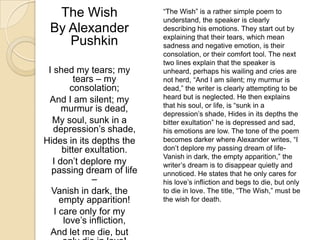
The Wish
By Alexander
Pushkin
I shed my tears; my
tears – my
consolation;
And I am silent; my
murmur is dead,
My soul, sunk in a
depression’s shade,
Hides in its depths the
bitter exultation.
I don’t deplore my
passing dream of life
–
Vanish in dark, the
empty apparition!
I care only for my
love’s infliction,
And let me die, but
“The Wish” is a rather simple poem to
understand, the speaker is clearly
describing his emotions. They start out by
explaining that their tears, which mean
sadness and negative emotion, is their
consolation, or their comfort tool. The next
two lines explain that the speaker is
unheard, perhaps his wailing and cries are
not herd, “And I am silent; my murmur is
dead,” the writer is clearly attempting to be
heard but is neglected. He then explains
that his soul, or life, is “sunk in a
depression’s shade, Hides in its depths the
bitter exultation” he is depressed and sad,
his emotions are low. The tone of the poem
becomes darker where Alexander writes, “I
don’t deplore my passing dream of life-
Vanish in dark, the empty apparition,” the
writer’s dream is to disappear quietly and
unnoticed. He states that he only cares for
his love’s infliction and begs to die, but only
to die in love. The title, “The Wish,” must be
the wish for death.
Pantoum of the Great Depression
Donald Justice
Our lives avoided tragedy
Simply by going on and on,
Without end and with little apparent meaning.
Oh, there were storms and small catastrophes.
Simply by going on and on
We managed. No need for the heroic.
Oh, there were storms and small catastrophes.
I don't remember all the particulars.
We managed. No need for the heroic.
There were the usual celebrations, the usual sorrows.
I don't remember all the particulars.
Across the fence, the neighbors were our chorus.
There were the usual celebrations, the usual sorrows
Thank god no one said anything in verse.
The neighbors were our only chorus,
And if we suffered we kept quiet about it.
At no time did anyone say anything in verse.
It was the ordinary pities and fears consumed us,
And if we suffered we kept quiet about it.
No audience would ever know our story.
It was the ordinary pities and fears consumed us.
We gathered on porches; the moon rose; we were poor.
What audience would ever know our story?
Beyond our windows shone the actual world.
We gathered on porches; the moon rose; we were poor.
And time went by, drawn by slow horses.
Somewhere beyond our windows shone the world.
The Great Depression had entered our souls like fog.
And time went by, drawn by slow horses.
We did not ourselves know what the end was.
The Great Depression had entered our souls like fog.
We had our flaws, perhaps a few private virtues.
But we did not ourselves know what the end was.
People like us simply go on.
We have our flaws, perhaps a few private virtues,
But it is by blind chance only that we escape tragedy.
And there is no plot in that; it is devoid of poetry.
“Pantoum Of The Great Depression” is a
poem about the economic depression and the
struggles. The poem talks about the storms
and the hard times that everyone lived
through. The poem uses a very interesting,
non-patterned, form of repetition. The poet
takes one line from each stanza and repeats it
in the next stanza, however he doesn’t take
the same line (such as line 1 each time or line
3 each time), instead he uses variations,
forcing the reader to pay closer attention and
think. The poem peaks about the hard
emotional and physical times of the lack of
food, the storms, the catasrphies, the lack of
money and so much more. However, the
speaker makes sure that in each stanza he
gives a positive hopeful or some statement
lessening the great issue. view of the issue.
For example he says “small catastrophes”,
even though they were always large issues,
or he writes, “We managed. No need for the
heroic,” implying that everything was okay,
and there were no large issues.
The Night by Gary R. Ferris
Still a mystery,
I can’t figure out;
Race home from work,
Where life is without.
*****
I race to see you,
And hold you to me;
My mind says you’re there,
And my heart won’t see.
*****
I open the door,
It’s still a surprise:
You’re not there,
And tears fill my eyes.
*****
I need someone,
Or call on the phone;
But nothing breaks the silence,
Of these walls made of stone.
*****
I punish myself,
By refusing to eat:
Depression is silent,
I hear my heart beat.
*****
Where can I go,
Or should I stay:
Shy to choose,
In bed I lay.
*****
Time will pass,
And the dark sets in;
Laying there wishing,
I could still touch your skin.
*****
Lying there hurting,
I wish I could die;
Missing you so much,
Again I start to cry.
*****
Sometimes I wonder,
If you even know;
The way that I need you,
Would you still go.
*****
I can’t sleep now,
Again a long night;
Are you this lonely,
Do you share in my fright.
The Night” is very easy to follow and read, however the
writer does not sacrifice easy reading for deep and
powerful poetry. The poem starts out with a man coming
home from work, however, as he gets home he is
reminded that his lover is no longer there, and then
finishes with him describing his dark depressing feelings.
The poem never tells the reader what has happen to his
lover, but I assume that his lover is not lost in dead, but
instead they are still alive but has left him, due to the line
“Are you this lonely, Do you share in my fright,” whilst
speaking to his ex-lover. The speaker explains that he
cries the moment he enters his home and remember his
lover is gone, and that he is deeply lonely. He is not
coping well with his feelings as he writes, “I wish I could
die.”
Taking It Day By Day
Vincent Ramos
Each day I live, the pain consumes
What little sanity I have bloomed
Like walking in a cloud of fog
Falling down, sinking into smog
Life just seems grim
I think on a whim
Interest lost in everything I do
But what a life, who really knew?
Depressed to a fault, that all I see
Death just seems like the only way for me
A waste of time, I feel I am
But that's its nature, a full mind jam
I try and try to ease the pain
A fallen effort with no gain
Thoughts begin to eat away
Makes me want to end it today
Uncomfortable around others for the way I feel
I pray and wish this all wasn't real
Life just seems more like a prison
Caged, alone, an abomination risen
No one could ever understand
Why I would want my death sooner than planned
Its not something I want for me
But to end my suffering this is what has to be
So I write this all as I fall from grace
Down to this place, some barren waste
I know not how much longer I will last
But all I can do, is pray that this will just pass.
“Taking it Day by Day” is another poem that
show descriptive emotion of the author. The
author describes his pain of everyday, hence
the title “Taking it Day by Day.” He uses
similes and metaphors to help paint an image
such as comparing his life to walking in a
cloud of fog, or comparing each day to a
prison. Feeling alone in life the speaker
states, “No one could understand.” The
emotion is very clearly outlined and there
should be no confusion when it comes to the
descriptions in the lines. However if the
reader looks closely, he will notice the
authors everyday struggle to continue on with
life as he stuggles and weighs the option to
take his life. The author writes, “Why I would
want my death sooner than planned, Its not
something I want for me, but to end my
suffering this is what has to be.”
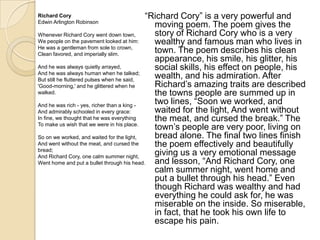
“Richard Cory” is a very powerful and
moving poem. The poem gives the
story of Richard Cory who is a very
wealthy and famous man who lives in
town. The poem describes his clean
appearance, his smile, his glitter, his
social skills, his effect on people, his
wealth, and his admiration. After
Richard’s amazing traits are described
the towns people are summed up in
two lines, “Soon we worked, and
waited for the light, And went without
the meat, and cursed the break.” The
town’s people are very poor, living on
bread alone. The final two lines finish
the poem effectively and beautifully
giving us a very emotional message
and lesson, “And Richard Cory, one
calm summer night, went home and
put a bullet through his head.” Even
though Richard was wealthy and had
everything he could ask for, he was
miserable on the inside. So miserable,
in fact, that he took his own life to
escape his pain.
Richard Cory
Edwin Arlington Robinson
Whenever Richard Cory went down town,
We people on the pavement looked at him:
He was a gentleman from sole to crown,
Clean favored, and imperially slim.
And he was always quietly arrayed,
And he was always human when he talked;
But still he fluttered pulses when he said,
'Good-morning,' and he glittered when he
walked.
And he was rich - yes, richer than a king -
And admirably schooled in every grace:
In fine, we thought that he was everything
To make us wish that we were in his place.
So on we worked, and waited for the light,
And went without the meat, and cursed the
bread;
And Richard Cory, one calm summer night,
Went home and put a bullet through his head.
“Inside Out” is a poem about a girl that is
struggling with her inner emotions. The
poem describes the girl’s outward
appearance, however it also describes her
inner feelings that she experiences. The
girl on the outside is happy, she brightens
rooms, is fearless and tough, full of life,
and has a perfect image. On the other
hand, inside she hides her dark grim
depression that she experiences. The
author uses repetition very effectively as
each 1 line starts with “Outside lives a girl
with…” and each 2 line starts with “yet
inside hides a girl…” Normally the reader
would become bored with such repetition,
however in this poem this is not the case.
The words that follow the repetitious
introduction to each line are what the
reader is forced to pay attention too, and
the author makes sure that these words
are descriptive, colorful, and meaning full,
for example “…hides a girl screaming her
lungs out in unwanted anger.”
Inside Out
© Angie Flores
Outside lives a girl with a smile that will brighten up
the room,
yet inside hides a girl with a frown full of despair.
Outside lives a girl with eyes of joy that brings you
to ease,
yet inside hides a girl shedding tears of sadness.
Outside lives a girl with a beautiful laugh that's
contagious,
yet inside hides a girl screaming her lungs out in
unwanted anger.
Outside lives a girl with the personality everyone
envies,
yet inside hides a girl full of insecurities and
shame.
Outside lives a girl who is fearless and tough,
yet inside hides a weak girl who lives in fear.
Outside lives a girl full of life,
yet inside hides a girl full of pain, wanting to die.
Outside lives a girl with a perfect image,
yet inside hides a girl with regrets and mistakes.
Outside lives a girl of innocence,
yet inside hides a girl with tremendous guilt.
Outside lives a girl with goals and aspirations,
yet inside lives a girl lost in confusion.
What you see on the outside is my personal
disguise,
What hides underneath you can't even begin to
imagine.
My Daughter's Tears
© Annabel Sheila
Until it affects someone we love,
We don’t even know it’s there.
It’s really not our problem,
So why should we care.
The statistics are quite shocking,
One in four they say
Will suffer from depression
In their lives one day.
There’s not much stigma anymore
For this serious mental flaw.
But no one knows where it will strike,
It’s just the luck of the draw.
No one would choose to live with it,
And some don’t even try.
I see my daughter suffering
And all she can do is cry.
Most people turn the other cheek,
They’ve been doing it for years.
But I must face the pain I see,
In my daughter’s tears.
“My Daughter’s Tears” is a poem
written by a mother describing her
daughter’s depression. The poem
starts out with the writer explaining
that we don’t care about depression
until someone we love is affected by it.
She mentions that “One in four they
say Will suffer from depression,” and
that “No one would choose to live with
it.” The seriousness of the issue is
really portrayed when the author
writes “And some don’t even try (to
live with depression),” referring to
suicide. The author is pouring her
frustration with her daughters
suffering into the poem stating that
she watches her daughter cry, and
sees nothing but pain in her face and
her tears. The author’s word choice is
what makes this a piece of art.
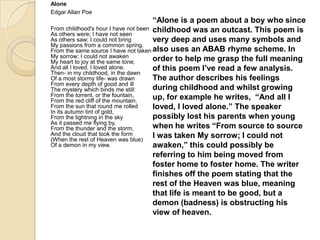
Alone
Edgar Allan Poe
From childhood's hour I have not been
As others were; I have not seen
As others saw; I could not bring
My passions from a common spring.
From the same source I have not taken
My sorrow; I could not awaken
My heart to joy at the same tone;
And all I loved, I loved alone.
Then- in my childhood, in the dawn
Of a most stormy life- was drawn
From every depth of good and ill
The mystery which binds me still:
From the torrent, or the fountain,
From the red cliff of the mountain,
From the sun that round me rolled
In its autumn tint of gold,
From the lightning in the sky
As it passed me flying by,
From the thunder and the storm,
And the cloud that took the form
(When the rest of Heaven was blue)
Of a demon in my view.
“Alone is a poem about a boy who since
childhood was an outcast. This poem is
very deep and uses many symbols and
also uses an ABAB rhyme scheme. In
order to help me grasp the full meaning
of this poem I’ve read a few analysis.
The author describes his feelings
during childhood and whilst growing
up, for example he writes, “And all I
loved, I loved alone.” The speaker
possibly lost his parents when young
when he writes “From source to source
I was taken My sorrow; I could not
awaken,” this could possibly be
referring to him being moved from
foster home to foster home. The writer
finishes off the poem stating that the
rest of the Heaven was blue, meaning
that life is meant to be good, but a
demon (badness) is obstructing his
view of heaven.
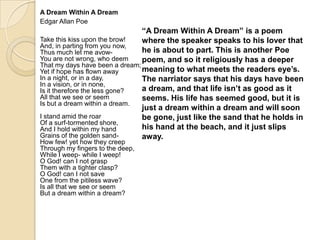
A Dream Within A Dream
Edgar Allan Poe
Take this kiss upon the brow!
And, in parting from you now,
Thus much let me avow-
You are not wrong, who deem
That my days have been a dream;
Yet if hope has flown away
In a night, or in a day,
In a vision, or in none,
Is it therefore the less gone?
All that we see or seem
Is but a dream within a dream.
I stand amid the roar
Of a surf-tormented shore,
And I hold within my hand
Grains of the golden sand-
How few! yet how they creep
Through my fingers to the deep,
While I weep- while I weep!
O God! can I not grasp
Them with a tighter clasp?
O God! can I not save
One from the pitiless wave?
Is all that we see or seem
But a dream within a dream?
“A Dream Within A Dream” is a poem
where the speaker speaks to his lover that
he is about to part. This is another Poe
poem, and so it religiously has a deeper
meaning to what meets the readers eye’s.
The narriator says that his days have been
a dream, and that life isn’t as good as it
seems. His life has seemed good, but it is
just a dream within a dream and will soon
be gone, just like the sand that he holds in
his hand at the beach, and it just slips
away.
Poem [autosaved]

Poem [autosaved]

  • 1.
  • 2.
    Stasis in darkness. Thenthe substanceless blue Pour of tor and distances. God's lioness, How one we grow, Pivot of heels and knees! -- The furrow Splits and passes, sister to The brown arc Of the neck I cannot catch, Nigger-eye Berries cast dark Hooks – Black sweet blood mouthfuls, Shadows . Something else Hauls methrough air – Thighs, hair; Flakes from my heels. White Godiva, I unpeel – Dead hands, dead stringencies. And now I Foam to wheat, a glitter of seas. The child's cry Melts in the wall. And I Am the arrow, The dew that flies Suicidal, at one with the drive Into the red Eye, the cauldron of morning. Ariel By Sylvia Plath “Ariel” is a poem about a woman riding upon a horse, first in the darkness of dawn, she becomes more in touch with the horse, and begins to gain speed and becomes an “arrow” darting through the morning. After reading some analysis papers on the poem, I’ve become very confused as to the meaning of the poem. The speaker compares herself to Lady Godiva, who gracefully rode naked upon her horse in order to protest a tax which her husband bestowed upon his tenants, which [to me] symbolizes freedom. The fact that the woman is riding a horse, is also in itself a symbol of freedom and being able to ride where she pleases. As the woman frees herself from the darkness of humanity and becomes “at one with the drive (meaning ride/horse)”. She takes a suicidal leap into red “cauldron of the morning” ready to take on life, and free herself from the depression and from the darkness.
  • 4.
    The Wish By Alexander Pushkin Ished my tears; my tears – my consolation; And I am silent; my murmur is dead, My soul, sunk in a depression’s shade, Hides in its depths the bitter exultation. I don’t deplore my passing dream of life – Vanish in dark, the empty apparition! I care only for my love’s infliction, And let me die, but “The Wish” is a rather simple poem to understand, the speaker is clearly describing his emotions. They start out by explaining that their tears, which mean sadness and negative emotion, is their consolation, or their comfort tool. The next two lines explain that the speaker is unheard, perhaps his wailing and cries are not herd, “And I am silent; my murmur is dead,” the writer is clearly attempting to be heard but is neglected. He then explains that his soul, or life, is “sunk in a depression’s shade, Hides in its depths the bitter exultation” he is depressed and sad, his emotions are low. The tone of the poem becomes darker where Alexander writes, “I don’t deplore my passing dream of life- Vanish in dark, the empty apparition,” the writer’s dream is to disappear quietly and unnoticed. He states that he only cares for his love’s infliction and begs to die, but only to die in love. The title, “The Wish,” must be the wish for death.
  • 5.
    Pantoum of theGreat Depression Donald Justice Our lives avoided tragedy Simply by going on and on, Without end and with little apparent meaning. Oh, there were storms and small catastrophes. Simply by going on and on We managed. No need for the heroic. Oh, there were storms and small catastrophes. I don't remember all the particulars. We managed. No need for the heroic. There were the usual celebrations, the usual sorrows. I don't remember all the particulars. Across the fence, the neighbors were our chorus. There were the usual celebrations, the usual sorrows Thank god no one said anything in verse. The neighbors were our only chorus, And if we suffered we kept quiet about it. At no time did anyone say anything in verse. It was the ordinary pities and fears consumed us, And if we suffered we kept quiet about it. No audience would ever know our story. It was the ordinary pities and fears consumed us. We gathered on porches; the moon rose; we were poor. What audience would ever know our story? Beyond our windows shone the actual world. We gathered on porches; the moon rose; we were poor. And time went by, drawn by slow horses. Somewhere beyond our windows shone the world. The Great Depression had entered our souls like fog. And time went by, drawn by slow horses. We did not ourselves know what the end was. The Great Depression had entered our souls like fog. We had our flaws, perhaps a few private virtues. But we did not ourselves know what the end was. People like us simply go on. We have our flaws, perhaps a few private virtues, But it is by blind chance only that we escape tragedy. And there is no plot in that; it is devoid of poetry. “Pantoum Of The Great Depression” is a poem about the economic depression and the struggles. The poem talks about the storms and the hard times that everyone lived through. The poem uses a very interesting, non-patterned, form of repetition. The poet takes one line from each stanza and repeats it in the next stanza, however he doesn’t take the same line (such as line 1 each time or line 3 each time), instead he uses variations, forcing the reader to pay closer attention and think. The poem peaks about the hard emotional and physical times of the lack of food, the storms, the catasrphies, the lack of money and so much more. However, the speaker makes sure that in each stanza he gives a positive hopeful or some statement lessening the great issue. view of the issue. For example he says “small catastrophes”, even though they were always large issues, or he writes, “We managed. No need for the heroic,” implying that everything was okay, and there were no large issues.
  • 6.
    The Night byGary R. Ferris Still a mystery, I can’t figure out; Race home from work, Where life is without. ***** I race to see you, And hold you to me; My mind says you’re there, And my heart won’t see. ***** I open the door, It’s still a surprise: You’re not there, And tears fill my eyes. ***** I need someone, Or call on the phone; But nothing breaks the silence, Of these walls made of stone. ***** I punish myself, By refusing to eat: Depression is silent, I hear my heart beat. ***** Where can I go, Or should I stay: Shy to choose, In bed I lay. ***** Time will pass, And the dark sets in; Laying there wishing, I could still touch your skin. ***** Lying there hurting, I wish I could die; Missing you so much, Again I start to cry. ***** Sometimes I wonder, If you even know; The way that I need you, Would you still go. ***** I can’t sleep now, Again a long night; Are you this lonely, Do you share in my fright. The Night” is very easy to follow and read, however the writer does not sacrifice easy reading for deep and powerful poetry. The poem starts out with a man coming home from work, however, as he gets home he is reminded that his lover is no longer there, and then finishes with him describing his dark depressing feelings. The poem never tells the reader what has happen to his lover, but I assume that his lover is not lost in dead, but instead they are still alive but has left him, due to the line “Are you this lonely, Do you share in my fright,” whilst speaking to his ex-lover. The speaker explains that he cries the moment he enters his home and remember his lover is gone, and that he is deeply lonely. He is not coping well with his feelings as he writes, “I wish I could die.”
  • 7.
    Taking It DayBy Day Vincent Ramos Each day I live, the pain consumes What little sanity I have bloomed Like walking in a cloud of fog Falling down, sinking into smog Life just seems grim I think on a whim Interest lost in everything I do But what a life, who really knew? Depressed to a fault, that all I see Death just seems like the only way for me A waste of time, I feel I am But that's its nature, a full mind jam I try and try to ease the pain A fallen effort with no gain Thoughts begin to eat away Makes me want to end it today Uncomfortable around others for the way I feel I pray and wish this all wasn't real Life just seems more like a prison Caged, alone, an abomination risen No one could ever understand Why I would want my death sooner than planned Its not something I want for me But to end my suffering this is what has to be So I write this all as I fall from grace Down to this place, some barren waste I know not how much longer I will last But all I can do, is pray that this will just pass. “Taking it Day by Day” is another poem that show descriptive emotion of the author. The author describes his pain of everyday, hence the title “Taking it Day by Day.” He uses similes and metaphors to help paint an image such as comparing his life to walking in a cloud of fog, or comparing each day to a prison. Feeling alone in life the speaker states, “No one could understand.” The emotion is very clearly outlined and there should be no confusion when it comes to the descriptions in the lines. However if the reader looks closely, he will notice the authors everyday struggle to continue on with life as he stuggles and weighs the option to take his life. The author writes, “Why I would want my death sooner than planned, Its not something I want for me, but to end my suffering this is what has to be.”
  • 8.
    “Richard Cory” isa very powerful and moving poem. The poem gives the story of Richard Cory who is a very wealthy and famous man who lives in town. The poem describes his clean appearance, his smile, his glitter, his social skills, his effect on people, his wealth, and his admiration. After Richard’s amazing traits are described the towns people are summed up in two lines, “Soon we worked, and waited for the light, And went without the meat, and cursed the break.” The town’s people are very poor, living on bread alone. The final two lines finish the poem effectively and beautifully giving us a very emotional message and lesson, “And Richard Cory, one calm summer night, went home and put a bullet through his head.” Even though Richard was wealthy and had everything he could ask for, he was miserable on the inside. So miserable, in fact, that he took his own life to escape his pain. Richard Cory Edwin Arlington Robinson Whenever Richard Cory went down town, We people on the pavement looked at him: He was a gentleman from sole to crown, Clean favored, and imperially slim. And he was always quietly arrayed, And he was always human when he talked; But still he fluttered pulses when he said, 'Good-morning,' and he glittered when he walked. And he was rich - yes, richer than a king - And admirably schooled in every grace: In fine, we thought that he was everything To make us wish that we were in his place. So on we worked, and waited for the light, And went without the meat, and cursed the bread; And Richard Cory, one calm summer night, Went home and put a bullet through his head.
  • 9.
    “Inside Out” isa poem about a girl that is struggling with her inner emotions. The poem describes the girl’s outward appearance, however it also describes her inner feelings that she experiences. The girl on the outside is happy, she brightens rooms, is fearless and tough, full of life, and has a perfect image. On the other hand, inside she hides her dark grim depression that she experiences. The author uses repetition very effectively as each 1 line starts with “Outside lives a girl with…” and each 2 line starts with “yet inside hides a girl…” Normally the reader would become bored with such repetition, however in this poem this is not the case. The words that follow the repetitious introduction to each line are what the reader is forced to pay attention too, and the author makes sure that these words are descriptive, colorful, and meaning full, for example “…hides a girl screaming her lungs out in unwanted anger.” Inside Out © Angie Flores Outside lives a girl with a smile that will brighten up the room, yet inside hides a girl with a frown full of despair. Outside lives a girl with eyes of joy that brings you to ease, yet inside hides a girl shedding tears of sadness. Outside lives a girl with a beautiful laugh that's contagious, yet inside hides a girl screaming her lungs out in unwanted anger. Outside lives a girl with the personality everyone envies, yet inside hides a girl full of insecurities and shame. Outside lives a girl who is fearless and tough, yet inside hides a weak girl who lives in fear. Outside lives a girl full of life, yet inside hides a girl full of pain, wanting to die. Outside lives a girl with a perfect image, yet inside hides a girl with regrets and mistakes. Outside lives a girl of innocence, yet inside hides a girl with tremendous guilt. Outside lives a girl with goals and aspirations, yet inside lives a girl lost in confusion. What you see on the outside is my personal disguise, What hides underneath you can't even begin to imagine.
  • 11.
    My Daughter's Tears ©Annabel Sheila Until it affects someone we love, We don’t even know it’s there. It’s really not our problem, So why should we care. The statistics are quite shocking, One in four they say Will suffer from depression In their lives one day. There’s not much stigma anymore For this serious mental flaw. But no one knows where it will strike, It’s just the luck of the draw. No one would choose to live with it, And some don’t even try. I see my daughter suffering And all she can do is cry. Most people turn the other cheek, They’ve been doing it for years. But I must face the pain I see, In my daughter’s tears. “My Daughter’s Tears” is a poem written by a mother describing her daughter’s depression. The poem starts out with the writer explaining that we don’t care about depression until someone we love is affected by it. She mentions that “One in four they say Will suffer from depression,” and that “No one would choose to live with it.” The seriousness of the issue is really portrayed when the author writes “And some don’t even try (to live with depression),” referring to suicide. The author is pouring her frustration with her daughters suffering into the poem stating that she watches her daughter cry, and sees nothing but pain in her face and her tears. The author’s word choice is what makes this a piece of art.
  • 13.
    Alone Edgar Allan Poe Fromchildhood's hour I have not been As others were; I have not seen As others saw; I could not bring My passions from a common spring. From the same source I have not taken My sorrow; I could not awaken My heart to joy at the same tone; And all I loved, I loved alone. Then- in my childhood, in the dawn Of a most stormy life- was drawn From every depth of good and ill The mystery which binds me still: From the torrent, or the fountain, From the red cliff of the mountain, From the sun that round me rolled In its autumn tint of gold, From the lightning in the sky As it passed me flying by, From the thunder and the storm, And the cloud that took the form (When the rest of Heaven was blue) Of a demon in my view. “Alone is a poem about a boy who since childhood was an outcast. This poem is very deep and uses many symbols and also uses an ABAB rhyme scheme. In order to help me grasp the full meaning of this poem I’ve read a few analysis. The author describes his feelings during childhood and whilst growing up, for example he writes, “And all I loved, I loved alone.” The speaker possibly lost his parents when young when he writes “From source to source I was taken My sorrow; I could not awaken,” this could possibly be referring to him being moved from foster home to foster home. The writer finishes off the poem stating that the rest of the Heaven was blue, meaning that life is meant to be good, but a demon (badness) is obstructing his view of heaven.
  • 15.
    A Dream WithinA Dream Edgar Allan Poe Take this kiss upon the brow! And, in parting from you now, Thus much let me avow- You are not wrong, who deem That my days have been a dream; Yet if hope has flown away In a night, or in a day, In a vision, or in none, Is it therefore the less gone? All that we see or seem Is but a dream within a dream. I stand amid the roar Of a surf-tormented shore, And I hold within my hand Grains of the golden sand- How few! yet how they creep Through my fingers to the deep, While I weep- while I weep! O God! can I not grasp Them with a tighter clasp? O God! can I not save One from the pitiless wave? Is all that we see or seem But a dream within a dream? “A Dream Within A Dream” is a poem where the speaker speaks to his lover that he is about to part. This is another Poe poem, and so it religiously has a deeper meaning to what meets the readers eye’s. The narriator says that his days have been a dream, and that life isn’t as good as it seems. His life has seemed good, but it is just a dream within a dream and will soon be gone, just like the sand that he holds in his hand at the beach, and it just slips away.