LIMBO
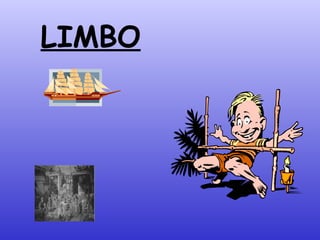
This is a poem about slavery.  Men, women and children were captured in Africa and were taken in ships to America.  Once there, they were made to work as slaves on the plantations in America and the Caribbean islands.  The slaves would be expected to row on the voyage and they would be struck with whips to ensure that they did so. Slave Ships  –  An estimated 15 million Africans were transported to the Americas between 1540 and 1850.  Due to the fact that they were chained together, it was very difficult for the slaves to move.  Conditions aboard the ships were so poor that a large number of slaves died in the process and many were crippled for life due to the appalling conditions. Limbo  by  Edward Kamau Brathwaite
Edward Kamau Brathwaite   Edward Brathwaite was born in Bridgetown, Barbados in 1930. He studied History at Cambridge. In 1983 was appointed Professor of Social and Cultural History at the University of the West Indies in Kingston, Jamaica. He has won many awards for his poetry .
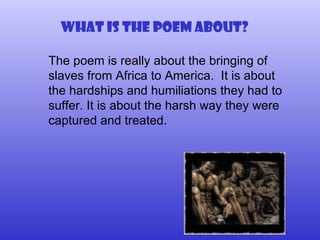
What is the poem about? The poem is really about the bringing of slaves from Africa to America.  It is about the hardships and humiliations they had to suffer. It is about the harsh way they were captured and treated.
LIMBO – What does it mean? A dance in which a dancer has to pass under a stick by bending over backwards; the stick is gradually lowered An intermediate place between two extremes An imaginary place for lost, unwanted or forgotten things In Christianity, the place of rest for infants who dies without baptism In Roman Catholic tradition, it is a place where the souls of people go, if they are not good enough for heaven or bad enough for hell
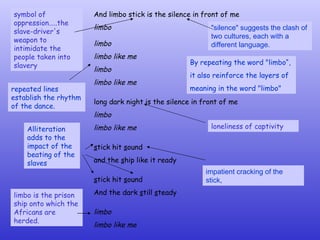
And limbo stick is the silence in front of me limbo limbo limbo like me limbo limbo like me   long dark night is the silence in front of me limbo limbo like me   s tick hit  s ound and the  s hip like it ready   s tick hit  s ound And the dark  s till  s teady limbo limbo like me "silence" suggests the clash of two cultures, each with a different language.  repeated lines  establish the rhythm of the dance.  impatient cracking of the stick,  Alliteration adds to the impact of the beating of the slaves symbol of oppression…..the slave-driver's weapon to intimidate the people taken into slavery loneliness of captivity limbo is the prison ship onto which the Africans are herded.   By repeating the word "limbo“,  it also reinforce the layers of  meaning in the word "limbo"
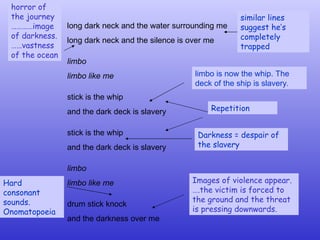
long dark neck and the water surrounding me long dark neck and the silence is over me   limbo limbo like me   stick is the whip and the dark deck is slavery   stick is the whip and the dark deck is slavery   limbo limbo like me   drum stick knock and the darkness over me   similar lines suggest he’s completely trapped limbo is now the whip. The deck of the ship is slavery . Darkness = despair of the slavery Repetition Hard consonant sounds. Onomatopoeia horror of the journey …………image of darkness. ……vastness of the ocean Images of violence appear. ….the victim is forced to the ground and the threat is pressing downwards.
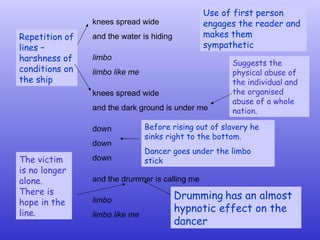
knees spread wide and the water is hiding limbo limbo like me   knees spread wide  and the dark ground is under me   down down down and the drummer is calling me   limbo limbo like me   Use of first person engages the reader and makes them sympathetic Repetition of lines – harshness of conditions on the ship Before rising out of slavery he sinks right to the bottom. Dancer goes under the limbo stick Drumming   has an almost hypnotic effect on the dancer Suggests the physical abuse of the individual and the organised abuse of a whole nation.   The victim is no longer alone. There is hope in the line.
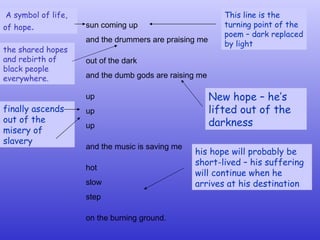
sun coming up and the drummers are praising me   out of the dark and the dumb gods are raising me   up up up   and the music is saving me   hot slow step   on the burning ground.   This line is the turning point of the poem – dark replaced by light New hope – he’s lifted out of the darkness finally ascends out of the misery of slavery his hope will probably be short-lived – his suffering will continue when he arrives at his destination A symbol of life, of hope .   the shared hopes and rebirth of black people everywhere.
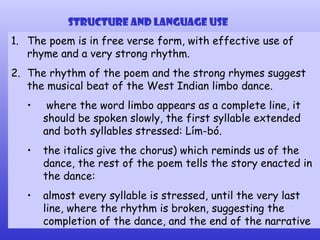
The poem is in free verse form, with effective use of rhyme and a very strong rhythm. The rhythm of the poem and the strong rhymes suggest the musical beat of the West Indian limbo dance.   where the word limbo appears as a complete line, it should be spoken slowly, the first syllable extended and both syllables stressed: Lím-bó.  the italics give the chorus) which reminds us of the dance, the rest of the poem tells the story enacted in the dance:  almost every syllable is stressed, until the very last line, where the rhythm is broken, suggesting the completion of the dance, and the end of the narrative  Structure and Language Use
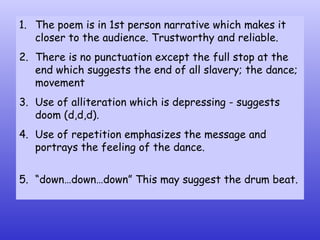
The poem is in 1st person narrative which makes it closer to the audience. Trustworthy and reliable. There is no punctuation except the full stop at the end which suggests the end of all slavery; the dance; movement  Use of alliteration which is depressing - suggests doom (d,d,d).  Use of repetition emphasizes the message and portrays the feeling of the dance. “ down…down…down” This may suggest the drum beat.

Llimbo annotated

  • 1.
  • 2.
    This is apoem about slavery. Men, women and children were captured in Africa and were taken in ships to America. Once there, they were made to work as slaves on the plantations in America and the Caribbean islands. The slaves would be expected to row on the voyage and they would be struck with whips to ensure that they did so. Slave Ships – An estimated 15 million Africans were transported to the Americas between 1540 and 1850. Due to the fact that they were chained together, it was very difficult for the slaves to move. Conditions aboard the ships were so poor that a large number of slaves died in the process and many were crippled for life due to the appalling conditions. Limbo by Edward Kamau Brathwaite
  • 3.
    Edward Kamau Brathwaite Edward Brathwaite was born in Bridgetown, Barbados in 1930. He studied History at Cambridge. In 1983 was appointed Professor of Social and Cultural History at the University of the West Indies in Kingston, Jamaica. He has won many awards for his poetry .
  • 4.
    What is thepoem about? The poem is really about the bringing of slaves from Africa to America. It is about the hardships and humiliations they had to suffer. It is about the harsh way they were captured and treated.
  • 5.
    LIMBO – Whatdoes it mean? A dance in which a dancer has to pass under a stick by bending over backwards; the stick is gradually lowered An intermediate place between two extremes An imaginary place for lost, unwanted or forgotten things In Christianity, the place of rest for infants who dies without baptism In Roman Catholic tradition, it is a place where the souls of people go, if they are not good enough for heaven or bad enough for hell
  • 6.
    And limbo stickis the silence in front of me limbo limbo limbo like me limbo limbo like me   long dark night is the silence in front of me limbo limbo like me   s tick hit s ound and the s hip like it ready   s tick hit s ound And the dark s till s teady limbo limbo like me "silence" suggests the clash of two cultures, each with a different language. repeated lines establish the rhythm of the dance. impatient cracking of the stick, Alliteration adds to the impact of the beating of the slaves symbol of oppression…..the slave-driver's weapon to intimidate the people taken into slavery loneliness of captivity limbo is the prison ship onto which the Africans are herded. By repeating the word "limbo“, it also reinforce the layers of meaning in the word "limbo"
  • 7.
    long dark neckand the water surrounding me long dark neck and the silence is over me   limbo limbo like me   stick is the whip and the dark deck is slavery   stick is the whip and the dark deck is slavery   limbo limbo like me   drum stick knock and the darkness over me similar lines suggest he’s completely trapped limbo is now the whip. The deck of the ship is slavery . Darkness = despair of the slavery Repetition Hard consonant sounds. Onomatopoeia horror of the journey …………image of darkness. ……vastness of the ocean Images of violence appear. ….the victim is forced to the ground and the threat is pressing downwards.
  • 8.
    knees spread wideand the water is hiding limbo limbo like me   knees spread wide and the dark ground is under me   down down down and the drummer is calling me   limbo limbo like me   Use of first person engages the reader and makes them sympathetic Repetition of lines – harshness of conditions on the ship Before rising out of slavery he sinks right to the bottom. Dancer goes under the limbo stick Drumming has an almost hypnotic effect on the dancer Suggests the physical abuse of the individual and the organised abuse of a whole nation. The victim is no longer alone. There is hope in the line.
  • 9.
    sun coming upand the drummers are praising me   out of the dark and the dumb gods are raising me   up up up   and the music is saving me   hot slow step   on the burning ground. This line is the turning point of the poem – dark replaced by light New hope – he’s lifted out of the darkness finally ascends out of the misery of slavery his hope will probably be short-lived – his suffering will continue when he arrives at his destination A symbol of life, of hope . the shared hopes and rebirth of black people everywhere.
  • 10.
    The poem isin free verse form, with effective use of rhyme and a very strong rhythm. The rhythm of the poem and the strong rhymes suggest the musical beat of the West Indian limbo dance.   where the word limbo appears as a complete line, it should be spoken slowly, the first syllable extended and both syllables stressed: Lím-bó. the italics give the chorus) which reminds us of the dance, the rest of the poem tells the story enacted in the dance: almost every syllable is stressed, until the very last line, where the rhythm is broken, suggesting the completion of the dance, and the end of the narrative Structure and Language Use
  • 11.
    The poem isin 1st person narrative which makes it closer to the audience. Trustworthy and reliable. There is no punctuation except the full stop at the end which suggests the end of all slavery; the dance; movement Use of alliteration which is depressing - suggests doom (d,d,d). Use of repetition emphasizes the message and portrays the feeling of the dance. “ down…down…down” This may suggest the drum beat.