The Right Word
Imtiaz Dharker
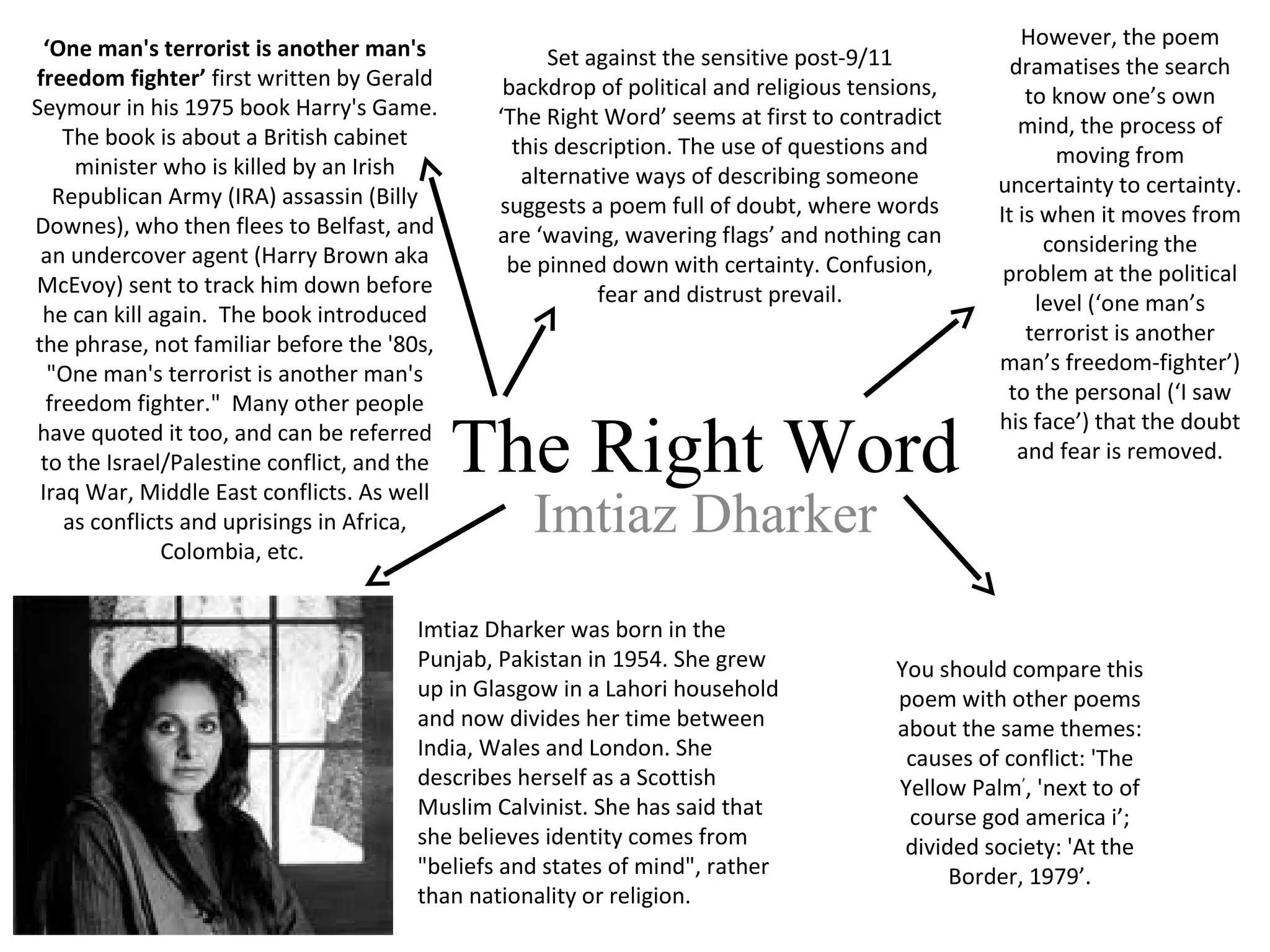
Imtiaz Dharker was born in the
Punjab, Pakistan in 1954. She grew
up in Glasgow in a Lahori household
and now divides her time between
India, Wales and London. She
describes herself as a Scottish
Muslim Calvinist. She has said that
she believes identity comes from
"beliefs and states of mind", rather
than nationality or religion.
‘One man's terrorist is another man's
freedom fighter’ first written by Gerald
Seymour in his 1975 book Harry's Game.
The book is about a British cabinet
minister who is killed by an Irish
Republican Army (IRA) assassin (Billy
Downes), who then flees to Belfast, and
an undercover agent (Harry Brown aka
McEvoy) sent to track him down before
he can kill again. The book introduced
the phrase, not familiar before the '80s,
"One man's terrorist is another man's
freedom fighter." Many other people
have quoted it too, and can be referred
to the Israel/Palestine conflict, and the
Iraq War, Middle East conflicts. As well
as conflicts and uprisings in Africa,
Colombia, etc.
Set against the sensitive post-9/11
backdrop of political and religious tensions,
‘The Right Word’ seems at first to contradict
this description. The use of questions and
alternative ways of describing someone
suggests a poem full of doubt, where words
are ‘waving, wavering flags’ and nothing can
be pinned down with certainty. Confusion,
fear and distrust prevail.
However, the poem
dramatises the search
to know one’s own
mind, the process of
moving from
uncertainty to certainty.
It is when it moves from
considering the
problem at the political
level (‘one man’s
terrorist is another
man’s freedom-fighter’)
to the personal (‘I saw
his face’) that the doubt
and fear is removed.
You should compare this
poem with other poems
about the same themes:
causes of conflict: 'The
Yellow Palm’
, 'next to of
course god america i’;
divided society: 'At the
Border, 1979’.
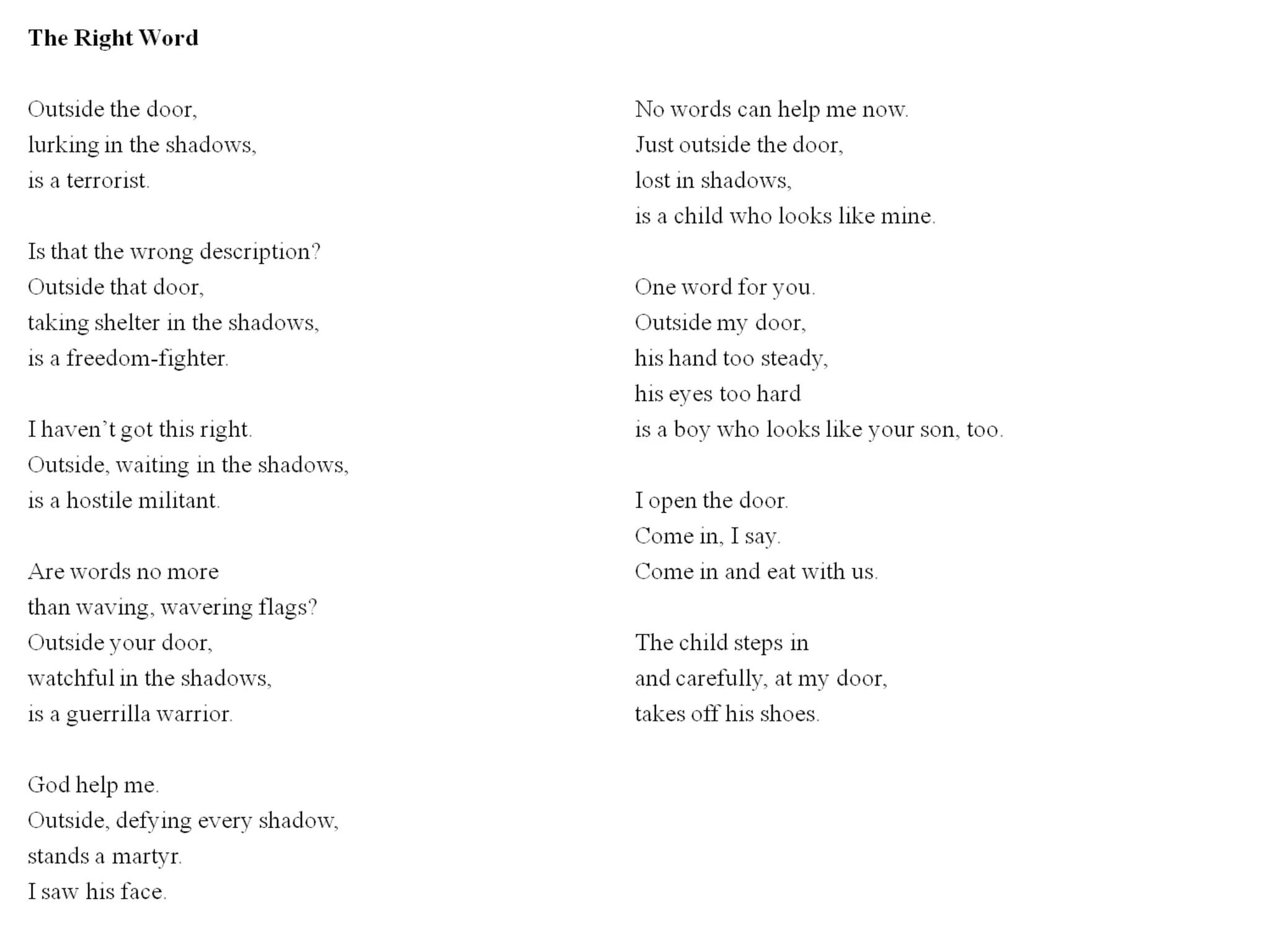
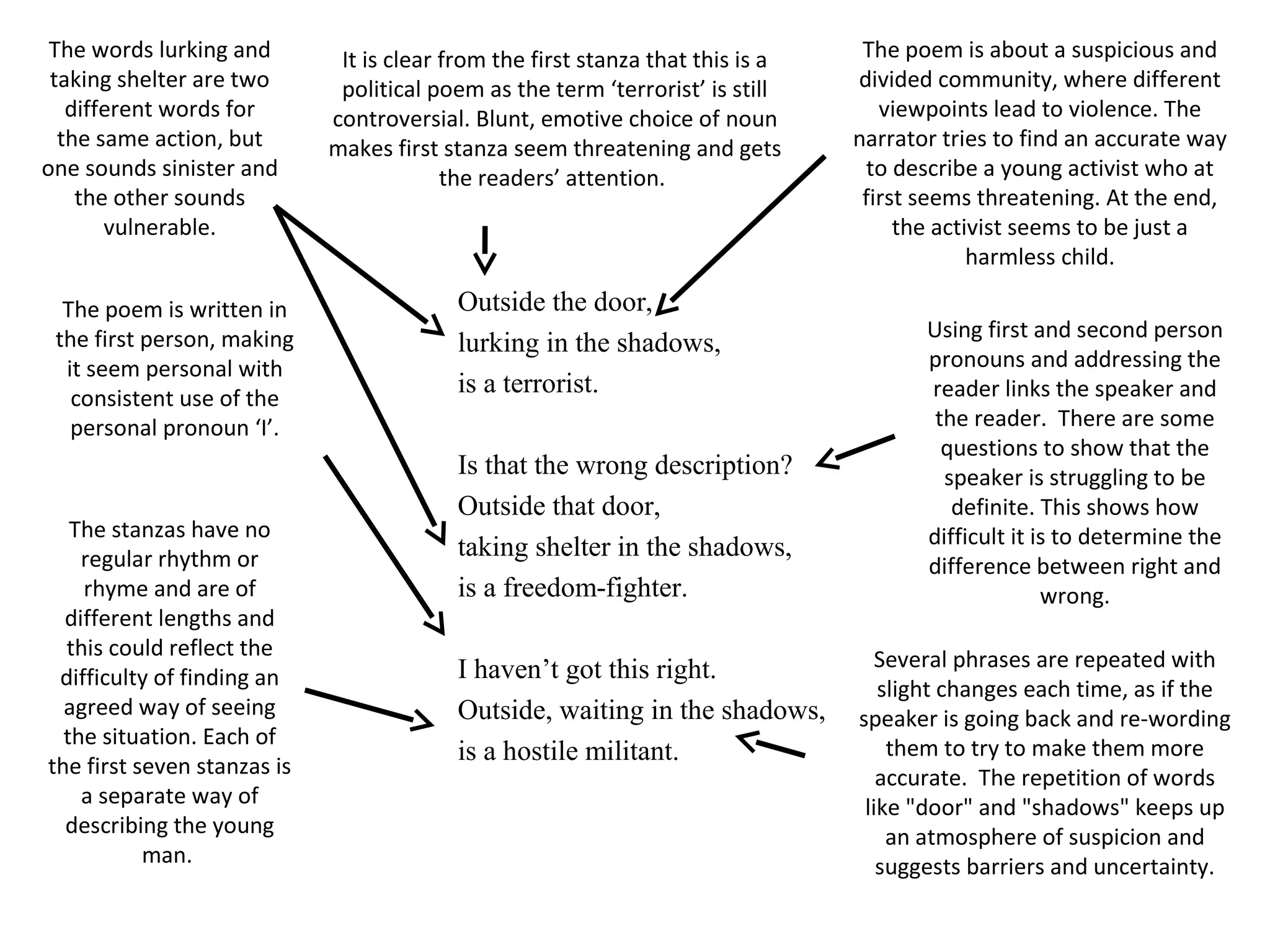
Outside the door,
lurking in the shadows,
is a terrorist.
Is that the wrong description?
Outside that door,
taking shelter in the shadows,
is a freedom-fighter.
I haven’t got this right.
Outside, waiting in the shadows,
is a hostile militant.
The poem is about a suspicious and
divided community, where different
viewpoints lead to violence. The
narrator tries to find an accurate way
to describe a young activist who at
first seems threatening. At the end,
the activist seems to be just a
harmless child.
The poem is written in
the first person, making
it seem personal with
consistent use of the
personal pronoun ‘I’.
The words lurking and
taking shelter are two
different words for
the same action, but
one sounds sinister and
the other sounds
vulnerable.
It is clear from the first stanza that this is a
political poem as the term ‘terrorist’ is still
controversial. Blunt, emotive choice of noun
makes first stanza seem threatening and gets
the readers’ attention.
Using first and second person
pronouns and addressing the
reader links the speaker and
the reader. There are some
questions to show that the
speaker is struggling to be
definite. This shows how
difficult it is to determine the
difference between right and
wrong.
Several phrases are repeated with
slight changes each time, as if the
speaker is going back and re-wording
them to try to make them more
accurate. The repetition of words
like "door" and "shadows" keeps up
an atmosphere of suspicion and
suggests barriers and uncertainty.
The stanzas have no
regular rhythm or
rhyme and are of
different lengths and
this could reflect the
difficulty of finding an
agreed way of seeing
the situation. Each of
the first seven stanzas is
a separate way of
describing the young
man.
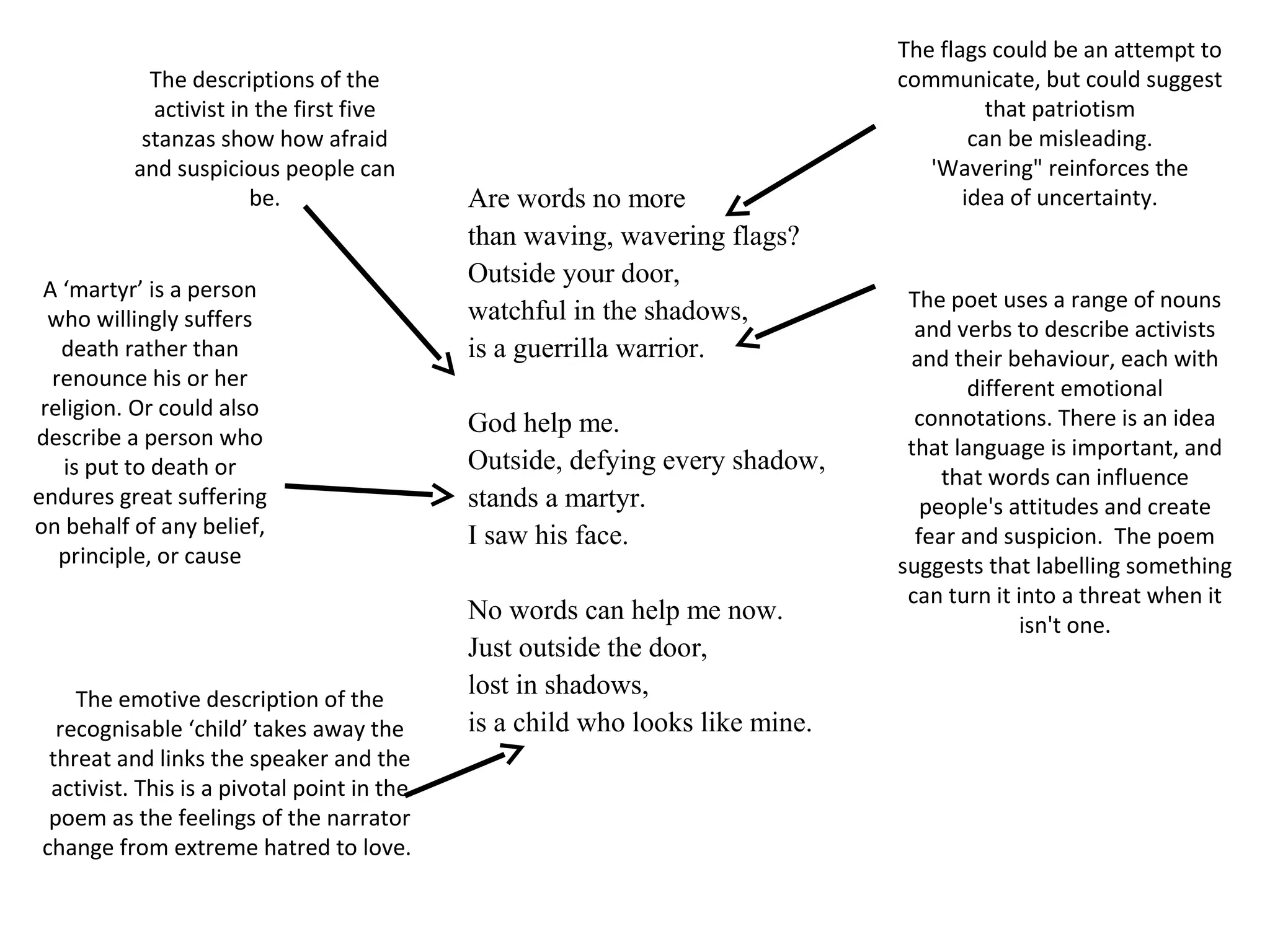
Are words no more
than waving, wavering flags?
Outside your door,
watchful in the shadows,
is a guerrilla warrior.
God help me.
Outside, defying every shadow,
stands a martyr.
I saw his face.
No words can help me now.
Just outside the door,
lost in shadows,
is a child who looks like mine.
The poet uses a range of nouns
and verbs to describe activists
and their behaviour, each with
different emotional
connotations. There is an idea
that language is important, and
that words can influence
people's attitudes and create
fear and suspicion. The poem
suggests that labelling something
can turn it into a threat when it
isn't one.
The descriptions of the
activist in the first five
stanzas show how afraid
and suspicious people can
be.
The flags could be an attempt to
communicate, but could suggest
that patriotism
can be misleading.
'Wavering" reinforces the
idea of uncertainty.
A ‘martyr’ is a person
who willingly suffers
death rather than
renounce his or her
religion. Or could also
describe a person who
is put to death or
endures great suffering
on behalf of any belief,
principle, or cause
The emotive description of the
recognisable ‘child’ takes away the
threat and links the speaker and the
activist. This is a pivotal point in the
poem as the feelings of the narrator
change from extreme hatred to love.
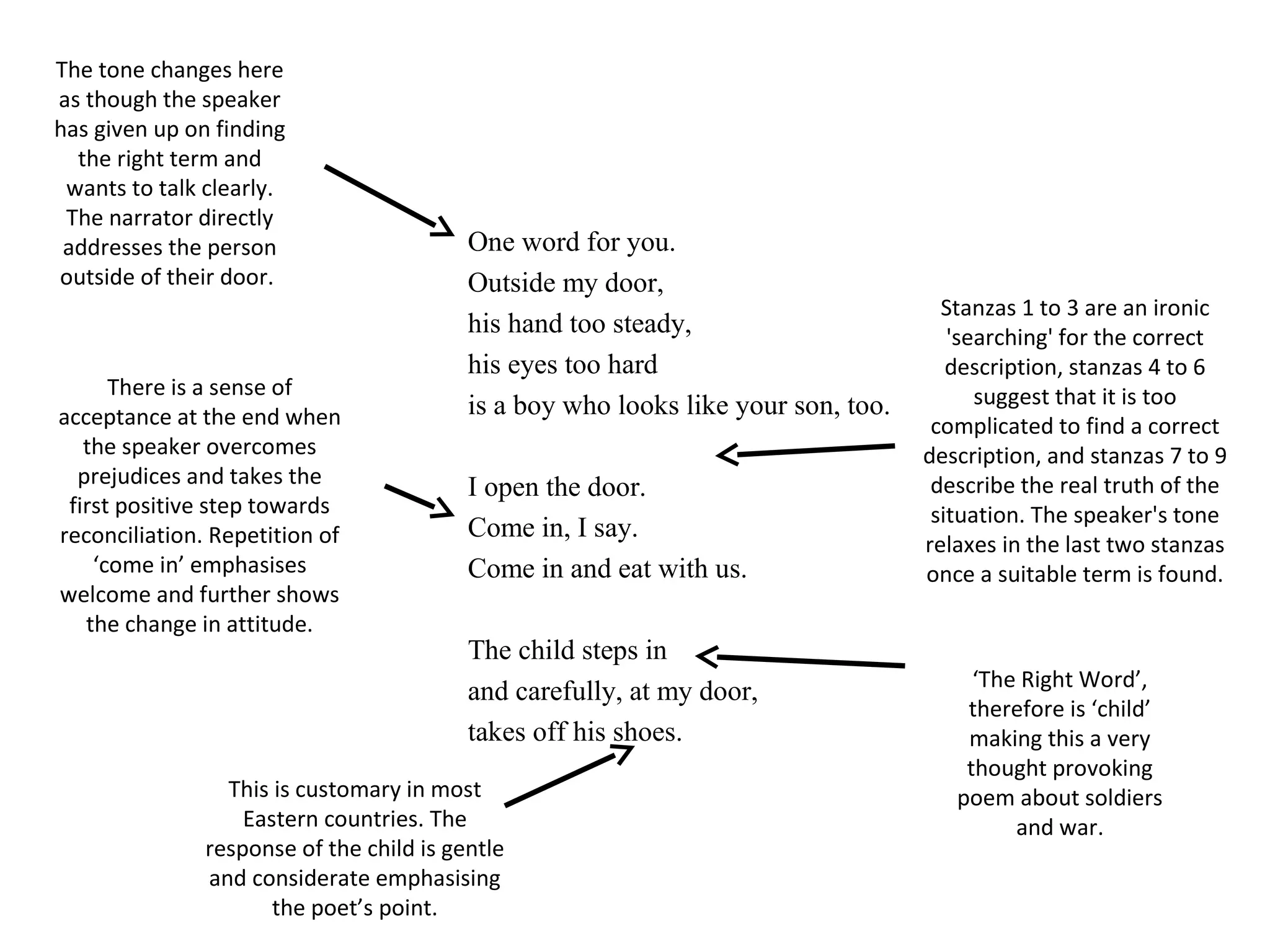
One word for you.
Outside my door,
his hand too steady,
his eyes too hard
is a boy who looks like your son, too.
I open the door.
Come in, I say.
Come in and eat with us.
The child steps in
and carefully, at my door,
takes off his shoes.
Stanzas 1 to 3 are an ironic
'searching' for the correct
description, stanzas 4 to 6
suggest that it is too
complicated to find a correct
description, and stanzas 7 to 9
describe the real truth of the
situation. The speaker's tone
relaxes in the last two stanzas
once a suitable term is found.
There is a sense of
acceptance at the end when
the speaker overcomes
prejudices and takes the
first positive step towards
reconciliation. Repetition of
‘come in’ emphasises
welcome and further shows
the change in attitude.
The tone changes here
as though the speaker
has given up on finding
the right term and
wants to talk clearly.
The narrator directly
addresses the person
outside of their door.
This is customary in most
Eastern countries. The
response of the child is gentle
and considerate emphasising
the poet’s point.
‘The Right Word’,
therefore is ‘child’
making this a very
thought provoking
poem about soldiers
and war.
One word for you.
Outside my door,
his hand too steady,
his eyes too hard
is a boy who looks like your son, too.
I open the door.
Come in, I say.
Come in and eat with us.
The child steps in
and carefully, at my door,
takes off his shoes.
Stanzas 1 to 3 are an ironic
'searching' for the correct
description, stanzas 4 to 6
suggest that it is too
complicated to find a correct
description, and stanzas 7 to 9
describe the real truth of the
situation. The speaker's tone
relaxes in the last two stanzas
once a suitable term is found.
There is a sense of
acceptance at the end when
the speaker overcomes
prejudices and takes the
first positive step towards
reconciliation. Repetition of
‘come in’ emphasises
welcome and further shows
the change in attitude.
The tone changes here
as though the speaker
has given up on finding
the right term and
wants to talk clearly.
The narrator directly
addresses the person
outside of their door.
This is customary in most
Eastern countries. The
response of the child is gentle
and considerate emphasising
the poet’s point.
‘The Right Word’,
therefore is ‘child’
making this a very
thought provoking
poem about soldiers
and war.

The Right Word by Imtiaz Dharker

  • 1.
    The Right Word ImtiazDharker Imtiaz Dharker was born in the Punjab, Pakistan in 1954. She grew up in Glasgow in a Lahori household and now divides her time between India, Wales and London. She describes herself as a Scottish Muslim Calvinist. She has said that she believes identity comes from "beliefs and states of mind", rather than nationality or religion. ‘One man's terrorist is another man's freedom fighter’ first written by Gerald Seymour in his 1975 book Harry's Game. The book is about a British cabinet minister who is killed by an Irish Republican Army (IRA) assassin (Billy Downes), who then flees to Belfast, and an undercover agent (Harry Brown aka McEvoy) sent to track him down before he can kill again. The book introduced the phrase, not familiar before the '80s, "One man's terrorist is another man's freedom fighter." Many other people have quoted it too, and can be referred to the Israel/Palestine conflict, and the Iraq War, Middle East conflicts. As well as conflicts and uprisings in Africa, Colombia, etc. Set against the sensitive post-9/11 backdrop of political and religious tensions, ‘The Right Word’ seems at first to contradict this description. The use of questions and alternative ways of describing someone suggests a poem full of doubt, where words are ‘waving, wavering flags’ and nothing can be pinned down with certainty. Confusion, fear and distrust prevail. However, the poem dramatises the search to know one’s own mind, the process of moving from uncertainty to certainty. It is when it moves from considering the problem at the political level (‘one man’s terrorist is another man’s freedom-fighter’) to the personal (‘I saw his face’) that the doubt and fear is removed. You should compare this poem with other poems about the same themes: causes of conflict: 'The Yellow Palm’ , 'next to of course god america i’; divided society: 'At the Border, 1979’.
  • 3.
    Outside the door, lurkingin the shadows, is a terrorist. Is that the wrong description? Outside that door, taking shelter in the shadows, is a freedom-fighter. I haven’t got this right. Outside, waiting in the shadows, is a hostile militant. The poem is about a suspicious and divided community, where different viewpoints lead to violence. The narrator tries to find an accurate way to describe a young activist who at first seems threatening. At the end, the activist seems to be just a harmless child. The poem is written in the first person, making it seem personal with consistent use of the personal pronoun ‘I’. The words lurking and taking shelter are two different words for the same action, but one sounds sinister and the other sounds vulnerable. It is clear from the first stanza that this is a political poem as the term ‘terrorist’ is still controversial. Blunt, emotive choice of noun makes first stanza seem threatening and gets the readers’ attention. Using first and second person pronouns and addressing the reader links the speaker and the reader. There are some questions to show that the speaker is struggling to be definite. This shows how difficult it is to determine the difference between right and wrong. Several phrases are repeated with slight changes each time, as if the speaker is going back and re-wording them to try to make them more accurate. The repetition of words like "door" and "shadows" keeps up an atmosphere of suspicion and suggests barriers and uncertainty. The stanzas have no regular rhythm or rhyme and are of different lengths and this could reflect the difficulty of finding an agreed way of seeing the situation. Each of the first seven stanzas is a separate way of describing the young man.
  • 4.
    Are words nomore than waving, wavering flags? Outside your door, watchful in the shadows, is a guerrilla warrior. God help me. Outside, defying every shadow, stands a martyr. I saw his face. No words can help me now. Just outside the door, lost in shadows, is a child who looks like mine. The poet uses a range of nouns and verbs to describe activists and their behaviour, each with different emotional connotations. There is an idea that language is important, and that words can influence people's attitudes and create fear and suspicion. The poem suggests that labelling something can turn it into a threat when it isn't one. The descriptions of the activist in the first five stanzas show how afraid and suspicious people can be. The flags could be an attempt to communicate, but could suggest that patriotism can be misleading. 'Wavering" reinforces the idea of uncertainty. A ‘martyr’ is a person who willingly suffers death rather than renounce his or her religion. Or could also describe a person who is put to death or endures great suffering on behalf of any belief, principle, or cause The emotive description of the recognisable ‘child’ takes away the threat and links the speaker and the activist. This is a pivotal point in the poem as the feelings of the narrator change from extreme hatred to love.
  • 5.
    One word foryou. Outside my door, his hand too steady, his eyes too hard is a boy who looks like your son, too. I open the door. Come in, I say. Come in and eat with us. The child steps in and carefully, at my door, takes off his shoes. Stanzas 1 to 3 are an ironic 'searching' for the correct description, stanzas 4 to 6 suggest that it is too complicated to find a correct description, and stanzas 7 to 9 describe the real truth of the situation. The speaker's tone relaxes in the last two stanzas once a suitable term is found. There is a sense of acceptance at the end when the speaker overcomes prejudices and takes the first positive step towards reconciliation. Repetition of ‘come in’ emphasises welcome and further shows the change in attitude. The tone changes here as though the speaker has given up on finding the right term and wants to talk clearly. The narrator directly addresses the person outside of their door. This is customary in most Eastern countries. The response of the child is gentle and considerate emphasising the poet’s point. ‘The Right Word’, therefore is ‘child’ making this a very thought provoking poem about soldiers and war.
  • 6.
    One word foryou. Outside my door, his hand too steady, his eyes too hard is a boy who looks like your son, too. I open the door. Come in, I say. Come in and eat with us. The child steps in and carefully, at my door, takes off his shoes. Stanzas 1 to 3 are an ironic 'searching' for the correct description, stanzas 4 to 6 suggest that it is too complicated to find a correct description, and stanzas 7 to 9 describe the real truth of the situation. The speaker's tone relaxes in the last two stanzas once a suitable term is found. There is a sense of acceptance at the end when the speaker overcomes prejudices and takes the first positive step towards reconciliation. Repetition of ‘come in’ emphasises welcome and further shows the change in attitude. The tone changes here as though the speaker has given up on finding the right term and wants to talk clearly. The narrator directly addresses the person outside of their door. This is customary in most Eastern countries. The response of the child is gentle and considerate emphasising the poet’s point. ‘The Right Word’, therefore is ‘child’ making this a very thought provoking poem about soldiers and war.