Exposure
Wilfred Owen
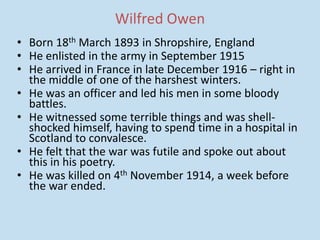
• Born 18th March 1893 in Shropshire, England
• He enlisted in the army in September 1915
• He arrived in France in late December 1916 – right in
the middle of one of the harshest winters.
• He was an officer and led his men in some bloody
battles.
• He witnessed some terrible things and was shell-
shocked himself, having to spend time in a hospital in
Scotland to convalesce.
• He felt that the war was futile and spoke out about
this in his poetry.
• He was killed on 4th November 1914, a week before
the war ended.
Background Details
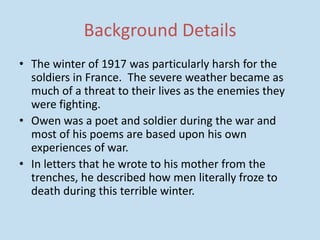
• The winter of 1917 was particularly harsh for the
soldiers in France. The severe weather became as
much of a threat to their lives as the enemies they
were fighting.
• Owen was a poet and soldier during the war and
most of his poems are based upon his own
experiences of war.
• In letters that he wrote to his mother from the
trenches, he described how men literally froze to
death during this terrible winter.
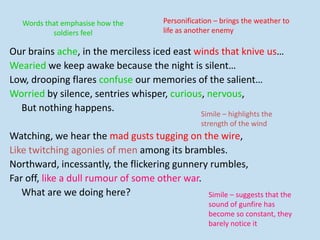
Our brains ache, in the merciless iced east winds that knive us…
Wearied we keep awake because the night is silent…
Low, drooping flares confuse our memories of the salient…
Worried by silence, sentries whisper, curious, nervous,
But nothing happens.
Watching, we hear the mad gusts tugging on the wire,
Like twitching agonies of men among its brambles.
Northward, incessantly, the flickering gunnery rumbles,
Far off, like a dull rumour of some other war.
What are we doing here?
Personification – brings the weather to
life as another enemy
Words that emphasise how the
soldiers feel
Simile – highlights the
strength of the wind
Simile – suggests that the
sound of gunfire has
become so constant, they
barely notice it
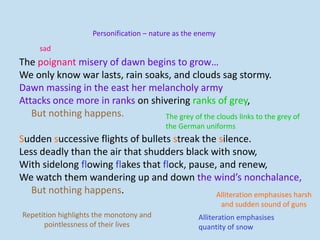
The poignant misery of dawn begins to grow…
We only know war lasts, rain soaks, and clouds sag stormy.
Dawn massing in the east her melancholy army
Attacks once more in ranks on shivering ranks of grey,
But nothing happens.
Sudden successive flights of bullets streak the silence.
Less deadly than the air that shudders black with snow,
With sidelong flowing flakes that flock, pause, and renew,
We watch them wandering up and down the wind’s nonchalance,
But nothing happens.
sad
Personification – nature as the enemy
The grey of the clouds links to the grey of
the German uniforms
Alliteration emphasises harsh
and sudden sound of guns
Alliteration emphasises
quantity of snow
Repetition highlights the monotony and
pointlessness of their lives
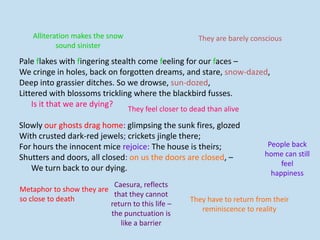
Pale flakes with fingering stealth come feeling for our faces –
We cringe in holes, back on forgotten dreams, and stare, snow-dazed,
Deep into grassier ditches. So we drowse, sun-dozed,
Littered with blossoms trickling where the blackbird fusses.
Is it that we are dying?
Slowly our ghosts drag home: glimpsing the sunk fires, glozed
With crusted dark-red jewels; crickets jingle there;
For hours the innocent mice rejoice: The house is theirs;
Shutters and doors, all closed: on us the doors are closed, –
We turn back to our dying.
Alliteration makes the snow
sound sinister
They are barely conscious
They feel closer to dead than alive
Metaphor to show they are
so close to death
People back
home can still
feel
happiness
They have to return from their
reminiscence to reality
Caesura, reflects
that they cannot
return to this life –
the punctuation is
like a barrier
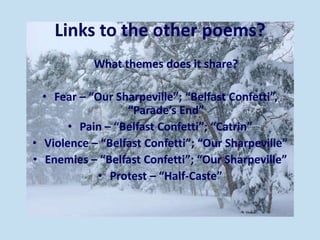
Links to the other poems?
What themes does it share?
• Fear – “Our Sharpeville”; “Belfast Confetti”,
“Parade’s End”
• Pain – “Belfast Confetti”; “Catrin”
• Violence – “Belfast Confetti”; “Our Sharpeville”
• Enemies – “Belfast Confetti”; “Our Sharpeville”
• Protest – “Half-Caste”

Exposure 1

  • 1.
  • 2.
    Wilfred Owen • Born18th March 1893 in Shropshire, England • He enlisted in the army in September 1915 • He arrived in France in late December 1916 – right in the middle of one of the harshest winters. • He was an officer and led his men in some bloody battles. • He witnessed some terrible things and was shell- shocked himself, having to spend time in a hospital in Scotland to convalesce. • He felt that the war was futile and spoke out about this in his poetry. • He was killed on 4th November 1914, a week before the war ended.
  • 3.
    Background Details • Thewinter of 1917 was particularly harsh for the soldiers in France. The severe weather became as much of a threat to their lives as the enemies they were fighting. • Owen was a poet and soldier during the war and most of his poems are based upon his own experiences of war. • In letters that he wrote to his mother from the trenches, he described how men literally froze to death during this terrible winter.
  • 4.
    Our brains ache,in the merciless iced east winds that knive us… Wearied we keep awake because the night is silent… Low, drooping flares confuse our memories of the salient… Worried by silence, sentries whisper, curious, nervous, But nothing happens. Watching, we hear the mad gusts tugging on the wire, Like twitching agonies of men among its brambles. Northward, incessantly, the flickering gunnery rumbles, Far off, like a dull rumour of some other war. What are we doing here? Personification – brings the weather to life as another enemy Words that emphasise how the soldiers feel Simile – highlights the strength of the wind Simile – suggests that the sound of gunfire has become so constant, they barely notice it
  • 5.
    The poignant miseryof dawn begins to grow… We only know war lasts, rain soaks, and clouds sag stormy. Dawn massing in the east her melancholy army Attacks once more in ranks on shivering ranks of grey, But nothing happens. Sudden successive flights of bullets streak the silence. Less deadly than the air that shudders black with snow, With sidelong flowing flakes that flock, pause, and renew, We watch them wandering up and down the wind’s nonchalance, But nothing happens. sad Personification – nature as the enemy The grey of the clouds links to the grey of the German uniforms Alliteration emphasises harsh and sudden sound of guns Alliteration emphasises quantity of snow Repetition highlights the monotony and pointlessness of their lives
  • 6.
    Pale flakes withfingering stealth come feeling for our faces – We cringe in holes, back on forgotten dreams, and stare, snow-dazed, Deep into grassier ditches. So we drowse, sun-dozed, Littered with blossoms trickling where the blackbird fusses. Is it that we are dying? Slowly our ghosts drag home: glimpsing the sunk fires, glozed With crusted dark-red jewels; crickets jingle there; For hours the innocent mice rejoice: The house is theirs; Shutters and doors, all closed: on us the doors are closed, – We turn back to our dying. Alliteration makes the snow sound sinister They are barely conscious They feel closer to dead than alive Metaphor to show they are so close to death People back home can still feel happiness They have to return from their reminiscence to reality Caesura, reflects that they cannot return to this life – the punctuation is like a barrier
  • 7.
    Links to theother poems? What themes does it share? • Fear – “Our Sharpeville”; “Belfast Confetti”, “Parade’s End” • Pain – “Belfast Confetti”; “Catrin” • Violence – “Belfast Confetti”; “Our Sharpeville” • Enemies – “Belfast Confetti”; “Our Sharpeville” • Protest – “Half-Caste”