Guide: Mrs. Gurkiran Kaur
AssistantProfessor(Peadiatrics)
Dasmesh College of
Nursing, Fdk
Co – Guide: Mrs. Rajwinder
Kaur
Assistant Professor
(Community Health
Nursing)
Dasmesh College of
Nursing,Fdk
GENERAL OBJECTIVE:
To assess the knowledge and practices regarding the
prevention of home accidents among mothers of under
five children.
1. To assess the knowledge on prevention of home
accidents among mothers of under five children
at selected rural areas of Faridkot, Punjab.
2. To assess the practices on prevention of home
accidents among mothers of under five children
at selected rural areas of Faridkot, Punjab.
3. To find out association between knowledge and
practices on prevention of Home Accidents
among mothers of under Five Children at
selected rural areas of Faridkot, Punjab.
4. To find out the association of knowledge on prevention
of home accidents among mothers of under Five Children
with their selected demographic variables.
5. To find out the association of practices on prevention of
home accidents among mothers of under Five Children
with their selected demographic variables.
6. To prepare and distribute booklet regarding knowledge
and practices on prevention of home accidents among
mothers of under Five Children at selected rural areas of
Faridkot, Punjab.
A home accident represents a major epidemic of non-
communicable disease throughout the world and is a leading cause
for death and disability among children. Every year 750,000
children die from injury and another 400 million are seriously
hurt. The most common injuries are falls, burns, drowning and
such injuries commonly occur in child’s own home.
Injuries are also leading cause of death and disability among
children in Asian countries. The research includes studies from six
countries i.e Bangladesh, China, India, Thailand , The Philippines
and viet nam indicates that child injuries accounts for as many as
half of the million child deaths recorded each year in East Asia
and Pacific region. In India, injuries were the second leading
Cause of death in 0-5 years old children.
So, the above facts motivates the researcher’s mind that by
improving knowledge of mothers of under five children through
Structured teaching programme to reduce the incidence of home
accidents.
Knowledge:- It is defined as the facts or condition of having
information or of being learned by the mothers of under five children
regarding home accidents and its prevention.
Prevention of accidents:- It refers to the plans, preparations and actions
taken by mothers to avoid or stop an accident before it happens.
Under-Five Children:- The term refers to the children who are aged
between 0-5 years.
Accidents:- An accident is defined as an unplanned event among under
five children resulting physical injury or even death may occur.
Assess:- It refers to judge the knowledge and practices of under five
children’s mothers on prevention of home accidents through self-
structured questionnaire and self-structured checklist.
Practices:- It refers to methods adapted by mothers of under five
children regarding prevention of home accidents.
The study was delimited to:
• Samples were restricted to the selected community
area.
• Sample size was limited to 120 mothers.
• Mothers of under five children.
• Who were willing to participate in this study.
Inclusion Criteria:
 Mothers those who were having under five children
in selected rural areas of Faridkot.
 Mothers who were willing to participate in the study.
 Mothers who were be able to understand Punjabi or
English.
Exclusion Criteria:
 Mothers who were sick at the time of data collection.
 Mothers who were not be available during the period
of data collection.
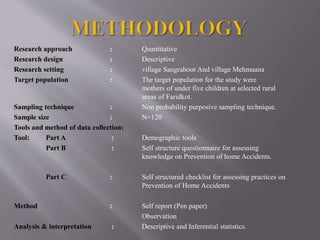
Research approach : Quantitative
Research design : Descriptive
Research setting : village Sangrahoor And village Mehmuana
Target population : The target population for the study were
mothers of under five children at selected rural
areas of Faridkot.
Sampling technique : Non probability purposive sampling technique.
Sample size : N=120
Tools and method of data collection:
Tool: Part A : Demographic tools
Part B : Self structure questionnaire for assessing
knowledge on Prevention of home Accidents.
Part C : Self structured checklist for assessing practices on
Prevention of Home Accidents
Method : Self report (Pen paper)
Observation
Analysis & interpretation : Descriptive and Inferential statistics.
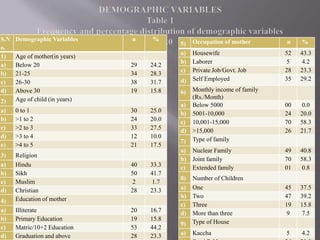
5) Occupation of mother n %
a) Housewife 52 43.3
b) Laborer 5 4.2
c) Private Job/Govt. Job 28 23.3
d) Self Employed 35 29.2
6) Monthly income of family
(Rs./Month)
a) Below 5000 00 0.0
b) 5001-10,000 24 20.0
c) 10,001-15,000 70 58.3
d) >15,000 26 21.7
7) Type of family
a) Nuclear Family 49 40.8
b) Joint family 70 58.3
c) Extended family 01 0.8
8) Number of Children
a) One 45 37.5
b) Two 47 39.2
c) Three 19 15.8
d) More than three 9 7.5
9) Type of House
a) Kaccha 5 4.2
S.N
o.
Demographic Variables n %
1) Age of mother(in years)
a) Below 20 29 24.2
b) 21-25 34 28.3
c) 26-30 38 31.7
d) Above 30 19 15.8
2) Age of child (in years)
a) 0 to 1 30 25.0
b) >1 to 2 24 20.0
c) >2 to 3 33 27.5
d) >3 to 4 12 10.0
e) >4 to 5 21 17.5
3) Religion
a) Hindu 40 33.3
b) Sikh 50 41.7
c) Muslim 2 1.7
d) Christian 28 23.3
4) Education of mother
a) Illiterate 20 16.7
b) Primary Education 19 15.8
c) Matric/10+2 Education 53 44.2
d) Graduation and above 28 23.3
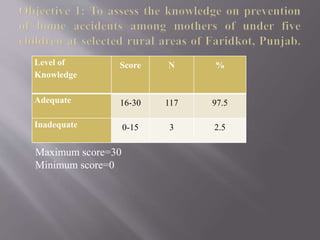
Level of
Knowledge
Score N %
Adequate 16-30 117 97.5
Inadequate 0-15 3 2.5
Maximum score=30
Minimum score=0
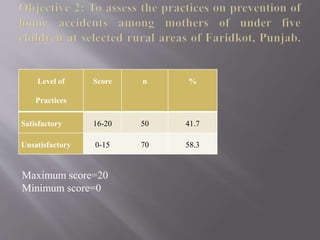
Level of
Practices
Score n %
Satisfactory 16-20 50 41.7
Unsatisfactory 0-15 70 58.3
Maximum score=20
Minimum score=0
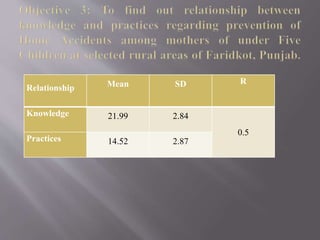
Relationship Mean SD R
Knowledge 21.99 2.84
0.5
Practices 14.52 2.87
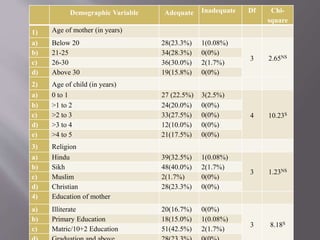
Demographic Variable Adequate Inadequate Df Chi-
square
1) Age of mother (in years)
a) Below 20 28(23.3%) 1(0.08%)
3 2.65NS
b) 21-25 34(28.3%) 0(0%)
c) 26-30 36(30.0%) 2(1.7%)
d) Above 30 19(15.8%) 0(0%)
2) Age of child (in years)
a) 0 to 1 27 (22.5%) 3(2.5%)
4 10.23S
b) >1 to 2 24(20.0%) 0(0%)
c) >2 to 3 33(27.5%) 0(0%)
d) >3 to 4 12(10.0%) 0(0%)
e) >4 to 5 21(17.5%) 0(0%)
3) Religion
a) Hindu 39(32.5%) 1(0.08%)
3 1.23NS
b) Sikh 48(40.0%) 2(1.7%)
c) Muslim 2(1.7%) 0(0%)
d) Christian 28(23.3%) 0(0%)
4) Education of mother
a) Illiterate 20(16.7%) 0(0%)
3 8.18S
b) Primary Education 18(15.0%) 1(0.08%)
c) Matric/10+2 Education 51(42.5%) 2(1.7%)
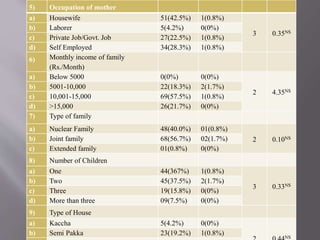
5) Occupation of mother
a) Housewife 51(42.5%) 1(0.8%)
3 0.35NS
b) Laborer 5(4.2%) 0(0%)
c) Private Job/Govt. Job 27(22.5%) 1(0.8%)
d) Self Employed 34(28.3%) 1(0.8%)
6) Monthly income of family
(Rs./Month)
a) Below 5000 0(0%) 0(0%)
2 4.35NS
b) 5001-10,000 22(18.3%) 2(1.7%)
c) 10,001-15,000 69(57.5%) 1(0.8%)
d) >15,000 26(21.7%) 0(0%)
7) Type of family
a) Nuclear Family 48(40.0%) 01(0.8%)
2 0.10NS
b) Joint family 68(56.7%) 02(1.7%)
c) Extended family 01(0.8%) 0(0%)
8) Number of Children
a) One 44(367%) 1(0.8%)
3 0.33NS
b) Two 45(37.5%) 2(1.7%)
c) Three 19(15.8%) 0(0%)
d) More than three 09(7.5%) 0(0%)
9) Type of House
a) Kaccha 5(4.2%) 0(0%)
NS
b) Semi Pakka 23(19.2%) 1(0.8%)
Demographic Variable Adequate Inadequate df Chi-square
1) Age of mother (in years)
a) Below 20 16(13.4%) 13(10.9%)
3 4.08NS
b) 21-25 13(10.9%) 20(16.8%)
c) 26-30 12(10.1%) 26(21.8%)
d) Above 30 9(7.6%) 10(8.4%)
2) Age of child (in years)
a) 0 to 1 10(8.3%) 20(16.7%)
4 6.07S
b) >1 to 2 9(7.5%) 15(12.5%)
c) >2 to 3 19(15.8%) 14(11.7%)
d) >3 to 4 5(4.2%) 7(5.8%)
e) >4 to 5 7(5.8%) 14(11.7%)
3) Religion
a) Hindu 15(12.5%) 25(20.8%)
3 1.23NS
b) Sikh 23(19.2%) 27(22.5%)
c) Muslim 0(0.0%) 2(1.7%)
d) Christian 12(10.0%) 16(13.3%)
4) Education of mother
a) Illiterate 12(10.0%/) 8(6.7%)
b) Primary Education 8(6.7%) 11(9.2%)
5) Occupation of mother
a) Housewife 22(18.3%) 30(25.0%)
3 0.10NS
b) Laborer 2(1.7%) 3(2.5%)
c) Private Job/Govt. Job 11(9.2%) 17(14.2%)
d) Self Employed 15(12.5%) 20(16.7%)
6) Monthly income of family
(Rs./Month)
a) Below 5000 0 0
2
4.35NS
b) 5001-10,000 9(7.6%) 15(12.6%)
c) 10,001-15,000 32(26.9%) 37(31.1%)
d) >15,000 9(7.6%) 17(14.3%)
7) Type of family
a) Nuclear Family 22(18.3%) 27(22.5%)
2
0.10NS
b) Joint family 27(22.5%) 43(35.8%)
c) Extended family 01(0.8%) 0(0%)
8) Number of Children
a) One 18(15.0%) 27(22.5%)
3 0.33NS
b) Two 22(18.3%) 25(20.8%)
c) Three 08(6.7%) 11(9.2%)
d) More than three 02(1.7%) 7(5.8%)
9) Type of House
a) Kaccha 3(2.5%) 2(1.7%)
2 2.92NS
b) Semi Pakka 13(10.8%) 11(9.2%)
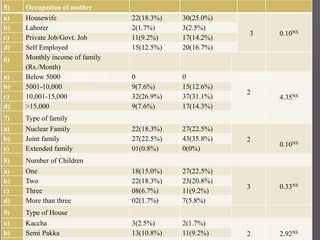
Maximum score = 20 S = Significant at p<0.05
Minimum score = 0 NS = Non-Significant
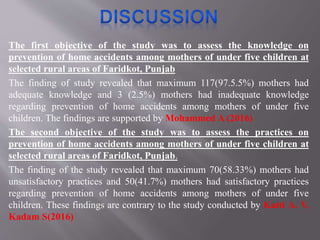
The first objective of the study was to assess the knowledge on
prevention of home accidents among mothers of under five children at
selected rural areas of Faridkot, Punjab
The finding of study revealed that maximum 117(97.5.5%) mothers had
adequate knowledge and 3 (2.5%) mothers had inadequate knowledge
regarding prevention of home accidents among mothers of under five
children. The findings are supported by Mohammed A (2016)
The second objective of the study was to assess the practices on
prevention of home accidents among mothers of under five children at
selected rural areas of Faridkot, Punjab.
The finding of the study revealed that maximum 70(58.33%) mothers had
unsatisfactory practices and 50(41.7%) mothers had satisfactory practices
regarding prevention of home accidents among mothers of under five
children. These findings are contrary to the study conducted by Katti A. V,
Kadam S(2016)
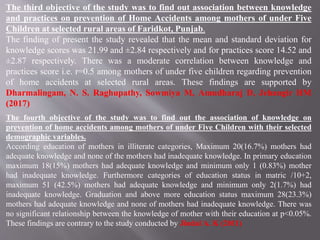
The third objective of the study was to find out association between knowledge
and practices on prevention of Home Accidents among mothers of under Five
Children at selected rural areas of Faridkot, Punjab.
The finding of present the study revealed that the mean and standard deviation for
knowledge scores was 21.99 and ±2.84 respectively and for practices score 14.52 and
±2.87 respectively. There was a moderate correlation between knowledge and
practices score i.e. r=0.5 among mothers of under five children regarding prevention
of home accidents at selected rural areas. These findings are supported by
Dharmalingam, N. S. Raghupathy, Sowmiya M, Amudharaj D, Jehangir HM
(2017)
The fourth objective of the study was to find out the association of knowledge on
prevention of home accidents among mothers of under Five Children with their selected
demographic variables.
According education of mothers in illiterate categories, Maximum 20(16.7%) mothers had
adequate knowledge and none of the mothers had inadequate knowledge. In primary education
maximum 18(15%) mothers had adequate knowledge and minimum only 1 (0.83%) mother
had inadequate knowledge. Furthermore categories of education status in matric /10+2,
maximum 51 (42.5%) mothers had adequate knowledge and minimum only 2(1.7%) had
inadequate knowledge. Graduation and above more education status maximum 28(23.3%)
mothers had adequate knowledge and none of mothers had inadequate knowledge. There was

no significant relationship between the knowledge of mother with their education at p<0.05%.
These findings are contrary to the study conducted by Jindal A. K (2011)
The fifth objective of the study was to find out the association of
practices on prevention of home accidents among mothers of
under Five Children with their selected demographic variables.
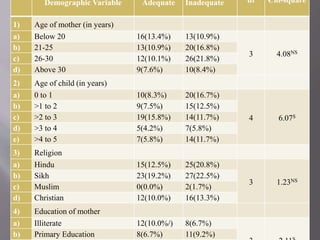
In the age of children 0-1 year, that 10(8.3%) mothers had satisfactory
practices, minimum 20(16.7%) mothers had unsatisfactory practices.
In the age of children>1 upto 2 years, 9(7.5%) mothers had
satisfactory practices, minimum 15 (12.5%) had unsatisfactory
practices,>2 upto 3 years of children, maximum 19 (15.8%) mothers
had satisfactory practices and minimum 14(11.7%) had unsatisfactory.
In age group of children >3 upto 4 years 5 (4.2%) had satisfactory
practices and 7 (5.8%) mothers had unsatisfactory practices. In age
group >4 upto 5 years 7 (5.8%) had satisfactory practices and 14
(11.7%) had unsatisfactory practices regarding prevention of home
accidents. There was no significant relationship between the practices
of mother with their age of children at p<0.05level. The findings was
supported by Khan S, Tauheed N, Nawab S, Afzal S and Khaliqu N (2019)
MAJOR FINDINGS
Distribution of the demographic variables of study revealed that
• Maximum number of the mothers 38 (31.7%) were in the age
group of 26-30 years, minimum 19 (15.8%) mothers were in age
group of above 30 years.
• Maximum number of the children 33 (27.5%) were in the age
group of <2 to 3 years and minimum 12 (10.0%) children were
in the age group of <4 to 5 years.
• Maximum number of the mothers 50 (41.7%) were belonged to
Sikh religion; minimum 2 (1.7%) mothers were belonged to
Muslim religion.
• Maximum number of mothers 53 (44.2.%) were educated up to
matric/ 10+2 standard and minimum 19 (15.8%) mothers were
primary educate.
• Maximum number of mothers 52 (43.3%) were
housewife and minimum 5(4.2%) mothers were laborers.
• Maximum monthly income of family of 70 (58.3%)
mothers had 10,001-15,000 Rs/month, minimum no
mother had >5000 Rs/month.
• Maximum number of mothers 70 (58.3%) were belonged
to joint family and minimum 01 (0.8%) mother were
belonged to extended family.
• Maximum number of mothers 47 (39.2%) were having
two children; minimum 9 (7.5%) mothers were having
more than three children.
• Maximum number of 91 (75.8%) mothers had pakka
house and minimum 5 (4.2%) mothers had kaccha house.
• According to criterion measure adopted by
investigator, maximum 117(97.5.5%) mothers
had adequate knowledge and 3(2.5%) mothers
had inadequate knowledge.
• Maximum number of the mothers 70 (58.3%)
had satisfactory practices and minimum 50
(41.7.%) mothers had unsatisfactory practices.
There was a moderate correlation between
knowledge and practices that is r =0.5 among
mothers of under five children regarding
prevention of home accidents in selected rural
areas.
There was significant relationship found between knowledge
and selected variables i.e. age of child and educational status of
mother and there was no significant relationship between
knowledge and selected variables i.e. age of mother, religion of
family, occupational status of mother, monthly income of
family, type of family, number of children, type of house.
There was significant relationship found between practices and
selected variables i.e age of child and type of family and there
was no significant relationship between practices score and
selected variables i.e. age of mother, religion of family,
educational status of mother, occupational status of mother,
monthly income of family, number of children, type of house.
1. The study can be replicate on large sample to validate
and generalize its findings.
2. The study can be conducted in different community
health settings.
3. Comparative study can be conducted in rural and urban
areas to compare the knowledge and practices of mothers
of under five children regarding prevention of home
accidents.
4. A quasi experimental study can be conducted to
evaluate the effectiveness of structured teaching
programme on knowledge and practices of children
regarding prevention of home accidents.
thesis presentation.pptx

thesis presentation.pptx

  • 1.
    Guide: Mrs. GurkiranKaur AssistantProfessor(Peadiatrics) Dasmesh College of Nursing, Fdk Co – Guide: Mrs. Rajwinder Kaur Assistant Professor (Community Health Nursing) Dasmesh College of Nursing,Fdk
  • 2.
    GENERAL OBJECTIVE: To assessthe knowledge and practices regarding the prevention of home accidents among mothers of under five children.
  • 3.
    1. To assessthe knowledge on prevention of home accidents among mothers of under five children at selected rural areas of Faridkot, Punjab. 2. To assess the practices on prevention of home accidents among mothers of under five children at selected rural areas of Faridkot, Punjab. 3. To find out association between knowledge and practices on prevention of Home Accidents among mothers of under Five Children at selected rural areas of Faridkot, Punjab.
  • 4.
    4. To findout the association of knowledge on prevention of home accidents among mothers of under Five Children with their selected demographic variables. 5. To find out the association of practices on prevention of home accidents among mothers of under Five Children with their selected demographic variables. 6. To prepare and distribute booklet regarding knowledge and practices on prevention of home accidents among mothers of under Five Children at selected rural areas of Faridkot, Punjab.
  • 5.
    A home accidentrepresents a major epidemic of non- communicable disease throughout the world and is a leading cause for death and disability among children. Every year 750,000 children die from injury and another 400 million are seriously hurt. The most common injuries are falls, burns, drowning and such injuries commonly occur in child’s own home. Injuries are also leading cause of death and disability among children in Asian countries. The research includes studies from six countries i.e Bangladesh, China, India, Thailand , The Philippines and viet nam indicates that child injuries accounts for as many as half of the million child deaths recorded each year in East Asia and Pacific region. In India, injuries were the second leading Cause of death in 0-5 years old children. So, the above facts motivates the researcher’s mind that by improving knowledge of mothers of under five children through Structured teaching programme to reduce the incidence of home accidents.
  • 6.
    Knowledge:- It isdefined as the facts or condition of having information or of being learned by the mothers of under five children regarding home accidents and its prevention. Prevention of accidents:- It refers to the plans, preparations and actions taken by mothers to avoid or stop an accident before it happens. Under-Five Children:- The term refers to the children who are aged between 0-5 years. Accidents:- An accident is defined as an unplanned event among under five children resulting physical injury or even death may occur. Assess:- It refers to judge the knowledge and practices of under five children’s mothers on prevention of home accidents through self- structured questionnaire and self-structured checklist. Practices:- It refers to methods adapted by mothers of under five children regarding prevention of home accidents.
  • 7.
    The study wasdelimited to: • Samples were restricted to the selected community area. • Sample size was limited to 120 mothers. • Mothers of under five children. • Who were willing to participate in this study.
  • 8.
    Inclusion Criteria:  Mothersthose who were having under five children in selected rural areas of Faridkot.  Mothers who were willing to participate in the study.  Mothers who were be able to understand Punjabi or English. Exclusion Criteria:  Mothers who were sick at the time of data collection.  Mothers who were not be available during the period of data collection.
  • 9.
    Research approach :Quantitative Research design : Descriptive Research setting : village Sangrahoor And village Mehmuana Target population : The target population for the study were mothers of under five children at selected rural areas of Faridkot. Sampling technique : Non probability purposive sampling technique. Sample size : N=120 Tools and method of data collection: Tool: Part A : Demographic tools Part B : Self structure questionnaire for assessing knowledge on Prevention of home Accidents. Part C : Self structured checklist for assessing practices on Prevention of Home Accidents Method : Self report (Pen paper) Observation Analysis & interpretation : Descriptive and Inferential statistics.
  • 12.
    5) Occupation ofmother n % a) Housewife 52 43.3 b) Laborer 5 4.2 c) Private Job/Govt. Job 28 23.3 d) Self Employed 35 29.2 6) Monthly income of family (Rs./Month) a) Below 5000 00 0.0 b) 5001-10,000 24 20.0 c) 10,001-15,000 70 58.3 d) >15,000 26 21.7 7) Type of family a) Nuclear Family 49 40.8 b) Joint family 70 58.3 c) Extended family 01 0.8 8) Number of Children a) One 45 37.5 b) Two 47 39.2 c) Three 19 15.8 d) More than three 9 7.5 9) Type of House a) Kaccha 5 4.2 S.N o. Demographic Variables n % 1) Age of mother(in years) a) Below 20 29 24.2 b) 21-25 34 28.3 c) 26-30 38 31.7 d) Above 30 19 15.8 2) Age of child (in years) a) 0 to 1 30 25.0 b) >1 to 2 24 20.0 c) >2 to 3 33 27.5 d) >3 to 4 12 10.0 e) >4 to 5 21 17.5 3) Religion a) Hindu 40 33.3 b) Sikh 50 41.7 c) Muslim 2 1.7 d) Christian 28 23.3 4) Education of mother a) Illiterate 20 16.7 b) Primary Education 19 15.8 c) Matric/10+2 Education 53 44.2 d) Graduation and above 28 23.3
  • 13.
    Level of Knowledge Score N% Adequate 16-30 117 97.5 Inadequate 0-15 3 2.5 Maximum score=30 Minimum score=0
  • 14.
    Level of Practices Score n% Satisfactory 16-20 50 41.7 Unsatisfactory 0-15 70 58.3 Maximum score=20 Minimum score=0
  • 15.
    Relationship Mean SDR Knowledge 21.99 2.84 0.5 Practices 14.52 2.87
  • 17.
    Demographic Variable AdequateInadequate Df Chi- square 1) Age of mother (in years) a) Below 20 28(23.3%) 1(0.08%) 3 2.65NS b) 21-25 34(28.3%) 0(0%) c) 26-30 36(30.0%) 2(1.7%) d) Above 30 19(15.8%) 0(0%) 2) Age of child (in years) a) 0 to 1 27 (22.5%) 3(2.5%) 4 10.23S b) >1 to 2 24(20.0%) 0(0%) c) >2 to 3 33(27.5%) 0(0%) d) >3 to 4 12(10.0%) 0(0%) e) >4 to 5 21(17.5%) 0(0%) 3) Religion a) Hindu 39(32.5%) 1(0.08%) 3 1.23NS b) Sikh 48(40.0%) 2(1.7%) c) Muslim 2(1.7%) 0(0%) d) Christian 28(23.3%) 0(0%) 4) Education of mother a) Illiterate 20(16.7%) 0(0%) 3 8.18S b) Primary Education 18(15.0%) 1(0.08%) c) Matric/10+2 Education 51(42.5%) 2(1.7%)
  • 18.
    5) Occupation ofmother a) Housewife 51(42.5%) 1(0.8%) 3 0.35NS b) Laborer 5(4.2%) 0(0%) c) Private Job/Govt. Job 27(22.5%) 1(0.8%) d) Self Employed 34(28.3%) 1(0.8%) 6) Monthly income of family (Rs./Month) a) Below 5000 0(0%) 0(0%) 2 4.35NS b) 5001-10,000 22(18.3%) 2(1.7%) c) 10,001-15,000 69(57.5%) 1(0.8%) d) >15,000 26(21.7%) 0(0%) 7) Type of family a) Nuclear Family 48(40.0%) 01(0.8%) 2 0.10NS b) Joint family 68(56.7%) 02(1.7%) c) Extended family 01(0.8%) 0(0%) 8) Number of Children a) One 44(367%) 1(0.8%) 3 0.33NS b) Two 45(37.5%) 2(1.7%) c) Three 19(15.8%) 0(0%) d) More than three 09(7.5%) 0(0%) 9) Type of House a) Kaccha 5(4.2%) 0(0%) NS b) Semi Pakka 23(19.2%) 1(0.8%)
  • 20.
    Demographic Variable AdequateInadequate df Chi-square 1) Age of mother (in years) a) Below 20 16(13.4%) 13(10.9%) 3 4.08NS b) 21-25 13(10.9%) 20(16.8%) c) 26-30 12(10.1%) 26(21.8%) d) Above 30 9(7.6%) 10(8.4%) 2) Age of child (in years) a) 0 to 1 10(8.3%) 20(16.7%) 4 6.07S b) >1 to 2 9(7.5%) 15(12.5%) c) >2 to 3 19(15.8%) 14(11.7%) d) >3 to 4 5(4.2%) 7(5.8%) e) >4 to 5 7(5.8%) 14(11.7%) 3) Religion a) Hindu 15(12.5%) 25(20.8%) 3 1.23NS b) Sikh 23(19.2%) 27(22.5%) c) Muslim 0(0.0%) 2(1.7%) d) Christian 12(10.0%) 16(13.3%) 4) Education of mother a) Illiterate 12(10.0%/) 8(6.7%) b) Primary Education 8(6.7%) 11(9.2%)
  • 21.
    5) Occupation ofmother a) Housewife 22(18.3%) 30(25.0%) 3 0.10NS b) Laborer 2(1.7%) 3(2.5%) c) Private Job/Govt. Job 11(9.2%) 17(14.2%) d) Self Employed 15(12.5%) 20(16.7%) 6) Monthly income of family (Rs./Month) a) Below 5000 0 0 2 4.35NS b) 5001-10,000 9(7.6%) 15(12.6%) c) 10,001-15,000 32(26.9%) 37(31.1%) d) >15,000 9(7.6%) 17(14.3%) 7) Type of family a) Nuclear Family 22(18.3%) 27(22.5%) 2 0.10NS b) Joint family 27(22.5%) 43(35.8%) c) Extended family 01(0.8%) 0(0%) 8) Number of Children a) One 18(15.0%) 27(22.5%) 3 0.33NS b) Two 22(18.3%) 25(20.8%) c) Three 08(6.7%) 11(9.2%) d) More than three 02(1.7%) 7(5.8%) 9) Type of House a) Kaccha 3(2.5%) 2(1.7%) 2 2.92NS b) Semi Pakka 13(10.8%) 11(9.2%) Maximum score = 20 S = Significant at p<0.05 Minimum score = 0 NS = Non-Significant
  • 23.
    The first objectiveof the study was to assess the knowledge on prevention of home accidents among mothers of under five children at selected rural areas of Faridkot, Punjab The finding of study revealed that maximum 117(97.5.5%) mothers had adequate knowledge and 3 (2.5%) mothers had inadequate knowledge regarding prevention of home accidents among mothers of under five children. The findings are supported by Mohammed A (2016) The second objective of the study was to assess the practices on prevention of home accidents among mothers of under five children at selected rural areas of Faridkot, Punjab. The finding of the study revealed that maximum 70(58.33%) mothers had unsatisfactory practices and 50(41.7%) mothers had satisfactory practices regarding prevention of home accidents among mothers of under five children. These findings are contrary to the study conducted by Katti A. V, Kadam S(2016)
  • 24.
    The third objectiveof the study was to find out association between knowledge and practices on prevention of Home Accidents among mothers of under Five Children at selected rural areas of Faridkot, Punjab. The finding of present the study revealed that the mean and standard deviation for knowledge scores was 21.99 and ±2.84 respectively and for practices score 14.52 and ±2.87 respectively. There was a moderate correlation between knowledge and practices score i.e. r=0.5 among mothers of under five children regarding prevention of home accidents at selected rural areas. These findings are supported by Dharmalingam, N. S. Raghupathy, Sowmiya M, Amudharaj D, Jehangir HM (2017) The fourth objective of the study was to find out the association of knowledge on prevention of home accidents among mothers of under Five Children with their selected demographic variables. According education of mothers in illiterate categories, Maximum 20(16.7%) mothers had adequate knowledge and none of the mothers had inadequate knowledge. In primary education maximum 18(15%) mothers had adequate knowledge and minimum only 1 (0.83%) mother had inadequate knowledge. Furthermore categories of education status in matric /10+2, maximum 51 (42.5%) mothers had adequate knowledge and minimum only 2(1.7%) had inadequate knowledge. Graduation and above more education status maximum 28(23.3%) mothers had adequate knowledge and none of mothers had inadequate knowledge. There was no significant relationship between the knowledge of mother with their education at p<0.05%. These findings are contrary to the study conducted by Jindal A. K (2011)
  • 25.
    The fifth objectiveof the study was to find out the association of practices on prevention of home accidents among mothers of under Five Children with their selected demographic variables. In the age of children 0-1 year, that 10(8.3%) mothers had satisfactory practices, minimum 20(16.7%) mothers had unsatisfactory practices. In the age of children>1 upto 2 years, 9(7.5%) mothers had satisfactory practices, minimum 15 (12.5%) had unsatisfactory practices,>2 upto 3 years of children, maximum 19 (15.8%) mothers had satisfactory practices and minimum 14(11.7%) had unsatisfactory. In age group of children >3 upto 4 years 5 (4.2%) had satisfactory practices and 7 (5.8%) mothers had unsatisfactory practices. In age group >4 upto 5 years 7 (5.8%) had satisfactory practices and 14 (11.7%) had unsatisfactory practices regarding prevention of home accidents. There was no significant relationship between the practices of mother with their age of children at p<0.05level. The findings was supported by Khan S, Tauheed N, Nawab S, Afzal S and Khaliqu N (2019)
  • 26.
    MAJOR FINDINGS Distribution ofthe demographic variables of study revealed that • Maximum number of the mothers 38 (31.7%) were in the age group of 26-30 years, minimum 19 (15.8%) mothers were in age group of above 30 years. • Maximum number of the children 33 (27.5%) were in the age group of <2 to 3 years and minimum 12 (10.0%) children were in the age group of <4 to 5 years. • Maximum number of the mothers 50 (41.7%) were belonged to Sikh religion; minimum 2 (1.7%) mothers were belonged to Muslim religion. • Maximum number of mothers 53 (44.2.%) were educated up to matric/ 10+2 standard and minimum 19 (15.8%) mothers were primary educate.
  • 27.
    • Maximum numberof mothers 52 (43.3%) were housewife and minimum 5(4.2%) mothers were laborers. • Maximum monthly income of family of 70 (58.3%) mothers had 10,001-15,000 Rs/month, minimum no mother had >5000 Rs/month. • Maximum number of mothers 70 (58.3%) were belonged to joint family and minimum 01 (0.8%) mother were belonged to extended family. • Maximum number of mothers 47 (39.2%) were having two children; minimum 9 (7.5%) mothers were having more than three children. • Maximum number of 91 (75.8%) mothers had pakka house and minimum 5 (4.2%) mothers had kaccha house.
  • 28.
    • According tocriterion measure adopted by investigator, maximum 117(97.5.5%) mothers had adequate knowledge and 3(2.5%) mothers had inadequate knowledge. • Maximum number of the mothers 70 (58.3%) had satisfactory practices and minimum 50 (41.7.%) mothers had unsatisfactory practices.
  • 29.
    There was amoderate correlation between knowledge and practices that is r =0.5 among mothers of under five children regarding prevention of home accidents in selected rural areas.
  • 30.
    There was significantrelationship found between knowledge and selected variables i.e. age of child and educational status of mother and there was no significant relationship between knowledge and selected variables i.e. age of mother, religion of family, occupational status of mother, monthly income of family, type of family, number of children, type of house. There was significant relationship found between practices and selected variables i.e age of child and type of family and there was no significant relationship between practices score and selected variables i.e. age of mother, religion of family, educational status of mother, occupational status of mother, monthly income of family, number of children, type of house.
  • 31.
    1. The studycan be replicate on large sample to validate and generalize its findings. 2. The study can be conducted in different community health settings. 3. Comparative study can be conducted in rural and urban areas to compare the knowledge and practices of mothers of under five children regarding prevention of home accidents. 4. A quasi experimental study can be conducted to evaluate the effectiveness of structured teaching programme on knowledge and practices of children regarding prevention of home accidents.