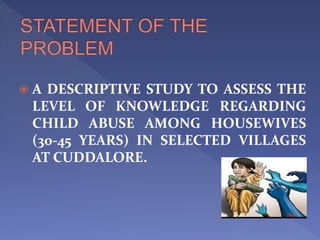
 A DESCRIPTIVE STUDY TO ASSESS THE
LEVEL OF KNOWLEDGE REGARDING
CHILD ABUSE AMONG HOUSEWIVES
(30-45 YEARS) IN SELECTED VILLAGES
AT CUDDALORE.
 Abuse changes your life…Fight Back and
changes the life of your abusers by breaking
Your Silence on Abuse!
-Patty Rase Hopson
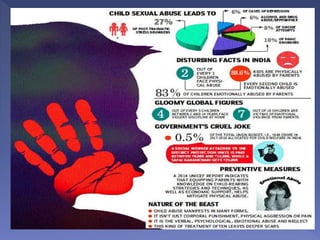
Crimes against children increased in India by
16.2% between 2020 and 2021, according to the latest
National Crime Records Bureau (NCRB) data.
 There were just under 1.5 lakh cases of crimes
against children registered last year across all states
and Union Territories.
 This includes child sexual abuse, abduction,
murder, child marriage among other crimes.
 The total crime rate went up from 28.9% in 2020 to
33.6% in 2021. (The crime rate is the number of
incidences of crime registered per lakh population.)
 The report noted that in percentage terms, major
crime heads under ‘Crime Against Children’ during
2020 were Kidnapping & Abduction (45.0%) and
Protection of Children from Sexual Offences Act
(POCSO), 2012 (38.1%), including child rape.
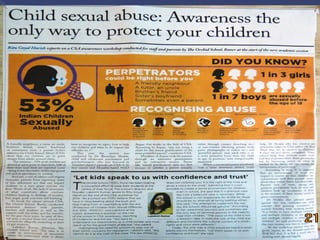
 In India 53% of the children facing any form of
child abuse that is a child can be abused physically,
mentally and sexually.
 This abuse can be blaming, neglecting, assaulting,
forced sexual stimulation, exploitation and even
sexual abuse.
 National crime records Bureau says that the cases
of rape and murder in children increases every year.
 The Study throws light on the following facts
Physical Abuse
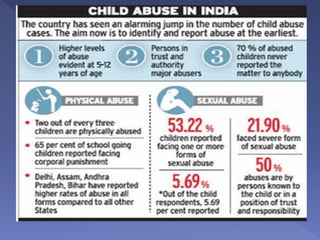
 Out of 3, 2 children were physically abused.
 Out f 1000 There were 69 children physically abused in
that 58.4 percentages were boys.
 Over 50% children were being subjected to at least one or
the opposite sort of physical abuse.
 In their family situation 88.6% were physically abused
by their parents itself
 In a week 50.2 % children’s working all 7 days
 Every second child reported facing emotional
abuse.
 Equal percentage of both girls and boys
reported facing emotional abuse.
 In 83% of the cases parents were the abusers.
 48.4% of girls wished they were boys.
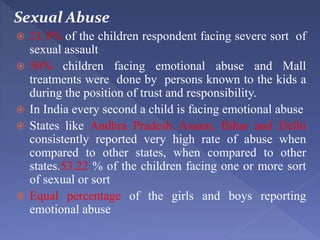
Sexual Abuse
 21.9% of the children respondent facing severe sort of
sexual assault
 50% children facing emotional abuse and Mall
treatments were done by persons known to the kids a
during the position of trust and responsibility.
 In India every second a child is facing emotional abuse
 States like Andhra Pradesh Assam, Bihar and Delhi
consistently reported very high rate of abuse when
compared to other states, when compared to other
states.53.22 % of the children facing one or more sort
of sexual or sort
 Equal percentage of the girls and boys reporting
emotional abuse
 1.To assess the knowledge of Housewives
regarding child abuse.
 2. To determine the association between
knowledge score and socio demographic variable
such Age, religion, education, type of family,
family income, number of children, place of
residence and previous knowledge .
 3. To prepare health education module on child
abuse and its prevention.
 Housewives will have inadequate knowledge
regarding child abuse.
 Housewives having better knowledge on child
abuse will treat the child in a positive manner.
 Knowledge of Housewives regarding child abuse
may influence by different demographic variable
such as age, religion, education, occupation,
family monthly income, type of family, number of
children in family, previous experience, witness
and parents abuse their own children.
 The study is limited to mothers of
children under 12 years of age residing
at Parvathipuram, Vadalur.
 The study is limited to 60 mothers.
 The study is limited to mothers
present at the time of study.
 For the purpose of logical sequence the
chapter was divide into the following
sections.
SECTION A: Literature related to child
abuse
SECTION B: Studies related to child
abuse
 RESEARCH APPROACH
DESCRIPTIVE APPROACH
 RESEARCH DESIGN
NON EXPERIMENTAL RESEARCH
 INDEPENDENT VARIABLE
In the present study in dependent
variables are age, religion, education, type of
family, family income, number of children,
place of residence and previous knowledge
 DEPENDENT VARIABLE:
Knowledge of mothers regarding child
abuse.
 The target population for the present study
includes housewives having children under 12
years of age.
SAMPLE AND SAMPLING TECHNIQUE:
 For the present study, the investigator adopted
convenient sampling method and the sample
comprised of 60 housewives having children
under 12 years of age residing at Parvathipuram,
Vadalur.
TARGET POPULATION:
INCLUSION CRITERIA
 Housewives who are in the age of (30-45
Years).
 Housewives who are willing to
participate in the study.
 Housewives who are available during the
period of data collection.
EXCLUSION CRITERIA
 Housewives who are below 30 years and above
41 years
 Housewives who are not willing to participate
in the study.
 Housewives who are not available during the
period of data collection.
 SECTION A: Demographic variables
Age, religion, education, type of family,
family income, number of children, and place of
residence and previous knowledge .
 SECTION B:
Knowledge regarding child abuse. The
knowledge aspects consist of 25 items regarding the
knowledge of child abuse. It includes definition,
types, methods, clinical manifestations,
management and prevention
Of child abuse.
 CONTENTVALIDITY
The content validity of the tool was obtained from
seven different experts in the field of child health
nursing, community health nursing, Mental
health nursing and psychologists.
 RELIABILITY
The structured interview schedule was as
administered to 10 housewives having children
under 12 years of age. The co-efficient correlation
of the knowledge was found to be r=0.99 and
showed high degree of reliability of the tool to
conduct the study.
 The pilot study was conducted in the month of
September 2019.
 The investigator translated interview schedule
into Tamil to maintain the
objectivity.
 Ten housewives having children under 12 years of
age were selected.
 The investigator visited the village and personally
interviewed all the 10 mothers.
 The investigator took an average time about 30-
40 minutes for each interview.
PROCEDURE FOR DATA
COLLECTION
 A Formal permission was obtained from the
Principal, OPR Memorial College of Nursing.
 The main study was conducted at Parvathipuram,
The data was collected within the period of 4 weeks.
 The purpose of the interview was explained to all
housewives with self introduction.
 The investigator personally visited each house for
the interview. Nearly 10-20 minutes were spent for

each interview. The investigator visited10houses
daily.
 PRESENTATION OF DATA:
 The analysis of data is organized and
presented in 3 sections
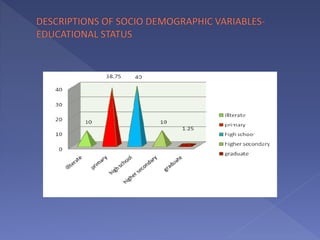
 Section 1: Descriptions of socio demographic
variables
 Section 2: Assessment of knowledge of
mothers regarding child abuse
 Section 3: Association between knowledge
score and socio demographic variables
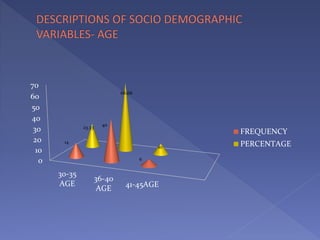
0
10
20
30
40
50
60
70
30-35
AGE
36-40
AGE 41-45AGE
FREQUENCY
PERCENTAGE
14
23.33
40
66.66
6
10
0
10
20
30
40
50
60
70
1 2 3 4
FREQUENCY
PERCENTAGE
7
11.66
40
66.66
11
18.33
2
3.3
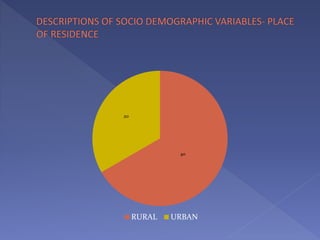
RURAL URBAN
20
40
 Only 22(36.66%) mothers had previous
knowledge regarding child abuse
 and 38(63.33%) were not aware about this
condition.
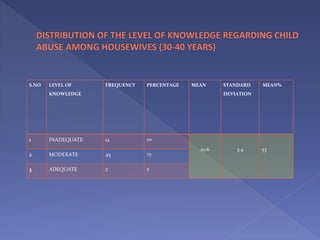
S.NO LEVEL OF
KNOWLEDGE
FREQUENCY PERCENTAGE MEAN STANDARD
DEVIATION
MEAN%
1 INADEQUATE 12 20
10.6 3.4 53
2 MODERATE 45 75
3 ADEQUATE 3 5
 The study revealed that there is significant
relationship between knowledge of
sample and socio demographic variable
such as education and previous
knowledge. Rest of the variables such as age,
religion, number of children and income were
not significantly associated with knowledge
level.
 The conclusion drawn from the findings of the
study. 75% subjects had moderate knowledge
regarding child abuse.
 Knowledge of housewives regarding child
abuse was significant with education and
previous knowledge.
 A K Dutta, (2007), Advances In Pediatrics, 1st Edition, , JaypeeBrothers Medical
Publishers (P) Ltd, New Delhi, Page No:1023- 1030
 2. A.K. Patwari (1998), frontiers in social pediatrics, 1st Edition,Jaypee Brothers
Medical Publishers (P) Ltd, New Delhi, Page No:57-70
 3. Alan Glasper,(2006), A Text Book Of Children’s And YoungPeople’s Nursing,1st
Edition,Churchil Livingston Elsevier, London,Page No:200
 Elizabeth B.Hurlock “ A textbook of psychology” 4th edition, Megrawhill company
publications Pp: 107,108,149
 Donaathy R.Marlow Textbook of pediatric nursing”(1988), 6th edition ,Saunders
publication Pp: 47,51
 Kavitha, “a textbook of sociology in nursing “ I st edition, Jaypee brothers
publications, New Delhi..Pp:197
 Jerry wines M.D. “A Textbook of Child and Adolescent Psychiatry” 2nd edition
Pp:690 691 692
 Kathy neeb .“ A Textbook of Mental Health Nursing”, Jaypee brothers publications,
New Delhi.
 Suresh K Sharma. Nursing Research & statistics; 1st edition, New Delhi; Elsevier
publications 2006.
Research paper presentation on child abuse . ppt

Research paper presentation on child abuse . ppt

  • 2.
     A DESCRIPTIVESTUDY TO ASSESS THE LEVEL OF KNOWLEDGE REGARDING CHILD ABUSE AMONG HOUSEWIVES (30-45 YEARS) IN SELECTED VILLAGES AT CUDDALORE.
  • 6.
     Abuse changesyour life…Fight Back and changes the life of your abusers by breaking Your Silence on Abuse! -Patty Rase Hopson Crimes against children increased in India by 16.2% between 2020 and 2021, according to the latest National Crime Records Bureau (NCRB) data.
  • 7.
     There werejust under 1.5 lakh cases of crimes against children registered last year across all states and Union Territories.  This includes child sexual abuse, abduction, murder, child marriage among other crimes.  The total crime rate went up from 28.9% in 2020 to 33.6% in 2021. (The crime rate is the number of incidences of crime registered per lakh population.)  The report noted that in percentage terms, major crime heads under ‘Crime Against Children’ during 2020 were Kidnapping & Abduction (45.0%) and Protection of Children from Sexual Offences Act (POCSO), 2012 (38.1%), including child rape.
  • 8.
     In India53% of the children facing any form of child abuse that is a child can be abused physically, mentally and sexually.  This abuse can be blaming, neglecting, assaulting, forced sexual stimulation, exploitation and even sexual abuse.  National crime records Bureau says that the cases of rape and murder in children increases every year.
  • 9.
     The Studythrows light on the following facts Physical Abuse  Out of 3, 2 children were physically abused.  Out f 1000 There were 69 children physically abused in that 58.4 percentages were boys.  Over 50% children were being subjected to at least one or the opposite sort of physical abuse.  In their family situation 88.6% were physically abused by their parents itself  In a week 50.2 % children’s working all 7 days
  • 10.
     Every secondchild reported facing emotional abuse.  Equal percentage of both girls and boys reported facing emotional abuse.  In 83% of the cases parents were the abusers.  48.4% of girls wished they were boys.
  • 11.
    Sexual Abuse  21.9%of the children respondent facing severe sort of sexual assault  50% children facing emotional abuse and Mall treatments were done by persons known to the kids a during the position of trust and responsibility.  In India every second a child is facing emotional abuse  States like Andhra Pradesh Assam, Bihar and Delhi consistently reported very high rate of abuse when compared to other states, when compared to other states.53.22 % of the children facing one or more sort of sexual or sort  Equal percentage of the girls and boys reporting emotional abuse
  • 12.
     1.To assessthe knowledge of Housewives regarding child abuse.  2. To determine the association between knowledge score and socio demographic variable such Age, religion, education, type of family, family income, number of children, place of residence and previous knowledge .  3. To prepare health education module on child abuse and its prevention.
  • 13.
     Housewives willhave inadequate knowledge regarding child abuse.  Housewives having better knowledge on child abuse will treat the child in a positive manner.  Knowledge of Housewives regarding child abuse may influence by different demographic variable such as age, religion, education, occupation, family monthly income, type of family, number of children in family, previous experience, witness and parents abuse their own children.
  • 14.
     The studyis limited to mothers of children under 12 years of age residing at Parvathipuram, Vadalur.  The study is limited to 60 mothers.  The study is limited to mothers present at the time of study.
  • 15.
     For thepurpose of logical sequence the chapter was divide into the following sections. SECTION A: Literature related to child abuse SECTION B: Studies related to child abuse
  • 16.
     RESEARCH APPROACH DESCRIPTIVEAPPROACH  RESEARCH DESIGN NON EXPERIMENTAL RESEARCH
  • 17.
     INDEPENDENT VARIABLE Inthe present study in dependent variables are age, religion, education, type of family, family income, number of children, place of residence and previous knowledge  DEPENDENT VARIABLE: Knowledge of mothers regarding child abuse.
  • 18.
     The targetpopulation for the present study includes housewives having children under 12 years of age. SAMPLE AND SAMPLING TECHNIQUE:  For the present study, the investigator adopted convenient sampling method and the sample comprised of 60 housewives having children under 12 years of age residing at Parvathipuram, Vadalur. TARGET POPULATION:
  • 19.
    INCLUSION CRITERIA  Housewiveswho are in the age of (30-45 Years).  Housewives who are willing to participate in the study.  Housewives who are available during the period of data collection.
  • 20.
    EXCLUSION CRITERIA  Housewiveswho are below 30 years and above 41 years  Housewives who are not willing to participate in the study.  Housewives who are not available during the period of data collection.
  • 21.
     SECTION A:Demographic variables Age, religion, education, type of family, family income, number of children, and place of residence and previous knowledge .  SECTION B: Knowledge regarding child abuse. The knowledge aspects consist of 25 items regarding the knowledge of child abuse. It includes definition, types, methods, clinical manifestations, management and prevention Of child abuse.
  • 22.
     CONTENTVALIDITY The contentvalidity of the tool was obtained from seven different experts in the field of child health nursing, community health nursing, Mental health nursing and psychologists.  RELIABILITY The structured interview schedule was as administered to 10 housewives having children under 12 years of age. The co-efficient correlation of the knowledge was found to be r=0.99 and showed high degree of reliability of the tool to conduct the study.
  • 23.
     The pilotstudy was conducted in the month of September 2019.  The investigator translated interview schedule into Tamil to maintain the objectivity.  Ten housewives having children under 12 years of age were selected.  The investigator visited the village and personally interviewed all the 10 mothers.  The investigator took an average time about 30- 40 minutes for each interview.
  • 24.
    PROCEDURE FOR DATA COLLECTION A Formal permission was obtained from the Principal, OPR Memorial College of Nursing.  The main study was conducted at Parvathipuram, The data was collected within the period of 4 weeks.  The purpose of the interview was explained to all housewives with self introduction.  The investigator personally visited each house for the interview. Nearly 10-20 minutes were spent for each interview. The investigator visited10houses daily.
  • 25.
     PRESENTATION OFDATA:  The analysis of data is organized and presented in 3 sections  Section 1: Descriptions of socio demographic variables  Section 2: Assessment of knowledge of mothers regarding child abuse  Section 3: Association between knowledge score and socio demographic variables
  • 26.
  • 29.
    0 10 20 30 40 50 60 70 1 2 34 FREQUENCY PERCENTAGE 7 11.66 40 66.66 11 18.33 2 3.3
  • 32.
  • 33.
     Only 22(36.66%)mothers had previous knowledge regarding child abuse  and 38(63.33%) were not aware about this condition.
  • 34.
    S.NO LEVEL OF KNOWLEDGE FREQUENCYPERCENTAGE MEAN STANDARD DEVIATION MEAN% 1 INADEQUATE 12 20 10.6 3.4 53 2 MODERATE 45 75 3 ADEQUATE 3 5
  • 35.
     The studyrevealed that there is significant relationship between knowledge of sample and socio demographic variable such as education and previous knowledge. Rest of the variables such as age, religion, number of children and income were not significantly associated with knowledge level.
  • 36.
     The conclusiondrawn from the findings of the study. 75% subjects had moderate knowledge regarding child abuse.  Knowledge of housewives regarding child abuse was significant with education and previous knowledge.
  • 37.
     A KDutta, (2007), Advances In Pediatrics, 1st Edition, , JaypeeBrothers Medical Publishers (P) Ltd, New Delhi, Page No:1023- 1030  2. A.K. Patwari (1998), frontiers in social pediatrics, 1st Edition,Jaypee Brothers Medical Publishers (P) Ltd, New Delhi, Page No:57-70  3. Alan Glasper,(2006), A Text Book Of Children’s And YoungPeople’s Nursing,1st Edition,Churchil Livingston Elsevier, London,Page No:200  Elizabeth B.Hurlock “ A textbook of psychology” 4th edition, Megrawhill company publications Pp: 107,108,149  Donaathy R.Marlow Textbook of pediatric nursing”(1988), 6th edition ,Saunders publication Pp: 47,51  Kavitha, “a textbook of sociology in nursing “ I st edition, Jaypee brothers publications, New Delhi..Pp:197  Jerry wines M.D. “A Textbook of Child and Adolescent Psychiatry” 2nd edition Pp:690 691 692  Kathy neeb .“ A Textbook of Mental Health Nursing”, Jaypee brothers publications, New Delhi.  Suresh K Sharma. Nursing Research & statistics; 1st edition, New Delhi; Elsevier publications 2006.