Journal presentation
Prepared by
Bindiya Rani Bhattacherjee
MSC nursing 2nd
year
Introduction:
The complex interplay of globalization, lifestyle changes, socioeconomic
conditions and greater exposure to the unsafe environment has led to
increased deaths and disabilities due to injuries among children in India.
The child's community includes several places like homes, playgrounds,
gardens, fields, ponds, waste dumps, etc. However, their relative
importance depends on a child's way of life. According to World Health
Organization (WHO), "an accident is an event independent of human will,
caused by an outside force acting rapidly and resulting in bodily or
mental injury" [WHO, 2004]. Accidental death in children, particularly
during playing, while flying kites, fall from the terrace, injury from sharp
objects, injury from firecrackers particularly during the festive seasons,
improper use of electrically operated toys, sharp toys, scissors, knives,
blades are not uncommon.
Statement of the problem:
A study to evaluate the effectiveness of planned teaching
programme on knowledge regarding the prevention of
accidents in under-five children among mothers in a selected
village, Gwalior.
Name of the author:
*1 UMAMAHESWARI PAKKIRISAMY, 2VISHNU PRIYA
1 Professor, Department of Pediatric Nursing, Baba
Educational Society Institute of Paramedicals College of
Nursing, Lucknow, Uttar Pradesh,
India. Email Id.: umaamu05@gmail.com
2 Professor cum Principal, Hayward Institute of Nursing
and Science, Gwalior, Madhya Pradesh, India.
Objectives
 To assess the level of knowledge regarding prevention of
accidents in under-five children among mothers before the
planned
teaching programme.
 To assess the level of knowledge regarding prevention of
accidents in under-five children among mothers after the
planned
teaching programme.
 To find out the effectiveness of planned teaching programme
on the prevention of accidents in under-five children.
Variables
Independent variable:
The Independent variable of this study is a planned teaching programme
regarding the prevention of accidents in under-five children.
Dependent variable:
The dependent variable of this study is the level of knowledge regarding
the prevention of accidents in under-five children among mothers.
.
Hypothesis:
The mean post-test
knowledge score of mothers
regarding the prevention of
accidents in children under
five will be significantly
higher than the mean pre-
Assumptions:
The
 mothers are having inadequate knowledge
regarding the prevention of accidents in under-
five children.
Mothers are interested to know about the

prevention of accidents in under-five children and
are willing to attend the PTP.
Mothers require accurate information regarding

the prevention of accidents in under-five children.
Delimitations of the study:
 The sample size of the study was
delimited to only 50.
 The study was delimited to mothers in
Piproli village, Gwalior district, M.P.
 The data collection period was
delimited to four weeks.
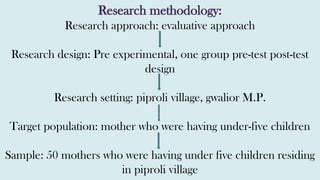
Research methodology:
Research approach: evaluative approach
Research design: Pre experimental, one group pre-test post-test
design
Research setting: piproli village, gwalior M.P.
Target population: mother who were having under-five children
Sample: 50 mothers who were having under five children residing
in piproli village
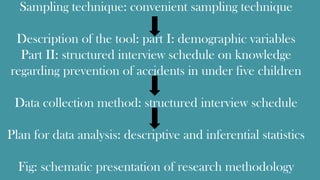
Sampling technique: convenient sampling technique
Description of the tool: part I: demographic variables
Part II: structured interview schedule on knowledge
regarding prevention of accidents in under five children
Data collection method: structured interview schedule
Plan for data analysis: descriptive and inferential statistics
Fig: schematic presentation of research methodology
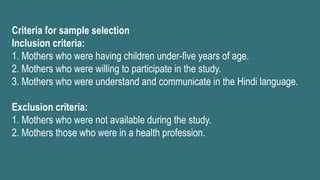
Criteria for sample selection
Inclusion criteria:
1. Mothers who were having children under-five years of age.
2. Mothers who were willing to participate in the study.
3. Mothers who were understand and communicate in the Hindi language.
Exclusion criteria:
1. Mothers who were not available during the study.
2. Mothers those who were in a health profession.
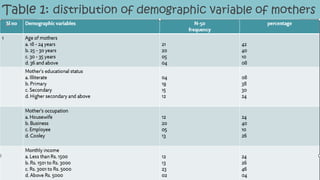
Table 1: distribution of demographic variable of mothers
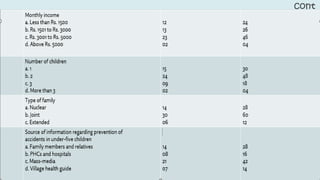
cont
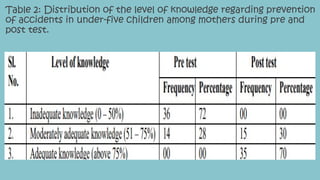
Table 2: Distribution of the level of knowledge regarding prevention
of accidents in under-five children among mothers during pre and
post test.
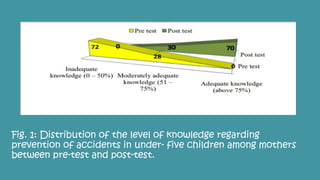
Fig. 1: Distribution of the level of knowledge regarding
prevention of accidents in under- five children among mothers
between pre-test and post-test.
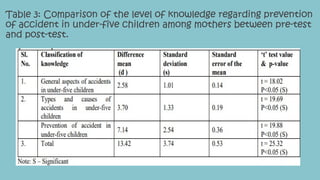
Table 3: Comparison of the level of knowledge regarding prevention
of accident in under-five children among mothers between pre-test
and post-test.
. The children of today are the adult of tomorrow, it is
essential to make the life of children safer. It is the
responsibility of the nurse to enlighten the knowledge
of mothers of ‘under-five’ children with various types of
accidents and its prevention. The ultimate goal of study
is to improve the knowledge level of mother regarding
prevention of accidents in under-five children and
thereby prevent the morbidity and mortality rate of
children. It was successfully achieved through planned
teaching program
CONCLUSION
references
[1]. Babu, A., Rattan, A., Ranjan, P., Singhal, M., Gupta, A., Kumar, S., et al.
2016.Are falls more common than road traffic accidents in pediatric
trauma? Experience from a Level 1 trauma centre in New Delhi, India.
Chin J Traumatol. 19(2):75–8.
[2]. Calvin G. Lowe. 2005. Safety for ages 2-4. Arch Fr pediat. 12 (6), 34-40.
[3]. Calvin, G. Lowe. 2005.Safety for ages 2-4. Arch Fr pediat. 12 (6) : 34-
40.
[4]. Chaudhari, VP., Srivastava, RK., Moitra, M., Desai, VK. 2009. Risk of
domestic accidents among under five children. The Internet Journal of
Family Practice, 7.
[5]. Dhopte, A., Bamal, R., Tiwari, VK. 2017. A prospective analysis of risk
factors for pediatric burn mortality at a tertiary burn center in North
India. Burns Trauma . Dec; 5(1).
[6]. Dorothy, R Marlow., Barbara A. Redding. 2006. Text book of Pediatric
Nursing (6th ed.). Philadelphia: Elsevier. 588-592.
Cont.
[7]. Global Burden of Disease (GBD). 2017. GBD Results Tool. Institute of
Health Metrics and Evaluation. Retrieved from:
http://ghdx.healthdata.org/gbd-results-tool.
8]. Jagnoor, J., Suraweera, W., Keay, L. et al. 2012. Unintentional injury
mortality in India, 2005: Nationally representative mortality survey of 1.1
million homes. BMC Public Health. 12, 487.
[9]. Janki, Patel., Arpan, Pandya., Ravindra, HN. 2014. A Study To Assess The
Effectiveness Of Structure Teaching Programme On Knowledge Regarding
Prevention Of Childhood Accidents Among Mothers Of Under Five Children
At Piparia, Vadodara. IOSR Journal of Nursing and Health Science. Volume 3,
Issue 5, 72-79.
[10]. National Crime Records Bureau. 2015. Accidental Deaths and Suicides
in India. Ministry of Home Affairs, Government of India. Retrieved from:
http://ncrb.gov.in/StatPublications/ADSI/ADSI2.
[11]. NIMHANS. 2019. Advancing-Child-Safety-in-India-Implementation-is-
the-Key. Available from:
https://nimhans.ac.in/wpcontent/uploads/2019/09/Advancing-Child-Safety-
in-India-Implementation-is-the-Key.-A-report-by-NIMHANS-2019.pdf.
Cont.
12]. Pradeep, M Suryawanshi., Sunita, Tata., Simi, Elsa Philip. 2018. A Study to Assess the
Effectiveness of Structured Teaching Programme on Knowledge of Mothers Regarding
Prevention of Accidents among Preschoolers in Selected Anganwadi at Karad. International
Journal of Science and Research. Issue 7, July 2018, 760 – 765.
[13]. Priya, Kapoor. 2021. 31 children die in road crashes in India every day. The times of India.
Retrieved from: https://timesofindia.indiatimes.com/india/31-children-die-in-road-crashes-in-
india-every-day/articleshow/78808958.cms.
[14]. Ravinder, K Gupta., Ritu, Gupta. 2004. Home Related Accidents during Infancy. Adval
Pediatric Clini. NaiBasti, Jammu Cantt. & Department of Physiology, Govt. Medical College.
Jammu (J&K). 6(2).
[15]. S.P. Goel. 2005. Common poisonings and their management in children. Current medical
Journal. XI (6): 7 -14
[16]. Wale, Pratiksha., Bathe, Himanshu., Betal, Hina., et al. 2018. A Study to assess the
effectiveness of structured teaching programme on knowledge regarding prevention of home
accidents among parents of under five years children in selected rural areas of Nagpur District.
Asian J. Nursing Education and Research. 8(2): 205-208.
[17]. WHO. 2004. World health day theme, 2004, road safety and accidents. Health action, April,
4-13
Positive criticism
1. Problem statement is not complex to study and clearly
explain the study setting and population under the study
2. Significance of the study is well mentioned
3. In the article variable assumption and delimitation are
clearly mentioned.
4. Research methodology are clearly stated.
5. Results shows effectiveness of the study.
6. Bibliography/ references is clearly included in vankover
style
Negative criticism
1)There is no articulation in objectives in the
study.
2)The aim of the study is not mentioned.
3)Hypothesis should be in a present tense.
4)There is no explanation regarding
operational definition in the study.
5)Conceptual framework of the study is not
mentioned.
journal presentation bindiya Bhattacharjee

journal presentation bindiya Bhattacharjee

  • 1.
    Journal presentation Prepared by BindiyaRani Bhattacherjee MSC nursing 2nd year
  • 2.
    Introduction: The complex interplayof globalization, lifestyle changes, socioeconomic conditions and greater exposure to the unsafe environment has led to increased deaths and disabilities due to injuries among children in India. The child's community includes several places like homes, playgrounds, gardens, fields, ponds, waste dumps, etc. However, their relative importance depends on a child's way of life. According to World Health Organization (WHO), "an accident is an event independent of human will, caused by an outside force acting rapidly and resulting in bodily or mental injury" [WHO, 2004]. Accidental death in children, particularly during playing, while flying kites, fall from the terrace, injury from sharp objects, injury from firecrackers particularly during the festive seasons, improper use of electrically operated toys, sharp toys, scissors, knives, blades are not uncommon.
  • 3.
    Statement of theproblem: A study to evaluate the effectiveness of planned teaching programme on knowledge regarding the prevention of accidents in under-five children among mothers in a selected village, Gwalior.
  • 4.
    Name of theauthor: *1 UMAMAHESWARI PAKKIRISAMY, 2VISHNU PRIYA 1 Professor, Department of Pediatric Nursing, Baba Educational Society Institute of Paramedicals College of Nursing, Lucknow, Uttar Pradesh, India. Email Id.: umaamu05@gmail.com 2 Professor cum Principal, Hayward Institute of Nursing and Science, Gwalior, Madhya Pradesh, India.
  • 5.
    Objectives  To assessthe level of knowledge regarding prevention of accidents in under-five children among mothers before the planned teaching programme.  To assess the level of knowledge regarding prevention of accidents in under-five children among mothers after the planned teaching programme.  To find out the effectiveness of planned teaching programme on the prevention of accidents in under-five children.
  • 6.
    Variables Independent variable: The Independentvariable of this study is a planned teaching programme regarding the prevention of accidents in under-five children. Dependent variable: The dependent variable of this study is the level of knowledge regarding the prevention of accidents in under-five children among mothers. .
  • 7.
    Hypothesis: The mean post-test knowledgescore of mothers regarding the prevention of accidents in children under five will be significantly higher than the mean pre-
  • 8.
    Assumptions: The  mothers arehaving inadequate knowledge regarding the prevention of accidents in under- five children. Mothers are interested to know about the  prevention of accidents in under-five children and are willing to attend the PTP. Mothers require accurate information regarding  the prevention of accidents in under-five children.
  • 9.
    Delimitations of thestudy:  The sample size of the study was delimited to only 50.  The study was delimited to mothers in Piproli village, Gwalior district, M.P.  The data collection period was delimited to four weeks.
  • 10.
    Research methodology: Research approach:evaluative approach Research design: Pre experimental, one group pre-test post-test design Research setting: piproli village, gwalior M.P. Target population: mother who were having under-five children Sample: 50 mothers who were having under five children residing in piproli village
  • 11.
    Sampling technique: convenientsampling technique Description of the tool: part I: demographic variables Part II: structured interview schedule on knowledge regarding prevention of accidents in under five children Data collection method: structured interview schedule Plan for data analysis: descriptive and inferential statistics Fig: schematic presentation of research methodology
  • 12.
    Criteria for sampleselection Inclusion criteria: 1. Mothers who were having children under-five years of age. 2. Mothers who were willing to participate in the study. 3. Mothers who were understand and communicate in the Hindi language. Exclusion criteria: 1. Mothers who were not available during the study. 2. Mothers those who were in a health profession.
  • 13.
    Table 1: distributionof demographic variable of mothers
  • 14.
  • 15.
    Table 2: Distributionof the level of knowledge regarding prevention of accidents in under-five children among mothers during pre and post test.
  • 16.
    Fig. 1: Distributionof the level of knowledge regarding prevention of accidents in under- five children among mothers between pre-test and post-test.
  • 17.
    Table 3: Comparisonof the level of knowledge regarding prevention of accident in under-five children among mothers between pre-test and post-test.
  • 18.
    . The childrenof today are the adult of tomorrow, it is essential to make the life of children safer. It is the responsibility of the nurse to enlighten the knowledge of mothers of ‘under-five’ children with various types of accidents and its prevention. The ultimate goal of study is to improve the knowledge level of mother regarding prevention of accidents in under-five children and thereby prevent the morbidity and mortality rate of children. It was successfully achieved through planned teaching program CONCLUSION
  • 19.
    references [1]. Babu, A.,Rattan, A., Ranjan, P., Singhal, M., Gupta, A., Kumar, S., et al. 2016.Are falls more common than road traffic accidents in pediatric trauma? Experience from a Level 1 trauma centre in New Delhi, India. Chin J Traumatol. 19(2):75–8. [2]. Calvin G. Lowe. 2005. Safety for ages 2-4. Arch Fr pediat. 12 (6), 34-40. [3]. Calvin, G. Lowe. 2005.Safety for ages 2-4. Arch Fr pediat. 12 (6) : 34- 40. [4]. Chaudhari, VP., Srivastava, RK., Moitra, M., Desai, VK. 2009. Risk of domestic accidents among under five children. The Internet Journal of Family Practice, 7. [5]. Dhopte, A., Bamal, R., Tiwari, VK. 2017. A prospective analysis of risk factors for pediatric burn mortality at a tertiary burn center in North India. Burns Trauma . Dec; 5(1). [6]. Dorothy, R Marlow., Barbara A. Redding. 2006. Text book of Pediatric Nursing (6th ed.). Philadelphia: Elsevier. 588-592.
  • 20.
    Cont. [7]. Global Burdenof Disease (GBD). 2017. GBD Results Tool. Institute of Health Metrics and Evaluation. Retrieved from: http://ghdx.healthdata.org/gbd-results-tool. 8]. Jagnoor, J., Suraweera, W., Keay, L. et al. 2012. Unintentional injury mortality in India, 2005: Nationally representative mortality survey of 1.1 million homes. BMC Public Health. 12, 487. [9]. Janki, Patel., Arpan, Pandya., Ravindra, HN. 2014. A Study To Assess The Effectiveness Of Structure Teaching Programme On Knowledge Regarding Prevention Of Childhood Accidents Among Mothers Of Under Five Children At Piparia, Vadodara. IOSR Journal of Nursing and Health Science. Volume 3, Issue 5, 72-79. [10]. National Crime Records Bureau. 2015. Accidental Deaths and Suicides in India. Ministry of Home Affairs, Government of India. Retrieved from: http://ncrb.gov.in/StatPublications/ADSI/ADSI2. [11]. NIMHANS. 2019. Advancing-Child-Safety-in-India-Implementation-is- the-Key. Available from: https://nimhans.ac.in/wpcontent/uploads/2019/09/Advancing-Child-Safety- in-India-Implementation-is-the-Key.-A-report-by-NIMHANS-2019.pdf.
  • 21.
    Cont. 12]. Pradeep, MSuryawanshi., Sunita, Tata., Simi, Elsa Philip. 2018. A Study to Assess the Effectiveness of Structured Teaching Programme on Knowledge of Mothers Regarding Prevention of Accidents among Preschoolers in Selected Anganwadi at Karad. International Journal of Science and Research. Issue 7, July 2018, 760 – 765. [13]. Priya, Kapoor. 2021. 31 children die in road crashes in India every day. The times of India. Retrieved from: https://timesofindia.indiatimes.com/india/31-children-die-in-road-crashes-in- india-every-day/articleshow/78808958.cms. [14]. Ravinder, K Gupta., Ritu, Gupta. 2004. Home Related Accidents during Infancy. Adval Pediatric Clini. NaiBasti, Jammu Cantt. & Department of Physiology, Govt. Medical College. Jammu (J&K). 6(2). [15]. S.P. Goel. 2005. Common poisonings and their management in children. Current medical Journal. XI (6): 7 -14 [16]. Wale, Pratiksha., Bathe, Himanshu., Betal, Hina., et al. 2018. A Study to assess the effectiveness of structured teaching programme on knowledge regarding prevention of home accidents among parents of under five years children in selected rural areas of Nagpur District. Asian J. Nursing Education and Research. 8(2): 205-208. [17]. WHO. 2004. World health day theme, 2004, road safety and accidents. Health action, April, 4-13
  • 22.
    Positive criticism 1. Problemstatement is not complex to study and clearly explain the study setting and population under the study 2. Significance of the study is well mentioned 3. In the article variable assumption and delimitation are clearly mentioned. 4. Research methodology are clearly stated. 5. Results shows effectiveness of the study. 6. Bibliography/ references is clearly included in vankover style
  • 23.
    Negative criticism 1)There isno articulation in objectives in the study. 2)The aim of the study is not mentioned. 3)Hypothesis should be in a present tense. 4)There is no explanation regarding operational definition in the study. 5)Conceptual framework of the study is not mentioned.