MOTHER’S KNOWLEDGE, ATTITUDE AND
PREVENTION OF HOME ACCIDENTS AMONG
TODDLERS 2-5YEARS: THE CASE OF THE
NDONGO COMMUNITY-BUEA)
By;
AGBOR ELIZABETH AYUK-FAY
(HS20BN004)
SUPERVISOR:
FOLEFACK ALEXANDER
(MNE)
JULY 2021
A Research Project Submitted to the Department of Nursing School of Health Sciences of the Biaka
University Institute of Buea in Partial Fulfilment of the Award of the Bachelor of Science (B.Sc.) in
Nursing
outline
 INTRODUCTION
 STATEMENT OF PROBLEM
 RESEARCH OBJECTIVES
 JUSTIFICATION OF THE STUDY
 METHODOLOGY
 RESULTS AND DISCUSSION
 CONCLUSION
 RECOMMENDATION
 ACKNOWLEDGEMENT
INTRODUCTION
 Home or domestic accident is accident which takes place in the home or in its
adjacent surroundings which is a worldwide public health problem.
These accidents impair homeostasis of an individual by influences on physical,
psychological and social health of child and may cause disease, disability or even
deaths. Thus, accidents at childhood are an important public health issue
The most important risk factors reported for home injury include living in unsafe
homes, low socioeconomic status, and mothers’ low knowledge and inappropriate
attitudes. Several studies have evaluated the role of parents’ preventive measures in
decreasing the incidence of home injuries
 Given the importance of this subject matter and great strains of household
accidents on society, it is essential to develop training programs to enhance public
knowledge and performance so that they can prevent household accidents. Formal
and informal education is one of the cheapest methods to prevent household
accidents.
PROBLEM STATEMENT
Injuries related to home accidents are gradually becoming health problems in our communities.
It is argued that although home accidents are unexpected and unintentional, mothers feel remorseful
when they occur (Olutayo, 2013).
The frequency and severity rate of accident vary from country to country and home to home. Home
accident destroys the health, lives and independence of many, yet home accident prevention receives
little or no attention.
In Cameroon, like other developing countries, the available information on knowledge and attitude
of mothers on the preventive measures available for home accidents is little.
An extensive review by the researcher shows that data on the knowledge, attitude and preventive
measures put in place by mothers to avoid home accidents in Cameroon and in Buea Municipality in
particular is generally inadequate. Hence, the need for this study.
Research objectives
General objective
The main objective of this study is to examine mother’s
knowledge, attitude and prevention of home accidents among
toddlers 2-5 years.
Specific objectives
To determine the level of knowledge mothers, have on home
accidents.
To examine mothers’ attitude towards the occurrence of home
accidents.
To find out the measures used by mothers in the prevention of
home accidents among toddlers 2-5 years.
Justification of the study
According to World Health Organization (2014) findings, every year about, 830,000 children die
from home accidents worldwide.
 Most injury-related deaths occur in low and middle-income countries especially in rural areas where
knowledge is limited regarding injury prevention.
 Third, some types of comorbid disorders can magnify the functional impairment and adversely
influence the course of other conditions (Kessler, 2001).
Much of the burden of ill health due to comorbidity among older people can be reduced or prevented
by adequately addressing specific risk factors, including injury, and by instituting coping strategies
(Evans 2012).
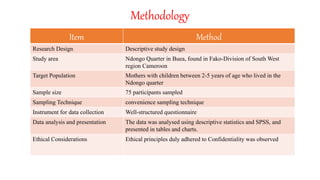
Methodology
Item Method
Research Design Descriptive study design
Study area Ndongo Quarter in Buea, found in Fako-Division of South West
region Cameroon
Target Population Mothers with children between 2-5 years of age who lived in the
Ndongo quarter
Sample size 75 participants sampled
Sampling Technique convenience sampling technique
Instrument for data collection Well-structured questionnaire
Data analysis and presentation The data was analysed using descriptive statistics and SPSS, and
presented in tables and charts.
Ethical Considerations Ethical principles duly adhered to Confidentiality was observed
Presentation of results
Objective 1:To determine the level of knowledge mothers, have on home
accidents.
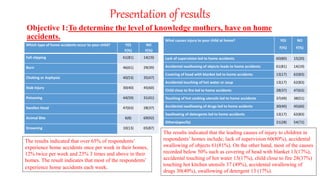
The results indicated that the leading causes of injury to children in
respondents’ homes include; lack of supervision 60(80%), accidental
swallowing of objects 61(81%). On the other hand, most of the causes
recorded below 50% such as covering of head with blanket 13(17%),
accidental touching of hot water 13(17%), child close to fire 28(37%)
touching hot kitchen utensils 37 (49%), accidental swallowing of
drugs 30(40%), swallowing of detergent 13 (17%).
The results indicated that over 65% of respondents’
experience home accidents once per week in their homes,
12% twice per week and 23% 3 times and above in their
homes. The result indicates that most of the respondents’
experience home accidents each week.
Which type of home accidents occur to your child? YES
F(%)
NO
F(%)
Fall-slipping 61(81) 14(19)
Burn 46(61) 29(39)
Choking or Asphyxia 40(53) 35(47)
Stab injury 30(40) 45(60)
Poisoning 44(59) 31(41)
Swollen Head 47(63) 28(37)
Animal Bite 6(8) 69(92)
Drowning 10(13) 65(87)
What causes injury to your child at home? YES
F(%)
NO
F(%)
Lack of supervision led to home accidents 60(80) 15(20)
Accidental swallowing of objects leads to home accidents 61(81) 14(19)
Covering of head with blanket led to home accidents 13(17) 62(83)
Accidental touching of hot water or soup 13(17) 62(83)
Child close to fire led to home accidents 28(37) 47(63)
Touching of hot cooking utensils led to home accidents 37(49) 38(51)
Accidental swallowing of drugs led to home acidents 30(40) 45(60)
Swallowing of detergents led to home accidents 13(17) 62(83)
Others(specify) 21(28) 54(72)
Presentation of results…………..
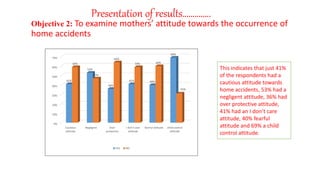
Objective 2: To examine mothers’ attitude towards the occurrence of
home accidents
This indicates that just 41%
of the respondents had a
cautious attitude towards
home accidents, 53% had a
negligent attitude, 36% had
over protective attitude,
41% had an I don’t care
attitude, 40% fearful
attitude and 69% a child
control attitude.
0%
10%
20%
30%
40%
50%
60%
70%
Cautious
attitude
Negligent Over
protective
I don't care
attitude
fearful attitude child control
attitude
41%
53%
36%
41% 40%
69%
59%
47%
64%
59% 60%
31%
YES NO
Presentation of results…………..
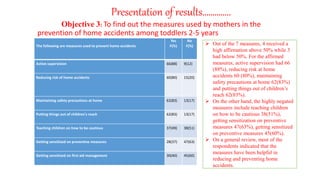
Objective 3: To find out the measures used by mothers in the
prevention of home accidents among toddlers 2-5 years
 Out of the 7 measures, 4 received a
high affirmation above 50% while 3
had below 50%. For the affirmed
measures, active supervision had 66
(88%), reducing risk at home
accidents 60 (80%), maintaining
safety precautions at home 62(83%)
and putting things out of children’s
reach 62(83%).
 On the other hand, the highly negated
measures include teaching children
on how to be cautious 38(51%),
getting sensitization on preventive
measures 47(63%), getting sensitized
on preventive measures 45(60%).
 On a general review, most of the
respondents indicated that the
measures have been helpful in
reducing and preventing home
accidents.
The following are measures used to prevent home accidents
Yes
F(%)
No
F(%)
Active supervision 66(88) 9(12)
Reducing risk of home accidents 60(80) 15(20)
Maintaining safety precautions at home 62(83) 13(17)
Putting things out of children's reach 62(83) 13(17)
Teaching children on how to be cautious 37(49) 38(51)
Getting sensitized on preventive measures 28(37) 47(63)
Getting sensitized on first aid management 30(40) 45(60)
Conclusion
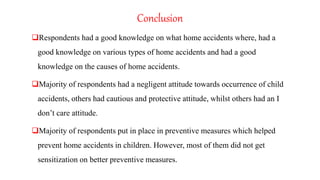
Respondents had a good knowledge on what home accidents where, had a
good knowledge on various types of home accidents and had a good
knowledge on the causes of home accidents.
Majority of respondents had a negligent attitude towards occurrence of child
accidents, others had cautious and protective attitude, whilst others had an I
don’t care attitude.
Majority of respondents put in place in preventive measures which helped
prevent home accidents in children. However, most of them did not get
sensitization on better preventive measures.
Recommendations
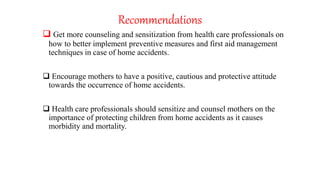
 Get more counseling and sensitization from health care professionals on
how to better implement preventive measures and first aid management
techniques in case of home accidents.
 Encourage mothers to have a positive, cautious and protective attitude
towards the occurrence of home accidents.
 Health care professionals should sensitize and counsel mothers on the
importance of protecting children from home accidents as it causes
morbidity and mortality.
ACKNOWLEDGEMENTS
The realization of this work is a combined effort of a host of
individuals.
 Firstly, I want to acknowledge my supervisor Folefack Alexander for
having relentless effort to see that this work is realized.
 I also want to acknowledge the entire staff of BUIB for imparting me
with knowledge that contributed to the realization of this work.
 I equally want to acknowledge the chief and people of the Ndongo
Community for giving me the chance to carry out this academic
exercise.
 And finally I acknowledge God Almighty for His blessings, wisdom,
love and strength throughout my study.
THANK YOU
IMMENSELY

Ayuk final powerpoint1.pptx

  • 1.
    MOTHER’S KNOWLEDGE, ATTITUDEAND PREVENTION OF HOME ACCIDENTS AMONG TODDLERS 2-5YEARS: THE CASE OF THE NDONGO COMMUNITY-BUEA) By; AGBOR ELIZABETH AYUK-FAY (HS20BN004) SUPERVISOR: FOLEFACK ALEXANDER (MNE) JULY 2021 A Research Project Submitted to the Department of Nursing School of Health Sciences of the Biaka University Institute of Buea in Partial Fulfilment of the Award of the Bachelor of Science (B.Sc.) in Nursing
  • 2.
    outline  INTRODUCTION  STATEMENTOF PROBLEM  RESEARCH OBJECTIVES  JUSTIFICATION OF THE STUDY  METHODOLOGY  RESULTS AND DISCUSSION  CONCLUSION  RECOMMENDATION  ACKNOWLEDGEMENT
  • 3.
    INTRODUCTION  Home ordomestic accident is accident which takes place in the home or in its adjacent surroundings which is a worldwide public health problem. These accidents impair homeostasis of an individual by influences on physical, psychological and social health of child and may cause disease, disability or even deaths. Thus, accidents at childhood are an important public health issue The most important risk factors reported for home injury include living in unsafe homes, low socioeconomic status, and mothers’ low knowledge and inappropriate attitudes. Several studies have evaluated the role of parents’ preventive measures in decreasing the incidence of home injuries  Given the importance of this subject matter and great strains of household accidents on society, it is essential to develop training programs to enhance public knowledge and performance so that they can prevent household accidents. Formal and informal education is one of the cheapest methods to prevent household accidents.
  • 4.
    PROBLEM STATEMENT Injuries relatedto home accidents are gradually becoming health problems in our communities. It is argued that although home accidents are unexpected and unintentional, mothers feel remorseful when they occur (Olutayo, 2013). The frequency and severity rate of accident vary from country to country and home to home. Home accident destroys the health, lives and independence of many, yet home accident prevention receives little or no attention. In Cameroon, like other developing countries, the available information on knowledge and attitude of mothers on the preventive measures available for home accidents is little. An extensive review by the researcher shows that data on the knowledge, attitude and preventive measures put in place by mothers to avoid home accidents in Cameroon and in Buea Municipality in particular is generally inadequate. Hence, the need for this study.
  • 5.
    Research objectives General objective Themain objective of this study is to examine mother’s knowledge, attitude and prevention of home accidents among toddlers 2-5 years. Specific objectives To determine the level of knowledge mothers, have on home accidents. To examine mothers’ attitude towards the occurrence of home accidents. To find out the measures used by mothers in the prevention of home accidents among toddlers 2-5 years.
  • 6.
    Justification of thestudy According to World Health Organization (2014) findings, every year about, 830,000 children die from home accidents worldwide.  Most injury-related deaths occur in low and middle-income countries especially in rural areas where knowledge is limited regarding injury prevention.  Third, some types of comorbid disorders can magnify the functional impairment and adversely influence the course of other conditions (Kessler, 2001). Much of the burden of ill health due to comorbidity among older people can be reduced or prevented by adequately addressing specific risk factors, including injury, and by instituting coping strategies (Evans 2012).
  • 7.
    Methodology Item Method Research DesignDescriptive study design Study area Ndongo Quarter in Buea, found in Fako-Division of South West region Cameroon Target Population Mothers with children between 2-5 years of age who lived in the Ndongo quarter Sample size 75 participants sampled Sampling Technique convenience sampling technique Instrument for data collection Well-structured questionnaire Data analysis and presentation The data was analysed using descriptive statistics and SPSS, and presented in tables and charts. Ethical Considerations Ethical principles duly adhered to Confidentiality was observed
  • 8.
    Presentation of results Objective1:To determine the level of knowledge mothers, have on home accidents. The results indicated that the leading causes of injury to children in respondents’ homes include; lack of supervision 60(80%), accidental swallowing of objects 61(81%). On the other hand, most of the causes recorded below 50% such as covering of head with blanket 13(17%), accidental touching of hot water 13(17%), child close to fire 28(37%) touching hot kitchen utensils 37 (49%), accidental swallowing of drugs 30(40%), swallowing of detergent 13 (17%). The results indicated that over 65% of respondents’ experience home accidents once per week in their homes, 12% twice per week and 23% 3 times and above in their homes. The result indicates that most of the respondents’ experience home accidents each week. Which type of home accidents occur to your child? YES F(%) NO F(%) Fall-slipping 61(81) 14(19) Burn 46(61) 29(39) Choking or Asphyxia 40(53) 35(47) Stab injury 30(40) 45(60) Poisoning 44(59) 31(41) Swollen Head 47(63) 28(37) Animal Bite 6(8) 69(92) Drowning 10(13) 65(87) What causes injury to your child at home? YES F(%) NO F(%) Lack of supervision led to home accidents 60(80) 15(20) Accidental swallowing of objects leads to home accidents 61(81) 14(19) Covering of head with blanket led to home accidents 13(17) 62(83) Accidental touching of hot water or soup 13(17) 62(83) Child close to fire led to home accidents 28(37) 47(63) Touching of hot cooking utensils led to home accidents 37(49) 38(51) Accidental swallowing of drugs led to home acidents 30(40) 45(60) Swallowing of detergents led to home accidents 13(17) 62(83) Others(specify) 21(28) 54(72)
  • 9.
    Presentation of results………….. Objective2: To examine mothers’ attitude towards the occurrence of home accidents This indicates that just 41% of the respondents had a cautious attitude towards home accidents, 53% had a negligent attitude, 36% had over protective attitude, 41% had an I don’t care attitude, 40% fearful attitude and 69% a child control attitude. 0% 10% 20% 30% 40% 50% 60% 70% Cautious attitude Negligent Over protective I don't care attitude fearful attitude child control attitude 41% 53% 36% 41% 40% 69% 59% 47% 64% 59% 60% 31% YES NO
  • 10.
    Presentation of results………….. Objective3: To find out the measures used by mothers in the prevention of home accidents among toddlers 2-5 years  Out of the 7 measures, 4 received a high affirmation above 50% while 3 had below 50%. For the affirmed measures, active supervision had 66 (88%), reducing risk at home accidents 60 (80%), maintaining safety precautions at home 62(83%) and putting things out of children’s reach 62(83%).  On the other hand, the highly negated measures include teaching children on how to be cautious 38(51%), getting sensitization on preventive measures 47(63%), getting sensitized on preventive measures 45(60%).  On a general review, most of the respondents indicated that the measures have been helpful in reducing and preventing home accidents. The following are measures used to prevent home accidents Yes F(%) No F(%) Active supervision 66(88) 9(12) Reducing risk of home accidents 60(80) 15(20) Maintaining safety precautions at home 62(83) 13(17) Putting things out of children's reach 62(83) 13(17) Teaching children on how to be cautious 37(49) 38(51) Getting sensitized on preventive measures 28(37) 47(63) Getting sensitized on first aid management 30(40) 45(60)
  • 11.
    Conclusion Respondents had agood knowledge on what home accidents where, had a good knowledge on various types of home accidents and had a good knowledge on the causes of home accidents. Majority of respondents had a negligent attitude towards occurrence of child accidents, others had cautious and protective attitude, whilst others had an I don’t care attitude. Majority of respondents put in place in preventive measures which helped prevent home accidents in children. However, most of them did not get sensitization on better preventive measures.
  • 12.
    Recommendations  Get morecounseling and sensitization from health care professionals on how to better implement preventive measures and first aid management techniques in case of home accidents.  Encourage mothers to have a positive, cautious and protective attitude towards the occurrence of home accidents.  Health care professionals should sensitize and counsel mothers on the importance of protecting children from home accidents as it causes morbidity and mortality.
  • 13.
    ACKNOWLEDGEMENTS The realization ofthis work is a combined effort of a host of individuals.  Firstly, I want to acknowledge my supervisor Folefack Alexander for having relentless effort to see that this work is realized.  I also want to acknowledge the entire staff of BUIB for imparting me with knowledge that contributed to the realization of this work.  I equally want to acknowledge the chief and people of the Ndongo Community for giving me the chance to carry out this academic exercise.  And finally I acknowledge God Almighty for His blessings, wisdom, love and strength throughout my study.
  • 14.