PROBLEM STATEMENT
“A STUDYTO ASSESS THE EFFECTIVENESS OF
PLANNED TEACHING PROGRAMME ON
KNOWLEDGE REGARDING ACUTE DIARRHEAL
DISEASE AMONG MOTHERS OF UNDER FIVE
CHILDREN RESIDING IN SELECTED RURAL
AREAS AT HINDAUN CITY.”
3.
RESEARCH OBJECTIVES
The objectivesof the study were:
To assess the pre-test knowledge regarding acute diarrheal
disease among mothers of under five children.
To assess the effectiveness of planned teaching programme on
knowledge regarding acute diarrheal disease among mothers of
under five children.
To determine the association between the pre-test knowledge
score of mothers of under five children with their selected
socio-demographic variables.
4.
RESEARCH HYPOTHESIS
H1 – The mean post test knowledge score
regarding acute diarrheal disease among mothers
of under five children will be significantly higher
than the mean pre-test knowledge score after
administration of planned teaching programme
H 2 – There will be significant association
between pre test knowledge scores of acute
diarrheal disease among mothers of under five
children with their selected socio - demographic
variables.
5.
ASSUMPTION
The study assumesthat :
Mothers of under five children may have inadequate
knowledge regarding acute diarrheal disease
Planned teaching programme will help to improve the
knowledge of Mothers of under five children regarding acute
diarrheal disease
Mothers of under five children will give free and frank
responses to the questions.
Planned teaching programme will be an effective tool in
improving the knowledge regarding acute diarrheal disease
among mothers of under five children
RESEARCH APPROACH
Theresearch approach refers to a general set of
orderly disciplined procedures used to assure
useful information’s. Research approach helps
the researcher to determine what data to be
collected and how to analyses them. It also
suggests possible conclusion to be drawn from
the data.
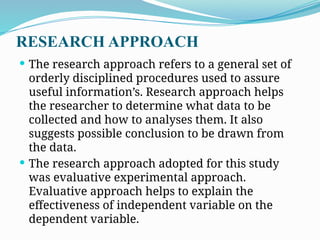
The research approach adopted for this study
was evaluative experimental approach.
Evaluative approach helps to explain the
effectiveness of independent variable on the
dependent variable.
8.
RESEARCH DESIGN
Theresearch design is the overall plan for
obtaining answers to the research questions
being studied and for handling some of the
difficulties encountered during the research
process. Research design is the backbone of the
research study. It determines how the study will
be organized and the data will be collected and
when intervention if any, are to be implemented.
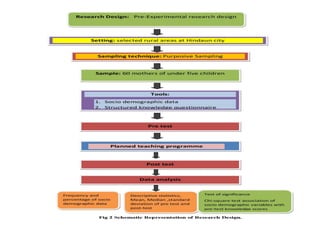
A pre experimental design with one group pre-
test and post-test was used to assess the
effectiveness of the planned teaching programme
for the present study.
10.
VARIABLES
Independent variable- In this study independent
variable refers to planned teaching programme
regarding acute diarrheal disease
Dependent variable - Dependent variable is the
outcome variable of interest. In this study,
knowledge of mothers of under five children was
the dependent variable.
Demographical variable - Age, education status,
occupation status, number of children , type of
family, monthly family income in rupees, and
source of information regarding cataract.
11.
SETTINGS OF THESTUDY
Research can be undertaken in a variety of settings
which are specific places where information is
gathered. Some studies take place in a
naturalistic setting in the field, such as in
people’s home or place of work. This study was
undertaken in selected rural areas at Hindaun
city.
12.
STUDY POPULATION
Thepopulation for the study consisted of
mothers of under five children .The target
population included the mothers of under five
children residing at selected rural areas at
Hindaun City.
13.
TARGET POPULATION
Settingis a physical location in which data
collection takes place in a study. This study was
undertaken in selected rural areas at Hindaun
city.
14.
ACCESSIBLE POPULATION
populationthat is selected to participate in a
particular study. It is a portion of the population,
which represents the entire population. In this
study sample were 60 mothers of under five
children residing at selected rural areas at
Hindaun City.
15.
SAMPLE AND SAMPLESIZE
It is a portion of the population, which
represents the entire population. In this study
sample were 60 mothers of under five children
residing at selected rural areas at Hindaun City
SAMPLE SIZE
Sample size in this study was 60 mothers of
under five children residing at selected rural
areas at Hindaun City
SAMPLING CRITERIA
Inclusive Criteria
Mothers of under five children
who were willing to participate in this study.
who were able to read, understand and write
Hindi or English.
Exclusive Criteria
Mothers of under five children who were not
available during data collection period.
Mothers of under five children who were
mentally challenged
18.
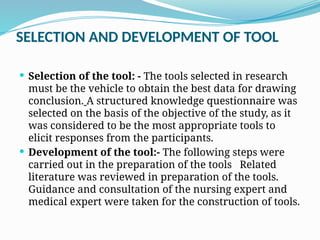
SELECTION AND DEVELOPMENTOF TOOL
Selection of the tool: - The tools selected in research
must be the vehicle to obtain the best data for drawing
conclusion. A structured knowledge questionnaire was
selected on the basis of the objective of the study, as it
was considered to be the most appropriate tools to
elicit responses from the participants.
Development of the tool:- The following steps were
carried out in the preparation of the tools Related
literature was reviewed in preparation of the tools.
Guidance and consultation of the nursing expert and
medical expert were taken for the construction of tools.
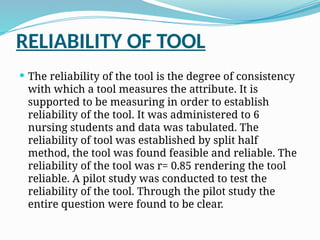
RELIABILITY OF TOOL
The reliability of the tool is the degree of consistency
with which a tool measures the attribute. It is
supported to be measuring in order to establish
reliability of the tool. It was administered to 6
nursing students and data was tabulated. The
reliability of tool was established by split half
method, the tool was found feasible and reliable. The
reliability of the tool was r= 0.85 rendering the tool
reliable. A pilot study was conducted to test the
reliability of the tool. Through the pilot study the
entire question were found to be clear.
21.
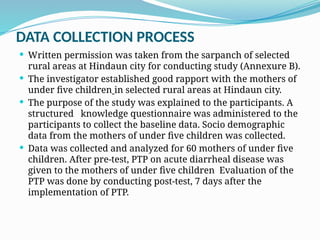
DATA COLLECTION PROCESS
Written permission was taken from the sarpanch of selected
rural areas at Hindaun city for conducting study (Annexure B).
The investigator established good rapport with the mothers of
under five children in selected rural areas at Hindaun city.
The purpose of the study was explained to the participants. A
structured knowledge questionnaire was administered to the
participants to collect the baseline data. Socio demographic
data from the mothers of under five children was collected.
Data was collected and analyzed for 60 mothers of under five
children. After pre-test, PTP on acute diarrheal disease was
given to the mothers of under five children Evaluation of the
PTP was done by conducting post-test, 7 days after the
implementation of PTP.
22.
PLAN FOR DATACOLLECTION
Data analysis is the schematic organization and
synthesis of research data and the testing of
research hypothesis using those data.
Data was planned to be analyzed on the basis of
objectives and hypothesis.
The plan of data analysis includes both
descriptive and inferential statistics.
The collected data was organized, tabulated and
analyzed based on the objectives of the study by
using descriptive statistics.
23.
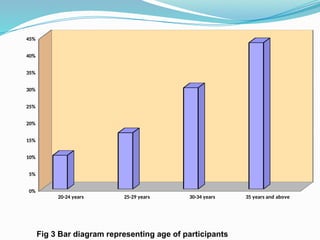
20-24 years 25-29years 30-34 years 35 years and above
0%
5%
10%
15%
20%
25%
30%
35%
40%
45%
Fig 3 Bar diagram representing age of participants
24.
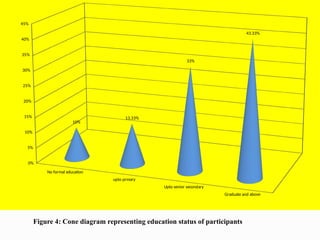
No formal education
uptoprmary
Upto senior secondary
Graduate and above
0%
5%
10%
15%
20%
25%
30%
35%
40%
45%
10%
13.33%
33%
43.33%
Figure 4: Cone diagram representing education status of participants
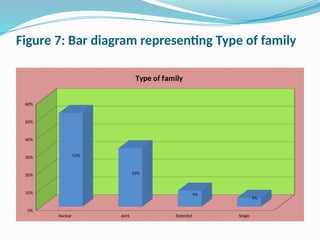
Figure 7: Bardiagram representing Type of family
Nuclear Joint Extended Single
0%
10%
20%
30%
40%
50%
60%
53%
33%
9%
5%
Type of family
28.
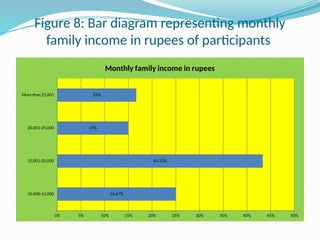
Figure 8: Bardiagram representing monthly
family income in rupees of participants
10,000-15,000
15,001-20,000
20,001-25,000
More than 25,001
0% 5% 10% 15% 20% 25% 30% 35% 40% 45% 50%
16.67%
43.33%
15%
25%
Monthly family income in rupees
29.
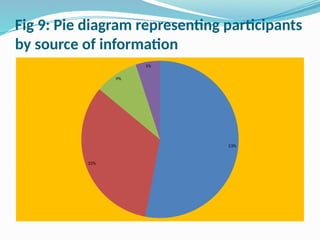
Fig 9: Piediagram representing participants
by source of information
53%
33%
9%
5%
30.
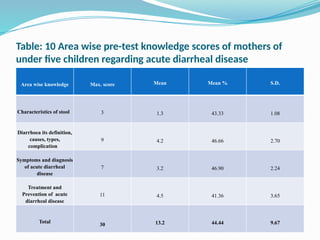
Table: 10 Areawise pre-test knowledge scores of mothers of
under five children regarding acute diarrheal disease
Area wise knowledge Max. score Mean Mean % S.D.
Characteristics of stool 3 1.3 43.33 1.08
Diarrhoea its definition,
causes, types,
complication
9 4.2 46.66 2.70
Symptoms and diagnosis
of acute diarrheal
disease
7 3.2 46.90 2.24
Treatment and
Prevention of acute
diarrheal disease
11 4.5 41.36 3.65
Total
30 13.2 44.44 9.67
31.
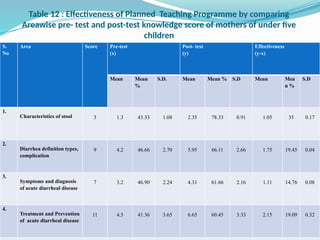
Table 12 :Effectiveness of Planned Teaching Programme by comparing
Areawise pre- test and post-test knowledge score of mothers of under five
children
S.
No
Area Score Pre-test
(x)
Post- test
(y)
Effectiveness
(y-x)
Mean Mean
%
S.D. Mean Mean % S.D Mean Mea
n %
S.D
1.
Characteristics of stool 3 1.3 43.33 1.08 2.35 78.33 0.91 1.05 35 0.17
2.
Diarrhea definition types,
complication
9 4.2 46.66 2.70 5.95 66.11 2.66 1.75 19.45 0.04
3.
Symptoms and diagnosis
of acute diarrheal disease
7 3.2 46.90 2.24 4.31 61.66 2.16 1.11 14.76 0.08
4.
Treatment and Prevention
of acute diarrheal disease
11 4.5 41.36 3.65 6.65 60.45 3.33 2.15 19.09 0.32
32.
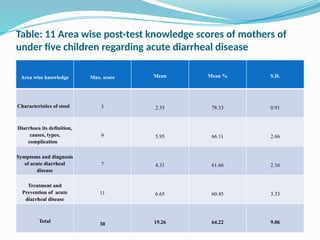
Table: 11 Areawise post-test knowledge scores of mothers of
under five children regarding acute diarrheal disease
Area wise knowledge Max. score Mean Mean % S.D.
Characteristics of stool 3 2.35 78.33 0.91
Diarrhoea its definition,
causes, types,
complication
9 5.95 66.11 2.66
Symptoms and diagnosis
of acute diarrheal
disease
7 4.31 61.66 2.16
Treatment and
Prevention of acute
diarrheal disease
11 6.65 60.45 3.33
Total
30 19.26 64.22 9.06
33.
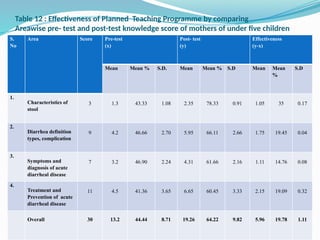
Table 12 :Effectiveness of Planned Teaching Programme by comparing
Areawise pre- test and post-test knowledge score of mothers of under five children
S.
No
Area Score Pre-test
(x)
Post- test
(y)
Effectiveness
(y-x)
Mean Mean % S.D. Mean Mean % S.D Mean Mean
%
S.D
1.
Characteristics of
stool
3 1.3 43.33 1.08 2.35 78.33 0.91 1.05 35 0.17
2.
Diarrhea definition
types, complication
9 4.2 46.66 2.70 5.95 66.11 2.66 1.75 19.45 0.04
3.
Symptoms and
diagnosis of acute
diarrheal disease
7 3.2 46.90 2.24 4.31 61.66 2.16 1.11 14.76 0.08
4.
Treatment and
Prevention of acute
diarrheal disease
11 4.5 41.36 3.65 6.65 60.45 3.33 2.15 19.09 0.32
Overall 30 13.2 44.44 8.71 19.26 64.22 9.82 5.96 19.78 1.11
34.
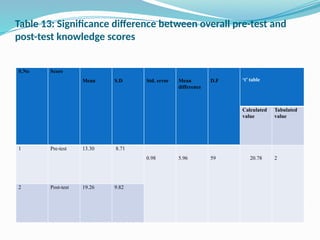
Table 13: Significancedifference between overall pre-test and
post-test knowledge scores
S.No Score
Mean S.D Std. error Mean
difference
D.F ‘t’ table
Calculated
value
Tabulated
value
1 Pre-test 13.30 8.71
0.98 5.96 59 20.78 2
2 Post-test 19.26 9.82
35.
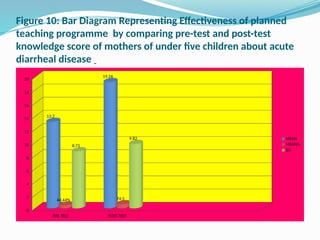
Figure 10: BarDiagram Representing Effectiveness of planned
teaching programme by comparing pre-test and post-test
knowledge score of mothers of under five children about acute
diarrheal disease
PRE TEST POST TEST
0
2
4
6
8
10
12
14
16
18
20
13.2
19.26
44.44% 74.5
8.71
9.82 MEAN
MEAN%
SD
36.
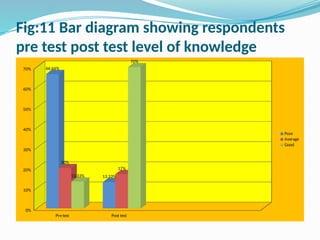
Fig:11 Bar diagramshowing respondents
pre test post test level of knowledge
Pre test Post test
0%
10%
20%
30%
40%
50%
60%
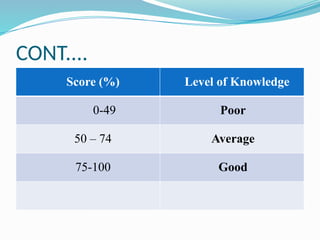
70% 66.66%
13.33%
20%
17%
13.33%
70%
Poor
Average
Good
37.
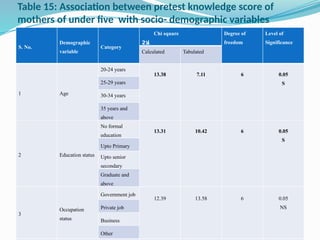
Table 15: Associationbetween pretest knowledge score of
mothers of under five with socio- demographic variables
S. No.
Demographic
variable
Category
Chi square
ﻼ
2
Degree of
freedom
Level of
Significance
Calculated Tabulated
1 Age
20-24 years
13.38 7.11 6 0.05
S
25-29 years
30-34 years
35 years and
above
2 Education status
No formal
education
13.31 10.42 6 0.05
S
Upto Primary
Upto senior
secondary
Graduate and
above
3
Occupation
status
Government job
12.39 13.58 6 0.05
NS
Private job
Business
Other
38.
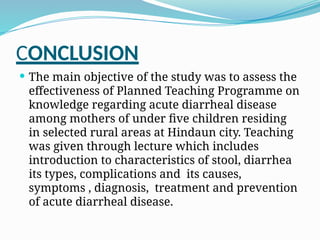
CONCLUSION
The mainobjective of the study was to assess the
effectiveness of Planned Teaching Programme on
knowledge regarding acute diarrheal disease
among mothers of under five children residing
in selected rural areas at Hindaun city. Teaching
was given through lecture which includes
introduction to characteristics of stool, diarrhea
its types, complications and its causes,
symptoms , diagnosis, treatment and prevention
of acute diarrheal disease.
39.
RECOMMENDATIONS
A similarstudy can be conducted on a large sample.
A quasi experimental study can be conducted using
experimental group.
Follow up study can be conducted to assess the effectiveness of
Planned teaching programme .
The same study can be conducted in various nursing colleges,
different hospitals and in rural areas.
A comparative study can be conducted to assess the
effectiveness of planned teaching programme on acute
diarrheal disease between rural and urban mothers of under
five children.
A longitudinal study can be conducted to assess the
vulnerability of acute diarrheal disease.






![this is the Human resource M iman[1].pptx](https://cdn.slidesharecdn.com/ss_thumbnails/hmiman1-250914100220-640e6245-thumbnail.jpg?width=640&height=640&fit=bounds)


![ONFH[AVN HIP] -TRIPLE REGIME -A NOVAL SURGICAL CONCEPT .pptx](https://cdn.slidesharecdn.com/ss_thumbnails/onfhavnhip2026koaconcalicutdrgokuldevdrmashraf-260210064517-213ec005-thumbnail.jpg?width=640&height=640&fit=bounds)


![CTEV [ clubfoot] DR ARUN LAL ,DR MOHAMED ASHRAF travancore medical college k...](https://cdn.slidesharecdn.com/ss_thumbnails/ctevclubfootdrarunlaldrmohamedashraftravancoremedicalcollegekollamkeralaindia-260208063247-18fc466c-thumbnail.jpg?width=640&height=640&fit=bounds)


