Chapter 4
THE SECOND LAW
OF THERMODYNAMICS
4.1 Limitations of First Law of Thermodynamics
If a well insulated tank of fluid is stirred by a rotating paddle wheel, the energy of the fluid
increases. If the stirrer is stopped, however the energy of the fluid will not decrease and cause
the stirrer to rotate in the opposite direction. The possibility of this process proceeding in the
opposite direction is not excluded by the first law of Thermodynamics. Hence first law of
thermodynamics does not allow us to predict whether a proposed conceived energy conversion
is possible or not.
In all the internal combustion engines fuel and air mixture is supplied at room
temperature. This mixture undergoes combustion inside the engine and gives out work. Exhaust
gases coming out of the engine are always at higher temperature, indicating that some heat is
taken away into atmosphere. Hence, in all the IC engines only a part of the heat is converted into
work. From our experience we know that if any attempt is made to convert all the heat into work,
our effort will go in vain. This limitation in the extent of energy conversion has also not been
addressed in first law of thermodynamics.
4.2 The Second law of Thermodynamics
Kelvin Planck’s statement : It is impossible to construct a device that, operating
continuously, will produce no effect other than transfer of heat
from a single thermal reservoir and performance of an equal
amount of work.
The term thermal reservoir refers to a very large system in stable equilibrium, to which or
from which, any amount of heat can be transferred at constant temperature.
A thermal reservoir supplying heat continuously at constant temperature is known as
source. (Example : Sun)
A thermal reservoir receiving heat continuously at constant temperature is known as sink.
(Examples : River, Sea)
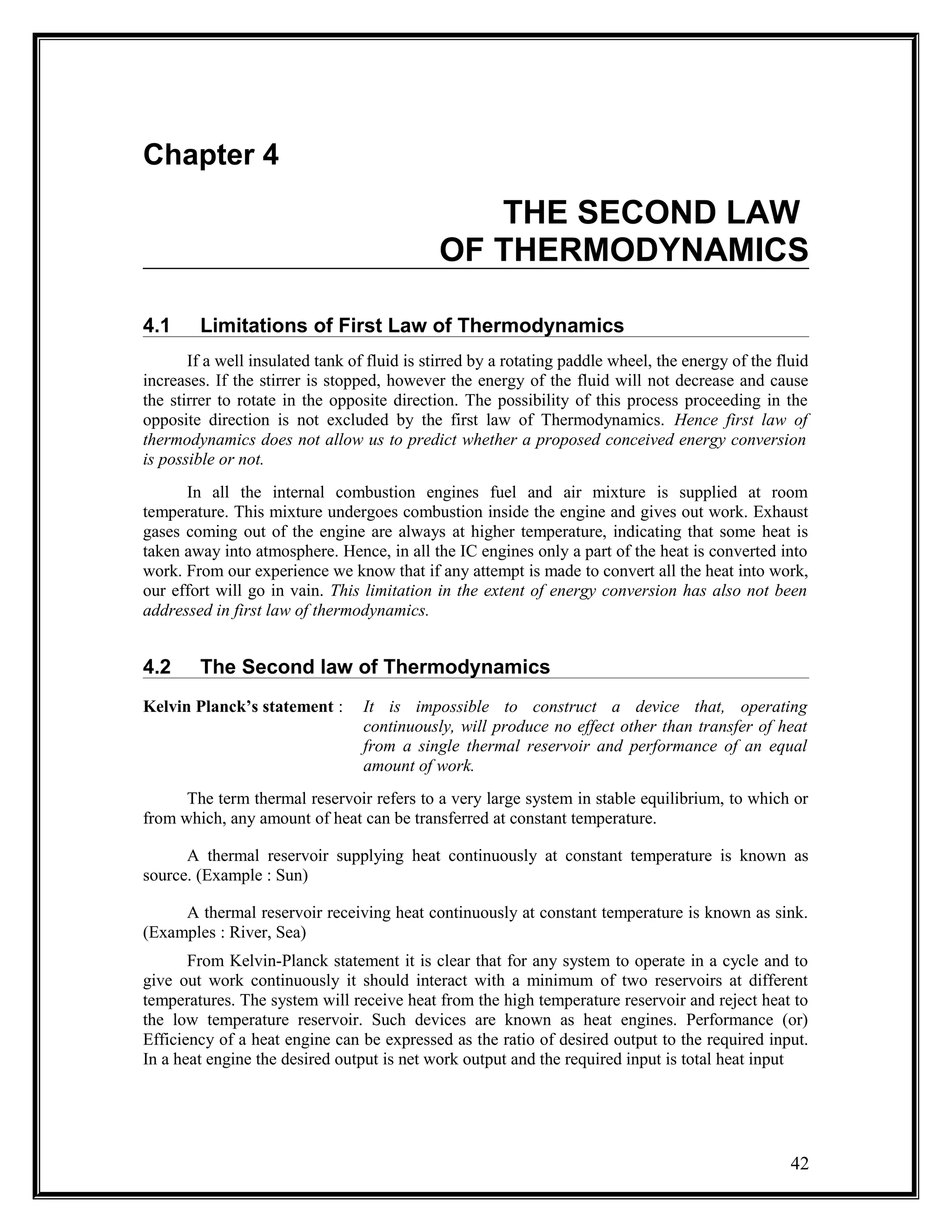
From Kelvin-Planck statement it is clear that for any system to operate in a cycle and to
give out work continuously it should interact with a minimum of two reservoirs at different
temperatures. The system will receive heat from the high temperature reservoir and reject heat to
the low temperature reservoir. Such devices are known as heat engines. Performance (or)
Efficiency of a heat engine can be expressed as the ratio of desired output to the required input.
In a heat engine the desired output is net work output and the required input is total heat input
42
Figure 4.1 Heat Engine
in
net
Q
W
=η
...(4.1)
From first law of thermodynamics
ΣQ = ΣW
Qin
− Qout
= Wnet
...(4.2)
Clausius statement : Unaided by an external agency heat can not be transferred from a body at
lower temperature to a body at higher temperature.
Devices that are used to transfer heat from a body at lower temperature to a body at higher
temperature are known as refrigerators (or) heat pumps. If the high temperature side is
atmosphere it is a refrigerator. If the low temperature side is atmosphere it is known as a heat
pump. The performance index here is called coefficient of performance (COP). In refrigerator
(and heat pumps) the performance is the ratio of two independent parameters and hence the
possibility of getting the value more than unity is always there. But the term efficiency is
restricted to a maximum of unity. Hence the term efficiency is not used here.
Source
Heat
Engine
Sink
W
Qin
Qout
Desired
Effect
Required
Effect
43
W
Q
COP
Effectquired
EffectDesired
COP
2
Re
=
=
Taking work as external agency, for refrigerators (Figure 4.2)
...(4.3)
From first law
ΣQ = ΣW
Q1
− Q2
= W
Figure 4.2 Refrigerator
Sink
[Atmosphere]
Refrig
erator
Source
[conditioned Space]
W
Q1
Q2
Desired
Effect
Require
d Effect
44
21
2
QQ
Q
COP
−
=
Figure 4.3 Heat Pump
Similarly for a heat pumps (Figure 4.3)
...(4.4)
...(4.5)
Sink
[Conditioned Space]
Heat
Pump
Source
[Atmosphere]
W
Q1
Q2
Require
d
Effect
Desired
Effect
45
21
1
21
1
,
Re
QQ
Q
COP
WQQSince
W
Q
COP
Effectquired
EffectDesired
COP
−
=
=+
=
=
4.3 Equivalence of Kelvin-Planck and Clausius Statements
The Clausius and Kelvin-Planck statements of the second law are entirely equivalent. This
equivalence can be demonstrated by showing that the violation of either statement can result in
violation of the other one.
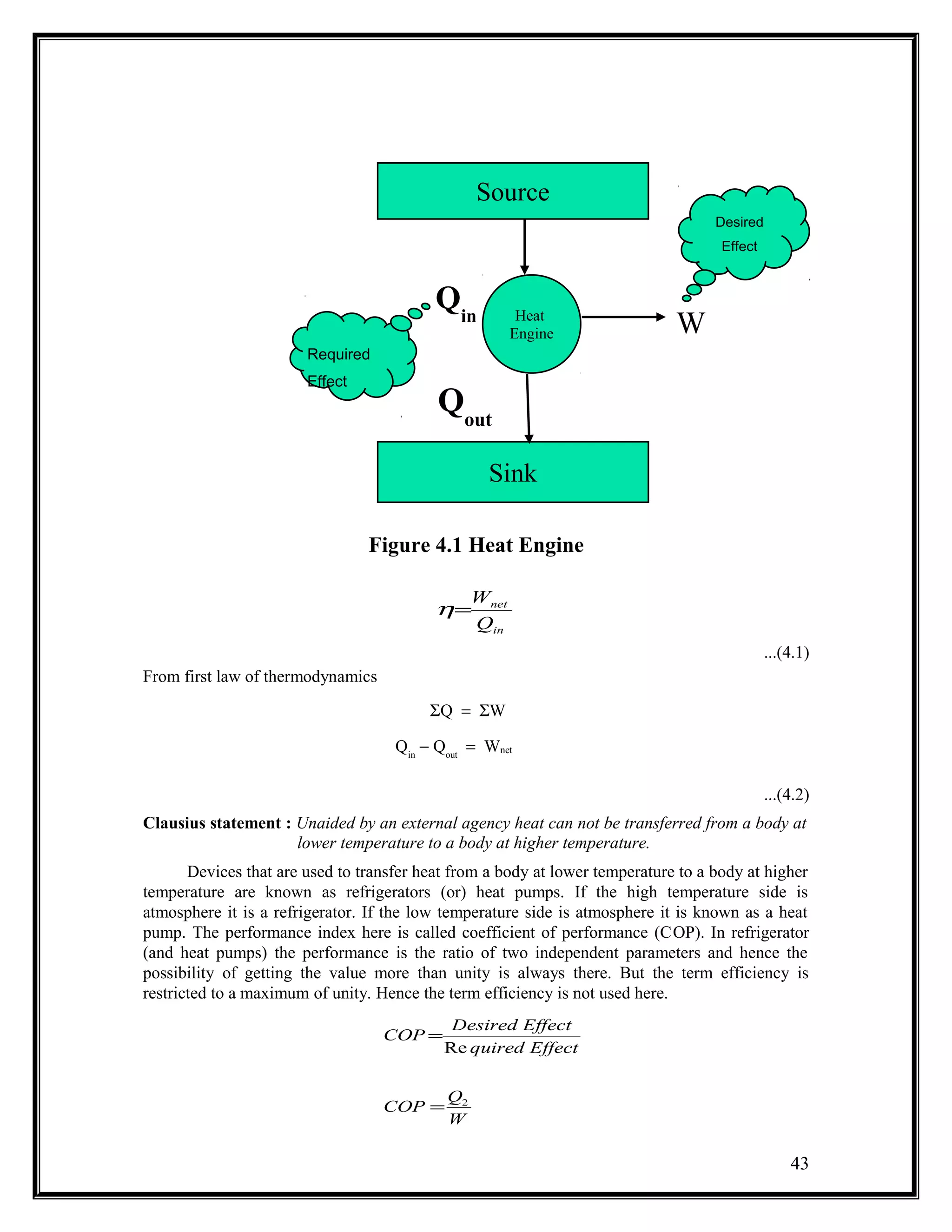
Referring to Figure 4.4(a) the device marked Clausius violator is pumping Q1
amount of
heat from a low temperature reservoir at T1
to a high temperature reservoir at T2
without the aid
of any external agency. This is an impossible arrangement.
If such an arrangement is possible it would also violate Kelvin-Planck statement. Let a
heat engine operating between the same reservoirs at T2
and T1
take in Q2
as heat input at T2
. It
converts a part of this heat into work and rejects heat Q3
to the sink at T1
. Since the Clausius
violator is rejecting the same quantity Q2
at T2
, it can be supplied directly into the heat engine so
that the reservoir at T2
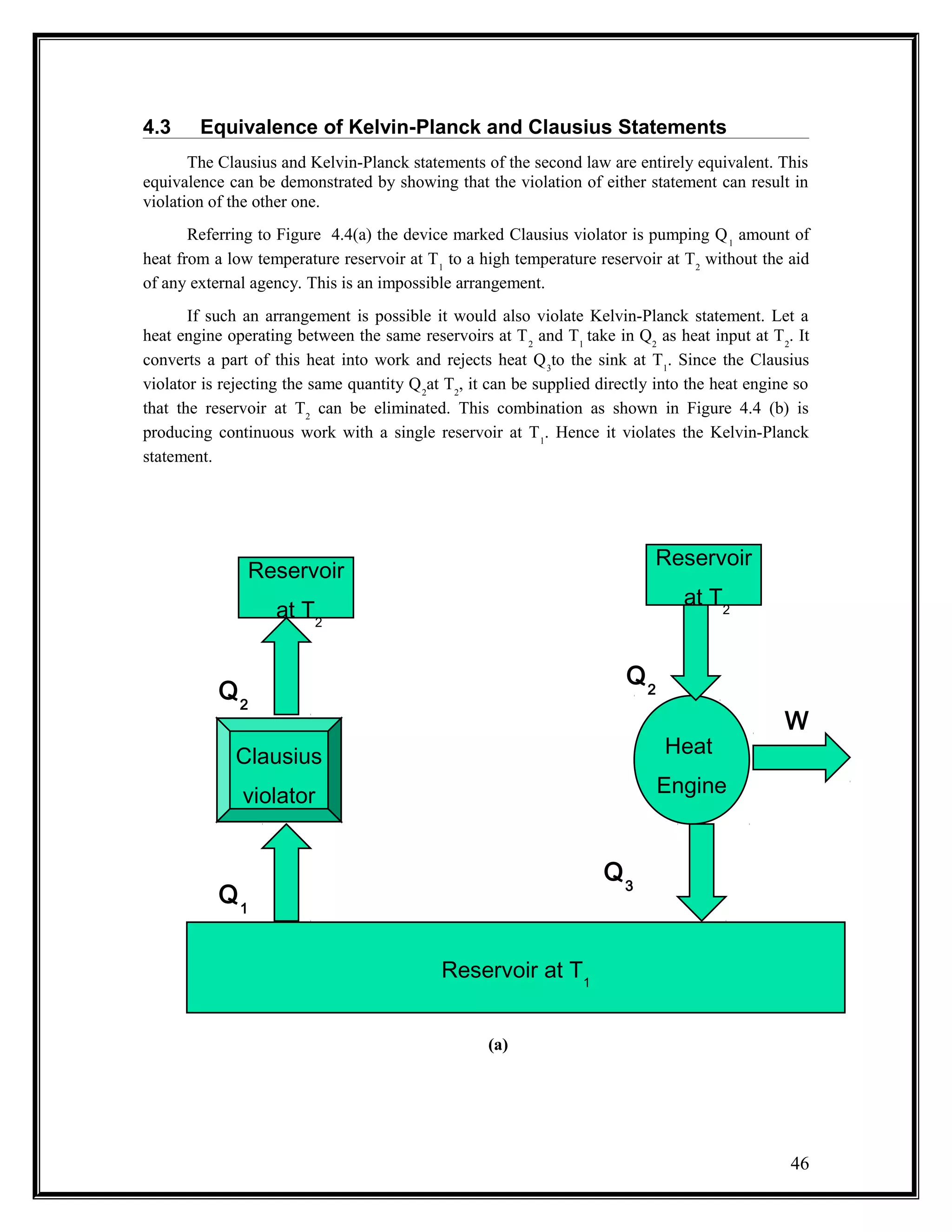
can be eliminated. This combination as shown in Figure 4.4 (b) is
producing continuous work with a single reservoir at T1
. Hence it violates the Kelvin-Planck
statement.
(a)
Reservoir at T1
Heat
Engine
Clausius
violator
Reservoir
at T2
Q1
Q2
Q3
Reservoir
at T2
W
Q2
46
(b)
Figure 4.4 Illustration of the equivalence of Clausius and Kelvin-Planck’s statement
Referring to Figure 4.5 a Kelvin-planck violator is converting all heat QH
taken from the
reservoir at TH
into work. If such an impossible heat engine is assumed to exist it will violate the
Clausius statement. Consider a refrigerator pumping QL
heat from the low temperature reservoir
at TL
to the reservoir at higher temperature TH
. Combined with the Kelvin-Planck violator, the
arrangement is pumping QL
heat from TL
to TH
, without any external agency. Hence it violate the
Clausius statement.
4.4 Reversible Process
A process is said to be reversible if it can be reversed without leaving any trace on the
surroundings.
For example, let a system be taken from state 1 to state 2 with a work transfer of +5 kJ and
heat transfer of −10 kJ. If the process is reversible, while taking the system from state 2 to state
1, the work transfer must be −5 kJ and heat transfer must be +10 kJ. So that, both the system and
surroundings are returned to their initial states at the end of the process 2 to 1.
4.5 Irreversibility and Causes of Irreversibility
The factors that make a process irreversible are known as irreversibilities. Various forms
of irreversibilities are listed below.
Reservoir at T1
Heat
Engin
e
Clausius
violator
Q1
Q2
Q3
W
Q2
47
a) Friction : Friction occurs at the interface of two bodies moving relative to each
other. It is the main cause of irreversibility in many processes. Energy
spent in overcoming friction is dissipated in the form of heat which
can never be restored.
b) Heat transfer: Once heat is transferred from a body at higher temperature to a body
at lower temperature, it can never be reversed without the aid of an
external agency.
through finite
temperature
difference
c) Unresisted expansion :
Consider a vessel with two chambers as given in the
arrangement as shown in Fig. 4.6. If the members separating the gas
from vacuum is removed, gas will expand and occupy the entire space.
Since the expansion has no influence on the surroundings, there is no
work output in this process. But to restore the initial arrangement, a
definite work input is required.
d) Mixing of two gases : Consider a vessel with two chambers, one with O2
and the other with
N2
. When the member separating O2
& N2
is removed, uniform mixing
is taking place without any work output. But such a process can not be
reversed without any work input.
e) Throttling : It is a totally irreversible process. Gas or vapour will expand
through a restricted passage with its pressure decreasing rapidly
without any work output. Such an expansion can not be reversed.
4.6 Externally and internally reversible processes
As mentioned earlier if no irreversibilities occur outside the system boundaries during the
process, it is known as externally reversible.
If no irreversibilities occur within the boundary of the system during a process, it is known
as internally reversible process. For such a process, the path of the reverse process will follow
exactly that of the forward process in any property diagram.
To be totally reversible or simply reversible both external and internal reversibilities must
be ensured.
48
4.7 The Carnot Cycle
In 1824, Nicholas Sadi Carnot proposed a classical ideal cycle consisting of four
processes. All processes are individually reversible and hence the cycle as a whole is a reversible
cycle. The processes that make up the Carnot cycle are :
Process 1-2
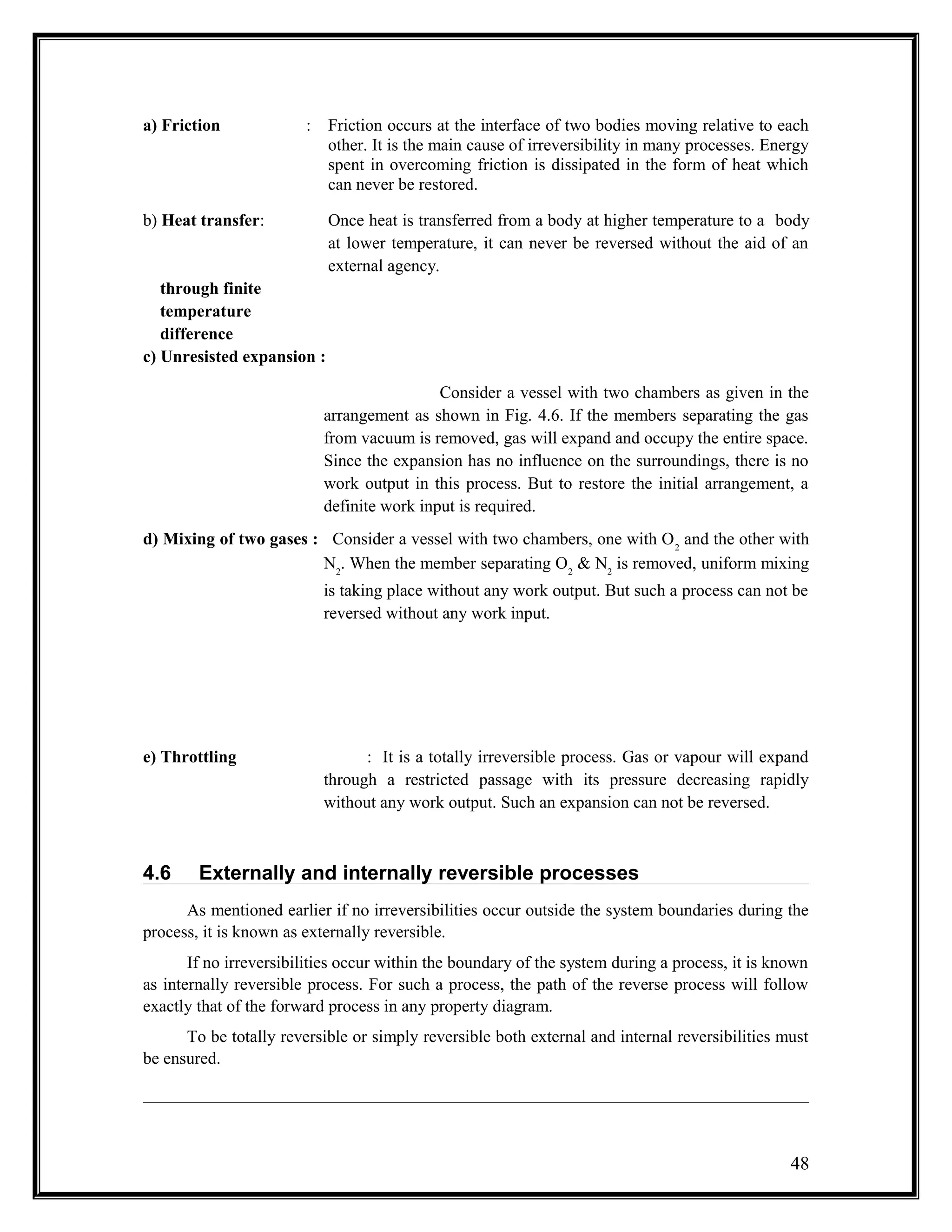
The working substance is taken in a piston cylinder arrangement as given in Figure 4.8(a).
Heat is added reversibly and isothermally from a high temperature reservoir at TH
. Since the
process is to be reversible, the temperature TH
of the reservoir should be equal to or
infinitesimally greater than that of the working substance.
Figure 4.8(a) Figure 4.8(b)
Process 2-3
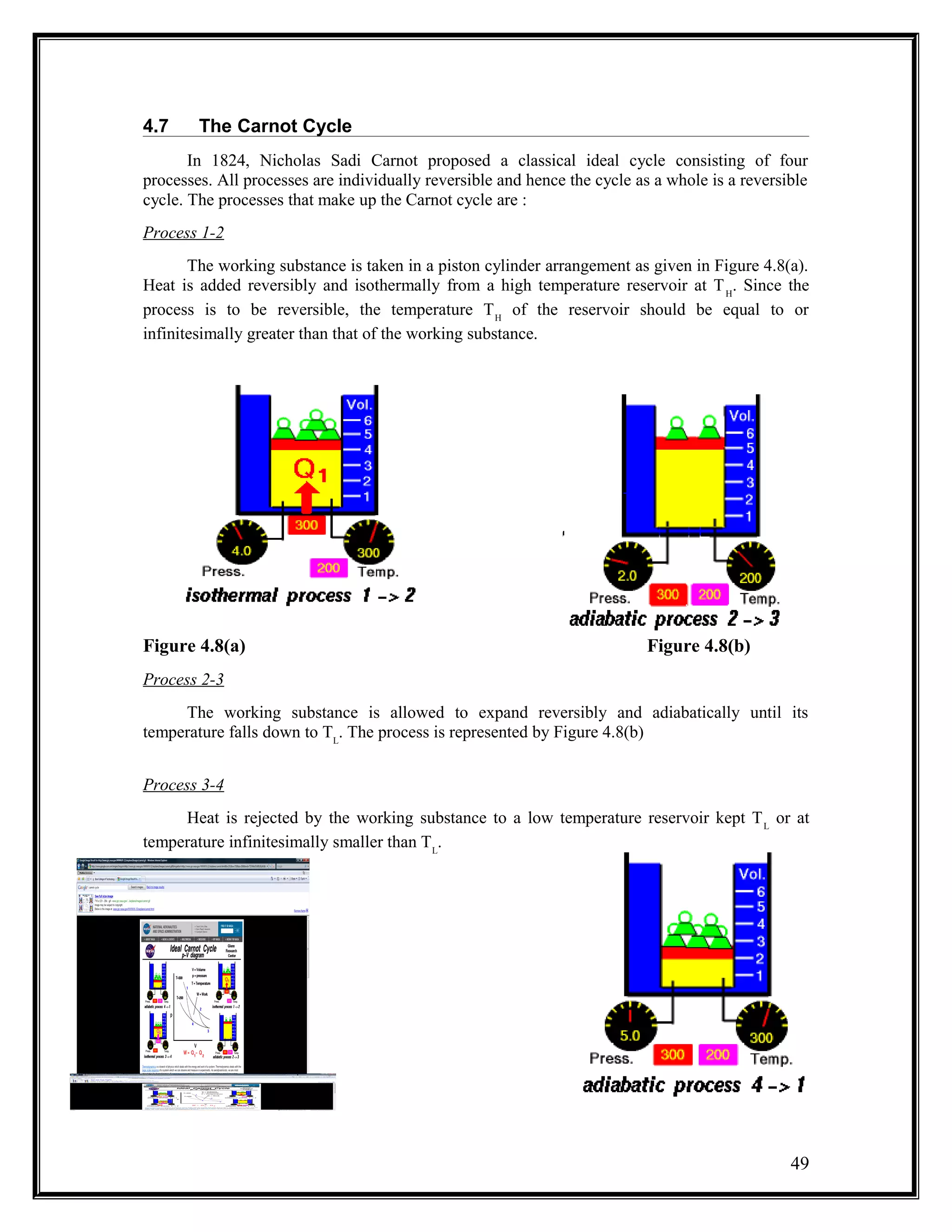
The working substance is allowed to expand reversibly and adiabatically until its
temperature falls down to TL
. The process is represented by Figure 4.8(b)
Process 3-4
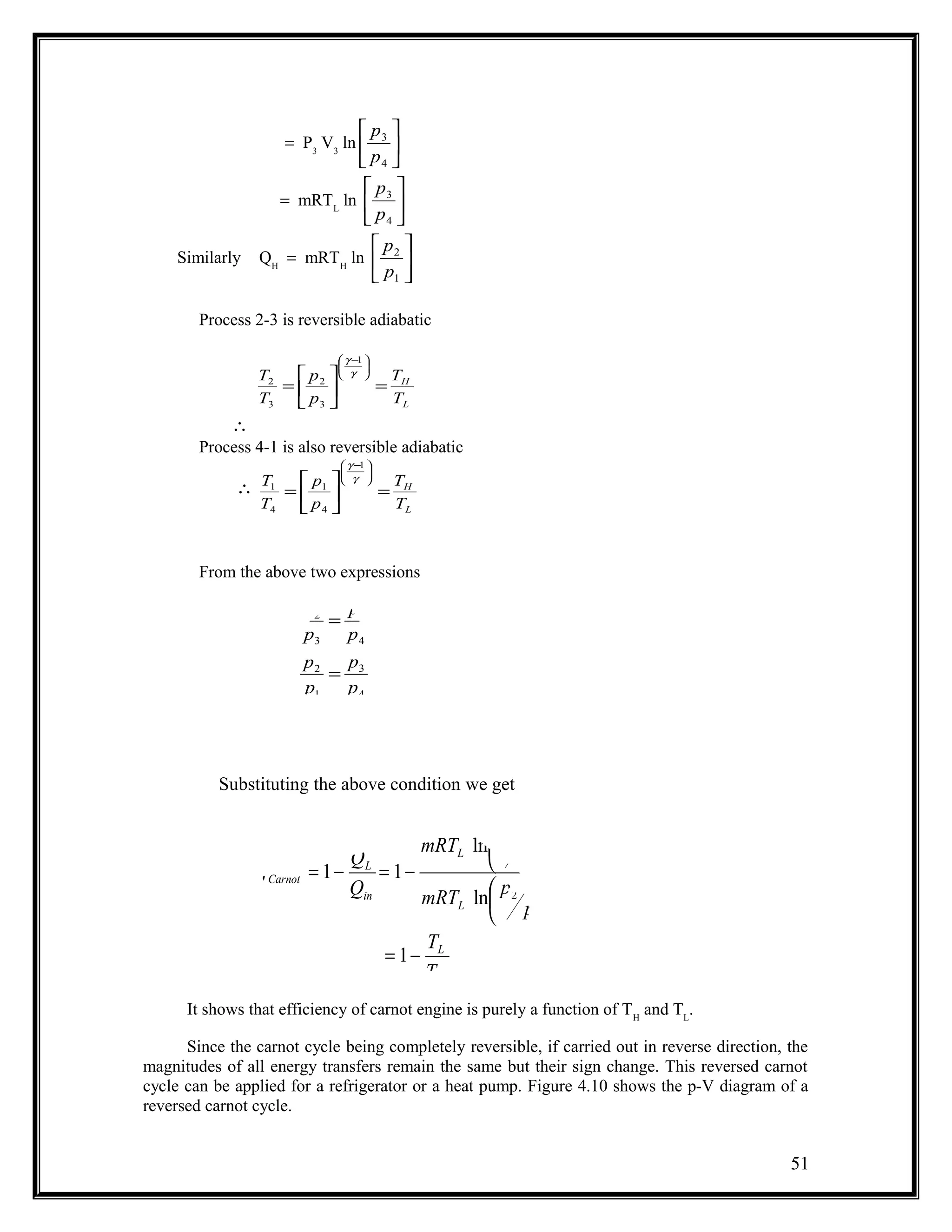
Heat is rejected by the working substance to a low temperature reservoir kept TL
or at
temperature infinitesimally smaller than TL
.
49
Process 4-1
The working substance is then compressed reversibly and adiabatically until its
temperature becomes TH
and the cycle continues.
The cycle has been represented in a p-V diagram in Figure 4.9. The included area
represents the net work done in the cycle. From first law of thermodynamics net workdone is
equal to net heat transfer in the cycle. Since QH
is the heat added to system and QL
is the heat
rejected by the system, the neat heat transfer is QH
− QL
.
Efficiency of Carnot Engine =
in
net
Q
W
=
in
LH
Q
QQ −
=
in
L
Q
Q
−1
Where
QL = 3
W4
+ U4
− U3
Since the process is isothermal U4
= U3
∴ QL
= 3
W4
50
1
v
4 3
2
p
Isothermal heat
addition
Adiabatic expansion
Isothermal heat
rejection
Adiabatic compression
= P3
V3
ln 





4
3
p
p
= mRTL
ln 





4
3
p
p
Similarly QH
= mRTH
ln 





1
2
p
p
Process 2-3 is reversible adiabatic
L
H
T
T
p
p
T
T
=





=





 −
γ
γ 1
3
2
3
2
∴
Process 4-1 is also reversible adiabatic
∴
L
H
T
T
p
p
T
T
=





=





 −
γ
γ 1
4
1
4
1
From the above two expressions
Substituting the above condition we get
It shows that efficiency of carnot engine is purely a function of TH
and TL
.
Since the carnot cycle being completely reversible, if carried out in reverse direction, the
magnitudes of all energy transfers remain the same but their sign change. This reversed carnot
cycle can be applied for a refrigerator or a heat pump. Figure 4.10 shows the p-V diagram of a
reversed carnot cycle.
51
4
3
1
2
4
1
3
2
p
p
p
p
p
p
p
p
=
=
H
L
L
L
in
L
Carnot
T
T
p
p
mRT
p
p
mRT
Q
Q
−=












−=−=
1
ln
ln
11
1
2
4
3
η
52

Chapter 4 second law

  • 1.
    Chapter 4 THE SECONDLAW OF THERMODYNAMICS 4.1 Limitations of First Law of Thermodynamics If a well insulated tank of fluid is stirred by a rotating paddle wheel, the energy of the fluid increases. If the stirrer is stopped, however the energy of the fluid will not decrease and cause the stirrer to rotate in the opposite direction. The possibility of this process proceeding in the opposite direction is not excluded by the first law of Thermodynamics. Hence first law of thermodynamics does not allow us to predict whether a proposed conceived energy conversion is possible or not. In all the internal combustion engines fuel and air mixture is supplied at room temperature. This mixture undergoes combustion inside the engine and gives out work. Exhaust gases coming out of the engine are always at higher temperature, indicating that some heat is taken away into atmosphere. Hence, in all the IC engines only a part of the heat is converted into work. From our experience we know that if any attempt is made to convert all the heat into work, our effort will go in vain. This limitation in the extent of energy conversion has also not been addressed in first law of thermodynamics. 4.2 The Second law of Thermodynamics Kelvin Planck’s statement : It is impossible to construct a device that, operating continuously, will produce no effect other than transfer of heat from a single thermal reservoir and performance of an equal amount of work. The term thermal reservoir refers to a very large system in stable equilibrium, to which or from which, any amount of heat can be transferred at constant temperature. A thermal reservoir supplying heat continuously at constant temperature is known as source. (Example : Sun) A thermal reservoir receiving heat continuously at constant temperature is known as sink. (Examples : River, Sea) From Kelvin-Planck statement it is clear that for any system to operate in a cycle and to give out work continuously it should interact with a minimum of two reservoirs at different temperatures. The system will receive heat from the high temperature reservoir and reject heat to the low temperature reservoir. Such devices are known as heat engines. Performance (or) Efficiency of a heat engine can be expressed as the ratio of desired output to the required input. In a heat engine the desired output is net work output and the required input is total heat input 42
  • 2.
    Figure 4.1 HeatEngine in net Q W =η ...(4.1) From first law of thermodynamics ΣQ = ΣW Qin − Qout = Wnet ...(4.2) Clausius statement : Unaided by an external agency heat can not be transferred from a body at lower temperature to a body at higher temperature. Devices that are used to transfer heat from a body at lower temperature to a body at higher temperature are known as refrigerators (or) heat pumps. If the high temperature side is atmosphere it is a refrigerator. If the low temperature side is atmosphere it is known as a heat pump. The performance index here is called coefficient of performance (COP). In refrigerator (and heat pumps) the performance is the ratio of two independent parameters and hence the possibility of getting the value more than unity is always there. But the term efficiency is restricted to a maximum of unity. Hence the term efficiency is not used here. Source Heat Engine Sink W Qin Qout Desired Effect Required Effect 43 W Q COP Effectquired EffectDesired COP 2 Re = =
  • 3.
    Taking work asexternal agency, for refrigerators (Figure 4.2) ...(4.3) From first law ΣQ = ΣW Q1 − Q2 = W Figure 4.2 Refrigerator Sink [Atmosphere] Refrig erator Source [conditioned Space] W Q1 Q2 Desired Effect Require d Effect 44 21 2 QQ Q COP − =
  • 4.
    Figure 4.3 HeatPump Similarly for a heat pumps (Figure 4.3) ...(4.4) ...(4.5) Sink [Conditioned Space] Heat Pump Source [Atmosphere] W Q1 Q2 Require d Effect Desired Effect 45 21 1 21 1 , Re QQ Q COP WQQSince W Q COP Effectquired EffectDesired COP − = =+ = =
  • 5.
    4.3 Equivalence ofKelvin-Planck and Clausius Statements The Clausius and Kelvin-Planck statements of the second law are entirely equivalent. This equivalence can be demonstrated by showing that the violation of either statement can result in violation of the other one. Referring to Figure 4.4(a) the device marked Clausius violator is pumping Q1 amount of heat from a low temperature reservoir at T1 to a high temperature reservoir at T2 without the aid of any external agency. This is an impossible arrangement. If such an arrangement is possible it would also violate Kelvin-Planck statement. Let a heat engine operating between the same reservoirs at T2 and T1 take in Q2 as heat input at T2 . It converts a part of this heat into work and rejects heat Q3 to the sink at T1 . Since the Clausius violator is rejecting the same quantity Q2 at T2 , it can be supplied directly into the heat engine so that the reservoir at T2 can be eliminated. This combination as shown in Figure 4.4 (b) is producing continuous work with a single reservoir at T1 . Hence it violates the Kelvin-Planck statement. (a) Reservoir at T1 Heat Engine Clausius violator Reservoir at T2 Q1 Q2 Q3 Reservoir at T2 W Q2 46
  • 6.
    (b) Figure 4.4 Illustrationof the equivalence of Clausius and Kelvin-Planck’s statement Referring to Figure 4.5 a Kelvin-planck violator is converting all heat QH taken from the reservoir at TH into work. If such an impossible heat engine is assumed to exist it will violate the Clausius statement. Consider a refrigerator pumping QL heat from the low temperature reservoir at TL to the reservoir at higher temperature TH . Combined with the Kelvin-Planck violator, the arrangement is pumping QL heat from TL to TH , without any external agency. Hence it violate the Clausius statement. 4.4 Reversible Process A process is said to be reversible if it can be reversed without leaving any trace on the surroundings. For example, let a system be taken from state 1 to state 2 with a work transfer of +5 kJ and heat transfer of −10 kJ. If the process is reversible, while taking the system from state 2 to state 1, the work transfer must be −5 kJ and heat transfer must be +10 kJ. So that, both the system and surroundings are returned to their initial states at the end of the process 2 to 1. 4.5 Irreversibility and Causes of Irreversibility The factors that make a process irreversible are known as irreversibilities. Various forms of irreversibilities are listed below. Reservoir at T1 Heat Engin e Clausius violator Q1 Q2 Q3 W Q2 47
  • 7.
    a) Friction :Friction occurs at the interface of two bodies moving relative to each other. It is the main cause of irreversibility in many processes. Energy spent in overcoming friction is dissipated in the form of heat which can never be restored. b) Heat transfer: Once heat is transferred from a body at higher temperature to a body at lower temperature, it can never be reversed without the aid of an external agency. through finite temperature difference c) Unresisted expansion : Consider a vessel with two chambers as given in the arrangement as shown in Fig. 4.6. If the members separating the gas from vacuum is removed, gas will expand and occupy the entire space. Since the expansion has no influence on the surroundings, there is no work output in this process. But to restore the initial arrangement, a definite work input is required. d) Mixing of two gases : Consider a vessel with two chambers, one with O2 and the other with N2 . When the member separating O2 & N2 is removed, uniform mixing is taking place without any work output. But such a process can not be reversed without any work input. e) Throttling : It is a totally irreversible process. Gas or vapour will expand through a restricted passage with its pressure decreasing rapidly without any work output. Such an expansion can not be reversed. 4.6 Externally and internally reversible processes As mentioned earlier if no irreversibilities occur outside the system boundaries during the process, it is known as externally reversible. If no irreversibilities occur within the boundary of the system during a process, it is known as internally reversible process. For such a process, the path of the reverse process will follow exactly that of the forward process in any property diagram. To be totally reversible or simply reversible both external and internal reversibilities must be ensured. 48
  • 8.
    4.7 The CarnotCycle In 1824, Nicholas Sadi Carnot proposed a classical ideal cycle consisting of four processes. All processes are individually reversible and hence the cycle as a whole is a reversible cycle. The processes that make up the Carnot cycle are : Process 1-2 The working substance is taken in a piston cylinder arrangement as given in Figure 4.8(a). Heat is added reversibly and isothermally from a high temperature reservoir at TH . Since the process is to be reversible, the temperature TH of the reservoir should be equal to or infinitesimally greater than that of the working substance. Figure 4.8(a) Figure 4.8(b) Process 2-3 The working substance is allowed to expand reversibly and adiabatically until its temperature falls down to TL . The process is represented by Figure 4.8(b) Process 3-4 Heat is rejected by the working substance to a low temperature reservoir kept TL or at temperature infinitesimally smaller than TL . 49
  • 9.
    Process 4-1 The workingsubstance is then compressed reversibly and adiabatically until its temperature becomes TH and the cycle continues. The cycle has been represented in a p-V diagram in Figure 4.9. The included area represents the net work done in the cycle. From first law of thermodynamics net workdone is equal to net heat transfer in the cycle. Since QH is the heat added to system and QL is the heat rejected by the system, the neat heat transfer is QH − QL . Efficiency of Carnot Engine = in net Q W = in LH Q QQ − = in L Q Q −1 Where QL = 3 W4 + U4 − U3 Since the process is isothermal U4 = U3 ∴ QL = 3 W4 50 1 v 4 3 2 p Isothermal heat addition Adiabatic expansion Isothermal heat rejection Adiabatic compression
  • 10.
    = P3 V3 ln       4 3 p p =mRTL ln       4 3 p p Similarly QH = mRTH ln       1 2 p p Process 2-3 is reversible adiabatic L H T T p p T T =      =       − γ γ 1 3 2 3 2 ∴ Process 4-1 is also reversible adiabatic ∴ L H T T p p T T =      =       − γ γ 1 4 1 4 1 From the above two expressions Substituting the above condition we get It shows that efficiency of carnot engine is purely a function of TH and TL . Since the carnot cycle being completely reversible, if carried out in reverse direction, the magnitudes of all energy transfers remain the same but their sign change. This reversed carnot cycle can be applied for a refrigerator or a heat pump. Figure 4.10 shows the p-V diagram of a reversed carnot cycle. 51 4 3 1 2 4 1 3 2 p p p p p p p p = = H L L L in L Carnot T T p p mRT p p mRT Q Q −=             −=−= 1 ln ln 11 1 2 4 3 η
  • 11.