UNIT - II
ZEROTHAND FIRST LAW OF
THERMODYNAMICS
Presented by
K Rajendra, M. Tech(Ph. D)
Assistant Professor
Department of Mechanical Engineering
2.
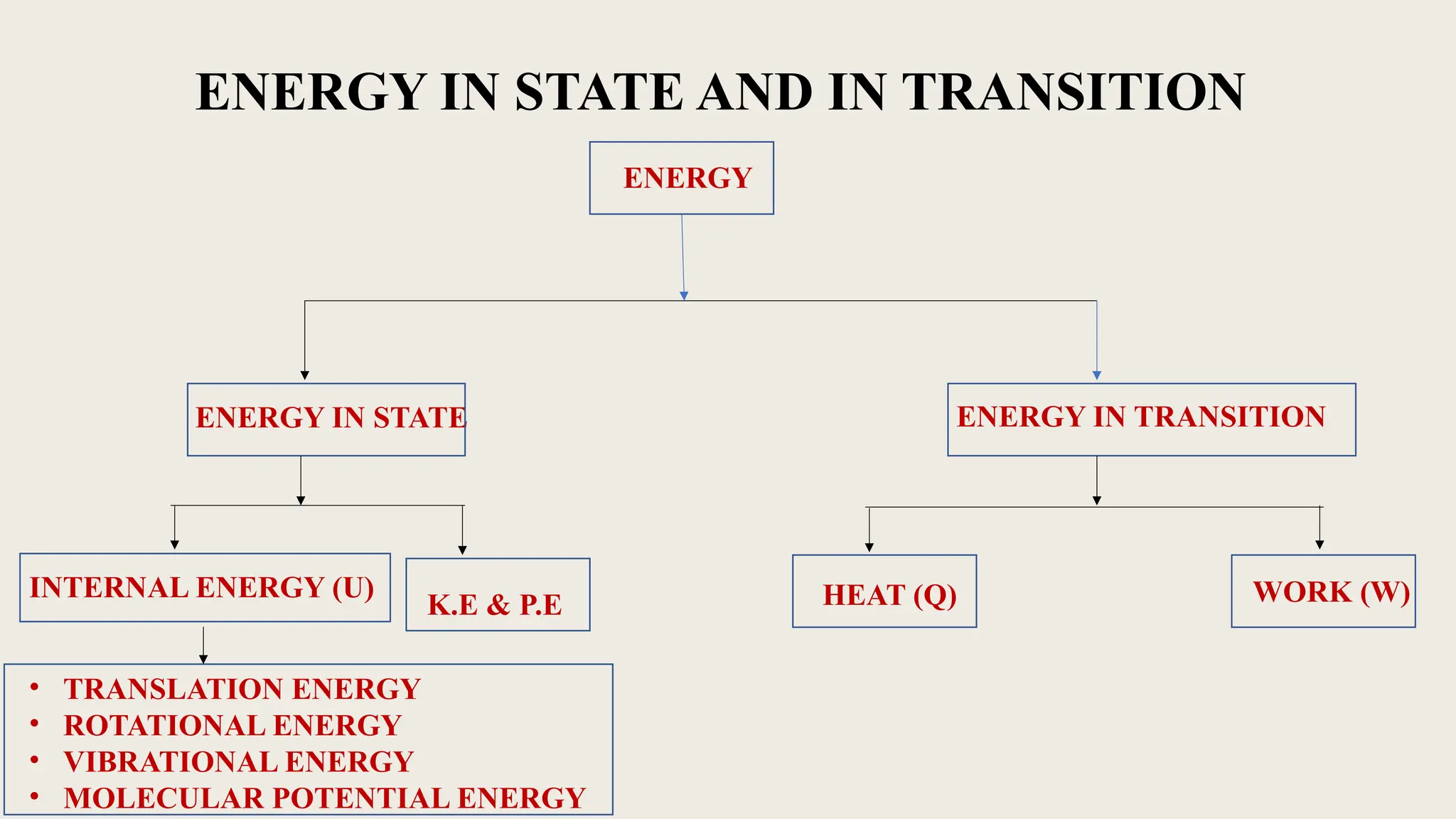
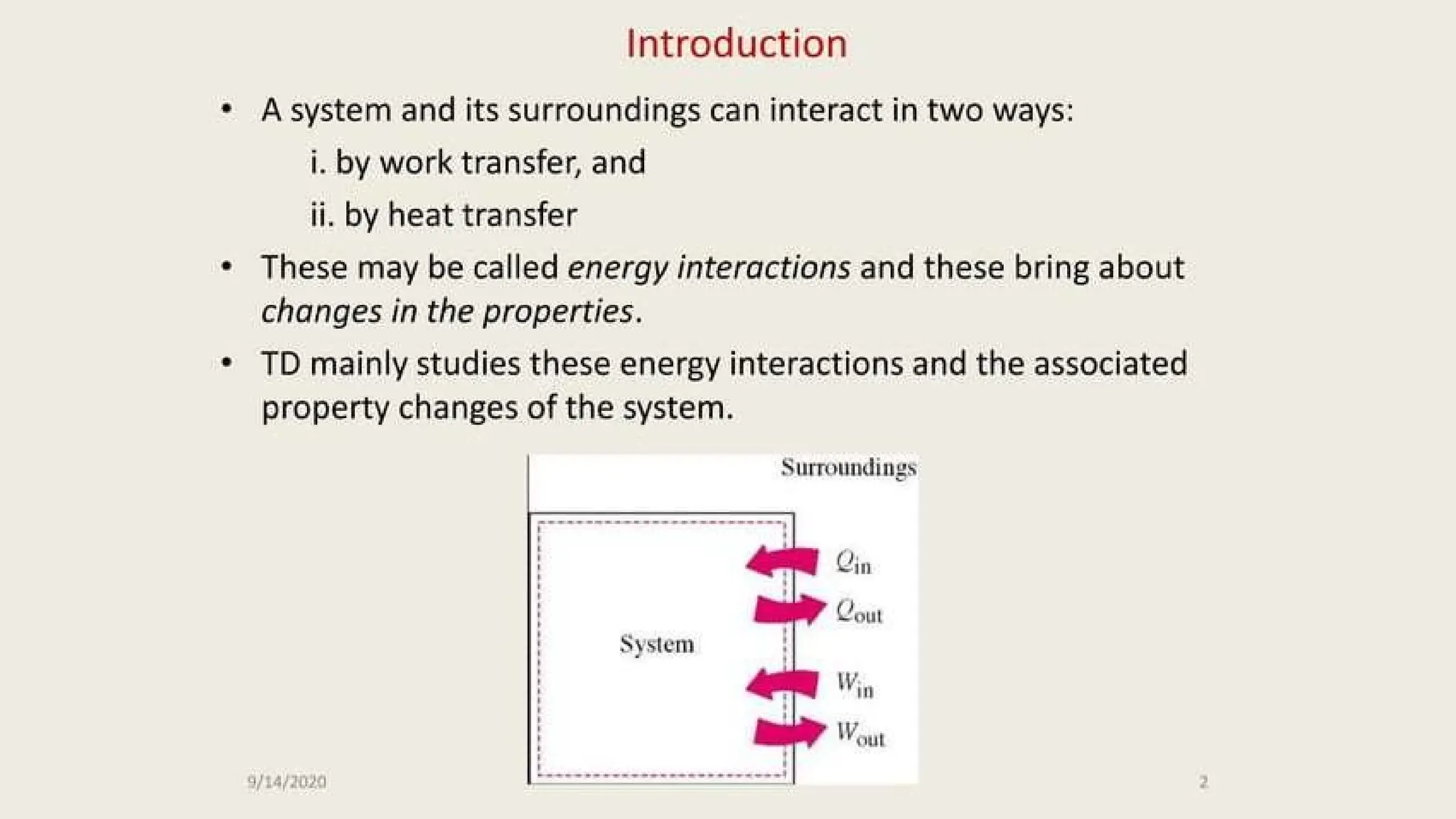
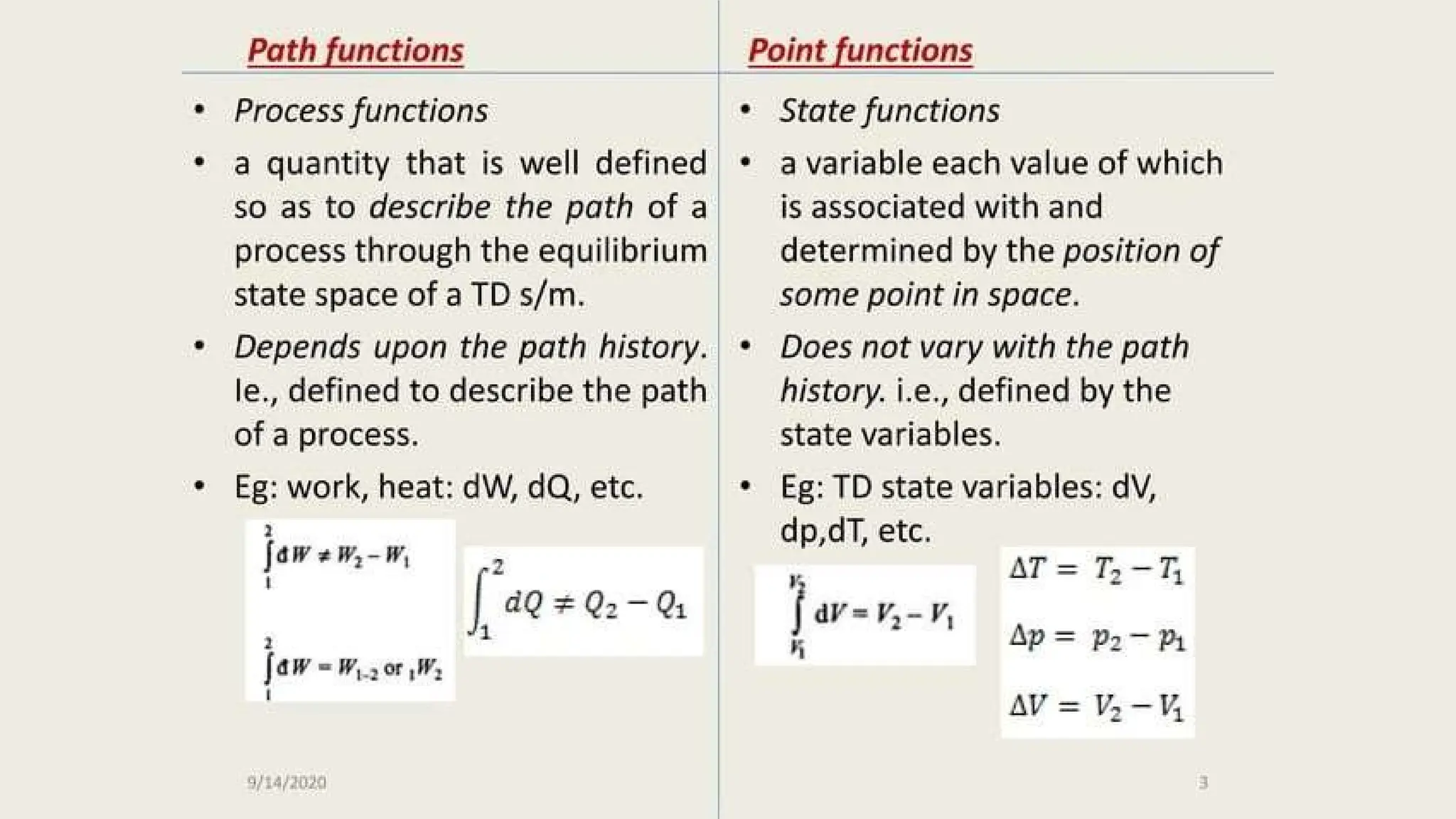
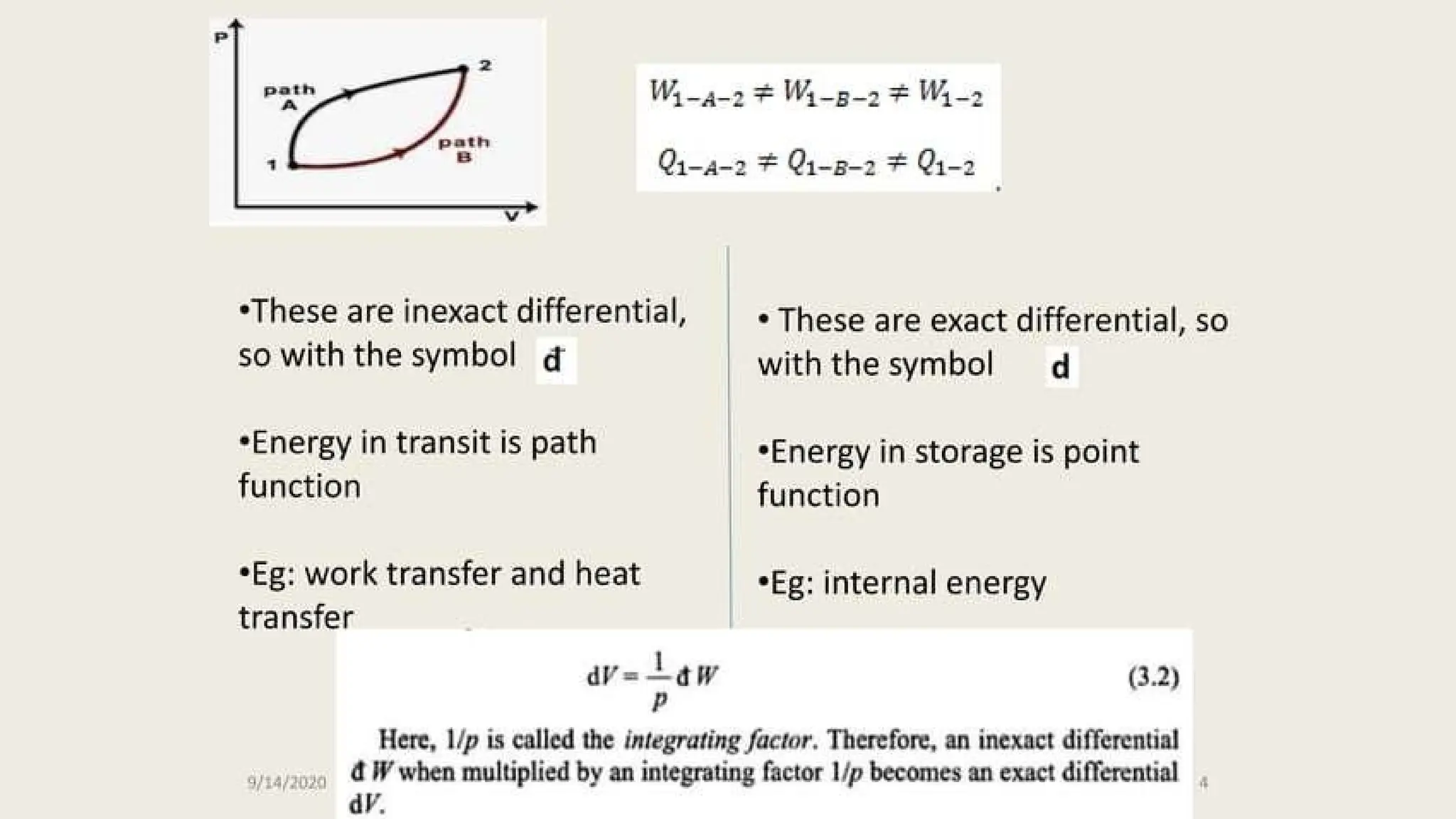
ENERGY IN STATEAND IN TRANSITION
ENERGY
K.E & P.E
ENERGY IN TRANSITION
INTERNAL ENERGY (U)
ENERGY IN STATE
HEAT (Q) WORK (W)
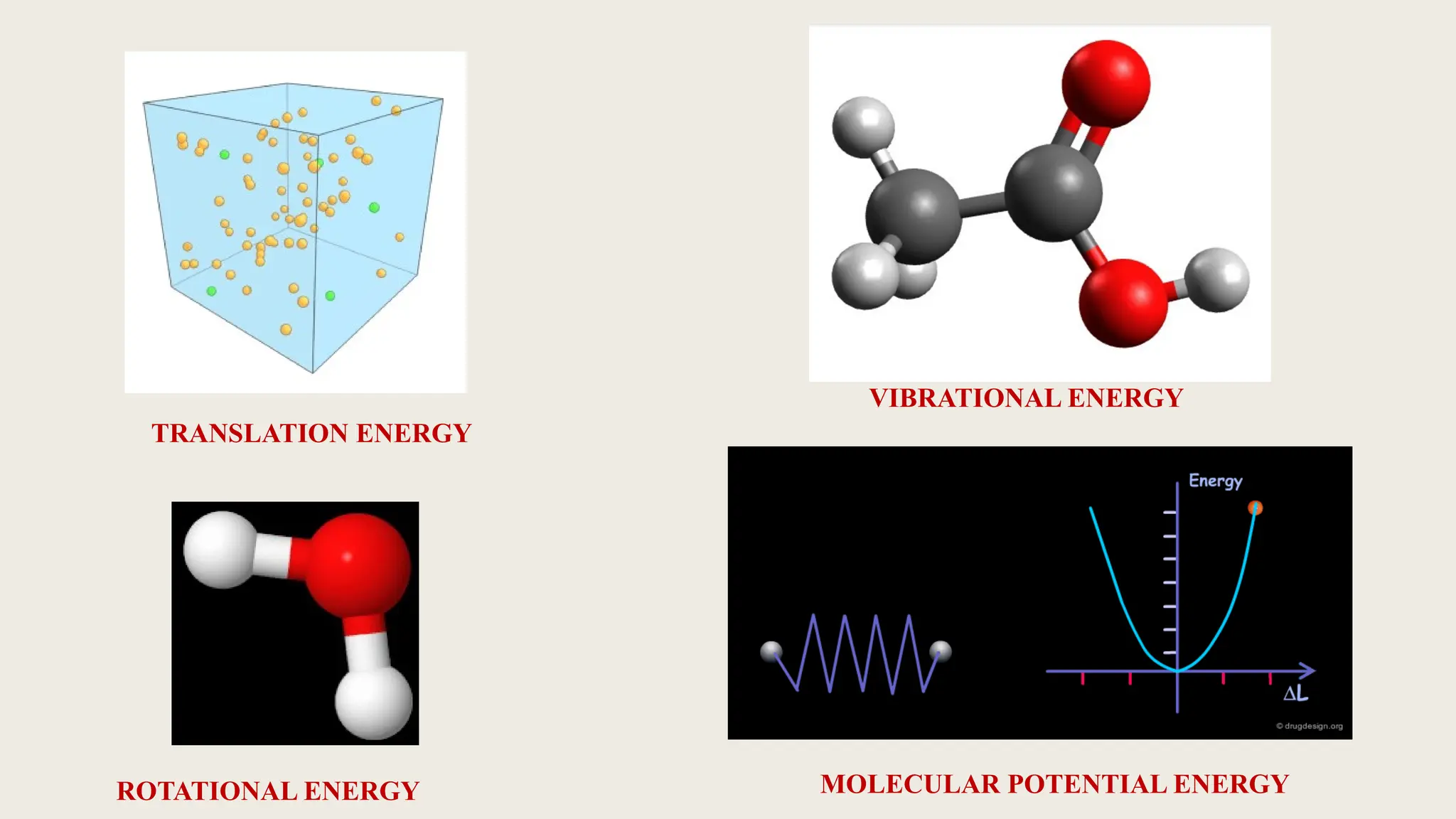
• TRANSLATION ENERGY
• ROTATIONAL ENERGY
• VIBRATIONAL ENERGY
• MOLECULAR POTENTIAL ENERGY
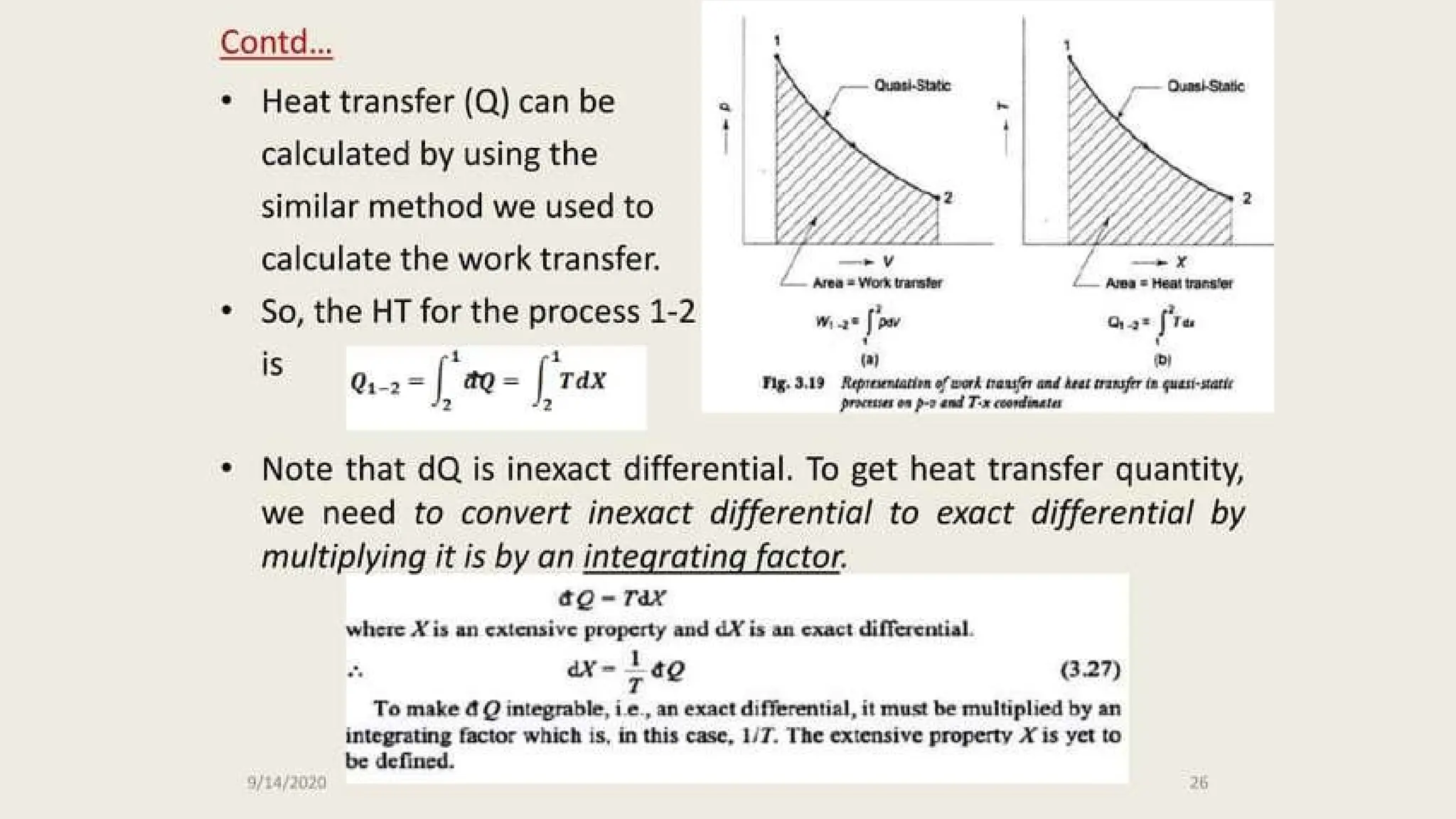
HEAT AND WORKTRANSFER
HEAT:
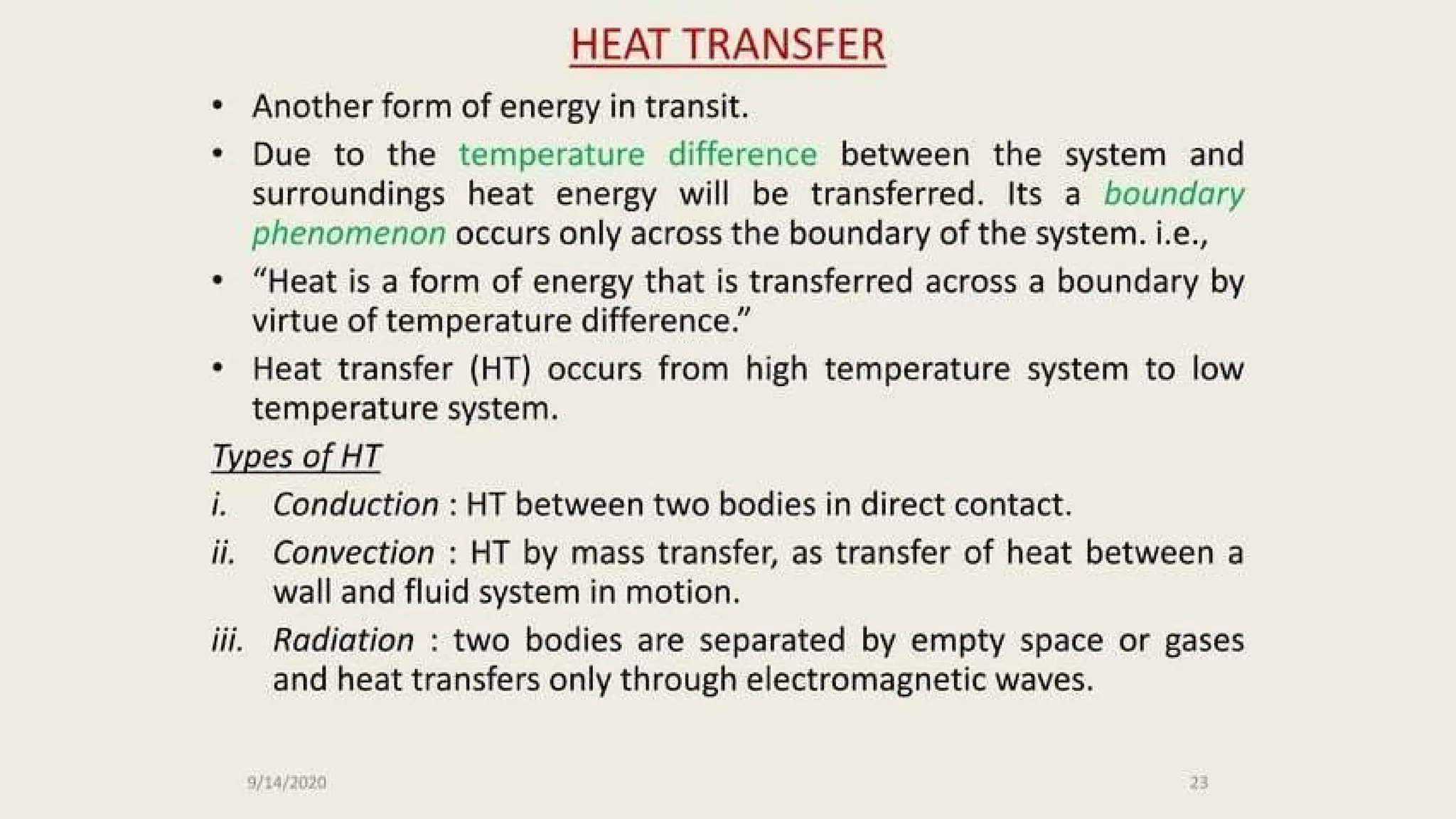
• It is the energy in transition between the system and the surroundings by
virtue of the difference in temperature. (OR)
• Heat is energy transferred from one system to another solely by reason
of a temperature difference between the systems.
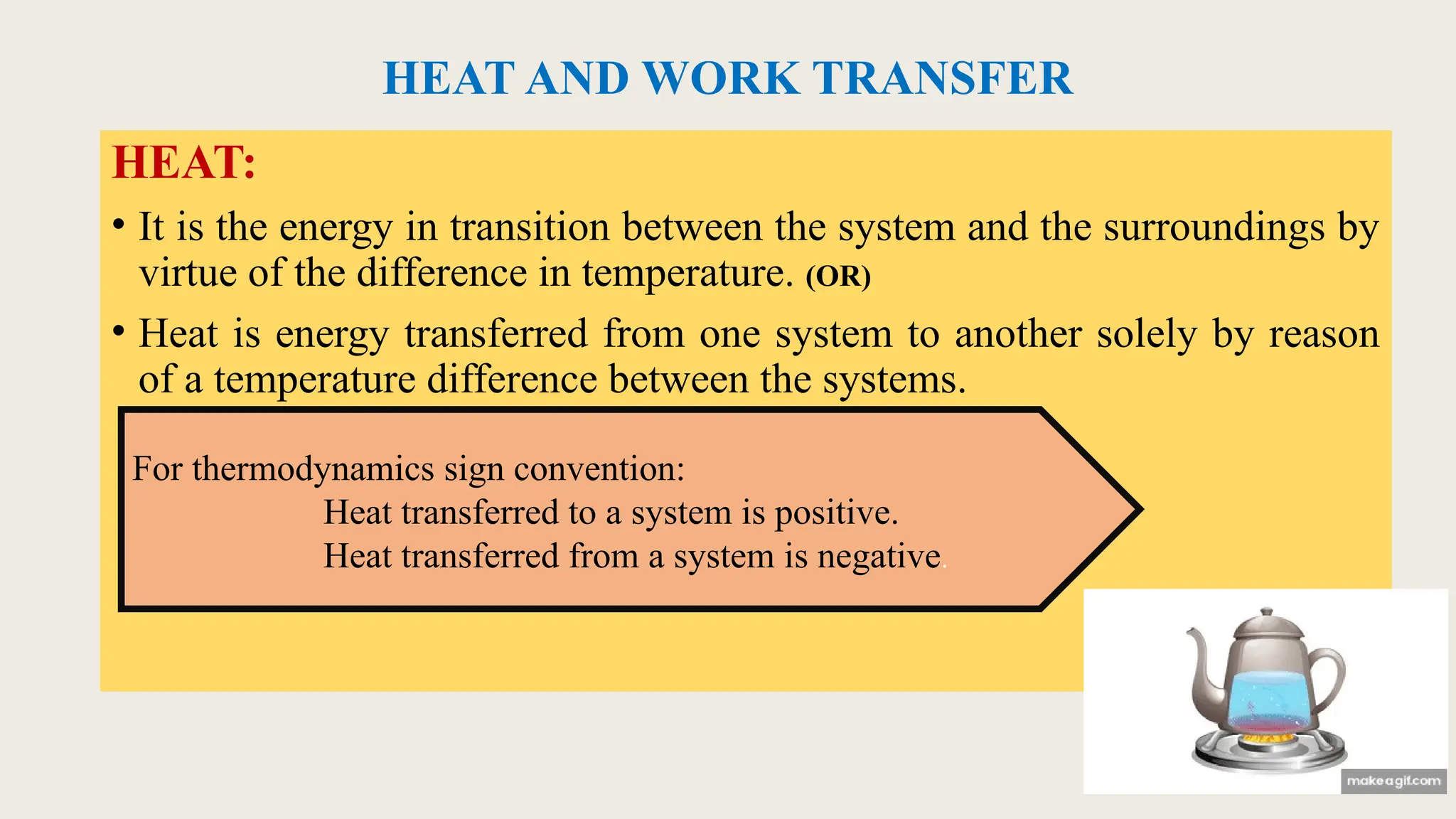
For thermodynamics sign convention:
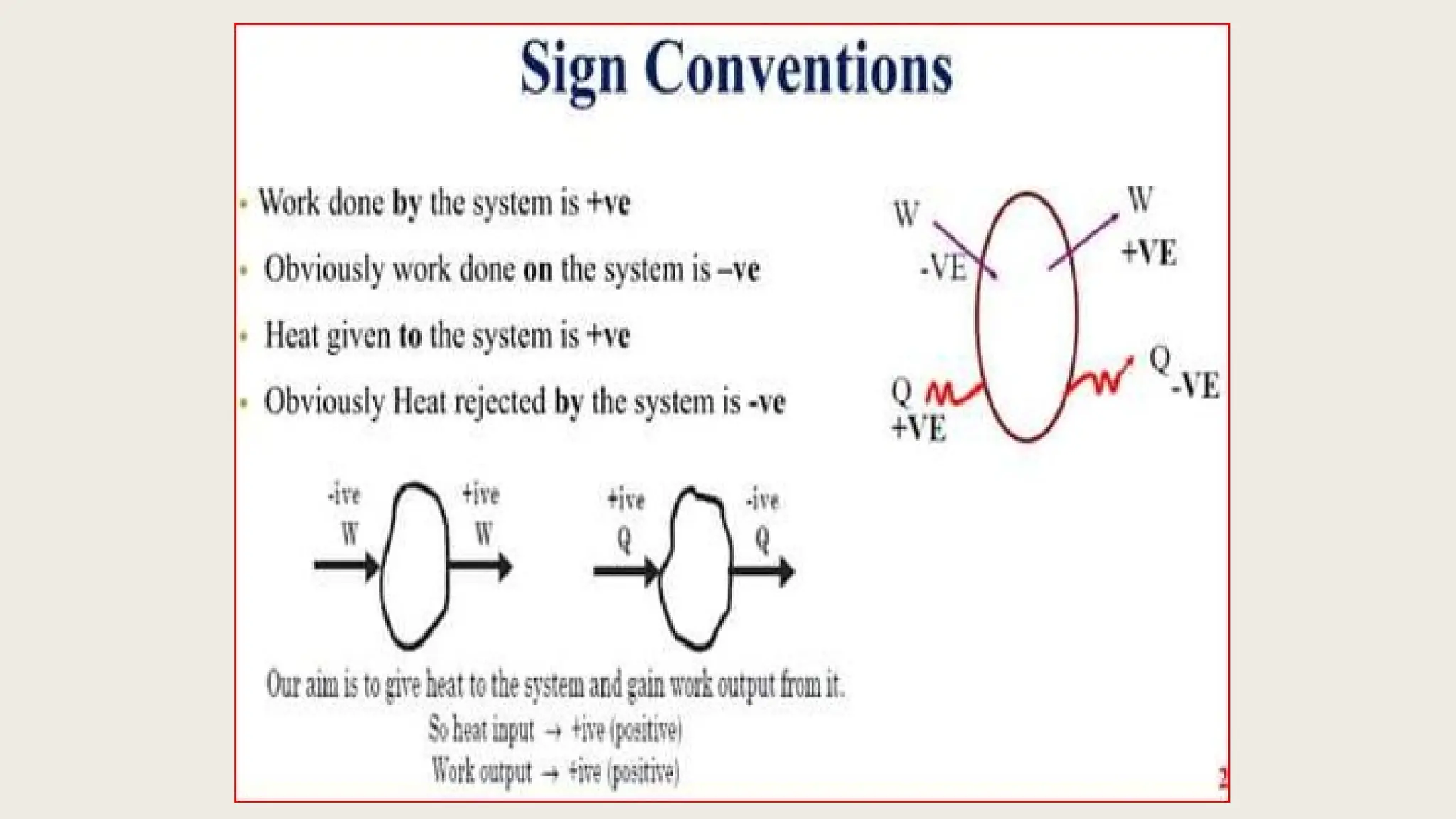
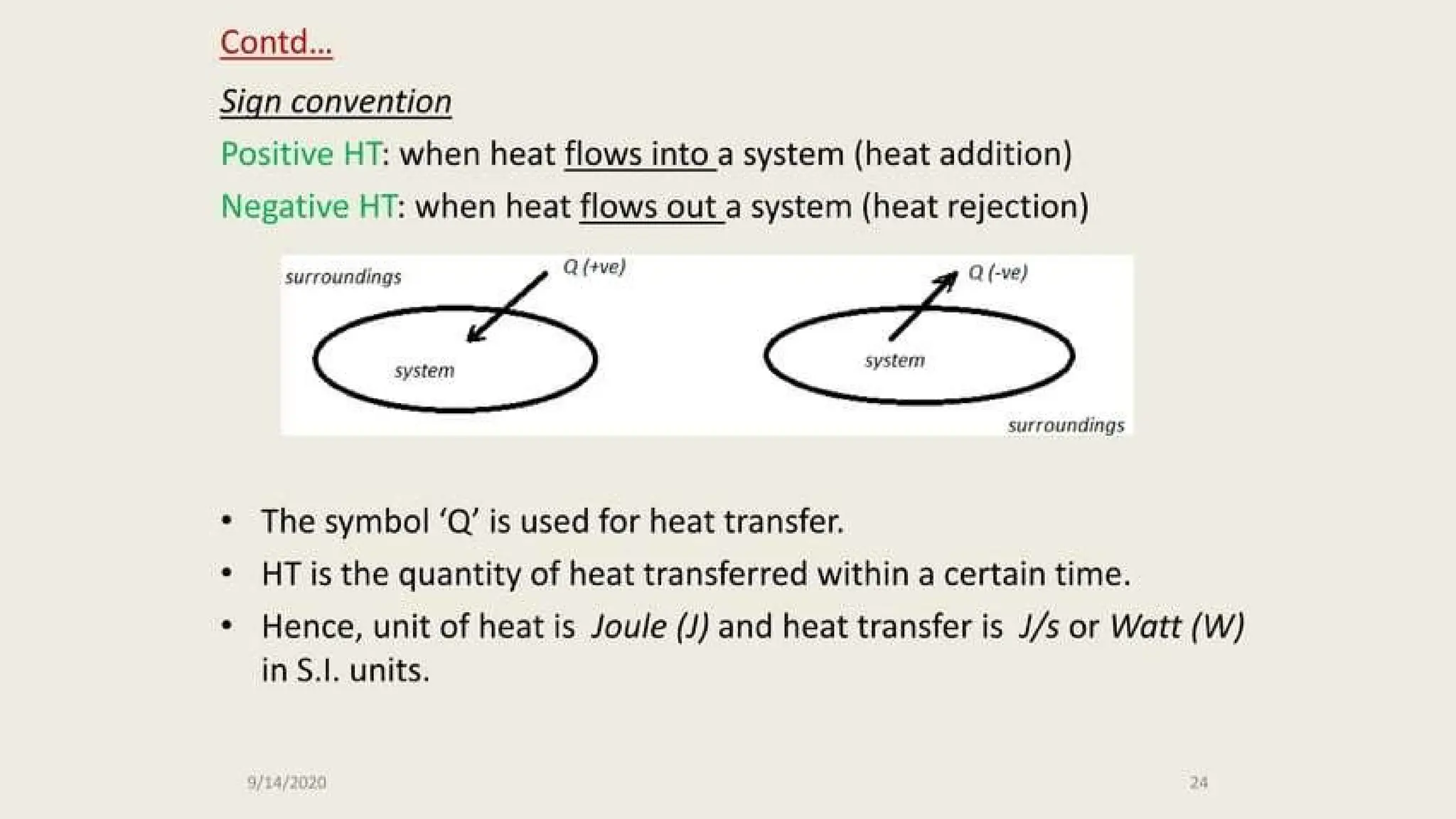
Heat transferred to a system is positive.
Heat transferred from a system is negative.
5.
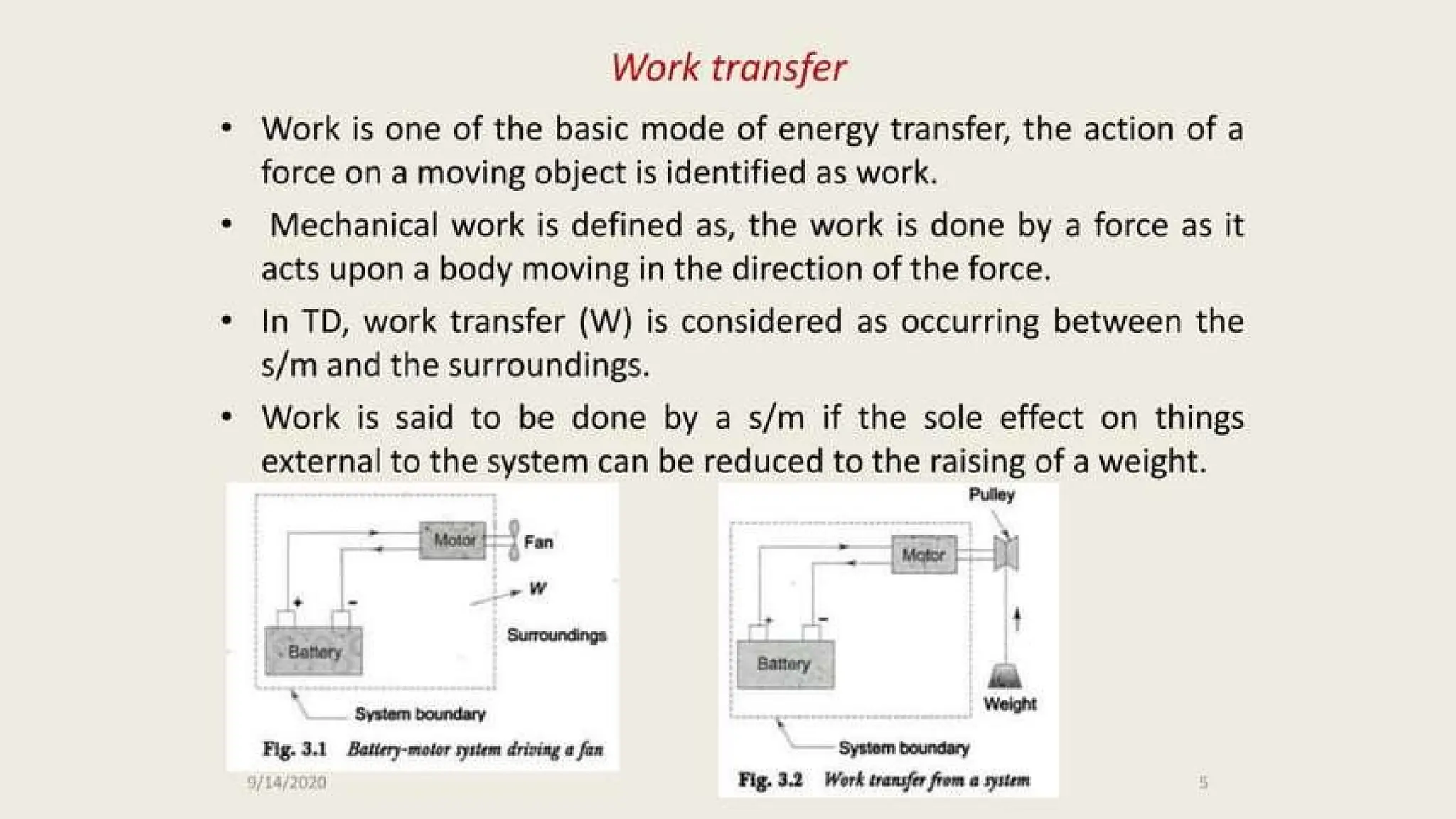
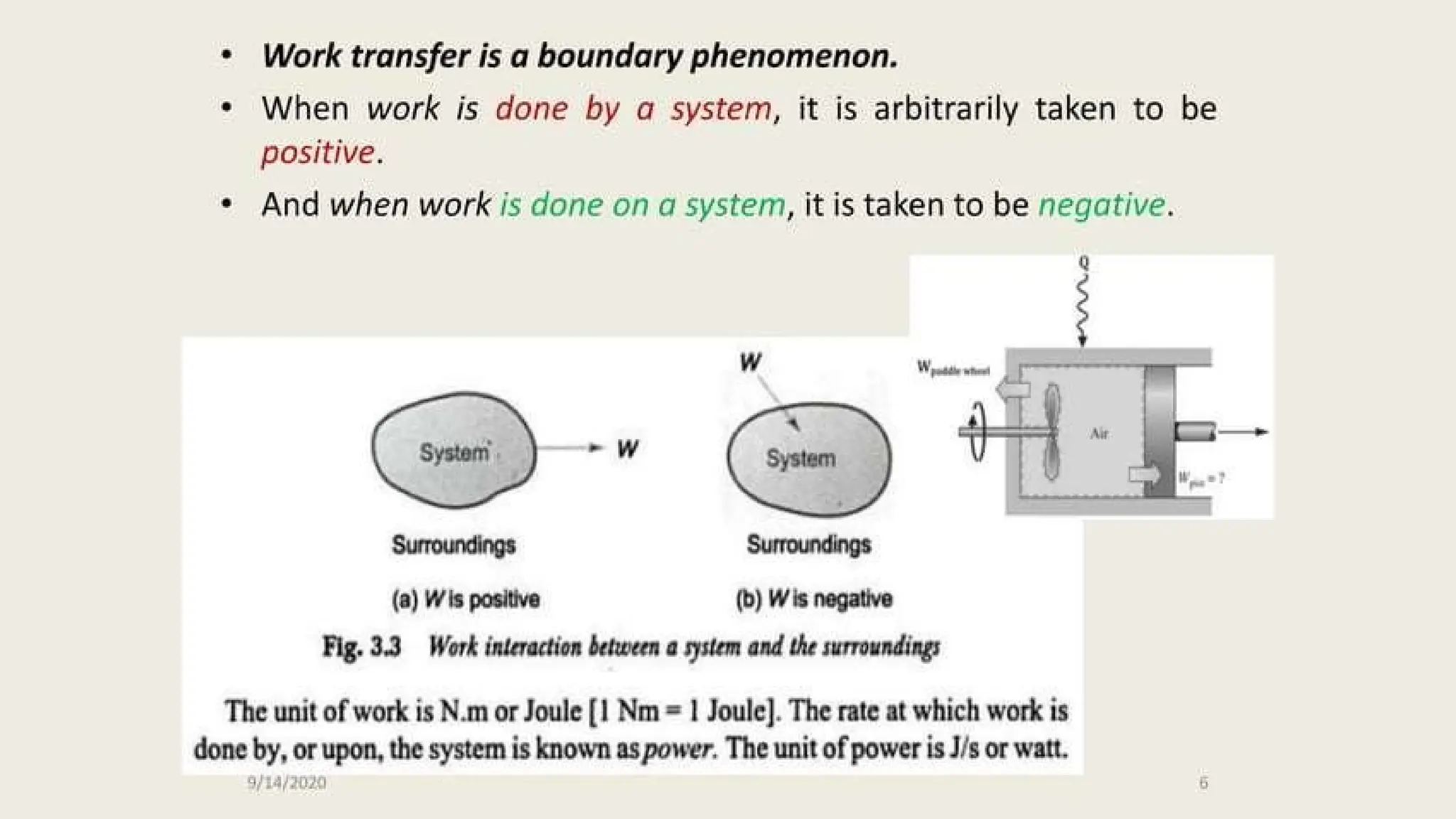
WORK:
Thermodynamic definition ofwork:
Positive work is done by a system when the sole effect external to the
system could be reduced to the rise of a weight.
Work done by the system is positive and
work done on the system is negative.
Types of work interaction:
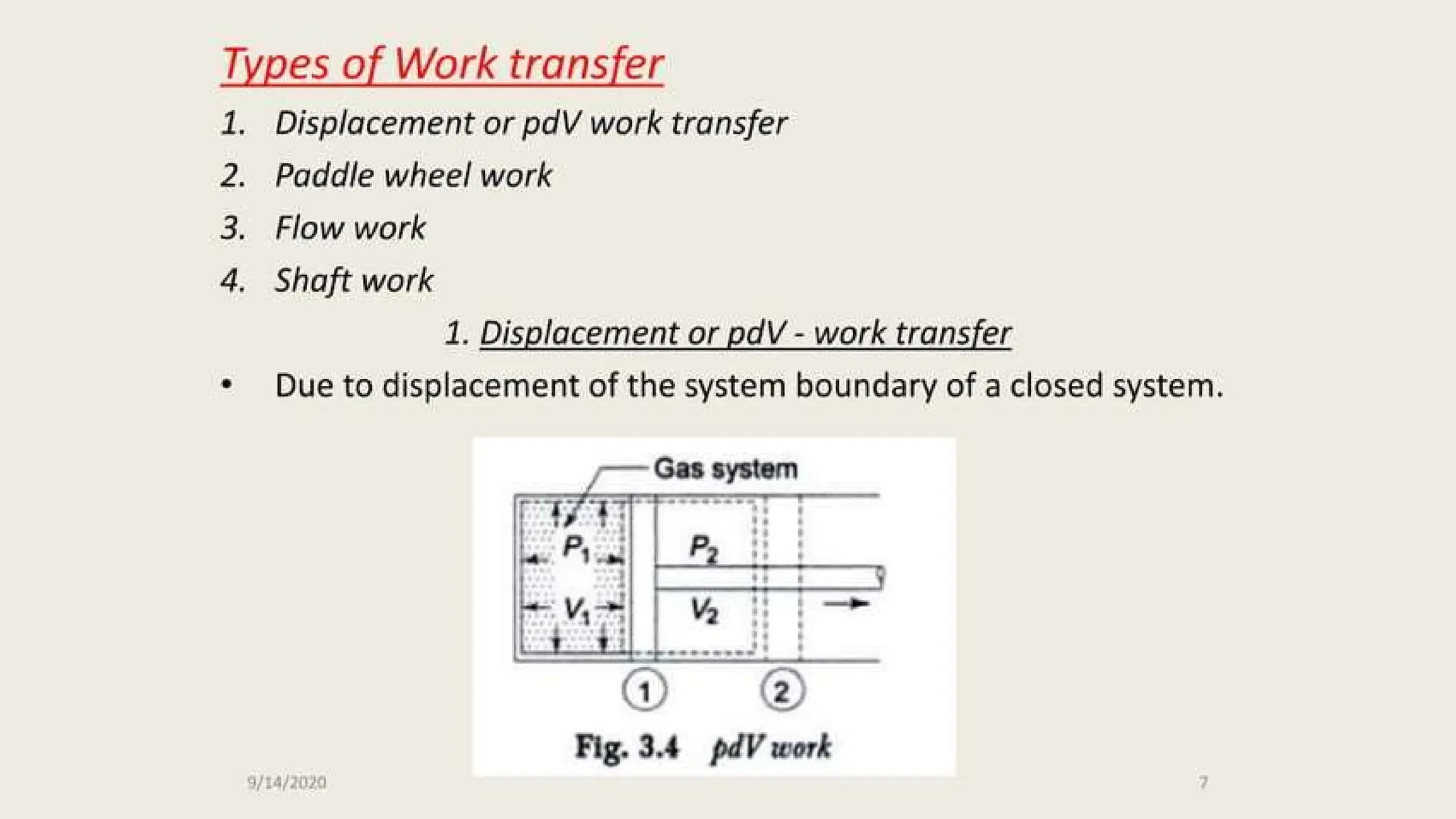
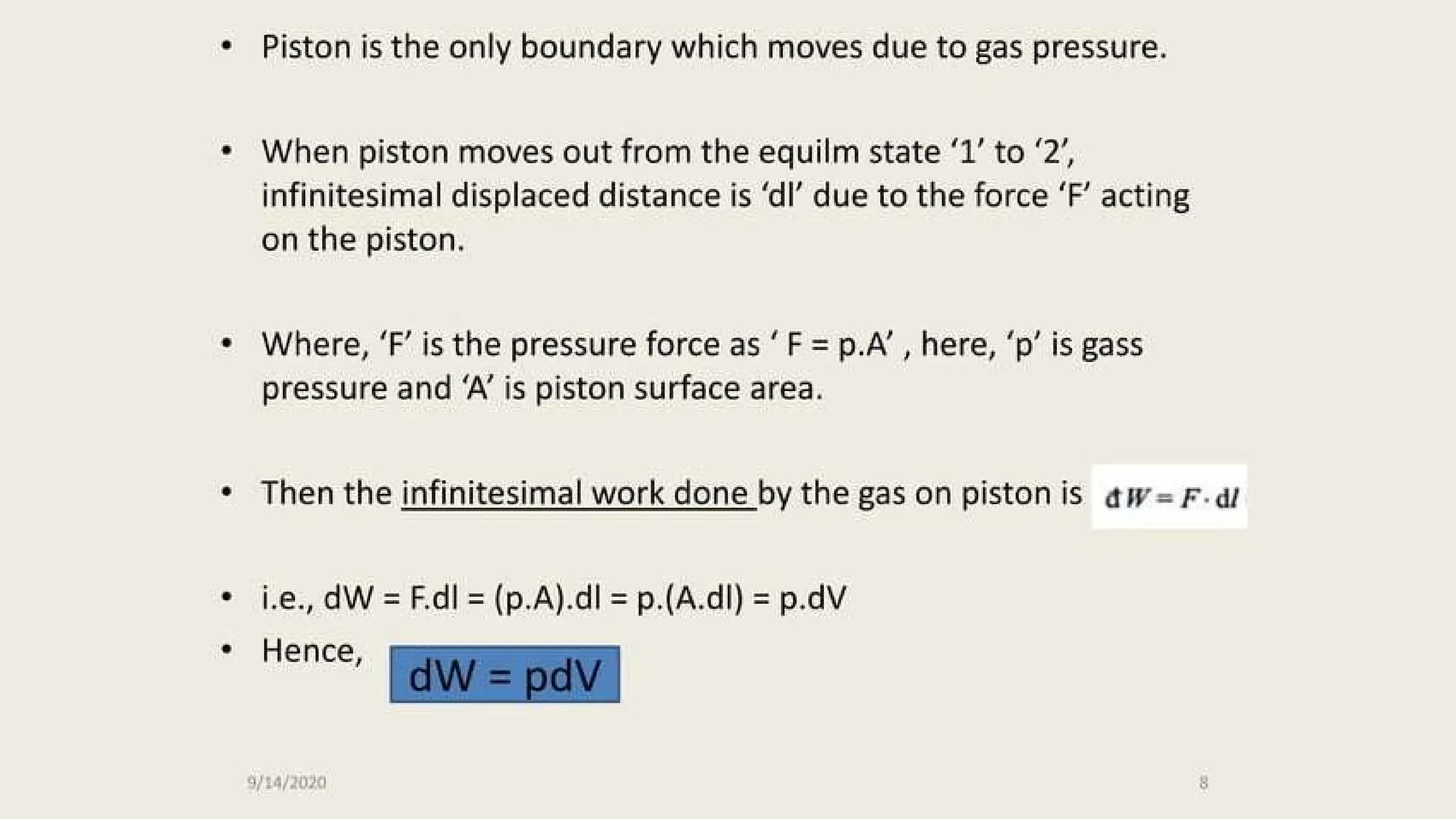
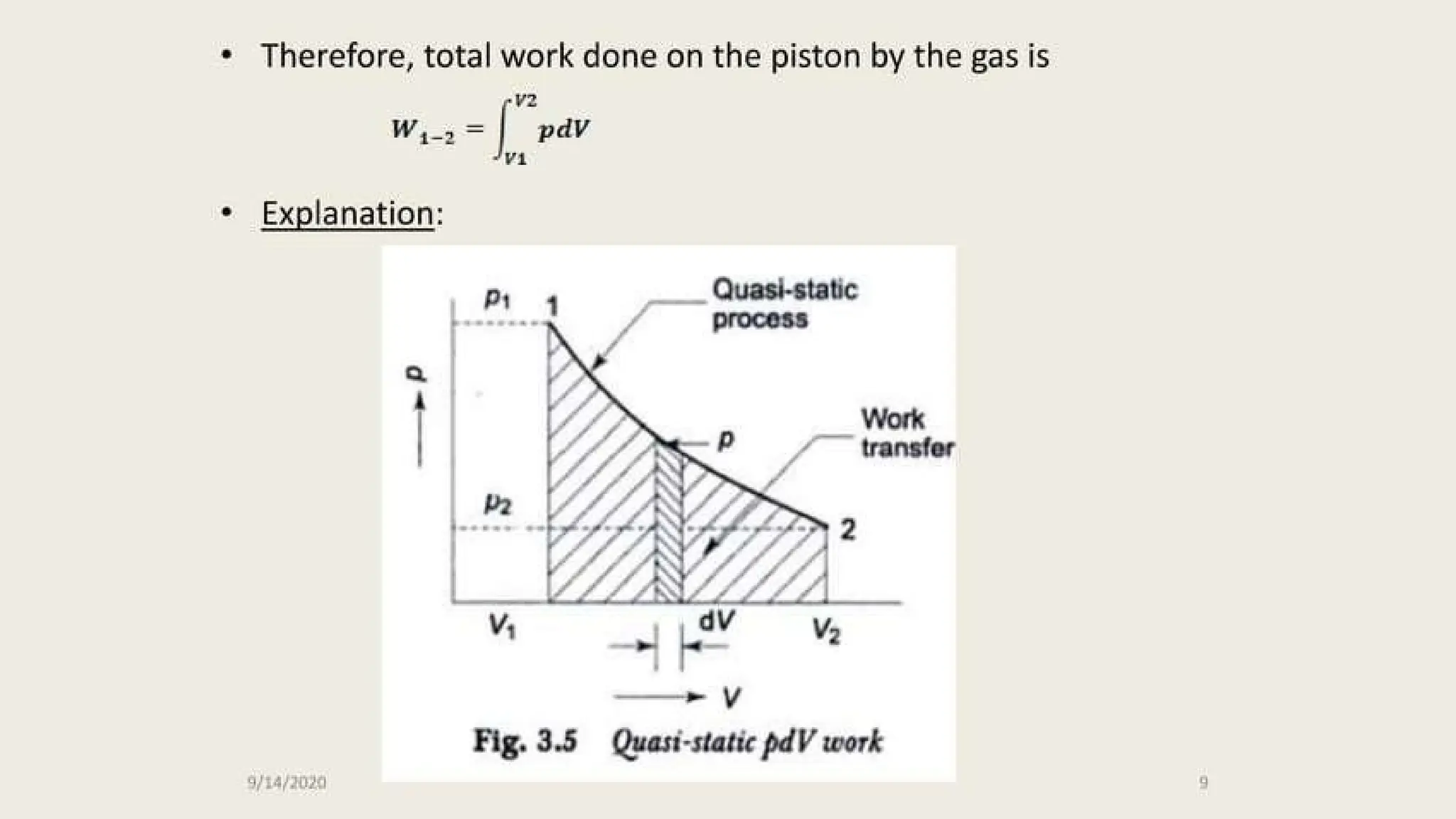
• Expansion and compression work (displacement
work)
• Work of a reversible chemical cell
• Work in stretching of a liquid surface
• Work done on elastic solids
• Work of polarization and magnetization
6.
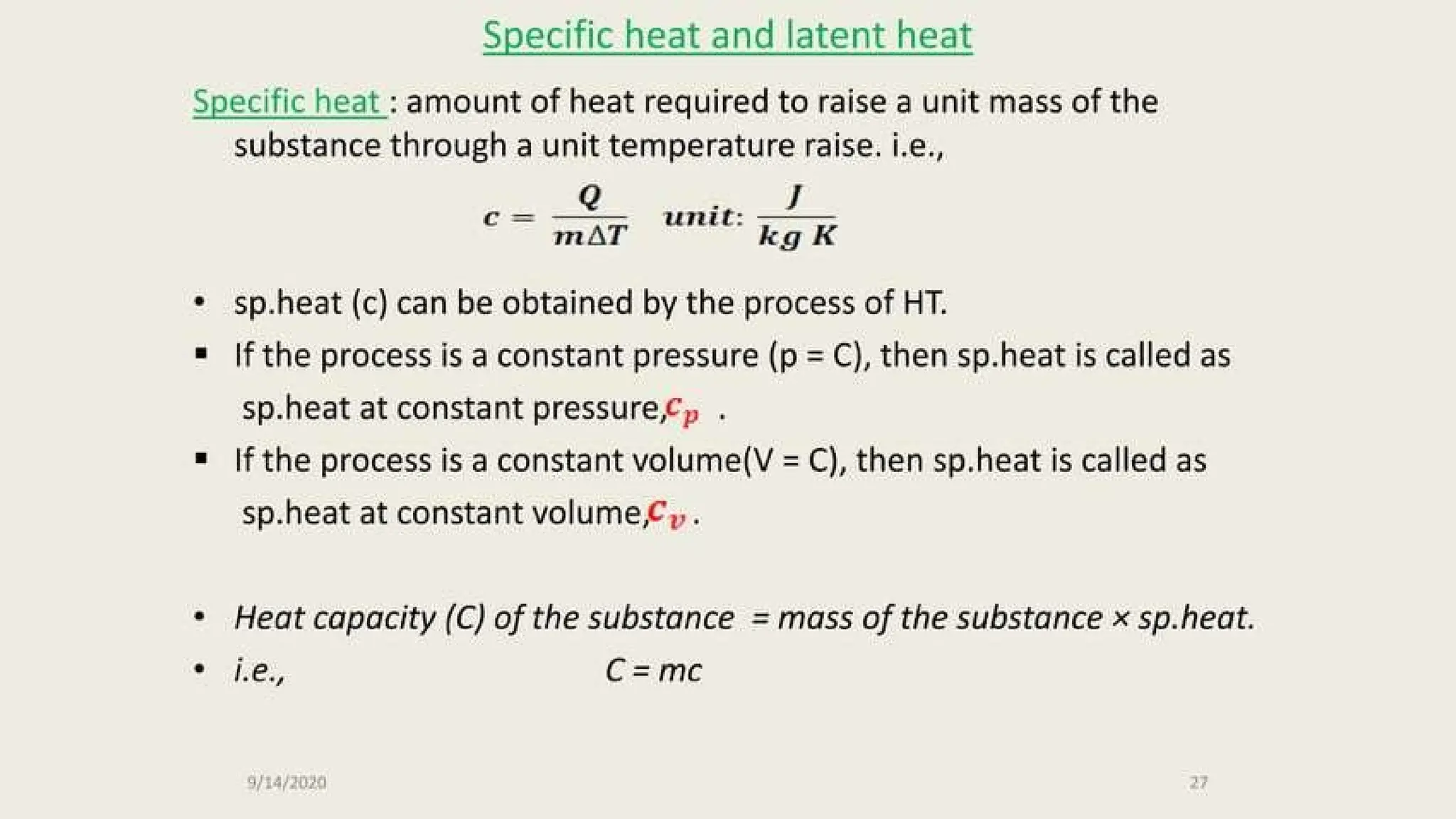
HEAT
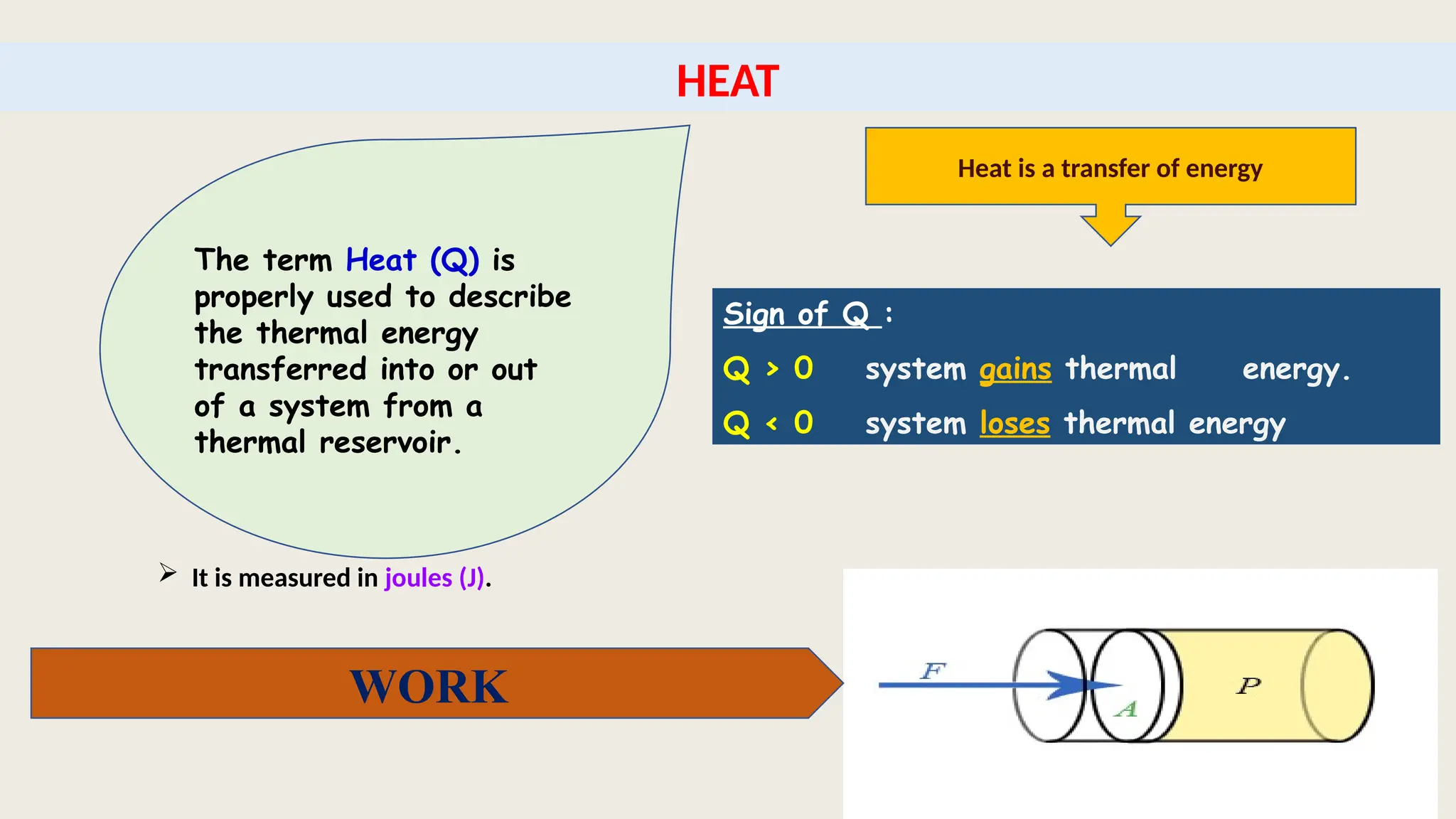
The term Heat(Q) is
properly used to describe
the thermal energy
transferred into or out
of a system from a
thermal reservoir.
Sign of Q :
Q > 0 system gains thermal energy.
Q < 0 system loses thermal energy
Heat is a transfer of energy
It is measured in joules (J).
WORK
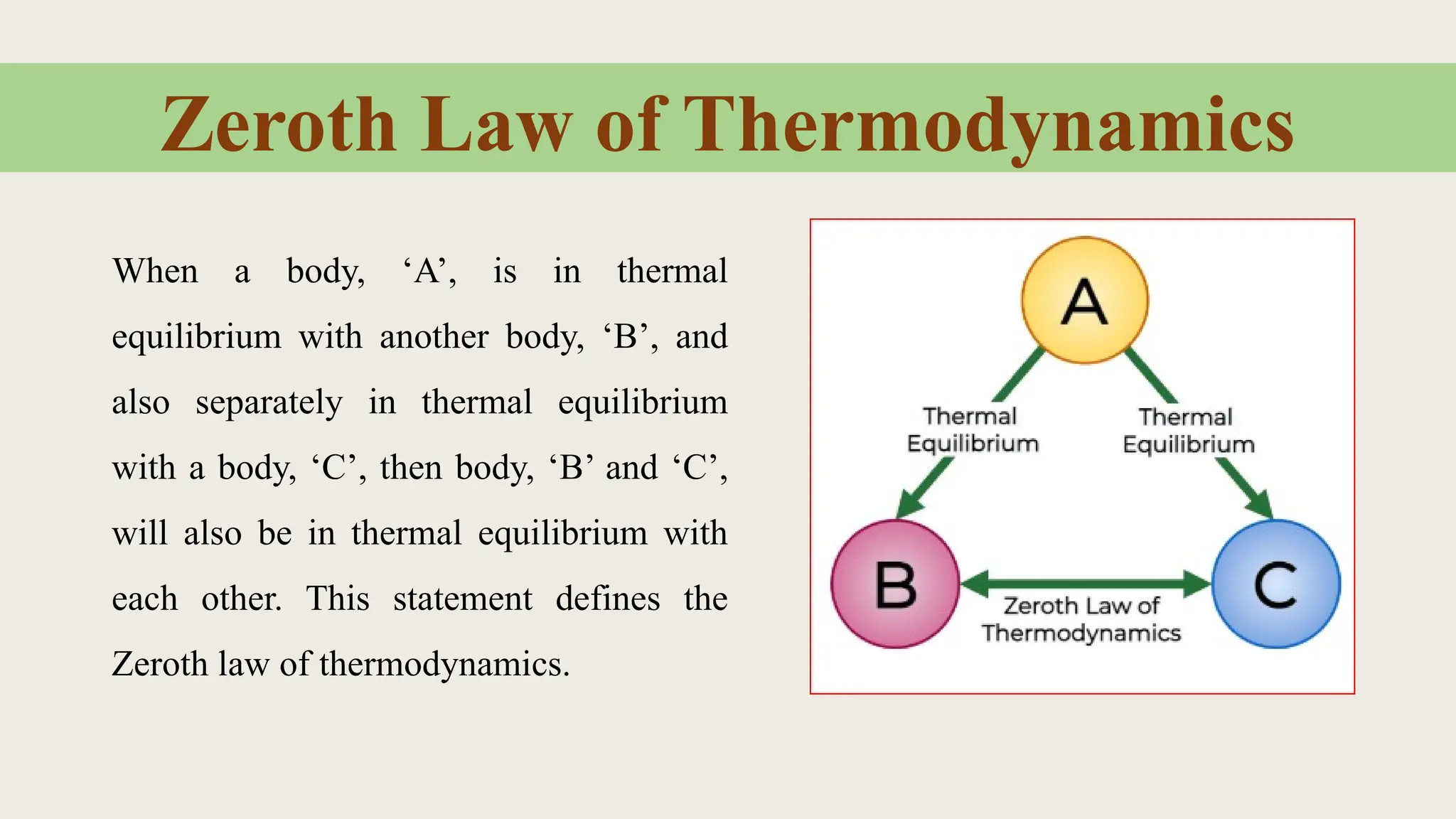
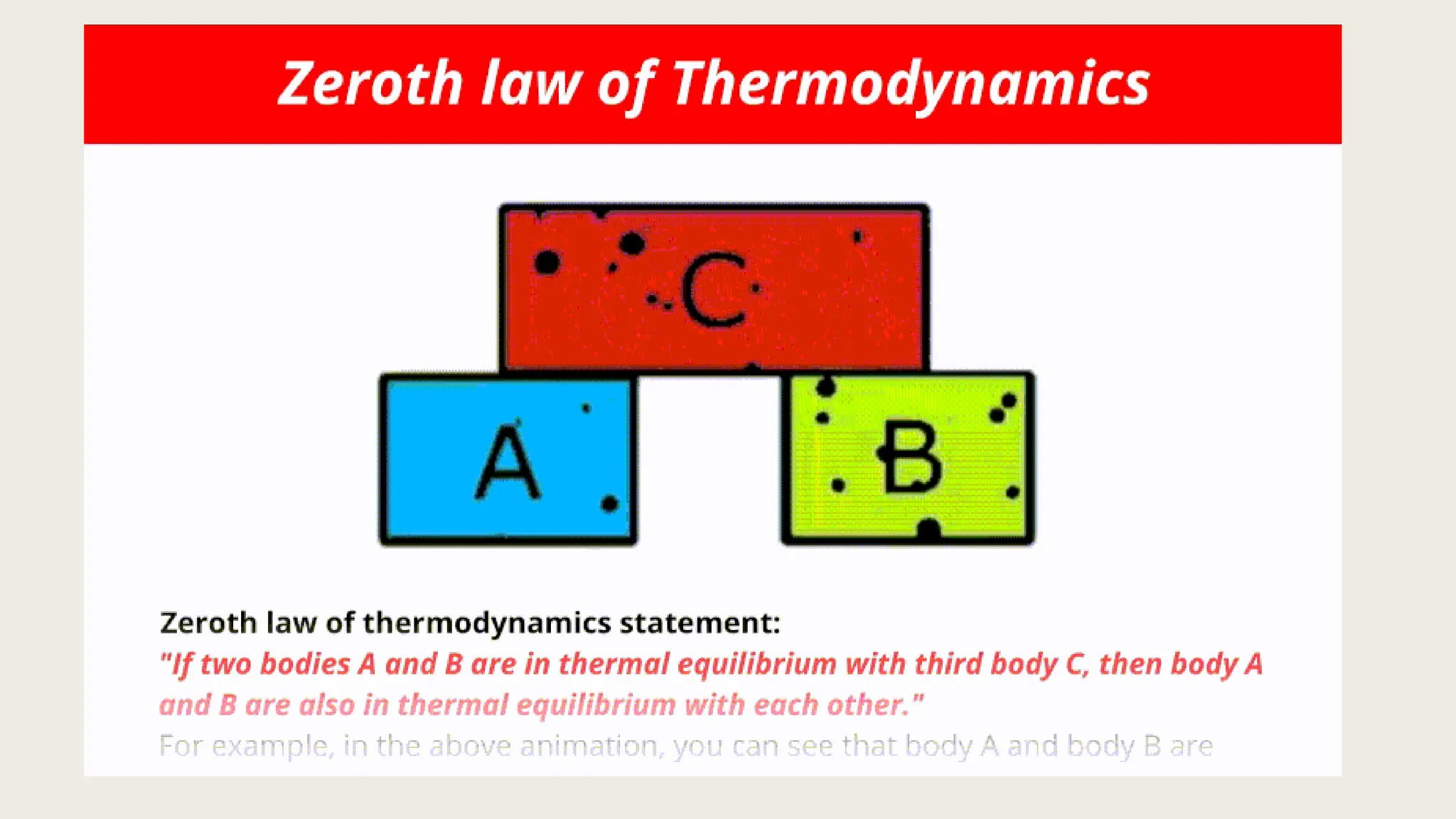
Zeroth Law ofThermodynamics
When a body, ‘A’, is in thermal
equilibrium with another body, ‘B’, and
also separately in thermal equilibrium
with a body, ‘C’, then body, ‘B’ and ‘C’,
will also be in thermal equilibrium with
each other. This statement defines the
Zeroth law of thermodynamics.
37.
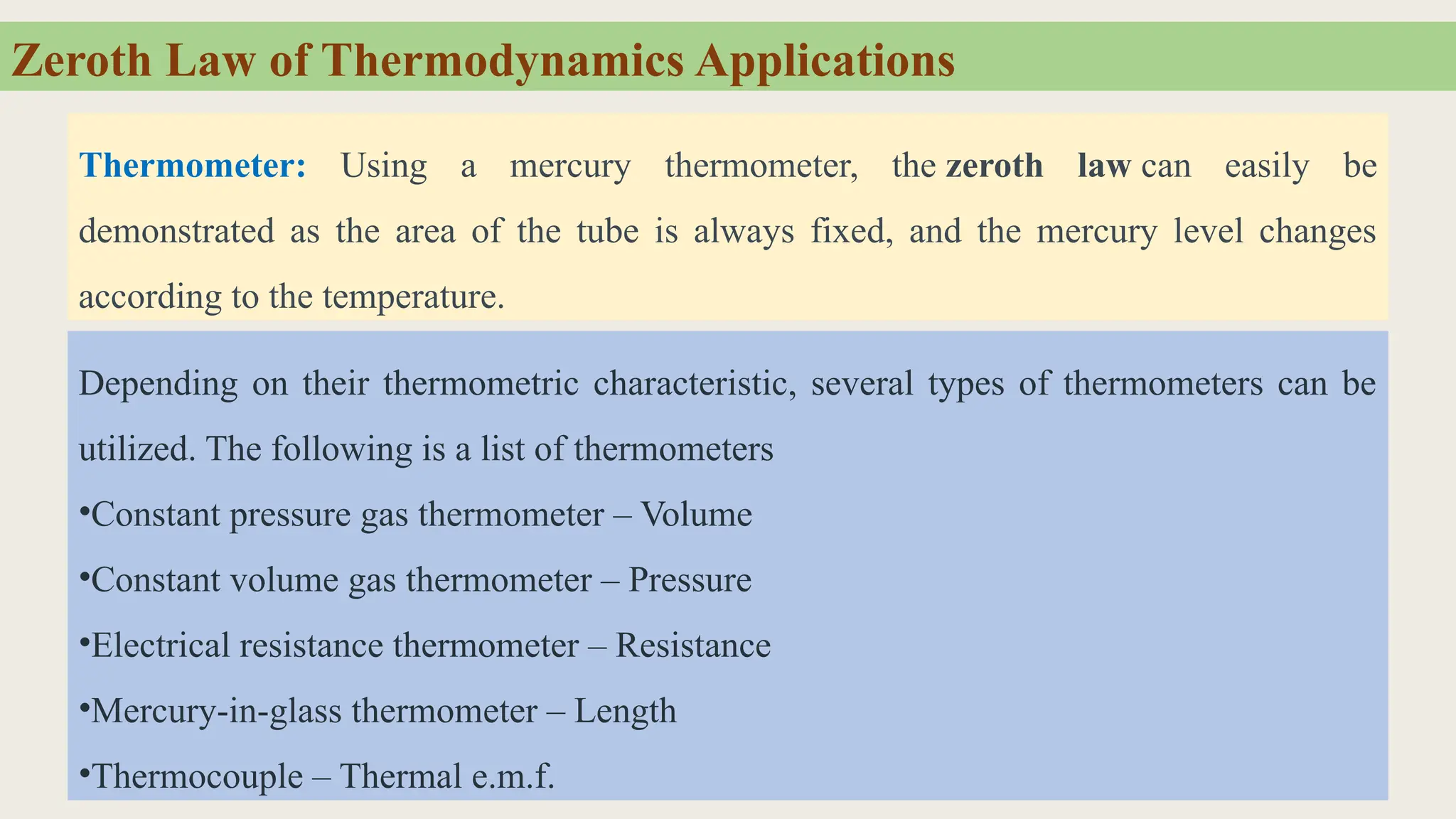
Zeroth Law ofThermodynamics Applications
Thermometer: Using a mercury thermometer, the zeroth law can easily be
demonstrated as the area of the tube is always fixed, and the mercury level changes
according to the temperature.
Depending on their thermometric characteristic, several types of thermometers can be
utilized. The following is a list of thermometers
•Constant pressure gas thermometer – Volume
•Constant volume gas thermometer – Pressure
•Electrical resistance thermometer – Resistance
•Mercury-in-glass thermometer – Length
•Thermocouple – Thermal e.m.f.
38.
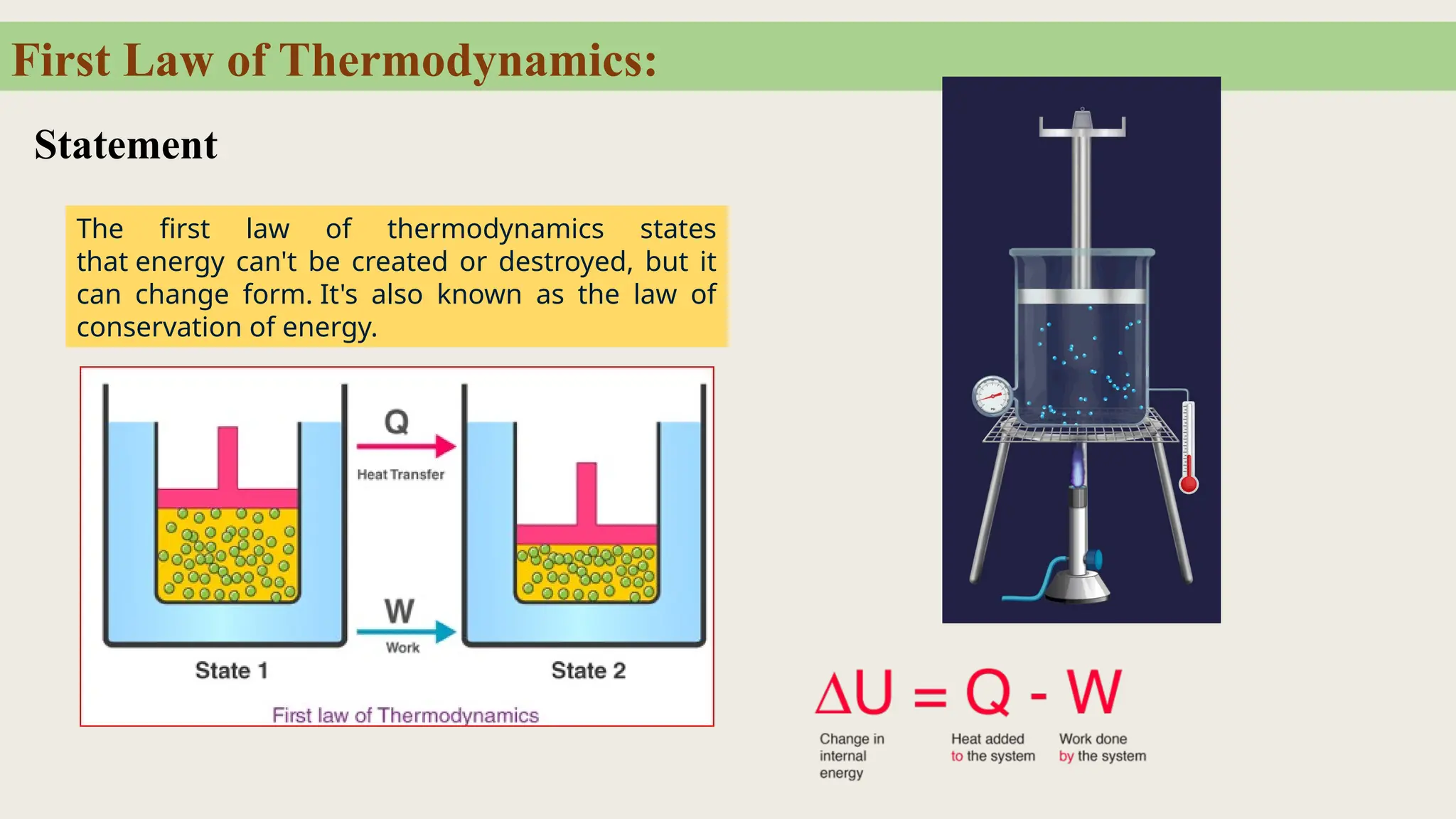
First Law ofThermodynamics:
The first law of thermodynamics states
that energy can't be created or destroyed, but it
can change form. It's also known as the law of
conservation of energy.
Statement
39.
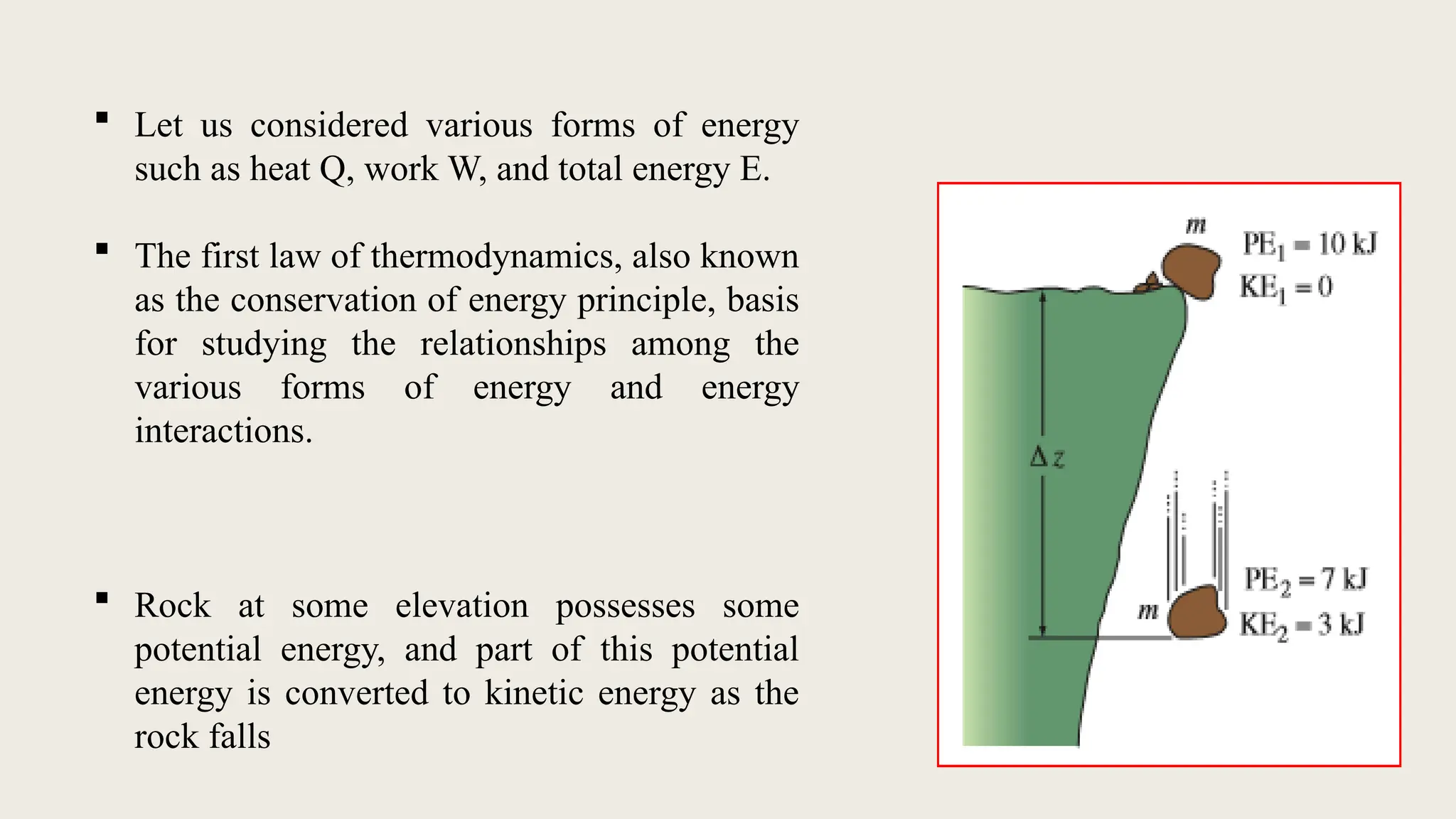
Let usconsidered various forms of energy
such as heat Q, work W, and total energy E.
The first law of thermodynamics, also known
as the conservation of energy principle, basis
for studying the relationships among the
various forms of energy and energy
interactions.
Rock at some elevation possesses some
potential energy, and part of this potential
energy is converted to kinetic energy as the
rock falls
40.
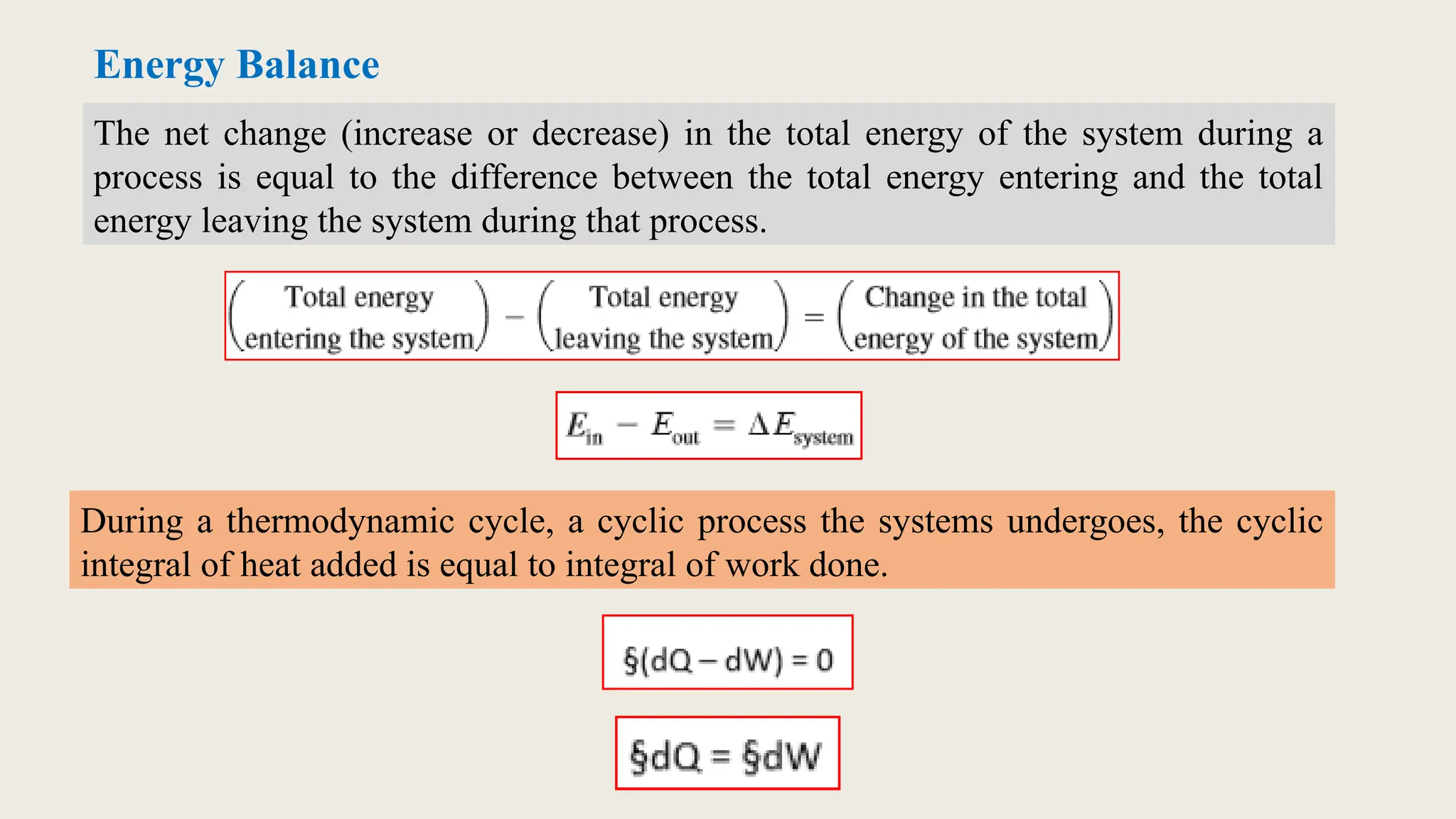
Energy Balance
The netchange (increase or decrease) in the total energy of the system during a
process is equal to the difference between the total energy entering and the total
energy leaving the system during that process.
During a thermodynamic cycle, a cyclic process the systems undergoes, the cyclic
integral of heat added is equal to integral of work done.
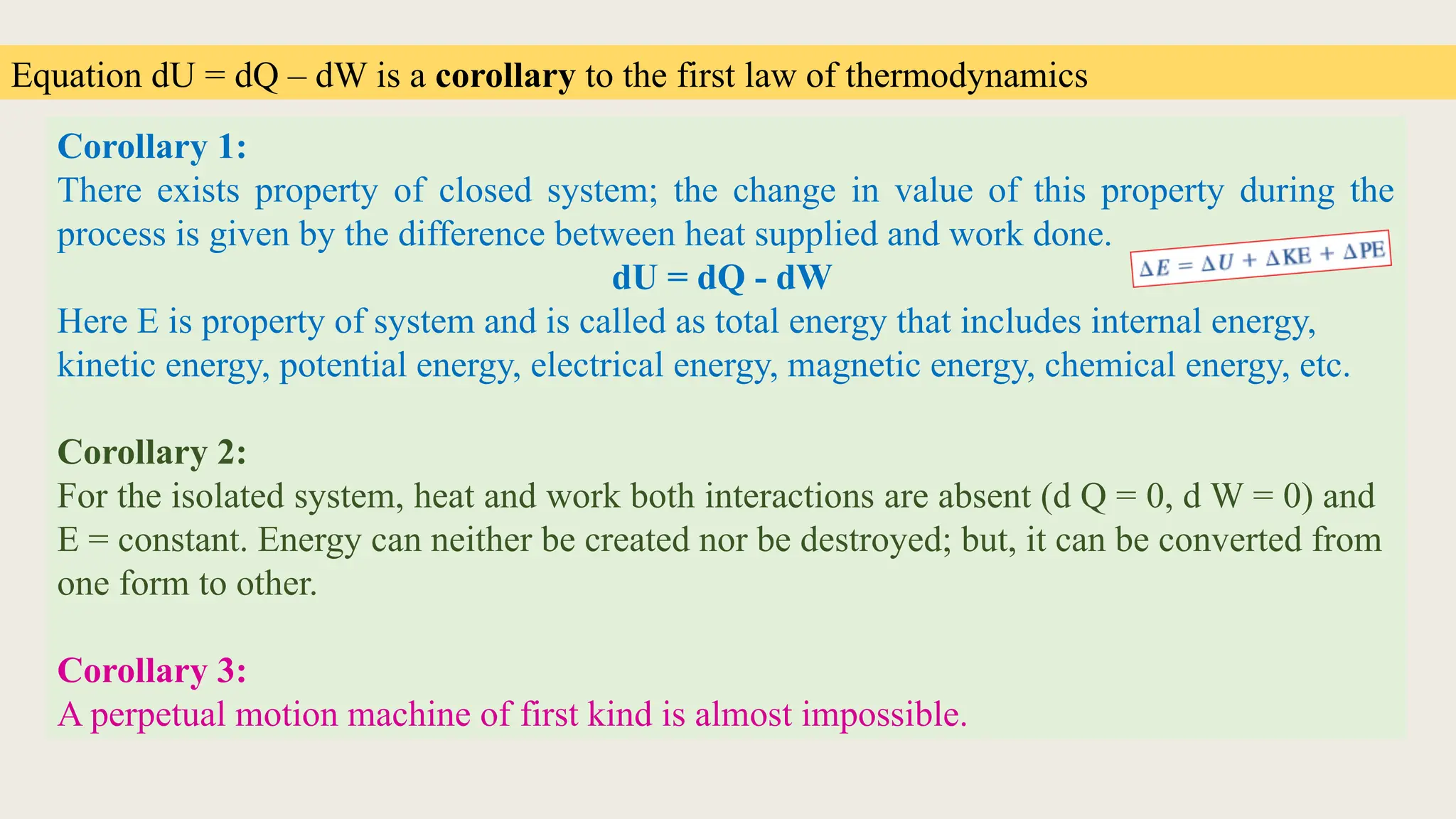
41.
Equation dU =dQ – dW is a corollary to the first law of thermodynamics
Corollary 1:
There exists property of closed system; the change in value of this property during the
process is given by the difference between heat supplied and work done.
dU = dQ - dW
Here E is property of system and is called as total energy that includes internal energy,
kinetic energy, potential energy, electrical energy, magnetic energy, chemical energy, etc.
Corollary 2:
For the isolated system, heat and work both interactions are absent (d Q = 0, d W = 0) and
E = constant. Energy can neither be created nor be destroyed; but, it can be converted from
one form to other.
Corollary 3:
A perpetual motion machine of first kind is almost impossible.
42.
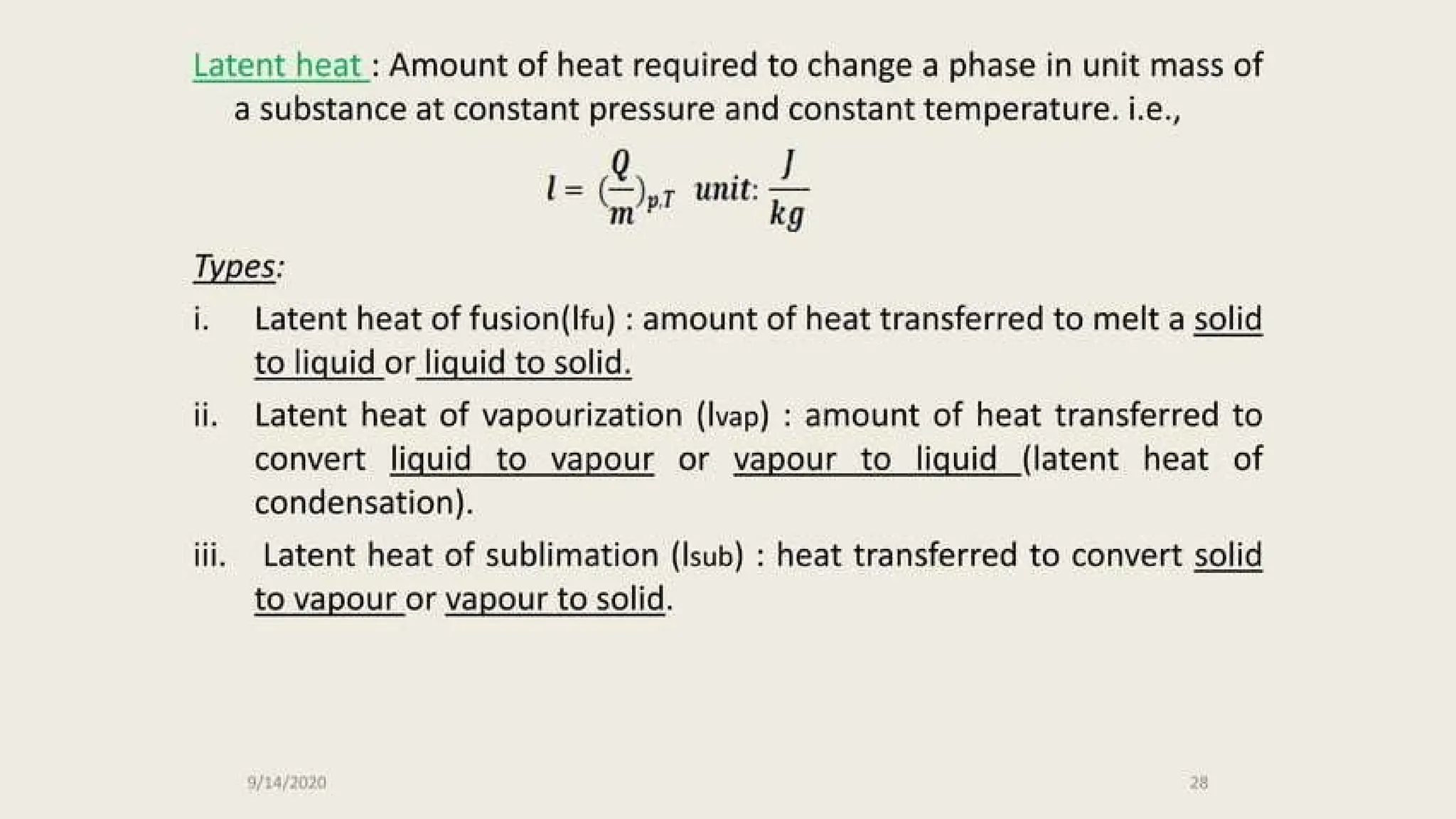
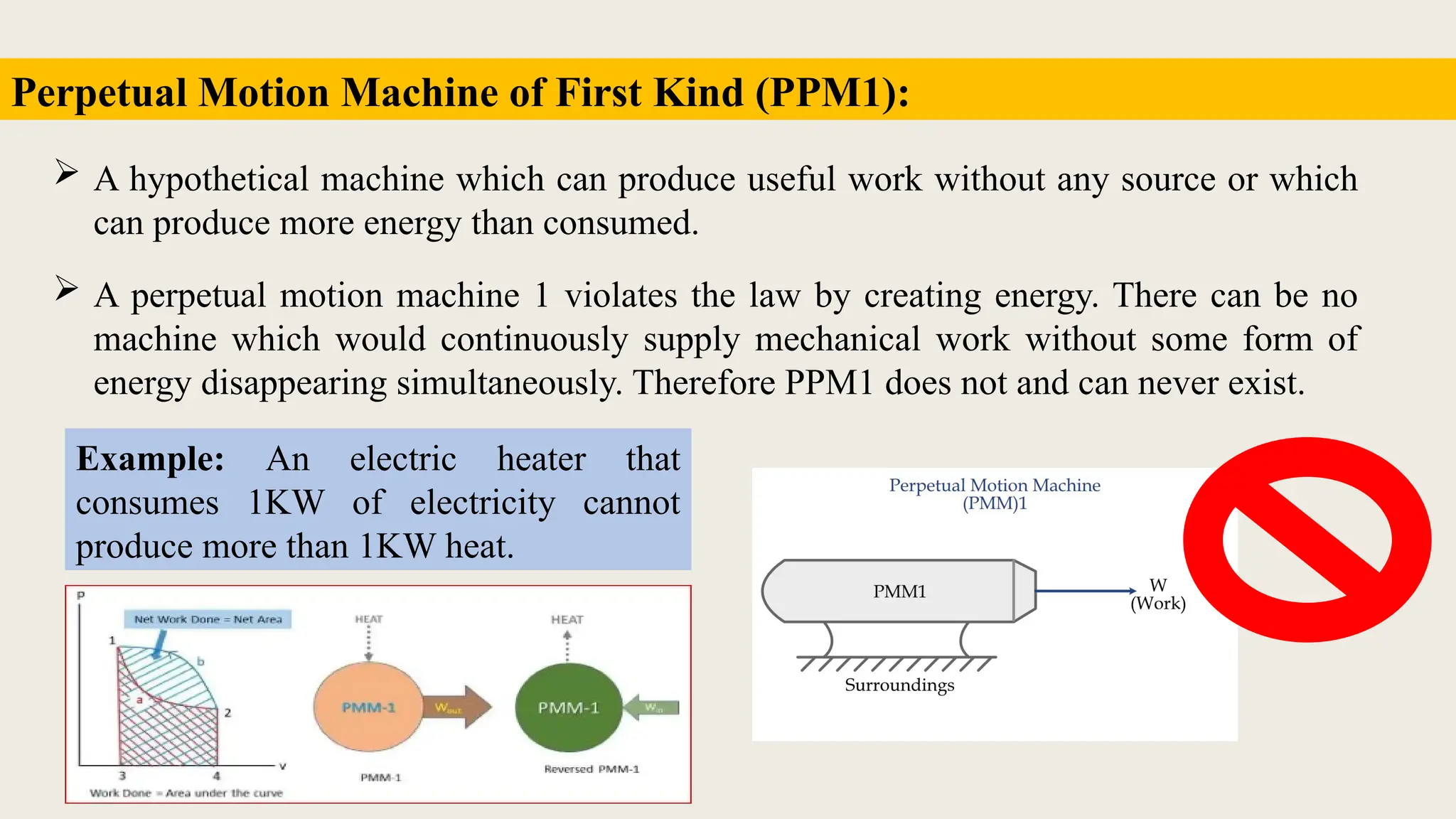
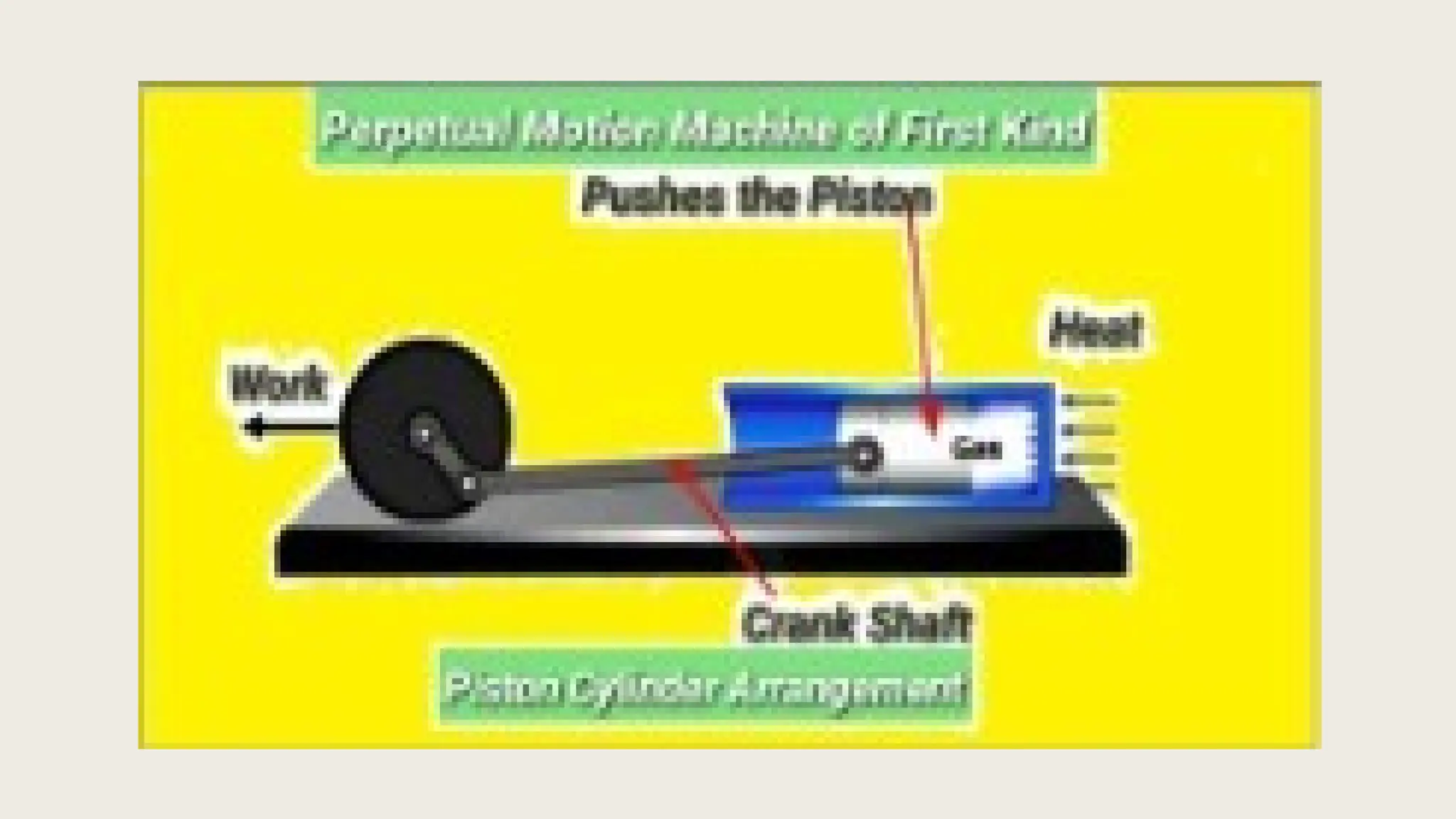
Perpetual Motion Machineof First Kind (PPM1):
A hypothetical machine which can produce useful work without any source or which
can produce more energy than consumed.
A perpetual motion machine 1 violates the law by creating energy. There can be no
machine which would continuously supply mechanical work without some form of
energy disappearing simultaneously. Therefore PPM1 does not and can never exist.
Example: An electric heater that
consumes 1KW of electricity cannot
produce more than 1KW heat.
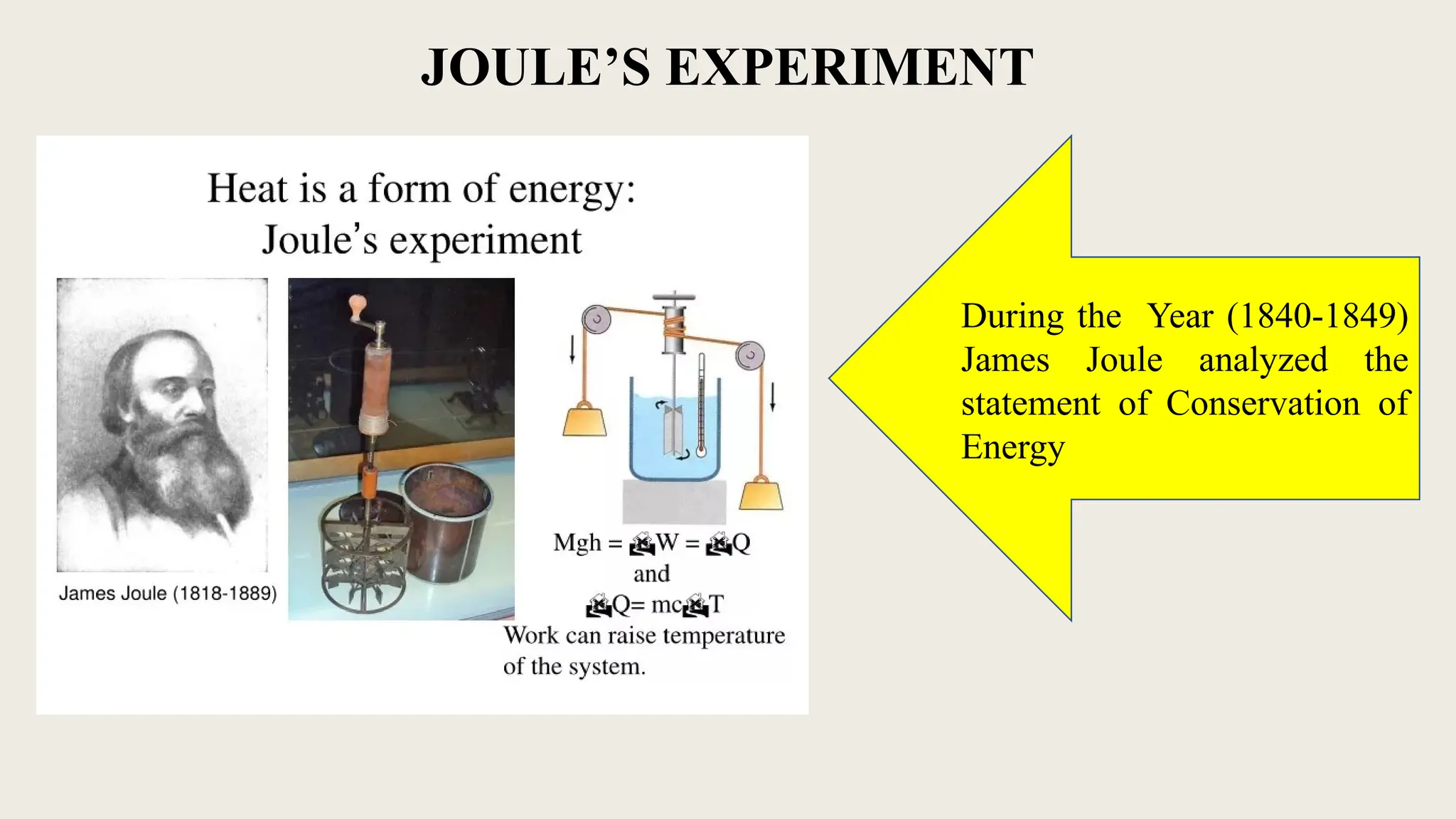
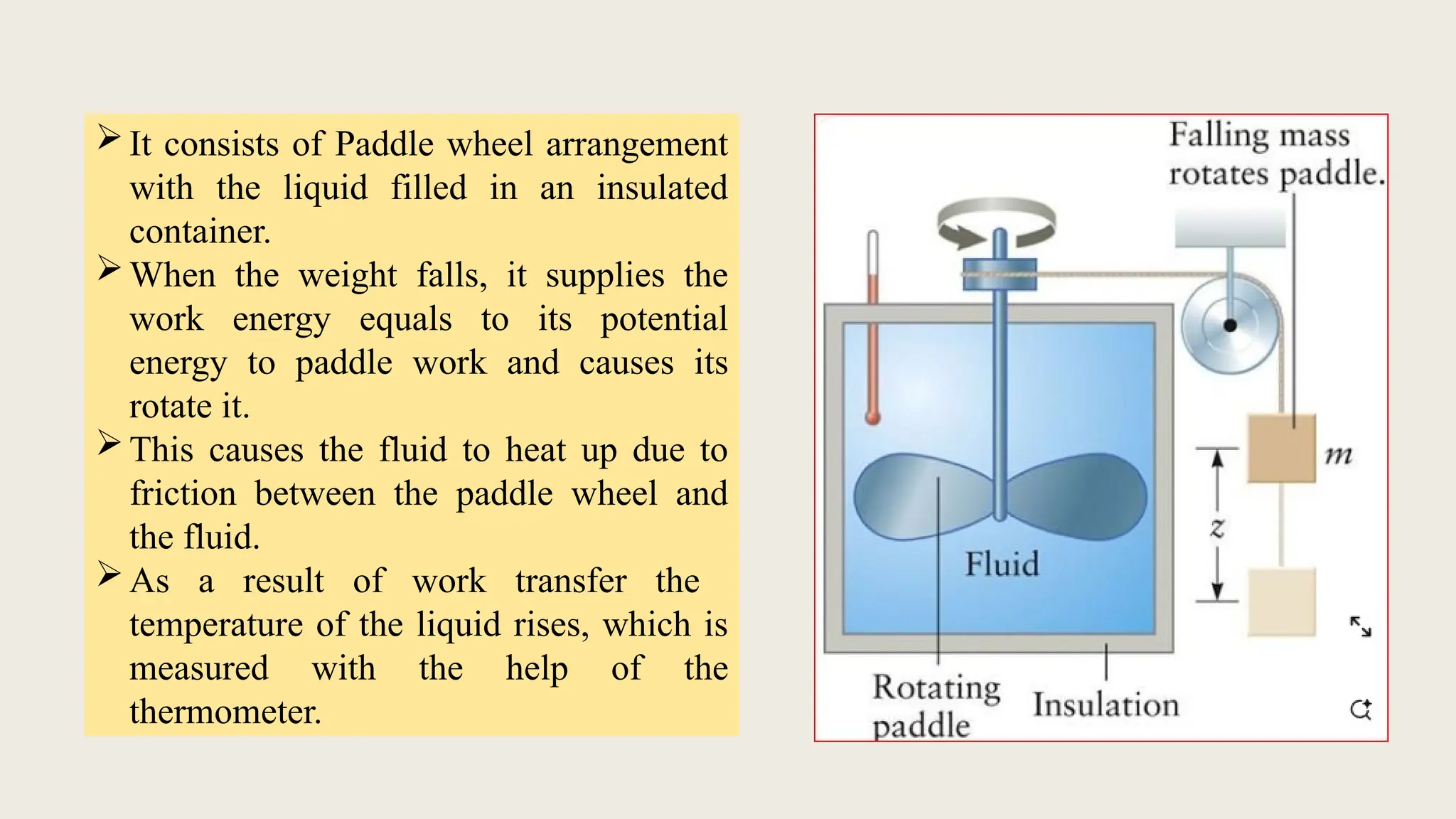
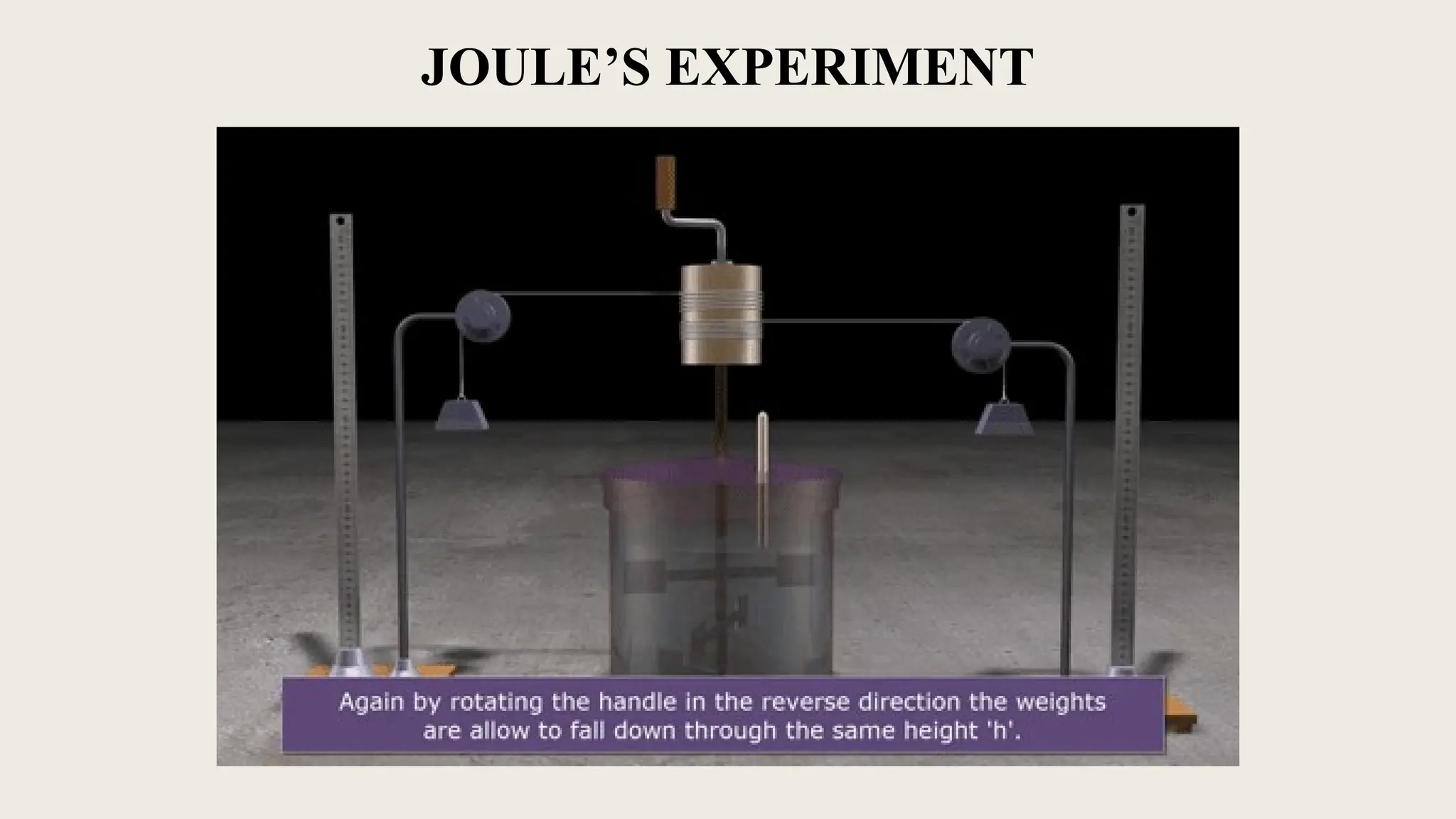
It consists ofPaddle wheel arrangement
with the liquid filled in an insulated
container.
When the weight falls, it supplies the
work energy equals to its potential
energy to paddle work and causes its
rotate it.
This causes the fluid to heat up due to
friction between the paddle wheel and
the fluid.
As a result of work transfer the
temperature of the liquid rises, which is
measured with the help of the
thermometer.
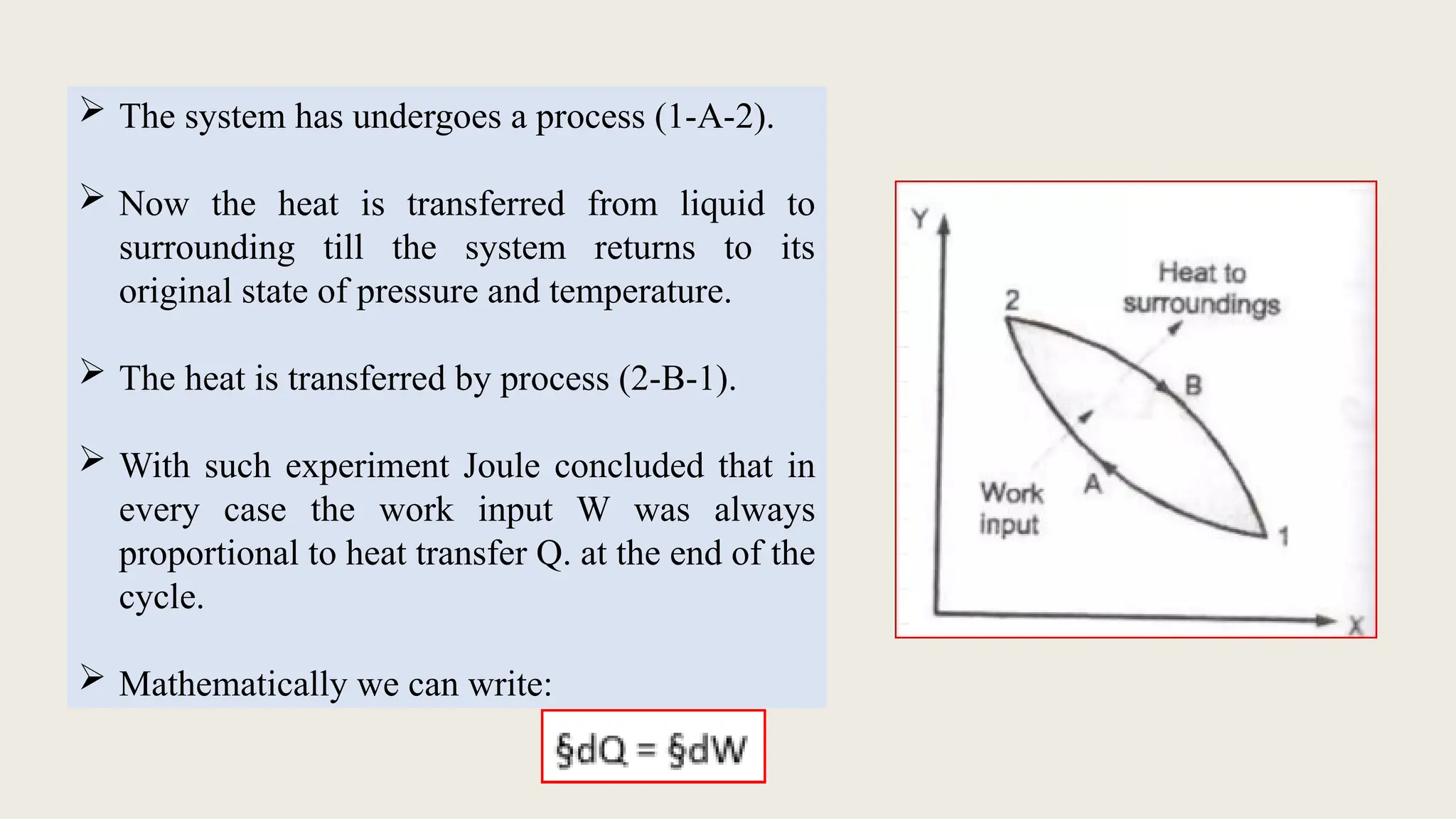
The systemhas undergoes a process (1-A-2).
Now the heat is transferred from liquid to
surrounding till the system returns to its
original state of pressure and temperature.
The heat is transferred by process (2-B-1).
With such experiment Joule concluded that in
every case the work input W was always
proportional to heat transfer Q. at the end of the
cycle.
Mathematically we can write:
What is SteadyFlow steady flow energy equation (SFEE)?
The steady flow energy equation (SFEE) is an equation that describes the
conservation of energy in a flowing system.
Key applications of the SFEE:
Power plant analysis:
Calculating the efficiency of steam turbines in power plants by analyzing the
energy changes of steam flowing through the turbine blades.
Fluid flow in pipes:
Determining pressure drops and energy losses in pipelines due to friction and other
factors.
51.
Nozzle design:
Calculatingthe velocity and pressure of a fluid exiting a nozzle, crucial for rocket
engine design.
Compressor performance:
Assessing the work required to increase the pressure of a fluid in a compressor.
Heat exchanger design:
Analyzing heat transfer between two fluids flowing in a heat exchanger.
Refrigeration systems:
Calculating the cooling effect of a refrigerant flowing through an evaporator
52.
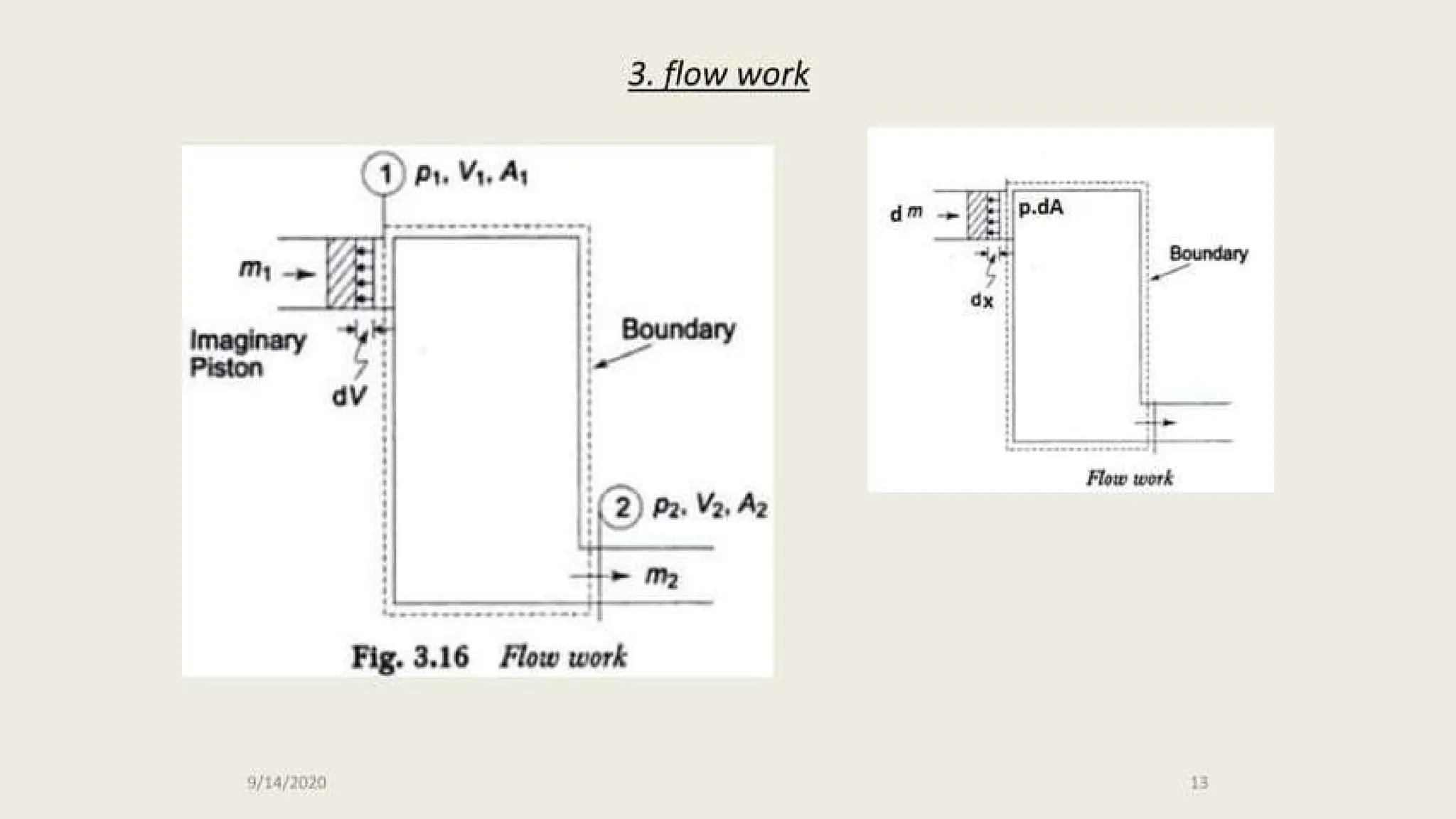
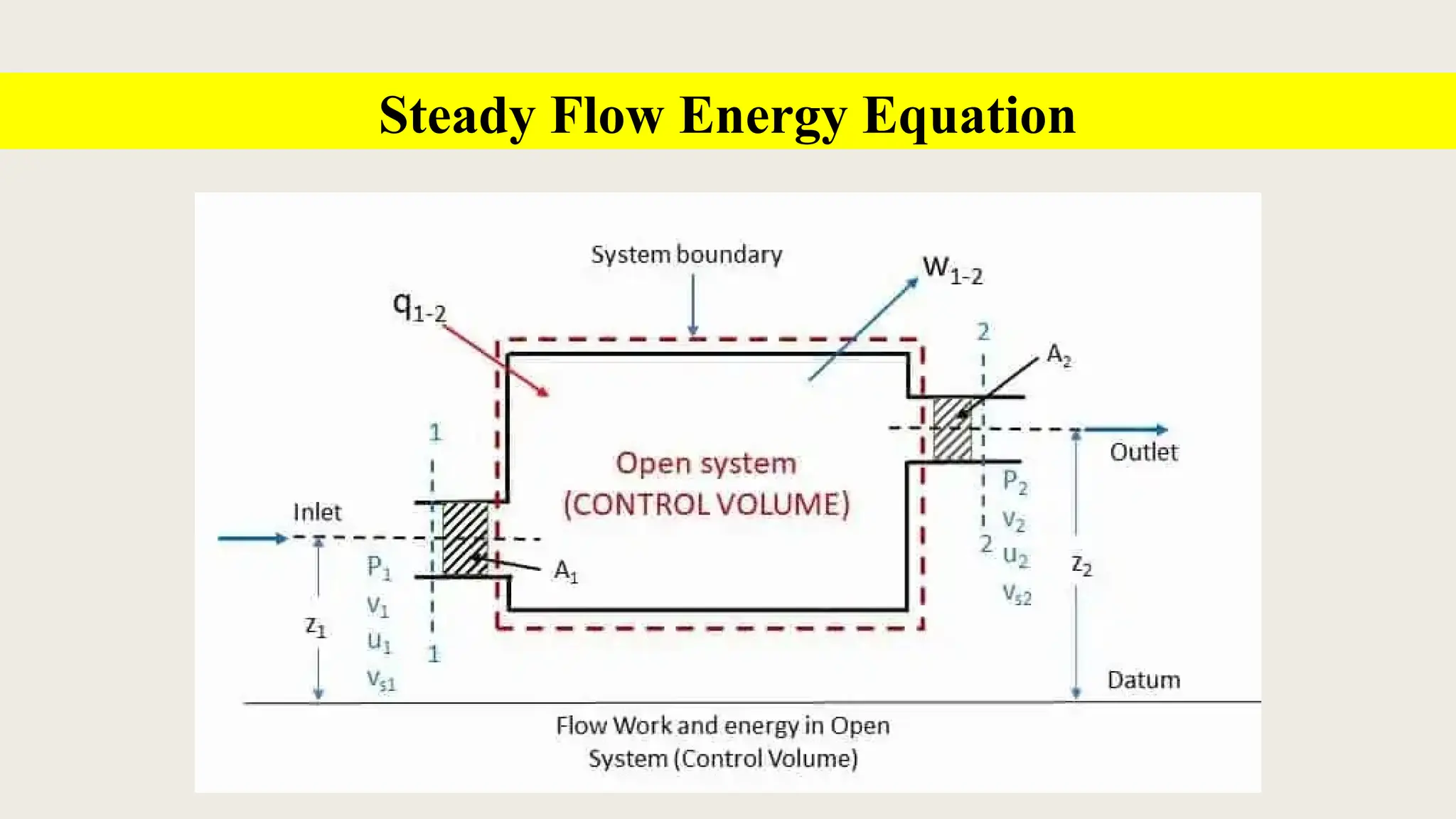
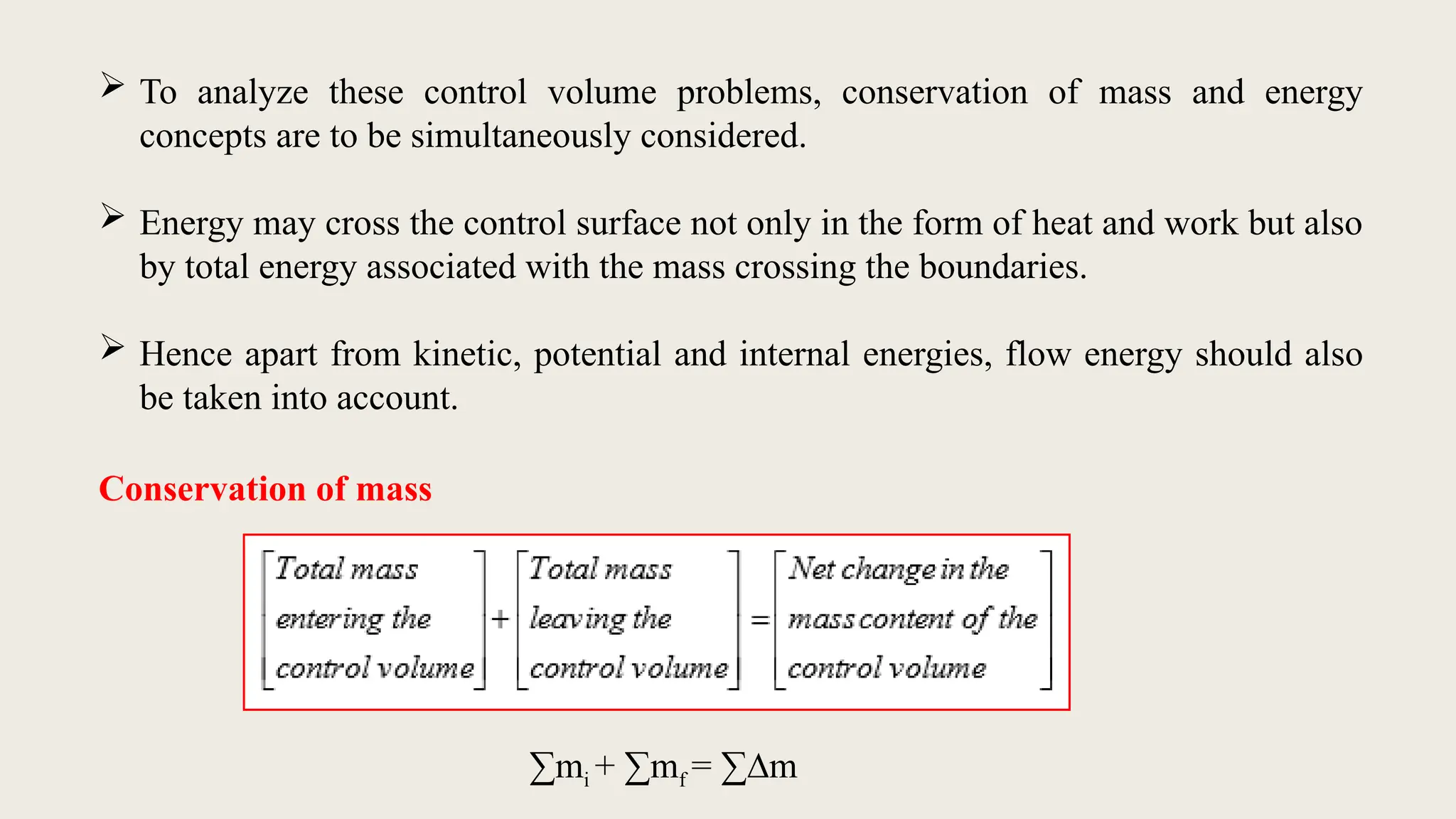
To analyzethese control volume problems, conservation of mass and energy
concepts are to be simultaneously considered.
Energy may cross the control surface not only in the form of heat and work but also
by total energy associated with the mass crossing the boundaries.
Hence apart from kinetic, potential and internal energies, flow energy should also
be taken into account.
Conservation of mass
∑mi + ∑mf = ∑∆m
53.
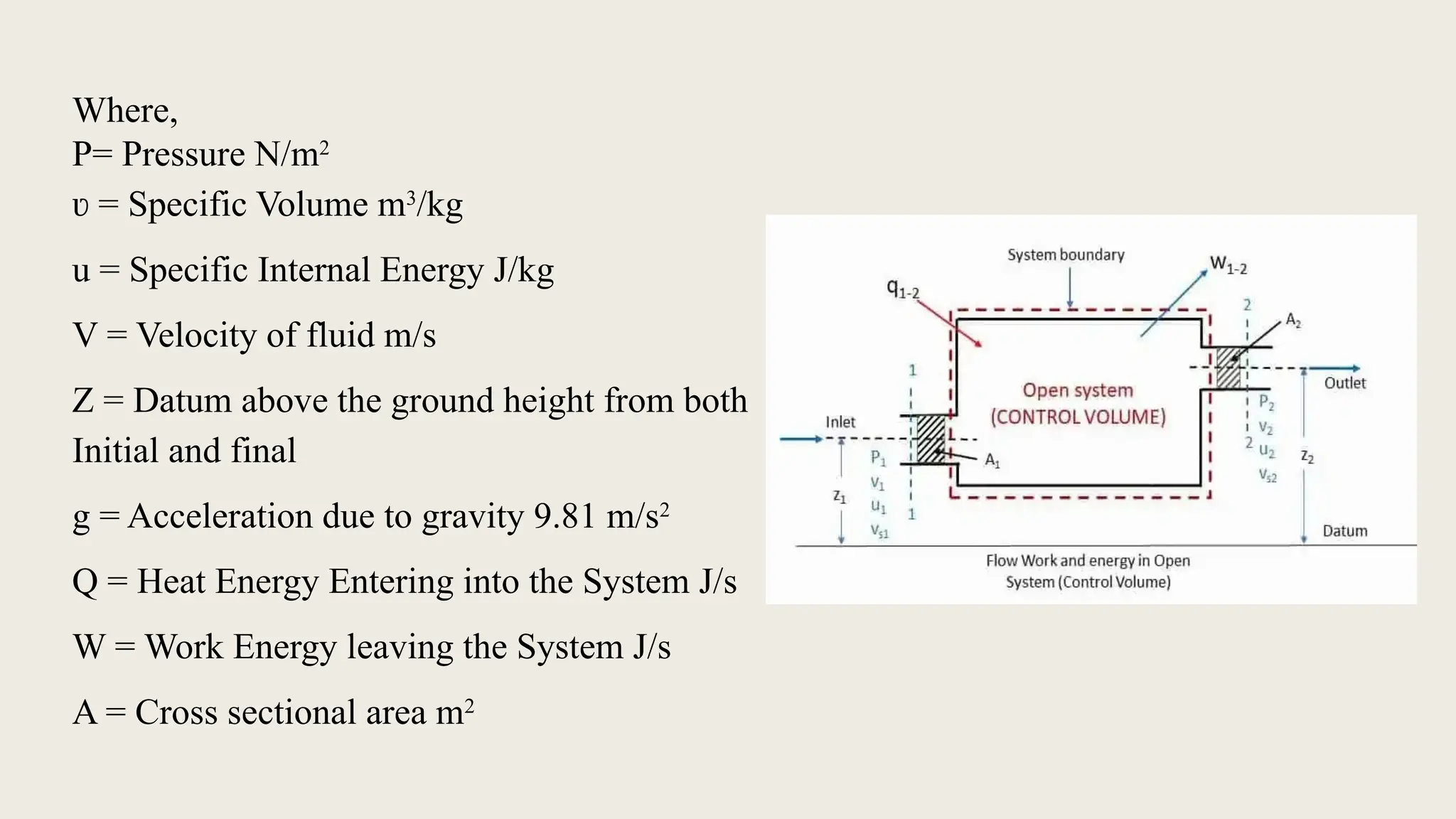
Where,
P= Pressure N/m2
=Specific Volume m
ʋ 3
/kg
u = Specific Internal Energy J/kg
V = Velocity of fluid m/s
Z = Datum above the ground height from both
Initial and final
g = Acceleration due to gravity 9.81 m/s2
Q = Heat Energy Entering into the System J/s
W = Work Energy leaving the System J/s
A = Cross sectional area m2
E2 = W+m[u2+P2ʋ2+Z2g+V2
2
/2]
h= u+Pʋ
E2 = W+m[h2+Z2g+V2
2
/2] OUTLET
Energy Entering into the System = Energy leaving from the System
E1 = E2
Q+m[h1+Z1g+V1
2
/2] = W+m[h2+Z2g+V2
2
/2]
Q-W = m[h2+Z2g+V2
2
/2] - m[h1+Z1g+V1
2
/2]
56.
Q-W = m[(h2- h1)+(Z2-Z1)g+]
Here, If Datum heights is not given then, you can neglect the terms of Z1 and Z2
Q-W = m[(h2 - h1)+]
This is known as Steady Flow Energy Equation.
57.
Applications of theSFEE:
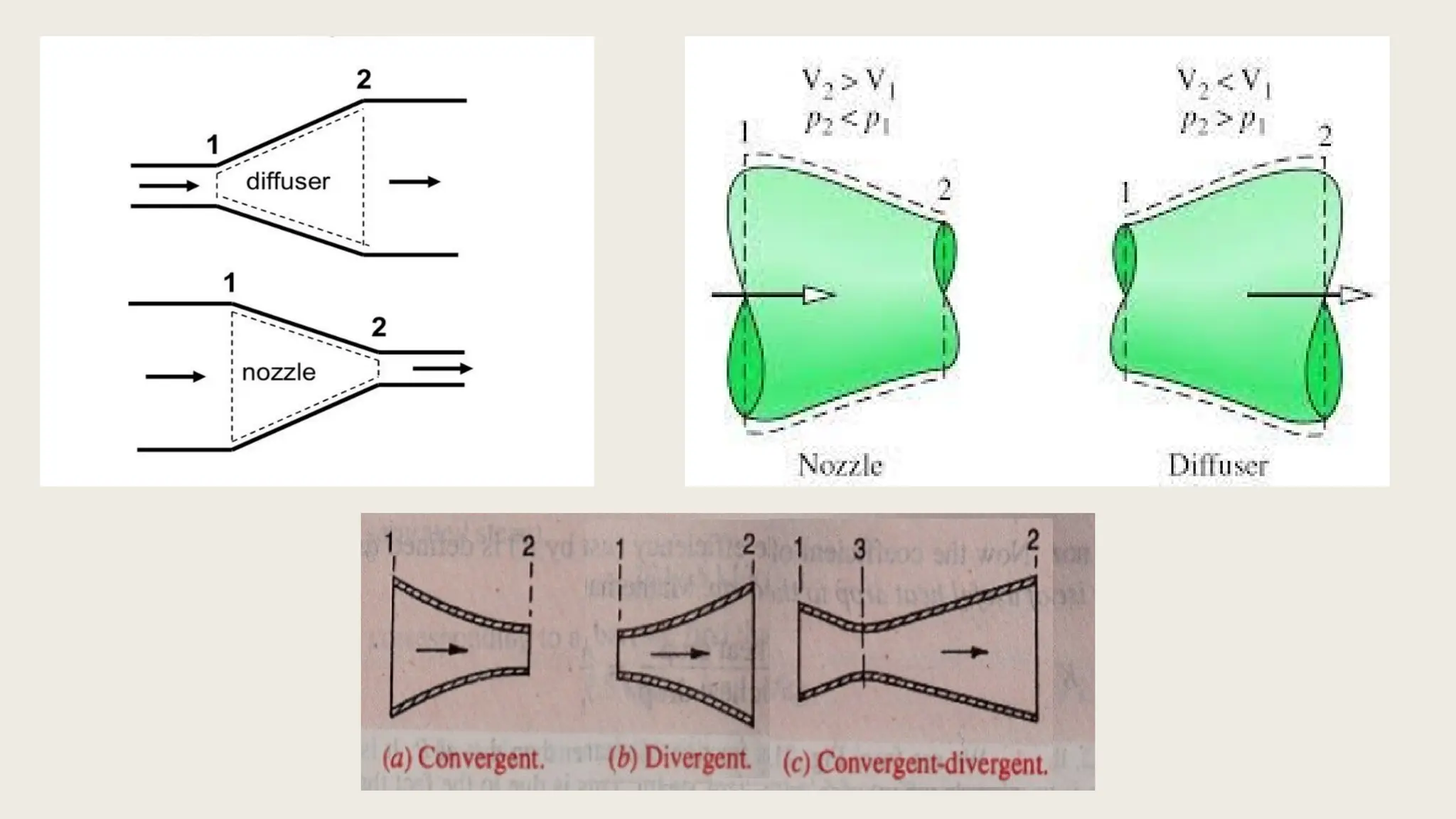
Steam Nozzle
Q+m[h1+Z1g+V1
2
/2] = W+m[h2+Z2g+V2
2
/2]
[h1+V1
2
/2] = [h2+V2
2
/2]
h2 - h1=
)
)
)
If <<<<<
It is a device used to increase the K.E of Working Fluid. In this
device Pressure Energy is Converted into K.E.
58.
Diffuser:
[h1+V1
2
/2] = [h2+V2
2
/2]
h2- h1=
)
)
)
If <<<<<
It is a device used to increase the Pressure Energy of Working
Fluid. In this device Kinetic Energy is Converted into Pressure
Energy. Where outlet Velocity is too Less.
Q+m[h1+Z1g+V1
2
/2] = W+m[h2+Z2g+V2
2
/2]
60.
Steam/Gas Turbine:
It isa device which gives Mechanical Energy as output. We consider heat transfer
negligible s insulation is provided, also we consider changes in K.E & P.E is zero.
Q-W = m[(h2 - h1)+(Z2-Z1)g+]
-W = h2 - h1
W = h1 – h2
61.
Compressors:
It is adevice which compress the fluid that means it increases pressure and reduce
Volume. Here, Heat Transfer change in K.E & P.E is negligible & consider to be Zero.
Q-W = m[(h2 - h1)+(Z2-Z1)g+]
-(-W) = h2 - h1
W = h2 - h1
Here, -ve work is input
-W = h2 - h1
62.
Throttling valve:
It isa device which is used for changing the mass flow rate of the fluid. Except Enthalpy
all other parameters change is negligible.
Q-W = m[(h2 - h1)+(Z2-Z1)g+]
h2 - h1 = 0
h2 = h1
Here Enthalpy at inlet & outlet is same.
63.
Limitations of theFirst Law of Thermodynamics
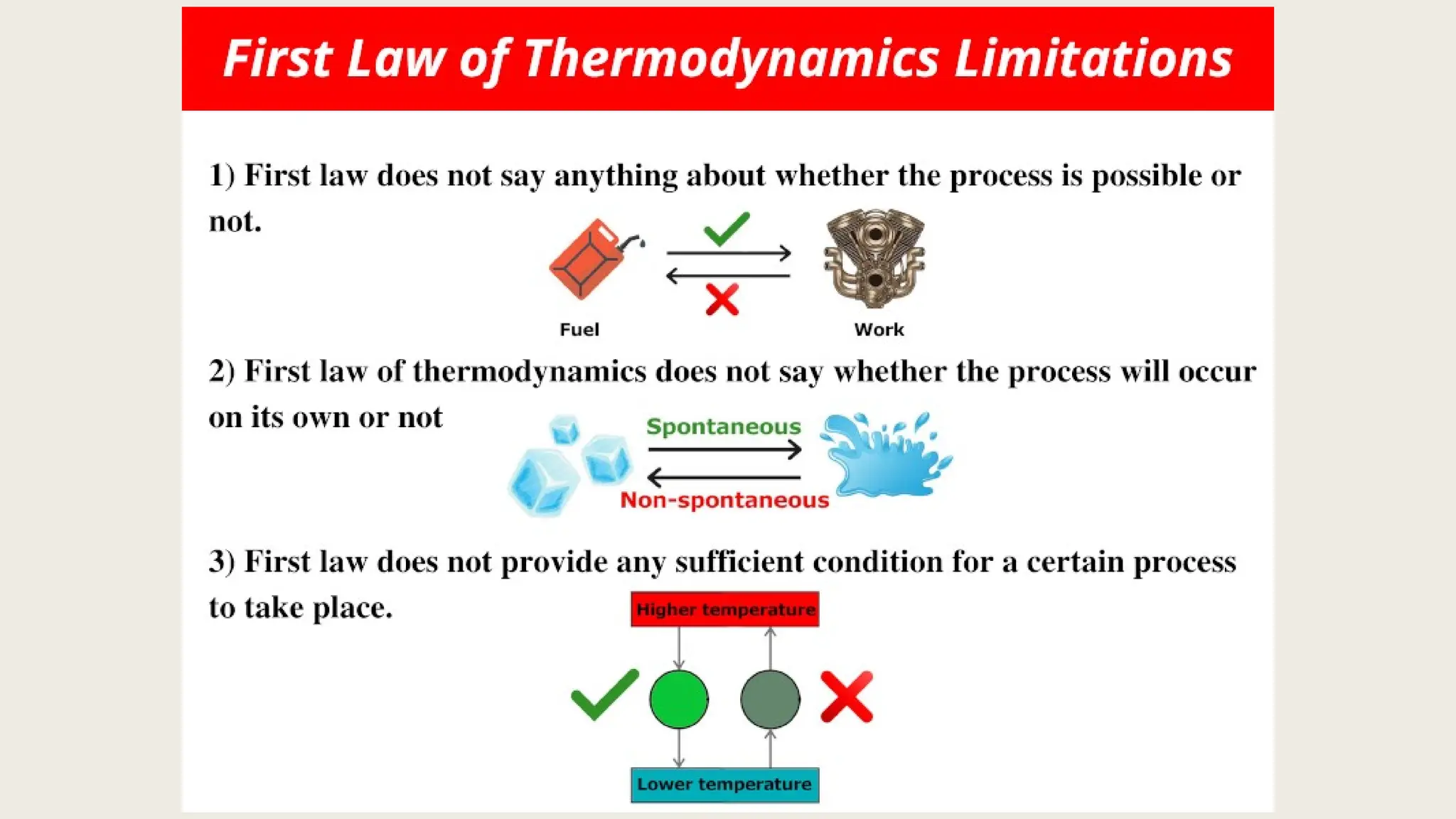
1.No Information on Process Direction:
The First Law defines energy conservation but does not indicate whether a process is
spontaneous or reversible. For example, it cannot predict if heat will naturally flow
from cold to hot without additional guidance (which requires the Second Law).
2.No Insight into Efficiency or Quality of Energy:
While the First Law tracks energy quantities, it does not differentiate between useful
work energy and less useful energy like heat loss. Thus, it overlooks efficiency
concerns.
3.No Control Over Energy Degradation:
The First Law does not account for entropy changes or energy dissipation, which are
crucial in real-world thermodynamic systems.
64.
Limitations in EnthalpyContext
•Enthalpy Alone Cannot Predict Feasibility: While enthalpy change (ΔH)
indicates heat exchange at constant pressure, it does not determine if the process is
spontaneous or efficient.
•Phase Change Complexity: Enthalpy calculations may oversimplify phase
transitions where latent heat plays a significant role.
•Energy Storage Misconceptions: Enthalpy values alone may mislead energy
storage potential without considering entropy or system constraints.
4. Ignores Time Dependency:
It cannot describe the rate at which energy transformations occur, which is
essential in dynamic systems like thermal management frameworks.
5. No Insight into Internal Irreversibilities:
Real processes often have friction, turbulence, and heat losses that reduce
system performance. The First Law does not address these factors.
66.
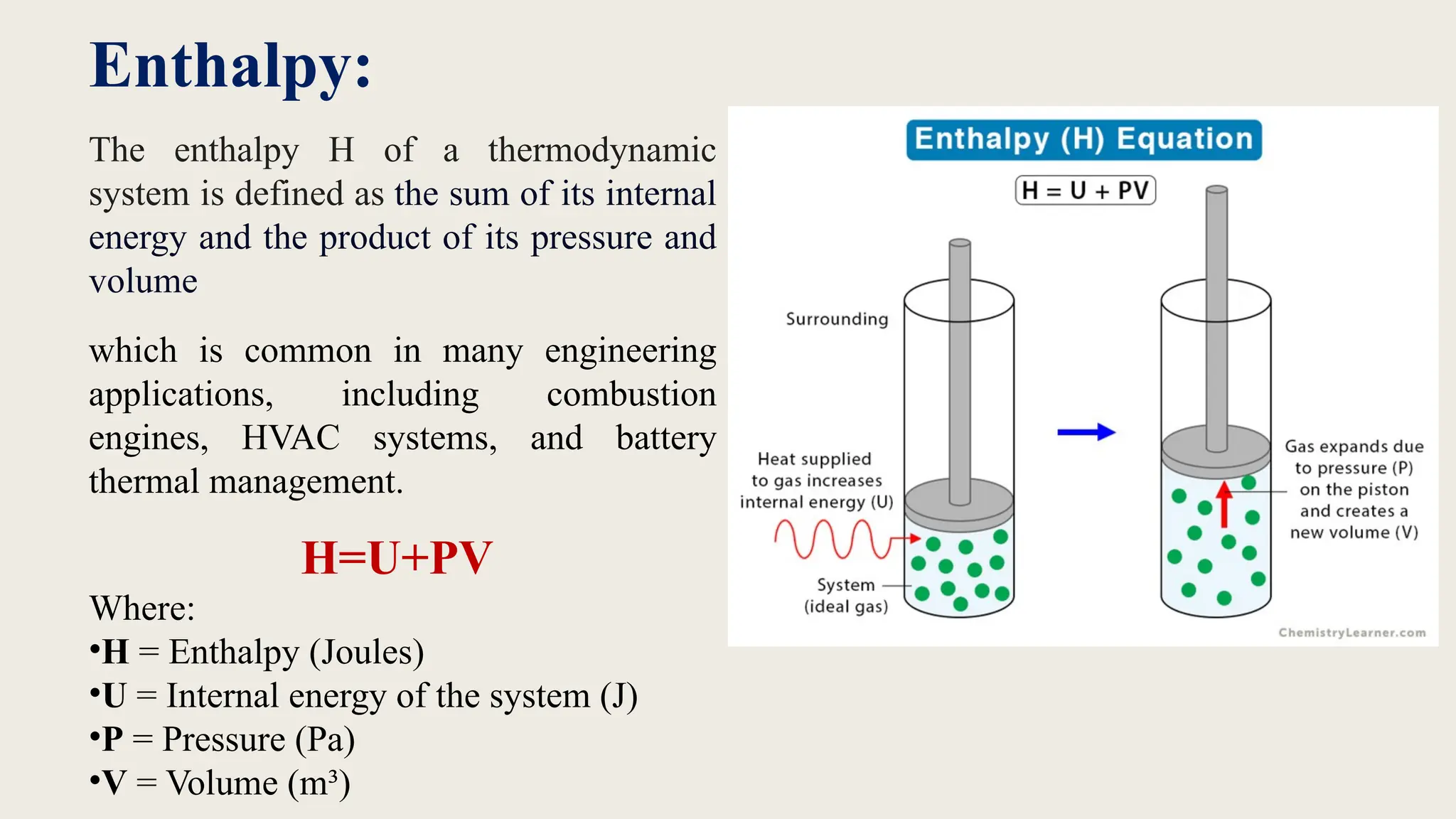
Enthalpy:
The enthalpy Hof a thermodynamic
system is defined as the sum of its internal
energy and the product of its pressure and
volume
which is common in many engineering
applications, including combustion
engines, HVAC systems, and battery
thermal management.
H=U+PV
Where:
•H = Enthalpy (Joules)
•U = Internal energy of the system (J)
•P = Pressure (Pa)
•V = Volume (m³)
67.
Change in Enthalpy(ΔH):
In practical applications, we are more interested in the change in enthalpy rather
than its absolute value.
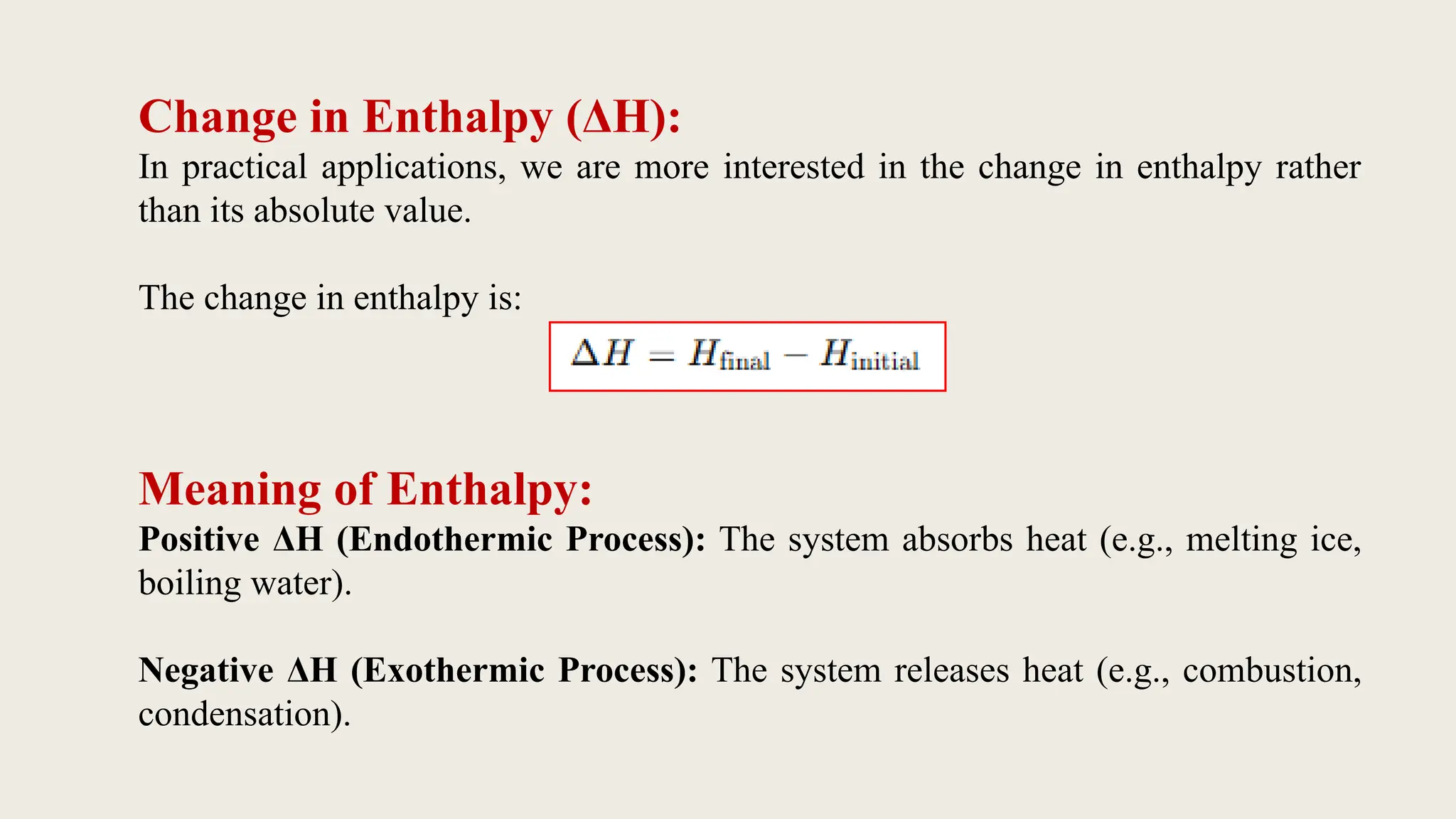
The change in enthalpy is:
Meaning of Enthalpy:
Positive ΔH (Endothermic Process): The system absorbs heat (e.g., melting ice,
boiling water).
Negative ΔH (Exothermic Process): The system releases heat (e.g., combustion,
condensation).
![Conservation of energy
E1 = Q+m[u1+P1ʋ1+Z1g+V1
2
/2]
h = u+Pʋ
E1 = Q+m[h1+Z1g+V1
2
/2] INLET](https://image.slidesharecdn.com/unit-ii-copy-250628133804-c68c75d9/75/Themordynamics-Unit-2-Mechanical-First-year-54-2048.jpg)
![E2 = W+m[u2+P2ʋ2+Z2g+V2
2
/2]
h = u+Pʋ
E2 = W+m[h2+Z2g+V2
2
/2] OUTLET
Energy Entering into the System = Energy leaving from the System
E1 = E2
Q+m[h1+Z1g+V1
2
/2] = W+m[h2+Z2g+V2
2
/2]
Q-W = m[h2+Z2g+V2
2
/2] - m[h1+Z1g+V1
2
/2]](https://image.slidesharecdn.com/unit-ii-copy-250628133804-c68c75d9/75/Themordynamics-Unit-2-Mechanical-First-year-55-2048.jpg)
![Q-W = m[(h2 - h1)+(Z2-Z1)g+]
Here, If Datum heights is not given then, you can neglect the terms of Z1 and Z2
Q-W = m[(h2 - h1)+]
This is known as Steady Flow Energy Equation.](https://image.slidesharecdn.com/unit-ii-copy-250628133804-c68c75d9/75/Themordynamics-Unit-2-Mechanical-First-year-56-2048.jpg)
![Applications of the SFEE:
Steam Nozzle
Q+m[h1+Z1g+V1
2
/2] = W+m[h2+Z2g+V2
2
/2]
[h1+V1
2
/2] = [h2+V2
2
/2]
h2 - h1=
)
)
)
If <<<<<
It is a device used to increase the K.E of Working Fluid. In this
device Pressure Energy is Converted into K.E.](https://image.slidesharecdn.com/unit-ii-copy-250628133804-c68c75d9/75/Themordynamics-Unit-2-Mechanical-First-year-57-2048.jpg)
![Diffuser:
[h1+V1
2
/2] = [h2+V2
2
/2]
h2 - h1=
)
)
)
If <<<<<
It is a device used to increase the Pressure Energy of Working
Fluid. In this device Kinetic Energy is Converted into Pressure
Energy. Where outlet Velocity is too Less.
Q+m[h1+Z1g+V1
2
/2] = W+m[h2+Z2g+V2
2
/2]](https://image.slidesharecdn.com/unit-ii-copy-250628133804-c68c75d9/75/Themordynamics-Unit-2-Mechanical-First-year-58-2048.jpg)
![Steam/Gas Turbine:
It is a device which gives Mechanical Energy as output. We consider heat transfer
negligible s insulation is provided, also we consider changes in K.E & P.E is zero.
Q-W = m[(h2 - h1)+(Z2-Z1)g+]
-W = h2 - h1
W = h1 – h2](https://image.slidesharecdn.com/unit-ii-copy-250628133804-c68c75d9/75/Themordynamics-Unit-2-Mechanical-First-year-60-2048.jpg)
![Compressors:
It is a device which compress the fluid that means it increases pressure and reduce
Volume. Here, Heat Transfer change in K.E & P.E is negligible & consider to be Zero.
Q-W = m[(h2 - h1)+(Z2-Z1)g+]
-(-W) = h2 - h1
W = h2 - h1
Here, -ve work is input
-W = h2 - h1](https://image.slidesharecdn.com/unit-ii-copy-250628133804-c68c75d9/75/Themordynamics-Unit-2-Mechanical-First-year-61-2048.jpg)
![Throttling valve:
It is a device which is used for changing the mass flow rate of the fluid. Except Enthalpy
all other parameters change is negligible.
Q-W = m[(h2 - h1)+(Z2-Z1)g+]
h2 - h1 = 0
h2 = h1
Here Enthalpy at inlet & outlet is same.](https://image.slidesharecdn.com/unit-ii-copy-250628133804-c68c75d9/75/Themordynamics-Unit-2-Mechanical-First-year-62-2048.jpg)