Evan Petrovich Pavlov
Theory of Behaviorism
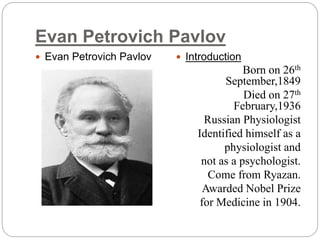
Evan Petrovich Pavlov
 Evan Petrovich Pavlov  Introduction
Born on 26th
September,1849
Died on 27th
February,1936
Russian Physiologist
Identified himself as a
physiologist and
not as a psychologist.
Come from Ryazan.
Awarded Nobel Prize
for Medicine in 1904.
Conditioned Response
Theory/Learning by Conditioning.
 With his experiments on various animals like cats,
dogs, rats, Pavlov gave birth to the theory of
learning which is known as Conditioned
Response Theory or simply as by Conditioning.
 On the basis of his experiments Pavlov
considered learning as a habit formation based
on association and substitution. For example
presence of both artificial and natural stimuli for a
number of times, forming a habit.
What is ‘Conditioning’ ?
 The term ‘conditioning’ refers to building or
making of an environment that can bring change
into the behavior of a living being.
 It is a situation in which the behavior of any living
being is controlled or possessed. The thing which
alters or controls one’s behavior is called
Stimulus/stimuli.
 In the presence Stimulus the Response occurs.
Responses are of two types 1. Natural
(Unconditioned) and 2. Artificial/fabricated
(Conditioned)
Classical Conditioning
 It is a learning process whereby an
artificial stimulus is able to behave like a
natural stimulus when both natural and
artificial stimuli are presented together. In
this kind of learning, association plays a
great role since the individual responds to
an artificial stimulus because he
associates it with the natural stimulus.
Continues…
 The Conditioning Theory of Learning by
Pavlov involves the conditioning of
Respondent Behavior through a process
of stimulus association and substitution.
Here, the responses of the learners
become so much conditioned that
behaving in the same way or responding
similarly to a similar situation that he does
not care for the natural stimuli for evoking
the related natural response. As a result
the new substituted stimulus behaves like
original stimulus and is able to evoke the
desired response.
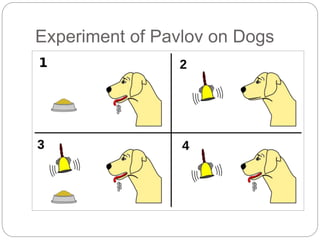
Experiment of Pavlov on Dogs
Implications
Theory of Rewards and
Punishment
Useful in Language Learning
Development of attitudes
Helpful in adjustment
Merits and Drawbacks
Thank
You

Theory of Behaviorism

  • 1.
  • 2.
    Evan Petrovich Pavlov Evan Petrovich Pavlov  Introduction Born on 26th September,1849 Died on 27th February,1936 Russian Physiologist Identified himself as a physiologist and not as a psychologist. Come from Ryazan. Awarded Nobel Prize for Medicine in 1904.
  • 3.
    Conditioned Response Theory/Learning byConditioning.  With his experiments on various animals like cats, dogs, rats, Pavlov gave birth to the theory of learning which is known as Conditioned Response Theory or simply as by Conditioning.  On the basis of his experiments Pavlov considered learning as a habit formation based on association and substitution. For example presence of both artificial and natural stimuli for a number of times, forming a habit.
  • 4.
    What is ‘Conditioning’?  The term ‘conditioning’ refers to building or making of an environment that can bring change into the behavior of a living being.  It is a situation in which the behavior of any living being is controlled or possessed. The thing which alters or controls one’s behavior is called Stimulus/stimuli.  In the presence Stimulus the Response occurs. Responses are of two types 1. Natural (Unconditioned) and 2. Artificial/fabricated (Conditioned)
  • 5.
    Classical Conditioning  Itis a learning process whereby an artificial stimulus is able to behave like a natural stimulus when both natural and artificial stimuli are presented together. In this kind of learning, association plays a great role since the individual responds to an artificial stimulus because he associates it with the natural stimulus.
  • 6.
    Continues…  The ConditioningTheory of Learning by Pavlov involves the conditioning of Respondent Behavior through a process of stimulus association and substitution. Here, the responses of the learners become so much conditioned that behaving in the same way or responding similarly to a similar situation that he does not care for the natural stimuli for evoking the related natural response. As a result the new substituted stimulus behaves like original stimulus and is able to evoke the desired response.
  • 7.
  • 8.
    Implications Theory of Rewardsand Punishment Useful in Language Learning Development of attitudes Helpful in adjustment
  • 9.
  • 10.