MEDIA THEORY 
Jacob Dunlop
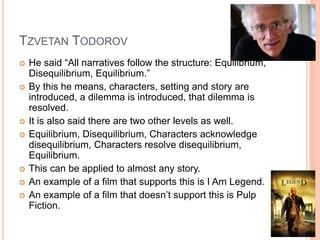
TZVETAN TODOROV 
 He said “All narratives follow the structure: Equilibrium, 
Disequilibrium, Equilibrium.” 
 By this he means, characters, setting and story are 
introduced, a dilemma is introduced, that dilemma is 
resolved. 
 It is also said there are two other levels as well. 
 Equilibrium, Disequilibrium, Characters acknowledge 
disequilibrium, Characters resolve disequilibrium, 
Equilibrium. 
 This can be applied to almost any story. 
 An example of a film that supports this is I Am Legend. 
 An example of a film that doesn’t support this is Pulp 
Fiction.
VLADIMIR PROPP 
 Propp said that almost any character in a story can fit to a certain 
category and most narratives have most of these characters. 
 Hero – Protagonist 
 Villain – Antagonist 
 Donor – Gives Hero a device or power 
 Helper – Helps Hero on their journey 
 False Hero – Appears at first as a good character but turns out to 
be evil 
 Dispatcher – Sends Hero on journey 
 Princess – Marries Hero 
 These characters are based on fairytales and don’t stick to other 
kinds of narrative so well but are still applicable to modern 
narratives. 
 An example of a film that supports this is Shrek. 
 An example of a film that doesn’t support this is LA Condifential.
CLAUDE LEVI-STRAUSS 
 He said that there are almost always binary opposites 
motivating characters and plot, these are: 
 Good vs. Evil 
 Weak vs. Strong 
 Young vs. Old 
 Male vs. Female 
 These opposing forces are still very relevant to modern 
narratives and usually at least one can be found in every 
narrative. 
 An example of a film that supports this is Harry Potter. 
 An example of a film that doesn’t support this is Amelie.

Theory

  • 1.
  • 2.
    TZVETAN TODOROV He said “All narratives follow the structure: Equilibrium, Disequilibrium, Equilibrium.”  By this he means, characters, setting and story are introduced, a dilemma is introduced, that dilemma is resolved.  It is also said there are two other levels as well.  Equilibrium, Disequilibrium, Characters acknowledge disequilibrium, Characters resolve disequilibrium, Equilibrium.  This can be applied to almost any story.  An example of a film that supports this is I Am Legend.  An example of a film that doesn’t support this is Pulp Fiction.
  • 3.
    VLADIMIR PROPP Propp said that almost any character in a story can fit to a certain category and most narratives have most of these characters.  Hero – Protagonist  Villain – Antagonist  Donor – Gives Hero a device or power  Helper – Helps Hero on their journey  False Hero – Appears at first as a good character but turns out to be evil  Dispatcher – Sends Hero on journey  Princess – Marries Hero  These characters are based on fairytales and don’t stick to other kinds of narrative so well but are still applicable to modern narratives.  An example of a film that supports this is Shrek.  An example of a film that doesn’t support this is LA Condifential.
  • 4.
    CLAUDE LEVI-STRAUSS He said that there are almost always binary opposites motivating characters and plot, these are:  Good vs. Evil  Weak vs. Strong  Young vs. Old  Male vs. Female  These opposing forces are still very relevant to modern narratives and usually at least one can be found in every narrative.  An example of a film that supports this is Harry Potter.  An example of a film that doesn’t support this is Amelie.