Narrative Theory
Narrative is the art of storytelling, it is an important part of our lives and something that we value
highly. Narrative is in multiple forms of media like T.V, Films, and all forms of literature.
In media studies there is a different between plot and story compared to narrative. The plot is what is
present (visibly & audibly) in the film and in what order you get it.
The story us all the happenings in the narrative, both the ones that we see in the film and the ones we
infer or referred to. Things like eating or sleeping, what we assume is happening..
Some thrillers and other genres do not assembled there plot in chronological order to push the viewer
to think what might happen as the audience would feel cheated if part of the story was suddenly
revealed at the end with no possible way of the audience guessing.
Vladimir Propp
Propp looked at folk tales and saw some structures they shared in common. He found 8 character
roles that move the story along.
1. The Villain
2. The Hero (not always good but carries the story along, the central character and not always
male)
3. The donor (who provides an object with some special property)
4. The helper (who helps the hero)
5. The princess (the reward for the hero and object of the villain’s schemes)
6. Her father (Who rewards the hero)
7. The dispatcher (who sends the hero on his way)
8. The false hero
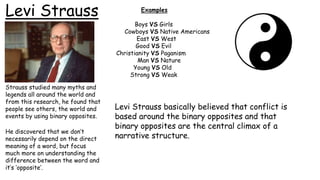
Levi Strauss
Strauss studied many myths and
legends all around the world and
from this research, he found that
people see others, the world and
events by using binary opposites.
He discovered that we don’t
necessarily depend on the direct
meaning of a word, but focus
much more on understanding the
difference between the word and
it’s ‘opposite’.
Examples
Boys VS Girls
Cowboys VS Native Americans
East VS West
Good VS Evil
Christianity VS Paganism
Man VS Nature
Young VS Old
Strong VS Weak
Levi Strauss basically believed that conflict is
based around the binary opposites and that
binary opposites are the central climax of a
narrative structure.
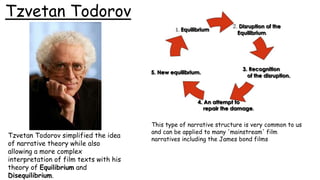
Tzvetan Todorov
Tzvetan Todorov simplified the idea
of narrative theory while also
allowing a more complex
interpretation of film texts with his
theory of Equilibrium and
Disequilibrium.
This type of narrative structure is very common to us
and can be applied to many 'mainstream' film
narratives including the James bond films

Narrative theories

  • 1.
    Narrative Theory Narrative isthe art of storytelling, it is an important part of our lives and something that we value highly. Narrative is in multiple forms of media like T.V, Films, and all forms of literature. In media studies there is a different between plot and story compared to narrative. The plot is what is present (visibly & audibly) in the film and in what order you get it. The story us all the happenings in the narrative, both the ones that we see in the film and the ones we infer or referred to. Things like eating or sleeping, what we assume is happening.. Some thrillers and other genres do not assembled there plot in chronological order to push the viewer to think what might happen as the audience would feel cheated if part of the story was suddenly revealed at the end with no possible way of the audience guessing.
  • 2.
    Vladimir Propp Propp lookedat folk tales and saw some structures they shared in common. He found 8 character roles that move the story along. 1. The Villain 2. The Hero (not always good but carries the story along, the central character and not always male) 3. The donor (who provides an object with some special property) 4. The helper (who helps the hero) 5. The princess (the reward for the hero and object of the villain’s schemes) 6. Her father (Who rewards the hero) 7. The dispatcher (who sends the hero on his way) 8. The false hero
  • 3.
    Levi Strauss Strauss studiedmany myths and legends all around the world and from this research, he found that people see others, the world and events by using binary opposites. He discovered that we don’t necessarily depend on the direct meaning of a word, but focus much more on understanding the difference between the word and it’s ‘opposite’. Examples Boys VS Girls Cowboys VS Native Americans East VS West Good VS Evil Christianity VS Paganism Man VS Nature Young VS Old Strong VS Weak Levi Strauss basically believed that conflict is based around the binary opposites and that binary opposites are the central climax of a narrative structure.
  • 4.
    Tzvetan Todorov Tzvetan Todorovsimplified the idea of narrative theory while also allowing a more complex interpretation of film texts with his theory of Equilibrium and Disequilibrium. This type of narrative structure is very common to us and can be applied to many 'mainstream' film narratives including the James bond films