Communication is
Important
Pamela Diamond
Derricka De jean
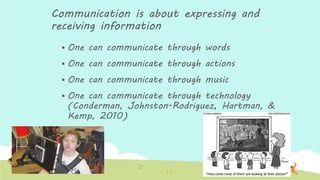
Communication is about expressing and
receiving information
 One can communicate through words
 One can communicate through actions
 One can communicate through music
 One can communicate through technology
(Conderman, Johnston-Rodriguez, Hartman, &
Kemp, 2010)
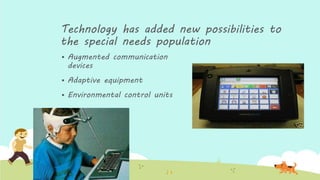
Technology has added new possibilities to
the special needs population
 Augmented communication
devices
 Adaptive equipment
 Environmental control units
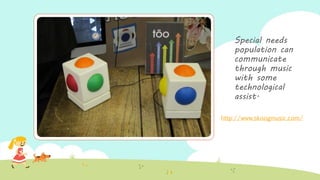
Special needs
population can
communicate
through music
with some
technological
assist.
http://www.skoogmusic.com/
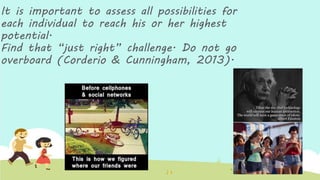
It is important to assess all possibilities for
each individual to reach his or her highest
potential.
Find that “just right” challenge. Do not go
overboard (Corderio & Cunningham, 2013).
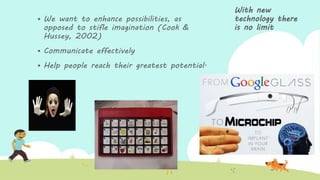
 We want to enhance possibilities, as
opposed to stifle imagination (Cook &
Hussey, 2002)
 Communicate effectively
 Help people reach their greatest potential.
With new
technology there
is no limit
References
Conderman, G., Johnston-Rodriguez, S., Hartman, P., & Kemp, D.
(2010). What teachers should say and how they should say it. Kappa
Delta Pi Record, 46 (4), 175-181
Cook, A.,M., & Hussey, S., M., (2002). Assistive Technologies; Principles
and Practice. St. Louis, MO:Mosby, Inc.
Corderio, PA., & Cunningham, W.G. (2013). Educational Leadership; A
bridge to Improved Practice. Saddle River, NJ: Pearson Education, Inc.

Communication assistance power point

  • 1.
  • 2.
    Communication is aboutexpressing and receiving information  One can communicate through words  One can communicate through actions  One can communicate through music  One can communicate through technology (Conderman, Johnston-Rodriguez, Hartman, & Kemp, 2010)
  • 3.
    Technology has addednew possibilities to the special needs population  Augmented communication devices  Adaptive equipment  Environmental control units
  • 4.
    Special needs population can communicate throughmusic with some technological assist. http://www.skoogmusic.com/
  • 5.
    It is importantto assess all possibilities for each individual to reach his or her highest potential. Find that “just right” challenge. Do not go overboard (Corderio & Cunningham, 2013).
  • 6.
     We wantto enhance possibilities, as opposed to stifle imagination (Cook & Hussey, 2002)  Communicate effectively  Help people reach their greatest potential. With new technology there is no limit
  • 7.
    References Conderman, G., Johnston-Rodriguez,S., Hartman, P., & Kemp, D. (2010). What teachers should say and how they should say it. Kappa Delta Pi Record, 46 (4), 175-181 Cook, A.,M., & Hussey, S., M., (2002). Assistive Technologies; Principles and Practice. St. Louis, MO:Mosby, Inc. Corderio, PA., & Cunningham, W.G. (2013). Educational Leadership; A bridge to Improved Practice. Saddle River, NJ: Pearson Education, Inc.