THE 7 KEY
CONCEPTS
THE 7 KEY CONCEPTS
• The key concepts underpin all of your
A level Media studies work.
• You must use the key concepts as a
framework for analysis.
• The application of the key concepts is
equally important across all four topic
areas.
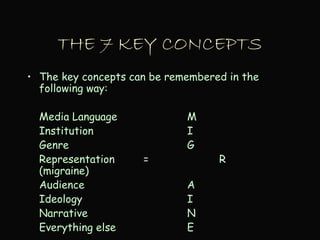
THE 7 KEY CONCEPTS
• The key concepts can be remembered in the
following way:
Media Language M
Institution I
Genre G
Representation = R
(migraine)
Audience A
Ideology I
Narrative N
Everything else E
MEDIA LANGUAGE
• Media Language is the language we use to
deconstruct a media text.
• Remember, a text does not use media language,
YOU DO as a tool for analysing still or moving
image products.
• You should not refer to this concept directly as
‘media language’ in your analysis.
MEDIA LANGUAGE
• KEY WORDS INCLUDE:
DENOTATION; CONNOTATION; MISE-EN-SCENE
NON-VERBAL COMMUNICATION; ANCHORAGE
ICONOGRAPHY; EDITING; INTERTEXTUALITY
Are you able to name any type of camera shot/angle?
INSTITUTION
• The context and origin of a media text and how
this has an influence upon the form and content of
a product is very important.
• Essentially, you must consider who made the text
and why.
• The motivation/purpose for making the text may
have some bearing upon how the text is shaped.
INSTITUTION
• KEY WORDS TO CONSIDER:
COMMERCIAL; PUBLIC SERVICE BROADCASTER
MAINSTREAM; ALTERNATIVE; INDEPENDENT
MULTINATIONAL CORPORATIONS
Can you think of 6 major media institutions?
GENRE
• Genre, in the context of media studies, is defined
as:
• All media texts, whether audio, audio-visual or
print based belong to a particular genre, that will
possess specific codes and conventions.
• Media industries use genres because they aid
audience understanding and help them reduce
their risks.
• Modern media texts are said to be less rigid in
their use of media texts.
GENRE
• KEY WORDS TO CONSIDER:
GENERIC CONVENTIONS; SUB-GENRES
GENERIC HYBRIDISATION
GENERIC DETERMINATION
Can you think of any characteristics of the teen pic?
REPRESENTATION
• Representation is the way that media texts re-
present different aspects of society, particularly
in relation to age, sexuality, race and gender.
• The manner in which these aspects are re-
presented will be effected by the ideology in the
production of the text.
• Representations can work to support or challenge
widely accepted values, attitudes or opinions.
REPRESENTATION
• KEY WORDS TO CONSIDER:
STEREOTYPES
POSITIVE/NEGATIVE REPRESENTATIONS
MINORITY GROUPS; POWER; IDEOLOGY
RACE/CLASS/GENDER/SEXUALITY/AGE
What words would you use to describe a ‘chav’ ?
AUDIENCE
• Media products are never made just for the sake
of it.
• They are always made to appeal to a specific
audience or audiences in order to inform, educate
and/or entertain.
• You should never just state who the target
audience are.
• You must also consider how the audience are being
target and for what purpose.
AUDIENCE
• KEY WORDS TO CONSIDER:
TARGET AUDIENCE
MAINSTREAM; ALTERNATIVE
NICHE
PREFERRED/NEGOTIATED/OPPOSITIONAL
READINGS
Who do you think would watch Big Brother?
IDEOLOGY
• Ideology relates to the system of attitudes,
values and beliefs that are apparent within
society.
• When studying media texts, it is important to
understand that they will be supported by a
particular ideological point of view e.g. pro-family,
heterosexuality.
• The views within the media often represent the
views of those with the most power in society and
so the texts they produce often help to support
dominant ideology.
IDEOLOGY
• KEYS WORDS TO CONSIDER:
DOMINANT IDEOLOGY; HEGEMONY
MAINSTREAM OR ALTERNATIVE
RACISM; SEXISM; HOMPHOBIA; XENOPHOBIA
How do soaps work to support dominant ideology?
NARRATIVE
• Whether you are examining print, audio or audio-
visual media products, they will contain a narrative
structure in which they present their ideas,
opinions, values to the audience.
• When exploring any media product, always think
about it in terms of how it tells a story.
• It is often the case, particularly with mainstream
narratives, that a deep structure or dominant set
of norms will directly influence the structure
which impacts on the messages for the audience.
NARRATIVE
• KEY WORDS TO CONSIDER:
CLASSIC HOLLYWOOD NARRATIVE
EQUILIBRIUM/DISEQUILIBRIUM
NARRATIVE AGENT; CLOSURE
MULTI-STRAND; CAUSE AND EFFECT
What do you expect from a Disney narrative?
EVERYTHING ELSE
• Outside of the key concepts, you must also
consider the wider social, political, economic and
historical contexts.
• You MUST keep your eye on the news and keep up
to date with what is happening in the world.
• If you do this, it will help you to understand the
texts we study on a higher level.
• READ NEWSPAPERS, WATCH TV AND GO TO
THE CINEMA!!!

Media 7 Key concepts

  • 1.
  • 2.
    THE 7 KEYCONCEPTS • The key concepts underpin all of your A level Media studies work. • You must use the key concepts as a framework for analysis. • The application of the key concepts is equally important across all four topic areas.
  • 3.
    THE 7 KEYCONCEPTS • The key concepts can be remembered in the following way: Media Language M Institution I Genre G Representation = R (migraine) Audience A Ideology I Narrative N Everything else E
  • 4.
    MEDIA LANGUAGE • MediaLanguage is the language we use to deconstruct a media text. • Remember, a text does not use media language, YOU DO as a tool for analysing still or moving image products. • You should not refer to this concept directly as ‘media language’ in your analysis.
  • 5.
    MEDIA LANGUAGE • KEYWORDS INCLUDE: DENOTATION; CONNOTATION; MISE-EN-SCENE NON-VERBAL COMMUNICATION; ANCHORAGE ICONOGRAPHY; EDITING; INTERTEXTUALITY Are you able to name any type of camera shot/angle?
  • 6.
    INSTITUTION • The contextand origin of a media text and how this has an influence upon the form and content of a product is very important. • Essentially, you must consider who made the text and why. • The motivation/purpose for making the text may have some bearing upon how the text is shaped.
  • 7.
    INSTITUTION • KEY WORDSTO CONSIDER: COMMERCIAL; PUBLIC SERVICE BROADCASTER MAINSTREAM; ALTERNATIVE; INDEPENDENT MULTINATIONAL CORPORATIONS Can you think of 6 major media institutions?
  • 8.
    GENRE • Genre, inthe context of media studies, is defined as: • All media texts, whether audio, audio-visual or print based belong to a particular genre, that will possess specific codes and conventions. • Media industries use genres because they aid audience understanding and help them reduce their risks. • Modern media texts are said to be less rigid in their use of media texts.
  • 9.
    GENRE • KEY WORDSTO CONSIDER: GENERIC CONVENTIONS; SUB-GENRES GENERIC HYBRIDISATION GENERIC DETERMINATION Can you think of any characteristics of the teen pic?
  • 10.
    REPRESENTATION • Representation isthe way that media texts re- present different aspects of society, particularly in relation to age, sexuality, race and gender. • The manner in which these aspects are re- presented will be effected by the ideology in the production of the text. • Representations can work to support or challenge widely accepted values, attitudes or opinions.
  • 11.
    REPRESENTATION • KEY WORDSTO CONSIDER: STEREOTYPES POSITIVE/NEGATIVE REPRESENTATIONS MINORITY GROUPS; POWER; IDEOLOGY RACE/CLASS/GENDER/SEXUALITY/AGE What words would you use to describe a ‘chav’ ?
  • 12.
    AUDIENCE • Media productsare never made just for the sake of it. • They are always made to appeal to a specific audience or audiences in order to inform, educate and/or entertain. • You should never just state who the target audience are. • You must also consider how the audience are being target and for what purpose.
  • 13.
    AUDIENCE • KEY WORDSTO CONSIDER: TARGET AUDIENCE MAINSTREAM; ALTERNATIVE NICHE PREFERRED/NEGOTIATED/OPPOSITIONAL READINGS Who do you think would watch Big Brother?
  • 14.
    IDEOLOGY • Ideology relatesto the system of attitudes, values and beliefs that are apparent within society. • When studying media texts, it is important to understand that they will be supported by a particular ideological point of view e.g. pro-family, heterosexuality. • The views within the media often represent the views of those with the most power in society and so the texts they produce often help to support dominant ideology.
  • 15.
    IDEOLOGY • KEYS WORDSTO CONSIDER: DOMINANT IDEOLOGY; HEGEMONY MAINSTREAM OR ALTERNATIVE RACISM; SEXISM; HOMPHOBIA; XENOPHOBIA How do soaps work to support dominant ideology?
  • 16.
    NARRATIVE • Whether youare examining print, audio or audio- visual media products, they will contain a narrative structure in which they present their ideas, opinions, values to the audience. • When exploring any media product, always think about it in terms of how it tells a story. • It is often the case, particularly with mainstream narratives, that a deep structure or dominant set of norms will directly influence the structure which impacts on the messages for the audience.
  • 17.
    NARRATIVE • KEY WORDSTO CONSIDER: CLASSIC HOLLYWOOD NARRATIVE EQUILIBRIUM/DISEQUILIBRIUM NARRATIVE AGENT; CLOSURE MULTI-STRAND; CAUSE AND EFFECT What do you expect from a Disney narrative?
  • 18.
    EVERYTHING ELSE • Outsideof the key concepts, you must also consider the wider social, political, economic and historical contexts. • You MUST keep your eye on the news and keep up to date with what is happening in the world. • If you do this, it will help you to understand the texts we study on a higher level. • READ NEWSPAPERS, WATCH TV AND GO TO THE CINEMA!!!