Television an Introduction
LO: To identify the advantages and disadvantages of Public
Service Broadcasting and Commercial Broadcasting.
Public Service Broadcasting
The Beginning
• 1922 the British Broadcasting Company (later to become Corporation)
was founded and led by the BBC’s first Director General, John Reith.
• The BBC followed his view that broadcasting should be organised in
the public interest.
John Reith
• In his view, it was the responsibility of the BBC
‘to carry into the greatest possible number of homes everything that
is best in every department of human knowledge, endeavour and
achievement’
• What could be an argument for this statement?
John Reith’s Four Principles
1. Broadcasting should be protected from commercial pressures and
the profit motive.
2. Broadcasting should provide services to the whole community, and
should be national.
3. Broadcasting should be characterised by ‘unified control’ (a strong
monopoly).
4. Broadcasting must be closely regulated to establish high standards
and ensure that programmes are of a high quality.
The heart of the BBC
INFORM
EDUCATE
ENTERTAIN
A Big Criticism
• Although some see Reith as having good intentions his views were
often criticised.
• In 1924 Reith was quoted to say:
‘It is occasionally indicated to us that we are apparently setting out to
give the public what we think they need – and not what they want,
but few know what they want, and very few what they need’
Finding a Balance
• To break the BBC’s monopoly in 1954 ITV was founded.
• This is a commercial channel funded by advertising.
• Reith feared that advertisers would influence programme content as
in the US.
• However, in the UK terrestrial broadcasting regulation insists that
broadcasting should primarily benefit the public.
ITV
• Now established ITV provided an alternative for the public.
• However, it was mainly concerned with the commercial viability of its
products and the maximum profit it can create.
• Then something interesting happened as ITV was accused of having a
monopoly over the sale of advertising space.
Channel 4
• To break the advertising monopoly of ITV and provide something
alternative to the BBC Channel 4 was created in 1982.
• Channel 4 is also a Public Service Broadcaster, even though it is
funded through advertising.
• It has remit of public service obligations it must fulfil to continue to
broadcast.
• If it does not comply to these rules theoretically it can legally be shut
down.
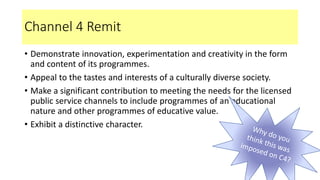
Channel 4 Remit
• Demonstrate innovation, experimentation and creativity in the form
and content of its programmes.
• Appeal to the tastes and interests of a culturally diverse society.
• Make a significant contribution to meeting the needs for the licensed
public service channels to include programmes of an educational
nature and other programmes of educative value.
• Exhibit a distinctive character.
Along came Sky
• Finally in 1998 Sky Television is launched (BSKYB).
• This was the first satellite and subscription service in the UK and took
on the US style of broadcasting.
• This is commercial broadcasting in its finest form as it has no remit to
fulfil and is profit lead.
• Provides a huge variety of channels and programmes to its audience
for a fee.
The Great Debate
• Your task is convince ME as your president of our new country which
method of broadcasting to undertake for its people.
• You will now get into 2 groups
• Half FOR Public Service Broadcasting
• Half FOR Commercial Broadcasting
Finally
• Did we meet our learning objective?
To identify the advantages and disadvantages of Public Service
Broadcasting and Commercial Broadcasting.
Homework –Monday 20th NOVEMBER
• Create and complete a table of the advantages and disadvantages of
PSB and Commercial Broadcasting
• Write 1 side of A4 answering the following question:
• Do you think we should keep the Television licence fee or not?
• Plan your answer
• Conduct further reading/research if needed (keep this in your notes for a later date)
• Use the debate to help you structure your argument
• State in your introduction if you are for or against

Tv industry intro 1

  • 1.
    Television an Introduction LO:To identify the advantages and disadvantages of Public Service Broadcasting and Commercial Broadcasting.
  • 2.
    Public Service Broadcasting TheBeginning • 1922 the British Broadcasting Company (later to become Corporation) was founded and led by the BBC’s first Director General, John Reith. • The BBC followed his view that broadcasting should be organised in the public interest.
  • 3.
    John Reith • Inhis view, it was the responsibility of the BBC ‘to carry into the greatest possible number of homes everything that is best in every department of human knowledge, endeavour and achievement’ • What could be an argument for this statement?
  • 4.
    John Reith’s FourPrinciples 1. Broadcasting should be protected from commercial pressures and the profit motive. 2. Broadcasting should provide services to the whole community, and should be national. 3. Broadcasting should be characterised by ‘unified control’ (a strong monopoly). 4. Broadcasting must be closely regulated to establish high standards and ensure that programmes are of a high quality.
  • 5.
    The heart ofthe BBC INFORM EDUCATE ENTERTAIN
  • 6.
    A Big Criticism •Although some see Reith as having good intentions his views were often criticised. • In 1924 Reith was quoted to say: ‘It is occasionally indicated to us that we are apparently setting out to give the public what we think they need – and not what they want, but few know what they want, and very few what they need’
  • 7.
    Finding a Balance •To break the BBC’s monopoly in 1954 ITV was founded. • This is a commercial channel funded by advertising. • Reith feared that advertisers would influence programme content as in the US. • However, in the UK terrestrial broadcasting regulation insists that broadcasting should primarily benefit the public.
  • 8.
    ITV • Now establishedITV provided an alternative for the public. • However, it was mainly concerned with the commercial viability of its products and the maximum profit it can create. • Then something interesting happened as ITV was accused of having a monopoly over the sale of advertising space.
  • 9.
    Channel 4 • Tobreak the advertising monopoly of ITV and provide something alternative to the BBC Channel 4 was created in 1982. • Channel 4 is also a Public Service Broadcaster, even though it is funded through advertising. • It has remit of public service obligations it must fulfil to continue to broadcast. • If it does not comply to these rules theoretically it can legally be shut down.
  • 10.
    Channel 4 Remit •Demonstrate innovation, experimentation and creativity in the form and content of its programmes. • Appeal to the tastes and interests of a culturally diverse society. • Make a significant contribution to meeting the needs for the licensed public service channels to include programmes of an educational nature and other programmes of educative value. • Exhibit a distinctive character.
  • 11.
    Along came Sky •Finally in 1998 Sky Television is launched (BSKYB). • This was the first satellite and subscription service in the UK and took on the US style of broadcasting. • This is commercial broadcasting in its finest form as it has no remit to fulfil and is profit lead. • Provides a huge variety of channels and programmes to its audience for a fee.
  • 12.
    The Great Debate •Your task is convince ME as your president of our new country which method of broadcasting to undertake for its people. • You will now get into 2 groups • Half FOR Public Service Broadcasting • Half FOR Commercial Broadcasting
  • 13.
    Finally • Did wemeet our learning objective? To identify the advantages and disadvantages of Public Service Broadcasting and Commercial Broadcasting.
  • 14.
    Homework –Monday 20thNOVEMBER • Create and complete a table of the advantages and disadvantages of PSB and Commercial Broadcasting • Write 1 side of A4 answering the following question: • Do you think we should keep the Television licence fee or not? • Plan your answer • Conduct further reading/research if needed (keep this in your notes for a later date) • Use the debate to help you structure your argument • State in your introduction if you are for or against