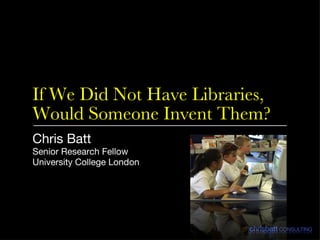
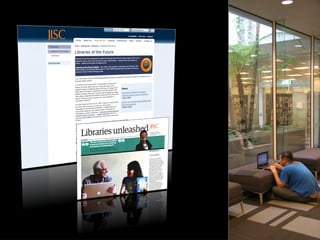
If We Did Not Have Libraries, Would Someone Invent Them? Chris Batt Senior Research Fellow University College London
Will the Internet kill institutions like libraries?  Nature and scope of my research Some thoughts on what it all might mean Then let’s talk 1. 4. 3. 2. Agenda
Once upon a time, a librarian Director of Cultural Services Libraries Museum and archive Performing arts and cinema Parks and open spaces Sport Who was I?
1991 - First public access to the Internet
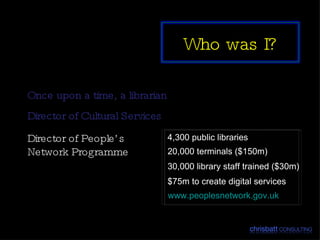
Once upon a time, a librarian Director of Cultural Services 4,300 public libraries 20,000 terminals ($150m) 30,000 library staff trained ($30m) $75m to create digital services www.peoplesnetwork.gov.uk Director of People’s Network Programme Who was I?
Once upon a time, a librarian Director of Cultural Services New strategic government agency www.mla.gov.uk Director of People’s Network Programme Chief Executive of the Museums, Libraries and Archives Council  Who was I?
Occasional consultant Who am I now?
 
Occasional consultant www.ucl.ac.uk/infostudies/research/ciber Senior Research Fellow “ CIBER research tells us the world as we knew it is being shattered and reassembled by the digital transition, and many of the existing paradigms are bust.” “ It seeks to inform by  countering idle speculation, PowerPoint puff and uninformed opinion with the evidence and facts.” Who am I now?
Occasional consultant Senior Research Fellow Knowledge strategy in the networked society Chrisbatt.wordpress.com/ PhD student Who am I now?
Will the increasing importance of digital technologies and networks across society  require new approaches to public policy formulation, implementation and delivery?  New architectures New policy frameworks New professionals Knowledge and learning in 2050
Fragmentation Disintermediation Participatory culture One-stop 24/7 Digital determinism
Music, media, newspapers  Utopia or dystopia? Professional uncertainty or professional protectionism? Digital determinism
Digital determinism
Widely accessible Highly successful Valued by users Unique tools of public policy Library: the Traditional model
Looking forward, not backwards Willing to try new ideas Adopted and adapted to technology UK public libraries
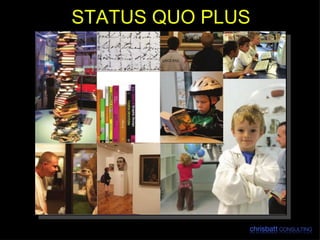
Skyline STATUS QUO PLUS
Competition Amazon/Abe iTunes On demand Wikipedia Google Technology On the move Social networking eBooks Bandwidth Aggregation Public Policy Learning Knowledge economy Globalisation Funding pressures Society Fragmentation The crowd Web has the answer 24/7 STATUS QUO 2.0
THE WORLD HAS CHANGED 60 hours 1,700 0 20 minutes 200,000+ +300 1850 2005 Cost of a book Periodicals Other media
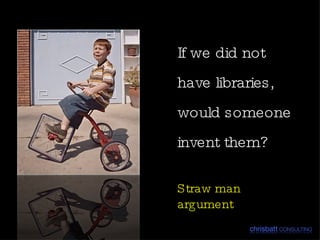
If we did not have libraries, would someone invent them? Straw man argument
How would you sell the idea of a library to the people who have the money?
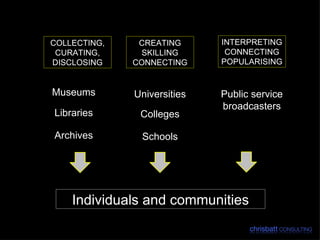
Museums Libraries Archives Universities Colleges Schools Public service broadcasters COLLECTING, CURATING, DISCLOSING CREATING SKILLING CONNECTING INTERPRETING CONNECTING POPULARISING PUBLIC KNOWLEDGE INSTITUTIONS
Museums Libraries Archives Universities Colleges Schools Public service broadcasters COLLECTING, CURATING, DISCLOSING CREATING SKILLING CONNECTING INTERPRETING CONNECTING POPULARISING Individuals and communities
That the delivery of public value through knowledge and learning based on  the binary relationship between institution and user will become more and more ineffective and expensive as online channels become the preferred user choice. PROPOSITION ONE
“ Megaphones of informal learning ” Martin Bean Convergence = competition Who owns the third place? What is a museum website for?
 
 
That  public value will best be achieved by strategic policies that treat end user value as the product of  managed flows across institutions rather than as actions based on classes of institutions: the integration of unrelated institutions into a co-ordinated strategy .  PROPOSITION TWO
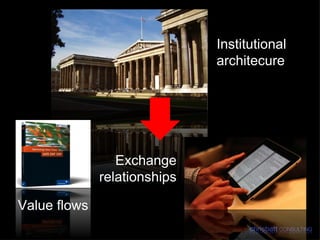
Institutional architecure Value flows Exchange relationships
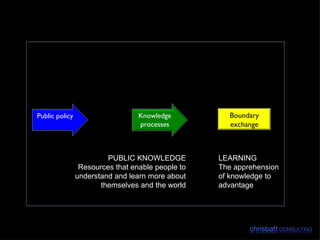
PUBLIC KNOWLEDGE Resources that enable people to understand and learn more about themselves and the world LEARNING The apprehension of knowledge to advantage Public policy Knowledge processes Boundary exchange
Methodology
Museums Libraries Archives Universities Colleges Schools Public service broadcasters COLLECTING, CURATING, DISCLOSING CREATING SKILLING CONNECTING INTERPRETING CONNECTING POPULARISING PUBLIC KNOWLEDGE INSTITUTIONS How to start a collective debate about knowledge institutions in 2050
PEST/SWOT TRIANGLE Shared value flows Boundary exchanges Target audiences Common policy and outcomes Partnerships already in play Mission overlap
NEW PARTNERSHIPS Your Paintings Public Catalogue Foundation
Public knowledge ecosystem model
PUBLIC NETWORK THEORY Organisation theory Policy science Political science Policy networks Policy communities Public network management
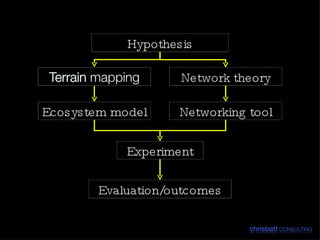
Hypothesis Ecosystem model Experiment Evaluation/outcomes Networking tool Network theory
The future value of libraries depends on much more than their relationship with technology Citizens and technology Other knowledge institutions Status within information society policy The coming revolution
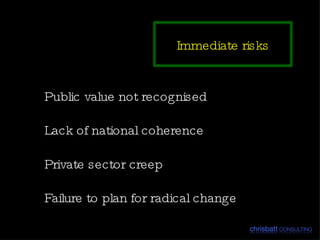
Public value not recognised Lack of national coherence Private sector creep Failure to plan for radical change Immediate risks
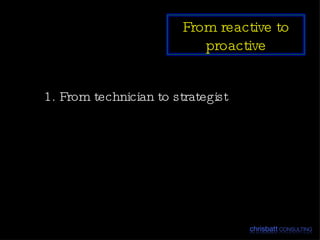
1. From technician to strategist From reactive to proactive
1. From technician to strategist 2. The elevator pitch From reactive to proactive
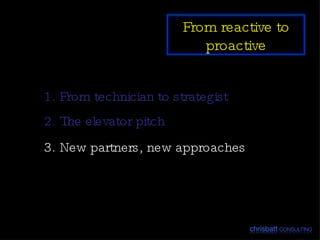
1. From technician to strategist 2. The elevator pitch 3. New partners, new approaches From reactive to proactive
1. From technician to strategist 2. The elevator pitch 3. New partners, new approaches 4. USP that fits in with other components of the ecosystem  From reactive to proactive
1. KNOWLEDGE: the raw material of the future Economy development Personal well-being/happiness Creativity and imagination Social capital Discovery and understanding The knowledge revolution
1. KNOWLEDGE: the raw material of the future Education is not enough Informal learning is lifelong Learning to cope and survive Learning just for fun 2. LEARNING: the engine of progress The knowledge revolution
1. KNOWLEDGE: the raw material of the future Content first, institution second Partnering the crowd Inclusion and special needs 2. LEARNING the engine of progress 3. Knowledge must be presented to meet people’s learning needs The knowledge revolution
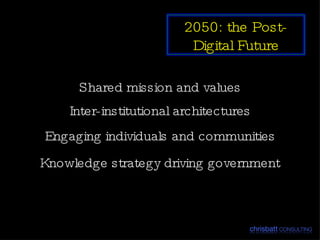
Engaging individuals and communities Knowledge strategy driving government Shared mission and values Inter-institutional architectures 2050: the Post-Digital Future
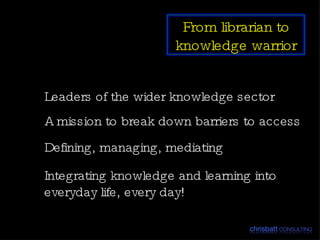
Leaders of the wider knowledge sector A mission to break down barriers to access Defining, managing, mediating Integrating knowledge and learning into everyday life, every day! From librarian to knowledge warrior
Leadership
Vision
Passion
Let’s talk [email_address] www.chrisbattconsulting.com/resources http://www.slideshare.net/Chris_Batt chrisbatt.wordpress.com Twitter: @chrisbatt

Chris batt unc presentation 05-10

  • 1.
    If We DidNot Have Libraries, Would Someone Invent Them? Chris Batt Senior Research Fellow University College London
  • 2.
    Will the Internetkill institutions like libraries? Nature and scope of my research Some thoughts on what it all might mean Then let’s talk 1. 4. 3. 2. Agenda
  • 3.
    Once upon atime, a librarian Director of Cultural Services Libraries Museum and archive Performing arts and cinema Parks and open spaces Sport Who was I?
  • 4.
    1991 - Firstpublic access to the Internet
  • 5.
    Once upon atime, a librarian Director of Cultural Services 4,300 public libraries 20,000 terminals ($150m) 30,000 library staff trained ($30m) $75m to create digital services www.peoplesnetwork.gov.uk Director of People’s Network Programme Who was I?
  • 6.
    Once upon atime, a librarian Director of Cultural Services New strategic government agency www.mla.gov.uk Director of People’s Network Programme Chief Executive of the Museums, Libraries and Archives Council Who was I?
  • 7.
  • 8.
  • 9.
    Occasional consultant www.ucl.ac.uk/infostudies/research/ciberSenior Research Fellow “ CIBER research tells us the world as we knew it is being shattered and reassembled by the digital transition, and many of the existing paradigms are bust.” “ It seeks to inform by countering idle speculation, PowerPoint puff and uninformed opinion with the evidence and facts.” Who am I now?
  • 10.
    Occasional consultant SeniorResearch Fellow Knowledge strategy in the networked society Chrisbatt.wordpress.com/ PhD student Who am I now?
  • 11.
    Will the increasingimportance of digital technologies and networks across society require new approaches to public policy formulation, implementation and delivery? New architectures New policy frameworks New professionals Knowledge and learning in 2050
  • 12.
    Fragmentation Disintermediation Participatoryculture One-stop 24/7 Digital determinism
  • 13.
    Music, media, newspapers Utopia or dystopia? Professional uncertainty or professional protectionism? Digital determinism
  • 14.
  • 15.
    Widely accessible Highlysuccessful Valued by users Unique tools of public policy Library: the Traditional model
  • 16.
    Looking forward, notbackwards Willing to try new ideas Adopted and adapted to technology UK public libraries
  • 17.
  • 18.
    Competition Amazon/Abe iTunesOn demand Wikipedia Google Technology On the move Social networking eBooks Bandwidth Aggregation Public Policy Learning Knowledge economy Globalisation Funding pressures Society Fragmentation The crowd Web has the answer 24/7 STATUS QUO 2.0
  • 19.
    THE WORLD HASCHANGED 60 hours 1,700 0 20 minutes 200,000+ +300 1850 2005 Cost of a book Periodicals Other media
  • 20.
    If we didnot have libraries, would someone invent them? Straw man argument
  • 21.
    How would yousell the idea of a library to the people who have the money?
  • 22.
    Museums Libraries ArchivesUniversities Colleges Schools Public service broadcasters COLLECTING, CURATING, DISCLOSING CREATING SKILLING CONNECTING INTERPRETING CONNECTING POPULARISING PUBLIC KNOWLEDGE INSTITUTIONS
  • 23.
    Museums Libraries ArchivesUniversities Colleges Schools Public service broadcasters COLLECTING, CURATING, DISCLOSING CREATING SKILLING CONNECTING INTERPRETING CONNECTING POPULARISING Individuals and communities
  • 24.
    That the deliveryof public value through knowledge and learning based on the binary relationship between institution and user will become more and more ineffective and expensive as online channels become the preferred user choice. PROPOSITION ONE
  • 25.
    “ Megaphones ofinformal learning ” Martin Bean Convergence = competition Who owns the third place? What is a museum website for?
  • 26.
  • 27.
  • 28.
    That publicvalue will best be achieved by strategic policies that treat end user value as the product of managed flows across institutions rather than as actions based on classes of institutions: the integration of unrelated institutions into a co-ordinated strategy . PROPOSITION TWO
  • 29.
    Institutional architecure Valueflows Exchange relationships
  • 30.
    PUBLIC KNOWLEDGE Resourcesthat enable people to understand and learn more about themselves and the world LEARNING The apprehension of knowledge to advantage Public policy Knowledge processes Boundary exchange
  • 31.
  • 32.
    Museums Libraries ArchivesUniversities Colleges Schools Public service broadcasters COLLECTING, CURATING, DISCLOSING CREATING SKILLING CONNECTING INTERPRETING CONNECTING POPULARISING PUBLIC KNOWLEDGE INSTITUTIONS How to start a collective debate about knowledge institutions in 2050
  • 33.
    PEST/SWOT TRIANGLE Sharedvalue flows Boundary exchanges Target audiences Common policy and outcomes Partnerships already in play Mission overlap
  • 34.
    NEW PARTNERSHIPS YourPaintings Public Catalogue Foundation
  • 35.
  • 36.
    PUBLIC NETWORK THEORYOrganisation theory Policy science Political science Policy networks Policy communities Public network management
  • 37.
    Hypothesis Ecosystem modelExperiment Evaluation/outcomes Networking tool Network theory
  • 38.
    The future valueof libraries depends on much more than their relationship with technology Citizens and technology Other knowledge institutions Status within information society policy The coming revolution
  • 39.
    Public value notrecognised Lack of national coherence Private sector creep Failure to plan for radical change Immediate risks
  • 40.
    1. From technicianto strategist From reactive to proactive
  • 41.
    1. From technicianto strategist 2. The elevator pitch From reactive to proactive
  • 42.
    1. From technicianto strategist 2. The elevator pitch 3. New partners, new approaches From reactive to proactive
  • 43.
    1. From technicianto strategist 2. The elevator pitch 3. New partners, new approaches 4. USP that fits in with other components of the ecosystem From reactive to proactive
  • 44.
    1. KNOWLEDGE: theraw material of the future Economy development Personal well-being/happiness Creativity and imagination Social capital Discovery and understanding The knowledge revolution
  • 45.
    1. KNOWLEDGE: theraw material of the future Education is not enough Informal learning is lifelong Learning to cope and survive Learning just for fun 2. LEARNING: the engine of progress The knowledge revolution
  • 46.
    1. KNOWLEDGE: theraw material of the future Content first, institution second Partnering the crowd Inclusion and special needs 2. LEARNING the engine of progress 3. Knowledge must be presented to meet people’s learning needs The knowledge revolution
  • 47.
    Engaging individuals andcommunities Knowledge strategy driving government Shared mission and values Inter-institutional architectures 2050: the Post-Digital Future
  • 48.
    Leaders of thewider knowledge sector A mission to break down barriers to access Defining, managing, mediating Integrating knowledge and learning into everyday life, every day! From librarian to knowledge warrior
  • 49.
  • 50.
  • 51.
  • 52.
    Let’s talk [email_address]www.chrisbattconsulting.com/resources http://www.slideshare.net/Chris_Batt chrisbatt.wordpress.com Twitter: @chrisbatt