Big History
                   By
    Tysen Quaintance
          History 140
         Dr. Arguello
The Day the
Universe Changed

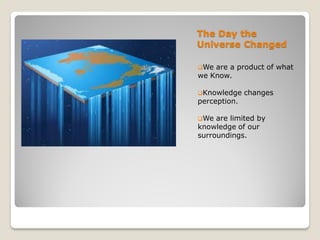
We are a product of what
we Know.

Knowledge    changes
perception.

We  are limited by
knowledge of our
surroundings.
The Day the
Universe Changed


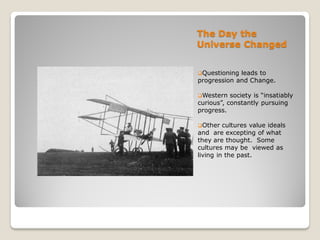
Questioning leads to
progression and Change.

Western   society is “insatiably
curious”, constantly pursuing
progress.

Other   cultures value ideals
and are excepting of what
they are thought. Some
cultures may be viewed as
living in the past.
The Journey of
man

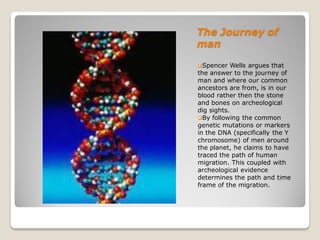
Spencer   Wells argues that
the answer to the journey of
man and where our common
ancestors are from, is in our
blood rather then the stone
and bones on archeological
dig sights.
By following the common
genetic mutations or markers
in the DNA (specifically the Y
chromosome) of men around
the planet, he claims to have
traced the path of human
migration. This coupled with
archeological evidence
determines the path and time
frame of the migration.
The Journey of
man
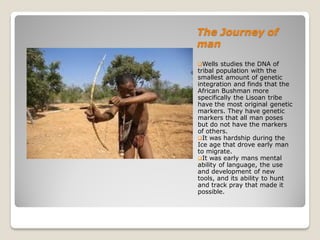
Wells   studies the DNA of
tribal population with the
smallest amount of genetic
integration and finds that the
African Bushman more
specifically the Lisoan tribe
have the most original genetic
markers. They have genetic
markers that all man poses
but do not have the markers
of others.
It was hardship during the
Ice age that drove early man
to migrate.
It was early mans mental
ability of language, the use
and development of new
tools, and its ability to hunt
and track pray that made it
possible.
Catastrophe
Themes:
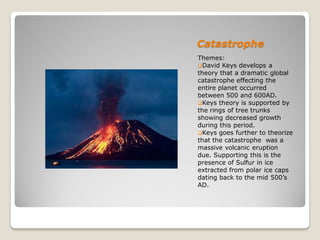
David Keys develops a
theory that a dramatic global
catastrophe effecting the
entire planet occurred
between 500 and 600AD.
Keys theory is supported by
the rings of tree trunks
showing decreased growth
during this period.
Keys goes further to theorize
that the catastrophe was a
massive volcanic eruption
due. Supporting this is the
presence of Sulfur in ice
extracted from polar ice caps
dating back to the mid 500’s
AD.
Catastrophe
Themes Continued:
Keys also produces written
evidence from all over the
world from that time period.
Accounts from Romans,
Chinese, and Indonesians may
describe such an event.
Keys then describes the
effects of this event on world
history. I would have brought
about a decade of drought,
famine, and later flood.
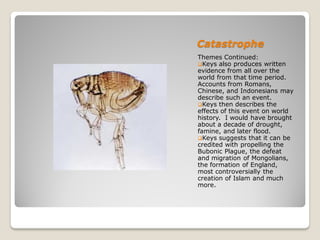
Keys suggests that it can be
credited with propelling the
Bubonic Plague, the defeat
and migration of Mongolians,
the formation of England,
most controversially the
creation of Islam and much
more.
Guns, Germs, and
Steel

Jared   Diamond seeks to
answer the question, ”Why
have some societies
progressed rather then
others.
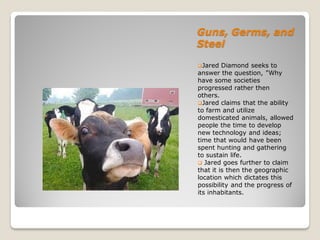
Jared claims that the ability
to farm and utilize
domesticated animals, allowed
people the time to develop
new technology and ideas;
time that would have been
spent hunting and gathering
to sustain life.
 Jared goes further to claim
that it is then the geographic
location which dictates this
possibility and the progress of
its inhabitants.
Guns, Germs, and
Steel
Jared  claims that there are
only 14 domesticated farm
animals 13 of which originated
in a region called the Fertile
Crest (the middle east).
According to Jared Large live
stock provided, milk, manure
(for crops), wool, leather, meat,
and muscle power.
The time provided by these
animals and agriculture they
support, gave birth to advances
in technology(metal tools and
weapons), written language,
new ideas, crafts, and
prosperity.
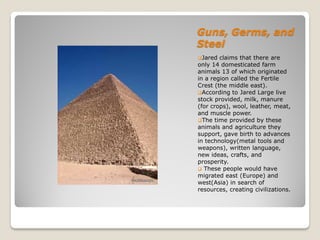
 These people would have
migrated east (Europe) and
west(Asia) in search of
resources, creating civilizations.
Guns, Germs, and
Steel
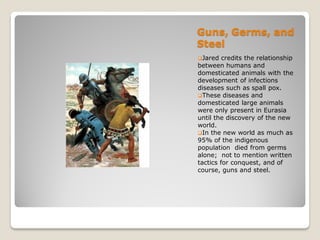
Jared   credits the relationship
between humans and
domesticated animals with the
development of infections
diseases such as spall pox.
These diseases and
domesticated large animals
were only present in Eurasia
until the discovery of the new
world.
In the new world as much as
95% of the indigenous
population died from germs
alone; not to mention written
tactics for conquest, and of
course, guns and steel.
The World and
Trade
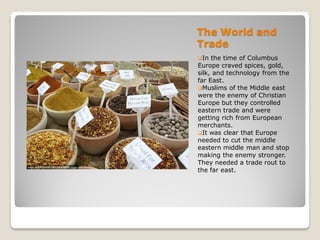
In  the time of Columbus
Europe craved spices, gold,
silk, and technology from the
far East.
Muslims of the Middle east
were the enemy of Christian
Europe but they controlled
eastern trade and were
getting rich from European
merchants.
It was clear that Europe
needed to cut the middle
eastern middle man and stop
making the enemy stronger.
They needed a trade rout to
the far east.
The World and
Trade
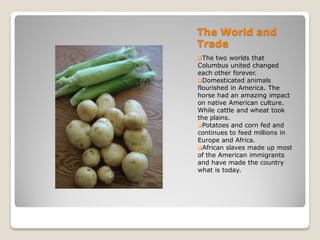
The   two worlds that
Columbus united changed
each other forever.
Domesticated animals
flourished in America. The
horse had an amazing impact
on native American culture.
While cattle and wheat took
the plains.
Potatoes and corn fed and
continues to feed millions in
Europe and Africa.
African slaves made up most
of the American immigrants
and have made the country
what is today.

Big History

  • 1.
    Big History By Tysen Quaintance History 140 Dr. Arguello
  • 2.
    The Day the UniverseChanged We are a product of what we Know. Knowledge changes perception. We are limited by knowledge of our surroundings.
  • 3.
    The Day the UniverseChanged Questioning leads to progression and Change. Western society is “insatiably curious”, constantly pursuing progress. Other cultures value ideals and are excepting of what they are thought. Some cultures may be viewed as living in the past.
  • 4.
    The Journey of man Spencer Wells argues that the answer to the journey of man and where our common ancestors are from, is in our blood rather then the stone and bones on archeological dig sights. By following the common genetic mutations or markers in the DNA (specifically the Y chromosome) of men around the planet, he claims to have traced the path of human migration. This coupled with archeological evidence determines the path and time frame of the migration.
  • 5.
    The Journey of man Wells studies the DNA of tribal population with the smallest amount of genetic integration and finds that the African Bushman more specifically the Lisoan tribe have the most original genetic markers. They have genetic markers that all man poses but do not have the markers of others. It was hardship during the Ice age that drove early man to migrate. It was early mans mental ability of language, the use and development of new tools, and its ability to hunt and track pray that made it possible.
  • 6.
    Catastrophe Themes: David Keys developsa theory that a dramatic global catastrophe effecting the entire planet occurred between 500 and 600AD. Keys theory is supported by the rings of tree trunks showing decreased growth during this period. Keys goes further to theorize that the catastrophe was a massive volcanic eruption due. Supporting this is the presence of Sulfur in ice extracted from polar ice caps dating back to the mid 500’s AD.
  • 7.
    Catastrophe Themes Continued: Keys alsoproduces written evidence from all over the world from that time period. Accounts from Romans, Chinese, and Indonesians may describe such an event. Keys then describes the effects of this event on world history. I would have brought about a decade of drought, famine, and later flood. Keys suggests that it can be credited with propelling the Bubonic Plague, the defeat and migration of Mongolians, the formation of England, most controversially the creation of Islam and much more.
  • 8.
    Guns, Germs, and Steel Jared Diamond seeks to answer the question, ”Why have some societies progressed rather then others. Jared claims that the ability to farm and utilize domesticated animals, allowed people the time to develop new technology and ideas; time that would have been spent hunting and gathering to sustain life.  Jared goes further to claim that it is then the geographic location which dictates this possibility and the progress of its inhabitants.
  • 9.
    Guns, Germs, and Steel Jared claims that there are only 14 domesticated farm animals 13 of which originated in a region called the Fertile Crest (the middle east). According to Jared Large live stock provided, milk, manure (for crops), wool, leather, meat, and muscle power. The time provided by these animals and agriculture they support, gave birth to advances in technology(metal tools and weapons), written language, new ideas, crafts, and prosperity.  These people would have migrated east (Europe) and west(Asia) in search of resources, creating civilizations.
  • 10.
    Guns, Germs, and Steel Jared credits the relationship between humans and domesticated animals with the development of infections diseases such as spall pox. These diseases and domesticated large animals were only present in Eurasia until the discovery of the new world. In the new world as much as 95% of the indigenous population died from germs alone; not to mention written tactics for conquest, and of course, guns and steel.
  • 11.
    The World and Trade In the time of Columbus Europe craved spices, gold, silk, and technology from the far East. Muslims of the Middle east were the enemy of Christian Europe but they controlled eastern trade and were getting rich from European merchants. It was clear that Europe needed to cut the middle eastern middle man and stop making the enemy stronger. They needed a trade rout to the far east.
  • 12.
    The World and Trade The two worlds that Columbus united changed each other forever. Domesticated animals flourished in America. The horse had an amazing impact on native American culture. While cattle and wheat took the plains. Potatoes and corn fed and continues to feed millions in Europe and Africa. African slaves made up most of the American immigrants and have made the country what is today.