Presenter:
Sajida Sharif
( M.Phil. Linguistics)
INTRODUCTION TO WRITING
The Magician’s Wand
PROCESS AND STRUCTURE
Writing and thinking
AIMS FOR WRITING
Expressive writing
Using description
Creative writing
Writing to inform
Writing to persuade
Writing about literature
Writing a report
INTRODUCTION TO WRITING
James L. Kinneavy an American author describes writng
as
THE MAGICIAN’S WAND
The tall, mysterious magician. He shakes out a silk
handkerchief, rolls it up, points the magic wand. Eureka! Birds
fly from the silk. His assistant disappears into a small box.
What amazing powers magicians appear to have. But did you
know the some of the world’s most powerful magicians don’t
wear capes or perform happen all around you. With their magic
wands they explain mysteries (even magic tricks), build whole
cities, fill theaters with laughter. Astounding!
Who Are These Magicians?
These magicians are writers and their magic wands are words.
Their words give them the power to make things happen and
appear. What things? All the things that fill your life.
What’s the Magic?
Writers really do have a special power: the power of
communication. They have something to write about (a
subject), someone to say it to (a audience), and a way to say it (a
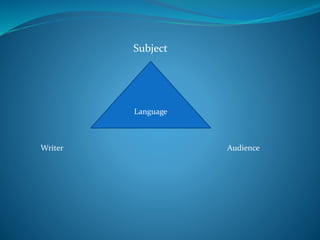
language). You can have this power, too. Think of these magic
elements as communication triangle. Notice that language----
both written and spoken---- is at the center of the triangle.
Language
Writer Audience
Subject
How Do Writers Write?
Writers even have a magic formula for what they do. But this
formula is not a trick, and it’s not a secret. It’s a series of steps
called the writing process. It helps writers develop their ideas
and communicate them clearly. Different writers use the process
in different ways, but it’s a basic formula for making things hap-
pen on paper.
1. Pre Writing
Thinking and planning;
Thinking of a subject to write about,
a purpose, and an audience;
collecting ideas and details;
making a plan for presenting ideas
2.Writing
Writing a first draft;
putting ideas into sentences and paragraphs;
following the writing plan
3. Evaluating and Revising
Reading the draft closely;
deciding what to keep and what to take out;
making changes to make the draft better
4. Proofreading and Publishing
Looking for and fixing mistakes;
writing a final copy;
finding ways to share it with an audience
Why Do Writers Write?
The Aims of Writing
Writers have four main reasons, or aims, for writing.
They write to inform someone,
to persuade someone,
to express themselves,
or to be creative.
Sometimes a writer has only one aim, but other times a
writer might combine two or more aims. Part of a writer’s
power comes from knowing the basic aim before starting
to write.
To Inform
Writers give facts and other information,
or explain something.
To Persuade
Writers also try to convince others to think
or act in a certain way.
To Express Themselves
Writers sometimes just want to express
their own thoughts and feelings.
To Be Creative
Writers may also write to create something
new with language. They create stories, poems, songs,
and plays.
The first problem every writer faces is “ What will I write
about?” Your experiences and interests make good writing
topics. These six prewriting techniques will help you
explore ideas for writing. As you try them out, some
techniques will become your favorites. And often you’ll use
more than one for a paper.
1. Writer’s journal
Recording experiences and thoughts
Fill your writer’s journal with experiences, feelings and thought.
You can have a section called “Things Like.” You can put in
cartoons, quotations, song lyrics, and poems that have special
meaning for you. Keep your journal in a notebook or file folder.
2.Free writing
Writing for a few minutes about what-ever comes to mind
Free writing means just that—writing freely. You begin with a word or phrase
and then write whatever comes to mind. Time yourself for three to five
minutes, and keep writing until the time is up.
Write your topic first. Then write whatever the topic makes you think of.
Don’t stop or pause. If you can’t think anything to write, keep writing the same
word or phrase until something pops into your head.
Don’t worry about spelling, punctuation complete sentences.
3.Brainstorming
Listing ideas as quickly as you think of them
Brainstorming
When you brainstorm, your thoughts fly out in all directions. You start with a
subject. Then you quickly list everything the subject makes you think of. You can
brainstorm alone, but it’s also fun to brainstorm ideas with a group.
Write any subject at the top of a piece of paper or on a chalkboard.
Write down every idea that occurs to you. If you’re brainstorming in a group, one
person should record ideas.
Don’t stop to judge what’s listed.
Don’t stop until you run out of ideas.
4. Clustering
Brainstorming ideas and connecting the ideas with circles and lines
Clustering
Clustering is sometimes called mapping or webbing (because the diagram looks like a spider web). It’s a
visual kind of brainstorming.
•Write your subject in the center of your paper and then circle it.
•Around the subject, write related ideas that you think of. Circle these, and draw lines to connect them
with the subject or with each other.
•Keep going. Write new ideas, circle them, and draw lines to show connections.
5.Asking Questions
Asking the “5W-How?” and “What if?” questions
Asking Questions
Do you ever talk to yourself? Do you ever answer? You can find facts and ideas for writing by
asking yourself two different kinds of questions.
5W-How? questions. To gather information when they write their news stories,
reporters often ask the 5W-How? questions: who? What? Where? When? Why? and How?
You can do the same for any topic.
What if I could change one thing in my life? (What if I could make myself invisible? What if I
had a car and a driver’s license?)
What if some everyday thing did not exist? (What if the earth
had no moon? What if radios hadn’t been invented?)
What if I could change one thing about the world? (What if
everyone in the whole world had enough food and a home?
What if animals could really talk with people?)
6.Reading and Listening
Reading and listening to find information
Suppose you need to write about CEPEC or the Panama case or
about any crusades wars. How can you find out? For the topics
like these, you will read or listen to gather the information.
When you look for information in books , magazines and newspapers.
 Find your topic in a book’s table of contents or index . Turn to the
pages listed.
 Don’t read every word. Skim pages quickly, looking for your topic.
 When you find information on your topic, slow down and read
carefully.
 Take notes on main ideas and important details.
You can find information by listening to radio and TV programs,
audiotapes and videotapes.
You may even be able to interview someone who knows something
about your topic.
Before you listen, write out some questions about your topic. Then
listen for answers to your questions and take notes.
Teaching Writing Skills.pptx

Teaching Writing Skills.pptx

  • 2.
  • 3.
    INTRODUCTION TO WRITING TheMagician’s Wand PROCESS AND STRUCTURE Writing and thinking AIMS FOR WRITING Expressive writing Using description Creative writing Writing to inform Writing to persuade Writing about literature Writing a report
  • 4.
    INTRODUCTION TO WRITING JamesL. Kinneavy an American author describes writng as THE MAGICIAN’S WAND
  • 5.
    The tall, mysteriousmagician. He shakes out a silk handkerchief, rolls it up, points the magic wand. Eureka! Birds fly from the silk. His assistant disappears into a small box. What amazing powers magicians appear to have. But did you know the some of the world’s most powerful magicians don’t wear capes or perform happen all around you. With their magic wands they explain mysteries (even magic tricks), build whole cities, fill theaters with laughter. Astounding!
  • 6.
    Who Are TheseMagicians? These magicians are writers and their magic wands are words. Their words give them the power to make things happen and appear. What things? All the things that fill your life.
  • 7.
    What’s the Magic? Writersreally do have a special power: the power of communication. They have something to write about (a subject), someone to say it to (a audience), and a way to say it (a language). You can have this power, too. Think of these magic elements as communication triangle. Notice that language---- both written and spoken---- is at the center of the triangle.
  • 8.
  • 9.
    How Do WritersWrite? Writers even have a magic formula for what they do. But this formula is not a trick, and it’s not a secret. It’s a series of steps called the writing process. It helps writers develop their ideas and communicate them clearly. Different writers use the process in different ways, but it’s a basic formula for making things hap- pen on paper.
  • 10.
    1. Pre Writing Thinkingand planning; Thinking of a subject to write about, a purpose, and an audience; collecting ideas and details; making a plan for presenting ideas
  • 11.
    2.Writing Writing a firstdraft; putting ideas into sentences and paragraphs; following the writing plan
  • 12.
    3. Evaluating andRevising Reading the draft closely; deciding what to keep and what to take out; making changes to make the draft better
  • 13.
    4. Proofreading andPublishing Looking for and fixing mistakes; writing a final copy; finding ways to share it with an audience
  • 14.
    Why Do WritersWrite? The Aims of Writing Writers have four main reasons, or aims, for writing. They write to inform someone, to persuade someone, to express themselves, or to be creative.
  • 15.
    Sometimes a writerhas only one aim, but other times a writer might combine two or more aims. Part of a writer’s power comes from knowing the basic aim before starting to write.
  • 16.
    To Inform Writers givefacts and other information, or explain something.
  • 17.
    To Persuade Writers alsotry to convince others to think or act in a certain way.
  • 18.
    To Express Themselves Writerssometimes just want to express their own thoughts and feelings.
  • 19.
    To Be Creative Writersmay also write to create something new with language. They create stories, poems, songs, and plays.
  • 20.
    The first problemevery writer faces is “ What will I write about?” Your experiences and interests make good writing topics. These six prewriting techniques will help you explore ideas for writing. As you try them out, some techniques will become your favorites. And often you’ll use more than one for a paper.
  • 21.
    1. Writer’s journal Recordingexperiences and thoughts Fill your writer’s journal with experiences, feelings and thought. You can have a section called “Things Like.” You can put in cartoons, quotations, song lyrics, and poems that have special meaning for you. Keep your journal in a notebook or file folder.
  • 22.
    2.Free writing Writing fora few minutes about what-ever comes to mind Free writing means just that—writing freely. You begin with a word or phrase and then write whatever comes to mind. Time yourself for three to five minutes, and keep writing until the time is up. Write your topic first. Then write whatever the topic makes you think of. Don’t stop or pause. If you can’t think anything to write, keep writing the same word or phrase until something pops into your head. Don’t worry about spelling, punctuation complete sentences.
  • 23.
    3.Brainstorming Listing ideas asquickly as you think of them Brainstorming When you brainstorm, your thoughts fly out in all directions. You start with a subject. Then you quickly list everything the subject makes you think of. You can brainstorm alone, but it’s also fun to brainstorm ideas with a group. Write any subject at the top of a piece of paper or on a chalkboard. Write down every idea that occurs to you. If you’re brainstorming in a group, one person should record ideas. Don’t stop to judge what’s listed. Don’t stop until you run out of ideas.
  • 24.
    4. Clustering Brainstorming ideasand connecting the ideas with circles and lines Clustering Clustering is sometimes called mapping or webbing (because the diagram looks like a spider web). It’s a visual kind of brainstorming. •Write your subject in the center of your paper and then circle it. •Around the subject, write related ideas that you think of. Circle these, and draw lines to connect them with the subject or with each other. •Keep going. Write new ideas, circle them, and draw lines to show connections.
  • 25.
    5.Asking Questions Asking the“5W-How?” and “What if?” questions Asking Questions Do you ever talk to yourself? Do you ever answer? You can find facts and ideas for writing by asking yourself two different kinds of questions. 5W-How? questions. To gather information when they write their news stories, reporters often ask the 5W-How? questions: who? What? Where? When? Why? and How? You can do the same for any topic. What if I could change one thing in my life? (What if I could make myself invisible? What if I had a car and a driver’s license?)
  • 26.
    What if someeveryday thing did not exist? (What if the earth had no moon? What if radios hadn’t been invented?) What if I could change one thing about the world? (What if everyone in the whole world had enough food and a home? What if animals could really talk with people?)
  • 27.
    6.Reading and Listening Readingand listening to find information
  • 28.
    Suppose you needto write about CEPEC or the Panama case or about any crusades wars. How can you find out? For the topics like these, you will read or listen to gather the information.
  • 29.
    When you lookfor information in books , magazines and newspapers.  Find your topic in a book’s table of contents or index . Turn to the pages listed.  Don’t read every word. Skim pages quickly, looking for your topic.  When you find information on your topic, slow down and read carefully.  Take notes on main ideas and important details.
  • 30.
    You can findinformation by listening to radio and TV programs, audiotapes and videotapes. You may even be able to interview someone who knows something about your topic. Before you listen, write out some questions about your topic. Then listen for answers to your questions and take notes.