Advice on Academic Writing
Pena, Karina
ISFD Nº18
L&WE IV
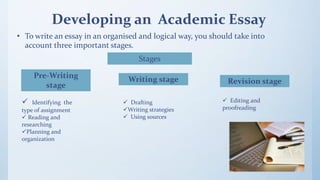
Developing an Academic Essay
• To write an essay in an organised and logical way, you should take into
account three important stages.
Stages
Writing stagePre-Writing
stage Revision stage
 Identifying the
type of assignment
 Reading and
researching
Planning and
organization
 Drafting
Writing strategies
 Using sources
 Editing and
proofreading
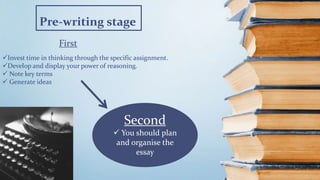
First
Pre-writing stage
Invest time in thinking through the specific assignment.
Develop and display your power of reasoning.
 Note key terms
 Generate ideas
Second
 You should plan
and organise the
essay
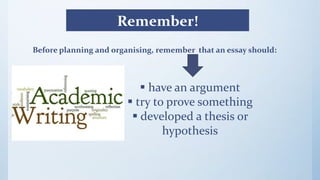
Remember!
Before planning and organising, remember that an essay should:
 have an argument
 try to prove something
 developed a thesis or
hypothesis
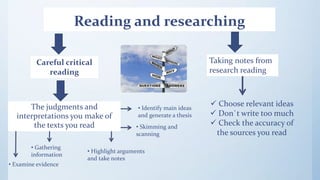
Reading and researching
The judgments and
interpretations you make of
the texts you read
Careful critical
reading
• Identify main ideas
and generate a thesis
• Skimming and
scanning
• Highlight arguments
and take notes
• Examine evidence
• Gathering
information
Taking notes from
research reading
 Choose relevant ideas
 Don`t write too much
 Check the accuracy of
the sources you read
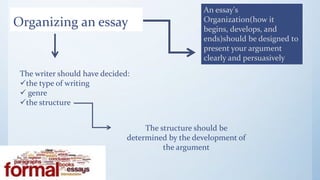
Organizing an essay
An essay's
Organization(how it
begins, develops, and
ends)should be designed to
present your argument
clearly and persuasively
The writer should have decided:
the type of writing
 genre
the structure
The structure should be
determined by the development of
the argument
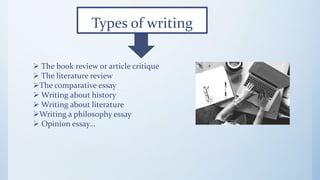
Types of writing
 The book review or article critique
 The literature review
The comparative essay
 Writing about history
 Writing about literature
Writing a philosophy essay
 Opinion essay...
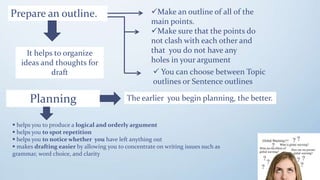
Prepare an outline. Make an outline of all of the
main points.
Make sure that the points do
not clash with each other and
that you do not have any
holes in your argument
It helps to organize
ideas and thoughts for
draft
Planning The earlier you begin planning, the better.
 You can choose between Topic
outlines or Sentence outlines
 helps you to produce a logical and orderly argument
 helps you to spot repetition
 helps you to notice whether you have left anything out
 makes drafting easier by allowing you to concentrate on writing issues such as
grammar, word choice, and clarity
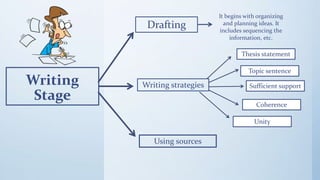
Writing
Stage
Drafting
Writing strategies
Using sources
It begins with organizing
and planning ideas. It
includes sequencing the
information, etc.
Thesis statement
Topic sentence
Sufficient support
Coherence
Unity
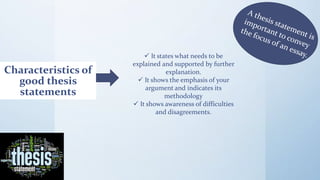
Characteristics of
good thesis
statements
 It states what needs to be
explained and supported by further
explanation.
 It shows the emphasis of your
argument and indicates its
methodology
 It shows awareness of difficulties
and disagreements.
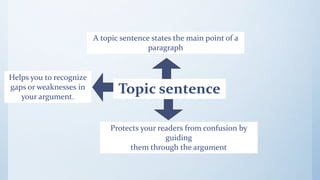
Topic sentence
A topic sentence states the main point of a
paragraph
Helps you to recognize
gaps or weaknesses in
your argument.
Protects your readers from confusion by
guiding
them through the argument
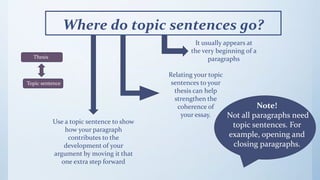
Where do topic sentences go?
It usually appears at
the very beginning of a
paragraphs
Relating your topic
sentences to your
thesis can help
strengthen the
coherence of
your essay.
Use a topic sentence to show
how your paragraph
contributes to the
development of your
argument by moving it that
one extra step forward
Thesis
Topic sentence
Note!
Not all paragraphs need
topic sentences. For
example, opening and
closing paragraphs.
Sufficient support
 Support the topic ideas by developing the paragraph with
evidence from accurate sources. For instance, statistics,
interviews, definitions, case studies, etc.
 The more specific the information, the more interesting
the paragraph
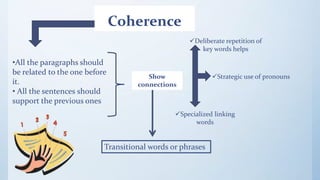
Coherence
•All the paragraphs should
be related to the one before
it.
• All the sentences should
support the previous ones
Show
connections
Deliberate repetition of
key words helps
Strategic use of pronouns
Specialized linking
words
Transitional words or phrases
Unity
All sentences related to topic
sentence
All paragraph related to the
thesis
Paragraph length Paragraphs vary in length
depending on the needs of the
paragraph
 Long paragraphs can make prose dense and
unpleasant to read
 Short paragraphs make academic writing seem
disjointed or skimpy
Short paragraphs might also
need to be developed further.
Make sure that nothing vital has
been omitted.
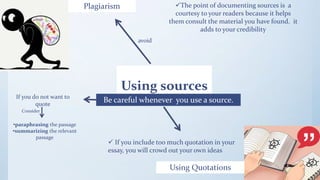
Using sources
Plagiarism
Be careful whenever you use a source.
avoid
The point of documenting sources is a
courtesy to your readers because it helps
them consult the material you have found. it
adds to your credibility
Using Quotations
 If you include too much quotation in your
essay, you will crowd out your own ideas
If you do not want to
quote
Consider
•paraphrasing the passage
•summarizing the relevant
passage
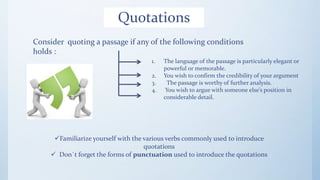
Quotations
Consider quoting a passage if any of the following conditions
holds :
1. The language of the passage is particularly elegant or
powerful or memorable.
2. You wish to confirm the credibility of your argument
3. The passage is worthy of further analysis.
4. You wish to argue with someone else’s position in
considerable detail.
Familiarize yourself with the various verbs commonly used to introduce
quotations
 Don`t forget the forms of punctuation used to introduce the quotations
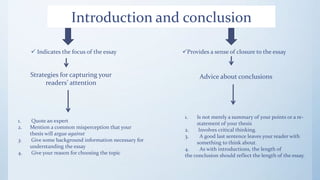
Introduction and conclusion
 Indicates the focus of the essay Provides a sense of closure to the essay
Strategies for capturing your
readers’ attention
1. Quote an expert
2. Mention a common misperception that your
thesis will argue against
3. Give some background information necessary for
understanding the essay
4. Give your reason for choosing the topic
Advice about conclusions
1. Is not merely a summary of your points or a re-
statement of your thesis
2. Involves critical thinking.
3. A good last sentence leaves your reader with
something to think about.
4. As with introductions, the length of
the conclusion should reflect the length of the essay.
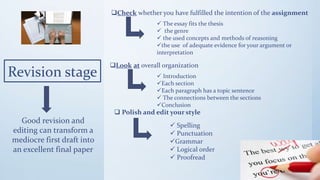
Revision stage
Good revision and
editing can transform a
mediocre first draft into
an excellent final paper
Check whether you have fulfilled the intention of the assignment
 The essay fits the thesis
 the genre
 the used concepts and methods of reasoning
the use of adequate evidence for your argument or
interpretation
Look at overall organization
 Introduction
Each section
Each paragraph has a topic sentence
 The connections between the sections
Conclusion
 Polish and edit your style
 Spelling
 Punctuation
Grammar
 Logical order
 Proofread
Bibliography
 Prof. Silber C.A.(1995). “Some General Advice on Academic Essay-Writing”, from Department of
English, University of Toronto.
http://advice.writing.utoronto.ca/
 Plotnick, J.(n.d). “Organizing an Essay”, from University of Toronto website
http://advice.writing.utoronto.ca/
 Procter, M. (n.d). “Using Thesis Statement”, from University of Toronto website
http://advice.writing.utoronto.ca/
 Freedman,L. & Plotnick,J.(n.d). “Introductions and Conclusions”, from University of Toronto
website
http://advice.writing.utoronto.ca/
 Procter,M. & Visvis, V. (n.d). “Paragraphs”, from University of Toronto website
http://advice.writing.utoronto.ca/
 Plotnick, J.(n.d). “Using Quotations”, from University of Toronto website
http://advice.writing.utoronto.ca/
 Hall,J.& plotnick,J.(n.d). “Using Topic Sentences”, from University of Toronto website
http://advice.writing.utoronto.ca/
 Plotnick,J. (n.d).”Paraphrase and Summary”, from University of Toronto website
http://advice.writing.utoronto.ca/

Advice on academic writing

  • 1.
    Advice on AcademicWriting Pena, Karina ISFD Nº18 L&WE IV
  • 2.
    Developing an AcademicEssay • To write an essay in an organised and logical way, you should take into account three important stages. Stages Writing stagePre-Writing stage Revision stage  Identifying the type of assignment  Reading and researching Planning and organization  Drafting Writing strategies  Using sources  Editing and proofreading
  • 3.
    First Pre-writing stage Invest timein thinking through the specific assignment. Develop and display your power of reasoning.  Note key terms  Generate ideas Second  You should plan and organise the essay
  • 4.
    Remember! Before planning andorganising, remember that an essay should:  have an argument  try to prove something  developed a thesis or hypothesis
  • 5.
    Reading and researching Thejudgments and interpretations you make of the texts you read Careful critical reading • Identify main ideas and generate a thesis • Skimming and scanning • Highlight arguments and take notes • Examine evidence • Gathering information Taking notes from research reading  Choose relevant ideas  Don`t write too much  Check the accuracy of the sources you read
  • 6.
    Organizing an essay Anessay's Organization(how it begins, develops, and ends)should be designed to present your argument clearly and persuasively The writer should have decided: the type of writing  genre the structure The structure should be determined by the development of the argument
  • 7.
    Types of writing The book review or article critique  The literature review The comparative essay  Writing about history  Writing about literature Writing a philosophy essay  Opinion essay...
  • 8.
    Prepare an outline.Make an outline of all of the main points. Make sure that the points do not clash with each other and that you do not have any holes in your argument It helps to organize ideas and thoughts for draft Planning The earlier you begin planning, the better.  You can choose between Topic outlines or Sentence outlines  helps you to produce a logical and orderly argument  helps you to spot repetition  helps you to notice whether you have left anything out  makes drafting easier by allowing you to concentrate on writing issues such as grammar, word choice, and clarity
  • 9.
    Writing Stage Drafting Writing strategies Using sources Itbegins with organizing and planning ideas. It includes sequencing the information, etc. Thesis statement Topic sentence Sufficient support Coherence Unity
  • 10.
    Characteristics of good thesis statements It states what needs to be explained and supported by further explanation.  It shows the emphasis of your argument and indicates its methodology  It shows awareness of difficulties and disagreements.
  • 11.
    Topic sentence A topicsentence states the main point of a paragraph Helps you to recognize gaps or weaknesses in your argument. Protects your readers from confusion by guiding them through the argument
  • 12.
    Where do topicsentences go? It usually appears at the very beginning of a paragraphs Relating your topic sentences to your thesis can help strengthen the coherence of your essay. Use a topic sentence to show how your paragraph contributes to the development of your argument by moving it that one extra step forward Thesis Topic sentence Note! Not all paragraphs need topic sentences. For example, opening and closing paragraphs.
  • 13.
    Sufficient support  Supportthe topic ideas by developing the paragraph with evidence from accurate sources. For instance, statistics, interviews, definitions, case studies, etc.  The more specific the information, the more interesting the paragraph
  • 14.
    Coherence •All the paragraphsshould be related to the one before it. • All the sentences should support the previous ones Show connections Deliberate repetition of key words helps Strategic use of pronouns Specialized linking words Transitional words or phrases
  • 15.
    Unity All sentences relatedto topic sentence All paragraph related to the thesis Paragraph length Paragraphs vary in length depending on the needs of the paragraph  Long paragraphs can make prose dense and unpleasant to read  Short paragraphs make academic writing seem disjointed or skimpy Short paragraphs might also need to be developed further. Make sure that nothing vital has been omitted.
  • 16.
    Using sources Plagiarism Be carefulwhenever you use a source. avoid The point of documenting sources is a courtesy to your readers because it helps them consult the material you have found. it adds to your credibility Using Quotations  If you include too much quotation in your essay, you will crowd out your own ideas If you do not want to quote Consider •paraphrasing the passage •summarizing the relevant passage
  • 17.
    Quotations Consider quoting apassage if any of the following conditions holds : 1. The language of the passage is particularly elegant or powerful or memorable. 2. You wish to confirm the credibility of your argument 3. The passage is worthy of further analysis. 4. You wish to argue with someone else’s position in considerable detail. Familiarize yourself with the various verbs commonly used to introduce quotations  Don`t forget the forms of punctuation used to introduce the quotations
  • 18.
    Introduction and conclusion Indicates the focus of the essay Provides a sense of closure to the essay Strategies for capturing your readers’ attention 1. Quote an expert 2. Mention a common misperception that your thesis will argue against 3. Give some background information necessary for understanding the essay 4. Give your reason for choosing the topic Advice about conclusions 1. Is not merely a summary of your points or a re- statement of your thesis 2. Involves critical thinking. 3. A good last sentence leaves your reader with something to think about. 4. As with introductions, the length of the conclusion should reflect the length of the essay.
  • 19.
    Revision stage Good revisionand editing can transform a mediocre first draft into an excellent final paper Check whether you have fulfilled the intention of the assignment  The essay fits the thesis  the genre  the used concepts and methods of reasoning the use of adequate evidence for your argument or interpretation Look at overall organization  Introduction Each section Each paragraph has a topic sentence  The connections between the sections Conclusion  Polish and edit your style  Spelling  Punctuation Grammar  Logical order  Proofread
  • 20.
    Bibliography  Prof. SilberC.A.(1995). “Some General Advice on Academic Essay-Writing”, from Department of English, University of Toronto. http://advice.writing.utoronto.ca/  Plotnick, J.(n.d). “Organizing an Essay”, from University of Toronto website http://advice.writing.utoronto.ca/  Procter, M. (n.d). “Using Thesis Statement”, from University of Toronto website http://advice.writing.utoronto.ca/  Freedman,L. & Plotnick,J.(n.d). “Introductions and Conclusions”, from University of Toronto website http://advice.writing.utoronto.ca/  Procter,M. & Visvis, V. (n.d). “Paragraphs”, from University of Toronto website http://advice.writing.utoronto.ca/  Plotnick, J.(n.d). “Using Quotations”, from University of Toronto website http://advice.writing.utoronto.ca/  Hall,J.& plotnick,J.(n.d). “Using Topic Sentences”, from University of Toronto website http://advice.writing.utoronto.ca/  Plotnick,J. (n.d).”Paraphrase and Summary”, from University of Toronto website http://advice.writing.utoronto.ca/