ADVICE ON ACADEMIC WRITING
COLLEGE: Instituto Superior de Formación Docente N° 41
SUBJECT: Prácticas Discursivas de la Comunicación Escrita IV
TEACHER: Stella Maris Saubidet Oyhamburu
STUDENT’S NAME: Martín Alejandro Graff
DATE: May 20th
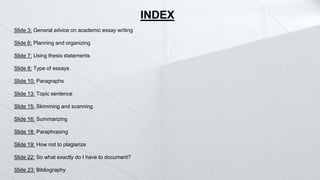
Slide 3: General advice on academic essay writing
Slide 6: Planning and organizing
Slide 7: Using thesis statements
Slide 8: Type of essays
Slide 10: Paragraphs
Slide 13: Topic sentence
Slide 15: Skimming and scanning
Slide 16: Summarizing
Slide 18: Paraphrasing
Slide 19: How not to plagiarize
Slide 22: So what exactly do I have to document?
Slide 23: Bibliography
INDEX
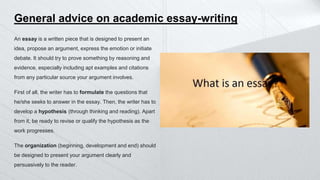
General advice on academic essay-writing
An essay is a written piece that is designed to present an
idea, propose an argument, express the emotion or initiate
debate. It should try to prove something by reasoning and
evidence, especially including apt examples and citations
from any particular source your argument involves.
First of all, the writer has to formulate the questions that
he/she seeks to answer in the essay. Then, the writer has to
develop a hypothesis (through thinking and reading). Apart
from it, be ready to revise or qualify the hypothesis as the
work progresses.
The organization (beginning, development and end) should
be designed to present your argument clearly and
persuasively to the reader.
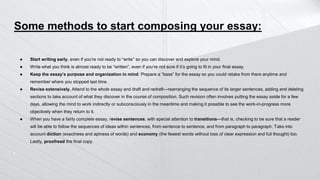
Some methods to start composing your essay:
● Start writing early, even if you’re not ready to “write” so you can discover and explore your mind.
● Write what you think is almost ready to be “written”, even if you’re not sure if it’s going to fit in your final essay.
● Keep the essay’s purpose and organization in mind. Prepare a “base” for the essay so you could retake from there anytime and
remember where you stopped last time.
● Revise extensively. Attend to the whole essay and draft and redraft—rearranging the sequence of its larger sentences, adding and deleting
sections to take account of what they discover in the course of composition. Such revision often involves putting the essay aside for a few
days, allowing the mind to work indirectly or subconsciously in the meantime and making it possible to see the work-in-progress more
objectively when they return to it.
● When you have a fairly complete essay, revise sentences, with special attention to transitions—that is, checking to be sure that a reader
will be able to follow the sequences of ideas within sentences, from sentence to sentence, and from paragraph to paragraph. Take into
account diction (exactness and aptness of words) and economy (the fewest words without loss of clear expression and full thought) too.
Lastly, proofread the final copy.
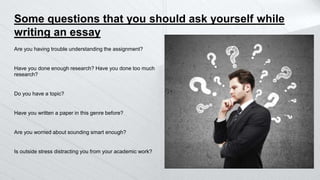
Some questions that you should ask yourself while
writing an essay
Are you having trouble understanding the assignment?
Have you done enough research? Have you done too much
research?
Do you have a topic?
Have you written a paper in this genre before?
Are you worried about sounding smart enough?
Is outside stress distracting you from your academic work?
When you begin planning, ask the following questions: What type of essay am I going to be writing? Does it belong to a
specific genre? In university, you may be asked to write, say, a book review, a lab report, a document study, or a compare-
and-contrast essay. Knowing the patterns of reasoning associated with a genre can help you to structure your essay.
When should I begin putting together a plan?
The earlier you begin planning, the better. You will have to do some reading and weighing of evidence before you start to
plan. But as a potential argument begins to take shape in your mind, you may start to formalize your thoughts in the form of
a tentative plan. You will be much more efficient in your reading and your research if you have some idea of where your
argument is headed.
You can then search for evidence for the points in your tentative plan while you are reading and researching. As you gather
evidence, those points that still lack evidence should guide you in your research. Remember, though, that your plan may
need to be modified as you critically evaluate your evidence.
Planning and Organizing
Using Thesis Statements
Here are some characteristics of good thesis statements, with samples of good and
poor ones. Note that the better examples substitute specific argumentative points for
sweeping general statements; they indicate a theoretical basis and promise substantial
support.
â—Ź It makes a definite and limited assertion that needs to be explained and
supported by further discussion
â—Ź It shows the emphasis and indicates the methodology of your argument
â—Ź It shows awareness of difficulties and disagreements
Types of essays
The first step to writing an essay is to define what type of essay you are writing. There are four main categories into
which essays can be grouped:
â—Ź Narrative essay - Tell a story or impart information about your subject in a straightforward, orderly manner, like
in a story.
â—Ź Persuasive essay - Convince the reader about some point of view.
â—Ź Expository essay - Explain to the reader how to perform a given process. You could, for example, write an
expository essay with step-by-step instructions on how to make a peanut butter sandwich.
â—Ź Descriptive essay - Focus on the details of what is going on. For example, if you want to write a descriptive
essay about your trip to the park, you would give great detail about what you experienced: how the grass felt
beneath your feet, what the park benches looked like, and anything else the reader would need to feel as if he
were there.
Other types of essays:
â—Ź Argumentative essay - Take a position on a
controversial issue and present evidence in favor of
your position. If you’ve been assigned an
argumentative essay, check out these top 10
argumentative essay topics.
â—Ź Compare and contrast essay - Identify similarities and
differences between two subjects that are, typically,
under the same umbrella.
â—Ź Problem solution essay - Describe a problem,
convince the reader to care about the problem,
propose a solution, and be prepared to dismantle
objections.
â—Ź Informative essay - Educate the reader on a
What is a paragraph?
A paragraph is a series of related sentences developing a central idea, called the topic. Try to think about paragraphs in
terms of thematic unity: a paragraph is a sentence or a group of sentences that supports one central, unified idea.
Paragraphs add one idea at a time to your broader argument.
How to unify your ideas in a paragraph:
Probably the most effective way to achieve paragraph unity is to express the central idea of the paragraph in a topic
sentence.
Topic sentences are similar to mini thesis statements. Like a thesis statement, a topic sentence has a specific main point.
Whereas the thesis is the main point of the essay, the topic sentence is the main point of the paragraph. Like the thesis
statement, a topic sentence has a unifying function. But a thesis statement or topic sentence alone doesn’t guarantee unity.
An essay is unified if all the paragraphs relate to the thesis, whereas a paragraph is unified if all the sentences relate to the
topic sentence.
How long should a paragraph be?
Paragraphs vary in length depending on the needs of the paragraph. Usually, paragraphs are between one-third and two-
thirds of a page double spaced.
A series of long paragraphs can make prose dense and unpleasant to read. Check any paragraph that is a page or longer to
see whether it would work better as two or more paragraphs. Break it at a logical place (e.g., where your focus shifts), and
see whether you need to create new topic sentences to make the shift clear.
Also look out for short paragraphs only two or three sentences long. They make academic writing seem disjointed or
skimpy. Try combining short paragraphs with the preceding or following paragraph if they share the same topic. Short
paragraphs might also need to be developed further. Make sure that nothing vital has been omitted.
What is a topic sentence?
A topic sentence states the main point of a paragraph: it serves as a mini-thesis for the paragraph. You might think of it as a signpost for your
readers—or a headline—something that alerts them to the most important, interpretive points in your essay. When read in sequence, your
essay’s topic sentences will provide a sketch of the essay’s argument. Thus topics sentences help protect your readers from confusion by
guiding them through the argument. But topic sentences can also help you to improve your essay by making it easier for you to recognize
gaps or weaknesses in your argument.
Where do topic sentences go?
Topic sentences usually appear at the very beginning of paragraphs.
Does every paragraph need one?
No, but most do. Sometimes a paragraph helps to develop the same point as in the previous paragraph, and so a new topic sentence would
be redundant. And sometimes the evidence in your paragraph makes your point so effectively that your topic sentence can remain implicit.
But if you are in doubt, it’s best to use one.
Does a topic sentence have to be at the beginning of a
paragraph?
No, though this is usually the most logical place for it. Sometimes a transitional sentence or two will come before a topic sentence
How do I come up with a topic sentence? And what
makes a good one?
Relating your topic sentences to your thesis can help strengthen the coherence of your essay. If you include a thesis statement in your
introduction, then think of incorporating a keyword from that statement into the topic sentence. But you need not be overly explicit when you
echo the thesis statement. Better to be subtle rather than heavy-handed. Do not forget that your topic sentence should do more than just
establish a connection between your paragraph and your thesis. Use a topic sentence to show how your paragraph contributes to the
development of your argument by moving it that one extra step forward.
Skimming and Scanning
One of the most effective methods for beginning the kind of thoughtful reading necessary for academic work is to get a
general overview of the text before beginning to read it in detail. By first skimming a text, you can get a sense of its overall
logical progression. Skimming can also help you make decisions about where to place your greatest focus when you have
limited time for your reading.
Scanning is basically skimming with a more tightly focused purpose: skimming to locate a particular fact or figure, or to
see whether this text mentions a subject you’re researching. Scanning is essential in the writing of research papers, when
you may need to look through many articles and books in order to find the material you need. Keep a specific set of goals in
mind as you scan the text, and avoid becoming distracted by other material.
Summarizing
Summarizing a text, or distilling its essential concepts into a paragraph or two, is a useful study tool as well as good writing practice. A summary has two aims: (1) to reproduce the
overarching ideas in a text, identifying the general concepts that run through the entire piece, and (2) to express these overarching ideas using precise, specific language. When you
summarize, you cannot rely on the language the author has used to develop his or her points, and you must find a way to give an overview of these points without your own sentences
becoming too general. You must also make decisions about which concepts to leave in and which to omit, taking into consideration your purposes in summarizing and also your view of
what is important in this text. Here are some methods for summarizing:First, prior to skimming, use some of the previewing techniques.
1. Include the title and identify the author in your first sentence.
2. The first sentence or two of your summary should contain the author’s thesis, or central concept, stated in your own words. This is the idea that runs through the entire text–
the one you’d mention if someone asked you: “What is this piece/article about?” Unlike student essays, the main idea in a primary document or an academic article may not
be stated in one location at the beginning. Instead, it may be gradually developed throughout the piece or it may become fully apparent only at the end.
3. When summarizing a longer article, try to see how the various stages in the explanation or argument are built up in groups of related paragraphs. Divide the article into
sections if it isn’t done in the published form. Then, write a sentence or two to cover the key ideas in each section.
4. Omit ideas that are not really central to the text. Don’t feel that you must reproduce the author’s exact progression of thought. (On the other hand, be careful not to
misrepresent ideas by omitting important aspects of the author’s discussion).
5. In general, omit minor details and specific examples. (In some texts, an extended example may be a key part of the argument, so you would want to mention it).
6. Avoid writing opinions or personal responses in your summaries (save these for active reading responses or tutorial discussions).
7. Be careful not to plagiarize the author’s words. If you do use even a few of the author’s words, they must appear in quotation marks. To avoid plagiarism, try writing the first
draft of your summary without looking back at the original text.
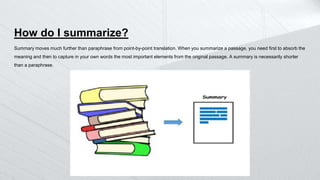
How do I summarize?
Summary moves much further than paraphrase from point-by-point translation. When you summarize a passage, you need first to absorb the
meaning and then to capture in your own words the most important elements from the original passage. A summary is necessarily shorter
than a paraphrase.
Paraphrasing
Whenever you paraphrase, remember these two points:
â—Ź You must provide a reference.
â—Ź The paraphrase must be in your own words. You must do more than merely substitute phrases here and there. You must also create your own sentence
structures.
Finding new words for ideas that are already well expressed can be hard, but changing words should not be your chief aim anyway. Focus, rather, on filtering the
ideas through your own understanding. The following strategy will make the job of paraphrasing a lot easier:
1. When you are at the note-taking stage, and you come across a passage that may be useful for your essay, do not copy the passage verbatim unless you
think you will want to quote it.
2. If you think you will want to paraphrase the passage, make a note only of the author’s basic point (or points). You don’t even need to use full sentences.
3. In your note, you should already be translating the language of the original into your own words. What matters is that you capture the original idea.
4. Make sure to jot down the source as well as the page number so that you can make a proper reference later on.
When it comes time to write the paper, rely on your notes rather than on the author’s work. You will find it much easier to avoid borrowing from the original passage
because you will not have seen it recently. Follow this simple sequence:
1. Convert the ideas from your notes into full sentences.
2. Provide a reference.
3. Go back to the original to ensure that (a) your paraphrase is accurate and (b) you have truly said things in your own words.
How Not to Plagiarize
It’s against the rules to buy essays or copy chunks from your friend’s homework, and it’s also plagiarism to borrow passages from books or
articles or Web sites without identifying them. You know that the purpose of any paper is to show your own thinking, not create a patchwork
of borrowed ideas.
The point of documenting sources in academic papers is not just to avoid unpleasant visits to the Dean’s office, but to demonstrate that you
know what is going on in your field of study. It’s also a courtesy to your readers because it helps them consult the material you’ve found.
That’s especially important for Internet sources. So mentioning what others have said doesn’t lessen the credit you get for your own
thinking—in fact, it adds to your credibility.
Here are some common questions and basic answers:
Can’t I avoid problems just by listing every source in the bibliography? No, you need to integrate your
acknowledgements into what you’re saying. Give the reference as soon as you’ve mentioned the idea you’re using, not just
at the end of the paragraph.
If I put the ideas into my own words, do I still have to clog up my pages with all those names and numbers?
Sorry—yes, you do. In academic papers, you need to keep mentioning authors and pages and dates to show how your
ideas are related to those of the experts. It’s sensible to use your own words because that saves space and lets you
connect ideas smoothly. But whether you quote a passage directly in quotation marks, paraphrase it closely in your own
words, or just summarize it rapidly, you need to identify the source then and there.
But I didn’t know anything about the subject until I started this paper. Do I have to give an acknowledgement for every point I
make? You’re safer to over-reference than to skimp. But you can cut down the clutter by recognizing that some ideas are “common
knowledge” in the field—that is, taken for granted by people knowledgeable about the topic.
How can I tell what’s my own idea and what has come from somebody else? Careful record-keeping helps. Always write down the
author, title and publication information (including the specific identifying information for online publications) so you can attach names and
dates to specific ideas. Taking good notes is also essential. Don’t paste passages from online sources into your draft: that’s asking for
trouble. As you read any text—online or on the page—summarize useful points in your own words.
So what exactly do I have to document?
Quotations, paraphrases, or summaries: If you use the author’s exact words, enclose them in quotation marks, or indent
passages of more than four lines. In most cases, use your own words to paraphrase or summarize the idea you want to
discuss, emphasizing the points relevant to your argument. But be sure to name sources even when you are not using the
exact original words. As in the examples below, it’s often a good idea to mention the author’s name.
Specific facts used as evidence for your argument or interpretation: First consider whether the facts you’re mentioning
are “common knowledge”. If so, you may not need to give a reference. But when you’re relying on facts that might be
disputed within your discipline establish that they’re trustworthy by showing that you got them from an authoritative source.
Distinctive or authoritative ideas, whether you agree with them or not: The way you introduce a reference can indicate
your attitude and lead into your own argument.
Bibliography:
Freedman, L. Skimming and scanning. Retrieved from University of
Toronto webpage. Available at:
https://advice.writing.utoronto.ca/researching/skim-and-scan/
Freedman, L. Summarizing. Retrieved from University of Toronto
webpage. Available at:
https://advice.writing.utoronto.ca/researching/summarize/
Hall, J. and Plotnick, J. Using topic sentences. Retrieved from University
of Toronto webpage. Available at:
https://advice.writing.utoronto.ca/planning/topic-sentences/
LeBel, S. Writer’s block. Retrieved from University of Toronto webpage.
Available at: https://advice.writing.utoronto.ca/general/writers-block/
Plotnick, J. Organizing an essay. Retrieved from University of Toronto
webpage. Available at:
https://advice.writing.utoronto.ca/planning/organizing/
Plotnick, J. Paraphrase and Summary. Retrieved from University of
Toronto webpage. Available at:
https://advice.writing.utoronto.ca/using-sources/paraphrase/
Bibliography:
Procter, M. How not to plagiarize. Retrieved from University of Toronto webpage. Available at:
https://advice.writing.utoronto.ca/using-sources/how-not-to-plagiarize/
Procter, M. Paragraphs. Retrieved from University of Toronto webpage. Available at:
https://advice.writing.utoronto.ca/planning/paragraphs/
Procter, M. Understanding Essay Topics: A Checklist. Retrieved from University of Toronto webpage. Available at:
https://advice.writing.utoronto.ca/general/essay-topics/
Procter, M. Using thesis statements. Retrieved from University of Toronto webpage. Available at:
https://advice.writing.utoronto.ca/planning/thesis-statements/
Silber, C. A. . Some General Advice on Academic Essay-Writing. Retrieved from University of Toronto webpage. Available
at: https://advice.writing.utoronto.ca/general/general-advice/

Advice on academic writing - Martin Graff

  • 1.
    ADVICE ON ACADEMICWRITING COLLEGE: Instituto Superior de Formación Docente N° 41 SUBJECT: Prácticas Discursivas de la Comunicación Escrita IV TEACHER: Stella Maris Saubidet Oyhamburu STUDENT’S NAME: Martín Alejandro Graff DATE: May 20th
  • 2.
    Slide 3: Generaladvice on academic essay writing Slide 6: Planning and organizing Slide 7: Using thesis statements Slide 8: Type of essays Slide 10: Paragraphs Slide 13: Topic sentence Slide 15: Skimming and scanning Slide 16: Summarizing Slide 18: Paraphrasing Slide 19: How not to plagiarize Slide 22: So what exactly do I have to document? Slide 23: Bibliography INDEX
  • 3.
    General advice onacademic essay-writing An essay is a written piece that is designed to present an idea, propose an argument, express the emotion or initiate debate. It should try to prove something by reasoning and evidence, especially including apt examples and citations from any particular source your argument involves. First of all, the writer has to formulate the questions that he/she seeks to answer in the essay. Then, the writer has to develop a hypothesis (through thinking and reading). Apart from it, be ready to revise or qualify the hypothesis as the work progresses. The organization (beginning, development and end) should be designed to present your argument clearly and persuasively to the reader.
  • 4.
    Some methods tostart composing your essay: ● Start writing early, even if you’re not ready to “write” so you can discover and explore your mind. ● Write what you think is almost ready to be “written”, even if you’re not sure if it’s going to fit in your final essay. ● Keep the essay’s purpose and organization in mind. Prepare a “base” for the essay so you could retake from there anytime and remember where you stopped last time. ● Revise extensively. Attend to the whole essay and draft and redraft—rearranging the sequence of its larger sentences, adding and deleting sections to take account of what they discover in the course of composition. Such revision often involves putting the essay aside for a few days, allowing the mind to work indirectly or subconsciously in the meantime and making it possible to see the work-in-progress more objectively when they return to it. ● When you have a fairly complete essay, revise sentences, with special attention to transitions—that is, checking to be sure that a reader will be able to follow the sequences of ideas within sentences, from sentence to sentence, and from paragraph to paragraph. Take into account diction (exactness and aptness of words) and economy (the fewest words without loss of clear expression and full thought) too. Lastly, proofread the final copy.
  • 5.
    Some questions thatyou should ask yourself while writing an essay Are you having trouble understanding the assignment? Have you done enough research? Have you done too much research? Do you have a topic? Have you written a paper in this genre before? Are you worried about sounding smart enough? Is outside stress distracting you from your academic work?
  • 6.
    When you beginplanning, ask the following questions: What type of essay am I going to be writing? Does it belong to a specific genre? In university, you may be asked to write, say, a book review, a lab report, a document study, or a compare- and-contrast essay. Knowing the patterns of reasoning associated with a genre can help you to structure your essay. When should I begin putting together a plan? The earlier you begin planning, the better. You will have to do some reading and weighing of evidence before you start to plan. But as a potential argument begins to take shape in your mind, you may start to formalize your thoughts in the form of a tentative plan. You will be much more efficient in your reading and your research if you have some idea of where your argument is headed. You can then search for evidence for the points in your tentative plan while you are reading and researching. As you gather evidence, those points that still lack evidence should guide you in your research. Remember, though, that your plan may need to be modified as you critically evaluate your evidence. Planning and Organizing
  • 7.
    Using Thesis Statements Hereare some characteristics of good thesis statements, with samples of good and poor ones. Note that the better examples substitute specific argumentative points for sweeping general statements; they indicate a theoretical basis and promise substantial support. â—Ź It makes a definite and limited assertion that needs to be explained and supported by further discussion â—Ź It shows the emphasis and indicates the methodology of your argument â—Ź It shows awareness of difficulties and disagreements
  • 8.
    Types of essays Thefirst step to writing an essay is to define what type of essay you are writing. There are four main categories into which essays can be grouped: â—Ź Narrative essay - Tell a story or impart information about your subject in a straightforward, orderly manner, like in a story. â—Ź Persuasive essay - Convince the reader about some point of view. â—Ź Expository essay - Explain to the reader how to perform a given process. You could, for example, write an expository essay with step-by-step instructions on how to make a peanut butter sandwich. â—Ź Descriptive essay - Focus on the details of what is going on. For example, if you want to write a descriptive essay about your trip to the park, you would give great detail about what you experienced: how the grass felt beneath your feet, what the park benches looked like, and anything else the reader would need to feel as if he were there.
  • 9.
    Other types ofessays: ● Argumentative essay - Take a position on a controversial issue and present evidence in favor of your position. If you’ve been assigned an argumentative essay, check out these top 10 argumentative essay topics. ● Compare and contrast essay - Identify similarities and differences between two subjects that are, typically, under the same umbrella. ● Problem solution essay - Describe a problem, convince the reader to care about the problem, propose a solution, and be prepared to dismantle objections. ● Informative essay - Educate the reader on a
  • 10.
    What is aparagraph? A paragraph is a series of related sentences developing a central idea, called the topic. Try to think about paragraphs in terms of thematic unity: a paragraph is a sentence or a group of sentences that supports one central, unified idea. Paragraphs add one idea at a time to your broader argument.
  • 11.
    How to unifyyour ideas in a paragraph: Probably the most effective way to achieve paragraph unity is to express the central idea of the paragraph in a topic sentence. Topic sentences are similar to mini thesis statements. Like a thesis statement, a topic sentence has a specific main point. Whereas the thesis is the main point of the essay, the topic sentence is the main point of the paragraph. Like the thesis statement, a topic sentence has a unifying function. But a thesis statement or topic sentence alone doesn’t guarantee unity. An essay is unified if all the paragraphs relate to the thesis, whereas a paragraph is unified if all the sentences relate to the topic sentence.
  • 12.
    How long shoulda paragraph be? Paragraphs vary in length depending on the needs of the paragraph. Usually, paragraphs are between one-third and two- thirds of a page double spaced. A series of long paragraphs can make prose dense and unpleasant to read. Check any paragraph that is a page or longer to see whether it would work better as two or more paragraphs. Break it at a logical place (e.g., where your focus shifts), and see whether you need to create new topic sentences to make the shift clear. Also look out for short paragraphs only two or three sentences long. They make academic writing seem disjointed or skimpy. Try combining short paragraphs with the preceding or following paragraph if they share the same topic. Short paragraphs might also need to be developed further. Make sure that nothing vital has been omitted.
  • 13.
    What is atopic sentence? A topic sentence states the main point of a paragraph: it serves as a mini-thesis for the paragraph. You might think of it as a signpost for your readers—or a headline—something that alerts them to the most important, interpretive points in your essay. When read in sequence, your essay’s topic sentences will provide a sketch of the essay’s argument. Thus topics sentences help protect your readers from confusion by guiding them through the argument. But topic sentences can also help you to improve your essay by making it easier for you to recognize gaps or weaknesses in your argument. Where do topic sentences go? Topic sentences usually appear at the very beginning of paragraphs. Does every paragraph need one? No, but most do. Sometimes a paragraph helps to develop the same point as in the previous paragraph, and so a new topic sentence would be redundant. And sometimes the evidence in your paragraph makes your point so effectively that your topic sentence can remain implicit. But if you are in doubt, it’s best to use one.
  • 14.
    Does a topicsentence have to be at the beginning of a paragraph? No, though this is usually the most logical place for it. Sometimes a transitional sentence or two will come before a topic sentence How do I come up with a topic sentence? And what makes a good one? Relating your topic sentences to your thesis can help strengthen the coherence of your essay. If you include a thesis statement in your introduction, then think of incorporating a keyword from that statement into the topic sentence. But you need not be overly explicit when you echo the thesis statement. Better to be subtle rather than heavy-handed. Do not forget that your topic sentence should do more than just establish a connection between your paragraph and your thesis. Use a topic sentence to show how your paragraph contributes to the development of your argument by moving it that one extra step forward.
  • 15.
    Skimming and Scanning Oneof the most effective methods for beginning the kind of thoughtful reading necessary for academic work is to get a general overview of the text before beginning to read it in detail. By first skimming a text, you can get a sense of its overall logical progression. Skimming can also help you make decisions about where to place your greatest focus when you have limited time for your reading. Scanning is basically skimming with a more tightly focused purpose: skimming to locate a particular fact or figure, or to see whether this text mentions a subject you’re researching. Scanning is essential in the writing of research papers, when you may need to look through many articles and books in order to find the material you need. Keep a specific set of goals in mind as you scan the text, and avoid becoming distracted by other material.
  • 16.
    Summarizing Summarizing a text,or distilling its essential concepts into a paragraph or two, is a useful study tool as well as good writing practice. A summary has two aims: (1) to reproduce the overarching ideas in a text, identifying the general concepts that run through the entire piece, and (2) to express these overarching ideas using precise, specific language. When you summarize, you cannot rely on the language the author has used to develop his or her points, and you must find a way to give an overview of these points without your own sentences becoming too general. You must also make decisions about which concepts to leave in and which to omit, taking into consideration your purposes in summarizing and also your view of what is important in this text. Here are some methods for summarizing:First, prior to skimming, use some of the previewing techniques. 1. Include the title and identify the author in your first sentence. 2. The first sentence or two of your summary should contain the author’s thesis, or central concept, stated in your own words. This is the idea that runs through the entire text– the one you’d mention if someone asked you: “What is this piece/article about?” Unlike student essays, the main idea in a primary document or an academic article may not be stated in one location at the beginning. Instead, it may be gradually developed throughout the piece or it may become fully apparent only at the end. 3. When summarizing a longer article, try to see how the various stages in the explanation or argument are built up in groups of related paragraphs. Divide the article into sections if it isn’t done in the published form. Then, write a sentence or two to cover the key ideas in each section. 4. Omit ideas that are not really central to the text. Don’t feel that you must reproduce the author’s exact progression of thought. (On the other hand, be careful not to misrepresent ideas by omitting important aspects of the author’s discussion). 5. In general, omit minor details and specific examples. (In some texts, an extended example may be a key part of the argument, so you would want to mention it). 6. Avoid writing opinions or personal responses in your summaries (save these for active reading responses or tutorial discussions). 7. Be careful not to plagiarize the author’s words. If you do use even a few of the author’s words, they must appear in quotation marks. To avoid plagiarism, try writing the first draft of your summary without looking back at the original text.
  • 17.
    How do Isummarize? Summary moves much further than paraphrase from point-by-point translation. When you summarize a passage, you need first to absorb the meaning and then to capture in your own words the most important elements from the original passage. A summary is necessarily shorter than a paraphrase.
  • 18.
    Paraphrasing Whenever you paraphrase,remember these two points: ● You must provide a reference. ● The paraphrase must be in your own words. You must do more than merely substitute phrases here and there. You must also create your own sentence structures. Finding new words for ideas that are already well expressed can be hard, but changing words should not be your chief aim anyway. Focus, rather, on filtering the ideas through your own understanding. The following strategy will make the job of paraphrasing a lot easier: 1. When you are at the note-taking stage, and you come across a passage that may be useful for your essay, do not copy the passage verbatim unless you think you will want to quote it. 2. If you think you will want to paraphrase the passage, make a note only of the author’s basic point (or points). You don’t even need to use full sentences. 3. In your note, you should already be translating the language of the original into your own words. What matters is that you capture the original idea. 4. Make sure to jot down the source as well as the page number so that you can make a proper reference later on. When it comes time to write the paper, rely on your notes rather than on the author’s work. You will find it much easier to avoid borrowing from the original passage because you will not have seen it recently. Follow this simple sequence: 1. Convert the ideas from your notes into full sentences. 2. Provide a reference. 3. Go back to the original to ensure that (a) your paraphrase is accurate and (b) you have truly said things in your own words.
  • 19.
    How Not toPlagiarize It’s against the rules to buy essays or copy chunks from your friend’s homework, and it’s also plagiarism to borrow passages from books or articles or Web sites without identifying them. You know that the purpose of any paper is to show your own thinking, not create a patchwork of borrowed ideas. The point of documenting sources in academic papers is not just to avoid unpleasant visits to the Dean’s office, but to demonstrate that you know what is going on in your field of study. It’s also a courtesy to your readers because it helps them consult the material you’ve found. That’s especially important for Internet sources. So mentioning what others have said doesn’t lessen the credit you get for your own thinking—in fact, it adds to your credibility.
  • 20.
    Here are somecommon questions and basic answers: Can’t I avoid problems just by listing every source in the bibliography? No, you need to integrate your acknowledgements into what you’re saying. Give the reference as soon as you’ve mentioned the idea you’re using, not just at the end of the paragraph. If I put the ideas into my own words, do I still have to clog up my pages with all those names and numbers? Sorry—yes, you do. In academic papers, you need to keep mentioning authors and pages and dates to show how your ideas are related to those of the experts. It’s sensible to use your own words because that saves space and lets you connect ideas smoothly. But whether you quote a passage directly in quotation marks, paraphrase it closely in your own words, or just summarize it rapidly, you need to identify the source then and there.
  • 21.
    But I didn’tknow anything about the subject until I started this paper. Do I have to give an acknowledgement for every point I make? You’re safer to over-reference than to skimp. But you can cut down the clutter by recognizing that some ideas are “common knowledge” in the field—that is, taken for granted by people knowledgeable about the topic. How can I tell what’s my own idea and what has come from somebody else? Careful record-keeping helps. Always write down the author, title and publication information (including the specific identifying information for online publications) so you can attach names and dates to specific ideas. Taking good notes is also essential. Don’t paste passages from online sources into your draft: that’s asking for trouble. As you read any text—online or on the page—summarize useful points in your own words.
  • 22.
    So what exactlydo I have to document? Quotations, paraphrases, or summaries: If you use the author’s exact words, enclose them in quotation marks, or indent passages of more than four lines. In most cases, use your own words to paraphrase or summarize the idea you want to discuss, emphasizing the points relevant to your argument. But be sure to name sources even when you are not using the exact original words. As in the examples below, it’s often a good idea to mention the author’s name. Specific facts used as evidence for your argument or interpretation: First consider whether the facts you’re mentioning are “common knowledge”. If so, you may not need to give a reference. But when you’re relying on facts that might be disputed within your discipline establish that they’re trustworthy by showing that you got them from an authoritative source. Distinctive or authoritative ideas, whether you agree with them or not: The way you introduce a reference can indicate your attitude and lead into your own argument.
  • 23.
    Bibliography: Freedman, L. Skimmingand scanning. Retrieved from University of Toronto webpage. Available at: https://advice.writing.utoronto.ca/researching/skim-and-scan/ Freedman, L. Summarizing. Retrieved from University of Toronto webpage. Available at: https://advice.writing.utoronto.ca/researching/summarize/ Hall, J. and Plotnick, J. Using topic sentences. Retrieved from University of Toronto webpage. Available at: https://advice.writing.utoronto.ca/planning/topic-sentences/ LeBel, S. Writer’s block. Retrieved from University of Toronto webpage. Available at: https://advice.writing.utoronto.ca/general/writers-block/ Plotnick, J. Organizing an essay. Retrieved from University of Toronto webpage. Available at: https://advice.writing.utoronto.ca/planning/organizing/ Plotnick, J. Paraphrase and Summary. Retrieved from University of Toronto webpage. Available at: https://advice.writing.utoronto.ca/using-sources/paraphrase/
  • 24.
    Bibliography: Procter, M. Hownot to plagiarize. Retrieved from University of Toronto webpage. Available at: https://advice.writing.utoronto.ca/using-sources/how-not-to-plagiarize/ Procter, M. Paragraphs. Retrieved from University of Toronto webpage. Available at: https://advice.writing.utoronto.ca/planning/paragraphs/ Procter, M. Understanding Essay Topics: A Checklist. Retrieved from University of Toronto webpage. Available at: https://advice.writing.utoronto.ca/general/essay-topics/ Procter, M. Using thesis statements. Retrieved from University of Toronto webpage. Available at: https://advice.writing.utoronto.ca/planning/thesis-statements/ Silber, C. A. . Some General Advice on Academic Essay-Writing. Retrieved from University of Toronto webpage. Available at: https://advice.writing.utoronto.ca/general/general-advice/