April 2016 University Library, Thomas Hapke
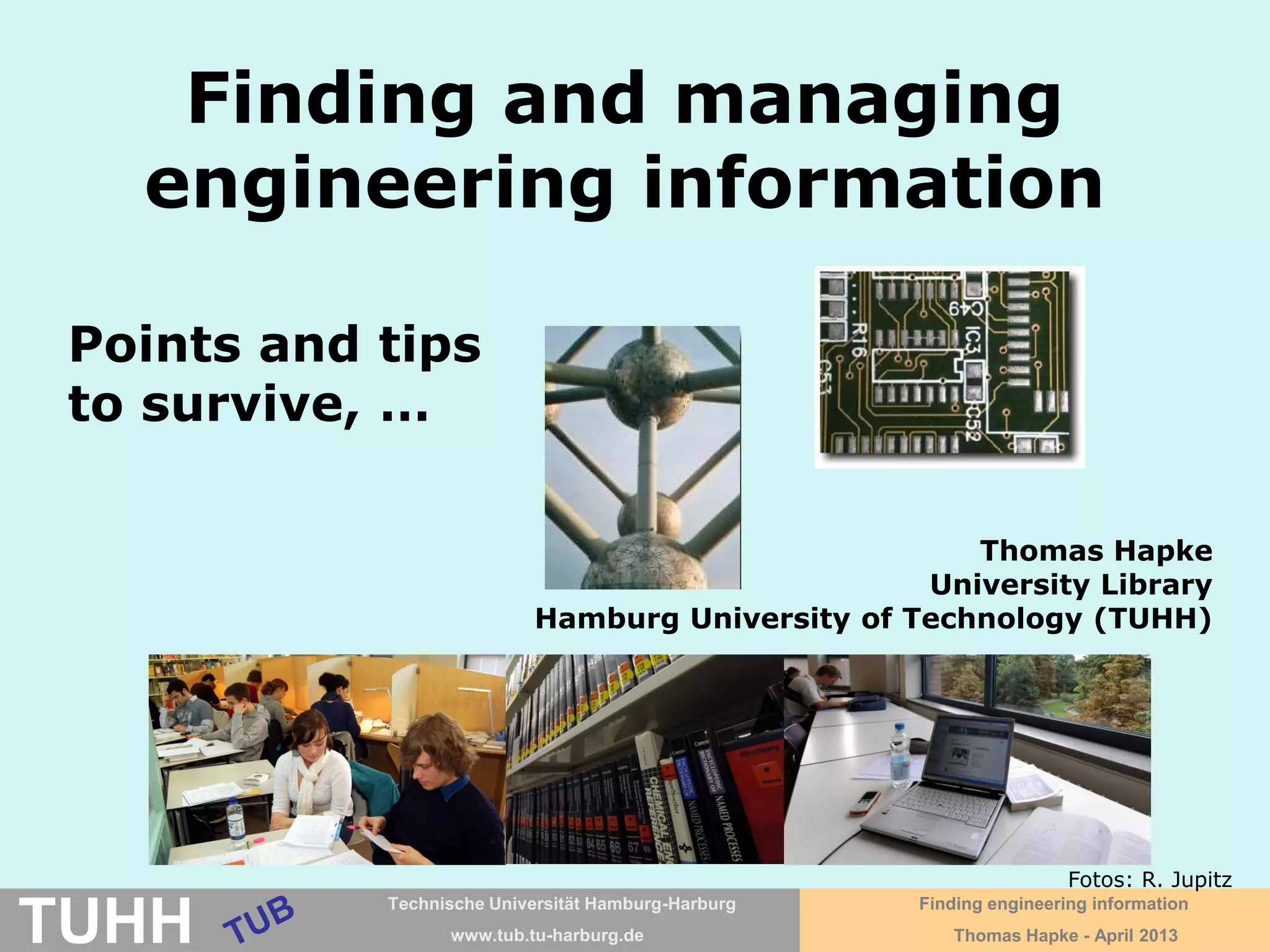
Finding and managing
engineering information
Photos: R. Jupitz
April 2016 University Library, Thomas Hapke
Information challenges for
academic research
• How to be more sure not to miss something
essential?
– Systematically searching for information
– Using subject-specific databases
• How to get full texts?
– Availability in TUHH intranet via search engines
– The library catalog as search engine
• How to cope with information overload?
– Using reference managent software like Citavi
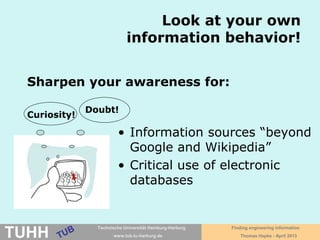
Curiosity!
Doubt!
Graphics: D. Bieler
April 2016 University Library, Thomas Hapke
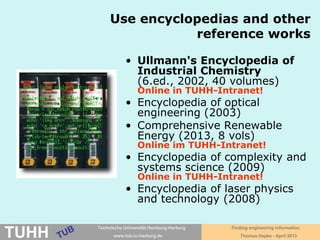
• Ullmann's encyclopedia of industrial chemistry
(6. ed., 2002, 40 vols.)
Online in TUHH intranet (2016 ed.)!
• Comprehensive renewable energy
(2013, 8 vols) Online in TUHH intranet!
• Handbook of loss prevention engineering
(2013) Online in TUHH intranet!
• Encyclopedia of tribology (2013)
Online in TUHH intranet!
• Encyclopedia of complexity and systems science
(2009) Online in TUHH intranet!
• Encyclopedia of optimization
(2009) Online in TUHH intranet!
• Wiley encyclopedia of computer science and
engineering (2009)
• Encyclopedia of nanoscience and society
(2010, 2 vols.)
Using encyclopedias and
reference works for orientation!
April 2016 University Library, Thomas Hapke
Subject gateways
U.S. National Center for Biotechnology Information
http://www.ncbi.nlm.nih.gov
http://www.econbiz.de
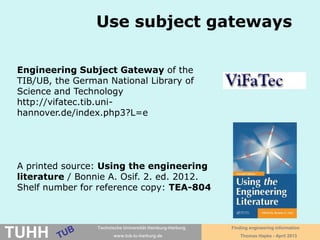
A printed source: Using the engineering literature /
Bonnie A. Osif. 2. ed. 2012.
Shelf number for reference copy: TEA-804
https://www.tib.eu/en/
April 2016 University Library, Thomas Hapke
Orientation: Subject information
Process engineering @TUBHH
http://www.tub.tuhh.de/en/subject-information/process-and-chemical-engineering/
April 2016 University Library, Thomas Hapke
Informing – Points to survive
1. Orientation before searching.
2. Don‘t trust only one information source.
How to be more sure not to miss
something essential?
April 2016 University Library, Thomas Hapke
Beyond Google!
FindING @ TUHH-Bibliothek
First orientation
Catalog
Actual
research information
Specials
Reference databases for journal articles:
TEMA, Web of Science
Civil engineering: RSWB, TEMA
Electrical engeineering: Inspec, TEMA, (IEEE)
Mechanical engineering: TEMA, Web of Science
Process engineering: Web of Science, TEMA
Business sciences: TEMA, Business Source
Premier, WISO
Library website: http://www.tub.tu-harburg.de/en/
Subject groups in reading room
Encyclopedias and other reference works
Media - digital (TUHH intranet!) or printed
(reading rooms, closed stacks)
https://katalog.tub.tu-harburg.de/?mylang=en
German DIN standards online!
Patents: Esp@cenet, DEPATISnet
Interlibrary loan and document delivery
April 2016 University Library, Thomas Hapke
Dimensions of
finding
How?
Adopted from: Sheila Corrall, John Dove: Web scale discovery and information literacy: competing visions or mutual support?
LILAC 2012, Glasgow. http://de.slideshare.net/infolit_group/corrall-dove)
Approved
scholarly content
What?
Open web content
Single search box
Advanced search
options
Google
Scholar
Where? Local
availability!
Specialized databases with
costs:
Web of Science, Inspec, wti
April 2016 University Library, Thomas Hapke
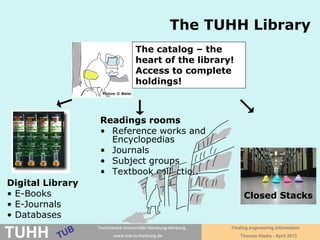
The TUHH Library
Closed Stacks
Readings rooms
• Reference works and
Encyclopedias
• Journals
• Subject groups
• Textbook collection
Digital Library
• Online-Books
• E-Journals
• Databases
Picture: D. Bieler
The catalog – the heart
of the library!
Access to complete
holdings!
April 2016 University Library, Thomas Hapke
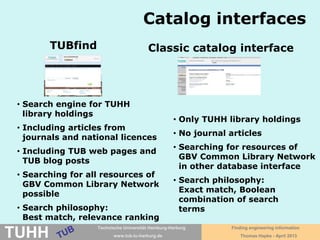
TUBfind
The library catalog as search engine
April 2016 University Library, Thomas Hapke
TUBfind – simply more!
• Search engine to find TUHH library holdings and more
• Including also journal articles
• Also for searching within library website and library weblog
• In addition finding resources of the GBV Common Library
Network – to order via interlibrary loan
• Search philosophy: Best hits, relevance ranking
• Sorting according descending date possible
• Filtering according format, language, author
April 2016 University Library, Thomas Hapke
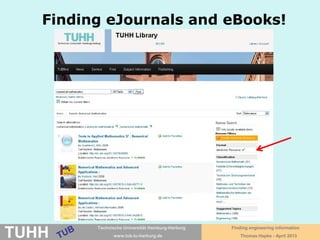
Finding books,
also online books!
April 2016 University Library, Thomas Hapke
Finding journal articles!
April 2016 University Library, Thomas Hapke
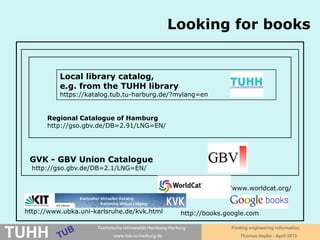
Looking for books
http://www.ubka.uni-karlsruhe.de/kvk.html
GVK - GBV Union Catalogue
http://gso.gbv.de/DB=2.1/LNG=EN/
http://www.worldcat.org/
Local library catalog,
e.g. from the TUHH library
https://katalog.tub.tuhh.de/?mylang=en
Regional Catalogue of Hamburg
http://gso.gbv.de/DB=2.91/LNG=EN/
http://books.google.com
http://beluga.hamburg
April 2016 University Library, Thomas Hapke
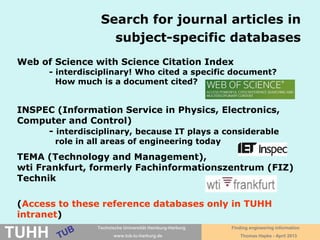
Finding journal articles via
subject-specific databases
Web of Science with Science Citation Index
- interdisciplinary! Who cited a specific document?
How much is a document cited?
TEMA (Technology and Management),
wti Frankfurt, formerly Fachinformationszentrum (FIZ) Technik
(Access to these reference databases only within TUHH intranet)
PubMed
April 2016 University Library, Thomas Hapke
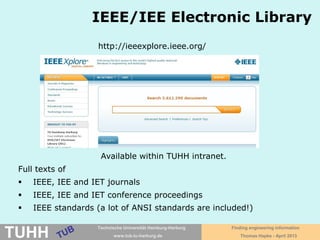
Full texts of
 IEEE, IEE and IET journals
 IEEE, IEE and IET conference proceedings
 IEEE standards (a lot of ANSI standards are included!)
 VDE Publisher Conference Proceedings
http://ieeexplore.ieee.org (Available within TUHH intranet)
IEEE/IEE Electronic Library
April 2016 University Library, Thomas Hapke
Differences
Seach engines Subject databases
• Interdisciplinary sources
• Widely intuitively to use
• Full text often searchable
• Rarely intellectual indexing
• Abbrevating of search terms
automatically („stemming“)
• Search philosophy: Best hits,
relevance ranking
• Good for subject-specific searching
• Sophisticated stragegies for
searching possible
• Full text not included in search index
• Partially intellectual indexing with
descriptors or integrated thesaurus
• Abbreviating search terms with
wildcard symbol (often *)
• Search philosophy: Exact hits,
Boolean combination of search terms
Use diverse databases and search engines!
April 2016 University Library, Thomas Hapke
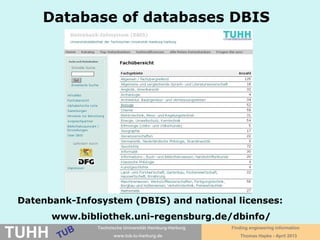
Database of databases:
Subject overview
www.bibliothek.uni-regensburg.de/dbinfo/
http://tinyurl.com/DBIS-TUHH (German interface only)
April 2016 University Library, Thomas Hapke
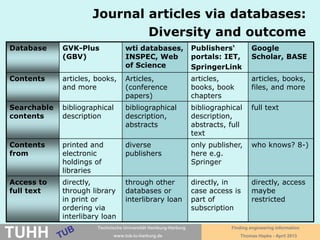
Articles’ databases:
Diversity and outcome
Database GVK-Plus (GBV
Common
Library
Network )
PubMed, TEMA
(wti), Web of
Science
Publishers‘
portals: Wiley,
SpringerLink,
ScienceDirect
Google
Scholar, BASE
(Bielefeld
Acad. Search
Engine)
Content articles, books,
and more
Articles,
(conference
papers)
articles, books,
book chapters
articles, books,
files, and more
Searchable
content
bibliographical
description
bibliographical
description,
abstracts
bibliographical
description,
abstracts, full
text
full text
Content
from
printed and
electronic
holdings of
libraries
diverse
publishers
only publisher,
here e.g.
Springer
who knows?
8-)
Access to
full text
directly, through
library in print
or ordering via
interlibary loan
through other
databases, link
resolver or
interlibrary loan
directly, in case
access is part of
subscription
directly, access
maybe
restricted
April 2016 University Library, Thomas Hapke
About 60 % of the information in patents is not
published elsewhere.
DEPATISnet - the German patent information
system at http://depatisnet.dpma.de
esp@cenet – European Patent Office
http://worldwide.espacenet.com/
US patents via the US Patent and Trademark
Office http://patft.uspto.gov/
https://www.tub.tuhh.de/en/find/patents/
Patents for talents!
April 2016 University Library, Thomas Hapke
Searching for
substance properties’ data
 In reference works
(CRC Handbook of Chemistry and Physics, Perry's Chemical
Engineers' Handbook, Aldrich Handbook)
 In extensive substance property collections
(„Handbooks“)
(Landolt-Börnstein Numerical data and functional relationships in
science and technology, Gmelin Handbook of Inorganic and
Organometallic Chemistry, Beilstein Handbook of Organic
Chemistry)
 Via the net
(e.g. NIST Chemistry WebBook at
http://webbook.nist.gov/chemistry/ or the Physical Properties
Sources Index (PPSI) at http://www.eqi.ethz.ch/en/
- also: Reaxys, SciFinder, both not @TUHamburg)
More:
https://www.tub.tuhh.de/en/find/substance-property-data/
April 2016 University Library, Thomas Hapke
Specials: Searching for
substance properties’ data
Data on harzardous substances with safety instructions
and data sheets containing operational guidelines and
hints to laws (e.g. EU) as well as to compulsory and
advisory critical levels in the area of hazardous materials!
http://tinyurl.com/merkblaetter
April 2016 University Library, Thomas Hapke
Informing – Points to survive
1. Orientation before searching.
2. Don‘t trust only one information source.
3. In case you are asked for your login or for your credit card,
remember the library …
How to get full text?
April 2016 University Library, Thomas Hapke
How to get the full text
of this article?
Sparrow, B.; Liu, J.; Wegner, D. M. (2011): Google Effects
on Memory: Cognitive Consequences of Having
Information at Our Fingertip. Science 333, 6043, 776-
778 2011.
Access: Online in Internet as author
copy
How to get the full text in case the
author would not have put the article
online?
April 2016 University Library, Thomas Hapke
How to get the full text
of this article?
R. Ladenstein, G. Antranikian: Proteins from
hyperthermophiles: Stability and enzymatic catalysis
close to the boiling point of water. Biotechnology of
Extremophiles. 1998, pp. 37 - 85.
Access: Printed in a book located in
the TUHH reading rooms
How found?
April 2016 University Library, Thomas Hapke
How to get the full text
of this article?
Early Modern Information Overload, Daniel Rosenberg,
Journal of the History of Ideas 64 (2003) 1, pp. 1-9
10.1353/jhi.2003.0017
Access: Full text from TUHH only
available via interlibrary loan!
How to do interlibrary loan?
What does the character string at the
end of the citation mean?
April 2016 University Library, Thomas Hapke
How to get the full text
of this article?
Access not possible via publisher‘s
website within TUHH intranet.
Catalog links to fulltext via GetInfo at
TIB Hannover!
Merajver, S. D.; Yorke, E. D.; Rocco, A. G. de. Random-
walk model of the phase transition of hydrocarbon chains
on a lattice. Physical Review A (General Physics) 1981, 23
(2), 897–907
April 2016 University Library, Thomas Hapke
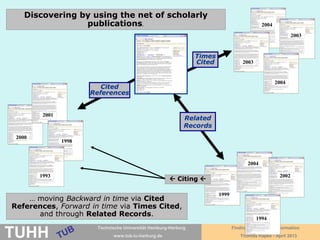
„On the shoulders of“
Google Scholar
Ca. 1410
Quelle: http://lccn.loc.gov/50041709
April 2016 University Library, Thomas Hapke
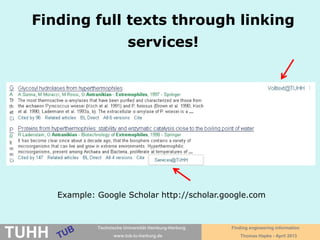
Google Scholar http://scholar.google.com
Finding full texts
April 2016 University Library, Thomas Hapke
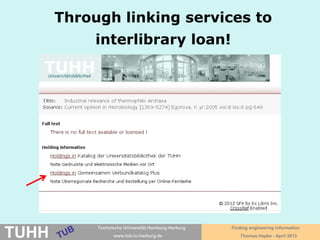
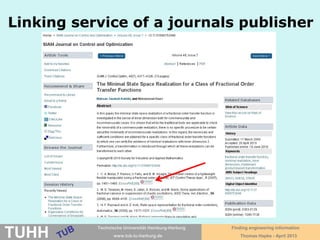
Via linking service
to the catalog!
April 2016 University Library, Thomas Hapke
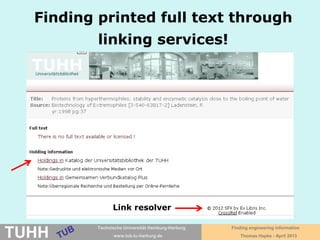
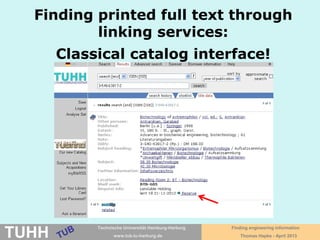
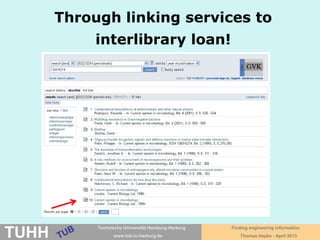
From Google Scholar
to the printed book!
Classical interface of the catalog!
April 2016 University Library, Thomas Hapke
A further example
Google Scholar http://scholar.google.com
April 2016 University Library, Thomas Hapke
Request for interlibrary loan!
April 2016 University Library, Thomas Hapke
Ordering interlibrary loan
via GBV database
April 2016 University Library, Thomas Hapke
Request for copy!
Ordering!
April 2016 University Library, Thomas Hapke
Interlibrary loan via
library union network
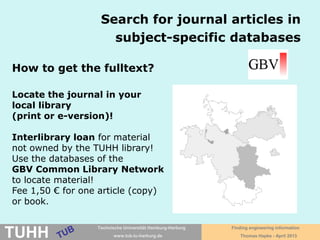
Interlibrary loan for material not
owned by the TUHH library!
Use the databases of the
GBV Common Library Network
to locate material!
Fee 1,50 € for one article (copy) or
book.
April 2016 University Library, Thomas Hapke
Request details already filled!
April 2016 University Library, Thomas Hapke
Function of Link
Resolvers
Cited source
Link Resolver
Source of full text
Knowledge base
with local
holdings data
Catalog data,
maintenance through
library
Meta data
(in OpenURL)
URL of source,
e.g. DOI
(in OpenURL)
Search in catalog,
interlibrary loan
database
Meta data
(in OpenURL)
April 2016 University Library, Thomas Hapke
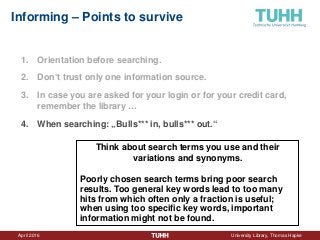
Informing – Points to survive
1. Orientation before searching.
2. Don‘t trust only one information source.
3. In case you are asked for your login or for your credit card,
remember the library …
4. When searching: „Bulls*** in, bulls*** out.“
Think about search terms you use and their
variations and synonyms.
Poorly chosen search terms bring poor search
results. Too general key words lead to too many
hits from which often only a fraction is useful;
when using too specific key words, important
information might not be found.
April 2016 University Library, Thomas Hapke
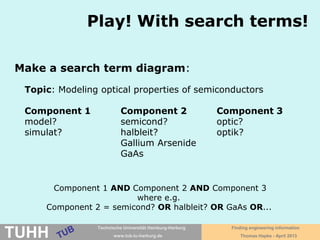
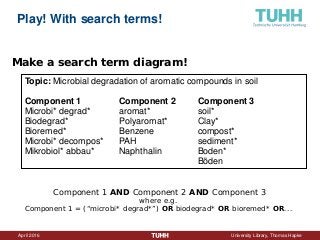
Play! With search terms!
Make a search term diagram!
Topic: Microbial degradation of aromatic compounds in soil
Component 1 Component 2 Component 3
Microbi* degrad* aromat* soil*
Biodegrad* Polyaromat* Clay*
Bioremed* Benzene compost*
Microbi* decompos* PAH sediment*
Mikrobiol* abbau* Naphthalin Boden*
Böden
Component 1 AND Component 2 AND Component 3
where e.g.
Component 1 = (“microbi* degrad*”) OR biodegrad* OR bioremed* OR...
April 2016 University Library, Thomas Hapke
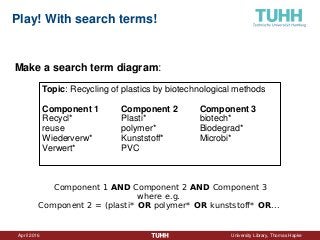
Play! With search terms!
Make a search term diagram:
Topic: Recycling of plastics by biotechnological methods
Component 1 Component 2 Component 3
Recycl* Plasti* biotech*
reuse polymer* Biodegrad*
Wiederverw* Kunststoff* Microbi*
Verwert* PVC
Component 1 AND Component 2 AND Component 3
where e.g.
Component 2 = (plasti* OR polymer* OR kunststoff* OR...
April 2016 University Library, Thomas Hapke
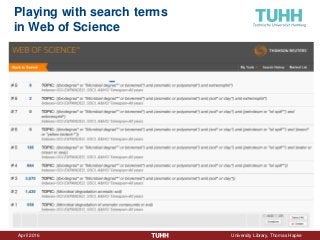
Playing with search terms
in Web of Science
www.bibliothek.uni-regensburg.de/dbinfo/
April 2016 University Library, Thomas Hapke
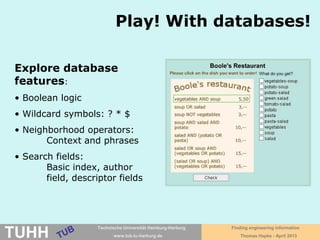
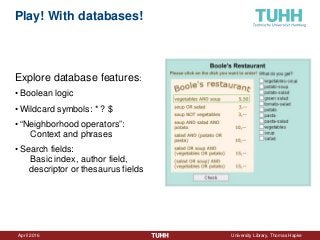
Play! With databases!
Explore database features:
• Boolean logic
• Wildcard symbols: * ? $
• “Neighborhood operators”:
Context and phrases
• Search fields:
Basic index, author field,
descriptor or thesaurus fields
April 2016 University Library, Thomas Hapke
Informing – Points to survive
1. Orientation before searching.
2. Don‘t trust only one information source.
3. In case you are asked for your login or for your credit card,
remember the library …
4. When searching: „Bulls*** in, bulls*** out.“
5. When finding information - think already of its further
processing, respectively later publication of your
research results.
How to cope with
information overload?
April 2016 University Library, Thomas Hapke
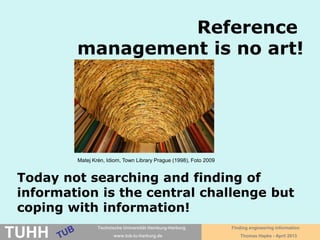
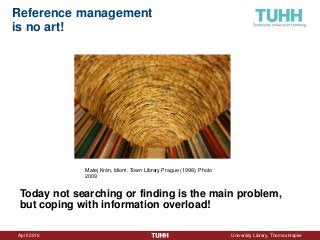
Reference management
is no art!
Matej Krén, Idiom, Town Library Prague (1998), Photo
2009
Today not searching or finding is the main problem,
but coping with information overload!
April 2016 University Library, Thomas Hapke
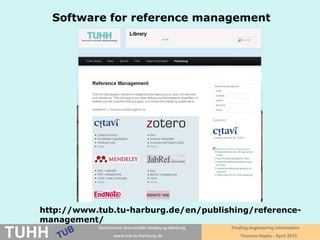
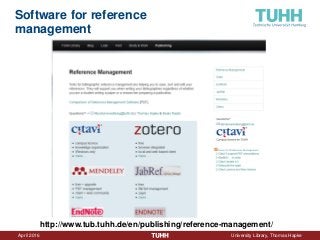
Software for reference
management
http://www.tub.tuhh.de/en/publishing/reference-management/
April 2016 University Library, Thomas Hapke
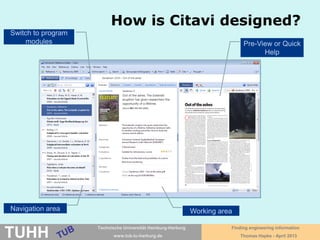
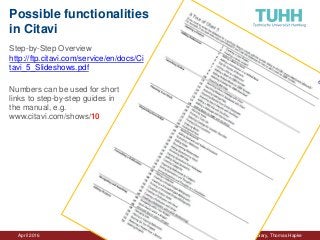
Possible functionalities
in Citavi
Step-by-Step Overview
http://ftp.citavi.com/service/en/docs/Ci
tavi_5_Slideshows.pdf
Numbers can be used for short
links to step-by-step guides in
the manual, e.g.
www.citavi.com/shows/10
April 2016 University Library, Thomas Hapke
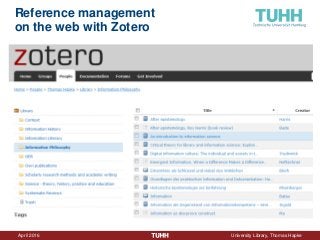
Reference management
on the web with Zotero
April 2016 University Library, Thomas Hapke
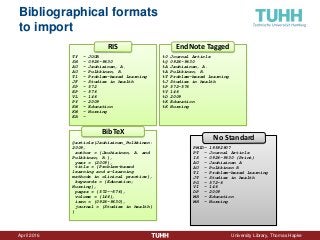
Bibliographical formats
to import
TY - JOUR
SN - 0926-9630
AU - Jauhiainen, A.
AU - Pulkkinen, R.
T1 - Problem-based learning
JF - Studies in health
SP - 572
EP - 576
VL - 146
PY - 2009
KW - Education
KW - Nursing
ER -
RIS
%0 Journal Article
%@ 0926-9630
%A Jauhiainen, A.
%A Pulkkinen, R.
%T Problem-based learning
%J Studies in health
%P 572-576
%V 146
%D 2009
%K Education
%K Nursing
EndNote Tagged
@article{Jauhiainen_Pulkkinen:
2009,
author = {Jauhiainen, A. and
Pulkkinen, R.},
year = {2009},
title = {Problem-based
learning and e-learning
methods in clinical practice},
keywords = {Education;
Nursing},
pages = {572--576},
volume = {146},
issn = {0926-9630},
journal = {Studies in health}
}
BibTeX
PMID- 19592907
PT - Journal Article
IS - 0926-9630 (Print)
AU - Jauhiainen A
AU - Pulkkinen R
TI - Problem-based learning
JT - Studies in health
PG - 572-6
VI - 146
DP - 2009
MH - Education
MH - Nursing
No Standard
April 2016 University Library, Thomas Hapke
Types of Citation Styles
50
References as
in-text
citations
Author / Date
(Doe, Smith 2009:
14)
Reference
number
[34]
Citation Key
[DoS09:14]
References as
footnotes
Author / Date
Doe, Smith 2009: 14
Full citation
Jane Doe, Mia
Smith: E-Learning.
London 2009, p. 14
Full citation in footnotes sometimes
called „Oxford System“.
Known style = Chicago-Manual of Style
Author-Year-System also called
„Harvard System“.
Known style = APA-Style.
April 2016 University Library, Thomas Hapke
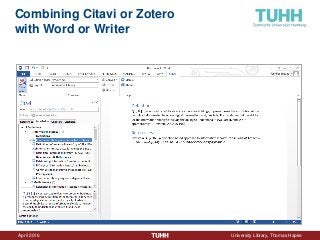
Combining Citavi or Zotero
with Word or Writer
April 2016 University Library, Thomas Hapke
How to reduce uncertainty to miss
important information?
• Using different databases.
• Using subject-specific databases.
• Reflecting on appropriate search terms.
• Knowing how to logically combine search terms
within a specific database interface.
• Keeping treck of results through effective
reference management.
• …
A first summary
April 2016 University Library, Thomas Hapke
Basic rules for citing
1) Used sources have to be quoted.
2) Position of references has to be without any doubt.
3) Cited sources have to be traceable because of bibliographical
description.
4) Consult the original document of your sources!
Don‘t use a citation from a paper without looking at the
original document of the citation.
Avoid secondary citations!
According:
Theuerkauf, Judith: Schreiben im Ingenieurstudium : Effektiv und effizient zur Bachelor-, Master- und
Doktorarbeit. Paderborn : Schöningh, 2012, pp. 86-99.
Biedermann, Wieland et al: Forschungsmethodik in den Ingenieurwissenschaften : Skript vom Lehrstuhl für
Produktentwicklung, Prof. Dr.-Ing. Udo Lindemann, Technische Universität München (TUM), 2012, p. 63.
April 2016 University Library, Thomas Hapke
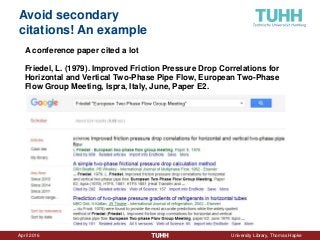
Avoid secondary
citations! An example
A conference paper cited a lot
Friedel, L. (1979). Improved Friction Pressure Drop Correlations for
Horizontal and Vertical Two-Phase Pipe Flow, European Two-Phase
Flow Group Meeting, Ispra, Italy, June, Paper E2.
April 2016 University Library, Thomas Hapke
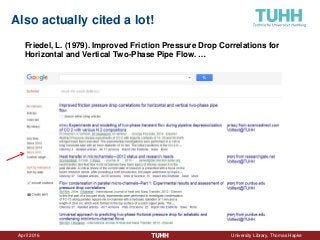
Also actually cited a lot!
Friedel, L. (1979). Improved Friction Pressure Drop Correlations for
Horizontal and Vertical Two-Phase Pipe Flow. …
April 2016 University Library, Thomas Hapke
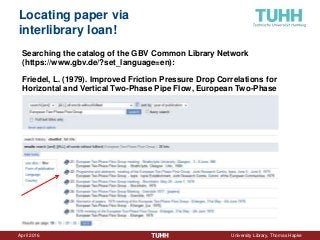
Locating paper via
interlibrary loan!
Searching the catalog of the GBV Common Library Network
(https://www.gbv.de/?set_language=en):
Friedel, L. (1979). Improved Friction Pressure Drop Correlations for
Horizontal and Vertical Two-Phase Pipe Flow, European Two-Phase
Flow Group Meeting, Ispra, Italy, June, Paper E2.
April 2016 University Library, Thomas Hapke
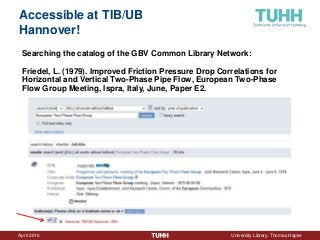
Accessible at TIB/UB
Hannover!
Searching the catalog of the GBV Common Library Network:
Friedel, L. (1979). Improved Friction Pressure Drop Correlations for
Horizontal and Vertical Two-Phase Pipe Flow, European Two-Phase
Flow Group Meeting, Ispra, Italy, June, Paper E2.
April 2016 University Library, Thomas Hapke
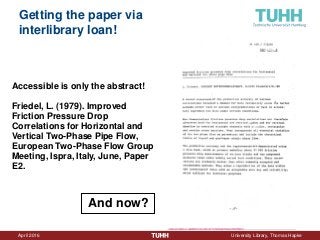
Getting the paper via
interlibrary loan!
Accessible is only the abstract!
Friedel, L. (1979). Improved
Friction Pressure Drop
Correlations for Horizontal and
Vertical Two-Phase Pipe Flow,
European Two-Phase Flow Group
Meeting, Ispra, Italy, June, Paper
E2.
And now?
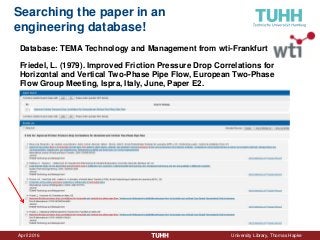
April 2016 University Library, Thomas Hapke
Searching the paper in an
engineering database!
Database: TEMA Technology and Management from wti-Frankfurt
Friedel, L. (1979). Improved Friction Pressure Drop Correlations for
Horizontal and Vertical Two-Phase Pipe Flow, European Two-Phase
Flow Group Meeting, Ispra, Italy, June, Paper E2.
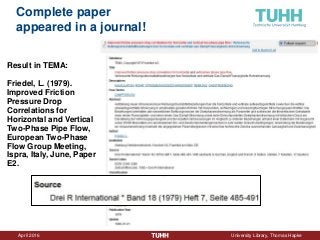
April 2016 University Library, Thomas Hapke
Complete paper
appeared in a journal!
Result in TEMA:
Friedel, L. (1979).
Improved Friction
Pressure Drop
Correlations for
Horizontal and Vertical
Two-Phase Pipe Flow,
European Two-Phase
Flow Group Meeting,
Ispra, Italy, June, Paper
E2.
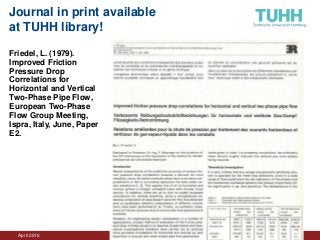
April 2016 University Library, Thomas Hapke
Journal in print available
at TUHH library!
Friedel, L. (1979).
Improved Friction
Pressure Drop
Correlations for
Horizontal and Vertical
Two-Phase Pipe Flow,
European Two-Phase
Flow Group Meeting,
Ispra, Italy, June, Paper
E2.
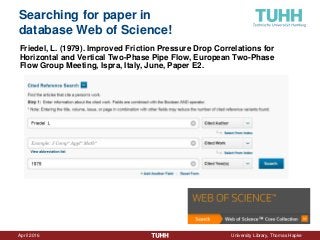
April 2016 University Library, Thomas Hapke
Searching for paper in
database Web of Science!
Friedel, L. (1979). Improved Friction Pressure Drop Correlations for
Horizontal and Vertical Two-Phase Pipe Flow, European Two-Phase
Flow Group Meeting, Ispra, Italy, June, Paper E2.
April 2016 University Library, Thomas Hapke
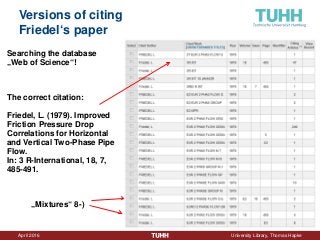
Versions of citing
Friedel‘s paper
Searching the database
„Web of Science“!
The correct citation:
Friedel, L. (1979). Improved
Friction Pressure Drop
Correlations for Horizontal
and Vertical Two-Phase Pipe
Flow.
In: 3 R-International, 18, 7,
485-491.
„Mixtures“ 8-)
April 2016 University Library, Thomas Hapke
Informing – Points to survive
1. Orientation before searching.
2. Don‘t trust only one information source.
3. In case you are asked for your login or for your credit card,
remember the library …
4. When searching: „Bulls*** in, bulls*** out.“
5. When finding information - think already of its further
processing respectively later publication of your
research results.
6. Keeping current …
7. Reflect on information and on your own information behavior
https://www.tub.tuhh.de/en/find/subject-information/informing-points-to-survive/
April 2016 University Library, Thomas Hapke
Info-Tips
April 2016 University Library, Thomas Hapke
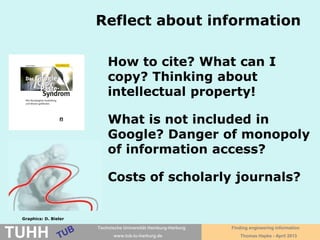
Thinking about
information!
How to cite? What can I copy?
Thinking about intellectual property!
What is not included in Google?
Danger of monopoly of information
access?
Costs of scholarly journals?
April 2016 University Library, Thomas Hapke
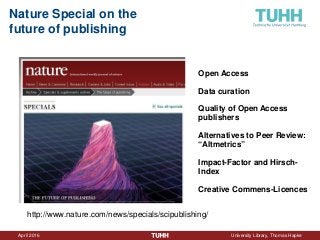
Nature Special on the
future of publishing
http://www.nature.com/news/specials/scipublishing/
Open Access
Data curation
Quality of Open Access
publishers
Alternatives to Peer Review:
“Altmetrics”
Impact-Factor and Hirsch-
Index
Creative Commens-Licences
April 2016 University Library, Thomas Hapke
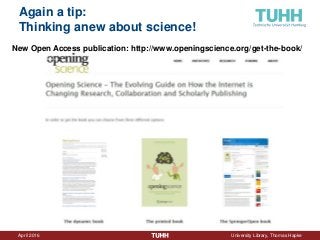
Again a tip:
Thinking anew about science!
New Open Access publication: http://www.openingscience.org/get-the-book/
April 2016 University Library, Thomas Hapke
At the end something general
Some general hints and key competences when managing
information
‣ Be prepared for constant change.
‣ Know your skills and limits!
‣ Tolerate ambiguity and differences.
‣ Don‘t give up too early.
‣ Be aware that every fact is the result of an act, that information
has been created by somebody with a certain purpose.
According: T. Hapke: Informationskompetenz in einer neuen Informationskultur. In:
Handbuch Informationskompetenz, S. 36-48. Ed. W. Sühl-Strohmenger. Berlin: De Gruyter
Saur, 2012.
April 2016 University Library, Thomas Hapke
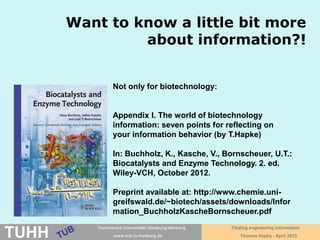
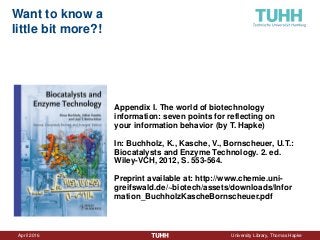
Want to know a
little bit more?!
Appendix I. The world of biotechnology
information: seven points for reflecting on
your information behavior (by T. Hapke)
In: Buchholz, K., Kasche, V., Bornscheuer, U.T.:
Biocatalysts and Enzyme Technology. 2. ed.
Wiley-VCH, 2012, S. 553-564.
Preprint available at: http://www.chemie.uni-
greifswald.de/~biotech/assets/downloads/Infor
mation_BuchholzKascheBornscheuer.pdf
April 2016 University Library, Thomas Hapke
Kontakt
Thomas Hapke
• Web: http://www.tuhh.de/b/hapke/
• Blog: http://blog.hapke.de
• Slidespace: http://www.slideshare.net/thapke
• Tweets: http://twitter.com/thapke
Informing – Points to survive at
http://www.tub.tu-harburg.de/en/subject-information/informing-points-to-
survive/

Finding and managing engineering information

  • 1.
    April 2016 UniversityLibrary, Thomas Hapke Finding and managing engineering information Photos: R. Jupitz
  • 2.
    April 2016 UniversityLibrary, Thomas Hapke Information challenges for academic research • How to be more sure not to miss something essential? – Systematically searching for information – Using subject-specific databases • How to get full texts? – Availability in TUHH intranet via search engines – The library catalog as search engine • How to cope with information overload? – Using reference managent software like Citavi Curiosity! Doubt! Graphics: D. Bieler
  • 3.
    April 2016 UniversityLibrary, Thomas Hapke • Ullmann's encyclopedia of industrial chemistry (6. ed., 2002, 40 vols.) Online in TUHH intranet (2016 ed.)! • Comprehensive renewable energy (2013, 8 vols) Online in TUHH intranet! • Handbook of loss prevention engineering (2013) Online in TUHH intranet! • Encyclopedia of tribology (2013) Online in TUHH intranet! • Encyclopedia of complexity and systems science (2009) Online in TUHH intranet! • Encyclopedia of optimization (2009) Online in TUHH intranet! • Wiley encyclopedia of computer science and engineering (2009) • Encyclopedia of nanoscience and society (2010, 2 vols.) Using encyclopedias and reference works for orientation!
  • 4.
    April 2016 UniversityLibrary, Thomas Hapke Subject gateways U.S. National Center for Biotechnology Information http://www.ncbi.nlm.nih.gov http://www.econbiz.de A printed source: Using the engineering literature / Bonnie A. Osif. 2. ed. 2012. Shelf number for reference copy: TEA-804 https://www.tib.eu/en/
  • 5.
    April 2016 UniversityLibrary, Thomas Hapke Orientation: Subject information Process engineering @TUBHH http://www.tub.tuhh.de/en/subject-information/process-and-chemical-engineering/
  • 6.
    April 2016 UniversityLibrary, Thomas Hapke Informing – Points to survive 1. Orientation before searching. 2. Don‘t trust only one information source. How to be more sure not to miss something essential?
  • 7.
    April 2016 UniversityLibrary, Thomas Hapke Beyond Google! FindING @ TUHH-Bibliothek First orientation Catalog Actual research information Specials Reference databases for journal articles: TEMA, Web of Science Civil engineering: RSWB, TEMA Electrical engeineering: Inspec, TEMA, (IEEE) Mechanical engineering: TEMA, Web of Science Process engineering: Web of Science, TEMA Business sciences: TEMA, Business Source Premier, WISO Library website: http://www.tub.tu-harburg.de/en/ Subject groups in reading room Encyclopedias and other reference works Media - digital (TUHH intranet!) or printed (reading rooms, closed stacks) https://katalog.tub.tu-harburg.de/?mylang=en German DIN standards online! Patents: Esp@cenet, DEPATISnet Interlibrary loan and document delivery
  • 8.
    April 2016 UniversityLibrary, Thomas Hapke Dimensions of finding How? Adopted from: Sheila Corrall, John Dove: Web scale discovery and information literacy: competing visions or mutual support? LILAC 2012, Glasgow. http://de.slideshare.net/infolit_group/corrall-dove) Approved scholarly content What? Open web content Single search box Advanced search options Google Scholar Where? Local availability! Specialized databases with costs: Web of Science, Inspec, wti
  • 9.
    April 2016 UniversityLibrary, Thomas Hapke The TUHH Library Closed Stacks Readings rooms • Reference works and Encyclopedias • Journals • Subject groups • Textbook collection Digital Library • Online-Books • E-Journals • Databases Picture: D. Bieler The catalog – the heart of the library! Access to complete holdings!
  • 10.
    April 2016 UniversityLibrary, Thomas Hapke TUBfind The library catalog as search engine
  • 11.
    April 2016 UniversityLibrary, Thomas Hapke TUBfind – simply more! • Search engine to find TUHH library holdings and more • Including also journal articles • Also for searching within library website and library weblog • In addition finding resources of the GBV Common Library Network – to order via interlibrary loan • Search philosophy: Best hits, relevance ranking • Sorting according descending date possible • Filtering according format, language, author
  • 12.
    April 2016 UniversityLibrary, Thomas Hapke Finding books, also online books!
  • 13.
    April 2016 UniversityLibrary, Thomas Hapke Finding journal articles!
  • 14.
    April 2016 UniversityLibrary, Thomas Hapke Looking for books http://www.ubka.uni-karlsruhe.de/kvk.html GVK - GBV Union Catalogue http://gso.gbv.de/DB=2.1/LNG=EN/ http://www.worldcat.org/ Local library catalog, e.g. from the TUHH library https://katalog.tub.tuhh.de/?mylang=en Regional Catalogue of Hamburg http://gso.gbv.de/DB=2.91/LNG=EN/ http://books.google.com http://beluga.hamburg
  • 15.
    April 2016 UniversityLibrary, Thomas Hapke Finding journal articles via subject-specific databases Web of Science with Science Citation Index - interdisciplinary! Who cited a specific document? How much is a document cited? TEMA (Technology and Management), wti Frankfurt, formerly Fachinformationszentrum (FIZ) Technik (Access to these reference databases only within TUHH intranet) PubMed
  • 16.
    April 2016 UniversityLibrary, Thomas Hapke Full texts of  IEEE, IEE and IET journals  IEEE, IEE and IET conference proceedings  IEEE standards (a lot of ANSI standards are included!)  VDE Publisher Conference Proceedings http://ieeexplore.ieee.org (Available within TUHH intranet) IEEE/IEE Electronic Library
  • 17.
    April 2016 UniversityLibrary, Thomas Hapke Differences Seach engines Subject databases • Interdisciplinary sources • Widely intuitively to use • Full text often searchable • Rarely intellectual indexing • Abbrevating of search terms automatically („stemming“) • Search philosophy: Best hits, relevance ranking • Good for subject-specific searching • Sophisticated stragegies for searching possible • Full text not included in search index • Partially intellectual indexing with descriptors or integrated thesaurus • Abbreviating search terms with wildcard symbol (often *) • Search philosophy: Exact hits, Boolean combination of search terms Use diverse databases and search engines!
  • 18.
    April 2016 UniversityLibrary, Thomas Hapke Database of databases: Subject overview www.bibliothek.uni-regensburg.de/dbinfo/ http://tinyurl.com/DBIS-TUHH (German interface only)
  • 19.
    April 2016 UniversityLibrary, Thomas Hapke Articles’ databases: Diversity and outcome Database GVK-Plus (GBV Common Library Network ) PubMed, TEMA (wti), Web of Science Publishers‘ portals: Wiley, SpringerLink, ScienceDirect Google Scholar, BASE (Bielefeld Acad. Search Engine) Content articles, books, and more Articles, (conference papers) articles, books, book chapters articles, books, files, and more Searchable content bibliographical description bibliographical description, abstracts bibliographical description, abstracts, full text full text Content from printed and electronic holdings of libraries diverse publishers only publisher, here e.g. Springer who knows? 8-) Access to full text directly, through library in print or ordering via interlibary loan through other databases, link resolver or interlibrary loan directly, in case access is part of subscription directly, access maybe restricted
  • 20.
    April 2016 UniversityLibrary, Thomas Hapke About 60 % of the information in patents is not published elsewhere. DEPATISnet - the German patent information system at http://depatisnet.dpma.de esp@cenet – European Patent Office http://worldwide.espacenet.com/ US patents via the US Patent and Trademark Office http://patft.uspto.gov/ https://www.tub.tuhh.de/en/find/patents/ Patents for talents!
  • 21.
    April 2016 UniversityLibrary, Thomas Hapke Searching for substance properties’ data  In reference works (CRC Handbook of Chemistry and Physics, Perry's Chemical Engineers' Handbook, Aldrich Handbook)  In extensive substance property collections („Handbooks“) (Landolt-Börnstein Numerical data and functional relationships in science and technology, Gmelin Handbook of Inorganic and Organometallic Chemistry, Beilstein Handbook of Organic Chemistry)  Via the net (e.g. NIST Chemistry WebBook at http://webbook.nist.gov/chemistry/ or the Physical Properties Sources Index (PPSI) at http://www.eqi.ethz.ch/en/ - also: Reaxys, SciFinder, both not @TUHamburg) More: https://www.tub.tuhh.de/en/find/substance-property-data/
  • 22.
    April 2016 UniversityLibrary, Thomas Hapke Specials: Searching for substance properties’ data Data on harzardous substances with safety instructions and data sheets containing operational guidelines and hints to laws (e.g. EU) as well as to compulsory and advisory critical levels in the area of hazardous materials! http://tinyurl.com/merkblaetter
  • 23.
    April 2016 UniversityLibrary, Thomas Hapke Informing – Points to survive 1. Orientation before searching. 2. Don‘t trust only one information source. 3. In case you are asked for your login or for your credit card, remember the library … How to get full text?
  • 24.
    April 2016 UniversityLibrary, Thomas Hapke How to get the full text of this article? Sparrow, B.; Liu, J.; Wegner, D. M. (2011): Google Effects on Memory: Cognitive Consequences of Having Information at Our Fingertip. Science 333, 6043, 776- 778 2011. Access: Online in Internet as author copy How to get the full text in case the author would not have put the article online?
  • 25.
    April 2016 UniversityLibrary, Thomas Hapke How to get the full text of this article? R. Ladenstein, G. Antranikian: Proteins from hyperthermophiles: Stability and enzymatic catalysis close to the boiling point of water. Biotechnology of Extremophiles. 1998, pp. 37 - 85. Access: Printed in a book located in the TUHH reading rooms How found?
  • 26.
    April 2016 UniversityLibrary, Thomas Hapke How to get the full text of this article? Early Modern Information Overload, Daniel Rosenberg, Journal of the History of Ideas 64 (2003) 1, pp. 1-9 10.1353/jhi.2003.0017 Access: Full text from TUHH only available via interlibrary loan! How to do interlibrary loan? What does the character string at the end of the citation mean?
  • 27.
    April 2016 UniversityLibrary, Thomas Hapke How to get the full text of this article? Access not possible via publisher‘s website within TUHH intranet. Catalog links to fulltext via GetInfo at TIB Hannover! Merajver, S. D.; Yorke, E. D.; Rocco, A. G. de. Random- walk model of the phase transition of hydrocarbon chains on a lattice. Physical Review A (General Physics) 1981, 23 (2), 897–907
  • 28.
    April 2016 UniversityLibrary, Thomas Hapke „On the shoulders of“ Google Scholar Ca. 1410 Quelle: http://lccn.loc.gov/50041709
  • 29.
    April 2016 UniversityLibrary, Thomas Hapke Google Scholar http://scholar.google.com Finding full texts
  • 30.
    April 2016 UniversityLibrary, Thomas Hapke Via linking service to the catalog!
  • 31.
    April 2016 UniversityLibrary, Thomas Hapke From Google Scholar to the printed book! Classical interface of the catalog!
  • 32.
    April 2016 UniversityLibrary, Thomas Hapke A further example Google Scholar http://scholar.google.com
  • 33.
    April 2016 UniversityLibrary, Thomas Hapke Request for interlibrary loan!
  • 34.
    April 2016 UniversityLibrary, Thomas Hapke Ordering interlibrary loan via GBV database
  • 35.
    April 2016 UniversityLibrary, Thomas Hapke Request for copy! Ordering!
  • 36.
    April 2016 UniversityLibrary, Thomas Hapke Interlibrary loan via library union network Interlibrary loan for material not owned by the TUHH library! Use the databases of the GBV Common Library Network to locate material! Fee 1,50 € for one article (copy) or book.
  • 37.
    April 2016 UniversityLibrary, Thomas Hapke Request details already filled!
  • 38.
    April 2016 UniversityLibrary, Thomas Hapke Function of Link Resolvers Cited source Link Resolver Source of full text Knowledge base with local holdings data Catalog data, maintenance through library Meta data (in OpenURL) URL of source, e.g. DOI (in OpenURL) Search in catalog, interlibrary loan database Meta data (in OpenURL)
  • 39.
    April 2016 UniversityLibrary, Thomas Hapke Informing – Points to survive 1. Orientation before searching. 2. Don‘t trust only one information source. 3. In case you are asked for your login or for your credit card, remember the library … 4. When searching: „Bulls*** in, bulls*** out.“ Think about search terms you use and their variations and synonyms. Poorly chosen search terms bring poor search results. Too general key words lead to too many hits from which often only a fraction is useful; when using too specific key words, important information might not be found.
  • 40.
    April 2016 UniversityLibrary, Thomas Hapke Play! With search terms! Make a search term diagram! Topic: Microbial degradation of aromatic compounds in soil Component 1 Component 2 Component 3 Microbi* degrad* aromat* soil* Biodegrad* Polyaromat* Clay* Bioremed* Benzene compost* Microbi* decompos* PAH sediment* Mikrobiol* abbau* Naphthalin Boden* Böden Component 1 AND Component 2 AND Component 3 where e.g. Component 1 = (“microbi* degrad*”) OR biodegrad* OR bioremed* OR...
  • 41.
    April 2016 UniversityLibrary, Thomas Hapke Play! With search terms! Make a search term diagram: Topic: Recycling of plastics by biotechnological methods Component 1 Component 2 Component 3 Recycl* Plasti* biotech* reuse polymer* Biodegrad* Wiederverw* Kunststoff* Microbi* Verwert* PVC Component 1 AND Component 2 AND Component 3 where e.g. Component 2 = (plasti* OR polymer* OR kunststoff* OR...
  • 42.
    April 2016 UniversityLibrary, Thomas Hapke Playing with search terms in Web of Science www.bibliothek.uni-regensburg.de/dbinfo/
  • 43.
    April 2016 UniversityLibrary, Thomas Hapke Play! With databases! Explore database features: • Boolean logic • Wildcard symbols: * ? $ • “Neighborhood operators”: Context and phrases • Search fields: Basic index, author field, descriptor or thesaurus fields
  • 44.
    April 2016 UniversityLibrary, Thomas Hapke Informing – Points to survive 1. Orientation before searching. 2. Don‘t trust only one information source. 3. In case you are asked for your login or for your credit card, remember the library … 4. When searching: „Bulls*** in, bulls*** out.“ 5. When finding information - think already of its further processing, respectively later publication of your research results. How to cope with information overload?
  • 45.
    April 2016 UniversityLibrary, Thomas Hapke Reference management is no art! Matej Krén, Idiom, Town Library Prague (1998), Photo 2009 Today not searching or finding is the main problem, but coping with information overload!
  • 46.
    April 2016 UniversityLibrary, Thomas Hapke Software for reference management http://www.tub.tuhh.de/en/publishing/reference-management/
  • 47.
    April 2016 UniversityLibrary, Thomas Hapke Possible functionalities in Citavi Step-by-Step Overview http://ftp.citavi.com/service/en/docs/Ci tavi_5_Slideshows.pdf Numbers can be used for short links to step-by-step guides in the manual, e.g. www.citavi.com/shows/10
  • 48.
    April 2016 UniversityLibrary, Thomas Hapke Reference management on the web with Zotero
  • 49.
    April 2016 UniversityLibrary, Thomas Hapke Bibliographical formats to import TY - JOUR SN - 0926-9630 AU - Jauhiainen, A. AU - Pulkkinen, R. T1 - Problem-based learning JF - Studies in health SP - 572 EP - 576 VL - 146 PY - 2009 KW - Education KW - Nursing ER - RIS %0 Journal Article %@ 0926-9630 %A Jauhiainen, A. %A Pulkkinen, R. %T Problem-based learning %J Studies in health %P 572-576 %V 146 %D 2009 %K Education %K Nursing EndNote Tagged @article{Jauhiainen_Pulkkinen: 2009, author = {Jauhiainen, A. and Pulkkinen, R.}, year = {2009}, title = {Problem-based learning and e-learning methods in clinical practice}, keywords = {Education; Nursing}, pages = {572--576}, volume = {146}, issn = {0926-9630}, journal = {Studies in health} } BibTeX PMID- 19592907 PT - Journal Article IS - 0926-9630 (Print) AU - Jauhiainen A AU - Pulkkinen R TI - Problem-based learning JT - Studies in health PG - 572-6 VI - 146 DP - 2009 MH - Education MH - Nursing No Standard
  • 50.
    April 2016 UniversityLibrary, Thomas Hapke Types of Citation Styles 50 References as in-text citations Author / Date (Doe, Smith 2009: 14) Reference number [34] Citation Key [DoS09:14] References as footnotes Author / Date Doe, Smith 2009: 14 Full citation Jane Doe, Mia Smith: E-Learning. London 2009, p. 14 Full citation in footnotes sometimes called „Oxford System“. Known style = Chicago-Manual of Style Author-Year-System also called „Harvard System“. Known style = APA-Style.
  • 51.
    April 2016 UniversityLibrary, Thomas Hapke Combining Citavi or Zotero with Word or Writer
  • 52.
    April 2016 UniversityLibrary, Thomas Hapke How to reduce uncertainty to miss important information? • Using different databases. • Using subject-specific databases. • Reflecting on appropriate search terms. • Knowing how to logically combine search terms within a specific database interface. • Keeping treck of results through effective reference management. • … A first summary
  • 53.
    April 2016 UniversityLibrary, Thomas Hapke Basic rules for citing 1) Used sources have to be quoted. 2) Position of references has to be without any doubt. 3) Cited sources have to be traceable because of bibliographical description. 4) Consult the original document of your sources! Don‘t use a citation from a paper without looking at the original document of the citation. Avoid secondary citations! According: Theuerkauf, Judith: Schreiben im Ingenieurstudium : Effektiv und effizient zur Bachelor-, Master- und Doktorarbeit. Paderborn : Schöningh, 2012, pp. 86-99. Biedermann, Wieland et al: Forschungsmethodik in den Ingenieurwissenschaften : Skript vom Lehrstuhl für Produktentwicklung, Prof. Dr.-Ing. Udo Lindemann, Technische Universität München (TUM), 2012, p. 63.
  • 54.
    April 2016 UniversityLibrary, Thomas Hapke Avoid secondary citations! An example A conference paper cited a lot Friedel, L. (1979). Improved Friction Pressure Drop Correlations for Horizontal and Vertical Two-Phase Pipe Flow, European Two-Phase Flow Group Meeting, Ispra, Italy, June, Paper E2.
  • 55.
    April 2016 UniversityLibrary, Thomas Hapke Also actually cited a lot! Friedel, L. (1979). Improved Friction Pressure Drop Correlations for Horizontal and Vertical Two-Phase Pipe Flow. …
  • 56.
    April 2016 UniversityLibrary, Thomas Hapke Locating paper via interlibrary loan! Searching the catalog of the GBV Common Library Network (https://www.gbv.de/?set_language=en): Friedel, L. (1979). Improved Friction Pressure Drop Correlations for Horizontal and Vertical Two-Phase Pipe Flow, European Two-Phase Flow Group Meeting, Ispra, Italy, June, Paper E2.
  • 57.
    April 2016 UniversityLibrary, Thomas Hapke Accessible at TIB/UB Hannover! Searching the catalog of the GBV Common Library Network: Friedel, L. (1979). Improved Friction Pressure Drop Correlations for Horizontal and Vertical Two-Phase Pipe Flow, European Two-Phase Flow Group Meeting, Ispra, Italy, June, Paper E2.
  • 58.
    April 2016 UniversityLibrary, Thomas Hapke Getting the paper via interlibrary loan! Accessible is only the abstract! Friedel, L. (1979). Improved Friction Pressure Drop Correlations for Horizontal and Vertical Two-Phase Pipe Flow, European Two-Phase Flow Group Meeting, Ispra, Italy, June, Paper E2. And now?
  • 59.
    April 2016 UniversityLibrary, Thomas Hapke Searching the paper in an engineering database! Database: TEMA Technology and Management from wti-Frankfurt Friedel, L. (1979). Improved Friction Pressure Drop Correlations for Horizontal and Vertical Two-Phase Pipe Flow, European Two-Phase Flow Group Meeting, Ispra, Italy, June, Paper E2.
  • 60.
    April 2016 UniversityLibrary, Thomas Hapke Complete paper appeared in a journal! Result in TEMA: Friedel, L. (1979). Improved Friction Pressure Drop Correlations for Horizontal and Vertical Two-Phase Pipe Flow, European Two-Phase Flow Group Meeting, Ispra, Italy, June, Paper E2.
  • 61.
    April 2016 UniversityLibrary, Thomas Hapke Journal in print available at TUHH library! Friedel, L. (1979). Improved Friction Pressure Drop Correlations for Horizontal and Vertical Two-Phase Pipe Flow, European Two-Phase Flow Group Meeting, Ispra, Italy, June, Paper E2.
  • 62.
    April 2016 UniversityLibrary, Thomas Hapke Searching for paper in database Web of Science! Friedel, L. (1979). Improved Friction Pressure Drop Correlations for Horizontal and Vertical Two-Phase Pipe Flow, European Two-Phase Flow Group Meeting, Ispra, Italy, June, Paper E2.
  • 63.
    April 2016 UniversityLibrary, Thomas Hapke Versions of citing Friedel‘s paper Searching the database „Web of Science“! The correct citation: Friedel, L. (1979). Improved Friction Pressure Drop Correlations for Horizontal and Vertical Two-Phase Pipe Flow. In: 3 R-International, 18, 7, 485-491. „Mixtures“ 8-)
  • 64.
    April 2016 UniversityLibrary, Thomas Hapke Informing – Points to survive 1. Orientation before searching. 2. Don‘t trust only one information source. 3. In case you are asked for your login or for your credit card, remember the library … 4. When searching: „Bulls*** in, bulls*** out.“ 5. When finding information - think already of its further processing respectively later publication of your research results. 6. Keeping current … 7. Reflect on information and on your own information behavior https://www.tub.tuhh.de/en/find/subject-information/informing-points-to-survive/
  • 65.
    April 2016 UniversityLibrary, Thomas Hapke Info-Tips
  • 66.
    April 2016 UniversityLibrary, Thomas Hapke Thinking about information! How to cite? What can I copy? Thinking about intellectual property! What is not included in Google? Danger of monopoly of information access? Costs of scholarly journals?
  • 67.
    April 2016 UniversityLibrary, Thomas Hapke Nature Special on the future of publishing http://www.nature.com/news/specials/scipublishing/ Open Access Data curation Quality of Open Access publishers Alternatives to Peer Review: “Altmetrics” Impact-Factor and Hirsch- Index Creative Commens-Licences
  • 68.
    April 2016 UniversityLibrary, Thomas Hapke Again a tip: Thinking anew about science! New Open Access publication: http://www.openingscience.org/get-the-book/
  • 69.
    April 2016 UniversityLibrary, Thomas Hapke At the end something general Some general hints and key competences when managing information ‣ Be prepared for constant change. ‣ Know your skills and limits! ‣ Tolerate ambiguity and differences. ‣ Don‘t give up too early. ‣ Be aware that every fact is the result of an act, that information has been created by somebody with a certain purpose. According: T. Hapke: Informationskompetenz in einer neuen Informationskultur. In: Handbuch Informationskompetenz, S. 36-48. Ed. W. Sühl-Strohmenger. Berlin: De Gruyter Saur, 2012.
  • 70.
    April 2016 UniversityLibrary, Thomas Hapke Want to know a little bit more?! Appendix I. The world of biotechnology information: seven points for reflecting on your information behavior (by T. Hapke) In: Buchholz, K., Kasche, V., Bornscheuer, U.T.: Biocatalysts and Enzyme Technology. 2. ed. Wiley-VCH, 2012, S. 553-564. Preprint available at: http://www.chemie.uni- greifswald.de/~biotech/assets/downloads/Infor mation_BuchholzKascheBornscheuer.pdf
  • 71.
    April 2016 UniversityLibrary, Thomas Hapke Kontakt Thomas Hapke • Web: http://www.tuhh.de/b/hapke/ • Blog: http://blog.hapke.de • Slidespace: http://www.slideshare.net/thapke • Tweets: http://twitter.com/thapke Informing – Points to survive at http://www.tub.tu-harburg.de/en/subject-information/informing-points-to- survive/