COUNTRY X (Tier 2 Watch List)
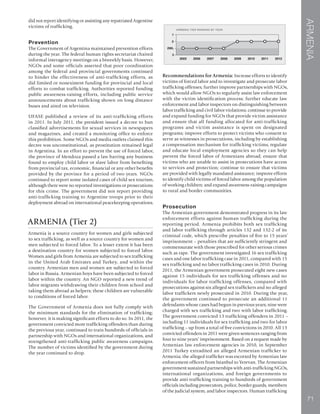
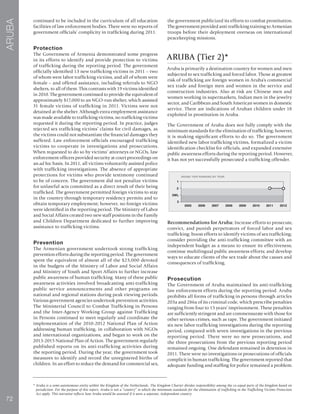
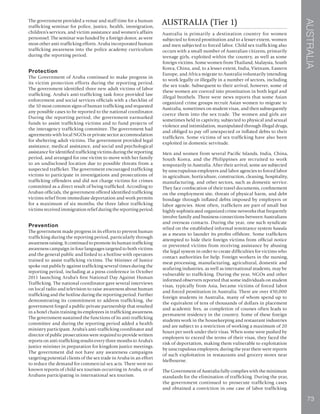
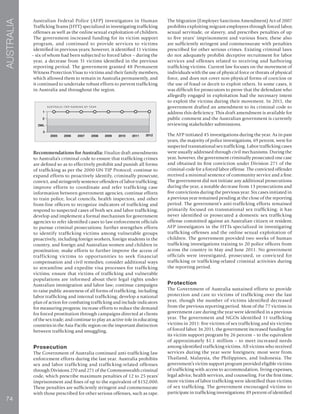
Country X is a transit and destination country for men
and women subjected to forced labor and, to a much lesser
extent, forced prostitution. Men and women from South and
Southeast Asia, East Africa, and the Middle East voluntarily
travel to Country X as laborers and domestic servants, but
some subsequently face conditions indicative of involuntary
servitude. These conditions include threats of serious harm,
including threats of legal action and deportation; withholding
of pay; restrictions on freedom of movement, including the
confiscation of passports and travel documents and physical,
mental, and sexual abuse. In some cases, arriving migrant
workers have found that the terms of employment in Country
X are wholly different from those they agreed to in their home
countries. Individuals employed as domestic servants are
particularly vulnerable to trafficking since they are not covered
under the provisions of the labor law. Country X is also a
destination for women who migrate and become involved in
prostitution, but the extent to which these women are subjected
to forced prostitution is unknown.
The Government of Country X does not fully comply with
the minimum standards for the elimination of trafficking;
however, it is making significant efforts to do so. Although
the government has not yet enacted necessary anti-trafficking
legislation, during the reporting period it reaffirmed its
commitment to this goal over the next year. Despite these
efforts, the government did not show evidence of overall
progress in prosecuting and punishing trafficking offenders
and identifying victims of trafficking; therefore, Country X
is placed on Tier 2 Watch List.
Recommendations for Country X: Enact the draft
comprehensive anti-trafficking legislation; significantly
increase efforts to investigate and prosecute trafficking offenses,
and convict and punish trafficking offenders; institute and
consistently apply formal procedures to identify victims of
trafficking among vulnerable groups, such as those arrested
for immigration violations or prostitution; and collect,
disaggregate, analyze and disseminate counter-trafficking
law enforcement data.
The Government of Country X made minimal efforts to
investigate and prosecute trafficking offenses during the
reporting period. Country X does not prohibit all acts of
trafficking, but it criminalizes slavery under Section 321 and
forced labor under Section 322 of its criminal law. The prescribed
penalty for forced labor – up to six months’ imprisonment – is
not sufficiently stringent. Article 297 prohibits forced or coerced
prostitution, and the prostitution of a child below age 15 even
if there was no compulsion or redress; the prescribed penalty
is up to 15 years’ imprisonment, which is commensurate with
penalties prescribed for other serious crimes, such as rape.
Draft revisions to the penal code have not yet been enacted.
An unconfirmed report indicates that four traffickers were
charged with fraudulently issuing visas to workers who they
then exploited. Two were reportedly deported, and two were
reportedly convicted. The government did not confirm nor
deny the existence of this case. The government did not report
any investigations, prosecutions, convictions, or sentences for
trafficking complicity of public officials.
Country X made minimal progress in protecting victims of
trafficking during the reporting period. Although health
care facilities reportedly refer suspected abuse cases to the
government anti-trafficking shelter for investigation, the
government continues to lack a systematic procedure for law
enforcement to identify victims of trafficking among vulnerable
populations, such as foreign workers awaiting deportation and
women arrested for prostitution; as a result, victims may be
punished and automatically deported without being identified
as victims or offered protection. The government reported
that the MOI has a process by which it refers victims to the
trafficking shelter; however, this process is underutilized in
practice. The trafficking shelter assisted 24 individuals during
the reporting period and provided them with a wide range of
services, including full medical treatment and legal and job
assistance. Country X commonly fines and detains potential
trafficking victims for unlawful acts committed as a direct result
of being trafficked, such as immigration violations and running
away from their sponsors, without determining whether the
individuals are victims of trafficking.
Country X sometimes offers temporary relief from deportation
so that victims can testify as witnesses against their employers.
However, victims were generally not permitted to leave
the country if there is a pending case. The government
did not routinely encourage victims to assist in trafficking
investigations or consistently offer victims alternatives to
removal to countries where they may face retribution or
hardship.
Country X made modest progress in preventing trafficking
in persons during the reporting period. In March, Country X
hosted a two-day regional workshop meant to establish dialog
between scholars, government officials, and stakeholders; to
discuss regional and international efforts to combat TIP; and
how to help victims. While the government made no apparent
effort to amend provisions of Country X‘s sponsorship law
– enacted in March 2009 – to help prevent the forced labor
of migrant workers, the government did start to enforce
other parts of the law to the benefit of migrant workers. One
provision in the sponsorship law continues to require foreign
workers to request exit permits from their sponsors in order
to leave Country X. Although this may increase migrant
workers’ vulnerability to forced labor, the law created a new
process through which a laborer who was not granted an exit
permit due to a sponsor’s refusal or other circumstances can
seek one by other means. The government has a national
plan of action to address trafficking in persons, but did not
publicly disseminate the plan or take steps to implement it
during the reporting period. The government did not take any
public awareness campaigns aimed at reducing the demand
for commercial sex acts in Country X, but the government
undertook public awareness campaigns, but the government
convicted two of its nationals for soliciting children for sex in
other countries and sentenced them to 10 years’ imprisonment.
individuals are victims of trafficking.
Country X commonly fines and detains potentialnd
trafficking victims for unlawful acts committed as a direct resulti
of being trafficked, such as immigration violations and running
away from their sponsors, without determining whether the
that the MOI has a process by which it refers victims to theim
trafficking shelter; however, this process is underutilized ineru
practice.
did not routinely encourage victims to assist in trafficking
investigations or consistently offer victims alternatives to
removal to countries where they may face retribution or
The government
government continues to lack a systematic procedure for law
eenforcement to identify victims of trafficking among vulnerablee
populations,
effort to amend provisions of Country X‘s sponsorship law
– enacted in March 2009 – to help prevent the forced labor
of migrant workers, the government did start to enforce
other parts of the law to the benefit of migrant workers.
While the government made no apparent
The government did not take any
undertook public awareness campaigns, but the government
convicted two of its nationals for soliciting children for sex in
other countries and sentenced them to 10 years’ imprisonment.
public awareness campaigns aimed at reducing the demand
for commercial sex acts in Country X, but the government
The government did not report
efforts, the government did not show evidence of overall
progress in prosecuting and punishing trafficking offenders
and identifying victims of trafficking; therefore, Country X
Despite these
Country X does not prohibit all acts of
An unconfirmed report indicates that four traffickers were
is up to 15 years’ imprisonment, which is commensurate with
penalties prescribed for other serious crimes, such as rape.
not sufficiently stringent. Article 297 prohibits forced or coerced
penalty for forced labor – up to six months’ imprisonment – is
forced labor under Section 322 of its criminal law. The prescribed
trafficking, but it criminalizes slavery under Section 321 and
if there was no compulsion or redress; the prescribed penalty
then exploited.
charged with fraudulently issuing visas to workers who they
any investigations, prosecutions, convictions, or sentences for
prostitution, and the prostitution of a child below age 15 even
trafficking complicity of public officials.
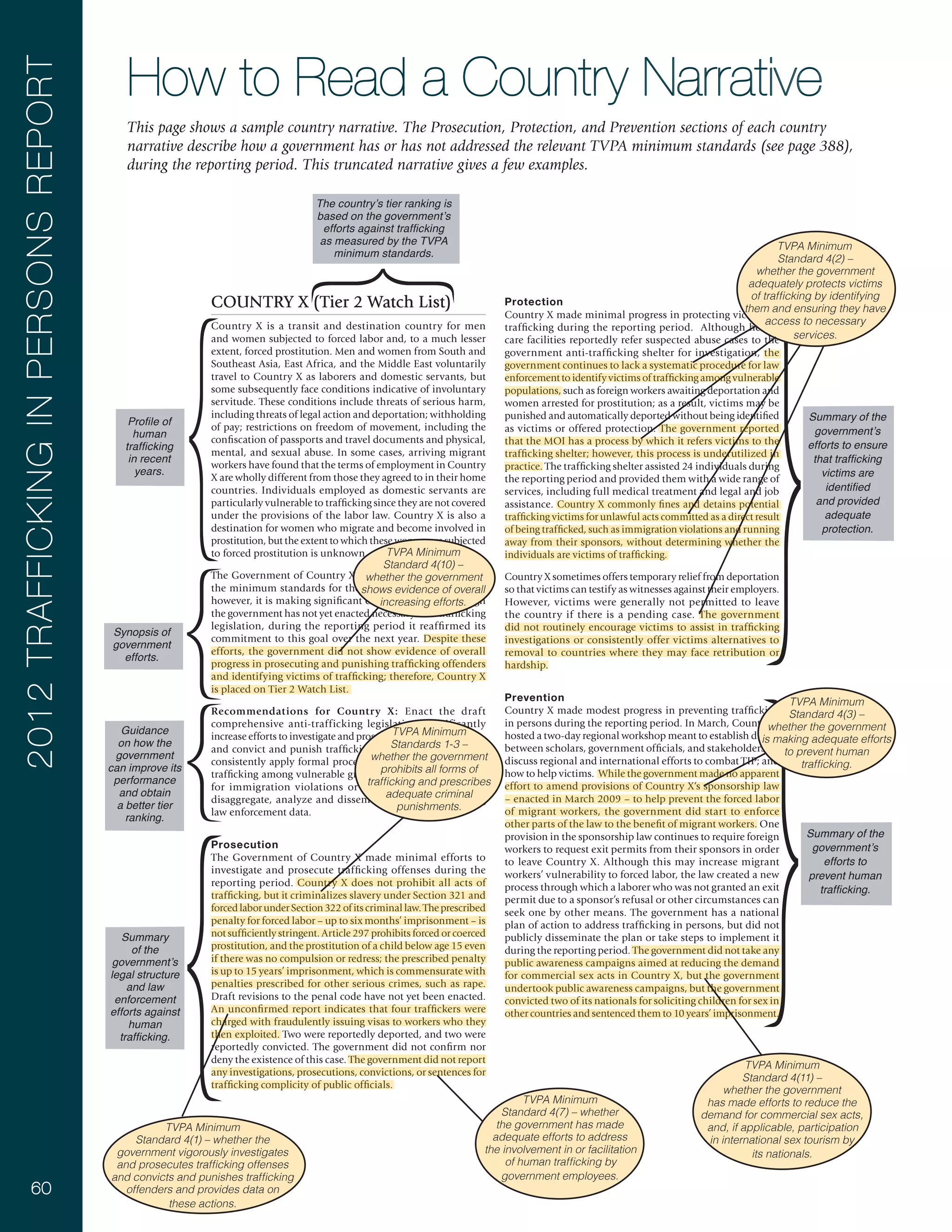
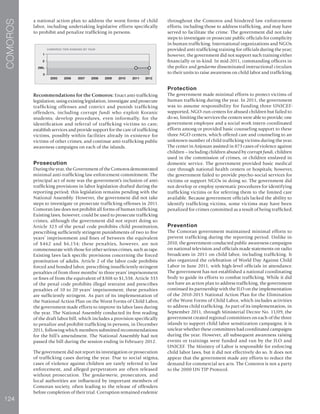
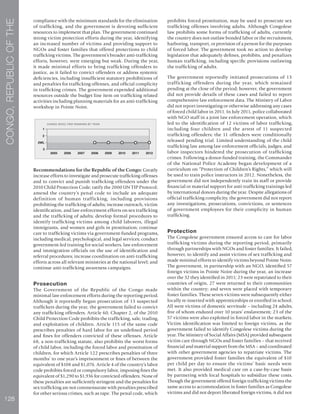
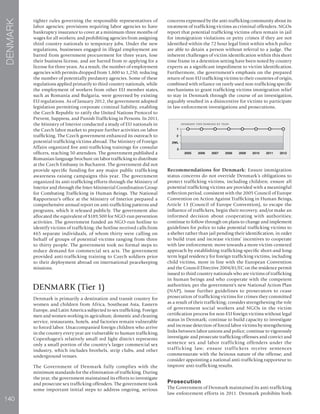
The country’s tier ranking is
based on the government’s
e orts against tra cking
as measured by the TVPA
minimum standards.
Pro e o
human
tra cking
in recent
years.
Guidance
on how the
government
can improve its
performance
and obtain
a better tier
ranking.
Synopsis of
government
efforts.
Summary
of the
government’s
ega structure
and aw
enforcement
efforts against
human
traf cking.
Summary of the
government’s
efforts to ensure
that traf cking
victims are
identi ed
and provided
adequate
protection.
Summary of the
government’s
efforts to
prevent human
traf cking.
TVPA Minimum
Standard 4(10) –
whether the government
shows evidence of overall
increasing efforts.
TVPA Minimum
Standards 1-3 –
whether the government
prohibits all forms of
traf c ing and prescribes
adequate criminal
punishments.
TVPA Minimum
Standard 4(1) – whether the
government vigorously investigates
and prosecutes traf c ing offenses
and convicts and punishes traf c ing
offenders and provides data on
these actions.
TVPA Minimum
Standard 4(11) –
whether the government
has made efforts to reduce the
demand for commercial sex acts,
and, if applicable, participation
in international sex tourism by
its nationals.
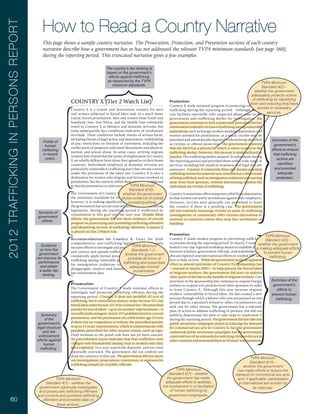
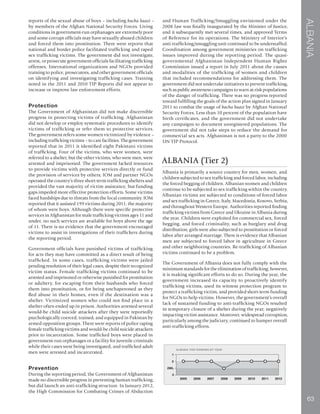
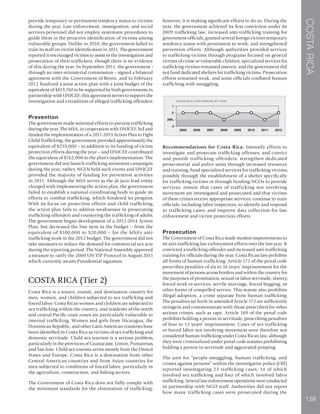
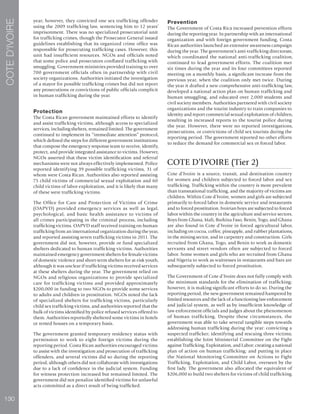
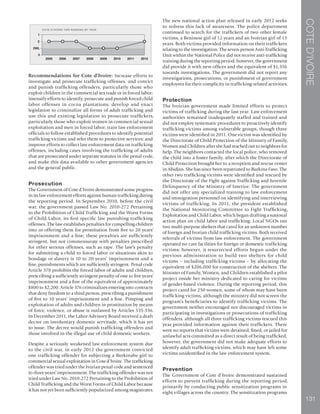
This page shows a sample country narrative. The Prosecution, Protection, and Prevention sections of each country
narrative describe how a government has or has not addressed the relevant TVPA minimum standards (see page 388),
during the reporting period. This truncated narrative gives a few examples.
TVPA Minimum
Standard 4(2) –
whether the government
adequately protects victims
of traf c ing by identifying
them and ensuring they have
access to necessary
services.
TVPA Minimum
Standard 4(7) – whether
the government has made
adequate efforts to address
the involvement in or facilitation
of human traf c ing by
government employees.
is placed on Tier 2 Watch List.
the
reportedThe government rerep
hardship.
TVPA Minimum
Standard 4(3) –
whether the government
is ma ing adequate efforts
to prevent human
traf c ing.
COUNTRYNARRATIVES
61
COUNTRY
NARRATIVES
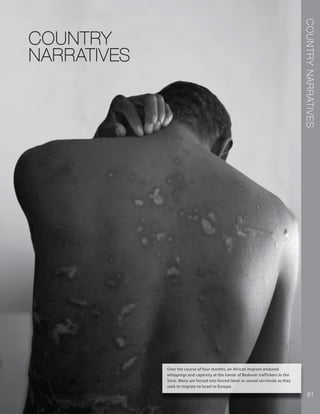
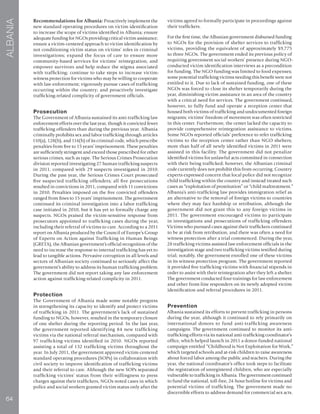
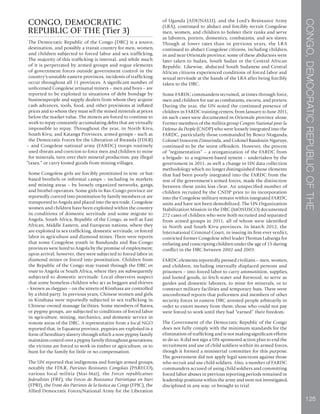
Over the course of four months, an African migrant endured
whippings and captivity at the hands of Bedouin traffickers in the
Sinai. Many are forced into forced labor or sexual servitude as they
seek to migrate to Israel or Europe.
62
AFGHANISTAN
AFGHANISTAN
(Tier 2 Watch List)
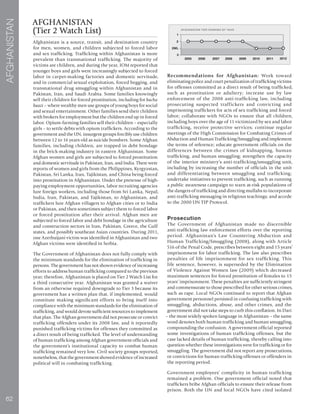
Afghanistan is a source, transit, and destination country
for men, women, and children subjected to forced labor
and sex trafficking. Trafficking within Afghanistan is more
prevalent than transnational trafficking. The majority of
victims are children, and during the year, IOM reported that
younger boys and girls were increasingly subjected to forced
labor in carpet-making factories and domestic servitude,
and in commercial sexual exploitation, forced begging, and
transnational drug smuggling within Afghanistan and in
Pakistan, Iran, and Saudi Arabia. Some families knowingly
sell their children for forced prostitution, including for bacha
baazi – where wealthy men use groups of young boys for social
and sexual entertainment. Other families send their children
with brokers for employment but the children end up in forced
labor. Opium-farming families sell their children – especially
girls – to settle debts with opium traffickers. According to the
government and the UN, insurgent groups forcibly use children
between 12 to 16 years old as suicide bombers. Some Afghan
families, including children, are trapped in debt bondage
in the brick-making industry in eastern Afghanistan. Some
Afghan women and girls are subjected to forced prostitution
and domestic servitude in Pakistan, Iran, and India. There were
reports of women and girls from the Philippines, Kyrgyzstan,
Pakistan, Sri Lanka, Iran, Tajikistan, and China being forced
into prostitution in Afghanistan. Under the pretense of high-
paying employment opportunities, labor recruiting agencies
lure foreign workers, including those from Sri Lanka, Nepal,
India, Iran, Pakistan, and Tajikistan, to Afghanistan, and
traffickers lure Afghan villagers to Afghan cities or to India
or Pakistan, and then sometimes subject them to forced labor
or forced prostitution after their arrival. Afghan men are
subjected to forced labor and debt bondage in the agriculture
and construction sectors in Iran, Pakistan, Greece, the Gulf
states, and possibly southeast Asian countries. During 2011,
one Azerbaijani victim was identified in Afghanistan and two
Afghan victims were identified in Serbia.
The Government of Afghanistan does not fully comply with
the minimum standards for the elimination of trafficking in
persons. The government has not shown evidence of increasing
efforts to address human trafficking compared to the previous
year; therefore, Afghanistan is placed on Tier 2 Watch List for
a third consecutive year. Afghanistan was granted a waiver
from an otherwise required downgrade to Tier 3 because its
government has a written plan that, if implemented, would
constitute making significant efforts to bring itself into
compliance with the minimum standards for the elimination of
trafficking, and would devote sufficient resources to implement
that plan. The Afghan government did not prosecute or convict
trafficking offenders under its 2008 law, and it reportedly
punished trafficking victims for offenses they committed as
a direct result of being trafficked. The level of understanding
of human trafficking among Afghan government officials and
the government’s institutional capacity to combat human
trafficking remained very low. Civil society groups reported,
nonetheless, that the government showed evidence of increased
political will in combating trafficking.
Recommendations for Afghanistan: Work toward
eliminating police and court penalization of trafficking victims
for offenses committed as a direct result of being trafficked,
such as prostitution or adultery; increase use by law
enforcement of the 2008 anti-trafficking law, including
prosecuting suspected traffickers and convicting and
imprisoning traffickers for acts of sex trafficking and forced
labor; collaborate with NGOs to ensure that all children,
including boys over the age of 11 victimized by sex and labor
trafficking, receive protective services; continue regular
meetings of the High Commission for Combating Crimes of
Abduction and Human Trafficking/Smuggling and implement
the terms of reference; educate government officials on the
differences between the crimes of kidnapping, human
trafficking, and human smuggling; strengthen the capacity
of the interior ministry’s anti-trafficking/smuggling unit,
including by increasing the number of officials in the unit
and differentiating between smuggling and trafficking;
undertake initiatives to prevent trafficking, such as running
a public awareness campaign to warn at-risk populations of
the dangers of trafficking and directing mullahs to incorporate
anti-trafficking messaging in religious teachings; and accede
to the 2000 UN TIP Protocol.
Prosecution
The Government of Afghanistan made no discernible
anti-trafficking law enforcement efforts over the reporting
period. Afghanistan’s Law Countering Abduction and
Human Trafficking/Smuggling (2008), along with Article
516 of the Penal Code, prescribes between eight and 15 years’
imprisonment for labor trafficking. The law also prescribes
penalties of life imprisonment for sex trafficking. This
life sentence, however, is superseded by the Elimination
of Violence Against Women law (2009) which decreased
maximum sentences for forced prostitution of females to 15
years’ imprisonment. These penalties are sufficiently stringent
and commensurate to those prescribed for other serious crimes,
such as rape. Local NGOs continued to report that Afghan
government personnel persisted in confusing trafficking with
smuggling, abductions, abuse, and other crimes, and the
government did not take steps to curb this conflation. In Dari
– the most widely spoken language in Afghanistan – the same
word denotes both human trafficking and human smuggling,
compounding the confusion. A government official reported
some investigations of human trafficking offenses, but the
case lacked details of human trafficking, thereby calling into
question whether these investigations were for trafficking or for
smuggling. The government did not report any prosecutions,
or convictions for human trafficking offenses or offenders in
the reporting period.
Government employees’ complicity in human trafficking
remained a problem. One government official noted that
traffickers bribe Afghan officials to ensure their release from
prison. Both the UN and local NGOs have cited isolated
63
ALBANIA
reports of the sexual abuse of boys – including bacha baazi –
by members of the Afghan National Security Forces. Living
conditions in government-run orphanages are extremely poor
and some corrupt officials may have sexually abused children
and forced them into prostitution. There were reports that
national and border police facilitated trafficking and raped
sex trafficking victims. The government did not investigate,
arrest, or prosecute government officials facilitating trafficking
offenses. International organizations and NGOs provided
training to police, prosecutors, and other government officials
on identifying and investigating trafficking cases. Training
noted in the 2011 and 2010 TIP Reports did not appear to
increase or improve law enforcement efforts.
Protection
The Government of Afghanistan did not make discernible
progress in protecting victims of trafficking. Afghanistan
did not develop or employ systematic procedures to identify
victims of trafficking or refer them to protective services.
The government refers some women victimized by violence –
including trafficking victims – to care facilities. The government
reported that in 2011 it identified eight Pakistani victims
of trafficking. Four of the victims, who were women, were
referred to a shelter, but the other victims, who were men, were
arrested and imprisoned. The government lacked resources
to provide victims with protective services directly or fund
the provision of services by others; IOM and partner NGOs
operated the country’s three short-term trafficking shelters and
provided the vast majority of victim assistance, but funding
gaps impeded more effective protection efforts. Some victims
faced hardships due to threats from the local community. IOM
reported that it assisted 199 victims during 2011, the majority
of whom were boys. Although there were specific protective
services in Afghanistan for male trafficking victims ages 11 and
under, no such services are available for boys above the age
of 11. There is no evidence that the government encouraged
victims to assist in investigations of their traffickers during
the reporting period.
Government officials have punished victims of trafficking
for acts they may have committed as a direct result of being
trafficked. In some cases, trafficking victims were jailed
pending resolution of their legal cases, despite their recognized
victim status. Female trafficking victims continued to be
arrested and imprisoned or otherwise punished for prostitution
or adultery, for escaping from their husbands who forced
them into prostitution, or for being unchaperoned as they
fled abuse in their homes, even if the destination was a
shelter. Victimized women who could not find place in a
shelter often ended up in prison. Authorities arrested several
would-be child suicide attackers after they were reportedly
psychologically coerced, trained, and equipped in Pakistan by
armed opposition groups. There were reports of police raping
female trafficking victims and would-be child suicide attackers
prior to incarceration. Some trafficked boys were placed in
government-run orphanages or a facility for juvenile criminals
while their cases were being investigated, and trafficked adult
men were arrested and incarcerated.
Prevention
During the reporting period, the Government of Afghanistan
made no discernible progress in preventing human trafficking,
but did launch an anti-trafficking structure. In January 2012,
the High Commission for Combating Crimes of Abduction
and Human Trafficking/Smuggling envisioned under the
2008 law was finally inaugurated by the Minister of Justice,
and it subsequently met several times, and approved Terms
of Reference for its operations. The Ministry of Interior’s
anti-trafficking/smuggling unit continued to be understaffed.
Coordination among government ministries on trafficking
issues improved during the reporting period. The quasi-
governmental Afghanistan Independent Human Rights
Commission issued a report in July 2011 about the causes
and modalities of the trafficking of women and children
that included recommendations for addressing them. The
government did not undertake initiatives to prevent trafficking,
such as public awareness campaigns to warn at-risk populations
of the danger of trafficking. There was no progress reported
toward fulfilling the goals of the action plan signed in January
2011 to combat the usage of bacha baazi by Afghan National
Security Forces. Less than 10 percent of the population have
birth certificates, and the government did not undertake
any campaigns to document unregistered populations. The
government did not take steps to reduce the demand for
commercial sex acts. Afghanistan is not a party to the 2000
UN TIP Protocol.
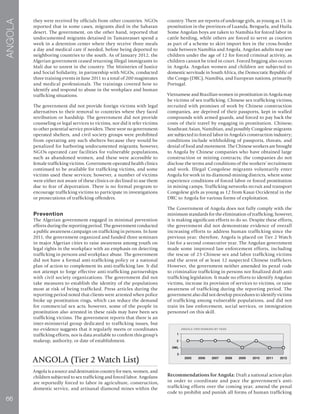
ALBANIA (Tier 2)
Albania is primarily a source country for men, women, and
children subjected to sex trafficking and forced labor, including
the forced begging of children. Albanian women and children
continue to be subjected to sex trafficking within the country.
Albanian victims are subjected to conditions of forced labor
and sex trafficking in Greece, Italy, Macedonia, Kosovo, Serbia,
and throughout Western Europe. Authorities reported finding
trafficking victims from Greece and Ukraine in Albania during
the year. Children were exploited for commercial sex, forced
begging, and forced criminality, such as burglary and drug
distribution; girls were also subjected to prostitution or forced
labor after arranged marriage. There is evidence that Albanian
men are subjected to forced labor in agriculture in Greece
and other neighboring countries. Re-trafficking of Albanian
victims continued to be a problem.
The Government of Albania does not fully comply with the
minimum standards for the elimination of trafficking; however,
it is making significant efforts to do so. During the year, the
government increased its capacity to proactively identify
trafficking victims, used its witness protection program to
protect a trafficking victim, and provided short-term funding
for NGOs to help victims. However, the government’s overall
lack of sustained funding to anti-trafficking NGOs resulted
in temporary closure of a shelter during the year, negatively
impacting victim assistance. Moreover, widespread corruption,
particularly among the judiciary, continued to hamper overall
anti-trafficking efforts.
64
ALBANIA
Recommendations for Albania: Proactively implement the
new standard operating procedures on victim identification
to increase the scope of victims identified in Albania; ensure
adequate funding for NGOs providing critical victim assistance;
ensure a victim-centered approach to victim identification by
not conditioning victim status on victims’ roles in criminal
investigations; expand the focus of care to ensure more
community-based services for victims’ reintegration, and
empower survivors and help reduce the stigma associated
with trafficking; continue to take steps to increase victim-
witness protection for victims who may be willing to cooperate
with law enforcement; vigorously pursue cases of trafficking
occurring within the country; and proactively investigate
trafficking-related complicity of government officials.
Prosecution
The Government of Albania sustained its anti-trafficking law
enforcement efforts over the last year, though it convicted fewer
trafficking offenders than during the previous year. Albania
criminally prohibits sex and labor trafficking through articles
110(a), 128(b), and 114(b) of its criminal code, which prescribe
penalties from five to 15 years’ imprisonment. These penalties
are sufficiently stringent and exceed those prescribed for other
serious crimes, such as rape. The Serious Crimes Prosecution
division reported investigating 27 human trafficking suspects
in 2011, compared with 29 suspects investigated in 2010.
During the past year, the Serious Crimes Court prosecuted
five suspected trafficking offenders; all five prosecutions
resulted in convictions in 2011, compared with 11 convictions
in 2010. Penalties imposed on the five convicted offenders
ranged from fines to 15 years’ imprisonment. The government
continued its criminal investigation into a labor trafficking
case initiated in 2010, but it has yet to formally charge any
suspects. NGOs praised the victim-sensitive response from
prosecutors appointed to trafficking cases during the year,
including their referral of victims to care. According to a 2011
report on Albania produced by the Council of Europe’s Group
of Experts on Action against Trafficking in Human Beings
(GRETA), the Albanian government’s official recognition of the
need to increase the response to internal trafficking has yet to
lead to tangible actions. Pervasive corruption in all levels and
sectors of Albanian society continued to seriously affect the
government’s ability to address its human trafficking problem.
The government did not report taking any law enforcement
action against trafficking-related complicity in 2011.
Protection
The Government of Albania made some notable progress
in strengthening its capacity to identify and protect victims
of trafficking in 2011. The government’s lack of sustained
funding to NGOs, however, resulted in the temporary closure
of one shelter during the reporting period. In the last year,
the government reported identifying 84 new trafficking
victims via the national referral mechanism, compared with
97 trafficking victims identified in 2010. NGOs reported
assisting a total of 132 trafficking victims throughout the
year. In July 2011, the government approved victim-centered
standard operating procedures (SOPs) in collaboration with
civil society to improve identification of trafficking victims
and their referral to care. Although the new SOPs separated
trafficking victims’ status from their willingness to press
charges against their traffickers, NGOs noted cases in which
police and social workers granted victim status only after the
victims agreed to formally participate in proceedings against
their traffickers.
For the first time, the Albanian government disbursed funding
to NGOs for the provision of shelter services to trafficking
victims, providing the equivalent of approximately $9,775
to three NGOs. The government ended its previous policy of
requiring government social workers’ presence during NGO-
conducted victim identification interviews as a precondition
for funding. The NGO funding was limited to food expenses;
some potential trafficking victims needing this benefit were not
entitled to it. Due to lack of sustained funding, one of these
NGOs was forced to close its shelter temporarily during the
year, diminishing victim assistance in an area of the country
with a critical need for services. The government continued,
however, to fully fund and operate a reception center that
housed both victims of trafficking and undocumented foreign
migrants; victims’ freedom of movement was often restricted
in this center. Furthermore, the center lacked the capacity to
provide comprehensive reintegration assistance to victims.
Some NGOs reported officials’ preference to refer trafficking
victims to the reception center rather than NGO shelters;
more than half of all newly identified victims in 2011 were
assisted in this facility. The government did not penalize
identified victims for unlawful acts committed in connection
with their being trafficked; however, the Albanian criminal
code currently does not prohibit this from occurring. Country
experts expressed concern that local police did not recognize
child trafficking within the country and instead treated such
cases as “exploitation of prostitution” or “child maltreatment.”
Albania’s anti-trafficking law provides immigration relief as
an alternative to the removal of foreign victims to countries
where they may face hardship or retribution, although the
government did not grant this to any foreign victims in
2011. The government encouraged victims to participate
in investigations and prosecutions of trafficking offenders.
Victims who pursued cases against their traffickers continued
to be at risk from retribution, and there was often a need for
witness protection after a trial commenced. During the year,
28 trafficking victims assisted law enforcement officials in the
investigation stage and two trafficking victims testified during
trial; notably, the government enrolled one of these victims
in its witness protection program. The government reported
it provided five trafficking victims with financial stipends in
order to assist with their reintegration after they left a shelter.
The government conducted four trainings for law enforcement
and other front-line responders on its newly adopted victim
identification and referral procedures in 2011.
Prevention
Albania sustained its efforts to prevent trafficking in persons
during the year, although it continued to rely primarily on
international donors to fund anti-trafficking awareness
campaigns. The government continued to monitor its anti-
trafficking efforts via its national anti-trafficking coordinator’s
office, which helped launch in 2011 a donor-funded national
campaign entitled “Childhood is Not Exploitation for Work,”
which targeted schools and at-risk children to raise awareness
about forced labor among the public and teachers. During the
year, the national coordinator’s office took steps to facilitate
the registration of unregistered children, who are especially
vulnerable to trafficking in Albania. The government continued
to fund the national, toll-free, 24-hour hotline for victims and
potential victims of trafficking. The government made no
discernible efforts to address demand for commercial sex acts.
ALGERIA
65
ALGERIA (Tier 3)
Algeria is a transit and, to a lesser extent, a destination
and source country for women and, to a lesser extent, men,
subjected to forced labor and sex trafficking. Most commonly,
sub-Saharan African men and women enter Algeria voluntarily
but illegally, often with the assistance of smugglers, for the
purpose of traveling to Europe. Some of these women are
forced into prostitution. Criminal networks which sometimes
extend to sub-Saharan Africa and to Europe are involved
in both smuggling and human trafficking. The “chairmen,”
or leaders, of the “African villages” – small non-Algerian
ethnic enclaves located in and around the southern city
of Tamanrasset – are among those responsible for forcing
women into prostitution. To a lesser extent, some sub-Saharan
African men, mostly from Mali, are forced domestic workers;
homeowners sometimes confiscate identification documents,
indicative of forced labor. Some Algerian women are also
forced into prostitution. Civil society groups believe that as
Europe tightens its borders, Algeria is increasingly becoming a
destination for both undocumented migration and trafficking.
The “cost” – in terms of fees – of a migrant’s trip to and
through Algeria have increased due to a greater crackdown
against undocumented migration. Malians continue to flee
insecurity in Mali and flood into southern Algeria; some of
these migrants could be vulnerable to forced labor or forced
prostitution.
The Government of Algeria does not fully comply with
the minimum standards for the elimination of trafficking
and is not making significant efforts to do so. During the
reporting period, the government sought prosecutions under
its 2009 anti-trafficking law, yet continued to conflate human
trafficking and smuggling. It failed to identify and protect
trafficking victims and continued to lack adequate measures to
protect victims. The government engaged in some awareness
efforts to educate the public about human trafficking and
workplace exploitation.
Recommendations for Algeria: Proactively increase
implementation of Algeria’s anti-trafficking law by continuing
to train law enforcement and judicial officials, investigate
potential offenses, and prosecute alleged offenders; establish
capacity to identify victims of trafficking among illegal
migrants; ensure that trafficking victims are offered necessary
assistance, such as shelter, medical, psychological, and legal
aid; ensure identified victims are not punished for unlawful
acts committed as a direct result of being trafficked; establish
partnerships with relevant international organizations and
NGOs in source countries to ensure the safe and voluntary
repatriation of trafficking victims; train law enforcement,
security, and other government officials on how to identify
trafficking, and measures to protect victims; and expand
existing efforts to increase public awareness of trafficking,
including on the differences between human smuggling and
trafficking.
Prosecution
The Algerian government made minimal efforts to address
human trafficking through law enforcement means during
the reporting period. Algeria prohibits all forms of trafficking
under Section 5 of its criminal code, enacted in March 2009.
Prescribed penalties under this statute range from three
to 10 years’ imprisonment. These penalties are sufficiently
stringent and commensurate with those prescribed under
Algerian law for other serious crimes, such as rape. During the
year, the government reported investigating and prosecuting
offenders under the trafficking law, though it was unclear
whether these were human trafficking or smuggling cases, the
latter of which appear not to come within the scope of the
trafficking in persons law. In March 2012, three individuals
were convicted under the illegal immigration law of smuggling
illegal immigrants from Arzew, Algeria, to Morocco en route
to Europe. According to Algerian officials, those prosecuted
sought to keep the immigrants’ passports and extort higher
transportation fees from them. It was not clear whether the
three were involved in human trafficking. In 2011, an Algerian
man was sentenced in absentia to 10 years’ imprisonment
under Algeria’s anti-trafficking law for operating a network
that moved sub-Saharan migrants from Algeria to Morocco
en route to Europe, which was also not clearly a trafficking
case. Two suspected human trafficking investigations were
reportedly ongoing at the end of the reporting period, but it is
unclear whether these were cases of trafficking or smuggling.
The National Police and National Gendarmerie are reportedly
involved in efforts to combat sex trafficking and forced labor,
but they reported no knowledge of trafficking cases in southern
Algeria. Nonetheless, some African village “chairmen” have
close ties to the Algerian police, and previous reporting has
indicated that some police have released arrested women in
prostitution and sex trafficking victims back to their pimps.
The government provides and funds anti-trafficking sessions
for National Police and National Gendarmerie officials as a
part of their routine training. In October 2011, the National
Police provided a training course on organized crime and
human trafficking for 60 police officers.
Protection
The Government of Algeria made no discernible progress in
protecting victims of trafficking over the last year. It did not
develop or employ systematic procedures for the identification
of trafficking victims among vulnerable populations, such as
foreign women arrested for prostitution or undocumented
migrants. NGOs reported that some trafficking victims were
jailed for unlawful acts committed as a result of their being
trafficked – such as engaging in prostitution or lacking adequate
immigration documentation. Similarly, NGOs indicated that if
a prostitution operation becomes too public, police will arrest
women in prostitution and deport them through Algeria’s
southern border, making no attempt to identify potential sex
trafficking victims. Security officials in Tamanrasset reported
that 8,097 illegal immigrants were picked up and deported
from Algeria during this reporting period. Among these
immigrants, 241 were arrested for crimes, three of which
were charged with prostitution. Security officials made no
effort to screen or identify these immigrants for indications
of trafficking, nor did they provide protection or refer these
victims to service facilities. NGOs reported that deported
migrants, some of whom may have been trafficking victims,
received a liter of milk and some bread and were transported
to desert borders with Mali and Niger where – on occasion –
66
ANGOLA
they were received by officials from other countries. NGOs
reported that in some cases, migrants died in the Saharan
desert. The government, on the other hand, reported that
undocumented migrants detained in Tamanrasset spend a
week in a detention center where they receive three meals
a day and medical care if needed, before being deported to
neighboring countries to the south. As of January 2012, the
Algerian government ceased returning illegal immigrants to
Mali due to unrest in the country. The Ministries of Justice
and Social Solidarity, in partnership with NGOs, conducted
three training events in June 2011 to a total of 200 magistrates
and medical professionals. The trainings covered how to
identify and respond to abuse in the workplace and human
trafficking situations.
The government did not provide foreign victims with legal
alternatives to their removal to countries where they faced
retribution or hardship. The government did not provide
counseling or legal services to victims, nor did it refer victims
to other potential service providers. There were no government-
operated shelters, and civil society groups were prohibited
from operating any such shelters because they would be
penalized for harboring undocumented migrants; however,
NGOs operated care facilities for vulnerable populations,
such as abandoned women, and these were accessible to
female trafficking victims. Government-operated health clinics
continued to be available for trafficking victims, and some
victims used these services; however, a number of victims
were either not aware of these clinics or declined to use them
due to fear of deportation. There is no formal program to
encourage trafficking victims to participate in investigations
or prosecutions of trafficking offenders.
Prevention
The Algerian government engaged in minimal prevention
efforts during the reporting period. The government conducted
a public awareness campaign on trafficking in persons. In June
2011, the government organized and funded three seminars
in major Algerian cities to raise awareness among youth on
legal rights in the workplace with an emphasis on detecting
trafficking in persons and workplace abuse. The government
did not have a formal anti-trafficking policy or a national
plan of action to complement its anti-trafficking law. It did
not attempt to forge effective anti-trafficking partnerships
with civil society organizations. The government did not
take measures to establish the identity of the populations
most at risk of being trafficked. Press articles during the
reporting period noted that clients were arrested when police
broke up prostitution rings, which can reduce the demand
for commercial sex acts; however, some of the people in
prostitution also arrested in these raids may have been sex
trafficking victims. The government reports that there is an
inter-ministerial group dedicated to trafficking issues, but
no evidence suggests that it regularly meets or coordinates
trafficking efforts, nor is data available to confirm this group’s
makeup, authority, or date of establishment.
ANGOLA (Tier 2 Watch List)
Angola is a source and destination country for men, women, and
children subjected to sex trafficking and forced labor. Angolans
are reportedly forced to labor in agriculture, construction,
domestic service, and artisanal diamond mines within the
country. There are reports of underage girls, as young as 13, in
prostitution in the provinces of Luanda, Benguela, and Huila.
Some Angolan boys are taken to Namibia for forced labor in
cattle herding, while others are forced to serve as couriers
as part of a scheme to skirt import fees in the cross-border
trade between Namibia and Angola. Angolan adults may use
children under the age of 12 for forced criminal activity, as
children cannot be tried in court. Forced begging also occurs
in Angola. Angolan women and children are subjected to
domestic servitude in South Africa, the Democratic Republic of
the Congo (DRC), Namibia, and European nations, primarily
Portugal.
Vietnamese and Brazilian women in prostitution in Angola may
be victims of sex trafficking. Chinese sex trafficking victims,
recruited with promises of work by Chinese construction
companies, are deprived of their passports, kept in walled
compounds with armed guards, and forced to pay back the
costs of their travel by engaging in prostitution. Chinese,
Southeast Asian, Namibian, and possibly Congolese migrants
are subjected to forced labor in Angola’s construction industry;
conditions include withholding of passports, threats, and
denial of food and movement. The Chinese workers are brought
to Angola by Chinese companies who have obtained large
construction or mining contracts; the companies do not
disclose the terms and conditions of the workers’ recruitment
and work. Illegal Congolese migrants voluntarily enter
Angola for work in its diamond-mining districts, where some
experience conditions of forced labor or forced prostitution
in mining camps. Trafficking networks recruit and transport
Congolese girls as young as 12 from Kasai Occidental in the
DRC to Angola for various forms of exploitation.
The Government of Angola does not fully comply with the
minimum standards for the elimination of trafficking; however,
it is making significant efforts to do so. Despite these efforts,
the government did not demonstrate evidence of overall
increasing efforts to address human trafficking since the
previous year; therefore, Angola is placed on Tier 2 Watch
List for a second consecutive year. The Angolan government
made some improved law enforcement efforts, including
the rescue of 23 Chinese sex and labor trafficking victims
and the arrest of at least 12 suspected Chinese traffickers.
However, the government neither amended its penal code
to criminalize trafficking in persons nor finalized draft anti-
trafficking legislation. It made no efforts to identify Angolan
victims, increase its provision of services to victims, or raise
awareness of trafficking during the reporting period. The
government also did not develop procedures to identify victims
of trafficking among vulnerable populations, and did not
train its law enforcement, social services, or immigration
personnel on this skill.
Recommendations for Angola: Draft a national action plan
in order to coordinate and pace the government’s anti-
trafficking efforts over the coming year; amend the penal
code to prohibit and punish all forms of human trafficking
ANGOLA
67
and provide sufficient protections for victims; train law
enforcement officials to use existing portions of the penal
code to prosecute and convict trafficking offenders; investigate
and prosecute forced labor abuses in the construction sector;
develop and implement procedures for the identification of
trafficking victims among vulnerable populations; train law
enforcement, social services, and immigration officials in
identification and referral procedures; provide support for the
establishment and maintenance of shelters for trafficking
victims; collect anti-trafficking law enforcement data; and
expand nationwide anti-trafficking public awareness
campaigns.
Prosecution
The Government of Angola modestly increased its anti-
trafficking efforts during the year through the rescue of 23
Chinese nationals and the arrest of at least 12 suspected
trafficking offenders, one of whom remains in jail pending
trial. Angola does not have a law that specifically prohibits
all forms of trafficking, though the constitution promulgated
in February 2010 prohibits human trafficking. The penal
code, in force since 1886, has not yet been amended to reflect
this constitutional provision. Although the government
drafted amendments to the penal code during the reporting
period, they remain pending with the National Assembly for
a second year. Draft comprehensive anti-trafficking legislation
also remains pending with the assembly. Article 71 of the
current penal code prohibits facilitating prostitution, and
Article 406 specifically prohibits child prostitution, imposing
insufficiently stringent penalties of between three months’ and
one year’s imprisonment and a fine. These penalties are not
commensurate with those prescribed for other serious crimes,
such as rape. Article 4 of the General Labor Law prohibits
forced, coerced, or bonded labor, prescribing insufficient
penalties of a fine of between five and 10 times the average
workers’ salary.
Following a phone call from trafficking victims to a foreign
embassy in Luanda, the Special Crimes Unit of the National
Police raided a Chinese construction site in Luanda in April 2011,
arresting an unknown number of supervisors and rescuing
four Chinese trafficking victims. The government charged one
of the alleged trafficking offenders with “organized crime,”
and he remains in prison awaiting trial. However, authorities
have neither sought to rescue and screen an additional 121
Chinese workers reported to be in the same conditions, some of
whom may be trafficking victims, nor investigated forced labor
abuses in Chinese companies in the construction sector. In
November 2011, after receiving a tip from a foreign government,
Angolan authorities apprehended 11 suspected traffickers
for the alleged sex trafficking of 19 Chinese nationals and
extradited them to China. The government took no action to
address allegations of official complicity in trafficking from
previous reporting periods, including allegations that police
and military officials facilitated the illegal entry of Congolese
nationals who subsequently became victims of forced labor or
prostitution in mining camps, as well as allegations military
personnel in Cabinda province purchased more than 30
trafficked women and girls from a sex trafficking ring in
2010. IOM trained 829 officials and 163 service providers on
identifying and protecting trafficking victims; the Ministry of
the Interior supplemented the costs of some of these trainings
held in government facilities and provided office furniture
in an effort to increase the number of officials trained in
these sessions. The government signed a memorandum of
understanding with Zambia in March 2012 to advance a
bilateral partnership on anti-trafficking efforts.
Protection
During the past year, the government sustained modest efforts
to ensure victims of trafficking received access to protective
services, although a systematic process for the identification
of trafficking victims and legal remedies for victims remained
lacking. The government did not report the identification
of any Angolan trafficking victims in 2011. Following their
rescue from a construction site in late April 2011, authorities
placed four Chinese trafficking victims in the care of IOM,
which in the absence of support from the Chinese or Angolan
governments provided shelter, assistance, and repatriation. In
November 2011, the Chinese Embassy in Luanda provided
shelter and assistance to 19 sex trafficking victims and funded
their repatriation to China. There are existing facilities within
Angola that could provide care to trafficking victims, though
there was no evidence victims were referred to these resources
during the reporting period. In partnership with UNICEF, the
National Children’s Council (INAC) oversaw Child Protection
Networks (CPNs) in all 18 provinces that have in the past
rescued victims of trafficking. These CPNs offered health
care, legal and social assistance, and family reunification
for crime victims under the age of 18; however, there was no
evidence that victims used these resources during the reporting
period. The Ministry of Assistance and Social Reintegration,
the Ministry of Family and Women’s Promotion (MINFAM),
and the Organization of Angolan Women operated a limited
number of multi-purpose shelters that trafficking victims
could access, although there were no signs that victims used
these resources during the reporting period. The government
provided extremely limited funding for NGOs in all areas of
social programming; no information was available on the
amount of funding, if any, that it provided to NGOs for anti-
trafficking work during the reporting period.
Law enforcement, immigration, and social services personnel
lacked a formal system of proactively identifying victims of
trafficking among vulnerable groups, including women in
prostitution and illegal immigrants. During the reporting
period, the government did not provide training to these
officials on victim identification procedures. Without
standardized procedures for identifying trafficking victims
among vulnerable populations, some trafficking victims may
have been penalized for unlawful acts committed as a direct
result of being trafficked. During the reporting period, IOM
partnered with the Ministry of the Interior to review manuals
and standard operating procedures on victim identification,
which were developed for the southern African region, to
modify them for use in Angola. The government did not offer
victims long-term assistance and did not provide foreign
victims with temporary residency or other legal alternatives
to their removal to countries where they may face retribution
or hardship. The Ministry of Exterior Relations and MINFAM
are responsible for coordinating the repatriation and providing
assistance to Angolans victimized abroad; it was unclear
whether the government provided such assistance during
the reporting period.
Prevention
The government made limited efforts to prevent trafficking
during the reporting period. The Cross-Sectoral Committee
on Trafficking in Persons, comprised of representatives from
68
ANTIGUAANDBARBUDA
various ministries, exists to coordinate government efforts
against trafficking, although, as in the previous reporting period,
there was no evidence it did so in 2011. The government did not
launch any new anti-trafficking awareness campaigns during
the year. INAC and the Ministry of Social Communication
continued to publish anti-trafficking advertisements in the
press. Through INAC-sponsored seminars throughout 2011,
teachers, students, and traditional community leaders were
sensitized on indicators of child trafficking. The Ministry
of Public Administration, Employment, and Social Security
inspected work sites and fined companies for labor law
violations, but did not identify victims of forced labor. The
government did not make efforts to reduce the demand for
commercial sex acts. Angola is not a party to the 2000 UN
TIP Protocol.
ANTIGUA AND BARBUDA
(Tier 2)
Antigua and Barbuda is a destination and transit country for
men, women, and children subjected to sex trafficking and
forced labor. Legal and undocumented immigrants from the
Caribbean region and Southeast Asia reportedly comprise
the population most vulnerable to trafficking. According to
some sources, forced prostitution occurs in bars and brothels.
Incidences of forced labor have occurred in domestic service,
on farm lands, and in the retail sector.
The Government of Antigua and Barbuda does not fully comply
with the minimum standards for the elimination of trafficking;
however, it is making significant efforts to do so. Despite
limited human and financial resources, the government made
substantial progress during the reporting period in its efforts
to proactively identify human trafficking, protect victims, and
raise awareness about the issue. The government initiated new
trafficking investigations and began two prosecutions, but it
did not report any convictions or punishments of trafficking
offenders over the past year.
Recommendations for Antigua and Barbuda: Vigorously
prosecute, convict, and punish trafficking offenders, including
officials complicit in human trafficking; continue identifying
and protecting trafficking victims by formalizing procedures
to guide law enforcement and other officials in identifying
victims and referring them to available services; consider
creating a centralized database to track trafficking cases and
enhance inter-ministerial cooperation; and continue efforts
to raise awareness about child sex trafficking, underscoring
that all prostituted children are considered trafficking victims
by UN definitions.
Prosecution
The government made progress in the prosecution of trafficking
offenders during the reporting period. Antigua and Barbuda’s
Trafficking in Persons (Prevention) Act 2010 prohibits forced
prostitution and forced labor, including bonded labor, and
prescribes punishments of 20 to 30 years’ imprisonment
with fines. These penalties are sufficiently stringent and
commensurate with those prescribed for other serious crimes,
such as rape. The law is comprehensive, including extensive
victim protection measures. During the reporting period,
the government initiated three trafficking investigations;
all involved suspected forced labor, and one also involved
suspected forced prostitution. The investigations led to the
rescue of trafficking victims. The government initiated two
trafficking prosecutions, though it reported no convictions
of trafficking offenders during the reporting period. The
government did not report any investigations or prosecutions
of officials allegedly complicit in human trafficking. The
government pursued various training opportunities and
provided in-kind support to three IOM-led capacity building
and technical skills training workshops, which included
personnel from the Directorate of Gender Affairs (DGA), law
enforcement, the defense force, and other agencies. Some
officials suggested that a centralized database to track human
trafficking data would enhance interagency cooperation on
trafficking cases.
Protection
The government made clear progress in the protection of
trafficking victims during the reporting period. In a positive
development reflecting the government’s commitment to
address human trafficking, the government identified and
assisted 21 foreign victims of human trafficking, including
one child. With assistance from IOM, the government referred
trafficking victims to care providers after administering needs
assessments. The DGA faced both human and financial
resource challenges that were addressed through creative
private-public partnerships, such as an Emergency Safe Havens
network to provide shelter in confidential locations to victims
through collaboration with local businesses, churches, clinics,
and volunteers. Additionally, the DGA opened a center which
provided services – including finding shelter and facilitating
medical and mental health care services – to victims of general
crimes, including trafficking. Trafficking victims were not
detained in shelters. The Antiguan government ensured
that identified victims were not penalized for unlawful acts
committed as a direct result of their being trafficked and offered
foreign victims long-term residency as a legal alternative to
their removal to countries where they may face retribution or
hardship. During the year, one victim was granted permanent
residence in the country. Authorities collaborated with IOM
to repatriate other foreign victims safely and voluntarily.
Prevention
The government demonstrated significant trafficking
prevention efforts during the reporting period. It continued
to distribute and share with other officials in the region
human trafficking public awareness materials and to air
radio spots in English and Spanish that targeted victims as
well as the general public. The DGA hosted community talks
and distributed posters throughout Antigua and Barbuda to
raise anti-trafficking awareness. The government continued
to operate a hotline with operators trained to identify and
assist human trafficking victims. The DGA led a national anti-
trafficking coalition which met regularly and was comprised
of representatives from the Ministries of Social Welfare, Social
Transformation, Health, Labor, Immigration and Customs,
ARGENTINA
69
and Foreign Affairs, as well as officials from the Royal Antigua
and Barbuda Police Force, members of various civil society
groups, and community activists. The coalition has a national
action plan that has not yet been formalized. Throughout the
reporting period, the coalition held discussions on human
trafficking with NGOs, faith-based organizations, members of
the police force, and various interest groups within the Spanish-
speaking community. The coalition also produced a public
service announcement on trafficking that was specifically
targeted to children. The minister of national security chaired
a newly established committee of high-level officials to address
trafficking prevention. The government did not report any
initiatives aimed at reducing the demand for commercial sex.
The government and local NGOs reported no evidence that
child sex tourism occurs in Antigua and Barbuda.
ARGENTINA (Tier 2)
Argentina is a source, transit, and destination country for
men, women, and children subjected to sex trafficking and
forced labor. Many sex trafficking victims from rural areas or
northern provinces are forced into prostitution in urban centers
or wealthier provinces in central and southern Argentina. A
significant number of foreign women and children, primarily
from Paraguay, Bolivia, and Peru, and, to a lesser extent, from
the Dominican Republic, are subjected to sex trafficking in
Argentina. A significant number of Bolivians, Paraguayans,
and Peruvians, as well as Argentine citizens from poorer
northern provinces, are subjected to forced labor in sweatshops,
in agriculture, and in domestic work. Officials report there
could be some labor trafficking victims exploited as street
vendors and in forced begging in the capital. Argentina is
a transit point for foreign women and girls trafficked into
commercial sexual exploitation in Chile, Brazil, Mexico, and
Western Europe, and some Argentine women and girls have
been exploited in sex trafficking in other countries. Argentine
officials reported that in 2011 the number of labor trafficking
victims identified was over three times the number of sex
trafficking victims identified during the same year.
The Government of Argentina does not fully comply with the
minimum standards for the elimination of trafficking; however,
it is making significant efforts to do so. During the past year,
the Government of Argentina reported identifying a record
number of trafficking victims, the majority of whom were
foreign labor trafficking victims. It increased prosecutions and
convictions of trafficking offenders and issued numerous anti-
trafficking protocols and guidelines for distinct government
actors. Five shelters for trafficking victims received Argentine
government support: one received funds from the federal
government and others received resources from provincial
or municipal authorities. Nevertheless, specialized services
for trafficking victims remained uneven across the country,
competing mandates and lack of coordination between federal
and provincial authorities caused delays in some investigations,
and significant allegations of trafficking-related complicity of
government officials at the local and federal level prevented
more comprehensive anti-trafficking efforts.
Recommendations for Argentina: Continue to implement
vigorously the anti-trafficking law through increased efforts
to investigate, prosecute, convict, and punish trafficking
offenders, including public officials who may be complicit in
trafficking crimes; increase funding for victim assistance,
particularly through shelters and specialized services, at both
the national and local level and in partnership with NGOs;
continue anti-trafficking training for law enforcement and
judicial personnel, and other public officials; develop and
implement protocols for local-level officials to identify and
assist trafficking victims; intensify law enforcement efforts
to dismantle trafficking networks by investigating assets
connected to trafficking crimes; continue to increase
investigations of forced labor and domestic servitude crimes
in both urban and rural areas, and hold responsible companies
whose supply chains benefit from forced labor; continue to
strengthen anti-trafficking coordination among the federal
and provincial governments and between different actors on
the federal level, possibly through development of a national
anti-trafficking plan; and continue efforts to raise awareness
about all forms of trafficking.
Prosecution
The Government of Argentina strengthened anti-trafficking law
enforcement efforts last year, particularly through increased
prosecutions and convictions, although NGOs, the media, and
some officials continued to report significant and unaddressed
levels of complicity in human trafficking by provincial and
local officials. Argentina prohibits all forms of trafficking
pursuant to Law 26,364, which prescribes penalties of three
to 15 years’ imprisonment. Such penalties are sufficiently
stringent and are equal to or exceed those prescribed for other
serious crimes, such as rape. The current anti-trafficking law
does not expressly state that an adult victim’s initial consent
to engage in an activity is irrelevant once an element of force,
fraud, or coercion has been established. The Senate approved
an amendment to this law during the year, addressing, inter alia,
the issue of a victim’s initial consent. It awaited approval by
the Chamber of Deputies at the end of the year. This proposed
amendment also defined “human trafficking” as the initial
component of a process that is distinct from the “exploitation”
that is the end of that process. This language reflected a broader
shift in Argentine officials’ use of the term “human trafficking,”
which is narrower than the definition employed in the 2000
UN TIP Protocol. NGOs and officials noted that authorities
often employed archaic statutes regarding condom use against
individuals operating commercial sex sites when investigating
and prosecuting sex trafficking cases; the NGOs and officials
commented that these statutes prescribe inadequate criminal
penalties and generally modest fines.
Authorities continued significant investigations of forced
labor crimes during the reporting period. Law enforcement
officials coordinated with the Office for Rescue and Caring
of Victims during raids. In 2011, authorities carried out 196
70
ARGENTINA
preliminary investigations and, as of late 2011, there were
167 ongoing trafficking prosecutions nationwide. During the
reporting period, the government obtained the convictions
of 19 trafficking offenders, including three labor traffickers
who exploited Bolivian victims in sweatshops, with sentences
ranging from two to 17 years’ imprisonment. In comparison,
in 2010, authorities reported achieving 15 convictions of sex
trafficking and no labor trafficking offenders.
NGOs and officials noted significant efforts by the new Ministry
of Security, established in December 2010, to coordinate the
efforts of different federal law enforcement entities, create a
database system for human trafficking crimes, and establish
protocols with other ministries to strengthen federal-level
collaboration. The federal government maintained an anti-
trafficking prosecutor’s office (UFASE), which also assisted
in prosecuting kidnapping cases. UFASE coordinated its
work with the anti-trafficking units in the federal police,
coast guard, and the gendarmerie. In addition, at least 10
provinces maintained their own specialized law enforcement
units to investigate human trafficking offenses. Some NGOs
reported that coordination between law enforcement officials
and judicial officials was sometimes weak at the local level.
Although trafficking remained a federal crime, some trafficking
cases were investigated or prosecuted at the local level under
other statutes – such as those penalizing servitude or the
promotion of prostitution – due to lack of knowledge or
to a desire to pursue cases at the local level, and were not
immediately transferred to the appropriate federal authorities.
Some officials and NGOs noted significant delays caused by
confusion over which authorities had jurisdiction, and in
some cases testimonies were discarded during this process.
The government continued to provide anti-trafficking training
to social workers and judicial and law enforcement officials,
sometimes in partnership with international organizations.
During the year, the federal prosecutor’s office issued detailed
guidelines on how to investigate labor trafficking cases, and
the Ministry of Security issued written procedures for federal
security forces on how to investigate trafficking cases.
According to NGOs and international organizations, some
provincial, local, and, to a lesser extent, federal officials
participated directly and indirectly in human trafficking
crimes. Some police officers reportedly turned a blind eye to
sex or labor trafficking activity or tipped off brothel owners
about impending raids, and some judges reportedly did not
adequately investigate signs of official complicity in trafficking
cases. Authorities continued to investigate 75 federal police
officers removed from their duties for trafficking-related
complicity, and the former head of the anti-trafficking police
unit remained under investigation for allegedly running
brothels. The government, however, did not prosecute or
convict any government officials involved in human trafficking
in 2011.
Protection
The government reported identifying and assisting a record
number of victims during the year, although services were
uneven across the country. Several NGOs and some officials
stated the resources the government devoted to the protection
of trafficking victims seemed to be insufficient compared
with the large number of victims identified. Some NGOs
asserted that some officials errantly categorized cases of labor
exploitation as human trafficking. The Ministry of Security
reported identifying almost 1,000 victims; most of these
victims were Bolivian and Paraguayan adults exploited in
forced labor. In contrast, in past years authorities identified
more sex trafficking victims than forced labor victims. The
government’s Office for Rescue and Caring of Victims of
Trafficking, with an interdisciplinary team located in Buenos
Aires, took initial victim statements, generally within a week
of identification, and reported providing emergency post-
rescue care to some trafficking victims, including access to
legal, medical, and psychological services. This office reported
to the press that it assisted 1,597 trafficking victims in 2011.
However, the Special Rapporteur and other officials noted
this number represented the total number of individuals
encountered in raids, not just victims, and NGOs gave mixed
assessments of the office’s effectiveness, with some asserting
it used flawed procedures for victim interviews.
According to NGOs and some officials, the quality and level
of victim care varied widely by province, and most provinces
lacked dedicated resources to care for trafficking victims,
particularly forced labor victims. After victims provided their
initial testimony, the Secretariat for Childhood, Adolescence,
and Family (SENAF) of the Ministry of Social Development
was responsible for providing follow-up assistance to them, in
coordination with provincial authorities. However, specialized
services and reintegration efforts were limited. SENAF reported
assisting 134 victims directly and over 500 additional victims
in cooperation with other provincial agencies; 63 percent
decided to return to their country of origin, while only three
percent decided to stay and requested assistance from SENAF.
Authorities did not report what specific services victims were
offered or received from SENAF, and some officials and NGOs
noted that victim assistance mechanisms were often unclear.
It was also unclear to what extent foreign victims were fully
informed of their options before their repatriation. Only five
percent of the victims assisted were Argentine. NGOs stated
that the federal government’s de facto protocol of quickly
returning victims to their country or province of origin was
not always in the best interest of the victims, and asserted that
federal entities do not consistently refer victims to specialized
services in those victims’ communities of origin.
The Office for Rescue and Caring of Victims of Trafficking
maintained a shelter in the capital to care temporarily for
trafficking victims before they give their initial statement,
though it was unclear how many of the victims identified
during the year stayed at this shelter, or where they were
housed immediately following raids. Federal, provincial,
and municipal authorities supported five shelters for women
and child victims of sex trafficking across the country, some
in partnership with a civil society organization. In areas
without these dedicated shelters, trafficking victims could be
referred to existing government-operated shelters for victims
of domestic violence or for at-risk children, although it was
unclear if any victims received services at these institutions
during the reporting period.
Argentine authorities encouraged victims to assist with the
investigation and prosecution of their traffickers, and some
victims did so during the year. There were no specific reports
of identified victims being jailed or penalized for unlawful acts
committed as a direct result of being trafficked. Authorities
reported providing temporary residency to some foreign
victims during the reporting period. Long-term residency was
available through Argentine immigration policy, though it was
not trafficking-specific, and it was unclear how many foreign
victims received this status during the year. The government
ARMENIA
71
did not report identifying or assisting any repatriated Argentine
victims of trafficking.
Prevention
The Government of Argentina maintained prevention efforts
during the year. The federal human rights secretariat chaired
informal interagency meetings on a biweekly basis. However,
NGOs and some officials asserted that poor coordination
among the federal and provincial governments continued
to hinder the effectiveness of anti-trafficking efforts, as
did limited or nonexistent funding for provincial and local
efforts to combat trafficking. Authorities reported funding
public awareness-raising efforts, including public service
announcements about trafficking shown on long distance
buses and aired on television.
UFASE published a review of its anti-trafficking efforts
in 2011. In July 2011, the president issued a decree to ban
classified advertisements for sexual services in newspapers
and magazines, and created a monitoring office to enforce
this prohibition. Some NGOs and media outlets claimed this
decree was unconstitutional, as prostitution remained legal
in Argentina. In an effort to prevent the use of forced labor,
the province of Mendoza passed a law barring any business
found to employ child labor or slave labor from benefiting
from provincial tax, economic, financial or any other benefits
provided by the province for a period of two years. NGOs
continued to report some isolated cases of child sex tourism,
although there were no reported investigations or prosecutions
for this crime. The government did not report providing
anti-trafficking training to Argentine troops prior to their
deployment abroad on international peacekeeping operations.
ARMENIA (Tier 2)
Armenia is a source country for women and girls subjected
to sex trafficking, as well as a source country for women and
men subjected to forced labor. To a lesser extent it has been
a destination country for women subjected to forced labor.
Women and girls from Armenia are subjected to sex trafficking
in the United Arab Emirates and Turkey, and within the
country. Armenian men and women are subjected to forced
labor in Russia. Armenian boys have been subjected to forced
labor within the country. An NGO reported a new trend of
labor migrants withdrawing their children from school and
taking them abroad as helpers; these children are vulnerable
to conditions of forced labor.
The Government of Armenia does not fully comply with
the minimum standards for the elimination of trafficking;
however, it is making significant efforts to do so. In 2011, the
government convicted more trafficking offenders than during
the previous year, continued to train hundreds of officials in
partnership with NGOs and international organizations, and
strengthened anti-trafficking public awareness campaigns.
The number of victims identified by the government during
the year continued to drop.
Recommendations for Armenia: Increase efforts to identify
victims of forced labor and to investigate and prosecute labor
trafficking offenses; further improve partnerships with NGOs,
which would allow NGOs to regularly assist law enforcement
with the victim identification process; further educate law
enforcement and labor inspectors on distinguishing between
labor trafficking and civil labor violations; continue to provide
and expand funding for NGOs that provide victim assistance
and ensure that all funding allocated for anti-trafficking
programs and victim assistance is spent on designated
programs; improve efforts to protect victims who consent to
serve as witnesses in prosecutions, including by establishing
a compensation mechanism for trafficking victims; regulate
and educate local employment agencies so they can help
prevent the forced labor of Armenians abroad; ensure that
victims who are unable to assist in prosecutions have access
to services and protection; continue to ensure that victims
are provided with legally mandated assistance; improve efforts
to identify child victims of forced labor among the population
of working children; and expand awareness-raising campaigns
to rural and border communities.
Prosecution
The Armenian government demonstrated progress in its law
enforcement efforts against human trafficking during the
reporting period. Armenia prohibits both sex trafficking
and labor trafficking through articles 132 and 132-2 of its
criminal code, which prescribe penalties of five to 15 years’
imprisonment – penalties that are sufficiently stringent and
commensurate with those prescribed for other serious crimes
such as rape. The government investigated 16 sex trafficking
cases and one labor trafficking case in 2011, compared with 15
sex trafficking and no labor trafficking cases in 2010. During
2011, the Armenian government prosecuted eight new cases
against 15 individuals for sex trafficking offenses and no
individuals for labor trafficking offenses, compared with
prosecutions against six alleged sex traffickers and no alleged
labor traffickers newly prosecuted in 2010. During the year,
the government continued to prosecute an additional 11
defendants whose cases had begun in previous years; nine were
charged with sex trafficking and two with labor trafficking.
The government convicted 13 trafficking offenders in 2011 –
including 11 individuals for sex trafficking and two for labor
trafficking – up from a total of five convictions in 2010. All 13
convicted offenders in 2011 were given sentences ranging from
four to nine years’ imprisonment. Based on a request made by
Armenian law enforcement agencies in 2010, in September
2011 Turkey extradited an alleged Armenian trafficker to
Armenia; the alleged trafficker was escorted by Armenian law
enforcement officers from Istanbul to Yerevan. The Armenian
government sustained partnerships with anti-trafficking NGOs,
international organizations, and foreign governments to
provide anti-trafficking training to hundreds of government
officials including prosecutors, police, border guards, members
of the judicial system, and labor inspectors. Human trafficking
72
ARUBA
continued to be included in the curriculum of all education
facilities of law enforcement bodies. There were no reports of
government officials’ complicity in trafficking during 2011.
Protection
The Government of Armenia demonstrated some progress
in its efforts to identify and provide protection to victims
of trafficking during the reporting period. The government
officially identified 13 new trafficking victims in 2011 – two
of whom were labor trafficking victims, and all of whom were
female – and offered assistance, including referrals to NGO
shelters, to all of them. This contrasts with 19 victims identified
in 2010. The government continued to provide the equivalent of
approximately $17,000 to an NGO-run shelter, which assisted
31 female victims of trafficking in 2011. Victims were not
detained at the shelter. Although extra employment assistance
was made available to trafficking victims, no trafficking victims
requested it during the reporting period. In practice, judges
rejected sex trafficking victims’ claims for civil damages, as
the victims could not substantiate the financial damages they
suffered. Law enforcement officials encouraged trafficking
victims to cooperate in investigations and prosecutions.
When requested to do so by victims’ attorneys or NGOs, law
enforcement officers provided security at court proceedings on
an ad hoc basis. In 2011, all victims voluntarily assisted police
with trafficking investigations. The absence of appropriate
protections for victims who provide testimony continued
to be of concern. The government did not penalize victims
for unlawful acts committed as a direct result of their being
trafficked. The government permitted foreign victims to stay
in the country through temporary residency permits and to
obtain temporary employment; however, no foreign victims
were identified in the reporting period. The Ministry of Labor
and Social Affairs created two new staff positions in the Family
and Children Department dedicated to further improving
assistance to trafficking victims.
Prevention
The Armenian government undertook strong trafficking
prevention efforts during the reporting period. The government
spent the equivalent of almost all of the $23,000 devoted
in the budgets of the Ministry of Labor and Social Affairs
and Ministry of Youth and Sport Affairs to further increase
public awareness of human trafficking. Many of these public
awareness activities involved broadcasting anti-trafficking
public service announcements and other programs on
national and regional stations during peak viewing periods.
Various government agencies undertook prevention activities.
The Ministerial Council to Combat Trafficking in Persons
and the Inter-Agency Working Group against Trafficking
in Persons continued to meet regularly and coordinate the
implementation of the 2010-2012 National Plan of Action
addressing human trafficking, in collaboration with NGOs
and international organizations, and began to work on the
2013-2015 National Plan of Action. The government regularly
published reports on its anti-trafficking activities during
the reporting period. During the year, the government took
measures to identify and record the unregistered births of
children. In an effort to reduce the demand for commercial sex,
the government publicized its efforts to combat prostitution.
The government provided anti-trafficking training to Armenian
troops before their deployment overseas on international
peacekeeping missions.
ARUBA (Tier 2)*
Aruba is primarily a destination country for women and men
subjected to sex trafficking and forced labor. Those at greatest
risk of trafficking are foreign women in Aruba’s commercial
sex trade and foreign men and women in the service and
construction industries. Also at risk are Chinese men and
women working in supermarkets, Indian men in the jewelry
sector, and Caribbean and South American women in domestic
service. There are indications of Aruban children under 18
exploited in prostitution in Aruba.
The Government of Aruba does not fully comply with the
minimum standards for the elimination of trafficking; however,
it is making significant efforts to do so. The government
identified new labor trafficking victims, formalized a victim
identification checklist for officials, and expanded extensive
public awareness efforts during the reporting period. However,
it has not yet successfully prosecuted a trafficking offender.
Recommendations for Aruba: Increase efforts to prosecute,
convict, and punish perpetrators of forced labor and sex
trafficking; boost efforts to identify victims of sex trafficking;
consider providing the anti-trafficking committee with an
independent budget as a means to ensure its effectiveness;
continue multilingual public awareness efforts; and develop
ways to educate clients of the sex trade about the causes and
consequences of trafficking.
Prosecution
The Government of Aruba maintained its anti-trafficking
law enforcement efforts during the reporting period. Aruba
prohibits all forms of trafficking in persons through articles
203a and 286a of its criminal code, which prescribe penalties
ranging from four to 15 years’ imprisonment. These penalties
are sufficiently stringent and are commensurate with those for
other serious crimes, such as rape. The government initiated
six new labor trafficking investigations during the reporting
period, compared with seven investigations in the previous
reporting period. There were no new prosecutions, and
the three prosecutions from the previous reporting period
remained ongoing. One defendant remained in detention in
2011. There were no investigations or prosecutions of officials
complicit in human trafficking. The government reported that
adequate funding and staffing for police remained a problem.
* Aruba is a semi-autonomous entity within the Kingdom of the Netherlands. The Kingdom Charter divides responsibility among the co-equal parts of the kingdom based on
jurisdiction. For the purpose of this report, Aruba is not a “country” to which the minimum standards for the elimination of trafficking in the Trafficking Victims Protection
Act apply. This narrative reflects how Aruba would be assessed if it were a separate, independent country.
AUSTRALIA
73
The government provided a venue and staff time for a human
trafficking seminar for police, justice, health, immigration,
children’s services, and victim assistance and women’s affairs
personnel. The seminar was funded by a foreign donor, as were
most other anti-trafficking efforts. Aruba incorporated human
trafficking awareness into the police academy curriculum
during the reporting period.
Protection
The Government of Aruba continued to make progress in
its victim protection efforts during the reporting period.
The government identified three new adult victims of labor
trafficking. Aruba’s anti-trafficking task force provided law
enforcement and social services officials with a checklist of
the 10 most common signs of human trafficking and requested
any possible cases to be reported to the national coordinator.
During the reporting period, the government earmarked
funds to assist trafficking victims and to fund projects of
the interagency trafficking committee. The government had
agreements with local NGOs or private sector accommodation
for sheltering adult victims. The government provided legal
assistance, medical assistance, and social and psychological
assistance for identified trafficking victims during the reporting
period, and arranged for one victim to move with her family
to an undisclosed location due to possible threats from a
suspected trafficker. The government encouraged trafficking
victims to participate in investigations and prosecutions of
trafficking offenders and did not charge victims for crimes
committed as a direct result of being trafficked. According to
Aruban officials, the government offered identified trafficking
victims relief from immediate deportation and work permits
for a maximum of six months; the three labor trafficking
victims received immigration relief during the reporting period.
Prevention
The government made progress in its efforts to prevent human
trafficking during the reporting period, particularly through
awareness raising. It continued to promote its human trafficking
awareness campaign in four languages targeted to both victims
and the general public and linked to a hotline with operators
trained to assist trafficking victims. The Minister of Justice
spoke out publicly against trafficking several times during the
reporting period, including at a press conference in October
2011 launching Aruba’s first National Day Against Human
Trafficking. The national coordinator gave several interviews
on local radio and television to raise awareness about human
trafficking and the hotline during the reporting period. Further
demonstrating its commitment to address trafficking, the
government forged a public-private partnership that resulted
in a hotel chain training its employees in trafficking awareness.
The government sustained the functions of its anti-trafficking
committee and during the reporting period added a health
ministry participant. Aruba’s anti-trafficking coordinator and
director of public prosecutions were required to provide written
reports on anti-trafficking results every three months to Aruba’s
justice minister in preparation for kingdom justice meetings.
The government did not have any awareness campaigns
targeting potential clients of the sex trade in Aruba in an effort
to reduce the demand for commercial sex acts. There were no
known reports of child sex tourism occurring in Aruba, or of
Arubans participating in international sex tourism.
AUSTRALIA (Tier 1)
Australia is primarily a destination country for women
subjected to forced prostitution and to a lesser extent, women
and men subjected to forced labor. Child sex trafficking also
occurs with a small number of Australian citizens, primarily
teenage girls, exploited within the country, as well as some
foreign victims. Some women from Thailand, Malaysia, South
Korea, China, and, to a lesser extent, India, Vietnam, Eastern
Europe, and Africa migrate to Australia voluntarily intending
to work legally or illegally in a number of sectors, including
the sex trade. Subsequent to their arrival, however, some of
these women are coerced into prostitution in both legal and
illegal brothels. There were news reports that some Asian
organized crime groups recruit Asian women to migrate to
Australia, sometimes on student visas, and then subsequently
coerce them into the sex trade. The women and girls are
sometimes held in captivity, subjected to physical and sexual
violence and intimidation, manipulated through illegal drugs,
and obliged to pay off unexpected or inflated debts to their
traffickers. Some victims of sex trafficking have also been
exploited in domestic servitude.
Men and women from several Pacific Islands, India, China,
South Korea, and the Philippines are recruited to work
temporarily in Australia. After their arrival, some are subjected
by unscrupulous employers and labor agencies to forced labor
in agriculture, horticulture, construction, cleaning, hospitality,
manufacturing, and other sectors, such as domestic service.
They face confiscation of their travel documents, confinement
on the employment site, threats of physical harm, and debt
bondage through inflated debts imposed by employers or
labor agencies. Most often, traffickers are part of small but
highly sophisticated organized crime networks that frequently
involve family and business connections between Australians
and overseas contacts. During the year, one such syndicate
relied on the established informal remittance system hawala
as a means to launder its profits offshore. Some traffickers
attempted to hide their foreign victims from official notice
or prevented victims from receiving assistance by abusing
the legal system in order to create difficulties for victims who
contact authorities for help. Foreign workers in the nursing,
meat processing, manufacturing, agricultural, domestic and
seafaring industries, as well as international students, may be
vulnerable to trafficking. During the year, NGOs and other
informed observers reported that some individuals on student
visas, typically from Asia, became victims of forced labor
and forced prostitution in Australia. There are over 450,000
foreign students in Australia, many of whom spend up to
the equivalent of tens of thousands of dollars in placement
and academic fees, as completion of courses often leads to
permanent residency in the country. Some of these foreign
students work in the housekeeping and restaurant industries
and are subject to a restriction of working a maximum of 20
hours per week under their visas. When some were pushed by
employers to exceed the terms of their visas, they faced the
risk of deportation, making them vulnerable to exploitation
by unscrupulous employers; during the year there were reports
of such exploitation in restaurants and grocery stores near
Melbourne.
The Government of Australia fully complies with the minimum
standards for the elimination of trafficking. During the year,
the government continued to prosecute trafficking cases
and obtained a conviction in one case of labor trafficking.
74
AUSTRALIA
Australian Federal Police (AFP) investigators in Human
Trafficking Teams (HTT) specialized in investigating trafficking
offenses as well as the online sexual exploitation of children.
The government increased funding for its victim support
program, and continued to provide services to victims
identified in previous years; however, it identified 11 victims
– six of whom had been subjected to forced labor – during the
year, a decrease from 31 victims identified in the previous
reporting period. The government granted 48 Permanent
Witness Protection Visas to victims and their family members,
which allowed them to remain in Australia permanently, and
it continued to undertake robust efforts to prevent trafficking
in Australia and throughout the region.
Recommendations for Australia: Finalize draft amendments
to Australia’s criminal code to ensure that trafficking crimes
are defined so as to effectively prohibit and punish all forms
of trafficking as per the 2000 UN TIP Protocol; continue to
expand efforts to proactively identify, criminally prosecute,
convict, and stringently sentence offenders of labor trafficking;
improve efforts to coordinate and refer trafficking case
information between government agencies; continue efforts
to train police, local councils, health inspectors, and other
front-line officers to recognize indicators of trafficking and
respond to suspected cases of both sex and labor trafficking;
develop and implement a formal mechanism for government
agencies to refer identified cases to law enforcement officials
to pursue criminal prosecutions; further strengthen efforts
to identify trafficking victims among vulnerable groups
proactively, including foreign workers, foreign students in the
country, and foreign and Australian women and children in
prostitution; make efforts to further improve the access of
trafficking victims to opportunities to seek financial
compensation and civil remedies; consider additional ways
to streamline and expedite visa processes for trafficking
victims; ensure that victims of trafficking and vulnerable
populations are informed about their legal rights under
Australian immigration and labor law; continue campaigns
to raise public awareness of all forms of trafficking, including
labor trafficking and internal trafficking; develop a national
plan of action for combating trafficking and include indicators
for measuring progress; increase efforts to reduce the demand
for forced prostitution through campaigns directed at clients
of the sex trade; and continue to play an active role in educating
countries in the Asia-Pacific region on the important distinction
between trafficking and smuggling.
Prosecution
The Government of Australia continued anti-trafficking law
enforcement efforts during the last year. Australia prohibits
sex and labor trafficking and trafficking-related offenses
through Divisions 270 and 271 of the Commonwealth criminal
code, which prescribe maximum penalties of 12 to 25 years’
imprisonment and fines of up to the equivalent of $152,000.
These penalties are sufficiently stringent and commensurate
with those prescribed for other serious offenses, such as rape.
The Migration (Employer Sanctions Amendment) Act of 2007
prohibits exploiting migrant employees through forced labor,
sexual servitude, or slavery, and prescribes penalties of up
to five years’ imprisonment and various fines; these also
are sufficiently stringent and commensurate with penalties
prescribed for other serious crimes. Existing criminal laws
do not adequately prohibit deceptive recruitment for labor
services and offenses related to receiving and harboring
trafficking victims. Current law focuses on the movement of
individuals with the use of physical force or threats of physical
force, and does not cover non-physical forms of coercion or
the use of fraud or deceit to exploit others. In some cases, it
was difficult for prosecutors to prove that the defendant who
allegedly engaged in exploitation had the necessary intent
to exploit the victims during their movement. In 2011, the
government drafted an amendment to its criminal code to
address this deficiency. This draft amendment is available for
public comment and the Australian government is currently
reviewing stakeholder submissions.
The AFP initiated 45 investigations during the year. As in past
years, the majority of police investigations, 69 percent, were for
suspected transnational sex trafficking. Labor trafficking cases
were usually addressed through civil mechanisms. During the
year, however, the government criminally prosecuted one case
and obtained its first conviction under Division 271 of the
criminal code for a forced labor offense. The convicted offender
received a minimal sentence of community service and a fine.
The government did not initiate any additional prosecutions
during the year, a notable decrease from 13 prosecutions and
five convictions during the previous year. Six cases initiated in
a previous year remained pending at the close of the reporting
period. The government’s anti-trafficking efforts remained
primarily focused on transnational sex trafficking; it has
never identified or prosecuted a domestic sex trafficking
offense committed against an Australian citizen or resident.
AFP investigators in the HTTs specialized in investigating
trafficking offenses and the online sexual exploitation of
children. The government provided two weeks of human
trafficking investigations training to 20 police officers from
across the country in May and June 2011. No government
officials were investigated, prosecuted, or convicted for
trafficking or trafficking-related criminal activities during
the reporting period.
Protection
The Government of Australia sustained efforts to provide
protection and care to victims of trafficking over the last
year, though the number of victims identified decreased
from the previous reporting period. Most of the 77 victims in
government care during the year were identified in a previous
year. The government and NGOs identified 11 trafficking
victims in 2011: five victims of sex trafficking and six victims
of forced labor. In 2011, the government increased funding for
its victim support program by 26 percent – to the equivalent
of approximately $1.1 million – to meet increased needs
among identified trafficking victims. All victims who received
services during the year were foreigners; most were from
Thailand, Malaysia, the Philippines, and Indonesia. The
government’s victim support program provided eligible victims
of trafficking with access to accommodation, living expenses,
legal advice, health services, and counseling. For the first time,
more victims of labor trafficking were identified than victims
of sex trafficking. The government encouraged victims to
participate in trafficking investigations; 89 percent of identified
AUSTRIA
75
victims participated in an investigation or prosecution during
the reporting period. In 2011, the government granted 48
Permanent Witness Protection (Trafficking) visas to victims
and their immediate family members; permanent visas
required the victims’ contribution to an investigation or
prosecution of an alleged trafficking offense. Victims identified
by authorities were not incarcerated, fined, or penalized for
unlawful acts committed as a direct result of being trafficked.
Officials followed formal procedures for proactively identifying
victims involved in the legal sex trade, and referred them for
services, though efforts to identify and assist victims of forced
labor could be improved. To date, there have been few claims
for compensation made on behalf of trafficking victims, and
there are reports that victims are not always informed about
visa options available to individuals who wish to remain in
Australia to pursue compensation or civil remedies.
Prevention
The Government of Australia continued to demonstrate
notable efforts to prevent trafficking in persons during the
year. Government anti-trafficking efforts were coordinated by
the Interdepartmental Committee, chaired by the Attorney
General’s Department, which produced an annual report
on its efforts for Parliament. In May 2011, police endorsed
the Australian Policing Strategy to Combat Trafficking in
Persons 2011-2013. In September 2011, the government
appointed a Global Ambassador for Women and Girls, whose
formal duties include efforts to end the trafficking of women
and girls. The government hosted a visit by the UN Special
Rapporteur on trafficking in persons in November 2011; the
Special Rapporteur stated that Australia has demonstrated
strong leadership in combating trafficking in persons, but
needs to increase victim support as well as efforts to combat
labor trafficking. In May 2011, the government convened
the first Senior Officials’ Meeting, to supplement the
National Roundtable on People Trafficking, a mechanism
for coordinating among its agencies, NGOs, unions, and
industry bodies. Human trafficking units within the Australian
Federal Police hosted a training seminar in April 2011 for
50 governmental and non-governmental stakeholders,
which resulted in the formation of local human trafficking
community groups that held stakeholder meetings in Brisbane,
Sydney, and Melbourne. The government continued to provide
the equivalent of $600,000 a year to fund the Australian
Institute of Criminology to analyze human trafficking trends
in Australia and the region, as well as four NGOs to provide
pro bono legal services to trafficking victims, direct support for
victims, and raise community awareness of trafficking. The
Ministry for Home Affairs and Justice awarded the equivalent
of more than $500,000 from confiscated criminal assets to
fund five NGOs to implement projects to raise awareness of
labor trafficking among vulnerable groups; these programs are
scheduled to be implemented in future years. The Fair Work
Ombudsman continued to conduct awareness campaigns and
pursue efforts through the courts for workplace violations
such as underpayment of wages; however, none of the cases
it investigated were referred to the AFP or the Department
of Immigration and Citizenship for criminal investigation
of potential forced labor. Officials continued to include the
“Travel Smart: Hints for Australian Travelers,” brochure with
all passport issuances, which highlights Australian trafficking
and child sex crime laws and details for reporting a possible
violation of the child sex laws to the AFP. The Australian
Institute of Criminology released several reports throughout
the year on trafficking in persons, including reports focused on
the trafficking of children in the Asia-Pacific region, Australia’s
Pacific Seasonal Worker Pilot Scheme, and vulnerabilities to
trafficking in persons in the Pacific islands.
Australia is a regional leader in combating trafficking in
persons. Australian diplomats and consular personnel received
training on their obligations to report extraterritorial offenses
of serious crimes, including child sex crimes and trafficking
in persons. The government provided substantial funding for
law enforcement training, victim assistance programs, and
prevention activities throughout Southeast Asia. The Australian
Agency for International Development continued to fund anti-
trafficking activities in the Asia-Pacific region, including efforts
to improve criminal justice systems to address trafficking,
enhance efforts to identify and protect child soldiers, and
implement anti-trafficking public awareness programs. In 2011,
the government provided assistance to Cambodian authorities
to prosecute and convict an Australian child sex offender;
officials in Australia prosecuted two cases of alleged child sex
tourism offenses, but did not obtain any convictions of such
cases during the year. The government did not take significant
steps to reduce the demand for commercial sex acts or forced
labor during the reporting period. The Australian government
educated troops and police officers on human trafficking prior
to their deployments on international peacekeeping missions.
AUSTRIA (Tier 1)
Austria is a destination and transit country for women, men,
and children subjected to forced labor and sex trafficking.
Victims originate from Eastern Europe, Africa, and Asia. Some
domestic servitude occurs at the hands of foreign diplomats
from Asia, the Middle East, and Africa working in Austria.
According to a March 2011 study funded by the European
Commission, forced labor also occurs in the agricultural,
construction, and catering sectors. The forced begging of
Roma children and other children from Eastern Europe
continues to be a problem. An NGO that works with Nigerian
trafficking victims in Austria reports traffickers abuse the legal
prostitution and asylum processes to control their victims.
The Government of Austria fully complies with the minimum
standards for the elimination of trafficking. During the
reporting period the government prosecuted its first forced
labor case and significantly increased the number of trafficking
victims it identified and referred for care. The government
continued its proactive efforts to prevent domestic servitude
in diplomatic households, and it identified victims subjected
to domestic servitude by diplomats during the year. However,
many convicted trafficking offenders continued to receive
inadequate sentences of one year or less in prison. There
were also reports that the government treated some trafficked
children as offenders, particularly in areas outside of Vienna.
76
AUSTRIA
Recommendations for Austria: Aggressively prosecute and
convict trafficking offenders to ensure that more of them
receive sentences that are proportionate to the gravity of the
crime; establish a case-based analysis of trafficking cases to
help demonstrate vigorous prosecution of trafficking offenders;
step up training and outreach efforts to proactively identify
trafficking victims among children in prostitution and men
working in agriculture, construction, and other sectors where
foreign migrants are vulnerable to exploitation; expand the use
of systematic procedures to identify indications of trafficking
among women in the legalized prostitution sector; establish
and formalize a nationwide trafficking identification and
referral system, including in reception centers for asylum
seekers; and continue to explore ways to increase victims’
incentives to cooperate with law enforcement.
Prosecution
In 2011, the Austrian government demonstrated important
progress in its anti-trafficking law enforcement efforts,
including the first conviction for forced labor. However,
courts continued to hand down suspended sentences and
penalties of less than one year’s imprisonment to trafficking
offenders. The government prohibits both sex trafficking
and labor trafficking under article 104(a) of the Austrian
criminal code, but continued to use primarily article 217,
which prohibits the transnational movement of persons for
prostitution, to prosecute suspected traffickers. Paragraph 2
of article 217 prohibits the movement of people into Austria
for prostitution. Article 104 criminalizes “trafficking for the
purpose of slavery” and prescribes penalties ranging from 10 to
20 years in prison. Penalties prescribed in article 104(a) range
up to 10 years’ imprisonment, while penalties prescribed in
article 217 range from six months’ to 10 years’ imprisonment.
These penalties are sufficiently stringent and commensurate
with those prescribed for other serious crimes, such as rape.
In March 2011, the government successfully prosecuted its first
labor trafficking case when a Serbian woman was sentenced
to 10 months’ imprisonment for subjecting Romanian women
to forced labor in the cleaning sector. In September 2011, the
government took an important step towards improving the
handling of trafficking cases and increasing the penalties for
traffickers when it established a human trafficking division
within the Vienna criminal court staffed by a judge dedicated
to trafficking cases. The government reportedly prosecuted
65 offenders using articles 217 and 104(a) in 2010 – the most
recent year for which comprehensive data were available –
which is the same number of offenders prosecuted under these
statutes in 2009. Austrian courts convicted 14 offenders in
2010, the majority under article 217, a decrease from the 32
convicted trafficking offenders reported in 2009. Five offenders
convicted under article 217 were sentenced to one to five
years’ imprisonment; one received a suspended sentence and
no jail time, and six received partially suspended sentences
resulting in jail time of one month to one year. Two offenders
convicted under Article 104(a) received suspended sentences
and no jail time.
The Council of Europe’s Group of Experts on Trafficking
(GRETA) September 2011 report on Austria noted the
“dissuasiveness of penalties provided in article 104(a)” and
urged the government to increase maximum penalties to reflect
that trafficking is a serious human rights abuse. According to
a media report, a trafficker received a 27-month sentence for
the commercial sexual exploitation of a child. A case-based
analysis of trafficking cases prosecuted under 217 in 2011 and
early 2012 demonstrates that the government used article 217
to convict at least nine human trafficking offenders. In March
2012, a court convicted six Bulgarian nationals under article
217 for subjecting 31 Bulgarian women to forced prostitution
or forced begging. The ringleader received a full four-year
prison sentence, the others five offenders received sentences of
between 12 months’ and four years’ imprisonment. On April 3,
2012, a court convicted three Serbian nationals under article
217 for subjecting a Serbian woman to forced prostitution in
the escort sector. Sentences for these three offenders ranged
from 12 months’ to two years’ imprisonment. In 2011, the
government reported it secured one conviction under its
slavery law, article 104, which prescribes a minimum ten-
year sentence; however, sentencing data was not available for
this case. In October 2011, the government, in partnership
with NGOs, conducted an anti-trafficking seminar for judges,
prosecutors, and other officials. The government also addressed
trafficking perpetrated by diplomats posted in Austria, despite
challenges that diplomatic immunity posed to the prosecution
of these offenders. The government reported that several
diplomats left the country in 2011 due to pressure from the
Austrian government, which included requiring diplomats
suspected of trafficking to renew their diplomatic identification
cards every three months. The government did not prosecute
any acts of trafficking-related complicity.
Protection
The Government of Austria sustained effective partnerships
with civil society to assist female victims of trafficking; these
partnerships resulted in the identification of a significant
number of trafficking victims in 2011. NGOs reported the
police improved cooperation, particularly in referring victims
to NGOs for the victims’ recovery and reflection period. The
government, in coordination with NGOs, identified 251
trafficking victims in 2011, compared to 63 identified in 2010.
The GRETA report for Austria, however, noted shortcomings in
the government’s identification of child victims of trafficking.
The report noted potential victims of child trafficking are
sometimes treated as offenders and arrested for theft, drug
trafficking, or prostitution-related offenses. The government’s
anti-trafficking police unit used a database to track when local
law enforcement arrested a child for prostitution in order to
check for indications of trafficking. The government’s regulation
of Austria’s sizable, legal, commercial sex sector continued
to include weekly health checks for sexually transmitted
infections and periodic police checks of registration cards.
In 2011, the police began screening women in prostitution
for trafficking indicators. Police had at their disposal various
manuals on trafficking and victim identification – including a
pocket card developed in coordination with NGOs – that listed
the main indicators for identifying victims of trafficking. In
2011, the government, in cooperation with an NGO, launched
a pilot project in a reception center for asylum seekers to
facilitate the identification of trafficking victims. During the
reporting period, the government identified 12 victims of
domestic servitude in the residences of Asian, Middle Eastern,
and African diplomats working in Austria.
The Austrian government continued to fund a specialized
anti-trafficking NGO that provided shelter, housing, and
services in Vienna to female trafficking victims; victims
provided such shelter were not detained involuntarily. The
government provided the equivalent of $744,000 to this
NGO in 2011, compared with the equivalent of $840,000
AZERBAIJAN
77
in 2010. During the year, the NGO provided counseling,
outreach, and other assistance services, including responsible
repatriation, to the 251 trafficking victims it identified in
cooperation with the police. The government reported it
provided foreign victims of trafficking with legal alternatives
to their removal through its 2009 Residence and Settlement
Act, which listed victims of trafficking as a special category
with a right for temporary resident status of at least six months.
The government reported that between April and December
2011, it issued 24 temporary residence permits or renewals to
trafficking victims. Residence permits are generally granted
for a period of one year. In July 2011, via an amendment to
the Law on Foreigners, the government granted trafficking
victims who hold residence permits access to the Austrian
labor market. The government encouraged victims to assist
with investigations and prosecutions, though NGOs reported
that few victims assisted in prosecution of their traffickers due
to fear of retaliation. The government continued to fund the
city of Vienna’s specialist center for unaccompanied minors,
which accommodated approximately 17 child victims of
trafficking in 2011, a decrease from the 40 it assisted in 2010.
The government reportedly ensured identified victims were
not punished for unlawful acts committed as a direct result
of being trafficked.
Prevention
Austria sustained strong efforts to prevent domestic servitude
within diplomatic households, requiring all foreign domestic
workers to appear in person at the Ministry of Foreign Affairs
to receive information on how to get help if they become
victims of forced labor. In addition, the government required
diplomatic employers of domestic servants to provide evidence
of direct salary transfers to accounts held in the domestic
servant’s name. In July 2011, it enhanced this oversight by
requiring domestic workers to obtain their own ATM cards.
The government continued its series of school exhibitions to
sensitize Austrian youth to sex trafficking and continued to
run an anti-trafficking hotline. Austria continued a campaign
to encourage tourists and travel agencies to report cases of
child sex tourism; it reported it prosecuted three child sex
tourists in 2011. The government demonstrated transparency
in its anti-trafficking efforts in 2011 by drafting a report on
the implementation of its 2009-2011 national action plan,
released in March 2012. The government continued to fund
courses conducted by an anti-trafficking NGO to sensitize
troops prior to their deployment on peacekeeping missions.
AZERBAIJAN (Tier 2 Watch List)
Azerbaijan is a source, transit, and destination country for men,
women, and children subjected to forced labor and women
and children subjected to sex trafficking. Men and boys from
Azerbaijan are subjected to conditions of forced labor in
Russia. Women and children from Azerbaijan are subjected
to sex trafficking in the United Arab Emirates, Turkey, Russia,
and Iran. Women and children from Azerbaijan are subjected
to sex trafficking and children are subjected to forced labor,
including forced begging, within the country. Azerbaijan is also
a destination country for men from Turkey, Afghanistan, and
China subjected to conditions of forced labor, primarily in the
construction industry. Chinese women are subjected to forced
labor as street vendors and in agriculture within Azerbaijan.
In 2011, Azerbaijani victims were identified in Afghanistan
and Turkmenistan, and victims from Turkmenistan, Pakistan,
Ukraine, and the Philippines were identified in Azerbaijan
by civil society groups.
The Government of Azerbaijan does not fully comply with the
minimum standards for the elimination of trafficking. During
the year, the government prosecuted fewer alleged trafficking
cases and convicted fewer trafficking offenders than in the
previous year, and it did not identify any labor trafficking
victims; therefore, Azerbaijan is placed on Tier 2 Watch List for
a fifth consecutive year. Azerbaijan was granted a waiver of an
otherwise required downgrade to Tier 3 because its government
has a written plan that, if implemented, would constitute
making significant efforts to meet the minimum standards
for the elimination of trafficking and is devoting sufficient
resources to implement that plan. During the reporting period,
the government did increase funding for protection services,
implemented measures to protect at-risk children, made
new efforts to inspect work places, and passed legislative
amendments which, if implemented, could contribute to an
increase in prosecutions and victim protection.
Recommendations for Azerbaijan: Strengthen efforts to
identify victims of forced labor by improving implementation
of the national victim referral mechanism and by training
labor inspectors on proactive victim identification techniques;
demonstrate and report on efforts to vigorously investigate,
prosecute, convict, and criminally punish government officials
complicit in both sex and labor trafficking; improve quality
of labor inspections at construction sites in order to identify
victims of forced labor; consider amending legislation
governing labor migration to require work permits for migrant
construction workers from all countries; enhance victim
protection during court proceedings; send court verdicts to
addresses chosen by the victims; enforce the law against
passport withholding; increase provision of victim
identification and victim sensitivity training to working-level
law enforcement officials; and continue efforts to raise public
awareness about both sex and labor trafficking.
Prosecution
The Government of Azerbaijan demonstrated some anti-
trafficking law enforcement efforts during the reporting
period. Azerbaijan’s 2005 Law on the Fight Against
Trafficking in Persons prohibits both forced prostitution
and forced labor and prescribes penalties of five to 15 years’
imprisonment, punishments which are sufficiently stringent
and commensurate with those prescribed for other serious
crimes, such as rape. The government reported two new
labor trafficking investigations and 17 new sex trafficking
investigations in 2011, compared with three labor trafficking
investigations and an unknown number of sex trafficking
investigations in 2010. The government reported prosecuting
20 individuals – nine of which were new prosecutions – for
sex trafficking crimes in 2011, compared with 38 individuals
prosecuted for such crimes in 2010. The government convicted
78
THEBAHAMAS
10 sex trafficking offenders in 2011, a decrease from the 28
and 58 trafficking offenders convicted in 2010 and 2009,
respectively.
Nine convicted offenders received sentences ranging from
seven to eight years’ imprisonment, and one offender received
a two-year prison sentence. The government did not prosecute
or convict any individuals for forced labor in 2011. The Ministry
of Internal Affairs’ Anti-Trafficking Department (MIA ATD)
reported that it extradited three Azerbaijani citizens from the
UAE to face sex trafficking charges in Azerbaijan. In March
2012, the government passed amendments to the criminal code
to allow punitive measures – including criminal prosecution,
imposition of fines, asset confiscation, and liquidation – to be
taken against legal entities such as construction companies,
which commit certain crimes, including using compulsory
labor. Two NGOs alleged that police officers controlled or
influenced the activities of certain saunas, motels, and massage
parlors where forced prostitution likely occurred. They further
stated that construction companies, including those that used
forced labor, were protected by government officials. The
government did not investigate allegations of government
officials’ involvement in sex or labor trafficking. Some civil
society groups criticized the MIA ATD for being corrupt and
ineffectual.
In 2011, the MIA ATD, in cooperation with NGOs, provided
law enforcement authorities with anti-trafficking training
on investigative techniques, public awareness raising, and
sensitivity. The government provided in-kind assistance for
a three-day conference, led and financed by international
partners, in Baku; prosecutors, judges, and police investigators
responsible for trafficking crimes participated in the event
which focused on implementing the country’s labor trafficking
law, including through building cases.
Protection
The Government of Azerbaijan made progress during the
reporting period to protect and assist victims of trafficking,
although victim identification remained a concern. In 2011,
the government identified 29 female victims of sex trafficking,
including one child, and no male victims or victims of forced
labor, while in 2010 the government identified 31 trafficking
victims, including three male victims of forced labor. Labor
inspectors and police officers inspected construction sites, rock
quarries, cotton fields, and tobacco farms; these inspections
included efforts to detect forced labor indicators, but did not
result in the identification of trafficking victims.
During the year, the government continued to fund one
trafficking shelter, which assisted 38 victims of trafficking,
including one labor trafficking victim; 27 victims were assisted
by the shelter in 2010. All government-identified victims
were assisted in this shelter and were provided with medical
and psychological assistance. Each of the 28 identified adult
victims was provided with a one-time subsidy payment in
the equivalent of $243, an increase from the equivalent of
approximately $40 in 2010. Victims were not detained at the
government-funded shelter and could enter and leave the
premises freely. The government continued to provide initial
assistance to domestic trafficking victims without requiring
them to file a formal complaint with the police. In March
2012, the government amended the Law on Social Services
to permit trafficking victims to receive social services from
local governments.
In practice, most aid to victims was contingent upon their
cooperation with law enforcement authorities, though this
was not a legal requirement. There were no reports that victims
were penalized for unlawful acts committed as a direct result
of being trafficked; however, there were allegations that sex
and labor trafficking victims, who were not identified by the
government, were deported. While the anti-trafficking law
allowed victims to receive temporary relief from deportation,
this was not applied in practice as no foreign victims were
identified by the government.
Prevention
The Government of Azerbaijan sustained its trafficking
prevention efforts during the reporting period. The National
Referral Mechanism (NRM), which serves as the national
coordinating body of relevant ministries responsible for
fighting trafficking, met twice during the reporting period.
Many working-level officials in the NRM appeared to be
focused mainly on sex trafficking and to have a limited
understanding of labor trafficking indicators.
The government provided the equivalent of $62,000 in
assistance to NGOs working on trafficking issues in 2011,
compared with the equivalent of approximately $56,700
provided in 2010. Additionally, the MIA recognized the work
of 10 NGOs involved in anti-trafficking issues, awarding
each organization the equivalent $1,200. The government
disseminated tens of thousands of anti-trafficking booklets,
pocket cards, posters, and DVDs to teachers and students,
as well as methodological guides to government and shelter
officials; these materials were developed by international
organizations. The government continued to run trafficking
awareness public service announcements, developed by NGOs,
on major TV networks, and the MIA ATD placed anti-trafficking
messages in more than 50 newspapers. The government
continued to fund an NGO-operated trafficking hotline that
served to provide information to the public and assist potential
victims of trafficking; seven of the 15,768 phone calls came
from possible sex trafficking victims and all seven cases were
investigated.
The government does not have an effective birth registration
process for home births, leaving some Azerbaijani citizens
without legitimate identification documents, thus vulnerable
to trafficking. During the year, the government reported that
it provided 16 undocumented children and 46 undocumented
adults with identification documents. The government did
not take actions to reduce the demand for commercial sex
acts. The Government of Azerbaijan has a 2009-2013 action
plan to combat trafficking.
THE BAHAMAS
(Tier 2 Watch List)
The Bahamas is a destination, source, and transit country
for men, women, and children subjected to forced labor
and sex trafficking. Undocumented migrants, particularly
the estimated 30,000 Haitians who largely arrive in The
Bahamas voluntarily, are vulnerable to forced labor, especially
in domestic servitude and in the agriculture sector. Experts
also have raised concerns that some workers from Jamaica
could be vulnerable to involuntary servitude. Media outlets
have reported that Chinese workers in a large-scale Chinese
BAHRAIN
79
construction project in The Bahamas do not have freedom of
movement – a human trafficking indicator. Groups especially
vulnerable to sex trafficking in The Bahamas include foreign
citizens in prostitution and local children engaging in sex with
men for basics such as food, transportation, or material goods.
The Government of The Bahamas does not comply fully with
the minimum standards for the elimination of trafficking;
however, it is making significant efforts to do so. Despite
these efforts – most notably the establishment of a high-
level interagency committee and continued statements of
commitment to address human trafficking – the government
has not identified or assisted any victims of trafficking or
initiated any forced labor or sex trafficking prosecutions;
therefore, The Bahamas is placed on Tier 2 Watch List for
a second consecutive year. In a positive development, in
March 2012 the government announced the establishment
of a working level interagency task force to handle specific
allegations of human trafficking and a protocol to guide
officials in handling trafficking cases. In addition, the
government held a trafficking awareness event in March 2012
to express its commitment to addressing human trafficking.
Recommendations for The Bahamas: Implement formal
procedures to guide police, immigration officials, child welfare
officers, health officials and labor inspectors on how to identify
victims of forced labor and forced prostitution among
vulnerable groups, including migrant workers and people in
prostitution, and refer them to available services; greatly
improve efforts to investigate, prosecute, convict, and punish
trafficking offenders, including any government employees
complicit in human trafficking; when conducting trafficking
investigations, ensure suspected victims are taken to a safe
location, as victims of human trafficking often feel threatened
and are reluctant to identify themselves as victims during a
raid but are likely to reveal at least a portion of their true
situations when they are interviewed in a non-confrontational,
supportive setting; identify potential victims of forced labor
and forced prostitution; and fund NGOs designated to assist
victims.
Prosecution
The Government of The Bahamas demonstrated minimal anti-
trafficking law enforcement efforts during the reporting period.
All forms of human trafficking are prohibited through the
country’s Trafficking in Persons Prevention and Suppression
Act of 2008, which prescribes penalties ranging from three
years’ to life imprisonment; these penalties are sufficiently
stringent and commensurate with penalties prescribed for
other serious crimes, such as rape. The government reported
one new human trafficking investigation during the reporting
period, compared with three investigations in the previous
reporting period. There were no prosecutions or convictions
of trafficking offenders during the reporting period. The
government did not report any investigations or prosecutions
of government officials for human trafficking complicity. The
government provided venues and required representatives from
multiple agencies to attend training provided by foreign donors.
Protection
During the year, the Bahamian authorities identified no
trafficking victims. Greatly hindering its ability to rescue
victims, the government did not employ systematic procedures
to assist law enforcement personnel, labor inspectors, child
welfare officers, and health workers to proactively identify
victims of forced prostitution and forced labor. The government
launched an official witness care program that provides
support programs and information to victims of crime in
2011, but the program reportedly has not yet assisted any
trafficking victims. The government designated a domestic
violence NGO as a “focal point” for female human trafficking
victims and provided the NGO with the equivalent of $25,000
to cover its primary mission as well as human trafficking
services. Reportedly, the government made available facilities
to assist child victims. There were no services, however, for
adult male trafficking victims. The Bahamian trafficking
law allows for temporary relief from deportation for foreign
trafficking victims, although the government did not report
any victims given such immigration relief. The Bahamian law
also specifies that trafficking victims should not be penalized
for immigration or prostitution violations committed as a
result of being in a human trafficking situation.
Prevention
The government demonstrated some trafficking prevention
efforts during the reporting period. Bahamian authorities
conducted a large trafficking awareness forum in March 2012
that included government and non-government stakeholders
in which officials expressed public commitment to address
trafficking. Also in March 2012, the government spoke out
on the radio to raise awareness of human trafficking. The
government provided funding for an NGO that operated
a hotline for domestic violence with operators trained to
assist victims of trafficking. The government established a
national committee chaired by a senior official to review
the government’s anti-trafficking efforts to date and make
recommendations to the cabinet. This committee worked
on a national action plan, the establishment of a task
force – including law enforcement, social service, medical
professionals, NGOs and religious leaders – to handle
trafficking allegations, and a protocol to guide officials in
the identification and appropriate handling of trafficking cases.
The government did not undertake measures to reduce the
demand for commercial sex acts. Authorities did not consider
child sex tourism to be a problem in The Bahamas during
the reporting period and reported no cases of it identified,
investigated, or prosecuted.
BAHRAIN (Tier 2 Watch List)
Bahrain is a destination country for men and women subjected
to forced labor and sex trafficking. Men and women from India,
Pakistan, Nepal, Sri Lanka, Bangladesh, Indonesia, Thailand,
the Philippines, Ethiopia, and Eritrea migrate voluntarily to
Bahrain to work as domestic workers or as unskilled laborers
in the construction and service industries. Some, however, face
conditions of forced labor after arriving in Bahrain, through
the use of such practices as unlawful withholding of passports,
80
BAHRAIN
restrictions on movement, contract substitution, nonpayment
of wages, threats, and physical or sexual abuse. NGOs report
that Bangladeshi unskilled workers are in particularly high
demand in Bahrain and are considered exploitable since they
do not typically protest difficult work conditions or low pay.
Domestic workers are also considered to be highly vulnerable
to forced labor and sexual exploitation because they are not
protected under the labor law. Government and NGO officials
report that abuse and sexual assault of domestic workers are
significant problems in Bahrain; however, strict confinement
to the household and intimidation by employers prevent
these workers from reporting abuse. A study by the Bahrain
government’s Labor Market Regulatory Authority (LMRA)
found that 65 percent of migrant workers had not seen their
employment contract and that 89 percent were unaware of their
terms of employment upon arrival in Bahrain. Many labor
recruitment agencies in Bahrain and source countries require
workers to pay high recruitment fees – a practice that makes
workers highly vulnerable to forced labor once in Bahrain. The
LMRA study found that 70 percent of foreign workers borrowed
money or sold property in their home countries in order to
secure a job in Bahrain. Some Bahraini employers illegally
charge workers exorbitant fees to remain in Bahrain working
for third-party employers (under the “free visa” arrangement).
In previous years, the LMRA has estimated that approximately
10 percent of migrant workers were in Bahrain under illegal
“free visa” arrangements – a practice that can contribute to
debt bondage – while the Bahrain Chamber of Commerce and
Industry puts the figure at 25 percent. Women from Thailand,
the Philippines, Morocco, Jordan, Syria, Lebanon, Russia,
Ukraine, China, Vietnam, and Eastern European states are
subjected to forced prostitution in Bahrain.
The Government of Bahrain does not fully comply with the
minimum standards for the elimination of trafficking; however,
it is making significant efforts to do so. Despite these efforts,
the government did not show evidence of an overall increase
in efforts to address human trafficking over the previous year,
despite past commitments and pledges to proactively address
and respond to human trafficking in Bahrain. The government
did not reform the migrant worker sponsorship system, which
continues to give employers inordinate power over foreign
workers and contributes to forced labor and debt bondage.
Indeed, rather than reforming this system, the government
adopted a law that increases the minimum amount of time a
worker must remain with an employer, thus expanding the
length of time a worker could be held under conditions of
forced labor. There was no indication that the Government of
Bahrain took steps to institute a formal victim identification
procedure, so few victims were assisted by the government.
Nevertheless, the government continued to investigate and
prosecute a few trafficking offenses during the reporting period.
In addition, the government offered two amnesties for out-of-
status foreign workers to return to their home countries with
no fines or penalties against them.
Recommendations for Bahrain: Continue to enforce
the 2008 anti-trafficking law, and significantly increase
the investigation and prosecution of trafficking offenses –
particularly those involving forced labor – and convictions and
punishment of trafficking offenders; reform the sponsorship
system to eliminate obstacles to migrant workers’ access
to legal recourse for complaints of forced labor; vigorously
investigate all credible trafficking tips secured through the anti-
trafficking hotline; institute and apply formal procedures to
identify victims of trafficking among vulnerable groups, such
as domestic workers who have fled from abusive employers and
women in prostitution; refer identified victims to protection
services; expand the government-run shelter to protect all
victims of trafficking, including victims of forced labor and
male victims of trafficking; ensure that the shelter does not
inappropriately restrict victims’ movement and that shelter
staff are qualified and speak the languages of expatriate
workers; ensure that identified victims of trafficking are not
punished for unlawful acts committed as a direct result of being
trafficked, such as illegal migration or prostitution; continue
to publicly raise awareness of trafficking issues and the anti-
trafficking hotline number in the media and other outlets
for foreign migrants, and specifically, domestic workers, and
extend labor law protections to domestic workers to ensure
that they have the same protections under the law as other
expatriate workers.
Prosecution
The Government of Bahrain made limited efforts to investigate,
prosecute, and convict trafficking offenses during the
reporting period, but made no efforts to conduct and fund
anti-trafficking training for government and police officials.
The 2008 Law to Combat Trafficking in Persons prohibits all
forms of trafficking in persons and prescribes penalties ranging
from three to 15 years’ imprisonment, which are sufficiently
stringent and commensurate with those prescribed for other
serious crimes, such as rape. The Government of Bahrain
investigated 18 trafficking cases, five of which resulted in
convictions during the reporting period; however, given the
government’s conflation of people smuggling and human
trafficking, it is not known how many of these convictions, if
any, involved human trafficking offenses. The media reported
possibly negligent deaths of foreign workers in labor camps
due to carbon monoxide poisoning and electrical fires; it is
unclear whether the government investigated these deaths.
The government also did not report efforts to investigate
government complicity in trafficking offenses. The government
did not provide funding for or conduct anti-trafficking training
for its officials during the reporting period; however, officials
participated in two foreign government-sponsored anti-
trafficking trainings. Bahraini government officials indicate
there is a general lack of awareness of trafficking crimes among
working-level police.
Protection
The Government of Bahrain made minimal progress in
improving protection for victims of trafficking over the last
year, although the government continued to lack systematic
procedures to identify victims among vulnerable groups, such
as migrant domestic workers who have left their employers
or women arrested for prostitution. As a result, potential
trafficking victims may have been charged with employment
or immigration violations, detained, and deported without
adequate protection. Most migrant workers who were able
BANGLADESH
81
to flee their abusive employers were frequently charged as
“runaways,” sentenced to two weeks’ detention, and deported.
The government continued to fund a 120-bed NGO-run shelter
called Dar al Aman, which is described as serving victims of
family violence, but there is no evidence to suggest that this
shelter served trafficking victims. NGOs reported knowledge
of 128 victims of trafficking during the 2011 calendar year,
some of which were referred by the government. The majority
of victims continued to seek shelter at their embassies or
at the shelter operated by an NGO. Many police officers
remained unfamiliar with procedures for referring victims
of labor abuse and human trafficking to these shelters. In
previous years, an international NGO reported that the shelter
restricted residents’ freedom of movement, was not staffed with
qualified personnel, and did not provide long-term shelter or
housing benefits to victims; it was not known whether this
was the case during 2011. There remained no shelters or other
protection services provided by the government for male
trafficking victims. Human Rights Watch documented seven
cases of foreign residents prohibited from leaving Bahrain
due to debts or contractual obligations with their employers;
moreover, these workers were barred from working to pay off
their creditors or even pay for basic needs such as housing
and health care. However, to attempt to remedy this situation,
the LMRA organized two major amnesties for out-of-status
migrant workers to be repatriated to their home countries
with no fines or charges against them. The Government of
Bahrain encouraged victims to participate in the investigation
and prosecution of traffickers; however, workers typically did
not file court cases against employers due to fear or ignorance
of the law, distrust of the legal system, inability to afford
legal representation, lack of interpretation and translation
provided by courts, fear of losing residency permits during
legal proceedings, and to avoid additional maltreatment at the
hands of the employer. The government did not provide foreign
victims with legal alternatives for their removal to countries
where they faced retribution or hardship. The Ministry of
Interior continued to operate a toll-free hotline for trafficking
victims, but officials noted a significant drop in the number
of calls the hotline received in 2011. The LMRA also operates
an abuse hotline during working hours and coordinates with
NGOs who staff 24-hour information lines to provide legal
advice to workers.
Prevention
The government made some efforts to prevent trafficking in
persons during the reporting period. In 2011, the government
instituted an interagency committee to monitor and identify
human trafficking issues. The LMRA disseminates trafficking-
related information to vulnerable workers through media
outlets, including through local and satellite television
channels; it also conducts radio shows in Hindi and English to
educate workers on their rights and how they can resolve issues.
While Bahrain’s Ministry of Labor has pledged for several years
to end the sponsorship (kafala) system – which contributes
greatly to forced labor and debt bondage – it has not abolished
this structure to meaningfully prevent trafficking in persons.
Earlier reforms of the sponsorship system to regulate labor
recruitment and expand worker mobility continue to exclude
Bahrain’s approximately 70,000 domestic workers, the group
that is most vulnerable to trafficking. In addition, the 2010
labor law does not afford basic protections to domestic workers.
Moreover, the law against withholding workers’ passports – a
common practice that restricts the mobility of migrant workers
and contributes to forced labor – was not enforced effectively.
In June 2011, the government issued Law 15, which mandates
a foreign worker must complete a minimum of one year of
work with an employer before transferring to a different
employer. This law lengthens the minimum amount of time
a worker must remain with an employer, which also expands
the length of time a worker could be held under conditions
of forced labor. The government reported no efforts to reduce
the demand for commercial sex.
BANGLADESH (Tier 2)
Bangladesh is a source country for men, women, and children
subjected to forced labor and sex trafficking. Bangladeshi men
and women migrate willingly to Saudi Arabia, Bahrain, Kuwait,
the United Arab Emirates (UAE), Qatar, the Maldives, Iraq, Iran,
Lebanon, Malaysia, Singapore, Europe, and other countries
for work, often legally via some of the more than 1,000
recruiting agencies belonging to the Bangladesh Association
of International Recruiting Agencies (BAIRA). These agencies
are permitted legally to charge workers recruitment fees that
are the equivalent of a year’s salary, but these recruiting
agencies often charge additional amounts in contravention of
government regulations. These exorbitant fees place migrant
workers in a condition of debt bondage, in which they are
compelled to work out of fear of otherwise incurring serious
financial harm. Many Bangladeshi migrant laborers are
victims of recruitment fraud, including additional and illegal
exorbitant recruitment fees often accompanied by fraudulent
representation of terms of employment. These victims may
also experience restrictions on their movements, nonpayment
of wages, threats, and physical or sexual abuse. There are
reports of an increased number of Bangladeshis transiting
through Nepal to obtain Nepalese visas and work permits for
employment in the Gulf; some are trafficking victims.
Bangladeshi children and adults are trafficked internally
for commercial sexual exploitation, domestic servitude,
and forced and bonded labor, including forced begging.
In some instances, children are sold into bondage by their
parents, while others are induced into labor or commercial
sexual exploitation through fraud and physical coercion.
Girls and boys as young as eight years old are subjected to
forced prostitution within the country, living in slave-like
conditions in secluded environments. Trafficking within
the country often occurs from poorer, more rural regions, to
cities. Internationally, women and children from Bangladesh
are trafficked to India and Pakistan for commercial sexual
exploitation or forced labor. Some Rohingya refugees from
Burma have been subjected to human trafficking. Many brothel
owners and pimps coerce Bangladeshi girls to take steroids to
make them more attractive to clients, with devastating side
effects; the drug is reported to be used by 90 percent of girls
and women between the ages of 15 and 35 in Bangladeshi
brothels. In 2012, nine South African labor trafficking victims
were found in Bangladesh.
Bangladesh does not fully comply with the minimum
standards for the elimination of trafficking; however, it is
making significant efforts to do so. In December 2011, the
government enacted a comprehensive anti-trafficking law
which addressed legislative gaps such as the absence of a
prohibition on the trafficking of men. The government also
approved a new anti-trafficking action plan which incorporated
necessary steps to implement the new law. Although the
82
BANGLADESH
law does not include a specific prohibition on fraudulent
recruitment, it cites the concept of fraud as a possible element
of human trafficking. The number of prosecutions increased,
but the number of convictions declined as compared to the
previous year. The government did not take sufficient steps to
protect trafficking victims. Official complicity in trafficking
remained a problem.
Recommendations for Bangladesh: Draft and disseminate
the implementing rules for the Human Trafficking Deterrence
and Suppression Act; increase efforts to prosecute trafficking
cases and convict trafficking offenders; use the new trafficking
law to prosecute fraudulent labor recruiters; become a party
to the 2000 UN TIP Protocol; take steps to address the
allegations concerning the complicity of public officials in
trafficking, particularly through criminal prosecution and
punishment of those involved in or abetting human trafficking;
improve oversight of Bangladesh’s international recruiting
agencies to ensure they are not promoting practices that
contribute to labor trafficking; reduce exorbitant legal
recruitment fees, per the Vigilance Task Force’s mandate;
expand the roles and responsibilities of existing labor attaches
in destination countries to include anti-trafficking monitoring,
reporting, and engagement with destination countries; provide
support services for adult male trafficking victims and victims
of forced labor; and work with civil society to improve anti-
trafficking messaging in awareness campaigns.
Prosecution
The Government of Bangladesh made clear anti-trafficking
law enforcement progress over the reporting period by passing
a comprehensive counter-trafficking law and increasing the
number of investigations and prosecutions, although the
number of convictions declined compared to the previous
year. In December 2011, the president put the law into effect
as an ordinance, and in February 2012 the parliament passed
the ordinance as law: the Human Trafficking Deterrence and
Suppression Act. This Act generally prohibits and punishes all
forms of human trafficking, though it does not flatly prohibit
the fraudulent recruitment of labor migrants; rather, the Act
requires the recruiter to have known that the recruited workers
would be subject to forced labor. Prescribed penalties for labor
trafficking offenses are five to 12 years’ imprisonment and
a fine of not less than approximately the equivalent of $600,
and prescribed penalties for sex trafficking offenses range
from five years’ imprisonment to the death sentence. These
penalties are sufficiently stringent, and commensurate with
those prescribed for other serious crimes, such as rape. The
new law supersedes sections of the Repression of Women and
Children Act of 2000 (amended in 2003), which had prohibited
the trafficking of women and children for the purpose of
commercial sexual exploitation or involuntary servitude.
During the reporting period, the government reported the
convictions of 14 trafficking offenders and the sentencing
of eight of them to life imprisonment under Sections 5
(prohibiting “women trafficking”) and Section 6(1) (prohibiting
“girl trafficking”) of the Repression of Women and Children
Act; six were sentenced to lesser prison terms. This is a decrease
from the 42 convictions obtained in 2010, with 24 offenders
sentenced to life imprisonment. The government prosecuted
129 cases involving suspected trafficking offenders and
conducted 143 investigations, compared with 80 prosecutions
and 101 investigations during the previous year. Twenty-nine
prosecutions resulted in acquittals.
The alleged human trafficking complicity of some Bangladeshi
government officials remained a serious problem and the
government made no discernible efforts to address it. Several
NGOs reported a nexus among members of parliament, corrupt
recruiting agencies, and village level brokers,and also reported
that politicians and regional gangs were involved in human
trafficking. NGOs and the media reported that registered
recruitment agencies in Dhaka have links with employers –
some of which have subjected migrant workers to trafficking
– and brokers in destination countries and help facilitate
fraudulent recruitment. The Government of Bangladesh did
not investigate or prosecute government officials suspected of
trafficking-related complicity. Government officials continued
to receive training from civil society groups and foreign
governments.
Protection
The Government of Bangladesh made limited efforts to protect
victims of trafficking over the last year. The government
did not have a systematic procedure to identify trafficking
victims among vulnerable populations, and to refer victims of
trafficking to protective services. The government reported that
immigration police, working with the Ministry of Expatriate
Welfare’s Vigilance Taskforce, identified trafficking victims at
international airports by checking passports and questioning
potential trafficking victims; it is not known how many victims
were identified through this process. The government identified
181 victims in the reporting period. While the government
did not provide or fund shelter or other services specifically
dedicated to trafficking victims, it continued to run nine
homes for women and children who were victims of violence,
which could be accessed by trafficking victims; the government
also ran a “one-stop crisis center” for women and children
in the Dhaka general hospital – also accessible to trafficking
victims. The government continued to run one shelter in
the Bangladeshi Embassy in Riyadh for female Bangladeshi
domestic workers fleeing abusive employers. The government
did not compile statistics on the number of trafficking victims,
if any, assisted through these establishments. An NGO noted
that adult female victims could leave the shelters in Bangladesh
at will. The government did not provide protective services
to male victims of trafficking. Law enforcement personnel
occasionally encouraged victims of trafficking, when identified,
to participate in investigations and prosecutions of their
traffickers by providing transportation to courts, but there
was no information on the number of victims who did so.
Some trafficking victims were detained, fined, or jailed for
unlawful acts committed as a direct result of their being
trafficked. Victims were often detained when they returned
to Bangladesh after migrating irregularly to another country.
Government officials detained women in prostitution without
determining whether they were trafficking victims. Female
trafficking victims were placed in divisional custody facilities
at government-run prisons when no space was available in
shelter homes. Unregistered Rohingya refugees who were
BARBADOS
83
trafficking victims were detained indefinitely for their lack of
documentation. The government did not provide temporary or
permanent residency status for Rohingya victims of trafficking
– the only foreign victims of human trafficking identified in
Bangladesh.
When Bangladeshi migrant workers lodged complaints of
labor and recruitment violations, they most often resorted
to arbitration by BAIRA, which did not provide sufficient
financial compensation and rarely addressed the illegal
activities of some BAIRA-affiliated recruitment agents. NGOs
and news reports alleged instances of officials working at some
Bangladeshi embassies abroad were mostly unresponsive to
complaints; attempts to seek restitution abroad were rare.
Prevention
The Bangladeshi government made efforts to prevent trafficking
over the reporting period. In January 2012, the Ministry of
Home Affairs promulgated a new National Plan of Action
for Combating Human Trafficking for 2012-2014, which
includes plans to implement the new law. The Ministries of
Social Welfare, Women and Children Affairs, and Primary
and Mass Education, continued to raise awareness on the
trafficking of women and children. The Ministry of Expatriate
Welfare’s Vigilance Task Force continued its work to improve
the oversight of Bangladesh’s labor recruiting process ahead
of a future merge with a Monitoring Wing. This wing lacks
the funding or professional capacity to address fraudulent
recruitment. The government continued to allow BAIRA to set
fees, license individual agencies, certify workers for overseas
labor, and handle most complaints of expatriate laborers,
while exercising inadequate oversight over this consortium
of labor recruiters to ensure their practices did not facilitate
debt bondage of Bangladeshi workers abroad. The Home
Secretary continued to chair the interministerial National
Anti-Trafficking Committee meetings, which met regularly.
The government did not implement any campaigns in the
reporting period to establish the identity of undocumented
and vulnerable local populations, such as street children or
rural women. Training, including awareness about human
trafficking, was provided to Bangladeshi soldiers prior to their
deployment abroad on international peacekeeping missions.
During the year, the government did not demonstrate measures
to reduce the demand for commercial sex acts. Bangladesh is
not a party to the 2000 UN TIP Protocol.
BARBADOS (Tier 2 Watch List)
Barbados is a source and destination country for men, women,
and children subjected to sex trafficking and forced labor. The
profile of human trafficking in Barbados is similar to those
of other countries in the region. Evidence suggests there are
foreign women forced into prostitution in Barbados. Legal and
illegal immigrants from Jamaica, the Dominican Republic,
and Guyana appear to be the most vulnerable to trafficking.
The prostitution of children is known to exist in Barbados; a
high-risk group is Barbadian and immigrant children engaging
in transactional sex with older men for material goods. In
the past, foreigners reportedly have been subjected to forced
labor in Barbados, with the highest risk sectors being domestic
service, agriculture, and construction.
The Government of Barbados does not fully comply with the
minimum standards for the elimination of trafficking. The
government has not shown evidence of increasing efforts to
address human trafficking over the previous year; therefore,
Barbados is placed on Tier 2 Watch List for a third consecutive
year. Barbados was granted a waiver of an otherwise required
downgrade to Tier 3 because its government has developed a
written plan that, if implemented, would constitute significant
efforts to meet the minimum standards for the elimination of
trafficking and is devoting sufficient resources to implement
that plan. In March 2012, the Barbadian government issued a
national action plan on human trafficking, containing specific
deadlines and implementing agencies, addressing prosecution,
protection, and prevention measures, and demonstrating its
commitment to addressing human trafficking in a substantive
way.
Recommendations for Barbados: Amend the 2011
legislation to prohibit all forms of human trafficking and
prescribe penalties that are commensurate with those
prescribed for other serious crimes; implement procedures
for law enforcement officers to identify proactively trafficking
victims among vulnerable populations, such as people in
prostitution and migrant workers; when conducting trafficking
investigations, ensure suspected victims are taken to a safe
location, as victims of human trafficking often feel threatened
and are reluctant to identify themselves as victims during a
raid; enact protections for victims of trafficking, including
provisions that provide foreign victims with relief from
immediate deportation and ensure victims are not punished
for crimes committed as a direct result of being trafficked;
increase funding to the NGO shelter and crisis center to ensure
adequate assistance is available to human trafficking victims;
and continue to develop awareness programs on all forms of
human trafficking – including domestic servitude, other forms
of forced labor, and commercial sexual exploitation of children
– in partnership with NGOs through the use of radio or other
media.
Prosecution
The Government of Barbados made little discernible progress
in its law enforcement response to human trafficking during
the reporting period. Barbadian law does not prohibit all forms
of human trafficking. The Transnational Crime Bill (Part III),
enacted in February 2011, prohibits some forms of trafficking,
though it is inconsistent with international standards because it
requires migration as a necessary element of human trafficking
offenses. Moreover, it appears not to prohibit the forced labor
or forced prostitution of Barbadian citizens and residents,
but rather prohibits only the prosecution of persons who
enter, exit, or are received into Barbados. This 2011 law
prescribes maximum penalties of 15 years’ imprisonment,
which are sufficiently stringent, but are not commensurate
with penalties for other serious crimes, such as rape, and are
lower than the penalties prescribed for the separate crime of
human smuggling. The government did not report data on
any investigations, prosecutions, convictions, or sentences of
trafficking offenders under the 2011 Transnational Crime Bill
84
BELARUS
or any other statute. It also did not report any actions taken
against government employees complicit in human trafficking
during the year. Barbados did not provide specialized training
for government officials on how to recognize, investigate,
and prosecute instances of trafficking, although the Gender
Affairs Bureau conducted a presentation on human trafficking
to Barbadian foreign service officers in July 2011.
Protection
The government did not demonstrate progress in protecting
victims during the reporting period. Greatly hindering its
ability to rescue victims, the government did not develop or
employ systematic procedures to guide officials in proactively
identifying victims of sex trafficking and forced labor and
referring them to available services. The government did not
report identifying any victims during the year or referring any
potential victims to protection services, despite conducting
raids on prostitution establishments. Officials drafted a
formal protocol that outlines protections for trafficking
victims, which the cabinet approved in February 2012.
The government provided funding for an NGO shelter and
crisis center providing security and services primarily for
domestic violence victims, but also for women and children
who had been trafficked. Despite significant financial strain,
this organization provided very high quality services, had
staff trained to handle trafficking cases, and had assisted
trafficking victims in the past. There were no services available
for possible male victims. The government did not have in
place any specific policies to encourage victims’ assistance
in the investigation and prosecution of trafficking. It also
did not offer foreign trafficking victims legal alternatives to
their removal to countries where they would face hardship or
retribution. The government did not have formal provisions in
place to ensure identified victims would not be inappropriately
penalized for unlawful offenses committed solely as a direct
result of being in a human trafficking situation.
Prevention
The government made some efforts to prevent human
trafficking in Barbados. In March 2012, the government
established a high level interministerial group that included
NGOs to coordinate the government’s anti-trafficking efforts.
The Gender Affairs Bureau director raised public awareness
of trafficking indicators in two five-minute radio programs
that the government information service aired multiple
times throughout the year. The Bureau of Gender Affairs also
presented a seminar on human trafficking to the members of a
local government during the reporting period. The government
funded the operation of a hotline staffed by professionals
from the women’s crisis center trained to identify human
trafficking. The government did not report any efforts to
reduce the demand for commercial sex acts. The government
has not identified a problem with child sex tourism. Barbados
is not a party to the 2000 UN TIP Protocol.
BELARUS (Tier 2 Watch List)
Belarus is a source and transit country for women, men,
and children subjected to sex trafficking and forced labor.
Belarusian women and children are subjected to sex trafficking
in Russia, Germany, Poland, Cyprus, Italy, Egypt, the Czech
Republic, Lithuania, Spain, Greece, Belgium, Turkey, Israel,
Lebanon, the United Arab Emirates, and within Belarus.
Reports continued of women from low-income families
in Belarus being subjected to forced prostitution in Minsk.
Belarusian men, women, and children are found in forced
labor, including forced begging in foreign countries, such as
Sweden, as well as in forced labor in the construction industry
and other sectors in Russia and Belarus. Belarusian single,
unemployed females between the ages of 16 and 30 and
without higher education are at the greatest risk of becoming
victims of human trafficking. Belarusian children aged 16 and
17 are found in sex trafficking within Belarus and in Russia.
Belarusian men seeking work abroad are increasingly subjected
to forced labor. Traffickers often used informal social networks
to approach potential victims.
The Government of Belarus does not fully comply with
the minimum standards for the elimination of trafficking;
however, it is making significant efforts to do so. Despite
these efforts, the government did not demonstrate evidence of
increasing anti-trafficking efforts over the previous reporting
period; therefore, Belarus is placed on Tier 2 Watch List for
a second consecutive year. During the reporting period, the
government’s emphasis on anti-trafficking efforts shifted from
prosecution and protection efforts to prevention. Over the
same period, there was a continued steep decline in victim
identification, trafficking investigations, prosecutions and
convictions. The decline in victim identification, vigorous
investigation, and prosecution of trafficking cases left
trafficking victims unprotected. Although over 100 Belarusian
victims were reported repatriated after being trafficking abroad,
the Belarusian government did not report investigations
commensurate with the extent of those victims identified, nor
did it report government-funded services provided to more
than three victims. The government did improve its prevention
activities, making efforts to oppose child sex tourism and to
raise public awareness; however, many of these campaigns
blurred trafficking and illegal migration.
Recommendations for Belarus:Improve victim identification,
including of teenagers in prostitution inside Belarus and
forced labor victims ; certify individuals as trafficking victims
in cases in which a criminal case has not been opened in
order to ensure that victims receive appropriate victim
assistance; increase investigation, prosecution, and conviction
of trafficking cases; increase use of Article 181 of the criminal
code to prosecute trafficking cases, even in cases also charged
under other statutes; increase resources devoted to victim
assistance and protection within Belarus; ensure all victims,
including children, are provided with appropriate assistance
and protection; establish a program to ensure that repatriated
victims are given care; cultivate a climate of cooperation with
NGO partners providing critical victim protection services;
distinguish prevention activities focused on curbing forced
labor and forced prostitution from those focused on illegal
migration, and increase the former; adopt and implement
victim protection action plans; implement the new counter-
trafficking law.
BELARUS
85
Prosecution
The Government of Belarus demonstrated decreased law
enforcement efforts during the reporting period. Belarusian
law prohibits both sex and labor trafficking through Article
181 of its criminal code, which prescribes penalties ranging
from five to 15 years’ imprisonment in addition to asset
forfeiture. These penalties are sufficiently stringent and
are commensurate with penalties prescribed for other
serious crimes. The Government of Belarus reported nine
sex trafficking investigations in 2011, a 77 percent decrease
compared with 39 human trafficking investigations reported
in 2010. Belarusian authorities prosecuted 14 trafficking
cases in 2011, but did not disaggregate the prosecutions
between sex and labor trafficking. Belarusian authorities
convicted seven trafficking offenders under Article 181 in
2011, in contrast to 12 trafficking offenders convicted in
2010. Six offenders were given sentences of imprisonment;
one was given “restriction of freedom.” The government did
not provide data on specific sentences imposed on any of the
convicted offenders; other sources reported that imposed
sentences ranged from four to 11 years in prison. According
to international experts, the government’s efforts against
trafficking focused more on sex trafficking than on labor
trafficking. There were no reports of government officials’
complicity in trafficking in persons during the reporting
period; however, a trafficking-related complicity investigation
initiated in 2010 remained pending in 2011. The government
did not otherwise report the investigation, conviction, or
sentencing of any official for complicity in trafficking in
persons. The government reported that, with the collaboration
of NGOs and international organizations, its international
anti-trafficking training center trained over 200 Belarusian
officials from the Ministry of Interior and officials from
the prosecutor’s office and the state border committee. The
training center also conducted anti-trafficking trainings for
Belarusian and foreign government law enforcement officials.
Law enforcement authorities reported jointly investigating
several trafficking cases with counterparts from the United
Kingdom, Turkey, Poland, and Italy.
Protection
The government demonstrated decreased efforts to protect
trafficking victims during the reporting period, identifying and
providing care to fewer victims of trafficking. The government’s
victim identification efforts continued to decrease significantly.
In 2011, the Belarusian government identified 14 victims of
trafficking under article 181, compared with 64 victims of
trafficking in 2010, and 147 victims in 2009. The continual
decline corresponded with the decrease in trafficking
investigations and demonstrated a reduced capacity to ensure
that human trafficking offenses were recognized and victims
were appropriately referred to care. Experts observed that the
number of trafficking victims identified by the government
was not commensurate with the number of Belarusian victims
identified by NGOs and other sources outside of the country,
particularly with regard to the increase in labor migration
to Russia. The government does not have trafficking-specific
facilities available to care for victims, but its anti-trafficking
law indicates that the following assistance would be available
to trafficking victims: temporary shelter, legal aid, medical
care, psychological assistance, employment assistance, and
financial support. The Government of Belarus operated 41 non-
trafficking-specific “crisis rooms,” for emergency assistance
of victims. Corresponding with the government’s decline in
proactive victim identification, however, the government’s
efforts to care for trafficking victims were modest. One female
trafficking victim received seven days of shelter in a “crisis room”
in 2011. The Belarusian government reported that an oblast-
level health facility offered medical care and psychological
assistance to two victims of trafficking in 2011. In 2011, as
in 2010, most trafficking victims declined assistance from
government sources. Experts observe that actual provision of
services to victims is limited. The government reported that
NGOs assisted 142 victims of trafficking during the reporting
period, in contrast to 159 in 2011. The government did not
provide financial assistance to these NGOs that provided care,
although it did give limited in-kind assistance to some anti-
trafficking programs. Although the government reported that
it had the regulatory structure necessary for foreign victims
to receive temporary residence permits, it did not grant any
such permits in 2011, stating that it had not identified any
foreign trafficking victims. The government reported that it
had measures available to encourage victims to participate in
the prosecution of the trafficking offenders, including witness
protection methods such as closed hearings; the government
did not report applying these measures in any trafficking
cases. The government did note that all trafficking victims
cooperated with investigations and prosecutions in 2011. An
NGO reported that at least 13 trafficking victims participated
in the prosecutions of the trafficking offenders. There were
no reports of identified victims penalized for unlawful acts
committed as a direct result of being trafficked.
Prevention
The Government of Belarus emphasized anti-trafficking
prevention activities over protection and prosecution activities
during the reporting period. The government reported that it
broadcast over 200 television advertisements, over 300 radio
spots, and over 900 print advertisements against trafficking.
The Ministry of Education conducted a survey of high school
students to study the extent of their awareness of trafficking
in persons and addressed trafficking issues and illegal
migration in publications to students. It was difficult to discern
whether many of the Belarusian government public awareness
campaigns emphasized illegal migration or human trafficking.
The Government of Belarus provided a “911 style” number
for two NGO-operated anti-trafficking hotlines in different
regions. The government reported that, in 2011, it conducted
research to discern the best policy responses to address the
demand for sexual services. The Belarusian government made
efforts to oppose sex tourism in the reporting period. After
liaising with Interpol and a foreign government to gather law
enforcement information, the government denied a visa to
an individual with a history of sex tourism. The government
reported that it had adopted an interagency plan of actions
on granting assistance to victims of trafficking for 2011-
2012. The government enhanced transparency by analyzing
anti-trafficking data and publishing information about its
anti-trafficking efforts on the Ministry of Interior website. In
January 2012, the Belarusian government adopted a new law
to address human trafficking which reorganized government
responsibilities on trafficking, addressed the provision of
victim services, and established a national rapporteur on
trafficking in persons; the law will come into effect in summer
2012.
86
BELGIUM
BELGIUM (Tier 1)
Belgium is a source, destination, and transit country for
men, women, and children subjected to forced labor and sex
trafficking. Victims originate in Eastern Europe, Africa, East
Asia, as well as Brazil and India. Prominent source countries
for victims exploited in Belgium include Bulgaria, Romania,
Albania, Nigeria, China, and Turkey. Male victims are subjected
to forced labor in restaurants, bars, sweatshops, horticulture
sites, fruit farms, construction sites, cleaning businesses, and
retail shops. The main source countries for labor trafficking
include China, India, Brazil, and Bulgaria. Belgian underage
girls are recruited by local pimps and then subjected to sex
trafficking within the country, and foreign children, including
ethnic Roma, are subjected to sex trafficking. Forced begging
within the Roma community in Belgium also occurs. Foreign
workers continued to be subjected to forced domestic service,
some involving members of the international diplomatic
community assigned to Belgium.
The Government of Belgium fully complies with the minimum
standards for the elimination of trafficking. The government
continued to pursue a multi-disciplinary, case-based approach
to trafficking during the reporting period. The government
aggressively investigated alleged forced labor involving the
diplomatic community, despite immunity challenges posed
by these specific offenders. The government continued to issue
residency permits for trafficking victims and provide them with
comprehensive care. Despite reports of a significant number
of children in prostitution in the country, the government
failed to identify many child trafficking victims.
Recommendations for Belgium: Demonstrate vigorous
prosecution of forced labor and forced prostitution offenders;
pursue criminal sentences of imprisonment for convicted
trafficking offenders; continue efforts to engage more front-
line responders in victim identification to increase detection
of trafficking victims in Belgium; continue to examine ways
to balance human rights of trafficking victims and their need
for assistance with law enforcement priorities; tighten the
statutory regime to more clearly track with international
definitions of trafficking, with coercion as a core component;
and ensure more intensive outreach to unaccompanied minors
who are potential victims of trafficking in Belgium.
Prosecution
The government continued to investigate and vigorously
prosecute trafficking offenders during the reporting period.
Belgium prohibits all forms of trafficking through a 2005
amendment to its 1995 Act Containing Measures to Repress
Trafficking in Persons. As amended, the law’s maximum
prescribed penalty for all forms of trafficking – 30 years’
imprisonment – is sufficiently stringent and commensurate
with penalties prescribed for other serious crimes, such as rape.
The government’s 2010 de facto rapporteur’s report noted that
some anti-trafficking reformers in Belgium acknowledge that
the current definition of trafficking under Belgium law “leads
to ideological dilution of the concept of trafficking in human
beings,” and requested that the law “take greater account
of the coercion component” involved in human trafficking
crimes. The failure of an employer to meet prevailing wage,
hours, and working conditions can constitute “exploitation”
under Belgium’s anti-trafficking law; these cases are included
as trafficking offenses in the government’s prosecution data.
The government reported it prosecuted 358 suspected human
trafficking offenders in 2011; it prosecuted 170 offenders for
sex trafficking offenses, 165 for labor trafficking or economic
exploitation offenses, 14 for coerced criminality, and eight
suspects in cases of forced begging. The government provided
preliminary conviction and sentencing data for 2010, the
most recent year for which data was available and for which
approximately 80 percent of the data for 2010 had been
analyzed. The 2010 data was the first time the government
reported trafficking convictions as separate from smuggling
cases. The preliminary 2010 data demonstrate that the
government secured convictions for at least 64 trafficking
offenders in 2010, involving 107 instances of aggravated
circumstances. The most common aggravating circumstance
(34 instances) was the abuse of a particularly vulnerable
situation, followed by the repetitiveness of the trafficking (20
cases) and the use of fraudulent maneuvers in the conduct of
trafficking (19 cases). In 16 cases, the aggravating circumstance
was that the victim was a child. In 2009, aggregate trafficking
and smuggling convictions totaled 132. There were no cases
involving government officers or civil servants in 2010.
The 60 prison sentences for convicted traffickers in 2010
ranged from less than one year to five years’ imprisonment;
nine were sentenced to less than one year, 30 were sentenced
to between one and three years, 18 were sentenced to three
to five years and three were sentenced to five years or more.
Thirty-two of the 60 sentenced traffickers received suspended
sentences; in most cases these were partially, not entirely
suspended sentences. During the reporting period, Belgium
filed a request for extradition for two trafficking offenders. Both
were represented by their legal advisors and were sentenced to
seven and five years of prison and fines. However, the country
in question had not ratified the UN Treaty on Organized Crime
and the 2000 UN TIP Protocol and the bilateral extradition
treaty did not include trafficking, so the extradition was denied.
In September 2011, a labor court in Liege convicted four
members of a Romanian family for the enslavement of a
Romanian child in domestic service. The offenders were
sentenced to three to five and a half years’ imprisonment; the
court suspended half of all four sentences. In June 2011, the
government initiated a criminal investigation into a Sierra
Leonean diplomat posted in Belgium for subjecting his three
domestic workers to forced labor and torture while posted
in the country; the government suspended the recruitment
of new staff members at the Sierra Leonean mission. Even
though a trafficking perpetrator enjoying diplomatic immunity
could not be subject to criminal prosecution, the government
reported that launching a criminal investigation serves several
purposes; first, it will render the victims eligible for government
protection; second, the victims can still file a civil court
claim for compensation for damages; finally, the Protocol
Department of the Ministry of Foreign Affairs can use the
investigation as a basis for action to prevent future cases.
The government reported that it prosecuted some trafficking
offenders who subjected women to forced prostitution in the
BELIZE
87
legalized commercial sex industry in the country. During the
year, the government continued to train police officers on how
to identify labor trafficking. The government did not report
any investigations, prosecutions, convictions, or sentences
of any Belgian government employees for trafficking-related
complicity in 2011.
Protection
The government sustained its efforts to protect victims of
trafficking in 2011. During the year, the government issued
or renewed 614 residence permits to trafficking victims; some
of these permits issued were for an indefinite length of time.
According to a 2011 government report, 2010 marked an
increase in the number of trafficking victims who obtained
victim status in Belgium. The government continued to fully
fund three NGOs that provided shelter and comprehensive
assistance to trafficking victims. These shelters assisted 150 new
victims in 2011. The majority were victims of labor trafficking
or economic exploitation, the second largest group were victims
of sex trafficking or sexual exploitation. Child victims are not
allowed in these adult centers and are redirected to centers
dedicated to children – not only victims of trafficking, but
all unaccompanied minors. The government used systematic
procedures to proactively identify and refer victims for care
based on a 2008 interagency directive on coordination and
assistance to trafficking victims; the government conducted
an evaluation of the effectiveness of this directive in 2011.
Key stakeholders from the Ministry of Justice, the police,
social institutions, shelters, the Foreigners Office and Office
of Social Inspection participated in the evaluation, which
noted good cooperation between actors, but added that it
could be improved. The evaluation’s main recommendation
was to expand awareness of the directive through training
and information sessions. The evaluation praised the focus
on the trafficking of diplomats’ domestic personnel, but
recommended that the procedures be accelerated because
diplomats are often gone by the time an investigation starts.
The evaluation noted the use of a victim translation assistance
questionnaire from UNODC and a pilot project in Liege to
sensitize the medical sector about trafficking and encourage
referral of potential trafficking victims as best practices
in victim identification. During the year, the government
identified and provided assistance to at least three Sierra
Leonean victims subjected to forced labor by diplomatic
staff. According to the government, front-line responders
other than police, including social workers and hospital staff,
increasingly referred victims to specialized NGO trafficking
shelters during the reporting period. In order to qualify for
victim status, victims must fulfill three conditions: they must
have broken off all contact with their traffickers; they must
agree to counseling at a specialized trafficking shelter; and they
must agree to cooperate with authorities in the investigation
and prosecution of their traffickers. A 2009 ECPAT report noted
that these conditions for victim assistance are too high for
child victims to meet. Children who were victims of trafficking
reportedly were granted three months in which to decide
whether to testify against their traffickers. According to the
government, if children do not qualify for victim status, they
may still qualify for protection under the government’s rules for
unaccompanied minors. According to the government, victims
are granted immunity from fines, detention, or deportation
only if they assist in the prosecution of their trafficker. The
government acknowledged that the level of protection
afforded to victims was dependent on the legal status of the
victim’s right to be in Belgium. Victims’ whose cases do not
result in a conviction or who do not pursue criminal charges
against their traffickers remained vulnerable to deportation
or criminalization. Victim-witnesses were granted access to the
Belgian labor market during legal proceedings. Victims may
obtain permanent residency in Belgium after the sentencing
of their traffickers, and victims may be eligible for residence
permits for indefinite lengths of time without the conviction
of their traffickers, provided that authorities first establish
a formal charge of trafficking. However, in some cases, if a
trafficking offender is not convicted, a victim may have to
return to his or her country of origin.
Prevention
The Government of Belgium continued its efforts to prevent
trafficking in 2011. The government’s de facto rapporteur’s
office continued to publish an annual self-critical report on
the government’s anti-trafficking activities. The government
continued to co-sponsor the nationwide campaign, “Stop
Child Prostitution” in 2011 and continued to distribute a
multilingual flyer on visas for potential trafficking victims from
common source countries of trafficking victims in Belgium.
The government continued its proactive outreach to domestic
employees to inform them of their rights and provide them
with avenues to report abuse. Among other measures, the
government required domestic workers to appear in person
once a year to renew their identification cards. Furthermore,
the government has expelled foreign diplomats found to be
engaged in trafficking or exploitation and, despite pressure
from foreign diplomatic interlocutors, remained committed
to this course of action. The government’s inter-departmental
coordination unit on trafficking, chaired by the Justice Minister,
met twice during the year; this coordination unit created
an awareness leaflet to assist hospital staff in identifying
trafficking victims during the reporting period. During the
reporting period, Belgian authorities developed a campaign
tailored to identify and assist Brazilian nationals vulnerable
to labor trafficking in the country. Belgian authorities
identified child sex tourism as a serious problem among
Belgian nationals, but reported no prosecutions of such
activity. The government provided specific anti-trafficking
training to Belgian troops prior to their deployment abroad
on international peacekeeping missions.
BELIZE (Tier 2)
Belize is a source, destination, and transit country for men,
women, and children subjected to sex trafficking and forced
labor. A common form of human trafficking in Belize is the
coerced prostitution of children, often occurring through poor
parents pushing their children to provide sexual favors to older
men in exchange for school fees, money, and gifts. Child sex
tourism, involving primarily U.S. citizens, has been identified
as an emerging trend in Belize. Additionally, sex trafficking
and forced labor of Belizean and foreign women and girls –
primarily from Central America – occurs in bars, nightclubs,
and brothels throughout the country. Foreign men, women,
and children, particularly from Central America and Asian
countries, migrate voluntarily to Belize in search of work; some
may fall victim to forced labor. Children and adults working
in the agricultural and fishing sectors in Belize are vulnerable
to forced labor. Forced labor has been identified in the service
sector among the South Asian and Chinese communities in
Belize, primarily in restaurants and shops with owners from
88
BELIZE
the same country. There has been at least one case of a Belizean
trafficking victim identified in the United States.
The Government of Belize does not fully comply with the
minimum standards for the elimination of trafficking; however,
it is making significant efforts to do so. During the reporting
period, government officials demonstrated a sustained
commitment to addressing trafficking in persons by achieving
two convictions of trafficking offenders, devoting resources
toward victim protection, and raising public awareness. Flaws
in current legislation, a very low victim identification rate,
and official complicity remain challenges.
Recommendations for Belize: Enact legislation that would
prescribepenaltiesforhumantraffickingthatarecommensurate
with those for other serious crimes, such as rape; demonstrate
more vigorous efforts to investigate, prosecute, and convict
government officials complicit in sex trafficking and forced
labor, and seek criminal punishment of any guilty official;
demonstrate transparency and appropriate follow-through
regarding the prosecution of the police officer allegedly linked
with human trafficking; employ formal procedures to guide
officials in identifying victims of sex trafficking and forced
labor among vulnerable populations, including migrant
laborers and people in prostitution, and refer them to the
government’s anti-trafficking committee; continue to identify
and assist domestic and foreign labor and sex trafficking
victims and ensure identified foreign victims are not penalized
for crimes, such as immigration violations, committed as a
direct result of being in a human trafficking situation; develop
a strategic plan to enhance effectiveness of the government’s
anti-trafficking initiatives over the coming years; continue to
develop targeted campaigns educating domestic and foreign
communities about forced domestic service and other types
of forced labor, in addition to commercial sexual exploitation
of children, and other forms of human trafficking.
Prosecution
Despite resource constraints, the government made progress in
law enforcement efforts during the reporting period. Belize’s
government prohibits all forms of trafficking through its
Trafficking in Persons Prohibition Act of 2003, which prescribes
punishments of from one and five years’ imprisonment and a
fine the equivalent of $5,000. These penalties are sufficiently
stringent, but are not commensurate with penalties prescribed
for other serious crimes such as rape, for which penalties
from eight years’ to life imprisonment are prescribed. Under
existing law, trafficking is a “summary offence,” tried in
the lower courts, where cases are often dismissed, which is
problematic as it treats trafficking as a less than significant
crime. Draft legislation, which the government announced in
2011 it was committed to passing, would lead to significant
improvements, including elevating trafficking offenses above
“summary” status. However, this legislation was not enacted
during the reporting period. In an effort to address some of the
shortcomings of current law, the director of public prosecutions
began handling the prosecution of trafficking cases, and the
chief magistrate assumed the responsibility of hearing all
human trafficking cases. These initiatives led to the country’s
first sex trafficking convictions in several years: one offender
received an 18 month prison sentence, and another received
a one year prison sentence. The government reported at least
eight new sex trafficking investigations during the reporting
period, but no new prosecutions. Seven human trafficking
prosecutions from previous years remained pending, and
eight were dismissed. Trafficking-related complicity reportedly
remained a serious problem. The case reported in the 2011
TIP Report involving a government official charged with rape
resulting from human trafficking investigations remained
pending. The government provided anti-trafficking training for
officials from many different ministries during the reporting
period.
Protection
The Belizean government made some progress in the protection
of trafficking victims during the reporting period. Its officials
reported the provision of services to 12 trafficking victims,
though the government identified only two new sex trafficking
victims and no forced labor victims during the year, compared
with its identification of 10 sex trafficking victims and three
forced labor victims in 2010. Law enforcement and other
officials do not systematically employ formal mechanisms to
guide them in identifying victims of sex trafficking and forced
labor among vulnerable populations, such as migrant laborers
or foreign citizens in prostitution. However, Belize’s anti-
trafficking committee, comprised of 13 agencies and NGOs,
reportedly developed formal procedures to guide officials and
NGOs in referring trafficking victims to available services. The
government spent approximately $125,000 in 2011 in services
for trafficking victims. Through direct services and funding of
NGOs, the government provided housing (including 24-hour
security protection in some cases), health care, counseling,
stipends, case management, and reintegration services to adult
and child victims of trafficking in Belize during the reporting
period. The government funded two NGO-operated shelters
that assisted adult victims; the government has placed child
victims in foster care or with relatives. There were no reports
that victims were detained involuntarily in these shelters.
Authorities in Belize reportedly encouraged victims to assist
with the investigation and prosecution of trafficking offenders,
although court delays caused victims to become discouraged
and often led them to cease cooperation with law enforcement
authorities, despite their interest in seeking justice. Authorities
provided temporary residency for foreign trafficking victims
participating in court cases. After the conclusion of court cases,
foreign victims could remain in the country by applying for
residency; however, the government did not cover the costs of
the application, presenting a barrier to those victims without
funds. Also, there were reports the government deported or
punished some foreign victims before they were able to receive
assistance due to lack of identification procedures to guide
immigration authorities and prison officials.
Prevention
The government made progress in prevention efforts during
the reporting period. The government continued to coordinate
Belize’s anti-trafficking programs through an anti-trafficking
committee of 13 agencies and NGOs chaired by a senior
Ministry of Human Development official. During the year,
the committee sustained a multimedia trafficking awareness
BENIN
89
campaign in English, Spanish, Mandarin, and Hindi. In
addition, the Belize Tourism Board led a campaign during
the reporting period in schools to raise awareness about
the commercial sexual exploitation of children that reached
nearly 500 people throughout the country. The government’s
Office of the Special Envoy for Women and Children launched
a public service message to encourage the public to report
commercial sexual exploitation of children and child sex
tourism. In August 2011 the government held a symposium on
the commercial sexual exploitation of children, and in October
the government hosted a workshop for persons working in the
tourism industry to examine sex tourism. The government
did not have any awareness campaigns targeted at either the
root causes of commercial sexual exploitation or the clients
of the sex trade to reduce the demand for commercial sex. The
government did not have a formal mechanism to monitor
its anti-trafficking efforts or a current national action plan.
BENIN (Tier 2)
Benin is a country of origin, transit, and destination for
women and children, and possibly men, subjected to forced
labor and sex trafficking. The majority of identified victims
are girls subjected to domestic servitude or sex trafficking in
Cotonou, the administrative capital. Children are forced to
labor on farms, in commercial agriculture – particularly in
the cotton sector – in artisanal mines, at construction sites,
or as street vendors to produce or hawk items. The majority
of child trafficking victims are from the northern regions of
Benin, and many are recruited and transported to Republic
of the Congo, Nigeria, and Gabon, and to a lesser extent Cote
d’Ivoire, Ghana, and Guinea-Bissau, where they are forced to
labor in mines, quarries, restaurants, street vending, and on
cocoa farms. Guinean and Nigerian women are trafficked into
domestic servitude and forced prostitution in Benin. Beninese
adult and child trafficking victims have been identified in
neighboring West African countries, as well as in the United
Kingdom.
The Government of Benin does not fully comply with the
minimum standards for the elimination of trafficking; however,
it is making significant efforts to do so. The government
acknowledges that child labor trafficking is a problem in
Benin; however its efforts to address the trafficking of adults
remained weak and, despite reports of children held in
commercial sexual exploitation, it neither investigated nor
prosecuted any suspected sex traffickers during the year. In
2011, the government identified 249 child labor trafficking
victims and convicted 25 trafficking offenders for child labor
trafficking offenses.
Recommendations for Benin: Finalize and enact draft
legislation to criminalize all forms of adult trafficking; increase
efforts to convict and punish trafficking offenders, including
using existing statutes to successfully prosecute trafficking
crimes committed against adults and sex trafficking of children;
train law enforcement officials to identify trafficking victims
among vulnerable populations, such as women and children
in prostitution and children in the informal labor sector, and
refer them to protective services; and improve efforts to collect
law enforcement data on trafficking offenses, including cases
involving the trafficking of adults prosecuted under separate
statutes in the penal or labor code, and make these data
available to other government agencies and the public.
Prosecution
The government maintained its anti-trafficking law
enforcement efforts aimed at combating child labor trafficking
during the reporting period; however, it took no discernable
prosecutorial action against traffickers engaged in commercial
sexual exploitation of women and children. Existing laws do
not prohibit all forms of trafficking. The 2006 Act Relating to
the Transportation of Minors and the Suppression of Child
Trafficking criminalizes all forms of child trafficking and
prescribes penalties of 10 to 20 years’ imprisonment. These
penalties are sufficiently stringent and exceed those prescribed
for other serious crimes, such as rape. The country’s penal
code outlaws pimping and the facilitation of prostitution and
prescribes a sentence of six months’ to two years’ imprisonment,
while the labor code prohibits forced labor and prescribes a
penalty of two months’ to one year’s imprisonment or a fine.
These punishments are not sufficiently stringent.
During the year, the Ministry of the Interior’s Office for
the Protection of Minors (OCPM) charged nine suspected
traffickers with the illegal movement of children and forced
child labor. Eight courts in Cotonou convicted 25 individuals
of child labor trafficking under Act 2006-04, handing down
sentences ranging from a three-month suspended prison
term to a five years prison term and fines of $20 to $1,000;
some of these sentences were neither sufficiently stringent nor
commensurate to the penalty for other serious crimes, such
as rape. Seven trafficking prosecutions remained pending
at year’s end. In January 2012, gendarmes intercepted two
boats transporting 85 children en route to Gbadagry, Nigeria
for forced labor. They apprehended five suspected traffickers
and transferred the suspects to the court of Porto-Novo for
prosecution, which remained pending at the close of the
reporting period. Through Benin’s National Police Academy,
the government provided senior police officers with training on
counteracting child trafficking. The government did not report
other efforts to investigate, prosecute, convict, or sentence
government officials complicit in human trafficking; however,
there were reports that individuals in the Benin diplomatic
corps protected traffickers and sought to hinder the repatriation
of child trafficking victims to Benin.
Protection
The Government of Benin sustained efforts to protect child
labor victims during the year, but did not identify or provide
protective services to any adult victims of trafficking and did
not disaggregate data to indicate if care was provided to child
victims of commercial sexual exploitation. The Ministries of
Family, Interior, Justice, and Foreign Affairs collaboratively
provided services to 164 victims and referred them to NGOs to
receive additional care. The OCPM identified 249 child labor
trafficking victims by interviewing the children it took into
custody. It provided 164 trafficking victims with temporary
shelter, as well as legal, medical, and psychological services in
90
BOLIVIA
a transit center staffed by government and NGO personnel, but
located on police premises in Cotonou, before referring them
to long-term NGO shelters. In 2011, the OCPM transferred
custody over five trafficking victims to officials from their
countries of origin, including Ghana, Togo, and Nigeria.
The OCPM did not encourage child victims to take part in
an investigation or trial unless a judge required it, preferring
not to expose them to the potential for additional trauma.
There were no reports that victims were detained, fined, or
jailed for unlawful acts committed as a direct result of being
trafficked; however, the government did not make efforts to
identify adult trafficking victims, nor did it have a mechanism
for screening individuals in prostitution, which may have left
victims unidentified in the law enforcement system.
Prevention
The government took moderate steps to prevent trafficking
in persons during the year. In October 2011, the Ministry of
Labor and the Ministry of Family conducted outreach programs
at quarries in the areas of Lokossa, in southwest Benin in
an effort to prevent child labor trafficking. In November
2011, local authorities in the southeast coordinated outreach
campaigns aimed at raising awareness of the practice of child
sex trafficking. The Ministries of Family and Justice held
sessions across the country to publicize child anti-trafficking
legislation, including the January 2011 decree on the list of
hazardous work prohibited for children. The Joint Nigeria-
Benin Committee to Combat Child Trafficking met in
February 2012 and continued its coordinating efforts aimed
at reducing child labor trafficking from Zakpota, Benin to
quarries in Abeokuta, Nigeria. In September 2011, the Beninese
government signed a bilateral agreement with the Republic
of the Congo to prevent transnational child trafficking. The
government took no systematic steps to reduce the demand
for commercial sex or forced labor during the reporting period.
The government provided Beninese troops with anti-trafficking
training prior to their deployment abroad on international
peacekeeping missions, though such training was conducted
by a foreign donor.
BOLIVIA (Tier 2)
Bolivia is principally a source country for men, women, and
children who are exploited in sex trafficking and forced labor
within the country or abroad. A significant number of Bolivians
are found in conditions of forced labor in Argentina, Brazil,
Chile, Peru, Spain, the United States, and other countries,
usually in sweatshops and agriculture, as well as in domestic
service. Within Bolivia, women and girls are subjected to
sex trafficking, often in urban areas. Bolivian women and
girls are also exploited in sex trafficking in neighboring
countries, including Argentina, Peru, and Chile. To a more
limited extent, women from other nearby countries, including
Brazil and Paraguay, have been identified in sex trafficking in
Bolivia. Members of indigenous communities are vulnerable
to forced labor and sex trafficking. Within the country, Bolivian
children are found in forced labor in mining, agriculture, and
as domestic servants, and some women and girls are forced to
work as hostesses. Reports also indicate some families lease
out their children for forced labor in mining and agriculture
near border areas with Peru. In Chile and Brazil, authorities
have identified some Bolivian children forced to courier drugs.
The Government of Bolivia does not fully comply with
the minimum standards for the elimination of trafficking;
however, it is making significant efforts to do so. During the
year, authorities achieved the first forced labor conviction in
Bolivia and established a new office to coordinate trafficking
prosecution efforts. However, despite the large number of
possible trafficking cases identified by dedicated trafficking
and smuggling units around the country, authorities did not
report how many victims it identified or assisted during the
year, and victim services, including for the large number of
repatriated Bolivian victims, were inadequate.
Recommendations for Bolivia: Enhance victim services
across the country through increased resources designated for
specialized assistance for trafficking victims, including for
victims of forced labor; strengthen efforts to prosecute
trafficking offenses, and convict and punish trafficking
offenders and fraudulent labor recruiters; increase resources
for dedicated anti-trafficking prosecutorial and police units to
address the challenges in moving from investigation to
successful prosecution; enhance efforts to identify trafficking
victims proactively through developing formal procedures for
identifying trafficking victims among vulnerable populations;
intensify law enforcement efforts against the forced labor of
adults and children, including domestic servitude and the
forced prostitution of adults; work with destination countries
to ensure that returning Bolivian trafficking victims receive
care services; enhance ongoing training opportunities for police
officers, judicial officials, social workers, and other government
officials; and increase public awareness about human trafficking,
particularly among Bolivians seeking work abroad.
Prosecution
The government made uneven progress in its law enforcement
efforts against human trafficking during the year. While
authorities achieved the country’s first forced labor conviction,
successful prosecutions remained low given the large number of
cases identified. Bolivia prohibits all forms of human trafficking
through Law 3325, a 2006 human trafficking and smuggling
law that prescribes penalties of eight to 12 years’ imprisonment
for both internal and transnational trafficking offenses. These
penalties are sufficiently stringent and commensurate with
penalties prescribed under Bolivian law for other serious
crimes, such as rape. This law also prohibits illegal adoption as
a form of human trafficking, a crime that does not fall within
the 2000 UN TIP Protocol.
The Bolivian National Police reported investigating over 250
cases of potential human trafficking in 2011, and prosecutors
reported that almost 300 trafficking cases remained pending.
There was no information available regarding how many of
these cases involved forced labor or illegal adoption. There
continued to be a significant disparity between the large
number of cases investigated and the low number of cases
successfully prosecuted. Authorities did not report the number
of prosecutions initiated during the year. With substantial civil
BOSNIAANDHERZEGOVINA
91
society assistance, authorities prosecuted and convicted two
labor trafficking offenders in 2011 under smuggling statutes,
with sentences of 13 years and 4 months, sentences the
traffickers appealed. The government also reported convicting
seven sex trafficking offenders through plea bargains under
the trafficking law: reported sentences ranged from eight to 10
years’ imprisonment. In comparison, in 2010, the government
reported prosecuting 31 trafficking offenders and convicting
seven under pimping and sexual exploitation statutes.
The government maintained 13 specialized trafficking and
smuggling units with funding from a foreign government;
two of the units opened during the year. The dedicated anti-
trafficking prosecutorial unit in the capital was underfunded
and understaffed. During the year, the lack of data-tracking
mechanisms for trafficking crimes made it difficult for officials
to coordinate or track cases through the judicial process. In
September 2011, the Attorney General announced the creation
of a national coordination office responsible for sexual crimes,
human trafficking, and human smuggling. During the reporting
period, this office centralized information, drafted victim care
protocols, and designated one prosecutor in each department
as a regional coordinator on these issues. Law enforcement
officials and prosecutors received anti-trafficking training
funded by NGOs, international organizations, and a foreign
government, but the Bolivian government did not report
funding any training of its officials. Some judges reportedly
were reluctant to use the anti-trafficking law. Authorities
reported no investigation, prosecutions, or convictions of
government officials for trafficking-related complicity. There
were no reports of cooperative international investigations
with the governments of receiving countries during the year.
Protection
Bolivian government efforts to protect trafficking victims
remained limited, and civil society organizations provided the
vast majority of specialized care without government funding.
The government lacked formal procedures for identifying
trafficking victims among vulnerable populations, though
some police and prosecutors reportedly referred victims to
services and shelters during the year. In past years, the Bolivian
police have reported the number of possible trafficking victims
identified by officers, and the number of victims that were
referred to care services; authorities did not report this data
for 2011. The government of La Paz provided some funding
to one NGO shelter for female sex trafficking victims and
victims of sexual abuse; the shelter reported assisting 38
trafficking victims during the year. A special victims unit
in Santa Cruz reported providing medical attention, shelter,
food, and clothing to 18 victims in 2011. Two civil society
organizations in Potosi received limited government funding
to assist six female trafficking victims. NGOs and religious
groups without government funding provided the majority of
shelter care and reintegration programs to trafficking victims;
most of these services were targeted at female victims of abuse,
and some shelters also housed juvenile offenders. Temporary
and long-term services for victims remained unavailable in
parts of the country. Services for adult female victims and for
male victims were virtually non-existent. Argentine officials
reported identifying hundreds of Bolivian victims of trafficking
during the year, many of whom reportedly chose to return to
Bolivia. There were no reports that the government provided
assistance to Bolivian victims repatriated from other countries.
The government encouraged victims to participate in
investigations and prosecutions of trafficking offenders,
although victims often chose not to cooperate because of their
fear of reprisals from traffickers, and their lack of faith in the
judicial system. A special victims unit in Santa Cruz provided
legal assistance to 39 victims in 2011. An NGO reported that
officials often fail to record initial victim statements that can
be used during trials in lieu of a victim testifying in court.
Furthermore, as courts maintain open records, no mechanisms
existed to protect information about trafficking victims, and
the legal structure often provided greater safeguards to accused
trafficking offenders than to victims. The government did not
provide foreign trafficking victims with legal alternatives to
deportation to countries where they may face retribution or
hardship.
Prevention
The government sustained limited prevention and public
awareness efforts, largely in collaboration with international
donors. The National Anti-Trafficking Council did not report
meeting during the year, and effective coordination between
government agencies was low. Investigators from the specialized
trafficking and smuggling units reported that they spoke at
schools to raise awareness of human trafficking. No efforts to
reduce demand for commercial sex acts or forced labor were
reported during the year. The government provided human
rights training with anti-trafficking content for its troops
before they deployed on international peacekeeping missions.
BOSNIA AND HERZEGOVINA
(Tier 2)
Bosnia and Herzegovina is a source, destination and transit
country for men, women, and children who are subjected to
sex trafficking and forced labor. Bosnian victims are subjected
to sex trafficking and forced labor in Azerbaijan, Slovenia,
Croatia, Spain and other countries in Europe. Bosnian women
and young girls, as well as women and girls from Ukraine,
Albania, Serbia, Kosovo, and Germany are subjected to sex
trafficking within Bosnia. Local girls, particularly Roma, and
girls from other countries in the region were trafficked for
forced marriage or for domestic servitude. Experts reported a
significant number of Roma boys and girls, some as young as
four years old, were forced into begging by organized crime
groups. An NGO reported children as young as 12 years old are
subjected to sex trafficking by traffickers who use blackmail,
gang rape, and drugs as tools of coercion and control.
The Government of Bosnia does not fully comply with
the minimum standards for the elimination of trafficking;
however, it is making significant efforts to do so. Bosnia’s
government failed to demonstrate appreciable progress in
its prosecution and protection efforts during the year, partly
due to a lack of political support for anti-trafficking activities
and NGOs and lack of a national budget during the reporting
period. While courts in local jurisdictions convicted some
trafficking offenders under trafficking-related laws, the
Bosnian government did not investigate, prosecute, or convict
any trafficking offenders in 2011. The Bosnian government did
not demonstrate concrete improvements in the identification
or protection of trafficking victims during the year, and it
provided little support to NGOs providing critical care and
assistance to trafficking victims. Finally, the government did
92
BOSNIAANDHERZEGOVINA
not prosecute any cases of officials’ complicity with trafficking,
which some country experts and NGOs report significantly
hampered the government’s overall anti-trafficking efforts.
Recommendations for Bosnia and Herzegovina: Vigorously
investigate sex and labor trafficking cases and aggressively
prosecute and punish trafficking offenders; continue efforts
to harmonize state and sub-state laws to explicitly criminalize
all forms of trafficking; vigorously investigate and prosecute
trafficking-related complicity; ensure identified victims,
including Bosnian children older than 14 and children
subjected to forced begging, are not punished as a direct result
of being trafficked; empower and institutionalize support for
monitoring teams, as well as other front-line responders in
Bosnia, to increase detection and referral of trafficking victims,
including victims of forced begging and adult men; continue
steps to intensify partnerships with NGOs and formalize their
role in the Anti-Trafficking Strike Force; ensure adequate
funding for NGOs to facilitate their ability to provide critical
care and assistance, including specialized legal assistance, for
domestic and foreign victims; ensure potential trafficking
victims arrested for prostitution are identified and referred
for care; carry out anti-trafficking training to sensitize law
enforcement, the judiciary, and social workers to victims of
this serious human rights abuse; and develop national
campaigns to educate Bosnian officials and the public about
all forms of trafficking, and to reduce demand for commercial
sex.
Prosecution
The Government of Bosnia’s anti-trafficking law enforcement
efforts diminished significantly in 2011. The national
government prohibits trafficking for sexual and labor
exploitation through Article 186 of its criminal code, which
prescribes penalties of up to 10 years’ imprisonment. These
penalties are sufficiently stringent and commensurate with
those prescribed for other serious crimes, such as rape. In 2011,
the state-level government failed to convict any trafficking
offenders; this represents a decline from the seven convictions
of trafficking offenders in 2010 and 11 in 2009. In the absence
of sub-national trafficking laws, courts in local jurisdictions
used “enticement to prostitution” laws to address these cases.
The Federation convicted two traffickers for the commercial
sexual exploitation of eight children, some under 14 years
of age, and sentenced them to one year and three months
and two years and four months imprisonment. Courts in
the Brcko District prosecuted six other child prostitution
offenders, under an “enticement to prostitution” statute,
convicting five offenders with sentences ranging from six
months to three and a half years. Local jurisdictions convicted
nine offenders in 2010. During the year, the government
developed draft amendments to harmonize national and sub-
national trafficking laws to explicitly criminalize all forms
of trafficking; however, it has yet to officially amend these
laws. In August 2011, the Deputy State Prosecutor requested
local law enforcement agencies not to prosecute any victims
for crimes committed as a result of their being trafficked
and to refer all trafficking cases to the national government;
local law enforcement entities referred 19 cases involving 22
suspects to national authorities. The national government,
however, did not initiate any new trafficking investigations
and experts reported that national prosecutors demonstrated a
reluctance to pursue trafficking charges or identify trafficking
victims during the year. Most trafficking cases continued to
be prosecuted at the local level; these local prosecutors and
courts lack understanding of trafficking and community actors
report that sentencing is influenced at the local level by local
judges’ familiarity with the trafficking suspects.
There were continued reports of police and other government
employees’ facilitation of trafficking, including by willfully
ignoring trafficking offenses, exploiting trafficking victims,
and actively protecting traffickers or exploiters of trafficking
victims in return for payoffs. The national government did
not vigorously prosecute any cases of trafficking complicity in
2011. Moreover, the government did not report any progress
in an investigation of two local officials started by the state
prosecutor for their December 2007 involvement in the forced
prostitution of three children.
Protection
The Government of Bosnia did not demonstrate appreciable
progress in the identification or protection of trafficking
victims in 2011. Furthermore, it provided limited assistance
to victims and did not provide any financial support for one
of Bosnia’s major trafficking shelters. Authorities identified
34 trafficking victims in 2011, compared with 37 in 2010
and 46 victims in 2009. Local experts report that the actual
number of trafficking victims in Bosnia is increasing and that
police are not using proactive identification techniques to
locate victims. Local level authorities’ misunderstanding of
and prejudice towards trafficking victims contributed to low
levels of victim identification, as well as likely inadvertent
punishment of victims for crimes committed as a result of their
being trafficked. Monitoring teams established by an outside
donor in a prior year to improve victim identification and
referral received no funding or support from the government;
these teams did not increase victim identification. Children
in prostitution over 14 years of age continued to be treated
as juvenile offenders, and were likely punished for crimes
committed as a direct result of being trafficked. During the
year, a Macedonian child allegedly subjected to forced marriage
was detained by the Aliens Unit for several months. One NGO
reported that children, who are likely forced into begging by
their parents and criminal groups, were treated as offenders
rather than being treated as trafficking victims. During the year,
two NGO shelters assisted a combined 21 Bosnian trafficking
victims, 18 of whom were children. Authorities reported that
victims were not permitted to leave the shelters unchaperoned,
purportedly due to safety concerns. The government reported
that it used a general fund for all victims of sexual violence
– funding in the amount of $46,000 – to assist trafficking
victims. However, country experts report the government did
not provide sufficient funds to NGOs providing critical and
comprehensive care to trafficking victims in 2011. Additionally,
the government failed to provide any funding for the care and
assistance of foreign trafficking victims in 2011; NGOs assisting
seven foreign victims funded the assistance for these victims.
The government reported it provided legal alternatives to
foreign trafficking victims’ removal to countries where they
BOTSWANA
93
face hardship or retribution, by providing short- and long-
term residence permits to victims. However, prosecutors
reportedly continued to initiate deportation procedures for
foreign trafficking victims without arranging for their safe
and responsible return after deciding there was a lack of
evidence or if the victim’s testimony was not needed. Also, the
government failed to refer foreign trafficking victims to NGO
service providers. The government provided four trafficking
victims with temporary residency permits in 2011 in order
to facilitate their assistance in criminal investigations and
prosecutions. The government reportedly encouraged victims
to assist in the investigation and prosecution of traffickers,
however local experts continued to report that legal assistance
and overall protection of witnesses in Bosnia was limited and
inadequate. Some anti-trafficking NGOs with a history of
providing assistance to trafficking victims continued to report
the need for more effective partnering with the government
to improve victim identification, referral and care.
Prevention
The Bosnian government’s limited trafficking prevention
efforts depended on a few key motivated actors, including the
National Anti-trafficking Coordinator, whose office failed to
receive adequate funding due to the lack of a regular national
budget during the year. The Office of the State Coordinator
continued to serve as a general point of contact for anti-
trafficking stakeholders; during the year, the Coordinator
took important steps to increase partnerships with civil
society. Furthermore, the Coordinator, in partnership with
an NGO, continued to provide victim identification training
to staff members in day centers frequented by Roma and
other vulnerable groups to trafficking. In honor of Europe’s
anti-trafficking day, the National Coordinator and NGOs
set up awareness exhibits and radio and television ads in
Tuzla, Mostar, and Sarajevo aimed at decreasing demand
for commercial sex acts. During the year, the government
initiated a draft of its third National Action Plan (NAP) on
trafficking. The government did not report transparently on
its anti-trafficking efforts, but commissioned a university with
donor funds to evaluate its anti-trafficking efforts; the resulting
recommendations will inform its new NAP. The government
also continued specialized anti-trafficking training of Bosnian
troops prior to their deployment abroad on international
peacekeeping missions.
BOTSWANA (Tier 2)
Botswana is a source and destination country for women
and children subjected to forced labor and sex trafficking.
Residents in Botswana most susceptible to trafficking are
illegal immigrants from Zimbabwe, unemployed men and
women, those living in rural poverty, agricultural workers,
and children orphaned by HIV/AIDS. Some parents in poor
rural communities send their children to work for wealthier
families as domestic servants in cities, or as herders at remote
cattle posts, where some become victims of forced labor.
Young Batswana, serving as domestic workers for extended
family or friends of family, in some cases may be subjected
to confinement, verbal, physical, or sexual abuse and denied
access to education and basic necessities, conditions indicative
of forced labor. Batswana girls are exploited in prostitution
within the country, including in bars and by truck drivers
along major highways. The ILO and child welfare organizations
in Botswana confirm that a significant minority of persons
in prostitution are children. Batswana families who employ
Zimbabwean women as domestic workers at times restrict or
control the movements of these workers, or threaten to have
them deported to Zimbabwe as a means to maintain their
labor. Indians and Pakistanis are brought into Botswana under
false pretenses for forced labor in the agricultural sector by
traffickers of the same nationalities; recently identified victims
reported non-payment of wages and withholding of passports.
NGOs report forced labor of San people – including adults and
children – on private farms and cattle posts.
The Government of Botswana does not fully comply with
the minimum standards for the elimination of trafficking;
however, it is making significant efforts to do so. During the
reporting period, the government appointed a lead ministry
– the Ministry of Defense, Justice, and Security (MDJS) – to
coordinate national anti-trafficking efforts and the drafting
of comprehensive anti-trafficking legislation. Additionally,
the government convicted and administratively penalized
one trafficking offender – the first trafficking conviction in
Botswana – under the Employment of Non-Citizens Act, and
rescued two trafficking victims and two additional potential
victims. Despite these efforts, the government has yet to
criminally prosecute a trafficking offender for trafficking
violations, it has not developed formal identification and
referral procedures, and it did not continue awareness
campaigns started in the previous reporting period.
Recommendations for Botswana: Begin drafting
comprehensive legislation criminalizing all forms of trafficking
in persons and incorporating a broader definition of trafficking
in persons consistent with the 2000 UN TIP Protocol; increase
efforts to investigate and criminally prosecute suspected
traffickers under existing laws in both transnational and
internal trafficking cases; develop a formal system to identify
proactively trafficking victims and continue to train law
enforcement, immigration, and social welfare officials to use
this system to identify victims among vulnerable populations;
launch public awareness campaigns to educate the general
public on the nature of human trafficking; and institute a
unified system for documenting and collecting data on human
trafficking cases.
Prosecution
The Government of Botswana demonstrated progress in its anti-
trafficking law enforcement efforts over the last year. Drafting
of anti-trafficking legislation has not begun. It provided data on
potential trafficking prosecutions for the first time, including
evidence of its first conviction of a trafficking offender on
a labor violation, for which the offender was penalized by
a fine. Although Botswana does not have a law specifically
prohibiting trafficking in persons, provisions in the Penal Code
of 1998, such as those in sections 155-158 (forced prostitution)
and sections 260-262 (slavery and forced labor), prohibit
some forms of trafficking. The sufficiently stringent penalties
94
BRAZIL
prescribed for offenses under these sections range from seven
to 10 years’ imprisonment, and are commensurate with those
prescribed for other serious crimes, such as rape. Sections 57
and 114 of the 2009 Children’s Act prohibit child prostitution
and child trafficking, respectively; section 57 prescribes
penalties of two to five years’ imprisonment for facilitation
or coercion of children into prostitution, while section 114
prescribes penalties of five to 15 years’ imprisonment for child
trafficking. The Children’s Act, however, fails to define child
trafficking, potentially limiting its utility. In December 2011,
the cabinet approved a memo directing the attorney general
to begin drafting anti-trafficking legislation.
In January 2012, MDJS produced a document containing law
enforcement statistics – the government’s first effort to report
trafficking data – which noted the investigation of several
potential trafficking cases and the first known enforcement
actions taken against labor traffickers in Botswana. In August
2011 the Botswana Police Service (BPS) arrested a Motswana
individual, and in November 2011 deported an Indian national
suspected of forcing two Indians to labor on a farm. Charged
with the administrative violation of employing non-citizens
without a proper work permit under the Employment of Non-
Citizens Act, the Motswana pled guilty and paid a $133 fine in
August 2011; along with the Indian national suspect, he also
paid the $2,500 salary arrears for each victim and provided them
return tickets home. The government failed to seek criminal
prosecution and imprisonment of the offenders under Penal
Code section 262 (forced labor), and the administrative fines
were insufficient to serve as a deterrent to trafficking crimes.
In a potential transnational labor trafficking case detected
by airport authorities, an immigration officer facilitated the
illegal movement of Ethiopian nationals to South Africa,
as authorities believe, for the purpose of forced labor. The
government declared this official unfit for service and she
resigned from the Immigration Service in March 2012; it also
arrested and deported a Zimbabwean national in October
2011 for his suspected role. A trafficking prosecution initiated
in 2010 remained ongoing. During the reporting period, 81
police officers received training at the Botswana Police College
on the identification of trafficking victims.
Protection
Although the government demonstrated modest efforts to
protect victims of transnational trafficking, it did not identify
any victims of internal trafficking during the year. Botswana
has no social services specifically to assist victims of human
trafficking. The BPS rescued two Indian trafficking victims and
two potential Ethiopian trafficking victims; all four victims
were repatriated to their countries of origin, but not provided
with additional protective services. The government did not
penalize those rescued for crimes committed as a result of their
being trafficked, including immigration violations; however,
Botswana’s laws do not specifically protect trafficking victims
from penalization for unlawful acts committed as a direct result
of being trafficked. In one case, the government facilitated the
victims’ repatriation by sentencing their traffickers to pay for
their return tickets; however, the government did not provide
foreign victims with temporary residency or legal alternatives
to their removal to countries where they could face hardship or
retribution. The government deports undocumented foreign
migrants within 24 hours of arrest and, due to limited time
and resources, provides only informal screening for trafficking
victimization for the 300 undocumented foreign migrants
deported each day. This informal screening has never resulted
in the identification of a trafficking victim.
The government funded NGO-operated shelters, which
provided general services to children, including children in
prostitution. One child victim of domestic servitude, identified
during the previous reporting period, remained within the care
of one such shelter for a second year and government social
workers continued to oversee her case. The government has yet
to develop a systematic process for the proactive identification
and referral of victims among vulnerable populations, such as
irregular migrants and women and children in prostitution;
however, in March 2011, the government began training border
police in victim identification.
Prevention
Although the government built its capacity to address the
country’s human trafficking problem through the identification
of a lead ministry, it made minimal efforts to prevent trafficking
during the year. In August 2011, the minister of presidential
affairs and public administration designated the minister of
defense, justice, and security as the lead on anti-trafficking
issues. Despite official recognition of the need to increase the
understanding of trafficking among Batswana, the government
neither launched any prevention campaigns during the year,
nor continued those started in the previous reporting period.
In partnership with the ILO, the government implemented
its Program for the Elimination of the Worst Forms of Child
Labor and began compiling a list of hazardous forms of work,
both of which cover some forms of trafficking. During the
year, the Department of Labor partnered with the Department
of Social Services to advocate against and raise awareness of
exploitative child labor on Radio Botswana and Botswana TV.
The government did not make efforts to reduce the demand
for commercial sex acts during the reporting period.
BRAZIL (Tier 2)
Brazil is a large source country for men, women, and children
subjected to sex trafficking within the country and abroad,
as well as a source country for men and children in forced
labor within the country. To a more limited extent, Brazil is a
destination and transit country for men, women, and children
in forced labor and sex trafficking. A significant number of
Brazilian women and children are exploited in sex trafficking
within the country, and federal police report higher rates
of child prostitution in the Northeast. A large number of
Brazilian women are found in sex trafficking abroad, often
in European countries, including Spain, Italy, Portugal, the
United Kingdom, the Netherlands, Switzerland, France, and
Germany, as well as in the United States, and as far away as
Japan. Some Brazilian women and children also are subjected
to sex trafficking in neighboring countries, such as Suriname,
French Guiana, Guyana, and Venezuela. To a lesser extent,
some women from neighboring countries have been exploited
in sex trafficking in Brazil. Some transgender Brazilians are
forced into prostitution within the country, and Brazilian
men and transgender Brazilians have been exploited in sex
trafficking in Spain and Italy. Child sex tourism remains a
serious problem, particularly in resort and coastal areas in
Brazil’s northeast. Child sex tourists typically arrive from
Europe and, to a lesser extent, the United States.
BRAZIL
95
Under Brazilian law, the term trabalho escravo, or slave labor,
can signify forced labor or labor performed during exhausting
work days or in degrading working conditions. It is unclear how
many individuals identified in trabalho escravo are trafficking
victims: however, a study published during the year noted
that 60 percent of workers interviewed in rural trabalho escravo
had experienced key indicators of forced labor. Thousands
of Brazilian men are subjected to trabalho escravo within the
country, often on cattle ranches, logging and mining camps,
sugar-cane plantations, and large farms producing corn, cotton,
soy, and charcoal, as well as in construction and deforestation.
Some children have been identified in trabalho escravo in cattle
ranching, deforestation, mining, and agriculture. Civil society
organizations identified a strong link between environmental
degradation and deforestation, particularly of the Amazon, and
incidence of trabalho escravo. Forced labor victims are commonly
lured with promises of good pay by local recruiters – known
as gatos – in northeastern states, such as Maranhao, Piaui,
Tocantins, to other locations, particularly Para, Mato Grosso,
Goias, and Sao Paulo, where many victims are subjected to
debt bondage. While many of these victims were migratory
workers, in one case victims were subjected to a system of debt
bondage in brick making for more than 30 years. Domestic
servitude, particularly of teenage girls, also remains a problem
in the country. To a lesser extent, Brazil is a destination for
men, women, and children from Bolivia, Paraguay, Peru, and
China in situations of trabalho escravo in garment factories and
textile sweatshops in metropolitan centers, particularly Sao
Paulo. Some of these sweatshops are sub-contractors for large
companies, a number of which are international.
The Government of Brazil does not fully comply with the
minimum standards for the elimination of trafficking;
however, it is making significant efforts to do so. Authorities
continued efforts to investigate sex and labor trafficking
crimes, but data collection on trafficking prosecutions and
convictions continued to be a challenge. There were nine
reported human trafficking convictions during the reporting
period, while over 2,800 potential trafficking victims were
identified in 2011 through continued mobile labor inspection
operations to identify trabalho escravo and by anti-trafficking
offices in 14 states. Government-provided specialized shelter
and services for victims of all forms of trafficking victims
remained inadequate. Authorities continued to partner with
civil society and international organizations to raise awareness
about sex trafficking and trabalho escravo. Despite continued
prevention efforts on child sex tourism and investigations
of commercial sexual exploitation of children, there were
no reported prosecutions or convictions of child sex tourists.
Recommendations for Brazil: Increase efforts to investigate
and prosecute trafficking offenses, and convict and sentence
trafficking offenders, including those involved in internal
cases of sex trafficking; increase dedicated funding for
specialized assistance, shelters, and protection for victims of
sex trafficking and of forced labor, in partnership with civil
society; vigorously investigate and prosecute those who engage
in the prostitution of children, including through child sex
tourism; amend legislation to apply more stringent sentences
for trafficking offenders; strengthen the interagency
mechanisms at the federal, state, and local level and enhance
collaboration between government entities involved in
combating trabalho escravo, sex trafficking, and child
prostitution, in order to ensure coordinated efforts against
all forms of human trafficking; continue to increase training
for local-level law enforcement officers, judicial officials and
labor officials, and social workers; pass and implement a
second national plan to combat trafficking; and strengthen
partnerships between the government and the business sector
to encourage voluntary efforts made by companies to eliminate
forced labor.
Prosecution
The Brazilian government maintained law enforcement efforts
to confront internal forced labor and transnational forced
prostitution during the past year. There was limited public
information on government efforts to prosecute and convict
internal sex trafficking offenders, including those involved in
the prostitution of children. In some trabalho escravo convictions
achieved during the year, federal judges commuted sentences
of less than four years’ imprisonment to community service,
thus undercutting in practice the otherwise stringent penalties
set forth in the relevant anti-trafficking statutes. Brazilian
laws prohibit most forms of trafficking in persons. Articles
231 and 231-A of the penal code prohibit some forms of sex
trafficking – the promoting or facilitating movement to, from,
or within the country for the purposes of prostitution or other
forms of sexual exploitation, with violence, threats, or fraud
as aggravating elements, as opposed to necessary elements
of the offense. These articles prescribe penalties of three to
12 years’ imprisonment, which are sufficiently stringent and
commensurate with those prescribed for other serious crimes,
such as rape. These statutes prohibit movement of a person for
the purpose of prostitution, which is not a trafficking crime as
defined in the 2000 UN TIP Protocol. Other statutes prohibit
sex trafficking that does not involve moving the victim.
Some labor trafficking offenses are criminalized pursuant to
article 149 of the penal code, which prohibits trabalho escravo, or
reducing a person to a condition analogous to slavery. Article
149, however, goes beyond situations in which people are
held in service through force, fraud or coercion and includes
situations in which persons were subjected to exhausting work
days or degrading working conditions. This statute, therefore,
prohibits some activities that are considered human trafficking,
such as forced labor, as well as other conditions, such as poor
labor conditions, that are not considered human trafficking. In
practice few convicted labor trafficking offenders have served
jail time in Brazil. Brazilian law does not appear to adequately
criminalize non-physical coercion or fraud used to subject
workers to forced labor, such as threatening foreign victims
with deportation unless they continue to work. Article 207 of
the penal code does, however, prohibit fraudulent recruitment
of workers, with sentences of one to three years’ imprisonment.
During the year, legislators presented several draft federal
trafficking laws, as well as new draft trabalho escravo laws, and
legislators called for higher sentences for trafficking crimes.
Some Ministry of Justice officials echoed the need for increased
penalties, noting that under current statutes many convicted
traffickers can serve their sentences under house arrest. During
the reporting period, both houses of Congress established
96
BRAZIL
official committees to investigate sex trafficking in Brazil.
Officials noted that delays in the justice system made it difficult
to hold traffickers accountable for their crimes. The federal
judiciary partnered with the Ministry of Justice, Ministry of
Labor, the Federal Prosecutor’s office, state representatives
and several diplomatic missions to launch a working group
on developing a judicial strategy against trafficking.
In 2011, there were no reports of prosecutions or convictions
for internal sex trafficking under Article 231-A, nor were
there any reported convictions for this crime in 2010 or 2009.
The federal police reported investigating 67 transnational
sex trafficking cases, compared with 74 such investigations
during the previous year. Authorities reported prosecuting five
transnational sex trafficking cases and two convictions under
Article 231, with sentences of five years’ imprisonment; the
traffickers were free to appeal their convictions while out on
bail. In comparison, four transnational trafficking offenders
were convicted under Article 231 during the previous year.
In January 2012, Brazilian authorities worked with Mexican
officials to extradite a German citizen previously convicted
of transnational sex trafficking in Brazil in 2010.
To investigate potential cases of trabalho escravo, the Ministry
of Labor conducted 164 operations targeting 331 properties in
2011, compared with 142 operations involving 310 properties
in 2010. The federal police reported investigating 63 potential
cases of trabalho escravo in 2011, in comparison with 142 cases
in 2010. In most cases, these investigations were in tandem
with Ministry of Labor operations. Many investigations were
the result of complaints filed by civil society organizations
or by labor authorities; the NGO that filed the most of these
complaints noted that only half of the cases they referred
to authorities were investigated. There was no information
available regarding the total number of trabalho escravo civil
and criminal suits filed in federal and labor courts in 2011; 177
cases were filed in 2010. There were no comprehensive data on
how many labor traffickers federal and labor courts prosecuted
during the reporting period; however, media reports indicated
that authorities convicted seven possible labor trafficking
offenders, including one former congressman, under the
trabalho escravo statute. Sentences for these seven convicted
offenders ranged from four to seven years and ten months’
imprisonment. Three of these sentences were commuted to
community service, which in one case was fulfilled by the
payment of one month’s minimum wage salary to a health
center; other labor traffickers convicted in 2011 were eligible to
appeal their convictions while out on bail or to serve sentences
in a half-way home. In comparison, authorities reported eight
convictions for trabalho escravo during the previous year. One
NGO noted that only ten percent of trabalho escravo cases
were criminally prosecuted. Civil society actors reported
that there continued to be occasional confusion about which
authorities were responsible for prosecuting trabalho escravo
cases, which resulted in delays in prosecutions. Furthermore,
NGOs identified several cases of individuals and companies
with multiple accusations and investigations involving trabalho
escravo against them, indicating the difficulty in preventing
recurrence of this crime.
The Ministry of Labor’s anti-trabalho escravo mobile units,
created in 1995, continued to free laborers and require those
responsible to pay fines. Fines varied significantly in amount,
and some were invested in anti-trafficking infrastructure. It
was unclear how many fines were levied in 2011 and there is
no public information on how many fines were paid. In some
cases, mobile unit inspectors did not seize physical evidence
or attempt to interview witnesses with the goal of developing
a criminal investigation or prosecution; labor inspectors and
labor prosecutors can only apply civil penalties, and their
efforts were not always coordinated with public ministry
prosecutors, who initiate criminal cases in federal court,
though federal prosecutors can use labor inspectors’ reports as
valid evidence in indictments. Local political pressure and the
remoteness of areas in which rural trabalho escravo was prevalent
have been cited as impediments in the investigation of these
cases. Since the murder of three labor inspectors in 2004, a case
in which the accused have yet to be tried, mobile inspection
teams were to be accompanied by federal police for physical
protection. This did not always occur, and in some cases state
labor prosecutors reported being unable to investigate cases
due to a lack of federal police officers to accompany them.
The Ministry of Labor released a manual on fighting trabalho
escravo for inspectors. In urban areas, particularly Sao Paulo,
the shortage of labor inspectors, as well as difficulties in
prosecuting companies who subcontracted with sweatshops
using trabalho escravo, were cited as impediments to criminal
prosecution of trafficking offenders, and in most cases
inspectors only levied administrative fines.
Credible NGOs continued to report instances of serious official
complicity in trafficking crimes at the local level, alleging
that police continued to turn a blind eye to child prostitution
and potential human trafficking activity in commercial sex
sites. There were no reports of investigations, prosecutions,
or convictions for official complicity involving sex trafficking
during the year. Some elected officials were reported to own
property where trabalho escravo occurred, and the Supreme
Court accepted cases against two congressmen under Article
149 during the reporting period. Authorities trained law
enforcement officials and labor inspectors on how to identify
trafficking cases and assist victims, often in collaboration with
civil society organizations or foreign governments. Authorities
reported launching an integrated national database that has
been in development for three years, but implementation was
uneven. This database collects information on sex trafficking
and trabalho escravo, as well as other federal-level crimes, from
law enforcement, the judicial branch, and anti-trafficking
offices around the country.
Protection
The Brazilian government maintained limited efforts to ensure
that trafficking victims had access to specialized services
during the year; although authorities operated regional anti-
trafficking offices in 14 states, funding for victim services was
limited, and there were few specialized services or shelters for
victims of sex trafficking or forced labor. Authorities continued
to use mobile inspection teams to identify forced laborers,
but did not report systematic procedures for identifying sex
trafficking victims among other vulnerable populations,
such as people in prostitution. There were no comprehensive
statistics regarding the number of sex trafficking victims
identified and assisted during the year. The federal government
did not fund specialized shelters for trafficking victims. The
Ministry of Social Development provided generalized shelter,
counseling, and medical aid to women through its nationwide
network of 187 centers and 72 shelters for victims of domestic
violence and sexual abuse, though it is unclear how many
trafficking victims received services at these centers. These
centers do not receive additional funding and some do not
receive training to handle trafficking cases, and many services
BRAZIL
97
were limited due to lack of funding. Brazilian police continued
to refer child sex trafficking victims to the government-
run specialized social service centers for care, where they
could be referred to legal and health services and offered
temporary shelter for 24 hours, after which the children
were referred to families or to an alternate shelter. The only
government-funded shelter specifically for trafficking victims
is in Salvador; it cared for female minors and was funded by
the state government with civil society support. NGOs noted
some government-run centers were not prepared or willing
to handle trafficking cases and were underfunded. NGOs
and international organizations provided additional victim
services, and authorities referred victims to NGOs during the
reporting period for specialized care. A few NGOs received
limited funding from local governments, but most provided
these services without this support. Services for male and
transgender sex trafficking victims were lacking. Long-term
shelter options for sex trafficking victims were generally
unavailable.
The federal government, with assistance from an international
organization, continued to fund regional anti-trafficking
offices in partnership with state governments in Sao Paulo, Rio
de Janeiro, Goias, Pernambuco, Ceara, Para, Acre, and Bahia,
and opened offices in Algoas, Amapa, the Federal District,
Minas Gerais, Parana, Rio Grande do Sul, and a second office
in Sao Paulo during the reporting period. These offices are
responsible preventing and combating human trafficking, as
well as coordinating victim assistance. NGOs reported that the
quality of services varied, and that some centers focused on
public awareness as opposed to victim care. During 2011, the
Sao Paulo office reported assisting 179 victims, 114 of which
were transgender Brazilians. The office in Fortaleza reported
assisting 241 victims during the year. Authorities continued
to fund assistance posts at airports in Sao Paulo, Belem, Rio
de Janeiro and Fortaleza, to aid repatriated citizens who
might be trafficking victims. It also opened posts in Acre and
Amazonas during the year; some of these posts functioned
with limited schedules.
In 2011, the Ministry of Labor’s mobile units conducted 164
operations that identified and freed 2,428 laborers in situations
of trabalho escravo: it is unclear how many of these laborers were
victims of forced labor. In comparison, authorities identified
and freed 2,628 workers in 2010 with 142 operations. A study
published during the year reported that only 13 percent of
workers that had experienced strong indicators of forced
labor were rescued by mobile units during their exploitative
experience, suggesting that many exploited workers and forced
labor victims remain unidentified. The government did not
generally encourage victims of trabalho escravo to participate in
criminal investigations or prosecutions. Forced labor victims
were not eligible for government-provided shelter assistance,
though victims who were Brazilian citizens were provided
with unpaid wages plus three months’ salary at minimum
wage, as well as job training and assistance when available.
Although the Ministry of Labor reported awarding some
victims monetary compensation from fines levied against
employers, in some cases authorities did not file for these
indemnities, and in other cases the victims did not receive
them due to non-payment by traffickers. However, authorities
reported that rescued workers received approximately $3.4
million in back-pay and damages in 2011. The state of Mato
Grosso continued to fund a program to provide vocational
training in construction skills and other services to freed slave
laborers, and was one of the only states to do so. In partnership
with a university and an NGO, the press reported that over
25 workers received jobs building stadiums for the upcoming
large events through this program. According to NGOs and
international organizations, a significant percentage of rescued
slave laborers have been re-trafficked, due to few alternate
forms of employment and a lack of substantive assistance
and services. An NGO working with forced labor victims in
Maranhao noted that none of the 70 rescued victims it assisted
between 2009 and 2011 received any government assistance
with job training, lodging, or education.
The government encouraged sex trafficking victims to
participate in investigations and prosecutions of trafficking,
although it did not report if any did so in 2011. Some victims
were reluctant to testify due to fear of reprisals from traffickers
and corrupt law enforcement officials. NGOs allege that
police often dismissed cases involving sex trafficking victims,
and some victims reported prejudicial treatment due to the
fact that they had engaged in prostitution prior to being
subjected to coercive conditions. In some states, victims of
sex trafficking were eligible for short-term protection under a
program for witnesses, but this program was generally regarded
as lacking sufficient resources. The government generally did
not detain, fine, or otherwise penalize identified victims of
trafficking for unlawful acts committed as a direct result of
being trafficked. Foreign victims of trafficking were eligible
for permanent visa status; however, authorities did not report
if any victims received this status in 2011. Brazilian consular
officers received guidance on how to report trafficking cases
and assist trafficking victims; however, a report released during
the year noted that Brazilian victims exploited in Europe were
afraid to seek the assistance of consulate officials and, when
they did so, were sometimes disappointed in the assistance
they received.
Prevention
The Brazilian government maintained efforts to prevent human
trafficking last year in partnership with state governments,
international organizations and NGOs. Authorities gathered
extensive civil society and federal, state, and local government
input to draft a second national plan for 2012-2016, as the first
national plan ended in January 2010. As of April 2012, the plan
awaited the President’s signature. There was no permanent
interagency committee to address trafficking, but the National
Secretary of Justice was responsible for coordinating anti-
trafficking activities, including coordinating the interagency
group developing the second national plan. Some states or
municipalities had local-level anti-trafficking coalitions or
committees. The national Commission to Eradicate Slave Labor,
a permanent council composed of government agencies, NGOs
and international organizations, continued to coordinate
efforts against trabalho escravo, and eight states had local
commissions displaying varying degrees of activity. Civil
society organizations, religious officials, foreign governments
and various federal, state, and municipal agencies collaborated
on anti-trafficking initiatives. The federal police provided
training to law enforcement officials in other Lusophone
countries.
The Ministry of Labor publishes a “dirty list,” which publicly
identifies individuals and corporate entities the government
has determined to have been responsible for trabalho escravo
and are subject to civil penalties. While some NGOs, an
international organization, and the Ministry of Labor cite the
“dirty list” as an effective tool against trabalho escravo, a study
98
BRUNEI
has found that many companies on the list were not subjected
to criminal prosecutions. The most recent version of the list,
released in December 2011, added 52 new entries for a total
of 294 total employers, some of whom were denied access to
credit by public and private financial institutions because of
this designation. Only two companies were taken off the list;
the others were not deemed to have addressed irregularities,
paid fines, and or avoided reoccurrence of trabalho escravo
during a two-year monitoring period.
A hotline for victims of gender-based violence was expanded
to receive toll-free calls from Italy, Spain, and Portugal; the
vast majority of calls received by the hotline in 2011 related
to domestic violence. Authorities continued partnerships with
civil society and the business sector to provide vocational
training to adolescents who were vulnerable to sexual
exploitation. The government took public measures to reduce
demand for commercial sexual exploitation of children by
conducting a multi-media campaign during the 2012 Carnival
holiday period. There were no reported efforts to reduce the
demand for commercial sexual activity involving adults.
Despite the significant number of child sex tourists visiting
Brazil, there were no reports of prosecutions or convictions for
child sex tourism during the reporting period. The Brazilian
government provided anti-trafficking training to its military
troops prior to their deployment abroad on international
peacekeeping missions.
BRUNEI (Tier 2)
Brunei is a destination country and, to a much lesser extent,
a source and transit country for men and women who are
subjected to forced labor and forced prostitution. Men and
women from countries within the region, such as Indonesia,
Bangladesh, China, the Philippines, and Malaysia, migrate
to Brunei primarily for domestic work and are sometimes
subjected to conditions of involuntary servitude after arrival.
There are approximately 100,000 migrant workers in Brunei,
some of whom face debt bondage, nonpayment of wages,
passport confiscation, abusive employers, and confinement
to the home – conditions widely recognized as indicators
of human trafficking. Although it is illegal for employers in
Brunei to withhold wages of domestic workers for more than
10 days, some employers are known to withhold wages in order
to recoup labor broker or recruitment fees or as a tool with
which to maintain the service of the workers. While officials
attempt to ensure that workers understand the contracts by
reviewing the details and witnessing the signatures, foreign
nationals continue to have difficulties understanding the
contract stipulations as many do not speak the local language
or lack basic literacy skills. Many victims enter the country
on social visit passes or tourist visas.
The Government of Brunei does not fully comply with the
minimum standards for the elimination of trafficking; however,
it is making significant efforts to do so. During the reporting
period, the government increased its anti-trafficking efforts,
particularly in the areas of law enforcement and public
awareness. It investigated eight human trafficking cases using
its 2004 anti-trafficking law, in comparison with zero cases
investigated during the previous year. From among these
investigations, the Government of Brunei prosecuted its first
two trafficking cases. In addition, authorities established an
anti-trafficking unit within the Royal Brunei Police Force in
August 2011. During the year, the government identified and
assisted one trafficking victim, in contrast to the previous
year when no victims were identified. However, the Bruneian
government has failed to fully implement formal procedures
to proactively identify victims of trafficking. The government
allocated resources toward a new unit within the police force
dedicated to trafficking investigations and enforcement,
increased training and assistance from outside experts, and
conducted anti-trafficking prevention campaigns. New efforts
related to the monitoring of fraudulent labor recruitment
and the exploitation of forced labor were implemented but
remained insufficient; the issues of confiscation of travel
documents and nonpayment of wages were not adequately
addressed.
Recommendations for Brunei: Differentiate between human
trafficking and smuggling in legal protocol and trainings, and
disaggregate data collection on law enforcement efforts to
combat these separate crimes; continue to increase the number
of investigations and prosecutions of both sex and labor
trafficking offenses using the anti-trafficking law and convict
and punish trafficking offenders; adopt and implement
proactive procedures to identify victims of trafficking among
vulnerable groups, such as migrant workers and females in
prostitution; enforce stringent criminal penalties against those
involved in fraudulent labor recruitment or exploitation of
forced labor; prosecute employers and employment agencies
who unlawfully confiscate workers’ passports as a means of
extracting forced labor; continue cooperative exchanges of
information about trafficking cases with foreign governments
in order to arrest and prosecute traffickers who enter Brunei;
continue to ensure that victims of trafficking are not threatened
or otherwise punished for crimes committed as a direct result
of being trafficked; develop a national plan of action for anti-
trafficking matters; become a party to the 2000 UN TIP
Protocol; and continue to support comprehensive and visible
anti-trafficking awareness campaigns directed at employers
of foreign workers and clients of the sex trade.
Prosecution
The government demonstrated increased progress in its
anti-trafficking law enforcement efforts during the past year.
The Government of Brunei prohibits both sex and labor
trafficking through its Trafficking and Smuggling Persons
Order of 2004, which prescribes punishments of up to 30
years’ imprisonment. These punishments are sufficiently
stringent and commensurate with penalties prescribed for
other serious offenses, such as rape. In February 2012, the
government initiated the prosecution of its first trafficking case,
which involved a Malaysian couple who allegedly recruited
and received an Indonesian adult domestic maid for the
purposes of forced labor, extracted by means of physical
abuse and deception. The government initiated prosecution
of a second trafficking case in March 2012, which involved
a Thai national who allegedly subjected three Thai women
to forced prostitution. The Bruneian government officially
BULGARIA
99
formed a dedicated anti-trafficking law enforcement unit –
the Heads of Specialist Trafficking Unit within the Royal
Brunei Police Force – in August 2011. During the year, the
government continued to rely on mediation or administrative
action rather than criminal penalties in labor-related offenses.
One military officer received a punishment of a fine and
license cancellation for failure to pay wages to his employees.
Authorities also investigated and concluded two other
cases regarding the same offense, but they did not provide
information regarding prosecutions or prescribed punishments
or report investigating these labor cases to collect trafficking
evidence. The Government of Brunei collaborated with the
Association of Southeast Asian Nations’ law enforcement
organization, ASEANAPOL, participated in the Bali Process
on trafficking in persons, and sent 10 police officials to an
anti-trafficking training hosted by French police officials.
Protection
The Government of Brunei’s efforts to identify and protect
trafficking victims during the reporting period were modest.
In early 2012, the government enacted several amendments
to the penal code in order to further curb commercial sexual
exploitation among children. In collaboration with the Royal
Brunei Police Force, these additions and changes to the laws
provide prosecutors with the capacities to prosecute and convict
a wider array of sexual offenses. For example, stricter penalties
are imposed for utilizing technology or traveling abroad to
exhibit crude sexual behavior involving children under the age
of 18. The government has not widely implemented proactive
procedures to systematically identify victims of trafficking
among vulnerable groups, such as foreign workers and
individuals in prostitution, but it has increased training and
interagency coordination, and sought technical assistance from
outside experts in order to do so. Authorities made minimal
efforts to proactively identify suspected trafficking victims,
identifying one victim, to whom medical assistance was
provided. While immigration authorities actively identified
and charged violators of immigration laws, there were no
cases reported of authorities screening for, identifying, or
assisting trafficking victims among immigration violators
during the reporting period. During the year, police reported
that women found in prostitution were allowed to stay at
a government-run shelter and were not fined or convicted
of any charges, representing significant improvement over
prior years. Three foreign nationals were initially arrested
for prostitution offenses but were subsequently treated as
trafficking victims; Bruneian authorities provided the victims
with shelter and repatriation at their request before they were
deported. However, there continued to be no safeguards
in place to reduce the risk of hardship, retribution, or re-
trafficking of those deported. Police officials reported that
while judicial proceedings are ongoing, victims are no longer
detained in prison in close proximity to their traffickers and
are encouraged to assist in investigations. The government
maintained three general-purpose shelters that could be used
to assist trafficking victims, but it continued to coordinate with
and rely on shelters run by foreign embassies to house their
own nationals; victims were not specifically notified of other
options. The Ministry of Home Affairs provided funding for
a shelter to accommodate trafficking victims and individuals
found in prostitution; however, men were not protected under
this provision. Bruneian officials have begun to issue special
immigration passes to suspected trafficking victims, which
permit them to remain in Brunei during investigations.
Prevention
The Bruneian government expanded prevention efforts
during the reporting period. In an effort to prevent labor
trafficking, the Labor Department began enforcing licensing
requirements for all labor recruitment agencies in early 2012,
requiring a monetary deposit and company-wide as well as
individual background checks. Recruiters were also required
to register with the government, and the government installed
posters to raise awareness of and encourage compliance with
labor and immigration laws. The government continued to
publicize, through the local media, a confidential hotline for
reporting trafficking and labor issues; however, the number
of calls received through this hotline has never been reported.
During the reporting year, the Department of Labor and
the Immigration Department conducted nationwide road
shows to publicize workers’ rights and various indicators
of forced labor, such as nonpayment of wages. In addition,
the anti-trafficking police unit led a poster campaign to
inform the general public about possible human trafficking
indicators; however, no specific populations were targeted,
and the campaigns were not solely related to trafficking in
persons. The public awareness campaign also included frequent
television public service announcements. The government-
influenced press disseminated stories regarding the prosecution
of the first two Bruneian trafficking cases. Authorities issued
a poster and bumper sticker discouraging child sex tourism,
along with a phone number to call to report such offenses.
The government has not drafted a national action plan against
trafficking in persons, and sufficient resources have not been
designated or allotted to this regard. Brunei is not a party to
the 2000 UN TIP Protocol.
BULGARIA (Tier 2)
Bulgaria is a source and, to a lesser extent, a transit and
destination country for women and children who are subjected
to sex trafficking, and men, women, and children subjected to
conditions of forced labor. Bulgarian women and children are
subjected to sex trafficking within the country, particularly in
resort areas and border towns, as well as in the Netherlands,
Belgium, France, Austria, Italy, Germany, the United States,
the Czech Republic, Finland, Greece, Spain, Norway, Poland,
Switzerland, Turkey, Cyprus, Macedonia, and South Africa.
Ethnic Roma men, women, and children are particularly
vulnerable to becoming trafficking victims and represent a
significant share of identified trafficking victims. Bulgarian
men, women, and children are subjected to conditions of forced
labor in Greece, Italy, Spain, the Czech Republic, Sweden,
Norway, Cyprus, and Iraq. Some Bulgarian children are forced
into street begging and petty theft within Bulgaria and also
in Greece, Italy, and the United Kingdom.
The Government of Bulgaria does not fully comply with
the minimum standards for the elimination of trafficking;
however, it is making significant efforts to do so. During the
reporting period, the Government of Bulgaria sustained its
high conviction rate and sent a larger percentage of convicted
trafficking offenders to prison. While the government
prosecuted roughly the same number of individuals for
trafficking crimes as 2010, it investigated fewer cases in 2011.
Prosecutors initiated prosecutions of two police officers in
the reporting period, although they investigated fewer public
officials overall. Although the government identified fewer
victims, it continued to make effective use of its national
100
BULGARIA
referral mechanism, adopted in late 2010, to assist more
victims. The government improved the operation of its two
shelters for adult trafficking victims, providing services to
significantly greater numbers of women than in previous years.
The Government of Bulgaria continued its robust prevention
efforts such as outreach campaigns targeting vulnerable
populations, including Roma communities.
Recommendations for Bulgaria: Continue efforts to
investigate, prosecute, and convict government officials
complicit in trafficking, and ensure that guilty officials receive
criminal punishment; continue efforts to investigate, prosecute,
and convict trafficking offenders and ensure that a majority
of convicted offenders serve time in prison; sustain efforts to
ensure that no victims of trafficking are punished for acts
committed as a direct result of being trafficked; continue
efforts to reduce human trafficking, including extending
prevention activities to more schools with a majority of Roma
children; continue to increase the number of victims referred
by government officials to service providers for assistance;
take legislative action to prohibit the prosecution of trafficking
victims for acts committed as a direct result of their being
trafficking.
Prosecution
The Government of Bulgaria demonstrated increased
overall law enforcement efforts during the reporting period.
Bulgaria prohibits trafficking for both sexual exploitation
and forced labor through Article 159 of its Criminal Code,
which prescribes penalties of between two and 15 years’
imprisonment for convicted offenders. These penalties are
sufficiently stringent and commensurate with those prescribed
for other serious crimes, such as rape. In 2011, police conducted
119 sex trafficking investigations and nine labor trafficking
investigations, compared with 149 sex trafficking and 11 labor
trafficking investigations conducted in 2010. Authorities
prosecuted 102 individuals for sex trafficking and 13 for labor
trafficking in 2011, compared with 113 persons prosecuted for
sex trafficking and five for labor trafficking in 2010. A total of
112 trafficking offenders were convicted in 2011 – 95 for sex
trafficking and 17 for labor trafficking offenses – compared with
112 sex trafficking offenders and five labor trafficking offenders
convicted in 2010. Only 54 of the 112 convicted trafficking
offenders were sentenced to any time in prison, however,
with sentences ranging from three to 13 years’ imprisonment,
compared with 43 of 117 convicted trafficking offenders
sentenced to imprisonment in 2010. In 2011, the National
Institute of Justice provided trafficking-specific training to 10
police officers, 14 investigators, 37 prosecutors, and 22 judges.
In November, with the support of an NGO, the government
held a seminar for 60 police officers, local officials, and NGO
representatives on forms of international police cooperation
and best practices in countering trafficking for both sexual and
labor exploitation. Bulgarian law enforcement officials also
collaborated on joint human trafficking investigations with
law enforcement counterparts from nine other governments.
There were continued reports of trafficking-related complicity
of government officials during the reporting period, including
reports of government officials who provided sensitive law
enforcement information to traffickers and intentionally
hindered the investigations of high-level traffickers. The
government demonstrated inadequate efforts in combating
this complicity. Seven police officers were investigated for
potential complicity in human trafficking in 2011, compared
with 12 officers investigated in 2010. While the government
prosecuted other officials for crimes related to facilitating
the acquisition of fraudulent identity documents, it did not
sufficiently investigate these cases to determine if the crimes
entailed human trafficking as opposed to human smuggling.
Protection
The Government of Bulgaria made modest progress in
protecting victims of trafficking in the reporting period.
The government spent $27,000 in 2011 on victim assistance
programs. The government continued implementing a national
referral mechanism, adopted in 2010, to ensure that trafficking
victims were identified and referred to specialized services.
This mechanism divides victim identification into formal and
informal stages, allowing victims to be identified and provided
with assistance regardless of their readiness to cooperate with
police investigations. In 2011, the government’s prosecution
service identified a total of 512 victims of trafficking, including
70 child victims, compared with 558 identified victims in
2010, 89 of which were children. Of the 512 victims, 404
were victims of sex trafficking and 108 suffered from labor
exploitation. The government identified no foreign victims in
2011, compared to one foreign victim identified in 2010. NGOs
identified an additional 55 to 91 victims in 2011, compared to
55 victims in 2010. Victims who did not cooperate with police
investigations were not included in the official government
statistics; however, law enforcement did not discriminate
against those who did not cooperate and routinely referred
them to NGOs. The government assisted a total of 150 victims
of trafficking through its national referral mechanism, an
increase from 110 in 2010. The national government, in
cooperation with local governments, continued to fund two
state-run trafficking shelters that provided long-term assistance,
including medical and reintegration services for adult women;
the shelters accommodated nine victims during the reporting
period. Trafficking victims were permitted to enter and leave
the shelters freely. No trafficking-specific government or NGO
shelters were available to male victims of trafficking. The
government continued to operate 11 crisis centers for child
victims of violence that provided shelter and psychological
and medical assistance to approximately 67 child victims of
trafficking in 2011, compared to 79 in 2010. Foreign victims of
trafficking were eligible for all assistance available to Bulgarian
victims of trafficking. The government encouraged victims to
assist in trafficking investigations and prosecutions; all 512
victims identified by the prosecution chose to cooperate with
law enforcement in 2011. At least two women were placed in
witness protection in 2011. Foreign victims who cooperated
with law enforcement were eligible to stay in Bulgaria for the
duration of the criminal proceedings before deportation or
mandatory repatriation. Foreign victims who chose not to
cooperate in trafficking investigations are permitted to remain
in Bulgaria for 40 days for recovery before being returned to
their country of origin; the recovery period for foreign child
victims was 70 days. There were no reports of trafficking
victims punished for unlawful acts that they committed as
part of their being trafficked.
BURKINAFASO
101
Prevention
The Bulgarian government demonstrated significant efforts
to prevent human trafficking during the reporting period.
The government spent approximately $37,000 in 2011 on
prevention activities. In October, the government implemented
its annual major campaign, “Human Trafficking – Time for
Action,” which in 2011 cost $27,000 and utilized booklets,
postcards, book separators, CDs, video and audio spots on
major radio and television stations, outdoor advertisements,
and campaign branding of three central metro stations
in Sofia. The government also trained 180 teachers in
engaging students in interactive discussions on trafficking.
The National Commission for the Fight against Trafficking
in Persons continued to serve as the government’s focal
point for coordinating anti-trafficking efforts. Six regional
commissions operating under the national commission
carried out trafficking prevention campaigns during the
year. For instance, in July, the local commission in Pazardzhik
organized a prevention campaign targeting the local Romani
community during which it distributed information brochures,
T-shirts, and hats. The National Commission routinely referred
information of potentially fraudulent job offers to the Labor
Ministry’s Inspectorate for investigation and administrative
punishment; in 2011, the Commission referred 11 such cases.
The government operated mobile child protection units to
identify vulnerable street children. The government also
demonstrated efforts to reduce demand for commercial sex
acts by emphasizing the punishments for offenders in its
awareness campaigns. The Bulgarian government participated
in a number of regional conferences, including hosting a
seminar on labor trafficking in June 2011 that was attended
by representatives from nine European countries. At the close
of the reporting period, the Government of Bulgaria had
developed but not yet adopted its 2012 national action plan
for combating human trafficking.
BURKINA FASO (Tier 2)
Burkina Faso is a country of origin, transit, and destination
for women and children subjected to forced labor and sex
trafficking. Burkinabe children are subjected to forced labor as
farm hands, gold panners and washers, street vendors, domestic
servants, and beggars recruited as pupils by individuals posing
as religious teachers. Girls are exploited in the commercial
sex trade. Burkinabe children are transported to Cote d’Ivoire,
Mali, or Niger for subsequent forced labor or sex trafficking.
Burkina Faso is a transit country for traffickers transporting
children from Mali to Cote d’Ivoire, and is a destination for
children trafficked from other countries in the region, such as
Ghana, Guinea, Mali, and Nigeria. To a lesser extent, traffickers
recruit women for ostensibly legitimate employment in Europe
and subsequently subject them to forced prostitution. Women
from other West African countries are fraudulently recruited
for employment in Burkina Faso and subsequently subjected
to situations of forced prostitution, forced labor in restaurants,
or domestic servitude in private homes.
The Government of Burkina Faso does not fully comply with
the minimum standards for the elimination of trafficking;
however, it is making significant efforts to do so. The
government recognizes that sex trafficking and forced labor
are a problem in the country, and continued efforts to identify
child victims. In 2011, it identified 1,282 child trafficking
victims. Despite this achievement, the government did not take
steps to identify adult victims of trafficking among vulnerable
populations. The government sustained anti-trafficking law
enforcement efforts which led to the arrest of 13 suspected
traffickers and the conviction of three trafficking offenders.
However, the government struggled to compile complete data
on its law enforcement efforts.
Recommendations for Burkina Faso: Strengthen the system
for collecting anti-trafficking law enforcement data and ensure
that authorities responsible for data collection are supplied
with adequate means for accessing and compiling this
information; while distinguishing between human trafficking
and the separate crimes of abduction and child selling, increase
efforts to prosecute and convict trafficking offenders and
apply appropriate penalties as prescribed by the May 2008
anti-trafficking law; train law enforcement officials to identify
trafficking victims among vulnerable populations, such as
women in prostitution and children working in agriculture
and mining, and refer them to protective services; include
adults in the Ministry of Social Action’s yearly victim
identification targets; and while continuing to fund transit
centers and vocational training programs, develop a formal
referral mechanism for coordinating with NGOs to provide
victims with long-term care.
Prosecution
The government sustained its anti-trafficking law enforcement
efforts during the year, though the number of cases
investigated and prosecuted continued to be few compared
with the significant number of victims identified in 2011. The
government also struggled to compile complete data on such
efforts. The May 2008 anti-trafficking law prohibits all forms
of trafficking and prescribes maximum penalties of 10 years’
imprisonment; these penalties are sufficiently stringent and
commensurate with prescribed penalties for other serious
offenses, such as rape. The government reported investigating
10 suspected trafficking cases in 2011. Thirteen individual
prosecutions were initiated and three persons were convicted,
a decrease in investigations and convictions compared with the
previous year. A Nigerian man and woman were convicted of
trafficking 11 Nigerian girls for forced prostitution and received
sentences of 24 and 36 months’ imprisonment, respectively.
The government did not provide information on the status
of the 11 additional prosecutions initiated in 2011, or the
investigations that remained pending at the close of the
previous reporting period. The Ministry of Social Action
disseminated anti-trafficking policies and procedures to law
enforcement and border officials throughout the country,
and in December 2011, government officials finished a
year-long IOM-supported anti-trafficking program, during
which Burkinabe officials presented best practices observed
throughout West Africa to counterparts from Cote d’Ivoire
and Niger. There were no reports of government officials’
complicity in trafficking cases; however, law enforcement
efforts remain hindered by limited human and financial
resources and general corruption in the judiciary.
102
BURMA
Protection
The Government of Burkina Faso sustained its efforts to
identify and provide protective services to large numbers
of child trafficking victims during the year, but did not
identify or provide services to any trafficked adults. In 2011,
the Ministry of Social Action (MSA) identified 1,112 child
victims of Burkinabe origin – 662 boys and 450 girls. The
government also reported another 170 child victims from other
countries. The MSA worked with donors and the diplomatic
representatives of neighboring countries to repatriate victims
of non-Burkinabe origin. The Government of Burkina Faso
collaborated on two cases with the Governments of Cote
d’Ivoire and Mali to repatriate victims to Burkina Faso. During
the year, the government continued to operate 23 multi-
purpose transit centers, in collaboration with UNICEF, and
referred an unknown number of victims to these centers
to receive food, medical care, and clothing before being
reunited with their families. To complement funding from
UNICEF and other donors, the government allocated $20,000
to assist the police border patrol’s anti-trafficking activities
and to provide ongoing funding for the transit centers. The
government allows foreign citizens to apply for asylum if they
fear they will face hardship or retribution if returned to their
country of origin, although no trafficking victims sought this
protection during the year. The aforementioned Nigerian
trafficking victims worked with Burkinabe law enforcement to
provide information during the investigation, which enabled
authorities to arrest and prosecute the traffickers. There were
no reports that trafficking victims were penalized for unlawful
acts committed as a direct result of being trafficked.
Prevention
The Government of Burkina Faso sustained moderate efforts to
prevent trafficking in persons. The MSA printed and distributed
3,000 informational flyers in four local languages on the risks
of human trafficking. The government hosted lectures, film
discussions, and theater forums focused on child labor and
trafficking, and also used nationwide radio and television
stations to broadcast anti-trafficking programs. The Ministry
of Territorial Administration, Decentralization, and Security
conducted periodic raids of sites vulnerable to trafficking,
such as brothels and farms. The country’s national committee
for the coordination of anti-trafficking activities, led by the
Minister of Social Action, held its inaugural meeting in October
2011 during which it set out its goals for the coming year.
Regional vigilance and surveillance committees, comprised
of local officials and community leaders who defend children
from various forms of exploitation, met during the year to
coordinate activities to identify and assist potential victims,
although it is unclear if they assisted any trafficking victims.
The government undertook measures to decrease the demand
for forced labor by increasing the number of labor inspectors
it trained and employed to 170. The government did not take
steps to reduce the demand for commercial sex acts. The
government provided Burkinabe troops with anti-trafficking
and human rights training prior to their deployment abroad
on international peacekeeping missions.
BURMA (Tier 2 Watch List)
Burma is a source country for men, women, and children who
are subjected to forced labor and for women and children
subjected to sex trafficking in other countries. Many Burmese
men, women, and children who migrate for work in Thailand,
Malaysia, China, Bangladesh, India, and South Korea are
subjected to conditions of forced labor or sex trafficking in
these countries. Poor economic conditions within Burma
have led to increased legal and illegal migration of Burmese
men, women, and children throughout East Asia and to
destinations in the Middle East, where they are subject to
forced labor and sex trafficking. For example, men are subjected
to forced labor in the fishing and construction industries
abroad. Some Bangladeshi trafficking victims transit Burma
en route to Malaysia, while Chinese victims transit Burma en
route to Thailand. The government is beginning to address
the systemic political and economic factors that cause many
Burmese to seek employment through both legal and illegal
means in neighboring countries, where some become victims
of trafficking.
Trafficking within Burma both by government officials and
private actors continues to be a significant problem. Military
personnel and insurgent militia engage in the unlawful
conscription of child soldiers and they continue to be the
leading perpetrators of forced labor inside the country,
particularly in conflict-prone ethnic areas. Since the dissolution
of a ceasefire with the Kachin Independence Army in June 2011,
fighting has displaced an estimated 60,000 Kachin residents,
who are highly vulnerable to forced labor and sex trafficking.
An NGO study published in 2010 found an acute problem in
Chin State, where a survey of over 600 households indicated
that over 92 percent experienced at least one instance of a
household member subjected to forced labor; the Burmese
military reportedly imposed two-thirds of these forced labor
demands. Because authorities refuse to recognize members
of certain ethnic minority groups (including the Rohingyas)
as citizens and do not provide them with identification
documentation, members of these communities are more
vulnerable to trafficking. Military and civilian officials have
for years systematically forced men, women, and children into
working for the development of infrastructure, in state-run
agricultural and commercial ventures, and as porters for the
military. Government authorities use various forms of coercion,
including threats of financial and physical harm, to compel
households to provide forced labor. Those living in areas
with the highest military presence, including remote border
areas populated by minority ethnic groups, are most at risk
for forced labor. The Kachin ethnic minority are particularly
vulnerable to trafficking due to an ongoing conflict between
the Burma Army and the Kachin Independence Army. Military
and civilian officials subject men, women, and children to
forced labor, and men and boys as young as 11 years old are
forced through intimidation, coercion, threats, and violence to
serve in the Burma Army as well as the armed wings of ethnic
minority groups. Some observers estimate that thousands of
children are forced to serve in Burma’s national army in part as
a way of offsetting desertions. Children of the urban poor are
at particular risk of conscription. Past UN reports indicate that
the army has targeted orphans and children on the streets and
in railway stations, and young novice monks from monasteries
for recruitment. Anecdotal reports indicate that children are
threatened with jail if they do not agree to join the army, and
are sometimes physically abused. Children are also subjected
to forced labor by private individuals and groups, in tea shops,
home industries, agricultural plantations, and as beggars.
Exploiters subject girls to sex trafficking, particularly in urban
areas. Anecdotal evidence suggests that a small number of
foreign pedophiles occasionally exploit Burmese children in
BURMA
103
the country, and observers expressed concern over a possible
increase in this problem as tourism increases.
The Government of Burma does not fully comply with
the minimum standards for the elimination of trafficking;
however, it is making significant efforts to do so. The Burmese
government took a number of unprecedented steps to address
forced labor and the conscription of child soldiers; these
steps amount to a credible commitment to undertake anti-
trafficking reforms over the coming year. Authorities continued
significant efforts to address the cross-border sex trafficking
of women and girls, and inaugurated a national hotline to
respond better to public complaints of all forms of human
trafficking. The government repealed antiquated laws that
sanctioned its use of forced labor; enacted new legislation
that clearly prohibits forced labor imposed by any entity;
and embarked on an ambitious new plan of action with the
ILO to eradicate forced labor by 2015. Nevertheless, forced
labor of civilians and the recruitment of child soldiers by
both military officials and private entities remained serious
problems. Previous government human rights abuses and
economic mismanagement , coupled with the Burma military’s
continued widespread use of forced and child labor as well as
recruitment of child soldiers, underpinned Burma’s significant
trafficking problem, both within the country and abroad. The
climate of impunity and repression and the government’s lack
of accountability in forced labor and the recruitment of child
soldiers represent the top casual factors for Burma’s significant
trafficking problem.
Recommendations for Burma: Complete and implement
the terms of the ILO action plan for the elimination of forced
labor offenses perpetrated by government employees,
particularly military personnel; take additional measures to
confront the unlawful conscription of children into the
military and ethnic armed groups, including the criminal
prosecution and punishment of offenders; increase efforts to
investigate and sanction, including through criminal
prosecution, government and military perpetrators of internal
trafficking offenses, including child soldier recruitment and
other such crimes; actively identify and demobilize all children
serving in the armed forces; continue improving UN access
to inspect recruitment centers, training centers, and military
camps in order to identify and support the reintegration and
rehabilitation of child soldiers; cease the arrest and
imprisonment of children for desertion or attempting to leave
the army and release imprisoned former child soldiers;
enhance partnerships with local and international NGOs to
improve victim identification and protection efforts, including
victim shelters; develop and implement formal victim
identification and referral procedures; and focus more attention
on the internal trafficking of women and children for
commercial sexual exploitation.
Prosecution
The Government of Burma reported continued law
enforcement efforts against trafficking of women and girls
across international borders during the year, including for
forced marriages. It failed to demonstrate discernible progress
in investigating, prosecuting, and convicting perpetrators
of internal trafficking – particularly the military’s forced
conscription of soldiers, including child soldiers, and use
of forced labor. The government continued to detain nine
individuals arrested in prior years for labor activism and
other labor activities. The ILO continued to voice its concern
over the detention of these nine individuals. In February
2012, parliament repealed two antiquated colonial-era laws
that had provided explicit legal sanction for government
employees’ use of forced labor among the citizenry – the 1907
Villages and Towns Acts. At the same time these antiquated
laws were repealed, the government enacted the Wards and
Village Tracts Administration Act which, after its amendment
in March 2012, explicitly prohibits and punishes the use of
forced labor by any entity.
Burma prohibits sex trafficking and labor trafficking through
its 2005 Anti-Trafficking in Persons Law, which prescribes
criminal penalties that are sufficiently stringent and
commensurate with those prescribed for rape. Engaging in
forced labor, including the recruitment of children into the
army, is a criminal offense under both the new Wards and
Village Tracts Administration Act and Penal Code Section 374,
which could result in imprisonment for up to one year, or a
fine, or both. In addition, forced labor is prohibited under
Section 359 of Burma’s 2008 Constitution. The power and
influence of the Burmese military continued to limit the
ability of civilian police and courts to address cases of forced
labor and the recruitment of child soldiers by the armed
forces. Without assent from high-ranking military officers, law
enforcement officials generally were not able to investigate or
prosecute such cases. During the year, however, the Ministry
of Defense reported its own efforts to investigate and punish
military personnel for their involvement in recruiting children
for military service.
Through 26 Anti-Trafficking Task Forces operating in key
cities and at international border crossings, the police
continued to identify and investigate trafficking offenses
and to arrest suspected trafficking offenders. The Government
of Burma reported investigating 136 cases of trafficking,
and prosecuting 231 offenders in 2011 – 160 of whom were
female – compared to 234 convicted in 2010. Burmese court
proceedings continued to lack transparency and due process
for defendants. Burma’s judiciary lacks sufficient independence
from military authorities; international organizations and
NGOs were often unable to verify court statistics provided by
the government. Additionally, limited capacity and training of
the police coupled with the lack of transparency in the justice
system make it uncertain whether all trafficking statistics
provided by authorities were indeed for trafficking crimes.
Corruption and lack of accountability remain pervasive in
Burma, affecting all aspects of society; officials frequently
engage in corrupt practices with impunity. Police can be
expected to self-limit investigations when well-connected
individuals are involved in forced labor cases. Although the
Ministry of Defense reported its discipline of some personnel
for trafficking offenses, the government did not report any
criminal prosecutions, convictions or serious punishment of
government officials for their complicity in human trafficking.
104
BURMA
During the year, a foreign donor provided some training to
police officials on human trafficking.
During the year, the government showed unprecedented
cooperation with the ILO and other international partners
in discussing remedies for the long-standing problems of
forced labor and child soldier conscription committed by
members of the military or civilian administrators. The ILO
continued to receive and investigate forced labor complaints;
324 were received in 2011, of which 236 involved alleged
conscription of children for military service. The ILO submitted
145 cases to the Burmese government for action in 2011.
The government resolved 80 cases; 65 cases are pending
resolution by the government and six cases were closed with
an “unsatisfactory outcome,” according to the ILO. For the first
time in several years, the Ministry of Defense provided data
on military personnel disciplined for forced labor offenses:
four officers and 37 enlisted personnel were punished for
“improper recruitment,” though none of these offenders were
imprisoned. The four officers received official reprimands and,
of the 37 enlisted personnel, 22 received reprimands, nine were
suspended without pay for seven days, five were suspended
without pay for 14 days, and one was reduced in rank.
Protection
The Burmese government made progress in ensuring that
victims of trafficking were identified and received access to
services. In September 2011, the government inaugurated a
national trafficking hotline that has since led to the rescue of
57 victims of trafficking. In addition, the government launched
an anti-trafficking website in February 2012. Government
officials in 2011 identified 177 victims of trafficking, including
14 males. Sixty-nine percent of the victims identified were
women and girls subjected to forced marriage in China(in
contrast to the 82 percent of victims identified in 2010 who
were subject to this form of trafficking) The remaining 31
percent of victims identified and assisted in 2011 consisted
of internal labor and sex trafficking and the forced labor of
Burmese nationals in other countries. During a presentation
of these statistics, a senior Burmese official remarked that –
though the figures depict a growing share of labor trafficking
victims – the government’s data still underrepresented the
true magnitude of forced labor problem. The government in
March 2012 established a Human Trafficking Fund to support
improved assistance to victims of trafficking, and in 2011 it
disbursed a total of $5,400 to 16 victims in compensation
from the seized property of traffickers. As part of its joint
implementation of the ILO complaints mechanism for forced
labor, the government identified and released 57 children
who had been recruited into military ranks. UN sources
reported nearly complete success in securing the release of
all children identified as having been recruited. The Burmese
military, however, has not yet proactively collected evidence
of child soldiering or initiated investigations on its own. In
another positive development, there were no new cases in
2011 of complainants being harassed, detained, or otherwise
penalized for making accusations against officials who had
forced them into labor. Furthermore, most complainants who
had been imprisoned during the previous year were released
during the reporting period.
Authorities reported assisting 229 Burmese victims identified
and repatriated by foreign governments in 2011, including 147
from China and 72 from Thailand. This represented a decrease
from 348 victims repatriated to Burma by foreign authorities
in 2010. In previous years, repatriated Burmese victims were
involuntarily placed in Department of Social Welfare (DSW)
rehabilitation centers for a mandatory minimum of two
weeks, which stretched into months if authorities could
not find an adult family member to accept responsibility
for the victim. The government ceased this practice in late
2011, in line with international norms on trafficking victim
protections. Victims repatriated since September 2011 have
been given the option of going to a government rehabilitation
center or returning to their communities immediately. In late
2011, the government also produced and disseminated, with
IOM assistance, a set of government guidelines for social
service providers on the appropriate handling and care of
trafficking victims. Nevertheless, the government’s provision
of resources to longer-term support for trafficking victims
remained meager. While in government facilities, victims
received basic medical care and had access to counseling,
which was often substandard. Victims had very limited access
to psychosocial counselors. There remained no shelter facilities
available to male victims of trafficking. NGOs were sometimes
allowed access to victims in government shelters, but the
government continued to bar NGOs from operating shelters
for trafficking victims. The government has employed formal
victim identification procedures in place since 2006. While
the government reported that it encouraged victims to assist
in investigations and prosecutions, there was no evidence
that officials provided financial support or other assistance
to victims as incentives to participate in the prosecution of
their traffickers. Although victims have the right to file civil
suits against their traffickers, the government did not provide
access to legal assistance to enable victims to do so.
Prevention
The Government of Burma increased its efforts to prevent all
forms of human trafficking over the last year. The government’s
Central Body for the Suppression of Trafficking in Persons
(CB-TIP), comprising representatives from 26 agencies
and some NGOs, increased its activity in coordinating the
government’s anti-trafficking programs and policies. In 2011,
two organizations considered government-affiliated were
dropped from the CB-TIP’s membership – the Women’s Affairs
Federation and the Union Solidarity Development Association.
The CB-TIP met regularly throughout the year and in March
2012 released a new five-year (2012-2016) national plan of
action on human trafficking at a gathering of government,
NGOs and foreign diplomats. In late 2011, the CB-TIP oversaw
the establishment of 16,589 community-based anti-trafficking
watch groups, although the vast majority of these groups have
not yet received any training.
During the reporting period, the Ministry of Labor took a
number of unprecedented steps to improve the prevention
of forced labor of Burmese citizens at home and abroad. In
late 2011, the deputy minister of labor negotiated with the
Thai government for the placement of a labor attaché at the
Burmese embassy in Thailand and the opening of five labor
assistance centers in Thailand, to be staffed by Burmese labor
ministry personnel. The centers, which the Thai government
has not yet approved for opening, will help expatriate Burmese
workers with obtaining Burmese identity documents and other
assistance. The Burmese labor ministry also collaborated with
the Thai government in attempting to increase the number of
Burmese workers sent to Thailand through the framework of
the 2003 Burma-Thailand MOU on migrant labor.
BURUNDI
105
The government continued awareness campaigns through
billboards, flyers, and public talks during the reporting period.
The CB-TIP held coordination meetings among domestic and
international organizations throughout the year. As part of
its partnership with the ILO, the government disseminated
throughout the country a brochure on forced labor printed in a
number of indigenous languages. Additionally, informational
billboards and booths were posted at bus and railway stations
and at airports to increase public awareness. UN sources report
they were allowed increased access to military recruitment
centers, where they conducted training courses for military
and civilian officials throughout the year. During the year,
Burmese authorities reported they had convicted one foreigner
of conspiring to procure children for sexual exploitation, and
sentenced him to 10 years’ imprisonment. The government
did not make any discernible efforts to reduce the demand
for forced labor inside Burma during the reporting period.
BURUNDI (Tier 2 Watch List)
Burundi is a source country for children and possibly women
subjected to forced labor and sex trafficking. Children and young
adults are coerced into forced labor on plantations or small farms
in southern Burundi, small-scale menial labor in gold mines in
Cibitoke, labor intensive tasks such as fetching river stones for
construction in Bujumbura, or informal commerce in the streets
of larger cities. Some traffickers are the victims’ family members,
neighbors, or friends who, under the pretext of assisting with
education or employment opportunities, obtain them for
forced labor. Some families are complicit in the exploitation of
children and adults with disabilities, accepting payment from
traffickers who run forced street begging operations. Young
women offer vulnerable girls room and board within their
homes, eventually pushing some of them into prostitution to
pay for living expenses; these brothels are located in poorer areas
of Bujumbura, as well as along the lake and trucking routes.
Extended family members sometimes also financially profit
from the prostitution of young relatives residing with them.
Male tourists from the Middle East, particularly Lebanon, exploit
Burundian girls in prostitution, mainly in newly constructed
high-end neighborhoods. Business people recruit Burundian
girls for prostitution in Bujumbura, as well as in Rwanda, Kenya,
and Uganda, and recruit boys and girls for various types of
forced labor in southern Burundi and Tanzania. During the
reporting period, Burundian girls were fraudulently recruited
for prostitution in Oman; the offenders originally promised
the intended victims transport to the Democratic Republic of
the Congo for religious purposes.
The Government of Burundi does not fully comply with the
minimum standards for the elimination of trafficking; however,
it is making significant efforts to do so. During the reporting
period, the government demonstrated a renewed interest
in combating trafficking in persons, as shown through its
ratification of the 2000 UN TIP Protocol. The Commander of
the Children and Ethics Brigade, the Burundian government’s
leading anti-trafficking agency, continued her nationwide
awareness-raising campaign for a third year. Despite these
efforts, the government did not demonstrate evidence of overall
increasing efforts to address human trafficking compared to
the previous year, particularly in regard to prosecution of
trafficking offenses and protection of victims; therefore, Burundi
is placed on Tier 2 Watch List for a second consecutive year.
While the government arrested four suspected traffickers and
began prosecuting two of them, it failed to convict a trafficking
offender during the reporting period. The Ministries of Health
and Solidarity provided ad hoc support to victims through the
provision of medical care vouchers and limited funding to
service providers, though most victim assistance continued
to be provided by NGOs without government support. The
government could greatly enhance the coordination of its anti-
trafficking efforts through the designation of a lead ministry
or the formation of an inter-ministerial body.
Recommendations for Burundi: Finalize and enact draft
anti-trafficking legislation; enforce the trafficking provisions
in the 2009 Criminal Code amendments through increased
prosecution of trafficking offenses and conviction and
punishment of trafficking offenders; ensure all units of the
police, as well as prosecutors, judges, and border guards receive
anti-trafficking training to include how to refer cases for
investigation; establish standardized policies and procedures
for government officials to identify and interview proactively
potential trafficking victims and transfer them to the care, when
appropriate, of local organizations; continue the anti-trafficking
public awareness campaign currently underway by the police;
establish mechanisms for increasing protective services to
victims, possibly through partnerships with NGOs or
international organizations; and establish broad-based
institutional capacity to combat trafficking by forming an
inter-ministerial committee to coordinate and guide government
efforts.
Prosecution
The Government of Burundi maintained its anti-trafficking law
enforcement efforts during the reporting period. Articles 242
and 243 of Burundi’s Criminal Code prohibit human trafficking
and smuggling and prescribe sentences of five to 20 years’
imprisonment; the code does not, however, provide a definition
of human trafficking, potentially impeding investigators’
or prosecutors’ ability to identify and prosecute trafficking
offenses. Sex trafficking offenses can also be addressed using
penal code articles on brothel-keeping and pimping, which
prescribe penalties of one to five years’ imprisonment, and
child prostitution, with prescribed penalties of five to 10 years’
imprisonment. These penalties are sufficiently stringent and
commensurate with those prescribed for other serious offenses,
such as rape. Forced labor is prohibited by Article 2 of the
Labor Law, though the Criminal Code prescribes no explicit
penalties for a violation; officials cite this as a weakness in
combating trafficking crimes, especially in addressing forced
child labor. The government made no efforts to complete its
draft comprehensive anti-trafficking legislation intended to
rectify this and other gaps in existing laws.
In 2011, the government did not collect aggregate data on its
anti-trafficking law enforcement efforts. The Children and
Ethics Brigade, under the Burundian National Police, was
the sole government entity that made specific anti-trafficking
efforts during the year. Police arrested four suspected trafficking
106
CAMBODIA
offenders; two remain in prison pending the government’s
appeal of the dismissal of their case and two remain in pre-
trial detention. The overall number of investigations and
prosecutions remain inadequate. In late 2011, police in
Makamba province, near the Tanzanian border, arrested one
Omani and one Rwandan for alleged sex trafficking of three
Burundian girls; when police arrested the suspects, four other
girls had already been sent to Oman authorities have not yet
attempted to recover them. The two offenders were charged
with conspiring to engage in trafficking, but the charges were
dismissed after the victims refused to testify; the offenders
remain in prison while a prosecutor appeals the decision. In
2011, Kenyan Interpol repatriated 60 Burundian children
and women who were en route to Australia, though they had
been promised jobs in Kenya; Burundian authorities charged
one suspected trafficker who remains in pre-trial detention.
Although the government continued to focus law enforcement
efforts on transnational trafficking cases, police in Buganda
arrested a suspected trafficker for transporting 11 children, one
only six years old, from Karuzi province to Cibitoke province
for domestic servitude in December 2011; the suspect remains
in pre-trail detention. During raids on hotels functioning
as brothels in 2010, police discovered government officials
soliciting people in prostitution, including children; however,
two years later, the government has yet to prosecute or convict
any officials for their complicity in trafficking. The government
provided no anti-trafficking training to law enforcement officials
in 2011.
Protection
The government made minimal efforts to protect victims
during the reporting period. It lacks the financial, human,
and institutional resources to assist victims directly or provide
adequate support to the organizations that provide such support.
Although the government reported its identification and referral
to services of trafficking victims during the year, it did not
quantify or provide information on these cases; NGOs reported
their organizations’ identification of 99 victims, at least one of
whom was identified and referred by a police officer. The care
centersinBurundiareoperatedbyNGOs,religiousorganizations,
and women’s or children’s associations, largely funded by UN
agencies; none are specifically focused on providing assistance
to trafficking victims. The Ministry of National Solidarity
provided funding to some local NGOs to assist victims of
gender-based violence and trafficking, while the Ministry of
Health provided vouchers for hospital care to an unspecified
number of trafficking victims. The government operated two
centers in Kigobe and Buyenzi Communes to assist street
children, including an unknown number of victims of forced
child labor. Police provided limited shelter and food assistance
to child victims in temporary custody, kept in a holding area
separate from adult detainees, while authorities attempted to
locate their families. In some instances, the police provided
counseling to children in prostitution and mediated between
these victims and their parents. The Ministry of National
Solidarity’s Department of Childhood provided small grants
to victims of child labor, who may have included trafficking
victims. The government completed family tracing and paid for
the return transport of 11 child trafficking victims during the
year. In 2011, the Minister of National Solidarity established
the Department for the Protection of Children, intended to
protect vulnerable children, including child trafficking victims.
Additionally, in December 2011, the Senate passed a resolution
to increase resources to combat trafficking; however, additional
funding has not yet been disbursed.
The government has not yet developed a system to proactively
identify trafficking victims among vulnerable populations or
to refer victims to service-providing organizations. Without
standardized procedures for identifying trafficking victims,
some may have been penalized for unlawful acts committed as a
direct result of their being trafficked; the brigade did not attempt
to identify trafficking victims among women in prostitution
who were arrested, jailed, or fined. The government did not
encourage victims to assist in the investigation or prosecution
of trafficking cases. Burundian law does not provide foreign
trafficking victims with legal alternatives to their removal to a
country where they may face hardship or retribution.
Prevention
The government maintained its efforts to prevent trafficking
during the year, though it remained without a ministry or
national committee to coordinate and lead its anti-trafficking
efforts. In 2011, the Children and Ethics Brigade continued its
national awareness-raising campaign throughout the country
to sensitize officials and local populations about the dangers
of human trafficking, encouraging citizens to report trafficking
cases to local authorities. The Office of the Second Vice President
assumed a leadership role on anti-trafficking efforts in 2011,
as it began drafting a national plan of action, which was not
finalized during the reporting period. Coordination across
government ministries to combat trafficking is poor and many
relevant agencies and police units are unaware of the problem,
which severely hindered progress. With donor funding, an
NGO formed a Joint Task Force on human trafficking, including
representation from the National Police and the Ministries
of Justice and National Solidarity; the Task Force meets
every three months to share information. Various ministries
provided representatives to the Municipal Council for Youth
and Children’s committee on the needs of vulnerable children,
including street children and orphans, registering them in
order to target government assistance. In 2011, the Ministry
of Labor’s 15 inspectors conducted no child labor inspections.
Police continued the investigation of incidents of child sex
tourism and deported suspected offenders, including two
Lebanese nationals in late 2011. The government did not make
efforts to reduce the demand for commercial sex acts during the
reporting period. The government did not provide its troops
with anti-trafficking training prior to their deployment abroad
on international peacekeeping missions, though foreign donors
provided such training to Burundian peacekeeping troops. In
March 2012, the National Assembly unanimously agreed to
ratify the 2000 UN TIP Protocol, which the President signed
in April 2012.
CAMBODIA (Tier 2)
Cambodia is a source, transit, and destination country for
men, women, and children who are subjected to forced labor
and sex trafficking. Cambodian men, women, and children
migrate to countries within the region – primarily Thailand
and Malaysia – for work, and many are subsequently subjected
to sex trafficking, domestic servitude, debt bondage, or forced
labor within the fishing, construction, and agricultural
industries. Vietnamese women and children, many of whom
are victims of debt bondage, are transported to Cambodia and
forced into commercial sex. The United Nations Inter-Agency
Project on Human Trafficking reported that 149 Cambodian
victims of human trafficking were repatriated from Thailand
CAMBODIA
107
in 2011, and the Ministry of Social Affairs, Veterans, and Youth
Rehabilitation (MOSAVY) reported receiving 106 victims of
trafficking from Thailand. During the year, more than 100 male
Cambodian victims of forced labor on Thai-flagged fishing
boats were repatriated after escaping from their traffickers, or
being rescued during Indonesian raids. The men reported being
deceived by Thai fishing boat owners about the expected length
of service and the amount of their payment. Some Cambodian
men also reported severe abuses by Thai captains and being
forced to remain aboard the vessels for up to two years.
The inability to understand obligations, read contracts, or pay
processing fees rendered some Cambodian migrant workers
vulnerable to forced labor and debt bondage, especially in
Malaysia. Such workers have reported employers in destination
countries withholding copies of employment contracts and
confiscating passports. Recruitment agencies have reportedly
engaged in the falsification of legal identification and age
verification documents to allow for the illegal recruitment
of children. Within Cambodia, parents sometimes sell their
children into conditions of forced labor, including domestic
servitude, and send them to beg on the streets in Thailand.
Cambodian children are also transported to Vietnam for the
purpose of forced labor. The Svay Pak brothel area outside
Phnom Penh, where children are exploited in the sex trade,
continues to operate despite numerous attempts by police to
close it down. According to the ILO, children are involved
in other manifestations of the worst forms of child labor
including work in agriculture, brick-making, street vending,
and begging; these children are particularly vulnerable to
trafficking.
Within the country, Cambodian and ethnic Vietnamese
women and girls are trafficked from rural areas to Phnom
Penh, Siem Reap, Poipet, Koh Kong, and Sihanoukville
for commercial sexual exploitation. The sale of virgin girls
continues to be a serious problem in Cambodia. Cambodian
men form the largest source of demand for child prostitution,
though a significant number of men from the United States and
Europe, as well as other Asian countries, travel to Cambodia
to engage in child sex tourism.
The Government of Cambodia does not fully comply with
the minimum standards for the elimination of trafficking;
however, it is making significant efforts to do so. The
government continued its efforts to prosecute sex trafficking
cases, convicting 62 trafficking offenders during the year – an
increase from 20 offenders convicted during the previous
reporting period. The government made significant progress in
confronting the transnational labor trafficking of Cambodians
as it obtained convictions involving licensed labor recruitment
agencies engaged in fraudulent recruitment and trafficking. In
October 2011, the Government of Cambodia enacted a ban on
recruiting, training, and sending domestic workers to Malaysia.
During the reporting year, the government also initiated the
negotiation of a memorandum of understanding with the
Malaysian government to protect the rights of Cambodian
migrant workers in Malaysia. In addition, the government
issued a decree to regulate the recruitment and treatment of
migrant workers. However, the decree contains fundamental
weaknesses – such as a lack of unequivocally defined migrant
workers’ rights or regulation of recruitment fees that domestic
agencies may charge potential migrant workers – leaving
Cambodian migrant workers vulnerable to debt bondage
and forced labor. The decree also fails to establish minimum
standards for the guidelines for government’s monitoring of
labor recruiters and brokers and enforcement of punishments
for illegal recruitment activities.
Recommendations for Cambodia: Sustain efforts to
investigate and prosecute offenders of both labor and sex
trafficking; improve efforts to investigate and prosecute
government officials complicit in human trafficking; initiate
more stringent monitoring and enforcement measures to
better regulate the recruitment, placement, and protection of
migrant workers going abroad; enforce criminal penalties for
labor recruitment companies engaging in illegal acts committed
during the recruitment process, such as debt bondage,
detention of workers during pre-departure training, and
recruitment of workers younger than 18; sensitize law
enforcement authorities and policy makers to the prevalence
of trafficking of adult men, especially in fishing, and make
more services available to male victims within NGO shelters;
revise the newly-enacted migrant worker sub-decree number
190 to include more comprehensive, transparent, and
unequivocal stipulations for the protection of migrant laborers;
increase efforts to make court processes more efficient and
sensitive to the needs and interests of trafficking victims;
establish witness protection provisions specifically for
trafficking victims; expand efforts to proactively identify
victims of trafficking among vulnerable groups, such as
children and migrant laborers; institute a nationwide victim
identification protocol; augment governmental referrals of
trafficking victims to NGOs with increased support and
services, inclusive legal aid, psychosocial support, and
reintegration programs; increase engagement with governments
of destination countries on the protection and safe repatriation
of migrant workers; adhere to and implement the terms of
the National Plan of Action (2011-2013); improve interagency
cooperation and coordination between police, court officials,
and other government personnel on trafficking cases and
victim referral processes; and continue to promulgate public
awareness campaigns aimed at reducing the demand for
commercial sex and child sex tourism by locals and foreign
nationals.
Prosecution
The Government of Cambodia demonstrated mixed progress
in its law enforcement efforts against trafficking crimes.
The 2008 Law on the Suppression of Human Trafficking
and Commercial Sexual Exploitation explicitly addresses
trafficking offenses through 12 of its 30 articles. The law
prohibits all forms of trafficking and prescribes penalties
that are sufficiently stringent and commensurate with other
serious crimes, such as rape. During the current year, the
Ministry of Justice (MOJ) reported 102 prosecutions resulting
in 62 convictions, compared with 20 convictions during the
previous year. Of the 102 cases, 49 traffickers were prosecuted
under the human trafficking law and 32 under the penal code
and Law on Aggravated Circumstances. During the reporting
period the Cambodian government convicted eight owners,
staff members, and managers from three licensed recruiting
108
CAMEROON
agencies for crimes related to trafficking for labor exploitation.
Those convicted received sentences ranging from one to eight
years’ imprisonment. Various Cambodian workers sent to
Thailand by a recruiting firm in Phnom Penh have testified
that the recruiters allegedly sent them to exploitative factories
where their passports were confiscated, medical needs denied,
and salaries drastically reduced, before being threatened for
informing the press of their plight. During the year, three
convicted foreign pedophiles – one of whom is also a sex
trafficking offender and one of whom was convicted in the
largest child sex offender case in Cambodian history – were
pardoned and released early from prison.
Endemic corruption at all levels continued to impede anti-
trafficking endeavors and local observers believe it to be
the cause of impunity afforded to firms engaging in illegal
recruitment practices that contribute to trafficking. In December
2011, the former head of the Phnom Penh Municipal Police’s
Anti-Human Trafficking and Juvenile Protection Department
was convicted in absentia and sentenced to seven years’
imprisonment on complicity charges, including accepting
payments from brothels in exchange for protection and
information on future raids. However, corruption allegations
were never addressed by the Phnom Penh Municipal Court
or the Anti-Corruption Unit and the convicted offender fled
prior to being apprehended and remains at large.
Protection
The government sustained efforts to identify trafficking victims
and ensured they received access to services during the reporting
period. Although several ministries contributed statistics to
the trafficking database, the information was inaccurate and
incomplete. Cambodian authorities continued to employ
systematic procedures to identify victims and refer them to
NGO shelters. The government also operated a temporary
shelter in Phnom Penh for women and girls, though the
authorities did not offer further assistance. Notwithstanding
the prevalence of male trafficking victims, there continued to
be a lack of shelter facilities to accommodate this population,
as NGOs are not required by the Cambodian government to
accept male victims. MOSAVY reported receiving and referring
884 trafficking victims to shelters and the local police referred
247 victims of sex trafficking to province-level Departments of
Social Affairs, Veterans, and Youth Rehabilitation. MOSAVY
continued to operate, with assistance from UNICEF, a transit
center in Poipet where it reported the identification of 106
victims of trafficking among Cambodian migrants deported
from Thailand during the year.
Authorities encouraged victims to participate in investigations
and prosecutions of traffickers and provided the right for
victims to seek legal action. However, Cambodia’s weak and
corrupt judicial and law enforcement systems, lengthy legal
processes, credible fears of retaliation, and the lack of witness
protection and access to resources continued to hinder victims’
willingness to cooperate in cases and impede their access
to legal redress. The government has not published data on
exploitative child labor since 2001. In addition, government
officials do not allocate funding specifically for investigating
forced child labor, and they did not carry out any inspections
of such during the reporting period.
Prevention
The Government of Cambodia expanded its limited efforts
to prevent trafficking during the reporting period. The
government implemented an airport fingerprint scanner
system that the Ministry of Labor hoped to employ in its
trafficking prevention efforts, but it had not done so by the
end of the reporting period. In October 2011, at the request
of anti-trafficking activists and in response to reports of
Cambodians being exploited in domestic service in Malaysia,
the government restricted the travel rights of citizens by
imposing a comprehensive ban on the emigration of
Cambodian women to Malaysia for work in domestic service;
this restriction could have the effect of increasing the risk of
trafficking for those intent on emigration for the purpose of
work. Separately, in August 2011, the government finalized
sub-decree number 190 governing the activities of companies
in the country that recruit Cambodians to work abroad,
though this measure failed to address recruiters’ charging
of excessive pre-departure fees, which contribute directly
to debt bondage. Overall, Cambodia’s laws and regulations
governing recruitment, placement, and protection of migrant
laborers abroad remained weak; they lacked clear delineation
of responsibilities of recruitment agencies and government
authorities during the recruitment process, and they did not
detail suitable controls or monitoring of agencies to avoid
abuses, prevent corruption, and enforce criminal penalties.
During the reporting period, the Ministry of Labor reported
that it began providing pre-departure training for potential
migrant workers on their rights. However, issues such as
passport confiscation and debt bondage were not explained
to the workers or adequately addressed by the newly-enacted
sub-decree. The National Plan of Action (2011-2013), which is
the government’s policy framework for combating trafficking,
was approved by the National Committee in December 2011.
The Ministry of Women’s Affairs coordinated and executed
an anti- trafficking awareness day in December 2011, through
which approximately 40,000 participants and three million
TV viewers heard testimonies from sex trafficking victims and
commitments from senior government officials to intensify the
fight against human trafficking. The government, with NGO
support, conducted anti-trafficking campaigns in Banteay
Meanchey and Siem Reap provinces. The Ministry of Tourism
continued efforts with NGOs to produce billboards, magazine
advertisements, and handouts to reduce the demand for
commercial sex acts and child sex tourism, though these
efforts were targeted at foreign sex tourists rather than the local
population. Authorities convicted six foreign child sex tourists
during the year, and three cases are ongoing. The pardon and
early release of three convicted pedophiles undermined the
credibility of Cambodian efforts to combat child sex tourism.
The Cambodia Royal Gendarmerie officers organized, with
the assistance and support of NGOs, and participated in a
law enforcement capacity-building training during the year.
Cambodian military forces participating in peacekeeping
initiatives abroad received training on trafficking in persons
prior to deployment.
CAMEROON (Tier 2)
Cameroon is a source, transit, and destination country for
children subjected to forced labor and sex trafficking, and
a country of origin for women subjected to forced labor and
forced prostitution. Trafficking operations usually target two
CAMEROON
109
or three children, often when rural parents hand over their
children to a middleman promising an education or a better life
in the city. Traffickers are increasingly resorting to kidnapping
their victims, however, as heightened public awareness about
trafficking has led to parents being less willing to give their
children to these middlemen. Cameroonian children from the
country’s 10 regions involuntarily work in domestic service,
street vending, mining, and agriculture, including on tea and
cocoa plantations. Cameroonian children are also exploited
in prostitution within the country. After parents gave their
children to Koranic teachers in Maroua and elsewhere in the
Far North Region, some children were subjected to forced
labor. Reports indicate the existence of hereditary servitude in
northern chiefdoms. Cameroonian women are lured to Europe
by fraudulent internet marriage proposals or offers of domestic
work, and subsequently become victims of forced labor or
forced prostitution in Switzerland and France, with smaller
numbers of cases in Russia. During the year, Cameroonian
trafficking victims were also identified in Denmark, Cyprus,
Spain, Germany, Norway, and several West and Central African
countries.
The Government of Cameroon does not fully comply with
the minimum standards for the elimination of trafficking;
however, it is making significant efforts to do so. During
the reporting year, the government passed a comprehensive
anti-trafficking law that criminalizes the trafficking of both
adults and children. It convicted two traffickers, sentencing
each to 20 years’ imprisonment. The government also opened
investigations into allegations that a soldier from the 62nd
Infantry Motorized Battalion based in Nkambe, Northwest
Region, and customs officers were engaged in human trafficking.
In addition, the government made progress in ensuring that
trafficking victims received access to protective services and
took significant steps to prevent human trafficking. It did not,
however, take action against law enforcement officials who
took bribes from traffickers, or put in place a standardized
mechanism to refer victims to protective services.
Recommendations for Cameroon: Increase efforts to
prosecute and convict trafficking offenders, including complicit
officials; continue to educate police, judges, lawyers, and social
workers about the new law against human trafficking; develop
standardized procedures for referring trafficking victims to
NGO care services, and socialize these mechanisms among
government officials and the NGO community; develop formal
procedures to identify trafficking victims among vulnerable
groups and refer them to care centers; and address cases of
hereditary servitude in the northern regions.
Prosecution
The Government of Cameroon demonstrated notable
improvements in anti-trafficking law enforcement efforts
over the last year, and passed comprehensive anti-trafficking
legislation, repealing the 2005 anti-trafficking law that
criminalized the trafficking of children, but not adults. The
2011 Law Project Relating to the Fight Against Trafficking
in Persons and Slavery prohibits all forms of trafficking in
persons and under Section 4 prescribes a penalty of 10 to 20
years’ imprisonment, penalties that are sufficiently stringent
and commensurate with those prescribed for other serious
offenses, such as rape. Section 5 prescribes penalties ranging
from 15 to 20 years’ imprisonment when the trafficking victim
is 15 years of age or younger, when violent pretexts are used
to coerce the victim, or if the victim sustained serious injuries
as a result of trafficking. Section 3 notes penalties for debt
bondage, which range from five to 10 years’ imprisonment.
During the reporting period, the government conducted five
trafficking investigations and obtained two convictions. This is
a significant improvement over the previous reporting period,
in which the government was unable to provide data on its
anti-trafficking law enforcement efforts. A police officer who
had attended a March 2011 NGO-led training on conducting
human trafficking investigations subsequently identified two
suspected child traffickers responsible for forcing 98 young
children to beg on the streets of Maroua. In September 2011, the
government convicted and sentenced both perpetrators to 20
years’ imprisonment, and all 98 children were safely returned
to their families. Two of the five investigations centered on
government officials’ alleged participation in trafficking crimes.
In one case, three children drowned in April 2011 when a child
trafficker and his accomplice, a customs officer, attempted to
take them to Nigeria by crossing a river; investigations against
both suspects were ongoing as of the end of the reporting
period. The government again made no efforts to investigate
traditional leaders in the northern regions suspected of
keeping people in conditions of hereditary servitude during
the reporting period. The government is not known to have
taken action to address allegations that a Cameroonian
diplomat subjected his domestic worker to servitude in the
United States. The National Commission on Human Rights
and Freedoms, a government body, continued to educate law
enforcement officers and magistrates on Cameroonian law and
the prosecution of human trafficking. During the reporting
period, approximately 40 officials received this training.
Protection
The Cameroonian government demonstrated modest efforts to
ensure that victims of trafficking received access to protective
services during the year. The government continued to provide
some direct assistance to child victims, including shelter
and medical care. The government identified 135 victims
during the reporting period, three of whom were referred to
a Ministry of Social Affairs-run care facility; the other 132
victims received assistance from NGOs. This is a substantial
increase in the number of victims identified compared to
the nine victims identified in the previous reporting period.
It is unclear how much funding the government devoted
to victim care during 2011, and despite an increase in the
number of victims identified, the government has yet to
institute a standardized, reliable referral mechanism to refer
victims to NGO services. Government personnel did not
demonstrate proactive efforts to identify trafficking victims
among vulnerable groups, such as street children, women in
prostitution, and illegal migrants. Although the government
stated that it would provide temporary resident status or legal
alternatives to the removal of foreign trafficking victims to
countries where they may face hardship or retribution, there
were no instances in which the government provided such
relief during the reporting period. The government continued
110
CANADA
to renovate a number of its care centers for abandoned
children, street children, and child trafficking victims, but
it did not report the number of trafficking victims cared for
in these centers. In April 2011, Cameroonian authorities
deported two Nigerian boys who were potential trafficking
victims following a 14-month prison term for not possessing
proper immigration papers to reside in Cameroon. In some
instances, the government encouraged victims to assist in
the investigation and prosecution of trafficking. Victims
may file suits or seek legal action against traffickers, and
during the reporting period, two boys in Nkambe assisted
in the investigation and prosecution of their traffickers, but
did not receive protective services from the government. No
Cameroonian nationals were repatriated to Cameroon during
the reporting period.
Prevention
The Cameroonian government demonstrated continued
progress in preventing human trafficking over the last year.
An inter-ministerial committee – chaired by the secretary
general of the prime ministers’ office and comprised of over
a dozen different ministries – is responsible for coordinating
anti-trafficking efforts across the government. During the
reporting period, the committee worked towards implementing
the national anti-trafficking action plan and drafted a new,
comprehensive anti-trafficking law that was passed in December
2011. In April 2011, the Ministry of Social Affairs held an event
for members of the government and NGO partners on human
trafficking issues and investigations. In February 2011, the
Minister of Social Affairs launched a nationwide campaign
against the sexual exploitation of children, which included
discussions on the provisions of the anti-trafficking law against
child trafficking. Also during February 2011, an NGO founded
and chaired by Cameroon’s First Lady signed a partnership
agreement with a private organization of tourism agencies and
tour operators to implement an initiative to prevent child sex
tourism in Cameroon. The government continued to provide
members of the Cameroonian armed forces with training
on human trafficking prior to their deployment abroad on
international peacekeeping missions as part of an overall
briefing on international humanitarian law.
CANADA (Tier 1)
Canada is a source, transit, and destination country for
men, women, and children subjected to sex trafficking, and
a destination country for adults subjected to forced labor.
Canadian women and girls are exploited in sex trafficking
across the country, and women and girls from aboriginal
communities are especially vulnerable. Foreign women,
primarily from Asia and Eastern Europe, are subjected to
sex trafficking as well, often in brothels and massage parlors.
Law enforcement officials continue to report the involvement
of organized crime in sex trafficking, including domestic
street gangs known for their involvement in prostitution
activities, as well as transnational criminal organizations.
Labor trafficking victims include foreign workers from Eastern
Europe, Asia, Latin America and Africa who enter Canada
legally, but then are subsequently subjected to forced labor in
agriculture, construction, sweatshops and processing plants,
the hospitality sector, or as domestic servants. During the year,
officials identified an increased number of forced labor cases
involving foreign victims, including several cases of domestic
servitude. Reports of forced labor continue to be more prevalent
in Ontario, Alberta, and British Columbia. Service providers
in Ontario and Manitoba reported that traffickers coerced
foreign victims to commit petty criminal activities, making
victims more vulnerable to being threatened with criminal
charges or deportation. Canada is also a significant source
country for child sex tourists, who travel abroad to engage
in sex acts with children.
The Government of Canada fully complies with the minimum
standards for the elimination of trafficking. During the past
year, the Canadian government maintained law enforcement
efforts and achieved its first labor trafficking convictions, as
well as sustaining victim protection and prevention efforts.
However, limited coordination between the federal and
provincial governments on anti-trafficking efforts continued
to hamper more effective collaboration and there were few
specialized services for trafficking victims.
Recommendations for Canada: Intensify efforts to
investigate and prosecute trafficking offenses, and convict
and sentence trafficking offenders using anti-trafficking laws;
increase use of proactive law enforcement techniques to
investigate trafficking cases, including all allegations of forced
labor among migrant workers; enhance specialized care
services available to trafficking victims, in partnership with
civil society; increase efforts to educate police, prosecutors,
and judges about trafficking and how to effectively use
Canadian anti-trafficking laws; establish formal mechanisms
for officials to identify trafficking victims and refer them to
protection services; increase investigations and prosecutions
of Canadian child sex tourists abroad; continue efforts to
improve trafficking data collection; and strengthen
coordination among national and provincial governments
on law enforcement and victim services.
Prosecution
The Government of Canada increased law enforcement
actions against trafficking offenders over the last year, and
achieved its first conviction for forced labor, which was also
the first conviction in a case involving foreign victims. Section
279.01 of the Canadian Criminal Code prohibits all forms
of human trafficking, prescribing a penalty of up to 14 years’
imprisonment, and related statutes prohibit receiving benefits
from trafficking, and withholding or destroying a victim’s
identity documents to facilitate trafficking. Section 279.011
specifically prohibits trafficking of children under the age of
18 and establishes a five-year mandatory minimum sentence.
Such penalties are sufficiently stringent and commensurate
with those for other serious crimes, such as sexual assault.
Section 279.04(a) defines “exploitation” for purposes of the
trafficking offenses as engaging in conduct which causes a
victim to provide labor or a service because they reasonably
believe their safety, or the safety of a person known to them,
is threatened. Some NGOs and law enforcement officers
believe that this definition is restrictively narrow. Section
CANADA
111
118 of Canada’s Immigration and Refugee Protection Act,
enacted in 2002, prohibits transnational human trafficking,
prescribing a maximum penalty of life imprisonment and the
equivalent of a $1 million fine. In March 2012, the Ontario
Court of Appeals ruled unconstitutional federal statutes
prohibiting living on the avails of prostitution and operating
bawdy houses; these statutes are frequently used in human
trafficking prosecutions.
In addition to ongoing investigations, there were at least 57
ongoing human trafficking prosecutions as of February 2012:
these cases involved at least 94 accused trafficking offenders
and 158 victims, though it is unclear how many prosecutions
were initiated during the reporting period. This compares with
46 ongoing trafficking prosecutions in the previous reporting
period, involving 68 defendants and 80 victims. Authorities
reported that all but four of these cases involved domestic
sex trafficking. The government reported three sex trafficking
convictions under trafficking-specific laws that occurred
during the reporting period, in contrast to two convictions
under trafficking-specific laws obtained during the preceding
reporting period. One convicted trafficking offender had not
yet been sentenced at the end of the reporting period; of the
two remaining offenders, one received a sentence of 30 months’
imprisonment, including credit for pre-trial custody, and
the other a sentence of time served after 374 days in custody.
Prosecutors convicted at least six trafficking offenders under
other sections of the criminal code, including provisions
against living on the proceeds of prostitution, and sexual
assault; this compares with six such convictions obtained
during the preceding reporting period. The six convicted
received sentences ranging from two years’ suspended to nine
years’ imprisonment.
In addition, in January and February 2012, officials achieved
the first convictions for labor trafficking in an ongoing case
involving Hungarian men exploited in Ontario. Three
defendants pleaded guilty to conspiring to commit human
trafficking, and were sentenced to prison terms ranging from
24 months’ to six years’ imprisonment, including pre-trial
custody. In August 2011, the Attorney General of British
Columbia filed a civil forfeiture claim to seize the home of
a woman charged with human trafficking, alleging that the
home was an instrument of crime, as the victim had been
subjected to domestic servitude; the case is currently before
the courts. Not all cases of human trafficking are identified
as such, and some judges and prosecutors were reportedly
reluctant or unwilling to pursue human trafficking charges.
Limited coordination between the federal and provincial
governments on anti-trafficking law enforcement efforts
continued to be a challenge. Last year, the Royal Canadian
Mounted Police (RCMP) continued extensive anti-trafficking
training efforts for law enforcement officers, border service
officers, and prosecutors; these efforts included launching an
online anti-trafficking course for Canadian law enforcement,
conducting awareness sessions for labor inspectors in Ontario
and Quebec, and conducting workshops for over 700 law
enforcement officials. Labor inspectors in Quebec received
training on how to identify trafficking victims. The Canadian
government reported collaborating with foreign governments
on several trafficking investigations and did not report
investigating, prosecuting, convicting, or sentencing any
public officials for complicity in human trafficking.
Protection
The government maintained protections for trafficking victims
during the reporting period, though most victim services
offered by the government are general services offered to victims
of crimes. Immigration officials continued implementing
guidelines to assess whether foreign nationals are potential
victims of trafficking. There were no nationwide procedures,
however, for other government officials to proactively identify
and assist trafficking victims among vulnerable populations,
such as women in prostitution or migrant workers. Officials
did not collect comprehensive statistics on the total number
of trafficking victims identified and assisted during the
year. Provincial and territorial governments had primary
responsibilities for general crime victim services, which are
available to trafficking victims, and the range and quality of
these services varied. However, most jurisdictions provided
trafficking victims with access to shelter services, short-term
counseling, court assistance, and other services, often through
funding NGOs to provide these services. One NGO ran a
dedicated shelter for trafficking victims in Vancouver and
received government funding: it assisted 12 victims during the
year. The government did not report funding or operating other
dedicated facilities for trafficking victims. Female trafficking
victims could receive services at 82 shelters designed for
victims of violence, and in some cases, shelters for homeless
persons provided basic services to male trafficking victims. The
demand for some services, such as longer-term assisted housing,
generally exceeded resources. Some law enforcement officials
and NGOs indicated that the lack of specialized services was
problematic, and noted that increased protection of victims
could result in greater cooperation with law enforcement.
NGOs noted that provincial referral mechanisms, often
involving a local anti-trafficking network or coalition,
worked well in practice; however, some NGOs reported
that communication between different actors, such as law
enforcement officials and service providers, was uneven.
Provinces and territories had primary responsibility for
enforcing labor standards. Civil society organizations, however,
reported that the provincial and territorial governments often
lacked adequate resources and personnel to effectively monitor
the labor conditions of increasing numbers of temporary
foreign workers or to proactively identify human trafficking
victims among such groups.
Undocumented foreign trafficking victims in Canada applied
for a temporary resident permit (TRP) to remain in the country.
Fifty three TRPs were issued to 48 foreign trafficking victims
in 2011, five of which were first-term permits and 48 of which
were renewals. In comparison, authorities reported granting
55 TRPs to 47 foreign victims in 2010. Some foreign trafficking
victims might have received different forms of immigration
relief, such as refugee protection. During a 180-day reflection
period, immigration officials determined whether to grant TRP
holders a longer residency period of up to three years, and
victims had access to essential and emergency medical care,
dental care, and trauma counseling. TRP holders could apply
for fee-exempt work permits, and 47 foreign victims received
these permits during the reporting period. Some officials
and NGOs reported difficulties in getting TRPs for foreign
victims due to lack of coordination or understanding among
service providers, law enforcement officers, and immigration
officials about whether or not an individual qualified as a
trafficking victim. Identified victims were not penalized
for crimes committed as a direct result of being trafficked.
112
CAPEVERDE
Canadian authorities encourage, but do not require, trafficking
victims to participate in investigations and prosecutions of
trafficking offenders. The government provides protections
to victims who choose to testify, such as witness protection
programs and the use of closed circuit television testimony,
although it did not report how many victims, if any, chose to
participate in investigations and prosecutions.
Prevention
The Government of Canada maintained strong anti-
trafficking prevention efforts during the reporting period.
Federal level anti-trafficking efforts were coordinated by the
Interdepartmental Working Group on Trafficking in Persons
(IWGTIP), which met three times during the reporting period;
smaller ad-hoc sub-groups met more frequently. NGOs and
some government officials continued to call for the IWGTIP to
develop a national strategy to combat trafficking, as mandated
in 2004. In May 2011, the government committed in its
election policy platform to enact a national anti-trafficking
action plan. The RCMP continued to conduct widespread
awareness-raising activities and maintained six regional
human trafficking awareness coordinators across the country
to facilitate anti-trafficking initiatives and assist in developing
local strategies. The government demonstrated transparency in
its anti-trafficking efforts by publishing an overview of federal
anti-trafficking efforts in 2010-2011, as well as providing
information about these efforts on government websites. The
federal government funded several anti-trafficking initiatives
abroad, with a focus on Latin America, through the Canadian
International Development Agency and the Department of
Foreign Affairs and International Trade (DFAIT).
Provincial and local governments also undertook a variety of
anti-trafficking events and initiatives during the year; these
efforts varied in effectiveness, and coordination between the
federal government and the provinces remained fragmented.
Alberta continued to fund an NGO coalition to coordinate
the province’s actions to combat trafficking. British Columbia
had the only provincial anti-trafficking office in the country,
and the office conducted a variety of prevention, training, and
awareness activities, including launching a standardized online
training program for service providers on how to identify and
assist trafficking victims. Quebec reported funding NGOs that
provided services to trafficking victims.
The federal Citizenship and Immigration Canada (CIC)
continued to provide information to temporary foreign
workers, including live-in caregivers, to let them know where
to seek assistance in case of exploitation or abuse, as well to
inform them of their rights. In April 2011, amendments to
the Immigration and Refugee Protection Regulations came
into effect establishing an enhanced compliance framework
for the federal temporary foreign worker program. Some
of these reforms included additional criteria for the live-
in-caregiver program, a more rigorous assessment of the
genuineness of job offers, guidelines for compensation to
temporary foreign workers in cases of employer fault, and
strengthened consequences for non-compliant employers.
Some NGOs asserted that these reforms did not address the
root issues that make temporary foreign workers vulnerable
to forced labor, and called for a national policy framework
to regulate labor brokers and recruiters. Some provinces also
strengthened efforts to protect temporary foreign workers and
improve employer accountability.
Canada is a source country for child sex tourists, and the
country prohibits its nationals from engaging in child sex
tourism through Section 7(4.1) of its Criminal Code. This
law has extraterritorial application, and carries penalties of
up to 14 years’ imprisonment. DFAIT continued to distribute
a publication warning Canadians traveling abroad about
penalties under Canada’s child sex tourism law, and every
new Canadian passport issued continued to be accompanied
by a copy of the booklet. However, authorities reported no
investigations, prosecutions, or convictions of child sex
tourists during the year. Canadian authorities provided anti-
trafficking information to Canadian military forces prior to
their deployment on international peacekeeping missions.
Canadian authorities continued to prosecute individuals who
solicited commercial sex, and there were no known efforts to
address demand for forced labor.
CAPE VERDE (Tier 2)
Cape Verde is a source country for children subjected to forced
labor and, at times, sex trafficking within the country and a
source for persons trafficked to Brazil, Portugal, and other
countries in Europe for forced transport of drugs. Migrants
from Guinea-Bissau, Senegal, Nigeria, and Guinea may receive
low wages and work without contracts – creating vulnerabilities
to forced labor in Cape Verde’s construction sector. West
African migrants may transit the archipelago en route to
situations of exploitation in Europe. Cape Verdean children
labor in domestic service, often working long hours and at
times experiencing physical and sexual abuse – indicators of
forced labor. Past reports indicate that boys and girls – some of
whom may be foreign – are exploited in prostitution in Santa
Maria, Praia, and Mindelo. Sex tourism – at times involving
prostituted children – is a growing problem in Cape Verde. In
2010, an Italian national was convicted for the sexual abuse of
three minors in commercial sex in Santa Maria on the island
of Sal. Children are also used in the commission of crimes
within the country, including the forced transport of drugs.
Street children are vulnerable to street crime and, on rare
occasions, prostitution. Cape Verdean adults and children are
tricked or forced into transporting drugs to or within Brazil and
Portugal. In December 2011, a Swiss court sentenced a Cape
Verdean woman to 22 months’ imprisonment for recruiting
143 Brazilian women for forced prostitution in Switzerland.
The Government of Cape Verde does not fully comply with
the minimum standards for the elimination of trafficking;
however, it is making significant efforts to do so. During the
year, the government investigated 44 cases of child sexual
abuse, some of which may have included trafficking offenses.
The Cape Verdean Institute for Children and Adolescents
(ICCA) made concerted efforts to protect child victims of
sexual abuse, including children in prostitution, and to prevent
and raise awareness of the worst forms of child labor, including
trafficking. Despite these efforts, the government did not
prosecute or convict trafficking offenders during the year,
including child sex trafficking crimes that occurred within the
country. Furthermore, it did not make efforts to identify any
trafficking victims in 2011, reduce the demand for commercial
sex acts, or address sex tourism involving children.
CAPEVERDE
113
P
Recommendations for Cape Verde: Draft comprehensive
anti-trafficking legislation, including a broad definition of
trafficking in persons that does not rely on evidence of
movement, but rather on exploitation, consistent with the
2000 UN TIP Protocol; ensure Cape Verdean law prohibits
facilitating the prostitution of children ages 16 and 17; train
law enforcement officials to use existing laws to investigate
and prosecute trafficking offenses; develop and implement
procedures for the identification of trafficking victims amongst
vulnerable populations; compile anti-trafficking law
enforcement data; and launch a nationwide anti-trafficking
public awareness campaign.
Prosecution
The Government of Cape Verde demonstrated modest
efforts to combat human trafficking during the year. It did
not, however, prosecute or convict any trafficking offenders.
Cape Verdean law does not specifically prohibit all forms
of trafficking, though several existing statutes cover certain
forms. Article 14 of the labor code prohibits forced labor
and Article 271 of the penal code outlaws slavery, both of
which prescribe sufficiently stringent penalties of six to 12
years’ imprisonment. Article 148 of the penal code outlaws
facilitating prostitution of children under the age of 16 and
prescribes sufficiently stringent penalties of between two to
eight years’ imprisonment for victims under 14 and one to
five years for victims aged 14 or 15. These penalties are not
commensurate with penalties for other grave crimes, such as
rape. The penal code does not prohibit and punish those who
exploit children aged 16 and 17 in prostitution. There is no
evidence that the government charged any suspected traffickers
under these laws during the year. The National Police reported
44 cases of child sexual abuse and 79 cases of violence against
minors in 2011; it is unknown whether any of these included
child trafficking offenses. The government did not provide
any specialized training for officials on the identification or
prosecution of trafficking offenses. There were no reports of
trafficking-related corruption in Cape Verde during the year.
Protection
The government made modest efforts to protect trafficking
victims. Although the government did not report its
identification or protection of trafficking victims, several
government facilities that provide care to vulnerable children
may have assisted trafficking victims during the year. Two
ICCA-run Centers for Child Emergencies in Praia and
Mindelo provided temporary care to child victims of sexual
abuse, violence, and abandonment. In 2011, the government
established five additional emergency centers on the islands
of Sal, Sao Nicolau, Bao Vista, Fogo, and Sao Tiago. In March
2011, the ICCA opened a reception center on the island of
Sao Antao, which provided food and psychological support
to children in need, including victims of sexual abuse. The
ICCA continued its Nôs kasa project that aims to reduce the
vulnerability of street children to sexual abuse and child
labor through the operation of six day centers on the islands
of Santo Antao, Sao Vincente, Sao Nicolau, Fogo, Boa Vista,
and Santiago, which host children during the day and provide
counseling. The government lacked formal procedures for the
identification and referral of trafficking victims. However,
the ICCA’s network for the protection and prevention of
sexual abuse of children and adolescents, comprised of the
Judicial Police, the National Police, the National Prosecutor,
the Directorate General of Tourism, and the Office of Health
for Praia, coordinated the referral of child victims of sexual
abuse to care and their support throughout the court processes.
Disque Denuncia, the government’s hotline for the reporting of
cases of child abuse, served as a referral system, coordinating
efforts between the Attorney General’s Office, the Judiciary
Police, the National Police, hospitals, and Offices of Health and
School; during the year, 12 calls involved child sexual abuse,
though it is unknown whether these or other calls related to
human trafficking. Cape Verdean law does not provide for
legal alternatives to the removal of foreign trafficking victims
to countries where they may face hardship or retribution.
Prevention
The government made modest efforts to prevent trafficking
during the reporting period through various efforts directed
towards the elimination of the worst forms of child labor,
including child trafficking. During the year, the government
ratified the ILO Worst Forms of Child Labor Convention
182 and began drafting a list of hazardous forms of work,
both of which include forms of trafficking, including child
prostitution. In 2011, the Ministry of Youth, Employment,
and Human Resources Development partnered with the
Directorate of Labor, ICCA, and the General Labor Inspectorate
to begin to domesticate the convention into the national legal
framework. In June 2011, in celebration of the World Day
Against Child Labor and the Day of the African Child, the
ICCA raised awareness of child labor on the island of Santo
Antao through theater, music, games, and speeches. During
the year, the government implemented its 2007-2011 National
Plan of Action for the Elimination of Child Labor, which
aims to eradicate the worst forms of child labor, including
some forms of trafficking. The government, in partnership
with the ILO, is carrying out a regional project to prevent and
eliminate child labor; as part of this effort, in September and
October 2011, the Ministry of Youth, Employment, and Human
Resource Development trained officials to identify victims
of the worst forms of child labor and promote coordination
between the ICCA and labor inspectorates. Labor inspectors
also received training on child labor as part of this partnership
with the ILO in June and July 2011. The government did not
identify any child labor violations during the reporting period
and did not remove any children from situations of child
labor. During the year, it developed a National Immigration
Strategy to manage migration flows, regulate migrant access
to the labor market, develop a model employment contract
for immigrant workers, and lay the groundwork to identify
and address their labor exploitation by strengthening the
coordination between inspection divisions, labor unions,
NGOs and migrant associations. In May 2010, the Sal District
Court sentenced an Italian national to a three year suspended
sentence, following his conviction for the commercial sexual
exploitation of three children in Santa Maria on the island of
Sal. In 2011, the government did not make efforts to reduce
the demand for commercial sex acts or to address sex tourism.
114
CENTRALAFRICANREPUBLIC
CENTRAL AFRICAN REPUBLIC
(Tier 3)
The Central African Republic (CAR) is a source and destination
country for children subjected to forced labor and sex
trafficking. While the scope of the trafficking problem is
unknown, observers report that most victims appear to be
CAR citizens trafficked within the country and that a smaller
number move back and forth between Cameroon, Chad,
Nigeria, Republic of the Congo, Democratic Republic of the
Congo (DRC), and South Sudan. Trafficking offenders – likely
including members of expatriate communities from Nigeria,
South Sudan, and Chad, as well as transient merchants and
herders – subject children to domestic servitude, commercial
sexual exploitation, and forced labor in agriculture, artisanal
gold and diamond mines, and street vending. Within the
country, children are at risk of becoming victims of forced
labor, Ba’aka (Pygmy) minorities are at risk of becoming
victims of forced agricultural work – especially in the region
around the Lobaye rainforest – and girls are at risk of being
exploited in the sex trade in urban centers.
Human rights observers reported that opposition militia
groups in the north of the country continued to recruit and
unlawfully use children, some of whom may be trafficking
victims, in armed conflict. Observers indicated that the Union
of Democratic Forces for Unity (UFDR) and People’s Army
for the Restoration of Democracy (APRD) still harbor child
soldiers. In the spring of 2011, the Convention of Patriots for
Justice and Peace (CPJP) became the last large rebel group to
sign a ceasefire agreement with the government. In October
2011, APRD signed an action plan with the UN to release its
child soldiers and in November, the CPJP signed an action
plan on releasing child soldiers with the government and
UNICEF. In November 2011, the UFDR orally and publicly
reaffirmed its commitment, initially made when it signed its
2007 action plan, to eliminate all use and recruitment of child
soldiers. During the reporting period, village self-defense units,
which were established by towns to combat armed groups
and bandits in areas where the national army or gendarmes
were not present, used children as combatants, lookouts, and
porters. UNICEF estimated that children comprise one-third
of these self-defense units. The Lord’s Resistance Army (LRA),
a Ugandan rebel group that operates in eastern regions of
the CAR, continued to abduct and enslave South Sudanese,
Congolese, Central African, and Ugandan children for use
as cooks, porters, concubines, and combatants. The LRA also
forced these children to commit atrocities such as looting and
burning villages, killing village residents, and abducting other
children. Some of these children were also taken back and
forth across borders into South Sudan or the DRC.
The Government of the Central African Republic does not fully
comply with the minimum standards for the elimination of
trafficking and is not making significant efforts to do so. The
government, which has limited human and financial resources,
did not investigate and prosecute any trafficking offenses,
identify or provide protective services to trafficking victims,
or take steps to raise public awareness about the dangers of
human trafficking. The 2010 Central African penal code
outlaws all forms of trafficking in persons, but awareness of
this statute remained low. In July 2011, the government, via the
Prime Minister’s office, formally launched an inter-ministerial
committee – the National Council on Child Protection – to
fight child exploitation, including child trafficking; the council
implemented aspects of the 2008 National Action Plan for
the Prevention and Protection of Abused, Sexually Exploited,
and Trafficked Children. The government also increased its
annual financial support for a multipurpose child shelter.
P
Recommendations for Central African Republic: Increase
efforts to demobilize and reintegrate child soldiers within
armed groups and self-defense units; in collaboration with
NGOs and the international community, train law enforcement
officials and magistrates to use the penal code’s anti-trafficking
provisions to investigate and prosecute these offenses; increase
efforts to educate and encourage the public and relevant
governmental authorities to identify and report trafficking
victims among vulnerable populations, such as women and
girls in prostitution, street children, and Ba’aka; and in
collaboration with NGOs and the international community,
provide care to children in commercial sexual exploitation
and forced labor.
Prosecution
The Government of the Central African Republic made no
discernible anti-trafficking law enforcement efforts during
the reporting period. Article 151 of its penal code prohibits
all forms of trafficking in persons, and prescribes penalties of
five to 10 years’ imprisonment, which are sufficiently stringent
and commensurate with penalties prescribed for other serious
offenses, such as rape. If the offense involves a child victim,
Article 151 prescribes the additional penalty of hard labor.
If the offense involves a child victim of sex trafficking or
forced labor similar to slavery, the prescribed penalty is life
imprisonment with hard labor. Articles 7 and 8 of the January
2009 Labor Code prohibit forced and bonded labor and
prescribe sufficiently stringent penalties of five to 10 years’
imprisonment. Victims can file civil suits to seek damages
from their traffickers. These provisions, however, are not
enforced and no cases of suspected human trafficking offenses
were investigated or prosecuted during the reporting period.
Traditional dispute resolution methods are widely practiced
throughout the country, often to the exclusion of formal legal
proceedings to punish criminal acts. The government took no
identifiable actions, such as prohibiting the use of child soldiers,
to implement the Optional Protocol on Armed Conflict, which
it signed in June 2010. Law enforcement officials reported
that they are not provided the appropriate technical training
and resources needed to identify and investigate trafficking
cases, and officials outside the capital may not have access to
copies of the legal codes.
Protection
The government did not make significant efforts to ensure
that victims of trafficking received access to protective
services during the reporting period. The CAR government
did not engage in efforts to identify trafficking victims among
vulnerable populations, though the government’s presence
outside the capital, especially in the diamond-producing
CHAD
115
northeast, remains limited to non-existent. The government
maintained its partnership with UNICEF and NGOs for the
protection and reintegration of demobilized child soldiers.
During the reporting period, UNICEF, in partnership with
local NGOs, worked to reintegrate 900 child soldiers; the
government’s role in this process was minimal. The government
took no action to promote a policy against child soldiering,
and did not investigate the use of child soldiers in self-defense
militias that may be supported by the government. The
government, which has very limited resources, did not directly
provide reintegration programs for child soldiers, which left
victims susceptible to further exploitation or re-trafficking by
armed groups or other traffickers. However, the government
provided approximately $70,000 to two multipurpose shelters
for children in Bangui – a 27 percent increase over its 2010
financial contribution – and allocated an operating budget of
$146,500 for these shelters in its 2012 budget, a 109 percent
increase. During 2011, the two centers provided care or
assistance to 243 vulnerable children, some of whom may
have been trafficking victims. Justice officials claimed that
trafficking victims were not penalized for unlawful acts
committed as a direct result of being trafficked, though no
victims were identified during the year. The government does
not provide legal alternatives to the removal of foreign victims
to countries where they may face hardship or retribution, and
no such victims were identified.
Prevention
The government undertook moderate anti-trafficking
prevention efforts during the reporting period. In July
2011, under the auspices of the Prime Minister’s office, the
government launched the National Council for the Protection
of Children, which included committees to address specific
topics related to child exploitation, including some forms of
child trafficking. After its inauguration, the national council
implemented aspects of the 2008 National Action Plan for the
Prevention and Protection of Abused, Sexually Exploited, and
Trafficked Children. The government did not take any measures
to reduce the demand for commercial sex acts during the year.
CHAD (Tier 2 Watch List)
Chad is a source, destination, and transit country for children
subjected to forced labor and sex trafficking. The country’s
trafficking problem is primarily internal and frequently
involves family members entrusting children to relatives
or intermediaries in return for promises of education,
apprenticeship, goods, or money. Selling or bartering children
into domestic servitude or forced herding is used as a means
of survival by families seeking to reduce the number of family
members they must feed. During the last year, some children
reportedly were sold in markets, a practice that had not been
documented previously. Child trafficking victims are primarily
subjected to forced labor as herders, beggars, domestic servants,
or agricultural laborers. Children in some religious schools,
madrassahs, are forced to beg for long hours for the benefit of
unscrupulous teachers and may be denied food or be physically
punished if they do not collect enough money. Child cattle
herders – some of whom are victims of forced labor – follow
traditional routes for grazing cattle and at times cross ill-
defined international borders into Cameroon, the Central
African Republic (CAR), and Nigeria. There continue to be
allegations of child herders being employed by military or
local government officials. Underage Chadian girls travel to
larger towns in search of work, where some are subsequently
subjected to prostitution or are abused in domestic servitude.
During the reporting period, local partners and government
officials reported an increase in formal trafficking networks
within Chad, though such networks are not documented and
most trafficking in Chad remains informal. International
observers believe that government campaigns have effectively
educated villagers on the perils of human trafficking, thus
diminishing the availability of children through informal
networks and inadvertently contributing to the ascendency
of formal networks. In past years, Chadian and Sudanese
children were unlawfully conscripted, including from refugee
camps, by both the Chadian military and rebel forces to engage
in armed conflict; they were used as combatants, guards,
cooks, and lookouts. According to international observers,
the government’s conscription of children for military service
ceased during mid-2010, and it did not appear that rebel forces
were recruiting children within Chad during the reporting
period.
The Government of Chad does not fully comply with the
minimum standards for the elimination of trafficking. The
government did not demonstrate evidence of increasing efforts
to address human trafficking compared to the previous year;
therefore, Chad is placed on Tier 2 Watch List for a third
consecutive year. Chad was granted a waiver of an otherwise
required downgrade to Tier 3 because its government has a
written plan that, if implemented, would constitute significant
efforts to meet the minimum standards for the elimination
of human trafficking and is devoting sufficient resources
implement that plan. In June 2011, the government signed
the joint UN-Government of Chad Action Plan on Children
Associated with Armed Forces and Groups in Chad, which
called for the establishment of institutional mechanisms
to prevent future recruitment of child soldiers. Some
government officials continued to coordinate with NGOs
to refer child trafficking victims to social services. Despite
these modest improvements, the government did not show
evidence of overall increasing efforts over the previous year.
The government made limited efforts to address the forced
labor of children in cattle herding, domestic service, and
begging, or to combat the commercial sexual exploitation of
Chadian girls. The government previously drafted, but did
not yet enact, legislation prohibiting trafficking in persons
and pursued only limited anti-trafficking law enforcement
and victim protection activities. The country continued to
face severe challenges, including lack of communications
infrastructure and a rudimentary judicial system that relies
largely on traditional forms of justice. Its resources remained
constrained following decades of conflict and instability,
exacerbated by the large numbers of refugees migrating from
neighboring states.
Recommendations for Chad: Pass and enact draft penal
code revisions that include a prohibition on child trafficking;
116
CHILE
consider drafting and enacting penal code provisions that
would criminalize the trafficking of adults; increase efforts
to enhance magistrates’ understanding of and capability to
prosecute and punish trafficking offenses under existing laws;
demonstrate increased anti-trafficking law enforcement efforts,
including the investigation and prosecution, when appropriate,
of suspected trafficking offenders; adopt and implement the
Child Protection Act, which would provide increased labor
protections for children; continue collaborating with NGOs
and international organizations to increase the provision of
protective services to all types of trafficking victims, including
children forced into cattle herding, domestic servitude, or
prostitution; take steps to raise public awareness of trafficking
issues, particularly at the local level among tribal leaders and
other members of the traditional justice system; and continue
to work with international partners to implement a national
action plan to combat trafficking.
Prosecution
Chad made limited law enforcement efforts against trafficking
in persons during the reporting period, due largely to its weak
judicial system. Existing laws do not specifically prohibit
human trafficking, though forced prostitution and many
types of labor exploitation are prohibited. Title 5 of the
labor code prohibits forced and bonded labor, prescribing
fines equivalent to $100 to $1,000 but not imprisonment
and, as such, is not sufficiently stringent to deter trafficking
crimes or reflect their serious nature. Penal code Articles 279
and 280 prohibit the prostitution of children, prescribing
punishments of five to 10 years’ imprisonment and fines up
to the equivalent of $2,000, penalties that are sufficiently
stringent, but not commensurate with penalties prescribed
for other serious crimes, such as rape. Pimping and owning
brothels are also prohibited under penal code Articles 281
and 282. The 1991 Chadian National Army Law prohibits
recruitment of children younger than 18; punishment for
those who violate this provision is conducted at the discretion
of military justice officials. Draft revisions to the penal code
that, in part, prohibit child trafficking and provide protection
for victims have not been enacted for the second consecutive
year due to controversy surrounding proposed amendments
unrelated to human trafficking. The draft Child Protection
Act – which would strengthen Chadian law protecting children
from forced labor, while allowing volunteers aged 18 and
older – would prohibit the recruitment of individuals younger
than 21, was awaiting final review at the ministerial level as of
March 2012. Chad continues to lack the capacity to compile
data on investigations, prosecutions, convictions, or sentencing
for trafficking offenses. The government did not investigate
or prosecute military officials for forcing children to work as
herders. During the reporting period, the government worked
with UNICEF to provide training for security forces on issues
pertaining to child soldiers; 91 members of the armed forces
and 30 training officers received this instruction.
Protection
The Chadian government did not take adequate steps to
ensure that all victims of trafficking received access to
protection services during the reporting period. Chronic
funding shortages, a largely traditional judicial system, and
a lack of reliable infrastructure all hindered efforts to provide
victim protection activities. The government maintained in-
kind assistance, including providing space and facilities for
victim protection activities and for long-term, NGO-operated
rehabilitation and reintegration centers that cared for a small
number of abused and homeless children. Other victims of
trafficking, however, continued to receive few protection
services. The government continued its participation in several
local-level committees comprised of law enforcement, judicial,
and social service officials to identify and refer trafficking
victims to protection services where available. Although these
committees – located in N’Djamena, Abeche, and southern
towns – are tasked with encouraging victims to file charges
against and assist in the investigation and prosecution of their
traffickers, it is unknown whether they did so during the year.
Chadian authorities did not report identifying victims or
referring victims to protection services during the reporting
period. Lack of formal victim identification continued to be
constrained by limited information-sharing within Chad.
To counteract this challenge, the government commenced
collaboration with a donor-funded NGO project to create a
human trafficking database. The government did not arrest or
detain trafficking victims, or prosecute or otherwise penalize
identified child victims for unlawful acts committed as a direct
result of being trafficked.
Prevention
The government continued to make limited efforts, beyond
those related to child soldiering, to prevent human trafficking
during the year. The government still lacked an inter-ministerial
committee to combat trafficking, which hampered progress
in combating trafficking. In conjunction with UNICEF, the
Directorate of Children within the Ministry of Justice developed
a 2008–2010 Integrated Action Plan to Fight the Worst Forms
of Labor, Exploitation, and Trafficking; the document expired
without being formally adopted by the government. In
February 2012, the government, in collaboration with the
UN and NGOs, began drafting a new action plan covering
the worst forms of child labor and human trafficking. In June
2011, in partnership with the UN, the government adopted
an action plan to prevent the recruitment and use of child
soldiers; this action plan calls for the government to adopt
the draft Child Protection Act, and provides safeguards to
ensure children are not drafted in the Chadian military. In
conjunction with UNICEF, the government continued to
educate members of the military on issues pertaining to child
soldiers. In May 2011, the Government of Chad worked with
UNICEF to host a training for 91 members of the armed forces
and 30 security forces instructors on issues pertaining to child
soldiers. The government also conducted a public outreach
poster campaign across the country on the dangers of child
herding. The government did not take any steps to reduce
demand for commercial sex acts during the reporting period.
CHILE (Tier 2)
Chile is a source, transit, and destination country for men,
women, and children subjected to sex trafficking and forced
labor. Within the country, victims are often Chilean women
and girls exploited in sex trafficking. To a limited extent,
Chilean women and girls also are subjected to sex trafficking
in other countries, including neighboring countries and
Spain. Women and girls from other Latin American countries,
including Argentina, Bolivia, Peru, Paraguay, the Dominican
Republic, and Colombia are lured to Chile by fraudulent
job offers and subsequently coerced into prostitution or
domestic servitude. During the year, three Indonesian
CHILE
117
women fled from alleged situations of domestic servitude
in Chile. Foreign victims of labor trafficking, primarily from
Bolivia, Peru, Colombia, Ecuador, and China, have been
identified in Chile’s mining and agricultural sectors. In 2011,
Chilean authorities identified 52 Paraguayans in forced labor
in a vineyard. Chilean authorities identified an increasing
number of children involved in illicit activities, including the
transportation of illegal drugs; some of these children may
have been coerced or forced.
The Government of Chile does not fully comply with the
minimum standards for the elimination of trafficking;
however, it is making significant efforts to do so. During the
reporting period, Chilean authorities investigated several
labor trafficking cases using Chile’s new anti-trafficking
law, increased efforts to assist adult trafficking victims, and
continued to provide specialized services for children exploited
in commercial sex. The government maintained efforts to
convict child sex trafficking offenders. However, specialized
services for adult victims were minimal. Authorities lacked
formal victim identification and referral mechanisms, and
interagency coordination was strengthened but remained
insufficient.
Recommendations for Chile: Strengthen victim protection
efforts, particularly for victims of forced labor and for adult
victims of forced prostitution, and ensure victim access to
shelters and comprehensive services through increased funding
and referral protocols; maintain efforts to investigate and
prosecute all forms of human trafficking offenses and convict
and punish trafficking offenders; continue to proactively
investigate possible cases of forced labor; establish formal
victim identification and referral protocols for frontline
responders; strengthen training for police officers, immigration
officials, labor inspectors, social workers, and judicial officials
on how to identify and respond to all forms of human
trafficking; continue to enhance interagency coordination
mechanisms; consider creating a national strategy or plan to
combat trafficking; and increase public awareness about all
forms of human trafficking.
Prosecution
The Government of Chile maintained law enforcement efforts
against sex trafficking offenders during the reporting period
and investigated several forced labor cases under the new anti-
trafficking law. Law 20.507, enacted in April 2011, prohibits all
forms of human trafficking, as well as human smuggling. The
law prescribes penalties ranging from five years and a day in
prison to 15 years of imprisonment, plus fines, for trafficking
offenses. Such penalties are sufficiently stringent and are
commensurate with those for other serious crimes, such as
rape. The new law also authorizes the use of undercover agents
and wire tapping, which officials reported using in some cases
during the year. The government established a trafficking
and smuggling police unit in 2011 composed of six officers.
During the reporting period, authorities investigated 46 cases
of transnational sex trafficking and 104 cases of promoting or
facilitating child prostitution using previous statutes. As the
prior transnational sex-trafficking statute also criminalized
moving people across borders for the purposes of prostitution,
it was unclear how many of those investigations involved sex
trafficking as defined in the 2000 UN TIP Protocol. Authorities
investigated several labor and sex trafficking cases under the
new law and initiated at least three prosecutions; one case
involved a former senator and presidential candidate accused of
forced labor crimes. Chilean courts achieved four convictions
under the transnational sex-trafficking statute, and reported
30 convictions for the facilitation or promotion of prostitution
of minors. Authorities did not report the range of sentences
for these convictions. This compares with 39 convictions
achieved under those statutes in 2010.
There were no reported investigations, prosecutions, or
convictions for official complicity related to human trafficking.
During the year, authorities provided specialized training on
trafficking for prosecutors and social workers.
Protection
The Chilean government delivered comprehensive victim
services to child sex trafficking victims, but offered few
specialized services to adult sex trafficking victims and
victims of forced labor. The government did not employ
systematic procedures to proactively identify trafficking
victims among vulnerable populations or to refer them to
services, although some agencies reported having guidelines
for victim identification. However, authorities did not report
how many victims were identified in Chile during the reporting
period.
Chilean law mandates the provision of medical care,
psychological counseling, and witness protection services
to adult victims of trafficking who assist in trafficking
investigations, and authorities reported providing this to
victims during the year. NGOs and some officials, however,
noted a lack of adequate services and shelters for trafficking
victims. The National Service for Minors (SENAME) provided
services to child victims of sex trafficking through its national
network of 16 walk-in centers for children subjected to
commercial sexual exploitation, and reported assisting 1,168
child victims in 2011, some of whom were likely trafficking
victims. SENAME had a budget of approximately $2.6 million
in 2011 for these NGO-administered centers. SENAME also
funded one residential shelter exclusively for child sex
trafficking victims and provided child trafficking victims
with legal services. Adult sex trafficking victims generally were
referred to NGOs and international organizations, some of
which received government funding. These organizations also
aided foreign trafficking victims with voluntary repatriation.
There were no specialized shelters for adult trafficking victims,
but the government planned to fund a dedicated shelter for
female adult trafficking victims which an NGO would operate;
this shelter was slated to open in 2012. Specialized assistance
to forced labor victims was limited; however, authorities
provided Paraguayans found in forced labor in a vineyard
with temporary lodging at a hotel, as well as food and medical
attention.
Chilean authorities encouraged victims to assist in the
investigation and prosecution of their traffickers. Foreign
victims were eligible for temporary residency with the right
118
CHINA
to work for a minimum six-month period while they decide
whether to participate in judicial proceedings, and six victims
received this residency during the reporting period. The law
also establishes foreign victims’ rights to take steps toward
regularizing their legal status in Chile.
Prevention
The government sustained awareness efforts during the
reporting period and increased interagency coordination.
The Interagency Working Group on Trafficking in Persons
met once in 2011, while its directing committee met on a
monthly basis and conducted an internal analysis of existing
anti-trafficking efforts. Lack of effective collaboration and
protocols between different government agencies continue to
be a challenge. SENAME continued to raise awareness about
child prostitution through awareness campaigns. Authorities
provided anti-trafficking training to Chilean troops prior
to their deployment abroad for international peacekeeping
missions. The government prosecuted individuals for soliciting
sexual services from children. No specific efforts to reduce
demand for forced labor were reported.
CHINA (Tier 2 Watch List)
China is a source, transit, and destination country for men,
women, and children subjected to forced labor and sex
trafficking. Women and children from neighboring countries
including Burma, Vietnam, Laos, Mongolia, Russia, and
North Korea, and from locations as distant as Europe and
Africa are reportedly trafficked to China for commercial
sexual exploitation and forced labor. While the majority of
trafficking occurs within China’s borders, there are numerous
reports that Chinese men, women, and children may be
subjected to conditions of forced prostitution and forced labor
around the world. Human trafficking of Chinese nationals
has been reported in over 70 countries, including every
populated continent. Low- and medium-skilled Chinese
workers migrate voluntarily to other countries for jobs, but
some subsequently face conditions indicative of forced labor,
such as withholding of passports and other restrictions on
movement, nonpayment of wages, physical or sexual abuse,
and threats. High recruitment fees, sometimes as much as
$70,000, compound Chinese migrants’ vulnerability to debt
bondage and other situations of trafficking.
Trafficking is most pronounced among China’s internal
migrant population, which is estimated to exceed 221 million
people. Forced labor remains a problem, including in brick
kilns, coal mines, and factories, some of which operate illegally
and take advantage of the lax labor supervision. Forced labor,
including forced begging by adults and children, took place
throughout China in 2011. In one case of forced labor, 2,000
workers protesting labor conditions were forced to return to
work under police surveillance. During the reporting period
some children in “work-study programs” were forced to work
in farms and factories. There were reports that authorities
in Xinjiang required school-age students to pick cotton and
engage in other forms of organized labor as part of a work-study
program. The forced labor of the mentally disabled continued
in the reporting period and was noted in the press in a number
of disturbing examples. For example, a reporter disguised
himself as a mentally disabled individual and roamed a city’s
railway station, soon after which he was thrown into a car
and sold by human traffickers for $78 to brick kiln owners to
work in their kiln. Also during the reporting period, police
rescued 30 mentally disabled men, some of whom had been
held for over seven years in appalling conditions in a brick
factory, where the men were beaten with belts, and in some
cases blinded as a result of their injuries. According to an NGO
in China, forced labor cases involving the mentally disabled
are prolific, police rarely follow up, and little action is taken
against the perpetrators.
Forced, state-sponsored labor is part of a systematic form
of repression known as “re-education through labor.” The
government reportedly profits from this forced labor. Many
prisoners and detainees in “reeducation through labor”
facilities were required to work, often with no remuneration.
Authorities held individuals in these institutions as a result of
administrative decisions. NGO reports state that forced labor
is also a problem in penal institutions. Forced labor was a
problem in some of the government’s drug detention centers
as well, according to NGO reporting; some detainees were
forced to work up to 18 hours a day without pay for private
companies working in partnership with Chinese authorities.
During the reporting period, over 216,000 former drug users
were detained in 165 “re-education through labor” centers,
where prisoners are subject to forced labor, often in the form of
hard labor, and receive no compensation for their work. Also
during the reporting period, media sources widely reported
on state-sponsored moneymaking schemes within prisons,
including the phenomenon of “virtual gold mining.” The
prisoners received no compensation for their labor, and in
fact were beaten for failing to complete work quotas.
There continue to be reports that some Chinese children are
forced into prostitution, and various forms of forced labor,
including begging, stealing, and work in brick kilns and
factories. Some children in work-study programs supported
by local governments have been reported to face conditions
of forced labor in factories and farms. China has millions of
child laborers in the country. Well-organized international
criminal syndicates and local gangs play key roles in both
internal and cross-border trafficking. China’s birth limitation
policy, coupled with a cultural preference for sons, creates
a skewed sex ratio in China, which served as a key cause of
trafficking of foreign women as brides for Chinese men and
for forced prostitution.
The Government of the People’s Republic of China does not
fully comply with the minimum standards for the elimination
of trafficking. The government did not demonstrate evidence
of increasing efforts to address human trafficking over the
previous year; therefore, China is placed on Tier 2 Watch List
for an eighth consecutive year. China was granted a waiver
of an otherwise required downgrade to Tier 3 because its
government has a written plan that, if implemented, would
constitute a significant effort to meet the minimum standards
for the elimination of trafficking and is devoting sufficient
resources to implement that plan.
During the reporting period the Chinese government made
public some statistics relating to the sex trafficking of women
and children, but these statistics were not disaggregated and
included a number of other crimes not related to trafficking,
such as kidnapping and smuggling. The government did not
release any statistics relating to the trafficking of forced labor
victims or the trafficking of men. The government did not
provide comprehensive victim protection services to both
CHINA
119
internal and foreign victims of trafficking throughout the
country, but continued to train managers of multipurpose
shelters.
The government continued drafting the 2012 National
Plan of Action for anti-trafficking efforts, which should be
released in December 2012, in consultation with international
organizations; at the time of publication of this report, the
details of the draft plan were not yet public. In March 2012, the
government released data about a variety of crimes, some of
them purportedly human trafficking, reflecting an expanded
definition of trafficking that included illegal adoption and
crimes of abduction. Thus, it is impossible to discern what
efforts the Chinese government has undertaken to combat
trafficking. The government’s crackdown on prostitution
and child abduction reportedly included rescuing victims of
trafficking and punishing trafficking offenders. Nonetheless
China continues to conflate trafficking with non-trafficking
crimes such as fraudulent child adoption, rendering the full
extent of the government’s anti-trafficking efforts unclear.
Despite basic efforts to investigate some cases of forced labor
that generated a high degree of media attention and the
plans to hire thousands of labor inspectors, the impact of
these measures on addressing the full extent of trafficking
for forced labor throughout the country remains unclear. The
government took no discernible steps to address the role that
its birth limitation policy plays in fueling human trafficking in
China, with gaping gender disparities resulting in a shortage
of female marriage partners. The government failed to take
any steps to change the policy; and in fact, according to the
Chinese government, the number of foreign female trafficking
victims in China rose substantially in the reporting period. The
Director of the Ministry of Public Security’s Anti-Trafficking
Task Force stated in the reporting period that “[t]he number
of foreign women trafficked to China is definitely rising”
and that “great demand from buyers as well as traditional
preferences for boys in Chinese families are the main culprits
fueling trafficking in China.” China continued to lack a formal,
nationwide procedure to systematically identify victims of
trafficking; however, in the past the government issued a
national directive instructing law enforcement officers to treat
people in prostitution as victims of trafficking until proven
otherwise and prohibited police from closing any trafficking-
related cases until the victims were located. Victims may be
punished for unlawful acts that were a direct result of their
being trafficked – for instance, violations of prostitution or
immigration and emigration controls. Chinese authorities
continue to detain and forcibly deport North Korean trafficking
victims who face punishment upon their return to North Korea
for unlawful acts that were sometimes a direct result of being
trafficked, and these North Koreans face severe punishment,
which may include death, upon being forcibly repatriated to
North Korea by China.
P
Recommendations for China:Draft and enact comprehensive
anti-trafficking legislation in line with the 2000 UN TIP
Protocol; cease pre-trial detention of forced labor and sex
trafficking victim advocates and activists; seek the assistance
of the international community to close “re-education through
labor” camps; provide disaggregated data on efforts to
investigate and prosecute human trafficking; vigorously
investigate and prosecute government corruption and
complicity cases, and ensure officials are held to the highest
standards of the law; seek the assistance of the international
community to bring China’s trafficking definition in line with
the 2000 UN TIP Protocol, including separating out non-
trafficking crimes such as illegal adoption, abduction, and
smuggling; publish the national plan of action to address all
forms of trafficking, including forced labor and the trafficking
of men; provide data on funds spent on trafficking and law
enforcement efforts, including separating out non-trafficking
crimes such as abduction, illegal adoption, and smuggling;
prohibit punishment clauses in employment contracts of
workers, both those working domestically and those working
abroad; increase transparency of government efforts to combat
trafficking; institute effective victim identification procedures
among vulnerable groups, such as migrant workers, the
mentally disabled, women arrested for prostitution, and
children, and ensure these populations are not prosecuted
for crimes committed as a result of trafficking; expand available
trafficking shelters and resources, including counseling,
medical, reintegration, and rehabilitative assistance to all
trafficking victims, including male and forced labor victims;
assist Chinese citizen victims of trafficking found abroad;
cease detaining, punishing, and forcibly repatriating North
Korean trafficking victims; provide legal alternatives to foreign
victims’ removal to countries in which they would face
hardship or retribution; educate the public to reduce demand
for, and vigorously investigate and prosecute, child sex tourism
cases.
Prosecution
The government’s anti-trafficking efforts continued to focus
on transnational trafficking of foreign women and girls to
China and the forced prostitution of Chinese girls and women
within the country. The amount and degree of complicity by
government officials in trafficking offences remained difficult
to ascertain. The government did not report efforts to combat
trafficking facilitated by government authorities.
Article 240 of China’s criminal code prohibits “abducting and
trafficking of women or children,” but does not adequately
define these concepts. Article 358 prohibits forced prostitution,
which is punishable by five to 10 years’ imprisonment.
Prescribed penalties under these statutes range from five
years’ imprisonment to death sentences, which are sufficiently
stringent and commensurate with those prescribed for other
serious crimes, including rape. Article 244 of the Chinese
Criminal Code prohibits “forcing workers to labor,” punishable
by three to 10 years’ imprisonment and a fine, and expands
culpability to those who also recruit, transport, or assist
in “forcing others to labor.” However, it remains unclear
whether, under Chinese law, children under the age of 18 in
prostitution are victims of trafficking regardless of whether
force is involved. In addition, it remains unclear whether these
Chinese laws prohibit the use of common non-physical forms
of coercion, such as threats and debt bondage, as a form of
“forcing workers to labor” or “forced prostitution” and whether
acts such as recruiting, providing, or obtaining persons for
compelled prostitution are covered. While trafficking crimes
could perhaps be prosecuted under general statutes related
to fraud and deprivation of liberty, authorities did not report
120
CHINA
using these provisions to prosecute and punish trafficking
offenders.
Due to the government’s continued conflation of human
smuggling, child abduction, and fraudulent adoptions with
trafficking offenses, it is unclear how many trafficking cases
the government investigated and prosecuted during the
reporting period. Due to this conflation, it was not possible
to accurately assess Chinese law enforcement efforts, including
statistics on trafficking such as investigations, prosecutions,
and convictions.
In April 2011, the government reported rescuing a number
of Uighur children from forced begging and pick-pocketing
rings, many of whom were likely victims of trafficking. In
November 2011, the Ministry of Public Security collaborated
with Angolan police to rescue 19 Chinese women found in
forced prostitution in Angola. Five suspects were arrested in
China in response to the case, although it is unknown what
charges were brought against the suspects, or what care was
provided to the victims. There were also instances of forced
labor of Chinese workers in Angola. Some companies owned
by the Chinese government reportedly subjected both Chinese
and locally-employed staff to conditions of forced labor. In
Zambia, local employees were forced to work in copper mines
under dangerous conditions by Chinese managers. Chinese
and Vietnamese police collaborated on a trafficking case,
leading to the rescue of 22 Vietnamese victims and the arrest of
17 suspects in China. In August 2011, Chinese officials worked
with Philippine counterparts to secure the extradition of a
trafficker back to China. The trafficker allegedly organized
and led a criminal gang which forced more than 2,000 women
into prostitution in Chongqing. In previous reporting periods,
the Ministry of Public Security reported conducting an annual
comprehensive assessment of anti-trafficking work in each
category of trafficking, but the government never reported
producing this report in 2011. The government did not report
funding any training for law enforcement during the reporting
period.
Protection
It is unclear what efforts the Chinese government made
to protect trafficking victims in the reporting period. The
government did not provide data on how many trafficking
victims the government rescued or identified, and did not
disaggregate data on trafficking from other statistics. The
Chinese government did not release information on what funds
were dedicated to provide protective services for trafficking
victims. During the reporting period, the Chinese government
claimed that, out of the 1,400 government-run and funded
shelters, five were dedicated to care for victims of human
trafficking, although victims also had access to basic services
at China’s general shelter network. It is unclear what guidelines,
if any, the government used to identify trafficking victims
formally, but the government did begin to provide training
to law enforcement officers on identifying such victims. The
lack of effective victim identification measures in China causes
victims to be punished for crimes committed as a direct result
of being trafficked. Law enforcement and judicial officials
continued to punish forced prostitution victims rather than
their traffickers.
The government continued to instruct local women’s federation
organizations to refer victims of trafficking to one of two phone
numbers to report cases of suspected human trafficking. The
quasi-governmental All-China Women’s Federation (ACWF)
continued to allocate an unknown amount of funds to operate
“women’s homes” where female victims have access to a variety
of protective services. It is unclear how many trafficking victims,
if any, reported their cases or if there were any instances in
which the government provided assistance based on calls
to the hotlines. In some instances, child trafficking victims
were placed in child welfare centers run by the Ministry
of Civil Affairs; those centers were linked with hospitals
and professionals that provide specialized care. Chinese
diplomatic staff overseas did not typically intervene in labor
disputes, some of which may have involved trafficking. While
there were some instances in which the Chinese government
assisted their citizens found in trafficking abroad, there were a
number of instances in which it did not. During the reporting
period, China worked with an international organization
to develop appropriate investigation protocols to prevent
potential trauma to juvenile crime victims. The government
did not provide foreign victims with legal alternatives to
removal to their native countries, even if they might face
hardship or retribution. NGOs along the southern border
reported some improvements in Chinese official rescue and
rehabilitation support to trafficking victims, particularly with
the establishment of cross-border anti-trafficking liaison
offices.
Chinese authorities continued to repatriate North Korean
refugees forcibly, including those found to be trafficked.
The government continued to treat North Koreans found in
China solely as illegal economic migrants despite credible
independent reporting that approximately 90 percent of
North Korean female refugees in China are trafficking victims.
The government detained and deported these refugees to
North Korea, where they faced severe punishment and death,
including in North Korean forced labor camps. The Chinese
government did not provide North Korean trafficking victims
with legal alternatives to repatriation. Chinese authorities
prosecuted citizens who assisted North Korean refugees and
trafficking victims, as well as those who facilitated illegal
border crossings. During the reporting period, the government
deployed hundreds of officers to conduct “manhunts” to
track down North Korean refugees in China. The government
continued to bar UNHCR from access to North Koreans in
northeast China. The lack of access to UNHCR assistance and
the issue of forced repatriation by Chinese authorities leave
North Koreans vulnerable to human traffickers.
Prevention
The Chinese government made minimal efforts to prevent
trafficking in persons during the reporting period. The
government undertook significant efforts to improve
interagency and other internal coordination among those
involved in combating trafficking throughout the country.
The State Council’s Inter-Ministerial Meeting Office against
Human Trafficking held quarterly working-level meetings with
the ministries and departments involved to gather information
for research and analysis. This information was used to shape
and guide next steps in China’s efforts to combat human
trafficking. The Labor Contract Law Enforcement Inspection
Team of the National People’s Congress Standing Committee
met for the first time in July 2011 and issued instructions
on conducting inspections of non state-owned enterprises
to ensure enforcement of the Labor Contract Law. Despite
these efforts, however, Chinese labor contracts often contain
“punishment clauses” which are enforceable in Chinese courts
COLOMBIA
121
but often illegal in countries to which Chinese workers are
sent. These clauses render workers vulnerable to forced labor,
often by allowing Chinese companies to impose steep fines
or require substantial deposits from Chinese workers that
could expose them to conditions of forced labor, including
debt bondage. The government did not address the effects its
birth limitation policy has in creating a gender imbalance and
fueling trafficking, particularly through forced marriage. In
August 2011, the Director of the Ministry of Public Security’s
Anti-Trafficking Office publicly acknowledged that the great
demand from marriage buyers, which results from the
traditional preference for boys in Chinese families, was the
main factor fueling trafficking in China. China’s highest-
rated television channel ran broadcasts raising awareness on
human trafficking. The government continued to disseminate
some anti-trafficking messages in train and bus stations
and through media such as cell phones, television, and the
internet. ACWF continued to work with an international
organization to incorporate messages on avoiding human
trafficking situations into school curricula. The Ministry of
Public Security convened a meeting of the Inter-Ministerial
Meeting Office against Human Trafficking in April 2011 to
coordinate the government’s anti-trafficking efforts with the
31 government ministries and agencies involved.
Another important contributing factor to the problem of
human trafficking is the government hukou household
registration system, which contributes to the vulnerability
to trafficking of internal migrants. Chinese forces participating
in peacekeeping initiatives abroad receive no trafficking-in-
persons training from the Chinese government independent
of the training provided by the UN prior to deployment. The
government did not take any measures to reduce the demand
for commercial sex acts during the reporting period. The
government made no efforts to prevent Chinese citizens
from engaging in child sex tourism while abroad during the
reporting period, despite the fact that Chinese citizens were
found engaging in child sex tourism in both Indonesia and
the Philippines during the reporting period.
COLOMBIA (Tier 1)
Colombia is a major source country for women and girls
subjected to sex trafficking in Latin America, the Caribbean,
Western Europe, Asia, and North America, including the
United States, as well as a transit and destination country
for men, women, and children subjected to forced labor.
During the year, seven Colombian sex trafficking victims
were identified in Indonesia. Within Colombia, some men
and children are found in conditions of forced labor in mining
and agriculture, and the sex trafficking of women and children
remains a significant problem. Some women and children are
subjected to domestic servitude; an international organization
published a study noting that 10 percent of domestic workers
interviewed in Cali experienced strong indicators of domestic
servitude during their first job. NGOs indicated that forced
begging was a problem in urban areas. Groups at high risk for
internal trafficking include internally displaced persons, poor
women in rural areas, indigenous communities, and relatives
of members of criminal organizations. Some Ecuadorian
children, many of them indigenous, are subjected to forced
labor and sex trafficking in Colombia. Illegal armed groups
forcibly recruit children to join their ranks; there are no
recent figures to estimate the total number of child soldiers
in Colombia, but authorities identified 483 cases of children
recruited by armed groups in 2011. Members of gangs and
organized criminal networks force relatives, acquaintances,
and displaced persons – typically women and children – into
conditions of sex trafficking and forced labor, including in
the illegal drug trade. Colombia (particularly the northern
Colombian coast and Medellin) is a destination for foreign
child sex tourists from the United States, Europe, and other
South American countries.
TheGovernmentofColombiafullycomplieswiththeminimum
standards for the elimination of trafficking in persons.
During the reporting period, the government maintained
strong law enforcement actions against transnational sex
trafficking offenders, continued to partner with international
organizations on prevention efforts, and reactivated its inactive
trafficking hotline. Efforts to investigate internal trafficking
cases and forced labor crimes remained weak, however, with
no reported convictions for these offenses. Authorities did
not make effective use of procedures to proactively identify
trafficking victims among vulnerable populations, and the
victim protection decree remained pending. While authorities
provided services to hundreds of suspected child trafficking
victims during the year, the only trafficking-specific shelter
in the country, operated by an NGO, opened and shut down
during the reporting period due to lack of funding. The
significant number of Colombians trafficked abroad as well
as internally reflects the continued need for dedicated funding
for comprehensive victim services.
Recommendations for Colombia: Ensure that trafficking
victims are provided access to protection and specialized
services, including dedicated shelters for trafficking victims,
through specific funding; work toward finalizing the pending
trafficking victim assistance decree with designated funding;
create formal measures to identify trafficking victims among
vulnerable populations within the country; increase efforts
to proactively identify, investigate and prosecute forced labor
and internal sex trafficking cases; enhance coordination
between labor officials and law enforcement officials to ensure
proactive identification and investigation of forced labor cases,
including those involving domestic servitude; establish
collaborative framework between labor inspectors and police
investigators and prosecutors to work on forced labor cases;
strengthen the interagency trafficking center’s ability to collect
accurate data and to coordinate anti-trafficking efforts; offer
anti-trafficking training for local police officers, labor
inspectors, immigration officials, prosecutors, and judges;
provide foreign victims with formal legal alternatives to
deportation; continue efforts to identify and assist Colombian
trafficking victims abroad through training and increased
resources for diplomatic missions in other countries; and
continue to raise public awareness about the dangers of all
forms of human trafficking.
122
COLOMBIA
Prosecution
The Government of Colombia maintained strong law
enforcement efforts against transnational human trafficking
during the reporting period, though its efforts to investigate
and prosecute internal trafficking crimes were weak, with
no reported convictions for internal trafficking. Colombia
prohibits all forms of trafficking through its anti-trafficking
statute, Law 985, which prohibits the capture, transfer, or
receipt of a person within the country or overseas for the
purposes of exploitation. Exploitation is defined as receiving a
benefit, economic or otherwise, through the exploitation or the
prostitution of another or other forms of sexual exploitation,
forced labor, slavery, servitude, begging, servile marriage,
organ extraction, sex tourism, or other exploitative activities,
for economic or other gain. Law 985 prescribes minimum
punishments of 13 to 23 years’ imprisonment, which are
sufficiently stringent and commensurate with punishments
prescribed for other serious crimes, such as rape. The law’s
definition of human trafficking does not include the element
of force, fraud, or coercion. In 2011, reforms to the penal
code increased fines for trafficking of minors, as well as
reforming penalties for using minors in the commission of
crimes, establishing sentences of 10 to 20 years’ imprisonment.
In 2011, Colombian authorities reported 72 open investigations
of trafficking cases; the majority of the cases involved adult
victims subjected to forced prostitution abroad, with one
reported investigation of forced child labor. Authorities
reported 56 new trafficking prosecutions, and convictions
were obtained in 16 transnational sex trafficking cases
during the year. Sentences ranged from two years’ to 26
years’ imprisonment, with seven convicted traffickers serving
sentences under house arrest, and fines ranging from the
equivalent of $47,000 to $310,000. In comparison, authorities
reported 17 convictions during the previous year, including one
for internal labor trafficking. Trafficking crimes are sometimes
categorized under other statutes, such as those prohibiting
pimping of minors or kidnapping.
While one specialized prosecutor handles all transnational
trafficking cases, there were no dedicated units for cases of
internal trafficking. Instead, internal cases of trafficking are
investigated by local prosecutors, including sex crimes units.
Officials noted efforts to investigate trafficking crimes were
limited by resources, and the specialized prosecutor faced a
significant number of cases. Authorities continued to operate
COAT (Operational Anti-Trafficking in Persons Center), an
interagency center which was supposed to coordinate and track
criminal investigations and prosecutions, collect nationwide
information and statistics about trafficking crimes, and refer
victims to providers of protective services. A study published
in 2011 highlighted the inconsistency in victim and case data
from COAT from 2005 through 2010. Authorities committed
to launching a new data-tracking system after failing to
successfully implement two previous systems, including one
developed for the government by an international organization.
NGOs and international organizations expressed concern
that some government officials had a limited understanding
of human trafficking, and could therefore not effectively
identify and assist victims. In partnership with an international
organization, public officials received training on how to
investigate and prosecute trafficking cases, as well as how
to assist trafficking victims, including through a mock trial
training program where more than 400 officials were trained
in 2011. The government did not report any cooperative
international trafficking investigations during the reporting
period. The government did not report investigating,
prosecuting, or convicting any public officials for trafficking-
related offenses.
Protection
The Government of Colombia provided some assistance
to trafficking victims: authorities identified and assisted a
significant number of potential child trafficking victims
through programs targeted at child victims of sexual violence
and for child soldiers, but few services were available
specifically for trafficking victims. The government did not
report employing formal procedures to identify trafficking
victims among vulnerable populations within the country,
such as displaced persons or women in prostitution. Labor
inspectors did not report identifying any trafficking victims
during the reporting period, and efforts to identify forced
labor victims were minimal, as most inspections were carried
out in the formal economy, as opposed to the informal and
illicit sectors, and inspectors lacked sufficient funding for
transportation.
Officials noted that the lack of legal guidelines for the care
and protection of victims remained a significant challenge.
A victim protection decree to formally assign responsibility
for victim services and to allocate funding was required by
Law 985 and was first drafted in 2008; however, it remained
pending during the year. Officials and members of civil
society noted that without this decree, there is no set budget
for victim services, and instructions for victim identification
and assistance were lacking. Some local officials noted that in
the absence of this decree, they could not claim competency
on the issue or include it in their budget.
The government reported identifying 21 trafficking victims in
2011; all but one victim was subjected to sex trafficking, and
one victim was a child. In comparison, in 2010, authorities
reported identifying 76 transnational trafficking victims and
15 victims of internal trafficking. The majority of victims
identified by authorities were adults exploited in transnational
sex trafficking. A study published during the year by an
international organization with anti-trafficking expertise
suggested that this form of trafficking is greatly under-reported
and under-identified by officials. The Colombian Child Welfare
Institute (ICBF) reported 589 cases of child prostitution
in 2011, and it is likely that many of these cases involved
trafficking victims. Colombian consular officials reported
assisting nine Colombian victims trafficked overseas during
the reporting period: four in Indonesia, three in China, one in
Guatemala, and one in Singapore. In comparison, Colombian
consular officers abroad assisted 106 trafficking victims in 2010.
However, a study published during the year noted that in 70
percent of the cases of transnational trafficking registered by
authorities between 2006 and 2010, there was no information
regarding the form of trafficking, calling into question the
accuracy of this data. One NGO in Medellin noted that the
majority of the victims they assisted were internally displaced,
and authorities reported rescuing 282 children from armed
groups in 2011.
The majority of specialized victim services in Colombia
were funded by international organizations and NGOs. The
government reported providing an international organization
with the equivalent of approximately $22,000 in funding for
short-term victim services, to be dispersed through Colombian
COMOROS
123
NGOs, as well as a separate amount of the equivalent of
$28,000 for emergency assistance to transnational trafficking
victims abroad. Ten victims received services through NGOs
funded by this mechanism. Authorities reported following
a national trafficking victim assistance plan to refer all 21
identified victims to services. Officials reported that this
system worked well and noted that significant funding for
victim services remained at the end of the year. However,
NGOs receiving these funds asserted that the referral process
did not work well in practice, and that funding was insufficient
and inefficiently distributed. During the year, one NGO
opened the first shelter in Colombia dedicated to assisting
trafficking victims, but the shelter closed due to lack of funding.
The ICBF operated 34 centers that offered comprehensive
services for child victims of sexual violence, although it
did not maintain statistics on how many child trafficking
victims received services at these centers during the year. The
government maintained a reintegration program for child
soldiers found in the ranks of armed groups and during the
year 835 children participated in the program. Authorities
reported providing medical and psychological care, access to
financial and employment assistance, and information and
legal support for judicial processes; however, NGOs stated that
this assistance was cursory and inadequate. An international
organization noted that reintegration services and assistance
beyond short-term emergency care were minimal. Services
for male victims were very limited.
The government encouraged victims to assist in trafficking
investigations and prosecutions. Prosecutors reported that
six victims collaborated with law enforcement officials to
identify traffickers in 2011. However, most victims were
reluctant to testify against their traffickers due to fear of
reprisals or lack of awareness of their status as victims of a
serious crime. An NGO reported that the judicial process
re-victimized the victims. While there is a limited program
to provide protections to victims of crimes who testify, no
trafficking victims participated during the year. Officials
reported that five victims received monetary compensations of
an undisclosed amount. There were no reports of victims being
jailed or otherwise penalized for unlawful acts committed as
a direct result of being trafficked. There was no specialized
legal mechanism whereby the government offered a visa or
temporary residence status to foreign trafficking victims.
Authorities reported that they could provide foreign trafficking
victims with temporary permission to remain in the country
during the investigative process on a case-by-case basis;
however, authorities did not report identifying or assisting
any foreign trafficking victims in 2011.
Prevention
The government maintained prevention efforts against human
trafficking in partnership with civil society organizations.
The interagency anti-trafficking committee continued to
coordinate efforts and to implement the national strategy to
combat trafficking, and reported meeting frequently during
the reporting period, although civil society actors noted that
high turnover impacted its efficacy. In partnership with an
international organization, all 32 departments maintained
anti-trafficking committees, although they maintained varying
degrees of activity and civil society actors noted that some
existed in name only. In June 2011, authorities re-launched
the human trafficking hotline: from April 2010 to June 2011,
the hotline had ceased functioning due to insufficient funds.
Between June and December 2011, the line received 8,000
calls. Authorities conducted a wide range of awareness-raising
activities in partnership with international organizations,
including a national information campaign on trafficking.
Authorities continued to partially fund awareness workshops
by an international organization that trained over 3,000 beauty
salon employees during the year. Child sex tourism is not a
specific crime under Colombian law; while the ICBF reported
49 cases of child sex tourism in 2011 and law enforcement
investigated several child sex tourists during the year, there
were no reported prosecutions or convictions of child sex
tourists in Colombia. There were no reported efforts to reduce
the demand for commercial sex from adults or any efforts to
reduce the demand for forced labor.
COMOROS (Tier 2 Watch List)
The Comoros is a source country for children, and possibly for
men and women, subjected to forced labor and sex trafficking.
Comoran children are subjected to forced labor within the
country – mostly on the island of Anjouan – in domestic
service, roadside and market vending, baking, and agriculture.
Children from Anjouan are sent as domestic workers to
Mayotte, where some of the children are subjected to forced
labor. Children from Anjouan are also coerced into criminal
activities, such as drug trafficking. Girls are exploited in
prostitution on all three islands in rented houses, nightclubs,
and hotels, often with the knowledge of their families and
after being coerced by other young girls. There are reports that
foreign tourists frequent these establishments. Many Comoran
boys aged three to 14 studying at Koranic schools headed by
corrupt fundi, or religious teachers, are exploited in forced labor
as porters, market vendors, field hands, construction workers,
or domestic servants. These Koranic students – including
girls – also are subjected to physical and sexual abuse; the
ILO reports more than 60 percent of children it surveyed in
2009 were victims of sexual abuse by their fundi. The Comoros
may be particularly vulnerable to transnational trafficking
due to a lack of adequate border controls, endemic corruption
within the administration, and the existence of local and
international criminal networks involved in human smuggling
and document forgery. Trafficked Comoran children have
been identified in domestic servitude in France.
The Government of the Comoros does not comply fully with
the minimum standards for the elimination of trafficking;
however, it is making significant efforts to do so. Despite
these efforts, the government did not demonstrate evidence
of overall increasing measures to address human trafficking
compared to the previous year; therefore, the Comoros is
placed on Tier 2 Watch List for a second consecutive year.
Although resource strapped, the government failed to find low-
cost ways to take law enforcement action against trafficking
offenders, improve efforts to protect victims, and prevent
these crimes from occurring. It took no discernible steps
under existing legislation to investigate, prosecute, or punish
trafficking offenders, including corrupt fundi. Furthermore,
the Ministry of Labor made negligible efforts to prevent
or investigate cases of forced child labor. NGO-run care
centers that provided support to trafficking victims received
minimal support from the government. The government
relied on donor funding and international organization
partners for the majority of its anti-trafficking efforts during
the year. Nevertheless, the government, in partnership with
international organizations, continued implementation of
124
COMOROS
a national action plan to address the worst forms of child
labor, including undertaking legislative efforts specifically
to prohibit and penalize trafficking in persons.
Recommendations for the Comoros: Enact anti-trafficking
legislation; using existing legislation, investigate and prosecute
trafficking offenses and convict and punish trafficking
offenders, including corrupt fundi who exploit Koranic
students; develop procedures, even informally, for the
identification and referral of trafficking victims to care;
establish services and provide support for the care of trafficking
victims, possibly within facilities already in existence for
victims of other crimes; and continue anti-trafficking public
awareness campaigns on each of the islands.
Prosecution
During the year, the Government of the Comoros demonstrated
minimal anti-trafficking law enforcement commitment. The
principal act of note was the government’s inclusion of anti-
trafficking provisions in labor legislation drafted during the
reporting period; this legislation remains pending with the
National Assembly. However, the government did not take
steps to investigate or prosecute trafficking offenses in 2011.
Comoran law does not prohibit all forms of human trafficking.
Existing laws, however, could be used to prosecute trafficking
crimes, although the government did not report doing so.
Article 323 of the penal code prohibits child prostitution,
prescribing sufficiently stringent punishments of two to five
years’ imprisonment and fines of between the equivalent
of $462 and $6,154; these penalties, however, are not
commensurate with those for other serious crimes, such as rape.
Existing laws lack specific provisions concerning the forced
prostitution of adults. Article 2 of the labor code prohibits
forced and bonded labor, prescribing insufficiently stringent
penalties of from three months’ to three years’ imprisonment
or fines of from the equivalent of $308 to $1,538. Article 333
of the penal code prohibits illegal restraint and prescribes
penalties of 10 to 20 years’ imprisonment; these penalties
are sufficiently stringent. As part of its implementation of
the National Action Plan on the Worst Forms of Child Labor,
the government made efforts to improve its labor laws during
the year. The National Assembly conducted its first reading
of the draft labor bill, which includes a provision specifically
to penalize and prohibit trafficking in persons, in December
2011, following which members submitted recommendations
for the bill’s amendment. The National Assembly had not
passed the bill during the session ending in February 2012.
The government did not report its investigation or prosecution
of trafficking cases during the year. Due to social stigma,
cases of violence against children are rarely referred to law
enforcement, and alleged perpetrators are often released
without prosecution. The gendarmerie, prosecutors, and
local authorities are influenced by important members of
Comoran society, often leading to the release of offenders
before completion of their trial. Corruption remained endemic
throughout the Comoros and hindered law enforcement
efforts, including those to address trafficking, and may have
served to facilitate the crime. The government did not take
steps to investigate or prosecute public officials for complicity
in human trafficking. International organizations and NGOs
provided anti-trafficking training for officials during the year;
however, the government did not support such training either
financially or in-kind. In mid-2011, commanding officers in
the police and gendarme disseminated instructional circulars
to their units to raise awareness on child labor and trafficking.
Protection
The government made minimal efforts to protect victims of
human trafficking during the year. In 2011, the government
was to assume responsibility for funding three UNICEF-
supported, NGO-run centers for abused children but failed to
do so, limiting the services the centers were able to provide; one
government employee and a social work intern coordinated
efforts among or provided basic counseling support to these
three NGO centers, which offered care and counseling to an
unknown number of child trafficking victims during the year.
The center in Anjouan assisted in 873 cases of violence against
children – including children abused by corrupt fundi, children
used in the commission of crimes, or children enslaved in
domestic service. The government provided basic medical
care through national health centers or hospitals; however,
the government failed to provide psycho-social services for
victims or support NGOs in doing so. The government did
not develop or employ systematic procedures for identifying
trafficking victims or for referring them to the limited care
available. Because government officials lacked the ability to
identify trafficking victims, some victims may have been
penalized for crimes committed as a result of being trafficked.
Prevention
The Comoran government maintained minimal efforts to
prevent trafficking during the reporting period. Unlike in
2010, the government conducted public awareness campaigns
on national television and officials made statements on radio
broadcasts in 2011 on child labor, including trafficking. It
also organized the celebration of World Day Against Child
Labor in June 2011, with high-level officials in attendance.
The government has not established a national coordinating
body to guide its efforts to combat trafficking. While it did
not have an action plan to address trafficking, the government
continued its partnership with the ILO on the implementation
of the 2010-2015 National Action Plan for the Elimination
of the Worst Forms of Child Labor, which includes activities
to address child trafficking. As part of its implementation, in
September 2011, through Ministerial Decree No. 11/09, the
government created regional committees on each of the three
islands to support child labor sensitization campaigns; it is
unclear whether these committees had coordinated campaigns
during the year. However, all subsequent awareness raising
events or trainings were funded and run by the ILO and
UNICEF. The Ministry of Labor is responsible for enforcing
child labor laws, but it did not effectively do so. It does not
appear that the government made any efforts to reduce the
demand for commercial sex acts. The Comoros is not a party
to the 2000 UN TIP Protocol.
CONGO,DEMOCRATICREPUBLICOFTHE
125
CONGO, DEMOCRATIC
REPUBLIC OF THE (Tier 3)
The Democratic Republic of the Congo (DRC) is a source,
destination, and possibly a transit country for men, women,
and children subjected to forced labor and sex trafficking.
The majority of this trafficking is internal, and while much
of it is perpetrated by armed groups and rogue elements
of government forces outside government control in the
country’s unstable eastern provinces, incidents of trafficking
occur throughout all 11 provinces. A significant number of
unlicensed Congolese artisanal miners – men and boys – are
reported to be exploited in situations of debt bondage by
businesspeople and supply dealers from whom they acquire
cash advances, tools, food, and other provisions at inflated
prices and to whom they must sell the mined minerals at prices
below the market value. The miners are forced to continue to
work to repay constantly accumulating debts that are virtually
impossible to repay. Throughout the year, in North Kivu,
South Kivu, and Katanga Provinces, armed groups – such as
the Democratic Forces for the Liberation of Rwanda (FDLR)
– and Congolese national army (FARDC) troops routinely
used threats and coercion to force men and children to mine
for minerals, turn over their mineral production, pay illegal
“taxes,” or carry looted goods from mining villages.
Some Congolese girls are forcibly prostituted in tent- or hut-
based brothels or informal camps – including in markets
and mining areas – by loosely organized networks, gangs,
and brothel operators. Some girls in Bas-Congo province are
reportedly coerced into prostitution by family members or are
transported to Angola and placed into the sex trade. Congolese
women and children have been exploited within the country
in conditions of domestic servitude and some migrate to
Angola, South Africa, Republic of the Congo, as well as East
African, Middle Eastern, and European nations, where they
are exploited in sex trafficking, domestic servitude, or forced
labor in agriculture and diamond mines. There were reports
that some Congolese youth in Bandundu and Bas-Congo
provinces were lured to Angola by the promise of employment;
upon arrival, however, they were subjected to forced labor in
diamond mines or forced into prostitution. Children from
the Republic of the Congo may transit through the DRC en
route to Angola or South Africa, where they are subsequently
subjected to domestic servitude. Local observers suspect
that some homeless children who act as beggars and thieves
– known as cheggues – on the streets of Kinshasa are controlled
by a third party. In previous years, Chinese women and girls
in Kinshasa were reportedly subjected to sex trafficking in
Chinese-owned massage facilities. Some members of Batwa,
or pygmy groups, are subjected to conditions of forced labor
in agriculture, mining, mechanics, and domestic service in
remote areas of the DRC. A representative from a local NGO
reported that, in Equateur province, pygmies are exploited in a
form of hereditary slavery through which a non-pygmy family
maintains control over a pygmy family throughout generations;
the victims are forced to work in timber or agriculture, or to
hunt for the family for little or no compensation.
The UN reported that indigenous and foreign armed groups,
notably the FDLR, Patriotes Resistants Congolais (PARECO),
various local militia (Mai-Mai), the Forces republicaines
federalistes (FRF), the Forces de Resistance Patriotique en Ituri
(FPRI), the Front des Patriotes de la Justice au Congo (FPJC), the
Allied Democratic Forces/National Army for the Liberation
of Uganda (ADF/NALU), and the Lord’s Resistance Army
(LRA), continued to abduct and forcibly recruit Congolese
men, women, and children to bolster their ranks and serve
as laborers, porters, domestics, combatants, and sex slaves.
Though at lower rates than in previous years, the LRA
continued to abduct Congolese citizens, including children,
in and near Orientale province; some of these abductees were
later taken to Sudan, South Sudan or the Central African
Republic. Likewise, abducted South Sudanese and Central
African citizens experienced conditions of forced labor and
sexual servitude at the hands of the LRA after being forcibly
taken to the DRC.
Some FARDC commanders recruited, at times through force,
men and children for use as combatants, escorts, and porters.
During the year, the UN noted the continued presence of
children in FARDC training centers; from January to June 2011,
66 such cases were documented in Orientale province alone.
Former members of the militia group Congres National pour la
Defense du People (CNDP) who were loosely integrated into the
FARDC, particularly those commanded by Bosco Ntaganda,
Colonel Innocent Zimurinda, and Colonel Baudouin Ngaruye,
continued to be the worst offenders. However, the process
of “regimentation” – a reorganization of the FARDC from
a brigade- to a regiment-based system – undertaken by the
government in 2011, as well a change in UN data collection
methodology which no longer distinguished those elements
that had been poorly integrated into the FARDC from the
rest of the government’s armed forces, made the distinction
between these units less clear. An unspecified number of
children recruited by the CNDP prior to its incorporation
into the Congolese military remain within integrated FARDC
units and have not been demobilized. The UN Organization
Stabilization Mission in the DRC (MONUSCO) documented
272 cases of children who were both recruited and separated
from armed groups in 2011, all of whom were identified
in North and South Kivu provinces. In March 2012, the
International Criminal Court, in issuing its first-ever verdict,
convicted former Congolese rebel leader Thomas Lubanga for
enlisting and conscripting children under the age of 15 during
conflict in the DRC between 2002 and 2003.
FARDC elements reportedly pressed civilians – men, women,
and children, including internally displaced persons and
prisoners – into forced labor to carry ammunition, supplies,
and looted goods, to fetch water and firewood, to serve as
guides and domestic laborers, to mine for minerals, or to
construct military facilities and temporary huts. There were
unconfirmed reports that policemen and members of other
security forces in eastern DRC arrested people arbitrarily in
order to extort money from them; those who could not pay
were forced to work until they had “earned” their freedom.
The Government of the Democratic Republic of the Congo
does not fully comply with the minimum standards for the
elimination of trafficking and is not making significant efforts
to do so. It did not sign a UN-sponsored action plan to end the
recruitment and use of child soldiers within its armed forces,
though it formed a ministerial committee for this purpose.
The government did not apply legal sanctions against those
who recruit and use child soldiers. Also, a number of FARDC
commanders accused of using child soldiers and committing
forced labor abuses in previous reporting periods remained in
leadership positions within the army and were not investigated,
disciplined in any way, or brought to trial.
126
CONGO,DEMOCRATICREPUBLICOFTHE
During the reporting period, the government made no
discernible law enforcement efforts to combat any form of
human trafficking. It continued to cooperate with international
organizations in the demobilization of children from armed
forces; however, despite evidence of a multifaceted human
trafficking problem throughout the country’s 11 provinces,
the government did not identify victims of other forms of
trafficking, and it did not provide protective services or referrals
to NGO-operated facilities to victims of other forms of forced
labor or sex trafficking.
Recommendations for the Democratic Republic of the
Congo: Investigate and prosecute military and other law
enforcement personnel – to the extent possible using existing
legislation and irrespective of their rank – accused of
unlawfully conscripting child soldiers or using local
populations to perform forced labor, including in the mining
of minerals, and punish convicted offenders; increase efforts
to prosecute and punish non-military trafficking offenders
who utilize forced labor or control women and children in
prostitution; cease the FARDC’s use of child soldiers, including
those forcibly recruited, and demobilize all children from its
ranks; adopt the implementing regulations to effectively apply
the previously passed Child Protection Code; continue to
ensure that any armed groups integrated into the FARDC are
vetted for the presence of child soldiers and all associated
children are removed and demobilized; adopt a UN-sponsored
action plan to end the recruitment and use of children by the
FARDC and begin to implement this plan; develop a legislative
proposal to comprehensively address all forms of human
trafficking, including labor trafficking; in partnership with
NGOs or other civil society institutions, ensure the provision
of short-term protective services to victims of forced labor
and sex trafficking; and take steps to raise awareness about
all forms of human trafficking among the general population.
Prosecution
The government made no discernible progress in law
enforcement efforts to combat trafficking during the reporting
period. The government’s ability to enforce its laws does not
extend to many areas of the country in which human trafficking
occurs. The Ministry of Justice was allocated a budget of slightly
less than 1 percent of the national budget and, at the close of
the reporting period, the government was operating without
an approved budget for the current year. Existing laws do not
prohibit all forms of labor trafficking. The July 2006 sexual
violence statute, Law 6/018, specifically prohibits sexual
slavery, sex trafficking, child and forced prostitution, and
pimping, prescribing penalties for these offenses ranging from
three months’ to 20 years’ imprisonment. These penalties are
sufficiently stringent and commensurate with those prescribed
for other serious crimes, such as rape. The government has
not reported applying this law to suspected trafficking cases.
The Child Protection Code (Law 09/001) also prohibits and
prescribes penalties of 10 to 20 years’ imprisonment for sexual
slavery, child trafficking, child commercial sexual exploitation,
and the enlistment of children into the armed forces; it cannot
be fully implemented, however, reportedly because necessary
decrees from several ministries are lacking as is a funding
allotment from the Ministry of Finance.
Unlike the previous year, the government did not report
investigating or prosecuting any trafficking cases during the
year, or convicting any offenders of trafficking on related
crimes. Bedi Mubuli Engangela (a.k.a. Colonel 106), a former
Mai-Mai commander suspected of insurrection and war crimes,
including the conscription of children, remained in detention
at Malaka Prison in Kinshasa for a fourth year; a trial date was
not set before the close of the reporting period.
Impunity for the commission of trafficking crimes by the
security forces remained acute; the government did not report
making efforts to hold suspected trafficking offenders within
its security forces accountable for the use of civilians for
forced labor or the unlawful recruitment and use of child
soldiers. There was no evidence of disciplinary, investigative,
or legal action taken by authorities, either during the reporting
period or in recent years, following the commission of such
abuses. Lieutenant Colonel Jean-Pierre Biyoyo, formerly of
the Mudundu-40 armed group and the first person convicted
by Congolese courts of conscripting children, escaped from
prison in 2006 and was not re-incarcerated by the close of
the reporting period. “Captain Gaston,” an armed group
commander allegedly responsible for the mid-2006 murder of
an NGO child protection advocate attempting to identify and
remove child soldiers, remained at large in Kitchanga, North
Kivu during the reporting period; his January 2007 arrest
warrant has not been executed and, after being promoted
by the FARDC to the rank of major, he is leading a FARDC
battalion between Ngungu and Karuba.
Protection
Elements of the governmental security forces continued to
victimize, rather than protect, local populations during the
reporting period. Although the government assisted in the
identification and demobilization of child soldiers, it did
not offer specific protections to other types of trafficking
victims; beyond child soldiers, it did not report identifying
any victims of forced labor or sex trafficking during the year.
NGOs provided the vast majority of the limited shelter, legal,
medical, and psychological services available to trafficking
victims. The government lacked procedures for proactively
identifying victims of trafficking among vulnerable groups
or referring victims to protective services; there were reports
that victims were sometimes detained for traveling within the
country without proper documentation. An NGO reported
that security forces regularly performed sweeps to round up
cheggues in Kinshasa, at times at gunpoint, and expel them
outside the city center. The government did not show evidence
of encouraging victims to assist in investigations against their
traffickers. While trafficking victims could file cases against
their traffickers in civil courts, there is no evidence that any
have ever done so; the public widely viewed civil courts as
corrupt and believed outcomes were determined based on
the relative financial means of the parties to the lawsuit. The
government offered no legal alternatives to the removal of
foreign victims to countries in which they may face hardship
or retribution; there were, however, few foreign trafficking
victims identified within the DRC in 2011 and the government
has consistently allowed for the safe repatriation of foreign
child soldiers in cooperation with MONUSCO.
CONGO,REPUBLICOFTHE
127
Under the National Disarmament, Demobilization, and
Reintegration Plan, all ex-combatants, including child soldiers,
pass through a common process during which they disarm and
receive information about military and civilian reintegration
options. During this process, the National Demobilization
Agency (UEPN-DDR), in cooperation with MONUSCO and
UNICEF, continued to separate and transport any identified
children to NGO-run centers for temporary housing and
vocational training. According to MONUSCO, 1,244 child
soldiers separated from armed groups were identified in
2011; 256 of these children were from the FARDC, including
in elements which have been poorly integrated into the
government’s armed forces; approximately two-thirds of
these children escaped from armed groups and the remainder,
including 12 children under the age of 10 years old, were
identified by UN child protection officers. An additional 302
children released from armed groups in previous years were
identified and provided services this year. Reintegrated child
soldiers remain vulnerable to re-recruitment as adequate
rehabilitation services do not exist for children suffering
the most severe psychological trauma. During the year, the
government, with support from a foreign donor, screened and
provided biometric identification cards to 103,217 members of
the FARDC; as a result of these efforts, an unknown number
of children were identified, removed from the armed forces,
and referred to NGOs to receive rehabilitative services. As a
result of MONUSCO’s government-requested assistance in
demobilizing children associated with the FRF prior to the
group’s integration into the FARDC, 52 children were identified
and removed during the year, though it was estimated that
this group contained greater numbers of children than were
identified.
While the FARDC high command remained supportive of
MONUSCO’s efforts to remove children from its forces during
the reporting period, it lacked sufficient command and control
to compel many FARDC commanders to comply with standing
orders to release their child soldiers, or to prevent ground
troops from recruiting additional children or subjecting
local populations to forced labor. There were fewer reports
during the year that FARDC commanders actively blocked
efforts by MONUSCO to separate children from their ranks;
however, it is suspected that some factions hid children from
UN representatives, and some FARDC elements continued
to harass, arrest, and physically mistreat children formerly
associated with armed groups.
Prevention
The government made no significant efforts to prevent human
trafficking during the reporting period. While the country
has inter-ministerial bodies focused on human rights and
child protection, no similar coordinating mechanism existed
to address human trafficking at the national level. Although
the National Ministry of Labor remained responsible for
inspecting worksites for child labor, the ministry neither
conducted any forced child labor investigations nor identified
any cases of forced child labor in 2011 and had no system to
track child labor complaints; inspectors often lacked means
of transportation or resources to carry out their work. The
government took some steps to establish the identity of adult
populations by issuing voter registration cards to several
million citizens between April 2011 and July 2011 through
the country’s voter registration process. In December 2011,
the government adopted a national action plan to combat
the worst forms of child labor, which includes some forms
of child trafficking including child soldiering, but it did not
allocate funds to implement the plan. The Katanga Provincial
Committee to Combat the Worst Forms of Child Labor reported
holding a public awareness event, reportedly focused on the
use of children in artisanal mining, to correspond with the
International Day to Combat Child Labor in June 2011; no
other actions were reported by the three provincial committees
established during the previous year to combat child labor.
The government did not take any known measures during
the reporting period to reduce the demand for forced labor
or commercial sex acts.
In March 2012, senior FARDC officers, including commanders,
from all regions of the DRC organized and participated in a
seminar on security sector reform, including the government’s
“zero tolerance” policy regarding the recruitment and use of
children in its armed forces. During the year, the Ministry of
Defense publicly maintained its adherence to this policy and
did not publicly engage in a discussion regarding children
used by government forces, claiming that rebel groups were
the sole perpetrators of these crimes. However, in September
2011, the government formed a committee comprised of
members of the Ministry of Defense and the Ministry of Justice
and Human Rights, to serve as the government’s focal point
for discussions with the UN regarding a joint action plan on
ending the recruitment and use of child soldiers in the FARDC.
In September, this committee met with UN representatives
to discuss the steps toward signing an action plan; however,
by the close of the reporting period, the government had
not formally committed to signing such an action plan and
negotiations between the UN and the government had not
yet begun.
CONGO, REPUBLIC OF THE
(Tier 2 Watch List)
The Republic of the Congo is a source and destination country
for children, men, and women subjected to forced labor and,
to a lesser extent, sex trafficking. The majority of children
trafficked within the country migrate from the Pool Region
to Pointe Noire and Brazzaville to serve as domestic workers
for relatives. Most child trafficking victims, however, are
from Benin, Togo, Mali, Guinea, Cameroon, Senegal, and
the Democratic Republic of the Congo (DRC) which are
also sources of children subjected to forced domestic service
and market vending. Some child trafficking victims are also
subjected to forced fishing, and agricultural labor in the cocoa
fields in the Sangha Department, as well as commercial sexual
exploitation. Sources estimate that child prostitution is highly
prevalent in Brazzaville, including many victims from the
DRC. Twenty-four adult victims of domestic servitude – both
men and women – were identified in the Congo in 2011, some
enduring enslavement for up to 16 years.
The Government of the Republic of the Congo does not fully
comply with the minimum standards for the elimination of
trafficking; however, it is making significant efforts to do so.
Despite these efforts, the government did not demonstrate
a sufficient overall response to address human trafficking;
therefore, the Republic of the Congo is placed on Tier 2 Watch
List for a fifth consecutive year. The country was granted a
waiver of an otherwise required downgrade to Tier 3 because
its government has a written plan that, if implemented, would
constitute making significant efforts to bring itself into
128
CONGO,REPUBLICOFTHE
compliance with the minimum standards for the elimination
of trafficking, and the government is devoting sufficient
resources to implement that plan. The government continued
strong victim protection efforts during the year, identifying
an increased number of victims and providing support to
NGOs and foster families that offered protections to child
trafficking victims. The government’s broader anti-trafficking
efforts, however, were emerging but weak. During the year,
it made minimal efforts to bring trafficking offenders to
justice, as it failed to convict offenders or address systemic
deficiencies, including insufficient statutory prohibitions of
and penalties for trafficking offenses, and official complicity
in trafficking crimes. The government expended additional
resources outside the budget line item on trafficking related
activities including planning materials for an anti-trafficking
workshop in Pointe Noire.
Recommendations for the Republic of the Congo: Greatly
increase efforts to investigate and prosecute trafficking offenses
and to convict and punish trafficking offenders under the
2010 Child Protection Code; ratify the 2000 UN TIP Protocol;
amend the country’s penal code to include an adequate
definition of human trafficking, including provisions
prohibiting the trafficking of adults; increase outreach, victim
identification, and law enforcement efforts on sex trafficking
and the trafficking of adults; develop formal procedures to
identify trafficking victims among child laborers, illegal
immigrants, and women and girls in prostitution; continue
care to trafficking victims via government-funded programs,
including medical, psychological, and legal services; conduct
government-led training for social workers, law enforcement
and immigration officials on the use of identification and
referral procedures; increase coordination on anti-trafficking
efforts across all relevant ministries at the national level; and
continue anti-trafficking awareness campaigns.
Prosecution
The Government of the Republic of the Congo made
minimal law enforcement efforts during the reporting period.
Although it reportedly began prosecution of 13 suspected
traffickers during the year, the government failed to convict
any trafficking offenders. Article 60, Chapter 2, of the 2010
Child Protection Code prohibits the trafficking, sale, trading,
and exploitation of children. Article 115 of the same code
prescribes penalties of hard labor for an undefined period
and fines for offenders convicted of these offenses. Article
68, a non-trafficking statute, also prohibits the worst forms
of child labor, including the forced labor and prostitution of
children, for which Article 122 prescribes penalties of three
months’ to one year’s imprisonment or fines of between the
equivalent of $108 and $1,076. Article 4 of the country’s labor
code prohibits forced or compulsory labor, imposing fines the
equivalent of $1,290 to $1,936 for convicted offenders. None of
these penalties are sufficiently stringent and the penalties for
sex trafficking are not commensurate with penalties prescribed
for other serious crimes, such as rape. The penal code, which
prohibits forced prostitution, may be used to prosecute sex
trafficking offenses involving adults. Although Congolese
law prohibits some forms of trafficking of adults, currently
the country does not outlaw bonded labor or the recruitment,
harboring, transport, or provision of a person for the purposes
of forced labor. The government took no action to develop
legislation that adequately defines, prohibits, and penalizes
human trafficking, including specific provisions outlawing
the trafficking of adults.
The government reportedly initiated prosecutions of 13
trafficking offenders during the year, which remained
pending at the close of the period; however, the government
did not provide details of these cases and failed to report
comprehensive law enforcement data. The Ministry of Labor
did not report investigating or otherwise addressing any cases
of forced child labor in 2011. In July 2011, police collaborated
with NGO staff in a joint law enforcement operation, which
led to the identification of 12 victims of labor trafficking,
including four children and the arrest of 11 suspected
trafficking offenders; the 11 offenders were conditionally
released pending trial. Limited understanding of the child
trafficking law among law enforcement officials, judges, and
labor inspectors hindered the prosecution of trafficking
crimes. Following a donor-funded training, the Commander
of the National Police Academy began development of a
curriculum on “Protection of Children’s Rights,” which will
be used to train police instructors in 2012. Nonetheless, the
government did not independently train its staff or provide
financial or material support for anti-trafficking trainings led
by international donors during the year. Despite allegations of
official trafficking complicity, the government did not report
any investigations, prosecutions, convictions, or sentences
of government employees for their complicity in human
trafficking.
Protection
The Congolese government ensured access to care for labor
trafficking victims during the reporting period, primarily
through partnerships with NGOs and foster families. It failed,
however, to identify and assist victims of sex trafficking and
made minimal efforts to identify victims beyond Pointe Noire.
The government, in partnership with an NGO, identified 57
foreign victims in Pointe Noire during the year, an increase
over the 32 they identified in 2011; 23 were repatriated to their
countries of origin, 27 were returned to their communities
within the country; and seven were placed with temporary
foster families. These seven victims were subsequently either
locally re-inserted with apprenticeships or enrolled in school.
All were victims of domestic servitude – including 24 adults,
five of whom endured over 10 years’ enslavement; 23 of the
57 victims were also exploited in forced labor in the markets.
Victim identification was limited to foreign victims, as the
government failed to identify Congolese victims during the
year. The Ministry of Social Affairs (MSA) provided subsequent
victim care through NGOs and foster families – that received
financial and material support from the MSA – and coordinated
with other government agencies to repatriate victims. The
government provided foster families the equivalent of $10
per child per day to ensure the victims’ basic needs were
met. It also provided medical care on a case-by-case basis
by partnering with local hospitals to subsidize these costs.
Though the government offered foreign trafficking victims the
same access to accommodation in foster families as Congolese
victims and did not deport liberated foreign victims, it did not
COSTARICA
129
provide temporary or permanent residency status to victims
during the year. Law enforcement, immigration, and social
services personnel did not employ systematic procedures to
guide them in the proactive identification of victims among
vulnerable groups. Unlike in 2010, the government failed to
train its staff on victim identification in 2011. The government
reported it encouraged victims to assist in the investigation and
prosecution of their traffickers, though there is no evidence
of this during the year. In September 2011, the government –
through an inter-ministerial commission – signed a bilateral
agreement with the Government of Benin, and in February
2012 finalized a joint action plan with a joint budget of the
equivalent of $819,760 to be supported by both governments in
partnership with UNICEF; this agreement serves to support the
investigation and extradition of alleged trafficking offenders.
Prevention
The government made minimal efforts to prevent trafficking
during the year. The MSA, in cooperation with UNICEF, led and
funded the implementation of a 2011-2013 Action Plan to Fight
Child Trafficking; the government provided approximately the
equivalent of $255,000 – in addition to its funding of victim
protection efforts during the year – and UNICEF contributed
the equivalent of $762,000 to the plan’s implementation. The
government did not launch trafficking awareness campaigns
during the year; rather, NGOs held such events and UNICEF
provided the majority of funding for prevention activities
in 2011. Although the MSA serves as the de facto lead entity
charged with implementing the action plan, the government
failed to establish a national coordinating body to guide its
efforts to combat trafficking, which hindered its progress.
With its focus on protection efforts and child trafficking,
the action plan fails to address weaknesses in prosecuting
trafficking offenders and countering the trafficking of adults.
The government began development of a 2012-2014 Action
Plan, but decreased the line item in the budget – from the
equivalent of $100,000 to $20,000 – for the MSA’s anti-
trafficking work in the 2012 budget. The government did not
take measures to reduce the demand for commercial sex acts
during the reporting period. The National Assembly approved
a measure to ratify the 2000 UN TIP Protocol in August 2011
which currently awaits Presidential signature.
COSTA RICA (Tier 2)
Costa Rica is a source, transit, and destination country for
men, women, and children subjected to sex trafficking and
forced labor. Costa Rican women and children are subjected to
sex trafficking within the country, and residents of the north
and central Pacific coast zones are particularly vulnerable to
internal trafficking. Women and girls from Nicaragua, the
Dominican Republic, and other Latin American countries have
been identified in Costa Rica as victims of sex trafficking and
domestic servitude. Child sex tourism is a serious problem,
particularly in the provinces of Guanacaste, Limon, Puntarenas,
and San Jose. Child sex tourists arrive mostly from the United
States and Europe. Costa Rica is a destination from other
Central American countries and from Asian countries for
men subjected to conditions of forced labor, particularly in
the agriculture, construction, and fishing sectors.
The Government of Costa Rica does not fully comply with
the minimum standards for the elimination of trafficking;
however, it is making significant efforts to do so. During the
year, the government achieved its first conviction under its
2009 trafficking law, increased anti-trafficking training for
government officials, granted several foreign victims temporary
residency status with permission to work, and strengthened
prevention efforts. Although authorities provided services
to trafficking victims through programs focused on general
victims of crime or vulnerable children, specialized services for
trafficking victims remained uneven, and the government did
not fund dedicated shelters for trafficking victims. Prosecution
efforts remained weak, and some officials conflated human
trafficking with smuggling.
Recommendations for Costa Rica: Intensify efforts to
investigate and prosecute trafficking offenses, and convict
and punish trafficking offenders; strengthen dedicated
prosecutorial and police units through increased resources
and training; fund specialized services for trafficking victims,
possibly through the establishment of a shelter specifically
for trafficking victims or through funding NGOs to provide
services; ensure that cases of trafficking not involving
movement are investigated and prosecuted and that victims
of these crimes receive appropriate services; continue to train
officials, including labor inspectors, to identify and respond
to trafficking cases; and improve data collection for law
enforcement and victim protection efforts.
Prosecution
The Government of Costa Rica made modest improvements to
its anti-trafficking law enforcement efforts over the last year. It
convicted a trafficking offender and increased anti-trafficking
training for officials during the year. Costa Rican law prohibits
all forms of human trafficking. Article 172 of the penal code
prescribes penalties of six to 16 years’ imprisonment for the
movement of persons across borders and within the country for
the purposes of prostitution, sexual or labor servitude, slavery,
forced work or services, servile marriage, forced begging, or
other forms of compelled service. This statute also prohibits
illegal adoption, a crime separate from human trafficking.
The penalties set forth in amended Article 172 are sufficiently
stringent and commensurate with those prescribed for other
serious crimes, such as rape. Article 189 of the penal code
prohibits holding a person in servitude, prescribing penalties
of four to 12 years’ imprisonment. Cases of sex trafficking
or forced labor not involving movement were therefore not
considered human trafficking under Costa Rican law, although
they were criminalized under penal code statutes prohibiting
holding a person in servitude and aggravated pimping.
The unit for “people smuggling, human trafficking, and
crimes against persons” within the investigative police (OIJ)
reported investigating 23 trafficking cases, 14 of which
involved sex trafficking and four of which involved labor
trafficking. Several law enforcement operations were conducted
in partnership with NGO staff. Authorities did not report
how many trafficking cases were prosecuted during the
130
COTED’IVOIRE
year; however, they convicted one sex trafficking offender
using the 2009 trafficking law, sentencing him to 12 years’
imprisonment. There was no specialized prosecutorial unit
for trafficking crimes, though the Prosecutor General issued
guidelines establishing that its organized crime office was
responsible for prosecuting trafficking cases. However, this
unit had insufficient resources. NGOs and officials noted
that some police and prosecutors conflated trafficking with
smuggling. Government ministries provided training to over
700 government officials often in partnership with civil
society organizations. Authorities initiated the investigation
of a mayor for possible trafficking crimes but did not report
any prosecutions or convictions of public officials complicit
in human trafficking during the year.
Protection
The Costa Rican government maintained efforts to identify
and assist trafficking victims, although access to specialized
services, including shelters, remained limited. The government
continued to implement its “immediate attention” protocol,
which defined the steps for different government institutions
that compose the emergency response team to receive, identify,
protect, and provide integrated assistance to victims. However,
NGOs asserted that these victim identification and referral
mechanisms were not always effectively implemented. Police
reported identifying 39 possible trafficking victims, 31 of
whom were Costa Rican. Authorities also reported assisting
75 child victims of commercial sexual exploitation and 60
child victims of labor exploitation, and it is likely that many
of these were trafficking victims.
The Office for Care and Protection of Victims of Crime
(OAPVD) provided emergency services as well as legal,
psychological, and basic health assistance to victims of
all crimes participating in the criminal process, including
trafficking victims. OAPVD staff received training on human
trafficking from an international organization during the year,
and reported assisting seven trafficking victims in 2011. The
government did not, however, provide or fund specialized
shelters dedicated to human trafficking victims. Authorities
maintained emergency government shelters for female victims
of domestic violence and short-term shelters for at-risk youth,
although it was unclear if trafficking victims received services
at these shelters during the year. The government relied on
NGOs and religious organizations to provide specialized
care for trafficking victims and provided approximately
$200,000 in funding to two NGOs to provide some services
to adults and children in prostitution. NGOs noted the lack
of specialized shelters for trafficking victims, particularly
child sex trafficking victims, and authorities reported that the
bulk of victims identified by police refused services offered to
them. Authorities reportedly sheltered some victims in hotels
or rented houses on a temporary basis.
The government granted temporary residency status with
permission to work to eight foreign victims during the
reporting period. Costa Rican authorities encouraged victims
to assist with the investigation and prosecution of trafficking
offenders, and several victims did so during the reporting
period, although others did not collaborate with investigations
due to a lack of confidence in the judicial system. Funding
for witness protection increased but remained limited. The
government did not penalize identified victims for unlawful
acts committed as a direct result of being trafficked.
Prevention
The Government of Costa Rica increased prevention efforts
during the reporting year. In partnership with an international
organization and with foreign government funding, Costa
Rican authorities launched an extensive awareness campaign
during the year. The government’s anti-trafficking directorate,
which coordinated the national anti-trafficking coalition,
continued to lead government efforts. The coalition met
six times during the year and its four committees reported
meeting on a monthly basis, a significant increase from the
previous year, when the coalition only met twice. During
the year it drafted a new comprehensive anti-trafficking law,
developed a national action plan on human trafficking and
human smuggling, and educated over 2,000 students and
civil society members. Authorities partnered with civil society
organizations and the tourist industry to train companies to
identity and report commercial sexual exploitation of children,
resulting in increased reports to the tourist police during
the year. However, there were no reported investigations,
prosecutions, or convictions of child sex tourists during the
reporting period. The government reported no other efforts
to reduce the demand for commercial sex or forced labor.
COTE D’IVOIRE (Tier 2)
Cote d’Ivoire is a source, transit, and destination country
for women and children subjected to forced labor and sex
trafficking. Trafficking within the country is more prevalent
than transnational trafficking, and the majority of victims are
children. Within Cote d’Ivoire, women and girls are subjected
primarily to forced labor in domestic service and restaurants
and to forced prostitution. Ivoirian boys are subjected to forced
labor within the country in the agriculture and service sectors.
Boys from Ghana, Mali, Burkina Faso, Benin, Togo, and Ghana
are also found in Cote d’Ivoire in forced agricultural labor,
including on cocoa, coffee, pineapple, and rubber plantations,
in the mining sector, and in carpentry and construction. Girls
recruited from Ghana, Togo, and Benin to work as domestic
servants and street vendors often are subjected to forced
labor. Some women and girls who are recruited from Ghana
and Nigeria to work as waitresses in restaurants and bars are
subsequently subjected to forced prostitution.
The Government of Cote d’Ivoire does not fully comply with
the minimum standards for the elimination of trafficking;
however, it is making significant efforts to do so. During the
reporting period, the new government remained hampered by
limited resources and the lack of a functioning law enforcement
and judicial system, as well as by insufficient knowledge of
law enforcement officials and judges about the phenomenon
of human trafficking. Despite these circumstances, the
government was able to take several tangible steps towards
addressing human trafficking during the year: convicting a
suspected trafficker; identifying and rescuing three victims;
establishing the Joint Ministerial Committee on the Fight
against Trafficking, Exploitation, and Labor; creating a national
plan of action on human trafficking; and putting in place
the National Monitoring Committee on Actions to Fight
Trafficking, Exploitation, and Child Labor, overseen by the
first lady. The government also allocated the equivalent of
$206,000 to build two shelters for victims of child trafficking.
COTED’IVOIRE
131
Recommendations for Cote d’Ivoire: Increase efforts to
investigate and prosecute trafficking offenses, and convict
and punish trafficking offenders, particularly those who
exploit children in the commercial sex trade or in forced labor;
intensify efforts to identify, prosecute and punish forced child
labor offenses in cocoa plantations; develop and enact
legislation to criminalize all forms of adult trafficking and
use this and existing legislation to prosecute traffickers,
particularly those who exploit women in commercial sexual
exploitation and men in forced labor; train law enforcement
officials to follow established procedures to identify potential
trafficking victims and refer them to protective services; and
improve efforts to collect law enforcement data on trafficking
offenses, including cases involving the trafficking of adults
that are prosecuted under separate statutes in the penal code,
and make this data available to other government agencies
and the general public.
Prosecution
The Government of Cote d’Ivoire demonstrated some progress
in its law enforcement efforts against human trafficking during
the reporting period. In September 2010, before the civil
war, the government passed Law No. 2010-272 Pertaining
to the Prohibition of Child Trafficking and the Worst Forms
of Child Labor, its first specific law punishing trafficking
offenses. The law establishes penalties for compelling children
into or offering them for prostitution from five to 20 years’
imprisonment and a fine; these penalties are sufficiently
stringent, but not commensurate with penalties prescribed
for other serious offenses, such as rape. The law’s penalty
for submitting a child to forced labor or situations akin to
bondage or slavery is 10 to 20 years’ imprisonment and a
fine, punishments which are sufficiently stringent. Penal code
Article 378 prohibits the forced labor of adults and children,
prescribing a sufficiently stringent penalty of one to five years’
imprisonment and a fine of the equivalent of approximately
$800 to $2,200. Article 376 criminalizes entering into contracts
that deny freedom to a third person, prescribing a punishment
of five to 10 years’ imprisonment and a fine. Pimping and
exploitation of adults and children in prostitution by means
of force, violence, or abuse is outlawed by Articles 335-336.
In December 2011, the Labor Advisory Board received a draft
decree on involuntary domestic servitude, which it has yet
to issue. The decree would punish trafficking offenders and
those involved in the illegal use of child domestic workers.
Despite a seriously weakened law enforcement system due
to the civil war, in early 2012 the government convicted
one trafficking offender for subjecting a Burkinabe girl to
commercial sexual exploitation in Cote d’Ivoire. The trafficking
offender was tried under the Ivorian penal code and sentenced
to three years’ imprisonment. The trafficking offender was not
tried under Law No. 2010-272 Pertaining to the Prohibition of
Child Trafficking and the Worst Forms of Child Labor because
it has not yet been sufficiently popularized among magistrates.
The new national action plan released in early 2012 seeks
to redress this lack of awareness. The police department
continued to search for the traffickers of two other female
victims, a Beninese girl of 12 years and an Ivoirian girl of 13
years. Both victims provided information on their traffickers
relating to the investigation. The seven-person Anti-Trafficking
Unit within the National Police did not receive anti-trafficking
training during the reporting period; however, the government
did provide it with new offices and the equivalent of $1,356
towards investigations. The government did not report any
investigations, prosecutions, or punishment of government
employees for their complicity in trafficking-related activities.
Protection
The Ivoirian government made limited efforts to protect
victims of trafficking during the last year. Law enforcement
authorities remained inadequately staffed and trained and
did not employ systematic procedures to proactively identify
trafficking victims among vulnerable groups, though three
victims were identified in 2011. One victim was identified by
the Directorate of Child Protection of the Ministry of Family,
Women and Children after she had reached out to neighbors for
help. The neighbors contacted the local police, who removed
the child into a foster family, after which the Directorate of
Child Protection brought her to a reception and rescue center
in Abidjan. She has since been repatriated to Burkina Faso. The
other two trafficking victims were identified and rescued by
the Directorate of the Fight against Trafficking and Juvenile
Delinquency of the Ministry of Interior. The government
did not offer any specialized training to law enforcement
and immigration personnel on identifying and interviewing
victims of trafficking. In 2011, the president established
the National Monitoring Committee to Fight Trafficking,
Exploitation and Child Labor, which began drafting a national
action plan on child labor and trafficking. Local NGOs ran
two multi-purpose shelters that cared for an unknown number
of foreign and Ivorian child trafficking victims. Both received
referrals of victims from law enforcement. The government
operated no care facilities for foreign or domestic trafficking
victims; however, it resurrected efforts begun under the
previous administration to build two shelters for child
victims – including trafficking victims – by allocating the
equivalent of $206,000 for construction of the shelters. The
Minister of Family, Women, and Children established a pilot
project inside her ministry dedicated to caring for victims
of gender-based violence. During the reporting period, this
project cared for 250 women, some of whom may have been
trafficking victims, although the ministry did not screen the
program’s beneficiaries to identify trafficking victims. The
government neither encouraged nor discouraged victims in
participating in investigations or prosecutions of trafficking
offenders, although all three trafficking victims rescued this
year provided information against their traffickers. There
were no reports that victims were detained, fined, or jailed for
unlawful acts committed as a direct result of being trafficked;
however, the government did not make adequate efforts to
identify adult trafficking victims, which may have left some
victims unidentified in the law enforcement system.
Prevention
The Government of Cote d’Ivoire demonstrated sustained
efforts to prevent trafficking during the reporting period,
primarily by conducting public sensitization programs in
eight villages across the country. The sensitization programs
132
CROATIA
addressed such issues as defining child trafficking and learning
to identify child trafficking victims. Through television and
radio shows, as well as workshops and outreach events, the
Ministry of Justice sought to educate the public about the
September 2010 law against child trafficking and worst forms
of child labor. The awareness campaign included paper posters,
billboard posters, radio broadcasts, and presentations in
public places. The Ministry of Labor provided the equivalent
of approximately $20,000 for awareness posters. Funding for
the overall campaign was not reported, as various ministries
provided inputs independently. The program broadly targeted
the community and vulnerable populations by conveying
information such as the worst forms of child labor, the rights
of a child, the consequences of hazardous work on a child’s
health, the role of local communities in the fight against
trafficking and child labor, and the national care procedure
for victims. The government made significant strides in
establishing a framework for monitoring and combating
trafficking in persons. In the fall, through a presidential decree,
the government established the Joint Ministerial Committee
on the Fight against Trafficking, Exploitation, and Child Labor,
which is led by the Ministry of Labor and supported by the
Ministry of Family, Women, and Children. The president
also created the National Monitoring Committee on Actions
to Fight Trafficking, Exploitation, and Child Labor, which is
overseen by the first lady, to ensure interagency cooperation
and ongoing government activity on trafficking matters. The
committee met twice a month and drafted a national action
plan against the worst forms of child labor and child trafficking
in early 2012. As part of the Mali-Cote d’Ivoire bilateral accord,
the Malian and Ivoirian first ladies met in October 2011 to
intensify their joint efforts against trafficking. The Ivorian
government budgeted the equivalent of $12,000,000 to fight
worst the forms of child labor and child trafficking over the
next three years. In January 2012, the Ministry of Labor signed
a bylaw that updated the list of hazardous works prohibited for
children. The government employed 25 child labor inspectors
during the reporting period; however, no trafficking victims
were identified as a result of their inspections. Government
officials took part in a training course on human trafficking at
the training center in Turin, Italy, which was financed jointly
by the center and the government of Cote d’Ivoire.
CROATIA (Tier 1)
Croatia is a destination, source, and transit country for men,
women, and children subjected to conditions of sex trafficking
and forced labor. Croatian women and girls fall victim to
sex trafficking within the country and throughout Europe.
Women and girls from the United States, Serbia, Bosnia and
Herzegovina, and other parts of Eastern Europe are subjected
to sex trafficking in Croatia. Women and men reportedly have
been subjected to forced labor in agricultural sectors, and
children, including Roma, are subjected to forced begging,
pickpocketing, and labor. A report by the Council of Europe’s
Group of Experts on Action against Trafficking in Human
Beings (GRETA) concluded that the extent of trafficking in
Croatia could be considerably higher than that identified by
the government.
The Government of Croatia fully complies with the minimum
standards for the elimination of trafficking. Over the last year,
the Croatian government continued its efforts to combat
trafficking, notably by incorporating NGOs into its interagency
anti-trafficking operational team and into mobile victim
identification teams. The government sustained funding for
victim services through NGOs. Nevertheless, the government’s
efforts to protect child victims of sex trafficking were weak.
The law did not automatically identify minors under the
age of 18 as trafficking victims; trafficking cases involving
minors were sometimes prosecuted under the forced pimping
statute. Further, the National Committee for the Suppression
of Trafficking did not meet in 2011.
Recommendations for Croatia: Intensify efforts to identify
trafficking victims proactively among vulnerable populations,
particularly women and children in prostitution, children
engaged in begging, and migrant men in the agricultural
sector; ensure that identified trafficking victims are not
punished for committing unlawful acts as a direct result of
being trafficked; adopt a policy and articulate that policy
through prosecutorial guidance, ordinances, or manuals, to
ensure that children in prostitution are not prosecuted for
prostitution offenses; ensure that training of law enforcement
officials, including non-specialist law enforcement officials,
about the principle of non-prosecution of trafficking victims,
including children in prostitution; reconvene the government’s
National Committee for the Suppression of Trafficking;
strengthen partnerships with NGOs to enlist their help in
identifying victims during authorities’ initial contact with
potential victims among women and children detained for
prostitution offenses; vigorously investigate, prosecute, and
convict trafficking offenders; ensure that trafficking offenders
are punished with sentences commensurate with the gravity
of the crime committed; intensify investigations of trafficking
crimes in high tourism sectors and other areas with prostitution;
strengthen partnerships with key tourism areas to ensure
effective victim identification at the Adriatic coast; expand
awareness efforts to educate clients of the sex trade about the
demand for commercial sex acts and forced labor; and educate
the public about prostitution and its links to trafficking.
Prosecution
The Government of Croatia sustained its law enforcement
efforts during the reporting period. Croatia prohibits both
forced labor and sex trafficking through Criminal Provision
175 of its penal code. Provision 175 prescribes penalties of
one to 10 years’ imprisonment; these penalties are sufficiently
stringent and are commensurate with those prescribed for rape.
During the year, the government investigated 37 suspected
trafficking offenders, in contrast to 19 suspected investigated
in 2010. Croatian authorities prosecuted 14 alleged trafficking
offenders in six cases, in contrast to 10 prosecuted in 2010.
Five of the cases concerned sex trafficking; one case involved
both sex and labor trafficking. The government convicted
seven trafficking offenders, five under the trafficking statute
and two for forced pimping; in 2010, they convicted three.
The convicted offenders prosecuted under the trafficking
statute were sentenced to prison terms of from one-month’s
imprisonment to three years’ and four months’ imprisonment.
CUBA
133
The two trafficking offenders convicted under the forced
pimping statute received prison sentences of nine years and two
years and three months. This was a significant increase from
prison sentences in 2010, in which the highest sentence awarded
was one year and six months’ imprisonment. The Ministry of
Interior conducted a variety of anti-trafficking trainings for
police officers and border officials in 2011, reaching over 1,300
officials in seminars throughout the country. The Croatian
government collaborated with both Spanish and Irish law
enforcement officials to investigate trafficking cases. The
government did not report the investigation, prosecution,
conviction, or sentencing of any public officials complicit in
human trafficking.
Protection
The Croatian government sustained its victim protection efforts
in 2011, although, as a policy matter, the Croatian government
did not identify children in prostitution as trafficking victims.
The government funded two NGO trafficking shelters, one
for adults and one for women and children; the government
also provided three reception centers to provide victims with
care before they could be transported to the shelters. The
Croatian government provided the equivalent of $70,381 to
fund the shelters in 2011, level with the $68,759 provided
in 2010. Foreign victims were offered the same standard of
care as domestic victims, including medical care, education,
legal assistance, psychological care, and assistance finding
employment. The Croatian government provided the equivalent
of an additional $125,490 in funding for care services, a help
line, health care, education, professional training, and legal
aid. Adult victims were allowed to leave shelters at will and
without chaperones. In 2011, the government identified 11
victims of trafficking, of whom nine were sex trafficking
victims, one was a labor trafficking victim, and one was
exploited for both labor and sex. In 2010, twelve victims
were identified. NGOs and other entities did not identify
any victims of trafficking. In total, the Croatian government
funded the care of ten victims of trafficking – four in the
children’s shelter and six in the adult shelter. The government
continued employing a national referral mechanism to identify
and care for victims, and began deploying mobile teams with
NGO participation to identify and refer trafficking victims
for assistance. The Croatian government has designated a
trained social worker in each of Croatia’s 21 counties to
assist trafficking victims. The Croatian government did not
automatically identify children in prostitution as trafficking
victims. The Croatian government extended the term of the
“reflection period” granted to suspected victims of trafficking
from 30 days to 60 days for adults and 90 days for children. The
government provided legal alternatives to removal for victims
of trafficking facing hardship or retribution at home through
its temporary residency permits for victims – initially valid
from six months to one year, and subject to extension by the
government based on a subsequent needs assessment. There
is no legal limit to the amount of time a trafficking victim can
spend in the shelter. The government of Croatia encouraged
victims to assist in the prosecution of trafficking offenders by
providing victims with free legal aid. Eight victims testified
against their offenders during the reporting period. An NGO
study claimed that the government inadequately protected
trafficking victims’ rights when they required the victims to
testify repeatedly during trial.
Prevention
The Croatian government sustained its efforts to prevent
trafficking in persons during the year. The Croatian government
coordinated anti-trafficking activities through a number of
mechanisms: a national coordinator housed in the Office
for Human Rights; a cabinet-level National Committee; and
an Operational Team composed of government officials and
NGO representatives. The government’s National Committee
for the Suppression of Trafficking did not meet in 2011,
although the Operational Team to Suppress Trafficking met
monthly. NGOs expressed concern that their voices were
not given sufficient weight within the Operational Team
during 2011. In February 2012, the government adopted a
new National Plan for Combating Trafficking in Persons.
The government conducted a number of anti-trafficking
awareness-raising campaigns in 2011, including three anti-
trafficking public service announcements that it broadcast on
television. The government led anti-trafficking efforts for EU
Anti-Trafficking Day, including information booths, leaflets,
and anti-trafficking performances. The government provided
$27,000 to NGOs for prevention efforts. Between April and
December 2011, NGOs led anti-trafficking awareness-raising
sessions in primary and secondary schools, reaching 1,734
primary school students, and 1,078 secondary school students.
The Ministry of Interior reported that it intensified measures to
prevent prostitution by monitoring restaurants and night clubs,
but did not otherwise report efforts to reduce the demand for
commercial sex acts. In an effort to address vulnerabilities
to trafficking in Croatia’s tourist area, the Croatian Human
Rights office organized a lecture for 20 tourism workers at
a popular spa resort near Zagreb. The Croatian government
provided anti-trafficking training to members of the Croatian
armed forces prior to their deployment abroad on international
peacekeeping missions.
CUBA (Tier 3)
Cuba is a source country for adults and children subjected
to sex trafficking and forced labor. Prostitution of children
reportedly occurs in Cuba, and the country’s laws do not appear
to penalize prostitution of children between the ages of 16 and
18. There have been past instances of Cuban citizens forced
into prostitution abroad. There have also been allegations of
coerced labor, particularly with Cuban work missions abroad.
Some Cubans working abroad have stated that postings are
voluntary and well paid; however, others have claimed that
their passports have been withheld by Cuban authorities and
movement restricted. The scope of trafficking involving Cuban
citizens is particularly difficult to gauge due to the closed
nature of the government and sparse non-governmental or
independent reporting.
The Government of Cuba does not fully comply with the
minimum standards for the elimination of trafficking and
is not making significant efforts to do so. Although media
sources reported the government prosecuted and convicted
three sex traffickers in 2011, the government did not respond
to requests for information on such sex trafficking and forced
labor prosecutions or on trafficking-specific victim protection
and prevention efforts that occurred during the reporting
period.
134
CURACAO
Recommendations for Cuba: Prohibit sex trafficking of all
persons under the age of 18; in partnership with trafficking
victim specialists, ensure adults and children have access to
specialized trafficking victim protection and assistance; take
measures to ensure identified sex and labor trafficking victims
are not punished for unlawful acts committed as a direct result
of being trafficked; and publicize measures to address human
trafficking, including prosecution data, protection efforts,
and prevention measures.
Prosecution
The Government of Cuba did not report on its efforts to
prosecute trafficking offenses that occurred during the
reporting period. Cuba appears to prohibit most forms of
trafficking activity through various provisions of its penal
code; however, the use of these provisions could not be verified,
and prostitution of children age 16 and older is not prohibited,
leaving those children particularly vulnerable to sex trafficking.
The government did not share official data for the reporting
period relating to Cuban investigations, prosecutions, and
convictions of trafficking offenders, including any officials
complicit in human trafficking, in 2011. In a positive step
toward transparency, the government reported it had
prosecuted two sex trafficking cases in previous years. The
media reported that the government convicted and handed
down lengthy prison sentences to several people involved with
organizing and benefiting financially from child prostitution,
a form of sex trafficking. The government did not report any
specific anti-trafficking training provided to officials in 2011.
Protection
The government did not publicize official data on protection of
trafficking victims during the reporting period. The government
did not report any trafficking victim identifications or
procedures in place to guide officials in proactively identifying
trafficking victims among vulnerable groups – such as persons
in prostitution – and referring them to available services. The
government operated three well-regarded facilities for the
treatment of children who have been sexually and physically
abused. In addition, the government operated a nationwide
network of shelters for victims of domestic violence or child
abuse, but the government did not verify if trafficking victims
received treatment in these centers. The government provided
no evidence that it encouraged trafficking victims to assist in
the investigation and prosecution of trafficking offenders. The
government did not report on the existence of any policies to
ensure that identified trafficking victims were not punished
for crimes committed as a direct result of being trafficked.
Prevention
The government did not report any anti-trafficking prevention
efforts that occurred during the reporting period. The
government did not implement any known public awareness
campaigns to prevent forced labor or forced prostitution. The
government did not report the existence of an anti-trafficking
task force, anti-trafficking action plan, or monitoring
mechanism. Transparency was lacking in the government’s
trafficking-related policies and activities; it did not report
publicly on its efforts. The government made no known efforts
to reduce the demand for commercial sex. The government
has not reported identification of a child sex tourism problem
involving its nationals or within Cuba, though there were
indications that child sex tourism was a problem. Cuba is
not a party to the 2000 UN TIP Protocol.
CURACAO (Tier 2)*
Curacao is a source, transit, and destination for women,
children, and men who are subjected to sex trafficking and
forced labor. There are indications that child prostitution may
be a problem in Curacao and that some of the hundreds of
migrant women in Curacao’s illegal and regulated sex trades are
victims of forced prostitution. It is unclear how the recruitment
process works for Curacao’s walled, legal, brothel in a remote
area that offers “24/7 access to more than 120” foreign women
in prostitution. Local authorities believe that migrant workers
also have been subjected to forced domestic service and forced
labor in construction, landscaping, and shops. Some migrants
in restaurants and local businesses may be vulnerable to debt
bondage. Foreign trafficking victims originate from Colombia,
the Dominican Republic, Haiti, and Asia.
The Government of Curacao does not fully comply with
the minimum standards for the elimination of trafficking;
however, it is making significant efforts to do so. During 2011,
Curacao enacted articles in its criminal code prohibiting all
forms of human trafficking. In contrast to previous years, the
government has not identified a trafficking victim or shown
evidence of increasing efforts to protect victims.
Recommendations for Curacao: Make a robust and
transparent effort to identify and assist potential victims of
sex trafficking and forced labor by implementing formal
proactive victim protection measures to guide officials,
including health workers, on how to identify victims and how
to assist victims of forced labor and sex trafficking in the legal
and illegal sex trade; integrate outreach by a Spanish-speaking
victim advocate, trained in human trafficking indicators, into
routine health inspections at the legal brothel to ensure the
*Curacao is a semi-autonomous entity within the Kingdom of the Netherlands. The Kingdom Charter divides responsibility among the co-equal parts of the Kingdom based on
jurisdiction. For the purpose of this report, Curacao is not a “country” to which the minimum standards for the elimination of trafficking in the Trafficking Victims Protection
Act apply. This narrative reflects how Curacao would be assessed if it were a separate, independent country.
CYPRUS
135
rights of women in the brothel are protected and coordinate
with law enforcement if signs of trafficking arise; consult with
The Netherlands government on how it proactively finds
victims of sex trafficking within the sex trade; vigorously
prosecute, convict and sentence trafficking offenders, including
any officials complicit in human trafficking; and implement
a multilingual public awareness campaign directed toward
potential victims, the general public, and potential clients of
the sex trade.
Prosecution
The government demonstrated modest efforts in the
prosecution of trafficking offenders. In November 2011, the
government passed a new penal code containing articles
that prohibit forced labor and sex trafficking and prescribes
penalties ranging from nine to 24 years’ imprisonment. These
penalties are sufficiently stringent and commensurate with
those for other serious crimes, such as rape. The government
reported one new investigation of an alleged trafficking offense,
but no prosecutions or convictions of sex or labor trafficking
offenders occurred under the new statute or any other statutes
that had been used in the past to prosecute trafficking
offenders. There were no investigations or prosecutions of
officials complicit in human trafficking. The government
did not offer law enforcement training to identify trafficking
victims and offenses.
Protection
The government’s victim protection measures remained
weak over the last year. The government did not identify any
trafficking victims during the reporting period, compared
with four victims identified in 2010 and 16 victims identified
in 2009. The lack of identification of sex trafficking victims,
despite a significant population of vulnerable foreign women
and girls in prostitution in Curacao’s sex trade, highlights
the ineffectiveness of the government’s victim identification
measures. Organizations in Colombia and Venezuela reported
assisting trafficking victims who had been exploited in Curacao.
The government did not ensure that health officials charged
with regulating the Curacao brothel employed measures
aggressively to identify human trafficking victims and refer
suspected victims for assistance. The government operated
multipurpose shelters, but these facilities reportedly did not
assist any trafficking victims during the reporting period. The
government did not grant temporary or longer-term residency
status to any foreign victims of trafficking during the year.
The government did not report a policy to protect identified
victims from being punished for crimes committed as a direct
result of being in a trafficking situation.
Prevention
The government initiated few trafficking prevention efforts
during the year, such as multilingual public awareness
campaigns about forced labor and forced prostitution. A
two-day information campaign, held around the International
Trafficking in Persons Day, included televised videos, radio
advertisements, and other media outreach. The Curacao
government acknowledged by ministerial decree the
observance of the European Union Anti-Trafficking Day. The
government did not have any awareness campaigns specifically
targeting potential clients of the sex trade in Curacao in an
effort to reduce the demand for commercial sex acts. Curacao
did not have a trafficking rapporteur to monitor and evaluate
its anti-trafficking efforts. The government has not identified
a child sex tourism problem involving Curacao.
CYPRUS (Tier 2 Watch List)
Cyprus is a destination country for men and women who are
subjected to forced labor and sex trafficking. The government
has identified trafficking victims from Belarus, Romania,
Bulgaria, Russia, Ukraine, Estonia, India, Pakistan, Vietnam,
the Philippines, and Cameroon. Sex trafficking occurs within
commercial sex industry outlets in Cyprus, including bars,
pubs, coffee shops, cabarets, and massage parlors. Foreign
migrant workers and asylum seekers from Eastern Europe and
Southeast Asia, as well as from some countries in Africa, are
subjected to forced labor within construction and agricultural
sectors, as well as the domestic work sector. A 2011 report
on labor trafficking in Cyprus found that migrant workers
brought into the country under a legal work program are highly
vulnerable to trafficking, particularly because of insufficient
protections and oversight of these temporary workers; the
report also noted that employers violate migrant worker
contracts and rights, force them to live in inhuman conditions,
and may abuse them. NGOs continue to report that Roma
children, as well as children of migrants and asylum seekers,
remain especially vulnerable to prostitution and other forms
of trafficking.
The Government of Cyprus does not fully comply with
the minimum standards for the elimination of trafficking;
however, it is making significant efforts to do so. Despite
these efforts, the government failed to demonstrate evidence
of increasing efforts to address human trafficking over the
previous reporting period; therefore, Cyprus is placed on Tier 2
Watch List for the second consecutive year. Despite convicting
an increased number of trafficking offenders, two of which
resulted in significant penalties, the government treated
trafficking offenders leniently in 2011. Furthermore, the
number of investigations declined in 2011, and the government
did not make critically needed improvements in protections
for trafficking victims. For example, the government failed
to increase inspections of commercial sex establishments
as well as in construction and agricultural sectors to ensure
proactive identification of potential victims. Finally, the
government’s failure to vigorously prosecute and convict
government employees for trafficking-related complicity
continued to be a significant obstacle to the government’s
ability to combat its trafficking problem.
P
Recommendations for Cyprus: Undertake greater measures
to vigorously prosecute, convict, and sentence trafficking
offenders, including officials who are complicit in trafficking;
ensure proactive identification of all potential trafficking
victims in Cyprus by developing and implementing for all
frontline responders a comprehensive guide that outlines
identification, referral, and protection procedures in vulnerable
136
CYPRUS
sectors including commercial sex, tourism, agriculture, and
domestic work; bolster the care to victims provided by the
Social Welfare Services by establishing formalized agreements
with NGOs; increase oversight and outreach to foreign
domestic migrant workers, including a consideration of an
amendment to the requirement that ties them to their employer
in Cyprus; continue to monitor the application of the visa
regimes for performing artists, bar-maids, students, and other
potential visa categories that might be used by traffickers;
increase the role of the Independent Authority to proactively
investigate reports of trafficking-related complicity; and ensure
that victims are responsibly repatriated and systematically
offered legal alternatives to their removal to countries where
they may face possible retribution and hardship.
Prosecution
The Government of Cyprus maintained its efforts in the
prosecution of suspected traffickers, but convictions and
punishment lagged behind. Cyprus prohibits both sex and
labor trafficking through its Law 87 (I) of 2007, which also
contains protection measures for victims. Although penalties of
up to 20 years’ imprisonment are prescribed for sex trafficking,
these penalties are not commensurate with those prescribed
for other serious crimes, such as rape. The government
investigated 18 new suspected cases of trafficking in 2011,
a decrease from 29 suspected trafficking cases in 2010. The
majority of trafficking offenders in Cyprus, convicted under
non-trafficking-specific statutes, continue to receive penalties
far below the available penalties under the 2007 trafficking
law. As noted by a 2011 Council of Europe Report by the
Group of Experts on Trafficking (GRETA), the government
has yet to successfully convict an individual of the crime of
trafficking using its 2007 law. A 2011 research report noted a
disproportionately low number of convictions related to the
large number of prosecutions in the country. The government
fully prosecuted and convicted ten trafficking offenders during
the reporting period, an increase over 2010 when four persons
were convicted. While the majority of sentences for these
convictions ranged from a fine to 22 months’ imprisonment,
there were two sentences handed down during the reporting
period that marked a significant increase over previous years:
one for 13 years and one for 11 years. In the December 2011
case involving a Vietnamese woman subjected to domestic
servitude, the suspects were charged under the trafficking
law principally with sexual exploitation (which carries a
maximum sentence of 10 years), and with rape, kidnapping,
and possession of a weapon. The suspects ultimately were
convicted of rape, kidnapping, and other offenses. According
to court transcripts, the employer who received the 13-year
sentence “sold” the woman for sex to two individuals after
she complained about her workload and asked to leave; those
two individuals subsequently raped the victim. The employer’s
wife received a 60-day sentence in the case for lying to the
police to protect her husband. During the reporting period, the
police academy provided specialized anti-trafficking training
to 80 police officers, and the government co-sponsored with
an international organization an anti-trafficking training for
three prosecutors, 22 police officers, and 50 judges in October
2011. The government devoted an additional officer to its
specialized anti-trafficking unit, bringing its total staffing to
six officers, although the unit remained understaffed.
The government has not begun the prosecution of a forced
labor case from November 2009 when it investigated
involving 95 Romanians in the construction sector. During
the reporting period, the Attorney General closed the case
because victims were unwilling to testify. However, Cypriot
police submitted a request to re-open the case after actively
liaising with Romanian counterparts to facilitate the return
of some of the Romanian workers to Cyprus to testify against
the alleged trafficker. The request is pending. The prime
suspect has since been re-arrested for a different case and is
a murder suspect; he remains free on bail related to that case.
In August 2011, an NGO reported that the Attorney General
closed an investigation of a German diplomat for allegedly
subjecting a domestic worker to forced labor; the Nepalese
housekeeper reported to police that she was compelled to work
excessive hours. A 2011 research report on labor trafficking in
Cyprus noted a reluctance to charge employers, “who might
be respectable citizens,” with charges of exploitation and
trafficking. Furthermore, the 2011 report on labor trafficking,
issued by the Re-integration Center for Migrant Workers,
found a tendency to reduce labor trafficking cases to labor
disputes or press charges for lesser offenses. According to
local observers, the alleged trafficking complicity of public
officials continued to significantly impede the government’s
anti-trafficking efforts. NGOs continued to report direct and
indirect involvement of law enforcement officers and senior
government officials in trafficking. The government took some
initial yet inadequate steps to address this problem during the
reporting period. In 2011, the government began prosecution
of the assistant chief of the Aliens and Immigration Unit
for his suspected involvement in trafficking. This unit has
direct responsibility for the oversight and inspection of all
bars, cabarets, and other commercial sex establishments in
Cyprus. NGOs had repeatedly reported concerns about this
officer and asked for his transfer. During the year, police
requested the officer be placed in pre-trial detention; while
released on bail, he had allegedly intimidated the witnesses
in the case. In February 2012, the court acquitted the officer
and two other suspects after the witnesses recanted their
testimony. The government suspended the assistant chief from
his duties and launched an internal disciplinary case against
him. Another member of the police force previously reported
as being prosecuted for trafficking-related corruption was
forced to leave the police force. His trial is still pending. The
government has yet to convict or criminally punish a public
official for complicity in trafficking.
Protection
The Government of Cyprus made limited improvements in
its efforts to identify and protect trafficking victims during
the reporting period. It failed to implement measures to
systematically identify trafficking victims, and the number of
victims officially identified by Cypriot authorities continued
to decline. Country experts reported that Cyprus’s widespread
trafficking problem continued to increase and noted an
overall reduction in investigations in locales where human
trafficking likely occurs. The government identified a total of
32 trafficking victims during the reporting period, including
16 victims of forced labor and 16 sex trafficking victims.
This is a decline from 43 trafficking victims identified in
2010. The government allocated the equivalent of $409,336
for the continued operation of its trafficking shelter in 2011.
Adult victims were allowed to leave the shelter unchaperoned,
provided they first met with the police and social services to be
informed of potential risks. The government cared for a total
of 28 trafficking victims in the shelter in 2011, compared with
26 in 2010. The government provided a total of the equivalent
of $300,360 in rent subsidies and monthly allowances to 39
CYPRUS
137
other victims who chose to stay in private apartments or hotels.
NGOs continue to report that the shelter does not sufficiently
provide services necessary for victims’ psychosocial recovery.
The government has yet to formalize or initiate procedures
for the safe repatriation of trafficking victims. Anti-trafficking
police reported, however, that they conducted risk assessments
prior to a victim’s repatriation to their country of origin. The
government encouraged victims to participate in investigations
of trafficking cases and reported that 28 identified trafficking
victims cooperated with law enforcement in 2011; all 28 were
granted residence permits. The recent GRETA report cited
inadequate protections for victim witnesses stating that once
they end their cooperation with authorities, they lose their
residence permit and are returned to their countries of origin.
The government provided protection for victims that chose not
to participate in investigations or prosecutions and granted
temporary residency to one of these victims; two others who
were EU nationals received assistance and remain in Cyprus;
and a fourth was repatriated.
Prevention
The government demonstrated some efforts to prevent
trafficking in Cyprus in 2011; however, overall progress on
implementation of the government’s 2010-12 National Action
Plan (NAP) continued to lag. The government provided the
equivalent of $7,390 to an NGO to conduct an anti-trafficking
awareness campaign during the reporting period. Passport
officials report they continue to distribute information
cards available in seven languages to potential trafficking
victims arriving at the airport, although this account is
disputed by an NGO. The government submitted on March
30, 2011 a draft bill introducing stricter criteria to prevent
the fraudulent recruitment of foreign workers. On September
27, the Ministerial Committee for the Employment of Third
Country nationals decided to ban the entry of Myanmar and
Ethiopian national domestic workers, citing their particular
vulnerability to trafficking. In August 2011, the government
printed posters and other materials aimed at general public
awareness. According to the GRETA Report, the government
began work to draft a National Action Plan for trafficked
children. As in previous years, local experts asserted that
continued and unchecked high demand for commercial sex
acts on the island sustains a market for traffickers and that the
majority of clients of the sex industry are Greek Cypriot men.
A Republic of Cyprus interagency effort, in cooperation with
an NGO, incorporated the issue of demand for commercial
sex into anti-trafficking lectures at universities and military
installations. The government reported it screened applications
for foreign “performing artists,” the work permit category
that replaced the previous artiste visa that had been rife with
abuse. The reported issuances of such “performing artists”
permits was 339, compared with 460 in 2010. Of the former,
82 permits were first-time issuances and the others were
renewals of existing permits. The government issued 246
“barmaid” and “barman” work permits in 2011, compared
with 323 in the previous year. Of these, 132 were issued to
first-time workers in Cyprus, and the others were renewals
of existing permits. Of the 132, 65 workers are male and 67
female. NGOs reported the abolishment of the artiste visa
made little actual impact in Cyprus, instead shifting the
problem elsewhere to bars, massage parlors and coffee shops.
Area Administered by Turkish Cypriots
The northern area of Cyprus is administered by Turkish
Cypriots; the area has declared itself the “Turkish Republic
of Northern Cyprus” (“TRNC”). The United States does not
recognize the “TRNC,” nor does any other country except
Turkey. The area administered by Turkish Cypriots is a
destination for women originating from Eastern European
countries and subjected to conditions of forced prostitution.
East European and Asian men and women also are subjected
to conditions of forced labor. According to an NGO, labor
trafficking victims originating mainly from China, Pakistan,
Philippines, Turkmenistan, Turkey, and Vietnam were exploited
in industrial, construction, agriculture, and domestic work,
as well as in restaurants and retail sectors. According to local
authorities, women working in nightclubs and pubs who
received “hostess” or “barmaid” work permits in 2011 came
overwhelmingly from Moldova, followed by Ukraine. Smaller
numbers of women came from Morocco, Russia, Kyrgyzstan,
Belarus, Kazakhstan, Turkmenistan, Kenya, and Paraguay.
This area continued to be a zone of impunity for trafficking.
In 2011, some Turkish Cypriot officials admitted that sex
trafficking is a problem; pressure from civil society has resulted
in some increased awareness and discussion of trafficking.
However, Turkish Cypriot officials continued to fail to identify
formally any trafficking victims, as no formal definition of
“victim” has been instituted. Most Turkish Cypriot authorities
continue to deny that trafficking is a significant problem in the
area, posing a serious challenge to assuring any protection for
women from trafficking or the prosecution of their traffickers.
Local observers continue to report a significant trafficking
problem with foreign women being deprived of their freedom
in nightclubs.
Although the authorities in the area administered by Turkish
Cypriots drafted an anti-trafficking bill in 2007, it has yet
to make any progress on this legislation. Turkish Cypriot
authorities provided no specialized training on how to identify,
investigate, or prosecute trafficking and most authorities
continued to confuse trafficking with prostitution and
smuggling. Sex trafficking crimes can potentially be prosecuted
on charges of “living off the earnings of prostitution” or
“encouraging prostitution,” but these charges are difficult to
support in court. Persons convicted under these laws can
receive up to two years’ imprisonment. These penalties are not
commensurate with those prescribed for other serious crimes
in the area administered by Turkish Cypriots. Forced labor can
potentially be prosecuted as a misdemeanor for “any person
who unlawfully compels any person to labor against the will
of that person” and can receive up to one year imprisonment.
NGOs report that organized crime elements are behind the
ownership and management of some of the nightclubs in
the north. Further, local observers report that local police
are complicit with traffickers and are directly involved in the
trafficking. Authorities hold the travel documents of foreign
women working in nightclubs.
Authorities do not have specialized procedures to identify
trafficking victims among vulnerable groups or to refer victims
to service providers, nor do they allocate any funding to
anti-trafficking efforts or provide any specialized care or
shelter for victims. Authorities reported that the Night Club
Commission increased its inspections within commercial
sex establishments where women with hostess visas reside.
However, deportation continued to be the most common
form of “rescue” the authorities use for women who complain
138
CZECHREPUBLIC
about their employment at nightclubs and who ask for help
from the local police. Although prostitution is illegal in
the area, female nightclub employees working as hostesses
are required to submit to weekly health checks for sexually
transmitted infection screening, suggesting tacit approval
by the authorities of the prostitution industry. If arrested on
prostitution charges, a foreign worker is usually deported
within 24 hours. The Turkish Cypriot authorities issued 994
“hostess” work permits and 21 “barmaid” work permits in
2011. Authorities in 2010 reported issuing 977 “hostess” work
permits, including renewals, and 16 “barmaid” permits during
the previous reporting period. Turkish Cypriot authorities
reported an increase in inspections of labor sectors and trained
inspectors to improve working conditions. Authorities formally
identified no labor trafficking victims because no formal
definition of trafficking exists.
Turkish Cypriot authorities did not conduct any anti-trafficking
awareness campaigns during the reporting period.
The “TRNC” does not fully comply with the minimum
standards for the elimination of trafficking and does not
appear to be making significant efforts to do so. If the “TRNC”
were assigned a formal ranking in this report, it would likely
be Tier 3.
Recommendations for Turkish Cypriot authorities:
Pass legislation specifically prohibiting all forms of human
trafficking; provide training for police and other front-line
responders on victim identification techniques to locate
trafficking victims within commercial sex and labor sectors;
create incentives for law enforcement and inspectors to
proactively investigate trafficking; establish specialized
protection and assistance services and a shelter; and educate
clients and the larger public about trafficking that generally
takes place within nightclubs and other sectors in the area.
CZECH REPUBLIC (Tier 1)
The Czech Republic is a source, transit, and destination
country for women who are subjected to forced prostitution,
and a source, transit, and destination country for men
and women subjected to forced labor. Women from many
countries including the Czech Republic, Slovakia, Ukraine,
Russia, Nigeria, and Brazil are subjected to forced prostitution
in the Czech Republic and also travel through the Czech
Republic en route to Western European countries, including
Germany and the United Kingdom, where they are subjected
to forced prostitution. Roma women from the Czech Republic
are subjected to forced prostitution and forced labor and
in destination countries, including Sweden, Switzerland,
Slovenia, and the United Kingdom. Men and women from
the Czech Republic, Romania, Bulgaria, Moldova, Mongolia,
Vietnam, Slovakia, Russia, Ukraine, and Sri Lanka are subjected
to forced labor in the construction, forestry, agricultural,
manufacturing, and service sectors in the Czech Republic.
During the year, there was a case of domestic servitude in the
house of a foreign diplomat working in Prague. In general,
there was a shift in the origin of victims of trafficking from
non-European Union to European Union countries, such
as the Czech Republic, Slovakia, Bulgaria, and Romania.
Employment agencies continue to be a leading source of labor
trafficking in the country. These agencies often charge high
fees to the workers, issue deceptive contracts, and withhold
pay or identity documents until debts are paid.
The Government of the Czech Republic fully complies with
the minimum standards for the elimination of trafficking.
The government improved its anti-trafficking prevention
by passing a series of new regulations to tighten controls on
potentially abusive labor agencies, including by raising barriers
to entry into the market of labor agencies, levying fines against
illegal employment, and putting limits on the temporary
employment of third country nationals. The overall number of
labor agencies decreased by 30 percent in the wake of passage of
the regulations, although their total number remains very high.
The Czech government passed a law permitting the imposition
of criminal liability on corporations. The percent of trafficking
offenders serving time in prison for their offenses continued to
increase; all but one of the trafficking offenders convicted in
2011 were sentenced to time in prison. While the government
increased prosecutions under labor trafficking statutes, it has
yet to achieve a final precedential court decision on labor
trafficking. Labor trafficking victims were still identified at
a lower rate than sex trafficking victims. Czech government
funding for victim care decreased during the year, though
the government collaborated with the European Union to
increase overall funding for this purpose. The government
did not undertake any large scale public awareness campaigns,
including any campaigns about labor trafficking, this year,
although it did undertake other prevention activities.
C C P C T A A
Recommendations for the Czech Republic: Robustly
implement new regulations to monitor and – as appropriate
–investigate and prosecute labor agencies to ensure that they
do not exploit foreign workers through debt bondage or forced
labor using deceptive labor agreements, or the use of force or
threat of force; develop regulations or controls to cover
potential abuses of EU citizens, rather than only third-country
nationals; ensure that workers are given written contracts that
they are able to understand, as required by new legislation;
ensure that trafficking victims are thoroughly explained their
rights at the outset of identification, in a language they
understand; increase training of judges on anti-trafficking
legislation, including European Union law, on trafficking;
modify existing trafficking identification criteria used by law
enforcement authorities to clearly incorporate indicators for
forced labor; continue to train first responders, including labor
inspectors, police, and state contracting officers, on labor
trafficking victim identification criteria and evolving trends
in labor trafficking; ensure adequate shelter space is available
for large-scale cases, including labor trafficking cases; continue
to ensure that presumed victims of trafficking are referred
promptly to care; vigorously investigate and prosecute labor
trafficking cases; strengthen bilateral coordination on
trafficking with source countries, including neighboring EU
countries; conduct large-scale public awareness raising
campaigns, particularly on labor trafficking; consider
increasing minority representation on the Inter-Ministerial
Coordination Group for Combating Trafficking in Human
Beings; and continue to increase referrals to victims for
assistance by law enforcement personnel.
CZECHREPUBLIC
139
Prosecution
The Czech government’s law enforcement activities against
trafficking improved this year; trafficking convictions doubled
during the reporting period, though no final labor trafficking
convictions were achieved using trafficking statutes. The
Government of the Czech Republic prohibits all forms of
trafficking in persons under Section 168 of its criminal code,
revised in 2010, prescribing punishments of up to 16 years’
imprisonment. These punishments are sufficiently stringent
and commensurate with those prescribed for other serious
crimes, such as rape. The government continued to prosecute
some trafficking cases investigated as human trafficking before
January 2010 under Sections 232a and 204 of the criminal
code. During the reporting period, the police conducted 19
investigations of 29 offenders under Section 168, down from
24 investigations of 35 offenders investigations conducted
in 2010. In 2011, Czech authorities prosecuted 21 alleged
trafficking offenders under Section 168 and 12 individuals in
cases investigated before January 2010 under the old Section
232a. In 2010, Czech authorities prosecuted 26 trafficking
offenders previously investigated under Section 232a, and
prosecuted 15 offenders under Section 168. In 2011, the
Czech government convicted ten offenders under Section
168; an increase from the three offenders convicted under
Section 168 in 2010. Seven of these offenders convicted in 2011
received prison sentences higher than five years; two lower
than five years; one trafficking offender received a suspended
sentence. Nine pre-2010 trafficking offenders were convicted
under Section 232a in 2011; seven such trafficking offenders
had been convicted in 2010. All nine trafficking offenders
were sentenced to time in prison. Conviction rates for sex
trafficking cases increased during the reporting period; law
enforcement authorities attributed this increase to improved
judicial understanding of trafficking. Law enforcement officials
observed that sex trafficking cases were easier to prosecute
when there was use of violence or when the victim was clearly
vulnerable. While several labor trafficking cases resulted in
convictions, these convictions were appealed; courts have yet
to produce a final judgment or conviction of labor trafficking
cases under trafficking statutes. Given the use of non-typical
coercive practices, Czech judges more readily view labor cases
as simple fraud rather than trafficking. Both government
officials and NGOs observed that labor trafficking offenses
were difficult to prove, particularly in the absence of physical
violence. The government trained law enforcement officials on
investigating and prosecuting trafficking offenses. The Czech
judicial academy offered specialized training on trafficking;
more prosecutors than judges attended the specialized training.
In October 2011, the Ministry of Interior organized a two-day
anti-trafficking training for 60 police and prosecutors. The
Czech police maintained a specialized anti-trafficking unit;
the unit organized 11 trainings for their investigators in 2011.
Czech authorities collaborated on trafficking investigations
during 2011 with foreign governments, including the United
Kingdom, Ukraine, Romania, and Bulgaria. The Czech
government did not report the investigation, prosecution,
conviction, or sentencing of any government employees
complicit in trafficking.
Protection
The Czech government had mixed victim protection efforts
during the reporting period. The government continued to
fund its comprehensive Program of Support and Protection of
Victims of Trafficking in Human Beings, which was available
for both foreign and Czech victims and provided for both
short-term and longer-term assistance. Government-funded
NGOs provided shelter and care to approximately 100 victims
of trafficking in 2011, of whom at least 27 were newly identified.
The government reduced its victim protection funding this year
by approximately twenty percent, providing the equivalent
of approximately $250,000 to three NGOs specializing in
trafficking in persons, a decrease from the $305,600 provided
to NGOs in 2010. However, overall program funding was
increased, as NGOs received EU matching funds for trafficking
victim care based on funding from the Czech government and
other international organizations. The Ministry of Interior
provided the equivalent of approximately $190,000 for
trafficking prevention projects and support for trafficking
victims who had entered into the Program. As of November
2011, due to a change in the Ministry of Interior’s funding
mechanism, a Ministry of Interior agreement with two NGO
partners came to an end. The NGOs’ financing was not renewed
on a longer term basis, though support for current victims
in the program continued throughout the reporting period.
Subsequently, funds for all NGOs will be directed through
one NGO, in an effort to improve oversight of ministry funds.
The government has adopted formal victim identification
procedures and a victim referral mechanism, although NGOs
raised concerns about the effectiveness of victim identification
in practice. NGOs observed that victims sometimes did not
trust officials or were too frightened to approach police. In
2011, the government referred to the Program 10 victims of
trafficking; three were victims of labor trafficking, and seven
were victims of sex trafficking. This was an increase from 2010,
when the government referred seven new trafficking victims
to the Program. Police reported identifying an additional
51 victims of trafficking who did not enter the program, in
contrast to 76 victims last year. The government did not
penalize victims who entered the program for unlawful
acts committed as a direct result of their being trafficked,
though victims not admitted to the program were potentially
vulnerable to such penalties. NGOs did not report any victims
of trafficking outside the Program who were prosecuted for
trafficking offenses. Foreign victims who cooperated with
investigators after the initial 60-day reflection period were
granted temporary residence, work visas, and support for the
duration of the relevant legal proceedings. Upon conclusion of
the court proceedings, victims had the opportunity to apply for
permanent residency. Three victims applied for this residency
provision in 2011 and were granted permanent residency. The
government encouraged victims of trafficking to participate
in prosecutions, including by providing witness protection
during trial; one trafficking victim was protected through
witness protection this year.
Prevention
The Czech government significantly improved its prevention
activities during the reporting period, particularly by
increasing efforts to prevent exploitative labor recruitment. As
of January 2012, the government hired 400 new staff members
for the Labor Inspection Offices and increased inspection
requirements. These inspectors were trained to identify labor
trafficking victims and were empowered to collaborate with
police and customs officials in investigating businesses and
potential labor exploitation. The government introduced
several new regulations to address labor trafficking and abusive
employment by labor agencies, including: requirements that
agencies have written work contracts, such as provisions that
the contract must be able to be understood by the worker;
140
DENMARK
tighter rules governing the responsible representatives of
labor agencies; provisions requiring labor agencies to have
bankruptcy insurance to cover at a minimum three months of
wages for all workers; and prohibiting agencies from assigning
third country nationals to temporary jobs. Under the new
regulations, businesses engaged in illegal employment are
barred from government procurement for three years, lose
their business license, and are barred from re-applying for a
license for three years. As a result, the number of employment
agencies with permits dropped from 1,800 to 1,250, reducing
the number of potentially predatory agencies. Some of these
regulations applied primarily to third country nationals, while
the employment of workers from other EU member states,
such as Romania and Bulgaria, were governed by existing
EU regulations. As of January 2012, the government adopted
legislation permitting corporate criminal liability, enabling
the Czech Republic to ratify the United Nations Protocol to
Prevent, Suppress, and Punish Trafficking in Persons. In 2011,
the Ministry of Interior conducted a study of EU nationals in
the Czech labor market to prepare further activities on labor
trafficking. The Czech government enhanced its outreach to
potential trafficking victims abroad. The Ministry of Foreign
Affairs organized five anti-trafficking trainings for consular
officers, reaching 50 attendees. The government published a
Romanian language brochure on labor trafficking to distribute
at the Czech Embassy in Bucharest. The government did not
provide specific funding for any major public trafficking
awareness raising campaigns this year. The government
organized its anti-trafficking efforts through the Ministry of
Interior and through the Inter-Ministerial Coordination Group
for Combating Trafficking in Human Beings. The National
Rapporteur’s office at the Ministry of Interior prepared a
comprehensive annual report on anti-trafficking patterns and
programs, which it released publicly. The government also
allocated the equivalent of $189,500 for NGO-run prevention
activities. The government funded an NGO-run hotline to
identify victims of trafficking; the hotline received calls from
465 separate individuals, of whom thirty were calling on
behalf of groups of potential victims ranging from three
to thirty people. The government took no formal steps to
reduce demand for commercial sex acts. The government
provided anti-trafficking training to Czech soldiers prior
to their deployment abroad on international peacekeeping
missions.
DENMARK (Tier 1)
Denmark is primarily a destination and transit country for
women and children from Africa, Southeast Asia, Eastern
Europe, and Latin America subjected to sex trafficking. Foreign
men and women working in agriculture, domestic and cleaning
service, restaurants, hotels, and factories remain vulnerable
to forced labor. Unaccompanied foreign children who arrive
in the country every year are vulnerable to human trafficking.
Copenhagen’s relatively small red light district represents
only a small portion of the country’s larger commercial sex
industry, which includes brothels, strip clubs, and other
underground venues.
The Government of Denmark fully complies with the
minimum standards for the elimination of trafficking. During
the year, the government maintained its efforts to investigate
and prosecute sex trafficking offenders. The government took
some important initial steps to address ongoing, serious
concerns expressed by the anti-trafficking community about its
treatment of trafficking victims as criminal offenders. NGOs
report that potential trafficking victims often remain in jail
for immigration violations or petty crimes if they are not
identified within the 72 hour legal limit within which police
are able to detain a person without referral to a judge. The
inherent challenges of victim identification within this short
time frame in a detention setting have been noted by country
experts as a significant impediment to victim identification.
Furthermore, the government’s emphasis on the prepared
return of non-EU trafficking victims to their countries of origin,
combined with reliance on rarely used non-trafficking specific
mechanisms to grant trafficking victims immigration relief
to stay in Denmark through the course of an investigation,
arguably resulted in a disincentive for victims to participate
in law enforcement investigations and prosecutions.
A T A A
Recommendations for Denmark: Ensure immigration
status concerns do not override Denmark’s obligations to
protect trafficking victims, including children; ensure all
potential trafficking victims are provided with a meaningful
reflection period, consistent with the 2005 Council of Europe
Convention on Action Against Trafficking in Human Beings,
Article 13 (Council of Europe Convention), to escape the
influence of traffickers, begin their recovery, and/or make an
informed decision about cooperating with authorities;
continue to follow through on plans to change and implement
guidelines for police to take potential trafficking victims to
a shelter rather than jail pending their identification, in order
to build trust and increase victims’ incentives to cooperate
with law enforcement; move towards a more victim-centered
approach by establishing trafficking-specific short-and long-
term legal residency for foreign trafficking victims, including
child victims, more in line with the European Convention
and the Council Directive 2004/81/EC on the residence permit
issued to third country nationals who are victims of trafficking
in human beings and who cooperate with the competent
authorities; per the government’s new National Action Plan
(NAP), issue further guidelines to prosecutors to cease
prosecution of trafficking victims for crimes they committed
as a result of their trafficking; consider strengthening the role
of government social workers and NGOs in the victim
certification process for non-EU foreign victims without legal
status in Denmark; continue to build capacity to investigate
and increase detection of forced labor victims by strengthening
links between labor unions and police; continue to vigorously
investigate and prosecute trafficking offenses and convict and
sentence sex and labor trafficking offenders under the
trafficking law; ensure traffickers receive sentences
commensurate with the heinous nature of the offense; and
consider appointing a national anti-trafficking rapporteur to
improve anti-trafficking results.
Prosecution
The Government of Denmark maintained its anti-trafficking
law enforcement efforts in 2011. Denmark prohibits both

2/7 Trafficking Report 2012 country profiles a c

  • 1.
    COUNTRY X (Tier2 Watch List) Country X is a transit and destination country for men and women subjected to forced labor and, to a much lesser extent, forced prostitution. Men and women from South and Southeast Asia, East Africa, and the Middle East voluntarily travel to Country X as laborers and domestic servants, but some subsequently face conditions indicative of involuntary servitude. These conditions include threats of serious harm, including threats of legal action and deportation; withholding of pay; restrictions on freedom of movement, including the confiscation of passports and travel documents and physical, mental, and sexual abuse. In some cases, arriving migrant workers have found that the terms of employment in Country X are wholly different from those they agreed to in their home countries. Individuals employed as domestic servants are particularly vulnerable to trafficking since they are not covered under the provisions of the labor law. Country X is also a destination for women who migrate and become involved in prostitution, but the extent to which these women are subjected to forced prostitution is unknown. The Government of Country X does not fully comply with the minimum standards for the elimination of trafficking; however, it is making significant efforts to do so. Although the government has not yet enacted necessary anti-trafficking legislation, during the reporting period it reaffirmed its commitment to this goal over the next year. Despite these efforts, the government did not show evidence of overall progress in prosecuting and punishing trafficking offenders and identifying victims of trafficking; therefore, Country X is placed on Tier 2 Watch List. Recommendations for Country X: Enact the draft comprehensive anti-trafficking legislation; significantly increase efforts to investigate and prosecute trafficking offenses, and convict and punish trafficking offenders; institute and consistently apply formal procedures to identify victims of trafficking among vulnerable groups, such as those arrested for immigration violations or prostitution; and collect, disaggregate, analyze and disseminate counter-trafficking law enforcement data. The Government of Country X made minimal efforts to investigate and prosecute trafficking offenses during the reporting period. Country X does not prohibit all acts of trafficking, but it criminalizes slavery under Section 321 and forced labor under Section 322 of its criminal law. The prescribed penalty for forced labor – up to six months’ imprisonment – is not sufficiently stringent. Article 297 prohibits forced or coerced prostitution, and the prostitution of a child below age 15 even if there was no compulsion or redress; the prescribed penalty is up to 15 years’ imprisonment, which is commensurate with penalties prescribed for other serious crimes, such as rape. Draft revisions to the penal code have not yet been enacted. An unconfirmed report indicates that four traffickers were charged with fraudulently issuing visas to workers who they then exploited. Two were reportedly deported, and two were reportedly convicted. The government did not confirm nor deny the existence of this case. The government did not report any investigations, prosecutions, convictions, or sentences for trafficking complicity of public officials. Country X made minimal progress in protecting victims of trafficking during the reporting period. Although health care facilities reportedly refer suspected abuse cases to the government anti-trafficking shelter for investigation, the government continues to lack a systematic procedure for law enforcement to identify victims of trafficking among vulnerable populations, such as foreign workers awaiting deportation and women arrested for prostitution; as a result, victims may be punished and automatically deported without being identified as victims or offered protection. The government reported that the MOI has a process by which it refers victims to the trafficking shelter; however, this process is underutilized in practice. The trafficking shelter assisted 24 individuals during the reporting period and provided them with a wide range of services, including full medical treatment and legal and job assistance. Country X commonly fines and detains potential trafficking victims for unlawful acts committed as a direct result of being trafficked, such as immigration violations and running away from their sponsors, without determining whether the individuals are victims of trafficking. Country X sometimes offers temporary relief from deportation so that victims can testify as witnesses against their employers. However, victims were generally not permitted to leave the country if there is a pending case. The government did not routinely encourage victims to assist in trafficking investigations or consistently offer victims alternatives to removal to countries where they may face retribution or hardship. Country X made modest progress in preventing trafficking in persons during the reporting period. In March, Country X hosted a two-day regional workshop meant to establish dialog between scholars, government officials, and stakeholders; to discuss regional and international efforts to combat TIP; and how to help victims. While the government made no apparent effort to amend provisions of Country X‘s sponsorship law – enacted in March 2009 – to help prevent the forced labor of migrant workers, the government did start to enforce other parts of the law to the benefit of migrant workers. One provision in the sponsorship law continues to require foreign workers to request exit permits from their sponsors in order to leave Country X. Although this may increase migrant workers’ vulnerability to forced labor, the law created a new process through which a laborer who was not granted an exit permit due to a sponsor’s refusal or other circumstances can seek one by other means. The government has a national plan of action to address trafficking in persons, but did not publicly disseminate the plan or take steps to implement it during the reporting period. The government did not take any public awareness campaigns aimed at reducing the demand for commercial sex acts in Country X, but the government undertook public awareness campaigns, but the government convicted two of its nationals for soliciting children for sex in other countries and sentenced them to 10 years’ imprisonment. individuals are victims of trafficking. Country X commonly fines and detains potentialnd trafficking victims for unlawful acts committed as a direct resulti of being trafficked, such as immigration violations and running away from their sponsors, without determining whether the that the MOI has a process by which it refers victims to theim trafficking shelter; however, this process is underutilized ineru practice. did not routinely encourage victims to assist in trafficking investigations or consistently offer victims alternatives to removal to countries where they may face retribution or The government government continues to lack a systematic procedure for law eenforcement to identify victims of trafficking among vulnerablee populations, effort to amend provisions of Country X‘s sponsorship law – enacted in March 2009 – to help prevent the forced labor of migrant workers, the government did start to enforce other parts of the law to the benefit of migrant workers. While the government made no apparent The government did not take any undertook public awareness campaigns, but the government convicted two of its nationals for soliciting children for sex in other countries and sentenced them to 10 years’ imprisonment. public awareness campaigns aimed at reducing the demand for commercial sex acts in Country X, but the government The government did not report efforts, the government did not show evidence of overall progress in prosecuting and punishing trafficking offenders and identifying victims of trafficking; therefore, Country X Despite these Country X does not prohibit all acts of An unconfirmed report indicates that four traffickers were is up to 15 years’ imprisonment, which is commensurate with penalties prescribed for other serious crimes, such as rape. not sufficiently stringent. Article 297 prohibits forced or coerced penalty for forced labor – up to six months’ imprisonment – is forced labor under Section 322 of its criminal law. The prescribed trafficking, but it criminalizes slavery under Section 321 and if there was no compulsion or redress; the prescribed penalty then exploited. charged with fraudulently issuing visas to workers who they any investigations, prosecutions, convictions, or sentences for prostitution, and the prostitution of a child below age 15 even trafficking complicity of public officials. The country’s tier ranking is based on the government’s e orts against tra cking as measured by the TVPA minimum standards. Pro e o human tra cking in recent years. Guidance on how the government can improve its performance and obtain a better tier ranking. Synopsis of government efforts. Summary of the government’s ega structure and aw enforcement efforts against human traf cking. Summary of the government’s efforts to ensure that traf cking victims are identi ed and provided adequate protection. Summary of the government’s efforts to prevent human traf cking. TVPA Minimum Standard 4(10) – whether the government shows evidence of overall increasing efforts. TVPA Minimum Standards 1-3 – whether the government prohibits all forms of traf c ing and prescribes adequate criminal punishments. TVPA Minimum Standard 4(1) – whether the government vigorously investigates and prosecutes traf c ing offenses and convicts and punishes traf c ing offenders and provides data on these actions. TVPA Minimum Standard 4(11) – whether the government has made efforts to reduce the demand for commercial sex acts, and, if applicable, participation in international sex tourism by its nationals. This page shows a sample country narrative. The Prosecution, Protection, and Prevention sections of each country narrative describe how a government has or has not addressed the relevant TVPA minimum standards (see page 388), during the reporting period. This truncated narrative gives a few examples. TVPA Minimum Standard 4(2) – whether the government adequately protects victims of traf c ing by identifying them and ensuring they have access to necessary services. TVPA Minimum Standard 4(7) – whether the government has made adequate efforts to address the involvement in or facilitation of human traf c ing by government employees. is placed on Tier 2 Watch List. the reportedThe government rerep hardship. TVPA Minimum Standard 4(3) – whether the government is ma ing adequate efforts to prevent human traf c ing.
  • 2.
    COUNTRYNARRATIVES 61 COUNTRY NARRATIVES Over the courseof four months, an African migrant endured whippings and captivity at the hands of Bedouin traffickers in the Sinai. Many are forced into forced labor or sexual servitude as they seek to migrate to Israel or Europe.
  • 3.
    62 AFGHANISTAN AFGHANISTAN (Tier 2 WatchList) Afghanistan is a source, transit, and destination country for men, women, and children subjected to forced labor and sex trafficking. Trafficking within Afghanistan is more prevalent than transnational trafficking. The majority of victims are children, and during the year, IOM reported that younger boys and girls were increasingly subjected to forced labor in carpet-making factories and domestic servitude, and in commercial sexual exploitation, forced begging, and transnational drug smuggling within Afghanistan and in Pakistan, Iran, and Saudi Arabia. Some families knowingly sell their children for forced prostitution, including for bacha baazi – where wealthy men use groups of young boys for social and sexual entertainment. Other families send their children with brokers for employment but the children end up in forced labor. Opium-farming families sell their children – especially girls – to settle debts with opium traffickers. According to the government and the UN, insurgent groups forcibly use children between 12 to 16 years old as suicide bombers. Some Afghan families, including children, are trapped in debt bondage in the brick-making industry in eastern Afghanistan. Some Afghan women and girls are subjected to forced prostitution and domestic servitude in Pakistan, Iran, and India. There were reports of women and girls from the Philippines, Kyrgyzstan, Pakistan, Sri Lanka, Iran, Tajikistan, and China being forced into prostitution in Afghanistan. Under the pretense of high- paying employment opportunities, labor recruiting agencies lure foreign workers, including those from Sri Lanka, Nepal, India, Iran, Pakistan, and Tajikistan, to Afghanistan, and traffickers lure Afghan villagers to Afghan cities or to India or Pakistan, and then sometimes subject them to forced labor or forced prostitution after their arrival. Afghan men are subjected to forced labor and debt bondage in the agriculture and construction sectors in Iran, Pakistan, Greece, the Gulf states, and possibly southeast Asian countries. During 2011, one Azerbaijani victim was identified in Afghanistan and two Afghan victims were identified in Serbia. The Government of Afghanistan does not fully comply with the minimum standards for the elimination of trafficking in persons. The government has not shown evidence of increasing efforts to address human trafficking compared to the previous year; therefore, Afghanistan is placed on Tier 2 Watch List for a third consecutive year. Afghanistan was granted a waiver from an otherwise required downgrade to Tier 3 because its government has a written plan that, if implemented, would constitute making significant efforts to bring itself into compliance with the minimum standards for the elimination of trafficking, and would devote sufficient resources to implement that plan. The Afghan government did not prosecute or convict trafficking offenders under its 2008 law, and it reportedly punished trafficking victims for offenses they committed as a direct result of being trafficked. The level of understanding of human trafficking among Afghan government officials and the government’s institutional capacity to combat human trafficking remained very low. Civil society groups reported, nonetheless, that the government showed evidence of increased political will in combating trafficking. Recommendations for Afghanistan: Work toward eliminating police and court penalization of trafficking victims for offenses committed as a direct result of being trafficked, such as prostitution or adultery; increase use by law enforcement of the 2008 anti-trafficking law, including prosecuting suspected traffickers and convicting and imprisoning traffickers for acts of sex trafficking and forced labor; collaborate with NGOs to ensure that all children, including boys over the age of 11 victimized by sex and labor trafficking, receive protective services; continue regular meetings of the High Commission for Combating Crimes of Abduction and Human Trafficking/Smuggling and implement the terms of reference; educate government officials on the differences between the crimes of kidnapping, human trafficking, and human smuggling; strengthen the capacity of the interior ministry’s anti-trafficking/smuggling unit, including by increasing the number of officials in the unit and differentiating between smuggling and trafficking; undertake initiatives to prevent trafficking, such as running a public awareness campaign to warn at-risk populations of the dangers of trafficking and directing mullahs to incorporate anti-trafficking messaging in religious teachings; and accede to the 2000 UN TIP Protocol. Prosecution The Government of Afghanistan made no discernible anti-trafficking law enforcement efforts over the reporting period. Afghanistan’s Law Countering Abduction and Human Trafficking/Smuggling (2008), along with Article 516 of the Penal Code, prescribes between eight and 15 years’ imprisonment for labor trafficking. The law also prescribes penalties of life imprisonment for sex trafficking. This life sentence, however, is superseded by the Elimination of Violence Against Women law (2009) which decreased maximum sentences for forced prostitution of females to 15 years’ imprisonment. These penalties are sufficiently stringent and commensurate to those prescribed for other serious crimes, such as rape. Local NGOs continued to report that Afghan government personnel persisted in confusing trafficking with smuggling, abductions, abuse, and other crimes, and the government did not take steps to curb this conflation. In Dari – the most widely spoken language in Afghanistan – the same word denotes both human trafficking and human smuggling, compounding the confusion. A government official reported some investigations of human trafficking offenses, but the case lacked details of human trafficking, thereby calling into question whether these investigations were for trafficking or for smuggling. The government did not report any prosecutions, or convictions for human trafficking offenses or offenders in the reporting period. Government employees’ complicity in human trafficking remained a problem. One government official noted that traffickers bribe Afghan officials to ensure their release from prison. Both the UN and local NGOs have cited isolated
  • 4.
    63 ALBANIA reports of thesexual abuse of boys – including bacha baazi – by members of the Afghan National Security Forces. Living conditions in government-run orphanages are extremely poor and some corrupt officials may have sexually abused children and forced them into prostitution. There were reports that national and border police facilitated trafficking and raped sex trafficking victims. The government did not investigate, arrest, or prosecute government officials facilitating trafficking offenses. International organizations and NGOs provided training to police, prosecutors, and other government officials on identifying and investigating trafficking cases. Training noted in the 2011 and 2010 TIP Reports did not appear to increase or improve law enforcement efforts. Protection The Government of Afghanistan did not make discernible progress in protecting victims of trafficking. Afghanistan did not develop or employ systematic procedures to identify victims of trafficking or refer them to protective services. The government refers some women victimized by violence – including trafficking victims – to care facilities. The government reported that in 2011 it identified eight Pakistani victims of trafficking. Four of the victims, who were women, were referred to a shelter, but the other victims, who were men, were arrested and imprisoned. The government lacked resources to provide victims with protective services directly or fund the provision of services by others; IOM and partner NGOs operated the country’s three short-term trafficking shelters and provided the vast majority of victim assistance, but funding gaps impeded more effective protection efforts. Some victims faced hardships due to threats from the local community. IOM reported that it assisted 199 victims during 2011, the majority of whom were boys. Although there were specific protective services in Afghanistan for male trafficking victims ages 11 and under, no such services are available for boys above the age of 11. There is no evidence that the government encouraged victims to assist in investigations of their traffickers during the reporting period. Government officials have punished victims of trafficking for acts they may have committed as a direct result of being trafficked. In some cases, trafficking victims were jailed pending resolution of their legal cases, despite their recognized victim status. Female trafficking victims continued to be arrested and imprisoned or otherwise punished for prostitution or adultery, for escaping from their husbands who forced them into prostitution, or for being unchaperoned as they fled abuse in their homes, even if the destination was a shelter. Victimized women who could not find place in a shelter often ended up in prison. Authorities arrested several would-be child suicide attackers after they were reportedly psychologically coerced, trained, and equipped in Pakistan by armed opposition groups. There were reports of police raping female trafficking victims and would-be child suicide attackers prior to incarceration. Some trafficked boys were placed in government-run orphanages or a facility for juvenile criminals while their cases were being investigated, and trafficked adult men were arrested and incarcerated. Prevention During the reporting period, the Government of Afghanistan made no discernible progress in preventing human trafficking, but did launch an anti-trafficking structure. In January 2012, the High Commission for Combating Crimes of Abduction and Human Trafficking/Smuggling envisioned under the 2008 law was finally inaugurated by the Minister of Justice, and it subsequently met several times, and approved Terms of Reference for its operations. The Ministry of Interior’s anti-trafficking/smuggling unit continued to be understaffed. Coordination among government ministries on trafficking issues improved during the reporting period. The quasi- governmental Afghanistan Independent Human Rights Commission issued a report in July 2011 about the causes and modalities of the trafficking of women and children that included recommendations for addressing them. The government did not undertake initiatives to prevent trafficking, such as public awareness campaigns to warn at-risk populations of the danger of trafficking. There was no progress reported toward fulfilling the goals of the action plan signed in January 2011 to combat the usage of bacha baazi by Afghan National Security Forces. Less than 10 percent of the population have birth certificates, and the government did not undertake any campaigns to document unregistered populations. The government did not take steps to reduce the demand for commercial sex acts. Afghanistan is not a party to the 2000 UN TIP Protocol. ALBANIA (Tier 2) Albania is primarily a source country for men, women, and children subjected to sex trafficking and forced labor, including the forced begging of children. Albanian women and children continue to be subjected to sex trafficking within the country. Albanian victims are subjected to conditions of forced labor and sex trafficking in Greece, Italy, Macedonia, Kosovo, Serbia, and throughout Western Europe. Authorities reported finding trafficking victims from Greece and Ukraine in Albania during the year. Children were exploited for commercial sex, forced begging, and forced criminality, such as burglary and drug distribution; girls were also subjected to prostitution or forced labor after arranged marriage. There is evidence that Albanian men are subjected to forced labor in agriculture in Greece and other neighboring countries. Re-trafficking of Albanian victims continued to be a problem. The Government of Albania does not fully comply with the minimum standards for the elimination of trafficking; however, it is making significant efforts to do so. During the year, the government increased its capacity to proactively identify trafficking victims, used its witness protection program to protect a trafficking victim, and provided short-term funding for NGOs to help victims. However, the government’s overall lack of sustained funding to anti-trafficking NGOs resulted in temporary closure of a shelter during the year, negatively impacting victim assistance. Moreover, widespread corruption, particularly among the judiciary, continued to hamper overall anti-trafficking efforts.
  • 5.
    64 ALBANIA Recommendations for Albania:Proactively implement the new standard operating procedures on victim identification to increase the scope of victims identified in Albania; ensure adequate funding for NGOs providing critical victim assistance; ensure a victim-centered approach to victim identification by not conditioning victim status on victims’ roles in criminal investigations; expand the focus of care to ensure more community-based services for victims’ reintegration, and empower survivors and help reduce the stigma associated with trafficking; continue to take steps to increase victim- witness protection for victims who may be willing to cooperate with law enforcement; vigorously pursue cases of trafficking occurring within the country; and proactively investigate trafficking-related complicity of government officials. Prosecution The Government of Albania sustained its anti-trafficking law enforcement efforts over the last year, though it convicted fewer trafficking offenders than during the previous year. Albania criminally prohibits sex and labor trafficking through articles 110(a), 128(b), and 114(b) of its criminal code, which prescribe penalties from five to 15 years’ imprisonment. These penalties are sufficiently stringent and exceed those prescribed for other serious crimes, such as rape. The Serious Crimes Prosecution division reported investigating 27 human trafficking suspects in 2011, compared with 29 suspects investigated in 2010. During the past year, the Serious Crimes Court prosecuted five suspected trafficking offenders; all five prosecutions resulted in convictions in 2011, compared with 11 convictions in 2010. Penalties imposed on the five convicted offenders ranged from fines to 15 years’ imprisonment. The government continued its criminal investigation into a labor trafficking case initiated in 2010, but it has yet to formally charge any suspects. NGOs praised the victim-sensitive response from prosecutors appointed to trafficking cases during the year, including their referral of victims to care. According to a 2011 report on Albania produced by the Council of Europe’s Group of Experts on Action against Trafficking in Human Beings (GRETA), the Albanian government’s official recognition of the need to increase the response to internal trafficking has yet to lead to tangible actions. Pervasive corruption in all levels and sectors of Albanian society continued to seriously affect the government’s ability to address its human trafficking problem. The government did not report taking any law enforcement action against trafficking-related complicity in 2011. Protection The Government of Albania made some notable progress in strengthening its capacity to identify and protect victims of trafficking in 2011. The government’s lack of sustained funding to NGOs, however, resulted in the temporary closure of one shelter during the reporting period. In the last year, the government reported identifying 84 new trafficking victims via the national referral mechanism, compared with 97 trafficking victims identified in 2010. NGOs reported assisting a total of 132 trafficking victims throughout the year. In July 2011, the government approved victim-centered standard operating procedures (SOPs) in collaboration with civil society to improve identification of trafficking victims and their referral to care. Although the new SOPs separated trafficking victims’ status from their willingness to press charges against their traffickers, NGOs noted cases in which police and social workers granted victim status only after the victims agreed to formally participate in proceedings against their traffickers. For the first time, the Albanian government disbursed funding to NGOs for the provision of shelter services to trafficking victims, providing the equivalent of approximately $9,775 to three NGOs. The government ended its previous policy of requiring government social workers’ presence during NGO- conducted victim identification interviews as a precondition for funding. The NGO funding was limited to food expenses; some potential trafficking victims needing this benefit were not entitled to it. Due to lack of sustained funding, one of these NGOs was forced to close its shelter temporarily during the year, diminishing victim assistance in an area of the country with a critical need for services. The government continued, however, to fully fund and operate a reception center that housed both victims of trafficking and undocumented foreign migrants; victims’ freedom of movement was often restricted in this center. Furthermore, the center lacked the capacity to provide comprehensive reintegration assistance to victims. Some NGOs reported officials’ preference to refer trafficking victims to the reception center rather than NGO shelters; more than half of all newly identified victims in 2011 were assisted in this facility. The government did not penalize identified victims for unlawful acts committed in connection with their being trafficked; however, the Albanian criminal code currently does not prohibit this from occurring. Country experts expressed concern that local police did not recognize child trafficking within the country and instead treated such cases as “exploitation of prostitution” or “child maltreatment.” Albania’s anti-trafficking law provides immigration relief as an alternative to the removal of foreign victims to countries where they may face hardship or retribution, although the government did not grant this to any foreign victims in 2011. The government encouraged victims to participate in investigations and prosecutions of trafficking offenders. Victims who pursued cases against their traffickers continued to be at risk from retribution, and there was often a need for witness protection after a trial commenced. During the year, 28 trafficking victims assisted law enforcement officials in the investigation stage and two trafficking victims testified during trial; notably, the government enrolled one of these victims in its witness protection program. The government reported it provided five trafficking victims with financial stipends in order to assist with their reintegration after they left a shelter. The government conducted four trainings for law enforcement and other front-line responders on its newly adopted victim identification and referral procedures in 2011. Prevention Albania sustained its efforts to prevent trafficking in persons during the year, although it continued to rely primarily on international donors to fund anti-trafficking awareness campaigns. The government continued to monitor its anti- trafficking efforts via its national anti-trafficking coordinator’s office, which helped launch in 2011 a donor-funded national campaign entitled “Childhood is Not Exploitation for Work,” which targeted schools and at-risk children to raise awareness about forced labor among the public and teachers. During the year, the national coordinator’s office took steps to facilitate the registration of unregistered children, who are especially vulnerable to trafficking in Albania. The government continued to fund the national, toll-free, 24-hour hotline for victims and potential victims of trafficking. The government made no discernible efforts to address demand for commercial sex acts.
  • 6.
    ALGERIA 65 ALGERIA (Tier 3) Algeriais a transit and, to a lesser extent, a destination and source country for women and, to a lesser extent, men, subjected to forced labor and sex trafficking. Most commonly, sub-Saharan African men and women enter Algeria voluntarily but illegally, often with the assistance of smugglers, for the purpose of traveling to Europe. Some of these women are forced into prostitution. Criminal networks which sometimes extend to sub-Saharan Africa and to Europe are involved in both smuggling and human trafficking. The “chairmen,” or leaders, of the “African villages” – small non-Algerian ethnic enclaves located in and around the southern city of Tamanrasset – are among those responsible for forcing women into prostitution. To a lesser extent, some sub-Saharan African men, mostly from Mali, are forced domestic workers; homeowners sometimes confiscate identification documents, indicative of forced labor. Some Algerian women are also forced into prostitution. Civil society groups believe that as Europe tightens its borders, Algeria is increasingly becoming a destination for both undocumented migration and trafficking. The “cost” – in terms of fees – of a migrant’s trip to and through Algeria have increased due to a greater crackdown against undocumented migration. Malians continue to flee insecurity in Mali and flood into southern Algeria; some of these migrants could be vulnerable to forced labor or forced prostitution. The Government of Algeria does not fully comply with the minimum standards for the elimination of trafficking and is not making significant efforts to do so. During the reporting period, the government sought prosecutions under its 2009 anti-trafficking law, yet continued to conflate human trafficking and smuggling. It failed to identify and protect trafficking victims and continued to lack adequate measures to protect victims. The government engaged in some awareness efforts to educate the public about human trafficking and workplace exploitation. Recommendations for Algeria: Proactively increase implementation of Algeria’s anti-trafficking law by continuing to train law enforcement and judicial officials, investigate potential offenses, and prosecute alleged offenders; establish capacity to identify victims of trafficking among illegal migrants; ensure that trafficking victims are offered necessary assistance, such as shelter, medical, psychological, and legal aid; ensure identified victims are not punished for unlawful acts committed as a direct result of being trafficked; establish partnerships with relevant international organizations and NGOs in source countries to ensure the safe and voluntary repatriation of trafficking victims; train law enforcement, security, and other government officials on how to identify trafficking, and measures to protect victims; and expand existing efforts to increase public awareness of trafficking, including on the differences between human smuggling and trafficking. Prosecution The Algerian government made minimal efforts to address human trafficking through law enforcement means during the reporting period. Algeria prohibits all forms of trafficking under Section 5 of its criminal code, enacted in March 2009. Prescribed penalties under this statute range from three to 10 years’ imprisonment. These penalties are sufficiently stringent and commensurate with those prescribed under Algerian law for other serious crimes, such as rape. During the year, the government reported investigating and prosecuting offenders under the trafficking law, though it was unclear whether these were human trafficking or smuggling cases, the latter of which appear not to come within the scope of the trafficking in persons law. In March 2012, three individuals were convicted under the illegal immigration law of smuggling illegal immigrants from Arzew, Algeria, to Morocco en route to Europe. According to Algerian officials, those prosecuted sought to keep the immigrants’ passports and extort higher transportation fees from them. It was not clear whether the three were involved in human trafficking. In 2011, an Algerian man was sentenced in absentia to 10 years’ imprisonment under Algeria’s anti-trafficking law for operating a network that moved sub-Saharan migrants from Algeria to Morocco en route to Europe, which was also not clearly a trafficking case. Two suspected human trafficking investigations were reportedly ongoing at the end of the reporting period, but it is unclear whether these were cases of trafficking or smuggling. The National Police and National Gendarmerie are reportedly involved in efforts to combat sex trafficking and forced labor, but they reported no knowledge of trafficking cases in southern Algeria. Nonetheless, some African village “chairmen” have close ties to the Algerian police, and previous reporting has indicated that some police have released arrested women in prostitution and sex trafficking victims back to their pimps. The government provides and funds anti-trafficking sessions for National Police and National Gendarmerie officials as a part of their routine training. In October 2011, the National Police provided a training course on organized crime and human trafficking for 60 police officers. Protection The Government of Algeria made no discernible progress in protecting victims of trafficking over the last year. It did not develop or employ systematic procedures for the identification of trafficking victims among vulnerable populations, such as foreign women arrested for prostitution or undocumented migrants. NGOs reported that some trafficking victims were jailed for unlawful acts committed as a result of their being trafficked – such as engaging in prostitution or lacking adequate immigration documentation. Similarly, NGOs indicated that if a prostitution operation becomes too public, police will arrest women in prostitution and deport them through Algeria’s southern border, making no attempt to identify potential sex trafficking victims. Security officials in Tamanrasset reported that 8,097 illegal immigrants were picked up and deported from Algeria during this reporting period. Among these immigrants, 241 were arrested for crimes, three of which were charged with prostitution. Security officials made no effort to screen or identify these immigrants for indications of trafficking, nor did they provide protection or refer these victims to service facilities. NGOs reported that deported migrants, some of whom may have been trafficking victims, received a liter of milk and some bread and were transported to desert borders with Mali and Niger where – on occasion –
  • 7.
    66 ANGOLA they were receivedby officials from other countries. NGOs reported that in some cases, migrants died in the Saharan desert. The government, on the other hand, reported that undocumented migrants detained in Tamanrasset spend a week in a detention center where they receive three meals a day and medical care if needed, before being deported to neighboring countries to the south. As of January 2012, the Algerian government ceased returning illegal immigrants to Mali due to unrest in the country. The Ministries of Justice and Social Solidarity, in partnership with NGOs, conducted three training events in June 2011 to a total of 200 magistrates and medical professionals. The trainings covered how to identify and respond to abuse in the workplace and human trafficking situations. The government did not provide foreign victims with legal alternatives to their removal to countries where they faced retribution or hardship. The government did not provide counseling or legal services to victims, nor did it refer victims to other potential service providers. There were no government- operated shelters, and civil society groups were prohibited from operating any such shelters because they would be penalized for harboring undocumented migrants; however, NGOs operated care facilities for vulnerable populations, such as abandoned women, and these were accessible to female trafficking victims. Government-operated health clinics continued to be available for trafficking victims, and some victims used these services; however, a number of victims were either not aware of these clinics or declined to use them due to fear of deportation. There is no formal program to encourage trafficking victims to participate in investigations or prosecutions of trafficking offenders. Prevention The Algerian government engaged in minimal prevention efforts during the reporting period. The government conducted a public awareness campaign on trafficking in persons. In June 2011, the government organized and funded three seminars in major Algerian cities to raise awareness among youth on legal rights in the workplace with an emphasis on detecting trafficking in persons and workplace abuse. The government did not have a formal anti-trafficking policy or a national plan of action to complement its anti-trafficking law. It did not attempt to forge effective anti-trafficking partnerships with civil society organizations. The government did not take measures to establish the identity of the populations most at risk of being trafficked. Press articles during the reporting period noted that clients were arrested when police broke up prostitution rings, which can reduce the demand for commercial sex acts; however, some of the people in prostitution also arrested in these raids may have been sex trafficking victims. The government reports that there is an inter-ministerial group dedicated to trafficking issues, but no evidence suggests that it regularly meets or coordinates trafficking efforts, nor is data available to confirm this group’s makeup, authority, or date of establishment. ANGOLA (Tier 2 Watch List) Angola is a source and destination country for men, women, and children subjected to sex trafficking and forced labor. Angolans are reportedly forced to labor in agriculture, construction, domestic service, and artisanal diamond mines within the country. There are reports of underage girls, as young as 13, in prostitution in the provinces of Luanda, Benguela, and Huila. Some Angolan boys are taken to Namibia for forced labor in cattle herding, while others are forced to serve as couriers as part of a scheme to skirt import fees in the cross-border trade between Namibia and Angola. Angolan adults may use children under the age of 12 for forced criminal activity, as children cannot be tried in court. Forced begging also occurs in Angola. Angolan women and children are subjected to domestic servitude in South Africa, the Democratic Republic of the Congo (DRC), Namibia, and European nations, primarily Portugal. Vietnamese and Brazilian women in prostitution in Angola may be victims of sex trafficking. Chinese sex trafficking victims, recruited with promises of work by Chinese construction companies, are deprived of their passports, kept in walled compounds with armed guards, and forced to pay back the costs of their travel by engaging in prostitution. Chinese, Southeast Asian, Namibian, and possibly Congolese migrants are subjected to forced labor in Angola’s construction industry; conditions include withholding of passports, threats, and denial of food and movement. The Chinese workers are brought to Angola by Chinese companies who have obtained large construction or mining contracts; the companies do not disclose the terms and conditions of the workers’ recruitment and work. Illegal Congolese migrants voluntarily enter Angola for work in its diamond-mining districts, where some experience conditions of forced labor or forced prostitution in mining camps. Trafficking networks recruit and transport Congolese girls as young as 12 from Kasai Occidental in the DRC to Angola for various forms of exploitation. The Government of Angola does not fully comply with the minimum standards for the elimination of trafficking; however, it is making significant efforts to do so. Despite these efforts, the government did not demonstrate evidence of overall increasing efforts to address human trafficking since the previous year; therefore, Angola is placed on Tier 2 Watch List for a second consecutive year. The Angolan government made some improved law enforcement efforts, including the rescue of 23 Chinese sex and labor trafficking victims and the arrest of at least 12 suspected Chinese traffickers. However, the government neither amended its penal code to criminalize trafficking in persons nor finalized draft anti- trafficking legislation. It made no efforts to identify Angolan victims, increase its provision of services to victims, or raise awareness of trafficking during the reporting period. The government also did not develop procedures to identify victims of trafficking among vulnerable populations, and did not train its law enforcement, social services, or immigration personnel on this skill. Recommendations for Angola: Draft a national action plan in order to coordinate and pace the government’s anti- trafficking efforts over the coming year; amend the penal code to prohibit and punish all forms of human trafficking
  • 8.
    ANGOLA 67 and provide sufficientprotections for victims; train law enforcement officials to use existing portions of the penal code to prosecute and convict trafficking offenders; investigate and prosecute forced labor abuses in the construction sector; develop and implement procedures for the identification of trafficking victims among vulnerable populations; train law enforcement, social services, and immigration officials in identification and referral procedures; provide support for the establishment and maintenance of shelters for trafficking victims; collect anti-trafficking law enforcement data; and expand nationwide anti-trafficking public awareness campaigns. Prosecution The Government of Angola modestly increased its anti- trafficking efforts during the year through the rescue of 23 Chinese nationals and the arrest of at least 12 suspected trafficking offenders, one of whom remains in jail pending trial. Angola does not have a law that specifically prohibits all forms of trafficking, though the constitution promulgated in February 2010 prohibits human trafficking. The penal code, in force since 1886, has not yet been amended to reflect this constitutional provision. Although the government drafted amendments to the penal code during the reporting period, they remain pending with the National Assembly for a second year. Draft comprehensive anti-trafficking legislation also remains pending with the assembly. Article 71 of the current penal code prohibits facilitating prostitution, and Article 406 specifically prohibits child prostitution, imposing insufficiently stringent penalties of between three months’ and one year’s imprisonment and a fine. These penalties are not commensurate with those prescribed for other serious crimes, such as rape. Article 4 of the General Labor Law prohibits forced, coerced, or bonded labor, prescribing insufficient penalties of a fine of between five and 10 times the average workers’ salary. Following a phone call from trafficking victims to a foreign embassy in Luanda, the Special Crimes Unit of the National Police raided a Chinese construction site in Luanda in April 2011, arresting an unknown number of supervisors and rescuing four Chinese trafficking victims. The government charged one of the alleged trafficking offenders with “organized crime,” and he remains in prison awaiting trial. However, authorities have neither sought to rescue and screen an additional 121 Chinese workers reported to be in the same conditions, some of whom may be trafficking victims, nor investigated forced labor abuses in Chinese companies in the construction sector. In November 2011, after receiving a tip from a foreign government, Angolan authorities apprehended 11 suspected traffickers for the alleged sex trafficking of 19 Chinese nationals and extradited them to China. The government took no action to address allegations of official complicity in trafficking from previous reporting periods, including allegations that police and military officials facilitated the illegal entry of Congolese nationals who subsequently became victims of forced labor or prostitution in mining camps, as well as allegations military personnel in Cabinda province purchased more than 30 trafficked women and girls from a sex trafficking ring in 2010. IOM trained 829 officials and 163 service providers on identifying and protecting trafficking victims; the Ministry of the Interior supplemented the costs of some of these trainings held in government facilities and provided office furniture in an effort to increase the number of officials trained in these sessions. The government signed a memorandum of understanding with Zambia in March 2012 to advance a bilateral partnership on anti-trafficking efforts. Protection During the past year, the government sustained modest efforts to ensure victims of trafficking received access to protective services, although a systematic process for the identification of trafficking victims and legal remedies for victims remained lacking. The government did not report the identification of any Angolan trafficking victims in 2011. Following their rescue from a construction site in late April 2011, authorities placed four Chinese trafficking victims in the care of IOM, which in the absence of support from the Chinese or Angolan governments provided shelter, assistance, and repatriation. In November 2011, the Chinese Embassy in Luanda provided shelter and assistance to 19 sex trafficking victims and funded their repatriation to China. There are existing facilities within Angola that could provide care to trafficking victims, though there was no evidence victims were referred to these resources during the reporting period. In partnership with UNICEF, the National Children’s Council (INAC) oversaw Child Protection Networks (CPNs) in all 18 provinces that have in the past rescued victims of trafficking. These CPNs offered health care, legal and social assistance, and family reunification for crime victims under the age of 18; however, there was no evidence that victims used these resources during the reporting period. The Ministry of Assistance and Social Reintegration, the Ministry of Family and Women’s Promotion (MINFAM), and the Organization of Angolan Women operated a limited number of multi-purpose shelters that trafficking victims could access, although there were no signs that victims used these resources during the reporting period. The government provided extremely limited funding for NGOs in all areas of social programming; no information was available on the amount of funding, if any, that it provided to NGOs for anti- trafficking work during the reporting period. Law enforcement, immigration, and social services personnel lacked a formal system of proactively identifying victims of trafficking among vulnerable groups, including women in prostitution and illegal immigrants. During the reporting period, the government did not provide training to these officials on victim identification procedures. Without standardized procedures for identifying trafficking victims among vulnerable populations, some trafficking victims may have been penalized for unlawful acts committed as a direct result of being trafficked. During the reporting period, IOM partnered with the Ministry of the Interior to review manuals and standard operating procedures on victim identification, which were developed for the southern African region, to modify them for use in Angola. The government did not offer victims long-term assistance and did not provide foreign victims with temporary residency or other legal alternatives to their removal to countries where they may face retribution or hardship. The Ministry of Exterior Relations and MINFAM are responsible for coordinating the repatriation and providing assistance to Angolans victimized abroad; it was unclear whether the government provided such assistance during the reporting period. Prevention The government made limited efforts to prevent trafficking during the reporting period. The Cross-Sectoral Committee on Trafficking in Persons, comprised of representatives from
  • 9.
    68 ANTIGUAANDBARBUDA various ministries, existsto coordinate government efforts against trafficking, although, as in the previous reporting period, there was no evidence it did so in 2011. The government did not launch any new anti-trafficking awareness campaigns during the year. INAC and the Ministry of Social Communication continued to publish anti-trafficking advertisements in the press. Through INAC-sponsored seminars throughout 2011, teachers, students, and traditional community leaders were sensitized on indicators of child trafficking. The Ministry of Public Administration, Employment, and Social Security inspected work sites and fined companies for labor law violations, but did not identify victims of forced labor. The government did not make efforts to reduce the demand for commercial sex acts. Angola is not a party to the 2000 UN TIP Protocol. ANTIGUA AND BARBUDA (Tier 2) Antigua and Barbuda is a destination and transit country for men, women, and children subjected to sex trafficking and forced labor. Legal and undocumented immigrants from the Caribbean region and Southeast Asia reportedly comprise the population most vulnerable to trafficking. According to some sources, forced prostitution occurs in bars and brothels. Incidences of forced labor have occurred in domestic service, on farm lands, and in the retail sector. The Government of Antigua and Barbuda does not fully comply with the minimum standards for the elimination of trafficking; however, it is making significant efforts to do so. Despite limited human and financial resources, the government made substantial progress during the reporting period in its efforts to proactively identify human trafficking, protect victims, and raise awareness about the issue. The government initiated new trafficking investigations and began two prosecutions, but it did not report any convictions or punishments of trafficking offenders over the past year. Recommendations for Antigua and Barbuda: Vigorously prosecute, convict, and punish trafficking offenders, including officials complicit in human trafficking; continue identifying and protecting trafficking victims by formalizing procedures to guide law enforcement and other officials in identifying victims and referring them to available services; consider creating a centralized database to track trafficking cases and enhance inter-ministerial cooperation; and continue efforts to raise awareness about child sex trafficking, underscoring that all prostituted children are considered trafficking victims by UN definitions. Prosecution The government made progress in the prosecution of trafficking offenders during the reporting period. Antigua and Barbuda’s Trafficking in Persons (Prevention) Act 2010 prohibits forced prostitution and forced labor, including bonded labor, and prescribes punishments of 20 to 30 years’ imprisonment with fines. These penalties are sufficiently stringent and commensurate with those prescribed for other serious crimes, such as rape. The law is comprehensive, including extensive victim protection measures. During the reporting period, the government initiated three trafficking investigations; all involved suspected forced labor, and one also involved suspected forced prostitution. The investigations led to the rescue of trafficking victims. The government initiated two trafficking prosecutions, though it reported no convictions of trafficking offenders during the reporting period. The government did not report any investigations or prosecutions of officials allegedly complicit in human trafficking. The government pursued various training opportunities and provided in-kind support to three IOM-led capacity building and technical skills training workshops, which included personnel from the Directorate of Gender Affairs (DGA), law enforcement, the defense force, and other agencies. Some officials suggested that a centralized database to track human trafficking data would enhance interagency cooperation on trafficking cases. Protection The government made clear progress in the protection of trafficking victims during the reporting period. In a positive development reflecting the government’s commitment to address human trafficking, the government identified and assisted 21 foreign victims of human trafficking, including one child. With assistance from IOM, the government referred trafficking victims to care providers after administering needs assessments. The DGA faced both human and financial resource challenges that were addressed through creative private-public partnerships, such as an Emergency Safe Havens network to provide shelter in confidential locations to victims through collaboration with local businesses, churches, clinics, and volunteers. Additionally, the DGA opened a center which provided services – including finding shelter and facilitating medical and mental health care services – to victims of general crimes, including trafficking. Trafficking victims were not detained in shelters. The Antiguan government ensured that identified victims were not penalized for unlawful acts committed as a direct result of their being trafficked and offered foreign victims long-term residency as a legal alternative to their removal to countries where they may face retribution or hardship. During the year, one victim was granted permanent residence in the country. Authorities collaborated with IOM to repatriate other foreign victims safely and voluntarily. Prevention The government demonstrated significant trafficking prevention efforts during the reporting period. It continued to distribute and share with other officials in the region human trafficking public awareness materials and to air radio spots in English and Spanish that targeted victims as well as the general public. The DGA hosted community talks and distributed posters throughout Antigua and Barbuda to raise anti-trafficking awareness. The government continued to operate a hotline with operators trained to identify and assist human trafficking victims. The DGA led a national anti- trafficking coalition which met regularly and was comprised of representatives from the Ministries of Social Welfare, Social Transformation, Health, Labor, Immigration and Customs,
  • 10.
    ARGENTINA 69 and Foreign Affairs,as well as officials from the Royal Antigua and Barbuda Police Force, members of various civil society groups, and community activists. The coalition has a national action plan that has not yet been formalized. Throughout the reporting period, the coalition held discussions on human trafficking with NGOs, faith-based organizations, members of the police force, and various interest groups within the Spanish- speaking community. The coalition also produced a public service announcement on trafficking that was specifically targeted to children. The minister of national security chaired a newly established committee of high-level officials to address trafficking prevention. The government did not report any initiatives aimed at reducing the demand for commercial sex. The government and local NGOs reported no evidence that child sex tourism occurs in Antigua and Barbuda. ARGENTINA (Tier 2) Argentina is a source, transit, and destination country for men, women, and children subjected to sex trafficking and forced labor. Many sex trafficking victims from rural areas or northern provinces are forced into prostitution in urban centers or wealthier provinces in central and southern Argentina. A significant number of foreign women and children, primarily from Paraguay, Bolivia, and Peru, and, to a lesser extent, from the Dominican Republic, are subjected to sex trafficking in Argentina. A significant number of Bolivians, Paraguayans, and Peruvians, as well as Argentine citizens from poorer northern provinces, are subjected to forced labor in sweatshops, in agriculture, and in domestic work. Officials report there could be some labor trafficking victims exploited as street vendors and in forced begging in the capital. Argentina is a transit point for foreign women and girls trafficked into commercial sexual exploitation in Chile, Brazil, Mexico, and Western Europe, and some Argentine women and girls have been exploited in sex trafficking in other countries. Argentine officials reported that in 2011 the number of labor trafficking victims identified was over three times the number of sex trafficking victims identified during the same year. The Government of Argentina does not fully comply with the minimum standards for the elimination of trafficking; however, it is making significant efforts to do so. During the past year, the Government of Argentina reported identifying a record number of trafficking victims, the majority of whom were foreign labor trafficking victims. It increased prosecutions and convictions of trafficking offenders and issued numerous anti- trafficking protocols and guidelines for distinct government actors. Five shelters for trafficking victims received Argentine government support: one received funds from the federal government and others received resources from provincial or municipal authorities. Nevertheless, specialized services for trafficking victims remained uneven across the country, competing mandates and lack of coordination between federal and provincial authorities caused delays in some investigations, and significant allegations of trafficking-related complicity of government officials at the local and federal level prevented more comprehensive anti-trafficking efforts. Recommendations for Argentina: Continue to implement vigorously the anti-trafficking law through increased efforts to investigate, prosecute, convict, and punish trafficking offenders, including public officials who may be complicit in trafficking crimes; increase funding for victim assistance, particularly through shelters and specialized services, at both the national and local level and in partnership with NGOs; continue anti-trafficking training for law enforcement and judicial personnel, and other public officials; develop and implement protocols for local-level officials to identify and assist trafficking victims; intensify law enforcement efforts to dismantle trafficking networks by investigating assets connected to trafficking crimes; continue to increase investigations of forced labor and domestic servitude crimes in both urban and rural areas, and hold responsible companies whose supply chains benefit from forced labor; continue to strengthen anti-trafficking coordination among the federal and provincial governments and between different actors on the federal level, possibly through development of a national anti-trafficking plan; and continue efforts to raise awareness about all forms of trafficking. Prosecution The Government of Argentina strengthened anti-trafficking law enforcement efforts last year, particularly through increased prosecutions and convictions, although NGOs, the media, and some officials continued to report significant and unaddressed levels of complicity in human trafficking by provincial and local officials. Argentina prohibits all forms of trafficking pursuant to Law 26,364, which prescribes penalties of three to 15 years’ imprisonment. Such penalties are sufficiently stringent and are equal to or exceed those prescribed for other serious crimes, such as rape. The current anti-trafficking law does not expressly state that an adult victim’s initial consent to engage in an activity is irrelevant once an element of force, fraud, or coercion has been established. The Senate approved an amendment to this law during the year, addressing, inter alia, the issue of a victim’s initial consent. It awaited approval by the Chamber of Deputies at the end of the year. This proposed amendment also defined “human trafficking” as the initial component of a process that is distinct from the “exploitation” that is the end of that process. This language reflected a broader shift in Argentine officials’ use of the term “human trafficking,” which is narrower than the definition employed in the 2000 UN TIP Protocol. NGOs and officials noted that authorities often employed archaic statutes regarding condom use against individuals operating commercial sex sites when investigating and prosecuting sex trafficking cases; the NGOs and officials commented that these statutes prescribe inadequate criminal penalties and generally modest fines. Authorities continued significant investigations of forced labor crimes during the reporting period. Law enforcement officials coordinated with the Office for Rescue and Caring of Victims during raids. In 2011, authorities carried out 196
  • 11.
    70 ARGENTINA preliminary investigations and,as of late 2011, there were 167 ongoing trafficking prosecutions nationwide. During the reporting period, the government obtained the convictions of 19 trafficking offenders, including three labor traffickers who exploited Bolivian victims in sweatshops, with sentences ranging from two to 17 years’ imprisonment. In comparison, in 2010, authorities reported achieving 15 convictions of sex trafficking and no labor trafficking offenders. NGOs and officials noted significant efforts by the new Ministry of Security, established in December 2010, to coordinate the efforts of different federal law enforcement entities, create a database system for human trafficking crimes, and establish protocols with other ministries to strengthen federal-level collaboration. The federal government maintained an anti- trafficking prosecutor’s office (UFASE), which also assisted in prosecuting kidnapping cases. UFASE coordinated its work with the anti-trafficking units in the federal police, coast guard, and the gendarmerie. In addition, at least 10 provinces maintained their own specialized law enforcement units to investigate human trafficking offenses. Some NGOs reported that coordination between law enforcement officials and judicial officials was sometimes weak at the local level. Although trafficking remained a federal crime, some trafficking cases were investigated or prosecuted at the local level under other statutes – such as those penalizing servitude or the promotion of prostitution – due to lack of knowledge or to a desire to pursue cases at the local level, and were not immediately transferred to the appropriate federal authorities. Some officials and NGOs noted significant delays caused by confusion over which authorities had jurisdiction, and in some cases testimonies were discarded during this process. The government continued to provide anti-trafficking training to social workers and judicial and law enforcement officials, sometimes in partnership with international organizations. During the year, the federal prosecutor’s office issued detailed guidelines on how to investigate labor trafficking cases, and the Ministry of Security issued written procedures for federal security forces on how to investigate trafficking cases. According to NGOs and international organizations, some provincial, local, and, to a lesser extent, federal officials participated directly and indirectly in human trafficking crimes. Some police officers reportedly turned a blind eye to sex or labor trafficking activity or tipped off brothel owners about impending raids, and some judges reportedly did not adequately investigate signs of official complicity in trafficking cases. Authorities continued to investigate 75 federal police officers removed from their duties for trafficking-related complicity, and the former head of the anti-trafficking police unit remained under investigation for allegedly running brothels. The government, however, did not prosecute or convict any government officials involved in human trafficking in 2011. Protection The government reported identifying and assisting a record number of victims during the year, although services were uneven across the country. Several NGOs and some officials stated the resources the government devoted to the protection of trafficking victims seemed to be insufficient compared with the large number of victims identified. Some NGOs asserted that some officials errantly categorized cases of labor exploitation as human trafficking. The Ministry of Security reported identifying almost 1,000 victims; most of these victims were Bolivian and Paraguayan adults exploited in forced labor. In contrast, in past years authorities identified more sex trafficking victims than forced labor victims. The government’s Office for Rescue and Caring of Victims of Trafficking, with an interdisciplinary team located in Buenos Aires, took initial victim statements, generally within a week of identification, and reported providing emergency post- rescue care to some trafficking victims, including access to legal, medical, and psychological services. This office reported to the press that it assisted 1,597 trafficking victims in 2011. However, the Special Rapporteur and other officials noted this number represented the total number of individuals encountered in raids, not just victims, and NGOs gave mixed assessments of the office’s effectiveness, with some asserting it used flawed procedures for victim interviews. According to NGOs and some officials, the quality and level of victim care varied widely by province, and most provinces lacked dedicated resources to care for trafficking victims, particularly forced labor victims. After victims provided their initial testimony, the Secretariat for Childhood, Adolescence, and Family (SENAF) of the Ministry of Social Development was responsible for providing follow-up assistance to them, in coordination with provincial authorities. However, specialized services and reintegration efforts were limited. SENAF reported assisting 134 victims directly and over 500 additional victims in cooperation with other provincial agencies; 63 percent decided to return to their country of origin, while only three percent decided to stay and requested assistance from SENAF. Authorities did not report what specific services victims were offered or received from SENAF, and some officials and NGOs noted that victim assistance mechanisms were often unclear. It was also unclear to what extent foreign victims were fully informed of their options before their repatriation. Only five percent of the victims assisted were Argentine. NGOs stated that the federal government’s de facto protocol of quickly returning victims to their country or province of origin was not always in the best interest of the victims, and asserted that federal entities do not consistently refer victims to specialized services in those victims’ communities of origin. The Office for Rescue and Caring of Victims of Trafficking maintained a shelter in the capital to care temporarily for trafficking victims before they give their initial statement, though it was unclear how many of the victims identified during the year stayed at this shelter, or where they were housed immediately following raids. Federal, provincial, and municipal authorities supported five shelters for women and child victims of sex trafficking across the country, some in partnership with a civil society organization. In areas without these dedicated shelters, trafficking victims could be referred to existing government-operated shelters for victims of domestic violence or for at-risk children, although it was unclear if any victims received services at these institutions during the reporting period. Argentine authorities encouraged victims to assist with the investigation and prosecution of their traffickers, and some victims did so during the year. There were no specific reports of identified victims being jailed or penalized for unlawful acts committed as a direct result of being trafficked. Authorities reported providing temporary residency to some foreign victims during the reporting period. Long-term residency was available through Argentine immigration policy, though it was not trafficking-specific, and it was unclear how many foreign victims received this status during the year. The government
  • 12.
    ARMENIA 71 did not reportidentifying or assisting any repatriated Argentine victims of trafficking. Prevention The Government of Argentina maintained prevention efforts during the year. The federal human rights secretariat chaired informal interagency meetings on a biweekly basis. However, NGOs and some officials asserted that poor coordination among the federal and provincial governments continued to hinder the effectiveness of anti-trafficking efforts, as did limited or nonexistent funding for provincial and local efforts to combat trafficking. Authorities reported funding public awareness-raising efforts, including public service announcements about trafficking shown on long distance buses and aired on television. UFASE published a review of its anti-trafficking efforts in 2011. In July 2011, the president issued a decree to ban classified advertisements for sexual services in newspapers and magazines, and created a monitoring office to enforce this prohibition. Some NGOs and media outlets claimed this decree was unconstitutional, as prostitution remained legal in Argentina. In an effort to prevent the use of forced labor, the province of Mendoza passed a law barring any business found to employ child labor or slave labor from benefiting from provincial tax, economic, financial or any other benefits provided by the province for a period of two years. NGOs continued to report some isolated cases of child sex tourism, although there were no reported investigations or prosecutions for this crime. The government did not report providing anti-trafficking training to Argentine troops prior to their deployment abroad on international peacekeeping operations. ARMENIA (Tier 2) Armenia is a source country for women and girls subjected to sex trafficking, as well as a source country for women and men subjected to forced labor. To a lesser extent it has been a destination country for women subjected to forced labor. Women and girls from Armenia are subjected to sex trafficking in the United Arab Emirates and Turkey, and within the country. Armenian men and women are subjected to forced labor in Russia. Armenian boys have been subjected to forced labor within the country. An NGO reported a new trend of labor migrants withdrawing their children from school and taking them abroad as helpers; these children are vulnerable to conditions of forced labor. The Government of Armenia does not fully comply with the minimum standards for the elimination of trafficking; however, it is making significant efforts to do so. In 2011, the government convicted more trafficking offenders than during the previous year, continued to train hundreds of officials in partnership with NGOs and international organizations, and strengthened anti-trafficking public awareness campaigns. The number of victims identified by the government during the year continued to drop. Recommendations for Armenia: Increase efforts to identify victims of forced labor and to investigate and prosecute labor trafficking offenses; further improve partnerships with NGOs, which would allow NGOs to regularly assist law enforcement with the victim identification process; further educate law enforcement and labor inspectors on distinguishing between labor trafficking and civil labor violations; continue to provide and expand funding for NGOs that provide victim assistance and ensure that all funding allocated for anti-trafficking programs and victim assistance is spent on designated programs; improve efforts to protect victims who consent to serve as witnesses in prosecutions, including by establishing a compensation mechanism for trafficking victims; regulate and educate local employment agencies so they can help prevent the forced labor of Armenians abroad; ensure that victims who are unable to assist in prosecutions have access to services and protection; continue to ensure that victims are provided with legally mandated assistance; improve efforts to identify child victims of forced labor among the population of working children; and expand awareness-raising campaigns to rural and border communities. Prosecution The Armenian government demonstrated progress in its law enforcement efforts against human trafficking during the reporting period. Armenia prohibits both sex trafficking and labor trafficking through articles 132 and 132-2 of its criminal code, which prescribe penalties of five to 15 years’ imprisonment – penalties that are sufficiently stringent and commensurate with those prescribed for other serious crimes such as rape. The government investigated 16 sex trafficking cases and one labor trafficking case in 2011, compared with 15 sex trafficking and no labor trafficking cases in 2010. During 2011, the Armenian government prosecuted eight new cases against 15 individuals for sex trafficking offenses and no individuals for labor trafficking offenses, compared with prosecutions against six alleged sex traffickers and no alleged labor traffickers newly prosecuted in 2010. During the year, the government continued to prosecute an additional 11 defendants whose cases had begun in previous years; nine were charged with sex trafficking and two with labor trafficking. The government convicted 13 trafficking offenders in 2011 – including 11 individuals for sex trafficking and two for labor trafficking – up from a total of five convictions in 2010. All 13 convicted offenders in 2011 were given sentences ranging from four to nine years’ imprisonment. Based on a request made by Armenian law enforcement agencies in 2010, in September 2011 Turkey extradited an alleged Armenian trafficker to Armenia; the alleged trafficker was escorted by Armenian law enforcement officers from Istanbul to Yerevan. The Armenian government sustained partnerships with anti-trafficking NGOs, international organizations, and foreign governments to provide anti-trafficking training to hundreds of government officials including prosecutors, police, border guards, members of the judicial system, and labor inspectors. Human trafficking
  • 13.
    72 ARUBA continued to beincluded in the curriculum of all education facilities of law enforcement bodies. There were no reports of government officials’ complicity in trafficking during 2011. Protection The Government of Armenia demonstrated some progress in its efforts to identify and provide protection to victims of trafficking during the reporting period. The government officially identified 13 new trafficking victims in 2011 – two of whom were labor trafficking victims, and all of whom were female – and offered assistance, including referrals to NGO shelters, to all of them. This contrasts with 19 victims identified in 2010. The government continued to provide the equivalent of approximately $17,000 to an NGO-run shelter, which assisted 31 female victims of trafficking in 2011. Victims were not detained at the shelter. Although extra employment assistance was made available to trafficking victims, no trafficking victims requested it during the reporting period. In practice, judges rejected sex trafficking victims’ claims for civil damages, as the victims could not substantiate the financial damages they suffered. Law enforcement officials encouraged trafficking victims to cooperate in investigations and prosecutions. When requested to do so by victims’ attorneys or NGOs, law enforcement officers provided security at court proceedings on an ad hoc basis. In 2011, all victims voluntarily assisted police with trafficking investigations. The absence of appropriate protections for victims who provide testimony continued to be of concern. The government did not penalize victims for unlawful acts committed as a direct result of their being trafficked. The government permitted foreign victims to stay in the country through temporary residency permits and to obtain temporary employment; however, no foreign victims were identified in the reporting period. The Ministry of Labor and Social Affairs created two new staff positions in the Family and Children Department dedicated to further improving assistance to trafficking victims. Prevention The Armenian government undertook strong trafficking prevention efforts during the reporting period. The government spent the equivalent of almost all of the $23,000 devoted in the budgets of the Ministry of Labor and Social Affairs and Ministry of Youth and Sport Affairs to further increase public awareness of human trafficking. Many of these public awareness activities involved broadcasting anti-trafficking public service announcements and other programs on national and regional stations during peak viewing periods. Various government agencies undertook prevention activities. The Ministerial Council to Combat Trafficking in Persons and the Inter-Agency Working Group against Trafficking in Persons continued to meet regularly and coordinate the implementation of the 2010-2012 National Plan of Action addressing human trafficking, in collaboration with NGOs and international organizations, and began to work on the 2013-2015 National Plan of Action. The government regularly published reports on its anti-trafficking activities during the reporting period. During the year, the government took measures to identify and record the unregistered births of children. In an effort to reduce the demand for commercial sex, the government publicized its efforts to combat prostitution. The government provided anti-trafficking training to Armenian troops before their deployment overseas on international peacekeeping missions. ARUBA (Tier 2)* Aruba is primarily a destination country for women and men subjected to sex trafficking and forced labor. Those at greatest risk of trafficking are foreign women in Aruba’s commercial sex trade and foreign men and women in the service and construction industries. Also at risk are Chinese men and women working in supermarkets, Indian men in the jewelry sector, and Caribbean and South American women in domestic service. There are indications of Aruban children under 18 exploited in prostitution in Aruba. The Government of Aruba does not fully comply with the minimum standards for the elimination of trafficking; however, it is making significant efforts to do so. The government identified new labor trafficking victims, formalized a victim identification checklist for officials, and expanded extensive public awareness efforts during the reporting period. However, it has not yet successfully prosecuted a trafficking offender. Recommendations for Aruba: Increase efforts to prosecute, convict, and punish perpetrators of forced labor and sex trafficking; boost efforts to identify victims of sex trafficking; consider providing the anti-trafficking committee with an independent budget as a means to ensure its effectiveness; continue multilingual public awareness efforts; and develop ways to educate clients of the sex trade about the causes and consequences of trafficking. Prosecution The Government of Aruba maintained its anti-trafficking law enforcement efforts during the reporting period. Aruba prohibits all forms of trafficking in persons through articles 203a and 286a of its criminal code, which prescribe penalties ranging from four to 15 years’ imprisonment. These penalties are sufficiently stringent and are commensurate with those for other serious crimes, such as rape. The government initiated six new labor trafficking investigations during the reporting period, compared with seven investigations in the previous reporting period. There were no new prosecutions, and the three prosecutions from the previous reporting period remained ongoing. One defendant remained in detention in 2011. There were no investigations or prosecutions of officials complicit in human trafficking. The government reported that adequate funding and staffing for police remained a problem. * Aruba is a semi-autonomous entity within the Kingdom of the Netherlands. The Kingdom Charter divides responsibility among the co-equal parts of the kingdom based on jurisdiction. For the purpose of this report, Aruba is not a “country” to which the minimum standards for the elimination of trafficking in the Trafficking Victims Protection Act apply. This narrative reflects how Aruba would be assessed if it were a separate, independent country.
  • 14.
    AUSTRALIA 73 The government provideda venue and staff time for a human trafficking seminar for police, justice, health, immigration, children’s services, and victim assistance and women’s affairs personnel. The seminar was funded by a foreign donor, as were most other anti-trafficking efforts. Aruba incorporated human trafficking awareness into the police academy curriculum during the reporting period. Protection The Government of Aruba continued to make progress in its victim protection efforts during the reporting period. The government identified three new adult victims of labor trafficking. Aruba’s anti-trafficking task force provided law enforcement and social services officials with a checklist of the 10 most common signs of human trafficking and requested any possible cases to be reported to the national coordinator. During the reporting period, the government earmarked funds to assist trafficking victims and to fund projects of the interagency trafficking committee. The government had agreements with local NGOs or private sector accommodation for sheltering adult victims. The government provided legal assistance, medical assistance, and social and psychological assistance for identified trafficking victims during the reporting period, and arranged for one victim to move with her family to an undisclosed location due to possible threats from a suspected trafficker. The government encouraged trafficking victims to participate in investigations and prosecutions of trafficking offenders and did not charge victims for crimes committed as a direct result of being trafficked. According to Aruban officials, the government offered identified trafficking victims relief from immediate deportation and work permits for a maximum of six months; the three labor trafficking victims received immigration relief during the reporting period. Prevention The government made progress in its efforts to prevent human trafficking during the reporting period, particularly through awareness raising. It continued to promote its human trafficking awareness campaign in four languages targeted to both victims and the general public and linked to a hotline with operators trained to assist trafficking victims. The Minister of Justice spoke out publicly against trafficking several times during the reporting period, including at a press conference in October 2011 launching Aruba’s first National Day Against Human Trafficking. The national coordinator gave several interviews on local radio and television to raise awareness about human trafficking and the hotline during the reporting period. Further demonstrating its commitment to address trafficking, the government forged a public-private partnership that resulted in a hotel chain training its employees in trafficking awareness. The government sustained the functions of its anti-trafficking committee and during the reporting period added a health ministry participant. Aruba’s anti-trafficking coordinator and director of public prosecutions were required to provide written reports on anti-trafficking results every three months to Aruba’s justice minister in preparation for kingdom justice meetings. The government did not have any awareness campaigns targeting potential clients of the sex trade in Aruba in an effort to reduce the demand for commercial sex acts. There were no known reports of child sex tourism occurring in Aruba, or of Arubans participating in international sex tourism. AUSTRALIA (Tier 1) Australia is primarily a destination country for women subjected to forced prostitution and to a lesser extent, women and men subjected to forced labor. Child sex trafficking also occurs with a small number of Australian citizens, primarily teenage girls, exploited within the country, as well as some foreign victims. Some women from Thailand, Malaysia, South Korea, China, and, to a lesser extent, India, Vietnam, Eastern Europe, and Africa migrate to Australia voluntarily intending to work legally or illegally in a number of sectors, including the sex trade. Subsequent to their arrival, however, some of these women are coerced into prostitution in both legal and illegal brothels. There were news reports that some Asian organized crime groups recruit Asian women to migrate to Australia, sometimes on student visas, and then subsequently coerce them into the sex trade. The women and girls are sometimes held in captivity, subjected to physical and sexual violence and intimidation, manipulated through illegal drugs, and obliged to pay off unexpected or inflated debts to their traffickers. Some victims of sex trafficking have also been exploited in domestic servitude. Men and women from several Pacific Islands, India, China, South Korea, and the Philippines are recruited to work temporarily in Australia. After their arrival, some are subjected by unscrupulous employers and labor agencies to forced labor in agriculture, horticulture, construction, cleaning, hospitality, manufacturing, and other sectors, such as domestic service. They face confiscation of their travel documents, confinement on the employment site, threats of physical harm, and debt bondage through inflated debts imposed by employers or labor agencies. Most often, traffickers are part of small but highly sophisticated organized crime networks that frequently involve family and business connections between Australians and overseas contacts. During the year, one such syndicate relied on the established informal remittance system hawala as a means to launder its profits offshore. Some traffickers attempted to hide their foreign victims from official notice or prevented victims from receiving assistance by abusing the legal system in order to create difficulties for victims who contact authorities for help. Foreign workers in the nursing, meat processing, manufacturing, agricultural, domestic and seafaring industries, as well as international students, may be vulnerable to trafficking. During the year, NGOs and other informed observers reported that some individuals on student visas, typically from Asia, became victims of forced labor and forced prostitution in Australia. There are over 450,000 foreign students in Australia, many of whom spend up to the equivalent of tens of thousands of dollars in placement and academic fees, as completion of courses often leads to permanent residency in the country. Some of these foreign students work in the housekeeping and restaurant industries and are subject to a restriction of working a maximum of 20 hours per week under their visas. When some were pushed by employers to exceed the terms of their visas, they faced the risk of deportation, making them vulnerable to exploitation by unscrupulous employers; during the year there were reports of such exploitation in restaurants and grocery stores near Melbourne. The Government of Australia fully complies with the minimum standards for the elimination of trafficking. During the year, the government continued to prosecute trafficking cases and obtained a conviction in one case of labor trafficking.
  • 15.
    74 AUSTRALIA Australian Federal Police(AFP) investigators in Human Trafficking Teams (HTT) specialized in investigating trafficking offenses as well as the online sexual exploitation of children. The government increased funding for its victim support program, and continued to provide services to victims identified in previous years; however, it identified 11 victims – six of whom had been subjected to forced labor – during the year, a decrease from 31 victims identified in the previous reporting period. The government granted 48 Permanent Witness Protection Visas to victims and their family members, which allowed them to remain in Australia permanently, and it continued to undertake robust efforts to prevent trafficking in Australia and throughout the region. Recommendations for Australia: Finalize draft amendments to Australia’s criminal code to ensure that trafficking crimes are defined so as to effectively prohibit and punish all forms of trafficking as per the 2000 UN TIP Protocol; continue to expand efforts to proactively identify, criminally prosecute, convict, and stringently sentence offenders of labor trafficking; improve efforts to coordinate and refer trafficking case information between government agencies; continue efforts to train police, local councils, health inspectors, and other front-line officers to recognize indicators of trafficking and respond to suspected cases of both sex and labor trafficking; develop and implement a formal mechanism for government agencies to refer identified cases to law enforcement officials to pursue criminal prosecutions; further strengthen efforts to identify trafficking victims among vulnerable groups proactively, including foreign workers, foreign students in the country, and foreign and Australian women and children in prostitution; make efforts to further improve the access of trafficking victims to opportunities to seek financial compensation and civil remedies; consider additional ways to streamline and expedite visa processes for trafficking victims; ensure that victims of trafficking and vulnerable populations are informed about their legal rights under Australian immigration and labor law; continue campaigns to raise public awareness of all forms of trafficking, including labor trafficking and internal trafficking; develop a national plan of action for combating trafficking and include indicators for measuring progress; increase efforts to reduce the demand for forced prostitution through campaigns directed at clients of the sex trade; and continue to play an active role in educating countries in the Asia-Pacific region on the important distinction between trafficking and smuggling. Prosecution The Government of Australia continued anti-trafficking law enforcement efforts during the last year. Australia prohibits sex and labor trafficking and trafficking-related offenses through Divisions 270 and 271 of the Commonwealth criminal code, which prescribe maximum penalties of 12 to 25 years’ imprisonment and fines of up to the equivalent of $152,000. These penalties are sufficiently stringent and commensurate with those prescribed for other serious offenses, such as rape. The Migration (Employer Sanctions Amendment) Act of 2007 prohibits exploiting migrant employees through forced labor, sexual servitude, or slavery, and prescribes penalties of up to five years’ imprisonment and various fines; these also are sufficiently stringent and commensurate with penalties prescribed for other serious crimes. Existing criminal laws do not adequately prohibit deceptive recruitment for labor services and offenses related to receiving and harboring trafficking victims. Current law focuses on the movement of individuals with the use of physical force or threats of physical force, and does not cover non-physical forms of coercion or the use of fraud or deceit to exploit others. In some cases, it was difficult for prosecutors to prove that the defendant who allegedly engaged in exploitation had the necessary intent to exploit the victims during their movement. In 2011, the government drafted an amendment to its criminal code to address this deficiency. This draft amendment is available for public comment and the Australian government is currently reviewing stakeholder submissions. The AFP initiated 45 investigations during the year. As in past years, the majority of police investigations, 69 percent, were for suspected transnational sex trafficking. Labor trafficking cases were usually addressed through civil mechanisms. During the year, however, the government criminally prosecuted one case and obtained its first conviction under Division 271 of the criminal code for a forced labor offense. The convicted offender received a minimal sentence of community service and a fine. The government did not initiate any additional prosecutions during the year, a notable decrease from 13 prosecutions and five convictions during the previous year. Six cases initiated in a previous year remained pending at the close of the reporting period. The government’s anti-trafficking efforts remained primarily focused on transnational sex trafficking; it has never identified or prosecuted a domestic sex trafficking offense committed against an Australian citizen or resident. AFP investigators in the HTTs specialized in investigating trafficking offenses and the online sexual exploitation of children. The government provided two weeks of human trafficking investigations training to 20 police officers from across the country in May and June 2011. No government officials were investigated, prosecuted, or convicted for trafficking or trafficking-related criminal activities during the reporting period. Protection The Government of Australia sustained efforts to provide protection and care to victims of trafficking over the last year, though the number of victims identified decreased from the previous reporting period. Most of the 77 victims in government care during the year were identified in a previous year. The government and NGOs identified 11 trafficking victims in 2011: five victims of sex trafficking and six victims of forced labor. In 2011, the government increased funding for its victim support program by 26 percent – to the equivalent of approximately $1.1 million – to meet increased needs among identified trafficking victims. All victims who received services during the year were foreigners; most were from Thailand, Malaysia, the Philippines, and Indonesia. The government’s victim support program provided eligible victims of trafficking with access to accommodation, living expenses, legal advice, health services, and counseling. For the first time, more victims of labor trafficking were identified than victims of sex trafficking. The government encouraged victims to participate in trafficking investigations; 89 percent of identified
  • 16.
    AUSTRIA 75 victims participated inan investigation or prosecution during the reporting period. In 2011, the government granted 48 Permanent Witness Protection (Trafficking) visas to victims and their immediate family members; permanent visas required the victims’ contribution to an investigation or prosecution of an alleged trafficking offense. Victims identified by authorities were not incarcerated, fined, or penalized for unlawful acts committed as a direct result of being trafficked. Officials followed formal procedures for proactively identifying victims involved in the legal sex trade, and referred them for services, though efforts to identify and assist victims of forced labor could be improved. To date, there have been few claims for compensation made on behalf of trafficking victims, and there are reports that victims are not always informed about visa options available to individuals who wish to remain in Australia to pursue compensation or civil remedies. Prevention The Government of Australia continued to demonstrate notable efforts to prevent trafficking in persons during the year. Government anti-trafficking efforts were coordinated by the Interdepartmental Committee, chaired by the Attorney General’s Department, which produced an annual report on its efforts for Parliament. In May 2011, police endorsed the Australian Policing Strategy to Combat Trafficking in Persons 2011-2013. In September 2011, the government appointed a Global Ambassador for Women and Girls, whose formal duties include efforts to end the trafficking of women and girls. The government hosted a visit by the UN Special Rapporteur on trafficking in persons in November 2011; the Special Rapporteur stated that Australia has demonstrated strong leadership in combating trafficking in persons, but needs to increase victim support as well as efforts to combat labor trafficking. In May 2011, the government convened the first Senior Officials’ Meeting, to supplement the National Roundtable on People Trafficking, a mechanism for coordinating among its agencies, NGOs, unions, and industry bodies. Human trafficking units within the Australian Federal Police hosted a training seminar in April 2011 for 50 governmental and non-governmental stakeholders, which resulted in the formation of local human trafficking community groups that held stakeholder meetings in Brisbane, Sydney, and Melbourne. The government continued to provide the equivalent of $600,000 a year to fund the Australian Institute of Criminology to analyze human trafficking trends in Australia and the region, as well as four NGOs to provide pro bono legal services to trafficking victims, direct support for victims, and raise community awareness of trafficking. The Ministry for Home Affairs and Justice awarded the equivalent of more than $500,000 from confiscated criminal assets to fund five NGOs to implement projects to raise awareness of labor trafficking among vulnerable groups; these programs are scheduled to be implemented in future years. The Fair Work Ombudsman continued to conduct awareness campaigns and pursue efforts through the courts for workplace violations such as underpayment of wages; however, none of the cases it investigated were referred to the AFP or the Department of Immigration and Citizenship for criminal investigation of potential forced labor. Officials continued to include the “Travel Smart: Hints for Australian Travelers,” brochure with all passport issuances, which highlights Australian trafficking and child sex crime laws and details for reporting a possible violation of the child sex laws to the AFP. The Australian Institute of Criminology released several reports throughout the year on trafficking in persons, including reports focused on the trafficking of children in the Asia-Pacific region, Australia’s Pacific Seasonal Worker Pilot Scheme, and vulnerabilities to trafficking in persons in the Pacific islands. Australia is a regional leader in combating trafficking in persons. Australian diplomats and consular personnel received training on their obligations to report extraterritorial offenses of serious crimes, including child sex crimes and trafficking in persons. The government provided substantial funding for law enforcement training, victim assistance programs, and prevention activities throughout Southeast Asia. The Australian Agency for International Development continued to fund anti- trafficking activities in the Asia-Pacific region, including efforts to improve criminal justice systems to address trafficking, enhance efforts to identify and protect child soldiers, and implement anti-trafficking public awareness programs. In 2011, the government provided assistance to Cambodian authorities to prosecute and convict an Australian child sex offender; officials in Australia prosecuted two cases of alleged child sex tourism offenses, but did not obtain any convictions of such cases during the year. The government did not take significant steps to reduce the demand for commercial sex acts or forced labor during the reporting period. The Australian government educated troops and police officers on human trafficking prior to their deployments on international peacekeeping missions. AUSTRIA (Tier 1) Austria is a destination and transit country for women, men, and children subjected to forced labor and sex trafficking. Victims originate from Eastern Europe, Africa, and Asia. Some domestic servitude occurs at the hands of foreign diplomats from Asia, the Middle East, and Africa working in Austria. According to a March 2011 study funded by the European Commission, forced labor also occurs in the agricultural, construction, and catering sectors. The forced begging of Roma children and other children from Eastern Europe continues to be a problem. An NGO that works with Nigerian trafficking victims in Austria reports traffickers abuse the legal prostitution and asylum processes to control their victims. The Government of Austria fully complies with the minimum standards for the elimination of trafficking. During the reporting period the government prosecuted its first forced labor case and significantly increased the number of trafficking victims it identified and referred for care. The government continued its proactive efforts to prevent domestic servitude in diplomatic households, and it identified victims subjected to domestic servitude by diplomats during the year. However, many convicted trafficking offenders continued to receive inadequate sentences of one year or less in prison. There were also reports that the government treated some trafficked children as offenders, particularly in areas outside of Vienna.
  • 17.
    76 AUSTRIA Recommendations for Austria:Aggressively prosecute and convict trafficking offenders to ensure that more of them receive sentences that are proportionate to the gravity of the crime; establish a case-based analysis of trafficking cases to help demonstrate vigorous prosecution of trafficking offenders; step up training and outreach efforts to proactively identify trafficking victims among children in prostitution and men working in agriculture, construction, and other sectors where foreign migrants are vulnerable to exploitation; expand the use of systematic procedures to identify indications of trafficking among women in the legalized prostitution sector; establish and formalize a nationwide trafficking identification and referral system, including in reception centers for asylum seekers; and continue to explore ways to increase victims’ incentives to cooperate with law enforcement. Prosecution In 2011, the Austrian government demonstrated important progress in its anti-trafficking law enforcement efforts, including the first conviction for forced labor. However, courts continued to hand down suspended sentences and penalties of less than one year’s imprisonment to trafficking offenders. The government prohibits both sex trafficking and labor trafficking under article 104(a) of the Austrian criminal code, but continued to use primarily article 217, which prohibits the transnational movement of persons for prostitution, to prosecute suspected traffickers. Paragraph 2 of article 217 prohibits the movement of people into Austria for prostitution. Article 104 criminalizes “trafficking for the purpose of slavery” and prescribes penalties ranging from 10 to 20 years in prison. Penalties prescribed in article 104(a) range up to 10 years’ imprisonment, while penalties prescribed in article 217 range from six months’ to 10 years’ imprisonment. These penalties are sufficiently stringent and commensurate with those prescribed for other serious crimes, such as rape. In March 2011, the government successfully prosecuted its first labor trafficking case when a Serbian woman was sentenced to 10 months’ imprisonment for subjecting Romanian women to forced labor in the cleaning sector. In September 2011, the government took an important step towards improving the handling of trafficking cases and increasing the penalties for traffickers when it established a human trafficking division within the Vienna criminal court staffed by a judge dedicated to trafficking cases. The government reportedly prosecuted 65 offenders using articles 217 and 104(a) in 2010 – the most recent year for which comprehensive data were available – which is the same number of offenders prosecuted under these statutes in 2009. Austrian courts convicted 14 offenders in 2010, the majority under article 217, a decrease from the 32 convicted trafficking offenders reported in 2009. Five offenders convicted under article 217 were sentenced to one to five years’ imprisonment; one received a suspended sentence and no jail time, and six received partially suspended sentences resulting in jail time of one month to one year. Two offenders convicted under Article 104(a) received suspended sentences and no jail time. The Council of Europe’s Group of Experts on Trafficking (GRETA) September 2011 report on Austria noted the “dissuasiveness of penalties provided in article 104(a)” and urged the government to increase maximum penalties to reflect that trafficking is a serious human rights abuse. According to a media report, a trafficker received a 27-month sentence for the commercial sexual exploitation of a child. A case-based analysis of trafficking cases prosecuted under 217 in 2011 and early 2012 demonstrates that the government used article 217 to convict at least nine human trafficking offenders. In March 2012, a court convicted six Bulgarian nationals under article 217 for subjecting 31 Bulgarian women to forced prostitution or forced begging. The ringleader received a full four-year prison sentence, the others five offenders received sentences of between 12 months’ and four years’ imprisonment. On April 3, 2012, a court convicted three Serbian nationals under article 217 for subjecting a Serbian woman to forced prostitution in the escort sector. Sentences for these three offenders ranged from 12 months’ to two years’ imprisonment. In 2011, the government reported it secured one conviction under its slavery law, article 104, which prescribes a minimum ten- year sentence; however, sentencing data was not available for this case. In October 2011, the government, in partnership with NGOs, conducted an anti-trafficking seminar for judges, prosecutors, and other officials. The government also addressed trafficking perpetrated by diplomats posted in Austria, despite challenges that diplomatic immunity posed to the prosecution of these offenders. The government reported that several diplomats left the country in 2011 due to pressure from the Austrian government, which included requiring diplomats suspected of trafficking to renew their diplomatic identification cards every three months. The government did not prosecute any acts of trafficking-related complicity. Protection The Government of Austria sustained effective partnerships with civil society to assist female victims of trafficking; these partnerships resulted in the identification of a significant number of trafficking victims in 2011. NGOs reported the police improved cooperation, particularly in referring victims to NGOs for the victims’ recovery and reflection period. The government, in coordination with NGOs, identified 251 trafficking victims in 2011, compared to 63 identified in 2010. The GRETA report for Austria, however, noted shortcomings in the government’s identification of child victims of trafficking. The report noted potential victims of child trafficking are sometimes treated as offenders and arrested for theft, drug trafficking, or prostitution-related offenses. The government’s anti-trafficking police unit used a database to track when local law enforcement arrested a child for prostitution in order to check for indications of trafficking. The government’s regulation of Austria’s sizable, legal, commercial sex sector continued to include weekly health checks for sexually transmitted infections and periodic police checks of registration cards. In 2011, the police began screening women in prostitution for trafficking indicators. Police had at their disposal various manuals on trafficking and victim identification – including a pocket card developed in coordination with NGOs – that listed the main indicators for identifying victims of trafficking. In 2011, the government, in cooperation with an NGO, launched a pilot project in a reception center for asylum seekers to facilitate the identification of trafficking victims. During the reporting period, the government identified 12 victims of domestic servitude in the residences of Asian, Middle Eastern, and African diplomats working in Austria. The Austrian government continued to fund a specialized anti-trafficking NGO that provided shelter, housing, and services in Vienna to female trafficking victims; victims provided such shelter were not detained involuntarily. The government provided the equivalent of $744,000 to this NGO in 2011, compared with the equivalent of $840,000
  • 18.
    AZERBAIJAN 77 in 2010. Duringthe year, the NGO provided counseling, outreach, and other assistance services, including responsible repatriation, to the 251 trafficking victims it identified in cooperation with the police. The government reported it provided foreign victims of trafficking with legal alternatives to their removal through its 2009 Residence and Settlement Act, which listed victims of trafficking as a special category with a right for temporary resident status of at least six months. The government reported that between April and December 2011, it issued 24 temporary residence permits or renewals to trafficking victims. Residence permits are generally granted for a period of one year. In July 2011, via an amendment to the Law on Foreigners, the government granted trafficking victims who hold residence permits access to the Austrian labor market. The government encouraged victims to assist with investigations and prosecutions, though NGOs reported that few victims assisted in prosecution of their traffickers due to fear of retaliation. The government continued to fund the city of Vienna’s specialist center for unaccompanied minors, which accommodated approximately 17 child victims of trafficking in 2011, a decrease from the 40 it assisted in 2010. The government reportedly ensured identified victims were not punished for unlawful acts committed as a direct result of being trafficked. Prevention Austria sustained strong efforts to prevent domestic servitude within diplomatic households, requiring all foreign domestic workers to appear in person at the Ministry of Foreign Affairs to receive information on how to get help if they become victims of forced labor. In addition, the government required diplomatic employers of domestic servants to provide evidence of direct salary transfers to accounts held in the domestic servant’s name. In July 2011, it enhanced this oversight by requiring domestic workers to obtain their own ATM cards. The government continued its series of school exhibitions to sensitize Austrian youth to sex trafficking and continued to run an anti-trafficking hotline. Austria continued a campaign to encourage tourists and travel agencies to report cases of child sex tourism; it reported it prosecuted three child sex tourists in 2011. The government demonstrated transparency in its anti-trafficking efforts in 2011 by drafting a report on the implementation of its 2009-2011 national action plan, released in March 2012. The government continued to fund courses conducted by an anti-trafficking NGO to sensitize troops prior to their deployment on peacekeeping missions. AZERBAIJAN (Tier 2 Watch List) Azerbaijan is a source, transit, and destination country for men, women, and children subjected to forced labor and women and children subjected to sex trafficking. Men and boys from Azerbaijan are subjected to conditions of forced labor in Russia. Women and children from Azerbaijan are subjected to sex trafficking in the United Arab Emirates, Turkey, Russia, and Iran. Women and children from Azerbaijan are subjected to sex trafficking and children are subjected to forced labor, including forced begging, within the country. Azerbaijan is also a destination country for men from Turkey, Afghanistan, and China subjected to conditions of forced labor, primarily in the construction industry. Chinese women are subjected to forced labor as street vendors and in agriculture within Azerbaijan. In 2011, Azerbaijani victims were identified in Afghanistan and Turkmenistan, and victims from Turkmenistan, Pakistan, Ukraine, and the Philippines were identified in Azerbaijan by civil society groups. The Government of Azerbaijan does not fully comply with the minimum standards for the elimination of trafficking. During the year, the government prosecuted fewer alleged trafficking cases and convicted fewer trafficking offenders than in the previous year, and it did not identify any labor trafficking victims; therefore, Azerbaijan is placed on Tier 2 Watch List for a fifth consecutive year. Azerbaijan was granted a waiver of an otherwise required downgrade to Tier 3 because its government has a written plan that, if implemented, would constitute making significant efforts to meet the minimum standards for the elimination of trafficking and is devoting sufficient resources to implement that plan. During the reporting period, the government did increase funding for protection services, implemented measures to protect at-risk children, made new efforts to inspect work places, and passed legislative amendments which, if implemented, could contribute to an increase in prosecutions and victim protection. Recommendations for Azerbaijan: Strengthen efforts to identify victims of forced labor by improving implementation of the national victim referral mechanism and by training labor inspectors on proactive victim identification techniques; demonstrate and report on efforts to vigorously investigate, prosecute, convict, and criminally punish government officials complicit in both sex and labor trafficking; improve quality of labor inspections at construction sites in order to identify victims of forced labor; consider amending legislation governing labor migration to require work permits for migrant construction workers from all countries; enhance victim protection during court proceedings; send court verdicts to addresses chosen by the victims; enforce the law against passport withholding; increase provision of victim identification and victim sensitivity training to working-level law enforcement officials; and continue efforts to raise public awareness about both sex and labor trafficking. Prosecution The Government of Azerbaijan demonstrated some anti- trafficking law enforcement efforts during the reporting period. Azerbaijan’s 2005 Law on the Fight Against Trafficking in Persons prohibits both forced prostitution and forced labor and prescribes penalties of five to 15 years’ imprisonment, punishments which are sufficiently stringent and commensurate with those prescribed for other serious crimes, such as rape. The government reported two new labor trafficking investigations and 17 new sex trafficking investigations in 2011, compared with three labor trafficking investigations and an unknown number of sex trafficking investigations in 2010. The government reported prosecuting 20 individuals – nine of which were new prosecutions – for sex trafficking crimes in 2011, compared with 38 individuals prosecuted for such crimes in 2010. The government convicted
  • 19.
    78 THEBAHAMAS 10 sex traffickingoffenders in 2011, a decrease from the 28 and 58 trafficking offenders convicted in 2010 and 2009, respectively. Nine convicted offenders received sentences ranging from seven to eight years’ imprisonment, and one offender received a two-year prison sentence. The government did not prosecute or convict any individuals for forced labor in 2011. The Ministry of Internal Affairs’ Anti-Trafficking Department (MIA ATD) reported that it extradited three Azerbaijani citizens from the UAE to face sex trafficking charges in Azerbaijan. In March 2012, the government passed amendments to the criminal code to allow punitive measures – including criminal prosecution, imposition of fines, asset confiscation, and liquidation – to be taken against legal entities such as construction companies, which commit certain crimes, including using compulsory labor. Two NGOs alleged that police officers controlled or influenced the activities of certain saunas, motels, and massage parlors where forced prostitution likely occurred. They further stated that construction companies, including those that used forced labor, were protected by government officials. The government did not investigate allegations of government officials’ involvement in sex or labor trafficking. Some civil society groups criticized the MIA ATD for being corrupt and ineffectual. In 2011, the MIA ATD, in cooperation with NGOs, provided law enforcement authorities with anti-trafficking training on investigative techniques, public awareness raising, and sensitivity. The government provided in-kind assistance for a three-day conference, led and financed by international partners, in Baku; prosecutors, judges, and police investigators responsible for trafficking crimes participated in the event which focused on implementing the country’s labor trafficking law, including through building cases. Protection The Government of Azerbaijan made progress during the reporting period to protect and assist victims of trafficking, although victim identification remained a concern. In 2011, the government identified 29 female victims of sex trafficking, including one child, and no male victims or victims of forced labor, while in 2010 the government identified 31 trafficking victims, including three male victims of forced labor. Labor inspectors and police officers inspected construction sites, rock quarries, cotton fields, and tobacco farms; these inspections included efforts to detect forced labor indicators, but did not result in the identification of trafficking victims. During the year, the government continued to fund one trafficking shelter, which assisted 38 victims of trafficking, including one labor trafficking victim; 27 victims were assisted by the shelter in 2010. All government-identified victims were assisted in this shelter and were provided with medical and psychological assistance. Each of the 28 identified adult victims was provided with a one-time subsidy payment in the equivalent of $243, an increase from the equivalent of approximately $40 in 2010. Victims were not detained at the government-funded shelter and could enter and leave the premises freely. The government continued to provide initial assistance to domestic trafficking victims without requiring them to file a formal complaint with the police. In March 2012, the government amended the Law on Social Services to permit trafficking victims to receive social services from local governments. In practice, most aid to victims was contingent upon their cooperation with law enforcement authorities, though this was not a legal requirement. There were no reports that victims were penalized for unlawful acts committed as a direct result of being trafficked; however, there were allegations that sex and labor trafficking victims, who were not identified by the government, were deported. While the anti-trafficking law allowed victims to receive temporary relief from deportation, this was not applied in practice as no foreign victims were identified by the government. Prevention The Government of Azerbaijan sustained its trafficking prevention efforts during the reporting period. The National Referral Mechanism (NRM), which serves as the national coordinating body of relevant ministries responsible for fighting trafficking, met twice during the reporting period. Many working-level officials in the NRM appeared to be focused mainly on sex trafficking and to have a limited understanding of labor trafficking indicators. The government provided the equivalent of $62,000 in assistance to NGOs working on trafficking issues in 2011, compared with the equivalent of approximately $56,700 provided in 2010. Additionally, the MIA recognized the work of 10 NGOs involved in anti-trafficking issues, awarding each organization the equivalent $1,200. The government disseminated tens of thousands of anti-trafficking booklets, pocket cards, posters, and DVDs to teachers and students, as well as methodological guides to government and shelter officials; these materials were developed by international organizations. The government continued to run trafficking awareness public service announcements, developed by NGOs, on major TV networks, and the MIA ATD placed anti-trafficking messages in more than 50 newspapers. The government continued to fund an NGO-operated trafficking hotline that served to provide information to the public and assist potential victims of trafficking; seven of the 15,768 phone calls came from possible sex trafficking victims and all seven cases were investigated. The government does not have an effective birth registration process for home births, leaving some Azerbaijani citizens without legitimate identification documents, thus vulnerable to trafficking. During the year, the government reported that it provided 16 undocumented children and 46 undocumented adults with identification documents. The government did not take actions to reduce the demand for commercial sex acts. The Government of Azerbaijan has a 2009-2013 action plan to combat trafficking. THE BAHAMAS (Tier 2 Watch List) The Bahamas is a destination, source, and transit country for men, women, and children subjected to forced labor and sex trafficking. Undocumented migrants, particularly the estimated 30,000 Haitians who largely arrive in The Bahamas voluntarily, are vulnerable to forced labor, especially in domestic servitude and in the agriculture sector. Experts also have raised concerns that some workers from Jamaica could be vulnerable to involuntary servitude. Media outlets have reported that Chinese workers in a large-scale Chinese
  • 20.
    BAHRAIN 79 construction project inThe Bahamas do not have freedom of movement – a human trafficking indicator. Groups especially vulnerable to sex trafficking in The Bahamas include foreign citizens in prostitution and local children engaging in sex with men for basics such as food, transportation, or material goods. The Government of The Bahamas does not comply fully with the minimum standards for the elimination of trafficking; however, it is making significant efforts to do so. Despite these efforts – most notably the establishment of a high- level interagency committee and continued statements of commitment to address human trafficking – the government has not identified or assisted any victims of trafficking or initiated any forced labor or sex trafficking prosecutions; therefore, The Bahamas is placed on Tier 2 Watch List for a second consecutive year. In a positive development, in March 2012 the government announced the establishment of a working level interagency task force to handle specific allegations of human trafficking and a protocol to guide officials in handling trafficking cases. In addition, the government held a trafficking awareness event in March 2012 to express its commitment to addressing human trafficking. Recommendations for The Bahamas: Implement formal procedures to guide police, immigration officials, child welfare officers, health officials and labor inspectors on how to identify victims of forced labor and forced prostitution among vulnerable groups, including migrant workers and people in prostitution, and refer them to available services; greatly improve efforts to investigate, prosecute, convict, and punish trafficking offenders, including any government employees complicit in human trafficking; when conducting trafficking investigations, ensure suspected victims are taken to a safe location, as victims of human trafficking often feel threatened and are reluctant to identify themselves as victims during a raid but are likely to reveal at least a portion of their true situations when they are interviewed in a non-confrontational, supportive setting; identify potential victims of forced labor and forced prostitution; and fund NGOs designated to assist victims. Prosecution The Government of The Bahamas demonstrated minimal anti- trafficking law enforcement efforts during the reporting period. All forms of human trafficking are prohibited through the country’s Trafficking in Persons Prevention and Suppression Act of 2008, which prescribes penalties ranging from three years’ to life imprisonment; these penalties are sufficiently stringent and commensurate with penalties prescribed for other serious crimes, such as rape. The government reported one new human trafficking investigation during the reporting period, compared with three investigations in the previous reporting period. There were no prosecutions or convictions of trafficking offenders during the reporting period. The government did not report any investigations or prosecutions of government officials for human trafficking complicity. The government provided venues and required representatives from multiple agencies to attend training provided by foreign donors. Protection During the year, the Bahamian authorities identified no trafficking victims. Greatly hindering its ability to rescue victims, the government did not employ systematic procedures to assist law enforcement personnel, labor inspectors, child welfare officers, and health workers to proactively identify victims of forced prostitution and forced labor. The government launched an official witness care program that provides support programs and information to victims of crime in 2011, but the program reportedly has not yet assisted any trafficking victims. The government designated a domestic violence NGO as a “focal point” for female human trafficking victims and provided the NGO with the equivalent of $25,000 to cover its primary mission as well as human trafficking services. Reportedly, the government made available facilities to assist child victims. There were no services, however, for adult male trafficking victims. The Bahamian trafficking law allows for temporary relief from deportation for foreign trafficking victims, although the government did not report any victims given such immigration relief. The Bahamian law also specifies that trafficking victims should not be penalized for immigration or prostitution violations committed as a result of being in a human trafficking situation. Prevention The government demonstrated some trafficking prevention efforts during the reporting period. Bahamian authorities conducted a large trafficking awareness forum in March 2012 that included government and non-government stakeholders in which officials expressed public commitment to address trafficking. Also in March 2012, the government spoke out on the radio to raise awareness of human trafficking. The government provided funding for an NGO that operated a hotline for domestic violence with operators trained to assist victims of trafficking. The government established a national committee chaired by a senior official to review the government’s anti-trafficking efforts to date and make recommendations to the cabinet. This committee worked on a national action plan, the establishment of a task force – including law enforcement, social service, medical professionals, NGOs and religious leaders – to handle trafficking allegations, and a protocol to guide officials in the identification and appropriate handling of trafficking cases. The government did not undertake measures to reduce the demand for commercial sex acts. Authorities did not consider child sex tourism to be a problem in The Bahamas during the reporting period and reported no cases of it identified, investigated, or prosecuted. BAHRAIN (Tier 2 Watch List) Bahrain is a destination country for men and women subjected to forced labor and sex trafficking. Men and women from India, Pakistan, Nepal, Sri Lanka, Bangladesh, Indonesia, Thailand, the Philippines, Ethiopia, and Eritrea migrate voluntarily to Bahrain to work as domestic workers or as unskilled laborers in the construction and service industries. Some, however, face conditions of forced labor after arriving in Bahrain, through the use of such practices as unlawful withholding of passports,
  • 21.
    80 BAHRAIN restrictions on movement,contract substitution, nonpayment of wages, threats, and physical or sexual abuse. NGOs report that Bangladeshi unskilled workers are in particularly high demand in Bahrain and are considered exploitable since they do not typically protest difficult work conditions or low pay. Domestic workers are also considered to be highly vulnerable to forced labor and sexual exploitation because they are not protected under the labor law. Government and NGO officials report that abuse and sexual assault of domestic workers are significant problems in Bahrain; however, strict confinement to the household and intimidation by employers prevent these workers from reporting abuse. A study by the Bahrain government’s Labor Market Regulatory Authority (LMRA) found that 65 percent of migrant workers had not seen their employment contract and that 89 percent were unaware of their terms of employment upon arrival in Bahrain. Many labor recruitment agencies in Bahrain and source countries require workers to pay high recruitment fees – a practice that makes workers highly vulnerable to forced labor once in Bahrain. The LMRA study found that 70 percent of foreign workers borrowed money or sold property in their home countries in order to secure a job in Bahrain. Some Bahraini employers illegally charge workers exorbitant fees to remain in Bahrain working for third-party employers (under the “free visa” arrangement). In previous years, the LMRA has estimated that approximately 10 percent of migrant workers were in Bahrain under illegal “free visa” arrangements – a practice that can contribute to debt bondage – while the Bahrain Chamber of Commerce and Industry puts the figure at 25 percent. Women from Thailand, the Philippines, Morocco, Jordan, Syria, Lebanon, Russia, Ukraine, China, Vietnam, and Eastern European states are subjected to forced prostitution in Bahrain. The Government of Bahrain does not fully comply with the minimum standards for the elimination of trafficking; however, it is making significant efforts to do so. Despite these efforts, the government did not show evidence of an overall increase in efforts to address human trafficking over the previous year, despite past commitments and pledges to proactively address and respond to human trafficking in Bahrain. The government did not reform the migrant worker sponsorship system, which continues to give employers inordinate power over foreign workers and contributes to forced labor and debt bondage. Indeed, rather than reforming this system, the government adopted a law that increases the minimum amount of time a worker must remain with an employer, thus expanding the length of time a worker could be held under conditions of forced labor. There was no indication that the Government of Bahrain took steps to institute a formal victim identification procedure, so few victims were assisted by the government. Nevertheless, the government continued to investigate and prosecute a few trafficking offenses during the reporting period. In addition, the government offered two amnesties for out-of- status foreign workers to return to their home countries with no fines or penalties against them. Recommendations for Bahrain: Continue to enforce the 2008 anti-trafficking law, and significantly increase the investigation and prosecution of trafficking offenses – particularly those involving forced labor – and convictions and punishment of trafficking offenders; reform the sponsorship system to eliminate obstacles to migrant workers’ access to legal recourse for complaints of forced labor; vigorously investigate all credible trafficking tips secured through the anti- trafficking hotline; institute and apply formal procedures to identify victims of trafficking among vulnerable groups, such as domestic workers who have fled from abusive employers and women in prostitution; refer identified victims to protection services; expand the government-run shelter to protect all victims of trafficking, including victims of forced labor and male victims of trafficking; ensure that the shelter does not inappropriately restrict victims’ movement and that shelter staff are qualified and speak the languages of expatriate workers; ensure that identified victims of trafficking are not punished for unlawful acts committed as a direct result of being trafficked, such as illegal migration or prostitution; continue to publicly raise awareness of trafficking issues and the anti- trafficking hotline number in the media and other outlets for foreign migrants, and specifically, domestic workers, and extend labor law protections to domestic workers to ensure that they have the same protections under the law as other expatriate workers. Prosecution The Government of Bahrain made limited efforts to investigate, prosecute, and convict trafficking offenses during the reporting period, but made no efforts to conduct and fund anti-trafficking training for government and police officials. The 2008 Law to Combat Trafficking in Persons prohibits all forms of trafficking in persons and prescribes penalties ranging from three to 15 years’ imprisonment, which are sufficiently stringent and commensurate with those prescribed for other serious crimes, such as rape. The Government of Bahrain investigated 18 trafficking cases, five of which resulted in convictions during the reporting period; however, given the government’s conflation of people smuggling and human trafficking, it is not known how many of these convictions, if any, involved human trafficking offenses. The media reported possibly negligent deaths of foreign workers in labor camps due to carbon monoxide poisoning and electrical fires; it is unclear whether the government investigated these deaths. The government also did not report efforts to investigate government complicity in trafficking offenses. The government did not provide funding for or conduct anti-trafficking training for its officials during the reporting period; however, officials participated in two foreign government-sponsored anti- trafficking trainings. Bahraini government officials indicate there is a general lack of awareness of trafficking crimes among working-level police. Protection The Government of Bahrain made minimal progress in improving protection for victims of trafficking over the last year, although the government continued to lack systematic procedures to identify victims among vulnerable groups, such as migrant domestic workers who have left their employers or women arrested for prostitution. As a result, potential trafficking victims may have been charged with employment or immigration violations, detained, and deported without adequate protection. Most migrant workers who were able
  • 22.
    BANGLADESH 81 to flee theirabusive employers were frequently charged as “runaways,” sentenced to two weeks’ detention, and deported. The government continued to fund a 120-bed NGO-run shelter called Dar al Aman, which is described as serving victims of family violence, but there is no evidence to suggest that this shelter served trafficking victims. NGOs reported knowledge of 128 victims of trafficking during the 2011 calendar year, some of which were referred by the government. The majority of victims continued to seek shelter at their embassies or at the shelter operated by an NGO. Many police officers remained unfamiliar with procedures for referring victims of labor abuse and human trafficking to these shelters. In previous years, an international NGO reported that the shelter restricted residents’ freedom of movement, was not staffed with qualified personnel, and did not provide long-term shelter or housing benefits to victims; it was not known whether this was the case during 2011. There remained no shelters or other protection services provided by the government for male trafficking victims. Human Rights Watch documented seven cases of foreign residents prohibited from leaving Bahrain due to debts or contractual obligations with their employers; moreover, these workers were barred from working to pay off their creditors or even pay for basic needs such as housing and health care. However, to attempt to remedy this situation, the LMRA organized two major amnesties for out-of-status migrant workers to be repatriated to their home countries with no fines or charges against them. The Government of Bahrain encouraged victims to participate in the investigation and prosecution of traffickers; however, workers typically did not file court cases against employers due to fear or ignorance of the law, distrust of the legal system, inability to afford legal representation, lack of interpretation and translation provided by courts, fear of losing residency permits during legal proceedings, and to avoid additional maltreatment at the hands of the employer. The government did not provide foreign victims with legal alternatives for their removal to countries where they faced retribution or hardship. The Ministry of Interior continued to operate a toll-free hotline for trafficking victims, but officials noted a significant drop in the number of calls the hotline received in 2011. The LMRA also operates an abuse hotline during working hours and coordinates with NGOs who staff 24-hour information lines to provide legal advice to workers. Prevention The government made some efforts to prevent trafficking in persons during the reporting period. In 2011, the government instituted an interagency committee to monitor and identify human trafficking issues. The LMRA disseminates trafficking- related information to vulnerable workers through media outlets, including through local and satellite television channels; it also conducts radio shows in Hindi and English to educate workers on their rights and how they can resolve issues. While Bahrain’s Ministry of Labor has pledged for several years to end the sponsorship (kafala) system – which contributes greatly to forced labor and debt bondage – it has not abolished this structure to meaningfully prevent trafficking in persons. Earlier reforms of the sponsorship system to regulate labor recruitment and expand worker mobility continue to exclude Bahrain’s approximately 70,000 domestic workers, the group that is most vulnerable to trafficking. In addition, the 2010 labor law does not afford basic protections to domestic workers. Moreover, the law against withholding workers’ passports – a common practice that restricts the mobility of migrant workers and contributes to forced labor – was not enforced effectively. In June 2011, the government issued Law 15, which mandates a foreign worker must complete a minimum of one year of work with an employer before transferring to a different employer. This law lengthens the minimum amount of time a worker must remain with an employer, which also expands the length of time a worker could be held under conditions of forced labor. The government reported no efforts to reduce the demand for commercial sex. BANGLADESH (Tier 2) Bangladesh is a source country for men, women, and children subjected to forced labor and sex trafficking. Bangladeshi men and women migrate willingly to Saudi Arabia, Bahrain, Kuwait, the United Arab Emirates (UAE), Qatar, the Maldives, Iraq, Iran, Lebanon, Malaysia, Singapore, Europe, and other countries for work, often legally via some of the more than 1,000 recruiting agencies belonging to the Bangladesh Association of International Recruiting Agencies (BAIRA). These agencies are permitted legally to charge workers recruitment fees that are the equivalent of a year’s salary, but these recruiting agencies often charge additional amounts in contravention of government regulations. These exorbitant fees place migrant workers in a condition of debt bondage, in which they are compelled to work out of fear of otherwise incurring serious financial harm. Many Bangladeshi migrant laborers are victims of recruitment fraud, including additional and illegal exorbitant recruitment fees often accompanied by fraudulent representation of terms of employment. These victims may also experience restrictions on their movements, nonpayment of wages, threats, and physical or sexual abuse. There are reports of an increased number of Bangladeshis transiting through Nepal to obtain Nepalese visas and work permits for employment in the Gulf; some are trafficking victims. Bangladeshi children and adults are trafficked internally for commercial sexual exploitation, domestic servitude, and forced and bonded labor, including forced begging. In some instances, children are sold into bondage by their parents, while others are induced into labor or commercial sexual exploitation through fraud and physical coercion. Girls and boys as young as eight years old are subjected to forced prostitution within the country, living in slave-like conditions in secluded environments. Trafficking within the country often occurs from poorer, more rural regions, to cities. Internationally, women and children from Bangladesh are trafficked to India and Pakistan for commercial sexual exploitation or forced labor. Some Rohingya refugees from Burma have been subjected to human trafficking. Many brothel owners and pimps coerce Bangladeshi girls to take steroids to make them more attractive to clients, with devastating side effects; the drug is reported to be used by 90 percent of girls and women between the ages of 15 and 35 in Bangladeshi brothels. In 2012, nine South African labor trafficking victims were found in Bangladesh. Bangladesh does not fully comply with the minimum standards for the elimination of trafficking; however, it is making significant efforts to do so. In December 2011, the government enacted a comprehensive anti-trafficking law which addressed legislative gaps such as the absence of a prohibition on the trafficking of men. The government also approved a new anti-trafficking action plan which incorporated necessary steps to implement the new law. Although the
  • 23.
    82 BANGLADESH law does notinclude a specific prohibition on fraudulent recruitment, it cites the concept of fraud as a possible element of human trafficking. The number of prosecutions increased, but the number of convictions declined as compared to the previous year. The government did not take sufficient steps to protect trafficking victims. Official complicity in trafficking remained a problem. Recommendations for Bangladesh: Draft and disseminate the implementing rules for the Human Trafficking Deterrence and Suppression Act; increase efforts to prosecute trafficking cases and convict trafficking offenders; use the new trafficking law to prosecute fraudulent labor recruiters; become a party to the 2000 UN TIP Protocol; take steps to address the allegations concerning the complicity of public officials in trafficking, particularly through criminal prosecution and punishment of those involved in or abetting human trafficking; improve oversight of Bangladesh’s international recruiting agencies to ensure they are not promoting practices that contribute to labor trafficking; reduce exorbitant legal recruitment fees, per the Vigilance Task Force’s mandate; expand the roles and responsibilities of existing labor attaches in destination countries to include anti-trafficking monitoring, reporting, and engagement with destination countries; provide support services for adult male trafficking victims and victims of forced labor; and work with civil society to improve anti- trafficking messaging in awareness campaigns. Prosecution The Government of Bangladesh made clear anti-trafficking law enforcement progress over the reporting period by passing a comprehensive counter-trafficking law and increasing the number of investigations and prosecutions, although the number of convictions declined compared to the previous year. In December 2011, the president put the law into effect as an ordinance, and in February 2012 the parliament passed the ordinance as law: the Human Trafficking Deterrence and Suppression Act. This Act generally prohibits and punishes all forms of human trafficking, though it does not flatly prohibit the fraudulent recruitment of labor migrants; rather, the Act requires the recruiter to have known that the recruited workers would be subject to forced labor. Prescribed penalties for labor trafficking offenses are five to 12 years’ imprisonment and a fine of not less than approximately the equivalent of $600, and prescribed penalties for sex trafficking offenses range from five years’ imprisonment to the death sentence. These penalties are sufficiently stringent, and commensurate with those prescribed for other serious crimes, such as rape. The new law supersedes sections of the Repression of Women and Children Act of 2000 (amended in 2003), which had prohibited the trafficking of women and children for the purpose of commercial sexual exploitation or involuntary servitude. During the reporting period, the government reported the convictions of 14 trafficking offenders and the sentencing of eight of them to life imprisonment under Sections 5 (prohibiting “women trafficking”) and Section 6(1) (prohibiting “girl trafficking”) of the Repression of Women and Children Act; six were sentenced to lesser prison terms. This is a decrease from the 42 convictions obtained in 2010, with 24 offenders sentenced to life imprisonment. The government prosecuted 129 cases involving suspected trafficking offenders and conducted 143 investigations, compared with 80 prosecutions and 101 investigations during the previous year. Twenty-nine prosecutions resulted in acquittals. The alleged human trafficking complicity of some Bangladeshi government officials remained a serious problem and the government made no discernible efforts to address it. Several NGOs reported a nexus among members of parliament, corrupt recruiting agencies, and village level brokers,and also reported that politicians and regional gangs were involved in human trafficking. NGOs and the media reported that registered recruitment agencies in Dhaka have links with employers – some of which have subjected migrant workers to trafficking – and brokers in destination countries and help facilitate fraudulent recruitment. The Government of Bangladesh did not investigate or prosecute government officials suspected of trafficking-related complicity. Government officials continued to receive training from civil society groups and foreign governments. Protection The Government of Bangladesh made limited efforts to protect victims of trafficking over the last year. The government did not have a systematic procedure to identify trafficking victims among vulnerable populations, and to refer victims of trafficking to protective services. The government reported that immigration police, working with the Ministry of Expatriate Welfare’s Vigilance Taskforce, identified trafficking victims at international airports by checking passports and questioning potential trafficking victims; it is not known how many victims were identified through this process. The government identified 181 victims in the reporting period. While the government did not provide or fund shelter or other services specifically dedicated to trafficking victims, it continued to run nine homes for women and children who were victims of violence, which could be accessed by trafficking victims; the government also ran a “one-stop crisis center” for women and children in the Dhaka general hospital – also accessible to trafficking victims. The government continued to run one shelter in the Bangladeshi Embassy in Riyadh for female Bangladeshi domestic workers fleeing abusive employers. The government did not compile statistics on the number of trafficking victims, if any, assisted through these establishments. An NGO noted that adult female victims could leave the shelters in Bangladesh at will. The government did not provide protective services to male victims of trafficking. Law enforcement personnel occasionally encouraged victims of trafficking, when identified, to participate in investigations and prosecutions of their traffickers by providing transportation to courts, but there was no information on the number of victims who did so. Some trafficking victims were detained, fined, or jailed for unlawful acts committed as a direct result of their being trafficked. Victims were often detained when they returned to Bangladesh after migrating irregularly to another country. Government officials detained women in prostitution without determining whether they were trafficking victims. Female trafficking victims were placed in divisional custody facilities at government-run prisons when no space was available in shelter homes. Unregistered Rohingya refugees who were
  • 24.
    BARBADOS 83 trafficking victims weredetained indefinitely for their lack of documentation. The government did not provide temporary or permanent residency status for Rohingya victims of trafficking – the only foreign victims of human trafficking identified in Bangladesh. When Bangladeshi migrant workers lodged complaints of labor and recruitment violations, they most often resorted to arbitration by BAIRA, which did not provide sufficient financial compensation and rarely addressed the illegal activities of some BAIRA-affiliated recruitment agents. NGOs and news reports alleged instances of officials working at some Bangladeshi embassies abroad were mostly unresponsive to complaints; attempts to seek restitution abroad were rare. Prevention The Bangladeshi government made efforts to prevent trafficking over the reporting period. In January 2012, the Ministry of Home Affairs promulgated a new National Plan of Action for Combating Human Trafficking for 2012-2014, which includes plans to implement the new law. The Ministries of Social Welfare, Women and Children Affairs, and Primary and Mass Education, continued to raise awareness on the trafficking of women and children. The Ministry of Expatriate Welfare’s Vigilance Task Force continued its work to improve the oversight of Bangladesh’s labor recruiting process ahead of a future merge with a Monitoring Wing. This wing lacks the funding or professional capacity to address fraudulent recruitment. The government continued to allow BAIRA to set fees, license individual agencies, certify workers for overseas labor, and handle most complaints of expatriate laborers, while exercising inadequate oversight over this consortium of labor recruiters to ensure their practices did not facilitate debt bondage of Bangladeshi workers abroad. The Home Secretary continued to chair the interministerial National Anti-Trafficking Committee meetings, which met regularly. The government did not implement any campaigns in the reporting period to establish the identity of undocumented and vulnerable local populations, such as street children or rural women. Training, including awareness about human trafficking, was provided to Bangladeshi soldiers prior to their deployment abroad on international peacekeeping missions. During the year, the government did not demonstrate measures to reduce the demand for commercial sex acts. Bangladesh is not a party to the 2000 UN TIP Protocol. BARBADOS (Tier 2 Watch List) Barbados is a source and destination country for men, women, and children subjected to sex trafficking and forced labor. The profile of human trafficking in Barbados is similar to those of other countries in the region. Evidence suggests there are foreign women forced into prostitution in Barbados. Legal and illegal immigrants from Jamaica, the Dominican Republic, and Guyana appear to be the most vulnerable to trafficking. The prostitution of children is known to exist in Barbados; a high-risk group is Barbadian and immigrant children engaging in transactional sex with older men for material goods. In the past, foreigners reportedly have been subjected to forced labor in Barbados, with the highest risk sectors being domestic service, agriculture, and construction. The Government of Barbados does not fully comply with the minimum standards for the elimination of trafficking. The government has not shown evidence of increasing efforts to address human trafficking over the previous year; therefore, Barbados is placed on Tier 2 Watch List for a third consecutive year. Barbados was granted a waiver of an otherwise required downgrade to Tier 3 because its government has developed a written plan that, if implemented, would constitute significant efforts to meet the minimum standards for the elimination of trafficking and is devoting sufficient resources to implement that plan. In March 2012, the Barbadian government issued a national action plan on human trafficking, containing specific deadlines and implementing agencies, addressing prosecution, protection, and prevention measures, and demonstrating its commitment to addressing human trafficking in a substantive way. Recommendations for Barbados: Amend the 2011 legislation to prohibit all forms of human trafficking and prescribe penalties that are commensurate with those prescribed for other serious crimes; implement procedures for law enforcement officers to identify proactively trafficking victims among vulnerable populations, such as people in prostitution and migrant workers; when conducting trafficking investigations, ensure suspected victims are taken to a safe location, as victims of human trafficking often feel threatened and are reluctant to identify themselves as victims during a raid; enact protections for victims of trafficking, including provisions that provide foreign victims with relief from immediate deportation and ensure victims are not punished for crimes committed as a direct result of being trafficked; increase funding to the NGO shelter and crisis center to ensure adequate assistance is available to human trafficking victims; and continue to develop awareness programs on all forms of human trafficking – including domestic servitude, other forms of forced labor, and commercial sexual exploitation of children – in partnership with NGOs through the use of radio or other media. Prosecution The Government of Barbados made little discernible progress in its law enforcement response to human trafficking during the reporting period. Barbadian law does not prohibit all forms of human trafficking. The Transnational Crime Bill (Part III), enacted in February 2011, prohibits some forms of trafficking, though it is inconsistent with international standards because it requires migration as a necessary element of human trafficking offenses. Moreover, it appears not to prohibit the forced labor or forced prostitution of Barbadian citizens and residents, but rather prohibits only the prosecution of persons who enter, exit, or are received into Barbados. This 2011 law prescribes maximum penalties of 15 years’ imprisonment, which are sufficiently stringent, but are not commensurate with penalties for other serious crimes, such as rape, and are lower than the penalties prescribed for the separate crime of human smuggling. The government did not report data on any investigations, prosecutions, convictions, or sentences of trafficking offenders under the 2011 Transnational Crime Bill
  • 25.
    84 BELARUS or any otherstatute. It also did not report any actions taken against government employees complicit in human trafficking during the year. Barbados did not provide specialized training for government officials on how to recognize, investigate, and prosecute instances of trafficking, although the Gender Affairs Bureau conducted a presentation on human trafficking to Barbadian foreign service officers in July 2011. Protection The government did not demonstrate progress in protecting victims during the reporting period. Greatly hindering its ability to rescue victims, the government did not develop or employ systematic procedures to guide officials in proactively identifying victims of sex trafficking and forced labor and referring them to available services. The government did not report identifying any victims during the year or referring any potential victims to protection services, despite conducting raids on prostitution establishments. Officials drafted a formal protocol that outlines protections for trafficking victims, which the cabinet approved in February 2012. The government provided funding for an NGO shelter and crisis center providing security and services primarily for domestic violence victims, but also for women and children who had been trafficked. Despite significant financial strain, this organization provided very high quality services, had staff trained to handle trafficking cases, and had assisted trafficking victims in the past. There were no services available for possible male victims. The government did not have in place any specific policies to encourage victims’ assistance in the investigation and prosecution of trafficking. It also did not offer foreign trafficking victims legal alternatives to their removal to countries where they would face hardship or retribution. The government did not have formal provisions in place to ensure identified victims would not be inappropriately penalized for unlawful offenses committed solely as a direct result of being in a human trafficking situation. Prevention The government made some efforts to prevent human trafficking in Barbados. In March 2012, the government established a high level interministerial group that included NGOs to coordinate the government’s anti-trafficking efforts. The Gender Affairs Bureau director raised public awareness of trafficking indicators in two five-minute radio programs that the government information service aired multiple times throughout the year. The Bureau of Gender Affairs also presented a seminar on human trafficking to the members of a local government during the reporting period. The government funded the operation of a hotline staffed by professionals from the women’s crisis center trained to identify human trafficking. The government did not report any efforts to reduce the demand for commercial sex acts. The government has not identified a problem with child sex tourism. Barbados is not a party to the 2000 UN TIP Protocol. BELARUS (Tier 2 Watch List) Belarus is a source and transit country for women, men, and children subjected to sex trafficking and forced labor. Belarusian women and children are subjected to sex trafficking in Russia, Germany, Poland, Cyprus, Italy, Egypt, the Czech Republic, Lithuania, Spain, Greece, Belgium, Turkey, Israel, Lebanon, the United Arab Emirates, and within Belarus. Reports continued of women from low-income families in Belarus being subjected to forced prostitution in Minsk. Belarusian men, women, and children are found in forced labor, including forced begging in foreign countries, such as Sweden, as well as in forced labor in the construction industry and other sectors in Russia and Belarus. Belarusian single, unemployed females between the ages of 16 and 30 and without higher education are at the greatest risk of becoming victims of human trafficking. Belarusian children aged 16 and 17 are found in sex trafficking within Belarus and in Russia. Belarusian men seeking work abroad are increasingly subjected to forced labor. Traffickers often used informal social networks to approach potential victims. The Government of Belarus does not fully comply with the minimum standards for the elimination of trafficking; however, it is making significant efforts to do so. Despite these efforts, the government did not demonstrate evidence of increasing anti-trafficking efforts over the previous reporting period; therefore, Belarus is placed on Tier 2 Watch List for a second consecutive year. During the reporting period, the government’s emphasis on anti-trafficking efforts shifted from prosecution and protection efforts to prevention. Over the same period, there was a continued steep decline in victim identification, trafficking investigations, prosecutions and convictions. The decline in victim identification, vigorous investigation, and prosecution of trafficking cases left trafficking victims unprotected. Although over 100 Belarusian victims were reported repatriated after being trafficking abroad, the Belarusian government did not report investigations commensurate with the extent of those victims identified, nor did it report government-funded services provided to more than three victims. The government did improve its prevention activities, making efforts to oppose child sex tourism and to raise public awareness; however, many of these campaigns blurred trafficking and illegal migration. Recommendations for Belarus:Improve victim identification, including of teenagers in prostitution inside Belarus and forced labor victims ; certify individuals as trafficking victims in cases in which a criminal case has not been opened in order to ensure that victims receive appropriate victim assistance; increase investigation, prosecution, and conviction of trafficking cases; increase use of Article 181 of the criminal code to prosecute trafficking cases, even in cases also charged under other statutes; increase resources devoted to victim assistance and protection within Belarus; ensure all victims, including children, are provided with appropriate assistance and protection; establish a program to ensure that repatriated victims are given care; cultivate a climate of cooperation with NGO partners providing critical victim protection services; distinguish prevention activities focused on curbing forced labor and forced prostitution from those focused on illegal migration, and increase the former; adopt and implement victim protection action plans; implement the new counter- trafficking law.
  • 26.
    BELARUS 85 Prosecution The Government ofBelarus demonstrated decreased law enforcement efforts during the reporting period. Belarusian law prohibits both sex and labor trafficking through Article 181 of its criminal code, which prescribes penalties ranging from five to 15 years’ imprisonment in addition to asset forfeiture. These penalties are sufficiently stringent and are commensurate with penalties prescribed for other serious crimes. The Government of Belarus reported nine sex trafficking investigations in 2011, a 77 percent decrease compared with 39 human trafficking investigations reported in 2010. Belarusian authorities prosecuted 14 trafficking cases in 2011, but did not disaggregate the prosecutions between sex and labor trafficking. Belarusian authorities convicted seven trafficking offenders under Article 181 in 2011, in contrast to 12 trafficking offenders convicted in 2010. Six offenders were given sentences of imprisonment; one was given “restriction of freedom.” The government did not provide data on specific sentences imposed on any of the convicted offenders; other sources reported that imposed sentences ranged from four to 11 years in prison. According to international experts, the government’s efforts against trafficking focused more on sex trafficking than on labor trafficking. There were no reports of government officials’ complicity in trafficking in persons during the reporting period; however, a trafficking-related complicity investigation initiated in 2010 remained pending in 2011. The government did not otherwise report the investigation, conviction, or sentencing of any official for complicity in trafficking in persons. The government reported that, with the collaboration of NGOs and international organizations, its international anti-trafficking training center trained over 200 Belarusian officials from the Ministry of Interior and officials from the prosecutor’s office and the state border committee. The training center also conducted anti-trafficking trainings for Belarusian and foreign government law enforcement officials. Law enforcement authorities reported jointly investigating several trafficking cases with counterparts from the United Kingdom, Turkey, Poland, and Italy. Protection The government demonstrated decreased efforts to protect trafficking victims during the reporting period, identifying and providing care to fewer victims of trafficking. The government’s victim identification efforts continued to decrease significantly. In 2011, the Belarusian government identified 14 victims of trafficking under article 181, compared with 64 victims of trafficking in 2010, and 147 victims in 2009. The continual decline corresponded with the decrease in trafficking investigations and demonstrated a reduced capacity to ensure that human trafficking offenses were recognized and victims were appropriately referred to care. Experts observed that the number of trafficking victims identified by the government was not commensurate with the number of Belarusian victims identified by NGOs and other sources outside of the country, particularly with regard to the increase in labor migration to Russia. The government does not have trafficking-specific facilities available to care for victims, but its anti-trafficking law indicates that the following assistance would be available to trafficking victims: temporary shelter, legal aid, medical care, psychological assistance, employment assistance, and financial support. The Government of Belarus operated 41 non- trafficking-specific “crisis rooms,” for emergency assistance of victims. Corresponding with the government’s decline in proactive victim identification, however, the government’s efforts to care for trafficking victims were modest. One female trafficking victim received seven days of shelter in a “crisis room” in 2011. The Belarusian government reported that an oblast- level health facility offered medical care and psychological assistance to two victims of trafficking in 2011. In 2011, as in 2010, most trafficking victims declined assistance from government sources. Experts observe that actual provision of services to victims is limited. The government reported that NGOs assisted 142 victims of trafficking during the reporting period, in contrast to 159 in 2011. The government did not provide financial assistance to these NGOs that provided care, although it did give limited in-kind assistance to some anti- trafficking programs. Although the government reported that it had the regulatory structure necessary for foreign victims to receive temporary residence permits, it did not grant any such permits in 2011, stating that it had not identified any foreign trafficking victims. The government reported that it had measures available to encourage victims to participate in the prosecution of the trafficking offenders, including witness protection methods such as closed hearings; the government did not report applying these measures in any trafficking cases. The government did note that all trafficking victims cooperated with investigations and prosecutions in 2011. An NGO reported that at least 13 trafficking victims participated in the prosecutions of the trafficking offenders. There were no reports of identified victims penalized for unlawful acts committed as a direct result of being trafficked. Prevention The Government of Belarus emphasized anti-trafficking prevention activities over protection and prosecution activities during the reporting period. The government reported that it broadcast over 200 television advertisements, over 300 radio spots, and over 900 print advertisements against trafficking. The Ministry of Education conducted a survey of high school students to study the extent of their awareness of trafficking in persons and addressed trafficking issues and illegal migration in publications to students. It was difficult to discern whether many of the Belarusian government public awareness campaigns emphasized illegal migration or human trafficking. The Government of Belarus provided a “911 style” number for two NGO-operated anti-trafficking hotlines in different regions. The government reported that, in 2011, it conducted research to discern the best policy responses to address the demand for sexual services. The Belarusian government made efforts to oppose sex tourism in the reporting period. After liaising with Interpol and a foreign government to gather law enforcement information, the government denied a visa to an individual with a history of sex tourism. The government reported that it had adopted an interagency plan of actions on granting assistance to victims of trafficking for 2011- 2012. The government enhanced transparency by analyzing anti-trafficking data and publishing information about its anti-trafficking efforts on the Ministry of Interior website. In January 2012, the Belarusian government adopted a new law to address human trafficking which reorganized government responsibilities on trafficking, addressed the provision of victim services, and established a national rapporteur on trafficking in persons; the law will come into effect in summer 2012.
  • 27.
    86 BELGIUM BELGIUM (Tier 1) Belgiumis a source, destination, and transit country for men, women, and children subjected to forced labor and sex trafficking. Victims originate in Eastern Europe, Africa, East Asia, as well as Brazil and India. Prominent source countries for victims exploited in Belgium include Bulgaria, Romania, Albania, Nigeria, China, and Turkey. Male victims are subjected to forced labor in restaurants, bars, sweatshops, horticulture sites, fruit farms, construction sites, cleaning businesses, and retail shops. The main source countries for labor trafficking include China, India, Brazil, and Bulgaria. Belgian underage girls are recruited by local pimps and then subjected to sex trafficking within the country, and foreign children, including ethnic Roma, are subjected to sex trafficking. Forced begging within the Roma community in Belgium also occurs. Foreign workers continued to be subjected to forced domestic service, some involving members of the international diplomatic community assigned to Belgium. The Government of Belgium fully complies with the minimum standards for the elimination of trafficking. The government continued to pursue a multi-disciplinary, case-based approach to trafficking during the reporting period. The government aggressively investigated alleged forced labor involving the diplomatic community, despite immunity challenges posed by these specific offenders. The government continued to issue residency permits for trafficking victims and provide them with comprehensive care. Despite reports of a significant number of children in prostitution in the country, the government failed to identify many child trafficking victims. Recommendations for Belgium: Demonstrate vigorous prosecution of forced labor and forced prostitution offenders; pursue criminal sentences of imprisonment for convicted trafficking offenders; continue efforts to engage more front- line responders in victim identification to increase detection of trafficking victims in Belgium; continue to examine ways to balance human rights of trafficking victims and their need for assistance with law enforcement priorities; tighten the statutory regime to more clearly track with international definitions of trafficking, with coercion as a core component; and ensure more intensive outreach to unaccompanied minors who are potential victims of trafficking in Belgium. Prosecution The government continued to investigate and vigorously prosecute trafficking offenders during the reporting period. Belgium prohibits all forms of trafficking through a 2005 amendment to its 1995 Act Containing Measures to Repress Trafficking in Persons. As amended, the law’s maximum prescribed penalty for all forms of trafficking – 30 years’ imprisonment – is sufficiently stringent and commensurate with penalties prescribed for other serious crimes, such as rape. The government’s 2010 de facto rapporteur’s report noted that some anti-trafficking reformers in Belgium acknowledge that the current definition of trafficking under Belgium law “leads to ideological dilution of the concept of trafficking in human beings,” and requested that the law “take greater account of the coercion component” involved in human trafficking crimes. The failure of an employer to meet prevailing wage, hours, and working conditions can constitute “exploitation” under Belgium’s anti-trafficking law; these cases are included as trafficking offenses in the government’s prosecution data. The government reported it prosecuted 358 suspected human trafficking offenders in 2011; it prosecuted 170 offenders for sex trafficking offenses, 165 for labor trafficking or economic exploitation offenses, 14 for coerced criminality, and eight suspects in cases of forced begging. The government provided preliminary conviction and sentencing data for 2010, the most recent year for which data was available and for which approximately 80 percent of the data for 2010 had been analyzed. The 2010 data was the first time the government reported trafficking convictions as separate from smuggling cases. The preliminary 2010 data demonstrate that the government secured convictions for at least 64 trafficking offenders in 2010, involving 107 instances of aggravated circumstances. The most common aggravating circumstance (34 instances) was the abuse of a particularly vulnerable situation, followed by the repetitiveness of the trafficking (20 cases) and the use of fraudulent maneuvers in the conduct of trafficking (19 cases). In 16 cases, the aggravating circumstance was that the victim was a child. In 2009, aggregate trafficking and smuggling convictions totaled 132. There were no cases involving government officers or civil servants in 2010. The 60 prison sentences for convicted traffickers in 2010 ranged from less than one year to five years’ imprisonment; nine were sentenced to less than one year, 30 were sentenced to between one and three years, 18 were sentenced to three to five years and three were sentenced to five years or more. Thirty-two of the 60 sentenced traffickers received suspended sentences; in most cases these were partially, not entirely suspended sentences. During the reporting period, Belgium filed a request for extradition for two trafficking offenders. Both were represented by their legal advisors and were sentenced to seven and five years of prison and fines. However, the country in question had not ratified the UN Treaty on Organized Crime and the 2000 UN TIP Protocol and the bilateral extradition treaty did not include trafficking, so the extradition was denied. In September 2011, a labor court in Liege convicted four members of a Romanian family for the enslavement of a Romanian child in domestic service. The offenders were sentenced to three to five and a half years’ imprisonment; the court suspended half of all four sentences. In June 2011, the government initiated a criminal investigation into a Sierra Leonean diplomat posted in Belgium for subjecting his three domestic workers to forced labor and torture while posted in the country; the government suspended the recruitment of new staff members at the Sierra Leonean mission. Even though a trafficking perpetrator enjoying diplomatic immunity could not be subject to criminal prosecution, the government reported that launching a criminal investigation serves several purposes; first, it will render the victims eligible for government protection; second, the victims can still file a civil court claim for compensation for damages; finally, the Protocol Department of the Ministry of Foreign Affairs can use the investigation as a basis for action to prevent future cases. The government reported that it prosecuted some trafficking offenders who subjected women to forced prostitution in the
  • 28.
    BELIZE 87 legalized commercial sexindustry in the country. During the year, the government continued to train police officers on how to identify labor trafficking. The government did not report any investigations, prosecutions, convictions, or sentences of any Belgian government employees for trafficking-related complicity in 2011. Protection The government sustained its efforts to protect victims of trafficking in 2011. During the year, the government issued or renewed 614 residence permits to trafficking victims; some of these permits issued were for an indefinite length of time. According to a 2011 government report, 2010 marked an increase in the number of trafficking victims who obtained victim status in Belgium. The government continued to fully fund three NGOs that provided shelter and comprehensive assistance to trafficking victims. These shelters assisted 150 new victims in 2011. The majority were victims of labor trafficking or economic exploitation, the second largest group were victims of sex trafficking or sexual exploitation. Child victims are not allowed in these adult centers and are redirected to centers dedicated to children – not only victims of trafficking, but all unaccompanied minors. The government used systematic procedures to proactively identify and refer victims for care based on a 2008 interagency directive on coordination and assistance to trafficking victims; the government conducted an evaluation of the effectiveness of this directive in 2011. Key stakeholders from the Ministry of Justice, the police, social institutions, shelters, the Foreigners Office and Office of Social Inspection participated in the evaluation, which noted good cooperation between actors, but added that it could be improved. The evaluation’s main recommendation was to expand awareness of the directive through training and information sessions. The evaluation praised the focus on the trafficking of diplomats’ domestic personnel, but recommended that the procedures be accelerated because diplomats are often gone by the time an investigation starts. The evaluation noted the use of a victim translation assistance questionnaire from UNODC and a pilot project in Liege to sensitize the medical sector about trafficking and encourage referral of potential trafficking victims as best practices in victim identification. During the year, the government identified and provided assistance to at least three Sierra Leonean victims subjected to forced labor by diplomatic staff. According to the government, front-line responders other than police, including social workers and hospital staff, increasingly referred victims to specialized NGO trafficking shelters during the reporting period. In order to qualify for victim status, victims must fulfill three conditions: they must have broken off all contact with their traffickers; they must agree to counseling at a specialized trafficking shelter; and they must agree to cooperate with authorities in the investigation and prosecution of their traffickers. A 2009 ECPAT report noted that these conditions for victim assistance are too high for child victims to meet. Children who were victims of trafficking reportedly were granted three months in which to decide whether to testify against their traffickers. According to the government, if children do not qualify for victim status, they may still qualify for protection under the government’s rules for unaccompanied minors. According to the government, victims are granted immunity from fines, detention, or deportation only if they assist in the prosecution of their trafficker. The government acknowledged that the level of protection afforded to victims was dependent on the legal status of the victim’s right to be in Belgium. Victims’ whose cases do not result in a conviction or who do not pursue criminal charges against their traffickers remained vulnerable to deportation or criminalization. Victim-witnesses were granted access to the Belgian labor market during legal proceedings. Victims may obtain permanent residency in Belgium after the sentencing of their traffickers, and victims may be eligible for residence permits for indefinite lengths of time without the conviction of their traffickers, provided that authorities first establish a formal charge of trafficking. However, in some cases, if a trafficking offender is not convicted, a victim may have to return to his or her country of origin. Prevention The Government of Belgium continued its efforts to prevent trafficking in 2011. The government’s de facto rapporteur’s office continued to publish an annual self-critical report on the government’s anti-trafficking activities. The government continued to co-sponsor the nationwide campaign, “Stop Child Prostitution” in 2011 and continued to distribute a multilingual flyer on visas for potential trafficking victims from common source countries of trafficking victims in Belgium. The government continued its proactive outreach to domestic employees to inform them of their rights and provide them with avenues to report abuse. Among other measures, the government required domestic workers to appear in person once a year to renew their identification cards. Furthermore, the government has expelled foreign diplomats found to be engaged in trafficking or exploitation and, despite pressure from foreign diplomatic interlocutors, remained committed to this course of action. The government’s inter-departmental coordination unit on trafficking, chaired by the Justice Minister, met twice during the year; this coordination unit created an awareness leaflet to assist hospital staff in identifying trafficking victims during the reporting period. During the reporting period, Belgian authorities developed a campaign tailored to identify and assist Brazilian nationals vulnerable to labor trafficking in the country. Belgian authorities identified child sex tourism as a serious problem among Belgian nationals, but reported no prosecutions of such activity. The government provided specific anti-trafficking training to Belgian troops prior to their deployment abroad on international peacekeeping missions. BELIZE (Tier 2) Belize is a source, destination, and transit country for men, women, and children subjected to sex trafficking and forced labor. A common form of human trafficking in Belize is the coerced prostitution of children, often occurring through poor parents pushing their children to provide sexual favors to older men in exchange for school fees, money, and gifts. Child sex tourism, involving primarily U.S. citizens, has been identified as an emerging trend in Belize. Additionally, sex trafficking and forced labor of Belizean and foreign women and girls – primarily from Central America – occurs in bars, nightclubs, and brothels throughout the country. Foreign men, women, and children, particularly from Central America and Asian countries, migrate voluntarily to Belize in search of work; some may fall victim to forced labor. Children and adults working in the agricultural and fishing sectors in Belize are vulnerable to forced labor. Forced labor has been identified in the service sector among the South Asian and Chinese communities in Belize, primarily in restaurants and shops with owners from
  • 29.
    88 BELIZE the same country.There has been at least one case of a Belizean trafficking victim identified in the United States. The Government of Belize does not fully comply with the minimum standards for the elimination of trafficking; however, it is making significant efforts to do so. During the reporting period, government officials demonstrated a sustained commitment to addressing trafficking in persons by achieving two convictions of trafficking offenders, devoting resources toward victim protection, and raising public awareness. Flaws in current legislation, a very low victim identification rate, and official complicity remain challenges. Recommendations for Belize: Enact legislation that would prescribepenaltiesforhumantraffickingthatarecommensurate with those for other serious crimes, such as rape; demonstrate more vigorous efforts to investigate, prosecute, and convict government officials complicit in sex trafficking and forced labor, and seek criminal punishment of any guilty official; demonstrate transparency and appropriate follow-through regarding the prosecution of the police officer allegedly linked with human trafficking; employ formal procedures to guide officials in identifying victims of sex trafficking and forced labor among vulnerable populations, including migrant laborers and people in prostitution, and refer them to the government’s anti-trafficking committee; continue to identify and assist domestic and foreign labor and sex trafficking victims and ensure identified foreign victims are not penalized for crimes, such as immigration violations, committed as a direct result of being in a human trafficking situation; develop a strategic plan to enhance effectiveness of the government’s anti-trafficking initiatives over the coming years; continue to develop targeted campaigns educating domestic and foreign communities about forced domestic service and other types of forced labor, in addition to commercial sexual exploitation of children, and other forms of human trafficking. Prosecution Despite resource constraints, the government made progress in law enforcement efforts during the reporting period. Belize’s government prohibits all forms of trafficking through its Trafficking in Persons Prohibition Act of 2003, which prescribes punishments of from one and five years’ imprisonment and a fine the equivalent of $5,000. These penalties are sufficiently stringent, but are not commensurate with penalties prescribed for other serious crimes such as rape, for which penalties from eight years’ to life imprisonment are prescribed. Under existing law, trafficking is a “summary offence,” tried in the lower courts, where cases are often dismissed, which is problematic as it treats trafficking as a less than significant crime. Draft legislation, which the government announced in 2011 it was committed to passing, would lead to significant improvements, including elevating trafficking offenses above “summary” status. However, this legislation was not enacted during the reporting period. In an effort to address some of the shortcomings of current law, the director of public prosecutions began handling the prosecution of trafficking cases, and the chief magistrate assumed the responsibility of hearing all human trafficking cases. These initiatives led to the country’s first sex trafficking convictions in several years: one offender received an 18 month prison sentence, and another received a one year prison sentence. The government reported at least eight new sex trafficking investigations during the reporting period, but no new prosecutions. Seven human trafficking prosecutions from previous years remained pending, and eight were dismissed. Trafficking-related complicity reportedly remained a serious problem. The case reported in the 2011 TIP Report involving a government official charged with rape resulting from human trafficking investigations remained pending. The government provided anti-trafficking training for officials from many different ministries during the reporting period. Protection The Belizean government made some progress in the protection of trafficking victims during the reporting period. Its officials reported the provision of services to 12 trafficking victims, though the government identified only two new sex trafficking victims and no forced labor victims during the year, compared with its identification of 10 sex trafficking victims and three forced labor victims in 2010. Law enforcement and other officials do not systematically employ formal mechanisms to guide them in identifying victims of sex trafficking and forced labor among vulnerable populations, such as migrant laborers or foreign citizens in prostitution. However, Belize’s anti- trafficking committee, comprised of 13 agencies and NGOs, reportedly developed formal procedures to guide officials and NGOs in referring trafficking victims to available services. The government spent approximately $125,000 in 2011 in services for trafficking victims. Through direct services and funding of NGOs, the government provided housing (including 24-hour security protection in some cases), health care, counseling, stipends, case management, and reintegration services to adult and child victims of trafficking in Belize during the reporting period. The government funded two NGO-operated shelters that assisted adult victims; the government has placed child victims in foster care or with relatives. There were no reports that victims were detained involuntarily in these shelters. Authorities in Belize reportedly encouraged victims to assist with the investigation and prosecution of trafficking offenders, although court delays caused victims to become discouraged and often led them to cease cooperation with law enforcement authorities, despite their interest in seeking justice. Authorities provided temporary residency for foreign trafficking victims participating in court cases. After the conclusion of court cases, foreign victims could remain in the country by applying for residency; however, the government did not cover the costs of the application, presenting a barrier to those victims without funds. Also, there were reports the government deported or punished some foreign victims before they were able to receive assistance due to lack of identification procedures to guide immigration authorities and prison officials. Prevention The government made progress in prevention efforts during the reporting period. The government continued to coordinate Belize’s anti-trafficking programs through an anti-trafficking committee of 13 agencies and NGOs chaired by a senior Ministry of Human Development official. During the year, the committee sustained a multimedia trafficking awareness
  • 30.
    BENIN 89 campaign in English,Spanish, Mandarin, and Hindi. In addition, the Belize Tourism Board led a campaign during the reporting period in schools to raise awareness about the commercial sexual exploitation of children that reached nearly 500 people throughout the country. The government’s Office of the Special Envoy for Women and Children launched a public service message to encourage the public to report commercial sexual exploitation of children and child sex tourism. In August 2011 the government held a symposium on the commercial sexual exploitation of children, and in October the government hosted a workshop for persons working in the tourism industry to examine sex tourism. The government did not have any awareness campaigns targeted at either the root causes of commercial sexual exploitation or the clients of the sex trade to reduce the demand for commercial sex. The government did not have a formal mechanism to monitor its anti-trafficking efforts or a current national action plan. BENIN (Tier 2) Benin is a country of origin, transit, and destination for women and children, and possibly men, subjected to forced labor and sex trafficking. The majority of identified victims are girls subjected to domestic servitude or sex trafficking in Cotonou, the administrative capital. Children are forced to labor on farms, in commercial agriculture – particularly in the cotton sector – in artisanal mines, at construction sites, or as street vendors to produce or hawk items. The majority of child trafficking victims are from the northern regions of Benin, and many are recruited and transported to Republic of the Congo, Nigeria, and Gabon, and to a lesser extent Cote d’Ivoire, Ghana, and Guinea-Bissau, where they are forced to labor in mines, quarries, restaurants, street vending, and on cocoa farms. Guinean and Nigerian women are trafficked into domestic servitude and forced prostitution in Benin. Beninese adult and child trafficking victims have been identified in neighboring West African countries, as well as in the United Kingdom. The Government of Benin does not fully comply with the minimum standards for the elimination of trafficking; however, it is making significant efforts to do so. The government acknowledges that child labor trafficking is a problem in Benin; however its efforts to address the trafficking of adults remained weak and, despite reports of children held in commercial sexual exploitation, it neither investigated nor prosecuted any suspected sex traffickers during the year. In 2011, the government identified 249 child labor trafficking victims and convicted 25 trafficking offenders for child labor trafficking offenses. Recommendations for Benin: Finalize and enact draft legislation to criminalize all forms of adult trafficking; increase efforts to convict and punish trafficking offenders, including using existing statutes to successfully prosecute trafficking crimes committed against adults and sex trafficking of children; train law enforcement officials to identify trafficking victims among vulnerable populations, such as women and children in prostitution and children in the informal labor sector, and refer them to protective services; and improve efforts to collect law enforcement data on trafficking offenses, including cases involving the trafficking of adults prosecuted under separate statutes in the penal or labor code, and make these data available to other government agencies and the public. Prosecution The government maintained its anti-trafficking law enforcement efforts aimed at combating child labor trafficking during the reporting period; however, it took no discernable prosecutorial action against traffickers engaged in commercial sexual exploitation of women and children. Existing laws do not prohibit all forms of trafficking. The 2006 Act Relating to the Transportation of Minors and the Suppression of Child Trafficking criminalizes all forms of child trafficking and prescribes penalties of 10 to 20 years’ imprisonment. These penalties are sufficiently stringent and exceed those prescribed for other serious crimes, such as rape. The country’s penal code outlaws pimping and the facilitation of prostitution and prescribes a sentence of six months’ to two years’ imprisonment, while the labor code prohibits forced labor and prescribes a penalty of two months’ to one year’s imprisonment or a fine. These punishments are not sufficiently stringent. During the year, the Ministry of the Interior’s Office for the Protection of Minors (OCPM) charged nine suspected traffickers with the illegal movement of children and forced child labor. Eight courts in Cotonou convicted 25 individuals of child labor trafficking under Act 2006-04, handing down sentences ranging from a three-month suspended prison term to a five years prison term and fines of $20 to $1,000; some of these sentences were neither sufficiently stringent nor commensurate to the penalty for other serious crimes, such as rape. Seven trafficking prosecutions remained pending at year’s end. In January 2012, gendarmes intercepted two boats transporting 85 children en route to Gbadagry, Nigeria for forced labor. They apprehended five suspected traffickers and transferred the suspects to the court of Porto-Novo for prosecution, which remained pending at the close of the reporting period. Through Benin’s National Police Academy, the government provided senior police officers with training on counteracting child trafficking. The government did not report other efforts to investigate, prosecute, convict, or sentence government officials complicit in human trafficking; however, there were reports that individuals in the Benin diplomatic corps protected traffickers and sought to hinder the repatriation of child trafficking victims to Benin. Protection The Government of Benin sustained efforts to protect child labor victims during the year, but did not identify or provide protective services to any adult victims of trafficking and did not disaggregate data to indicate if care was provided to child victims of commercial sexual exploitation. The Ministries of Family, Interior, Justice, and Foreign Affairs collaboratively provided services to 164 victims and referred them to NGOs to receive additional care. The OCPM identified 249 child labor trafficking victims by interviewing the children it took into custody. It provided 164 trafficking victims with temporary shelter, as well as legal, medical, and psychological services in
  • 31.
    90 BOLIVIA a transit centerstaffed by government and NGO personnel, but located on police premises in Cotonou, before referring them to long-term NGO shelters. In 2011, the OCPM transferred custody over five trafficking victims to officials from their countries of origin, including Ghana, Togo, and Nigeria. The OCPM did not encourage child victims to take part in an investigation or trial unless a judge required it, preferring not to expose them to the potential for additional trauma. There were no reports that victims were detained, fined, or jailed for unlawful acts committed as a direct result of being trafficked; however, the government did not make efforts to identify adult trafficking victims, nor did it have a mechanism for screening individuals in prostitution, which may have left victims unidentified in the law enforcement system. Prevention The government took moderate steps to prevent trafficking in persons during the year. In October 2011, the Ministry of Labor and the Ministry of Family conducted outreach programs at quarries in the areas of Lokossa, in southwest Benin in an effort to prevent child labor trafficking. In November 2011, local authorities in the southeast coordinated outreach campaigns aimed at raising awareness of the practice of child sex trafficking. The Ministries of Family and Justice held sessions across the country to publicize child anti-trafficking legislation, including the January 2011 decree on the list of hazardous work prohibited for children. The Joint Nigeria- Benin Committee to Combat Child Trafficking met in February 2012 and continued its coordinating efforts aimed at reducing child labor trafficking from Zakpota, Benin to quarries in Abeokuta, Nigeria. In September 2011, the Beninese government signed a bilateral agreement with the Republic of the Congo to prevent transnational child trafficking. The government took no systematic steps to reduce the demand for commercial sex or forced labor during the reporting period. The government provided Beninese troops with anti-trafficking training prior to their deployment abroad on international peacekeeping missions, though such training was conducted by a foreign donor. BOLIVIA (Tier 2) Bolivia is principally a source country for men, women, and children who are exploited in sex trafficking and forced labor within the country or abroad. A significant number of Bolivians are found in conditions of forced labor in Argentina, Brazil, Chile, Peru, Spain, the United States, and other countries, usually in sweatshops and agriculture, as well as in domestic service. Within Bolivia, women and girls are subjected to sex trafficking, often in urban areas. Bolivian women and girls are also exploited in sex trafficking in neighboring countries, including Argentina, Peru, and Chile. To a more limited extent, women from other nearby countries, including Brazil and Paraguay, have been identified in sex trafficking in Bolivia. Members of indigenous communities are vulnerable to forced labor and sex trafficking. Within the country, Bolivian children are found in forced labor in mining, agriculture, and as domestic servants, and some women and girls are forced to work as hostesses. Reports also indicate some families lease out their children for forced labor in mining and agriculture near border areas with Peru. In Chile and Brazil, authorities have identified some Bolivian children forced to courier drugs. The Government of Bolivia does not fully comply with the minimum standards for the elimination of trafficking; however, it is making significant efforts to do so. During the year, authorities achieved the first forced labor conviction in Bolivia and established a new office to coordinate trafficking prosecution efforts. However, despite the large number of possible trafficking cases identified by dedicated trafficking and smuggling units around the country, authorities did not report how many victims it identified or assisted during the year, and victim services, including for the large number of repatriated Bolivian victims, were inadequate. Recommendations for Bolivia: Enhance victim services across the country through increased resources designated for specialized assistance for trafficking victims, including for victims of forced labor; strengthen efforts to prosecute trafficking offenses, and convict and punish trafficking offenders and fraudulent labor recruiters; increase resources for dedicated anti-trafficking prosecutorial and police units to address the challenges in moving from investigation to successful prosecution; enhance efforts to identify trafficking victims proactively through developing formal procedures for identifying trafficking victims among vulnerable populations; intensify law enforcement efforts against the forced labor of adults and children, including domestic servitude and the forced prostitution of adults; work with destination countries to ensure that returning Bolivian trafficking victims receive care services; enhance ongoing training opportunities for police officers, judicial officials, social workers, and other government officials; and increase public awareness about human trafficking, particularly among Bolivians seeking work abroad. Prosecution The government made uneven progress in its law enforcement efforts against human trafficking during the year. While authorities achieved the country’s first forced labor conviction, successful prosecutions remained low given the large number of cases identified. Bolivia prohibits all forms of human trafficking through Law 3325, a 2006 human trafficking and smuggling law that prescribes penalties of eight to 12 years’ imprisonment for both internal and transnational trafficking offenses. These penalties are sufficiently stringent and commensurate with penalties prescribed under Bolivian law for other serious crimes, such as rape. This law also prohibits illegal adoption as a form of human trafficking, a crime that does not fall within the 2000 UN TIP Protocol. The Bolivian National Police reported investigating over 250 cases of potential human trafficking in 2011, and prosecutors reported that almost 300 trafficking cases remained pending. There was no information available regarding how many of these cases involved forced labor or illegal adoption. There continued to be a significant disparity between the large number of cases investigated and the low number of cases successfully prosecuted. Authorities did not report the number of prosecutions initiated during the year. With substantial civil
  • 32.
    BOSNIAANDHERZEGOVINA 91 society assistance, authoritiesprosecuted and convicted two labor trafficking offenders in 2011 under smuggling statutes, with sentences of 13 years and 4 months, sentences the traffickers appealed. The government also reported convicting seven sex trafficking offenders through plea bargains under the trafficking law: reported sentences ranged from eight to 10 years’ imprisonment. In comparison, in 2010, the government reported prosecuting 31 trafficking offenders and convicting seven under pimping and sexual exploitation statutes. The government maintained 13 specialized trafficking and smuggling units with funding from a foreign government; two of the units opened during the year. The dedicated anti- trafficking prosecutorial unit in the capital was underfunded and understaffed. During the year, the lack of data-tracking mechanisms for trafficking crimes made it difficult for officials to coordinate or track cases through the judicial process. In September 2011, the Attorney General announced the creation of a national coordination office responsible for sexual crimes, human trafficking, and human smuggling. During the reporting period, this office centralized information, drafted victim care protocols, and designated one prosecutor in each department as a regional coordinator on these issues. Law enforcement officials and prosecutors received anti-trafficking training funded by NGOs, international organizations, and a foreign government, but the Bolivian government did not report funding any training of its officials. Some judges reportedly were reluctant to use the anti-trafficking law. Authorities reported no investigation, prosecutions, or convictions of government officials for trafficking-related complicity. There were no reports of cooperative international investigations with the governments of receiving countries during the year. Protection Bolivian government efforts to protect trafficking victims remained limited, and civil society organizations provided the vast majority of specialized care without government funding. The government lacked formal procedures for identifying trafficking victims among vulnerable populations, though some police and prosecutors reportedly referred victims to services and shelters during the year. In past years, the Bolivian police have reported the number of possible trafficking victims identified by officers, and the number of victims that were referred to care services; authorities did not report this data for 2011. The government of La Paz provided some funding to one NGO shelter for female sex trafficking victims and victims of sexual abuse; the shelter reported assisting 38 trafficking victims during the year. A special victims unit in Santa Cruz reported providing medical attention, shelter, food, and clothing to 18 victims in 2011. Two civil society organizations in Potosi received limited government funding to assist six female trafficking victims. NGOs and religious groups without government funding provided the majority of shelter care and reintegration programs to trafficking victims; most of these services were targeted at female victims of abuse, and some shelters also housed juvenile offenders. Temporary and long-term services for victims remained unavailable in parts of the country. Services for adult female victims and for male victims were virtually non-existent. Argentine officials reported identifying hundreds of Bolivian victims of trafficking during the year, many of whom reportedly chose to return to Bolivia. There were no reports that the government provided assistance to Bolivian victims repatriated from other countries. The government encouraged victims to participate in investigations and prosecutions of trafficking offenders, although victims often chose not to cooperate because of their fear of reprisals from traffickers, and their lack of faith in the judicial system. A special victims unit in Santa Cruz provided legal assistance to 39 victims in 2011. An NGO reported that officials often fail to record initial victim statements that can be used during trials in lieu of a victim testifying in court. Furthermore, as courts maintain open records, no mechanisms existed to protect information about trafficking victims, and the legal structure often provided greater safeguards to accused trafficking offenders than to victims. The government did not provide foreign trafficking victims with legal alternatives to deportation to countries where they may face retribution or hardship. Prevention The government sustained limited prevention and public awareness efforts, largely in collaboration with international donors. The National Anti-Trafficking Council did not report meeting during the year, and effective coordination between government agencies was low. Investigators from the specialized trafficking and smuggling units reported that they spoke at schools to raise awareness of human trafficking. No efforts to reduce demand for commercial sex acts or forced labor were reported during the year. The government provided human rights training with anti-trafficking content for its troops before they deployed on international peacekeeping missions. BOSNIA AND HERZEGOVINA (Tier 2) Bosnia and Herzegovina is a source, destination and transit country for men, women, and children who are subjected to sex trafficking and forced labor. Bosnian victims are subjected to sex trafficking and forced labor in Azerbaijan, Slovenia, Croatia, Spain and other countries in Europe. Bosnian women and young girls, as well as women and girls from Ukraine, Albania, Serbia, Kosovo, and Germany are subjected to sex trafficking within Bosnia. Local girls, particularly Roma, and girls from other countries in the region were trafficked for forced marriage or for domestic servitude. Experts reported a significant number of Roma boys and girls, some as young as four years old, were forced into begging by organized crime groups. An NGO reported children as young as 12 years old are subjected to sex trafficking by traffickers who use blackmail, gang rape, and drugs as tools of coercion and control. The Government of Bosnia does not fully comply with the minimum standards for the elimination of trafficking; however, it is making significant efforts to do so. Bosnia’s government failed to demonstrate appreciable progress in its prosecution and protection efforts during the year, partly due to a lack of political support for anti-trafficking activities and NGOs and lack of a national budget during the reporting period. While courts in local jurisdictions convicted some trafficking offenders under trafficking-related laws, the Bosnian government did not investigate, prosecute, or convict any trafficking offenders in 2011. The Bosnian government did not demonstrate concrete improvements in the identification or protection of trafficking victims during the year, and it provided little support to NGOs providing critical care and assistance to trafficking victims. Finally, the government did
  • 33.
    92 BOSNIAANDHERZEGOVINA not prosecute anycases of officials’ complicity with trafficking, which some country experts and NGOs report significantly hampered the government’s overall anti-trafficking efforts. Recommendations for Bosnia and Herzegovina: Vigorously investigate sex and labor trafficking cases and aggressively prosecute and punish trafficking offenders; continue efforts to harmonize state and sub-state laws to explicitly criminalize all forms of trafficking; vigorously investigate and prosecute trafficking-related complicity; ensure identified victims, including Bosnian children older than 14 and children subjected to forced begging, are not punished as a direct result of being trafficked; empower and institutionalize support for monitoring teams, as well as other front-line responders in Bosnia, to increase detection and referral of trafficking victims, including victims of forced begging and adult men; continue steps to intensify partnerships with NGOs and formalize their role in the Anti-Trafficking Strike Force; ensure adequate funding for NGOs to facilitate their ability to provide critical care and assistance, including specialized legal assistance, for domestic and foreign victims; ensure potential trafficking victims arrested for prostitution are identified and referred for care; carry out anti-trafficking training to sensitize law enforcement, the judiciary, and social workers to victims of this serious human rights abuse; and develop national campaigns to educate Bosnian officials and the public about all forms of trafficking, and to reduce demand for commercial sex. Prosecution The Government of Bosnia’s anti-trafficking law enforcement efforts diminished significantly in 2011. The national government prohibits trafficking for sexual and labor exploitation through Article 186 of its criminal code, which prescribes penalties of up to 10 years’ imprisonment. These penalties are sufficiently stringent and commensurate with those prescribed for other serious crimes, such as rape. In 2011, the state-level government failed to convict any trafficking offenders; this represents a decline from the seven convictions of trafficking offenders in 2010 and 11 in 2009. In the absence of sub-national trafficking laws, courts in local jurisdictions used “enticement to prostitution” laws to address these cases. The Federation convicted two traffickers for the commercial sexual exploitation of eight children, some under 14 years of age, and sentenced them to one year and three months and two years and four months imprisonment. Courts in the Brcko District prosecuted six other child prostitution offenders, under an “enticement to prostitution” statute, convicting five offenders with sentences ranging from six months to three and a half years. Local jurisdictions convicted nine offenders in 2010. During the year, the government developed draft amendments to harmonize national and sub- national trafficking laws to explicitly criminalize all forms of trafficking; however, it has yet to officially amend these laws. In August 2011, the Deputy State Prosecutor requested local law enforcement agencies not to prosecute any victims for crimes committed as a result of their being trafficked and to refer all trafficking cases to the national government; local law enforcement entities referred 19 cases involving 22 suspects to national authorities. The national government, however, did not initiate any new trafficking investigations and experts reported that national prosecutors demonstrated a reluctance to pursue trafficking charges or identify trafficking victims during the year. Most trafficking cases continued to be prosecuted at the local level; these local prosecutors and courts lack understanding of trafficking and community actors report that sentencing is influenced at the local level by local judges’ familiarity with the trafficking suspects. There were continued reports of police and other government employees’ facilitation of trafficking, including by willfully ignoring trafficking offenses, exploiting trafficking victims, and actively protecting traffickers or exploiters of trafficking victims in return for payoffs. The national government did not vigorously prosecute any cases of trafficking complicity in 2011. Moreover, the government did not report any progress in an investigation of two local officials started by the state prosecutor for their December 2007 involvement in the forced prostitution of three children. Protection The Government of Bosnia did not demonstrate appreciable progress in the identification or protection of trafficking victims in 2011. Furthermore, it provided limited assistance to victims and did not provide any financial support for one of Bosnia’s major trafficking shelters. Authorities identified 34 trafficking victims in 2011, compared with 37 in 2010 and 46 victims in 2009. Local experts report that the actual number of trafficking victims in Bosnia is increasing and that police are not using proactive identification techniques to locate victims. Local level authorities’ misunderstanding of and prejudice towards trafficking victims contributed to low levels of victim identification, as well as likely inadvertent punishment of victims for crimes committed as a result of their being trafficked. Monitoring teams established by an outside donor in a prior year to improve victim identification and referral received no funding or support from the government; these teams did not increase victim identification. Children in prostitution over 14 years of age continued to be treated as juvenile offenders, and were likely punished for crimes committed as a direct result of being trafficked. During the year, a Macedonian child allegedly subjected to forced marriage was detained by the Aliens Unit for several months. One NGO reported that children, who are likely forced into begging by their parents and criminal groups, were treated as offenders rather than being treated as trafficking victims. During the year, two NGO shelters assisted a combined 21 Bosnian trafficking victims, 18 of whom were children. Authorities reported that victims were not permitted to leave the shelters unchaperoned, purportedly due to safety concerns. The government reported that it used a general fund for all victims of sexual violence – funding in the amount of $46,000 – to assist trafficking victims. However, country experts report the government did not provide sufficient funds to NGOs providing critical and comprehensive care to trafficking victims in 2011. Additionally, the government failed to provide any funding for the care and assistance of foreign trafficking victims in 2011; NGOs assisting seven foreign victims funded the assistance for these victims. The government reported it provided legal alternatives to foreign trafficking victims’ removal to countries where they
  • 34.
    BOTSWANA 93 face hardship orretribution, by providing short- and long- term residence permits to victims. However, prosecutors reportedly continued to initiate deportation procedures for foreign trafficking victims without arranging for their safe and responsible return after deciding there was a lack of evidence or if the victim’s testimony was not needed. Also, the government failed to refer foreign trafficking victims to NGO service providers. The government provided four trafficking victims with temporary residency permits in 2011 in order to facilitate their assistance in criminal investigations and prosecutions. The government reportedly encouraged victims to assist in the investigation and prosecution of traffickers, however local experts continued to report that legal assistance and overall protection of witnesses in Bosnia was limited and inadequate. Some anti-trafficking NGOs with a history of providing assistance to trafficking victims continued to report the need for more effective partnering with the government to improve victim identification, referral and care. Prevention The Bosnian government’s limited trafficking prevention efforts depended on a few key motivated actors, including the National Anti-trafficking Coordinator, whose office failed to receive adequate funding due to the lack of a regular national budget during the year. The Office of the State Coordinator continued to serve as a general point of contact for anti- trafficking stakeholders; during the year, the Coordinator took important steps to increase partnerships with civil society. Furthermore, the Coordinator, in partnership with an NGO, continued to provide victim identification training to staff members in day centers frequented by Roma and other vulnerable groups to trafficking. In honor of Europe’s anti-trafficking day, the National Coordinator and NGOs set up awareness exhibits and radio and television ads in Tuzla, Mostar, and Sarajevo aimed at decreasing demand for commercial sex acts. During the year, the government initiated a draft of its third National Action Plan (NAP) on trafficking. The government did not report transparently on its anti-trafficking efforts, but commissioned a university with donor funds to evaluate its anti-trafficking efforts; the resulting recommendations will inform its new NAP. The government also continued specialized anti-trafficking training of Bosnian troops prior to their deployment abroad on international peacekeeping missions. BOTSWANA (Tier 2) Botswana is a source and destination country for women and children subjected to forced labor and sex trafficking. Residents in Botswana most susceptible to trafficking are illegal immigrants from Zimbabwe, unemployed men and women, those living in rural poverty, agricultural workers, and children orphaned by HIV/AIDS. Some parents in poor rural communities send their children to work for wealthier families as domestic servants in cities, or as herders at remote cattle posts, where some become victims of forced labor. Young Batswana, serving as domestic workers for extended family or friends of family, in some cases may be subjected to confinement, verbal, physical, or sexual abuse and denied access to education and basic necessities, conditions indicative of forced labor. Batswana girls are exploited in prostitution within the country, including in bars and by truck drivers along major highways. The ILO and child welfare organizations in Botswana confirm that a significant minority of persons in prostitution are children. Batswana families who employ Zimbabwean women as domestic workers at times restrict or control the movements of these workers, or threaten to have them deported to Zimbabwe as a means to maintain their labor. Indians and Pakistanis are brought into Botswana under false pretenses for forced labor in the agricultural sector by traffickers of the same nationalities; recently identified victims reported non-payment of wages and withholding of passports. NGOs report forced labor of San people – including adults and children – on private farms and cattle posts. The Government of Botswana does not fully comply with the minimum standards for the elimination of trafficking; however, it is making significant efforts to do so. During the reporting period, the government appointed a lead ministry – the Ministry of Defense, Justice, and Security (MDJS) – to coordinate national anti-trafficking efforts and the drafting of comprehensive anti-trafficking legislation. Additionally, the government convicted and administratively penalized one trafficking offender – the first trafficking conviction in Botswana – under the Employment of Non-Citizens Act, and rescued two trafficking victims and two additional potential victims. Despite these efforts, the government has yet to criminally prosecute a trafficking offender for trafficking violations, it has not developed formal identification and referral procedures, and it did not continue awareness campaigns started in the previous reporting period. Recommendations for Botswana: Begin drafting comprehensive legislation criminalizing all forms of trafficking in persons and incorporating a broader definition of trafficking in persons consistent with the 2000 UN TIP Protocol; increase efforts to investigate and criminally prosecute suspected traffickers under existing laws in both transnational and internal trafficking cases; develop a formal system to identify proactively trafficking victims and continue to train law enforcement, immigration, and social welfare officials to use this system to identify victims among vulnerable populations; launch public awareness campaigns to educate the general public on the nature of human trafficking; and institute a unified system for documenting and collecting data on human trafficking cases. Prosecution The Government of Botswana demonstrated progress in its anti- trafficking law enforcement efforts over the last year. Drafting of anti-trafficking legislation has not begun. It provided data on potential trafficking prosecutions for the first time, including evidence of its first conviction of a trafficking offender on a labor violation, for which the offender was penalized by a fine. Although Botswana does not have a law specifically prohibiting trafficking in persons, provisions in the Penal Code of 1998, such as those in sections 155-158 (forced prostitution) and sections 260-262 (slavery and forced labor), prohibit some forms of trafficking. The sufficiently stringent penalties
  • 35.
    94 BRAZIL prescribed for offensesunder these sections range from seven to 10 years’ imprisonment, and are commensurate with those prescribed for other serious crimes, such as rape. Sections 57 and 114 of the 2009 Children’s Act prohibit child prostitution and child trafficking, respectively; section 57 prescribes penalties of two to five years’ imprisonment for facilitation or coercion of children into prostitution, while section 114 prescribes penalties of five to 15 years’ imprisonment for child trafficking. The Children’s Act, however, fails to define child trafficking, potentially limiting its utility. In December 2011, the cabinet approved a memo directing the attorney general to begin drafting anti-trafficking legislation. In January 2012, MDJS produced a document containing law enforcement statistics – the government’s first effort to report trafficking data – which noted the investigation of several potential trafficking cases and the first known enforcement actions taken against labor traffickers in Botswana. In August 2011 the Botswana Police Service (BPS) arrested a Motswana individual, and in November 2011 deported an Indian national suspected of forcing two Indians to labor on a farm. Charged with the administrative violation of employing non-citizens without a proper work permit under the Employment of Non- Citizens Act, the Motswana pled guilty and paid a $133 fine in August 2011; along with the Indian national suspect, he also paid the $2,500 salary arrears for each victim and provided them return tickets home. The government failed to seek criminal prosecution and imprisonment of the offenders under Penal Code section 262 (forced labor), and the administrative fines were insufficient to serve as a deterrent to trafficking crimes. In a potential transnational labor trafficking case detected by airport authorities, an immigration officer facilitated the illegal movement of Ethiopian nationals to South Africa, as authorities believe, for the purpose of forced labor. The government declared this official unfit for service and she resigned from the Immigration Service in March 2012; it also arrested and deported a Zimbabwean national in October 2011 for his suspected role. A trafficking prosecution initiated in 2010 remained ongoing. During the reporting period, 81 police officers received training at the Botswana Police College on the identification of trafficking victims. Protection Although the government demonstrated modest efforts to protect victims of transnational trafficking, it did not identify any victims of internal trafficking during the year. Botswana has no social services specifically to assist victims of human trafficking. The BPS rescued two Indian trafficking victims and two potential Ethiopian trafficking victims; all four victims were repatriated to their countries of origin, but not provided with additional protective services. The government did not penalize those rescued for crimes committed as a result of their being trafficked, including immigration violations; however, Botswana’s laws do not specifically protect trafficking victims from penalization for unlawful acts committed as a direct result of being trafficked. In one case, the government facilitated the victims’ repatriation by sentencing their traffickers to pay for their return tickets; however, the government did not provide foreign victims with temporary residency or legal alternatives to their removal to countries where they could face hardship or retribution. The government deports undocumented foreign migrants within 24 hours of arrest and, due to limited time and resources, provides only informal screening for trafficking victimization for the 300 undocumented foreign migrants deported each day. This informal screening has never resulted in the identification of a trafficking victim. The government funded NGO-operated shelters, which provided general services to children, including children in prostitution. One child victim of domestic servitude, identified during the previous reporting period, remained within the care of one such shelter for a second year and government social workers continued to oversee her case. The government has yet to develop a systematic process for the proactive identification and referral of victims among vulnerable populations, such as irregular migrants and women and children in prostitution; however, in March 2011, the government began training border police in victim identification. Prevention Although the government built its capacity to address the country’s human trafficking problem through the identification of a lead ministry, it made minimal efforts to prevent trafficking during the year. In August 2011, the minister of presidential affairs and public administration designated the minister of defense, justice, and security as the lead on anti-trafficking issues. Despite official recognition of the need to increase the understanding of trafficking among Batswana, the government neither launched any prevention campaigns during the year, nor continued those started in the previous reporting period. In partnership with the ILO, the government implemented its Program for the Elimination of the Worst Forms of Child Labor and began compiling a list of hazardous forms of work, both of which cover some forms of trafficking. During the year, the Department of Labor partnered with the Department of Social Services to advocate against and raise awareness of exploitative child labor on Radio Botswana and Botswana TV. The government did not make efforts to reduce the demand for commercial sex acts during the reporting period. BRAZIL (Tier 2) Brazil is a large source country for men, women, and children subjected to sex trafficking within the country and abroad, as well as a source country for men and children in forced labor within the country. To a more limited extent, Brazil is a destination and transit country for men, women, and children in forced labor and sex trafficking. A significant number of Brazilian women and children are exploited in sex trafficking within the country, and federal police report higher rates of child prostitution in the Northeast. A large number of Brazilian women are found in sex trafficking abroad, often in European countries, including Spain, Italy, Portugal, the United Kingdom, the Netherlands, Switzerland, France, and Germany, as well as in the United States, and as far away as Japan. Some Brazilian women and children also are subjected to sex trafficking in neighboring countries, such as Suriname, French Guiana, Guyana, and Venezuela. To a lesser extent, some women from neighboring countries have been exploited in sex trafficking in Brazil. Some transgender Brazilians are forced into prostitution within the country, and Brazilian men and transgender Brazilians have been exploited in sex trafficking in Spain and Italy. Child sex tourism remains a serious problem, particularly in resort and coastal areas in Brazil’s northeast. Child sex tourists typically arrive from Europe and, to a lesser extent, the United States.
  • 36.
    BRAZIL 95 Under Brazilian law,the term trabalho escravo, or slave labor, can signify forced labor or labor performed during exhausting work days or in degrading working conditions. It is unclear how many individuals identified in trabalho escravo are trafficking victims: however, a study published during the year noted that 60 percent of workers interviewed in rural trabalho escravo had experienced key indicators of forced labor. Thousands of Brazilian men are subjected to trabalho escravo within the country, often on cattle ranches, logging and mining camps, sugar-cane plantations, and large farms producing corn, cotton, soy, and charcoal, as well as in construction and deforestation. Some children have been identified in trabalho escravo in cattle ranching, deforestation, mining, and agriculture. Civil society organizations identified a strong link between environmental degradation and deforestation, particularly of the Amazon, and incidence of trabalho escravo. Forced labor victims are commonly lured with promises of good pay by local recruiters – known as gatos – in northeastern states, such as Maranhao, Piaui, Tocantins, to other locations, particularly Para, Mato Grosso, Goias, and Sao Paulo, where many victims are subjected to debt bondage. While many of these victims were migratory workers, in one case victims were subjected to a system of debt bondage in brick making for more than 30 years. Domestic servitude, particularly of teenage girls, also remains a problem in the country. To a lesser extent, Brazil is a destination for men, women, and children from Bolivia, Paraguay, Peru, and China in situations of trabalho escravo in garment factories and textile sweatshops in metropolitan centers, particularly Sao Paulo. Some of these sweatshops are sub-contractors for large companies, a number of which are international. The Government of Brazil does not fully comply with the minimum standards for the elimination of trafficking; however, it is making significant efforts to do so. Authorities continued efforts to investigate sex and labor trafficking crimes, but data collection on trafficking prosecutions and convictions continued to be a challenge. There were nine reported human trafficking convictions during the reporting period, while over 2,800 potential trafficking victims were identified in 2011 through continued mobile labor inspection operations to identify trabalho escravo and by anti-trafficking offices in 14 states. Government-provided specialized shelter and services for victims of all forms of trafficking victims remained inadequate. Authorities continued to partner with civil society and international organizations to raise awareness about sex trafficking and trabalho escravo. Despite continued prevention efforts on child sex tourism and investigations of commercial sexual exploitation of children, there were no reported prosecutions or convictions of child sex tourists. Recommendations for Brazil: Increase efforts to investigate and prosecute trafficking offenses, and convict and sentence trafficking offenders, including those involved in internal cases of sex trafficking; increase dedicated funding for specialized assistance, shelters, and protection for victims of sex trafficking and of forced labor, in partnership with civil society; vigorously investigate and prosecute those who engage in the prostitution of children, including through child sex tourism; amend legislation to apply more stringent sentences for trafficking offenders; strengthen the interagency mechanisms at the federal, state, and local level and enhance collaboration between government entities involved in combating trabalho escravo, sex trafficking, and child prostitution, in order to ensure coordinated efforts against all forms of human trafficking; continue to increase training for local-level law enforcement officers, judicial officials and labor officials, and social workers; pass and implement a second national plan to combat trafficking; and strengthen partnerships between the government and the business sector to encourage voluntary efforts made by companies to eliminate forced labor. Prosecution The Brazilian government maintained law enforcement efforts to confront internal forced labor and transnational forced prostitution during the past year. There was limited public information on government efforts to prosecute and convict internal sex trafficking offenders, including those involved in the prostitution of children. In some trabalho escravo convictions achieved during the year, federal judges commuted sentences of less than four years’ imprisonment to community service, thus undercutting in practice the otherwise stringent penalties set forth in the relevant anti-trafficking statutes. Brazilian laws prohibit most forms of trafficking in persons. Articles 231 and 231-A of the penal code prohibit some forms of sex trafficking – the promoting or facilitating movement to, from, or within the country for the purposes of prostitution or other forms of sexual exploitation, with violence, threats, or fraud as aggravating elements, as opposed to necessary elements of the offense. These articles prescribe penalties of three to 12 years’ imprisonment, which are sufficiently stringent and commensurate with those prescribed for other serious crimes, such as rape. These statutes prohibit movement of a person for the purpose of prostitution, which is not a trafficking crime as defined in the 2000 UN TIP Protocol. Other statutes prohibit sex trafficking that does not involve moving the victim. Some labor trafficking offenses are criminalized pursuant to article 149 of the penal code, which prohibits trabalho escravo, or reducing a person to a condition analogous to slavery. Article 149, however, goes beyond situations in which people are held in service through force, fraud or coercion and includes situations in which persons were subjected to exhausting work days or degrading working conditions. This statute, therefore, prohibits some activities that are considered human trafficking, such as forced labor, as well as other conditions, such as poor labor conditions, that are not considered human trafficking. In practice few convicted labor trafficking offenders have served jail time in Brazil. Brazilian law does not appear to adequately criminalize non-physical coercion or fraud used to subject workers to forced labor, such as threatening foreign victims with deportation unless they continue to work. Article 207 of the penal code does, however, prohibit fraudulent recruitment of workers, with sentences of one to three years’ imprisonment. During the year, legislators presented several draft federal trafficking laws, as well as new draft trabalho escravo laws, and legislators called for higher sentences for trafficking crimes. Some Ministry of Justice officials echoed the need for increased penalties, noting that under current statutes many convicted traffickers can serve their sentences under house arrest. During the reporting period, both houses of Congress established
  • 37.
    96 BRAZIL official committees toinvestigate sex trafficking in Brazil. Officials noted that delays in the justice system made it difficult to hold traffickers accountable for their crimes. The federal judiciary partnered with the Ministry of Justice, Ministry of Labor, the Federal Prosecutor’s office, state representatives and several diplomatic missions to launch a working group on developing a judicial strategy against trafficking. In 2011, there were no reports of prosecutions or convictions for internal sex trafficking under Article 231-A, nor were there any reported convictions for this crime in 2010 or 2009. The federal police reported investigating 67 transnational sex trafficking cases, compared with 74 such investigations during the previous year. Authorities reported prosecuting five transnational sex trafficking cases and two convictions under Article 231, with sentences of five years’ imprisonment; the traffickers were free to appeal their convictions while out on bail. In comparison, four transnational trafficking offenders were convicted under Article 231 during the previous year. In January 2012, Brazilian authorities worked with Mexican officials to extradite a German citizen previously convicted of transnational sex trafficking in Brazil in 2010. To investigate potential cases of trabalho escravo, the Ministry of Labor conducted 164 operations targeting 331 properties in 2011, compared with 142 operations involving 310 properties in 2010. The federal police reported investigating 63 potential cases of trabalho escravo in 2011, in comparison with 142 cases in 2010. In most cases, these investigations were in tandem with Ministry of Labor operations. Many investigations were the result of complaints filed by civil society organizations or by labor authorities; the NGO that filed the most of these complaints noted that only half of the cases they referred to authorities were investigated. There was no information available regarding the total number of trabalho escravo civil and criminal suits filed in federal and labor courts in 2011; 177 cases were filed in 2010. There were no comprehensive data on how many labor traffickers federal and labor courts prosecuted during the reporting period; however, media reports indicated that authorities convicted seven possible labor trafficking offenders, including one former congressman, under the trabalho escravo statute. Sentences for these seven convicted offenders ranged from four to seven years and ten months’ imprisonment. Three of these sentences were commuted to community service, which in one case was fulfilled by the payment of one month’s minimum wage salary to a health center; other labor traffickers convicted in 2011 were eligible to appeal their convictions while out on bail or to serve sentences in a half-way home. In comparison, authorities reported eight convictions for trabalho escravo during the previous year. One NGO noted that only ten percent of trabalho escravo cases were criminally prosecuted. Civil society actors reported that there continued to be occasional confusion about which authorities were responsible for prosecuting trabalho escravo cases, which resulted in delays in prosecutions. Furthermore, NGOs identified several cases of individuals and companies with multiple accusations and investigations involving trabalho escravo against them, indicating the difficulty in preventing recurrence of this crime. The Ministry of Labor’s anti-trabalho escravo mobile units, created in 1995, continued to free laborers and require those responsible to pay fines. Fines varied significantly in amount, and some were invested in anti-trafficking infrastructure. It was unclear how many fines were levied in 2011 and there is no public information on how many fines were paid. In some cases, mobile unit inspectors did not seize physical evidence or attempt to interview witnesses with the goal of developing a criminal investigation or prosecution; labor inspectors and labor prosecutors can only apply civil penalties, and their efforts were not always coordinated with public ministry prosecutors, who initiate criminal cases in federal court, though federal prosecutors can use labor inspectors’ reports as valid evidence in indictments. Local political pressure and the remoteness of areas in which rural trabalho escravo was prevalent have been cited as impediments in the investigation of these cases. Since the murder of three labor inspectors in 2004, a case in which the accused have yet to be tried, mobile inspection teams were to be accompanied by federal police for physical protection. This did not always occur, and in some cases state labor prosecutors reported being unable to investigate cases due to a lack of federal police officers to accompany them. The Ministry of Labor released a manual on fighting trabalho escravo for inspectors. In urban areas, particularly Sao Paulo, the shortage of labor inspectors, as well as difficulties in prosecuting companies who subcontracted with sweatshops using trabalho escravo, were cited as impediments to criminal prosecution of trafficking offenders, and in most cases inspectors only levied administrative fines. Credible NGOs continued to report instances of serious official complicity in trafficking crimes at the local level, alleging that police continued to turn a blind eye to child prostitution and potential human trafficking activity in commercial sex sites. There were no reports of investigations, prosecutions, or convictions for official complicity involving sex trafficking during the year. Some elected officials were reported to own property where trabalho escravo occurred, and the Supreme Court accepted cases against two congressmen under Article 149 during the reporting period. Authorities trained law enforcement officials and labor inspectors on how to identify trafficking cases and assist victims, often in collaboration with civil society organizations or foreign governments. Authorities reported launching an integrated national database that has been in development for three years, but implementation was uneven. This database collects information on sex trafficking and trabalho escravo, as well as other federal-level crimes, from law enforcement, the judicial branch, and anti-trafficking offices around the country. Protection The Brazilian government maintained limited efforts to ensure that trafficking victims had access to specialized services during the year; although authorities operated regional anti- trafficking offices in 14 states, funding for victim services was limited, and there were few specialized services or shelters for victims of sex trafficking or forced labor. Authorities continued to use mobile inspection teams to identify forced laborers, but did not report systematic procedures for identifying sex trafficking victims among other vulnerable populations, such as people in prostitution. There were no comprehensive statistics regarding the number of sex trafficking victims identified and assisted during the year. The federal government did not fund specialized shelters for trafficking victims. The Ministry of Social Development provided generalized shelter, counseling, and medical aid to women through its nationwide network of 187 centers and 72 shelters for victims of domestic violence and sexual abuse, though it is unclear how many trafficking victims received services at these centers. These centers do not receive additional funding and some do not receive training to handle trafficking cases, and many services
  • 38.
    BRAZIL 97 were limited dueto lack of funding. Brazilian police continued to refer child sex trafficking victims to the government- run specialized social service centers for care, where they could be referred to legal and health services and offered temporary shelter for 24 hours, after which the children were referred to families or to an alternate shelter. The only government-funded shelter specifically for trafficking victims is in Salvador; it cared for female minors and was funded by the state government with civil society support. NGOs noted some government-run centers were not prepared or willing to handle trafficking cases and were underfunded. NGOs and international organizations provided additional victim services, and authorities referred victims to NGOs during the reporting period for specialized care. A few NGOs received limited funding from local governments, but most provided these services without this support. Services for male and transgender sex trafficking victims were lacking. Long-term shelter options for sex trafficking victims were generally unavailable. The federal government, with assistance from an international organization, continued to fund regional anti-trafficking offices in partnership with state governments in Sao Paulo, Rio de Janeiro, Goias, Pernambuco, Ceara, Para, Acre, and Bahia, and opened offices in Algoas, Amapa, the Federal District, Minas Gerais, Parana, Rio Grande do Sul, and a second office in Sao Paulo during the reporting period. These offices are responsible preventing and combating human trafficking, as well as coordinating victim assistance. NGOs reported that the quality of services varied, and that some centers focused on public awareness as opposed to victim care. During 2011, the Sao Paulo office reported assisting 179 victims, 114 of which were transgender Brazilians. The office in Fortaleza reported assisting 241 victims during the year. Authorities continued to fund assistance posts at airports in Sao Paulo, Belem, Rio de Janeiro and Fortaleza, to aid repatriated citizens who might be trafficking victims. It also opened posts in Acre and Amazonas during the year; some of these posts functioned with limited schedules. In 2011, the Ministry of Labor’s mobile units conducted 164 operations that identified and freed 2,428 laborers in situations of trabalho escravo: it is unclear how many of these laborers were victims of forced labor. In comparison, authorities identified and freed 2,628 workers in 2010 with 142 operations. A study published during the year reported that only 13 percent of workers that had experienced strong indicators of forced labor were rescued by mobile units during their exploitative experience, suggesting that many exploited workers and forced labor victims remain unidentified. The government did not generally encourage victims of trabalho escravo to participate in criminal investigations or prosecutions. Forced labor victims were not eligible for government-provided shelter assistance, though victims who were Brazilian citizens were provided with unpaid wages plus three months’ salary at minimum wage, as well as job training and assistance when available. Although the Ministry of Labor reported awarding some victims monetary compensation from fines levied against employers, in some cases authorities did not file for these indemnities, and in other cases the victims did not receive them due to non-payment by traffickers. However, authorities reported that rescued workers received approximately $3.4 million in back-pay and damages in 2011. The state of Mato Grosso continued to fund a program to provide vocational training in construction skills and other services to freed slave laborers, and was one of the only states to do so. In partnership with a university and an NGO, the press reported that over 25 workers received jobs building stadiums for the upcoming large events through this program. According to NGOs and international organizations, a significant percentage of rescued slave laborers have been re-trafficked, due to few alternate forms of employment and a lack of substantive assistance and services. An NGO working with forced labor victims in Maranhao noted that none of the 70 rescued victims it assisted between 2009 and 2011 received any government assistance with job training, lodging, or education. The government encouraged sex trafficking victims to participate in investigations and prosecutions of trafficking, although it did not report if any did so in 2011. Some victims were reluctant to testify due to fear of reprisals from traffickers and corrupt law enforcement officials. NGOs allege that police often dismissed cases involving sex trafficking victims, and some victims reported prejudicial treatment due to the fact that they had engaged in prostitution prior to being subjected to coercive conditions. In some states, victims of sex trafficking were eligible for short-term protection under a program for witnesses, but this program was generally regarded as lacking sufficient resources. The government generally did not detain, fine, or otherwise penalize identified victims of trafficking for unlawful acts committed as a direct result of being trafficked. Foreign victims of trafficking were eligible for permanent visa status; however, authorities did not report if any victims received this status in 2011. Brazilian consular officers received guidance on how to report trafficking cases and assist trafficking victims; however, a report released during the year noted that Brazilian victims exploited in Europe were afraid to seek the assistance of consulate officials and, when they did so, were sometimes disappointed in the assistance they received. Prevention The Brazilian government maintained efforts to prevent human trafficking last year in partnership with state governments, international organizations and NGOs. Authorities gathered extensive civil society and federal, state, and local government input to draft a second national plan for 2012-2016, as the first national plan ended in January 2010. As of April 2012, the plan awaited the President’s signature. There was no permanent interagency committee to address trafficking, but the National Secretary of Justice was responsible for coordinating anti- trafficking activities, including coordinating the interagency group developing the second national plan. Some states or municipalities had local-level anti-trafficking coalitions or committees. The national Commission to Eradicate Slave Labor, a permanent council composed of government agencies, NGOs and international organizations, continued to coordinate efforts against trabalho escravo, and eight states had local commissions displaying varying degrees of activity. Civil society organizations, religious officials, foreign governments and various federal, state, and municipal agencies collaborated on anti-trafficking initiatives. The federal police provided training to law enforcement officials in other Lusophone countries. The Ministry of Labor publishes a “dirty list,” which publicly identifies individuals and corporate entities the government has determined to have been responsible for trabalho escravo and are subject to civil penalties. While some NGOs, an international organization, and the Ministry of Labor cite the “dirty list” as an effective tool against trabalho escravo, a study
  • 39.
    98 BRUNEI has found thatmany companies on the list were not subjected to criminal prosecutions. The most recent version of the list, released in December 2011, added 52 new entries for a total of 294 total employers, some of whom were denied access to credit by public and private financial institutions because of this designation. Only two companies were taken off the list; the others were not deemed to have addressed irregularities, paid fines, and or avoided reoccurrence of trabalho escravo during a two-year monitoring period. A hotline for victims of gender-based violence was expanded to receive toll-free calls from Italy, Spain, and Portugal; the vast majority of calls received by the hotline in 2011 related to domestic violence. Authorities continued partnerships with civil society and the business sector to provide vocational training to adolescents who were vulnerable to sexual exploitation. The government took public measures to reduce demand for commercial sexual exploitation of children by conducting a multi-media campaign during the 2012 Carnival holiday period. There were no reported efforts to reduce the demand for commercial sexual activity involving adults. Despite the significant number of child sex tourists visiting Brazil, there were no reports of prosecutions or convictions for child sex tourism during the reporting period. The Brazilian government provided anti-trafficking training to its military troops prior to their deployment abroad on international peacekeeping missions. BRUNEI (Tier 2) Brunei is a destination country and, to a much lesser extent, a source and transit country for men and women who are subjected to forced labor and forced prostitution. Men and women from countries within the region, such as Indonesia, Bangladesh, China, the Philippines, and Malaysia, migrate to Brunei primarily for domestic work and are sometimes subjected to conditions of involuntary servitude after arrival. There are approximately 100,000 migrant workers in Brunei, some of whom face debt bondage, nonpayment of wages, passport confiscation, abusive employers, and confinement to the home – conditions widely recognized as indicators of human trafficking. Although it is illegal for employers in Brunei to withhold wages of domestic workers for more than 10 days, some employers are known to withhold wages in order to recoup labor broker or recruitment fees or as a tool with which to maintain the service of the workers. While officials attempt to ensure that workers understand the contracts by reviewing the details and witnessing the signatures, foreign nationals continue to have difficulties understanding the contract stipulations as many do not speak the local language or lack basic literacy skills. Many victims enter the country on social visit passes or tourist visas. The Government of Brunei does not fully comply with the minimum standards for the elimination of trafficking; however, it is making significant efforts to do so. During the reporting period, the government increased its anti-trafficking efforts, particularly in the areas of law enforcement and public awareness. It investigated eight human trafficking cases using its 2004 anti-trafficking law, in comparison with zero cases investigated during the previous year. From among these investigations, the Government of Brunei prosecuted its first two trafficking cases. In addition, authorities established an anti-trafficking unit within the Royal Brunei Police Force in August 2011. During the year, the government identified and assisted one trafficking victim, in contrast to the previous year when no victims were identified. However, the Bruneian government has failed to fully implement formal procedures to proactively identify victims of trafficking. The government allocated resources toward a new unit within the police force dedicated to trafficking investigations and enforcement, increased training and assistance from outside experts, and conducted anti-trafficking prevention campaigns. New efforts related to the monitoring of fraudulent labor recruitment and the exploitation of forced labor were implemented but remained insufficient; the issues of confiscation of travel documents and nonpayment of wages were not adequately addressed. Recommendations for Brunei: Differentiate between human trafficking and smuggling in legal protocol and trainings, and disaggregate data collection on law enforcement efforts to combat these separate crimes; continue to increase the number of investigations and prosecutions of both sex and labor trafficking offenses using the anti-trafficking law and convict and punish trafficking offenders; adopt and implement proactive procedures to identify victims of trafficking among vulnerable groups, such as migrant workers and females in prostitution; enforce stringent criminal penalties against those involved in fraudulent labor recruitment or exploitation of forced labor; prosecute employers and employment agencies who unlawfully confiscate workers’ passports as a means of extracting forced labor; continue cooperative exchanges of information about trafficking cases with foreign governments in order to arrest and prosecute traffickers who enter Brunei; continue to ensure that victims of trafficking are not threatened or otherwise punished for crimes committed as a direct result of being trafficked; develop a national plan of action for anti- trafficking matters; become a party to the 2000 UN TIP Protocol; and continue to support comprehensive and visible anti-trafficking awareness campaigns directed at employers of foreign workers and clients of the sex trade. Prosecution The government demonstrated increased progress in its anti-trafficking law enforcement efforts during the past year. The Government of Brunei prohibits both sex and labor trafficking through its Trafficking and Smuggling Persons Order of 2004, which prescribes punishments of up to 30 years’ imprisonment. These punishments are sufficiently stringent and commensurate with penalties prescribed for other serious offenses, such as rape. In February 2012, the government initiated the prosecution of its first trafficking case, which involved a Malaysian couple who allegedly recruited and received an Indonesian adult domestic maid for the purposes of forced labor, extracted by means of physical abuse and deception. The government initiated prosecution of a second trafficking case in March 2012, which involved a Thai national who allegedly subjected three Thai women to forced prostitution. The Bruneian government officially
  • 40.
    BULGARIA 99 formed a dedicatedanti-trafficking law enforcement unit – the Heads of Specialist Trafficking Unit within the Royal Brunei Police Force – in August 2011. During the year, the government continued to rely on mediation or administrative action rather than criminal penalties in labor-related offenses. One military officer received a punishment of a fine and license cancellation for failure to pay wages to his employees. Authorities also investigated and concluded two other cases regarding the same offense, but they did not provide information regarding prosecutions or prescribed punishments or report investigating these labor cases to collect trafficking evidence. The Government of Brunei collaborated with the Association of Southeast Asian Nations’ law enforcement organization, ASEANAPOL, participated in the Bali Process on trafficking in persons, and sent 10 police officials to an anti-trafficking training hosted by French police officials. Protection The Government of Brunei’s efforts to identify and protect trafficking victims during the reporting period were modest. In early 2012, the government enacted several amendments to the penal code in order to further curb commercial sexual exploitation among children. In collaboration with the Royal Brunei Police Force, these additions and changes to the laws provide prosecutors with the capacities to prosecute and convict a wider array of sexual offenses. For example, stricter penalties are imposed for utilizing technology or traveling abroad to exhibit crude sexual behavior involving children under the age of 18. The government has not widely implemented proactive procedures to systematically identify victims of trafficking among vulnerable groups, such as foreign workers and individuals in prostitution, but it has increased training and interagency coordination, and sought technical assistance from outside experts in order to do so. Authorities made minimal efforts to proactively identify suspected trafficking victims, identifying one victim, to whom medical assistance was provided. While immigration authorities actively identified and charged violators of immigration laws, there were no cases reported of authorities screening for, identifying, or assisting trafficking victims among immigration violators during the reporting period. During the year, police reported that women found in prostitution were allowed to stay at a government-run shelter and were not fined or convicted of any charges, representing significant improvement over prior years. Three foreign nationals were initially arrested for prostitution offenses but were subsequently treated as trafficking victims; Bruneian authorities provided the victims with shelter and repatriation at their request before they were deported. However, there continued to be no safeguards in place to reduce the risk of hardship, retribution, or re- trafficking of those deported. Police officials reported that while judicial proceedings are ongoing, victims are no longer detained in prison in close proximity to their traffickers and are encouraged to assist in investigations. The government maintained three general-purpose shelters that could be used to assist trafficking victims, but it continued to coordinate with and rely on shelters run by foreign embassies to house their own nationals; victims were not specifically notified of other options. The Ministry of Home Affairs provided funding for a shelter to accommodate trafficking victims and individuals found in prostitution; however, men were not protected under this provision. Bruneian officials have begun to issue special immigration passes to suspected trafficking victims, which permit them to remain in Brunei during investigations. Prevention The Bruneian government expanded prevention efforts during the reporting period. In an effort to prevent labor trafficking, the Labor Department began enforcing licensing requirements for all labor recruitment agencies in early 2012, requiring a monetary deposit and company-wide as well as individual background checks. Recruiters were also required to register with the government, and the government installed posters to raise awareness of and encourage compliance with labor and immigration laws. The government continued to publicize, through the local media, a confidential hotline for reporting trafficking and labor issues; however, the number of calls received through this hotline has never been reported. During the reporting year, the Department of Labor and the Immigration Department conducted nationwide road shows to publicize workers’ rights and various indicators of forced labor, such as nonpayment of wages. In addition, the anti-trafficking police unit led a poster campaign to inform the general public about possible human trafficking indicators; however, no specific populations were targeted, and the campaigns were not solely related to trafficking in persons. The public awareness campaign also included frequent television public service announcements. The government- influenced press disseminated stories regarding the prosecution of the first two Bruneian trafficking cases. Authorities issued a poster and bumper sticker discouraging child sex tourism, along with a phone number to call to report such offenses. The government has not drafted a national action plan against trafficking in persons, and sufficient resources have not been designated or allotted to this regard. Brunei is not a party to the 2000 UN TIP Protocol. BULGARIA (Tier 2) Bulgaria is a source and, to a lesser extent, a transit and destination country for women and children who are subjected to sex trafficking, and men, women, and children subjected to conditions of forced labor. Bulgarian women and children are subjected to sex trafficking within the country, particularly in resort areas and border towns, as well as in the Netherlands, Belgium, France, Austria, Italy, Germany, the United States, the Czech Republic, Finland, Greece, Spain, Norway, Poland, Switzerland, Turkey, Cyprus, Macedonia, and South Africa. Ethnic Roma men, women, and children are particularly vulnerable to becoming trafficking victims and represent a significant share of identified trafficking victims. Bulgarian men, women, and children are subjected to conditions of forced labor in Greece, Italy, Spain, the Czech Republic, Sweden, Norway, Cyprus, and Iraq. Some Bulgarian children are forced into street begging and petty theft within Bulgaria and also in Greece, Italy, and the United Kingdom. The Government of Bulgaria does not fully comply with the minimum standards for the elimination of trafficking; however, it is making significant efforts to do so. During the reporting period, the Government of Bulgaria sustained its high conviction rate and sent a larger percentage of convicted trafficking offenders to prison. While the government prosecuted roughly the same number of individuals for trafficking crimes as 2010, it investigated fewer cases in 2011. Prosecutors initiated prosecutions of two police officers in the reporting period, although they investigated fewer public officials overall. Although the government identified fewer victims, it continued to make effective use of its national
  • 41.
    100 BULGARIA referral mechanism, adoptedin late 2010, to assist more victims. The government improved the operation of its two shelters for adult trafficking victims, providing services to significantly greater numbers of women than in previous years. The Government of Bulgaria continued its robust prevention efforts such as outreach campaigns targeting vulnerable populations, including Roma communities. Recommendations for Bulgaria: Continue efforts to investigate, prosecute, and convict government officials complicit in trafficking, and ensure that guilty officials receive criminal punishment; continue efforts to investigate, prosecute, and convict trafficking offenders and ensure that a majority of convicted offenders serve time in prison; sustain efforts to ensure that no victims of trafficking are punished for acts committed as a direct result of being trafficked; continue efforts to reduce human trafficking, including extending prevention activities to more schools with a majority of Roma children; continue to increase the number of victims referred by government officials to service providers for assistance; take legislative action to prohibit the prosecution of trafficking victims for acts committed as a direct result of their being trafficking. Prosecution The Government of Bulgaria demonstrated increased overall law enforcement efforts during the reporting period. Bulgaria prohibits trafficking for both sexual exploitation and forced labor through Article 159 of its Criminal Code, which prescribes penalties of between two and 15 years’ imprisonment for convicted offenders. These penalties are sufficiently stringent and commensurate with those prescribed for other serious crimes, such as rape. In 2011, police conducted 119 sex trafficking investigations and nine labor trafficking investigations, compared with 149 sex trafficking and 11 labor trafficking investigations conducted in 2010. Authorities prosecuted 102 individuals for sex trafficking and 13 for labor trafficking in 2011, compared with 113 persons prosecuted for sex trafficking and five for labor trafficking in 2010. A total of 112 trafficking offenders were convicted in 2011 – 95 for sex trafficking and 17 for labor trafficking offenses – compared with 112 sex trafficking offenders and five labor trafficking offenders convicted in 2010. Only 54 of the 112 convicted trafficking offenders were sentenced to any time in prison, however, with sentences ranging from three to 13 years’ imprisonment, compared with 43 of 117 convicted trafficking offenders sentenced to imprisonment in 2010. In 2011, the National Institute of Justice provided trafficking-specific training to 10 police officers, 14 investigators, 37 prosecutors, and 22 judges. In November, with the support of an NGO, the government held a seminar for 60 police officers, local officials, and NGO representatives on forms of international police cooperation and best practices in countering trafficking for both sexual and labor exploitation. Bulgarian law enforcement officials also collaborated on joint human trafficking investigations with law enforcement counterparts from nine other governments. There were continued reports of trafficking-related complicity of government officials during the reporting period, including reports of government officials who provided sensitive law enforcement information to traffickers and intentionally hindered the investigations of high-level traffickers. The government demonstrated inadequate efforts in combating this complicity. Seven police officers were investigated for potential complicity in human trafficking in 2011, compared with 12 officers investigated in 2010. While the government prosecuted other officials for crimes related to facilitating the acquisition of fraudulent identity documents, it did not sufficiently investigate these cases to determine if the crimes entailed human trafficking as opposed to human smuggling. Protection The Government of Bulgaria made modest progress in protecting victims of trafficking in the reporting period. The government spent $27,000 in 2011 on victim assistance programs. The government continued implementing a national referral mechanism, adopted in 2010, to ensure that trafficking victims were identified and referred to specialized services. This mechanism divides victim identification into formal and informal stages, allowing victims to be identified and provided with assistance regardless of their readiness to cooperate with police investigations. In 2011, the government’s prosecution service identified a total of 512 victims of trafficking, including 70 child victims, compared with 558 identified victims in 2010, 89 of which were children. Of the 512 victims, 404 were victims of sex trafficking and 108 suffered from labor exploitation. The government identified no foreign victims in 2011, compared to one foreign victim identified in 2010. NGOs identified an additional 55 to 91 victims in 2011, compared to 55 victims in 2010. Victims who did not cooperate with police investigations were not included in the official government statistics; however, law enforcement did not discriminate against those who did not cooperate and routinely referred them to NGOs. The government assisted a total of 150 victims of trafficking through its national referral mechanism, an increase from 110 in 2010. The national government, in cooperation with local governments, continued to fund two state-run trafficking shelters that provided long-term assistance, including medical and reintegration services for adult women; the shelters accommodated nine victims during the reporting period. Trafficking victims were permitted to enter and leave the shelters freely. No trafficking-specific government or NGO shelters were available to male victims of trafficking. The government continued to operate 11 crisis centers for child victims of violence that provided shelter and psychological and medical assistance to approximately 67 child victims of trafficking in 2011, compared to 79 in 2010. Foreign victims of trafficking were eligible for all assistance available to Bulgarian victims of trafficking. The government encouraged victims to assist in trafficking investigations and prosecutions; all 512 victims identified by the prosecution chose to cooperate with law enforcement in 2011. At least two women were placed in witness protection in 2011. Foreign victims who cooperated with law enforcement were eligible to stay in Bulgaria for the duration of the criminal proceedings before deportation or mandatory repatriation. Foreign victims who chose not to cooperate in trafficking investigations are permitted to remain in Bulgaria for 40 days for recovery before being returned to their country of origin; the recovery period for foreign child victims was 70 days. There were no reports of trafficking victims punished for unlawful acts that they committed as part of their being trafficked.
  • 42.
    BURKINAFASO 101 Prevention The Bulgarian governmentdemonstrated significant efforts to prevent human trafficking during the reporting period. The government spent approximately $37,000 in 2011 on prevention activities. In October, the government implemented its annual major campaign, “Human Trafficking – Time for Action,” which in 2011 cost $27,000 and utilized booklets, postcards, book separators, CDs, video and audio spots on major radio and television stations, outdoor advertisements, and campaign branding of three central metro stations in Sofia. The government also trained 180 teachers in engaging students in interactive discussions on trafficking. The National Commission for the Fight against Trafficking in Persons continued to serve as the government’s focal point for coordinating anti-trafficking efforts. Six regional commissions operating under the national commission carried out trafficking prevention campaigns during the year. For instance, in July, the local commission in Pazardzhik organized a prevention campaign targeting the local Romani community during which it distributed information brochures, T-shirts, and hats. The National Commission routinely referred information of potentially fraudulent job offers to the Labor Ministry’s Inspectorate for investigation and administrative punishment; in 2011, the Commission referred 11 such cases. The government operated mobile child protection units to identify vulnerable street children. The government also demonstrated efforts to reduce demand for commercial sex acts by emphasizing the punishments for offenders in its awareness campaigns. The Bulgarian government participated in a number of regional conferences, including hosting a seminar on labor trafficking in June 2011 that was attended by representatives from nine European countries. At the close of the reporting period, the Government of Bulgaria had developed but not yet adopted its 2012 national action plan for combating human trafficking. BURKINA FASO (Tier 2) Burkina Faso is a country of origin, transit, and destination for women and children subjected to forced labor and sex trafficking. Burkinabe children are subjected to forced labor as farm hands, gold panners and washers, street vendors, domestic servants, and beggars recruited as pupils by individuals posing as religious teachers. Girls are exploited in the commercial sex trade. Burkinabe children are transported to Cote d’Ivoire, Mali, or Niger for subsequent forced labor or sex trafficking. Burkina Faso is a transit country for traffickers transporting children from Mali to Cote d’Ivoire, and is a destination for children trafficked from other countries in the region, such as Ghana, Guinea, Mali, and Nigeria. To a lesser extent, traffickers recruit women for ostensibly legitimate employment in Europe and subsequently subject them to forced prostitution. Women from other West African countries are fraudulently recruited for employment in Burkina Faso and subsequently subjected to situations of forced prostitution, forced labor in restaurants, or domestic servitude in private homes. The Government of Burkina Faso does not fully comply with the minimum standards for the elimination of trafficking; however, it is making significant efforts to do so. The government recognizes that sex trafficking and forced labor are a problem in the country, and continued efforts to identify child victims. In 2011, it identified 1,282 child trafficking victims. Despite this achievement, the government did not take steps to identify adult victims of trafficking among vulnerable populations. The government sustained anti-trafficking law enforcement efforts which led to the arrest of 13 suspected traffickers and the conviction of three trafficking offenders. However, the government struggled to compile complete data on its law enforcement efforts. Recommendations for Burkina Faso: Strengthen the system for collecting anti-trafficking law enforcement data and ensure that authorities responsible for data collection are supplied with adequate means for accessing and compiling this information; while distinguishing between human trafficking and the separate crimes of abduction and child selling, increase efforts to prosecute and convict trafficking offenders and apply appropriate penalties as prescribed by the May 2008 anti-trafficking law; train law enforcement officials to identify trafficking victims among vulnerable populations, such as women in prostitution and children working in agriculture and mining, and refer them to protective services; include adults in the Ministry of Social Action’s yearly victim identification targets; and while continuing to fund transit centers and vocational training programs, develop a formal referral mechanism for coordinating with NGOs to provide victims with long-term care. Prosecution The government sustained its anti-trafficking law enforcement efforts during the year, though the number of cases investigated and prosecuted continued to be few compared with the significant number of victims identified in 2011. The government also struggled to compile complete data on such efforts. The May 2008 anti-trafficking law prohibits all forms of trafficking and prescribes maximum penalties of 10 years’ imprisonment; these penalties are sufficiently stringent and commensurate with prescribed penalties for other serious offenses, such as rape. The government reported investigating 10 suspected trafficking cases in 2011. Thirteen individual prosecutions were initiated and three persons were convicted, a decrease in investigations and convictions compared with the previous year. A Nigerian man and woman were convicted of trafficking 11 Nigerian girls for forced prostitution and received sentences of 24 and 36 months’ imprisonment, respectively. The government did not provide information on the status of the 11 additional prosecutions initiated in 2011, or the investigations that remained pending at the close of the previous reporting period. The Ministry of Social Action disseminated anti-trafficking policies and procedures to law enforcement and border officials throughout the country, and in December 2011, government officials finished a year-long IOM-supported anti-trafficking program, during which Burkinabe officials presented best practices observed throughout West Africa to counterparts from Cote d’Ivoire and Niger. There were no reports of government officials’ complicity in trafficking cases; however, law enforcement efforts remain hindered by limited human and financial resources and general corruption in the judiciary.
  • 43.
    102 BURMA Protection The Government ofBurkina Faso sustained its efforts to identify and provide protective services to large numbers of child trafficking victims during the year, but did not identify or provide services to any trafficked adults. In 2011, the Ministry of Social Action (MSA) identified 1,112 child victims of Burkinabe origin – 662 boys and 450 girls. The government also reported another 170 child victims from other countries. The MSA worked with donors and the diplomatic representatives of neighboring countries to repatriate victims of non-Burkinabe origin. The Government of Burkina Faso collaborated on two cases with the Governments of Cote d’Ivoire and Mali to repatriate victims to Burkina Faso. During the year, the government continued to operate 23 multi- purpose transit centers, in collaboration with UNICEF, and referred an unknown number of victims to these centers to receive food, medical care, and clothing before being reunited with their families. To complement funding from UNICEF and other donors, the government allocated $20,000 to assist the police border patrol’s anti-trafficking activities and to provide ongoing funding for the transit centers. The government allows foreign citizens to apply for asylum if they fear they will face hardship or retribution if returned to their country of origin, although no trafficking victims sought this protection during the year. The aforementioned Nigerian trafficking victims worked with Burkinabe law enforcement to provide information during the investigation, which enabled authorities to arrest and prosecute the traffickers. There were no reports that trafficking victims were penalized for unlawful acts committed as a direct result of being trafficked. Prevention The Government of Burkina Faso sustained moderate efforts to prevent trafficking in persons. The MSA printed and distributed 3,000 informational flyers in four local languages on the risks of human trafficking. The government hosted lectures, film discussions, and theater forums focused on child labor and trafficking, and also used nationwide radio and television stations to broadcast anti-trafficking programs. The Ministry of Territorial Administration, Decentralization, and Security conducted periodic raids of sites vulnerable to trafficking, such as brothels and farms. The country’s national committee for the coordination of anti-trafficking activities, led by the Minister of Social Action, held its inaugural meeting in October 2011 during which it set out its goals for the coming year. Regional vigilance and surveillance committees, comprised of local officials and community leaders who defend children from various forms of exploitation, met during the year to coordinate activities to identify and assist potential victims, although it is unclear if they assisted any trafficking victims. The government undertook measures to decrease the demand for forced labor by increasing the number of labor inspectors it trained and employed to 170. The government did not take steps to reduce the demand for commercial sex acts. The government provided Burkinabe troops with anti-trafficking and human rights training prior to their deployment abroad on international peacekeeping missions. BURMA (Tier 2 Watch List) Burma is a source country for men, women, and children who are subjected to forced labor and for women and children subjected to sex trafficking in other countries. Many Burmese men, women, and children who migrate for work in Thailand, Malaysia, China, Bangladesh, India, and South Korea are subjected to conditions of forced labor or sex trafficking in these countries. Poor economic conditions within Burma have led to increased legal and illegal migration of Burmese men, women, and children throughout East Asia and to destinations in the Middle East, where they are subject to forced labor and sex trafficking. For example, men are subjected to forced labor in the fishing and construction industries abroad. Some Bangladeshi trafficking victims transit Burma en route to Malaysia, while Chinese victims transit Burma en route to Thailand. The government is beginning to address the systemic political and economic factors that cause many Burmese to seek employment through both legal and illegal means in neighboring countries, where some become victims of trafficking. Trafficking within Burma both by government officials and private actors continues to be a significant problem. Military personnel and insurgent militia engage in the unlawful conscription of child soldiers and they continue to be the leading perpetrators of forced labor inside the country, particularly in conflict-prone ethnic areas. Since the dissolution of a ceasefire with the Kachin Independence Army in June 2011, fighting has displaced an estimated 60,000 Kachin residents, who are highly vulnerable to forced labor and sex trafficking. An NGO study published in 2010 found an acute problem in Chin State, where a survey of over 600 households indicated that over 92 percent experienced at least one instance of a household member subjected to forced labor; the Burmese military reportedly imposed two-thirds of these forced labor demands. Because authorities refuse to recognize members of certain ethnic minority groups (including the Rohingyas) as citizens and do not provide them with identification documentation, members of these communities are more vulnerable to trafficking. Military and civilian officials have for years systematically forced men, women, and children into working for the development of infrastructure, in state-run agricultural and commercial ventures, and as porters for the military. Government authorities use various forms of coercion, including threats of financial and physical harm, to compel households to provide forced labor. Those living in areas with the highest military presence, including remote border areas populated by minority ethnic groups, are most at risk for forced labor. The Kachin ethnic minority are particularly vulnerable to trafficking due to an ongoing conflict between the Burma Army and the Kachin Independence Army. Military and civilian officials subject men, women, and children to forced labor, and men and boys as young as 11 years old are forced through intimidation, coercion, threats, and violence to serve in the Burma Army as well as the armed wings of ethnic minority groups. Some observers estimate that thousands of children are forced to serve in Burma’s national army in part as a way of offsetting desertions. Children of the urban poor are at particular risk of conscription. Past UN reports indicate that the army has targeted orphans and children on the streets and in railway stations, and young novice monks from monasteries for recruitment. Anecdotal reports indicate that children are threatened with jail if they do not agree to join the army, and are sometimes physically abused. Children are also subjected to forced labor by private individuals and groups, in tea shops, home industries, agricultural plantations, and as beggars. Exploiters subject girls to sex trafficking, particularly in urban areas. Anecdotal evidence suggests that a small number of foreign pedophiles occasionally exploit Burmese children in
  • 44.
    BURMA 103 the country, andobservers expressed concern over a possible increase in this problem as tourism increases. The Government of Burma does not fully comply with the minimum standards for the elimination of trafficking; however, it is making significant efforts to do so. The Burmese government took a number of unprecedented steps to address forced labor and the conscription of child soldiers; these steps amount to a credible commitment to undertake anti- trafficking reforms over the coming year. Authorities continued significant efforts to address the cross-border sex trafficking of women and girls, and inaugurated a national hotline to respond better to public complaints of all forms of human trafficking. The government repealed antiquated laws that sanctioned its use of forced labor; enacted new legislation that clearly prohibits forced labor imposed by any entity; and embarked on an ambitious new plan of action with the ILO to eradicate forced labor by 2015. Nevertheless, forced labor of civilians and the recruitment of child soldiers by both military officials and private entities remained serious problems. Previous government human rights abuses and economic mismanagement , coupled with the Burma military’s continued widespread use of forced and child labor as well as recruitment of child soldiers, underpinned Burma’s significant trafficking problem, both within the country and abroad. The climate of impunity and repression and the government’s lack of accountability in forced labor and the recruitment of child soldiers represent the top casual factors for Burma’s significant trafficking problem. Recommendations for Burma: Complete and implement the terms of the ILO action plan for the elimination of forced labor offenses perpetrated by government employees, particularly military personnel; take additional measures to confront the unlawful conscription of children into the military and ethnic armed groups, including the criminal prosecution and punishment of offenders; increase efforts to investigate and sanction, including through criminal prosecution, government and military perpetrators of internal trafficking offenses, including child soldier recruitment and other such crimes; actively identify and demobilize all children serving in the armed forces; continue improving UN access to inspect recruitment centers, training centers, and military camps in order to identify and support the reintegration and rehabilitation of child soldiers; cease the arrest and imprisonment of children for desertion or attempting to leave the army and release imprisoned former child soldiers; enhance partnerships with local and international NGOs to improve victim identification and protection efforts, including victim shelters; develop and implement formal victim identification and referral procedures; and focus more attention on the internal trafficking of women and children for commercial sexual exploitation. Prosecution The Government of Burma reported continued law enforcement efforts against trafficking of women and girls across international borders during the year, including for forced marriages. It failed to demonstrate discernible progress in investigating, prosecuting, and convicting perpetrators of internal trafficking – particularly the military’s forced conscription of soldiers, including child soldiers, and use of forced labor. The government continued to detain nine individuals arrested in prior years for labor activism and other labor activities. The ILO continued to voice its concern over the detention of these nine individuals. In February 2012, parliament repealed two antiquated colonial-era laws that had provided explicit legal sanction for government employees’ use of forced labor among the citizenry – the 1907 Villages and Towns Acts. At the same time these antiquated laws were repealed, the government enacted the Wards and Village Tracts Administration Act which, after its amendment in March 2012, explicitly prohibits and punishes the use of forced labor by any entity. Burma prohibits sex trafficking and labor trafficking through its 2005 Anti-Trafficking in Persons Law, which prescribes criminal penalties that are sufficiently stringent and commensurate with those prescribed for rape. Engaging in forced labor, including the recruitment of children into the army, is a criminal offense under both the new Wards and Village Tracts Administration Act and Penal Code Section 374, which could result in imprisonment for up to one year, or a fine, or both. In addition, forced labor is prohibited under Section 359 of Burma’s 2008 Constitution. The power and influence of the Burmese military continued to limit the ability of civilian police and courts to address cases of forced labor and the recruitment of child soldiers by the armed forces. Without assent from high-ranking military officers, law enforcement officials generally were not able to investigate or prosecute such cases. During the year, however, the Ministry of Defense reported its own efforts to investigate and punish military personnel for their involvement in recruiting children for military service. Through 26 Anti-Trafficking Task Forces operating in key cities and at international border crossings, the police continued to identify and investigate trafficking offenses and to arrest suspected trafficking offenders. The Government of Burma reported investigating 136 cases of trafficking, and prosecuting 231 offenders in 2011 – 160 of whom were female – compared to 234 convicted in 2010. Burmese court proceedings continued to lack transparency and due process for defendants. Burma’s judiciary lacks sufficient independence from military authorities; international organizations and NGOs were often unable to verify court statistics provided by the government. Additionally, limited capacity and training of the police coupled with the lack of transparency in the justice system make it uncertain whether all trafficking statistics provided by authorities were indeed for trafficking crimes. Corruption and lack of accountability remain pervasive in Burma, affecting all aspects of society; officials frequently engage in corrupt practices with impunity. Police can be expected to self-limit investigations when well-connected individuals are involved in forced labor cases. Although the Ministry of Defense reported its discipline of some personnel for trafficking offenses, the government did not report any criminal prosecutions, convictions or serious punishment of government officials for their complicity in human trafficking.
  • 45.
    104 BURMA During the year,a foreign donor provided some training to police officials on human trafficking. During the year, the government showed unprecedented cooperation with the ILO and other international partners in discussing remedies for the long-standing problems of forced labor and child soldier conscription committed by members of the military or civilian administrators. The ILO continued to receive and investigate forced labor complaints; 324 were received in 2011, of which 236 involved alleged conscription of children for military service. The ILO submitted 145 cases to the Burmese government for action in 2011. The government resolved 80 cases; 65 cases are pending resolution by the government and six cases were closed with an “unsatisfactory outcome,” according to the ILO. For the first time in several years, the Ministry of Defense provided data on military personnel disciplined for forced labor offenses: four officers and 37 enlisted personnel were punished for “improper recruitment,” though none of these offenders were imprisoned. The four officers received official reprimands and, of the 37 enlisted personnel, 22 received reprimands, nine were suspended without pay for seven days, five were suspended without pay for 14 days, and one was reduced in rank. Protection The Burmese government made progress in ensuring that victims of trafficking were identified and received access to services. In September 2011, the government inaugurated a national trafficking hotline that has since led to the rescue of 57 victims of trafficking. In addition, the government launched an anti-trafficking website in February 2012. Government officials in 2011 identified 177 victims of trafficking, including 14 males. Sixty-nine percent of the victims identified were women and girls subjected to forced marriage in China(in contrast to the 82 percent of victims identified in 2010 who were subject to this form of trafficking) The remaining 31 percent of victims identified and assisted in 2011 consisted of internal labor and sex trafficking and the forced labor of Burmese nationals in other countries. During a presentation of these statistics, a senior Burmese official remarked that – though the figures depict a growing share of labor trafficking victims – the government’s data still underrepresented the true magnitude of forced labor problem. The government in March 2012 established a Human Trafficking Fund to support improved assistance to victims of trafficking, and in 2011 it disbursed a total of $5,400 to 16 victims in compensation from the seized property of traffickers. As part of its joint implementation of the ILO complaints mechanism for forced labor, the government identified and released 57 children who had been recruited into military ranks. UN sources reported nearly complete success in securing the release of all children identified as having been recruited. The Burmese military, however, has not yet proactively collected evidence of child soldiering or initiated investigations on its own. In another positive development, there were no new cases in 2011 of complainants being harassed, detained, or otherwise penalized for making accusations against officials who had forced them into labor. Furthermore, most complainants who had been imprisoned during the previous year were released during the reporting period. Authorities reported assisting 229 Burmese victims identified and repatriated by foreign governments in 2011, including 147 from China and 72 from Thailand. This represented a decrease from 348 victims repatriated to Burma by foreign authorities in 2010. In previous years, repatriated Burmese victims were involuntarily placed in Department of Social Welfare (DSW) rehabilitation centers for a mandatory minimum of two weeks, which stretched into months if authorities could not find an adult family member to accept responsibility for the victim. The government ceased this practice in late 2011, in line with international norms on trafficking victim protections. Victims repatriated since September 2011 have been given the option of going to a government rehabilitation center or returning to their communities immediately. In late 2011, the government also produced and disseminated, with IOM assistance, a set of government guidelines for social service providers on the appropriate handling and care of trafficking victims. Nevertheless, the government’s provision of resources to longer-term support for trafficking victims remained meager. While in government facilities, victims received basic medical care and had access to counseling, which was often substandard. Victims had very limited access to psychosocial counselors. There remained no shelter facilities available to male victims of trafficking. NGOs were sometimes allowed access to victims in government shelters, but the government continued to bar NGOs from operating shelters for trafficking victims. The government has employed formal victim identification procedures in place since 2006. While the government reported that it encouraged victims to assist in investigations and prosecutions, there was no evidence that officials provided financial support or other assistance to victims as incentives to participate in the prosecution of their traffickers. Although victims have the right to file civil suits against their traffickers, the government did not provide access to legal assistance to enable victims to do so. Prevention The Government of Burma increased its efforts to prevent all forms of human trafficking over the last year. The government’s Central Body for the Suppression of Trafficking in Persons (CB-TIP), comprising representatives from 26 agencies and some NGOs, increased its activity in coordinating the government’s anti-trafficking programs and policies. In 2011, two organizations considered government-affiliated were dropped from the CB-TIP’s membership – the Women’s Affairs Federation and the Union Solidarity Development Association. The CB-TIP met regularly throughout the year and in March 2012 released a new five-year (2012-2016) national plan of action on human trafficking at a gathering of government, NGOs and foreign diplomats. In late 2011, the CB-TIP oversaw the establishment of 16,589 community-based anti-trafficking watch groups, although the vast majority of these groups have not yet received any training. During the reporting period, the Ministry of Labor took a number of unprecedented steps to improve the prevention of forced labor of Burmese citizens at home and abroad. In late 2011, the deputy minister of labor negotiated with the Thai government for the placement of a labor attaché at the Burmese embassy in Thailand and the opening of five labor assistance centers in Thailand, to be staffed by Burmese labor ministry personnel. The centers, which the Thai government has not yet approved for opening, will help expatriate Burmese workers with obtaining Burmese identity documents and other assistance. The Burmese labor ministry also collaborated with the Thai government in attempting to increase the number of Burmese workers sent to Thailand through the framework of the 2003 Burma-Thailand MOU on migrant labor.
  • 46.
    BURUNDI 105 The government continuedawareness campaigns through billboards, flyers, and public talks during the reporting period. The CB-TIP held coordination meetings among domestic and international organizations throughout the year. As part of its partnership with the ILO, the government disseminated throughout the country a brochure on forced labor printed in a number of indigenous languages. Additionally, informational billboards and booths were posted at bus and railway stations and at airports to increase public awareness. UN sources report they were allowed increased access to military recruitment centers, where they conducted training courses for military and civilian officials throughout the year. During the year, Burmese authorities reported they had convicted one foreigner of conspiring to procure children for sexual exploitation, and sentenced him to 10 years’ imprisonment. The government did not make any discernible efforts to reduce the demand for forced labor inside Burma during the reporting period. BURUNDI (Tier 2 Watch List) Burundi is a source country for children and possibly women subjected to forced labor and sex trafficking. Children and young adults are coerced into forced labor on plantations or small farms in southern Burundi, small-scale menial labor in gold mines in Cibitoke, labor intensive tasks such as fetching river stones for construction in Bujumbura, or informal commerce in the streets of larger cities. Some traffickers are the victims’ family members, neighbors, or friends who, under the pretext of assisting with education or employment opportunities, obtain them for forced labor. Some families are complicit in the exploitation of children and adults with disabilities, accepting payment from traffickers who run forced street begging operations. Young women offer vulnerable girls room and board within their homes, eventually pushing some of them into prostitution to pay for living expenses; these brothels are located in poorer areas of Bujumbura, as well as along the lake and trucking routes. Extended family members sometimes also financially profit from the prostitution of young relatives residing with them. Male tourists from the Middle East, particularly Lebanon, exploit Burundian girls in prostitution, mainly in newly constructed high-end neighborhoods. Business people recruit Burundian girls for prostitution in Bujumbura, as well as in Rwanda, Kenya, and Uganda, and recruit boys and girls for various types of forced labor in southern Burundi and Tanzania. During the reporting period, Burundian girls were fraudulently recruited for prostitution in Oman; the offenders originally promised the intended victims transport to the Democratic Republic of the Congo for religious purposes. The Government of Burundi does not fully comply with the minimum standards for the elimination of trafficking; however, it is making significant efforts to do so. During the reporting period, the government demonstrated a renewed interest in combating trafficking in persons, as shown through its ratification of the 2000 UN TIP Protocol. The Commander of the Children and Ethics Brigade, the Burundian government’s leading anti-trafficking agency, continued her nationwide awareness-raising campaign for a third year. Despite these efforts, the government did not demonstrate evidence of overall increasing efforts to address human trafficking compared to the previous year, particularly in regard to prosecution of trafficking offenses and protection of victims; therefore, Burundi is placed on Tier 2 Watch List for a second consecutive year. While the government arrested four suspected traffickers and began prosecuting two of them, it failed to convict a trafficking offender during the reporting period. The Ministries of Health and Solidarity provided ad hoc support to victims through the provision of medical care vouchers and limited funding to service providers, though most victim assistance continued to be provided by NGOs without government support. The government could greatly enhance the coordination of its anti- trafficking efforts through the designation of a lead ministry or the formation of an inter-ministerial body. Recommendations for Burundi: Finalize and enact draft anti-trafficking legislation; enforce the trafficking provisions in the 2009 Criminal Code amendments through increased prosecution of trafficking offenses and conviction and punishment of trafficking offenders; ensure all units of the police, as well as prosecutors, judges, and border guards receive anti-trafficking training to include how to refer cases for investigation; establish standardized policies and procedures for government officials to identify and interview proactively potential trafficking victims and transfer them to the care, when appropriate, of local organizations; continue the anti-trafficking public awareness campaign currently underway by the police; establish mechanisms for increasing protective services to victims, possibly through partnerships with NGOs or international organizations; and establish broad-based institutional capacity to combat trafficking by forming an inter-ministerial committee to coordinate and guide government efforts. Prosecution The Government of Burundi maintained its anti-trafficking law enforcement efforts during the reporting period. Articles 242 and 243 of Burundi’s Criminal Code prohibit human trafficking and smuggling and prescribe sentences of five to 20 years’ imprisonment; the code does not, however, provide a definition of human trafficking, potentially impeding investigators’ or prosecutors’ ability to identify and prosecute trafficking offenses. Sex trafficking offenses can also be addressed using penal code articles on brothel-keeping and pimping, which prescribe penalties of one to five years’ imprisonment, and child prostitution, with prescribed penalties of five to 10 years’ imprisonment. These penalties are sufficiently stringent and commensurate with those prescribed for other serious offenses, such as rape. Forced labor is prohibited by Article 2 of the Labor Law, though the Criminal Code prescribes no explicit penalties for a violation; officials cite this as a weakness in combating trafficking crimes, especially in addressing forced child labor. The government made no efforts to complete its draft comprehensive anti-trafficking legislation intended to rectify this and other gaps in existing laws. In 2011, the government did not collect aggregate data on its anti-trafficking law enforcement efforts. The Children and Ethics Brigade, under the Burundian National Police, was the sole government entity that made specific anti-trafficking efforts during the year. Police arrested four suspected trafficking
  • 47.
    106 CAMBODIA offenders; two remainin prison pending the government’s appeal of the dismissal of their case and two remain in pre- trial detention. The overall number of investigations and prosecutions remain inadequate. In late 2011, police in Makamba province, near the Tanzanian border, arrested one Omani and one Rwandan for alleged sex trafficking of three Burundian girls; when police arrested the suspects, four other girls had already been sent to Oman authorities have not yet attempted to recover them. The two offenders were charged with conspiring to engage in trafficking, but the charges were dismissed after the victims refused to testify; the offenders remain in prison while a prosecutor appeals the decision. In 2011, Kenyan Interpol repatriated 60 Burundian children and women who were en route to Australia, though they had been promised jobs in Kenya; Burundian authorities charged one suspected trafficker who remains in pre-trial detention. Although the government continued to focus law enforcement efforts on transnational trafficking cases, police in Buganda arrested a suspected trafficker for transporting 11 children, one only six years old, from Karuzi province to Cibitoke province for domestic servitude in December 2011; the suspect remains in pre-trail detention. During raids on hotels functioning as brothels in 2010, police discovered government officials soliciting people in prostitution, including children; however, two years later, the government has yet to prosecute or convict any officials for their complicity in trafficking. The government provided no anti-trafficking training to law enforcement officials in 2011. Protection The government made minimal efforts to protect victims during the reporting period. It lacks the financial, human, and institutional resources to assist victims directly or provide adequate support to the organizations that provide such support. Although the government reported its identification and referral to services of trafficking victims during the year, it did not quantify or provide information on these cases; NGOs reported their organizations’ identification of 99 victims, at least one of whom was identified and referred by a police officer. The care centersinBurundiareoperatedbyNGOs,religiousorganizations, and women’s or children’s associations, largely funded by UN agencies; none are specifically focused on providing assistance to trafficking victims. The Ministry of National Solidarity provided funding to some local NGOs to assist victims of gender-based violence and trafficking, while the Ministry of Health provided vouchers for hospital care to an unspecified number of trafficking victims. The government operated two centers in Kigobe and Buyenzi Communes to assist street children, including an unknown number of victims of forced child labor. Police provided limited shelter and food assistance to child victims in temporary custody, kept in a holding area separate from adult detainees, while authorities attempted to locate their families. In some instances, the police provided counseling to children in prostitution and mediated between these victims and their parents. The Ministry of National Solidarity’s Department of Childhood provided small grants to victims of child labor, who may have included trafficking victims. The government completed family tracing and paid for the return transport of 11 child trafficking victims during the year. In 2011, the Minister of National Solidarity established the Department for the Protection of Children, intended to protect vulnerable children, including child trafficking victims. Additionally, in December 2011, the Senate passed a resolution to increase resources to combat trafficking; however, additional funding has not yet been disbursed. The government has not yet developed a system to proactively identify trafficking victims among vulnerable populations or to refer victims to service-providing organizations. Without standardized procedures for identifying trafficking victims, some may have been penalized for unlawful acts committed as a direct result of their being trafficked; the brigade did not attempt to identify trafficking victims among women in prostitution who were arrested, jailed, or fined. The government did not encourage victims to assist in the investigation or prosecution of trafficking cases. Burundian law does not provide foreign trafficking victims with legal alternatives to their removal to a country where they may face hardship or retribution. Prevention The government maintained its efforts to prevent trafficking during the year, though it remained without a ministry or national committee to coordinate and lead its anti-trafficking efforts. In 2011, the Children and Ethics Brigade continued its national awareness-raising campaign throughout the country to sensitize officials and local populations about the dangers of human trafficking, encouraging citizens to report trafficking cases to local authorities. The Office of the Second Vice President assumed a leadership role on anti-trafficking efforts in 2011, as it began drafting a national plan of action, which was not finalized during the reporting period. Coordination across government ministries to combat trafficking is poor and many relevant agencies and police units are unaware of the problem, which severely hindered progress. With donor funding, an NGO formed a Joint Task Force on human trafficking, including representation from the National Police and the Ministries of Justice and National Solidarity; the Task Force meets every three months to share information. Various ministries provided representatives to the Municipal Council for Youth and Children’s committee on the needs of vulnerable children, including street children and orphans, registering them in order to target government assistance. In 2011, the Ministry of Labor’s 15 inspectors conducted no child labor inspections. Police continued the investigation of incidents of child sex tourism and deported suspected offenders, including two Lebanese nationals in late 2011. The government did not make efforts to reduce the demand for commercial sex acts during the reporting period. The government did not provide its troops with anti-trafficking training prior to their deployment abroad on international peacekeeping missions, though foreign donors provided such training to Burundian peacekeeping troops. In March 2012, the National Assembly unanimously agreed to ratify the 2000 UN TIP Protocol, which the President signed in April 2012. CAMBODIA (Tier 2) Cambodia is a source, transit, and destination country for men, women, and children who are subjected to forced labor and sex trafficking. Cambodian men, women, and children migrate to countries within the region – primarily Thailand and Malaysia – for work, and many are subsequently subjected to sex trafficking, domestic servitude, debt bondage, or forced labor within the fishing, construction, and agricultural industries. Vietnamese women and children, many of whom are victims of debt bondage, are transported to Cambodia and forced into commercial sex. The United Nations Inter-Agency Project on Human Trafficking reported that 149 Cambodian victims of human trafficking were repatriated from Thailand
  • 48.
    CAMBODIA 107 in 2011, andthe Ministry of Social Affairs, Veterans, and Youth Rehabilitation (MOSAVY) reported receiving 106 victims of trafficking from Thailand. During the year, more than 100 male Cambodian victims of forced labor on Thai-flagged fishing boats were repatriated after escaping from their traffickers, or being rescued during Indonesian raids. The men reported being deceived by Thai fishing boat owners about the expected length of service and the amount of their payment. Some Cambodian men also reported severe abuses by Thai captains and being forced to remain aboard the vessels for up to two years. The inability to understand obligations, read contracts, or pay processing fees rendered some Cambodian migrant workers vulnerable to forced labor and debt bondage, especially in Malaysia. Such workers have reported employers in destination countries withholding copies of employment contracts and confiscating passports. Recruitment agencies have reportedly engaged in the falsification of legal identification and age verification documents to allow for the illegal recruitment of children. Within Cambodia, parents sometimes sell their children into conditions of forced labor, including domestic servitude, and send them to beg on the streets in Thailand. Cambodian children are also transported to Vietnam for the purpose of forced labor. The Svay Pak brothel area outside Phnom Penh, where children are exploited in the sex trade, continues to operate despite numerous attempts by police to close it down. According to the ILO, children are involved in other manifestations of the worst forms of child labor including work in agriculture, brick-making, street vending, and begging; these children are particularly vulnerable to trafficking. Within the country, Cambodian and ethnic Vietnamese women and girls are trafficked from rural areas to Phnom Penh, Siem Reap, Poipet, Koh Kong, and Sihanoukville for commercial sexual exploitation. The sale of virgin girls continues to be a serious problem in Cambodia. Cambodian men form the largest source of demand for child prostitution, though a significant number of men from the United States and Europe, as well as other Asian countries, travel to Cambodia to engage in child sex tourism. The Government of Cambodia does not fully comply with the minimum standards for the elimination of trafficking; however, it is making significant efforts to do so. The government continued its efforts to prosecute sex trafficking cases, convicting 62 trafficking offenders during the year – an increase from 20 offenders convicted during the previous reporting period. The government made significant progress in confronting the transnational labor trafficking of Cambodians as it obtained convictions involving licensed labor recruitment agencies engaged in fraudulent recruitment and trafficking. In October 2011, the Government of Cambodia enacted a ban on recruiting, training, and sending domestic workers to Malaysia. During the reporting year, the government also initiated the negotiation of a memorandum of understanding with the Malaysian government to protect the rights of Cambodian migrant workers in Malaysia. In addition, the government issued a decree to regulate the recruitment and treatment of migrant workers. However, the decree contains fundamental weaknesses – such as a lack of unequivocally defined migrant workers’ rights or regulation of recruitment fees that domestic agencies may charge potential migrant workers – leaving Cambodian migrant workers vulnerable to debt bondage and forced labor. The decree also fails to establish minimum standards for the guidelines for government’s monitoring of labor recruiters and brokers and enforcement of punishments for illegal recruitment activities. Recommendations for Cambodia: Sustain efforts to investigate and prosecute offenders of both labor and sex trafficking; improve efforts to investigate and prosecute government officials complicit in human trafficking; initiate more stringent monitoring and enforcement measures to better regulate the recruitment, placement, and protection of migrant workers going abroad; enforce criminal penalties for labor recruitment companies engaging in illegal acts committed during the recruitment process, such as debt bondage, detention of workers during pre-departure training, and recruitment of workers younger than 18; sensitize law enforcement authorities and policy makers to the prevalence of trafficking of adult men, especially in fishing, and make more services available to male victims within NGO shelters; revise the newly-enacted migrant worker sub-decree number 190 to include more comprehensive, transparent, and unequivocal stipulations for the protection of migrant laborers; increase efforts to make court processes more efficient and sensitive to the needs and interests of trafficking victims; establish witness protection provisions specifically for trafficking victims; expand efforts to proactively identify victims of trafficking among vulnerable groups, such as children and migrant laborers; institute a nationwide victim identification protocol; augment governmental referrals of trafficking victims to NGOs with increased support and services, inclusive legal aid, psychosocial support, and reintegration programs; increase engagement with governments of destination countries on the protection and safe repatriation of migrant workers; adhere to and implement the terms of the National Plan of Action (2011-2013); improve interagency cooperation and coordination between police, court officials, and other government personnel on trafficking cases and victim referral processes; and continue to promulgate public awareness campaigns aimed at reducing the demand for commercial sex and child sex tourism by locals and foreign nationals. Prosecution The Government of Cambodia demonstrated mixed progress in its law enforcement efforts against trafficking crimes. The 2008 Law on the Suppression of Human Trafficking and Commercial Sexual Exploitation explicitly addresses trafficking offenses through 12 of its 30 articles. The law prohibits all forms of trafficking and prescribes penalties that are sufficiently stringent and commensurate with other serious crimes, such as rape. During the current year, the Ministry of Justice (MOJ) reported 102 prosecutions resulting in 62 convictions, compared with 20 convictions during the previous year. Of the 102 cases, 49 traffickers were prosecuted under the human trafficking law and 32 under the penal code and Law on Aggravated Circumstances. During the reporting period the Cambodian government convicted eight owners, staff members, and managers from three licensed recruiting
  • 49.
    108 CAMEROON agencies for crimesrelated to trafficking for labor exploitation. Those convicted received sentences ranging from one to eight years’ imprisonment. Various Cambodian workers sent to Thailand by a recruiting firm in Phnom Penh have testified that the recruiters allegedly sent them to exploitative factories where their passports were confiscated, medical needs denied, and salaries drastically reduced, before being threatened for informing the press of their plight. During the year, three convicted foreign pedophiles – one of whom is also a sex trafficking offender and one of whom was convicted in the largest child sex offender case in Cambodian history – were pardoned and released early from prison. Endemic corruption at all levels continued to impede anti- trafficking endeavors and local observers believe it to be the cause of impunity afforded to firms engaging in illegal recruitment practices that contribute to trafficking. In December 2011, the former head of the Phnom Penh Municipal Police’s Anti-Human Trafficking and Juvenile Protection Department was convicted in absentia and sentenced to seven years’ imprisonment on complicity charges, including accepting payments from brothels in exchange for protection and information on future raids. However, corruption allegations were never addressed by the Phnom Penh Municipal Court or the Anti-Corruption Unit and the convicted offender fled prior to being apprehended and remains at large. Protection The government sustained efforts to identify trafficking victims and ensured they received access to services during the reporting period. Although several ministries contributed statistics to the trafficking database, the information was inaccurate and incomplete. Cambodian authorities continued to employ systematic procedures to identify victims and refer them to NGO shelters. The government also operated a temporary shelter in Phnom Penh for women and girls, though the authorities did not offer further assistance. Notwithstanding the prevalence of male trafficking victims, there continued to be a lack of shelter facilities to accommodate this population, as NGOs are not required by the Cambodian government to accept male victims. MOSAVY reported receiving and referring 884 trafficking victims to shelters and the local police referred 247 victims of sex trafficking to province-level Departments of Social Affairs, Veterans, and Youth Rehabilitation. MOSAVY continued to operate, with assistance from UNICEF, a transit center in Poipet where it reported the identification of 106 victims of trafficking among Cambodian migrants deported from Thailand during the year. Authorities encouraged victims to participate in investigations and prosecutions of traffickers and provided the right for victims to seek legal action. However, Cambodia’s weak and corrupt judicial and law enforcement systems, lengthy legal processes, credible fears of retaliation, and the lack of witness protection and access to resources continued to hinder victims’ willingness to cooperate in cases and impede their access to legal redress. The government has not published data on exploitative child labor since 2001. In addition, government officials do not allocate funding specifically for investigating forced child labor, and they did not carry out any inspections of such during the reporting period. Prevention The Government of Cambodia expanded its limited efforts to prevent trafficking during the reporting period. The government implemented an airport fingerprint scanner system that the Ministry of Labor hoped to employ in its trafficking prevention efforts, but it had not done so by the end of the reporting period. In October 2011, at the request of anti-trafficking activists and in response to reports of Cambodians being exploited in domestic service in Malaysia, the government restricted the travel rights of citizens by imposing a comprehensive ban on the emigration of Cambodian women to Malaysia for work in domestic service; this restriction could have the effect of increasing the risk of trafficking for those intent on emigration for the purpose of work. Separately, in August 2011, the government finalized sub-decree number 190 governing the activities of companies in the country that recruit Cambodians to work abroad, though this measure failed to address recruiters’ charging of excessive pre-departure fees, which contribute directly to debt bondage. Overall, Cambodia’s laws and regulations governing recruitment, placement, and protection of migrant laborers abroad remained weak; they lacked clear delineation of responsibilities of recruitment agencies and government authorities during the recruitment process, and they did not detail suitable controls or monitoring of agencies to avoid abuses, prevent corruption, and enforce criminal penalties. During the reporting period, the Ministry of Labor reported that it began providing pre-departure training for potential migrant workers on their rights. However, issues such as passport confiscation and debt bondage were not explained to the workers or adequately addressed by the newly-enacted sub-decree. The National Plan of Action (2011-2013), which is the government’s policy framework for combating trafficking, was approved by the National Committee in December 2011. The Ministry of Women’s Affairs coordinated and executed an anti- trafficking awareness day in December 2011, through which approximately 40,000 participants and three million TV viewers heard testimonies from sex trafficking victims and commitments from senior government officials to intensify the fight against human trafficking. The government, with NGO support, conducted anti-trafficking campaigns in Banteay Meanchey and Siem Reap provinces. The Ministry of Tourism continued efforts with NGOs to produce billboards, magazine advertisements, and handouts to reduce the demand for commercial sex acts and child sex tourism, though these efforts were targeted at foreign sex tourists rather than the local population. Authorities convicted six foreign child sex tourists during the year, and three cases are ongoing. The pardon and early release of three convicted pedophiles undermined the credibility of Cambodian efforts to combat child sex tourism. The Cambodia Royal Gendarmerie officers organized, with the assistance and support of NGOs, and participated in a law enforcement capacity-building training during the year. Cambodian military forces participating in peacekeeping initiatives abroad received training on trafficking in persons prior to deployment. CAMEROON (Tier 2) Cameroon is a source, transit, and destination country for children subjected to forced labor and sex trafficking, and a country of origin for women subjected to forced labor and forced prostitution. Trafficking operations usually target two
  • 50.
    CAMEROON 109 or three children,often when rural parents hand over their children to a middleman promising an education or a better life in the city. Traffickers are increasingly resorting to kidnapping their victims, however, as heightened public awareness about trafficking has led to parents being less willing to give their children to these middlemen. Cameroonian children from the country’s 10 regions involuntarily work in domestic service, street vending, mining, and agriculture, including on tea and cocoa plantations. Cameroonian children are also exploited in prostitution within the country. After parents gave their children to Koranic teachers in Maroua and elsewhere in the Far North Region, some children were subjected to forced labor. Reports indicate the existence of hereditary servitude in northern chiefdoms. Cameroonian women are lured to Europe by fraudulent internet marriage proposals or offers of domestic work, and subsequently become victims of forced labor or forced prostitution in Switzerland and France, with smaller numbers of cases in Russia. During the year, Cameroonian trafficking victims were also identified in Denmark, Cyprus, Spain, Germany, Norway, and several West and Central African countries. The Government of Cameroon does not fully comply with the minimum standards for the elimination of trafficking; however, it is making significant efforts to do so. During the reporting year, the government passed a comprehensive anti-trafficking law that criminalizes the trafficking of both adults and children. It convicted two traffickers, sentencing each to 20 years’ imprisonment. The government also opened investigations into allegations that a soldier from the 62nd Infantry Motorized Battalion based in Nkambe, Northwest Region, and customs officers were engaged in human trafficking. In addition, the government made progress in ensuring that trafficking victims received access to protective services and took significant steps to prevent human trafficking. It did not, however, take action against law enforcement officials who took bribes from traffickers, or put in place a standardized mechanism to refer victims to protective services. Recommendations for Cameroon: Increase efforts to prosecute and convict trafficking offenders, including complicit officials; continue to educate police, judges, lawyers, and social workers about the new law against human trafficking; develop standardized procedures for referring trafficking victims to NGO care services, and socialize these mechanisms among government officials and the NGO community; develop formal procedures to identify trafficking victims among vulnerable groups and refer them to care centers; and address cases of hereditary servitude in the northern regions. Prosecution The Government of Cameroon demonstrated notable improvements in anti-trafficking law enforcement efforts over the last year, and passed comprehensive anti-trafficking legislation, repealing the 2005 anti-trafficking law that criminalized the trafficking of children, but not adults. The 2011 Law Project Relating to the Fight Against Trafficking in Persons and Slavery prohibits all forms of trafficking in persons and under Section 4 prescribes a penalty of 10 to 20 years’ imprisonment, penalties that are sufficiently stringent and commensurate with those prescribed for other serious offenses, such as rape. Section 5 prescribes penalties ranging from 15 to 20 years’ imprisonment when the trafficking victim is 15 years of age or younger, when violent pretexts are used to coerce the victim, or if the victim sustained serious injuries as a result of trafficking. Section 3 notes penalties for debt bondage, which range from five to 10 years’ imprisonment. During the reporting period, the government conducted five trafficking investigations and obtained two convictions. This is a significant improvement over the previous reporting period, in which the government was unable to provide data on its anti-trafficking law enforcement efforts. A police officer who had attended a March 2011 NGO-led training on conducting human trafficking investigations subsequently identified two suspected child traffickers responsible for forcing 98 young children to beg on the streets of Maroua. In September 2011, the government convicted and sentenced both perpetrators to 20 years’ imprisonment, and all 98 children were safely returned to their families. Two of the five investigations centered on government officials’ alleged participation in trafficking crimes. In one case, three children drowned in April 2011 when a child trafficker and his accomplice, a customs officer, attempted to take them to Nigeria by crossing a river; investigations against both suspects were ongoing as of the end of the reporting period. The government again made no efforts to investigate traditional leaders in the northern regions suspected of keeping people in conditions of hereditary servitude during the reporting period. The government is not known to have taken action to address allegations that a Cameroonian diplomat subjected his domestic worker to servitude in the United States. The National Commission on Human Rights and Freedoms, a government body, continued to educate law enforcement officers and magistrates on Cameroonian law and the prosecution of human trafficking. During the reporting period, approximately 40 officials received this training. Protection The Cameroonian government demonstrated modest efforts to ensure that victims of trafficking received access to protective services during the year. The government continued to provide some direct assistance to child victims, including shelter and medical care. The government identified 135 victims during the reporting period, three of whom were referred to a Ministry of Social Affairs-run care facility; the other 132 victims received assistance from NGOs. This is a substantial increase in the number of victims identified compared to the nine victims identified in the previous reporting period. It is unclear how much funding the government devoted to victim care during 2011, and despite an increase in the number of victims identified, the government has yet to institute a standardized, reliable referral mechanism to refer victims to NGO services. Government personnel did not demonstrate proactive efforts to identify trafficking victims among vulnerable groups, such as street children, women in prostitution, and illegal migrants. Although the government stated that it would provide temporary resident status or legal alternatives to the removal of foreign trafficking victims to countries where they may face hardship or retribution, there were no instances in which the government provided such relief during the reporting period. The government continued
  • 51.
    110 CANADA to renovate anumber of its care centers for abandoned children, street children, and child trafficking victims, but it did not report the number of trafficking victims cared for in these centers. In April 2011, Cameroonian authorities deported two Nigerian boys who were potential trafficking victims following a 14-month prison term for not possessing proper immigration papers to reside in Cameroon. In some instances, the government encouraged victims to assist in the investigation and prosecution of trafficking. Victims may file suits or seek legal action against traffickers, and during the reporting period, two boys in Nkambe assisted in the investigation and prosecution of their traffickers, but did not receive protective services from the government. No Cameroonian nationals were repatriated to Cameroon during the reporting period. Prevention The Cameroonian government demonstrated continued progress in preventing human trafficking over the last year. An inter-ministerial committee – chaired by the secretary general of the prime ministers’ office and comprised of over a dozen different ministries – is responsible for coordinating anti-trafficking efforts across the government. During the reporting period, the committee worked towards implementing the national anti-trafficking action plan and drafted a new, comprehensive anti-trafficking law that was passed in December 2011. In April 2011, the Ministry of Social Affairs held an event for members of the government and NGO partners on human trafficking issues and investigations. In February 2011, the Minister of Social Affairs launched a nationwide campaign against the sexual exploitation of children, which included discussions on the provisions of the anti-trafficking law against child trafficking. Also during February 2011, an NGO founded and chaired by Cameroon’s First Lady signed a partnership agreement with a private organization of tourism agencies and tour operators to implement an initiative to prevent child sex tourism in Cameroon. The government continued to provide members of the Cameroonian armed forces with training on human trafficking prior to their deployment abroad on international peacekeeping missions as part of an overall briefing on international humanitarian law. CANADA (Tier 1) Canada is a source, transit, and destination country for men, women, and children subjected to sex trafficking, and a destination country for adults subjected to forced labor. Canadian women and girls are exploited in sex trafficking across the country, and women and girls from aboriginal communities are especially vulnerable. Foreign women, primarily from Asia and Eastern Europe, are subjected to sex trafficking as well, often in brothels and massage parlors. Law enforcement officials continue to report the involvement of organized crime in sex trafficking, including domestic street gangs known for their involvement in prostitution activities, as well as transnational criminal organizations. Labor trafficking victims include foreign workers from Eastern Europe, Asia, Latin America and Africa who enter Canada legally, but then are subsequently subjected to forced labor in agriculture, construction, sweatshops and processing plants, the hospitality sector, or as domestic servants. During the year, officials identified an increased number of forced labor cases involving foreign victims, including several cases of domestic servitude. Reports of forced labor continue to be more prevalent in Ontario, Alberta, and British Columbia. Service providers in Ontario and Manitoba reported that traffickers coerced foreign victims to commit petty criminal activities, making victims more vulnerable to being threatened with criminal charges or deportation. Canada is also a significant source country for child sex tourists, who travel abroad to engage in sex acts with children. The Government of Canada fully complies with the minimum standards for the elimination of trafficking. During the past year, the Canadian government maintained law enforcement efforts and achieved its first labor trafficking convictions, as well as sustaining victim protection and prevention efforts. However, limited coordination between the federal and provincial governments on anti-trafficking efforts continued to hamper more effective collaboration and there were few specialized services for trafficking victims. Recommendations for Canada: Intensify efforts to investigate and prosecute trafficking offenses, and convict and sentence trafficking offenders using anti-trafficking laws; increase use of proactive law enforcement techniques to investigate trafficking cases, including all allegations of forced labor among migrant workers; enhance specialized care services available to trafficking victims, in partnership with civil society; increase efforts to educate police, prosecutors, and judges about trafficking and how to effectively use Canadian anti-trafficking laws; establish formal mechanisms for officials to identify trafficking victims and refer them to protection services; increase investigations and prosecutions of Canadian child sex tourists abroad; continue efforts to improve trafficking data collection; and strengthen coordination among national and provincial governments on law enforcement and victim services. Prosecution The Government of Canada increased law enforcement actions against trafficking offenders over the last year, and achieved its first conviction for forced labor, which was also the first conviction in a case involving foreign victims. Section 279.01 of the Canadian Criminal Code prohibits all forms of human trafficking, prescribing a penalty of up to 14 years’ imprisonment, and related statutes prohibit receiving benefits from trafficking, and withholding or destroying a victim’s identity documents to facilitate trafficking. Section 279.011 specifically prohibits trafficking of children under the age of 18 and establishes a five-year mandatory minimum sentence. Such penalties are sufficiently stringent and commensurate with those for other serious crimes, such as sexual assault. Section 279.04(a) defines “exploitation” for purposes of the trafficking offenses as engaging in conduct which causes a victim to provide labor or a service because they reasonably believe their safety, or the safety of a person known to them, is threatened. Some NGOs and law enforcement officers believe that this definition is restrictively narrow. Section
  • 52.
    CANADA 111 118 of Canada’sImmigration and Refugee Protection Act, enacted in 2002, prohibits transnational human trafficking, prescribing a maximum penalty of life imprisonment and the equivalent of a $1 million fine. In March 2012, the Ontario Court of Appeals ruled unconstitutional federal statutes prohibiting living on the avails of prostitution and operating bawdy houses; these statutes are frequently used in human trafficking prosecutions. In addition to ongoing investigations, there were at least 57 ongoing human trafficking prosecutions as of February 2012: these cases involved at least 94 accused trafficking offenders and 158 victims, though it is unclear how many prosecutions were initiated during the reporting period. This compares with 46 ongoing trafficking prosecutions in the previous reporting period, involving 68 defendants and 80 victims. Authorities reported that all but four of these cases involved domestic sex trafficking. The government reported three sex trafficking convictions under trafficking-specific laws that occurred during the reporting period, in contrast to two convictions under trafficking-specific laws obtained during the preceding reporting period. One convicted trafficking offender had not yet been sentenced at the end of the reporting period; of the two remaining offenders, one received a sentence of 30 months’ imprisonment, including credit for pre-trial custody, and the other a sentence of time served after 374 days in custody. Prosecutors convicted at least six trafficking offenders under other sections of the criminal code, including provisions against living on the proceeds of prostitution, and sexual assault; this compares with six such convictions obtained during the preceding reporting period. The six convicted received sentences ranging from two years’ suspended to nine years’ imprisonment. In addition, in January and February 2012, officials achieved the first convictions for labor trafficking in an ongoing case involving Hungarian men exploited in Ontario. Three defendants pleaded guilty to conspiring to commit human trafficking, and were sentenced to prison terms ranging from 24 months’ to six years’ imprisonment, including pre-trial custody. In August 2011, the Attorney General of British Columbia filed a civil forfeiture claim to seize the home of a woman charged with human trafficking, alleging that the home was an instrument of crime, as the victim had been subjected to domestic servitude; the case is currently before the courts. Not all cases of human trafficking are identified as such, and some judges and prosecutors were reportedly reluctant or unwilling to pursue human trafficking charges. Limited coordination between the federal and provincial governments on anti-trafficking law enforcement efforts continued to be a challenge. Last year, the Royal Canadian Mounted Police (RCMP) continued extensive anti-trafficking training efforts for law enforcement officers, border service officers, and prosecutors; these efforts included launching an online anti-trafficking course for Canadian law enforcement, conducting awareness sessions for labor inspectors in Ontario and Quebec, and conducting workshops for over 700 law enforcement officials. Labor inspectors in Quebec received training on how to identify trafficking victims. The Canadian government reported collaborating with foreign governments on several trafficking investigations and did not report investigating, prosecuting, convicting, or sentencing any public officials for complicity in human trafficking. Protection The government maintained protections for trafficking victims during the reporting period, though most victim services offered by the government are general services offered to victims of crimes. Immigration officials continued implementing guidelines to assess whether foreign nationals are potential victims of trafficking. There were no nationwide procedures, however, for other government officials to proactively identify and assist trafficking victims among vulnerable populations, such as women in prostitution or migrant workers. Officials did not collect comprehensive statistics on the total number of trafficking victims identified and assisted during the year. Provincial and territorial governments had primary responsibilities for general crime victim services, which are available to trafficking victims, and the range and quality of these services varied. However, most jurisdictions provided trafficking victims with access to shelter services, short-term counseling, court assistance, and other services, often through funding NGOs to provide these services. One NGO ran a dedicated shelter for trafficking victims in Vancouver and received government funding: it assisted 12 victims during the year. The government did not report funding or operating other dedicated facilities for trafficking victims. Female trafficking victims could receive services at 82 shelters designed for victims of violence, and in some cases, shelters for homeless persons provided basic services to male trafficking victims. The demand for some services, such as longer-term assisted housing, generally exceeded resources. Some law enforcement officials and NGOs indicated that the lack of specialized services was problematic, and noted that increased protection of victims could result in greater cooperation with law enforcement. NGOs noted that provincial referral mechanisms, often involving a local anti-trafficking network or coalition, worked well in practice; however, some NGOs reported that communication between different actors, such as law enforcement officials and service providers, was uneven. Provinces and territories had primary responsibility for enforcing labor standards. Civil society organizations, however, reported that the provincial and territorial governments often lacked adequate resources and personnel to effectively monitor the labor conditions of increasing numbers of temporary foreign workers or to proactively identify human trafficking victims among such groups. Undocumented foreign trafficking victims in Canada applied for a temporary resident permit (TRP) to remain in the country. Fifty three TRPs were issued to 48 foreign trafficking victims in 2011, five of which were first-term permits and 48 of which were renewals. In comparison, authorities reported granting 55 TRPs to 47 foreign victims in 2010. Some foreign trafficking victims might have received different forms of immigration relief, such as refugee protection. During a 180-day reflection period, immigration officials determined whether to grant TRP holders a longer residency period of up to three years, and victims had access to essential and emergency medical care, dental care, and trauma counseling. TRP holders could apply for fee-exempt work permits, and 47 foreign victims received these permits during the reporting period. Some officials and NGOs reported difficulties in getting TRPs for foreign victims due to lack of coordination or understanding among service providers, law enforcement officers, and immigration officials about whether or not an individual qualified as a trafficking victim. Identified victims were not penalized for crimes committed as a direct result of being trafficked.
  • 53.
    112 CAPEVERDE Canadian authorities encourage,but do not require, trafficking victims to participate in investigations and prosecutions of trafficking offenders. The government provides protections to victims who choose to testify, such as witness protection programs and the use of closed circuit television testimony, although it did not report how many victims, if any, chose to participate in investigations and prosecutions. Prevention The Government of Canada maintained strong anti- trafficking prevention efforts during the reporting period. Federal level anti-trafficking efforts were coordinated by the Interdepartmental Working Group on Trafficking in Persons (IWGTIP), which met three times during the reporting period; smaller ad-hoc sub-groups met more frequently. NGOs and some government officials continued to call for the IWGTIP to develop a national strategy to combat trafficking, as mandated in 2004. In May 2011, the government committed in its election policy platform to enact a national anti-trafficking action plan. The RCMP continued to conduct widespread awareness-raising activities and maintained six regional human trafficking awareness coordinators across the country to facilitate anti-trafficking initiatives and assist in developing local strategies. The government demonstrated transparency in its anti-trafficking efforts by publishing an overview of federal anti-trafficking efforts in 2010-2011, as well as providing information about these efforts on government websites. The federal government funded several anti-trafficking initiatives abroad, with a focus on Latin America, through the Canadian International Development Agency and the Department of Foreign Affairs and International Trade (DFAIT). Provincial and local governments also undertook a variety of anti-trafficking events and initiatives during the year; these efforts varied in effectiveness, and coordination between the federal government and the provinces remained fragmented. Alberta continued to fund an NGO coalition to coordinate the province’s actions to combat trafficking. British Columbia had the only provincial anti-trafficking office in the country, and the office conducted a variety of prevention, training, and awareness activities, including launching a standardized online training program for service providers on how to identify and assist trafficking victims. Quebec reported funding NGOs that provided services to trafficking victims. The federal Citizenship and Immigration Canada (CIC) continued to provide information to temporary foreign workers, including live-in caregivers, to let them know where to seek assistance in case of exploitation or abuse, as well to inform them of their rights. In April 2011, amendments to the Immigration and Refugee Protection Regulations came into effect establishing an enhanced compliance framework for the federal temporary foreign worker program. Some of these reforms included additional criteria for the live- in-caregiver program, a more rigorous assessment of the genuineness of job offers, guidelines for compensation to temporary foreign workers in cases of employer fault, and strengthened consequences for non-compliant employers. Some NGOs asserted that these reforms did not address the root issues that make temporary foreign workers vulnerable to forced labor, and called for a national policy framework to regulate labor brokers and recruiters. Some provinces also strengthened efforts to protect temporary foreign workers and improve employer accountability. Canada is a source country for child sex tourists, and the country prohibits its nationals from engaging in child sex tourism through Section 7(4.1) of its Criminal Code. This law has extraterritorial application, and carries penalties of up to 14 years’ imprisonment. DFAIT continued to distribute a publication warning Canadians traveling abroad about penalties under Canada’s child sex tourism law, and every new Canadian passport issued continued to be accompanied by a copy of the booklet. However, authorities reported no investigations, prosecutions, or convictions of child sex tourists during the year. Canadian authorities provided anti- trafficking information to Canadian military forces prior to their deployment on international peacekeeping missions. Canadian authorities continued to prosecute individuals who solicited commercial sex, and there were no known efforts to address demand for forced labor. CAPE VERDE (Tier 2) Cape Verde is a source country for children subjected to forced labor and, at times, sex trafficking within the country and a source for persons trafficked to Brazil, Portugal, and other countries in Europe for forced transport of drugs. Migrants from Guinea-Bissau, Senegal, Nigeria, and Guinea may receive low wages and work without contracts – creating vulnerabilities to forced labor in Cape Verde’s construction sector. West African migrants may transit the archipelago en route to situations of exploitation in Europe. Cape Verdean children labor in domestic service, often working long hours and at times experiencing physical and sexual abuse – indicators of forced labor. Past reports indicate that boys and girls – some of whom may be foreign – are exploited in prostitution in Santa Maria, Praia, and Mindelo. Sex tourism – at times involving prostituted children – is a growing problem in Cape Verde. In 2010, an Italian national was convicted for the sexual abuse of three minors in commercial sex in Santa Maria on the island of Sal. Children are also used in the commission of crimes within the country, including the forced transport of drugs. Street children are vulnerable to street crime and, on rare occasions, prostitution. Cape Verdean adults and children are tricked or forced into transporting drugs to or within Brazil and Portugal. In December 2011, a Swiss court sentenced a Cape Verdean woman to 22 months’ imprisonment for recruiting 143 Brazilian women for forced prostitution in Switzerland. The Government of Cape Verde does not fully comply with the minimum standards for the elimination of trafficking; however, it is making significant efforts to do so. During the year, the government investigated 44 cases of child sexual abuse, some of which may have included trafficking offenses. The Cape Verdean Institute for Children and Adolescents (ICCA) made concerted efforts to protect child victims of sexual abuse, including children in prostitution, and to prevent and raise awareness of the worst forms of child labor, including trafficking. Despite these efforts, the government did not prosecute or convict trafficking offenders during the year, including child sex trafficking crimes that occurred within the country. Furthermore, it did not make efforts to identify any trafficking victims in 2011, reduce the demand for commercial sex acts, or address sex tourism involving children.
  • 54.
    CAPEVERDE 113 P Recommendations for CapeVerde: Draft comprehensive anti-trafficking legislation, including a broad definition of trafficking in persons that does not rely on evidence of movement, but rather on exploitation, consistent with the 2000 UN TIP Protocol; ensure Cape Verdean law prohibits facilitating the prostitution of children ages 16 and 17; train law enforcement officials to use existing laws to investigate and prosecute trafficking offenses; develop and implement procedures for the identification of trafficking victims amongst vulnerable populations; compile anti-trafficking law enforcement data; and launch a nationwide anti-trafficking public awareness campaign. Prosecution The Government of Cape Verde demonstrated modest efforts to combat human trafficking during the year. It did not, however, prosecute or convict any trafficking offenders. Cape Verdean law does not specifically prohibit all forms of trafficking, though several existing statutes cover certain forms. Article 14 of the labor code prohibits forced labor and Article 271 of the penal code outlaws slavery, both of which prescribe sufficiently stringent penalties of six to 12 years’ imprisonment. Article 148 of the penal code outlaws facilitating prostitution of children under the age of 16 and prescribes sufficiently stringent penalties of between two to eight years’ imprisonment for victims under 14 and one to five years for victims aged 14 or 15. These penalties are not commensurate with penalties for other grave crimes, such as rape. The penal code does not prohibit and punish those who exploit children aged 16 and 17 in prostitution. There is no evidence that the government charged any suspected traffickers under these laws during the year. The National Police reported 44 cases of child sexual abuse and 79 cases of violence against minors in 2011; it is unknown whether any of these included child trafficking offenses. The government did not provide any specialized training for officials on the identification or prosecution of trafficking offenses. There were no reports of trafficking-related corruption in Cape Verde during the year. Protection The government made modest efforts to protect trafficking victims. Although the government did not report its identification or protection of trafficking victims, several government facilities that provide care to vulnerable children may have assisted trafficking victims during the year. Two ICCA-run Centers for Child Emergencies in Praia and Mindelo provided temporary care to child victims of sexual abuse, violence, and abandonment. In 2011, the government established five additional emergency centers on the islands of Sal, Sao Nicolau, Bao Vista, Fogo, and Sao Tiago. In March 2011, the ICCA opened a reception center on the island of Sao Antao, which provided food and psychological support to children in need, including victims of sexual abuse. The ICCA continued its Nôs kasa project that aims to reduce the vulnerability of street children to sexual abuse and child labor through the operation of six day centers on the islands of Santo Antao, Sao Vincente, Sao Nicolau, Fogo, Boa Vista, and Santiago, which host children during the day and provide counseling. The government lacked formal procedures for the identification and referral of trafficking victims. However, the ICCA’s network for the protection and prevention of sexual abuse of children and adolescents, comprised of the Judicial Police, the National Police, the National Prosecutor, the Directorate General of Tourism, and the Office of Health for Praia, coordinated the referral of child victims of sexual abuse to care and their support throughout the court processes. Disque Denuncia, the government’s hotline for the reporting of cases of child abuse, served as a referral system, coordinating efforts between the Attorney General’s Office, the Judiciary Police, the National Police, hospitals, and Offices of Health and School; during the year, 12 calls involved child sexual abuse, though it is unknown whether these or other calls related to human trafficking. Cape Verdean law does not provide for legal alternatives to the removal of foreign trafficking victims to countries where they may face hardship or retribution. Prevention The government made modest efforts to prevent trafficking during the reporting period through various efforts directed towards the elimination of the worst forms of child labor, including child trafficking. During the year, the government ratified the ILO Worst Forms of Child Labor Convention 182 and began drafting a list of hazardous forms of work, both of which include forms of trafficking, including child prostitution. In 2011, the Ministry of Youth, Employment, and Human Resources Development partnered with the Directorate of Labor, ICCA, and the General Labor Inspectorate to begin to domesticate the convention into the national legal framework. In June 2011, in celebration of the World Day Against Child Labor and the Day of the African Child, the ICCA raised awareness of child labor on the island of Santo Antao through theater, music, games, and speeches. During the year, the government implemented its 2007-2011 National Plan of Action for the Elimination of Child Labor, which aims to eradicate the worst forms of child labor, including some forms of trafficking. The government, in partnership with the ILO, is carrying out a regional project to prevent and eliminate child labor; as part of this effort, in September and October 2011, the Ministry of Youth, Employment, and Human Resource Development trained officials to identify victims of the worst forms of child labor and promote coordination between the ICCA and labor inspectorates. Labor inspectors also received training on child labor as part of this partnership with the ILO in June and July 2011. The government did not identify any child labor violations during the reporting period and did not remove any children from situations of child labor. During the year, it developed a National Immigration Strategy to manage migration flows, regulate migrant access to the labor market, develop a model employment contract for immigrant workers, and lay the groundwork to identify and address their labor exploitation by strengthening the coordination between inspection divisions, labor unions, NGOs and migrant associations. In May 2010, the Sal District Court sentenced an Italian national to a three year suspended sentence, following his conviction for the commercial sexual exploitation of three children in Santa Maria on the island of Sal. In 2011, the government did not make efforts to reduce the demand for commercial sex acts or to address sex tourism.
  • 55.
    114 CENTRALAFRICANREPUBLIC CENTRAL AFRICAN REPUBLIC (Tier3) The Central African Republic (CAR) is a source and destination country for children subjected to forced labor and sex trafficking. While the scope of the trafficking problem is unknown, observers report that most victims appear to be CAR citizens trafficked within the country and that a smaller number move back and forth between Cameroon, Chad, Nigeria, Republic of the Congo, Democratic Republic of the Congo (DRC), and South Sudan. Trafficking offenders – likely including members of expatriate communities from Nigeria, South Sudan, and Chad, as well as transient merchants and herders – subject children to domestic servitude, commercial sexual exploitation, and forced labor in agriculture, artisanal gold and diamond mines, and street vending. Within the country, children are at risk of becoming victims of forced labor, Ba’aka (Pygmy) minorities are at risk of becoming victims of forced agricultural work – especially in the region around the Lobaye rainforest – and girls are at risk of being exploited in the sex trade in urban centers. Human rights observers reported that opposition militia groups in the north of the country continued to recruit and unlawfully use children, some of whom may be trafficking victims, in armed conflict. Observers indicated that the Union of Democratic Forces for Unity (UFDR) and People’s Army for the Restoration of Democracy (APRD) still harbor child soldiers. In the spring of 2011, the Convention of Patriots for Justice and Peace (CPJP) became the last large rebel group to sign a ceasefire agreement with the government. In October 2011, APRD signed an action plan with the UN to release its child soldiers and in November, the CPJP signed an action plan on releasing child soldiers with the government and UNICEF. In November 2011, the UFDR orally and publicly reaffirmed its commitment, initially made when it signed its 2007 action plan, to eliminate all use and recruitment of child soldiers. During the reporting period, village self-defense units, which were established by towns to combat armed groups and bandits in areas where the national army or gendarmes were not present, used children as combatants, lookouts, and porters. UNICEF estimated that children comprise one-third of these self-defense units. The Lord’s Resistance Army (LRA), a Ugandan rebel group that operates in eastern regions of the CAR, continued to abduct and enslave South Sudanese, Congolese, Central African, and Ugandan children for use as cooks, porters, concubines, and combatants. The LRA also forced these children to commit atrocities such as looting and burning villages, killing village residents, and abducting other children. Some of these children were also taken back and forth across borders into South Sudan or the DRC. The Government of the Central African Republic does not fully comply with the minimum standards for the elimination of trafficking and is not making significant efforts to do so. The government, which has limited human and financial resources, did not investigate and prosecute any trafficking offenses, identify or provide protective services to trafficking victims, or take steps to raise public awareness about the dangers of human trafficking. The 2010 Central African penal code outlaws all forms of trafficking in persons, but awareness of this statute remained low. In July 2011, the government, via the Prime Minister’s office, formally launched an inter-ministerial committee – the National Council on Child Protection – to fight child exploitation, including child trafficking; the council implemented aspects of the 2008 National Action Plan for the Prevention and Protection of Abused, Sexually Exploited, and Trafficked Children. The government also increased its annual financial support for a multipurpose child shelter. P Recommendations for Central African Republic: Increase efforts to demobilize and reintegrate child soldiers within armed groups and self-defense units; in collaboration with NGOs and the international community, train law enforcement officials and magistrates to use the penal code’s anti-trafficking provisions to investigate and prosecute these offenses; increase efforts to educate and encourage the public and relevant governmental authorities to identify and report trafficking victims among vulnerable populations, such as women and girls in prostitution, street children, and Ba’aka; and in collaboration with NGOs and the international community, provide care to children in commercial sexual exploitation and forced labor. Prosecution The Government of the Central African Republic made no discernible anti-trafficking law enforcement efforts during the reporting period. Article 151 of its penal code prohibits all forms of trafficking in persons, and prescribes penalties of five to 10 years’ imprisonment, which are sufficiently stringent and commensurate with penalties prescribed for other serious offenses, such as rape. If the offense involves a child victim, Article 151 prescribes the additional penalty of hard labor. If the offense involves a child victim of sex trafficking or forced labor similar to slavery, the prescribed penalty is life imprisonment with hard labor. Articles 7 and 8 of the January 2009 Labor Code prohibit forced and bonded labor and prescribe sufficiently stringent penalties of five to 10 years’ imprisonment. Victims can file civil suits to seek damages from their traffickers. These provisions, however, are not enforced and no cases of suspected human trafficking offenses were investigated or prosecuted during the reporting period. Traditional dispute resolution methods are widely practiced throughout the country, often to the exclusion of formal legal proceedings to punish criminal acts. The government took no identifiable actions, such as prohibiting the use of child soldiers, to implement the Optional Protocol on Armed Conflict, which it signed in June 2010. Law enforcement officials reported that they are not provided the appropriate technical training and resources needed to identify and investigate trafficking cases, and officials outside the capital may not have access to copies of the legal codes. Protection The government did not make significant efforts to ensure that victims of trafficking received access to protective services during the reporting period. The CAR government did not engage in efforts to identify trafficking victims among vulnerable populations, though the government’s presence outside the capital, especially in the diamond-producing
  • 56.
    CHAD 115 northeast, remains limitedto non-existent. The government maintained its partnership with UNICEF and NGOs for the protection and reintegration of demobilized child soldiers. During the reporting period, UNICEF, in partnership with local NGOs, worked to reintegrate 900 child soldiers; the government’s role in this process was minimal. The government took no action to promote a policy against child soldiering, and did not investigate the use of child soldiers in self-defense militias that may be supported by the government. The government, which has very limited resources, did not directly provide reintegration programs for child soldiers, which left victims susceptible to further exploitation or re-trafficking by armed groups or other traffickers. However, the government provided approximately $70,000 to two multipurpose shelters for children in Bangui – a 27 percent increase over its 2010 financial contribution – and allocated an operating budget of $146,500 for these shelters in its 2012 budget, a 109 percent increase. During 2011, the two centers provided care or assistance to 243 vulnerable children, some of whom may have been trafficking victims. Justice officials claimed that trafficking victims were not penalized for unlawful acts committed as a direct result of being trafficked, though no victims were identified during the year. The government does not provide legal alternatives to the removal of foreign victims to countries where they may face hardship or retribution, and no such victims were identified. Prevention The government undertook moderate anti-trafficking prevention efforts during the reporting period. In July 2011, under the auspices of the Prime Minister’s office, the government launched the National Council for the Protection of Children, which included committees to address specific topics related to child exploitation, including some forms of child trafficking. After its inauguration, the national council implemented aspects of the 2008 National Action Plan for the Prevention and Protection of Abused, Sexually Exploited, and Trafficked Children. The government did not take any measures to reduce the demand for commercial sex acts during the year. CHAD (Tier 2 Watch List) Chad is a source, destination, and transit country for children subjected to forced labor and sex trafficking. The country’s trafficking problem is primarily internal and frequently involves family members entrusting children to relatives or intermediaries in return for promises of education, apprenticeship, goods, or money. Selling or bartering children into domestic servitude or forced herding is used as a means of survival by families seeking to reduce the number of family members they must feed. During the last year, some children reportedly were sold in markets, a practice that had not been documented previously. Child trafficking victims are primarily subjected to forced labor as herders, beggars, domestic servants, or agricultural laborers. Children in some religious schools, madrassahs, are forced to beg for long hours for the benefit of unscrupulous teachers and may be denied food or be physically punished if they do not collect enough money. Child cattle herders – some of whom are victims of forced labor – follow traditional routes for grazing cattle and at times cross ill- defined international borders into Cameroon, the Central African Republic (CAR), and Nigeria. There continue to be allegations of child herders being employed by military or local government officials. Underage Chadian girls travel to larger towns in search of work, where some are subsequently subjected to prostitution or are abused in domestic servitude. During the reporting period, local partners and government officials reported an increase in formal trafficking networks within Chad, though such networks are not documented and most trafficking in Chad remains informal. International observers believe that government campaigns have effectively educated villagers on the perils of human trafficking, thus diminishing the availability of children through informal networks and inadvertently contributing to the ascendency of formal networks. In past years, Chadian and Sudanese children were unlawfully conscripted, including from refugee camps, by both the Chadian military and rebel forces to engage in armed conflict; they were used as combatants, guards, cooks, and lookouts. According to international observers, the government’s conscription of children for military service ceased during mid-2010, and it did not appear that rebel forces were recruiting children within Chad during the reporting period. The Government of Chad does not fully comply with the minimum standards for the elimination of trafficking. The government did not demonstrate evidence of increasing efforts to address human trafficking compared to the previous year; therefore, Chad is placed on Tier 2 Watch List for a third consecutive year. Chad was granted a waiver of an otherwise required downgrade to Tier 3 because its government has a written plan that, if implemented, would constitute significant efforts to meet the minimum standards for the elimination of human trafficking and is devoting sufficient resources implement that plan. In June 2011, the government signed the joint UN-Government of Chad Action Plan on Children Associated with Armed Forces and Groups in Chad, which called for the establishment of institutional mechanisms to prevent future recruitment of child soldiers. Some government officials continued to coordinate with NGOs to refer child trafficking victims to social services. Despite these modest improvements, the government did not show evidence of overall increasing efforts over the previous year. The government made limited efforts to address the forced labor of children in cattle herding, domestic service, and begging, or to combat the commercial sexual exploitation of Chadian girls. The government previously drafted, but did not yet enact, legislation prohibiting trafficking in persons and pursued only limited anti-trafficking law enforcement and victim protection activities. The country continued to face severe challenges, including lack of communications infrastructure and a rudimentary judicial system that relies largely on traditional forms of justice. Its resources remained constrained following decades of conflict and instability, exacerbated by the large numbers of refugees migrating from neighboring states. Recommendations for Chad: Pass and enact draft penal code revisions that include a prohibition on child trafficking;
  • 57.
    116 CHILE consider drafting andenacting penal code provisions that would criminalize the trafficking of adults; increase efforts to enhance magistrates’ understanding of and capability to prosecute and punish trafficking offenses under existing laws; demonstrate increased anti-trafficking law enforcement efforts, including the investigation and prosecution, when appropriate, of suspected trafficking offenders; adopt and implement the Child Protection Act, which would provide increased labor protections for children; continue collaborating with NGOs and international organizations to increase the provision of protective services to all types of trafficking victims, including children forced into cattle herding, domestic servitude, or prostitution; take steps to raise public awareness of trafficking issues, particularly at the local level among tribal leaders and other members of the traditional justice system; and continue to work with international partners to implement a national action plan to combat trafficking. Prosecution Chad made limited law enforcement efforts against trafficking in persons during the reporting period, due largely to its weak judicial system. Existing laws do not specifically prohibit human trafficking, though forced prostitution and many types of labor exploitation are prohibited. Title 5 of the labor code prohibits forced and bonded labor, prescribing fines equivalent to $100 to $1,000 but not imprisonment and, as such, is not sufficiently stringent to deter trafficking crimes or reflect their serious nature. Penal code Articles 279 and 280 prohibit the prostitution of children, prescribing punishments of five to 10 years’ imprisonment and fines up to the equivalent of $2,000, penalties that are sufficiently stringent, but not commensurate with penalties prescribed for other serious crimes, such as rape. Pimping and owning brothels are also prohibited under penal code Articles 281 and 282. The 1991 Chadian National Army Law prohibits recruitment of children younger than 18; punishment for those who violate this provision is conducted at the discretion of military justice officials. Draft revisions to the penal code that, in part, prohibit child trafficking and provide protection for victims have not been enacted for the second consecutive year due to controversy surrounding proposed amendments unrelated to human trafficking. The draft Child Protection Act – which would strengthen Chadian law protecting children from forced labor, while allowing volunteers aged 18 and older – would prohibit the recruitment of individuals younger than 21, was awaiting final review at the ministerial level as of March 2012. Chad continues to lack the capacity to compile data on investigations, prosecutions, convictions, or sentencing for trafficking offenses. The government did not investigate or prosecute military officials for forcing children to work as herders. During the reporting period, the government worked with UNICEF to provide training for security forces on issues pertaining to child soldiers; 91 members of the armed forces and 30 training officers received this instruction. Protection The Chadian government did not take adequate steps to ensure that all victims of trafficking received access to protection services during the reporting period. Chronic funding shortages, a largely traditional judicial system, and a lack of reliable infrastructure all hindered efforts to provide victim protection activities. The government maintained in- kind assistance, including providing space and facilities for victim protection activities and for long-term, NGO-operated rehabilitation and reintegration centers that cared for a small number of abused and homeless children. Other victims of trafficking, however, continued to receive few protection services. The government continued its participation in several local-level committees comprised of law enforcement, judicial, and social service officials to identify and refer trafficking victims to protection services where available. Although these committees – located in N’Djamena, Abeche, and southern towns – are tasked with encouraging victims to file charges against and assist in the investigation and prosecution of their traffickers, it is unknown whether they did so during the year. Chadian authorities did not report identifying victims or referring victims to protection services during the reporting period. Lack of formal victim identification continued to be constrained by limited information-sharing within Chad. To counteract this challenge, the government commenced collaboration with a donor-funded NGO project to create a human trafficking database. The government did not arrest or detain trafficking victims, or prosecute or otherwise penalize identified child victims for unlawful acts committed as a direct result of being trafficked. Prevention The government continued to make limited efforts, beyond those related to child soldiering, to prevent human trafficking during the year. The government still lacked an inter-ministerial committee to combat trafficking, which hampered progress in combating trafficking. In conjunction with UNICEF, the Directorate of Children within the Ministry of Justice developed a 2008–2010 Integrated Action Plan to Fight the Worst Forms of Labor, Exploitation, and Trafficking; the document expired without being formally adopted by the government. In February 2012, the government, in collaboration with the UN and NGOs, began drafting a new action plan covering the worst forms of child labor and human trafficking. In June 2011, in partnership with the UN, the government adopted an action plan to prevent the recruitment and use of child soldiers; this action plan calls for the government to adopt the draft Child Protection Act, and provides safeguards to ensure children are not drafted in the Chadian military. In conjunction with UNICEF, the government continued to educate members of the military on issues pertaining to child soldiers. In May 2011, the Government of Chad worked with UNICEF to host a training for 91 members of the armed forces and 30 security forces instructors on issues pertaining to child soldiers. The government also conducted a public outreach poster campaign across the country on the dangers of child herding. The government did not take any steps to reduce demand for commercial sex acts during the reporting period. CHILE (Tier 2) Chile is a source, transit, and destination country for men, women, and children subjected to sex trafficking and forced labor. Within the country, victims are often Chilean women and girls exploited in sex trafficking. To a limited extent, Chilean women and girls also are subjected to sex trafficking in other countries, including neighboring countries and Spain. Women and girls from other Latin American countries, including Argentina, Bolivia, Peru, Paraguay, the Dominican Republic, and Colombia are lured to Chile by fraudulent job offers and subsequently coerced into prostitution or domestic servitude. During the year, three Indonesian
  • 58.
    CHILE 117 women fled fromalleged situations of domestic servitude in Chile. Foreign victims of labor trafficking, primarily from Bolivia, Peru, Colombia, Ecuador, and China, have been identified in Chile’s mining and agricultural sectors. In 2011, Chilean authorities identified 52 Paraguayans in forced labor in a vineyard. Chilean authorities identified an increasing number of children involved in illicit activities, including the transportation of illegal drugs; some of these children may have been coerced or forced. The Government of Chile does not fully comply with the minimum standards for the elimination of trafficking; however, it is making significant efforts to do so. During the reporting period, Chilean authorities investigated several labor trafficking cases using Chile’s new anti-trafficking law, increased efforts to assist adult trafficking victims, and continued to provide specialized services for children exploited in commercial sex. The government maintained efforts to convict child sex trafficking offenders. However, specialized services for adult victims were minimal. Authorities lacked formal victim identification and referral mechanisms, and interagency coordination was strengthened but remained insufficient. Recommendations for Chile: Strengthen victim protection efforts, particularly for victims of forced labor and for adult victims of forced prostitution, and ensure victim access to shelters and comprehensive services through increased funding and referral protocols; maintain efforts to investigate and prosecute all forms of human trafficking offenses and convict and punish trafficking offenders; continue to proactively investigate possible cases of forced labor; establish formal victim identification and referral protocols for frontline responders; strengthen training for police officers, immigration officials, labor inspectors, social workers, and judicial officials on how to identify and respond to all forms of human trafficking; continue to enhance interagency coordination mechanisms; consider creating a national strategy or plan to combat trafficking; and increase public awareness about all forms of human trafficking. Prosecution The Government of Chile maintained law enforcement efforts against sex trafficking offenders during the reporting period and investigated several forced labor cases under the new anti- trafficking law. Law 20.507, enacted in April 2011, prohibits all forms of human trafficking, as well as human smuggling. The law prescribes penalties ranging from five years and a day in prison to 15 years of imprisonment, plus fines, for trafficking offenses. Such penalties are sufficiently stringent and are commensurate with those for other serious crimes, such as rape. The new law also authorizes the use of undercover agents and wire tapping, which officials reported using in some cases during the year. The government established a trafficking and smuggling police unit in 2011 composed of six officers. During the reporting period, authorities investigated 46 cases of transnational sex trafficking and 104 cases of promoting or facilitating child prostitution using previous statutes. As the prior transnational sex-trafficking statute also criminalized moving people across borders for the purposes of prostitution, it was unclear how many of those investigations involved sex trafficking as defined in the 2000 UN TIP Protocol. Authorities investigated several labor and sex trafficking cases under the new law and initiated at least three prosecutions; one case involved a former senator and presidential candidate accused of forced labor crimes. Chilean courts achieved four convictions under the transnational sex-trafficking statute, and reported 30 convictions for the facilitation or promotion of prostitution of minors. Authorities did not report the range of sentences for these convictions. This compares with 39 convictions achieved under those statutes in 2010. There were no reported investigations, prosecutions, or convictions for official complicity related to human trafficking. During the year, authorities provided specialized training on trafficking for prosecutors and social workers. Protection The Chilean government delivered comprehensive victim services to child sex trafficking victims, but offered few specialized services to adult sex trafficking victims and victims of forced labor. The government did not employ systematic procedures to proactively identify trafficking victims among vulnerable populations or to refer them to services, although some agencies reported having guidelines for victim identification. However, authorities did not report how many victims were identified in Chile during the reporting period. Chilean law mandates the provision of medical care, psychological counseling, and witness protection services to adult victims of trafficking who assist in trafficking investigations, and authorities reported providing this to victims during the year. NGOs and some officials, however, noted a lack of adequate services and shelters for trafficking victims. The National Service for Minors (SENAME) provided services to child victims of sex trafficking through its national network of 16 walk-in centers for children subjected to commercial sexual exploitation, and reported assisting 1,168 child victims in 2011, some of whom were likely trafficking victims. SENAME had a budget of approximately $2.6 million in 2011 for these NGO-administered centers. SENAME also funded one residential shelter exclusively for child sex trafficking victims and provided child trafficking victims with legal services. Adult sex trafficking victims generally were referred to NGOs and international organizations, some of which received government funding. These organizations also aided foreign trafficking victims with voluntary repatriation. There were no specialized shelters for adult trafficking victims, but the government planned to fund a dedicated shelter for female adult trafficking victims which an NGO would operate; this shelter was slated to open in 2012. Specialized assistance to forced labor victims was limited; however, authorities provided Paraguayans found in forced labor in a vineyard with temporary lodging at a hotel, as well as food and medical attention. Chilean authorities encouraged victims to assist in the investigation and prosecution of their traffickers. Foreign victims were eligible for temporary residency with the right
  • 59.
    118 CHINA to work fora minimum six-month period while they decide whether to participate in judicial proceedings, and six victims received this residency during the reporting period. The law also establishes foreign victims’ rights to take steps toward regularizing their legal status in Chile. Prevention The government sustained awareness efforts during the reporting period and increased interagency coordination. The Interagency Working Group on Trafficking in Persons met once in 2011, while its directing committee met on a monthly basis and conducted an internal analysis of existing anti-trafficking efforts. Lack of effective collaboration and protocols between different government agencies continue to be a challenge. SENAME continued to raise awareness about child prostitution through awareness campaigns. Authorities provided anti-trafficking training to Chilean troops prior to their deployment abroad for international peacekeeping missions. The government prosecuted individuals for soliciting sexual services from children. No specific efforts to reduce demand for forced labor were reported. CHINA (Tier 2 Watch List) China is a source, transit, and destination country for men, women, and children subjected to forced labor and sex trafficking. Women and children from neighboring countries including Burma, Vietnam, Laos, Mongolia, Russia, and North Korea, and from locations as distant as Europe and Africa are reportedly trafficked to China for commercial sexual exploitation and forced labor. While the majority of trafficking occurs within China’s borders, there are numerous reports that Chinese men, women, and children may be subjected to conditions of forced prostitution and forced labor around the world. Human trafficking of Chinese nationals has been reported in over 70 countries, including every populated continent. Low- and medium-skilled Chinese workers migrate voluntarily to other countries for jobs, but some subsequently face conditions indicative of forced labor, such as withholding of passports and other restrictions on movement, nonpayment of wages, physical or sexual abuse, and threats. High recruitment fees, sometimes as much as $70,000, compound Chinese migrants’ vulnerability to debt bondage and other situations of trafficking. Trafficking is most pronounced among China’s internal migrant population, which is estimated to exceed 221 million people. Forced labor remains a problem, including in brick kilns, coal mines, and factories, some of which operate illegally and take advantage of the lax labor supervision. Forced labor, including forced begging by adults and children, took place throughout China in 2011. In one case of forced labor, 2,000 workers protesting labor conditions were forced to return to work under police surveillance. During the reporting period some children in “work-study programs” were forced to work in farms and factories. There were reports that authorities in Xinjiang required school-age students to pick cotton and engage in other forms of organized labor as part of a work-study program. The forced labor of the mentally disabled continued in the reporting period and was noted in the press in a number of disturbing examples. For example, a reporter disguised himself as a mentally disabled individual and roamed a city’s railway station, soon after which he was thrown into a car and sold by human traffickers for $78 to brick kiln owners to work in their kiln. Also during the reporting period, police rescued 30 mentally disabled men, some of whom had been held for over seven years in appalling conditions in a brick factory, where the men were beaten with belts, and in some cases blinded as a result of their injuries. According to an NGO in China, forced labor cases involving the mentally disabled are prolific, police rarely follow up, and little action is taken against the perpetrators. Forced, state-sponsored labor is part of a systematic form of repression known as “re-education through labor.” The government reportedly profits from this forced labor. Many prisoners and detainees in “reeducation through labor” facilities were required to work, often with no remuneration. Authorities held individuals in these institutions as a result of administrative decisions. NGO reports state that forced labor is also a problem in penal institutions. Forced labor was a problem in some of the government’s drug detention centers as well, according to NGO reporting; some detainees were forced to work up to 18 hours a day without pay for private companies working in partnership with Chinese authorities. During the reporting period, over 216,000 former drug users were detained in 165 “re-education through labor” centers, where prisoners are subject to forced labor, often in the form of hard labor, and receive no compensation for their work. Also during the reporting period, media sources widely reported on state-sponsored moneymaking schemes within prisons, including the phenomenon of “virtual gold mining.” The prisoners received no compensation for their labor, and in fact were beaten for failing to complete work quotas. There continue to be reports that some Chinese children are forced into prostitution, and various forms of forced labor, including begging, stealing, and work in brick kilns and factories. Some children in work-study programs supported by local governments have been reported to face conditions of forced labor in factories and farms. China has millions of child laborers in the country. Well-organized international criminal syndicates and local gangs play key roles in both internal and cross-border trafficking. China’s birth limitation policy, coupled with a cultural preference for sons, creates a skewed sex ratio in China, which served as a key cause of trafficking of foreign women as brides for Chinese men and for forced prostitution. The Government of the People’s Republic of China does not fully comply with the minimum standards for the elimination of trafficking. The government did not demonstrate evidence of increasing efforts to address human trafficking over the previous year; therefore, China is placed on Tier 2 Watch List for an eighth consecutive year. China was granted a waiver of an otherwise required downgrade to Tier 3 because its government has a written plan that, if implemented, would constitute a significant effort to meet the minimum standards for the elimination of trafficking and is devoting sufficient resources to implement that plan. During the reporting period the Chinese government made public some statistics relating to the sex trafficking of women and children, but these statistics were not disaggregated and included a number of other crimes not related to trafficking, such as kidnapping and smuggling. The government did not release any statistics relating to the trafficking of forced labor victims or the trafficking of men. The government did not provide comprehensive victim protection services to both
  • 60.
    CHINA 119 internal and foreignvictims of trafficking throughout the country, but continued to train managers of multipurpose shelters. The government continued drafting the 2012 National Plan of Action for anti-trafficking efforts, which should be released in December 2012, in consultation with international organizations; at the time of publication of this report, the details of the draft plan were not yet public. In March 2012, the government released data about a variety of crimes, some of them purportedly human trafficking, reflecting an expanded definition of trafficking that included illegal adoption and crimes of abduction. Thus, it is impossible to discern what efforts the Chinese government has undertaken to combat trafficking. The government’s crackdown on prostitution and child abduction reportedly included rescuing victims of trafficking and punishing trafficking offenders. Nonetheless China continues to conflate trafficking with non-trafficking crimes such as fraudulent child adoption, rendering the full extent of the government’s anti-trafficking efforts unclear. Despite basic efforts to investigate some cases of forced labor that generated a high degree of media attention and the plans to hire thousands of labor inspectors, the impact of these measures on addressing the full extent of trafficking for forced labor throughout the country remains unclear. The government took no discernible steps to address the role that its birth limitation policy plays in fueling human trafficking in China, with gaping gender disparities resulting in a shortage of female marriage partners. The government failed to take any steps to change the policy; and in fact, according to the Chinese government, the number of foreign female trafficking victims in China rose substantially in the reporting period. The Director of the Ministry of Public Security’s Anti-Trafficking Task Force stated in the reporting period that “[t]he number of foreign women trafficked to China is definitely rising” and that “great demand from buyers as well as traditional preferences for boys in Chinese families are the main culprits fueling trafficking in China.” China continued to lack a formal, nationwide procedure to systematically identify victims of trafficking; however, in the past the government issued a national directive instructing law enforcement officers to treat people in prostitution as victims of trafficking until proven otherwise and prohibited police from closing any trafficking- related cases until the victims were located. Victims may be punished for unlawful acts that were a direct result of their being trafficked – for instance, violations of prostitution or immigration and emigration controls. Chinese authorities continue to detain and forcibly deport North Korean trafficking victims who face punishment upon their return to North Korea for unlawful acts that were sometimes a direct result of being trafficked, and these North Koreans face severe punishment, which may include death, upon being forcibly repatriated to North Korea by China. P Recommendations for China:Draft and enact comprehensive anti-trafficking legislation in line with the 2000 UN TIP Protocol; cease pre-trial detention of forced labor and sex trafficking victim advocates and activists; seek the assistance of the international community to close “re-education through labor” camps; provide disaggregated data on efforts to investigate and prosecute human trafficking; vigorously investigate and prosecute government corruption and complicity cases, and ensure officials are held to the highest standards of the law; seek the assistance of the international community to bring China’s trafficking definition in line with the 2000 UN TIP Protocol, including separating out non- trafficking crimes such as illegal adoption, abduction, and smuggling; publish the national plan of action to address all forms of trafficking, including forced labor and the trafficking of men; provide data on funds spent on trafficking and law enforcement efforts, including separating out non-trafficking crimes such as abduction, illegal adoption, and smuggling; prohibit punishment clauses in employment contracts of workers, both those working domestically and those working abroad; increase transparency of government efforts to combat trafficking; institute effective victim identification procedures among vulnerable groups, such as migrant workers, the mentally disabled, women arrested for prostitution, and children, and ensure these populations are not prosecuted for crimes committed as a result of trafficking; expand available trafficking shelters and resources, including counseling, medical, reintegration, and rehabilitative assistance to all trafficking victims, including male and forced labor victims; assist Chinese citizen victims of trafficking found abroad; cease detaining, punishing, and forcibly repatriating North Korean trafficking victims; provide legal alternatives to foreign victims’ removal to countries in which they would face hardship or retribution; educate the public to reduce demand for, and vigorously investigate and prosecute, child sex tourism cases. Prosecution The government’s anti-trafficking efforts continued to focus on transnational trafficking of foreign women and girls to China and the forced prostitution of Chinese girls and women within the country. The amount and degree of complicity by government officials in trafficking offences remained difficult to ascertain. The government did not report efforts to combat trafficking facilitated by government authorities. Article 240 of China’s criminal code prohibits “abducting and trafficking of women or children,” but does not adequately define these concepts. Article 358 prohibits forced prostitution, which is punishable by five to 10 years’ imprisonment. Prescribed penalties under these statutes range from five years’ imprisonment to death sentences, which are sufficiently stringent and commensurate with those prescribed for other serious crimes, including rape. Article 244 of the Chinese Criminal Code prohibits “forcing workers to labor,” punishable by three to 10 years’ imprisonment and a fine, and expands culpability to those who also recruit, transport, or assist in “forcing others to labor.” However, it remains unclear whether, under Chinese law, children under the age of 18 in prostitution are victims of trafficking regardless of whether force is involved. In addition, it remains unclear whether these Chinese laws prohibit the use of common non-physical forms of coercion, such as threats and debt bondage, as a form of “forcing workers to labor” or “forced prostitution” and whether acts such as recruiting, providing, or obtaining persons for compelled prostitution are covered. While trafficking crimes could perhaps be prosecuted under general statutes related to fraud and deprivation of liberty, authorities did not report
  • 61.
    120 CHINA using these provisionsto prosecute and punish trafficking offenders. Due to the government’s continued conflation of human smuggling, child abduction, and fraudulent adoptions with trafficking offenses, it is unclear how many trafficking cases the government investigated and prosecuted during the reporting period. Due to this conflation, it was not possible to accurately assess Chinese law enforcement efforts, including statistics on trafficking such as investigations, prosecutions, and convictions. In April 2011, the government reported rescuing a number of Uighur children from forced begging and pick-pocketing rings, many of whom were likely victims of trafficking. In November 2011, the Ministry of Public Security collaborated with Angolan police to rescue 19 Chinese women found in forced prostitution in Angola. Five suspects were arrested in China in response to the case, although it is unknown what charges were brought against the suspects, or what care was provided to the victims. There were also instances of forced labor of Chinese workers in Angola. Some companies owned by the Chinese government reportedly subjected both Chinese and locally-employed staff to conditions of forced labor. In Zambia, local employees were forced to work in copper mines under dangerous conditions by Chinese managers. Chinese and Vietnamese police collaborated on a trafficking case, leading to the rescue of 22 Vietnamese victims and the arrest of 17 suspects in China. In August 2011, Chinese officials worked with Philippine counterparts to secure the extradition of a trafficker back to China. The trafficker allegedly organized and led a criminal gang which forced more than 2,000 women into prostitution in Chongqing. In previous reporting periods, the Ministry of Public Security reported conducting an annual comprehensive assessment of anti-trafficking work in each category of trafficking, but the government never reported producing this report in 2011. The government did not report funding any training for law enforcement during the reporting period. Protection It is unclear what efforts the Chinese government made to protect trafficking victims in the reporting period. The government did not provide data on how many trafficking victims the government rescued or identified, and did not disaggregate data on trafficking from other statistics. The Chinese government did not release information on what funds were dedicated to provide protective services for trafficking victims. During the reporting period, the Chinese government claimed that, out of the 1,400 government-run and funded shelters, five were dedicated to care for victims of human trafficking, although victims also had access to basic services at China’s general shelter network. It is unclear what guidelines, if any, the government used to identify trafficking victims formally, but the government did begin to provide training to law enforcement officers on identifying such victims. The lack of effective victim identification measures in China causes victims to be punished for crimes committed as a direct result of being trafficked. Law enforcement and judicial officials continued to punish forced prostitution victims rather than their traffickers. The government continued to instruct local women’s federation organizations to refer victims of trafficking to one of two phone numbers to report cases of suspected human trafficking. The quasi-governmental All-China Women’s Federation (ACWF) continued to allocate an unknown amount of funds to operate “women’s homes” where female victims have access to a variety of protective services. It is unclear how many trafficking victims, if any, reported their cases or if there were any instances in which the government provided assistance based on calls to the hotlines. In some instances, child trafficking victims were placed in child welfare centers run by the Ministry of Civil Affairs; those centers were linked with hospitals and professionals that provide specialized care. Chinese diplomatic staff overseas did not typically intervene in labor disputes, some of which may have involved trafficking. While there were some instances in which the Chinese government assisted their citizens found in trafficking abroad, there were a number of instances in which it did not. During the reporting period, China worked with an international organization to develop appropriate investigation protocols to prevent potential trauma to juvenile crime victims. The government did not provide foreign victims with legal alternatives to removal to their native countries, even if they might face hardship or retribution. NGOs along the southern border reported some improvements in Chinese official rescue and rehabilitation support to trafficking victims, particularly with the establishment of cross-border anti-trafficking liaison offices. Chinese authorities continued to repatriate North Korean refugees forcibly, including those found to be trafficked. The government continued to treat North Koreans found in China solely as illegal economic migrants despite credible independent reporting that approximately 90 percent of North Korean female refugees in China are trafficking victims. The government detained and deported these refugees to North Korea, where they faced severe punishment and death, including in North Korean forced labor camps. The Chinese government did not provide North Korean trafficking victims with legal alternatives to repatriation. Chinese authorities prosecuted citizens who assisted North Korean refugees and trafficking victims, as well as those who facilitated illegal border crossings. During the reporting period, the government deployed hundreds of officers to conduct “manhunts” to track down North Korean refugees in China. The government continued to bar UNHCR from access to North Koreans in northeast China. The lack of access to UNHCR assistance and the issue of forced repatriation by Chinese authorities leave North Koreans vulnerable to human traffickers. Prevention The Chinese government made minimal efforts to prevent trafficking in persons during the reporting period. The government undertook significant efforts to improve interagency and other internal coordination among those involved in combating trafficking throughout the country. The State Council’s Inter-Ministerial Meeting Office against Human Trafficking held quarterly working-level meetings with the ministries and departments involved to gather information for research and analysis. This information was used to shape and guide next steps in China’s efforts to combat human trafficking. The Labor Contract Law Enforcement Inspection Team of the National People’s Congress Standing Committee met for the first time in July 2011 and issued instructions on conducting inspections of non state-owned enterprises to ensure enforcement of the Labor Contract Law. Despite these efforts, however, Chinese labor contracts often contain “punishment clauses” which are enforceable in Chinese courts
  • 62.
    COLOMBIA 121 but often illegalin countries to which Chinese workers are sent. These clauses render workers vulnerable to forced labor, often by allowing Chinese companies to impose steep fines or require substantial deposits from Chinese workers that could expose them to conditions of forced labor, including debt bondage. The government did not address the effects its birth limitation policy has in creating a gender imbalance and fueling trafficking, particularly through forced marriage. In August 2011, the Director of the Ministry of Public Security’s Anti-Trafficking Office publicly acknowledged that the great demand from marriage buyers, which results from the traditional preference for boys in Chinese families, was the main factor fueling trafficking in China. China’s highest- rated television channel ran broadcasts raising awareness on human trafficking. The government continued to disseminate some anti-trafficking messages in train and bus stations and through media such as cell phones, television, and the internet. ACWF continued to work with an international organization to incorporate messages on avoiding human trafficking situations into school curricula. The Ministry of Public Security convened a meeting of the Inter-Ministerial Meeting Office against Human Trafficking in April 2011 to coordinate the government’s anti-trafficking efforts with the 31 government ministries and agencies involved. Another important contributing factor to the problem of human trafficking is the government hukou household registration system, which contributes to the vulnerability to trafficking of internal migrants. Chinese forces participating in peacekeeping initiatives abroad receive no trafficking-in- persons training from the Chinese government independent of the training provided by the UN prior to deployment. The government did not take any measures to reduce the demand for commercial sex acts during the reporting period. The government made no efforts to prevent Chinese citizens from engaging in child sex tourism while abroad during the reporting period, despite the fact that Chinese citizens were found engaging in child sex tourism in both Indonesia and the Philippines during the reporting period. COLOMBIA (Tier 1) Colombia is a major source country for women and girls subjected to sex trafficking in Latin America, the Caribbean, Western Europe, Asia, and North America, including the United States, as well as a transit and destination country for men, women, and children subjected to forced labor. During the year, seven Colombian sex trafficking victims were identified in Indonesia. Within Colombia, some men and children are found in conditions of forced labor in mining and agriculture, and the sex trafficking of women and children remains a significant problem. Some women and children are subjected to domestic servitude; an international organization published a study noting that 10 percent of domestic workers interviewed in Cali experienced strong indicators of domestic servitude during their first job. NGOs indicated that forced begging was a problem in urban areas. Groups at high risk for internal trafficking include internally displaced persons, poor women in rural areas, indigenous communities, and relatives of members of criminal organizations. Some Ecuadorian children, many of them indigenous, are subjected to forced labor and sex trafficking in Colombia. Illegal armed groups forcibly recruit children to join their ranks; there are no recent figures to estimate the total number of child soldiers in Colombia, but authorities identified 483 cases of children recruited by armed groups in 2011. Members of gangs and organized criminal networks force relatives, acquaintances, and displaced persons – typically women and children – into conditions of sex trafficking and forced labor, including in the illegal drug trade. Colombia (particularly the northern Colombian coast and Medellin) is a destination for foreign child sex tourists from the United States, Europe, and other South American countries. TheGovernmentofColombiafullycomplieswiththeminimum standards for the elimination of trafficking in persons. During the reporting period, the government maintained strong law enforcement actions against transnational sex trafficking offenders, continued to partner with international organizations on prevention efforts, and reactivated its inactive trafficking hotline. Efforts to investigate internal trafficking cases and forced labor crimes remained weak, however, with no reported convictions for these offenses. Authorities did not make effective use of procedures to proactively identify trafficking victims among vulnerable populations, and the victim protection decree remained pending. While authorities provided services to hundreds of suspected child trafficking victims during the year, the only trafficking-specific shelter in the country, operated by an NGO, opened and shut down during the reporting period due to lack of funding. The significant number of Colombians trafficked abroad as well as internally reflects the continued need for dedicated funding for comprehensive victim services. Recommendations for Colombia: Ensure that trafficking victims are provided access to protection and specialized services, including dedicated shelters for trafficking victims, through specific funding; work toward finalizing the pending trafficking victim assistance decree with designated funding; create formal measures to identify trafficking victims among vulnerable populations within the country; increase efforts to proactively identify, investigate and prosecute forced labor and internal sex trafficking cases; enhance coordination between labor officials and law enforcement officials to ensure proactive identification and investigation of forced labor cases, including those involving domestic servitude; establish collaborative framework between labor inspectors and police investigators and prosecutors to work on forced labor cases; strengthen the interagency trafficking center’s ability to collect accurate data and to coordinate anti-trafficking efforts; offer anti-trafficking training for local police officers, labor inspectors, immigration officials, prosecutors, and judges; provide foreign victims with formal legal alternatives to deportation; continue efforts to identify and assist Colombian trafficking victims abroad through training and increased resources for diplomatic missions in other countries; and continue to raise public awareness about the dangers of all forms of human trafficking.
  • 63.
    122 COLOMBIA Prosecution The Government ofColombia maintained strong law enforcement efforts against transnational human trafficking during the reporting period, though its efforts to investigate and prosecute internal trafficking crimes were weak, with no reported convictions for internal trafficking. Colombia prohibits all forms of trafficking through its anti-trafficking statute, Law 985, which prohibits the capture, transfer, or receipt of a person within the country or overseas for the purposes of exploitation. Exploitation is defined as receiving a benefit, economic or otherwise, through the exploitation or the prostitution of another or other forms of sexual exploitation, forced labor, slavery, servitude, begging, servile marriage, organ extraction, sex tourism, or other exploitative activities, for economic or other gain. Law 985 prescribes minimum punishments of 13 to 23 years’ imprisonment, which are sufficiently stringent and commensurate with punishments prescribed for other serious crimes, such as rape. The law’s definition of human trafficking does not include the element of force, fraud, or coercion. In 2011, reforms to the penal code increased fines for trafficking of minors, as well as reforming penalties for using minors in the commission of crimes, establishing sentences of 10 to 20 years’ imprisonment. In 2011, Colombian authorities reported 72 open investigations of trafficking cases; the majority of the cases involved adult victims subjected to forced prostitution abroad, with one reported investigation of forced child labor. Authorities reported 56 new trafficking prosecutions, and convictions were obtained in 16 transnational sex trafficking cases during the year. Sentences ranged from two years’ to 26 years’ imprisonment, with seven convicted traffickers serving sentences under house arrest, and fines ranging from the equivalent of $47,000 to $310,000. In comparison, authorities reported 17 convictions during the previous year, including one for internal labor trafficking. Trafficking crimes are sometimes categorized under other statutes, such as those prohibiting pimping of minors or kidnapping. While one specialized prosecutor handles all transnational trafficking cases, there were no dedicated units for cases of internal trafficking. Instead, internal cases of trafficking are investigated by local prosecutors, including sex crimes units. Officials noted efforts to investigate trafficking crimes were limited by resources, and the specialized prosecutor faced a significant number of cases. Authorities continued to operate COAT (Operational Anti-Trafficking in Persons Center), an interagency center which was supposed to coordinate and track criminal investigations and prosecutions, collect nationwide information and statistics about trafficking crimes, and refer victims to providers of protective services. A study published in 2011 highlighted the inconsistency in victim and case data from COAT from 2005 through 2010. Authorities committed to launching a new data-tracking system after failing to successfully implement two previous systems, including one developed for the government by an international organization. NGOs and international organizations expressed concern that some government officials had a limited understanding of human trafficking, and could therefore not effectively identify and assist victims. In partnership with an international organization, public officials received training on how to investigate and prosecute trafficking cases, as well as how to assist trafficking victims, including through a mock trial training program where more than 400 officials were trained in 2011. The government did not report any cooperative international trafficking investigations during the reporting period. The government did not report investigating, prosecuting, or convicting any public officials for trafficking- related offenses. Protection The Government of Colombia provided some assistance to trafficking victims: authorities identified and assisted a significant number of potential child trafficking victims through programs targeted at child victims of sexual violence and for child soldiers, but few services were available specifically for trafficking victims. The government did not report employing formal procedures to identify trafficking victims among vulnerable populations within the country, such as displaced persons or women in prostitution. Labor inspectors did not report identifying any trafficking victims during the reporting period, and efforts to identify forced labor victims were minimal, as most inspections were carried out in the formal economy, as opposed to the informal and illicit sectors, and inspectors lacked sufficient funding for transportation. Officials noted that the lack of legal guidelines for the care and protection of victims remained a significant challenge. A victim protection decree to formally assign responsibility for victim services and to allocate funding was required by Law 985 and was first drafted in 2008; however, it remained pending during the year. Officials and members of civil society noted that without this decree, there is no set budget for victim services, and instructions for victim identification and assistance were lacking. Some local officials noted that in the absence of this decree, they could not claim competency on the issue or include it in their budget. The government reported identifying 21 trafficking victims in 2011; all but one victim was subjected to sex trafficking, and one victim was a child. In comparison, in 2010, authorities reported identifying 76 transnational trafficking victims and 15 victims of internal trafficking. The majority of victims identified by authorities were adults exploited in transnational sex trafficking. A study published during the year by an international organization with anti-trafficking expertise suggested that this form of trafficking is greatly under-reported and under-identified by officials. The Colombian Child Welfare Institute (ICBF) reported 589 cases of child prostitution in 2011, and it is likely that many of these cases involved trafficking victims. Colombian consular officials reported assisting nine Colombian victims trafficked overseas during the reporting period: four in Indonesia, three in China, one in Guatemala, and one in Singapore. In comparison, Colombian consular officers abroad assisted 106 trafficking victims in 2010. However, a study published during the year noted that in 70 percent of the cases of transnational trafficking registered by authorities between 2006 and 2010, there was no information regarding the form of trafficking, calling into question the accuracy of this data. One NGO in Medellin noted that the majority of the victims they assisted were internally displaced, and authorities reported rescuing 282 children from armed groups in 2011. The majority of specialized victim services in Colombia were funded by international organizations and NGOs. The government reported providing an international organization with the equivalent of approximately $22,000 in funding for short-term victim services, to be dispersed through Colombian
  • 64.
    COMOROS 123 NGOs, as wellas a separate amount of the equivalent of $28,000 for emergency assistance to transnational trafficking victims abroad. Ten victims received services through NGOs funded by this mechanism. Authorities reported following a national trafficking victim assistance plan to refer all 21 identified victims to services. Officials reported that this system worked well and noted that significant funding for victim services remained at the end of the year. However, NGOs receiving these funds asserted that the referral process did not work well in practice, and that funding was insufficient and inefficiently distributed. During the year, one NGO opened the first shelter in Colombia dedicated to assisting trafficking victims, but the shelter closed due to lack of funding. The ICBF operated 34 centers that offered comprehensive services for child victims of sexual violence, although it did not maintain statistics on how many child trafficking victims received services at these centers during the year. The government maintained a reintegration program for child soldiers found in the ranks of armed groups and during the year 835 children participated in the program. Authorities reported providing medical and psychological care, access to financial and employment assistance, and information and legal support for judicial processes; however, NGOs stated that this assistance was cursory and inadequate. An international organization noted that reintegration services and assistance beyond short-term emergency care were minimal. Services for male victims were very limited. The government encouraged victims to assist in trafficking investigations and prosecutions. Prosecutors reported that six victims collaborated with law enforcement officials to identify traffickers in 2011. However, most victims were reluctant to testify against their traffickers due to fear of reprisals or lack of awareness of their status as victims of a serious crime. An NGO reported that the judicial process re-victimized the victims. While there is a limited program to provide protections to victims of crimes who testify, no trafficking victims participated during the year. Officials reported that five victims received monetary compensations of an undisclosed amount. There were no reports of victims being jailed or otherwise penalized for unlawful acts committed as a direct result of being trafficked. There was no specialized legal mechanism whereby the government offered a visa or temporary residence status to foreign trafficking victims. Authorities reported that they could provide foreign trafficking victims with temporary permission to remain in the country during the investigative process on a case-by-case basis; however, authorities did not report identifying or assisting any foreign trafficking victims in 2011. Prevention The government maintained prevention efforts against human trafficking in partnership with civil society organizations. The interagency anti-trafficking committee continued to coordinate efforts and to implement the national strategy to combat trafficking, and reported meeting frequently during the reporting period, although civil society actors noted that high turnover impacted its efficacy. In partnership with an international organization, all 32 departments maintained anti-trafficking committees, although they maintained varying degrees of activity and civil society actors noted that some existed in name only. In June 2011, authorities re-launched the human trafficking hotline: from April 2010 to June 2011, the hotline had ceased functioning due to insufficient funds. Between June and December 2011, the line received 8,000 calls. Authorities conducted a wide range of awareness-raising activities in partnership with international organizations, including a national information campaign on trafficking. Authorities continued to partially fund awareness workshops by an international organization that trained over 3,000 beauty salon employees during the year. Child sex tourism is not a specific crime under Colombian law; while the ICBF reported 49 cases of child sex tourism in 2011 and law enforcement investigated several child sex tourists during the year, there were no reported prosecutions or convictions of child sex tourists in Colombia. There were no reported efforts to reduce the demand for commercial sex from adults or any efforts to reduce the demand for forced labor. COMOROS (Tier 2 Watch List) The Comoros is a source country for children, and possibly for men and women, subjected to forced labor and sex trafficking. Comoran children are subjected to forced labor within the country – mostly on the island of Anjouan – in domestic service, roadside and market vending, baking, and agriculture. Children from Anjouan are sent as domestic workers to Mayotte, where some of the children are subjected to forced labor. Children from Anjouan are also coerced into criminal activities, such as drug trafficking. Girls are exploited in prostitution on all three islands in rented houses, nightclubs, and hotels, often with the knowledge of their families and after being coerced by other young girls. There are reports that foreign tourists frequent these establishments. Many Comoran boys aged three to 14 studying at Koranic schools headed by corrupt fundi, or religious teachers, are exploited in forced labor as porters, market vendors, field hands, construction workers, or domestic servants. These Koranic students – including girls – also are subjected to physical and sexual abuse; the ILO reports more than 60 percent of children it surveyed in 2009 were victims of sexual abuse by their fundi. The Comoros may be particularly vulnerable to transnational trafficking due to a lack of adequate border controls, endemic corruption within the administration, and the existence of local and international criminal networks involved in human smuggling and document forgery. Trafficked Comoran children have been identified in domestic servitude in France. The Government of the Comoros does not comply fully with the minimum standards for the elimination of trafficking; however, it is making significant efforts to do so. Despite these efforts, the government did not demonstrate evidence of overall increasing measures to address human trafficking compared to the previous year; therefore, the Comoros is placed on Tier 2 Watch List for a second consecutive year. Although resource strapped, the government failed to find low- cost ways to take law enforcement action against trafficking offenders, improve efforts to protect victims, and prevent these crimes from occurring. It took no discernible steps under existing legislation to investigate, prosecute, or punish trafficking offenders, including corrupt fundi. Furthermore, the Ministry of Labor made negligible efforts to prevent or investigate cases of forced child labor. NGO-run care centers that provided support to trafficking victims received minimal support from the government. The government relied on donor funding and international organization partners for the majority of its anti-trafficking efforts during the year. Nevertheless, the government, in partnership with international organizations, continued implementation of
  • 65.
    124 COMOROS a national actionplan to address the worst forms of child labor, including undertaking legislative efforts specifically to prohibit and penalize trafficking in persons. Recommendations for the Comoros: Enact anti-trafficking legislation; using existing legislation, investigate and prosecute trafficking offenses and convict and punish trafficking offenders, including corrupt fundi who exploit Koranic students; develop procedures, even informally, for the identification and referral of trafficking victims to care; establish services and provide support for the care of trafficking victims, possibly within facilities already in existence for victims of other crimes; and continue anti-trafficking public awareness campaigns on each of the islands. Prosecution During the year, the Government of the Comoros demonstrated minimal anti-trafficking law enforcement commitment. The principal act of note was the government’s inclusion of anti- trafficking provisions in labor legislation drafted during the reporting period; this legislation remains pending with the National Assembly. However, the government did not take steps to investigate or prosecute trafficking offenses in 2011. Comoran law does not prohibit all forms of human trafficking. Existing laws, however, could be used to prosecute trafficking crimes, although the government did not report doing so. Article 323 of the penal code prohibits child prostitution, prescribing sufficiently stringent punishments of two to five years’ imprisonment and fines of between the equivalent of $462 and $6,154; these penalties, however, are not commensurate with those for other serious crimes, such as rape. Existing laws lack specific provisions concerning the forced prostitution of adults. Article 2 of the labor code prohibits forced and bonded labor, prescribing insufficiently stringent penalties of from three months’ to three years’ imprisonment or fines of from the equivalent of $308 to $1,538. Article 333 of the penal code prohibits illegal restraint and prescribes penalties of 10 to 20 years’ imprisonment; these penalties are sufficiently stringent. As part of its implementation of the National Action Plan on the Worst Forms of Child Labor, the government made efforts to improve its labor laws during the year. The National Assembly conducted its first reading of the draft labor bill, which includes a provision specifically to penalize and prohibit trafficking in persons, in December 2011, following which members submitted recommendations for the bill’s amendment. The National Assembly had not passed the bill during the session ending in February 2012. The government did not report its investigation or prosecution of trafficking cases during the year. Due to social stigma, cases of violence against children are rarely referred to law enforcement, and alleged perpetrators are often released without prosecution. The gendarmerie, prosecutors, and local authorities are influenced by important members of Comoran society, often leading to the release of offenders before completion of their trial. Corruption remained endemic throughout the Comoros and hindered law enforcement efforts, including those to address trafficking, and may have served to facilitate the crime. The government did not take steps to investigate or prosecute public officials for complicity in human trafficking. International organizations and NGOs provided anti-trafficking training for officials during the year; however, the government did not support such training either financially or in-kind. In mid-2011, commanding officers in the police and gendarme disseminated instructional circulars to their units to raise awareness on child labor and trafficking. Protection The government made minimal efforts to protect victims of human trafficking during the year. In 2011, the government was to assume responsibility for funding three UNICEF- supported, NGO-run centers for abused children but failed to do so, limiting the services the centers were able to provide; one government employee and a social work intern coordinated efforts among or provided basic counseling support to these three NGO centers, which offered care and counseling to an unknown number of child trafficking victims during the year. The center in Anjouan assisted in 873 cases of violence against children – including children abused by corrupt fundi, children used in the commission of crimes, or children enslaved in domestic service. The government provided basic medical care through national health centers or hospitals; however, the government failed to provide psycho-social services for victims or support NGOs in doing so. The government did not develop or employ systematic procedures for identifying trafficking victims or for referring them to the limited care available. Because government officials lacked the ability to identify trafficking victims, some victims may have been penalized for crimes committed as a result of being trafficked. Prevention The Comoran government maintained minimal efforts to prevent trafficking during the reporting period. Unlike in 2010, the government conducted public awareness campaigns on national television and officials made statements on radio broadcasts in 2011 on child labor, including trafficking. It also organized the celebration of World Day Against Child Labor in June 2011, with high-level officials in attendance. The government has not established a national coordinating body to guide its efforts to combat trafficking. While it did not have an action plan to address trafficking, the government continued its partnership with the ILO on the implementation of the 2010-2015 National Action Plan for the Elimination of the Worst Forms of Child Labor, which includes activities to address child trafficking. As part of its implementation, in September 2011, through Ministerial Decree No. 11/09, the government created regional committees on each of the three islands to support child labor sensitization campaigns; it is unclear whether these committees had coordinated campaigns during the year. However, all subsequent awareness raising events or trainings were funded and run by the ILO and UNICEF. The Ministry of Labor is responsible for enforcing child labor laws, but it did not effectively do so. It does not appear that the government made any efforts to reduce the demand for commercial sex acts. The Comoros is not a party to the 2000 UN TIP Protocol.
  • 66.
    CONGO,DEMOCRATICREPUBLICOFTHE 125 CONGO, DEMOCRATIC REPUBLIC OFTHE (Tier 3) The Democratic Republic of the Congo (DRC) is a source, destination, and possibly a transit country for men, women, and children subjected to forced labor and sex trafficking. The majority of this trafficking is internal, and while much of it is perpetrated by armed groups and rogue elements of government forces outside government control in the country’s unstable eastern provinces, incidents of trafficking occur throughout all 11 provinces. A significant number of unlicensed Congolese artisanal miners – men and boys – are reported to be exploited in situations of debt bondage by businesspeople and supply dealers from whom they acquire cash advances, tools, food, and other provisions at inflated prices and to whom they must sell the mined minerals at prices below the market value. The miners are forced to continue to work to repay constantly accumulating debts that are virtually impossible to repay. Throughout the year, in North Kivu, South Kivu, and Katanga Provinces, armed groups – such as the Democratic Forces for the Liberation of Rwanda (FDLR) – and Congolese national army (FARDC) troops routinely used threats and coercion to force men and children to mine for minerals, turn over their mineral production, pay illegal “taxes,” or carry looted goods from mining villages. Some Congolese girls are forcibly prostituted in tent- or hut- based brothels or informal camps – including in markets and mining areas – by loosely organized networks, gangs, and brothel operators. Some girls in Bas-Congo province are reportedly coerced into prostitution by family members or are transported to Angola and placed into the sex trade. Congolese women and children have been exploited within the country in conditions of domestic servitude and some migrate to Angola, South Africa, Republic of the Congo, as well as East African, Middle Eastern, and European nations, where they are exploited in sex trafficking, domestic servitude, or forced labor in agriculture and diamond mines. There were reports that some Congolese youth in Bandundu and Bas-Congo provinces were lured to Angola by the promise of employment; upon arrival, however, they were subjected to forced labor in diamond mines or forced into prostitution. Children from the Republic of the Congo may transit through the DRC en route to Angola or South Africa, where they are subsequently subjected to domestic servitude. Local observers suspect that some homeless children who act as beggars and thieves – known as cheggues – on the streets of Kinshasa are controlled by a third party. In previous years, Chinese women and girls in Kinshasa were reportedly subjected to sex trafficking in Chinese-owned massage facilities. Some members of Batwa, or pygmy groups, are subjected to conditions of forced labor in agriculture, mining, mechanics, and domestic service in remote areas of the DRC. A representative from a local NGO reported that, in Equateur province, pygmies are exploited in a form of hereditary slavery through which a non-pygmy family maintains control over a pygmy family throughout generations; the victims are forced to work in timber or agriculture, or to hunt for the family for little or no compensation. The UN reported that indigenous and foreign armed groups, notably the FDLR, Patriotes Resistants Congolais (PARECO), various local militia (Mai-Mai), the Forces republicaines federalistes (FRF), the Forces de Resistance Patriotique en Ituri (FPRI), the Front des Patriotes de la Justice au Congo (FPJC), the Allied Democratic Forces/National Army for the Liberation of Uganda (ADF/NALU), and the Lord’s Resistance Army (LRA), continued to abduct and forcibly recruit Congolese men, women, and children to bolster their ranks and serve as laborers, porters, domestics, combatants, and sex slaves. Though at lower rates than in previous years, the LRA continued to abduct Congolese citizens, including children, in and near Orientale province; some of these abductees were later taken to Sudan, South Sudan or the Central African Republic. Likewise, abducted South Sudanese and Central African citizens experienced conditions of forced labor and sexual servitude at the hands of the LRA after being forcibly taken to the DRC. Some FARDC commanders recruited, at times through force, men and children for use as combatants, escorts, and porters. During the year, the UN noted the continued presence of children in FARDC training centers; from January to June 2011, 66 such cases were documented in Orientale province alone. Former members of the militia group Congres National pour la Defense du People (CNDP) who were loosely integrated into the FARDC, particularly those commanded by Bosco Ntaganda, Colonel Innocent Zimurinda, and Colonel Baudouin Ngaruye, continued to be the worst offenders. However, the process of “regimentation” – a reorganization of the FARDC from a brigade- to a regiment-based system – undertaken by the government in 2011, as well a change in UN data collection methodology which no longer distinguished those elements that had been poorly integrated into the FARDC from the rest of the government’s armed forces, made the distinction between these units less clear. An unspecified number of children recruited by the CNDP prior to its incorporation into the Congolese military remain within integrated FARDC units and have not been demobilized. The UN Organization Stabilization Mission in the DRC (MONUSCO) documented 272 cases of children who were both recruited and separated from armed groups in 2011, all of whom were identified in North and South Kivu provinces. In March 2012, the International Criminal Court, in issuing its first-ever verdict, convicted former Congolese rebel leader Thomas Lubanga for enlisting and conscripting children under the age of 15 during conflict in the DRC between 2002 and 2003. FARDC elements reportedly pressed civilians – men, women, and children, including internally displaced persons and prisoners – into forced labor to carry ammunition, supplies, and looted goods, to fetch water and firewood, to serve as guides and domestic laborers, to mine for minerals, or to construct military facilities and temporary huts. There were unconfirmed reports that policemen and members of other security forces in eastern DRC arrested people arbitrarily in order to extort money from them; those who could not pay were forced to work until they had “earned” their freedom. The Government of the Democratic Republic of the Congo does not fully comply with the minimum standards for the elimination of trafficking and is not making significant efforts to do so. It did not sign a UN-sponsored action plan to end the recruitment and use of child soldiers within its armed forces, though it formed a ministerial committee for this purpose. The government did not apply legal sanctions against those who recruit and use child soldiers. Also, a number of FARDC commanders accused of using child soldiers and committing forced labor abuses in previous reporting periods remained in leadership positions within the army and were not investigated, disciplined in any way, or brought to trial.
  • 67.
    126 CONGO,DEMOCRATICREPUBLICOFTHE During the reportingperiod, the government made no discernible law enforcement efforts to combat any form of human trafficking. It continued to cooperate with international organizations in the demobilization of children from armed forces; however, despite evidence of a multifaceted human trafficking problem throughout the country’s 11 provinces, the government did not identify victims of other forms of trafficking, and it did not provide protective services or referrals to NGO-operated facilities to victims of other forms of forced labor or sex trafficking. Recommendations for the Democratic Republic of the Congo: Investigate and prosecute military and other law enforcement personnel – to the extent possible using existing legislation and irrespective of their rank – accused of unlawfully conscripting child soldiers or using local populations to perform forced labor, including in the mining of minerals, and punish convicted offenders; increase efforts to prosecute and punish non-military trafficking offenders who utilize forced labor or control women and children in prostitution; cease the FARDC’s use of child soldiers, including those forcibly recruited, and demobilize all children from its ranks; adopt the implementing regulations to effectively apply the previously passed Child Protection Code; continue to ensure that any armed groups integrated into the FARDC are vetted for the presence of child soldiers and all associated children are removed and demobilized; adopt a UN-sponsored action plan to end the recruitment and use of children by the FARDC and begin to implement this plan; develop a legislative proposal to comprehensively address all forms of human trafficking, including labor trafficking; in partnership with NGOs or other civil society institutions, ensure the provision of short-term protective services to victims of forced labor and sex trafficking; and take steps to raise awareness about all forms of human trafficking among the general population. Prosecution The government made no discernible progress in law enforcement efforts to combat trafficking during the reporting period. The government’s ability to enforce its laws does not extend to many areas of the country in which human trafficking occurs. The Ministry of Justice was allocated a budget of slightly less than 1 percent of the national budget and, at the close of the reporting period, the government was operating without an approved budget for the current year. Existing laws do not prohibit all forms of labor trafficking. The July 2006 sexual violence statute, Law 6/018, specifically prohibits sexual slavery, sex trafficking, child and forced prostitution, and pimping, prescribing penalties for these offenses ranging from three months’ to 20 years’ imprisonment. These penalties are sufficiently stringent and commensurate with those prescribed for other serious crimes, such as rape. The government has not reported applying this law to suspected trafficking cases. The Child Protection Code (Law 09/001) also prohibits and prescribes penalties of 10 to 20 years’ imprisonment for sexual slavery, child trafficking, child commercial sexual exploitation, and the enlistment of children into the armed forces; it cannot be fully implemented, however, reportedly because necessary decrees from several ministries are lacking as is a funding allotment from the Ministry of Finance. Unlike the previous year, the government did not report investigating or prosecuting any trafficking cases during the year, or convicting any offenders of trafficking on related crimes. Bedi Mubuli Engangela (a.k.a. Colonel 106), a former Mai-Mai commander suspected of insurrection and war crimes, including the conscription of children, remained in detention at Malaka Prison in Kinshasa for a fourth year; a trial date was not set before the close of the reporting period. Impunity for the commission of trafficking crimes by the security forces remained acute; the government did not report making efforts to hold suspected trafficking offenders within its security forces accountable for the use of civilians for forced labor or the unlawful recruitment and use of child soldiers. There was no evidence of disciplinary, investigative, or legal action taken by authorities, either during the reporting period or in recent years, following the commission of such abuses. Lieutenant Colonel Jean-Pierre Biyoyo, formerly of the Mudundu-40 armed group and the first person convicted by Congolese courts of conscripting children, escaped from prison in 2006 and was not re-incarcerated by the close of the reporting period. “Captain Gaston,” an armed group commander allegedly responsible for the mid-2006 murder of an NGO child protection advocate attempting to identify and remove child soldiers, remained at large in Kitchanga, North Kivu during the reporting period; his January 2007 arrest warrant has not been executed and, after being promoted by the FARDC to the rank of major, he is leading a FARDC battalion between Ngungu and Karuba. Protection Elements of the governmental security forces continued to victimize, rather than protect, local populations during the reporting period. Although the government assisted in the identification and demobilization of child soldiers, it did not offer specific protections to other types of trafficking victims; beyond child soldiers, it did not report identifying any victims of forced labor or sex trafficking during the year. NGOs provided the vast majority of the limited shelter, legal, medical, and psychological services available to trafficking victims. The government lacked procedures for proactively identifying victims of trafficking among vulnerable groups or referring victims to protective services; there were reports that victims were sometimes detained for traveling within the country without proper documentation. An NGO reported that security forces regularly performed sweeps to round up cheggues in Kinshasa, at times at gunpoint, and expel them outside the city center. The government did not show evidence of encouraging victims to assist in investigations against their traffickers. While trafficking victims could file cases against their traffickers in civil courts, there is no evidence that any have ever done so; the public widely viewed civil courts as corrupt and believed outcomes were determined based on the relative financial means of the parties to the lawsuit. The government offered no legal alternatives to the removal of foreign victims to countries in which they may face hardship or retribution; there were, however, few foreign trafficking victims identified within the DRC in 2011 and the government has consistently allowed for the safe repatriation of foreign child soldiers in cooperation with MONUSCO.
  • 68.
    CONGO,REPUBLICOFTHE 127 Under the NationalDisarmament, Demobilization, and Reintegration Plan, all ex-combatants, including child soldiers, pass through a common process during which they disarm and receive information about military and civilian reintegration options. During this process, the National Demobilization Agency (UEPN-DDR), in cooperation with MONUSCO and UNICEF, continued to separate and transport any identified children to NGO-run centers for temporary housing and vocational training. According to MONUSCO, 1,244 child soldiers separated from armed groups were identified in 2011; 256 of these children were from the FARDC, including in elements which have been poorly integrated into the government’s armed forces; approximately two-thirds of these children escaped from armed groups and the remainder, including 12 children under the age of 10 years old, were identified by UN child protection officers. An additional 302 children released from armed groups in previous years were identified and provided services this year. Reintegrated child soldiers remain vulnerable to re-recruitment as adequate rehabilitation services do not exist for children suffering the most severe psychological trauma. During the year, the government, with support from a foreign donor, screened and provided biometric identification cards to 103,217 members of the FARDC; as a result of these efforts, an unknown number of children were identified, removed from the armed forces, and referred to NGOs to receive rehabilitative services. As a result of MONUSCO’s government-requested assistance in demobilizing children associated with the FRF prior to the group’s integration into the FARDC, 52 children were identified and removed during the year, though it was estimated that this group contained greater numbers of children than were identified. While the FARDC high command remained supportive of MONUSCO’s efforts to remove children from its forces during the reporting period, it lacked sufficient command and control to compel many FARDC commanders to comply with standing orders to release their child soldiers, or to prevent ground troops from recruiting additional children or subjecting local populations to forced labor. There were fewer reports during the year that FARDC commanders actively blocked efforts by MONUSCO to separate children from their ranks; however, it is suspected that some factions hid children from UN representatives, and some FARDC elements continued to harass, arrest, and physically mistreat children formerly associated with armed groups. Prevention The government made no significant efforts to prevent human trafficking during the reporting period. While the country has inter-ministerial bodies focused on human rights and child protection, no similar coordinating mechanism existed to address human trafficking at the national level. Although the National Ministry of Labor remained responsible for inspecting worksites for child labor, the ministry neither conducted any forced child labor investigations nor identified any cases of forced child labor in 2011 and had no system to track child labor complaints; inspectors often lacked means of transportation or resources to carry out their work. The government took some steps to establish the identity of adult populations by issuing voter registration cards to several million citizens between April 2011 and July 2011 through the country’s voter registration process. In December 2011, the government adopted a national action plan to combat the worst forms of child labor, which includes some forms of child trafficking including child soldiering, but it did not allocate funds to implement the plan. The Katanga Provincial Committee to Combat the Worst Forms of Child Labor reported holding a public awareness event, reportedly focused on the use of children in artisanal mining, to correspond with the International Day to Combat Child Labor in June 2011; no other actions were reported by the three provincial committees established during the previous year to combat child labor. The government did not take any known measures during the reporting period to reduce the demand for forced labor or commercial sex acts. In March 2012, senior FARDC officers, including commanders, from all regions of the DRC organized and participated in a seminar on security sector reform, including the government’s “zero tolerance” policy regarding the recruitment and use of children in its armed forces. During the year, the Ministry of Defense publicly maintained its adherence to this policy and did not publicly engage in a discussion regarding children used by government forces, claiming that rebel groups were the sole perpetrators of these crimes. However, in September 2011, the government formed a committee comprised of members of the Ministry of Defense and the Ministry of Justice and Human Rights, to serve as the government’s focal point for discussions with the UN regarding a joint action plan on ending the recruitment and use of child soldiers in the FARDC. In September, this committee met with UN representatives to discuss the steps toward signing an action plan; however, by the close of the reporting period, the government had not formally committed to signing such an action plan and negotiations between the UN and the government had not yet begun. CONGO, REPUBLIC OF THE (Tier 2 Watch List) The Republic of the Congo is a source and destination country for children, men, and women subjected to forced labor and, to a lesser extent, sex trafficking. The majority of children trafficked within the country migrate from the Pool Region to Pointe Noire and Brazzaville to serve as domestic workers for relatives. Most child trafficking victims, however, are from Benin, Togo, Mali, Guinea, Cameroon, Senegal, and the Democratic Republic of the Congo (DRC) which are also sources of children subjected to forced domestic service and market vending. Some child trafficking victims are also subjected to forced fishing, and agricultural labor in the cocoa fields in the Sangha Department, as well as commercial sexual exploitation. Sources estimate that child prostitution is highly prevalent in Brazzaville, including many victims from the DRC. Twenty-four adult victims of domestic servitude – both men and women – were identified in the Congo in 2011, some enduring enslavement for up to 16 years. The Government of the Republic of the Congo does not fully comply with the minimum standards for the elimination of trafficking; however, it is making significant efforts to do so. Despite these efforts, the government did not demonstrate a sufficient overall response to address human trafficking; therefore, the Republic of the Congo is placed on Tier 2 Watch List for a fifth consecutive year. The country was granted a waiver of an otherwise required downgrade to Tier 3 because its government has a written plan that, if implemented, would constitute making significant efforts to bring itself into
  • 69.
    128 CONGO,REPUBLICOFTHE compliance with theminimum standards for the elimination of trafficking, and the government is devoting sufficient resources to implement that plan. The government continued strong victim protection efforts during the year, identifying an increased number of victims and providing support to NGOs and foster families that offered protections to child trafficking victims. The government’s broader anti-trafficking efforts, however, were emerging but weak. During the year, it made minimal efforts to bring trafficking offenders to justice, as it failed to convict offenders or address systemic deficiencies, including insufficient statutory prohibitions of and penalties for trafficking offenses, and official complicity in trafficking crimes. The government expended additional resources outside the budget line item on trafficking related activities including planning materials for an anti-trafficking workshop in Pointe Noire. Recommendations for the Republic of the Congo: Greatly increase efforts to investigate and prosecute trafficking offenses and to convict and punish trafficking offenders under the 2010 Child Protection Code; ratify the 2000 UN TIP Protocol; amend the country’s penal code to include an adequate definition of human trafficking, including provisions prohibiting the trafficking of adults; increase outreach, victim identification, and law enforcement efforts on sex trafficking and the trafficking of adults; develop formal procedures to identify trafficking victims among child laborers, illegal immigrants, and women and girls in prostitution; continue care to trafficking victims via government-funded programs, including medical, psychological, and legal services; conduct government-led training for social workers, law enforcement and immigration officials on the use of identification and referral procedures; increase coordination on anti-trafficking efforts across all relevant ministries at the national level; and continue anti-trafficking awareness campaigns. Prosecution The Government of the Republic of the Congo made minimal law enforcement efforts during the reporting period. Although it reportedly began prosecution of 13 suspected traffickers during the year, the government failed to convict any trafficking offenders. Article 60, Chapter 2, of the 2010 Child Protection Code prohibits the trafficking, sale, trading, and exploitation of children. Article 115 of the same code prescribes penalties of hard labor for an undefined period and fines for offenders convicted of these offenses. Article 68, a non-trafficking statute, also prohibits the worst forms of child labor, including the forced labor and prostitution of children, for which Article 122 prescribes penalties of three months’ to one year’s imprisonment or fines of between the equivalent of $108 and $1,076. Article 4 of the country’s labor code prohibits forced or compulsory labor, imposing fines the equivalent of $1,290 to $1,936 for convicted offenders. None of these penalties are sufficiently stringent and the penalties for sex trafficking are not commensurate with penalties prescribed for other serious crimes, such as rape. The penal code, which prohibits forced prostitution, may be used to prosecute sex trafficking offenses involving adults. Although Congolese law prohibits some forms of trafficking of adults, currently the country does not outlaw bonded labor or the recruitment, harboring, transport, or provision of a person for the purposes of forced labor. The government took no action to develop legislation that adequately defines, prohibits, and penalizes human trafficking, including specific provisions outlawing the trafficking of adults. The government reportedly initiated prosecutions of 13 trafficking offenders during the year, which remained pending at the close of the period; however, the government did not provide details of these cases and failed to report comprehensive law enforcement data. The Ministry of Labor did not report investigating or otherwise addressing any cases of forced child labor in 2011. In July 2011, police collaborated with NGO staff in a joint law enforcement operation, which led to the identification of 12 victims of labor trafficking, including four children and the arrest of 11 suspected trafficking offenders; the 11 offenders were conditionally released pending trial. Limited understanding of the child trafficking law among law enforcement officials, judges, and labor inspectors hindered the prosecution of trafficking crimes. Following a donor-funded training, the Commander of the National Police Academy began development of a curriculum on “Protection of Children’s Rights,” which will be used to train police instructors in 2012. Nonetheless, the government did not independently train its staff or provide financial or material support for anti-trafficking trainings led by international donors during the year. Despite allegations of official trafficking complicity, the government did not report any investigations, prosecutions, convictions, or sentences of government employees for their complicity in human trafficking. Protection The Congolese government ensured access to care for labor trafficking victims during the reporting period, primarily through partnerships with NGOs and foster families. It failed, however, to identify and assist victims of sex trafficking and made minimal efforts to identify victims beyond Pointe Noire. The government, in partnership with an NGO, identified 57 foreign victims in Pointe Noire during the year, an increase over the 32 they identified in 2011; 23 were repatriated to their countries of origin, 27 were returned to their communities within the country; and seven were placed with temporary foster families. These seven victims were subsequently either locally re-inserted with apprenticeships or enrolled in school. All were victims of domestic servitude – including 24 adults, five of whom endured over 10 years’ enslavement; 23 of the 57 victims were also exploited in forced labor in the markets. Victim identification was limited to foreign victims, as the government failed to identify Congolese victims during the year. The Ministry of Social Affairs (MSA) provided subsequent victim care through NGOs and foster families – that received financial and material support from the MSA – and coordinated with other government agencies to repatriate victims. The government provided foster families the equivalent of $10 per child per day to ensure the victims’ basic needs were met. It also provided medical care on a case-by-case basis by partnering with local hospitals to subsidize these costs. Though the government offered foreign trafficking victims the same access to accommodation in foster families as Congolese victims and did not deport liberated foreign victims, it did not
  • 70.
    COSTARICA 129 provide temporary orpermanent residency status to victims during the year. Law enforcement, immigration, and social services personnel did not employ systematic procedures to guide them in the proactive identification of victims among vulnerable groups. Unlike in 2010, the government failed to train its staff on victim identification in 2011. The government reported it encouraged victims to assist in the investigation and prosecution of their traffickers, though there is no evidence of this during the year. In September 2011, the government – through an inter-ministerial commission – signed a bilateral agreement with the Government of Benin, and in February 2012 finalized a joint action plan with a joint budget of the equivalent of $819,760 to be supported by both governments in partnership with UNICEF; this agreement serves to support the investigation and extradition of alleged trafficking offenders. Prevention The government made minimal efforts to prevent trafficking during the year. The MSA, in cooperation with UNICEF, led and funded the implementation of a 2011-2013 Action Plan to Fight Child Trafficking; the government provided approximately the equivalent of $255,000 – in addition to its funding of victim protection efforts during the year – and UNICEF contributed the equivalent of $762,000 to the plan’s implementation. The government did not launch trafficking awareness campaigns during the year; rather, NGOs held such events and UNICEF provided the majority of funding for prevention activities in 2011. Although the MSA serves as the de facto lead entity charged with implementing the action plan, the government failed to establish a national coordinating body to guide its efforts to combat trafficking, which hindered its progress. With its focus on protection efforts and child trafficking, the action plan fails to address weaknesses in prosecuting trafficking offenders and countering the trafficking of adults. The government began development of a 2012-2014 Action Plan, but decreased the line item in the budget – from the equivalent of $100,000 to $20,000 – for the MSA’s anti- trafficking work in the 2012 budget. The government did not take measures to reduce the demand for commercial sex acts during the reporting period. The National Assembly approved a measure to ratify the 2000 UN TIP Protocol in August 2011 which currently awaits Presidential signature. COSTA RICA (Tier 2) Costa Rica is a source, transit, and destination country for men, women, and children subjected to sex trafficking and forced labor. Costa Rican women and children are subjected to sex trafficking within the country, and residents of the north and central Pacific coast zones are particularly vulnerable to internal trafficking. Women and girls from Nicaragua, the Dominican Republic, and other Latin American countries have been identified in Costa Rica as victims of sex trafficking and domestic servitude. Child sex tourism is a serious problem, particularly in the provinces of Guanacaste, Limon, Puntarenas, and San Jose. Child sex tourists arrive mostly from the United States and Europe. Costa Rica is a destination from other Central American countries and from Asian countries for men subjected to conditions of forced labor, particularly in the agriculture, construction, and fishing sectors. The Government of Costa Rica does not fully comply with the minimum standards for the elimination of trafficking; however, it is making significant efforts to do so. During the year, the government achieved its first conviction under its 2009 trafficking law, increased anti-trafficking training for government officials, granted several foreign victims temporary residency status with permission to work, and strengthened prevention efforts. Although authorities provided services to trafficking victims through programs focused on general victims of crime or vulnerable children, specialized services for trafficking victims remained uneven, and the government did not fund dedicated shelters for trafficking victims. Prosecution efforts remained weak, and some officials conflated human trafficking with smuggling. Recommendations for Costa Rica: Intensify efforts to investigate and prosecute trafficking offenses, and convict and punish trafficking offenders; strengthen dedicated prosecutorial and police units through increased resources and training; fund specialized services for trafficking victims, possibly through the establishment of a shelter specifically for trafficking victims or through funding NGOs to provide services; ensure that cases of trafficking not involving movement are investigated and prosecuted and that victims of these crimes receive appropriate services; continue to train officials, including labor inspectors, to identify and respond to trafficking cases; and improve data collection for law enforcement and victim protection efforts. Prosecution The Government of Costa Rica made modest improvements to its anti-trafficking law enforcement efforts over the last year. It convicted a trafficking offender and increased anti-trafficking training for officials during the year. Costa Rican law prohibits all forms of human trafficking. Article 172 of the penal code prescribes penalties of six to 16 years’ imprisonment for the movement of persons across borders and within the country for the purposes of prostitution, sexual or labor servitude, slavery, forced work or services, servile marriage, forced begging, or other forms of compelled service. This statute also prohibits illegal adoption, a crime separate from human trafficking. The penalties set forth in amended Article 172 are sufficiently stringent and commensurate with those prescribed for other serious crimes, such as rape. Article 189 of the penal code prohibits holding a person in servitude, prescribing penalties of four to 12 years’ imprisonment. Cases of sex trafficking or forced labor not involving movement were therefore not considered human trafficking under Costa Rican law, although they were criminalized under penal code statutes prohibiting holding a person in servitude and aggravated pimping. The unit for “people smuggling, human trafficking, and crimes against persons” within the investigative police (OIJ) reported investigating 23 trafficking cases, 14 of which involved sex trafficking and four of which involved labor trafficking. Several law enforcement operations were conducted in partnership with NGO staff. Authorities did not report how many trafficking cases were prosecuted during the
  • 71.
    130 COTED’IVOIRE year; however, theyconvicted one sex trafficking offender using the 2009 trafficking law, sentencing him to 12 years’ imprisonment. There was no specialized prosecutorial unit for trafficking crimes, though the Prosecutor General issued guidelines establishing that its organized crime office was responsible for prosecuting trafficking cases. However, this unit had insufficient resources. NGOs and officials noted that some police and prosecutors conflated trafficking with smuggling. Government ministries provided training to over 700 government officials often in partnership with civil society organizations. Authorities initiated the investigation of a mayor for possible trafficking crimes but did not report any prosecutions or convictions of public officials complicit in human trafficking during the year. Protection The Costa Rican government maintained efforts to identify and assist trafficking victims, although access to specialized services, including shelters, remained limited. The government continued to implement its “immediate attention” protocol, which defined the steps for different government institutions that compose the emergency response team to receive, identify, protect, and provide integrated assistance to victims. However, NGOs asserted that these victim identification and referral mechanisms were not always effectively implemented. Police reported identifying 39 possible trafficking victims, 31 of whom were Costa Rican. Authorities also reported assisting 75 child victims of commercial sexual exploitation and 60 child victims of labor exploitation, and it is likely that many of these were trafficking victims. The Office for Care and Protection of Victims of Crime (OAPVD) provided emergency services as well as legal, psychological, and basic health assistance to victims of all crimes participating in the criminal process, including trafficking victims. OAPVD staff received training on human trafficking from an international organization during the year, and reported assisting seven trafficking victims in 2011. The government did not, however, provide or fund specialized shelters dedicated to human trafficking victims. Authorities maintained emergency government shelters for female victims of domestic violence and short-term shelters for at-risk youth, although it was unclear if trafficking victims received services at these shelters during the year. The government relied on NGOs and religious organizations to provide specialized care for trafficking victims and provided approximately $200,000 in funding to two NGOs to provide some services to adults and children in prostitution. NGOs noted the lack of specialized shelters for trafficking victims, particularly child sex trafficking victims, and authorities reported that the bulk of victims identified by police refused services offered to them. Authorities reportedly sheltered some victims in hotels or rented houses on a temporary basis. The government granted temporary residency status with permission to work to eight foreign victims during the reporting period. Costa Rican authorities encouraged victims to assist with the investigation and prosecution of trafficking offenders, and several victims did so during the reporting period, although others did not collaborate with investigations due to a lack of confidence in the judicial system. Funding for witness protection increased but remained limited. The government did not penalize identified victims for unlawful acts committed as a direct result of being trafficked. Prevention The Government of Costa Rica increased prevention efforts during the reporting year. In partnership with an international organization and with foreign government funding, Costa Rican authorities launched an extensive awareness campaign during the year. The government’s anti-trafficking directorate, which coordinated the national anti-trafficking coalition, continued to lead government efforts. The coalition met six times during the year and its four committees reported meeting on a monthly basis, a significant increase from the previous year, when the coalition only met twice. During the year it drafted a new comprehensive anti-trafficking law, developed a national action plan on human trafficking and human smuggling, and educated over 2,000 students and civil society members. Authorities partnered with civil society organizations and the tourist industry to train companies to identity and report commercial sexual exploitation of children, resulting in increased reports to the tourist police during the year. However, there were no reported investigations, prosecutions, or convictions of child sex tourists during the reporting period. The government reported no other efforts to reduce the demand for commercial sex or forced labor. COTE D’IVOIRE (Tier 2) Cote d’Ivoire is a source, transit, and destination country for women and children subjected to forced labor and sex trafficking. Trafficking within the country is more prevalent than transnational trafficking, and the majority of victims are children. Within Cote d’Ivoire, women and girls are subjected primarily to forced labor in domestic service and restaurants and to forced prostitution. Ivoirian boys are subjected to forced labor within the country in the agriculture and service sectors. Boys from Ghana, Mali, Burkina Faso, Benin, Togo, and Ghana are also found in Cote d’Ivoire in forced agricultural labor, including on cocoa, coffee, pineapple, and rubber plantations, in the mining sector, and in carpentry and construction. Girls recruited from Ghana, Togo, and Benin to work as domestic servants and street vendors often are subjected to forced labor. Some women and girls who are recruited from Ghana and Nigeria to work as waitresses in restaurants and bars are subsequently subjected to forced prostitution. The Government of Cote d’Ivoire does not fully comply with the minimum standards for the elimination of trafficking; however, it is making significant efforts to do so. During the reporting period, the new government remained hampered by limited resources and the lack of a functioning law enforcement and judicial system, as well as by insufficient knowledge of law enforcement officials and judges about the phenomenon of human trafficking. Despite these circumstances, the government was able to take several tangible steps towards addressing human trafficking during the year: convicting a suspected trafficker; identifying and rescuing three victims; establishing the Joint Ministerial Committee on the Fight against Trafficking, Exploitation, and Labor; creating a national plan of action on human trafficking; and putting in place the National Monitoring Committee on Actions to Fight Trafficking, Exploitation, and Child Labor, overseen by the first lady. The government also allocated the equivalent of $206,000 to build two shelters for victims of child trafficking.
  • 72.
    COTED’IVOIRE 131 Recommendations for Coted’Ivoire: Increase efforts to investigate and prosecute trafficking offenses, and convict and punish trafficking offenders, particularly those who exploit children in the commercial sex trade or in forced labor; intensify efforts to identify, prosecute and punish forced child labor offenses in cocoa plantations; develop and enact legislation to criminalize all forms of adult trafficking and use this and existing legislation to prosecute traffickers, particularly those who exploit women in commercial sexual exploitation and men in forced labor; train law enforcement officials to follow established procedures to identify potential trafficking victims and refer them to protective services; and improve efforts to collect law enforcement data on trafficking offenses, including cases involving the trafficking of adults that are prosecuted under separate statutes in the penal code, and make this data available to other government agencies and the general public. Prosecution The Government of Cote d’Ivoire demonstrated some progress in its law enforcement efforts against human trafficking during the reporting period. In September 2010, before the civil war, the government passed Law No. 2010-272 Pertaining to the Prohibition of Child Trafficking and the Worst Forms of Child Labor, its first specific law punishing trafficking offenses. The law establishes penalties for compelling children into or offering them for prostitution from five to 20 years’ imprisonment and a fine; these penalties are sufficiently stringent, but not commensurate with penalties prescribed for other serious offenses, such as rape. The law’s penalty for submitting a child to forced labor or situations akin to bondage or slavery is 10 to 20 years’ imprisonment and a fine, punishments which are sufficiently stringent. Penal code Article 378 prohibits the forced labor of adults and children, prescribing a sufficiently stringent penalty of one to five years’ imprisonment and a fine of the equivalent of approximately $800 to $2,200. Article 376 criminalizes entering into contracts that deny freedom to a third person, prescribing a punishment of five to 10 years’ imprisonment and a fine. Pimping and exploitation of adults and children in prostitution by means of force, violence, or abuse is outlawed by Articles 335-336. In December 2011, the Labor Advisory Board received a draft decree on involuntary domestic servitude, which it has yet to issue. The decree would punish trafficking offenders and those involved in the illegal use of child domestic workers. Despite a seriously weakened law enforcement system due to the civil war, in early 2012 the government convicted one trafficking offender for subjecting a Burkinabe girl to commercial sexual exploitation in Cote d’Ivoire. The trafficking offender was tried under the Ivorian penal code and sentenced to three years’ imprisonment. The trafficking offender was not tried under Law No. 2010-272 Pertaining to the Prohibition of Child Trafficking and the Worst Forms of Child Labor because it has not yet been sufficiently popularized among magistrates. The new national action plan released in early 2012 seeks to redress this lack of awareness. The police department continued to search for the traffickers of two other female victims, a Beninese girl of 12 years and an Ivoirian girl of 13 years. Both victims provided information on their traffickers relating to the investigation. The seven-person Anti-Trafficking Unit within the National Police did not receive anti-trafficking training during the reporting period; however, the government did provide it with new offices and the equivalent of $1,356 towards investigations. The government did not report any investigations, prosecutions, or punishment of government employees for their complicity in trafficking-related activities. Protection The Ivoirian government made limited efforts to protect victims of trafficking during the last year. Law enforcement authorities remained inadequately staffed and trained and did not employ systematic procedures to proactively identify trafficking victims among vulnerable groups, though three victims were identified in 2011. One victim was identified by the Directorate of Child Protection of the Ministry of Family, Women and Children after she had reached out to neighbors for help. The neighbors contacted the local police, who removed the child into a foster family, after which the Directorate of Child Protection brought her to a reception and rescue center in Abidjan. She has since been repatriated to Burkina Faso. The other two trafficking victims were identified and rescued by the Directorate of the Fight against Trafficking and Juvenile Delinquency of the Ministry of Interior. The government did not offer any specialized training to law enforcement and immigration personnel on identifying and interviewing victims of trafficking. In 2011, the president established the National Monitoring Committee to Fight Trafficking, Exploitation and Child Labor, which began drafting a national action plan on child labor and trafficking. Local NGOs ran two multi-purpose shelters that cared for an unknown number of foreign and Ivorian child trafficking victims. Both received referrals of victims from law enforcement. The government operated no care facilities for foreign or domestic trafficking victims; however, it resurrected efforts begun under the previous administration to build two shelters for child victims – including trafficking victims – by allocating the equivalent of $206,000 for construction of the shelters. The Minister of Family, Women, and Children established a pilot project inside her ministry dedicated to caring for victims of gender-based violence. During the reporting period, this project cared for 250 women, some of whom may have been trafficking victims, although the ministry did not screen the program’s beneficiaries to identify trafficking victims. The government neither encouraged nor discouraged victims in participating in investigations or prosecutions of trafficking offenders, although all three trafficking victims rescued this year provided information against their traffickers. There were no reports that victims were detained, fined, or jailed for unlawful acts committed as a direct result of being trafficked; however, the government did not make adequate efforts to identify adult trafficking victims, which may have left some victims unidentified in the law enforcement system. Prevention The Government of Cote d’Ivoire demonstrated sustained efforts to prevent trafficking during the reporting period, primarily by conducting public sensitization programs in eight villages across the country. The sensitization programs
  • 73.
    132 CROATIA addressed such issuesas defining child trafficking and learning to identify child trafficking victims. Through television and radio shows, as well as workshops and outreach events, the Ministry of Justice sought to educate the public about the September 2010 law against child trafficking and worst forms of child labor. The awareness campaign included paper posters, billboard posters, radio broadcasts, and presentations in public places. The Ministry of Labor provided the equivalent of approximately $20,000 for awareness posters. Funding for the overall campaign was not reported, as various ministries provided inputs independently. The program broadly targeted the community and vulnerable populations by conveying information such as the worst forms of child labor, the rights of a child, the consequences of hazardous work on a child’s health, the role of local communities in the fight against trafficking and child labor, and the national care procedure for victims. The government made significant strides in establishing a framework for monitoring and combating trafficking in persons. In the fall, through a presidential decree, the government established the Joint Ministerial Committee on the Fight against Trafficking, Exploitation, and Child Labor, which is led by the Ministry of Labor and supported by the Ministry of Family, Women, and Children. The president also created the National Monitoring Committee on Actions to Fight Trafficking, Exploitation, and Child Labor, which is overseen by the first lady, to ensure interagency cooperation and ongoing government activity on trafficking matters. The committee met twice a month and drafted a national action plan against the worst forms of child labor and child trafficking in early 2012. As part of the Mali-Cote d’Ivoire bilateral accord, the Malian and Ivoirian first ladies met in October 2011 to intensify their joint efforts against trafficking. The Ivorian government budgeted the equivalent of $12,000,000 to fight worst the forms of child labor and child trafficking over the next three years. In January 2012, the Ministry of Labor signed a bylaw that updated the list of hazardous works prohibited for children. The government employed 25 child labor inspectors during the reporting period; however, no trafficking victims were identified as a result of their inspections. Government officials took part in a training course on human trafficking at the training center in Turin, Italy, which was financed jointly by the center and the government of Cote d’Ivoire. CROATIA (Tier 1) Croatia is a destination, source, and transit country for men, women, and children subjected to conditions of sex trafficking and forced labor. Croatian women and girls fall victim to sex trafficking within the country and throughout Europe. Women and girls from the United States, Serbia, Bosnia and Herzegovina, and other parts of Eastern Europe are subjected to sex trafficking in Croatia. Women and men reportedly have been subjected to forced labor in agricultural sectors, and children, including Roma, are subjected to forced begging, pickpocketing, and labor. A report by the Council of Europe’s Group of Experts on Action against Trafficking in Human Beings (GRETA) concluded that the extent of trafficking in Croatia could be considerably higher than that identified by the government. The Government of Croatia fully complies with the minimum standards for the elimination of trafficking. Over the last year, the Croatian government continued its efforts to combat trafficking, notably by incorporating NGOs into its interagency anti-trafficking operational team and into mobile victim identification teams. The government sustained funding for victim services through NGOs. Nevertheless, the government’s efforts to protect child victims of sex trafficking were weak. The law did not automatically identify minors under the age of 18 as trafficking victims; trafficking cases involving minors were sometimes prosecuted under the forced pimping statute. Further, the National Committee for the Suppression of Trafficking did not meet in 2011. Recommendations for Croatia: Intensify efforts to identify trafficking victims proactively among vulnerable populations, particularly women and children in prostitution, children engaged in begging, and migrant men in the agricultural sector; ensure that identified trafficking victims are not punished for committing unlawful acts as a direct result of being trafficked; adopt a policy and articulate that policy through prosecutorial guidance, ordinances, or manuals, to ensure that children in prostitution are not prosecuted for prostitution offenses; ensure that training of law enforcement officials, including non-specialist law enforcement officials, about the principle of non-prosecution of trafficking victims, including children in prostitution; reconvene the government’s National Committee for the Suppression of Trafficking; strengthen partnerships with NGOs to enlist their help in identifying victims during authorities’ initial contact with potential victims among women and children detained for prostitution offenses; vigorously investigate, prosecute, and convict trafficking offenders; ensure that trafficking offenders are punished with sentences commensurate with the gravity of the crime committed; intensify investigations of trafficking crimes in high tourism sectors and other areas with prostitution; strengthen partnerships with key tourism areas to ensure effective victim identification at the Adriatic coast; expand awareness efforts to educate clients of the sex trade about the demand for commercial sex acts and forced labor; and educate the public about prostitution and its links to trafficking. Prosecution The Government of Croatia sustained its law enforcement efforts during the reporting period. Croatia prohibits both forced labor and sex trafficking through Criminal Provision 175 of its penal code. Provision 175 prescribes penalties of one to 10 years’ imprisonment; these penalties are sufficiently stringent and are commensurate with those prescribed for rape. During the year, the government investigated 37 suspected trafficking offenders, in contrast to 19 suspected investigated in 2010. Croatian authorities prosecuted 14 alleged trafficking offenders in six cases, in contrast to 10 prosecuted in 2010. Five of the cases concerned sex trafficking; one case involved both sex and labor trafficking. The government convicted seven trafficking offenders, five under the trafficking statute and two for forced pimping; in 2010, they convicted three. The convicted offenders prosecuted under the trafficking statute were sentenced to prison terms of from one-month’s imprisonment to three years’ and four months’ imprisonment.
  • 74.
    CUBA 133 The two traffickingoffenders convicted under the forced pimping statute received prison sentences of nine years and two years and three months. This was a significant increase from prison sentences in 2010, in which the highest sentence awarded was one year and six months’ imprisonment. The Ministry of Interior conducted a variety of anti-trafficking trainings for police officers and border officials in 2011, reaching over 1,300 officials in seminars throughout the country. The Croatian government collaborated with both Spanish and Irish law enforcement officials to investigate trafficking cases. The government did not report the investigation, prosecution, conviction, or sentencing of any public officials complicit in human trafficking. Protection The Croatian government sustained its victim protection efforts in 2011, although, as a policy matter, the Croatian government did not identify children in prostitution as trafficking victims. The government funded two NGO trafficking shelters, one for adults and one for women and children; the government also provided three reception centers to provide victims with care before they could be transported to the shelters. The Croatian government provided the equivalent of $70,381 to fund the shelters in 2011, level with the $68,759 provided in 2010. Foreign victims were offered the same standard of care as domestic victims, including medical care, education, legal assistance, psychological care, and assistance finding employment. The Croatian government provided the equivalent of an additional $125,490 in funding for care services, a help line, health care, education, professional training, and legal aid. Adult victims were allowed to leave shelters at will and without chaperones. In 2011, the government identified 11 victims of trafficking, of whom nine were sex trafficking victims, one was a labor trafficking victim, and one was exploited for both labor and sex. In 2010, twelve victims were identified. NGOs and other entities did not identify any victims of trafficking. In total, the Croatian government funded the care of ten victims of trafficking – four in the children’s shelter and six in the adult shelter. The government continued employing a national referral mechanism to identify and care for victims, and began deploying mobile teams with NGO participation to identify and refer trafficking victims for assistance. The Croatian government has designated a trained social worker in each of Croatia’s 21 counties to assist trafficking victims. The Croatian government did not automatically identify children in prostitution as trafficking victims. The Croatian government extended the term of the “reflection period” granted to suspected victims of trafficking from 30 days to 60 days for adults and 90 days for children. The government provided legal alternatives to removal for victims of trafficking facing hardship or retribution at home through its temporary residency permits for victims – initially valid from six months to one year, and subject to extension by the government based on a subsequent needs assessment. There is no legal limit to the amount of time a trafficking victim can spend in the shelter. The government of Croatia encouraged victims to assist in the prosecution of trafficking offenders by providing victims with free legal aid. Eight victims testified against their offenders during the reporting period. An NGO study claimed that the government inadequately protected trafficking victims’ rights when they required the victims to testify repeatedly during trial. Prevention The Croatian government sustained its efforts to prevent trafficking in persons during the year. The Croatian government coordinated anti-trafficking activities through a number of mechanisms: a national coordinator housed in the Office for Human Rights; a cabinet-level National Committee; and an Operational Team composed of government officials and NGO representatives. The government’s National Committee for the Suppression of Trafficking did not meet in 2011, although the Operational Team to Suppress Trafficking met monthly. NGOs expressed concern that their voices were not given sufficient weight within the Operational Team during 2011. In February 2012, the government adopted a new National Plan for Combating Trafficking in Persons. The government conducted a number of anti-trafficking awareness-raising campaigns in 2011, including three anti- trafficking public service announcements that it broadcast on television. The government led anti-trafficking efforts for EU Anti-Trafficking Day, including information booths, leaflets, and anti-trafficking performances. The government provided $27,000 to NGOs for prevention efforts. Between April and December 2011, NGOs led anti-trafficking awareness-raising sessions in primary and secondary schools, reaching 1,734 primary school students, and 1,078 secondary school students. The Ministry of Interior reported that it intensified measures to prevent prostitution by monitoring restaurants and night clubs, but did not otherwise report efforts to reduce the demand for commercial sex acts. In an effort to address vulnerabilities to trafficking in Croatia’s tourist area, the Croatian Human Rights office organized a lecture for 20 tourism workers at a popular spa resort near Zagreb. The Croatian government provided anti-trafficking training to members of the Croatian armed forces prior to their deployment abroad on international peacekeeping missions. CUBA (Tier 3) Cuba is a source country for adults and children subjected to sex trafficking and forced labor. Prostitution of children reportedly occurs in Cuba, and the country’s laws do not appear to penalize prostitution of children between the ages of 16 and 18. There have been past instances of Cuban citizens forced into prostitution abroad. There have also been allegations of coerced labor, particularly with Cuban work missions abroad. Some Cubans working abroad have stated that postings are voluntary and well paid; however, others have claimed that their passports have been withheld by Cuban authorities and movement restricted. The scope of trafficking involving Cuban citizens is particularly difficult to gauge due to the closed nature of the government and sparse non-governmental or independent reporting. The Government of Cuba does not fully comply with the minimum standards for the elimination of trafficking and is not making significant efforts to do so. Although media sources reported the government prosecuted and convicted three sex traffickers in 2011, the government did not respond to requests for information on such sex trafficking and forced labor prosecutions or on trafficking-specific victim protection and prevention efforts that occurred during the reporting period.
  • 75.
    134 CURACAO Recommendations for Cuba:Prohibit sex trafficking of all persons under the age of 18; in partnership with trafficking victim specialists, ensure adults and children have access to specialized trafficking victim protection and assistance; take measures to ensure identified sex and labor trafficking victims are not punished for unlawful acts committed as a direct result of being trafficked; and publicize measures to address human trafficking, including prosecution data, protection efforts, and prevention measures. Prosecution The Government of Cuba did not report on its efforts to prosecute trafficking offenses that occurred during the reporting period. Cuba appears to prohibit most forms of trafficking activity through various provisions of its penal code; however, the use of these provisions could not be verified, and prostitution of children age 16 and older is not prohibited, leaving those children particularly vulnerable to sex trafficking. The government did not share official data for the reporting period relating to Cuban investigations, prosecutions, and convictions of trafficking offenders, including any officials complicit in human trafficking, in 2011. In a positive step toward transparency, the government reported it had prosecuted two sex trafficking cases in previous years. The media reported that the government convicted and handed down lengthy prison sentences to several people involved with organizing and benefiting financially from child prostitution, a form of sex trafficking. The government did not report any specific anti-trafficking training provided to officials in 2011. Protection The government did not publicize official data on protection of trafficking victims during the reporting period. The government did not report any trafficking victim identifications or procedures in place to guide officials in proactively identifying trafficking victims among vulnerable groups – such as persons in prostitution – and referring them to available services. The government operated three well-regarded facilities for the treatment of children who have been sexually and physically abused. In addition, the government operated a nationwide network of shelters for victims of domestic violence or child abuse, but the government did not verify if trafficking victims received treatment in these centers. The government provided no evidence that it encouraged trafficking victims to assist in the investigation and prosecution of trafficking offenders. The government did not report on the existence of any policies to ensure that identified trafficking victims were not punished for crimes committed as a direct result of being trafficked. Prevention The government did not report any anti-trafficking prevention efforts that occurred during the reporting period. The government did not implement any known public awareness campaigns to prevent forced labor or forced prostitution. The government did not report the existence of an anti-trafficking task force, anti-trafficking action plan, or monitoring mechanism. Transparency was lacking in the government’s trafficking-related policies and activities; it did not report publicly on its efforts. The government made no known efforts to reduce the demand for commercial sex. The government has not reported identification of a child sex tourism problem involving its nationals or within Cuba, though there were indications that child sex tourism was a problem. Cuba is not a party to the 2000 UN TIP Protocol. CURACAO (Tier 2)* Curacao is a source, transit, and destination for women, children, and men who are subjected to sex trafficking and forced labor. There are indications that child prostitution may be a problem in Curacao and that some of the hundreds of migrant women in Curacao’s illegal and regulated sex trades are victims of forced prostitution. It is unclear how the recruitment process works for Curacao’s walled, legal, brothel in a remote area that offers “24/7 access to more than 120” foreign women in prostitution. Local authorities believe that migrant workers also have been subjected to forced domestic service and forced labor in construction, landscaping, and shops. Some migrants in restaurants and local businesses may be vulnerable to debt bondage. Foreign trafficking victims originate from Colombia, the Dominican Republic, Haiti, and Asia. The Government of Curacao does not fully comply with the minimum standards for the elimination of trafficking; however, it is making significant efforts to do so. During 2011, Curacao enacted articles in its criminal code prohibiting all forms of human trafficking. In contrast to previous years, the government has not identified a trafficking victim or shown evidence of increasing efforts to protect victims. Recommendations for Curacao: Make a robust and transparent effort to identify and assist potential victims of sex trafficking and forced labor by implementing formal proactive victim protection measures to guide officials, including health workers, on how to identify victims and how to assist victims of forced labor and sex trafficking in the legal and illegal sex trade; integrate outreach by a Spanish-speaking victim advocate, trained in human trafficking indicators, into routine health inspections at the legal brothel to ensure the *Curacao is a semi-autonomous entity within the Kingdom of the Netherlands. The Kingdom Charter divides responsibility among the co-equal parts of the Kingdom based on jurisdiction. For the purpose of this report, Curacao is not a “country” to which the minimum standards for the elimination of trafficking in the Trafficking Victims Protection Act apply. This narrative reflects how Curacao would be assessed if it were a separate, independent country.
  • 76.
    CYPRUS 135 rights of womenin the brothel are protected and coordinate with law enforcement if signs of trafficking arise; consult with The Netherlands government on how it proactively finds victims of sex trafficking within the sex trade; vigorously prosecute, convict and sentence trafficking offenders, including any officials complicit in human trafficking; and implement a multilingual public awareness campaign directed toward potential victims, the general public, and potential clients of the sex trade. Prosecution The government demonstrated modest efforts in the prosecution of trafficking offenders. In November 2011, the government passed a new penal code containing articles that prohibit forced labor and sex trafficking and prescribes penalties ranging from nine to 24 years’ imprisonment. These penalties are sufficiently stringent and commensurate with those for other serious crimes, such as rape. The government reported one new investigation of an alleged trafficking offense, but no prosecutions or convictions of sex or labor trafficking offenders occurred under the new statute or any other statutes that had been used in the past to prosecute trafficking offenders. There were no investigations or prosecutions of officials complicit in human trafficking. The government did not offer law enforcement training to identify trafficking victims and offenses. Protection The government’s victim protection measures remained weak over the last year. The government did not identify any trafficking victims during the reporting period, compared with four victims identified in 2010 and 16 victims identified in 2009. The lack of identification of sex trafficking victims, despite a significant population of vulnerable foreign women and girls in prostitution in Curacao’s sex trade, highlights the ineffectiveness of the government’s victim identification measures. Organizations in Colombia and Venezuela reported assisting trafficking victims who had been exploited in Curacao. The government did not ensure that health officials charged with regulating the Curacao brothel employed measures aggressively to identify human trafficking victims and refer suspected victims for assistance. The government operated multipurpose shelters, but these facilities reportedly did not assist any trafficking victims during the reporting period. The government did not grant temporary or longer-term residency status to any foreign victims of trafficking during the year. The government did not report a policy to protect identified victims from being punished for crimes committed as a direct result of being in a trafficking situation. Prevention The government initiated few trafficking prevention efforts during the year, such as multilingual public awareness campaigns about forced labor and forced prostitution. A two-day information campaign, held around the International Trafficking in Persons Day, included televised videos, radio advertisements, and other media outreach. The Curacao government acknowledged by ministerial decree the observance of the European Union Anti-Trafficking Day. The government did not have any awareness campaigns specifically targeting potential clients of the sex trade in Curacao in an effort to reduce the demand for commercial sex acts. Curacao did not have a trafficking rapporteur to monitor and evaluate its anti-trafficking efforts. The government has not identified a child sex tourism problem involving Curacao. CYPRUS (Tier 2 Watch List) Cyprus is a destination country for men and women who are subjected to forced labor and sex trafficking. The government has identified trafficking victims from Belarus, Romania, Bulgaria, Russia, Ukraine, Estonia, India, Pakistan, Vietnam, the Philippines, and Cameroon. Sex trafficking occurs within commercial sex industry outlets in Cyprus, including bars, pubs, coffee shops, cabarets, and massage parlors. Foreign migrant workers and asylum seekers from Eastern Europe and Southeast Asia, as well as from some countries in Africa, are subjected to forced labor within construction and agricultural sectors, as well as the domestic work sector. A 2011 report on labor trafficking in Cyprus found that migrant workers brought into the country under a legal work program are highly vulnerable to trafficking, particularly because of insufficient protections and oversight of these temporary workers; the report also noted that employers violate migrant worker contracts and rights, force them to live in inhuman conditions, and may abuse them. NGOs continue to report that Roma children, as well as children of migrants and asylum seekers, remain especially vulnerable to prostitution and other forms of trafficking. The Government of Cyprus does not fully comply with the minimum standards for the elimination of trafficking; however, it is making significant efforts to do so. Despite these efforts, the government failed to demonstrate evidence of increasing efforts to address human trafficking over the previous reporting period; therefore, Cyprus is placed on Tier 2 Watch List for the second consecutive year. Despite convicting an increased number of trafficking offenders, two of which resulted in significant penalties, the government treated trafficking offenders leniently in 2011. Furthermore, the number of investigations declined in 2011, and the government did not make critically needed improvements in protections for trafficking victims. For example, the government failed to increase inspections of commercial sex establishments as well as in construction and agricultural sectors to ensure proactive identification of potential victims. Finally, the government’s failure to vigorously prosecute and convict government employees for trafficking-related complicity continued to be a significant obstacle to the government’s ability to combat its trafficking problem. P Recommendations for Cyprus: Undertake greater measures to vigorously prosecute, convict, and sentence trafficking offenders, including officials who are complicit in trafficking; ensure proactive identification of all potential trafficking victims in Cyprus by developing and implementing for all frontline responders a comprehensive guide that outlines identification, referral, and protection procedures in vulnerable
  • 77.
    136 CYPRUS sectors including commercialsex, tourism, agriculture, and domestic work; bolster the care to victims provided by the Social Welfare Services by establishing formalized agreements with NGOs; increase oversight and outreach to foreign domestic migrant workers, including a consideration of an amendment to the requirement that ties them to their employer in Cyprus; continue to monitor the application of the visa regimes for performing artists, bar-maids, students, and other potential visa categories that might be used by traffickers; increase the role of the Independent Authority to proactively investigate reports of trafficking-related complicity; and ensure that victims are responsibly repatriated and systematically offered legal alternatives to their removal to countries where they may face possible retribution and hardship. Prosecution The Government of Cyprus maintained its efforts in the prosecution of suspected traffickers, but convictions and punishment lagged behind. Cyprus prohibits both sex and labor trafficking through its Law 87 (I) of 2007, which also contains protection measures for victims. Although penalties of up to 20 years’ imprisonment are prescribed for sex trafficking, these penalties are not commensurate with those prescribed for other serious crimes, such as rape. The government investigated 18 new suspected cases of trafficking in 2011, a decrease from 29 suspected trafficking cases in 2010. The majority of trafficking offenders in Cyprus, convicted under non-trafficking-specific statutes, continue to receive penalties far below the available penalties under the 2007 trafficking law. As noted by a 2011 Council of Europe Report by the Group of Experts on Trafficking (GRETA), the government has yet to successfully convict an individual of the crime of trafficking using its 2007 law. A 2011 research report noted a disproportionately low number of convictions related to the large number of prosecutions in the country. The government fully prosecuted and convicted ten trafficking offenders during the reporting period, an increase over 2010 when four persons were convicted. While the majority of sentences for these convictions ranged from a fine to 22 months’ imprisonment, there were two sentences handed down during the reporting period that marked a significant increase over previous years: one for 13 years and one for 11 years. In the December 2011 case involving a Vietnamese woman subjected to domestic servitude, the suspects were charged under the trafficking law principally with sexual exploitation (which carries a maximum sentence of 10 years), and with rape, kidnapping, and possession of a weapon. The suspects ultimately were convicted of rape, kidnapping, and other offenses. According to court transcripts, the employer who received the 13-year sentence “sold” the woman for sex to two individuals after she complained about her workload and asked to leave; those two individuals subsequently raped the victim. The employer’s wife received a 60-day sentence in the case for lying to the police to protect her husband. During the reporting period, the police academy provided specialized anti-trafficking training to 80 police officers, and the government co-sponsored with an international organization an anti-trafficking training for three prosecutors, 22 police officers, and 50 judges in October 2011. The government devoted an additional officer to its specialized anti-trafficking unit, bringing its total staffing to six officers, although the unit remained understaffed. The government has not begun the prosecution of a forced labor case from November 2009 when it investigated involving 95 Romanians in the construction sector. During the reporting period, the Attorney General closed the case because victims were unwilling to testify. However, Cypriot police submitted a request to re-open the case after actively liaising with Romanian counterparts to facilitate the return of some of the Romanian workers to Cyprus to testify against the alleged trafficker. The request is pending. The prime suspect has since been re-arrested for a different case and is a murder suspect; he remains free on bail related to that case. In August 2011, an NGO reported that the Attorney General closed an investigation of a German diplomat for allegedly subjecting a domestic worker to forced labor; the Nepalese housekeeper reported to police that she was compelled to work excessive hours. A 2011 research report on labor trafficking in Cyprus noted a reluctance to charge employers, “who might be respectable citizens,” with charges of exploitation and trafficking. Furthermore, the 2011 report on labor trafficking, issued by the Re-integration Center for Migrant Workers, found a tendency to reduce labor trafficking cases to labor disputes or press charges for lesser offenses. According to local observers, the alleged trafficking complicity of public officials continued to significantly impede the government’s anti-trafficking efforts. NGOs continued to report direct and indirect involvement of law enforcement officers and senior government officials in trafficking. The government took some initial yet inadequate steps to address this problem during the reporting period. In 2011, the government began prosecution of the assistant chief of the Aliens and Immigration Unit for his suspected involvement in trafficking. This unit has direct responsibility for the oversight and inspection of all bars, cabarets, and other commercial sex establishments in Cyprus. NGOs had repeatedly reported concerns about this officer and asked for his transfer. During the year, police requested the officer be placed in pre-trial detention; while released on bail, he had allegedly intimidated the witnesses in the case. In February 2012, the court acquitted the officer and two other suspects after the witnesses recanted their testimony. The government suspended the assistant chief from his duties and launched an internal disciplinary case against him. Another member of the police force previously reported as being prosecuted for trafficking-related corruption was forced to leave the police force. His trial is still pending. The government has yet to convict or criminally punish a public official for complicity in trafficking. Protection The Government of Cyprus made limited improvements in its efforts to identify and protect trafficking victims during the reporting period. It failed to implement measures to systematically identify trafficking victims, and the number of victims officially identified by Cypriot authorities continued to decline. Country experts reported that Cyprus’s widespread trafficking problem continued to increase and noted an overall reduction in investigations in locales where human trafficking likely occurs. The government identified a total of 32 trafficking victims during the reporting period, including 16 victims of forced labor and 16 sex trafficking victims. This is a decline from 43 trafficking victims identified in 2010. The government allocated the equivalent of $409,336 for the continued operation of its trafficking shelter in 2011. Adult victims were allowed to leave the shelter unchaperoned, provided they first met with the police and social services to be informed of potential risks. The government cared for a total of 28 trafficking victims in the shelter in 2011, compared with 26 in 2010. The government provided a total of the equivalent of $300,360 in rent subsidies and monthly allowances to 39
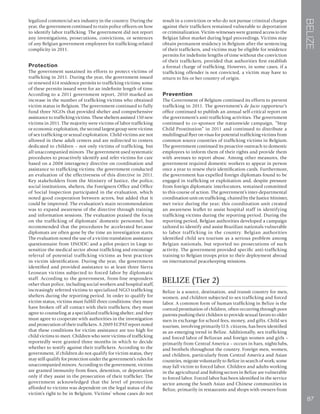
  • 78.
    CYPRUS 137 other victims whochose to stay in private apartments or hotels. NGOs continue to report that the shelter does not sufficiently provide services necessary for victims’ psychosocial recovery. The government has yet to formalize or initiate procedures for the safe repatriation of trafficking victims. Anti-trafficking police reported, however, that they conducted risk assessments prior to a victim’s repatriation to their country of origin. The government encouraged victims to participate in investigations of trafficking cases and reported that 28 identified trafficking victims cooperated with law enforcement in 2011; all 28 were granted residence permits. The recent GRETA report cited inadequate protections for victim witnesses stating that once they end their cooperation with authorities, they lose their residence permit and are returned to their countries of origin. The government provided protection for victims that chose not to participate in investigations or prosecutions and granted temporary residency to one of these victims; two others who were EU nationals received assistance and remain in Cyprus; and a fourth was repatriated. Prevention The government demonstrated some efforts to prevent trafficking in Cyprus in 2011; however, overall progress on implementation of the government’s 2010-12 National Action Plan (NAP) continued to lag. The government provided the equivalent of $7,390 to an NGO to conduct an anti-trafficking awareness campaign during the reporting period. Passport officials report they continue to distribute information cards available in seven languages to potential trafficking victims arriving at the airport, although this account is disputed by an NGO. The government submitted on March 30, 2011 a draft bill introducing stricter criteria to prevent the fraudulent recruitment of foreign workers. On September 27, the Ministerial Committee for the Employment of Third Country nationals decided to ban the entry of Myanmar and Ethiopian national domestic workers, citing their particular vulnerability to trafficking. In August 2011, the government printed posters and other materials aimed at general public awareness. According to the GRETA Report, the government began work to draft a National Action Plan for trafficked children. As in previous years, local experts asserted that continued and unchecked high demand for commercial sex acts on the island sustains a market for traffickers and that the majority of clients of the sex industry are Greek Cypriot men. A Republic of Cyprus interagency effort, in cooperation with an NGO, incorporated the issue of demand for commercial sex into anti-trafficking lectures at universities and military installations. The government reported it screened applications for foreign “performing artists,” the work permit category that replaced the previous artiste visa that had been rife with abuse. The reported issuances of such “performing artists” permits was 339, compared with 460 in 2010. Of the former, 82 permits were first-time issuances and the others were renewals of existing permits. The government issued 246 “barmaid” and “barman” work permits in 2011, compared with 323 in the previous year. Of these, 132 were issued to first-time workers in Cyprus, and the others were renewals of existing permits. Of the 132, 65 workers are male and 67 female. NGOs reported the abolishment of the artiste visa made little actual impact in Cyprus, instead shifting the problem elsewhere to bars, massage parlors and coffee shops. Area Administered by Turkish Cypriots The northern area of Cyprus is administered by Turkish Cypriots; the area has declared itself the “Turkish Republic of Northern Cyprus” (“TRNC”). The United States does not recognize the “TRNC,” nor does any other country except Turkey. The area administered by Turkish Cypriots is a destination for women originating from Eastern European countries and subjected to conditions of forced prostitution. East European and Asian men and women also are subjected to conditions of forced labor. According to an NGO, labor trafficking victims originating mainly from China, Pakistan, Philippines, Turkmenistan, Turkey, and Vietnam were exploited in industrial, construction, agriculture, and domestic work, as well as in restaurants and retail sectors. According to local authorities, women working in nightclubs and pubs who received “hostess” or “barmaid” work permits in 2011 came overwhelmingly from Moldova, followed by Ukraine. Smaller numbers of women came from Morocco, Russia, Kyrgyzstan, Belarus, Kazakhstan, Turkmenistan, Kenya, and Paraguay. This area continued to be a zone of impunity for trafficking. In 2011, some Turkish Cypriot officials admitted that sex trafficking is a problem; pressure from civil society has resulted in some increased awareness and discussion of trafficking. However, Turkish Cypriot officials continued to fail to identify formally any trafficking victims, as no formal definition of “victim” has been instituted. Most Turkish Cypriot authorities continue to deny that trafficking is a significant problem in the area, posing a serious challenge to assuring any protection for women from trafficking or the prosecution of their traffickers. Local observers continue to report a significant trafficking problem with foreign women being deprived of their freedom in nightclubs. Although the authorities in the area administered by Turkish Cypriots drafted an anti-trafficking bill in 2007, it has yet to make any progress on this legislation. Turkish Cypriot authorities provided no specialized training on how to identify, investigate, or prosecute trafficking and most authorities continued to confuse trafficking with prostitution and smuggling. Sex trafficking crimes can potentially be prosecuted on charges of “living off the earnings of prostitution” or “encouraging prostitution,” but these charges are difficult to support in court. Persons convicted under these laws can receive up to two years’ imprisonment. These penalties are not commensurate with those prescribed for other serious crimes in the area administered by Turkish Cypriots. Forced labor can potentially be prosecuted as a misdemeanor for “any person who unlawfully compels any person to labor against the will of that person” and can receive up to one year imprisonment. NGOs report that organized crime elements are behind the ownership and management of some of the nightclubs in the north. Further, local observers report that local police are complicit with traffickers and are directly involved in the trafficking. Authorities hold the travel documents of foreign women working in nightclubs. Authorities do not have specialized procedures to identify trafficking victims among vulnerable groups or to refer victims to service providers, nor do they allocate any funding to anti-trafficking efforts or provide any specialized care or shelter for victims. Authorities reported that the Night Club Commission increased its inspections within commercial sex establishments where women with hostess visas reside. However, deportation continued to be the most common form of “rescue” the authorities use for women who complain
  • 79.
    138 CZECHREPUBLIC about their employmentat nightclubs and who ask for help from the local police. Although prostitution is illegal in the area, female nightclub employees working as hostesses are required to submit to weekly health checks for sexually transmitted infection screening, suggesting tacit approval by the authorities of the prostitution industry. If arrested on prostitution charges, a foreign worker is usually deported within 24 hours. The Turkish Cypriot authorities issued 994 “hostess” work permits and 21 “barmaid” work permits in 2011. Authorities in 2010 reported issuing 977 “hostess” work permits, including renewals, and 16 “barmaid” permits during the previous reporting period. Turkish Cypriot authorities reported an increase in inspections of labor sectors and trained inspectors to improve working conditions. Authorities formally identified no labor trafficking victims because no formal definition of trafficking exists. Turkish Cypriot authorities did not conduct any anti-trafficking awareness campaigns during the reporting period. The “TRNC” does not fully comply with the minimum standards for the elimination of trafficking and does not appear to be making significant efforts to do so. If the “TRNC” were assigned a formal ranking in this report, it would likely be Tier 3. Recommendations for Turkish Cypriot authorities: Pass legislation specifically prohibiting all forms of human trafficking; provide training for police and other front-line responders on victim identification techniques to locate trafficking victims within commercial sex and labor sectors; create incentives for law enforcement and inspectors to proactively investigate trafficking; establish specialized protection and assistance services and a shelter; and educate clients and the larger public about trafficking that generally takes place within nightclubs and other sectors in the area. CZECH REPUBLIC (Tier 1) The Czech Republic is a source, transit, and destination country for women who are subjected to forced prostitution, and a source, transit, and destination country for men and women subjected to forced labor. Women from many countries including the Czech Republic, Slovakia, Ukraine, Russia, Nigeria, and Brazil are subjected to forced prostitution in the Czech Republic and also travel through the Czech Republic en route to Western European countries, including Germany and the United Kingdom, where they are subjected to forced prostitution. Roma women from the Czech Republic are subjected to forced prostitution and forced labor and in destination countries, including Sweden, Switzerland, Slovenia, and the United Kingdom. Men and women from the Czech Republic, Romania, Bulgaria, Moldova, Mongolia, Vietnam, Slovakia, Russia, Ukraine, and Sri Lanka are subjected to forced labor in the construction, forestry, agricultural, manufacturing, and service sectors in the Czech Republic. During the year, there was a case of domestic servitude in the house of a foreign diplomat working in Prague. In general, there was a shift in the origin of victims of trafficking from non-European Union to European Union countries, such as the Czech Republic, Slovakia, Bulgaria, and Romania. Employment agencies continue to be a leading source of labor trafficking in the country. These agencies often charge high fees to the workers, issue deceptive contracts, and withhold pay or identity documents until debts are paid. The Government of the Czech Republic fully complies with the minimum standards for the elimination of trafficking. The government improved its anti-trafficking prevention by passing a series of new regulations to tighten controls on potentially abusive labor agencies, including by raising barriers to entry into the market of labor agencies, levying fines against illegal employment, and putting limits on the temporary employment of third country nationals. The overall number of labor agencies decreased by 30 percent in the wake of passage of the regulations, although their total number remains very high. The Czech government passed a law permitting the imposition of criminal liability on corporations. The percent of trafficking offenders serving time in prison for their offenses continued to increase; all but one of the trafficking offenders convicted in 2011 were sentenced to time in prison. While the government increased prosecutions under labor trafficking statutes, it has yet to achieve a final precedential court decision on labor trafficking. Labor trafficking victims were still identified at a lower rate than sex trafficking victims. Czech government funding for victim care decreased during the year, though the government collaborated with the European Union to increase overall funding for this purpose. The government did not undertake any large scale public awareness campaigns, including any campaigns about labor trafficking, this year, although it did undertake other prevention activities. C C P C T A A Recommendations for the Czech Republic: Robustly implement new regulations to monitor and – as appropriate –investigate and prosecute labor agencies to ensure that they do not exploit foreign workers through debt bondage or forced labor using deceptive labor agreements, or the use of force or threat of force; develop regulations or controls to cover potential abuses of EU citizens, rather than only third-country nationals; ensure that workers are given written contracts that they are able to understand, as required by new legislation; ensure that trafficking victims are thoroughly explained their rights at the outset of identification, in a language they understand; increase training of judges on anti-trafficking legislation, including European Union law, on trafficking; modify existing trafficking identification criteria used by law enforcement authorities to clearly incorporate indicators for forced labor; continue to train first responders, including labor inspectors, police, and state contracting officers, on labor trafficking victim identification criteria and evolving trends in labor trafficking; ensure adequate shelter space is available for large-scale cases, including labor trafficking cases; continue to ensure that presumed victims of trafficking are referred promptly to care; vigorously investigate and prosecute labor trafficking cases; strengthen bilateral coordination on trafficking with source countries, including neighboring EU countries; conduct large-scale public awareness raising campaigns, particularly on labor trafficking; consider increasing minority representation on the Inter-Ministerial Coordination Group for Combating Trafficking in Human Beings; and continue to increase referrals to victims for assistance by law enforcement personnel.
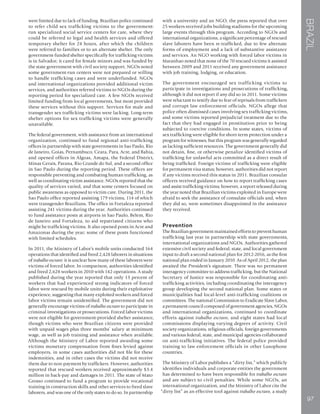
  • 80.
    CZECHREPUBLIC 139 Prosecution The Czech government’slaw enforcement activities against trafficking improved this year; trafficking convictions doubled during the reporting period, though no final labor trafficking convictions were achieved using trafficking statutes. The Government of the Czech Republic prohibits all forms of trafficking in persons under Section 168 of its criminal code, revised in 2010, prescribing punishments of up to 16 years’ imprisonment. These punishments are sufficiently stringent and commensurate with those prescribed for other serious crimes, such as rape. The government continued to prosecute some trafficking cases investigated as human trafficking before January 2010 under Sections 232a and 204 of the criminal code. During the reporting period, the police conducted 19 investigations of 29 offenders under Section 168, down from 24 investigations of 35 offenders investigations conducted in 2010. In 2011, Czech authorities prosecuted 21 alleged trafficking offenders under Section 168 and 12 individuals in cases investigated before January 2010 under the old Section 232a. In 2010, Czech authorities prosecuted 26 trafficking offenders previously investigated under Section 232a, and prosecuted 15 offenders under Section 168. In 2011, the Czech government convicted ten offenders under Section 168; an increase from the three offenders convicted under Section 168 in 2010. Seven of these offenders convicted in 2011 received prison sentences higher than five years; two lower than five years; one trafficking offender received a suspended sentence. Nine pre-2010 trafficking offenders were convicted under Section 232a in 2011; seven such trafficking offenders had been convicted in 2010. All nine trafficking offenders were sentenced to time in prison. Conviction rates for sex trafficking cases increased during the reporting period; law enforcement authorities attributed this increase to improved judicial understanding of trafficking. Law enforcement officials observed that sex trafficking cases were easier to prosecute when there was use of violence or when the victim was clearly vulnerable. While several labor trafficking cases resulted in convictions, these convictions were appealed; courts have yet to produce a final judgment or conviction of labor trafficking cases under trafficking statutes. Given the use of non-typical coercive practices, Czech judges more readily view labor cases as simple fraud rather than trafficking. Both government officials and NGOs observed that labor trafficking offenses were difficult to prove, particularly in the absence of physical violence. The government trained law enforcement officials on investigating and prosecuting trafficking offenses. The Czech judicial academy offered specialized training on trafficking; more prosecutors than judges attended the specialized training. In October 2011, the Ministry of Interior organized a two-day anti-trafficking training for 60 police and prosecutors. The Czech police maintained a specialized anti-trafficking unit; the unit organized 11 trainings for their investigators in 2011. Czech authorities collaborated on trafficking investigations during 2011 with foreign governments, including the United Kingdom, Ukraine, Romania, and Bulgaria. The Czech government did not report the investigation, prosecution, conviction, or sentencing of any government employees complicit in trafficking. Protection The Czech government had mixed victim protection efforts during the reporting period. The government continued to fund its comprehensive Program of Support and Protection of Victims of Trafficking in Human Beings, which was available for both foreign and Czech victims and provided for both short-term and longer-term assistance. Government-funded NGOs provided shelter and care to approximately 100 victims of trafficking in 2011, of whom at least 27 were newly identified. The government reduced its victim protection funding this year by approximately twenty percent, providing the equivalent of approximately $250,000 to three NGOs specializing in trafficking in persons, a decrease from the $305,600 provided to NGOs in 2010. However, overall program funding was increased, as NGOs received EU matching funds for trafficking victim care based on funding from the Czech government and other international organizations. The Ministry of Interior provided the equivalent of approximately $190,000 for trafficking prevention projects and support for trafficking victims who had entered into the Program. As of November 2011, due to a change in the Ministry of Interior’s funding mechanism, a Ministry of Interior agreement with two NGO partners came to an end. The NGOs’ financing was not renewed on a longer term basis, though support for current victims in the program continued throughout the reporting period. Subsequently, funds for all NGOs will be directed through one NGO, in an effort to improve oversight of ministry funds. The government has adopted formal victim identification procedures and a victim referral mechanism, although NGOs raised concerns about the effectiveness of victim identification in practice. NGOs observed that victims sometimes did not trust officials or were too frightened to approach police. In 2011, the government referred to the Program 10 victims of trafficking; three were victims of labor trafficking, and seven were victims of sex trafficking. This was an increase from 2010, when the government referred seven new trafficking victims to the Program. Police reported identifying an additional 51 victims of trafficking who did not enter the program, in contrast to 76 victims last year. The government did not penalize victims who entered the program for unlawful acts committed as a direct result of their being trafficked, though victims not admitted to the program were potentially vulnerable to such penalties. NGOs did not report any victims of trafficking outside the Program who were prosecuted for trafficking offenses. Foreign victims who cooperated with investigators after the initial 60-day reflection period were granted temporary residence, work visas, and support for the duration of the relevant legal proceedings. Upon conclusion of the court proceedings, victims had the opportunity to apply for permanent residency. Three victims applied for this residency provision in 2011 and were granted permanent residency. The government encouraged victims of trafficking to participate in prosecutions, including by providing witness protection during trial; one trafficking victim was protected through witness protection this year. Prevention The Czech government significantly improved its prevention activities during the reporting period, particularly by increasing efforts to prevent exploitative labor recruitment. As of January 2012, the government hired 400 new staff members for the Labor Inspection Offices and increased inspection requirements. These inspectors were trained to identify labor trafficking victims and were empowered to collaborate with police and customs officials in investigating businesses and potential labor exploitation. The government introduced several new regulations to address labor trafficking and abusive employment by labor agencies, including: requirements that agencies have written work contracts, such as provisions that the contract must be able to be understood by the worker;
  • 81.
    140 DENMARK tighter rules governingthe responsible representatives of labor agencies; provisions requiring labor agencies to have bankruptcy insurance to cover at a minimum three months of wages for all workers; and prohibiting agencies from assigning third country nationals to temporary jobs. Under the new regulations, businesses engaged in illegal employment are barred from government procurement for three years, lose their business license, and are barred from re-applying for a license for three years. As a result, the number of employment agencies with permits dropped from 1,800 to 1,250, reducing the number of potentially predatory agencies. Some of these regulations applied primarily to third country nationals, while the employment of workers from other EU member states, such as Romania and Bulgaria, were governed by existing EU regulations. As of January 2012, the government adopted legislation permitting corporate criminal liability, enabling the Czech Republic to ratify the United Nations Protocol to Prevent, Suppress, and Punish Trafficking in Persons. In 2011, the Ministry of Interior conducted a study of EU nationals in the Czech labor market to prepare further activities on labor trafficking. The Czech government enhanced its outreach to potential trafficking victims abroad. The Ministry of Foreign Affairs organized five anti-trafficking trainings for consular officers, reaching 50 attendees. The government published a Romanian language brochure on labor trafficking to distribute at the Czech Embassy in Bucharest. The government did not provide specific funding for any major public trafficking awareness raising campaigns this year. The government organized its anti-trafficking efforts through the Ministry of Interior and through the Inter-Ministerial Coordination Group for Combating Trafficking in Human Beings. The National Rapporteur’s office at the Ministry of Interior prepared a comprehensive annual report on anti-trafficking patterns and programs, which it released publicly. The government also allocated the equivalent of $189,500 for NGO-run prevention activities. The government funded an NGO-run hotline to identify victims of trafficking; the hotline received calls from 465 separate individuals, of whom thirty were calling on behalf of groups of potential victims ranging from three to thirty people. The government took no formal steps to reduce demand for commercial sex acts. The government provided anti-trafficking training to Czech soldiers prior to their deployment abroad on international peacekeeping missions. DENMARK (Tier 1) Denmark is primarily a destination and transit country for women and children from Africa, Southeast Asia, Eastern Europe, and Latin America subjected to sex trafficking. Foreign men and women working in agriculture, domestic and cleaning service, restaurants, hotels, and factories remain vulnerable to forced labor. Unaccompanied foreign children who arrive in the country every year are vulnerable to human trafficking. Copenhagen’s relatively small red light district represents only a small portion of the country’s larger commercial sex industry, which includes brothels, strip clubs, and other underground venues. The Government of Denmark fully complies with the minimum standards for the elimination of trafficking. During the year, the government maintained its efforts to investigate and prosecute sex trafficking offenders. The government took some important initial steps to address ongoing, serious concerns expressed by the anti-trafficking community about its treatment of trafficking victims as criminal offenders. NGOs report that potential trafficking victims often remain in jail for immigration violations or petty crimes if they are not identified within the 72 hour legal limit within which police are able to detain a person without referral to a judge. The inherent challenges of victim identification within this short time frame in a detention setting have been noted by country experts as a significant impediment to victim identification. Furthermore, the government’s emphasis on the prepared return of non-EU trafficking victims to their countries of origin, combined with reliance on rarely used non-trafficking specific mechanisms to grant trafficking victims immigration relief to stay in Denmark through the course of an investigation, arguably resulted in a disincentive for victims to participate in law enforcement investigations and prosecutions. A T A A Recommendations for Denmark: Ensure immigration status concerns do not override Denmark’s obligations to protect trafficking victims, including children; ensure all potential trafficking victims are provided with a meaningful reflection period, consistent with the 2005 Council of Europe Convention on Action Against Trafficking in Human Beings, Article 13 (Council of Europe Convention), to escape the influence of traffickers, begin their recovery, and/or make an informed decision about cooperating with authorities; continue to follow through on plans to change and implement guidelines for police to take potential trafficking victims to a shelter rather than jail pending their identification, in order to build trust and increase victims’ incentives to cooperate with law enforcement; move towards a more victim-centered approach by establishing trafficking-specific short-and long- term legal residency for foreign trafficking victims, including child victims, more in line with the European Convention and the Council Directive 2004/81/EC on the residence permit issued to third country nationals who are victims of trafficking in human beings and who cooperate with the competent authorities; per the government’s new National Action Plan (NAP), issue further guidelines to prosecutors to cease prosecution of trafficking victims for crimes they committed as a result of their trafficking; consider strengthening the role of government social workers and NGOs in the victim certification process for non-EU foreign victims without legal status in Denmark; continue to build capacity to investigate and increase detection of forced labor victims by strengthening links between labor unions and police; continue to vigorously investigate and prosecute trafficking offenses and convict and sentence sex and labor trafficking offenders under the trafficking law; ensure traffickers receive sentences commensurate with the heinous nature of the offense; and consider appointing a national anti-trafficking rapporteur to improve anti-trafficking results. Prosecution The Government of Denmark maintained its anti-trafficking law enforcement efforts in 2011. Denmark prohibits both