The Water Cycle A 3 rd  Grade Science Lesson
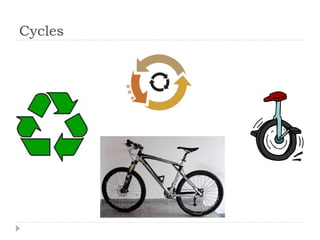
Cycles
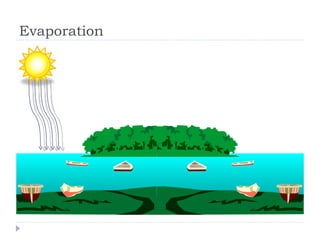
Evaporation
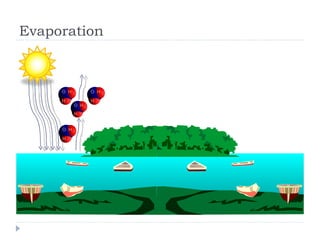
Evaporation
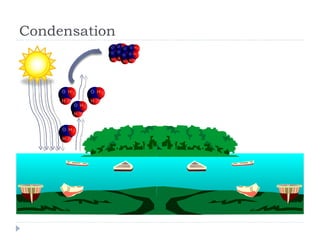
Condensation
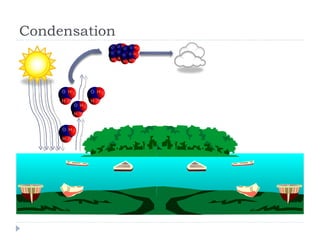
Condensation
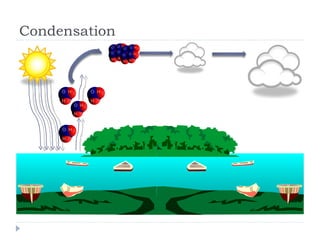
Condensation
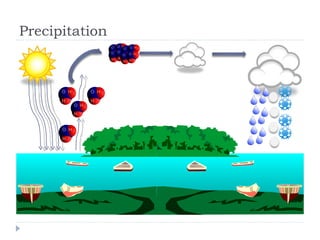
Precipitation
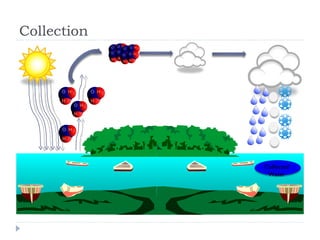
Collection Collected Water
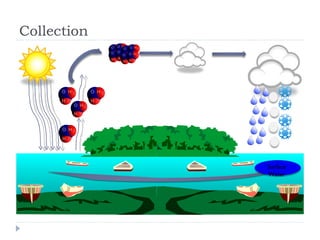
Collection Surface Water
Quiz Time 1.) During the process of precipitation, what can water fall to the ground as? A.) Rain B.) Snow C.) Hail D.) All of the Above
Quiz Time 2.) During the process of evaporation, water changes from a liquid to a _____________ ? A.) Solid B.) Gel C.) Gas D.) It doesn’t change at all
Quiz Time 3.) What is the centerpiece of the water cycle responsible for starting the whole process? A.) Oceans B.) Sun C.) Water D.) Clouds
Quiz Time 4.) What kind of water would a puddle be? A.) Surface Water B.) Ground Water C.) A puddle D.) None of the Above
Quiz Time 5.) What is the correct order of the water cycle? A.) Collection    Precipitation    Condensation    Evaporation B.) Evaporation    Condensation    Precipitation    Collection C.) Precipitation    Collection    Condensation    Evaporation D.) Condensation    Evaporation    Collection    Precipitation

The Water Cycle

  • 1.
    The Water CycleA 3 rd Grade Science Lesson
  • 2.
  • 3.
  • 4.
  • 5.
  • 6.
  • 7.
  • 8.
  • 9.
  • 10.
  • 11.
    Quiz Time 1.)During the process of precipitation, what can water fall to the ground as? A.) Rain B.) Snow C.) Hail D.) All of the Above
  • 12.
    Quiz Time 2.)During the process of evaporation, water changes from a liquid to a _____________ ? A.) Solid B.) Gel C.) Gas D.) It doesn’t change at all
  • 13.
    Quiz Time 3.)What is the centerpiece of the water cycle responsible for starting the whole process? A.) Oceans B.) Sun C.) Water D.) Clouds
  • 14.
    Quiz Time 4.)What kind of water would a puddle be? A.) Surface Water B.) Ground Water C.) A puddle D.) None of the Above
  • 15.
    Quiz Time 5.)What is the correct order of the water cycle? A.) Collection  Precipitation  Condensation  Evaporation B.) Evaporation  Condensation  Precipitation  Collection C.) Precipitation  Collection  Condensation  Evaporation D.) Condensation  Evaporation  Collection  Precipitation

Editor's Notes

  • #3 When we hear the word “cycle” these are some of the things that we associate with the word in our minds. The recycle sign shows three arrows chasing themselves representing the words reduce, reuse, and recycle. We use a product, recycle, and maybe years later you will be drinking a new product from essentially the same bottle. The process repeats itself and the bottle is used again and again. The unicycle and bicycle have two wheels, or cycles, that move around and around when pedal to move the bike. The wheels and tires are in the shape of a circle. Lastly, the symbol at the top of the page is a symbol for cycle. You will notice that it is made of up arrows, like the recycling sign, and in the shape of a circle, like the tires on a bike. A cycle is defined as something that is repeated. There is no definite start or end point because it is continues and always occurring. Today, we will learn about the constant cycling of water on earth, “The Water Cycle.”
  • #4 If you were to pick the first step of the water cycle, you would start with evaporation. Water everywhere, in lakes, rivers, streams, oceans, puddles, etc. may look like it does nothing, but it is always moving. In the first stage of the water cycle, known as evaporation, the sun’s invisible heat rays heat the water on any surface.
  • #5 This heating of the water changes the composition, or makeup, of the water from the liquid, seen here in the lake, into a gas. The gas form of water, or water vapor, is very light and rises into the air. This leads into the next stage of the water cycle known as condensation.
  • #6 During the process of condensation the water vapor (gas) combines in the atmosphere bumping together and forming clusters of molecules of water vapor.
  • #7 Once enough water vapor molecules clump together they form a cloud. Clouds are essentially big puffy collections of water and moisture. Once formed as a cloud water changes its composition, or makeup, again from a gas (water vapor) back to a liquid within the cloud itself.
  • #8 Eventually the water builds up and builds up within the cloud expanding its size. This is much like a dry sponge once you place it in water. When placed in water a dry sponge soaks up the water and “puffs” up. Once the cloud is full, much like a sponge, the next stage of the water cycle, precipitation, begins.
  • #9 During the process of precipitation, the cloud basically bursts from being too full of water. This causes the water to fall to the ground from the cloud in the from of precipitation. Precipitation can fall to the ground as rain, freezing rain, snow, sleet, and hail.
  • #10 The “last” stage of the water cycle is known as collection. Collection means exactly what its name implies. Water is collected on or in the ground. Water collected on the surface of the ground, as seen as the dark blue oval in the diagram, is called surface water. Surface water can consist of lakes, rivers, streams, oceans, puddles, etc. Any water that can be visibly seen on top of the ground is known as surface water. Water can also be collected underground. Water collected underground is known as ground water. The most common form of ground water that you are familiar with is the water that is absorbed from the ground and makes mud as you dig.
  • #11 Once the water is collected, the whole process starts over again as the sun heats the water and evaporation begins. The water cycle is called a cycle because water is constantly being reused on earth. The process never stops and there are no breaks. If the water cycle ever stopped we would have no water to drink, bathe in , or swim in. This essentially means that you could be drinking the water that George Washington once used to brush his teeth with. Of course it has been cleaned again by nature so it is okay to drink!