Arts 
By: Lenie Mangubat
the expression or application of 
human creative skill and 
imagination, typically in a visual 
form such as painting or sculpture, 
producing works to be appreciated 
primarily for their beauty or 
emotional power.
MOVEMENT 
OF 
ART
POP ART 
was a movement that began in the 
united states during the late 1950s. It is 
one of the extraordinary innovations of 
the 20th century. Pop Art brought back 
the material realities of everyday life, to 
popular culture in which the ordinary 
people derived most of their visual 
pleasure from television, magazines, or 
comics.
The media and advertisement were favorite 
subjects for pop arts often witty celebrations 
of consumer society. The term “ pop art “ 
was first used by the English critic in a 1958 
issue of Architectural Digest to describe 
those paintings that celebrate post war 
consumerism. 
ANDY WARHOL ( 1928-1987)- was the 
greatest American Pop Artist whose 
innovations has affected so much 
subsequent art.
EXPRESSIONISM 
applies to any artistic work in 
which objective reality is 
distorted to represent the 
mental condition of the artist. 
Expressionism has been applied 
to works in fields as desperate 
as literature, music, and the 
cinema.
Expressionism is an imaginative style in which 
the artist attempts to portray not objective 
reality but rather the subjective emotions and 
responses that objects and events arouse in 
him. He accomplishes his aim through 
distortion, exaggeration, primitivism, and 
fantasy and through the vivid, jarring violent, 
or dynamic application of formal elements. In a 
broader sense, Expressionism is one of the 
main currents of art in the later 19th and 20th 
centuries, and its qualities of highly subjective, 
personal, spontaneous self expression are 
typical of a wide range of modern artist and art 
movements.
ABSTRACT EXPRESSIONISM depicts 
form not drawn from the visible world. They 
emphasize free, spontaneous, and personal 
emotional expression, and they exercise 
considerable freedom of technique and 
execution to attain this goal, with a 
particular emphasis laid on the exploitation 
of the variable physical character of paint to 
evoke expressive qualities. 
Abstract Expressionism is influenced by 
existentialist ideas, which emphasized the 
importance of the act of creating, not of the 
finished object.
ENVIRONMENTAL ART 
refers to avant-garde works that are 
consciously designed to surround or 
include the viewer as participant, 
thereby fostering a direct emotional and 
sensory experienced. The term relates 
specifically to those works created since 
that late 50s which attempts to cloud 
the distinctions between art and life.
Also known as the earth art, it is the art 
which involves the creation and 
manipulation of a large and enclosed 
space. 
Architectural (including landscape and 
architectural) design must be said to 
qualify as environmental art, although 
the term usually refers to artworks 
which do not function as either of these 
kinds of environmental design typically 
do.
INSTALLATION ART 
is site-specific and usually consists 
of an ensemble of objects or effects 
that work together to create a 
whole. An artist takes over an 
installation space like a temporary 
squatter whose clutter of 
possessions challenges boundaries 
and sparks dialogue between the 
space itself and its contents.
Installation art is art uses sculptural materials 
and other forms of media to modify the way we 
experience a particular space. Installation art 
is not necessarily confined to gallery spaces 
and can refer to any material intervention in 
everyday public or private spaces. 
Installation art incorporates almost any media 
to create a visceral and or conceptual 
experience in a particular environment. 
Materials used in contemporary installation art 
range from everyday and natural materials to 
new media such as video, sound, performance, 
computers and internet.
Elements 
of 
art
PAINTING is one of the oldest and most important art. 
Since prehistoric times, artists have arranged paint on 
surfaces in ways that express their ideas about people and 
the world. 
Painting is a way in which people communicate their 
vision of life, joy, anxiety, sorrow and beliefs. 
PAINTING is the practice of applying color to a 
surface such as glass, paper, wood and canvas. In an 
artistic point of view the term painting means the 
amalgamation with drawing, composition and other 
aesthetic considerations in order to manifest the expressive 
and conceptual intention of the artist. 
Painting is used as a vehicle of expressing, 
documenting and representing all the varied intents and 
subjects of an artist. Paintings can be naturalistic and 
representational (as I a still life or landscape painting), 
photographic, abstract, be loaded with narrative content, 
symbolism, emotion or be political in nature.
STYLES IN PAINTING: 
Fauvism—a style of painting that flourished in France 
from 1898 to 1908. It is pure, brilliant colors, applied straight 
from the paint tubes in an aggressive, direct manner to create a 
sense of an explosion on the canvas. The FAUVIST painted 
directly from the nature as the IMPRESSIONIST had before them, 
but their works were invested with a strong expressive reaction 
to the subject they painted. 
Cubism—is a highly influential visual arts style of the 20th 
century that was created principally by the painters Pablo 
Picasso and George Braque in Paris between 1907and 1914.This 
style emphasizes the flat, two dimensional surface of the picture 
plane, the traditional techniques of perspective and refuting 
time-honored theories of art as the imitation of nature. 
CUBIST PAINTERS were not bound to copying form, 
texture, color, and space; instead, they presented a new reality in 
paintings that depicted radically fragmented objects, whose 
several sides were seen simultaneously.
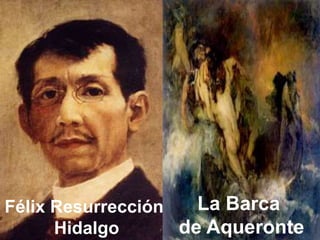
La Barca 
de Aqueronte 
Félix Resurrección 
Hidalgo
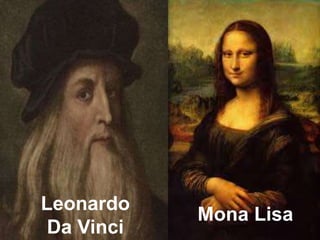
Leonardo 
Da Vinci 
Mona Lisa
ARCHITECTURE—is the oldest of the fine 
arts. It is the most useful and a prerequisite 
for the other arts. The history of 
architecture concerns buildings substantial 
enough to survive. 
Definitions: 
 It is the art and method of erecting 
structures. 
It is planned entity; the result of a 
conscious act. 
It is a body or corpus of work. 
It is a way to build.
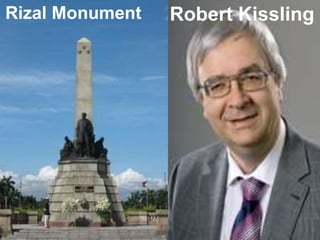
Rizal Monument Robert Kissling
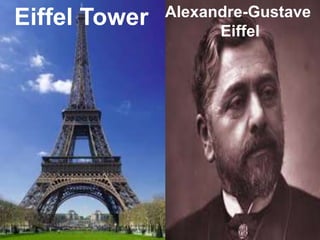
Eiffel Tower Alexandre-Gustave 
Eiffel
PHOTOGRAPHY- the name of which we owe from 
Sir John Herschel who was first used the term in 1839, 
the year the photographic process became public. This 
word is derived from the Greek words for “light” and 
“writing”. 
It is the process of making pictures by means of the 
action of light. Light patterns reflected or emitted from 
objects are recorded onto a sensitive medium or storage 
chip through a timed exposure. The process is done 
through mechanical, chemical or digital devices known 
as cameras. 
Traditionally the product of photography has been 
called a photograph. The term photo is an abbreviation; 
many people also call them pictures. In digital 
photography, the term image has begun to replace 
photograph.
TWO DISTINCT SCIENTIFIC PROCESS TO 
MAKE PHOTOGRAPHY POSSIBLE: 
•Optical- The camera Obscura (dark room) by 
Leonardo da Vinci. It is used as an aid to drawing 
was being advocated. 
•Chemical- before the photography was invented, 
people had been aware, that some colours are 
bleached in the sun, but they had made little 
distinction between heat, air and light.
SCULPTURE—portrayed 
figures of gods, goddesses, and 
human beings. Over the 
centuries it became increasingly 
life-like and showed figures in 
more active poses.
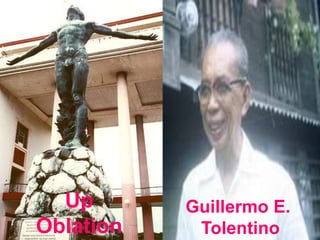
Up 
Oblation 
Guillermo E. 
Tolentino
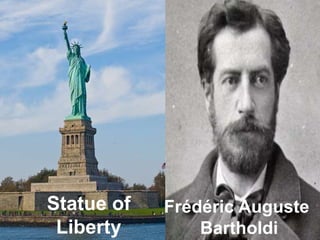
Statue of 
Liberty 
Frédéric Auguste 
Bartholdi
Period 
of 
art
RENAISSANCE PERIOD
During the Renaissance, many European 
scholars and artists, especially in Italy, studied the 
learning and art of ancient Greece and Rome. 
They wanted to recapture the spirit of the Greek 
and Roman cultures in their own artistic literary, 
and philosophic works. The Renaissance thus 
represented a rebirth of this cultures and is 
therefore also known as the “revival of antiquity or 
the revival of learning”. The influenced of the 
Renaissance on future generations was to prove 
immense in many fields-from art and literature to 
education, political, science and history. Because 
of this fact, most scholars have for hundreds of 
years agreed that the modern era of human history 
began with the Renaissance.
The influence of Renaissance 
painters, sculptors, and architects has 
been particularly strong. 
Renaissance Architects 
designed buildings on a smaller scale to 
help make people aware of their own 
powers and dignity.
BRUNELLESCHI—was the first 
Renaissance achitect to revive the 
ancient Roman Style of architecture. 
He incorporated arches, columns, and 
other elements of classical architecture 
into his designs. He was Also the first 
Renaissance artists to use linear 
perspective, a mathematical systen in 
which painters could show space and 
depth on a flat surface.
MIDDLE AGES PERIOD
During the middle ages, painters and 
sculptors tried to give their works a spiritual 
quality. They wanted viewers to concentrate 
on the deep religious meaning of their 
paintings and sculpture. They were not 
concerned with making their subjects 
appear natural or life –like. But 
Renaissance painters and sculptures. Like 
Renaissance writers, wanted to portray 
people and nature realistically. 
Architects of the Middle Ages designed 
huge cathedrals to emphasize the majesty 
and grandeur of God.
THEATER—From the French word 
“theatre”, from Greek “theatron”, meaning 
“place of seeing”. Is the branch of the 
performing arts concerned with acting out 
stories in front of an audience using 
combinations of speech, gesture, mime, 
music, dance, sounds, and spectacle--- indeed 
any one or more elements of the other 
performing arts. 
In addition to the standard narrative 
dialogue style, theater takes such forms as 
opera, ballet, mime, kabuki play of Japan, 
classical Indian dance, Chinese opera, 
mummers’ play and pantomime.
BERNARD BECKERMAN 
A respected scholar of Hofstra 
University’s department of drama, 
define theater as what “occurs 
when one or more human beings 
isolated in time and /or space, 
present themselves to another or 
others.
GENRES OF THEATER 
MUSICAL THEATER: A theatrical genre in which 
a story is told through the performance of singing 
with (instrumental music), spoken dialogue and 
often dance. 
ROCK OPERA: Same style as opera, except 
that the musical form is rock music. 
THEATER FOR SOCIAL CHANGE: Theater 
that addresses a social issue and uses 
performance as a way of illustrating injustice to the 
audience.
COMEDY: Comes from the Greek word 
“komos” which means celebration, revel of 
merrymaking. It does not necessarily mean 
funny, but it focuses more on a problem that 
leads to some form of catastrophe which in the 
end has a happy and joyful outcome. 
FARCE: A comic dramatic piece that uses 
highly improbable situations, stereotyped 
characters, extravagant exaggeration, fast 
pacing and violent horseplay.
PANTOMINE: A form of musical drama in which 
elements of dance, mime, puppetry, slaptick, and 
melodrama are combined to produce an entertaining 
and comic theatrical experience, often designed for 
children. These are often presented around the 
holidays. 
ROMANTIC COMEDY: A medley of clever scheming, 
calculated coincidence, and wondrous discovery, all of 
which contribute ultimately to making the events 
answer precisely to the hero’s or heroine’s wishes, with 
focus on love. 
COMEDY OF SITUATION: A comedy that grows out of 
a character’s attempt to solve a problem created by a 
situation. The attempt is often bumbling but ends up 
happily.
COMEDY OF MANNERS: Witty, cerebral form of 
dramatic comedy that depicts and often satirizes 
the manners and affectations of a contemporary 
society. A comedy of manners is concerned with 
social usage and the question of whether or not 
characters meet certain social standards. 
COMMEDIA DELL’ARTE: Very physical form of 
comedy which was created and originally 
performed in Italy. Commedia uses a series of 
stock characters and a list of events to improvise 
an entire play.
BLACK COMEDY: Comedy that tests the 
boundaries of good taste and moral 
acceptability by juxtaposing morbid or 
ghastly elements with comical ones. 
TRAGEDY: A drama that treats in a serious 
and dignified style the sorrowful or terrible 
events encountered or caused by a heroic 
individual. The word “tragedy” comes from 
the Greek word “tragos” which is translated 
to “goat”.
MELODRAMA: Originally, a sentimental drama 
with a musical underscoring. Often with an 
unlikely plot that concerns the suffering of the 
good at the hands of the villains but ends happily 
with good triumphant. Featuring stock characters 
such as the noble hero, the long suffering heroine, 
and the cold-blooded villain. 
FANTASY: The creation of a unique landscape on 
which a hero goes on a quest to find something 
that will defeat the powers of evil. 
MORALITY PLAY: A morality play is an allegory 
in which the characters are abstractions of moral 
ideas.
TRAGICOMEDY: A drama that has a 
bitter/sweet quality, containing elements of 
tragedy and comedy. 
DOMESTIC DRAMA: Drama in which the focus 
is on the everyday domestic lives of people and 
their relationships in the community that they 
live in. 
OPERA: A theatrical genre in which a story is 
told and emotion is conveyed primarily through 
singing (with instrumental singing).
Thank You 


Mapeh Arts

  • 1.
  • 2.
    the expression orapplication of human creative skill and imagination, typically in a visual form such as painting or sculpture, producing works to be appreciated primarily for their beauty or emotional power.
  • 3.
  • 4.
    POP ART wasa movement that began in the united states during the late 1950s. It is one of the extraordinary innovations of the 20th century. Pop Art brought back the material realities of everyday life, to popular culture in which the ordinary people derived most of their visual pleasure from television, magazines, or comics.
  • 5.
    The media andadvertisement were favorite subjects for pop arts often witty celebrations of consumer society. The term “ pop art “ was first used by the English critic in a 1958 issue of Architectural Digest to describe those paintings that celebrate post war consumerism. ANDY WARHOL ( 1928-1987)- was the greatest American Pop Artist whose innovations has affected so much subsequent art.
  • 6.
    EXPRESSIONISM applies toany artistic work in which objective reality is distorted to represent the mental condition of the artist. Expressionism has been applied to works in fields as desperate as literature, music, and the cinema.
  • 7.
    Expressionism is animaginative style in which the artist attempts to portray not objective reality but rather the subjective emotions and responses that objects and events arouse in him. He accomplishes his aim through distortion, exaggeration, primitivism, and fantasy and through the vivid, jarring violent, or dynamic application of formal elements. In a broader sense, Expressionism is one of the main currents of art in the later 19th and 20th centuries, and its qualities of highly subjective, personal, spontaneous self expression are typical of a wide range of modern artist and art movements.
  • 8.
    ABSTRACT EXPRESSIONISM depicts form not drawn from the visible world. They emphasize free, spontaneous, and personal emotional expression, and they exercise considerable freedom of technique and execution to attain this goal, with a particular emphasis laid on the exploitation of the variable physical character of paint to evoke expressive qualities. Abstract Expressionism is influenced by existentialist ideas, which emphasized the importance of the act of creating, not of the finished object.
  • 9.
    ENVIRONMENTAL ART refersto avant-garde works that are consciously designed to surround or include the viewer as participant, thereby fostering a direct emotional and sensory experienced. The term relates specifically to those works created since that late 50s which attempts to cloud the distinctions between art and life.
  • 10.
    Also known asthe earth art, it is the art which involves the creation and manipulation of a large and enclosed space. Architectural (including landscape and architectural) design must be said to qualify as environmental art, although the term usually refers to artworks which do not function as either of these kinds of environmental design typically do.
  • 11.
    INSTALLATION ART issite-specific and usually consists of an ensemble of objects or effects that work together to create a whole. An artist takes over an installation space like a temporary squatter whose clutter of possessions challenges boundaries and sparks dialogue between the space itself and its contents.
  • 12.
    Installation art isart uses sculptural materials and other forms of media to modify the way we experience a particular space. Installation art is not necessarily confined to gallery spaces and can refer to any material intervention in everyday public or private spaces. Installation art incorporates almost any media to create a visceral and or conceptual experience in a particular environment. Materials used in contemporary installation art range from everyday and natural materials to new media such as video, sound, performance, computers and internet.
  • 13.
  • 14.
    PAINTING is oneof the oldest and most important art. Since prehistoric times, artists have arranged paint on surfaces in ways that express their ideas about people and the world. Painting is a way in which people communicate their vision of life, joy, anxiety, sorrow and beliefs. PAINTING is the practice of applying color to a surface such as glass, paper, wood and canvas. In an artistic point of view the term painting means the amalgamation with drawing, composition and other aesthetic considerations in order to manifest the expressive and conceptual intention of the artist. Painting is used as a vehicle of expressing, documenting and representing all the varied intents and subjects of an artist. Paintings can be naturalistic and representational (as I a still life or landscape painting), photographic, abstract, be loaded with narrative content, symbolism, emotion or be political in nature.
  • 15.
    STYLES IN PAINTING: Fauvism—a style of painting that flourished in France from 1898 to 1908. It is pure, brilliant colors, applied straight from the paint tubes in an aggressive, direct manner to create a sense of an explosion on the canvas. The FAUVIST painted directly from the nature as the IMPRESSIONIST had before them, but their works were invested with a strong expressive reaction to the subject they painted. Cubism—is a highly influential visual arts style of the 20th century that was created principally by the painters Pablo Picasso and George Braque in Paris between 1907and 1914.This style emphasizes the flat, two dimensional surface of the picture plane, the traditional techniques of perspective and refuting time-honored theories of art as the imitation of nature. CUBIST PAINTERS were not bound to copying form, texture, color, and space; instead, they presented a new reality in paintings that depicted radically fragmented objects, whose several sides were seen simultaneously.
  • 16.
    La Barca deAqueronte Félix Resurrección Hidalgo
  • 17.
  • 18.
    ARCHITECTURE—is the oldestof the fine arts. It is the most useful and a prerequisite for the other arts. The history of architecture concerns buildings substantial enough to survive. Definitions:  It is the art and method of erecting structures. It is planned entity; the result of a conscious act. It is a body or corpus of work. It is a way to build.
  • 19.
  • 20.
  • 21.
    PHOTOGRAPHY- the nameof which we owe from Sir John Herschel who was first used the term in 1839, the year the photographic process became public. This word is derived from the Greek words for “light” and “writing”. It is the process of making pictures by means of the action of light. Light patterns reflected or emitted from objects are recorded onto a sensitive medium or storage chip through a timed exposure. The process is done through mechanical, chemical or digital devices known as cameras. Traditionally the product of photography has been called a photograph. The term photo is an abbreviation; many people also call them pictures. In digital photography, the term image has begun to replace photograph.
  • 22.
    TWO DISTINCT SCIENTIFICPROCESS TO MAKE PHOTOGRAPHY POSSIBLE: •Optical- The camera Obscura (dark room) by Leonardo da Vinci. It is used as an aid to drawing was being advocated. •Chemical- before the photography was invented, people had been aware, that some colours are bleached in the sun, but they had made little distinction between heat, air and light.
  • 23.
    SCULPTURE—portrayed figures ofgods, goddesses, and human beings. Over the centuries it became increasingly life-like and showed figures in more active poses.
  • 24.
  • 25.
    Statue of Liberty Frédéric Auguste Bartholdi
  • 26.
  • 27.
  • 28.
    During the Renaissance,many European scholars and artists, especially in Italy, studied the learning and art of ancient Greece and Rome. They wanted to recapture the spirit of the Greek and Roman cultures in their own artistic literary, and philosophic works. The Renaissance thus represented a rebirth of this cultures and is therefore also known as the “revival of antiquity or the revival of learning”. The influenced of the Renaissance on future generations was to prove immense in many fields-from art and literature to education, political, science and history. Because of this fact, most scholars have for hundreds of years agreed that the modern era of human history began with the Renaissance.
  • 29.
    The influence ofRenaissance painters, sculptors, and architects has been particularly strong. Renaissance Architects designed buildings on a smaller scale to help make people aware of their own powers and dignity.
  • 30.
    BRUNELLESCHI—was the first Renaissance achitect to revive the ancient Roman Style of architecture. He incorporated arches, columns, and other elements of classical architecture into his designs. He was Also the first Renaissance artists to use linear perspective, a mathematical systen in which painters could show space and depth on a flat surface.
  • 31.
  • 32.
    During the middleages, painters and sculptors tried to give their works a spiritual quality. They wanted viewers to concentrate on the deep religious meaning of their paintings and sculpture. They were not concerned with making their subjects appear natural or life –like. But Renaissance painters and sculptures. Like Renaissance writers, wanted to portray people and nature realistically. Architects of the Middle Ages designed huge cathedrals to emphasize the majesty and grandeur of God.
  • 33.
    THEATER—From the Frenchword “theatre”, from Greek “theatron”, meaning “place of seeing”. Is the branch of the performing arts concerned with acting out stories in front of an audience using combinations of speech, gesture, mime, music, dance, sounds, and spectacle--- indeed any one or more elements of the other performing arts. In addition to the standard narrative dialogue style, theater takes such forms as opera, ballet, mime, kabuki play of Japan, classical Indian dance, Chinese opera, mummers’ play and pantomime.
  • 34.
    BERNARD BECKERMAN Arespected scholar of Hofstra University’s department of drama, define theater as what “occurs when one or more human beings isolated in time and /or space, present themselves to another or others.
  • 35.
    GENRES OF THEATER MUSICAL THEATER: A theatrical genre in which a story is told through the performance of singing with (instrumental music), spoken dialogue and often dance. ROCK OPERA: Same style as opera, except that the musical form is rock music. THEATER FOR SOCIAL CHANGE: Theater that addresses a social issue and uses performance as a way of illustrating injustice to the audience.
  • 36.
    COMEDY: Comes fromthe Greek word “komos” which means celebration, revel of merrymaking. It does not necessarily mean funny, but it focuses more on a problem that leads to some form of catastrophe which in the end has a happy and joyful outcome. FARCE: A comic dramatic piece that uses highly improbable situations, stereotyped characters, extravagant exaggeration, fast pacing and violent horseplay.
  • 37.
    PANTOMINE: A formof musical drama in which elements of dance, mime, puppetry, slaptick, and melodrama are combined to produce an entertaining and comic theatrical experience, often designed for children. These are often presented around the holidays. ROMANTIC COMEDY: A medley of clever scheming, calculated coincidence, and wondrous discovery, all of which contribute ultimately to making the events answer precisely to the hero’s or heroine’s wishes, with focus on love. COMEDY OF SITUATION: A comedy that grows out of a character’s attempt to solve a problem created by a situation. The attempt is often bumbling but ends up happily.
  • 38.
    COMEDY OF MANNERS:Witty, cerebral form of dramatic comedy that depicts and often satirizes the manners and affectations of a contemporary society. A comedy of manners is concerned with social usage and the question of whether or not characters meet certain social standards. COMMEDIA DELL’ARTE: Very physical form of comedy which was created and originally performed in Italy. Commedia uses a series of stock characters and a list of events to improvise an entire play.
  • 39.
    BLACK COMEDY: Comedythat tests the boundaries of good taste and moral acceptability by juxtaposing morbid or ghastly elements with comical ones. TRAGEDY: A drama that treats in a serious and dignified style the sorrowful or terrible events encountered or caused by a heroic individual. The word “tragedy” comes from the Greek word “tragos” which is translated to “goat”.
  • 40.
    MELODRAMA: Originally, asentimental drama with a musical underscoring. Often with an unlikely plot that concerns the suffering of the good at the hands of the villains but ends happily with good triumphant. Featuring stock characters such as the noble hero, the long suffering heroine, and the cold-blooded villain. FANTASY: The creation of a unique landscape on which a hero goes on a quest to find something that will defeat the powers of evil. MORALITY PLAY: A morality play is an allegory in which the characters are abstractions of moral ideas.
  • 41.
    TRAGICOMEDY: A dramathat has a bitter/sweet quality, containing elements of tragedy and comedy. DOMESTIC DRAMA: Drama in which the focus is on the everyday domestic lives of people and their relationships in the community that they live in. OPERA: A theatrical genre in which a story is told and emotion is conveyed primarily through singing (with instrumental singing).
  • 42.