Understanding paintings

     Krishnan, GTC Talk
Seeing vs Looking
• Easy access to great paintings today
  – Greeting cards
  – Internet
• Seeing involves opening your eyes
• Looking involves opening your mind and
  taxing your intellect
• Look, don’t just see !
Six guidelines for looking at paintings
• Subject – Sometimes historical or mythological figures
• Techniques – Use of oil paints, frescos
• Symbolism – Many paintings use language of symbolism
  and allegory that was understood by the artists and
  audiences of the time
• Space and light – Artists mastery in creating space and
  light
• Historical Style – Each historical period had a style –
  Renaissance to Modern times
• Personal Interpretation – What you see with your
  knowledge of history, symbolism and techniques
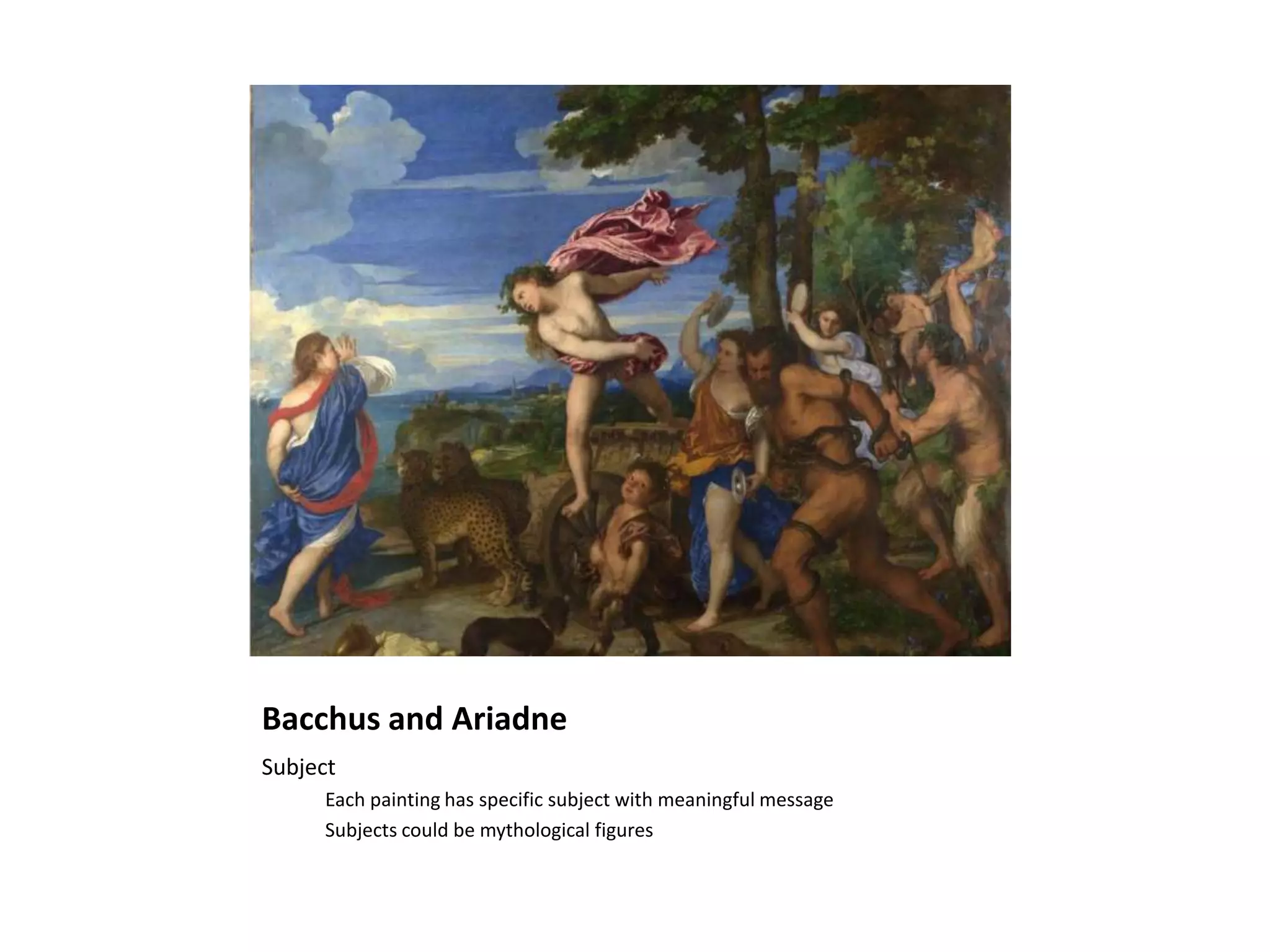
Bacchus and Ariadne
Subject
     Each painting has specific subject with meaningful message
     Subjects could be mythological figures
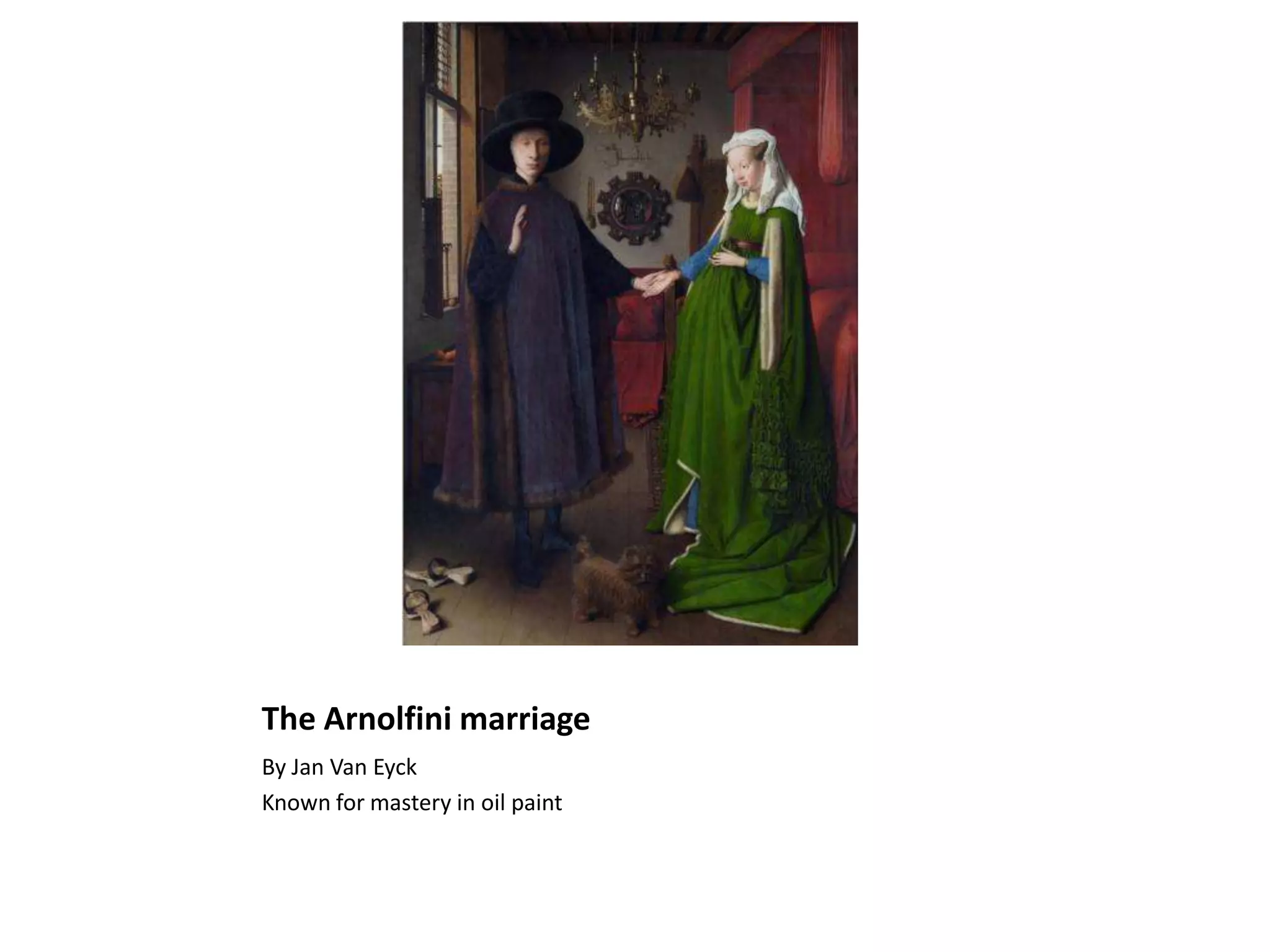
The Arnolfini marriage
By Jan Van Eyck
Known for mastery in oil paint
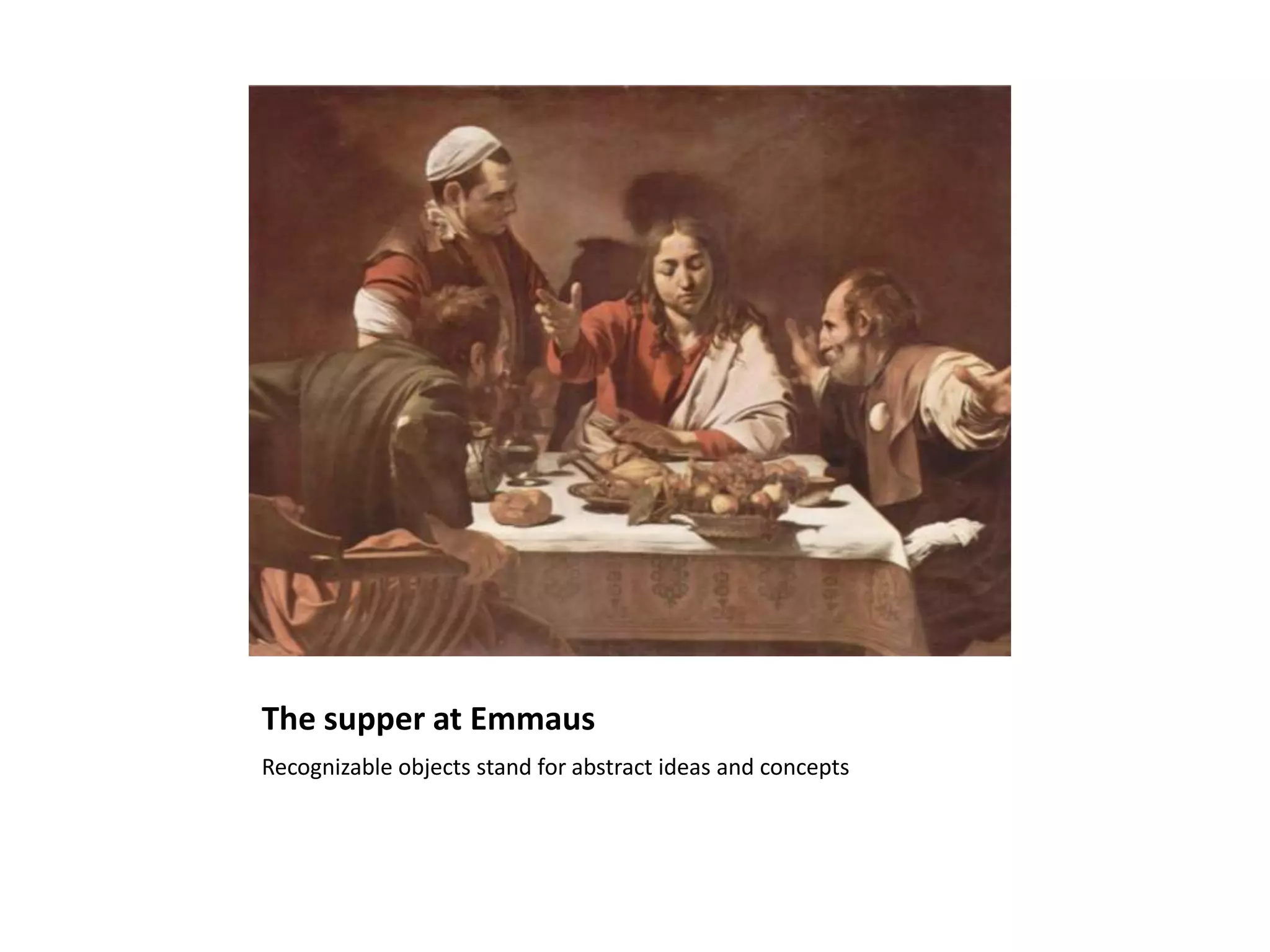
The supper at Emmaus
Recognizable objects stand for abstract ideas and concepts
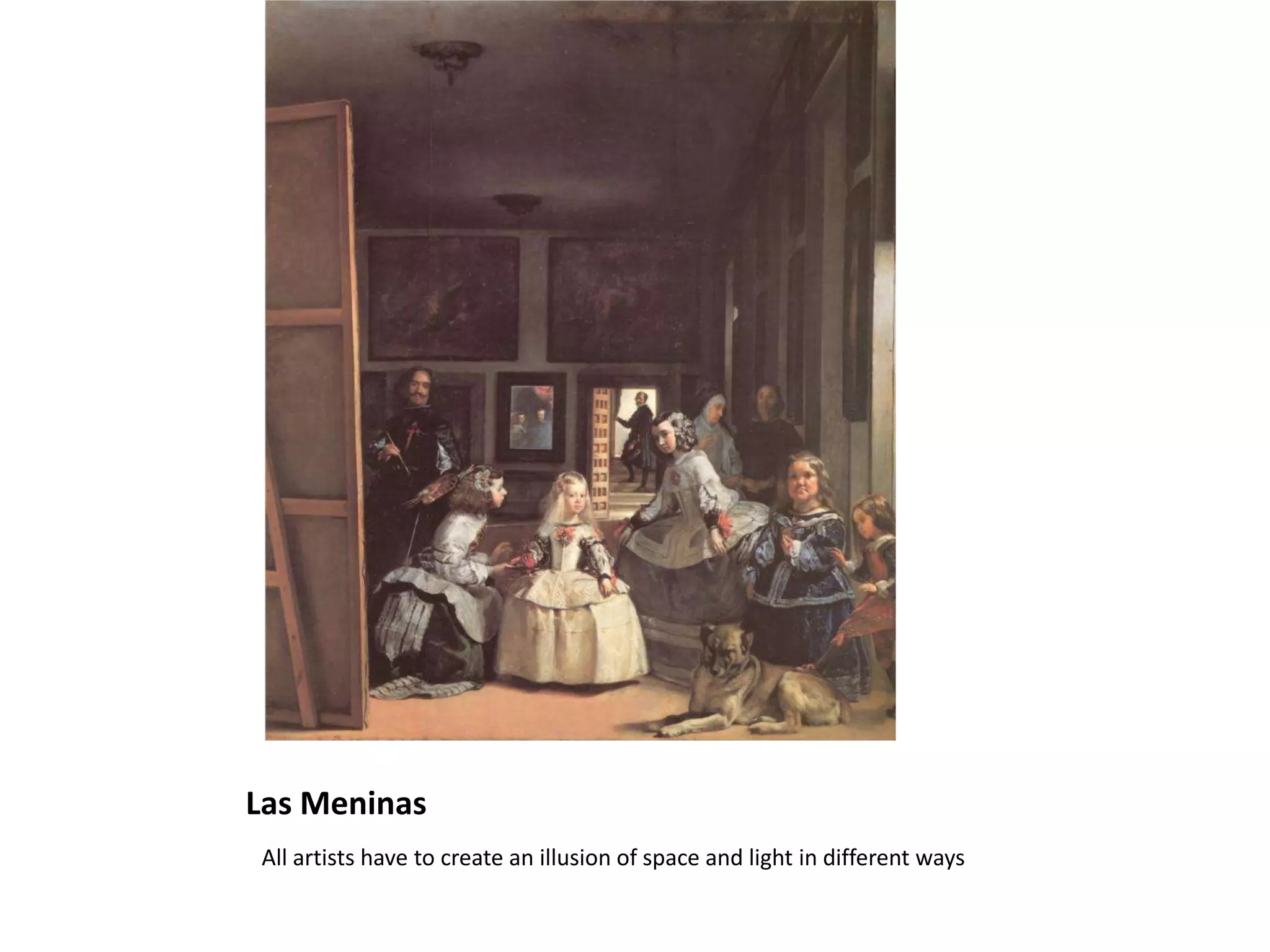
Las Meninas
All artists have to create an illusion of space and light in different ways
What creates a masterpiece
• Virtuosity – Skills + knowledge and
  imagination
• Innovation – Rewriting the existing rules –
  Giotto and Picasso
• Patronage – Catholic church and Royal coursts
• Artistic vision – Michelangelo’s ceiling
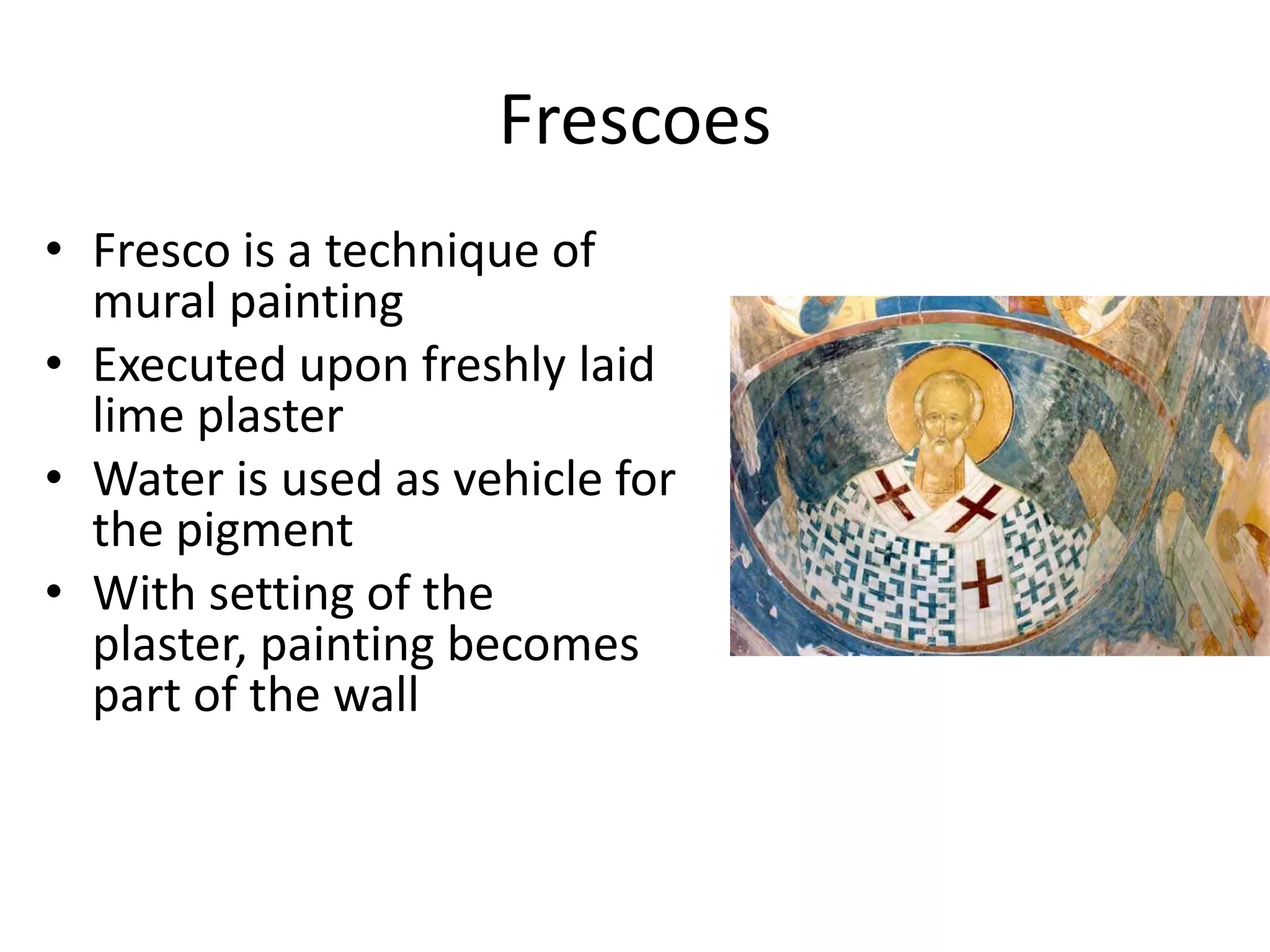
Frescoes
• Fresco is a technique of
  mural painting
• Executed upon freshly laid
  lime plaster
• Water is used as vehicle for
  the pigment
• With setting of the
  plaster, painting becomes
  part of the wall
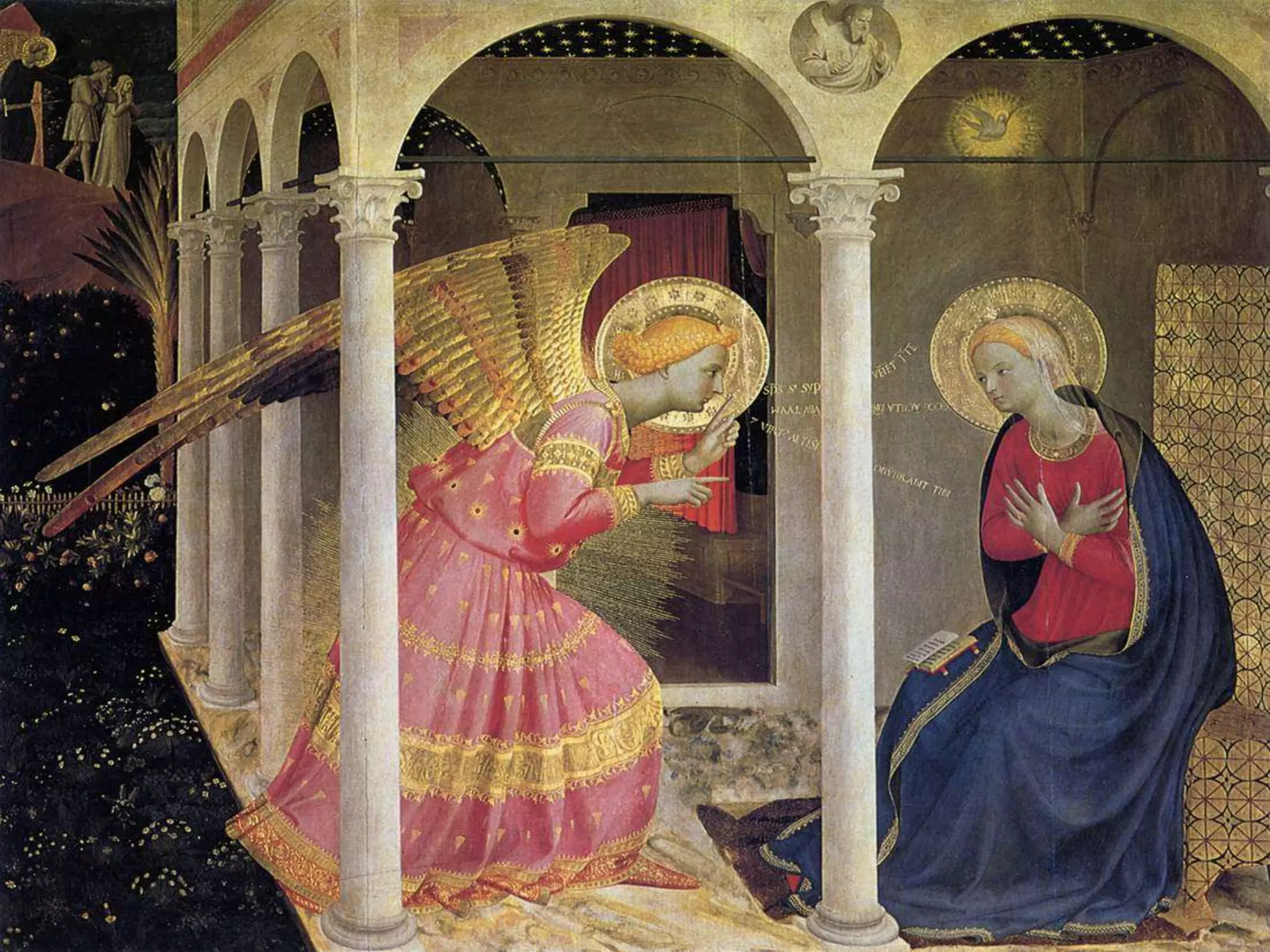
The annunciation
• By Guido de Pietro at the Fra Angelico Altarpiece
• Things to look for
  – A closed garden – symbolizing Mary’s purity
  – Classical architecture – slender corinthian columns
  – Archangel Gabriel – Youthful, energetic
  – Halo around Mary
  – Handmaiden of God – verses upside down (so God
    could read them)
  – Gothic style of Mary’s chair
  – Holy spirit – dove as the symbol
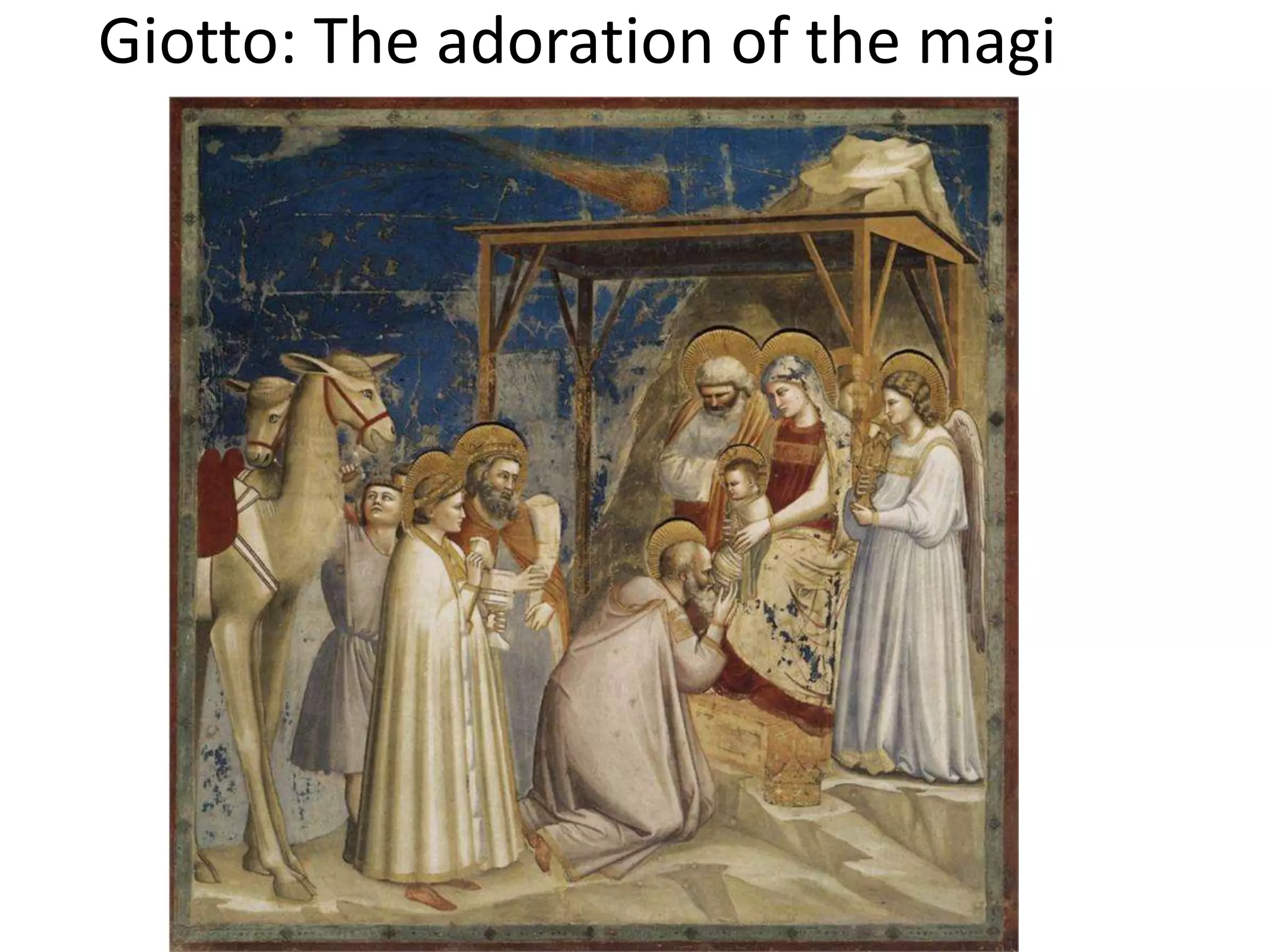
Giotto: The adoration of the magi
The adoration of the Magi
• Painted at the Arena chapel c. 1304-1306 by
  Giotto de Bondone (1267-1337)
• Things to look for
  – People’s position and character – The country lad
    in ill-fitting clothes
  – Kneeling king Caspar – sign of humility
  – Mountainous scenery
  – Shooting star – Giotto had seen a comet
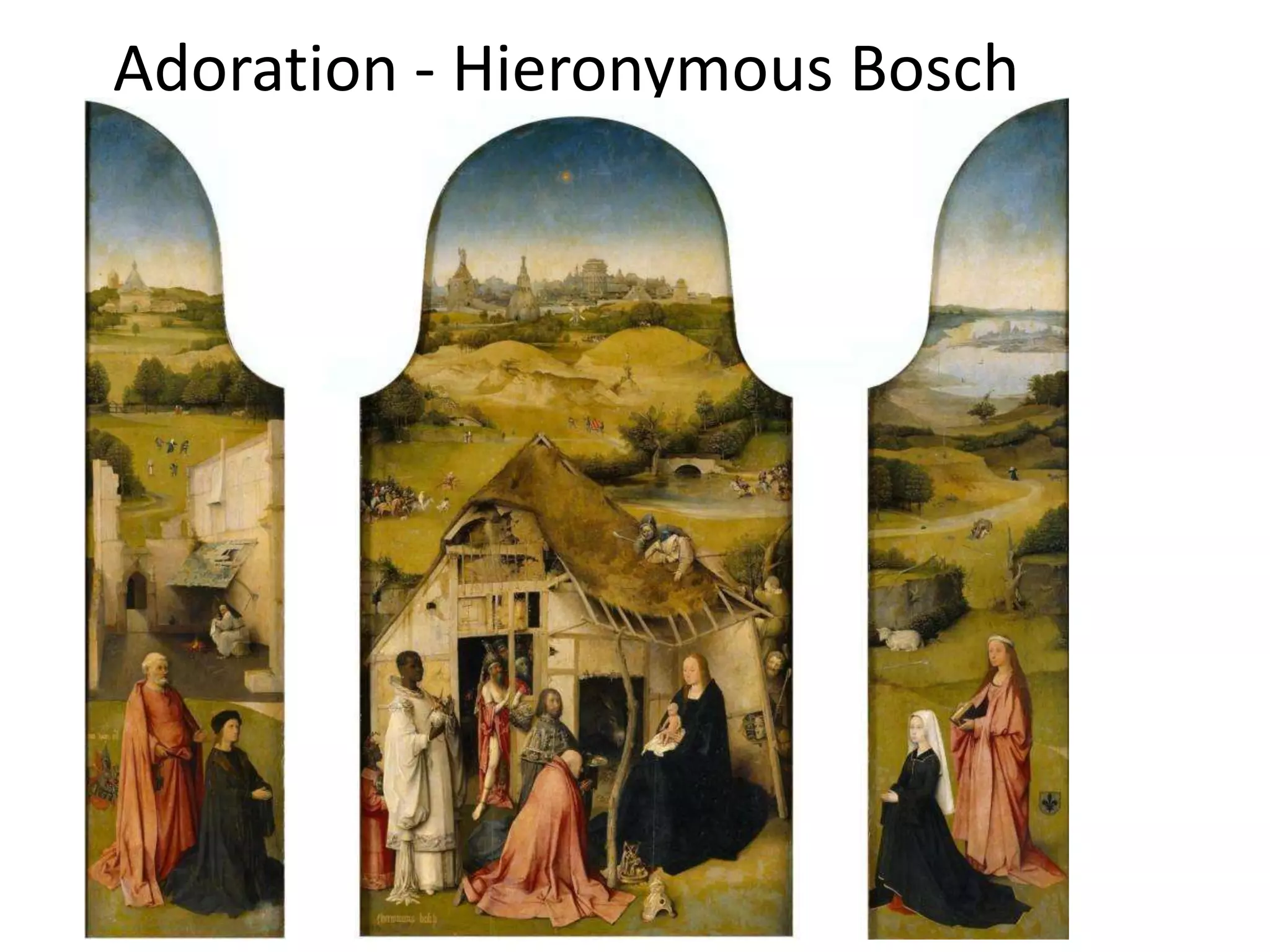
Adoration - Hieronymous Bosch
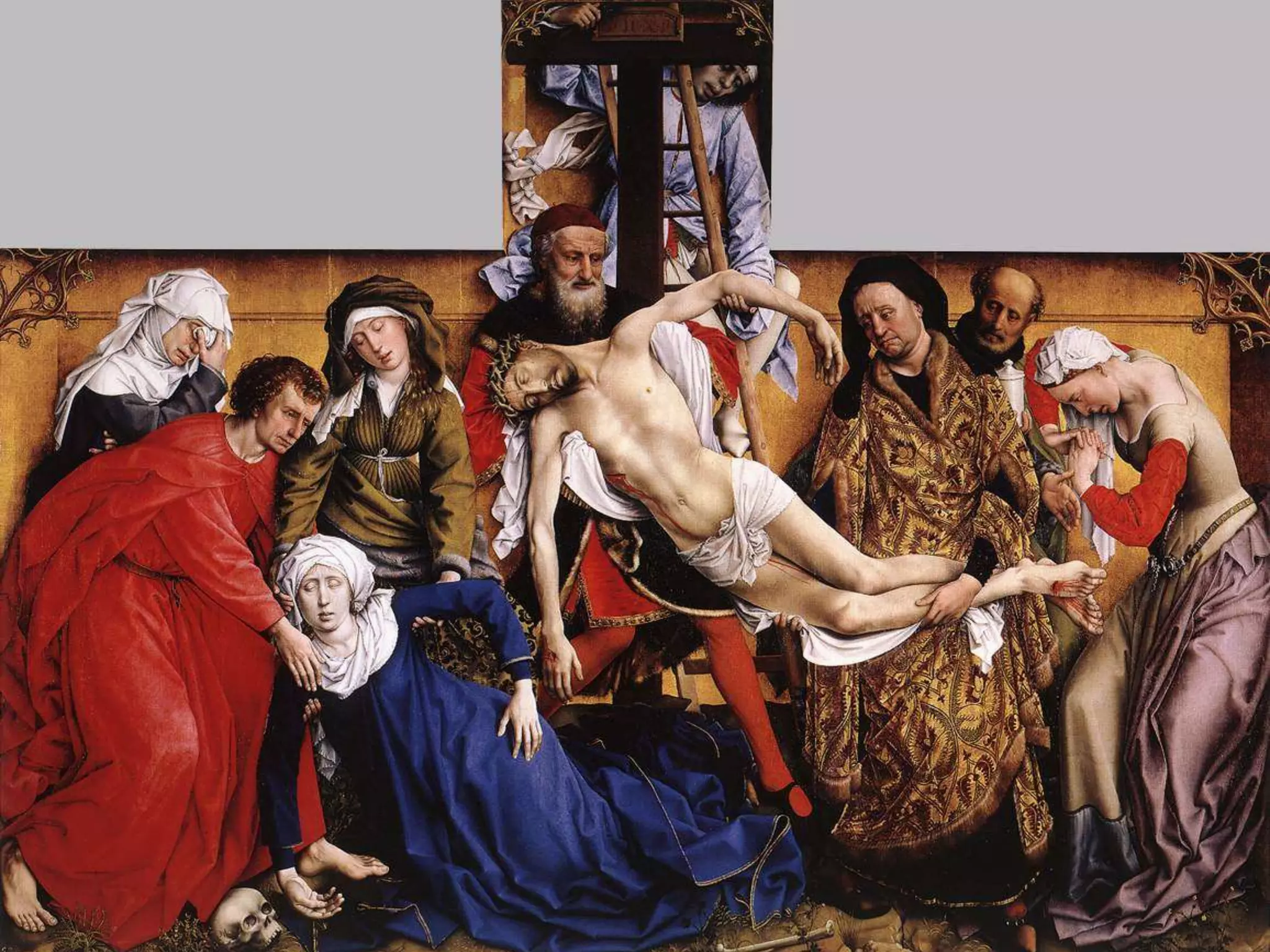
The Deposition
• By Roger van der Weyden
• Look for
  – The similarities in posture of Mary (with blue robe)
    and Christ
  – The plain clothes on the left and royal clothes on the
    right offset one less person on the right
  – Bracketing by people on the side focuses attention on
    Christ and Mary
  – The skull symbolises Adam (Christ was crucified at
    spot where Adam was buried, one signifying fall and
    the other the rise)
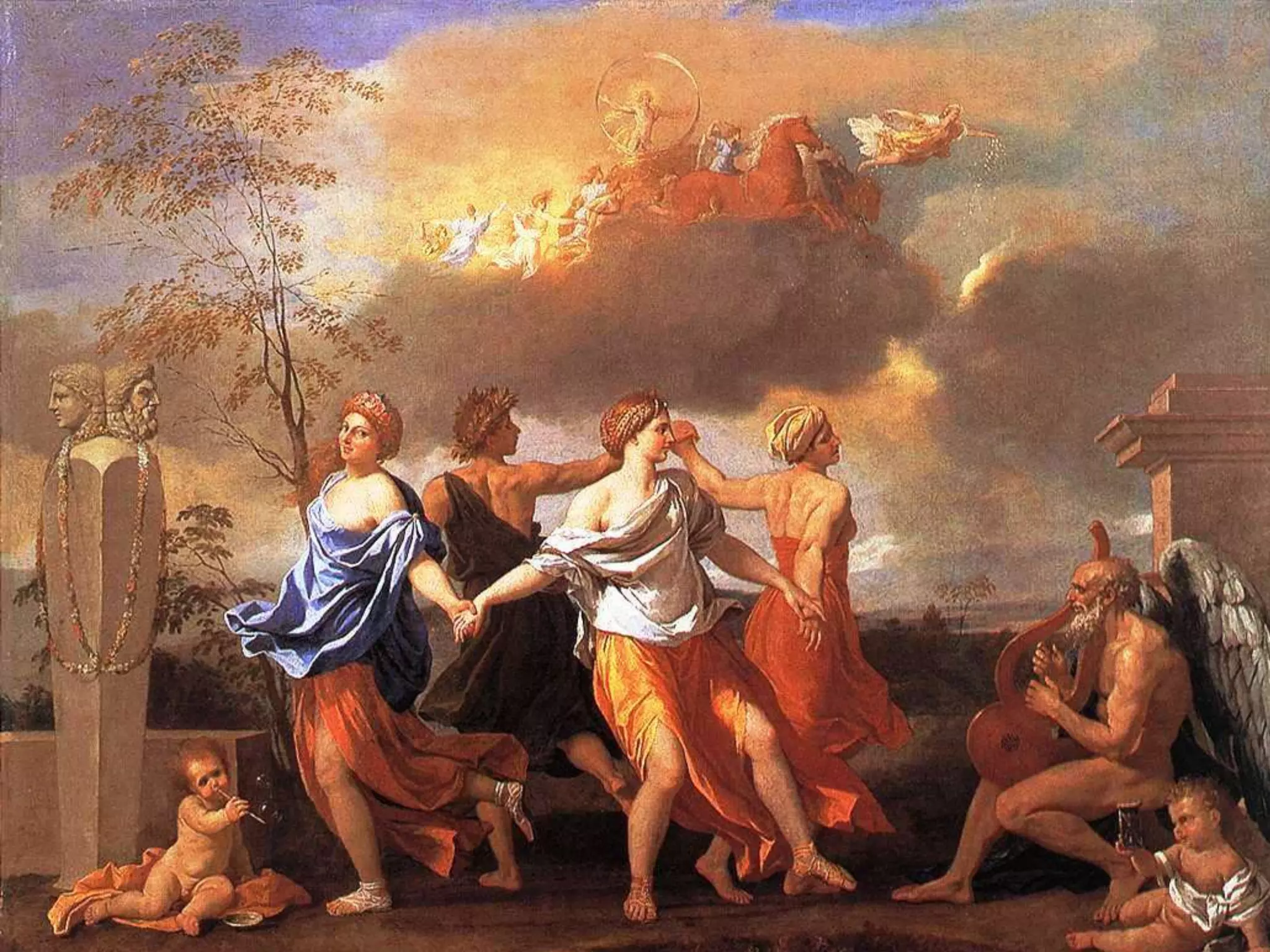
A dance to the music of time
• Painting by Nicolas Poussin (1594-1665)
• Four allegorical figures:
  Pleasure, wealth, industry and poverty
• Look for
  – Circular motion of dance in a triangle
  – Permanence and transcience – Statue of two
    faced Janus with flowers
  – Poverty and wealth holding hands
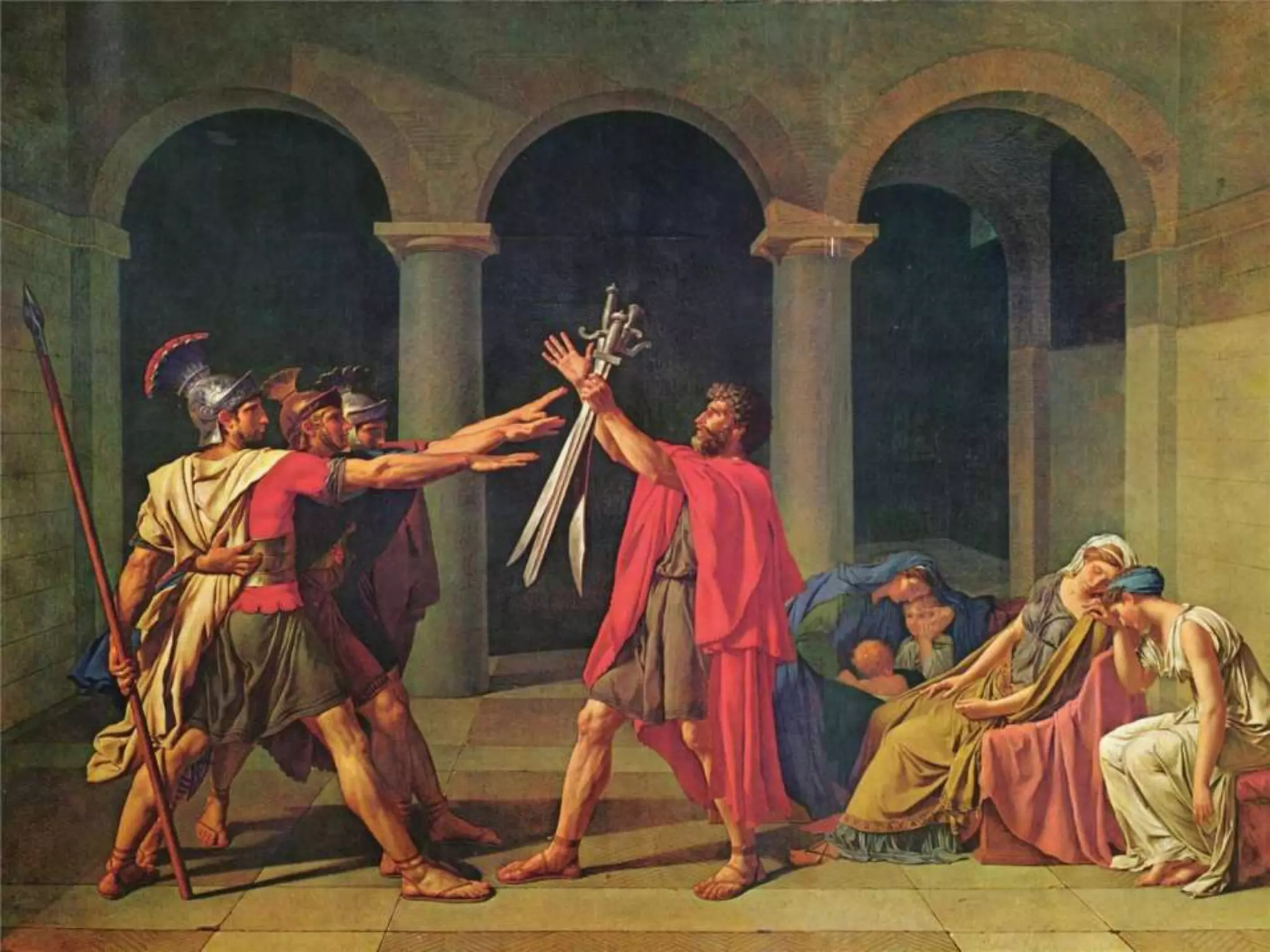
The oath of the Horatii
• By Jacques Louis David (1748-1825)
• War between Roman Horatii and Alba Coratii
• Theme of heroism and civic virtue, painted before
  the French revolution
• Look for
  – Strong profiles of soldiers, gentle curves of the sisters
  – Child pushing grandmothers hand to look at the
    swords
  – Austere columns signifying masculinity and military
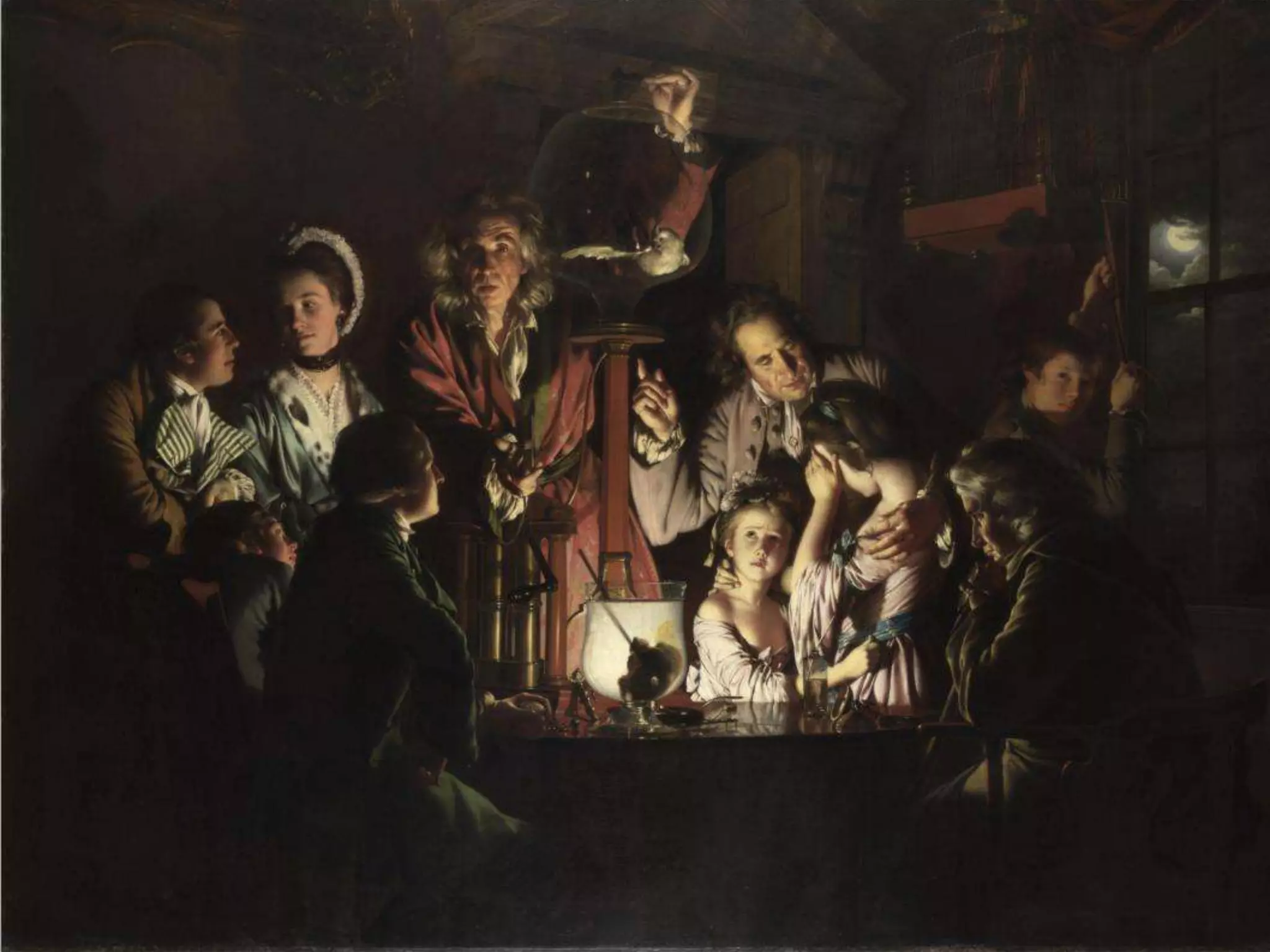
The experiment with the air pump
• By Joseph Wright
• Things to look for
   – The experiment: Will the bird survive if oxygen is pumped
     out – in a home setting – typical of 18th century
   – The lovers: not attentive to the experiment
   – The scientist: looks of a magician
   – The person with the clock: Timing the experiment
   – The girls reassured by their father
   – The boy – not sure if the cage should be lowered/needed
   – The philosopher – pondering the consequences
   – The moon: Sign of enlightenment
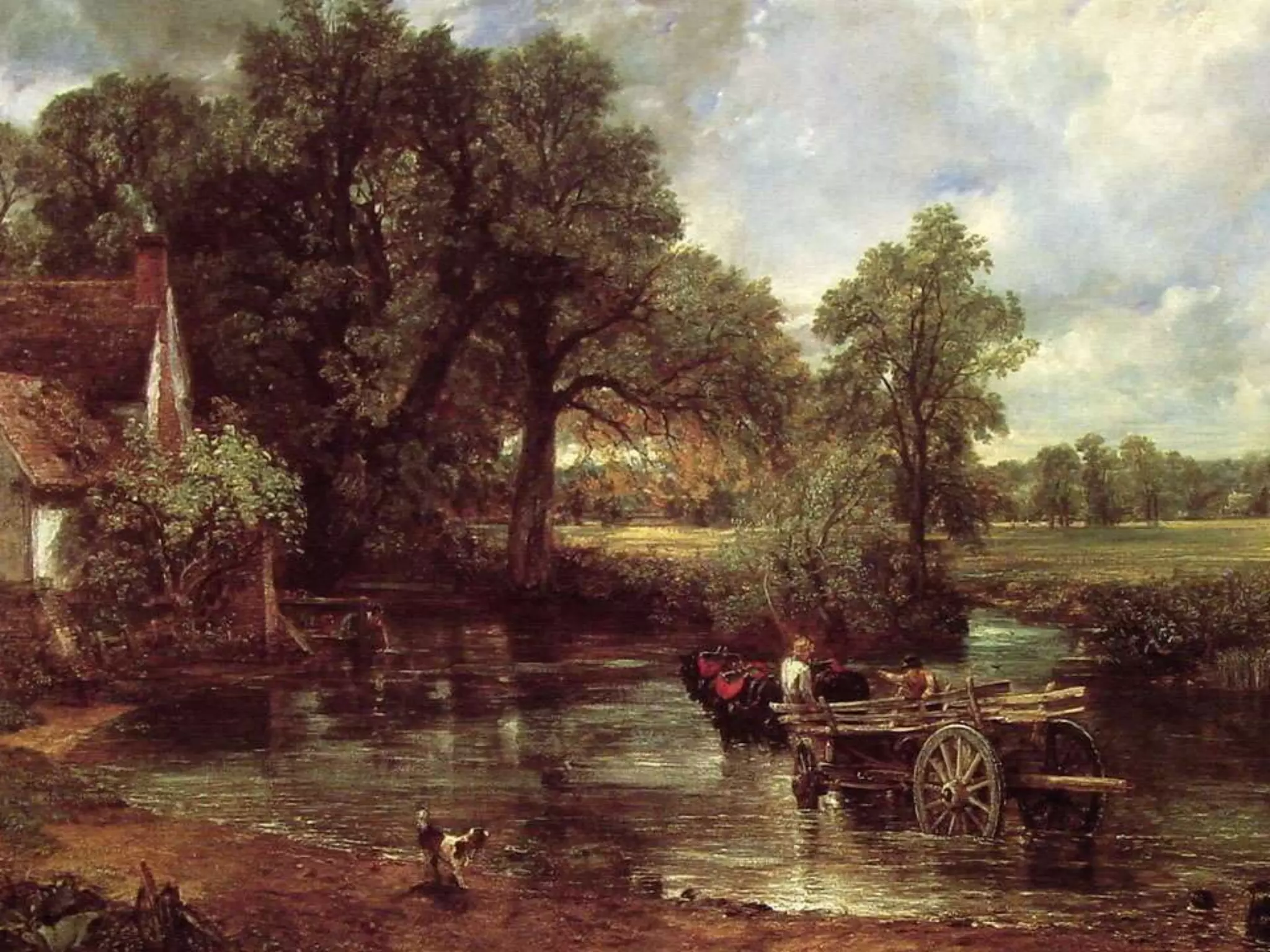
The Hay Wain
• By John Constable
• Quintessential English painting, painted in
  Suffolk, green countryside
• Things to look for
  – Washerwoman in front of cottage
  – Dog drawing attention
  – Cooling the horses
  – Clouds and the pattern of light
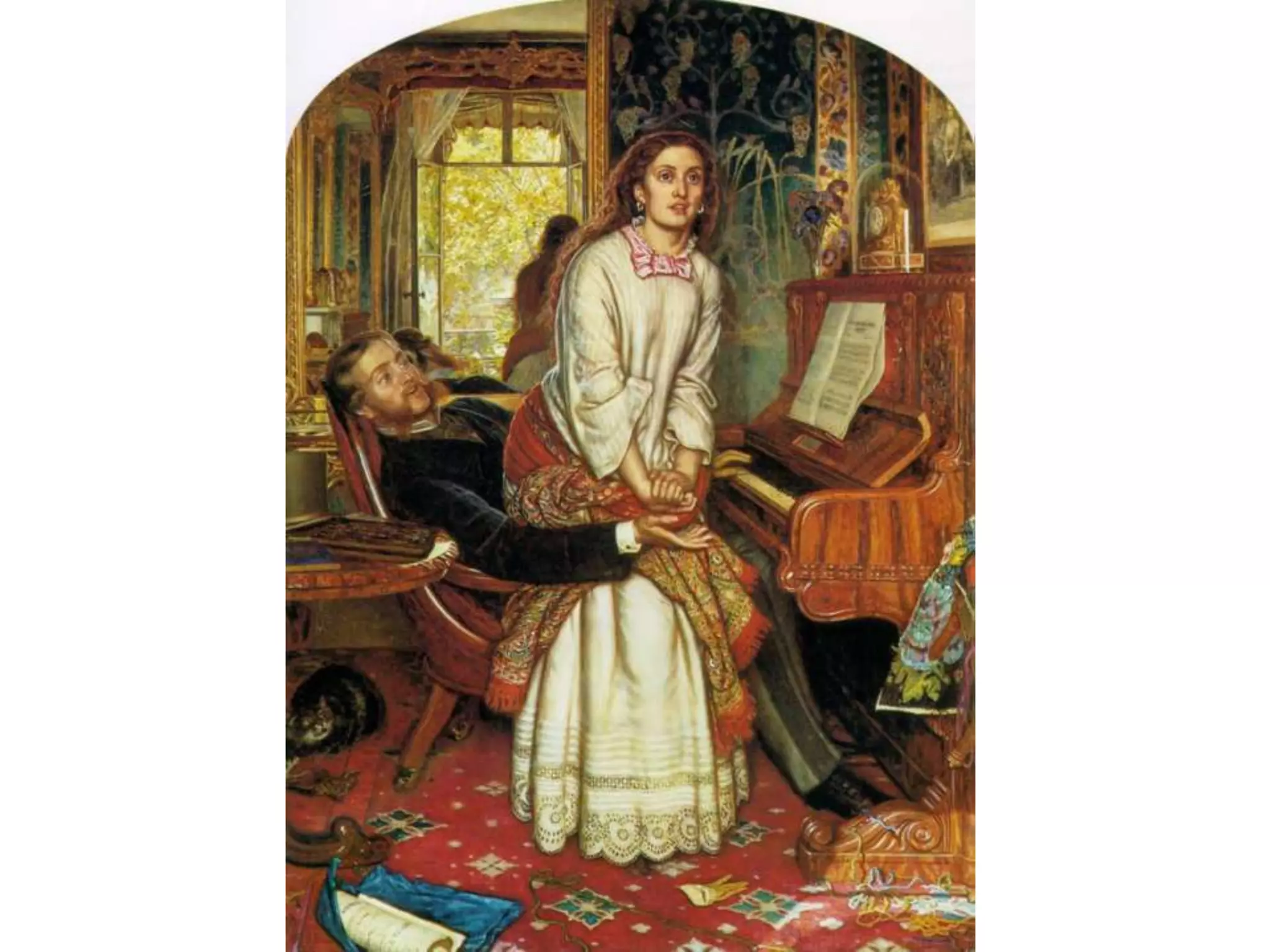
The awakening conscience
• By William Holman Hunt
• Look for
  – Depiction of luxurious items in the girls house
  – Nostalgic song – Oft in the silly night – about a
    woman reflecting on her childhood innocence
  – Cat and bird – Reflecting that salvation is possible
    for the woman
  – Discarded glove – The woman’s fate if she does
    not mend her ways
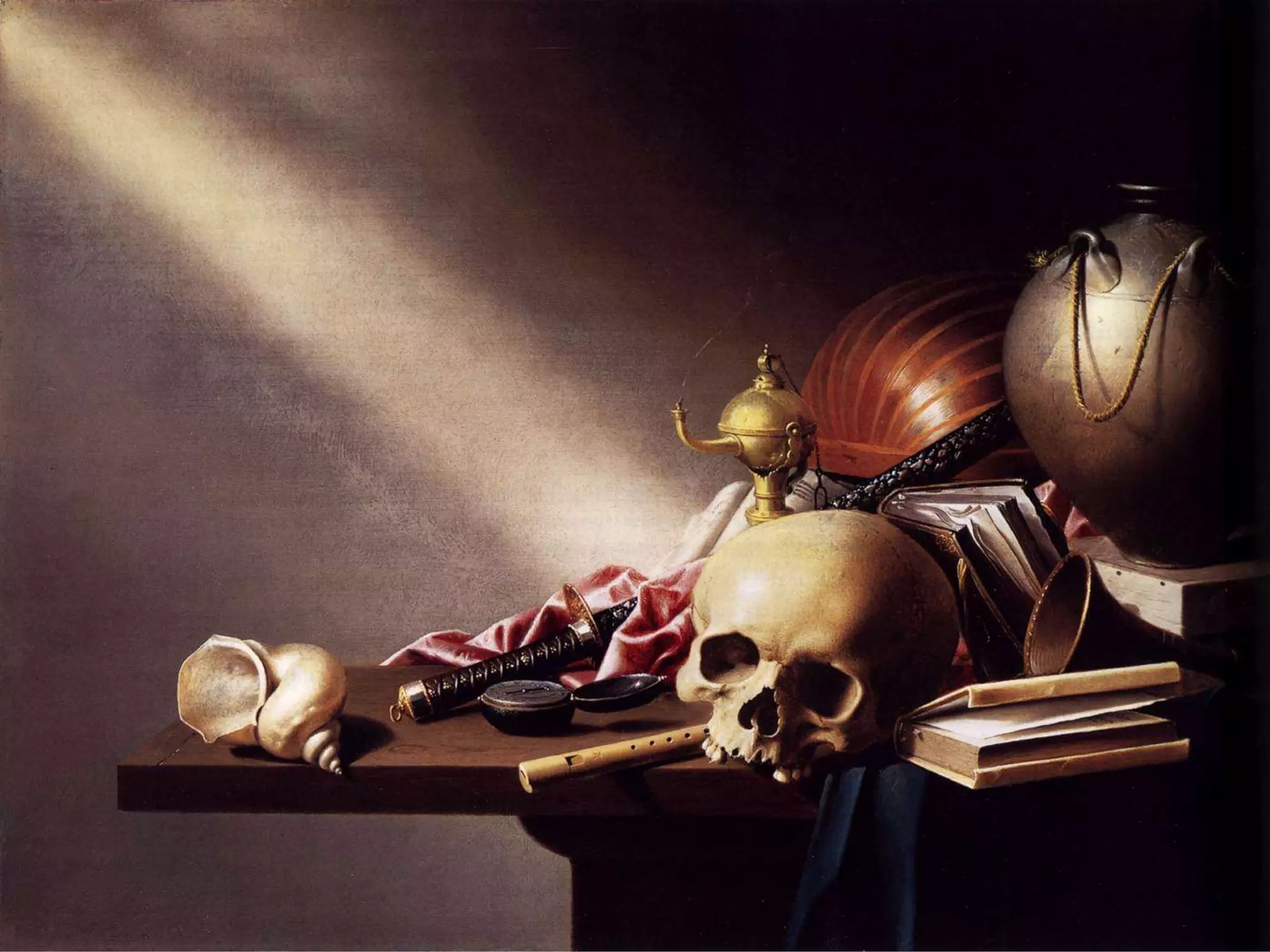
The vanities of life
• By Harmen SteenWyck
• Shell represents wealth
• Chronometer represents finite time, the
  sword (a symbol of power) reminds power is
  powerless before death
• Reminded of vanities of love (shawm) and
  knowledge (book)
• Extinguished lamp depicts life may end
  anytime
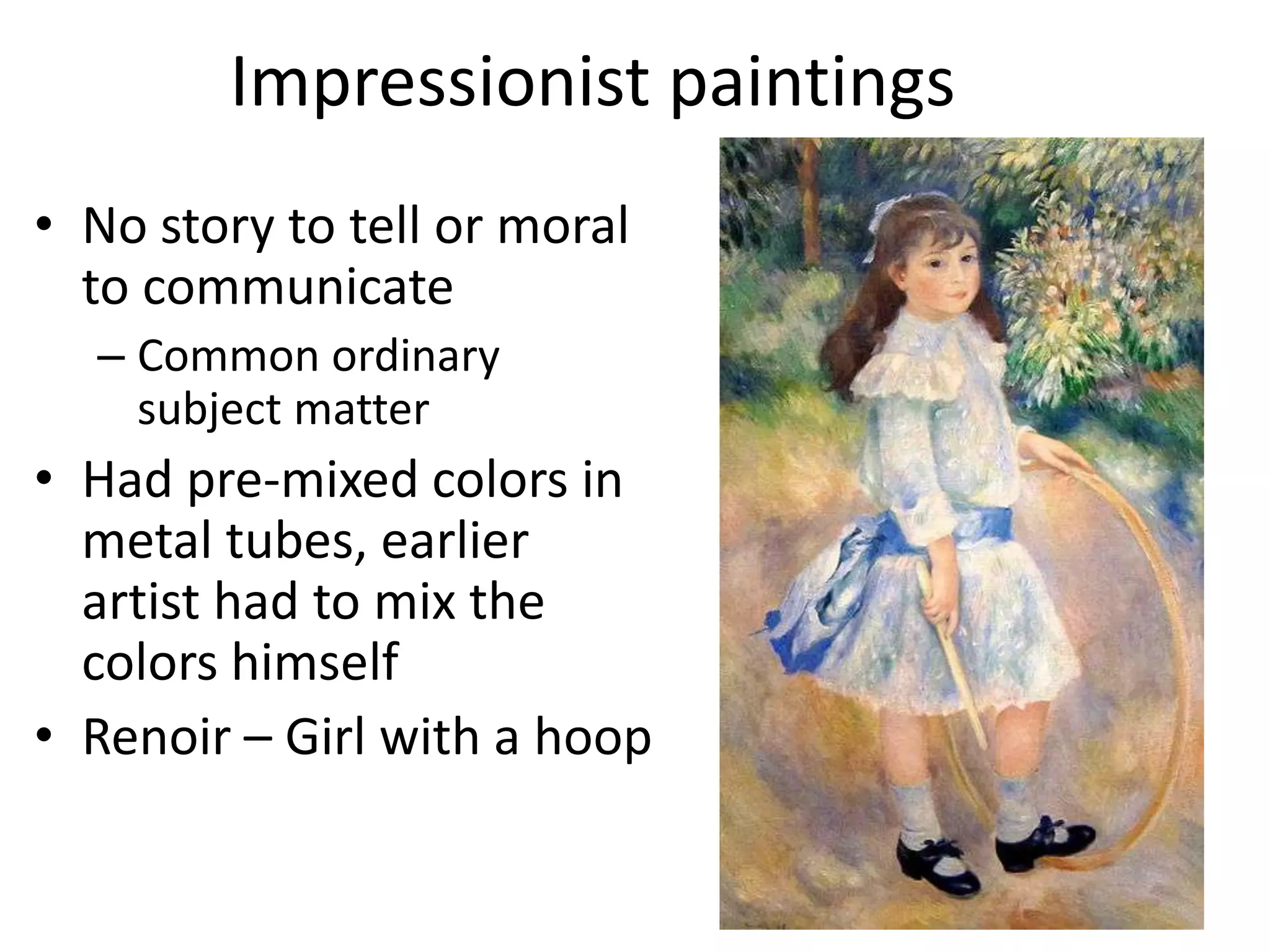
Impressionist paintings
• No story to tell or moral
  to communicate
  – Common ordinary
    subject matter
• Had pre-mixed colors in
  metal tubes, earlier
  artist had to mix the
  colors himself
• Renoir – Girl with a hoop
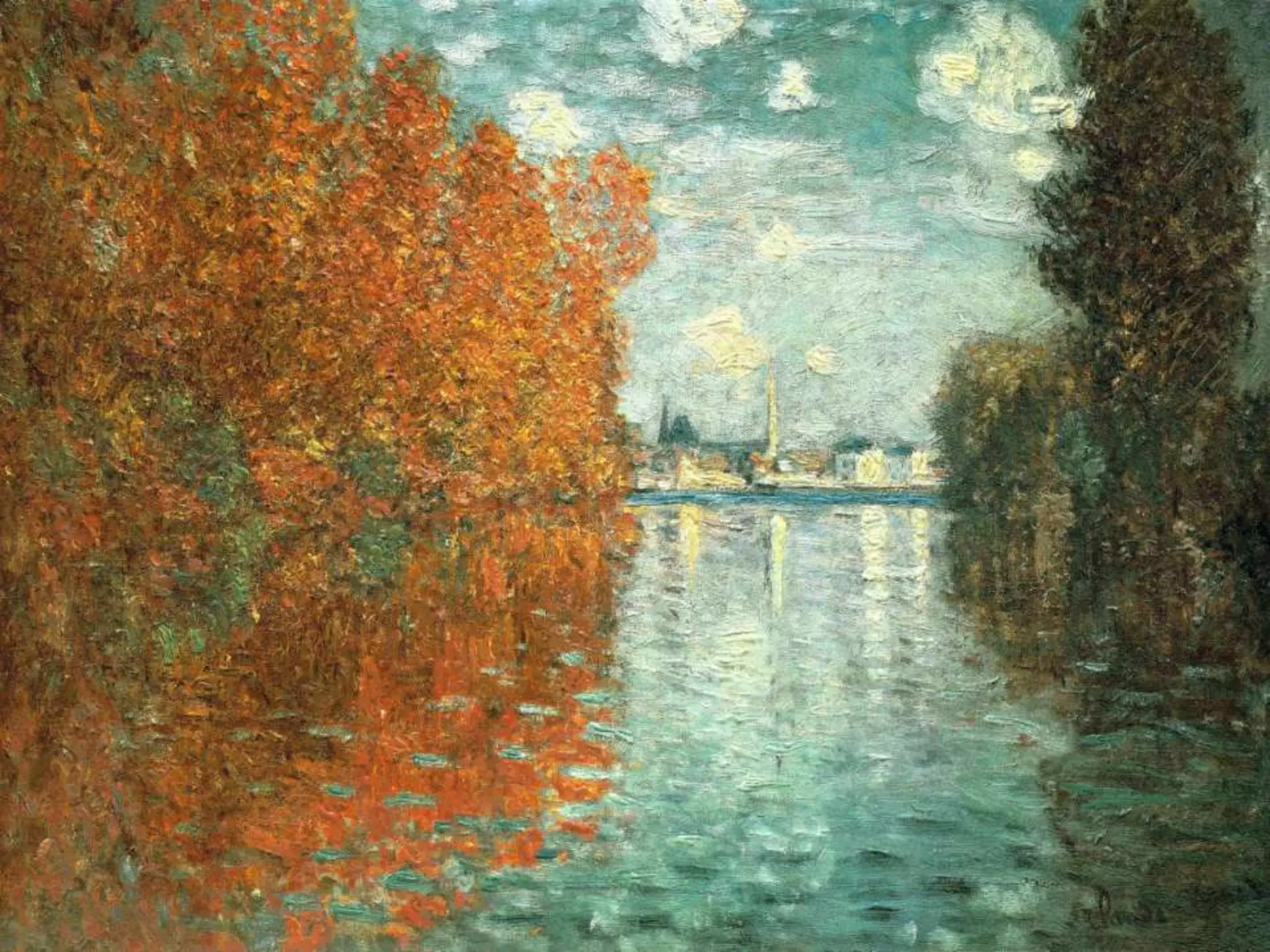
Autumn effect at Argentuil
• By Claude Monet
• Look for
  – Rainbow palette
  – Bold brushstrokes at the bottom, finer with
    distance
  – Reflected images
  – Rippling of the wind on the right
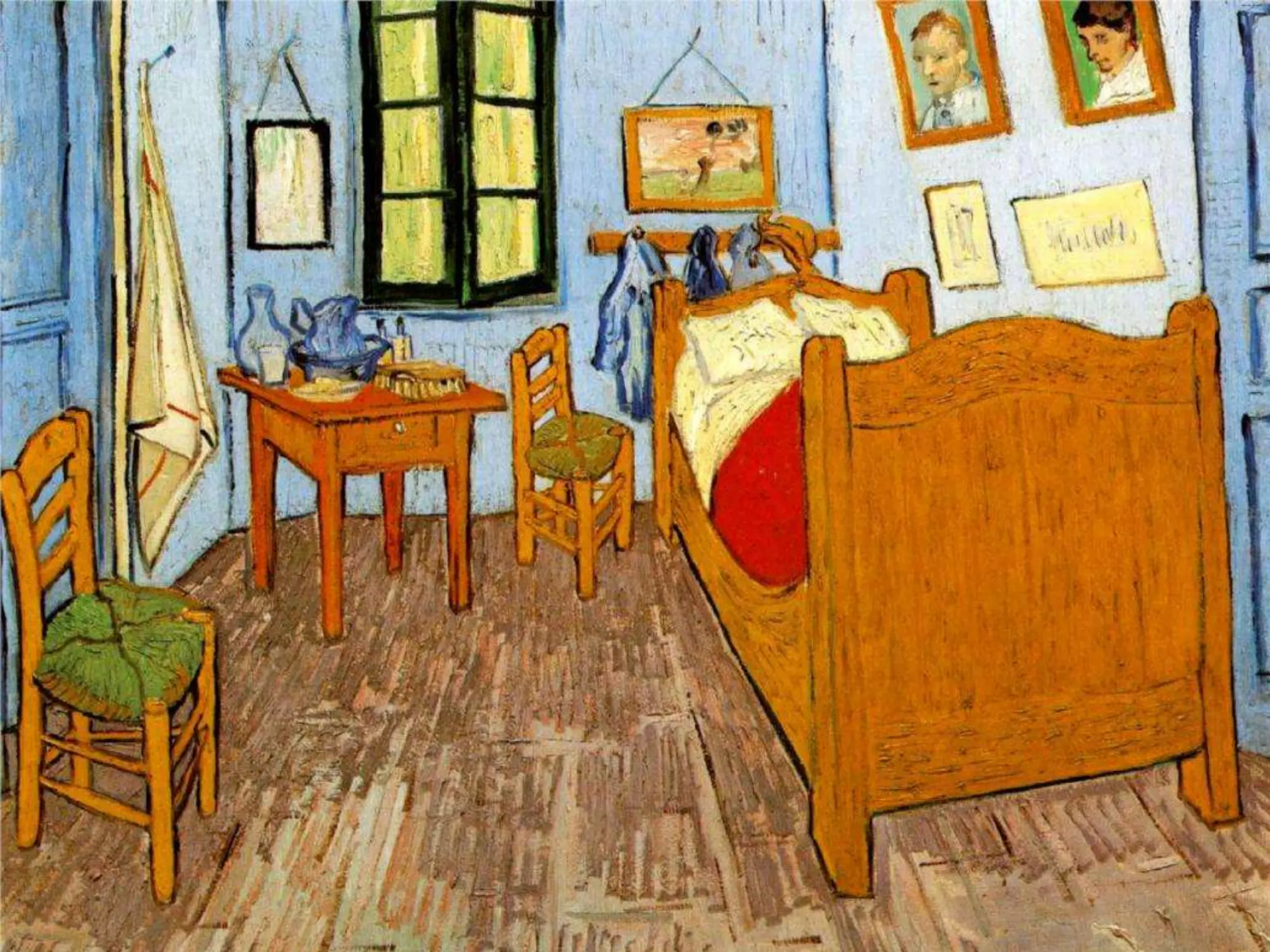
The bedroom at Arles
• By Vincent Van Gogh, 1888
• Color is everything, can suggest emotion
  regardless of the subject
• Unsophisticated and authentic
• Look for
  – Thick brushstrokes
  – Violet walls in harmony with green windows and
    contrast with yellow beds/chairs
  – Portraits of Van Gogh and his sister on the wall
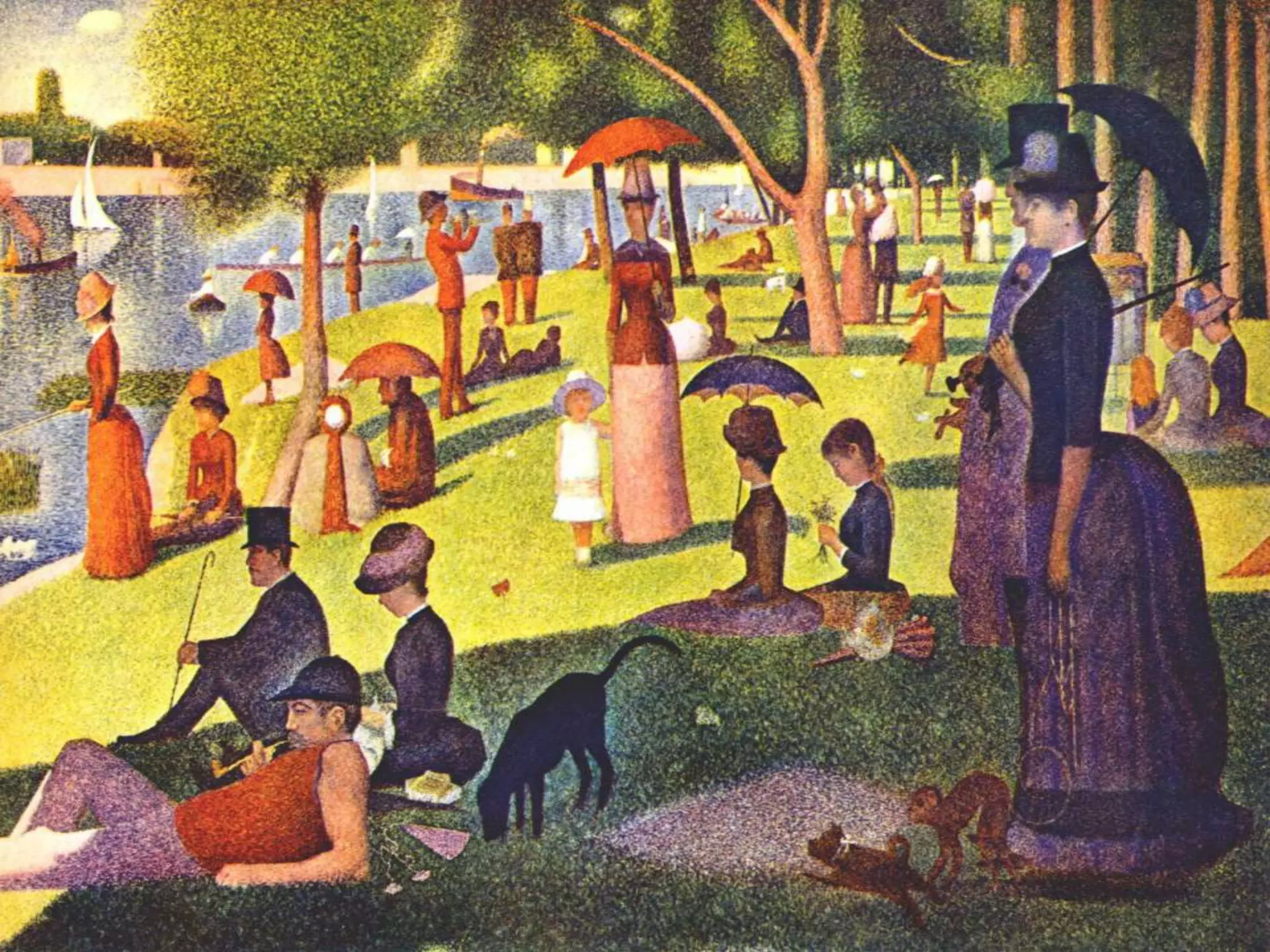
Le Grande Jatte
• By Georges Seurat
• Technique of divisionism – instead of mixing
  colors, put them separately and let the eye
  mix it
• Look for
  – Boating on the Seine and Woman fishing
  – Mixing of the classes
  – Perspective scheme – Woman with umbrella
    larger – supposed to be seen at 45 degrees
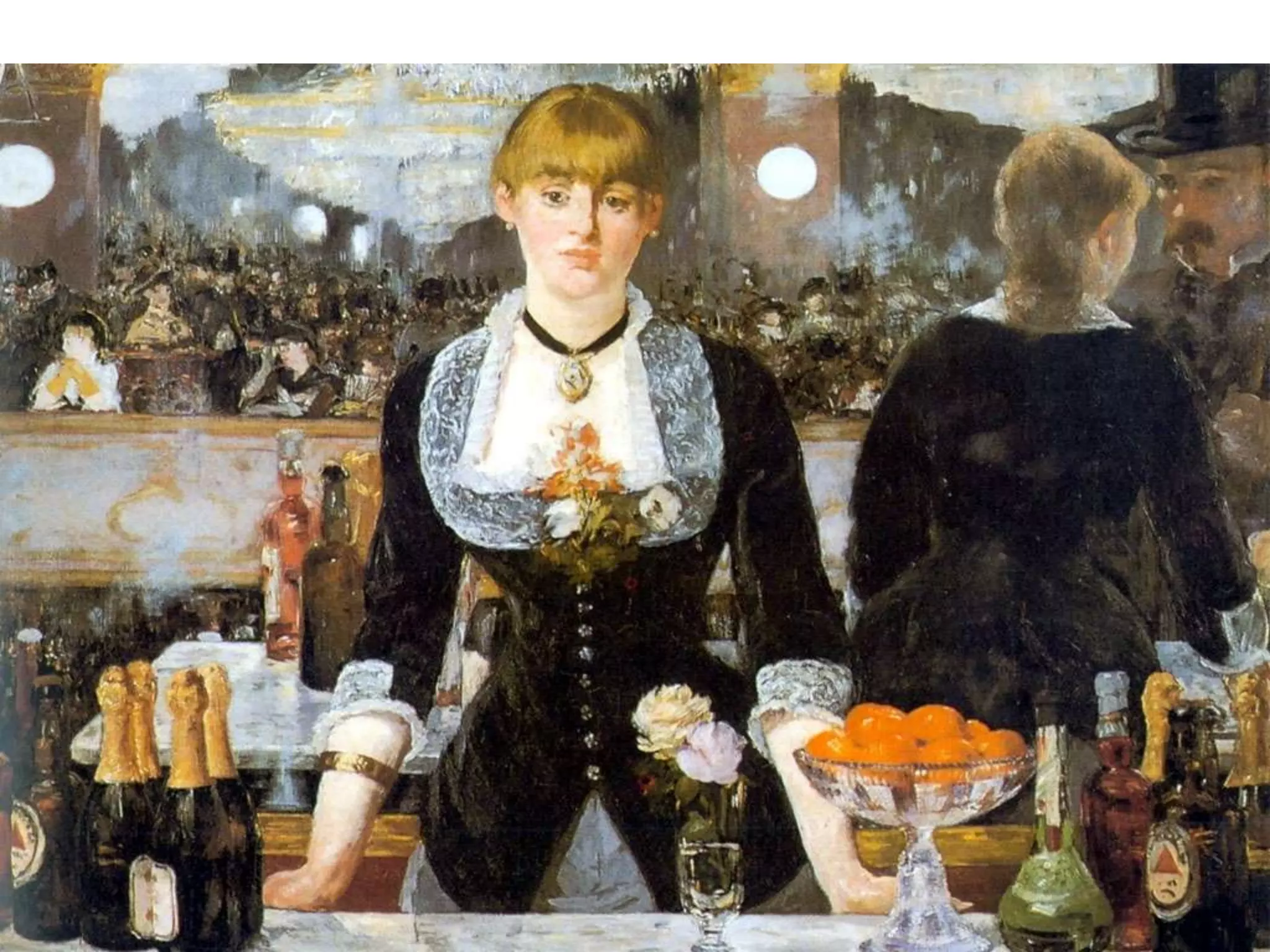
A bar at the Folies-Bergere
• By Eduardo Manet
• Set in a Paris night club
• Look for
  – Mirror
  – Inaccurate reflections depicting difference in time
    between subject and reflection
  – Difference in drinks (champagne and beer)
    depicting different classes of society
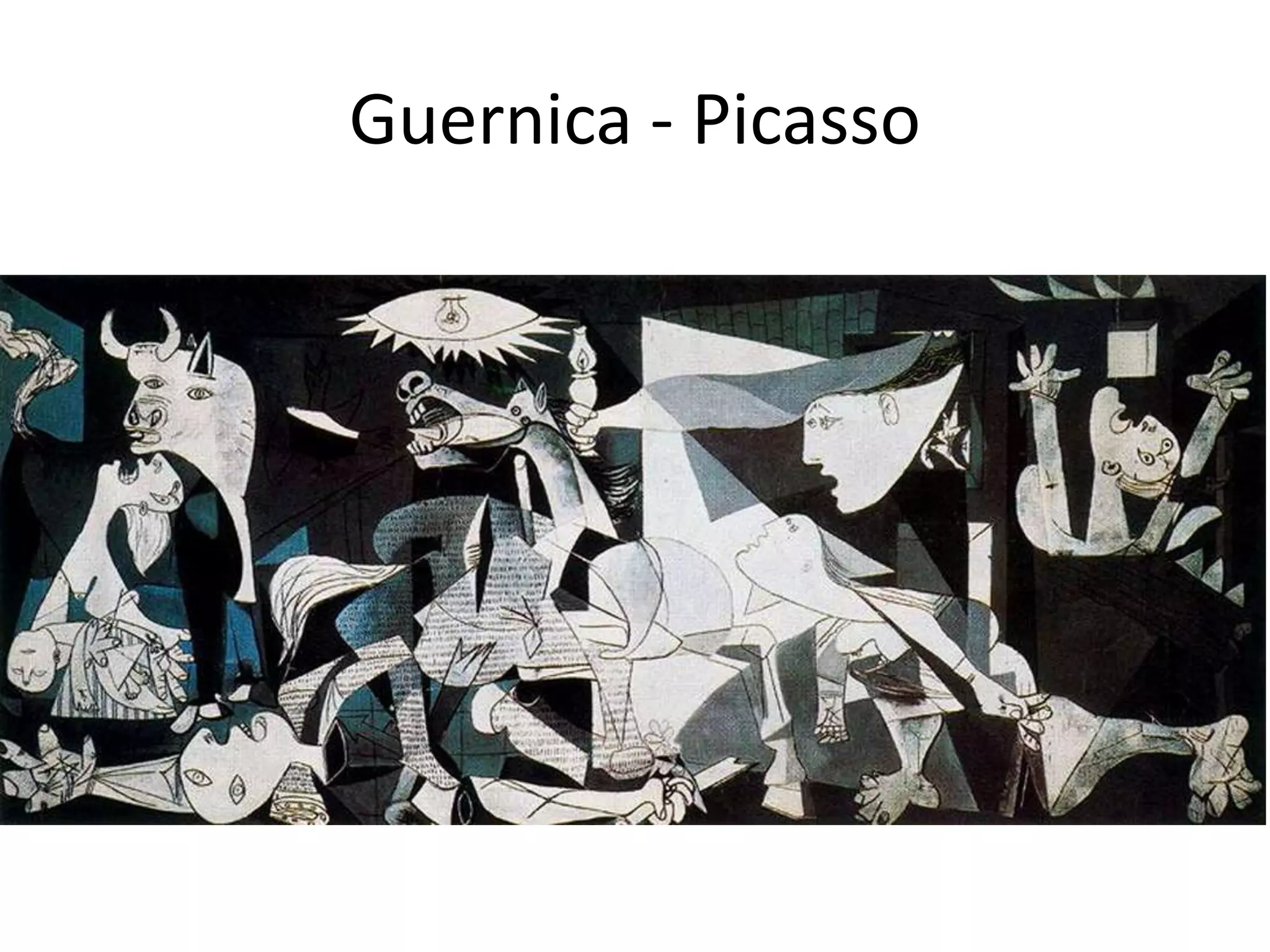
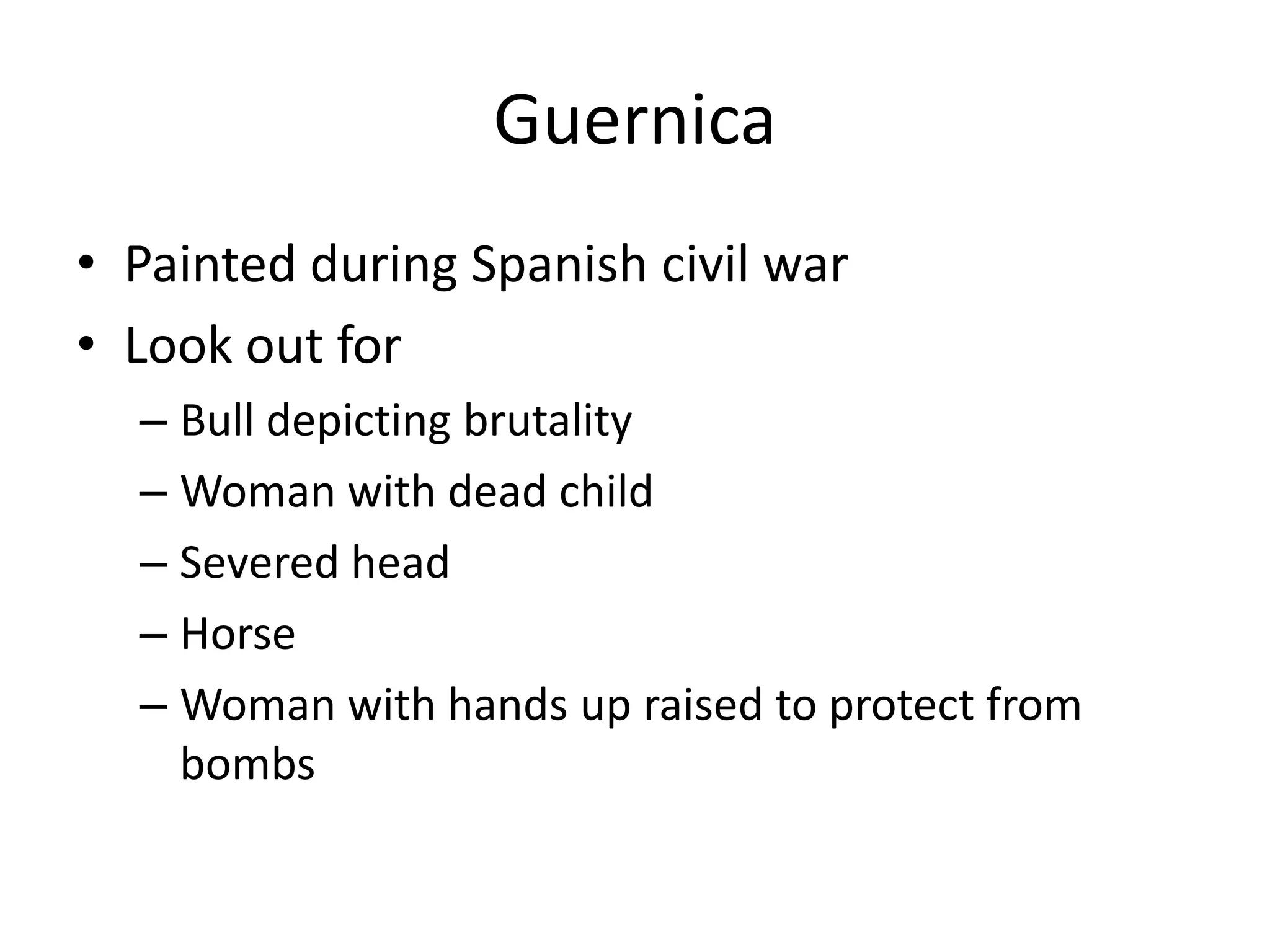
Guernica - Picasso
Guernica
• Painted during Spanish civil war
• Look out for
  – Bull depicting brutality
  – Woman with dead child
  – Severed head
  – Horse
  – Woman with hands up raised to protect from
    bombs
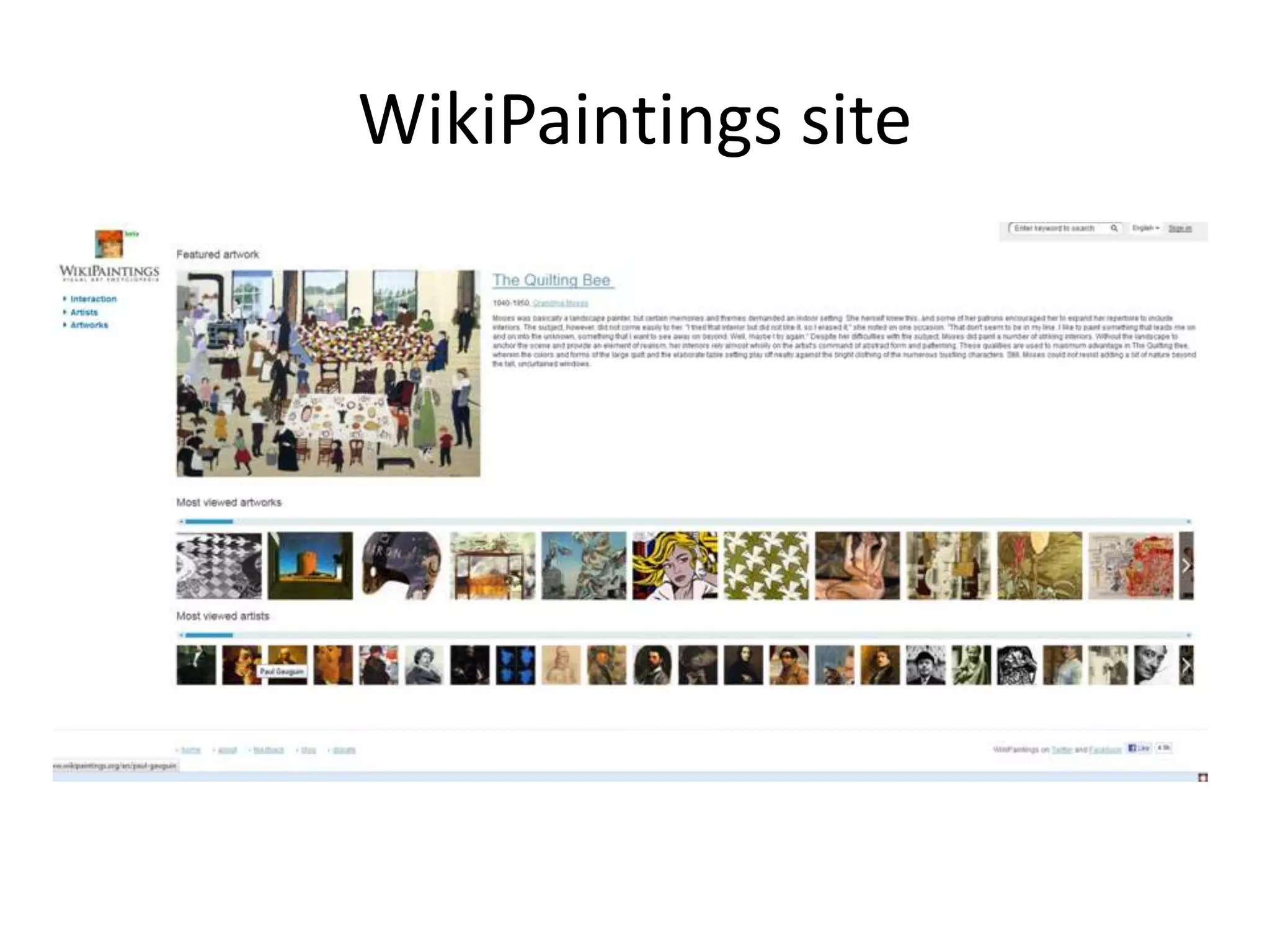
WikiPaintings site
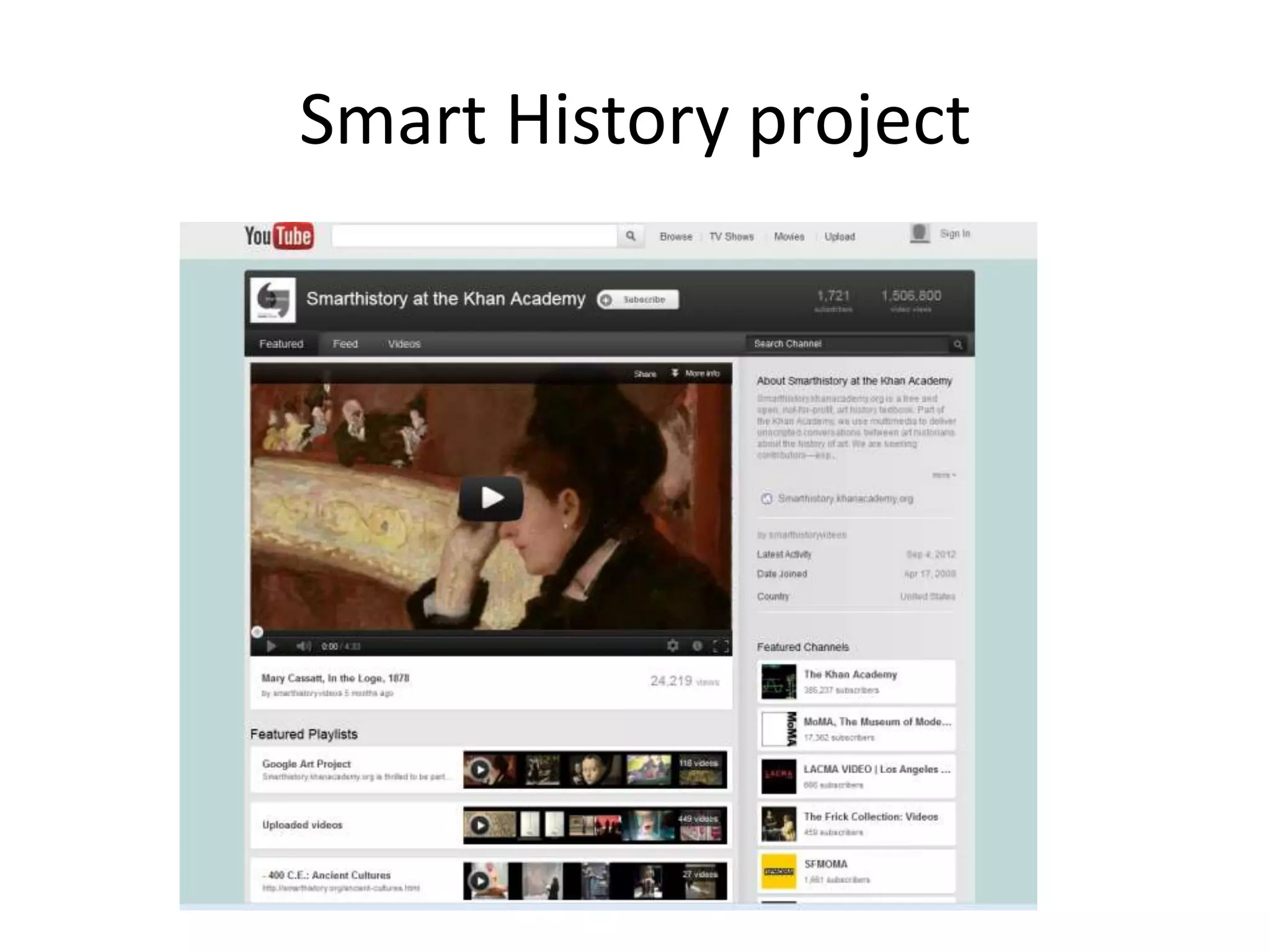
Smart History project
Thank You

Understanding paintings

  • 1.
    Understanding paintings Krishnan, GTC Talk
  • 2.
    Seeing vs Looking •Easy access to great paintings today – Greeting cards – Internet • Seeing involves opening your eyes • Looking involves opening your mind and taxing your intellect • Look, don’t just see !
  • 3.
    Six guidelines forlooking at paintings • Subject – Sometimes historical or mythological figures • Techniques – Use of oil paints, frescos • Symbolism – Many paintings use language of symbolism and allegory that was understood by the artists and audiences of the time • Space and light – Artists mastery in creating space and light • Historical Style – Each historical period had a style – Renaissance to Modern times • Personal Interpretation – What you see with your knowledge of history, symbolism and techniques
  • 4.
    Bacchus and Ariadne Subject Each painting has specific subject with meaningful message Subjects could be mythological figures
  • 5.
    The Arnolfini marriage ByJan Van Eyck Known for mastery in oil paint
  • 6.
    The supper atEmmaus Recognizable objects stand for abstract ideas and concepts
  • 7.
    Las Meninas All artistshave to create an illusion of space and light in different ways
  • 8.
    What creates amasterpiece • Virtuosity – Skills + knowledge and imagination • Innovation – Rewriting the existing rules – Giotto and Picasso • Patronage – Catholic church and Royal coursts • Artistic vision – Michelangelo’s ceiling
  • 9.
    Frescoes • Fresco isa technique of mural painting • Executed upon freshly laid lime plaster • Water is used as vehicle for the pigment • With setting of the plaster, painting becomes part of the wall
  • 11.
    The annunciation • ByGuido de Pietro at the Fra Angelico Altarpiece • Things to look for – A closed garden – symbolizing Mary’s purity – Classical architecture – slender corinthian columns – Archangel Gabriel – Youthful, energetic – Halo around Mary – Handmaiden of God – verses upside down (so God could read them) – Gothic style of Mary’s chair – Holy spirit – dove as the symbol
  • 12.
  • 13.
    The adoration ofthe Magi • Painted at the Arena chapel c. 1304-1306 by Giotto de Bondone (1267-1337) • Things to look for – People’s position and character – The country lad in ill-fitting clothes – Kneeling king Caspar – sign of humility – Mountainous scenery – Shooting star – Giotto had seen a comet
  • 14.
  • 16.
    The Deposition • ByRoger van der Weyden • Look for – The similarities in posture of Mary (with blue robe) and Christ – The plain clothes on the left and royal clothes on the right offset one less person on the right – Bracketing by people on the side focuses attention on Christ and Mary – The skull symbolises Adam (Christ was crucified at spot where Adam was buried, one signifying fall and the other the rise)
  • 18.
    A dance tothe music of time • Painting by Nicolas Poussin (1594-1665) • Four allegorical figures: Pleasure, wealth, industry and poverty • Look for – Circular motion of dance in a triangle – Permanence and transcience – Statue of two faced Janus with flowers – Poverty and wealth holding hands
  • 20.
    The oath ofthe Horatii • By Jacques Louis David (1748-1825) • War between Roman Horatii and Alba Coratii • Theme of heroism and civic virtue, painted before the French revolution • Look for – Strong profiles of soldiers, gentle curves of the sisters – Child pushing grandmothers hand to look at the swords – Austere columns signifying masculinity and military
  • 22.
    The experiment withthe air pump • By Joseph Wright • Things to look for – The experiment: Will the bird survive if oxygen is pumped out – in a home setting – typical of 18th century – The lovers: not attentive to the experiment – The scientist: looks of a magician – The person with the clock: Timing the experiment – The girls reassured by their father – The boy – not sure if the cage should be lowered/needed – The philosopher – pondering the consequences – The moon: Sign of enlightenment
  • 24.
    The Hay Wain •By John Constable • Quintessential English painting, painted in Suffolk, green countryside • Things to look for – Washerwoman in front of cottage – Dog drawing attention – Cooling the horses – Clouds and the pattern of light
  • 26.
    The awakening conscience •By William Holman Hunt • Look for – Depiction of luxurious items in the girls house – Nostalgic song – Oft in the silly night – about a woman reflecting on her childhood innocence – Cat and bird – Reflecting that salvation is possible for the woman – Discarded glove – The woman’s fate if she does not mend her ways
  • 28.
    The vanities oflife • By Harmen SteenWyck • Shell represents wealth • Chronometer represents finite time, the sword (a symbol of power) reminds power is powerless before death • Reminded of vanities of love (shawm) and knowledge (book) • Extinguished lamp depicts life may end anytime
  • 29.
    Impressionist paintings • Nostory to tell or moral to communicate – Common ordinary subject matter • Had pre-mixed colors in metal tubes, earlier artist had to mix the colors himself • Renoir – Girl with a hoop
  • 31.
    Autumn effect atArgentuil • By Claude Monet • Look for – Rainbow palette – Bold brushstrokes at the bottom, finer with distance – Reflected images – Rippling of the wind on the right
  • 33.
    The bedroom atArles • By Vincent Van Gogh, 1888 • Color is everything, can suggest emotion regardless of the subject • Unsophisticated and authentic • Look for – Thick brushstrokes – Violet walls in harmony with green windows and contrast with yellow beds/chairs – Portraits of Van Gogh and his sister on the wall
  • 35.
    Le Grande Jatte •By Georges Seurat • Technique of divisionism – instead of mixing colors, put them separately and let the eye mix it • Look for – Boating on the Seine and Woman fishing – Mixing of the classes – Perspective scheme – Woman with umbrella larger – supposed to be seen at 45 degrees
  • 37.
    A bar atthe Folies-Bergere • By Eduardo Manet • Set in a Paris night club • Look for – Mirror – Inaccurate reflections depicting difference in time between subject and reflection – Difference in drinks (champagne and beer) depicting different classes of society
  • 38.
  • 39.
    Guernica • Painted duringSpanish civil war • Look out for – Bull depicting brutality – Woman with dead child – Severed head – Horse – Woman with hands up raised to protect from bombs
  • 40.
  • 41.
  • 42.

Editor's Notes

  • #11 The annunciation
  • #28 SteenWyck – Vanities of human Life