The United Nations
BACKGROUND AND CREATION
Several international treaty organizations and conferences
had been formed to regulate conflicts between nations, such
as the International Committee of the Red Crossand
the Hague Conventions of 1899 and 1907
Following the catastrophic loss of life in the First World War,
the Paris Peace Conference established the League of
Nations to maintain harmony between countries
However, the League lacked representation for
colonial peoples (then half the world's
population) and significant participation from
several major powers, including the US, USSR,
Germany, and Japan.
The earliest concrete plan for a new world organization began under
the aegis of the US State Department in 1939.The text of the
"Declaration by United Nations" was drafted by President Franklin
Roosevelt, British Prime Minister Winston Churchill, and Roosevelt
aide Harry Hopkins, while meeting at the White House, 29 December
1941.
"Four Policemen" was coined to refer four major Allied
countries,United States, United Kingdom, Soviet Union, and China,
which was emerged in Declaration by United Nations.
Having subscribed to a common program of purposes and principles embodied in the
Joint Declaration of the President of the United States of America and the Prime
Minister of Great Britain dated August 14, 1941, known as the Atlantic Charter,
Being convinced that complete victory over their enemies is essential to defend life,
liberty, independence and religious freedom, and to preserve human rights and justice
in their own lands as well as in other lands, and that they are now engaged in a
common struggle against savage and brutal forces seeking to subjugate the world,
DECLARE:
(1) Each Government pledges itself to employ its full resources, military or economic,
against those members of the Tripartite Pact and its adherents with which such
government is at war.
(2) Each Government pledges itself to cooperate with the Governments signatory
hereto and not to make a separate armistice or peace with the enemies.
The foregoing declaration may be adhered to by other nations which are, or which may
be, rendering material assistance and contributions in the struggle for victory over
Hitlerism.
During the war, the United Nations became the official term for the Allies. To join countries had
to sign the Declaration and declare war on the Axis
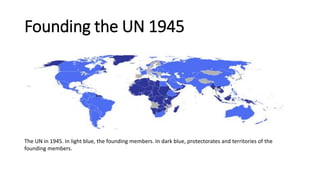
Founding the UN 1945
The UN in 1945. In light blue, the founding members. In dark blue, protectorates and territories of the
founding members.
United Nations’ Structure
the General Assembly,
the Security Council,
the Economic and Social Council (ECOSOC),
the Secretariat, and the International Court of Justice
A sixth principal organ, the Trusteeship Council, suspended
operations in 1994, upon the independence of Palau, the last
remaining UN trustee territory
GENERAL ASSEMBLY
• May resolve non-compulsory recommendations to states or
suggestions to the Security Council (UNSC);
• Decides on the admission of new members, following proposal by the
UNSC;
• Adopts the budget;
• Elects the non-permanent members of the UNSC; all members of
ECOSOC; the UN Secretary General (following his/her proposal by the
UNSC); and the fifteen judges of the International Court of Justice
(ICJ). Each country has one vote.
UN Secretariat
• Supports the other UN bodies administratively (for
example, in the organization of conferences, the
writing of reports and studies and the preparation of
the budget);
• Its chairperson – the UN Secretary General – is elected
by the General Assembly for a five-year mandate and
is the UN's foremost representative.
International Court of Justice
•Decides disputes between states that
recognize its jurisdiction;
•Issues legal opinions;
UN Security Council
•Responsible for the maintenance of international
peace andsecurity;
•May adopt compulsory resolutions;
•Has fifteen members: five permanent
members and ten elected members.
UN Economic and Social Council
• Responsible for co-operation between states as
regards economic and social matters;
• Co-ordinates co-operation between the UN's
numerousspecialized agencies;
• Has 54 members, elected by the General Assembly to
serve staggered three-year mandates.
UN Trusteeship Council
• For administering trust territories (currently inactive)
• Was originally designed to manage colonial
possessions that were former League of Nations
mandates;
• Has been inactive since 1994, when Palau, the last
trust territory, attained independence.
OBJECTIVES
Peacekeeping and security
Human rights
Economic development and
humanitarian assistance
Millennium Development Goals
1.Eradicate extremesdf poverty and hunger
2.Achieve universal primary education
3.Promote gender equality and empower women
4.Reduce child mortality
5.Improve maternal health
6.Combat HIV/AIDS, malaria, and other diseases
7.Ensure environmental sustainability
8.Develop a global partnership for development

The united nations

  • 1.
  • 2.
    BACKGROUND AND CREATION Severalinternational treaty organizations and conferences had been formed to regulate conflicts between nations, such as the International Committee of the Red Crossand the Hague Conventions of 1899 and 1907 Following the catastrophic loss of life in the First World War, the Paris Peace Conference established the League of Nations to maintain harmony between countries
  • 3.
    However, the Leaguelacked representation for colonial peoples (then half the world's population) and significant participation from several major powers, including the US, USSR, Germany, and Japan.
  • 4.
    The earliest concreteplan for a new world organization began under the aegis of the US State Department in 1939.The text of the "Declaration by United Nations" was drafted by President Franklin Roosevelt, British Prime Minister Winston Churchill, and Roosevelt aide Harry Hopkins, while meeting at the White House, 29 December 1941. "Four Policemen" was coined to refer four major Allied countries,United States, United Kingdom, Soviet Union, and China, which was emerged in Declaration by United Nations.
  • 5.
    Having subscribed toa common program of purposes and principles embodied in the Joint Declaration of the President of the United States of America and the Prime Minister of Great Britain dated August 14, 1941, known as the Atlantic Charter, Being convinced that complete victory over their enemies is essential to defend life, liberty, independence and religious freedom, and to preserve human rights and justice in their own lands as well as in other lands, and that they are now engaged in a common struggle against savage and brutal forces seeking to subjugate the world, DECLARE: (1) Each Government pledges itself to employ its full resources, military or economic, against those members of the Tripartite Pact and its adherents with which such government is at war. (2) Each Government pledges itself to cooperate with the Governments signatory hereto and not to make a separate armistice or peace with the enemies. The foregoing declaration may be adhered to by other nations which are, or which may be, rendering material assistance and contributions in the struggle for victory over Hitlerism. During the war, the United Nations became the official term for the Allies. To join countries had to sign the Declaration and declare war on the Axis
  • 6.
    Founding the UN1945 The UN in 1945. In light blue, the founding members. In dark blue, protectorates and territories of the founding members.
  • 7.
    United Nations’ Structure theGeneral Assembly, the Security Council, the Economic and Social Council (ECOSOC), the Secretariat, and the International Court of Justice A sixth principal organ, the Trusteeship Council, suspended operations in 1994, upon the independence of Palau, the last remaining UN trustee territory
  • 8.
    GENERAL ASSEMBLY • Mayresolve non-compulsory recommendations to states or suggestions to the Security Council (UNSC); • Decides on the admission of new members, following proposal by the UNSC; • Adopts the budget; • Elects the non-permanent members of the UNSC; all members of ECOSOC; the UN Secretary General (following his/her proposal by the UNSC); and the fifteen judges of the International Court of Justice (ICJ). Each country has one vote.
  • 9.
    UN Secretariat • Supportsthe other UN bodies administratively (for example, in the organization of conferences, the writing of reports and studies and the preparation of the budget); • Its chairperson – the UN Secretary General – is elected by the General Assembly for a five-year mandate and is the UN's foremost representative.
  • 10.
    International Court ofJustice •Decides disputes between states that recognize its jurisdiction; •Issues legal opinions;
  • 11.
    UN Security Council •Responsiblefor the maintenance of international peace andsecurity; •May adopt compulsory resolutions; •Has fifteen members: five permanent members and ten elected members.
  • 12.
    UN Economic andSocial Council • Responsible for co-operation between states as regards economic and social matters; • Co-ordinates co-operation between the UN's numerousspecialized agencies; • Has 54 members, elected by the General Assembly to serve staggered three-year mandates.
  • 13.
    UN Trusteeship Council •For administering trust territories (currently inactive) • Was originally designed to manage colonial possessions that were former League of Nations mandates; • Has been inactive since 1994, when Palau, the last trust territory, attained independence.
  • 14.
    OBJECTIVES Peacekeeping and security Humanrights Economic development and humanitarian assistance
  • 15.
    Millennium Development Goals 1.Eradicateextremesdf poverty and hunger 2.Achieve universal primary education 3.Promote gender equality and empower women 4.Reduce child mortality 5.Improve maternal health 6.Combat HIV/AIDS, malaria, and other diseases 7.Ensure environmental sustainability 8.Develop a global partnership for development