Heisenberg's Uncertainty
Principle
Understanding the Fundamental
Limit of Measurement in Quantum
Mechanics
Introduction
• The Uncertainty Principle states that it is
impossible to simultaneously measure the
exact position and momentum of a particle
with perfect accuracy.
Mathematical Form
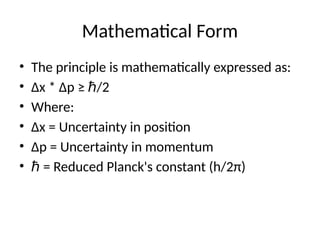
• The principle is mathematically expressed as:
• Δx * Δp ≥ /2
ℏ
• Where:
• Δx = Uncertainty in position
• Δp = Uncertainty in momentum
• ℏ = Reduced Planck's constant (h/2π)
Explanation
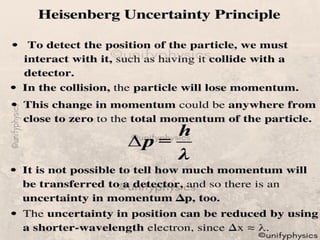
• When we try to measure a particle's position
more accurately, its momentum becomes
more uncertain, and vice versa. This is a
fundamental property of quantum systems,
not a limitation of measurement technology.
Real-World Examples
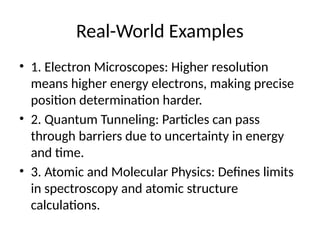
• 1. Electron Microscopes: Higher resolution
means higher energy electrons, making precise
position determination harder.
• 2. Quantum Tunneling: Particles can pass
through barriers due to uncertainty in energy
and time.
• 3. Atomic and Molecular Physics: Defines limits
in spectroscopy and atomic structure
calculations.
Conclusion
• The Uncertainty Principle is a cornerstone of
quantum mechanics. It explains why classical
physics cannot describe atomic and subatomic
systems accurately and has profound
implications in science and technology.

Uncertainty_Principle.pptx william Heisenberg

  • 1.
    Heisenberg's Uncertainty Principle Understanding theFundamental Limit of Measurement in Quantum Mechanics
  • 2.
    Introduction • The UncertaintyPrinciple states that it is impossible to simultaneously measure the exact position and momentum of a particle with perfect accuracy.
  • 3.
    Mathematical Form • Theprinciple is mathematically expressed as: • Δx * Δp ≥ /2 ℏ • Where: • Δx = Uncertainty in position • Δp = Uncertainty in momentum • ℏ = Reduced Planck's constant (h/2π)
  • 5.
    Explanation • When wetry to measure a particle's position more accurately, its momentum becomes more uncertain, and vice versa. This is a fundamental property of quantum systems, not a limitation of measurement technology.
  • 6.
    Real-World Examples • 1.Electron Microscopes: Higher resolution means higher energy electrons, making precise position determination harder. • 2. Quantum Tunneling: Particles can pass through barriers due to uncertainty in energy and time. • 3. Atomic and Molecular Physics: Defines limits in spectroscopy and atomic structure calculations.
  • 7.
    Conclusion • The UncertaintyPrinciple is a cornerstone of quantum mechanics. It explains why classical physics cannot describe atomic and subatomic systems accurately and has profound implications in science and technology.