”
Ms. Mohini R. Jagtap
M.Pharm ( Pharmacology )
Department Of Pharmacologyy
JMCT Institute Of Pharmacy, Nashik
TISSUE
TISSUE
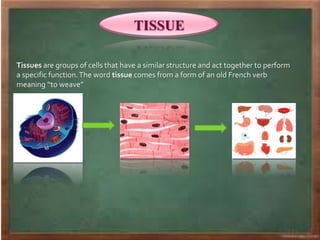
Tissues are groups of cells that have a similar structure and act together to perform
a specific function.The word tissue comes from a form of an old French verb
meaning “to weave”
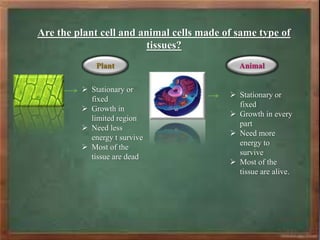
Are the plant cell and animal cells made of same type of
tissues?
Plant
 Stationary or
fixed
 Growth in
limited region
 Need less
energy t survive
 Most of the
tissue are dead
 Stationary or
fixed
 Growth in every
part
 Need more
energy to
survive
 Most of the
tissue are alive.
Animal
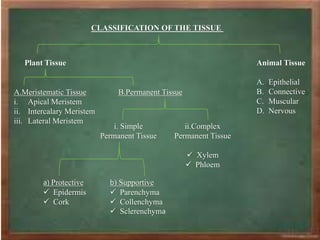
CLASSIFICATION OF THE TISSUE
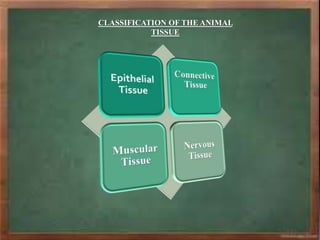
Animal Tissue
A. Epithelial
B. Connective
C. Muscular
D. Nervous
Plant Tissue
A.Meristematic Tissue
i. Apical Meristem
ii. Intercalary Meristem
iii. Lateral Meristem
B.Permanent Tissue
i. Simple
Permanent Tissue
a) Protective
 Epidermis
 Cork
b) Supportive
 Parenchyma
 Collenchyma
 Sclerenchyma
ii.Complex
Permanent Tissue
 Xylem
 Phloem
CLASSIFICATION OF THE ANIMAL
TISSUE
Epithelial Tissue/Epithilium Tissue
 It consist of single layer of cells. Blood vessels are absent. It covers all the organ.
The skin, lining of blood vessels, kidney tubules etc. are made up of this tissue.
Classification of the Epithelial Tissue
1) Squamous Epithelial Tissue
2) Cuboidal Epithelial Tissue
3) Columnar Epithelial Tissue
4) Stratified Squamous Epithelial Tissue
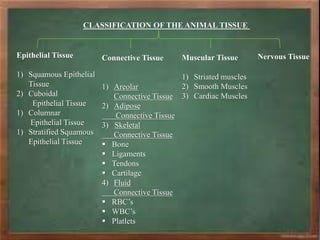
CLASSIFICATION OF THE ANIMAL TISSUE
Epithelial Tissue
1) Squamous Epithelial
Tissue
2) Cuboidal
Epithelial Tissue
1) Columnar
Epithelial Tissue
1) Stratified Squamous
Epithelial Tissue
Connective Tissue
1) Areolar
Connective Tissue
2) Adipose
Connective Tissue
3) Skeletal
Connective Tissue
 Bone
 Ligaments
 Tendons
 Cartilage
4) Fluid
Connective Tissue
 RBC’s
 WBC’s
 Platlets
Muscular Tissue
1) Striated muscles
2) Smooth Muscles
3) Cardiac Muscles
Nervous Tissue
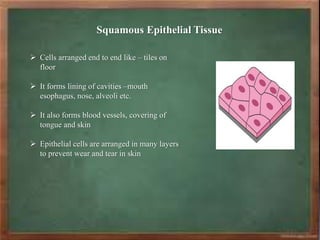
Squamous Epithelial Tissue
 Cells arranged end to end like – tiles on
floor
 It forms lining of cavities –mouth
esophagus, nose, alveoli etc.
 It also forms blood vessels, covering of
tongue and skin
 Epithelial cells are arranged in many layers
to prevent wear and tear in skin
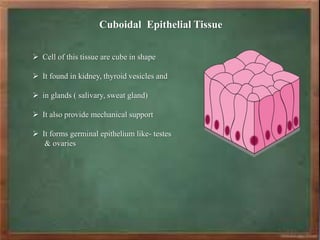
Cuboidal Epithelial Tissue
 Cell of this tissue are cube in shape
 It found in kidney, thyroid vesicles and
 in glands ( salivary, sweat gland)
 It also provide mechanical support
 It forms germinal epithelium like- testes
& ovaries
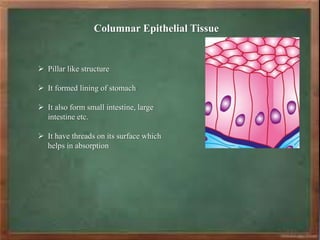
Columnar Epithelial Tissue
 Pillar like structure
 It formed lining of stomach
 It also form small intestine, large
intestine etc.
 It have threads on its surface which
helps in absorption
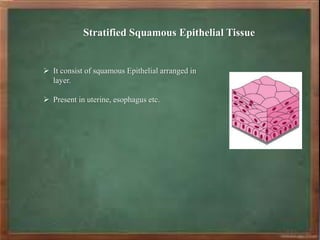
Stratified Squamous Epithelial Tissue
 It consist of squamous Epithelial arranged in
layer.
 Present in uterine, esophagus etc.
Connective Tissue
 The cells of the connective tissue are widely spaced
 The basic function is to provide support and connect different organ.
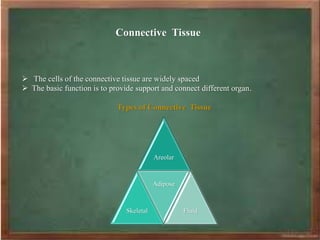
Types of Connective Tissue
Areolar
Skeletal
Adipose
Fluid
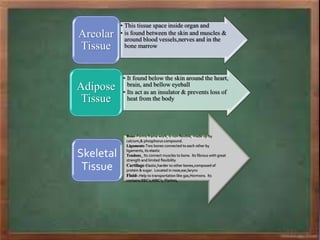
• This tissue space inside organ and
• is found between the skin and muscles &
around blood vessels,nerves and in the
bone marrow
Areolar
Tissue
• It found below the skin around the heart,
brain, and bellow eyeball
• Its act as an insulator & prevents loss of
heat from the body
Adipose
Tissue
Skeletal
Tissue
Bone-Forms frame work, is non flexible, made up by
calcium,& phosphorus compound.
Ligaments-Two bones connected to each other by
ligaments, its elastic
Tendons_ Its connect muscles to bone. Its fibrous with great
strength and limited flexibility
Cartilage-Elastic,harder to other bones,composed of
protein & sugar. Located in nose,ear,larynx
Fluid-.Help to transportation like gas,Hormons. Its
contains RBC’s,WBC’s, Platlets,
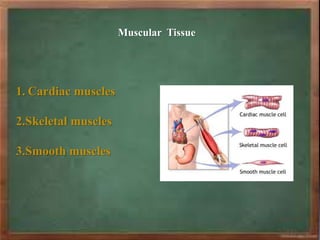
Muscular Tissue
1. Cardiac muscles
2.Skeletal muscles
3.Smooth muscles
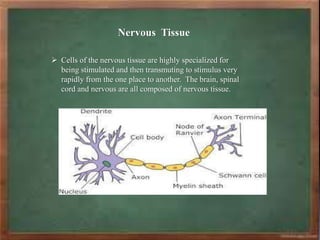
Nervous Tissue
 Cells of the nervous tissue are highly specialized for
being stimulated and then transmuting to stimulus very
rapidly from the one place to another. The brain, spinal
cord and nervous are all composed of nervous tissue.
Thank
you

The Tissues

  • 1.
    ” Ms. Mohini R.Jagtap M.Pharm ( Pharmacology ) Department Of Pharmacologyy JMCT Institute Of Pharmacy, Nashik TISSUE
  • 2.
    TISSUE Tissues are groupsof cells that have a similar structure and act together to perform a specific function.The word tissue comes from a form of an old French verb meaning “to weave”
  • 3.
    Are the plantcell and animal cells made of same type of tissues? Plant  Stationary or fixed  Growth in limited region  Need less energy t survive  Most of the tissue are dead  Stationary or fixed  Growth in every part  Need more energy to survive  Most of the tissue are alive. Animal
  • 4.
    CLASSIFICATION OF THETISSUE Animal Tissue A. Epithelial B. Connective C. Muscular D. Nervous Plant Tissue A.Meristematic Tissue i. Apical Meristem ii. Intercalary Meristem iii. Lateral Meristem B.Permanent Tissue i. Simple Permanent Tissue a) Protective  Epidermis  Cork b) Supportive  Parenchyma  Collenchyma  Sclerenchyma ii.Complex Permanent Tissue  Xylem  Phloem
  • 5.
    CLASSIFICATION OF THEANIMAL TISSUE
  • 6.
    Epithelial Tissue/Epithilium Tissue It consist of single layer of cells. Blood vessels are absent. It covers all the organ. The skin, lining of blood vessels, kidney tubules etc. are made up of this tissue. Classification of the Epithelial Tissue 1) Squamous Epithelial Tissue 2) Cuboidal Epithelial Tissue 3) Columnar Epithelial Tissue 4) Stratified Squamous Epithelial Tissue
  • 7.
    CLASSIFICATION OF THEANIMAL TISSUE Epithelial Tissue 1) Squamous Epithelial Tissue 2) Cuboidal Epithelial Tissue 1) Columnar Epithelial Tissue 1) Stratified Squamous Epithelial Tissue Connective Tissue 1) Areolar Connective Tissue 2) Adipose Connective Tissue 3) Skeletal Connective Tissue  Bone  Ligaments  Tendons  Cartilage 4) Fluid Connective Tissue  RBC’s  WBC’s  Platlets Muscular Tissue 1) Striated muscles 2) Smooth Muscles 3) Cardiac Muscles Nervous Tissue
  • 8.
    Squamous Epithelial Tissue Cells arranged end to end like – tiles on floor  It forms lining of cavities –mouth esophagus, nose, alveoli etc.  It also forms blood vessels, covering of tongue and skin  Epithelial cells are arranged in many layers to prevent wear and tear in skin
  • 9.
    Cuboidal Epithelial Tissue Cell of this tissue are cube in shape  It found in kidney, thyroid vesicles and  in glands ( salivary, sweat gland)  It also provide mechanical support  It forms germinal epithelium like- testes & ovaries
  • 10.
    Columnar Epithelial Tissue Pillar like structure  It formed lining of stomach  It also form small intestine, large intestine etc.  It have threads on its surface which helps in absorption
  • 11.
    Stratified Squamous EpithelialTissue  It consist of squamous Epithelial arranged in layer.  Present in uterine, esophagus etc.
  • 12.
    Connective Tissue  Thecells of the connective tissue are widely spaced  The basic function is to provide support and connect different organ. Types of Connective Tissue Areolar Skeletal Adipose Fluid
  • 13.
    • This tissuespace inside organ and • is found between the skin and muscles & around blood vessels,nerves and in the bone marrow Areolar Tissue • It found below the skin around the heart, brain, and bellow eyeball • Its act as an insulator & prevents loss of heat from the body Adipose Tissue Skeletal Tissue Bone-Forms frame work, is non flexible, made up by calcium,& phosphorus compound. Ligaments-Two bones connected to each other by ligaments, its elastic Tendons_ Its connect muscles to bone. Its fibrous with great strength and limited flexibility Cartilage-Elastic,harder to other bones,composed of protein & sugar. Located in nose,ear,larynx Fluid-.Help to transportation like gas,Hormons. Its contains RBC’s,WBC’s, Platlets,
  • 14.
    Muscular Tissue 1. Cardiacmuscles 2.Skeletal muscles 3.Smooth muscles
  • 15.
    Nervous Tissue  Cellsof the nervous tissue are highly specialized for being stimulated and then transmuting to stimulus very rapidly from the one place to another. The brain, spinal cord and nervous are all composed of nervous tissue.
  • 16.