THE THREE THINGS
You Need to Know to Transform Any Sized
Organization into an Agile Enterprise
mike@leadingagile.com
404-312-1471
www.leadingagile.com
twitter.com/mcottmeyer
facebook.com/leadingagile
linkedin.com/in/cottmeyer
MIKE COTTMEYER
Brief Agenda
• Discuss why adopting agile
isn’t ‘one size fits all’
• Explore the fundamentals
of agile transformation
• How to craft an agile
transformation roadmap
Brief Agenda
• Discuss why adopting agile
isn’t ‘one size fits all’
• Explore the fundamentals
of agile transformation
• How to craft an agile
transformation roadmap
Brief Agenda
• Discuss why adopting agile
isn’t ‘one size fits all’
• Explore the fundamentals
of agile transformation
• How to craft an agile
transformation roadmap
Brief Agenda
• Discuss why adopting agile
isn’t ‘one size fits all’
• Explore the fundamentals
of agile transformation
• How to craft an agile
transformation roadmap
ONE SIZE DOES
NOT FIT ALL
Predictability
Adaptability
Predictability
Adaptability
Emergence
Convergence
Predictability
Adaptability
Emergence
Convergence
Predictability
Adaptability
Emergence
Convergence
AE
PC
Predictability
Adaptability
Emergence
Convergence
AEPE
PC AC
Predictability
Adaptability
Emergence
Convergence
AEPE
PC AC
Ad-Hoc
Quadrant One
• Predictive
Emergent
Predictability
Adaptability
Emergence
Convergence
AEPE
PC AC
Ad-Hoc
Traditional
Quadrant Two
• Predictive
Convergent
Predictability
Adaptability
Emergence
Convergence
AEPE
PC AC
Ad-Hoc
Traditional Agile
Quadrant Three
• Adaptive
Convergent
Predictability
Adaptability
Emergence
Convergence
AEPE
PC AC
Ad-Hoc
Traditional Agile
Lean Startup
Quadrant Four
• Adaptive
Emergent
THE THREE THINGS
Backlog
Backlog
Backlog
Backlog
Backlogs
Teams
Backlog
Backlog
Backlog
Backlog
Backlogs Teams
Teams
Backlog
Backlog
Backlog
Backlog
Working
Tested
Software
Backlogs Teams Working Tested
Software
Teams
Backlog
Backlog
Backlog
Backlog
Working
Tested
Software
• INVEST
• CCC
• Small enough
for the team to
develop in a
day or so
• Everything
and everyone
necessary to
deliver
• Meets
acceptance
criteria
• No known
defects
• No technical
debt
What Do I Mean?
Backlogs Teams Working Tested
Software
Teams
Backlog
Backlog
Backlog
Backlog
Working
Tested
Software
• INVEST
• CCC
• Small enough
for the team to
develop in a
day or so
• Everything
and everyone
necessary to
deliver
• Meets
acceptance
criteria
• No known
defects
• No technical
debt
What Do I Mean?
Backlogs Teams Working Tested
Software
Teams
Backlog
Backlog
Backlog
Backlog
Working
Tested
Software
• INVEST
• CCC
• Small enough
for the team to
develop in a
day or so
• Everything
and everyone
necessary to
deliver
• Meets
acceptance
criteria
• No known
defects
• No technical
debt
What Do I Mean?
Backlogs Teams Working Tested
Software
Teams
Backlog
Backlog
Backlog
Backlog
Working
Tested
Software
• INVEST
• CCC
• Small enough
for the team to
develop in a
day or so
• Everything
and everyone
necessary to
deliver
• Meets
acceptance
criteria
• No known
defects
• No technical
debt
What Do I Mean?
Backlogs Teams Working Tested
Software
Teams
Backlog
Backlog
Backlog
Backlog
Working
Tested
Software
Why Are They Important?
Clarity Accountability Measureable
Progress
• People have
clarity around
what to build
• People
understand
how it maps to
the big picture
• Teams can be
held
accountable
for delivery
• No
indeterminate
work piling up
at the end of
the project
• 90% done,
90% left to do
Teams
Backlog
Backlog
Backlog
Backlog
Working
Tested
Software
Why Are They Important?
Clarity Accountability Measureable
Progress
• People have
clarity around
what to build
• People
understand
how it maps to
the big picture
• Teams can be
held
accountable
for delivery
• No
indeterminate
work piling up
at the end of
the project
• 90% done,
90% left to do
Teams
Backlog
Backlog
Backlog
Backlog
Working
Tested
Software
Why Are They Important?
Clarity Accountability Measureable
Progress
• People have
clarity around
what to build
• People
understand
how it maps to
the big picture
• Teams can be
held
accountable
for delivery
• No
indeterminate
work piling up
at the end of
the project
• 90% done,
90% left to do
Teams
Backlog
Backlog
Backlog
Backlog
Working
Tested
Software
Why Are They Important?
Clarity Accountability Measureable
Progress
• People have
clarity around
what to build
• People
understand
how it maps to
the big picture
• Teams can be
held
accountable
for delivery
• No
indeterminate
work piling up
at the end of
the project
• 90% done,
90% left to do
Teams
Backlog
Backlog
Backlog
Backlog
Working
Tested
Software
Why Are They Important?
Purpose Autonomy Mastery
• Understanding
the backlog
gives meaning
to work
• Local decision
making gives
people a
sense of
power and
control over
their work
• People can
demonstrate
that they are
good at what
they do
Teams
Backlog
Backlog
Backlog
Backlog
Working
Tested
Software
Why Are They Important?
Purpose Autonomy Mastery
• Understanding
the backlog
gives meaning
to work
• Local decision
making gives
people a
sense of
power and
control over
their work
• People can
demonstrate
that they are
good at what
they do
Teams
Backlog
Backlog
Backlog
Backlog
Working
Tested
Software
Why Are They Important?
Purpose Autonomy Mastery
• Understanding
the backlog
gives meaning
to work
• Local decision
making gives
people a
sense of
power and
control over
their work
• People can
demonstrate
that they are
good at what
they do
Teams
Backlog
Backlog
Backlog
Backlog
Working
Tested
Software
Why Are They Important?
Purpose Autonomy Mastery
• Understanding
the backlog
gives meaning
to work
• Local decision
making gives
people a
sense of
power and
control over
their work
• People can
demonstrate
that they are
good at what
they do
Teams
Backlog
Backlog
Backlog
Backlog
Working
Tested
Software
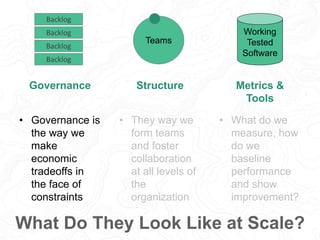
What Do They Look Like at Scale?
Governance Structure Metrics &
Tools
• Governance is
the way we
make
economic
tradeoffs in
the face of
constraints
• They way we
form teams
and foster
collaboration
at all levels of
the
organization
• What do we
measure, how
do we
baseline
performance
and show
improvement?
Teams
Backlog
Backlog
Backlog
Backlog
Working
Tested
Software
What Do They Look Like at Scale?
Governance Structure Metrics &
Tools
• Governance is
the way we
make
economic
tradeoffs in
the face of
constraints
• They way we
form teams
and foster
collaboration
at all levels of
the
organization
• What do we
measure, how
do we
baseline
performance
and show
improvement?
Teams
Backlog
Backlog
Backlog
Backlog
Working
Tested
Software
What Do They Look Like at Scale?
Governance Structure Metrics &
Tools
• Governance is
the way we
make
economic
tradeoffs in
the face of
constraints
• They way we
form teams
and foster
collaboration
at all levels of
the
organization
• What do we
measure, how
do we
baseline
performance
and show
improvement?
Teams
Backlog
Backlog
Backlog
Backlog
Working
Tested
Software
What Do They Look Like at Scale?
Governance Structure Metrics &
Tools
• Governance is
the way we
make
economic
tradeoffs in
the face of
constraints
• They way we
form teams
and foster
collaboration
at all levels of
the
organization
• What do we
measure, how
do we
baseline
performance
and show
improvement?
Teams
Backlog
Backlog
Backlog
Backlog
Working
Tested
Software
What Gets in the Way?
Business
Dependencies
Organizational
Dependencies
Technical
Dependencies
• Requirements
management
• Process flow
• Value streams
• Bottlenecks
• Too much in
process work
• Matrixed
Organizations
• Non instantly
available
resources
• Lack of SME
• Technical
Debt
• Defects
• Tight Coupling
• Low Cohesion
Teams
Backlog
Backlog
Backlog
Backlog
Working
Tested
Software
What Gets in the Way?
Business
Dependencies
Organizational
Dependencies
Technical
Dependencies
• Requirements
management
• Process flow
• Value streams
• Bottlenecks
• Too much in
process work
• Matrixed
Organizations
• Non instantly
available
resources
• Lack of SME
• Technical
Debt
• Defects
• Tight Coupling
• Low Cohesion
Teams
Backlog
Backlog
Backlog
Backlog
Working
Tested
Software
What Gets in the Way?
Business
Dependencies
Organizational
Dependencies
Technical
Dependencies
• Requirements
management
• Process flow
• Value streams
• Bottlenecks
• Too much in
process work
• Matrixed
Organizations
• Non instantly
available
resources
• Lack of SME
• Technical
Debt
• Defects
• Tight Coupling
• Low Cohesion
Teams
Backlog
Backlog
Backlog
Backlog
Working
Tested
Software
What Gets in the Way?
Business
Dependencies
Organizational
Dependencies
Technical
Dependencies
• Requirements
management
• Process flow
• Value streams
• Bottlenecks
• Too much in
process work
• Matrixed
Organizations
• Non instantly
available
resources
• Lack of SME
• Technical
Debt
• Defects
• Tight Coupling
• Low Cohesion
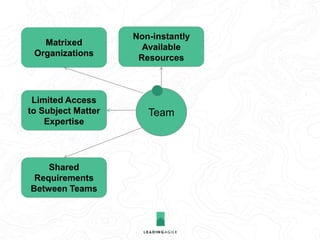
Team
Matrixed
Organizations
Team
Matrixed
Organizations
Non-instantly
Available
Resources
Team
Matrixed
Organizations
Limited Access
to Subject Matter
Expertise
Non-instantly
Available
Resources
Team
Matrixed
Organizations
Limited Access
to Subject Matter
Expertise
Non-instantly
Available
Resources
Shared
Requirements
Between Teams
Team
Matrixed
Organizations
Limited Access
to Subject Matter
Expertise
Non-instantly
Available
Resources
Too Much Work
In Process
Shared
Requirements
Between Teams
Team
Matrixed
Organizations
Limited Access
to Subject Matter
Expertise
Non-instantly
Available
Resources
Too Much Work
In Process
Shared
Requirements
Between Teams
Large Products
with Diverse
Technology
Team
Matrixed
Organizations
Limited Access
to Subject Matter
Expertise
Non-instantly
Available
Resources
Too Much Work
In Process
Shared
Requirements
Between Teams
Technical Debt &
Defects
Large Products
with Diverse
Technology
Team
Matrixed
Organizations
Limited Access
to Subject Matter
Expertise
Non-instantly
Available
Resources
Too Much Work
In Process
Low Cohesion &
Tight Coupling
Shared
Requirements
Between Teams
Technical Debt &
Defects
Large Products
with Diverse
Technology
Team
Teams
Backlog
Backlog
Backlog
Backlog
Working
Tested
Software
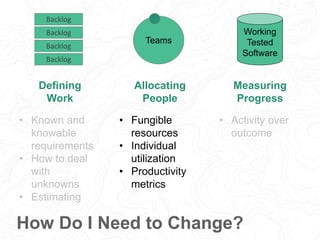
How Do I Need to Change?
• Known and
knowable
requirements
• How to deal
with
unknowns
• Estimating
• Fungible
resources
• Individual
utilization
• Productivity
metrics
• Activity over
outcome
Defining
Work
Allocating
People
Measuring
Progress
Teams
Backlog
Backlog
Backlog
Backlog
Working
Tested
Software
How Do I Need to Change?
• Known and
knowable
requirements
• How to deal
with
unknowns
• Estimating
• Fungible
resources
• Individual
utilization
• Productivity
metrics
• Activity over
outcome
Defining
Work
Allocating
People
Measuring
Progress
Teams
Backlog
Backlog
Backlog
Backlog
Working
Tested
Software
How Do I Need to Change?
• Known and
knowable
requirements
• How to deal
with
unknowns
• Estimating
• Fungible
resources
• Individual
utilization
• Productivity
metrics
• Activity over
outcome
Defining
Work
Allocating
People
Measuring
Progress
Teams
Backlog
Backlog
Backlog
Backlog
Working
Tested
Software
How Do I Need to Change?
• Known and
knowable
requirements
• How to deal
with
unknowns
• Estimating
• Fungible
resources
• Individual
utilization
• Productivity
metrics
• Activity over
outcome
Defining
Work
Allocating
People
Measuring
Progress
A THEORY OF
TRANSFORMATION
A Theory of Transformation
Agile is about forming teams,
building backlogs, and
regularly producing
increments of working tested
software
A Theory of Transformation
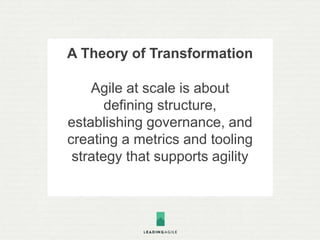
Agile at scale is about
defining structure,
establishing governance, and
creating a metrics and tooling
strategy that supports agility
A Theory of Transformation
Anything that gets in the way
of forming teams, building
backlogs, and producing
working tested software is an
impediment to transformation
TRANSFORMATION
IS A JOURNEY
Predictability
Adaptability
Emergence
Convergence
AEPE
PC AC
Ad-Hoc
Traditional Agile
Lean Startup
Predictability
Adaptability
Emergence
Convergence
AEPE
PC AC
Ad-Hoc
Traditional Agile
Lean Startup
Low Trust
Predictability
Adaptability
Emergence
Convergence
AEPE
PC AC
Ad-Hoc
Traditional Agile
Lean Startup
Low Trust
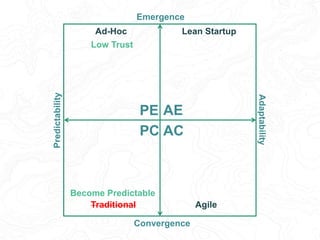
Become Predictable
Predictability
Adaptability
Emergence
Convergence
AEPE
PC AC
Ad-Hoc
Traditional Agile
Lean Startup
Low Trust
Become Predictable
Predictability
Adaptability
Emergence
Convergence
AEPE
PC AC
Ad-Hoc
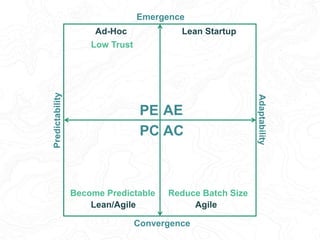
Lean/Agile Agile
Lean Startup
Low Trust
Become Predictable
Predictability
Adaptability
Emergence
Convergence
AEPE
PC AC
Ad-Hoc
Lean/Agile Agile
Lean Startup
Low Trust
Become Predictable Reduce Batch Size
Predictability
Adaptability
Emergence
Convergence
AEPE
PC AC
Ad-Hoc
Lean/Agile Agile
Lean Startup
Low Trust
Become Predictable Reduce Batch Size
Fully Decouple
Predictability
Adaptability
Emergence
Convergence
AEPE
PC AC
Ad-Hoc
Lean/Agile Agile
Lean Startup
Teams
Low Trust
Become Predictable Reduce Batch Size
Fully Decouple
Predictability
Adaptability
Emergence
Convergence
AEPE
PC AC
Ad-Hoc
Lean/Agile Agile
Lean Startup
Teams
Low Trust
Become Predictable Reduce Batch Size
Fully Decouple
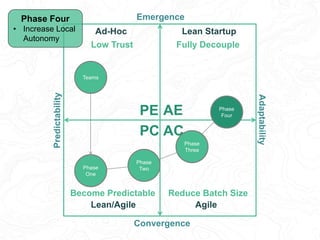
Phase
One
Phase One
• Stabilize the
System
Predictability
Adaptability
Emergence
Convergence
AEPE
PC AC
Ad-Hoc
Lean/Agile Agile
Lean Startup
Teams
Low Trust
Become Predictable Reduce Batch Size
Fully Decouple
Phase
One
Phase
Two
Phase Two
• Reduce Batch
Size
Predictability
Adaptability
Emergence
Convergence
AEPE
PC AC
Ad-Hoc
Lean/Agile Agile
Lean Startup
Teams
Low Trust
Become Predictable Reduce Batch Size
Fully Decouple
Phase
One
Phase
Three
Phase
Two
Phase Three
• Break
Dependencies
Predictability
Adaptability
Emergence
Convergence
AEPE
PC AC
Ad-Hoc
Lean/Agile Agile
Lean Startup
Teams
Low Trust
Become Predictable Reduce Batch Size
Fully Decouple
Phase
One
Phase
Three
Phase
Four
Phase
Two
Phase Four
• Increase Local
Autonomy
Predictability
Adaptability
Emergence
Convergence
AEPE
PC AC
Ad-Hoc
Lean/Agile Agile
Lean Startup
Teams
Low Trust
Become Predictable Reduce Batch Size
Fully Decouple
Phase
One
Phase
Three
Phase
Four
Phase
Two
Phase
Five
Phase Five
• Invest to
Learn
mike@leadingagile.com
404-312-1471
www.leadingagile.com
twitter.com/mcottmeyer
facebook.com/leadingagile
linkedin.com/in/cottmeyer
MIKE COTTMEYER
THE THREE THINGS
You Need to Know to Transform Any Sized
Organization into an Agile Enterprise

The Three Things

Editor's Notes

  • #20 11. We start with high level requirements that become more detailed as we learn more about the product we are building.  We start with high level architectural representations that emerge toward detailed design as we actually begin developing the working product.  You might think of this as rolling wave planning or progressive elaboration.  The idea is that we plan based on what we know, and plan more as we learn more.  
  • #21 11. We start with high level requirements that become more detailed as we learn more about the product we are building.  We start with high level architectural representations that emerge toward detailed design as we actually begin developing the working product.  You might think of this as rolling wave planning or progressive elaboration.  The idea is that we plan based on what we know, and plan more as we learn more.  
  • #22 11. We start with high level requirements that become more detailed as we learn more about the product we are building.  We start with high level architectural representations that emerge toward detailed design as we actually begin developing the working product.  You might think of this as rolling wave planning or progressive elaboration.  The idea is that we plan based on what we know, and plan more as we learn more.  
  • #23 11. We start with high level requirements that become more detailed as we learn more about the product we are building.  We start with high level architectural representations that emerge toward detailed design as we actually begin developing the working product.  You might think of this as rolling wave planning or progressive elaboration.  The idea is that we plan based on what we know, and plan more as we learn more.  
  • #24 11. We start with high level requirements that become more detailed as we learn more about the product we are building.  We start with high level architectural representations that emerge toward detailed design as we actually begin developing the working product.  You might think of this as rolling wave planning or progressive elaboration.  The idea is that we plan based on what we know, and plan more as we learn more.  
  • #25 11. We start with high level requirements that become more detailed as we learn more about the product we are building.  We start with high level architectural representations that emerge toward detailed design as we actually begin developing the working product.  You might think of this as rolling wave planning or progressive elaboration.  The idea is that we plan based on what we know, and plan more as we learn more.  
  • #26 11. We start with high level requirements that become more detailed as we learn more about the product we are building.  We start with high level architectural representations that emerge toward detailed design as we actually begin developing the working product.  You might think of this as rolling wave planning or progressive elaboration.  The idea is that we plan based on what we know, and plan more as we learn more.  
  • #27 11. We start with high level requirements that become more detailed as we learn more about the product we are building.  We start with high level architectural representations that emerge toward detailed design as we actually begin developing the working product.  You might think of this as rolling wave planning or progressive elaboration.  The idea is that we plan based on what we know, and plan more as we learn more.  
  • #28 11. We start with high level requirements that become more detailed as we learn more about the product we are building.  We start with high level architectural representations that emerge toward detailed design as we actually begin developing the working product.  You might think of this as rolling wave planning or progressive elaboration.  The idea is that we plan based on what we know, and plan more as we learn more.  
  • #29 11. We start with high level requirements that become more detailed as we learn more about the product we are building.  We start with high level architectural representations that emerge toward detailed design as we actually begin developing the working product.  You might think of this as rolling wave planning or progressive elaboration.  The idea is that we plan based on what we know, and plan more as we learn more.  
  • #30 11. We start with high level requirements that become more detailed as we learn more about the product we are building.  We start with high level architectural representations that emerge toward detailed design as we actually begin developing the working product.  You might think of this as rolling wave planning or progressive elaboration.  The idea is that we plan based on what we know, and plan more as we learn more.  
  • #31 11. We start with high level requirements that become more detailed as we learn more about the product we are building.  We start with high level architectural representations that emerge toward detailed design as we actually begin developing the working product.  You might think of this as rolling wave planning or progressive elaboration.  The idea is that we plan based on what we know, and plan more as we learn more.  
  • #32 11. We start with high level requirements that become more detailed as we learn more about the product we are building.  We start with high level architectural representations that emerge toward detailed design as we actually begin developing the working product.  You might think of this as rolling wave planning or progressive elaboration.  The idea is that we plan based on what we know, and plan more as we learn more.  
  • #33 11. We start with high level requirements that become more detailed as we learn more about the product we are building.  We start with high level architectural representations that emerge toward detailed design as we actually begin developing the working product.  You might think of this as rolling wave planning or progressive elaboration.  The idea is that we plan based on what we know, and plan more as we learn more.  
  • #34 11. We start with high level requirements that become more detailed as we learn more about the product we are building.  We start with high level architectural representations that emerge toward detailed design as we actually begin developing the working product.  You might think of this as rolling wave planning or progressive elaboration.  The idea is that we plan based on what we know, and plan more as we learn more.  
  • #35 11. We start with high level requirements that become more detailed as we learn more about the product we are building.  We start with high level architectural representations that emerge toward detailed design as we actually begin developing the working product.  You might think of this as rolling wave planning or progressive elaboration.  The idea is that we plan based on what we know, and plan more as we learn more.  
  • #36 11. We start with high level requirements that become more detailed as we learn more about the product we are building.  We start with high level architectural representations that emerge toward detailed design as we actually begin developing the working product.  You might think of this as rolling wave planning or progressive elaboration.  The idea is that we plan based on what we know, and plan more as we learn more.  
  • #37 11. We start with high level requirements that become more detailed as we learn more about the product we are building.  We start with high level architectural representations that emerge toward detailed design as we actually begin developing the working product.  You might think of this as rolling wave planning or progressive elaboration.  The idea is that we plan based on what we know, and plan more as we learn more.  
  • #38 11. We start with high level requirements that become more detailed as we learn more about the product we are building.  We start with high level architectural representations that emerge toward detailed design as we actually begin developing the working product.  You might think of this as rolling wave planning or progressive elaboration.  The idea is that we plan based on what we know, and plan more as we learn more.  
  • #39 11. We start with high level requirements that become more detailed as we learn more about the product we are building.  We start with high level architectural representations that emerge toward detailed design as we actually begin developing the working product.  You might think of this as rolling wave planning or progressive elaboration.  The idea is that we plan based on what we know, and plan more as we learn more.  
  • #40 11. We start with high level requirements that become more detailed as we learn more about the product we are building.  We start with high level architectural representations that emerge toward detailed design as we actually begin developing the working product.  You might think of this as rolling wave planning or progressive elaboration.  The idea is that we plan based on what we know, and plan more as we learn more.  
  • #41 11. We start with high level requirements that become more detailed as we learn more about the product we are building.  We start with high level architectural representations that emerge toward detailed design as we actually begin developing the working product.  You might think of this as rolling wave planning or progressive elaboration.  The idea is that we plan based on what we know, and plan more as we learn more.  
  • #42 11. We start with high level requirements that become more detailed as we learn more about the product we are building.  We start with high level architectural representations that emerge toward detailed design as we actually begin developing the working product.  You might think of this as rolling wave planning or progressive elaboration.  The idea is that we plan based on what we know, and plan more as we learn more.  
  • #43 11. We start with high level requirements that become more detailed as we learn more about the product we are building.  We start with high level architectural representations that emerge toward detailed design as we actually begin developing the working product.  You might think of this as rolling wave planning or progressive elaboration.  The idea is that we plan based on what we know, and plan more as we learn more.  
  • #44 Matrixed management Non-instantly available resources Project funding models Limited access to subject matter expertise Shared requirements between teams Technical debt Defects Tightly coupled architectures
  • #45 Matrixed management Non-instantly available resources Project funding models Limited access to subject matter expertise Shared requirements between teams Technical debt Defects Tightly coupled architectures
  • #46 Matrixed management Non-instantly available resources Project funding models Limited access to subject matter expertise Shared requirements between teams Technical debt Defects Tightly coupled architectures
  • #47 Matrixed management Non-instantly available resources Project funding models Limited access to subject matter expertise Shared requirements between teams Technical debt Defects Tightly coupled architectures
  • #48 Matrixed management Non-instantly available resources Project funding models Limited access to subject matter expertise Shared requirements between teams Technical debt Defects Tightly coupled architectures
  • #49 Matrixed management Non-instantly available resources Project funding models Limited access to subject matter expertise Shared requirements between teams Technical debt Defects Tightly coupled architectures
  • #50 Matrixed management Non-instantly available resources Project funding models Limited access to subject matter expertise Shared requirements between teams Technical debt Defects Tightly coupled architectures
  • #51 Matrixed management Non-instantly available resources Project funding models Limited access to subject matter expertise Shared requirements between teams Technical debt Defects Tightly coupled architectures
  • #52 Matrixed management Non-instantly available resources Project funding models Limited access to subject matter expertise Shared requirements between teams Technical debt Defects Tightly coupled architectures
  • #53 11. We start with high level requirements that become more detailed as we learn more about the product we are building.  We start with high level architectural representations that emerge toward detailed design as we actually begin developing the working product.  You might think of this as rolling wave planning or progressive elaboration.  The idea is that we plan based on what we know, and plan more as we learn more.  
  • #54 11. We start with high level requirements that become more detailed as we learn more about the product we are building.  We start with high level architectural representations that emerge toward detailed design as we actually begin developing the working product.  You might think of this as rolling wave planning or progressive elaboration.  The idea is that we plan based on what we know, and plan more as we learn more.  
  • #55 11. We start with high level requirements that become more detailed as we learn more about the product we are building.  We start with high level architectural representations that emerge toward detailed design as we actually begin developing the working product.  You might think of this as rolling wave planning or progressive elaboration.  The idea is that we plan based on what we know, and plan more as we learn more.  
  • #56 11. We start with high level requirements that become more detailed as we learn more about the product we are building.  We start with high level architectural representations that emerge toward detailed design as we actually begin developing the working product.  You might think of this as rolling wave planning or progressive elaboration.  The idea is that we plan based on what we know, and plan more as we learn more.