© 2016 Artemis Agile Consulting, Inc.
• 15+ years doing agile
• Different sized companies
• Different industries
© 2016 Artemis Agile Consulting, Inc.
“The most efficient and effective
method of conveying information
to and within a development team
is face-to-face conversation.”
–Agile Manifesto, Principle 6
Interpretation: If we have remote workers, we
can’t be agile! (whew – change is scary!)
© 2016 Artemis Agile Consulting, Inc.
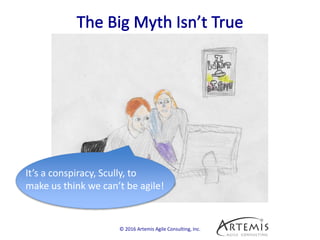
It’s a conspiracy, Scully, to
make us think we can’t be agile!
© 2016 Artemis Agile Consulting, Inc.
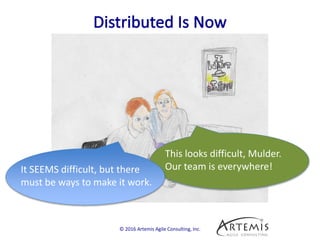
This looks difficult, Mulder.
Our team is everywhere!It SEEMS difficult, but there
must be ways to make it work.
© 2016 Artemis Agile Consulting, Inc.
Look – someone says we can’t
run ceremonies with remote
teams.
© 2016 Artemis Agile Consulting, Inc.
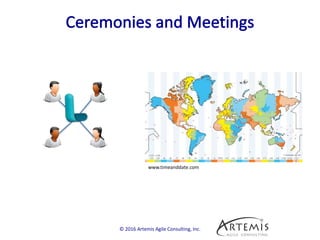
www.timeanddate.com
• Similar to in-person meetings
• Include all meeting info in invite
• Start with ice breakers
• Use video where possible
• Establish working agreements
© 2016 Artemis Agile Consulting, Inc.
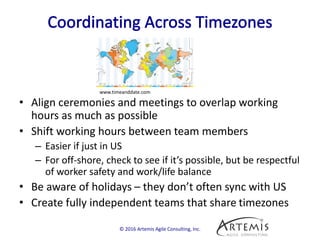
• Align ceremonies and meetings to overlap working
hours as much as possible
• Shift working hours between team members
– Easier if just in US
– For off-shore, check to see if it’s possible, but be respectful
of worker safety and work/life balance
• Be aware of holidays – they don’t often sync with US
• Create fully independent teams that share timezones
© 2016 Artemis Agile Consulting, Inc.
www.timeanddate.com
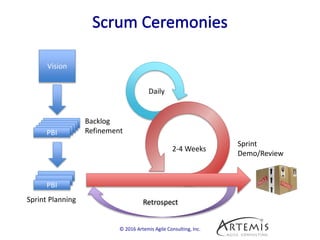
Daily
© 2016 Artemis Agile Consulting, Inc.
Vision
2-4 Weeks
Retrospect
PBI
Backlog
Refinement
PBI
Sprint Planning
Sprint
Demo/Review
© 2016 Artemis Agile Consulting, Inc.
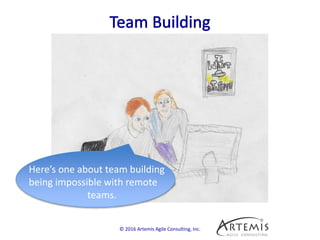
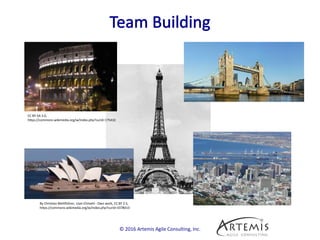
Here’s one about team building
being impossible with remote
teams.
© 2016 Artemis Agile Consulting, Inc.
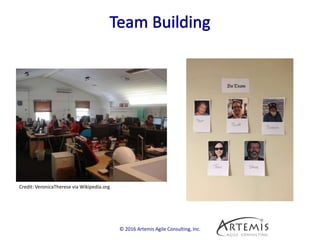
Credit: VeronicaTherese via Wikipedia.org
© 2016 Artemis Agile Consulting, Inc.
CC BY-SA 3.0,
https://commons.wikimedia.org/w/index.php?curid=175432
By Christian Mehlführer, User:Chmehl - Own work, CC BY 2.5,
https://commons.wikimedia.org/w/index.php?curid=3378013
© 2016 Artemis Agile Consulting, Inc.
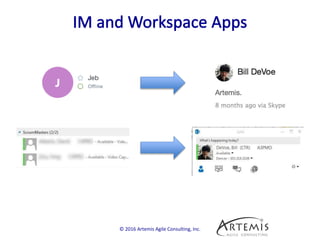
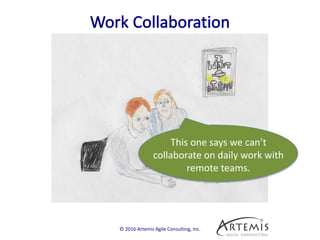
This one says we can’t
collaborate on daily work with
remote teams.
© 2016 Artemis Agile Consulting, Inc.
By Source, Fair use, https://en.wikipedia.org/w/index.php?curid=38347718
© 2016 Artemis Agile Consulting, Inc.© 2016 Artemis Agile Consulting, Inc.
IRC
wiki
By Source, Fair use, https://en.wikipedia.org/w/index.php?curid=38347718
FlowDock
© 2016 Artemis Agile Consulting, Inc.© 2016 Artemis Agile Consulting, Inc.
IRC
wiki
By Source, Fair use, https://en.wikipedia.org/w/index.php?curid=38347718
FlowDock
© 2016 Artemis Agile Consulting, Inc.
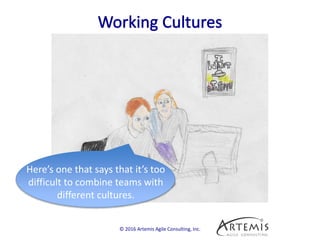
Here’s one that says that it’s too
difficult to combine teams with
different cultures.
© 2016 Artemis Agile Consulting, Inc.
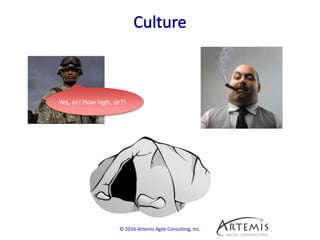
Yes, sir! How high, sir?!
© 2016 Artemis Agile Consulting, Inc.
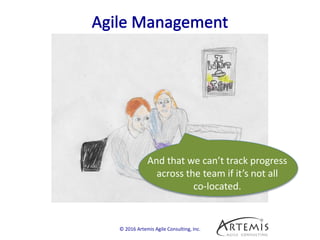
And that we can’t track progress
across the team if it’s not all
co-located.
© 2016 Artemis Agile Consulting, Inc.
We’ve debunked all those.
Did we miss anything, Scully?
© 2016 Artemis Agile Consulting, Inc.
IT Team
• Check Out
– The Year Without Pants – Scott Berkun
– CollaborationSuperPowers.com Podcast
– ScatterSpoke.com
© 2016 Artemis Agile Consulting, Inc.
Bill@ArtemisAgile.com
www.ArtemisAgile.com
@ArtemisAgile
Artemis Agile on YouTube
© 2016 Artemis Agile Consulting, Inc.

The D Files: Debunking Myths About Distributed Teams

  • 2.
    © 2016 ArtemisAgile Consulting, Inc.
  • 3.
    • 15+ yearsdoing agile • Different sized companies • Different industries © 2016 Artemis Agile Consulting, Inc.
  • 4.
    “The most efficientand effective method of conveying information to and within a development team is face-to-face conversation.” –Agile Manifesto, Principle 6 Interpretation: If we have remote workers, we can’t be agile! (whew – change is scary!) © 2016 Artemis Agile Consulting, Inc.
  • 5.
    © 2016 ArtemisAgile Consulting, Inc. It’s a conspiracy, Scully, to make us think we can’t be agile!
  • 6.
    © 2016 ArtemisAgile Consulting, Inc.
  • 7.
    © 2016 ArtemisAgile Consulting, Inc.
  • 8.
    © 2016 ArtemisAgile Consulting, Inc.
  • 9.
    © 2016 ArtemisAgile Consulting, Inc. This looks difficult, Mulder. Our team is everywhere!It SEEMS difficult, but there must be ways to make it work.
  • 10.
    © 2016 ArtemisAgile Consulting, Inc. Look – someone says we can’t run ceremonies with remote teams.
  • 11.
    © 2016 ArtemisAgile Consulting, Inc. www.timeanddate.com
  • 12.
    • Similar toin-person meetings • Include all meeting info in invite • Start with ice breakers • Use video where possible • Establish working agreements © 2016 Artemis Agile Consulting, Inc.
  • 13.
    • Align ceremoniesand meetings to overlap working hours as much as possible • Shift working hours between team members – Easier if just in US – For off-shore, check to see if it’s possible, but be respectful of worker safety and work/life balance • Be aware of holidays – they don’t often sync with US • Create fully independent teams that share timezones © 2016 Artemis Agile Consulting, Inc. www.timeanddate.com
  • 14.
    Daily © 2016 ArtemisAgile Consulting, Inc. Vision 2-4 Weeks Retrospect PBI Backlog Refinement PBI Sprint Planning Sprint Demo/Review
  • 15.
    © 2016 ArtemisAgile Consulting, Inc. Here’s one about team building being impossible with remote teams.
  • 16.
    © 2016 ArtemisAgile Consulting, Inc.
  • 17.
    © 2016 ArtemisAgile Consulting, Inc. Credit: VeronicaTherese via Wikipedia.org
  • 18.
    © 2016 ArtemisAgile Consulting, Inc. CC BY-SA 3.0, https://commons.wikimedia.org/w/index.php?curid=175432 By Christian Mehlführer, User:Chmehl - Own work, CC BY 2.5, https://commons.wikimedia.org/w/index.php?curid=3378013
  • 19.
    © 2016 ArtemisAgile Consulting, Inc. This one says we can’t collaborate on daily work with remote teams.
  • 20.
    © 2016 ArtemisAgile Consulting, Inc.
  • 21.
    © 2016 ArtemisAgile Consulting, Inc. By Source, Fair use, https://en.wikipedia.org/w/index.php?curid=38347718
  • 22.
    © 2016 ArtemisAgile Consulting, Inc.© 2016 Artemis Agile Consulting, Inc. IRC wiki By Source, Fair use, https://en.wikipedia.org/w/index.php?curid=38347718 FlowDock
  • 23.
    © 2016 ArtemisAgile Consulting, Inc.© 2016 Artemis Agile Consulting, Inc. IRC wiki By Source, Fair use, https://en.wikipedia.org/w/index.php?curid=38347718 FlowDock
  • 24.
    © 2016 ArtemisAgile Consulting, Inc. Here’s one that says that it’s too difficult to combine teams with different cultures.
  • 25.
    © 2016 ArtemisAgile Consulting, Inc. Yes, sir! How high, sir?!
  • 26.
    © 2016 ArtemisAgile Consulting, Inc. And that we can’t track progress across the team if it’s not all co-located.
  • 27.
    © 2016 ArtemisAgile Consulting, Inc.
  • 28.
    © 2016 ArtemisAgile Consulting, Inc. We’ve debunked all those. Did we miss anything, Scully?
  • 29.
    © 2016 ArtemisAgile Consulting, Inc. IT Team
  • 30.
    • Check Out –The Year Without Pants – Scott Berkun – CollaborationSuperPowers.com Podcast – ScatterSpoke.com © 2016 Artemis Agile Consulting, Inc. Bill@ArtemisAgile.com www.ArtemisAgile.com @ArtemisAgile Artemis Agile on YouTube
  • 31.
    © 2016 ArtemisAgile Consulting, Inc.

Editor's Notes

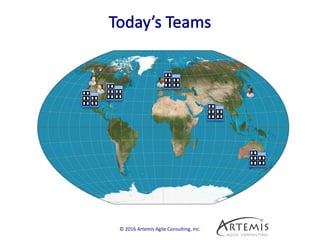
  • #3 How many have teams that are fully co-located? How many people have teams that distributed, even partially? How many people have teams that are completely distributed?
  • #7 Any team or group of people Not just Scrum teams, but Agile advocates for co-location to best facilitate face-to-face conversations Teams where one or more people are not co-located Remote workers/WFH On-shore Near-shore Off-shore Some companies have workers that are all co-located in a single space. What I see more and more is teams that may be in the same office but are in different parts of the workplace – different parts of the same floor, different floors, or even different buildings in the same campus. The challenges for any team that doesn’t sit together are similar and those difficulties are compounded the farther apart the team members are. For most intents, a team member that’s 10 miles from the office is not much different than one that’s 10,000 miles away. And let’s be clear. I’ve seen teams that are co-located operate less like a team than ones where everyone is at least a thousand miles away from anyone else.
  • #13 Meeting invite should contain all information – how to join, is there a conference call-in number, etc. Ice breaker – note the education studies about first 10 minutes setting the tone for the class Video changes the whole tone of the meeting Working agreements – fun fines for being tardy (e.g., sing a short song if you arrive late) Ice breakers Studies show if people don’t speak in the first 5-10 minutes they’ll be disengaged during meetings Get everyone speaking at some point during the beginning of the meeting/call
  • #14 Add something about the “ever give someone work then get an answer while you were sleeping that you answered while THEY were sleeping only to have them ask you ANOTHER question?”… This is a huge issue. When we did the distributed team discussion at the ScrumMaster guild we actually punted on addressing this because it was too big to discuss in 90 minutes. I worked with a company that had some developers in Lithuania who actually shifted their entire work day to align to ours. It was amazing and incredibly helpful – we were very lucky the team was willing to do it. If you can, it’s ideal. If you can’t, you’re in for some serious challenges. Holidays are one of the biggest problems I’ve seen. You’ll need to know what holidays your remote team members will be observing. It will impact your team velocity/throughput. Your last option is, of course, to create fully independent teams that share more of a timezone. This is sometimes what happens – and what some vendors prefer.
  • #15 For all meetings, it’s really important the team be prepared before the meeting. Make sure you’re asking your team to review whatever is going to be discussed during the meeting in advance of the meeting. Backlog refinement: One recommendation is to have the PO provide the top 5-10 items they’re going to discuss during refinement so your team can prepare. Ensure the backlog is groomed at least a day or two in advance. Sprint Planning: It’s critical that everyone be involved. This may mean an early morning/late night for some of the team, but it’s worth it. I like to see teams do tasking during sprint planning, but with widely-distributed teams that might be difficult or nearly impossible. You can have the team do this separately, but make sure you get back together after planning to review the tasking as a team. It should be a pretty quick meeting, maybe even do it as your “after scrum” items. Stand-up: It’s important to have people attend this meeting. Sometimes that means meeting at the end of the day (here’s what I did today, what I’m doing tomorrow). The key is to get everyone together for a little bit of time. Demo/Review: Have your PO drive the demo/review with support from the team as needed. Make sure that your PO is well-positioned to present. SM and as much of team as possible should attend. Retrospective: It’s critical that everyone be involved. This may mean an early morning/late night for some of the team, but it’s worth it.
  • #18 Photos of team members In open space areas Use for profile pics in ALL applications IM, version control, work item tracking (Rally, VersionOne, Jira, et al), email/Exchange servers, etc
  • #19 Consider doing what Wordpress does for its teams, which is scheduling a team trip somewhere for a week close to one of the team members. Be it Paris, Rome, London, Cape Town, or Sydney, having the team together in a single location can work to bind the team into a cohesive whole. For many companies it’s not really feasible, but for some - and you’re lucky if you can – this can really help a team bond.
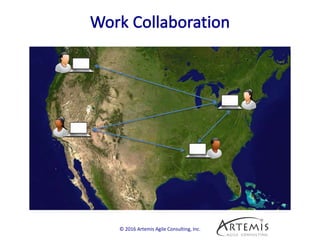
  • #21 Let’s say the team is split between the coasts – two people in Eastern time zone and two in Pacific. How can they collaborate? What about pair programming? The things we encourage – knowledge sharing, developing “T” shaped people (broad but shallow knowledge in some areas, very deep knowledge in others)? What about testing? When I started using agile we looked to Kent Beck’s XP methodology as our scaffolding but there were some things that weren’t going to fly (at the time) in our group. One them was pair programming. I did, however, encourage and use what I call “collaborative programming” for our team. I would often ask one of my team to come sit with me and look over things I was working on – not only to get a second set of eyes on it (which was good) but also to show them what I was doing and how so there was knowledge sharing (also good). For pair or collaborative programming, we can use some of the remote desktop, WebEx (or similar), and screen sharing capabilities of our IM clients to collaborate and pair. You may need to invest in headsets for your team (or something similar), but creating the environment where they can and are encouraged to collaborate can be met with some simple software fixes.
  • #22 IRC (Internet Relay Chat) OpenSource, easily installed, bots to persist conversations IRC bots that can record the conversations in the rooms FlowDock Integrated with Rally Group chats and Private conversations Slack More open implementation than FlowDock Group chats and Private conversations Twitter integration SharePoint/Wiki/Confluence Basic document storage Ability to reflect current state easily with history Lync has individual and group IM, screen share, and persistent chat rooms Continuous integration tools (Jenkins, Bamboo, etc) can often link into these, so you can get build and CI results posted directly to your team. Focus on using tools that persist information so you can search through it later. It’s amazing what you may need to access after the fact.
  • #26 Consider the vendor and people you’re working with Some employees are more used to taking direction; note that even the military is moving from this model Some vendors strongly encourage the above thought pattern Self-direction and empowerment can be hard for some employees to grasp, even the “cave dwellers” (fresh water fish and salt water fish)
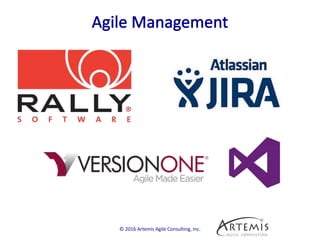
  • #28 Using tools like Rally, Jira, VersionOne, or Team Foundation Server can let you track how your team is performing. Some of them will allow you to link actual source code to user stories and defects, which can be helpful.
  • #30 Some organizations and teams are resistant. Check out Management 3.0 and Coaching Agile Teams for tips on overcoming that resistance. Management usually fails to understand the impact; must educate them on what we need (video conferencing systems/capabilities, etc). IT seems the main resistance to some of the technological solutions because they aren’t necessarily one-size-fits-all. Think about how you can engage them and help them while solving your problems. Video, firewalls, source code control, P2s, IM, etc. Working with Finance sometimes seems like a Sisyphean effort. With remote teams, you’re going to need technology – hardware, software, video, etc – the same things you need your IT team to provide. If you have any say in the financials for your project, make sure you include those things while setting up your budgets. And make sure that the things you want to buy can be used/supported by your IT team. Buying a cool new Cisco video conferencing system that can’t make it beyond the firewalls doesn’t do anyone any good. Also – there can be challenges while trying to get things for vendor-supplied contractors. A lot of pushback can come in the “we’re not buying that for THEM” kinds of things (and pushback not just from finance but management too). The main issue I’ve seen with HR is in the “employee” vs “contractor” spaces. Need to check on what can be done/not done within the legal and corporate guidelines while still building your teams and collaborating.
  • #31 Collaboration Super Powers podcast covers a lot of the topics I’ve touched on here. Good insights into how some people are dealing with these problems. ScatterSpoke is a retrospective tool for distributed teams.