The Theory of
Documentaries
Documentaries
 The purpose of a documentary is to document and report on a
significant event.
 Evidence produced in a documentary has to be supported, it has to be
based on real events.
 A voice over anchors meaning to the audience which helps to create
emotional responses.
 Some documentaries are more controversial than others and many
television companies are hesitant to broadcast them on television.
 Current affairs programmes are half way between a documentary and a
news programme and often explore weighty subjects that involve
controversial topics and social issues.
John Grierson
 John Grierson was a pioneering Scottish documentary maker, often considered the
father of British and Canadian documentary film.
 Created documentaries about war, housing problems and poverty
 In 1926 he coined the term documentary which he described as creativity of reality
 “creative treatment of actuality (reality)”
 His documentaries featured heavily during World War 2 and where often screened in
cinemas which allowed viewers to be exposed to current events
 He used documentaries to try and persuade the audience to feel emotional and
passionate about the subject
John Corner
 John Corner is a professor at the University of Liverpool
 5 key elements of a documentary
 Observation- Most documentaries include observations. This is usually done by placing the camera as if it is unseen and
the audience becoming a part of what is seen, almost from their POV.
 Interview- All documentaries include interviews, this is because a documentary relies on interviews to support or contrast
with the topic/argument. The film maker has the option to cut up an interview or just let it run as one piece, which is key in
delivering the right message to your audience.
 Dramatization- A documentary maker will do this through observation. It is used to build arguments and create conflict.
 Mies-en-scene- This a major element of any documentary. This is done to make reality for the audience so it has to be
relevant. Mise En Scene includes; set, props, costume, makeup, lighting and colour.
 Exposition- This is the part of the documentary which explored the argument/theme of documentary. This can be done in
many ways one being interviews and another being commentary (voiceovers). This can be approached in multiple ways.
 “what distinguishes documentaries is the portrayal of images and recorded sounds of actuality”
 “Technology only records traces of physical reality of the physical world. These traces can be used as evidence f actuality or
reality. This evidence then supports the exposition”
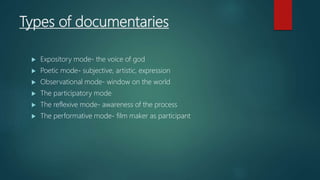
Types of documentaries
 Expository mode- the voice of god
 Poetic mode- subjective, artistic, expression
 Observational mode- window on the world
 The participatory mode
 The reflexive mode- awareness of the process
 The performative mode- film maker as participant

The theory of documentaries

  • 1.
  • 2.
    Documentaries  The purposeof a documentary is to document and report on a significant event.  Evidence produced in a documentary has to be supported, it has to be based on real events.  A voice over anchors meaning to the audience which helps to create emotional responses.  Some documentaries are more controversial than others and many television companies are hesitant to broadcast them on television.  Current affairs programmes are half way between a documentary and a news programme and often explore weighty subjects that involve controversial topics and social issues.
  • 3.
    John Grierson  JohnGrierson was a pioneering Scottish documentary maker, often considered the father of British and Canadian documentary film.  Created documentaries about war, housing problems and poverty  In 1926 he coined the term documentary which he described as creativity of reality  “creative treatment of actuality (reality)”  His documentaries featured heavily during World War 2 and where often screened in cinemas which allowed viewers to be exposed to current events  He used documentaries to try and persuade the audience to feel emotional and passionate about the subject
  • 4.
    John Corner  JohnCorner is a professor at the University of Liverpool  5 key elements of a documentary  Observation- Most documentaries include observations. This is usually done by placing the camera as if it is unseen and the audience becoming a part of what is seen, almost from their POV.  Interview- All documentaries include interviews, this is because a documentary relies on interviews to support or contrast with the topic/argument. The film maker has the option to cut up an interview or just let it run as one piece, which is key in delivering the right message to your audience.  Dramatization- A documentary maker will do this through observation. It is used to build arguments and create conflict.  Mies-en-scene- This a major element of any documentary. This is done to make reality for the audience so it has to be relevant. Mise En Scene includes; set, props, costume, makeup, lighting and colour.  Exposition- This is the part of the documentary which explored the argument/theme of documentary. This can be done in many ways one being interviews and another being commentary (voiceovers). This can be approached in multiple ways.  “what distinguishes documentaries is the portrayal of images and recorded sounds of actuality”  “Technology only records traces of physical reality of the physical world. These traces can be used as evidence f actuality or reality. This evidence then supports the exposition”
  • 5.
    Types of documentaries Expository mode- the voice of god  Poetic mode- subjective, artistic, expression  Observational mode- window on the world  The participatory mode  The reflexive mode- awareness of the process  The performative mode- film maker as participant