Theory of Documentaries.
• The aim of a documentary is to report something with evidence
Documentaries can use narration to anchor meaning. They also rely
on an unseen voice or narrator. Documentaries are problematic and
the definition of documentaries is problematic.
• “What distinguishes a documentary is the portrayal of sound and
images of actuality.” – John Corner (1995)
• Documentaries have to be based on fact and real events,
reconstructions can be used in documentaries where evidence is
lacking but it has to be based on fact and they don’t have to contain
analysis.
• Documentaries can deal with various issues and they shouldn’t be
based on Current Affairs.
History of Documentaries.
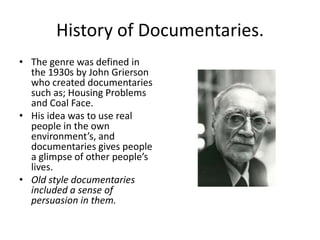
• The genre was defined in
the 1930s by John Grierson
who created documentaries
such as; Housing Problems
and Coal Face.
• His idea was to use real
people in the own
environment’s, and
documentaries gives people
a glimpse of other people’s
lives.
• Old style documentaries
included a sense of
persuasion in them.
• The genre of documentaries is important for TV stations as they won’t
broadcast controversial subjects.
• British documentaries are renown got investigative journalism and oppose
views of the British government.
• John Grierson first coined the term Documentary in 1926 and defined
documentary as “The creativity of actuality.”
• Arguments range from how creative documentaries should be as
problems of authentication can occur. Film makers argue that all films are
fake and that reconstruction becomes inevitable, and attempt of filming
reality becomes affected by the presentation of cameras and camera
crews.
• “I think the truth is what you actually come away with at the end of seeing
a film: I mean its your truth that your seeing. Everybody who makes a film
is putting their own truth on screen.” – Diane Tammes, Film maker.
• Creative development over the years means that documentary’s now
cover a huge range of production methods, some analysis’s argue that the
term documentary’s should be replaced with ‘Non-Fictional Programming’.
Although people disagree on the styles of documentary’s there is a
common thread across all types of documentaries.
• Documentaries are not just about facts but facts are used to create
socially critical arguments inviting the audience to draw conclusions about
topics and issues.
• Peter Mayex says that documentaries present facts about people, places
and subjects then creatively interprets or comments on those realities and
people.
• Current Affairs programs are midway between documentaries and the
news; these include shows such as Dispatches and Panorama. ITV’s Trevor
McDonald program has been accused of sensationalism.
• People have accused Current Affairs programs of distorting the truth and
or misrepresenting the views of contributions.
Features of a documentary according
to John Corner:
• Observation: Most documentaries have a sense of
observation can be used as evidence, and can turn
participations as objects instead of subject.
• Interview: Documentaries rely on interviews for a balanced
argument; the interviewer can be seen or unseen. Pictures
can be dubbed over the top of the interview for meaning.
• Interview: Documentaries rely on interviews for a balanced
argument; the interviewer can be seen or unseen. Pictures
can be dubbed over the top of the interview for meaning.
• Mise-en-scene: Important when reconstructing reality.
• Exposition: What is the point of the documentary?
• “It is critical that film makers be rid of fantasy that documentary can
be unproblematic representation of reality and that ‘truth’ can be
conveniently dispensed and received like Valium” –Dennis O’rourke,
Documentary Film maker.
• Since the beginning documentaries have struggled with truth
reality, John Corner believes that there needs to be evidence
included in documentaries and based on fact.
• Documentaries are real although there are elements of fiction
included for atheistic appeal.
• Documentaries are not good for ratings and are usually the first
programs to be cut if money is short, Controversial documentaries
are unpopular for TV stations as advertisers don’t want to place
their adverts between controversial documentaries. Popular
documentaries look at subjects such as Sex, Violence and Law and
Order.
• Documentaries, producers and the audience create a triangle.
• Documentaries normally cover
people who can’t help themselves
and are society’s victims.
• Ken Loach created a documentary
called ‘Cathy Come Home’. Because
of this documentary the law on
homeless people changed as
documentaries can have an impact of
the laws.
• Documentaries show light on
subjects that audience otherwise
might not of been aware of,
documentaries also expect audiences
to change their opinions on issues
and right the wrongs shown in the
documentary.
Types of documentaries:
• Fully Narrated: Fully narrated documentaries will use the use of a voice over to make sense
of visuals included in the documentary, this voice over is called ‘The voice of God’.
• Fly on the Wall: Fly of the wall documentaries relies entirely on observations and it includes
the audience watching something as it happens and features a distorted version of the truth.
• Mixed Documentary: Mixed documentaries used a mix of interviews, observation and
narration. Narration in these styles of documentary is almost like a news reporting. These
documentaries are more balanced as they use a variety of techniques throughout the
documentary rather than focusing entirely on narration or observation.
• Self-Reflective: Self-reflective documentaries are when the subject acknowledges the camera,
and they usually become about the person in front of the camera rather than the
topic/subject. Critics say that self-reflective documentaries fall into empty narcissism.
• Docudrama: Docudramas are a re-enactment of events that have happened and are a
fictional narrative based on facts. Critics say that docudramas claim to represent the truth
but can only ever hope to film fiction. Docudramas can be misleading and dangerous in some
cases.
• Docusoap: Docusoaps have become increasingly popular over the past 10 years, this type of
documentaries follow people’s lives. Docudramas originated in Britain and have low
production costs and people often become ‘famous’ from these type of documentaries.
Disneyfication Theory – Steven Barnetts.
• This is where TVs feel the need to broadcast
things that are colourful and bright and
represented as ‘perfect’ much like Disney
films. Due to this documentaries have become
dumbed down.
• Documentaries rely on a traditional narrative (Start, middle,
end). This is very apparent in documentaries. They also
have a strong focus on characters and conflict in characters
and the narrative is important to the documentary.
• Start: Pose a question, this can be using interview footage
of opposing view points.
• Middle: Can be complicated, examine the topic/issue show
different sides of the argument and conflict in evidence.
• End: The point of the documentary should be apparent and
conflict between views should be resolved.
• Music and sound effects are important throughout the
documentary when relevant. Also selection and
construction is important.

Theory of documentaries powerpoint

  • 1.
  • 2.
    • The aimof a documentary is to report something with evidence Documentaries can use narration to anchor meaning. They also rely on an unseen voice or narrator. Documentaries are problematic and the definition of documentaries is problematic. • “What distinguishes a documentary is the portrayal of sound and images of actuality.” – John Corner (1995) • Documentaries have to be based on fact and real events, reconstructions can be used in documentaries where evidence is lacking but it has to be based on fact and they don’t have to contain analysis. • Documentaries can deal with various issues and they shouldn’t be based on Current Affairs.
  • 3.
    History of Documentaries. •The genre was defined in the 1930s by John Grierson who created documentaries such as; Housing Problems and Coal Face. • His idea was to use real people in the own environment’s, and documentaries gives people a glimpse of other people’s lives. • Old style documentaries included a sense of persuasion in them.
  • 4.
    • The genreof documentaries is important for TV stations as they won’t broadcast controversial subjects. • British documentaries are renown got investigative journalism and oppose views of the British government. • John Grierson first coined the term Documentary in 1926 and defined documentary as “The creativity of actuality.” • Arguments range from how creative documentaries should be as problems of authentication can occur. Film makers argue that all films are fake and that reconstruction becomes inevitable, and attempt of filming reality becomes affected by the presentation of cameras and camera crews. • “I think the truth is what you actually come away with at the end of seeing a film: I mean its your truth that your seeing. Everybody who makes a film is putting their own truth on screen.” – Diane Tammes, Film maker.
  • 5.
    • Creative developmentover the years means that documentary’s now cover a huge range of production methods, some analysis’s argue that the term documentary’s should be replaced with ‘Non-Fictional Programming’. Although people disagree on the styles of documentary’s there is a common thread across all types of documentaries. • Documentaries are not just about facts but facts are used to create socially critical arguments inviting the audience to draw conclusions about topics and issues. • Peter Mayex says that documentaries present facts about people, places and subjects then creatively interprets or comments on those realities and people. • Current Affairs programs are midway between documentaries and the news; these include shows such as Dispatches and Panorama. ITV’s Trevor McDonald program has been accused of sensationalism. • People have accused Current Affairs programs of distorting the truth and or misrepresenting the views of contributions.
  • 6.
    Features of adocumentary according to John Corner: • Observation: Most documentaries have a sense of observation can be used as evidence, and can turn participations as objects instead of subject. • Interview: Documentaries rely on interviews for a balanced argument; the interviewer can be seen or unseen. Pictures can be dubbed over the top of the interview for meaning. • Interview: Documentaries rely on interviews for a balanced argument; the interviewer can be seen or unseen. Pictures can be dubbed over the top of the interview for meaning. • Mise-en-scene: Important when reconstructing reality. • Exposition: What is the point of the documentary?
  • 7.
    • “It iscritical that film makers be rid of fantasy that documentary can be unproblematic representation of reality and that ‘truth’ can be conveniently dispensed and received like Valium” –Dennis O’rourke, Documentary Film maker. • Since the beginning documentaries have struggled with truth reality, John Corner believes that there needs to be evidence included in documentaries and based on fact. • Documentaries are real although there are elements of fiction included for atheistic appeal. • Documentaries are not good for ratings and are usually the first programs to be cut if money is short, Controversial documentaries are unpopular for TV stations as advertisers don’t want to place their adverts between controversial documentaries. Popular documentaries look at subjects such as Sex, Violence and Law and Order. • Documentaries, producers and the audience create a triangle.
  • 8.
    • Documentaries normallycover people who can’t help themselves and are society’s victims. • Ken Loach created a documentary called ‘Cathy Come Home’. Because of this documentary the law on homeless people changed as documentaries can have an impact of the laws. • Documentaries show light on subjects that audience otherwise might not of been aware of, documentaries also expect audiences to change their opinions on issues and right the wrongs shown in the documentary.
  • 9.
    Types of documentaries: •Fully Narrated: Fully narrated documentaries will use the use of a voice over to make sense of visuals included in the documentary, this voice over is called ‘The voice of God’. • Fly on the Wall: Fly of the wall documentaries relies entirely on observations and it includes the audience watching something as it happens and features a distorted version of the truth. • Mixed Documentary: Mixed documentaries used a mix of interviews, observation and narration. Narration in these styles of documentary is almost like a news reporting. These documentaries are more balanced as they use a variety of techniques throughout the documentary rather than focusing entirely on narration or observation. • Self-Reflective: Self-reflective documentaries are when the subject acknowledges the camera, and they usually become about the person in front of the camera rather than the topic/subject. Critics say that self-reflective documentaries fall into empty narcissism. • Docudrama: Docudramas are a re-enactment of events that have happened and are a fictional narrative based on facts. Critics say that docudramas claim to represent the truth but can only ever hope to film fiction. Docudramas can be misleading and dangerous in some cases. • Docusoap: Docusoaps have become increasingly popular over the past 10 years, this type of documentaries follow people’s lives. Docudramas originated in Britain and have low production costs and people often become ‘famous’ from these type of documentaries.
  • 10.
    Disneyfication Theory –Steven Barnetts. • This is where TVs feel the need to broadcast things that are colourful and bright and represented as ‘perfect’ much like Disney films. Due to this documentaries have become dumbed down.
  • 11.
    • Documentaries relyon a traditional narrative (Start, middle, end). This is very apparent in documentaries. They also have a strong focus on characters and conflict in characters and the narrative is important to the documentary. • Start: Pose a question, this can be using interview footage of opposing view points. • Middle: Can be complicated, examine the topic/issue show different sides of the argument and conflict in evidence. • End: The point of the documentary should be apparent and conflict between views should be resolved. • Music and sound effects are important throughout the documentary when relevant. Also selection and construction is important.