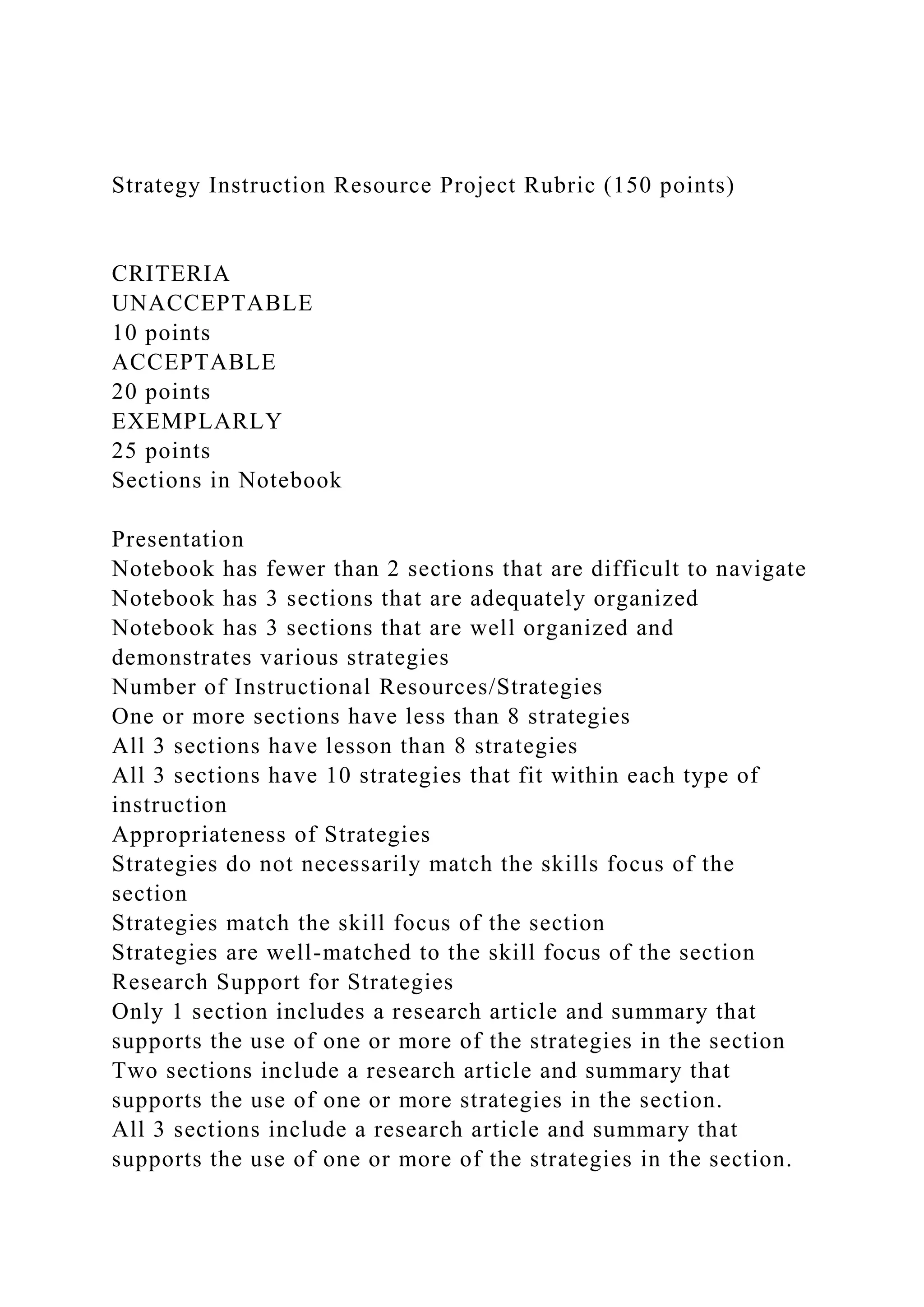
Strategy Instruction Resource Project Rubric (150 points)
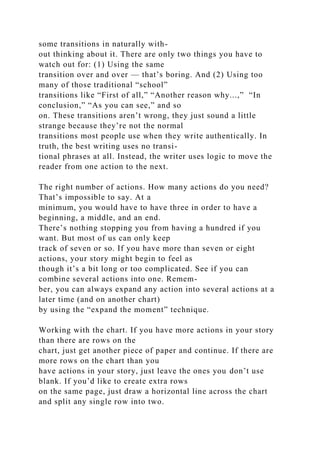
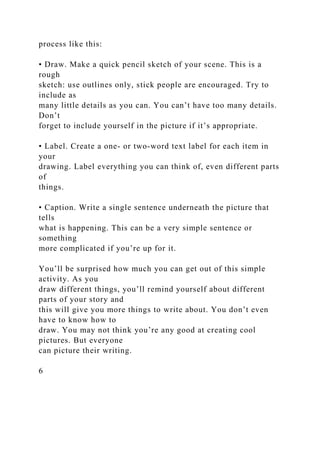
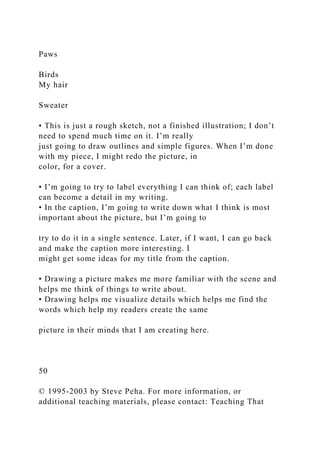
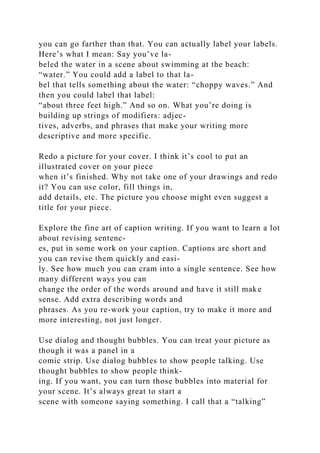
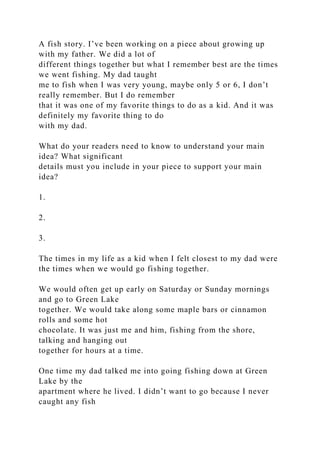
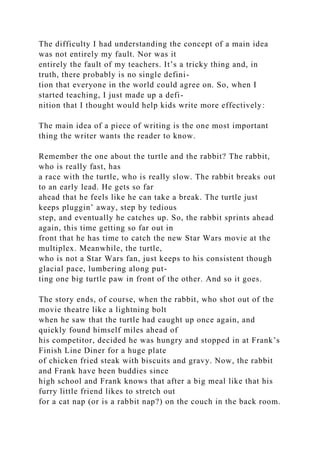
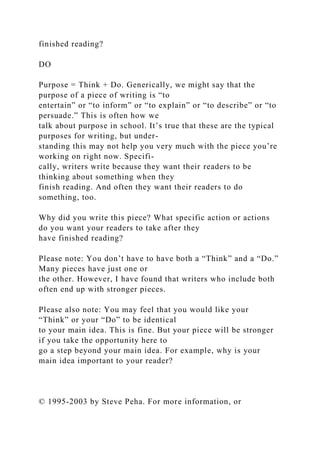
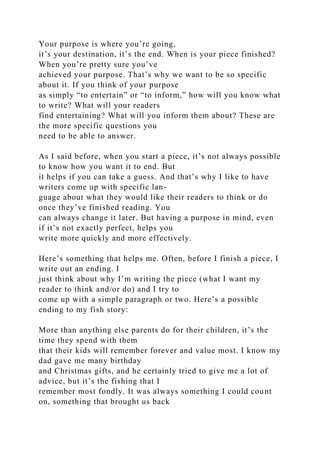
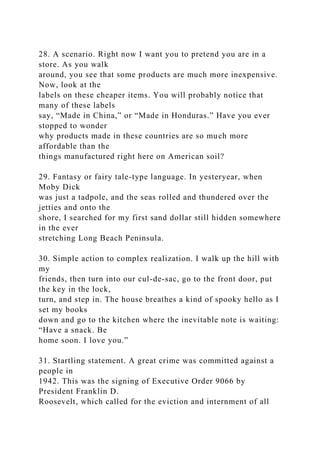
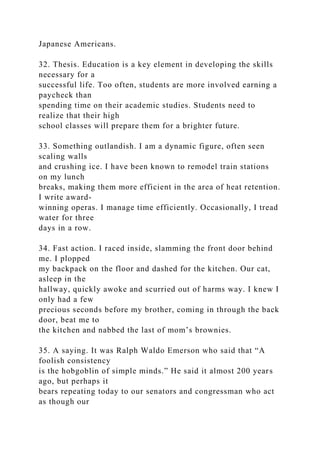
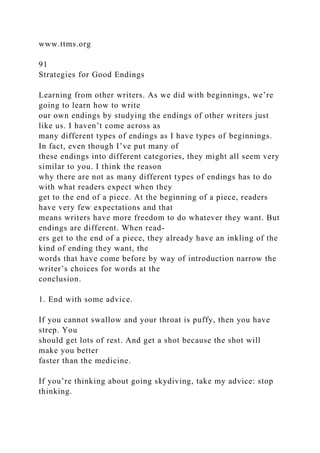
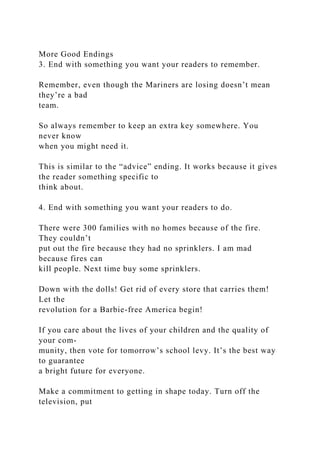
CRITERIA
UNACCEPTABLE
10 points
ACCEPTABLE
20 points
EXEMPLARLY
25 points
Sections in Notebook
Presentation
Notebook has fewer than 2 sections that are difficult to navigate
Notebook has 3 sections that are adequately organized
Notebook has 3 sections that are well organized and
demonstrates various strategies
Number of Instructional Resources/Strategies
One or more sections have less than 8 strategies
All 3 sections have lesson than 8 strategies
All 3 sections have 10 strategies that fit within each type of
instruction
Appropriateness of Strategies
Strategies do not necessarily match the skills focus of the
section
Strategies match the skill focus of the section
Strategies are well-matched to the skill focus of the section
Research Support for Strategies
Only 1 section includes a research article and summary that
supports the use of one or more of the strategies in the section
Two sections include a research article and summary that
supports the use of one or more strategies in the section.
All 3 sections include a research article and summary that
supports the use of one or more of the strategies in the section.
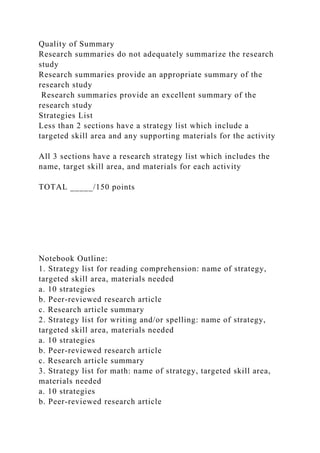
Quality of Summary
Research summaries do not adequately summarize the research
study
Research summaries provide an appropriate summary of the
research study
Research summaries provide an excellent summary of the
research study
Strategies List
Less than 2 sections have a strategy list which include a
targeted skill area and any supporting materials for the activity
All 3 sections have a research strategy list which includes the
name, target skill area, and materials for each activity
TOTAL _____/150 points
Notebook Outline:
1. Strategy list for reading comprehension: name of strategy,
targeted skill area, materials needed
a. 10 strategies
b. Peer-reviewed research article
c. Research article summary
2. Strategy list for writing and/or spelling: name of strategy,
targeted skill area, materials needed
a. 10 strategies
b. Peer-reviewed research article
c. Research article summary
3. Strategy list for math: name of strategy, targeted skill area,
materials needed
a. 10 strategies
b. Peer-reviewed research article
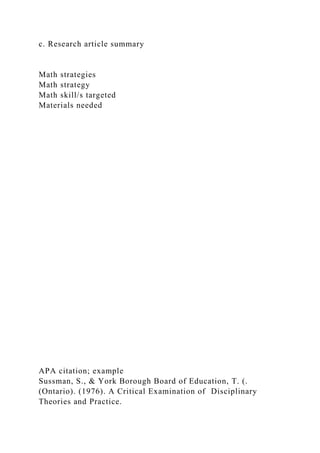
c. Research article summary
Math strategies
Math strategy
Math skill/s targeted
Materials needed
APA citation; example
Sussman, S., & York Borough Board of Education, T. (.
(Ontario). (1976). A Critical Examination of Disciplinary
Theories and Practice.
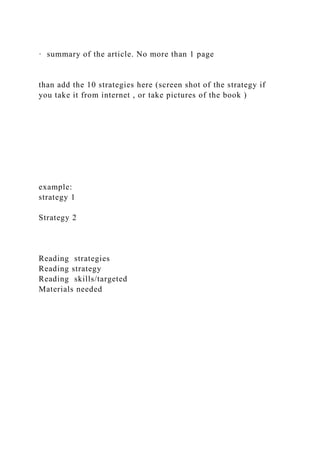
· summary of the article. No more than 1 page
than add the 10 strategies here (screen shot of the strategy if
you take it from internet , or take pictures of the book )
example:
strategy 1
Strategy 2
Reading strategies
Reading strategy
Reading skills/targeted
Materials needed
Mathematics Strategies
for Students with Varying Abilities
Introduction
Name some common learning barriers for students who struggle
with math
How do these barriers impact the instruction that takes place in
your classroom?
Explain some of your current math practices or what you have
seen others do.
7 Learning Characteristics That Create Barriers for Learning
Mathematics
☁Learned helplessness
☁Passive approach to learning
☁Metacognitive thinking deficits
☁Attention problems
☁Anxiety about learning mathematics
☁Cognitive Processing deficits (auditory, visual/spatial, fine
motor)
☁Memory problems
☁Low level of academic achievement (gaps)
General Mathematics Teaching Strategies to Help Struggling
Students
Many students struggle with abstract concepts. Introduce math
concepts in “real life” situations. This relationship will help
students understand the relevance of the lesson. Some examples
include:
Introducing percentages and graphing by using the statistics of
the school sports teams
Introduce addition, subtraction and decimals by relating them to
balancing a checkbook (or online statement)
Measurement and fractions can be taught through cooking
Time concepts can be taught using the class schedule
General Strategies cont…
When teaching a math concept, do not worry about perfect
calculations. The student must first understand the process.
Teach key math terms separately. Provide the students with a
dictionary of math terms. Include drawings and examples to
illustrate the various steps of the problems.
When teaching abstract concepts, use drawings, diagrams and
visual demonstrations to help the student establish a visual and
concrete relationship.
General Strategies cont…
Use colored pens when demonstrating assignments. This will
direct the student’s attention to the important points. An
example would be to color code the groups of ones, tens, or
hundreds. Another example would be to color code the number
that has been regrouped to be to color code the number that has
been regrouped to draw attention to the number.
You can also do this on worksheets the students complete as an
additional modification. For instance, on your guided example,
the ones column number (5) is yellow, the tens column number
(4) is pin, and the hundred column number (8) is blue. On their
worksheet, no matter the number, the ones column will be
yellow, tens pink, and the hundreds blue.
General Strategies cont…
Highlight similar math operations on each page to help the
student focus on the operation.
Cluster math problems into groups. If the assignment includes
several types of math calculations on one page, the student
should complete all the same operation before preceding on to
the next. For example, the student should complete all the
multiplication problems before moving on to division problems.
General Strategies cont…
Teach the student the math fact families. This will help to
establish the relationship between numbers.
If applicable, model the math problem using manipulatives.
When modeling explain each step verbally to the students.
Next, instruct the student to verbalize the steps. Listen
carefully as the student verbalizes to assess the student’s level
of understanding. This process allows the teacher to understand
the student’s thinking and ascertain where/if the student is
confused in the process.
General Strategies cont…
When teaching strategies for number lines, draw a number line
on the floor on which the students can walk. This will also help
the students develop directionality.
When teaching about money it is best to use real money rather
than paper money or cardboard money.
If using timed tests, reduce the number of problems or increase
the time limit. Provide ample workspace on the worksheet.
General Strategies cont…
When possible, in place of timed tests, use computer programs
as the time and number of problems may be preset. (MobyMax
offers a great math facts program)
Allow the student to graph the information from timed tests.
Look for improvement. Most timed tests only cause frustration
for students with disabilities or who struggle in math for other
reasons.
Add more time, for instance time them for three minutes rather
than one minute
Frequently review and reinforce previously taught skills. Use
daily quizzes.
General Strategies cont…
Many students who struggle with math need immediate feedback
on their assignments. Create several different work stations.
Include student activities with self correction sheets.
When teaching word problems, simplify the vocabulary. Leave
out irrelevant information. Teach the key words that are
associated with word problems. When teaching word problems
it is helpful to do the following:
General Strategies cont…
Word Problems continued:
Ask the student to read the problem to determine the question
Reread the word problem. Look for key words in the problem.
Some of the key words are: altogether, together, in all, are left,
spent or remain.
Draw a diagram of the word problem
Write out the problem. Estimate the answer before solving it.
If the answer seems reasonable, solve the problem
General Strategies cont…
Develop task analysis sheets for the basic areas of mathematics.
Use these checklists to determine the specific area of difficulty.
Look for patterns of errors in daily assignments
Have the student verbalize the process to you (Some students
will experience difficulties because they miss one step in the
process or they are performing one step incorrectly.)
Patterns of errors usually emerge in the following areas:
inadequate knowledge of facts, incorrect operations or the use
of ineffective strategies.
Parallel Math Activities
Even when using researched based strategies to support
struggling learners, some students will not be able to complete
the same curriculum as the rest of the class.
Further accommodations and sometimes modifications will need
to be implemented to result in success for these students. These
students may have an Individual Education Plan (IEP) through
special education, through a 504, or a Response to Instruction
and Intervention Plan (RTII).
Parallel Math Activities
These plans may mandate modifications (IEP), accommodations
or suggest accommodations for data collection purposes (RTII).
Supplementary skills can be provided for the student in
classroom that correspond with the class activity. The
following ideas are suggestions for working with students who
require assistance with math. Some may require a peer or an
adult to assist them.
Parallel Math Activities
Decide whether the skill is functional as a life skills. Make
sure the skills taught are skills that will support the student in
independent living.
Provide supplemental skills in the same content area as the rest
of the class. For example, if the class is learning addition with
regrouping, the student may work on basic addition facts,
possibly with an assistant. It is possible the student can still be
involved in the discussion, demonstration and use the
manipulatives, if the classroom teacher varies the questions and
directs specific questions toward the student.
Parallel Math Activities
Correlate the objectives from the IEP with the instruction. If
the student is working on number recognition, use the
classroom daily assignment or the textbook. If the objective is
for the student to write numbers, the student could write the
numbers from the textbook.
Parallel Math Activities
Utilize a supplemental text for the student’s direct instruction.
Direct instruction can be provided for the student while the rest
of the class is receiving instruction. During seat work time, the
student will be able to complete the assignment in the
supplementary text.
Parallel Math Activities
Give the student number cards. Work on the chronological
sequencing of numbers. Use the same cards for one-to-one
correspondence, ordering from least to greatest or number
recognition.
Make cards for mathematical symbols. Have the student put
them together into correct mathematical equations. The student
may copy the equation onto paper.
Parallel Math Activities
Collect shells, beads, seeds. Various shaped pasta and buttons.
Put them into boxes or bags. Use these collections to sort and
classify objects. The materials may also be used to assist with
one-to-one correspondence.
Use egg cartons to sort various materials and establish the
concept of groups. Use this concept of group to introduce
addition and subtraction.
Teach the student to use a calculator. Allow the student to do
some of the problems in the text with a calculator.
Parallel Math Activities
Have the students collate the papers in chronological order.
Coordinate the students assessments, seat work time and
rewards with the mainstream math class.
Create games the student may play with other students in the
classroom. Vary the peer groups.
Modifying Math Assignments
Place arrows on the student’s worksheet to assist with
directionality. Many students will try to perform math
calculations from left to right instead of right to left.
Draw dotted lines between the columns of math problems so the
student is able to record the information in the correct column.
Box in the ones column so the student knows where to begin the
math calculation.
Modifying Math Assignments
Turn lined paper vertically so the student has ready made
columns. Use graph paper for instant organization of math
problems.
Purchase consumable texts from the publisher if available.
Students with fine motor difficulty will not have to copy
problems and will be able to spend more time with the actual
calculator.
If consumables are unavailable, enlarge the text so the student
may write on the photocopied page.
Modifying Math Assignments
When working with problem solving activities, emphasize the
problem solving steps, not the final answer. Many students do
not participate for fear their final computation is incorrect.
Number the steps in word problems. Highlight the important
words.
Allow the student to use charts, graphs and tables when the
process of addition, subtraction, multiplication and division is
understood.
Modifying Math Assignments
When using addition, subtraction or multiplication charts,
provide the student with cutout “L” . This will assist the
student to find the intersection box of columns and rows.
Provide the student with ample time to memorize the basic facts
before using the calculator.
Student Aids
When teaching multiple step math calculations, write down the
steps of the process for students to use as a guide. Provide a
visual model next to the written steps so the student can see the
correlation between the model and the written problem.
Division is an example of a process that requires multiple steps.
Student Aids
Create a small booklet for the student to keep as a math
reference book. The booklet should include the basic math
concepts covered in the class. The student can then refer to the
guide if he/she is confused about a mathematical operation.
Include the math terminology and a visual diagram for each
step.
Attach a number line to the student’s desk or in the math book.
This will assist the student with addition, subtraction and the
correct formation of the numbers. This will also assist students
who experience difficulties with number reversals.
Student Aids
Teach the student to use the face clock in the classroom as a
number line for facts to 12. This will support the student who
is adverse to having a number line placed on the desk.
Create a chart with two number lines. Label one for addition
with an arrow to the right and label the other chart for
subtraction with an arrow running to the left. This will help the
student internalize the concept.
Student Aids
Allow the student to use a calculator
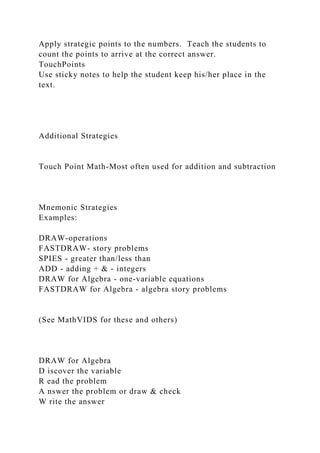
Apply strategic points to the numbers. Teach the students to
count the points to arrive at the correct answer.
TouchPoints
Use sticky notes to help the student keep his/her place in the
text.
Additional Strategies
Touch Point Math-Most often used for addition and subtraction
Mnemonic Strategies
Examples:
DRAW-operations
FASTDRAW- story problems
SPIES - greater than/less than
ADD - adding + & - integers
DRAW for Algebra - one-variable equations
FASTDRAW for Algebra - algebra story problems
(See MathVIDS for these and others)
DRAW for Algebra
D iscover the variable
R ead the problem
A nswer the problem or draw & check
W rite the answer
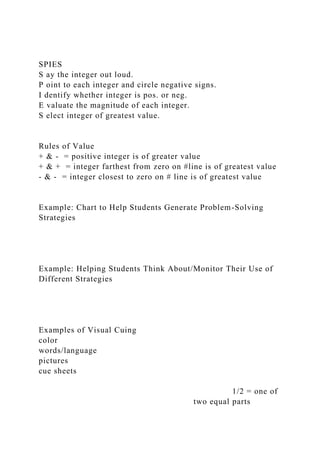
SPIES
S ay the integer out loud.
P oint to each integer and circle negative signs.
I dentify whether integer is pos. or neg.
E valuate the magnitude of each integer.
S elect integer of greatest value.
Rules of Value
+ & - = positive integer is of greater value
+ & + = integer farthest from zero on #line is of greatest value
- & - = integer closest to zero on # line is of greatest value
Example: Chart to Help Students Generate Problem-Solving
Strategies
Example: Helping Students Think About/Monitor Their Use of
Different Strategies
Examples of Visual Cuing
color
words/language
pictures
cue sheets
1/2 = one of
two equal parts
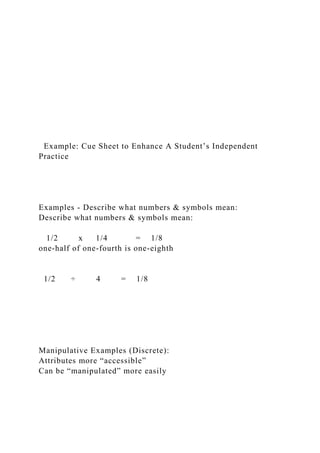
Example: Cue Sheet to Enhance A Student’s Independent
Practice
Examples - Describe what numbers & symbols mean:
Describe what numbers & symbols mean:
1/2 x 1/4 = 1/8
one-half of one-fourth is one-eighth
1/2 ÷ 4 = 1/8
Manipulative Examples (Discrete):
Attributes more “accessible”
Can be “manipulated” more easily
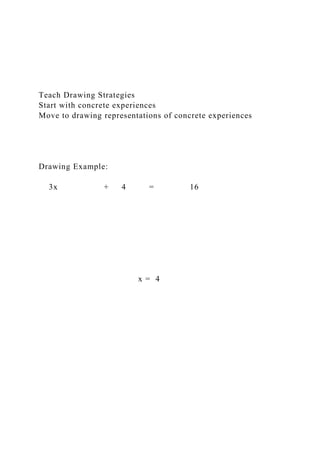
Teach Drawing Strategies
Start with concrete experiences
Move to drawing representations of concrete experiences
Drawing Example:
3x + 4 = 16
x = 4
Other Drawing Examples
Enhancing Abstract Understanding
Reasons for Difficulty
Lack of conceptual understanding
Memory problems
Organization/writing/visual processing problems
Provide Many Practice Opportunities/Link to concrete &
drawing experiences! MASTERY
Conclusions
Students need to have a strong understanding of the basics.
Teach one concept at a time until mastery, or as close to
mastery, is achieved-aim for 80%
Quiz a concept at a time rather than a comprehensive test
Guided notes with many examples
Fact fluency is a good thing; encourage facts to become
automatic!
Encourage students to use a calculator unless basic facts are
being assessed
At times, a textbook can be overwhelming, put notes, practice,
and homework all in one packet. The students work through
packet at the teacher’s pace
Students do not need to prove themselves by answering 30
problems for homework.
Use flow charts to explain a process
Be careful of the expectation of memorization, especially with
poor long term and working memory
Teach multiple ways to arrive at an answer
Conclusions Continued
Purposefully plan maintenance opportunities
Emphasize foundational concepts for the mathematics
curriculum you teach
Make sure target maintenance concepts are ones students have
previously mastered
Vary the type of activities
Avoid “drill & practice”
Include students in developing ideas for maintenance activities
Emphasize connections between abstract & concrete
Engage students in “talking/writing/drawing” about target
maintenance concepts
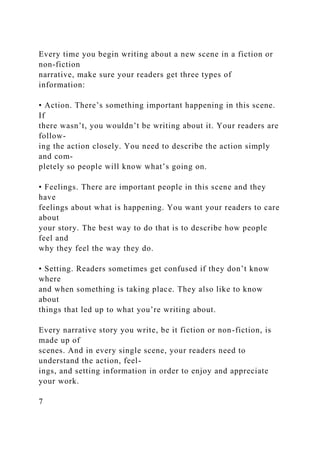
Writing
The
Teacher’s
Strategy
Guide
by Steve Peha
“FU
LL”
Ver
sion
For More inForMation
Visit ttMs.org
The best way to teach
is the way that makes sense
to you, your kids,
and your community.
www.ttms.org
1
2
3
4
5
6
7
8
Table
of Contents
The Definition of Writing 58
The Content-Purpose-Audience strategy. A powerful,
comprehensive strategy writers can use to
plan an entire piece or to identify areas in a draft that need
revision.
The Three Key Ingredients 52
The Action-Feelings-Setting strategy. A great tool for helping
writers describe a scene in a
narrative with effective detail. Also makes a great introduction
to paragraph writing.
The Picture Worth a Thousand Words 47
The Draw-Label-Caption strategy. A great strategy for writers
of all ability levels. Helps students
capture a scene and focus on important details.
A Sequence of Events 38
The Transition-Action-Details strategy. A perfect strategy for
narrative sequencing. Also works
well for summaries and procedural writing of all kinds
including step-by-step instructions.
A Game of Show and Tell 33
The Tell-Show strategy. A great strategy for adding rich,
descriptive detail. Helps writers bring a
strong visual component to their work.
It’s All in the Details 28
The Idea-Details strategy. A very simple strategy that is much
more powerful than it looks. Helps
writers add detail but can also be used to create entire pieces of
writing all by itself.
It’s Just a Matter of Opinion 20
The What-Why-How strategy. A powerful tool for helping
students explain their thinking and
support logical arguments. Perfect for expository and persuasive
writing.
I Don’t Know What to Write About 5
The Topic T-Chart strategy. A great way to guide students in
choosing good topics. Also, addi-
tional strategies for topic selection in research writing.
4
© 1995-2003 by Steve Peha. For more information, or
additional teaching materials, please contact: Teaching That
Makes Sense, Inc. • E-mail [email protected] • Web
www.ttms.org
9
10
11
TOC
Continued
Little Things That Make a Big Difference 104
A Variety of Strategies. A brief look at several small but
important topics including sharing and
conferencing, how to beat writer’s block, and The Five Big
Questions.
Happy Endings 90
Effective Ending Strategies. A set of excellent strategies for
creating effective endings. Many
authentic samples from student work.
Great Beginnings 74
Effective Lead Strategies. A large collection of strategies for
helping students produce great
beginnings. Includes samples of more than 25 types of leads.
© 1995-2003 by Steve Peha. For more information, or
additional teaching materials, please contact: Teaching That
Makes Sense, Inc. • E-mail [email protected] • Web
www.ttms.org
5
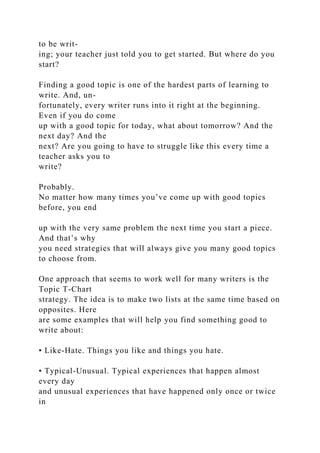
I Don’t Know What
to Write About
It’s the worst feeling in the world. You know you’re supposed
to be writ-
ing; your teacher just told you to get started. But where do you
start?
Finding a good topic is one of the hardest parts of learning to
write. And, un-
fortunately, every writer runs into it right at the beginning.
Even if you do come
up with a good topic for today, what about tomorrow? And the
next day? And the
next? Are you going to have to struggle like this every time a
teacher asks you to
write?
Probably.
No matter how many times you’ve come up with good topics
before, you end
up with the very same problem the next time you start a piece.
And that’s why
you need strategies that will always give you many good topics
to choose from.
One approach that seems to work well for many writers is the
Topic T-Chart
strategy. The idea is to make two lists at the same time based on
opposites. Here
are some examples that will help you find something good to
write about:
• Like-Hate. Things you like and things you hate.
• Typical-Unusual. Typical experiences that happen almost
every day
and unusual experiences that have happened only once or twice
in
your entire life.
• Fun-Have To. Things you do for fun and things you do
because you
have to.
• Regret-Proud Of. Things you regret and things you are
proud of.
You can use these lists over and over. (You can even use them
in different
classes and in different grades!) Try a couple of the ones
suggested here or make
up your own. In just a few minutes, you’ll have enough topics
to last a whole
year!
1
6
© 1995-2003 by Steve Peha. For more information, or
additional teaching materials, please contact: Teaching That
Makes Sense, Inc. • E-mail [email protected] • Web
www.ttms.org
Like-Hate T-Chart
Good writing comes from strong feelings. And strong feelings
come from things we like
and things we hate. Make a list of the things you really like and
the things you really hate (no
people on the “Hate List,” please!). If you’re honest about it,
each topic will be something you
have a lot to write about.
LIKE
Things I Really Like a Lot Things I Really Can’t Stand
(No people, please!)(Think about your absolute favorites!)
HATE
© 1995-2003 by Steve Peha. For more information, or
additional teaching materials, please contact: Teaching That
Makes Sense, Inc. • E-mail [email protected] • Web
www.ttms.org
7
UNUSUAL
Typical-Unusual T-Chart
Good writing comes from life experience. And the life
experiences we know best are the
typical things we do every day and the unusual things that
happen to us maybe only once or
twice in our entire lives. Either way, these kinds of topics are
perfect things to write about.
TYPICAL
Regular, Everyday Experiences
(Think of the highs and lows in your life, the
times that aren’t like all the others.)
(Sometimes the little things in life make the
best topics for writing.)
Out-of-the-Ordinary Experiences
8
© 1995-2003 by Steve Peha. For more information, or
additional teaching materials, please contact: Teaching That
Makes Sense, Inc. • E-mail [email protected] • Web
www.ttms.org
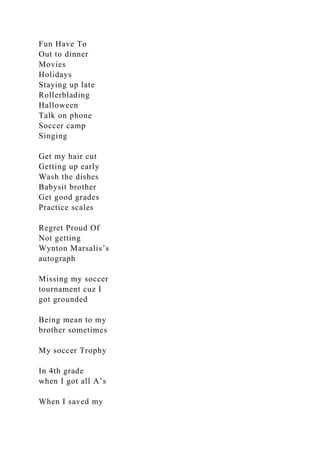
Examples
Like Hate
Pizza
The Internet
Ice cream
Music
Reading
My cat
Harry Potter
Soccer
Shopping
Candy
All vegetables
Homework
Science
Spelling tests
Getting dressed up
Cleaning my room
Rainy days
Being bored
Bowling
Golf on TV
Fun Have To
Out to dinner
Movies
Holidays
Staying up late
Rollerblading
Halloween
Talk on phone
Soccer camp
Singing
Get my hair cut
Getting up early
Wash the dishes
Babysit brother
Get good grades
Practice scales
Regret Proud Of
Not getting
Wynton Marsalis’s
autograph
Missing my soccer
tournament cuz I
got grounded
Being mean to my
brother sometimes
My soccer Trophy
In 4th grade
when I got all A’s
When I saved my
cat from that big
dog.
I’m good at math
Typical Unusual
Waking up
School
Dinner
Practice trumpet
Soccer
Watching TV
Visiting grandma
Feeding my cat
Bike accident
Chicken pox
Broke my arm
Disneyland
Getting my 1st bike
Met Mia Hamm
Saw Wynton Marsalis
Getting presents
Getting grounded
© 1995-2003 by Steve Peha. For more information, or
additional teaching materials, please contact: Teaching That
Makes Sense, Inc. • E-mail [email protected] • Web
www.ttms.org
9
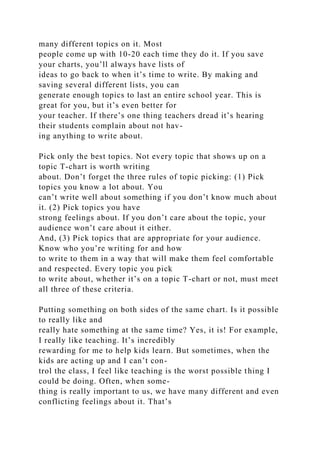
T-Chart Tips
Save your T-charts. Each topic T-chart you create will have
many different topics on it. Most
people come up with 10-20 each time they do it. If you save
your charts, you’ll always have lists of
ideas to go back to when it’s time to write. By making and
saving several different lists, you can
generate enough topics to last an entire school year. This is
great for you, but it’s even better for
your teacher. If there’s one thing teachers dread it’s hearing
their students complain about not hav-
ing anything to write about.
Pick only the best topics. Not every topic that shows up on a
topic T-chart is worth writing
about. Don’t forget the three rules of topic picking: (1) Pick
topics you know a lot about. You
can’t write well about something if you don’t know much about
it. (2) Pick topics you have
strong feelings about. If you don’t care about the topic, your
audience won’t care about it either.
And, (3) Pick topics that are appropriate for your audience.
Know who you’re writing for and how
to write to them in a way that will make them feel comfortable
and respected. Every topic you pick
to write about, whether it’s on a topic T-chart or not, must meet
all three of these criteria.
Putting something on both sides of the same chart. Is it possible
to really like and
really hate something at the same time? Yes, it is! For example,
I really like teaching. It’s incredibly
rewarding for me to help kids learn. But sometimes, when the
kids are acting up and I can’t con-
trol the class, I feel like teaching is the worst possible thing I
could be doing. Often, when some-
thing is really important to us, we have many different and even
conflicting feelings about it. That’s
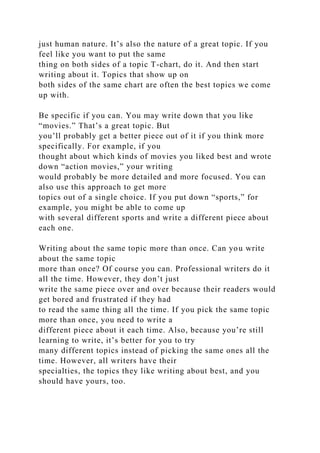
just human nature. It’s also the nature of a great topic. If you
feel like you want to put the same
thing on both sides of a topic T-chart, do it. And then start
writing about it. Topics that show up on
both sides of the same chart are often the best topics we come
up with.
Be specific if you can. You may write down that you like
“movies.” That’s a great topic. But
you’ll probably get a better piece out of it if you think more
specifically. For example, if you
thought about which kinds of movies you liked best and wrote
down “action movies,” your writing
would probably be more detailed and more focused. You can
also use this approach to get more
topics out of a single choice. If you put down “sports,” for
example, you might be able to come up
with several different sports and write a different piece about
each one.
Writing about the same topic more than once. Can you write
about the same topic
more than once? Of course you can. Professional writers do it
all the time. However, they don’t just
write the same piece over and over because their readers would
get bored and frustrated if they had
to read the same thing all the time. If you pick the same topic
more than once, you need to write a
different piece about it each time. Also, because you’re still
learning to write, it’s better for you to try
many different topics instead of picking the same ones all the
time. However, all writers have their
specialties, the topics they like writing about best, and you
should have yours, too.
10
© 1995-2003 by Steve Peha. For more information, or
additional teaching materials, please contact: Teaching That
Makes Sense, Inc. • E-mail [email protected] • Web
www.ttms.org
What’s a Good Idea?
Some ideas are better than others. Just because it’s on a list you
made doesn’t mean it’s
necessarily great thing to write about. Sometimes you may want
to consider things a bit more care-
fully before you start writing. To help you with that, I’ve come
up with a series of questions you can
ask yourself about any topic you choose. How you answer these
questions may help you discover
that some of your topics are better than others.
Is the topic something you have strong feelings about? How
much writers care
about their topic is probably the strongest predictor of success
with the finished piece. Your feelings
about the topic affect your writing in three ways: (1) The
amount of effort of you put in will be
greater if you care about your topic, and this extra effort will
probably lead you to produce better
work. (2) Your voice will be stronger if you care about the
topic. Voice is the personal quality in a
piece of writing, it’s how your personality shapes the piece in
ways that make it different from any-
one else’s. It’s also the aspect of your writing that will be most
interesting to the majority of your
readers. (3) You’ll have a lot more fun writing a piece if you
care about the topic. The work will
go faster and be more enjoyable.
Is the topic something you know a lot about? Writing is really
two activities wrapped
up into one. The first activity involves coming up with the ideas
you plan to write about. The sec-
ond involves writing those ideas down in ways that are
interesting and understandable to your read-
ers. The simple truth is that you can’t do the second. if you
haven’t figured out the first. If you
don’t know a lot about your topic, you have two choices: (1)
You can do some research and learn
more about it. Or (2) you can pick something different to work
on that you know more about.
Is the topic something you can describe in great detail? Details
are the heart of any
good piece of writing. Details are also what make your writing
different from anyone else’s. With-
out good details, most pieces are boring. Part of knowing a lot
about your topic is knowing the little
things about it that your readers probably don’t know.
Is the topic something your audience will be interested in?
Before you can answer
this question, you have to know who you’re writing for. In
school, your audience usually consists of
the other students in your class plus the teacher. But often we
write for wider audiences, too. In ei-
ther case, you have to know who your audience is and why they
might be interested in the topic
you’ve chosen to write about.
Is the topic something your audience will feel was worth
reading? Your readers
have to expend time and effort to read your writing. What do
you have to say to them about your
topic that will keep them reading all the way to the end, and
make them feel like they got their
money’s worth when they get there?
© 1995-2003 by Steve Peha. For more information, or
additional teaching materials, please contact: Teaching That
Makes Sense, Inc. • E-mail [email protected] • Web
www.ttms.org
11
Do You Have a Good Idea?
FEELINGS
KNOWLEDGE
DETAILS
INTEREST
VALUE
What are those feelings? How will you communicate them to
your reader? Is there an important
detail you want to emphasize so your reader will understand
exactly how you feel?
What are the main things you want to cover? What’s the most
important part of your piece?
What’s the one most important thing you want your audience to
know about your topic?
What are some of the important details of your topic? Why are
these details important? How do these
details help the reader understand your message?
Who is your audience? Why will they be interested in your
topic? What will interest them most?
What does your audience need to know to understand and enjoy
your piece?
What will your audience get from reading your piece? Will your
audience learn something new? What will make
your audience want to follow your piece all the way to the end?
12
© 1995-2003 by Steve Peha. For more information, or
additional teaching materials, please contact: Teaching That
Makes Sense, Inc. • E-mail [email protected] • Web
www.ttms.org
Choosing Topics For Research
Way back when I was your age. I had to do many research
papers. They were, without ex-
ception, awful pieces of writing. I had topics I didn’t like or
didn’t know much about. I didn’t
know what doing research really meant. (I thought it had
something to do with copying things
out of encyclopedias and changing the words around.) And I
certainly didn’t know very much
about writing.
My experience with research in school was, I think, typical of
many students even today. I did state
reports, country reports, animal reports, and famous people
reports. I didn’t enjoy it, I don’t re-
member the information, and I never again used the skills I
acquired. The whole process didn’t
make a lot of sense to me. And I never felt that I was learning
very much.
Now, as an adult, I find myself engaged in research of one kind
or another all the time. At the
moment, for example, I have two projects going. In one, I am
reading several books about the
brain and memory so I can help kids retain more of what they
study. In the other project, I am
learning about building complex interactive web sites. This is
more like the kind of research peo-
ple do for their jobs. In fact, that’s why I’m researching these
topics, so I can do some new things
in my work.
It’s interesting for me to note that neither of these projects will
require me to write a report. They
will both require, however, the creation of something tangible.
In one case, new teaching materi-
als, in the other, a web site. Research always has some kind of
output, some kind of finished prod-
uct that the researcher has to be responsible for. But written
reports of the kind we do in school are
only one way to present our results.
For me, the allure of research revolves around problem solving.
As I learn about how research is
done in the world, I find this to be a consistent theme. At the
root of it all is human curiosity. The
need to know creates the problem the act of research seeks to
solve. We all need to research the
things we’re curious about.
When I went to school, research involved the gathering up of
facts and the presentation of those
facts to the teacher in the form of a written report. Since the
facts I gathered were already known,
and since neither I nor my teacher had much interest in knowing
them, the exercise was mean-
ingless. In the world outside of school, it isn’t just the facts that
count. Facts are an important
part, but not the whole. It is the meaning of the facts that makes
the work worthwhile and the
learning long lasting. And that only happens when we’re solving
problems we care about and sat-
isfying our curiosity.
© 1995-2003 by Steve Peha. For more information, or
additional teaching materials, please contact: Teaching That
Makes Sense, Inc. • E-mail [email protected] • Web
www.ttms.org
13
The Six Principles of Research
A matter of principles. Few people get through their entire lives
without doing some re-
search. Even if you manage to avoid it in school, you’ll
undoubtedly be faced with it in your adult
life. So, if you’re going to do research in school, you might as
well do it the way people do it in the
real world. Then, even if you don’t like it, you’ll still get an
introduction in something valuable.
In the real world, research follows a set of six principles. These
principles define what research is,
how it should be done, and how it is evaluated. Even if you
don’t learn much doing research in
school, you can still learn these principles. Knowing them will
serve you well in your adult life
outside of school.
Principal #1: The researcher is an expert in the field. We don’t
ask dentists to re-
search industrial manufacturing methods, we don’t ask
accountants to study the human genome,
and we don’t ask graphic artists for their analysis of the
economy. Researchers research the things
they know best. You may not feel like a true expert in anything.
But you do have specific knowledge
in many areas: things you like, things you do for fun, things you
are interested in, etc. Your home
and family situations may also be helpful. When doing research
in school, you don’t have to be the
best expert in the world, you just have to know more about
something than your audience does.
Regardless of how much you think you may or may not know
about things, you must do your
work in an area you are familiar with just like real researchers.
Principal #2: The topic is narrow and manageable. Most
research has a very narrow
focus. There aren’t many people writing comprehensive
histories of Europe or complete biogra-
phies of famous people. The reason for this is the time involved.
It takes years, even decades, to
write the history of an entire country or the biography of a
famous person. And most school kids
don’t have that kind of time on their hands. Finding an
appropriately narrow topic takes a bit of
work. It might even take several days. But this is time well
spent because if you settle on a topic
that is too broad, it is likely that your research will take too
long, and that your writing will be of
poor quality. To help kids find just the right topic, I tell them to
first pick something that matches
a personal interest. Then we dig deeper and deeper into that
topic to find possible sub-topics. We
keep digging until we find something that seems just right.
Sometimes the process looks like
we’re drilling down the levels of an outline: Sports >> Baseball
>> Mariners >> Ichiro >>
Japanese players coming to America. Now here’s a topic that
might be specific enough for us to
work with. We started with “sports” and from there we had to
dig down four more levels before we
came to something small and focused. This is not uncommon.
Starting from a general interest,
you may have to dig down five or six levels or more before you
find something small enough that
you’ll be able to research thoroughly and write about well in the
short time you’ll have to do your
work.
14
© 1995-2003 by Steve Peha. For more information, or
additional teaching materials, please contact: Teaching That
Makes Sense, Inc. • E-mail [email protected] • Web
www.ttms.org
Six Research Principles Cont.
Principle #3: The research answers specific questions. The best
research answers
very specific questions, sometimes only one. How does a drug
inhibit the spread of cancer? How
can a company reduce the cost of a product? What were the
causes of The Great Depression? How
do I create teaching materials that help kids remember what
they learn? How do I build a really
cool interactive website? Etc. So, after we find an appropriately
narrow topic, we try to develop spe-
cific research questions that go with it: How many Japanese
players are in the Major Leagues?
How do they perform relative to other players? Why are
Japanese players coming to the Major
Leagues now instead of long ago? And so on. We may even
come up with questions that lead the
research in a slightly different direction: How have the events
of September 11th affected the de-
sire of foreign players to come to this country?
Principal #4: The audience is well defined. Research wouldn’t
be done if someone
wasn’t interested in it. Knowing who that someone is, and the
nature of their interest, helps re-
searchers focus their efforts on the right questions and the best
presentation of the answers. In
most cases, you’ll be doing your research for your peers. But
you may come up with different au-
diences like your family or other people in your community.
Principal #5: Neither author nor audience knows the result of
the research. Re-
searchers don’t research questions they already know the
answers to. Nor do they research things
their audience already knows. If you presented something you
already knew, no research would be
involved. If the information you presented was already known
to your audience, there would be
no need to present it. This just means that you may need to do a
little research on your audience
before you get too far into researching your topic. Ask people
what they know already about your
topic and what they would like to know next.
Principal #6: Presentation matches purpose. To reach their
audience most effectively,
researchers use a variety of methods to present their results.
Sometimes results are written in pa-
pers. But often they are presented in some kind of talk with
handouts, slides, or other props.
Sometimes researchers express their results in working models.
More and more, research results are
presented in hypertext documents on the web. Researchers do
their research for specific purposes.
And those purposes often have to do with how they want their
information to be used. It is appro-
priate to present research in written form when we need to reach
people who cannot hear us speak
or who may need to use our written word as evidence to support
their own research. We may reach
our audience more effectively, however, if we make an oral
presentation. If we intend our research
to prove a particular point, or solve a tangible problem, we may
want to present a model of some
kind. Presenting our research on the Internet is a great way to
reach larger audiences and to display
our results in an interactive format. How you decide to present
your results will influence the infor-
mation you gather and the way you organize it for your
audience.
© 1995-2003 by Steve Peha. For more information, or
additional teaching materials, please contact: Teaching That
Makes Sense, Inc. • E-mail [email protected] • Web
www.ttms.org
15
When You Can’t Choose
Choosing good topics when there is no choice. In an ideal
world, you would get to
work with any topics you wanted to work with and you could
carefully avoid topics you weren’t in-
terested in. But school is far from an ideal world. There’s all
this curriculum, for example, all
these subject areas you’re supposed to study whether you want
to learn about them or not.
When it comes to research in specific subject areas like social
studies and science, most kids find
themselves at a disadvantage right from the start because they
get stuck with unworkable topics.
In 7th grade, my social studies teacher told each of us to pick a
different country. Because we knew
little about our subjects, and because our teacher’s requirements
were so broad (he required us to
cover history, politics, economy, culture, geography, etc.), most
of us copied or paraphrased infor-
mation from encyclopedias. There really wasn’t much else we
could do given how little we knew
about our topics and how much we were supposed to research
about them.
So what will you do the next time you’re asked to do a research
project on something you don’t
know very much about or don’t have much interest in? You’ll
have to get creative and try to find
some meaningful connections between things you know from
your own life and things your
teachers want you to study.
Topic equations. The best research is always done by
researchers who are passionate about
their topics. This passion typically comes from a strong
personal connection between the re-
searcher and the topic being researched. I like to think of that
connection in terms of a mathe-
matical equation: Area of Interest + Area of Study = Possible
Research Topic.
The first thing to do is make lists of things in which you have
an interest. The lists I use most often
with students are: “Things I Like”, “Things I Do For Fun”,
“Things I Care About”, and “Things
I’m Interested In”. You can make up your own lists if you like,
but these work well for me.
Once you have your lists, the trick is to find connections
between certain items and the subject area
you are studying. For example, if one of the things I like is the
TV show Star Trek and we’re study-
ing 20th Century U.S. History, then doing research on the space
program might be perfect for me.
If we’re studying ancient Rome, however, I might not be able to
make such an easy connection
with that topic, so I’ll have to think about in a different way or
pick another item on my list and try
to make a different connection.
Picking research topics in traditional school subject areas using
the topic equation approach is not
easy. It takes some time, some thought, some creativity, and
even a little luck. But the effort is
worthwhile. When you have a topic that is appropriately defined
and connected to something you
understand and care about, you have more fun, your learning
increases, and you do better work.
16
© 1995-2003 by Steve Peha. For more information, or
additional teaching materials, please contact: Teaching That
Makes Sense, Inc. • E-mail [email protected] • Web
www.ttms.org
Start with What You Know and Love
Things I Care About Things I’m Interested In
INTERESTCARE
FUNLIKE
Things I Like Things I Do For Fun
© 1995-2003 by Steve Peha. For more information, or
additional teaching materials, please contact: Teaching That
Makes Sense, Inc. • E-mail [email protected] • Web
www.ttms.org
17
Connect it to the Curriculum
INTEREST
(Things from your list)
SUBJECT
(What you are studying)
TOPICS
(Possible areas for research)
18
© 1995-2003 by Steve Peha. For more information, or
additional teaching materials, please contact: Teaching That
Makes Sense, Inc. • E-mail [email protected] • Web
www.ttms.org
Example
Things I Care About Things I’m Interested In
INTERESTCARE
FUNLIKE
Things I Like Things I Do For Fun
Money
Rap music
Clothes
Pizza
Vide games
Movies
Play baseball
Take trips
Go to the mall
Hang out with friends
Surf the internet
Talk on the phone
My family
My pets
My friends
Violence in my community
People being treated fairly
Getting a part-time job
Computers
Cars
Going to college
© 1995-2003 by Steve Peha. For more information, or
additional teaching materials, please contact: Teaching That
Makes Sense, Inc. • E-mail [email protected] • Web
www.ttms.org
19
Example
INTEREST
(Things from your list)
SUBJECT
(What you are studying)
TOPICS
(Possible areas for research)
Baseball
Money
Part-Time Job
Family
Rap Music
Community Violence
Sports during the period; Baseball
as a popular pastime; Etc.
Standard of living; Purchasing power
of the average family; Types of coin
and paper money; Etc.
Work opportunities for young
people; Wages and availability of
work; Slavery as an impact on
employment in undeclared border
states; etc.
Family structure and relationships;
North-South cultural norms; Roles and
expectations; Etc.
Popular music of the period; Politically
and socially critical songs and poems;
Etc.
Relative safety of urban areas; Crime
rates; Police work; Etc.
The Civil War
The Civil War
The Civil War
The Civil War
The Civil War
The Civil War
20
© 1995-2003 by Steve Peha. For more information, or
additional teaching materials, please contact: Teaching That
Makes Sense, Inc. • E-mail [email protected] • Web
www.ttms.org
It’s Just a Matter
of Opinion
Isn’t it frustrating? You’re trying to explain something
important and people
don’t understand you. Or you’re trying to convince someone of
something but
they’re not going along.
The same thing can happen when you write. But it’s worse
because you can’t
be there to clear up any of your reader’s confusion. The only
thing you can do is
make sure that your argument makes sense.
When you’ve got an important opinion to express, the best way
to express it is
with the What-Why-How strategy:
• WHAT do you think? This is your opinion. Sometimes a single
sentence will be all you need. You can also think of it as your
main
idea if you’re writing an essay. Or, if you’re working on a
research
paper, this would be your thesis.
• WHY do you think it? Opinions don’t just pop up out of
nowhere
for no reason at all. If you’ve got an opinion, you’ve got a
reason for
it, and often more than one. Can’t think of a reason? Maybe
your
opinion isn’t really what you think. (But then, that’s just my
opin-
ion!)
• HOW do you know? As the saying goes: “Everyone’s entitled
to
their opinion.” But are you really? Where’s your proof? What
examples
or evidence can you come up with to make your point? For
every
reason you should have at least one example or other kind of
proof.
The key to a successful argument is great support. You’ve got
to be able to
back up everything you say with good reasons and solid
evidence. You can use
the What-Why-How strategy to support almost any opinion you
have. It’s great
for expository and persuasive writing. And it even works well
when you have to
answer essay questions.
2
© 1995-2003 by Steve Peha. For more information, or
additional teaching materials, please contact: Teaching That
Makes Sense, Inc. • E-mail [email protected] • Web
www.ttms.org
21
A What-Why-How Chart
WHAT
(This is your opinion)
What do you think?
WHY
(These are your reasons)
Why do you think it?
HOW
(This is your evidence or examples)
How do you know?
22
© 1995-2003 by Steve Peha. For more information, or
additional teaching materials, please contact: Teaching That
Makes Sense, Inc. • E-mail [email protected] • Web
www.ttms.org
Example
WHAT WHY HOW
Prompt: Some kids get allowance, some don’t. Some get a little,
some get a lot. What do you
think about allowance? Explain how you feel and try to
persuade someone that you’re right.
Allowance works out
better when parents
think carefully about
how much their kids
should get, what
they get it for, and
what they can spend
it on.
Some kids have so
much money that it
really isn’t good for
them.
Some kids get money
just for doing normal
stuff or for not
getting in trouble.
Sometimes parents
take away their kid’s
allowance and the kid
doesn’t think it’s fair.
Allowance is a good
way for kids to learn
about money.
A kid in my class gets
$50 a week and he’s
always bragging about
how much money he
has.
Our neighbors give
their kids money just
to stop being bad. But
it doesn’t make them
any nicer.
Mom took away my
allowance once
because I didn’t clean
my room but I just
forgot to do it.
I save some of my
allowance every
week so I can buy
something really
special.
© 1995-2003 by Steve Peha. For more information, or
additional teaching materials, please contact: Teaching That
Makes Sense, Inc. • E-mail [email protected] • Web
www.ttms.org
23
Paragraphs with What-Why-How
WHAT WHY HOW
Instant paragraphs. In addition to helping you organize your
ideas, the What-Why-How
strategy can also help with paragraphing. Each row of the chart
can become a single paragraph.
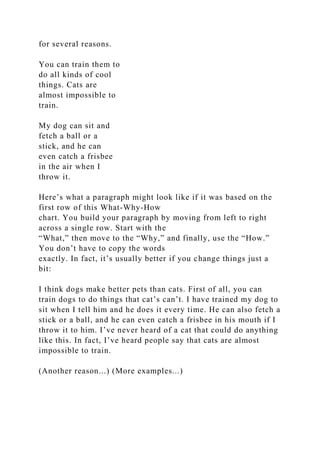
I think dogs make
better pets than cats
for several reasons.
You can train them to
do all kinds of cool
things. Cats are
almost impossible to
train.
My dog can sit and
fetch a ball or a
stick, and he can
even catch a frisbee
in the air when I
throw it.
Here’s what a paragraph might look like if it was based on the
first row of this What-Why-How
chart. You build your paragraph by moving from left to right
across a single row. Start with the
“What,” then move to the “Why,” and finally, use the “How.”
You don’t have to copy the words
exactly. In fact, it’s usually better if you change things just a
bit:
I think dogs make better pets than cats. First of all, you can
train dogs to do things that cat’s can’t. I have trained my dog to
sit when I tell him and he does it every time. He can also fetch a
stick or a ball, and he can even catch a frisbee in his mouth if I
throw it to him. I’ve never heard of a cat that could do anything
like this. In fact, I’ve heard people say that cats are almost
impossible to train.
(Another reason...) (More examples...)
24
© 1995-2003 by Steve Peha. For more information, or
additional teaching materials, please contact: Teaching That
Makes Sense, Inc. • E-mail [email protected] • Web
www.ttms.org
Writing in Reading with W-W-H
WHAT WHY HOW
Using What-Why-How to support predictions and inferences.
The What-Why-How
strategy comes in handy when we want to express an opinion
about something we’ve read. In this
example, I’ll make an inference about characters in the opening
paragraph of a story and I’ll use
the What-Why-How strategy to write it up.
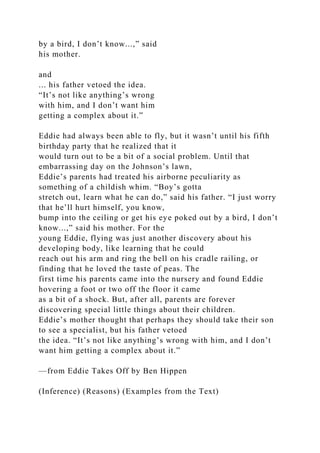
Eddie’s parents seem a little
strange. They don’t react to
their son’s unusual ability the
way I think normal parents
would act.
They speak in clichés. They
sound like people on a cartoon
or in a sitcom. They don’t
seem very smart or
responsible.
“Boy’s gotta stretch out, learn
what he can do,” said his father.
“I just worry that he’ll hurt
himself, you know, bump into the
ceiling or get his eye poked out
by a bird, I don’t know...,” said
his mother.
and
... his father vetoed the idea.
“It’s not like anything’s wrong
with him, and I don’t want him
getting a complex about it.”
Eddie had always been able to fly, but it wasn’t until his fifth
birthday party that he realized that it
would turn out to be a bit of a social problem. Until that
embarrassing day on the Johnson’s lawn,
Eddie’s parents had treated his airborne peculiarity as
something of a childish whim. “Boy’s gotta
stretch out, learn what he can do,” said his father. “I just worry
that he’ll hurt himself, you know,
bump into the ceiling or get his eye poked out by a bird, I don’t
know...,” said his mother. For the
young Eddie, flying was just another discovery about his
developing body, like learning that he could
reach out his arm and ring the bell on his cradle railing, or
finding that he loved the taste of peas. The
first time his parents came into the nursery and found Eddie
hovering a foot or two off the floor it came
as a bit of a shock. But, after all, parents are forever
discovering special little things about their children.
Eddie’s mother thought that perhaps they should take their son
to see a specialist, but his father vetoed
the idea. “It’s not like anything’s wrong with him, and I don’t
want him getting a complex about it.”
—from Eddie Takes Off by Ben Hippen
(Inference) (Reasons) (Examples from the Text)
In this example, my inference goes in the “What” column. My
reasons for the inference go in the
“Why” column. In the “How” column, I put the actual words
from the story on which my infer-
ence was based. This is the tangible evidence that supports my
opinion. Predictions work in a sim-
ilar way: the prediction goes in the “What” column, your
reasons for the prediction go in the
“Why” column, and the words from the story on which your
prediction was based go in the
“How” column.
© 1995-2003 by Steve Peha. For more information, or
additional teaching materials, please contact: Teaching That
Makes Sense, Inc. • E-mail [email protected] • Web
www.ttms.org
25
Using W-W-H in Social Studies
WHAT WHY HOW
Using What-Why-How to support a thesis statement or to
answer an essay
question. In social studies, we’re often asked to answer
questions and to provide supporting
evidence, we also have to come up with thesis statements for
essays and reports. The What-Why-
How strategy is the perfect tool to use in situations like these.
Here’s a typical essay test question or a potential report topic:
“Was Abraham Lincoln really as
honest as his nickname suggests?”
Lincoln was honest about many
things in his life but he was
not always honest about the
difficult subjects of slavery
and race relations in America,
especially while he was
running for president. Like
many politicians, Lincoln was
good at telling people what
they wanted to hear.
While campaigning for the
presidency, he told northern
voters he favored racial
equality. But while
campaigning in the South he
told voters there that he
supported the idea of whites
being superior to blacks.
“Let us discard all quibbling about
this man and the other man,
this race and that race and the
other race being inferior, and
therefore they must be placed
in an inferior position.”
—Campaign speech made in
Chicago, IL, July 10, 1858
“...while they do remain
together [blacks and whites]
there must be the position of
superior and inferior, and I as
much as any other man am in
favor of having the superior
position assigned to the white
race.”
—Campaign speech made in
Charleston, SC, Sept. 18, 1858
(Answer or Thesis) (Reasons) (Evidence and Bibliographic
Citations)
The answer or thesis goes in the “What” column. The reasons go
in the “Why” column. And the
“How” column is used for evidence which in this case consists
of two excerpts from campaign
speeches Lincoln made in the summer and early fall of 1858,
speeches that contain conflicting
statements about racial equality. Put it all together and you’ve
got a successful argument that is
easy to understand and strongly supported by tangible evidence.
26
© 1995-2003 by Steve Peha. For more information, or
additional teaching materials, please contact: Teaching That
Makes Sense, Inc. • E-mail [email protected] • Web
www.ttms.org
What-Why-How Strategy Tips
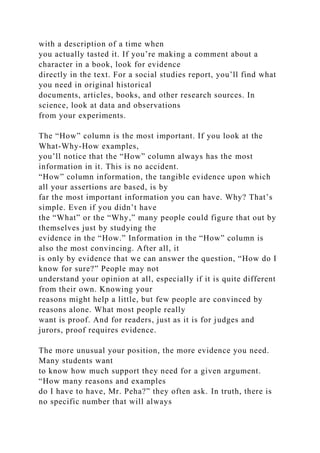
The “How” column is the hardest. We all have opinions, and
most of the time we have a
good sense of where they come from, a sense of the reasons why
we think the things we do. But
coming up with specific evidence can be hard. The trick is
knowing where to look. If you’re trying
to support an opinion about your own life, look for specific
things that you’ve experienced. If you
say that asparagus is gross because it has a bad taste, back it up
with a description of a time when
you actually tasted it. If you’re making a comment about a
character in a book, look for evidence
directly in the text. For a social studies report, you’ll find what
you need in original historical
documents, articles, books, and other research sources. In
science, look at data and observations
from your experiments.
The “How” column is the most important. If you look at the
What-Why-How examples,
you’ll notice that the “How” column always has the most
information in it. This is no accident.
“How” column information, the tangible evidence upon which
all your assertions are based, is by
far the most important information you can have. Why? That’s
simple. Even if you didn’t have
the “What” or the “Why,” many people could figure that out by
themselves just by studying the
evidence in the “How.” Information in the “How” column is
also the most convincing. After all, it
is only by evidence that we can answer the question, “How do I
know for sure?” People may not
understand your opinion at all, especially if it is quite different
from their own. Knowing your
reasons might help a little, but few people are convinced by
reasons alone. What most people really
want is proof. And for readers, just as it is for judges and
jurors, proof requires evidence.
The more unusual your position, the more evidence you need.
Many students want
to know how much support they need for a given argument.
“How many reasons and examples
do I have to have, Mr. Peha?” they often ask. In truth, there is
no specific number that will always
be enough. The amount of support you need varies depending on
how likely your audience is to
believe you. For example, if I say to you that the sky is blue,
you don’t need to know my reasons
and you certainly don’t need much evidence. But if I say that
the moon is made of green cheese,
well, that’s a horse of a completely different color. In order to
convince you, I’d have to have data
from scientific studies, detailed photographs, and tasty samples
from the surface. Even then you’d
probably still be suspicious. In terms of school writing, if I
want to write a report that says that
Abraham Lincoln was one of our greatest presidents, that’s
pretty easy to do. But if I want to say
that he was one of the worst, I’m going to need good reasons
and many solid examples.
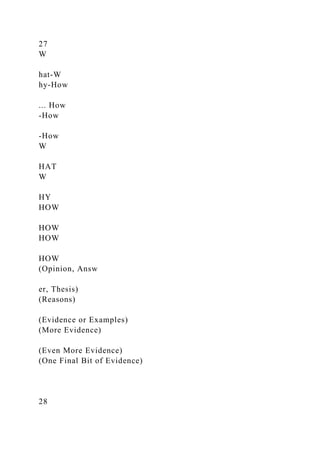
What-Why-How... How-How-How. It is fair for people to
question the truth of your evi-
dence. (It’s annoying, but it’s fair.) You’ll put something great
in the “How” column and some-
one will say in a whiney voice, “OK, but how do you know
that?” And you’ll have to come up with
a piece of evidence for your evidence. This can go on for quite
a while. In cases like this, you’ll need
to build in some extra “How” columns to the right of your chart.
You’ll probably need a second
piece of paper, too (or take a look on the next page).
© 1995-2003 by Steve Peha. For more information, or
additional teaching materials, please contact: Teaching That
Makes Sense, Inc. • E-mail [email protected] • Web
www.ttms.org
27
W
hat-W
hy-How
... How
-How
-How
W
HAT
W
HY
HOW
HOW
HOW
HOW
(Opinion, Answ
er, Thesis)
(Reasons)
(Evidence or Examples)
(More Evidence)
(Even More Evidence)
(One Final Bit of Evidence)
28
© 1995-2003 by Steve Peha. For more information, or
additional teaching materials, please contact: Teaching That
Makes Sense, Inc. • E-mail [email protected] • Web
www.ttms.org
It’s All in the
Details
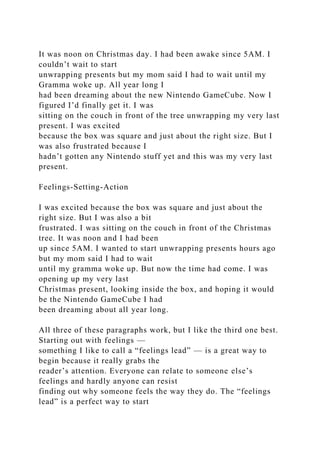
It was always the same thing. Every time I turned in a piece of
writing to
my teachers, they would give me the same comment: “Great
ideas, but you need
more support.” After a while, I figured out that this meant I
didn’t have enough
details in my writing. But I still didn’t know what to do.
My problem was that I didn’t know much about details.
Specifically, there
were three important pieces of information that I never
understood:
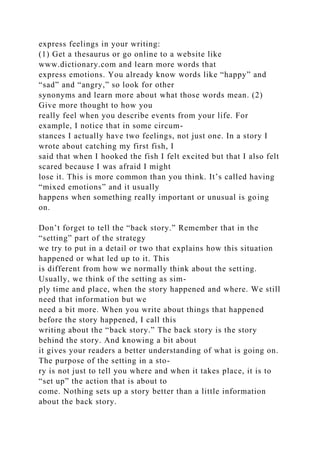
• What’s a detail? A detail is the answer to a question a reader
might have. Your audience may understand your ideas but want
to
know more about them. Readers are very curious; they almost
always
have questions they want you to answer. If you tell them
something in-
teresting, they want to know a lot about it.
• Why do we need details? If you don’t give your readers the in-
formation they want, they get frustrated. It’s like hearing the
first part
of a joke and not getting to hear the punch line. Or watching a
movie
and not getting to see the ending.
• How do I put details in my writing? The best way to add de-
tails to your writing is with the Idea-Details strategy (look at
the next
few pages). Just pick the sentence from your piece that needs
more sup-
port, write it down on the left side of an Idea-Details chart, and
then
list your details on the right side. When you finish the chart, put
the de-
tails back into your piece.
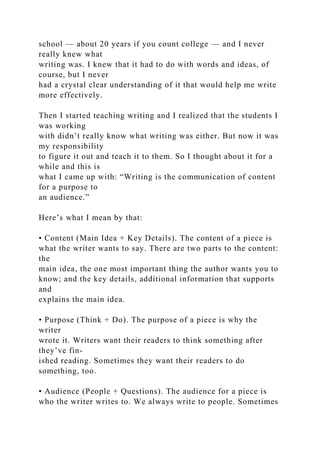
Details are an extremely important part of your writing. Without
good details
most writing isn’t worth reading. Why? Well, without details
it’s hard for a reader
to know exactly what a writer is trying to say. The writer’s head
is full of things the
reader can’t possibly know about. The question, of course, is
how to get those
things into the head of the reader. And the answer is all in the
details.
3
© 1995-2003 by Steve Peha. For more information, or
additional teaching materials, please contact: Teaching That
Makes Sense, Inc. • E-mail [email protected] • Web
www.ttms.org
29
The Idea-Details Strategy
IDEA
A sentence that needs more support
(Think of the questions people would ask)(Pick something
important from your piece)
DETAILS
Give it a try. Take a single sentence from your piece — a single
idea — and write it on the
“Ideas” side of the chart. Then, make a list on the “Details” side
of every detail you can think of
that goes with it. Think about the questions your audience
would ask and try to answer them.
How many details should you have? That’s impossible to say. In
general, having five to ten details
for an idea will be plenty. The more important and unusual your
idea, the more details you will
need. Think about what your audience needs to know and make
sure you include it.
What your audience needs to know
30
© 1995-2003 by Steve Peha. For more information, or
additional teaching materials, please contact: Teaching That
Makes Sense, Inc. • E-mail [email protected] • Web
www.ttms.org
Example
IDEA DETAILS
I had a huge car accident one
morning when I was driving to
school.
I was stopped in traffic on the
freeway when a truck came up behind
me.
I heard his engine roar and I knew he
was going too fast.
He didn’t notice I was stopped so he
didn’t slow down until it was too late.
He slammed on his brakes and veered
to the right but he still hit me. His
truck crunched most of the right side
of my car.
Glass and metal went flying
everywhere.
I was scared at first because I thought
I was going to get hurt. But
afterwards, I was relieved.
No one was hurt and I was still able to
drive my car away. But it needed
over $5000 of repair work.
© 1995-2003 by Steve Peha. For more information, or
additional teaching materials, please contact: Teaching That
Makes Sense, Inc. • E-mail [email protected] • Web
www.ttms.org
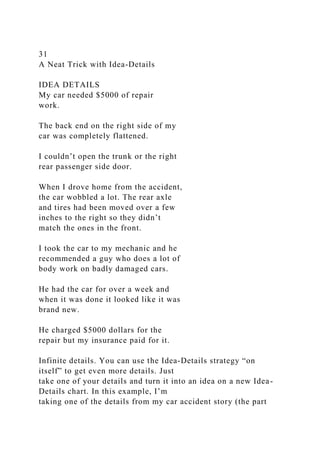
31
A Neat Trick with Idea-Details
IDEA DETAILS
My car needed $5000 of repair
work.
The back end on the right side of my
car was completely flattened.
I couldn’t open the trunk or the right
rear passenger side door.
When I drove home from the accident,
the car wobbled a lot. The rear axle
and tires had been moved over a few
inches to the right so they didn’t
match the ones in the front.
I took the car to my mechanic and he
recommended a guy who does a lot of
body work on badly damaged cars.
He had the car for over a week and
when it was done it looked like it was
brand new.
He charged $5000 dollars for the
repair but my insurance paid for it.
Infinite details. You can use the Idea-Details strategy “on
itself” to get even more details. Just
take one of your details and turn it into an idea on a new Idea-
Details chart. In this example, I’m
taking one of the details from my car accident story (the part
about the $5000 repair bill) and
putting it on the “Idea” side. Then I’ll add more details on the
“Details” side:
32
© 1995-2003 by Steve Peha. For more information, or
additional teaching materials, please contact: Teaching That
Makes Sense, Inc. • E-mail [email protected] • Web
www.ttms.org
Tips on Using Idea-Details
Anything goes. Often, kids draw up their Idea-Details chart, put
down their idea on the left
side, and then just sit there. They think they can’t come up with
any details. Or they worry too
much about how to write them down. Remember, this is just
pre-writing. It doesn’t really matter
how good your details are or how well you write them up. You
don’t even have to use complete
sentences. Just jot down anything that comes to mind that is
related to your idea. Put down as
many things as you can as quickly as you can even if you don’t
think you’ll use them all.
Let your audience come up with your details. Do you remember
that story where Tom
Sawyer has to whitewash the picket fence and he doesn’t want
to do it? He gets his friends to do it
for him by making them think it’s some kind of fun game. Well,
you can pull the same trick on
your audience and get them to write your details for you. Just
go up in front of your class to share.
Tell everybody you’re working on an Idea-Details chart and you
want help. Read your idea and
then get your audience to ask you questions about it. Every time
they ask a question, answer it by
writing something on the details side (but only if they ask good
questions; if they ask dumb ones,
ignore them). This always works because a detail is the answer
to a question a reader might have.
If your teacher wants more details. When I was in school, I
dreaded the moment when
my teachers would ask me to put in more details. Details,
details, details! It was all they ever
seemed to want. It wasn’t until I started teaching as an adult
that I realized why this was: details
are the most important part of a piece of writing. As some really
smart person once said, “It’s all in
the details.” So, the next time your teacher asks you to put more
details in a piece, don’t freak out
like I did, try this instead: Ask your teacher what he or she
would like to know more about. Write
that on the “Idea” side of an Idea-Details chart. Then ask your
teacher what he or she would like to
know about that idea. Answer the questions on the “Details”
side.
How many details do you need? Kids always want to know how
many details they need.
Well, the truth is, you need as many as you need. Sound weird?
I suppose it does, but it’s true. You
need to include enough details so that your audience gets all its
important questions answered —
and no more. How many questions will they have? Who knows?
In general, however, I have found
that most ideas can be explained well with five to ten
supporting details.
Types of details. No one ever believes me when I say this but
there are millions of details out
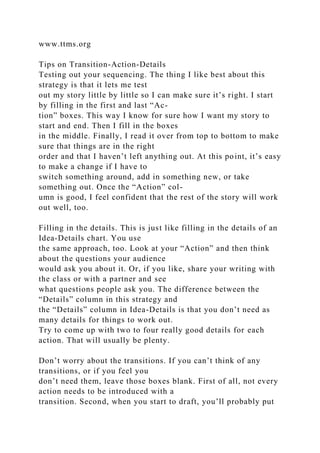
there just waiting to be used. I try to think of specific types of
details when I write. For example,
when I’m writing a story about something that happened to me,
I know that I can always find de-
tails in what I’m doing, how I’m feeling, what I’m thinking,
where I am, and so on. Whenever I
describe something, I can think of it’s size, shape, color,
position, and many other attributes. And
then there’s always the traditional who, what, when, where,
why, and how. Of these, it has been
my experience that “why” and “how” questions are the best
source of high quality details.
© 1995-2003 by Steve Peha. For more information, or
additional teaching materials, please contact: Teaching That
Makes Sense, Inc. • E-mail [email protected] • Web
www.ttms.org
33
A Game of
Show and Tell
Your probably remember this from kindergarten. You brought in
something from home, stood up in front of your class, showed
them what you
brought, and told a few things about it. That was “show and
tell.” But what if you
forgot to bring something from home and you still had to get up
and tell people
about it? You’d have to “show” them with your words by
describing it.
In writing, we often say that “showing” is better than just
“telling.” Here are a
few reasons why:
• Showing is more specific than telling. You could tell about
the weather by writing, “The weather was really bad.” But it
might be
better if you “showed” instead: “A harsh wind whipped through
the
trees. Dark clouds poured down buckets of rain that overran the
gutters
and spilled onto the sidewalks.”
• Showing helps readers make pictures in their minds. As
the writer, you know what you “see” in your mind as you write.
But all
your readers have is your words. If you don’t “show” them what
you’re
talking about, they won’t get the same pictures in their mind
that you
have in yours.
• Showing is more interesting than telling. You could write
something like “My dog is cool.” Or, you could describe all the
things
that make your dog so cool and let the readers figure out how
cool your
dog is all by themselves. This makes readers more interested in
your
writing because they want to work harder to figure things out.
Showing is one of the most sophisticated techniques a writer
can use. It makes
your writing richer and more descriptive. It also helps you
discover new ways to say
things. Showing is the key to rich and satisfying descriptive
writing that sounds like
the writing you read in the very best books.
4
34
© 1995-2003 by Steve Peha. For more information, or
additional teaching materials, please contact: Teaching That
Makes Sense, Inc. • E-mail [email protected] • Web
www.ttms.org
The Tell-Show Strategy
TELL
Just say it very simply
(Make a picture in the reader’s mind)(The less you write, the
better)
SHOW
Give it a try. Take any simple sentence from your current piece
that mentions something you
can describe and write it down on the “Tell” side of the chart.
Then, make a picture of that
sentence in your mind and write down all the things you see in
that picture on the “Show” side.
When I do this, it feels like I’m creating a “mini-story” about a
particular thing in my piece. I try
to think of all the things I “see” in my mental picture as
different characters in a scene. And then
I try to bring those characters to life with “showing.”
Describe it in detail
© 1995-2003 by Steve Peha. For more information, or
additional teaching materials, please contact: Teaching That
Makes Sense, Inc. • E-mail [email protected] • Web
www.ttms.org
35
Example
TELL SHOW
My basketball game had a strange
and exciting ending.
It all came down to the final few
seconds. We were behind by one point,
57-56. Our coach had just called time
out to set up a play. We were going to
go for one shot. My friend Robert was
supposed to take it. (He’s our best
outside shooter.) But something went
wrong. I was throwing the ball in but
when I looked for Robert, I saw that
he had been blocked out by two
players on the other team. For a split
second I froze, not knowing what to
do. Then I realized that if I didn’t
throw it in quickly, the ref would
blow his whistle and the other team
would take possession. So I just chucked
it as hard as I could toward the basket.
Close to the hoop, everyone’s arms
reached up for the ball. No one could
get hold of it as it bounced from
player to player. Then, a miracle
happened: the ball hit one of their
players in the head and bounced right
in the hoop as the buzzer went off.
36
© 1995-2003 by Steve Peha. For more information, or
additional teaching materials, please contact: Teaching That
Makes Sense, Inc. • E-mail [email protected] • Web
www.ttms.org
Another Way to Tell and Show
TELL VISUALIZE & LIST
The lake looked really nice that
morning.
• Water smooth and clear
• Mist rising up
• Fish jumping
• Sun coming up
• Our boat
• A group of ducks
• It was cold
Making it easier. Sometimes it’s hard for me to write the
“showing” part because I can’t
actually “see” it myself. When this happens, I make a list of
everything I want to show before I
actually write out the sentences. What I do is think about the
“tell” part, close my eyes, make a
picture of what I see, and then make a list on the “show” side. I
use this list to write it all up.
The water was as smooth as glass and clear enough that we
could see almost all the way to the bottom. Thin wisps of mist
rose
up all around us as our boat glided slowly along. Occasionally,
a fish
would jump but we’d never actually see it. We’d turn our heads
at
the sound of the splash just in time to see the circles of little
waves expanding outward where the fish had come down. Closer
to
shore, a group of ducks cut a v-shape in the quiet water as they
swam along. It was cold but the sun was coming up and I knew
that
in a few minutes it would start to get warm.
SHOW
© 1995-2003 by Steve Peha. For more information, or
additional teaching materials, please contact: Teaching That
Makes Sense, Inc. • E-mail [email protected] • Web
www.ttms.org
37
Tips on Using Tell-Show
“Showing” by any other name would work as well. Your
teachers will often ask you to
describe something, or to write descriptively, or to do a piece of
descriptive writing. All of these
things are the same as “showing” and they’re all good things to
do.
Tell-Show is similar to Idea-Details but not exactly the same.
The difference be-
tween Idea-Details and Tell-Show is subtle but important. In
both strategies, you list an idea on the
left side and some details on the right. But in Tell-Show we’re
only looking for certain kinds of de-
tails: the kind that help the reader make a mental picture of your
idea. These are mostly visual de-
tails., things you could really see if you were there.
“Showing” has a different “sound” and a different “feeling”
when you read
it. The best way to learn about “showing” is to look for it in the
books you read. Or, rather, to lis-
ten for it. Passages of rich descriptive “showing” detail always
sound a little different than the rest
of the writing. To me, the sound is smoother, more flowing,
more musical. In addition, I often
find that sentences and paragraphs get longer when an author is
“showing.” I think this gives it a
special feeling, too. Try to pay attention to these changes in
your own writing and in the writing
you read. Look for “showing” and when you find it, study it.
Save the “Showing” for what’s most important. “Showing”
catches a reader’s atten-
tion. Think about it: you’re talking about one little thing in a
story but you’re describing it with
sentence after sentence. It’s as if you’re making your reader
focus on one thing for a longer time
than they would normally. This is great but you can’t overdo it.
Save the “showing” for the most
important parts of your piece: the most important people,
places, events, objects, feelings, etc.
“Showing” slows down the pace. Because you’re spending so
much time describing one
thing in your piece, “showing” makes your readers feel like
they’re slowing down. This is great if
you slow them down to show them something important. But
you can’t do it all the time. Other-
wise, your piece gets too slow and it becomes tedious to read it.
“Showing” often requires specific language and special
techniques. When you
“show,” you’re using more words to talk about something than
you normally need. To accomplish
this, writers make their language more specific. They also use
some special writing techniques. You
could tell you readers that “It was hot.” Or you could show
them with something like this: “The
scorching sun was as hot as a flame crackling in a fireplace.”
The adjective “scorching” is very spe-
cific. This isn’t any old sunny day we’re talking about here.
And the words “as hot as” introduce a
technique called a simile where the writer compares one thing
to another to increase the reader’s
understanding.
38
© 1995-2003 by Steve Peha. For more information, or
additional teaching materials, please contact: Teaching That
Makes Sense, Inc. • E-mail [email protected] • Web
www.ttms.org
A Sequence of
Events
You do this all the time. You recount something that happened
to you. You
tell a friend about a movie. Or maybe in school you have to
retell part of a story
you read. Sometimes you even have to write down the steps you
used to solve a
problem in math (I know, it’s a drag). All of these things are the
same in one im-
portant way because they all involve describing a sequence of
events.
When you describe something as a sequence of events, you can
use the same
basic structure every time. That structure has three parts:
• Transitions. These are short phrases like “Then” or “After a
while”
or “In the beginning” that help to introduce each new action in
the se-
quence. You don’t have to have a transition for each action, but
they
can be very helpful at making your sequence flow smoothly.
• Actions. These are the actual events (the things that happened)
listed
in the order in which they occurred.
• Details. This is additional information about each action. For
each
action, your audience will probably have two or three important
ques-
tions you need to answer. These answers are your details.
The Transition-Action-Details strategy is very useful.
Opportunities to describe a
sequence of events come up all the time in school: in narrative
fiction and non-fic-
tion writing, in plot summaries for reading, in the steps of
solving a math prob-
lem, in social studies when you recount an historical event, in
science when you
study chemical processes, and so on.
When filling out the Transition-Action-Details chart, start in the
“Action” col-
umn first. Fill in the first box with the first thing that happens.
Then, go to the last
“Action” box and write the end. Now, fill in everything in
between. When you fin-
ish the “Action” column, add a couple of details for each action.
Finally, come up
with simple phrases in the “Transition” column that introduce
each action.
5
© 1995-2003 by Steve Peha. For more information, or
additional teaching materials, please contact: Teaching That
Makes Sense, Inc. • E-mail [email protected] • Web
www.ttms.org
39
Transition-Action-Details
TRANSITION
(Introduce the action)
ACTION
(Describe what happened)
DETAILS
(Answer audience questions)
40
© 1995-2003 by Steve Peha. For more information, or
additional teaching materials, please contact: Teaching That
Makes Sense, Inc. • E-mail [email protected] • Web
www.ttms.org
Example
TRANSITION ACTION DETAILS
I went on vacation with my family to
the ocean.
On the third day, I was walking with my dog along a
cliff overlooking the beach below.
We saw a small animal scurry under
some rocks.
My dog ran after the animal and
jumped over the rocks to try to
get it.
I tried to reach over the rocks to pull
him up.
I ran after him, looked over the
edge of the cliff, and found him
clinging to some brush hanging by his
paws.
Last summer, • We go almost every year.
• It’s fun because there’s a lot to do.
• I get to do a lot of exploring with
my dog.
• We were about 75 feet up from the
beach.
• We were on a path with trees and
brush and big piles of rocks by the
edge.
• It startled me at first but then I
realized that it was probably more
afraid of us than we were of it.
• I just kept on walking.
• He likes to chase things.
• I was amazed at how fast he ran.
• He got close to the rocks but didn’t
stop. He just went right over.
As we got up to the highest point on
the cliff,
All of a sudden,
• I was so scared.
• I thought he’d gone over the cliff
and had fallen all the way down.
• He looked scared, too.
• I grabbed a piece of the branch and
pulled him up with it.
• I just kept telling him to hold on and
not move.
• I could tell that he was just as scared
as I was.
At first I didn’t know what to do.
Then,
[ No Transition ]
© 1995-2003 by Steve Peha. For more information, or
additional teaching materials, please contact: Teaching That
Makes Sense, Inc. • E-mail [email protected] • Web
www.ttms.org
41
Expanding the Moment
TRANSITION ACTION DETAILS
A great technique. Sometimes, a part of a story is so good, we
want to stretch it out and make
it last a little longer. Here I’m using the Transition-Action-
Details strategy to make one part of the
dog story (the part when the dog runs off the cliff) take up more
time. It’s as though I’m taking
one moment out of the story and expanding it into several
smaller moments. This slows down the
pace just at the point where I want the audience to pay more
attention.
I immediately stopped and turned
around to watch him.
When I heard my dog start after the
animal,
• He doesn’t usually just run off like
that.
• I was surprised and a little scared.
As soon as I saw where he was
headed,
I called out to him to get him to
stop.
• He didn’t seem to notice. He just
kept on going.
• I had a feeling something bad
was going to happen.
I froze.
He started to run up the rocks just
as fast as he could.
When he got to the top, I could
tell he was trying to stop but he
was going so fast that he couldn’t.
I screamed his name again and
started running after him.
For the next few moments, • I wanted to do something but I
didn’t know what.
• It seemed like it was happening
in slow motion.
• As I got to the edge of the
cliff, I was afraid to look over.
• He was caught in a branch.
• He was dangling there 75 feet
above the rocks and the water.
• I was happy to see him and
terrified at the same time.
As I saw him going over the edge,
[ No Transition ]
42
© 1995-2003 by Steve Peha. For more information, or
additional teaching materials, please contact: Teaching That
Makes Sense, Inc. • E-mail [email protected] • Web
www.ttms.org
T-A-D in World History
TRANSITION ACTION DETAILS
Great Britain ended up administering
Palestine.
In 1917, at the urging of Zionist
groups in England,
The British issued the Balfour
Declaration.
Many Jews immigrated to Palestine.
The UN proposed splitting Palestine
into two states.
Israel came to occupy the remaining
territory of Palestine.
Israel declared its independence.
When the Turkish Ottoman
Empire collapsed at the end
of World War I,
• League of Nations’ Mandate System.
• League Covenant Article 22.
The declaration expressed support for
“the establishment in Palestine of a
national home for the Jewish people.”
• Mostly from Eastern Europe.
• Fleeing Nazi persecution in the 1930s.
• One state for Palestinian Arabs, the
other for Jews.
• Jerusalem would be internationalized.
• Resolution 181 of 1947.
During the years of the Mandate,
1922-1947,
In 1947,
• Israel was attacked by Arab nations.
• They won the war and claimed more
than 75% of the land in Palestine.
• Half the population of Palestinians left
or were thrown out.
• The West Bank was formerly under
Jordanian control.
• The Gaza Strip was controlled by
Egypt.
In 1967, as a result of the Six Day
War,
In 1948,
© 1995-2003 by Steve Peha. For more information, or
additional teaching materials, please contact: Teaching That
Makes Sense, Inc. • E-mail [email protected] • Web
www.ttms.org
43
T-A-D in the History of Science
TRANSITION ACTION DETAILS
Joseph Priestley, in England,
performed experiments showing that
plants release a type of air that
allows combustion.
Although Priestley did not know all
the implications of his discovery,
His work showed that plants release
oxygen into the atmosphere.
A Dutch doctor named Jan Ingenhousz
proved that sunlight was necessary
for photosynthesis and that only the
green parts of plants could release
oxygen.
Julius Robert von Mayer, a German
physician, proposed that
photosynthetic organisms convert
light energy into chemical free
energy.
The key feature of photosynthesis
was understood: that plants use light
energy to make carbohydrates from
CO2 and water.
In the 1770s, He burned a candle in a closed jar
until the flame went out. He put a leaf
in the jar and after several days
showed that the candle could burn
again.
Even today, scientists are still
investigating the mechanisms by
which plants produce oxygen.
• At the same time, Jean Senebier, in
Switzerland, discovered that CO
2
is
required.
• Nicolas-Théodore de Saussure, a Swiss
chemist, showed that water is required.
This was a final piece of the puzzle
that led to the modern understanding
of photosynthesis.
Building on Priestley’s work,
In 1845,
Because glucose, a six carbon sugar, is
often an intermediate product of
photosynthesis, the equation of
photosynthesis is frequently written as:
6CO
2
+ 12H
2
O + Light Energy —>
C6H12O6 + 6O2 + 6H2O
By the middle of the nineteenth
century,
44
© 1995-2003 by Steve Peha. For more information, or
additional teaching materials, please contact: Teaching That
Makes Sense, Inc. • E-mail [email protected] • Web
www.ttms.org
T-A-D and a Scientific Process
TRANSITION ACTION DETAILS
It hits the cornea first.
Eventually, The light reaches the retina, the
light-sensing part of the eye.
A series of complex chemical
reactions occurs.
Rhodopsin decomposes.
Rhodopsin breaks down and
eventually forms Metarhodopsin.
When light enters the eye, It passes through the cornea, then the
aqueous humor, the lens, and the
vitreous humor.
• The retina has rods and cones.
• Rods handle vision in low light.
• Cones handle color vision and detail.
A chemical called Rhodopsin creates
electrical impulses in the optic nerve.
Light causes a physical change in part
of the chemical.
When light contacts these two types of
cells,
When it is exposed to light,
This chemical causes electrical impulses
that are transmitted to the brain and
interpreted as light.
In an extremely fast reaction,
beginning in a few trillionths of a
second,
© 1995-2003 by Steve Peha. For more information, or
additional teaching materials, please contact: Teaching That
Makes Sense, Inc. • E-mail [email protected] • Web
www.ttms.org
45
T-A-D and Math Problem Solving
TRANSITION ACTION DETAILS
I remembered how many ounces
there are in a gallon.
Next, I multiplied this by 4 to get the
amount of juice he needed to get.
I figured out how much juice he
bought by multiplying the number of
cans times 12 ounces.
I subtracted the amount he bought
from the amount he needed.
First, 1 Gallon = 128 ounces
4 x 128 =
4 x 100 = 400 +
4 x 20 = 80 +
4 x 8 = 32
400 + 80 + 32 = 512 ounces
42 x 12 =
42 x 10 = 420
42 x 2 = 84
420 + 84 = 504 ounces
512 - 504 = 8
He was 8 ounces short.
Then,
Finally,
Orange Juice Birthday
On a sweltering Saturday in August, Mr. Cal Q. Luss trudged
into his local Friendly Mart to get orange juice for
his son’s birthday party. For last year’s party he had purchased
three gallons, more than enough, or so he thought,
to slake the monster thirsts of his son’s 23 classmates. But
Eddie Guzzle drank almost an entire gallon by himself,
and poor Elaine Dryer fainted from dehydration after Pin the
Tail on the Donkey.
As he entered the store, a blast of air-conditioned coolness
reminded him of the temperature outside. It was a
scorcher: you could fry eggs on the sidewalk and still have heat
left over for a side a bacon and a couple of flap-
jacks. Mr. Luss vowed that this year he wouldn’t be calling
little Lainie’s mom to pick her daughter up at the Emer-
gency Room. Better make it four gallons.
Proceeding quickly to the juice section, Mr. Luss found himself
at a loss when he discovered that all of the
large carton juice containers were sold out. He would have to
purchase 12-ounce cans of juice instead, but he
couldn’t figure out how many to get. Extremely frustrated, and
behind on time, he knocked the entire display
of juice cans into his shopping cart and dashed briskly to the
checkout. When he got home, he discovered he
had purchased 42 cans of juice. Did he get the four gallons that
he needed, or will two dozen 9-year olds be
fainting in the fierce mid-day summer sun?
46
© 1995-2003 by Steve Peha. For more information, or
additional teaching materials, please contact: Teaching That
Makes Sense, Inc. • E-mail [email protected] • Web
www.ttms.org
Tips on Transition-Action-Details
Testing out your sequencing. The thing I like best about this
strategy is that it lets me test
out my story little by little so I can make sure it’s right. I start
by filling in the first and last “Ac-
tion” boxes. This way I know for sure how I want my story to
start and end. Then I fill in the boxes
in the middle. Finally, I read it over from top to bottom to make
sure that things are in the right
order and that I haven’t left anything out. At this point, it’s easy
to make a change if I have to
switch something around, add in something new, or take
something out. Once the “Action” col-
umn is good, I feel confident that the rest of the story will work
out well, too.
Filling in the details. This is just like filling in the details of an
Idea-Details chart. You use
the same approach, too. Look at your “Action” and then think
about the questions your audience
would ask you about it. Or, if you like, share your writing with
the class or with a partner and see
what questions people ask you. The difference between the
“Details” column in this strategy and
the “Details” column in Idea-Details is that you don’t need as
many details for things to work out.
Try to come up with two to four really good details for each
action. That will usually be plenty.
Don’t worry about the transitions. If you can’t think of any
transitions, or if you feel you
don’t need them, leave those boxes blank. First of all, not every
action needs to be introduced with a
transition. Second, when you start to draft, you’ll probably put
some transitions in naturally with-
out thinking about it. There are only two things you have to
watch out for: (1) Using the same
transition over and over — that’s boring. And (2) Using too
many of those traditional “school”
transitions like “First of all,” “Another reason why...,” “In
conclusion,” “As you can see,” and so
on. These transitions aren’t wrong, they just sound a little
strange because they’re not the normal
transitions most people use when they write authentically. In
truth, the best writing uses no transi-
tional phrases at all. Instead, the writer uses logic to move the
reader from one action to the next.
The right number of actions. How many actions do you need?
That’s impossible to say. At a
minimum, you would have to have three in order to have a
beginning, a middle, and an end.
There’s nothing stopping you from having a hundred if you
want. But most of us can only keep
track of seven or so. If you have more than seven or eight
actions, your story might begin to feel as
though it’s a bit long or too complicated. See if you can
combine several actions into one. Remem-
ber, you can always expand any action into several actions at a
later time (and on another chart)
by using the “expand the moment” technique.
Working with the chart. If you have more actions in your story
than there are rows on the
chart, just get another piece of paper and continue. If there are
more rows on the chart than you
have actions in your story, just leave the ones you don’t use
blank. If you’d like to create extra rows
on the same page, just draw a horizontal line across the chart
and split any single row into two.
Use the chart in whatever way makes sense to you. There’s no
one right way to do it. Better yet,
draw your own Transition-Action-Details chart on your own
paper.
© 1995-2003 by Steve Peha. For more information, or
additional teaching materials, please contact: Teaching That
Makes Sense, Inc. • E-mail [email protected] • Web
www.ttms.org
47
The Picture Worth
a Thousand Words
They say a picture is worth a thousand words. But who are they
any-
way? And why do they exaggerate so much? Can you really get
a thousand words
out of a single picture?
Probably not. A hundred, two hundred maybe. But not a
thousand. Still, a
couple hundred words is nothing to sneeze at.
Drawing can really help you write. When you take a few
minutes to sketch a
quick picture, you give yourself a chance to focus on your topic
and that can make
your writing richer and more detailed.
Drawing for writing is a little different than normal drawing
because it has a
different purpose. To achieve that purpose, we use a three-step
process like this:
• Draw. Make a quick pencil sketch of your scene. This is a
rough
sketch: use outlines only, stick people are encouraged. Try to
include as
many little details as you can. You can’t have too many details.
Don’t
forget to include yourself in the picture if it’s appropriate.
• Label. Create a one- or two-word text label for each item in
your
drawing. Label everything you can think of, even different parts
of
things.
• Caption. Write a single sentence underneath the picture that
tells
what is happening. This can be a very simple sentence or
something
more complicated if you’re up for it.
You’ll be surprised how much you can get out of this simple
activity. As you
draw different things, you’ll remind yourself about different
parts of your story and
this will give you more things to write about. You don’t even
have to know how to
draw. You may not think you’re any good at creating cool
pictures. But everyone
can picture their writing.
6
48
© 1995-2003 by Steve Peha. For more information, or
additional teaching materials, please contact: Teaching That
Makes Sense, Inc. • E-mail [email protected] • Web
www.ttms.org
Draw-Label-Caption
DRAW
CAPTION
LABEL
© 1995-2003 by Steve Peha. For more information, or
additional teaching materials, please contact: Teaching That
Makes Sense, Inc. • E-mail [email protected] • Web
www.ttms.org
49
Example
I’m just about to throw the frisbee and my dog
is going to go after it.
Trees
Me
Wind
My
dogTail
Paws
Birds
My hair
Sweater
• This is just a rough sketch, not a finished illustration; I don’t
need to spend much time on it. I’m really
just going to draw outlines and simple figures. When I’m done
with my piece, I might redo the picture, in
color, for a cover.
• I’m going to try to label everything I can think of; each label
can become a detail in my writing.
• In the caption, I’m going to write down what I think is most
important about the picture, but I’m going to
try to do it in a single sentence. Later, if I want, I can go back
and make the caption more interesting. I
might get some ideas for my title from the caption.
• Drawing a picture makes me more familiar with the scene and
helps me think of things to write about.
• Drawing helps me visualize details which helps me find the
words which help my readers create the same
picture in their minds that I am creating here.
50
© 1995-2003 by Steve Peha. For more information, or
additional teaching materials, please contact: Teaching That
Makes Sense, Inc. • E-mail [email protected] • Web
www.ttms.org
What About All Those Words?
From labels to sentences. We thought we were going to get a
hundred, maybe two hundred
words. But all we got was a few labels and a one-sentence
caption. Where do we get the rest? For
each label in your picture, you can easily come up with one or
more sentences like this:
ME - I’m about to throw the frisbee. This is my favorite game
to
play with my dog. I love to see him chase it down and catch it
in
his mouth before it hits the ground.
SWEATER - It’s cold out but I’ve got a thick wool sweater on.
MY HAIR - The wind is blowing my hair all over the place.
WIND - It’s unusually windy today. I’m throwing into the wind
because I’m afraid that if I throw it the other way, the frisbee
will go too far.
TREES - The big trees in the park are swaying from side to
side.
Some of the leaves are falling off.
BIRDS - There are birds flying above the trees. I wonder how
they can fly in wind like this?
MY DOG - My dog is excited and ready to go. He knows that
when I get the frisbee out that we’re going to play one of his
favorite games.
TAIL - He’s wagging his tail like crazy. That means he’s really
happy. He can’t wait to tear off after the frisbee.
PAWS - He can’t keep his paws still. He’s scratching at the dirt
and getting ready to run.
( Almost 200 words! )
© 1995-2003 by Steve Peha. For more information, or
additional teaching materials, please contact: Teaching That
Makes Sense, Inc. • E-mail [email protected] • Web
www.ttms.org
51
Tips on Draw-Label-Caption
Don’t be shy about drawing. If you’re older than seven or eight,
you might think that draw-
ing a picture before you write is kind of silly. It’s not. Even if
you’re not the greatest artist in the
world, drawing a picture in preparation for writing can really
help. First of all, you’ll be much
more focused. Second, you’ll have better command of the
details. And finally, while you’re draw-
ing, you’ll spend several minutes thinking about what you want
to say. You can probably draw
something for just about every piece you write. Better yet, make
several drawings for each piece. Lay
them out in order like a storyboard.
Really get into the labeling. I’ve already talked about how each
label can be turned into a
detail in your piece, and how each detail can then be turned into
a sentence or two. But actually,
you can go farther than that. You can actually label your labels.
Here’s what I mean: Say you’ve la-
beled the water in a scene about swimming at the beach:
“water.” You could add a label to that la-
bel that tells something about the water: “choppy waves.” And
then you could label that label:
“about three feet high.” And so on. What you’re doing is
building up strings of modifiers: adjec-
tives, adverbs, and phrases that make your writing more
descriptive and more specific.
Redo a picture for your cover. I think it’s cool to put an
illustrated cover on your piece
when it’s finished. Why not take one of your drawings and redo
it? You can use color, fill things in,
add details, etc. The picture you choose might even suggest a
title for your piece.
Explore the fine art of caption writing. If you want to learn a lot
about revising sentenc-
es, put in some work on your caption. Captions are short and
you can revise them quickly and easi-
ly. See how much you can cram into a single sentence. See how
many different ways you can
change the order of the words around and have it still make
sense. Add extra describing words and
phrases. As you re-work your caption, try to make it more and
more interesting, not just longer.
Use dialog and thought bubbles. You can treat your picture as
though it was a panel in a
comic strip. Use dialog bubbles to show people talking. Use
thought bubbles to show people think-
ing. If you want, you can turn those bubbles into material for
your scene. It’s always great to start a
scene with someone saying something. I call that a “talking”
lead. And “thinking” leads are good
too: “I’d better not let this get by me, I thought to myself, as the
guy on the other team lined up for
the penalty kick.”
52
© 1995-2003 by Steve Peha. For more information, or
additional teaching materials, please contact: Teaching That
Makes Sense, Inc. • E-mail [email protected] • Web
www.ttms.org
The Three Key
Ingredients
If you don’t tell’em, they’ll have to ask. Readers are a pesky
lot. It
seems like they’re always asking questions about what you
write, and they don’t
give up until they’re satisfied.
Satisfying your readers isn’t easy. They always want to know
what’s going on,
they want to be able to follow the action. They want to enjoy
themselves, too; they
want to have interesting feelings as they read. Finally, they
seem to need some ba-
sic information about where and when things happen and what
led up to what.
And if you don’t give them everything they want, they’ll have
to ask you about it to
figure it out. If you’re not around to answer their questions,
they’ll probably just
stop reading your piece.
Every time you begin writing about a new scene in a fiction or
non-fiction
narrative, make sure your readers get three types of
information:
• Action. There’s something important happening in this scene.
If
there wasn’t, you wouldn’t be writing about it. Your readers are
follow-
ing the action closely. You need to describe the action simply
and com-
pletely so people will know what’s going on.
• Feelings. There are important people in this scene and they
have
feelings about what is happening. You want your readers to care
about
your story. The best way to do that is to describe how people
feel and
why they feel the way they do.
• Setting. Readers sometimes get confused if they don’t know
where
and when something is taking place. They also like to know
about
things that led up to what you’re writing about.
Every narrative story you write, be it fiction or non-fiction, is
made up of
scenes. And in every single scene, your readers need to
understand the action, feel-
ings, and setting information in order to enjoy and appreciate
your work.
7
© 1995-2003 by Steve Peha. For more information, or
additional teaching materials, please contact: Teaching That
Makes Sense, Inc. • E-mail [email protected] • Web
www.ttms.org
53
Action-Feelings-Setting
Give it a try. Pick a scene from your story that you’d like to
start writing. If you want, draw a
picture first so you have something to focus on.
ACTION
FEELINGS
SETTING
Describe what it is happening. A sentence or two about the main
action is all you
really need. If this story is about you, describe what you are
doing.
Describe the feelings of the important people in this scene. Tell
what they are
feeling and why they feel that way. Don’t forget to describe
your feelings.
Tell where and when this is taking place. Also, include a detail
or two that tells
something interesting about what led up to this situation.
54
© 1995-2003 by Steve Peha. For more information, or
additional teaching materials, please contact: Teaching That
Makes Sense, Inc. • E-mail [email protected] • Web
www.ttms.org
Example
ACTION
FEELINGS
SETTING
I’m opening up my last Christmas present and looking inside the
box. I’m hoping it’s
the Nintendo GameCube that I asked for.
I’m excited because the box is square and I think it might be the
GameCube. But I’m
also a little frustrated because I haven’t gotten any Nintendo
stuff yet and I’m
worried that I might not get the one thing I really wanted.
I’m in the livingroom sitting on the couch in front of the
Christmas tree. It’s almost
noon. I wanted to get up and start unwrapping presents hours
ago. I couldn’t wait
to see if I would get my Nintendo. I had been asking about it for
almost the whole
year. It was the only present I really cared about.
© 1995-2003 by Steve Peha. For more information, or
additional teaching materials, please contact: Teaching That
Makes Sense, Inc. • E-mail [email protected] • Web
www.ttms.org
55
Scene and Variations
Using your pre-writing. Use the material from the Action-
Feelings-Setting strategy to create
an opening paragraph for your scene. Write it up in any order
you like. Change the words around,
add new ideas, or leave things out that don’t seem important. As
long as you’ve got some action,
feelings, and setting information, your seen should be in good
shape. Here are three variations:
Action-Feelings-Setting
There I was opening up my last Christmas present, hoping it
would be the Nintendo
GameCube I’d been dreaming about all year long. I was excited
because the box was square and
just about the right size. But I was also frustrated because I
hadn’t gotten any Nintendo stuff
yet and this was my very last present. I was sitting on the couch
in front of the Christmas
tree, struggling with the wrapping paper. I couldn’t wait to see
what it was. The GameCube was
the only present I really cared about. It was almost noon and I
had been up since 5AM. I
wanted to start unwrapping presents hours ago but my mom said
I had to wait until my Gramma
got up.
Setting-Action-Feelings
It was noon on Christmas day. I had been awake since 5AM. I
couldn’t wait to start
unwrapping presents but my mom said I had to wait until my
Gramma woke up. All year long I
had been dreaming about the new Nintendo GameCube. Now I
figured I’d finally get it. I was
sitting on the couch in front of the tree unwrapping my very last
present. I was excited
because the box was square and just about the right size. But I
was also frustrated because I
hadn’t gotten any Nintendo stuff yet and this was my very last
present.
Feelings-Setting-Action
I was excited because the box was square and just about the
right size. But I was also a bit
frustrated. I was sitting on the couch in front of the Christmas
tree. It was noon and I had been
up since 5AM. I wanted to start unwrapping presents hours ago
but my mom said I had to wait
until my gramma woke up. But now the time had come. I was
opening up my very last
Christmas present, looking inside the box, and hoping it would
be the Nintendo GameCube I had
been dreaming about all year long.
All three of these paragraphs work, but I like the third one best.
Starting out with feelings —
something I like to call a “feelings lead” — is a great way to
begin because it really grabs the
reader’s attention. Everyone can relate to someone else’s
feelings and hardly anyone can resist
finding out why someone feels the way they do. The “feelings
lead” is a perfect way to start
because it gets your readers interested and makes them want to
read more.
56
© 1995-2003 by Steve Peha. For more information, or
additional teaching materials, please contact: Teaching That
Makes Sense, Inc. • E-mail [email protected] • Web
www.ttms.org
A-F-S in World History
ACTION
FEELINGS
SETTING
Winston Churchill, Franklin Roosevelt, and Joseph Stalin pose
impatiently for a
photograph at the opening of the Yalta conference which has
since come to
symbolize the end of World War II and the beginning of the
Cold War.
Roosevelt was weak and tired, his health was failing. He would
die in two months.
Churchill presented a stubborn and defiant posture but gave in
to the reality of
Soviet power. Stalin felt strong, energetic, even youthful. His
12-million man army
was the largest in Europe by far. He knew he could drive a hard
bargain and win.
This meeting of the “Big Three” at the former palace of Czar
Nicholas on the
Crimean shore of the Black Sea took place from February 4-11,
1945. Roosevelt had
hoped to deal with Russia through the soon-to-be created United
Nations. He knew
this was not the place and time to negotiate with Stalin. “I
didn’t say the result
was good,” he said to an associate. “I said it was the best I
could do.”
© 1995-2003 by Steve Peha. For more information, or
additional teaching materials, please contact: Teaching That
Makes Sense, Inc. • E-mail [email protected] • Web
www.ttms.org
57
Tips on Action-Feelings-Setting
Don’t skimp on the feelings. I say this all the time to writers:
“Put strong feelings in your
writing.” In fact, the main reason I came up with the Action-
Feelings-Setting strategy was because
I wanted to make sure everyone put their feelings down. Why
are feelings so important? I don’t
know exactly but I think it has something to do with how
readers relate to writers. If I read your
writing I may not be able to fully understand your experiences
because my life has been different.
But if you say you felt embarrassed or scared or excited about
something, I know exactly what you
mean because I’ve had those feelings, too.
There are a couple of things you can do to improve the way you
express feelings in your writing:
(1) Get a thesaurus or go online to a website like
www.dictionary.com and learn more words that
express emotions. You already know words like “happy” and
“sad” and “angry,” so look for other
synonyms and learn more about what those words mean. (2)
Give more thought to how you
really feel when you describe events from your life. For
example, I notice that in some circum-
stances I actually have two feelings, not just one. In a story I
wrote about catching my first fish, I
said that when I hooked the fish I felt excited but that I also felt
scared because I was afraid I might
lose it. This is more common than you think. It’s called having
“mixed emotions” and it usually
happens when something really important or unusual is going
on.
Don’t forget to tell the “back story.” Remember that in the
“setting” part of the strategy
we try to put in a detail or two that explains how this situation
happened or what led up to it. This
is different from how we normally think about the setting.
Usually, we think of the setting as sim-
ply time and place, when the story happened and where. We still
need that information but we
need a bit more. When you write about things that happened
before the story happened, I call this
writing about the “back story.” The back story is the story
behind the story. And knowing a bit about
it gives your readers a better understanding of what is going on.
The purpose of the setting in a sto-
ry is not just to tell you where and when it takes place, it is to
“set up” the action that is about to
come. Nothing sets up a story better than a little information
about the back story.
Try to “show” your feelings. Take the information you write for
your feelings and put it
into the “Tell” side of the Tell-Show strategy. Then, on the
“Show” side, think of ways to describe
yourself so that your readers will know how you feel without
actually having to tell them.
Try to detail your actions. Take the information you write for
your action and put it on the
“Idea” side of the Idea-Details strategy. Then, on the “Details”
side, break the action down into as
many parts as you can. Really stretch it out and try to make it
last.
Write an Action-Feelings-Setting “mini” story. If you do a good
job on each part of
this strategy, the information makes a tiny story all by itself.
Think about revising, editing, and
publishing it with a color picture. Can you tell a complete story
in a single paragraph?
58
© 1995-2003 by Steve Peha. For more information, or
additional teaching materials, please contact: Teaching That
Makes Sense, Inc. • E-mail [email protected] • Web
www.ttms.org
The Definition
of Writing
Why didn’t they just tell me in kindergarten? I went through a
lot of
school — about 20 years if you count college — and I never
really knew what
writing was. I knew that it had to do with words and ideas, of
course, but I never
had a crystal clear understanding of it that would help me write
more effectively.
Then I started teaching writing and I realized that the students I
was working
with didn’t really know what writing was either. But now it was
my responsibility
to figure it out and teach it to them. So I thought about it for a
while and this is
what I came up with: “Writing is the communication of content
for a purpose to
an audience.”
Here’s what I mean by that:
• Content (Main Idea + Key Details). The content of a piece is
what the writer wants to say. There are two parts to the content:
the
main idea, the one most important thing the author wants you to
know; and the key details, additional information that supports
and
explains the main idea.
• Purpose (Think + Do). The purpose of a piece is why the
writer
wrote it. Writers want their readers to think something after
they’ve fin-
ished reading. Sometimes they want their readers to do
something, too.
• Audience (People + Questions). The audience for a piece is
who the writer writes to. We always write to people. Sometimes
it’s a
specific person, sometimes it’s a group of people. And people
always
have questions they want you to answer. So, you can think of
the audi-
ence as the people you are writing to and the questions they
have about
your topic.
Every piece of writing can be broken down according to its
content, purpose,
and audience. If you think about these three things every time
you write, your
pieces will be more successful and you’ll always know that
you’re really writing.
8
© 1995-2003 by Steve Peha. For more information, or
additional teaching materials, please contact: Teaching That
Makes Sense, Inc. • E-mail [email protected] • Web
www.ttms.org
59
Content
MAIN IDEA What’s the one most important thing you want
your readers to know? Did you write itin a complete sentence?
Is it important to you? Is it important to your readers?
KEY DETAILS
Content = Main Idea + Key Details. The main idea of your piece
is a single sentence that
sums everything up and expresses the one most important thing
you want your readers to know. It
should be something that is important to you and that you think
will be important to your readers
as well. The key details are the vital pieces of information your
readers have to have in order to
“unlock” or understand your main idea.
What do your readers need to know to understand your main
idea? What significant
details must you include in your piece to support your main
idea?
1.
2.
3.
60
© 1995-2003 by Steve Peha. For more information, or
additional teaching materials, please contact: Teaching That
Makes Sense, Inc. • E-mail [email protected] • Web
www.ttms.org
Example
MAIN IDEA What’s the one most important thing you want
your readers to know? Did you write itin a complete sentence?
Is it important to you? Is it important to your readers?
KEY DETAILS
A fish story. I’ve been working on a piece about growing up
with my father. We did a lot of
different things together but what I remember best are the times
we went fishing. My dad taught
me to fish when I was very young, maybe only 5 or 6, I don’t
really remember. But I do remember
that it was one of my favorite things to do as a kid. And it was
definitely my favorite thing to do
with my dad.
What do your readers need to know to understand your main
idea? What significant
details must you include in your piece to support your main
idea?
1.
2.
3.
The times in my life as a kid when I felt closest to my dad were
the times when we would go fishing together.
We would often get up early on Saturday or Sunday mornings
and go to Green Lake
together. We would take along some maple bars or cinnamon
rolls and some hot
chocolate. It was just me and him, fishing from the shore,
talking and hanging out
together for hours at a time.
One time my dad talked me into going fishing down at Green
Lake by the
apartment where he lived. I didn’t want to go because I never
caught any fish
there. He had read in the paper that they had just stocked the
lake that
morning. But he didn’t tell me. Finally, I agreed to go. I caught
8 big trout in less
than half an hour. It was a wonderful surprise and I really loved
my dad for not
telling me about it ahead of time.
The times when we were fishing were the times when my dad
always seemed
happiest. He wasn’t sad or worried or frustrated like he was at
other times. I think
he felt good about himself because he knew he was doing
something good for me.
© 1995-2003 by Steve Peha. For more information, or
additional teaching materials, please contact: Teaching That
Makes Sense, Inc. • E-mail [email protected] • Web
www.ttms.org
61
This Main Idea Thing
Boy, was I confused. I remember my teachers trying to teach me
about “main idea.” I didn’t
get it at all. At different times I thought it was any or all of the
following: (1) The title. (2) The
main thing that happened in the story. (3) The main character.
(4) The topic. (5) Something
entirely mysterious that I would never ever understand no
matter how hard I tried. So, when I
started teaching kids about writing, I knew I needed to clear this
up for myself.
The difficulty I had understanding the concept of a main idea
was not entirely my fault. Nor was it
entirely the fault of my teachers. It’s a tricky thing and, in
truth, there probably is no single defini-
tion that everyone in the world could agree on. So, when I
started teaching, I just made up a defi-
nition that I thought would help kids write more effectively:
The main idea of a piece of writing is the one most important
thing the writer wants the reader to know.
Remember the one about the turtle and the rabbit? The rabbit,
who is really fast, has
a race with the turtle, who is really slow. The rabbit breaks out
to an early lead. He gets so far
ahead that he feels like he can take a break. The turtle just
keeps pluggin’ away, step by tedious
step, and eventually he catches up. So, the rabbit sprints ahead
again, this time getting so far out in
front that he has time to catch the new Star Wars movie at the
multiplex. Meanwhile, the turtle,
who is not a Star Wars fan, just keeps to his consistent though
glacial pace, lumbering along put-
ting one big turtle paw in front of the other. And so it goes.
The story ends, of course, when the rabbit, who shot out of the
movie theatre like a lightning bolt
when he saw that the turtle had caught up once again, and
quickly found himself miles ahead of
his competitor, decided he was hungry and stopped in at Frank’s
Finish Line Diner for a huge plate
of chicken fried steak with biscuits and gravy. Now, the rabbit
and Frank have been buddies since
high school and Frank knows that after a big meal like that his
furry little friend likes to stretch out
for a cat nap (or is a rabbit nap?) on the couch in the back room.
Well, you can imagine what
happened: there’s the rabbit, his big bunny belly full to burstin’
with Frank’s savory vittles, sawin’
logs on the couch while that pokey old turtle ambles over the
finish line and wins.
So what’s the one most important thing the writer of this story
wants you to
know? Don’t get in a race with a turtle? Don’t see the new Star
Wars movie? Don’t order the
chicken friend steak at Frank’s diner? Most people say it’s
something like, “Slow and steady wins
the race.” In this case, the main idea isn’t actually written in the
story. But you can figure it out
from the key details, the significant things that are in the story
that help you understand the writ-
ers’ message or, as it is sometimes called, the lesson or the
moral. You don’t have to hide your
main idea so cleverly in your own pieces. If you want, you can
just tell your readers what it is. But
you have to have a main idea so your readers will know exactly
what your piece is all about.
62
© 1995-2003 by Steve Peha. For more information, or
additional teaching materials, please contact: Teaching That
Makes Sense, Inc. • E-mail [email protected] • Web
www.ttms.org
Purpose
THINK Why did you write this piece? What specific thought or
thoughts do you want your readers thinkingabout after they have
finished reading?
DO
Purpose = Think + Do. Generically, we might say that the
purpose of a piece of writing is “to
entertain” or “to inform” or “to explain” or “to describe” or “to
persuade.” This is often how we
talk about purpose in school. It’s true that these are the typical
purposes for writing, but under-
standing this may not help you very much with the piece you’re
working on right now. Specifi-
cally, writers write because they want their readers to be
thinking about something when they
finish reading. And often they want their readers to do
something, too.
Why did you write this piece? What specific action or actions
do you want your readers to take after they
have finished reading?
Please note: You don’t have to have both a “Think” and a “Do.”
Many pieces have just one or
the other. However, I have found that writers who include both
often end up with stronger pieces.
Please also note: You may feel that you would like your
“Think” or your “Do” to be identical
to your main idea. This is fine. But your piece will be stronger
if you take the opportunity here to
go a step beyond your main idea. For example, why is your
main idea important to your reader?
© 1995-2003 by Steve Peha. For more information, or
additional teaching materials, please contact: Teaching That
Makes Sense, Inc. • E-mail [email protected] • Web
www.ttms.org
63
Example
THINK Why did you write this piece? What specific thought or
thoughts do you want your readers thinkingabout after they have
finished reading?
DO
Fishing for my purpose. I’ll be the first to admit that coming up
with a specific statement of
purpose is not easy. Sometimes I don’t figure it out until I’m
almost done with my piece. Then I
often have to go back and do some serious rewriting. At this
point, with my fishing story, I have
only a vague idea of why I’m writing this. I think it has
something to do with reminding parents
about what is most meaningful to their children.
Why did you write this piece? What specific action or actions
do you want your readers to take after they
have finished reading?
Is this any good? I have to admit that it’s not always possible to
know how well you’re doing
at this point. Sometimes, when I try to come up with my
purpose this way, I feel like what I’m
writing sounds kind of corny. That’s how this feels now.
Naturally, I want to scratch it out and try
to come up with something else (or just forget about it
altogether). But I’m not going to do that.
What I’ve learned about things like this is not to worry about
them so much while I’m drafting. I
can always change it later. And if I wait until my piece is
farther along, I’ll probably have a better
idea of what I really want. The key is to get something down —
anything — and move on.
More than anything else you do for your children, it’s the
time you spend with them that they will remember
forever and value most.
Try to find more time to do things with your kids. If
possible, see if you can come up with things you can do on
a regular basis so your kids will always know they can
count on having this time with you.
64
© 1995-2003 by Steve Peha. For more information, or
additional teaching materials, please contact: Teaching That
Makes Sense, Inc. • E-mail [email protected] • Web
www.ttms.org
Begin with the End in Mind
It ain’t rocket science. It’s a lot easier to get somewhere if you
know where you’re going
when you start. Imagine getting in the car to go on vacation
with your family and having no idea
where you’re supposed to end up. You drive for a few hours in
one direction and then you head off
somewhere else. You could spend days in the car and never get
to a nice hotel with cable TV and a
swimming pool or a really cool amusement park.
This is what writing is like when you don’t know your purpose.
Your purpose is where you’re going,
it’s your destination, it’s the end. When is your piece finished?
When you’re pretty sure you’ve
achieved your purpose. That’s why we want to be so specific
about it. If you think of your purpose
as simply “to entertain” or “to inform,” how will you know what
to write? What will your readers
find entertaining? What will you inform them about? These are
the more specific questions you
need to be able to answer.
As I said before, when you start a piece, it’s not always possible
to know how you want it to end. But
it helps if you can take a guess. And that’s why I like to have
writers come up with specific lan-
guage about what they would like their readers to think or do
once they’ve finished reading. You
can always change it later. But having a purpose in mind, even
if it’s not exactly perfect, helps you
write more quickly and more effectively.
Here’s something that helps me. Often, before I finish a piece, I
write out an ending. I
just think about why I’m writing the piece (what I want my
reader to think and/or do) and I try to
come up with a simple paragraph or two. Here’s a possible
ending to my fish story:
More than anything else parents do for their children, it’s the
time they spend with them
that their kids will remember forever and value most. I know my
dad gave me many birthday
and Christmas gifts, and he certainly tried to give me a lot of
advice, but it’s the fishing that I
remember most fondly. It was always something I could count
on, something that brought us back
together when we had been apart, something I knew we would
always do again. Except that
after I grew up, we didn’t do it again. And I have always missed
it.
If I ever become a parent, I hope I’ll remember to set aside
enough time to be with my kids,
especially regular time that they can count on. And I hope, too,
that we can continue to count
on our time together even after they grow up.
Is this any good? It’s OK for now. I really won’t know how well
it works until I get the rest of
the piece finished. At that point, I may discover that it’s
completely wrong. Or, if I’m lucky, it’ll
seem just perfect. But at least I have a destination in mind; I
have an idea of where I’m going so
I’ll know when I get there. And that’s going to help me get
there faster and easier even if I eventu-
ally find out that it’s not exactly where I want to be.
© 1995-2003 by Steve Peha. For more information, or
additional teaching materials, please contact: Teaching That
Makes Sense, Inc. • E-mail [email protected] • Web
www.ttms.org
65
Audience
AUDIENCE Who are you writing to? How would you describe
them? How old are they? What are theircircumstances and
interests? Be as specific as you can be.
QUESTIONS
Audience = People + Questions. Sometimes we write to specific
people like friends or
relatives. This happens when we write letters or send e-mail
messages. But often, and especially in
school, we’re trying to write for a broader audience. In this
case, the audience could be defined as
a group of people of a certain age (kids between the ages of 9
and 12), a particular set of circum-
stances (parents of who have kids in our school), a specific
interest (people who want ideas for
fun family vacations), or any combination. The better you know
your audience, the more you’ll
be able to understand and anticipate the kinds of questions they
will have about your topic.
What are the key questions your audience will have about your
topic? What are the
most important things your audience would want to know?
1.
2.
4.
3.
Please note: Many kids want to know if they can have more than
one audience. The answer is
“Yes, of course you can but just pick one anyway.” While it’s
true that many pieces are written to
appeal to more than one group of people, it’s hard to write to
more than one audience at a time
because each one has slightly different needs. If you focus on
the one audience that means the
most to you, and you do a good job, other audiences will
probably enjoy your piece, too.
66
© 1995-2003 by Steve Peha. For more information, or
additional teaching materials, please contact: Teaching That
Makes Sense, Inc. • E-mail [email protected] • Web
www.ttms.org
Example
AUDIENCE Who are you writing to? How would you describe
them? How old are they? What are theircircumstances and
interests? Be as specific as you can be.
QUESTIONS
Hooking my audience and reeling them in. I have to know my
audience. In fact, some-
times I can’t even start a piece unless I know exactly who I’m
writing for. I think this is because
writing seems so much like talking to me. As I write a piece,
and read it back to myself as I go
along, I imagine I’m saying the words to someone else, someone
in my audience. I try to imagine
how they’ll react. I want my readers to understand and enjoy my
writing. I also want them to be
influenced by it, to trust me, to believe what I have to say, and
to have it affect them in a meaning-
ful way. To accomplish this, I have to know who they are so I
can write things just right.
What are the key questions your audience will have about your
topic? What are the
most important things your audience would want to know?
1.
2.
4.
3.
Is there another possible audience? As I think here about my
audience, I’m very con-
scious of the fact that while I am writing primarily to parents,
certain kids might enjoy my piece,
too. I’m going to keep this thought in the back of my mind as I
write. I want my piece to be read
by as many people as possible. But I also know that if I try to
write to all of them, I won’t be able
to truly reach any of them because my writing won’t be clear
and focused.
What was it about fishing with my dad that made it so important
to me?
What was one of the best times I ever had fishing with my dad?
Why was fishing better than other things we did together?
Parents with young children
Do I still go fishing with my dad now that I’m grown up?
© 1995-2003 by Steve Peha. For more information, or
additional teaching materials, please contact: Teaching That
Makes Sense, Inc. • E-mail [email protected] • Web
www.ttms.org
67
The CPA Chart
MAIN IDEA KEY DETAILS
THINK DO
PEOPLE QUESTIONS
The one most important thing you
want your audience to know.
Significant information and examples
that support your main idea.
What you want your audience to think
when they’re done reading.
What you want your audience to do when they’re
done reading.
The particular person or group of people
you are writing to.
The things your audience will want
to know about your topic.
68
© 1995-2003 by Steve Peha. For more information, or
additional teaching materials, please contact: Teaching That
Makes Sense, Inc. • E-mail [email protected] • Web
www.ttms.org
Example
MAIN IDEA KEY DETAILS
THINK DO
PEOPLE QUESTIONS
The one most important thing you
want your audience to know.
Significant information and examples
that support your main idea.
What you want your audience to think
when they’re done reading.
What you want your audience to do when they’re
done reading.
The particular person or group of people
you are writing to.
The things your audience will want
to know about your topic.
The times in my life as a kid when I
felt closest to my dad were the times
when we would go fishing together.
We would often get up early on Saturday or
Sunday mornings and go to Green Lake together.
The time my dad talked me into going fishing
when he knew they had just stocked the lake.
My dad seemed really happy when we were
fishing together.
More than anything else you do for your
children, it’s the time you spend with
them that they will remember forever
and value most.
Try to find more time to do things with
your kids. If possible, see if you can come
up with things you can do on a regular
basis so your kids will always know they
can count on having this time with you.
What was it about fishing with my dad that
made it so important to me?
What was one of the best times I ever had
fishing with my dad?
Why was fishing better than other things we
did together?
Do I still go fishing with my dad now that I’m
grown up?
Parents with young children
© 1995-2003 by Steve Peha. For more information, or
additional teaching materials, please contact: Teaching That
Makes Sense, Inc. • E-mail [email protected] • Web
www.ttms.org
69
Using CPA for Research Writing
MAIN IDEA KEY DETAILS
THINK DO
PEOPLE QUESTIONS
The one most important thing you
want your audience to know.
Significant information and examples
that support your main idea.
What you want your audience to think
when they’re done reading.
What you want your audience to do when they’re
done reading.
The particular person or group of people
you are writing to.
The things your audience will want
to know about your topic.
George Washington was a reluctant hero.
He would rather have been a farmer and
a family man than a great general or
the President.
• He lost most of the battles he fought.
• He didn’t really want to be President.
• His favorite thing to do was to work on his
farm.
• He missed his family and didn’t like being
away from them.
The great heroes of American history are
often a lot more like regular people than
how they are portrayed in school and in the
movies.
Think carefully about the way books and
movies portray American heroes. Study the
whole person, not just their reputation.
• How did Washington get to be President?
• Why didn’t he want to be President?
• What did he say about his family life and
working on his plantation?
• What did Washington care about most?
• Why don’t we usually learn about the personal
side of George Washington?
Kids in middle school and junior high
who are studying American history
Research paper pre-write: Here’s some pre-writing for a report
on George Wash-
ington. In this case, some research has to be done before this
chart can be filled out.
70
© 1995-2003 by Steve Peha. For more information, or
additional teaching materials, please contact: Teaching That
Makes Sense, Inc. • E-mail [email protected] • Web
www.ttms.org
Using CPA to Respond to Prompts
MAIN IDEA KEY DETAILS
THINK DO
PEOPLE QUESTIONS
The one most important thing you
want your audience to know.
Significant information and examples
that support your main idea.
What you want your audience to think
when they’re done reading.
What you want your audience to do when they’re
done reading.
The particular person or group of people
you are writing to.
The things your audience will want
to know about your topic.
In order to get along in a family, everyone
has to make compromises and consider how
the other people feel.
• We rotate chores so no one has to do the
worst jobs all the time.
• We take turns on the computer and with the
TV remote.
• We try to be considerate about respecting
each other’s privacy.
• When we have disagreements we try to settle
them without arguing or fighting.
Making compromises isn’t so bad when
everyone has to do it. In fact, sometimes it
makes our family feel closer because each of
us is giving up something so that someone else
can have what they want.
Be kind and generous with the people in
your family. Don’t be the person who always
has to have things his way.
• What’s the secret to getting along in a big
family?
• How do you share things so that no one feels
bad?
• What’s the biggest problem you’ve ever had and
how did you fix it?
• What do you do when you get angry with each
other?
Kids who are growing up in large families.
A typical prompt from a test: On the previous pages you read a
story about how people get along
in a family. Write an essay that explains how you get along with
the people in your family.
© 1995-2003 by Steve Peha. For more information, or
additional teaching materials, please contact: Teaching That
Makes Sense, Inc. • E-mail [email protected] • Web
www.ttms.org
71
Using CPA in Revision
CPA is a phenomenal revision tool. CPA is a terrific pre-writing
strategy because it helps
you define your entire piece. But it also works well as a
revision strategy, too. If you’ve finished a
first draft and you’re not sure what you need to do to make your
piece better, CPA can help. Even if
you didn’t do a CPA chart during pre-writing, you can do one at
the revision stage. Read over your
piece and try to fill in the six boxes as you go. You’ll probably
find that one or two boxes are empty
or not completely filled out. This tells you what you need to do
for revision. The “holes” in the
chart show you the “holes” in your writing. Even if you can fill
up the chart completely, you may
find that some of what you’ve written isn’t accounted for. This
is an indication that you might not
need certain parts of your piece in order for it to be successful.
If this is the case, those parts can be
cut. Your piece will be shorter and yet still be complete. It’s
always good to take out material that
doesn’t absolutely have to be there. Your audience will
appreciate not having to read so much in or-
der to understand what you have to say.
The single best revision you can make. A teacher once asked
me, “What’s the best quick
fix for a piece of writing?” I thought about it for a while and
then it hit me: “Revise the main
idea.” The main idea is the one most important thing you want
your readers to know. If it’s not ex-
actly what you want, your entire piece won’t be exactly what
you want. Your main idea also deter-
mines everything else you decide to include in your piece. So,
revising your main idea can affect
many things in significant ways. Here’s a step-by-step approach
to revising your main idea: (1)
Read through your piece and see if you know what your main
idea is. Do you have one? Is it what
you want? (2) Decide whether or not you need to change it or
come up with one to begin with.
Maybe you don’t like the one you have, or possibly you don’t
have one at all. (3) Finalize your
new main idea and write it in the “Main Idea” box in your CPA
chart. (4) Now — and this is the
important part — go through your piece and make sure that
everything you have written supports
your main idea or is related to something that does. If you find
a part that isn’t related, think about
deleting it. (Don’t worry, you can always save it for another
piece at another time.)
Pick your best details. Once you get clear on your main idea,
think carefully about the key
details you want to include. Most of your piece will be devoted
to explaining your key details. These
are the parts that your readers will be most interested in. They
must also serve to illustrate your
main idea in clear and effective ways. By now, you know so
many ways to add details to your writ-
ing that you can probably come up with many of them. So the
question is “Which details do I
use?” One type of detail that is always worth considering is an
“anecdote.” An anecdote is a little
story within your story that serves as an example of a larger
point (like your main idea, for exam-
ple). In my story about fishing with my dad, I’m including an
anecdote about one particular time
when we caught a lot of fish together. I’m using this story as an
example to illustrate my main
idea: “The times in my life as a kid when I felt closest to my
dad were the times when we would go
fishing together.” Anecdotes are effective because everyone
loves a good story. The trick is to tell
them efficiently. They can’t be very long or they’ll take over
the whole piece.
72
© 1995-2003 by Steve Peha. For more information, or
additional teaching materials, please contact: Teaching That
Makes Sense, Inc. • E-mail [email protected] • Web
www.ttms.org
The CPA Revision Organizer
MAIN IDEA KEY DETAILS
THINK DO
PEOPLE QUESTIONS
Work in this box if: (1) Your piece seems to
ramble or is unfocused, it doesn’t have a single con-
trolling idea. (2) Your piece doesn’t seem to have a
point to it. (3) You think you might be writing about
more than one topic. (4) You just keep writing and
writing and you don’t know when to end.
Work in this box if: (1) Your piece seems too
short. (2) You don’t have many examples that sup-
port your main idea. (3) Your piece doesn’t seem
very interesting. (4) Your piece doesn’t make sense to
people when they read it. (5) Your audience doesn’t
understand your main idea even though you’ve stated
it clearly. (6) You’re having trouble distinguishing
between relevant and irrelevant details.
Work in this box if: (1) You don’t have an effec-
tive ending. (2) You don’t know why you’re writing
this particular piece. (3) Your ending is just a restate-
ment of your beginning or a summary of your main
points. (4) Your audience is unsatisfied with your
current ending. (5) You want your audience to keep
thinking about your piece long after they’ve finished
reading it.
Work in this box if: (1) You’re looking for a
powerful ending that really moves your reader. (2)
You want your piece to sound more persuasive. (3)
You think that what you’re writing about is so impor-
tant that readers need to take some action based on
what you’ve told them. (4) You want to write a long-
er ending that explores in great detail the implications
of what you want the reader to do.
Work in this box if: (1) You don’t know the best
way to start your piece. (2) You have the feeling that
you’re just writing instead of writing to a particular
person or type of person. (3) You’re not sure if what
you’re writing is appropriate. (4) You’re not sure
what to write at all. (5) You’re having trouble with
style, tone, voice, or word choice.
Work in this box if: (1) People have a lot of
questions after they’ve read your draft. (2) You’ve
gotten started but you’re not sure what to write about
next. (3) You don’t know how long your piece
should be. (4) Your audience thinks your piece is bor-
ing. (5) You think you may be ignoring things that
are important to your audience.
© 1995-2003 by Steve Peha. For more information, or
additional teaching materials, please contact: Teaching That
Makes Sense, Inc. • E-mail [email protected] • Web
www.ttms.org
73
Tips for the CPA Strategy
CPA is a big strategy. With six different boxes to fill up, and
several pieces of information re-
quired for “Key Details” and “Questions,” the CPA strategy can
seem fairly complicated. It can take
10-15 minutes to fill out completely. In many cases, you may
not be able to fill in the entire chart
during pre-writing because you don’t yet know enough about
the piece you are working on. That’s
OK. Just fill in what you can and start writing. Later, as you
discover more about what you want to
write, go back and fill in the rest. Each part of the chart is
valuable all by itself. Even if you could
only fill in one of the six boxes, you would still have some
valuable information that would help
make your piece easier to write and more effective.
I like to start with the audience first. For me, it’s easiest to start
with my audience. I fill
in the “People” box first and then I think about the important
questions they might have. Next, I
fill in the “Main Idea” and “Key Details.” I leave the “Think”
and “Do” boxes for last because
those are always the hardest for me. You can fill in the chart in
any order that works for you.
Parts of the chart are related to each other. The boxes in the
CPA chart are designed to
work together in certain ways. For example, you may notice that
what you write in the “Questions”
box seems to go with what you write in the “Key Details” box.
That’s just fine. It makes sense that
some of the significant details you decide to include might
answer some of your audience’s impor-
tant questions. You may also notice that you want to write the
same thing in both the “Main Idea”
and the “Think” boxes. That is, you may feel that for your
purpose, you want your audience to be
thinking about your main idea. That’s just fine, too. It’s very
common for main idea and purpose
to be similar or exactly the same. Your piece may be stronger,
however, if your “Think” or “Do”
boxes are different from your main idea. I like to think of it this
way: my main idea is the one
most important thing I want my readers to know; my purpose
explains why I think it’s important
for them to know it and what I think they might want to do
about it.
The only strategy you’ll ever need. I’ll admit that CPA is
probably the hardest writing
strategy I know. But it’s also the very best. It’s so good, in fact,
that if you learn it well, you probably
won’t need any of the other pre-writing strategies in this book.
Seriously. CPA is based on the defini-
tion of writing itself: “Writing is communication of content for
a purpose to an audience.” If
you know your content, purpose, and audience in a piece of
writing, you know the three most im-
portant things. Another thing that makes CPA so great is that it
works for every kind of writing.
Even though all the examples in this section were non-fiction
pieces, CPA can also be used for fic-
tion (more on that in another lesson). I’ll bet it would even
work for poetry, though I’ve never tried
it that way. The moral of the story is this: CPA is hard but it’s
worth the effort. If you only learn one
thing from all the lessons I’m showing you, learn this one: You
can use CPA your whole life. You
can use it in every class you take, in every year you’re in
school. You can take it with you to college
and from there you can take it to work. CPA will never let you
down, it’s the Swiss Army knife of
writing strategies.
74
© 1995-2003 by Steve Peha. For more information, or
additional teaching materials, please contact: Teaching That
Makes Sense, Inc. • E-mail [email protected] • Web
www.ttms.org
Great
Beginnings
Has this ever happened to you? You pick up something to read,
peruse a
paragraph or two, and then decide to put it down. Of course it
has, we’ve all had
that experience. Readers can be fickle. They don’t want to
waste their time reading
something that doesn’t interest them. And the way most readers
determine their
level of interest is by reading the beginning and seeing if they
like it.
When you think about creating a good beginning for a piece,
there are three
important criteria you want to meet. A good beginning:
• Catches the reader’s attention. Somewhere in your first para-
graph, maybe even in the first sentence, you’ve got to come up
with
something that hooks your reader, something that says “Hey,
this is a
good piece you’re really going to enjoy!”
• Makes the reader want to read more. It’s not enough just to
hook your readers, you’ve got to reel them in and get them to
read the
rest of your piece. Your beginning has to have something in it
that
makes them curious about what’s coming up next.
• Is appropriate to purpose and audience. Readers want to
feel like the beginning of your piece is an invitation to an
interesting
and enjoyable experience. You don’t want to start your piece in
a way
that makes people feel disrespected. They also don’t want to
feel that
you’re just wasting their time or being silly.
The beginning is the most important part of a piece of writing.
Why? Because
if the beginning isn’t good, readers will never get to the middle
or the end. Readers
can be very judgmental. They are quick to evaluate a piece as
being good, bad, or
in between. And often, they make that evaluation after reading
just a few sentenc-
es. Don’t let them get away. Give them a beginning that keeps
them glued to your
every word. Give them a beginning that reaches out, grabs them
by the collar,
gives them a good shake, and says, “Hey you, reader, you need
to read this!”
9
© 1995-2003 by Steve Peha. For more information, or
additional teaching materials, please contact: Teaching That
Makes Sense, Inc. • E-mail [email protected] • Web
www.ttms.org
75
Strategies for Good Beginnings
Steal from the best. So how do you find great strategies for
good beginnings? Fortunately,
good beginnings are everywhere in the reading you do every
day. Just about everything you read has
a beginning you can learn from. If you study the ways other
writers begin their pieces, you can
learn how to begin yours.
To help you get started, I’ll show you some of my favorite good
beginnings. These beginnings come
from the writing of kids just like you. They were written by
writers as young as first grade and as
old as high school. I’ll give each one a descriptive name that
says a bit about the strategy I think
the writer is using. And then I’ll tell you why I like them. You
can use any of these strategies in
your own writing. Just change the words around to match the
subject of your piece.
1. Start with an interesting description.
Ashes filled the air when I was around the camp fire. Crackle,
crackle it went.
In this beginning to a story about a camping trip, the writer
begins with an interesting description
of a camp fire. The writer is using sight and sound details that
we might not normally think of and
this is what makes this beginning effective for me.
2. Start with a sound.
Boom! The trunk slammed. Bang! The car doors slammed as we
got out of
the van.
Starting with a sound is a simple but effective way to get your
reader’s attention. In this beginning,
the writer uses two sounds and a simple repetition to make the
beginning even more interesting.
3. Start with the past in the present.
It is April 10, 1912. The Titanic is going to travel all the way
from England
to America.
In this history piece, the writer is writing about the past but
using the present tense. This pulls the
reader into the story by giving it the feeling that the action is
happening right now.
76
© 1995-2003 by Steve Peha. For more information, or
additional teaching materials, please contact: Teaching That
Makes Sense, Inc. • E-mail [email protected] • Web
www.ttms.org
More Good Beginnings
4. Start with an exclamation.
“Yeah! We’re going to Disneyland tomorrow! Yeah!” I yelled
about as loud as I
could.
Readers can’t help but get a bit excited when the first thing they
read is an exclamation. Usually,
the exclamation is a single word followed by an exclamation
mark: “Cool!” or “Awesome!” or
“Ouch!” Etc. Then, the next sentence or two tells the reader
what is being exclaimed about.
5. Start with a thought.
I’m in big trouble now, I thought to myself.
If you start your piece with someone thinking about something,
your readers will almost always
want to know why someone is thinking about it. In this lead,
don’t you want to know what kind of
trouble the person is in?
6. Start with a complaint.
It seems like we never go swimming at Fife pool!
In this beginning, a second grader is complaining to her parents
that her family never gets to go to
the pool where she likes to swim. She’s expressing strong
feelings here and that almost always
draws the reader into the story. Of course, if the whole piece
was cranky like this, it would get old
pretty fast. But for a one-sentence lead, it works well.
7. Start with a surprise.
Wow! I was doing my back hand-spring and I landed it!
Chances are that if the first line of your piece begins with some
kind of surprise, your reader will
feel surprised, too. This beginning also starts with an
exclamation and that helps convey the
writer’s feeling in a strong way the reader will be able to relate
to.
© 1995-2003 by Steve Peha. For more information, or
additional teaching materials, please contact: Teaching That
Makes Sense, Inc. • E-mail [email protected] • Web
www.ttms.org
77
Even More Good Beginnings
8. Start with a question.
Have you ever been an Editor-in-Chief? Well I’ll tell you, it’s a
big job!
If you ask a question at the beginning, your readers will find
themselves wanting to answer it, and
this will draw them in. Sometimes, as in this case, you don’t
actually answer the question at the
at all. In other situations, the writer may choose to answer
gradually throughout the piece. This is
one of the easiest leads to come up with. But you can’t use it
too often because it will lose it’s
effectiveness if readers can predict when and how you’re going
to use it.
9. Start with a sound. Start with repetition. Start with a simile.
Screech, screech, screech! The first time we tried to play the
recorders it
sounded like a lion running his claws down a chalkboard.
This short lead actually combines three different strategies into
one. It starts out with the sound of
third graders making awful sounds in music class on their
recorders. The sound is repeated three
times for emphasis. Then, the writer uses a simile so we can
understand just how annoying the
sound really was. Any one of these three strategies can be used
on their own to make a great
beginning. Starting with a simile can be particularly effective.
10. Start with an exclamation. Start with repetition. Start with
strong feelings.
Chores! Chores! Chores! Chores are boring! Scrubbing toilets,
cleaning sinks,
and washing bathtubs take up a lot of my time and are not fun at
all.
This is the same third grade writer from #9. You can see that
she’s following a similar pattern for
her beginning here. But instead of using a simile at the end, she
uses a statement of strong feelings.
Expressing strong feelings about something at the beginning of
a piece usually does a good job of
getting a reader’s attention and drawing them in.
78
© 1995-2003 by Steve Peha. For more information, or
additional teaching materials, please contact: Teaching That
Makes Sense, Inc. • E-mail [email protected] • Web
www.ttms.org
And Still More Good Beginnings
11. Start with extremely strong feelings.
The very first time I saw asparagus I hated it. I had never even
tried it
before and I still hated it!
This writer obviously has strong feelings about asparagus. What
I also like about this lead is that
she’s sort of poking fun at herself when she says that she hated
asparagus even though she’d never
even tried it before. She knows she’s overdoing it and that’s
what makes it sort of funny.
12. Start with a series of questions.
Touch of the flu? Egg in her hair? Poor Ramona!
This is the opening line to a book review of one of Beverly
Cleary’s “Ramona Quimby” books. In
addition to using the two questions in a row, what makes this
lead work so well is that the writer
seems to be commiserating with the character in the book.
Obviously, Ramona has some chal-
lenges in this story and the writer of this review is setting us up
to want to find out about them.
13. Start with a scary, exciting, or intense moment.
…I tried to run, but I couldn’t. The monster seemed like it was
growing by
the minute! And then, the most horrible thing was about to
happen — I
screamed and sat bolt upright in bed. I gasped swallowing huge
amounts of air.
This writer is starting her piece with the end of a nightmare.
Her use of the ellipsis at the beginning
tells us that we’re right in the middle of something. Then the
dash at the end of the dream signals
the interruption of her waking up. It’s a good description of the
intensity everyone feels when they
awake suddenly from a bad dream.
Here’s another lead from a different story by a different writer
that has almost the same quality to
it. It’s not as scary but it has the same kind of intensity that
makes you want to know more:
I woke up swiftly. My senses were blurred, except for my
hearing. All I
could hear was the sound of footsteps stepping on the creaky
board in the
hallway.
© 1995-2003 by Steve Peha. For more information, or
additional teaching materials, please contact: Teaching That
Makes Sense, Inc. • E-mail [email protected] • Web
www.ttms.org
79
Good Beginnings Galore
14. Start with your main idea.
I will always love my grandparents’ beach house. The way the
waves role
over the gooey sand and the way the sand weaves in between
your toes.
The way we pick up barnacle-covered rocks and watch the sand
crabs scurry
away. The way we dig for clams and end up knee deep in the
never ending
sand.
I love this lead. This is the beginning of a descriptive essay
about a family vacation spot. The
writer just starts right off with the one most important thing she
wants you to know: “I will always
love my grandparents’ beach house.” But then she gives you
some nice description to go with it, a
few sentences that show you what she loves about it.
15. Start with a hint of something interesting to come.
It all started on an average day. I didn’t think anything unusual
was going
to happen, but boy was I wrong!
One of the best ways to hook your readers is to give them just a
hint of something interesting
without telling them what it is. This lead does a nice job of that.
We can’t help but wonder what
unusual thing happened that day.
16. Start with an interesting conversation.
“We’re moving.”
That’s what she told me. I couldn’t believe it! I had just made
the
basketball team and was making more friends.
“What!” I exclaimed.
Most of us can’t resist listening in on a good conversation.
That’s why most readers like dialog so
much. It’s even better if you can introduce a conflict like the
one the writer sets up here. I like
how sparse the dialog is; it’s just three words. But the writer
gives us a great sense of how final the
decision is (the parent obviously doesn’t want to discuss things;
the decision has been made) and
how frustrated the kid is.
80
© 1995-2003 by Steve Peha. For more information, or
additional teaching materials, please contact: Teaching That
Makes Sense, Inc. • E-mail [email protected] • Web
www.ttms.org
Good Beginnings Ad Infinitum
17. Start by revealing something unusual.
“Company halt!” yelled the drill master. My mom stopped and
went into
position. Her dog tags clinked as she moved.
I don’t know about you, but when I hear a drill master say,
“Company halt!” I don’t expect to find
somebody’s mother in the ranks. Of course, there are many
women in the military, and many of
them either are or will be mothers, but the writer is playing on a
prejudice here that he knows
most readers will have, a prejudice that makes his lead more
effective because it reveals something
unusual about the story.
18. Start with an unsettling description.
A flash of lightning illuminates the harsh emptiness of the
night. In an or-
phanage children cry mournfully. They are starving.
Sometimes the best way to get a reader’s attention is to show
them a picture of something they
probably don’t want to see. You have to be careful when you do
this because you don’t want to of-
fend anyone or make them feel so uncomfortable that they stop
reading. But this sixth grade writer
is clearly in control of her language and that’s what makes it so
successful.
19. Start with an unusual image of a character.
Simon Wilken was snacking down on a plum with great gusto.
The thought of a guy tearing into a plum is just strange enough
to get your attention. Now, of
course, the writer will have to keep it going by continuing with
some equally compelling descrip-
tion. There’s great word choice here in the verb phrase
“snacking down” and in the adverbial
phrase “with great gusto.” The strong verb and thoughtful
modifier give us a very specific sense of
how this person is eating.
© 1995-2003 by Steve Peha. For more information, or
additional teaching materials, please contact: Teaching That
Makes Sense, Inc. • E-mail [email protected] • Web
www.ttms.org
81
Good Beginnings Etc.
20. Start with an interesting anecdote.
On a dark December night in 1776, as he led a barefoot brigade
of ragged
revolutionaries across the icy Delaware River, George
Washington said, “Shift
your fat behind, Harry. But slowly or you’ll swamp the darn
boat.”
In addition to exhibiting some nice sentence fluency, this lead
ends with something we just don’t
expect to hear from the Father of Our Country. It’s funny and it
also serves as a good example of
the writer’s thesis in this research paper: George Washington
was really a pretty normal guy and
not the aloof, untouchable leader we often think of him as. The
writer is using a technique called
an “anecdote.” An anecdote is a little story within a larger piece
that serves as an example of an
important point.
Here’s another great beginning to a research paper that uses an
anecdote to set up the writer’s
thesis. In this case, the writer is telling a personal story that
leads perfectly into the subject of his
report:
21 July 1994. Twenty-one shots fired into the air, the traditional
volleys
of the United States Marine Corps, in commemoration of fallen
comrades who
sacrificed their lives in one of the bloodiest assaults of World
War II in the
Pacific theater. It was one of the few contributions by the
Americans in this
memorial ceremony, and I could not comprehend why the
service was so
disproportionately representative of Japan. I scanned the
assembled crowd, but
only periodically noticed an American uniform in the sea of
former Japanese
troops. I was on the island of Guam, accompanied by my
grandfather, at the
fiftieth anniversary commemoration of the American invasion of
this formerly
Japanese-occupied island. This particular service was the
American-Japanese
joint memorial ceremony, the only event which united the
American and
Japanese veterans during the entire week. I was confused by the
low
American attendance, having joined hundreds of U.S. vets at the
various
memorial services earlier in the week. Standing in the crowd,
my reaction
was one of embarrassment fueled by an expectation that the low
turnout of
American veterans represented their inability to overcome racial
hatred.
The anecdote is one of the most commonly used techniques for
beginning a piece of non-fiction
writing . You see it all the time in magazine journalism and
popular history.
82
© 1995-2003 by Steve Peha. For more information, or
additional teaching materials, please contact: Teaching That
Makes Sense, Inc. • E-mail [email protected] • Web
www.ttms.org
Good Beginnings Cont.
21. Start by describing the setting.
The deafening crowd was packed into the Kingdome on sold-out
Buhner
Buzz-Cut Night. Hundreds of people, outfitted in brand new
buzz-cuts, were
enjoying the Mariner game.
You can always start just by setting the scene. It’s one of the
easiest strategies to use. But use good
descriptive language when you do it. A phrase like, “The
deafening crowd was packed into the
Kingdome” with a nice adjective (“deafening”) and a strong
verb (“packed”), paints a good pic-
ture in the reader’s mind and reinforces the feeling of an
important night at the ball park.
22. Start by addressing the audience.
You all know Bill Gates. When you hear that name you think
“Billionaire” or
“Lucky Guy,” but you haven’t really looked deep enough.
One way to get your readers’ attention is just to talk to them
directly. Here’s another way to do it:
You walk into the dentist’s office. You sit down. You try to
read a magazine.
But it’s no use. You’re scared and there’s nothing you can do
about it.
You don’t want to use this technique too much. You can easily
overdo it. You can annoy your reader
and you really don’t want to do that, do you?
23. Start by “showing” how someone feels.
I sat in my desk, sweat dripping down my face. I shut my eyes
tight, then
opened them. I looked at my watch, 11:27. Three minutes!
Three minutes until
I heard a sound, a sound that would set me free for three months
of total
nothingness.
This is a great description of a kid who can’t wait for the school
year to end. But rather than just
say something like, “I couldn’t wait for the school year to end,”
the writer gives you an extended
description that “shows” you how he feels.
© 1995-2003 by Steve Peha. For more information, or
additional teaching materials, please contact: Teaching That
Makes Sense, Inc. • E-mail [email protected] • Web
www.ttms.org
83
What? More Good Beginnings?
24. Start by telling a story in a comic way.
“Oh my God!” I exclaimed, “What’s John doing out there? Why
is he on his
hands and knees, Mom?” I looked out the big kitchen window
wondering if my
eight-year old brother was all right. He was looking distressed.
Then he
threw up.
Let me be the first one to say that throwing up is not exactly a
barrel of monkeys. Under normal
circumstances, this is not the kind of beginning I would
encourage. But it’s so well written. The
key is in the sentence fluency. The writer starts out with some
long sentences that set up the scene.
And then, as she gets to the “punch line,” she uses two very
short sentences that give the whole
thing a funny, matter-of-fact quality, as though her little brother
does this kind of thing all the
time. This is also another use of the “anecdote” strategy.
25. Start by challenging the reader.
Colin Greer, the President of the New World Foundation, a civil
rights
organization in New York, has something to say about your
character.
Another way to get your readers involved is to challenge them
in some way. Here, the writer is
suggesting, without really saying it, that I might have something
wrong with my character and
that this guy, Colin Greer, some New York hotshot from some
big foundation, knows how to fix my
problem. Hmmm... This kind of lead is sure to get a reaction but
sometimes it’s a bad one, so be
careful when you do this. The idea is to challenge your readers,
not pick a fight with them.
26. Start by focusing your audience’s attention on something
important.
In my old, battered, black wallet I carry many things. A letter
from a
friend. My lunch ticket. My social security card. Many other
tidbits and items
as well. There is one thing however, which I prize above all my
possessions. It
is a photograph.
This whole piece is about a photograph that is very important to
the writer. So, to get us started,
he leads us on a little trip through his wallet that ends with a
very short sentence about the thing
he wants us to think about. Many writers will set up their first
paragraph this way. They’ll start out
in one place and lead you around for a little while until they end
up, in the very last sentence, by
telling you exactly what the piece is about.
84
© 1995-2003 by Steve Peha. For more information, or
additional teaching materials, please contact: Teaching That
Makes Sense, Inc. • E-mail [email protected] • Web
www.ttms.org
Yes! More Good Beginnings!
27. Start with a list.
The sweat on your brow. A layer of dust on your face. Out in
the woods.
Somewhere. And on a horse. Of all the places in the world, I
feel best on a
horse.
This is similar in effect to the previous lead. Here, the writer
just gives us a list of descriptive ele-
ments without any real context. We’re left guessing about the
topic. Each item in his list is a sen-
tence fragment, and that adds to the feeling we get of wanting
more information. Finally, he tells
us what he’s talking about and, thankfully, gives us a complete
sentence so we can feel that the
trail of ideas has come to a proper stopping point.
28. Start with a scenario.
Right now I want you to pretend you are in a store. As you walk
around,
you see that some products are much less expensive. Now, look
at the labels
on these cheaper items. You will probably notice that many of
these labels
say, “Made in China,” or “Made in Honduras.” Have you ever
stopped to wonder
why products made in these countries are so much more
affordable than the
things manufactured right here on American soil?
In this beginning, the writer puts us in a made up situation for
the purpose of having us experience
a problem he wants us to know about. Like the other “you”
leads, this one will work as long as you
don’t overdo it.
29. Start with fantasy or fairy tale-type language.
In yesteryear, when Moby Dick was just a tadpole, and the seas
rolled and
thundered over the jetties and onto the shore, I searched for my
first sand
dollar still hidden somewhere in the ever stretching Long Beach
Peninsula.
This is the beginning to a simple essay about a kid finding sand
dollars on a vacation. But the be-
ginning really stands out because he writes it up as though it
happened long, long ago in fairy tale
time. It’s a true story, but this type of beginning fictionalizes it
just a bit and that makes it sound
like it’s going to be more fun than the typical “When I was a
kid, I used to find sand dollars at the
beach” story. This style of beginning gives the story a child-
like, mystical quality that fits the subject
matter perfectly.
© 1995-2003 by Steve Peha. For more information, or
additional teaching materials, please contact: Teaching That
Makes Sense, Inc. • E-mail [email protected] • Web
www.ttms.org
85
Good Beginnings (Again? Still?)
30. Start with simple action that leads to a complex realization.
I walk up the hill with my friends, then turn into our cul-de-sac,
go to the
front door, put the key in the lock, turn, and step in. The house
breathes a
spooky hello as I set my books down and go to the kitchen
where the inevi-
table note is waiting: “Have a snack. Be home soon. I love
you.”
This is how a lot of good movies begin. In this piece, the author
starts by describing a simple walk
home from school. But as the kid enters the house, things
change just a bit. And finally, when he
reads the note from his mom, and realizes he’s alone again, that
causes him to have a whole
bunch of complicated feelings which he spends the rest of the
piece telling us about. This kid is
writing about what it’s like to be an only child when your
parents work and you’re often left alone.
This beginning does a good job of leading us into that feeling
without actually telling us about it.
31. Start with a startling statement.
A great crime was committed against a people in 1942. This was
the signing
of Executive Order 9066 by President Franklin D. Roosevelt
which called for
the eviction and internment of all Japanese Americans.
This is a great start to a research paper. It draws our attention to
the subject matter by casting it in
a horrific light. We can’t help but have questions like “What
crime?” or “Which people?”
32. Start with your thesis.
Education is a key element in developing the skills necessary
for a success-
ful life. Too often, students are more involved earning a
paycheck than spend-
ing time on their academic studies. Students need to realize that
their high
school classes will prepare them for a brighter future.
This is the beginning of a persuasive essay that discusses the
pros and cons of high school students
having part-time jobs. She’s obviously against it. So, she just
starts off with her thesis statement
around which the rest of the essay will be based. This is not a
flashy or unusual way to start a piece.
But often, it’s very effective, especially if you feel your readers
are not in the mood for anything clev-
er or complicated.
86
© 1995-2003 by Steve Peha. For more information, or
additional teaching materials, please contact: Teaching That
Makes Sense, Inc. • E-mail [email protected] • Web
www.ttms.org
Finally! The Last Good Beginnings!
33. Start with something outlandish, eccentric, flamboyant,
fantastical.
I am a dynamic figure, often seen scaling walls and crushing
ice. I have been
known to remodel train stations on my lunch breaks, making
them more
efficient in the area of heat retention. I write award-winning
operas. I
manage time efficiently. Occasionally, I tread water for three
days in a row.
Personally, I find this lead very entertaining. The first time I
read it, I almost thought the writer
was being serious. Obviously he isn’t. This kind of beginning
certainly won’t be attractive to all
kinds of readers. Some will think it inappropriately silly. It’s
unusual, that’s for sure. But the writer
seems to be in control of what he’s doing. He’s doing something
unusual in a way that works —
at least and I see it — and that’s what counts in the end.
34. Start with fast action.
I raced inside, slamming the front door behind me. I plopped my
backpack on
the floor and dashed for the kitchen. Our cat, asleep in the
hallway, quickly
awoke and scurried out of harm’s way. I knew I only had a few
precious
seconds before my brother, coming in through the back door,
beat me to the
kitchen and nabbed the last of mom’s brownies.
You can’t lose with a good action sequence. One of the secrets
to good action writing is the use of
interesting verbs (“raced, plopped, dashed, scurried, nabbed”).
Strong verbs make for strong
writing. In this case, they make the lead sound more dramatic,
more intense.
35. Start with a saying.
It was Ralph Waldo Emerson who said that “A foolish
consistency is the
hobgoblin of simple minds.” He said it almost 200 years ago,
but perhaps it
bears repeating today to our senators and congressman who act
as though our
country can continue to spend money it does not have.
So many smart people have said so many smart things. Why not
let them speak for you? A
common technique is to use a famous saying to make a point.
As long as your readers are
somewhat familiar with the quotation and its context, this type
of beginning works well.
© 1995-2003 by Steve Peha. For more information, or
additional teaching materials, please contact: Teaching That
Makes Sense, Inc. • E-mail [email protected] • Web
www.ttms.org
87
Strategies you might consider not using. Without disparaging in
any way, shape, or
form the creative genius of any writer living, dead, or
hereinafter to be born, I respectfully request
that certain beginnings no longer be used. (Please note: There’s
not a one of us, myself included,
who hasn’t used each and every one of these beginnings at some
point in time. Now that we’re all
experts on the best ways to start a piece of writing we can, of
course, laugh at these simple lapses
in writerly judgment. But let’s not forget that we’ve all had
them, too.)
1. The “telephone call” beginning.
Hi! My name is Steve. Blah, blah, blah...
Unless I’m calling someone on the phone to get them to buy
something from me, (or writing a
piece about telemarketing) there is no legitimate reason why
this beginning should ever be used.
2. The completely unnecessary beginning.
In this paper, I will be telling you about blah, blah, blah...
I should always trust that my readers are smart enough to figure
out on their own what my piece
is about. Telling them ahead of time doesn’t win me any points.
And, if my piece turns out to be
about something different, then I’ve really gotten myself into a
pickle, haven’t I?
3. The “non-beginning” beginning.
One day, blah, blah, blah...
While this may be the well-intentioned opening of many an
earnest yarn, it is not properly a begin-
ning at all. It doesn’t do anything; it just sits there on the paper,
staring at us, thinking: “Couldn’t
come up with a real beginning, could you?” We could all spare
ourselves this indignity by simply
trying any other beginning at all (as long as it’s not on this
page). So let’s just do it, shall we? Sim-
ilarly weak variations on the “non-beginning” beginning include
“Once...” and “One time...”.
Though not quite as bad, but still rather unexciting, the
following beginnings may be used on an
extremely limited basis and only in desperate situations (such as
official prompted writing assess-
ments for state tests): “Last year...”, “Last week...”, “A year
ago...”, “Last month,...”, “A month
ago,...”, “A week ago...”, “A day ago...”, “A few days ago...”,
“A couple of days ago...”, and so on.
Not-So-Good Beginnings
88
© 1995-2003 by Steve Peha. For more information, or
additional teaching materials, please contact: Teaching That
Makes Sense, Inc. • E-mail [email protected] • Web
www.ttms.org
Tips for Good Beginnings
Start with the models. The easiest way to get started writing
your own good beginnings is to
use the models you already have. It isn’t considered cheating to
model one’s writing after the writ-
ing of another. The easiest models to start with are the short
ones. Some of the strategies can be ac-
complished in your own pieces with just a single sentence.
You’ll notice, too, that some of the strat-
egies can be combined. The models are a great resource for you.
They will always give you some-
thing to think about when you’re stuck. And, as you become
more familiar with them, they will be
easier to use. You’ll probably find that you end up being better
at some kinds of beginnings than
others. That’s just fine. You may also find that you like to
change your beginnings in certain ways
that are different from the models. The models are a starting
point. Where you end up is up to you.
Try several beginnings for each piece. I almost always advise
writers to try several differ-
ent beginnings for each piece that they write. This may seem
like a lot of extra work. It is. But it’s
really worth it. As I’ve said before, the beginning is the most
important part of your piece. And you
may not necessarily be in the best position to know which
beginning is most effective. What I usu-
ally suggest is this: Try three different beginnings. Read them
all to your class. Let your audience
tell you which one they like best. Even if you already have a
favorite, get this feedback from your
audience. You don’t have to do what they want. But it’s always
good to take the opinions of other
writers into consideration.
Reread, rethink, revise. Once you have a lead that you like, look
it over closely. Read it to
yourself many times. Look for small ways to make it better.
Change a word here or there. Improve
the punctuation. Give the beginning of your piece extra care and
attention so it comes out just
right. And don’t forget to share it with others to get their
opinions, too.
Variety is the spice of life. After a while, you will find that
some beginnings come quite
easily to you. The temptation will be to use these types of
beginnings over and over on every piece
you write. Resist this temptation. In the first place, your readers
will really appreciate it if you use
many different kinds of beginnings. In the second, each type of
beginning that you master makes
you a better writer.
Start your own collection. Ultimately, you’ll want to move away
from using the models I’ve
presented here and start thinking about your own models. What
kinds of beginnings do you like?
Why do you like them? You can collect them the same way I do.
When you read a beginning you
like, copy it down. When you hear or read something that
another writer in your class has come up
with, get a copy of that, too. For each beginning you collect,
give it a title that describes how it
works. Then write a few words about why you think it’s good.
One of the best ways to learn to write
is to model your writing after the writing of other writers you
enjoy.
© 1995-2003 by Steve Peha. For more information, or
additional teaching materials, please contact: Teaching That
Makes Sense, Inc. • E-mail [email protected] • Web
www.ttms.org
89
1. Interesting description. Ashes filled the air when I was
around the camp
fire. Crackle, crackle it went.
2. Sound. Boom! The trunk slammed. Bang! The car doors
slammed as we got
out of the van.
3. The past in the present. It is April 10, 1912. The Titanic is
going to travel
all the way from England to America.
4. Exclamation. Yeah! We’re going to Disneyland tomorrow!
Yeah!” I yelled
about as loud as I could.
5. A thought. I’m in big trouble now, I thought to myself.
6. A complaint. It seems like we never go swimming at Fife
pool!
7. A surprise. Wow! I was doing my back hand-spring and I
landed it!
8. A question. Have you ever been an Editor-in-Chief? Well I’ll
tell you, it’s a big
job!
9. Sound, repetition, and simile. Screech, screech, screech! The
first time
we tried to play the recorders it sounded like a lion running his
claws down a
chalkboard.
10. Exclamation, repetition, strong feelings. Chores! Chores!
Chores!
Chores are boring! Scrubbing toilets, cleaning sinks, and
washing bathtubs take
up a lot of my time and are not fun at all.
11. Extremely strong feelings. The very first time I saw
asparagus I hated
it. I had never even tried it before and I still hated it!
12. A series of questions. Touch of the flu? Egg in her hair?
Poor Ramona!
13. Scary, exciting, or intense moment. …I tried to run, but I
couldn’t.
The monster seemed like it was growing by the minute! And
then, the most
horrible thing was about to happen -— I screamed and sat bolt
upright in bed. I
gasped swallowing huge amounts of air.
14. Main idea. I will always love my grandparents’ beach house.
The way the
waves role over the gooey sand and the way the sand weaves in
between your toes.
The way we pick up barnacle-covered rocks and watch the sand
crabs scurry away.
The way we dig for clams and end up knee deep in the never
ending sand.
15. Something interesting to come. It all started on an average
day. I
didn’t think anything unusual was going to happen, but boy was
I wrong!
16. Conversation. “We’re moving.” That’s what she told me. I
couldn’t believe
it! I had just made the basketball team and was making more
friends. “What!” I
exclaimed.
17. Reveal something unusual. “Company halt!” yelled the drill
master. My
mom stopped and went into position. Her dog tags clinked as
she moved.
18. An unsettling description. A flash of lightning illuminates
the harsh
emptiness of the night. In an orphanage children cry
mournfully. They are
starving.
19. Unusual image of a character. Simon Wilken was snacking
down on a
plum with great gusto.
20. Anecdote. On a dark December night in 1776, as he led a
barefoot brigade
of ragged revolutionaries across the icy Delaware River, George
Washington said,
“Shift your fat behind, Harry. But slowly or you’ll swamp the
darn boat.”
21. Describe the setting. The deafening crowd was packed into
the
Kingdome on the sold-out Buhner Buzz-Cut Night. Hundreds of
people were
outfitted in brand new buzz-cuts and were enjoying the Mariner
game.
22. Address the audience. You walk into the dentist’s office.
You sit down.
You try to read a magazine. But it’s no use. You’re scared and
there’s nothing you
can do about it.
A Glossary of Good Beginnings
23. “Show” feelings. I sat in my desk, sweat dripping down my
face. I shut
my eyes tight, then opened them. I looked at my watch, 11:27.
Three minutes!
Three minutes until I heard a sound, a sound that would set me
free for three
months of total nothingness.
24. Comic story. “Oh my God!” I exclaimed, “What’s John
doing out there?
Why is he on his hands and knees, Mom?” I looked out the big
kitchen window
wondering if my eight-year old brother was all right. He was
looking distressed.
Then he threw up.
25. Challenge the reader. Colin Greer, the President of the New
World
Foundation, a civil rights organization in New York, has
something to say about
your character.
26. Focus on something important. In my old, battered, black
wallet I
carry many things. A letter from a friend. My lunch ticket. My
social security card.
Many other tidbits and items as well. There is one thing
however, which I prize
above all my possessions. It is a photograph.
27. A list. The sweat on your brow. A layer of dust on your
face. Out in the
woods. Somewhere. And on a horse. Of all the places in the
world, I feel best on a
horse.
28. A scenario. Right now I want you to pretend you are in a
store. As you walk
around, you see that some products are much more inexpensive.
Now, look at the
labels on these cheaper items. You will probably notice that
many of these labels
say, “Made in China,” or “Made in Honduras.” Have you ever
stopped to wonder
why products made in these countries are so much more
affordable than the
things manufactured right here on American soil?
29. Fantasy or fairy tale-type language. In yesteryear, when
Moby Dick
was just a tadpole, and the seas rolled and thundered over the
jetties and onto the
shore, I searched for my first sand dollar still hidden somewhere
in the ever
stretching Long Beach Peninsula.
30. Simple action to complex realization. I walk up the hill with
my
friends, then turn into our cul-de-sac, go to the front door, put
the key in the lock,
turn, and step in. The house breathes a kind of spooky hello as I
set my books
down and go to the kitchen where the inevitable note is waiting:
“Have a snack. Be
home soon. I love you.”
31. Startling statement. A great crime was committed against a
people in
1942. This was the signing of Executive Order 9066 by
President Franklin D.
Roosevelt, which called for the eviction and internment of all
Japanese Americans.
32. Thesis. Education is a key element in developing the skills
necessary for a
successful life. Too often, students are more involved earning a
paycheck than
spending time on their academic studies. Students need to
realize that their high
school classes will prepare them for a brighter future.
33. Something outlandish. I am a dynamic figure, often seen
scaling walls
and crushing ice. I have been known to remodel train stations
on my lunch
breaks, making them more efficient in the area of heat retention.
I write award-
winning operas. I manage time efficiently. Occasionally, I tread
water for three
days in a row.
34. Fast action. I raced inside, slamming the front door behind
me. I plopped
my backpack on the floor and dashed for the kitchen. Our cat,
asleep in the
hallway, quickly awoke and scurried out of harms way. I knew I
only had a few
precious seconds before my brother, coming in through the back
door, beat me to
the kitchen and nabbed the last of mom’s brownies.
35. A saying. It was Ralph Waldo Emerson who said that “A
foolish consistency
is the hobgoblin of simple minds.” He said it almost 200 years
ago, but perhaps it
bears repeating today to our senators and congressman who act
as though our
country can continue to spend money it does not have.
90
© 1995-2003 by Steve Peha. For more information, or
additional teaching materials, please contact: Teaching That
Makes Sense, Inc. • E-mail [email protected] • Web
www.ttms.org
Happy
Endings
I’ ll tell ya something right up front. Endings are hard.
Everybody strug-
gles with them. Some writers rewrite their endings 20 times.
That’s just the way it
is. Of course, there are things we can do to make it easier. And
that’s what we’ll
talk about here. But make no mistake: endings are, for most of
us, the hardest
things to write.
When you’re trying to come up with a good ending for a piece,
there are three
things you need to think about. A good ending should:
• Feel finished. A good ending has a certain feel to it, and that
feel-
ing is one of completeness: there’s nothing else the writer needs
to say,
the piece has been wrapped up, summed up, and tied up so
completely
that the reader feels completely satisfied.
• Give the reader something to think about or do. Readers
like to ponder a bit at the end of a piece, they like to have
something to
consider, something to reflect on, something to take with them
for the
future. Ideally, your ideas will linger in their mind long after
they’ve
read your last sentence. That’s the test of truly effective
writing.
• Meet your reader’s expectations. With the beginning and
middle of your piece, you’ve set up certain expectations in the
minds of
your readers. Your ending has to live up to those expectations,
it has to
fulfill the promise of everything that has come before.
Too often, readers feel let down by the ending. And that can
ruin their entire
experience of a piece. It’s not that readers are mean people with
impossibly high
standards. In fact, it’s quite the opposite. Your readers want you
to have a great
ending so badly that they often can’t help but disappoint
themselves. This is just
another reason why endings are so important and why good
endings are so hard to
write.
10
© 1995-2003 by Steve Peha. For more information, or
additional teaching materials, please contact: Teaching That
Makes Sense, Inc. • E-mail [email protected] • Web
www.ttms.org
91
Strategies for Good Endings
Learning from other writers. As we did with beginnings, we’re
going to learn how to write
our own endings by studying the endings of other writers just
like us. I haven’t come across as
many different types of endings as I have types of beginnings.
In fact, even though I’ve put many of
these endings into different categories, they might all seem very
similar to you. I think the reason
why there are not as many different types of endings has to do
with what readers expect when they
get to the end of a piece. At the beginning of a piece, readers
have very few expectations and that
means writers have more freedom to do whatever they want. But
endings are different. When read-
ers get to the end of a piece, they already have an inkling of the
kind of ending they want, the
words that have come before by way of introduction narrow the
writer’s choices for words at the
conclusion.
1. End with some advice.
If you cannot swallow and your throat is puffy, then you have
strep. You
should get lots of rest. And get a shot because the shot will
make you better
faster than the medicine.
If you’re thinking about going skydiving, take my advice: stop
thinking.
It just seems like part of being human to want to tell other
humans what we think they should do.
But more importantly, it makes for a good ending. As one of my
favorite sayings goes, “Take my
advice. I’m not using it.”
2. End with your big feeling.
Oh Yeah! Here is some thing really funny. My hair still smells
like smoke. I
love campfires.
Finally the parade was done. We put the blanket in the trunk.
Boom! It
slammed again and we drove away as I thought how much fun I
had.
When it’s time to go, none of us wants to leave. As I say my
good-byes, I
think of all the fun we had, and what fun we will have next
time.
Sometimes, at the end of an important experience, what we’re
left with is a single overwhelming
feeling (hopefully, a good one). But even if we’re sad or angry
or scared, ending with a big feeling
usually works.
92
© 1995-2003 by Steve Peha. For more information, or
additional teaching materials, please contact: Teaching That
Makes Sense, Inc. • E-mail [email protected] • Web
www.ttms.org
More Good Endings
3. End with something you want your readers to remember.
Remember, even though the Mariners are losing doesn’t mean
they’re a bad
team.
So always remember to keep an extra key somewhere. You
never know
when you might need it.
This is similar to the “advice” ending. It works because it gives
the reader something specific to
think about.
4. End with something you want your readers to do.
There were 300 families with no homes because of the fire.
They couldn’t
put out the fire because they had no sprinklers. I am mad
because fires can
kill people. Next time buy some sprinklers.
Down with the dolls! Get rid of every store that carries them!
Let the
revolution for a Barbie-free America begin!
If you care about the lives of your children and the quality of
your com-
munity, then vote for tomorrow’s school levy. It’s the best way
to guarantee
a bright future for everyone.
Make a commitment to getting in shape today. Turn off the
television, put
down whatever it is you’re reading (unless it’s this essay, of
course), start liv-
ing a healthy life right now. You’ll be glad you did.
This is a very strong type of ending. Telling your readers to go
out and do something is a big deal
because most of us don’t like to do the things that other people
tell us to do. But if what you have to
say is really important to you, then this type of ending might be
just what you’re looking for. It is
most commonly found in persuasive pieces when people write
about important political,social, and
community issues.
© 1995-2003 by Steve Peha. For more information, or
additional teaching materials, please contact: Teaching That
Makes Sense, Inc. • E-mail [email protected] • Web
www.ttms.org
93
Even More Good Endings
5. End by thinking about the future.
Last year was definitely the hardest, craziest year of my life.
And I
loved it! Things are going great. I never knew the incredible
feeling of ac-
complishing things that in the past seemed impossible — not
only with school,
but with my entire life. Every day is another chance to do
something great.
And now I have the confidence and motivation to conquer
anything that is put
forth in front of me. I feel I owe this to many things and to
many people,
but most of all I owe it to myself. Now I think about the
consequences of ev-
erything I do and say. And this helps me make better decisions,
decisions
that help me build a better future. The future! For the first time
I’m looking
forward to it.
Everybody’s always talking about adults being good role models
for kids, but
maybe we should be models for them. Maybe we could teach
them a few
things about how to have a good time and enjoy life. It’s worth
a try. I’d
hate to think that the way growing up seems to me now is the
way it’s go-
ing to be when I get there.
Kids dealing with the character issue is also good because we
need to learn
how to build our characters. Then, like Greer said, maybe we’ll
have new
kinds of political leaders and we’ll see society change.
Most of us think about the future all the time. It’s a normal and
natural thing. And I think
that’s why this type of ending feels normal and natural, too.
6. End with something you learned.
I learned that I shouldn’t lie because it gets me into worse
trouble. In the
future I’m not going to lie. If I have a problem, I’m going to tell
someone about
it, and ask for help.
From the wars in Korea and Vietnam, our country learned
painful but valuable
lessons that will guide our foreign policy well into the next
century and be-
yond.
This is the classic “moral of the story” ending that most of us
remember from when our parents read us
stories. But it makes a perfectly good ending for older kids and
adults, too.
94
© 1995-2003 by Steve Peha. For more information, or
additional teaching materials, please contact: Teaching That
Makes Sense, Inc. • E-mail [email protected] • Web
www.ttms.org
And Still More Good Endings
7. End with a recommendation.
I recommend this book for readers who like adventures and
interesting sto-
ries.
Even after all the bad things that happened, it was still a fun
trip. If you
go there, I can’t guarantee you won’t have all the problems we
did. But I can
recommend this vacation to any family who wants something
out of the ordi-
nary — and a real challenge.
Even though the food was pretty good and it wasn’t too
expensive, I’m
afraid I can’t recommend this restaurant to everyone. It was
very noisy and
the service was slow. I don’t think it would be a good choice for
families with
small children.
Much like the “advice” ending, the “recommendation” ending
also tells the reader to go out and
do something (or not do something). But it’s a little friendlier,
not quite as strong. It feels more
like a suggestion or an invitation than a demand.
8. End with your main idea.
Chores aren’t the worst but they’re definitely not the best!
An actor acts. A hero helps. The actor becomes famous and the
hero does
not. And that’s just it: Heroes don’t care about the credit, they
just care.
So, while having a neat room with nothing disturbed is great,
I’d take a
brother or sister in a minute if I could. The big irony is, if I had
that mythical
brother or sister, I would probably be wishing myself an only
child again the
first time my baseball shirt didn’t come back or my stereo got
broken. Life is
like that. What you don’t have always seems to be the thing you
want.
The last thing your readers read is what they’ll probably
remember best. So why not leave them
with the one most important thing you want them to know?
Ending with your main idea is almost
always a good strategy. The hard part is building up to it slowly
and saving it for last.
© 1995-2003 by Steve Peha. For more information, or
additional teaching materials, please contact: Teaching That
Makes Sense, Inc. • E-mail [email protected] • Web
www.ttms.org
95
Good Endings Galore
9. End with your main idea and its implications.
I always used to think of George Washington as a soldier and a
politician,
and I guess I always will. But he was really just a farmer. He
reminds me a
little of Dorothy from The Wizard of Oz. All she wanted to do
was get back
home. And finally the Wizard told her she could just click her
red shoes
three times and say “There’s no place like home.” But George
Washington and
his men didn’t have shoes when they went across the Delaware
River. Maybe
if they did, history would have turned out completely different.
Henry Ford’s revolutionary thinking affected the lives of many
Americans.
The Ford Motor Company became one of the largest industrial
companies in
the world, and a household name. Opportunity to be mobile in a
Ford car gave
the open road to the ordinary American. Businesses boomed in
the hard times
of the Depression because the auto gave the opportunity for
work to many.
The American dream of life, liberty, and the pursuit of
happiness was more
possible behind the wheel of a Ford. Americans today still have
a love affair
with cars thanks to Henry Ford and his revolutionary thinking.
Here’s another type of main idea ending. In this case, the
writers are starting their final paragraphs
with their main idea but then going just a little bit further. This
is a great strategy, especially for re-
search papers and other expository writing, because it not only
tells readers the one most important
thing you want them to know, it tells them why that one thing is
so important. I had a college
teacher once who called this the “So what?” He would read our
papers and then say, “So what? You
just told me this big thing. Why is it important to me?” This
wasn’t really as harsh as it sounds —
he was smiling when he said it. Actually, he helped me discover
one of the most valuable lessons
I’ve ever learned: Sometimes it isn’t enough just to say what
you think. You need to tell people why
what you think is so important.
One of the things I encourage kids to do in their endings is to
go just a bit farther than they think
they can. I know that sounds weird. I mean, the end should be
the end, right? But it’s not. You can
get to the end of something that happened to you and find that
there’s still a lot more to talk about.
And here’s where you’ll discover a wonderful opportunity. You
see, if someone has followed your
story all the way to the end, that means they’re really interested
in what you have to say. And when
people are interested in what you have to say, you shouldn’t
waste the opportunity to tell them
something really important. As I mentioned in the previous
paragraph, I often use my endings to
tell people why I think the ideas I’ve been writing about might
be important to them. You can tell
your readers what’s important to you.
96
© 1995-2003 by Steve Peha. For more information, or
additional teaching materials, please contact: Teaching That
Makes Sense, Inc. • E-mail [email protected] • Web
www.ttms.org
Good Endings Ad Infinitum
10. End with the effect on you or others.
While all this happened, another close neighbor had witnessed
the incident
and called 911. It was decided afterward that the dog had
contracted rabies
and he was soon put to sleep. I was given a series of shots and a
few stitches
only, and after a couple of years, my leg healed, but the scars
remain on
both the inside and out.
The internment of the Japanese Americans was one of the
lowest points in
United States history. We did it out of revenge and out of hate.
The fear that
we felt after the attack at Pearl Harbor was well founded, but
the intern-
ment was not the way to overcome it. The internment hurt so
many people so
deeply and really accomplished nothing in the short run. In the
long run, it
brought nothing but shame upon us.
This is another style of ending that tries to answer the “So
what?” question. This type of ending al-
ways seems very serious and profound to me. And I guess that’s
why I like it so much. Often, when
writers do this, they try to make the case, as these two writers
have, that the consequences of a par-
ticular action or event are permanent and significant.
11. End with a question.
As this miracle Mariner season comes to a close, the one
thought on every
fan’s mind is this: Can they do it again next year?
Will the human race ever see the irony in destroying the planet
that is its
only home? How much more evidence do we need before we
take global
warming seriously?
I guess what still bothers me is how confused I am about what
happened. If I
was ever in that same situation again, would I act the same way,
or would I do
something different?
If you can start a piece with questions, can you end a piece with
questions, too? Why do writers use
questions so often? Why are questions so effective in writing?
Would it be possible to create a piece
entirely out of questions? Does this paragraph give you any
hints about that?
© 1995-2003 by Steve Peha. For more information, or
additional teaching materials, please contact: Teaching That
Makes Sense, Inc. • E-mail [email protected] • Web
www.ttms.org
97
Good Endings Etc.
12. End by mentioning a sequel.
As soon as I walked in the dining room I smelled trouble. I
looked down at
my plate and saw what I smelled! Brussels sprouts! I gave a
loud tragic moan
and knew there was going to be another story written by Alex
Carter. But
for now, I would feed my brussels sprouts to the fish.
And so ends another after school adventure, or misadventure, I
should say.
Stay tuned for the further misadventures of a kid with not
enough homework
to keep him out of trouble and way too many crazy ideas.
If you liked the original, you’ll probably like the sequel, too. At
least that’s the thinking behind this
type of ending. Writers love to be read. And some are not
merely content with the fact that you’re
reading their current piece. They want you to read their next
piece, too. So they put a little adver-
tisement for it right in the ending.
13. End with a reflective evaluation.
So I guess that I lived happily ever after except that I couldn’t
walk for
the rest of the trip. Maybe that day hike wasn’t so cool after all.
From that point on my life has been good. Except for the
chores. I think
my mom got the better end of the deal on that one.
BRRRIIINNNGGG! The bell rang! I pulled on my backpack,
tore out of the
room, sprinted down the stairs, sped down the hallway, and
bounded out the
door. I dashed home and grabbed a snack. I popped a video into
the VCR,
turned on the TV, and relaxed. Ahhhhhh! What a glorious day!
My whole world seems to be more on track now that she’s gone.
My self-
confidence, my general attitude has improved immensely. I do
miss her some-
times. How could I not after three years of friendship? All I can
think is that
I was a good friend to her. Our relationship didn’t survive, but
we’ll always
have the laughs… and the tears.
Often, when we find ourselves at the end of something, we want
to make a judgment about it. We
look back over the entire experience and ask ourselves: Was it
good? Was it bad? How did things
turn out for me? What’s the bottom line? And then we try to
sum things up as best we can.
98
© 1995-2003 by Steve Peha. For more information, or
additional teaching materials, please contact: Teaching That
Makes Sense, Inc. • E-mail [email protected] • Web
www.ttms.org
Good Endings Cont.
14. End with a wish or a hope or a dream.
Now I’m looking at John, over the mess on the kitchen table,
wondering if
he’s all right, because he’s only eight years old, and that was a
lot of throw-
ing up to do. Then he gets to go out and play with his friend just
like he
wanted. I feel a little cheated. Would I have gotten to go back
out if that
was me? I really wish he could have the experience of a younger
sibling just
so he would know how I feel.
I hope someday that I can be a good parent just like my mom.
But until
then, I’ll just work on being a good kid.
Even now, years later, I still dream of what my life might have
been like.
I think that Jay Buhner is a true hero. The Seattle Mariners
would be lack-
ing an excellent right fielder without him. I hope he stays in
Seattle for the
rest of his baseball career.
This is similar to the “future” ending but it’s a bit more subtle
and, to my way of thinking, a bit a
bit more effective, too. I guess I can’t help but identify with
someone else’s hopes and dreams.
15. End with a tribute.
I salute you, Lieutenant John Olson. May your bravery and
courage be
passed on so that someone else may look up to you and yours,
and honor them
as I do.
Mark was the best friend I ever had. There when I need him,
gone when
he knew I needed to be alone. And I feel darn privileged of
having the honor
of being his blood-brother. I just wish we could have carted him
along when
we moved here to Canby. God bless his soul. I’m never going to
forget him.
This is a great type of ending when you’re writing about a
person or a place you want to honor
with words.
© 1995-2003 by Steve Peha. For more information, or
additional teaching materials, please contact: Teaching That
Makes Sense, Inc. • E-mail [email protected] • Web
www.ttms.org
99
One Last Really Good Ending
I saved the best one for last. One of my favorite kinds of
endings is, in my humble opin-
ion, so cool that it deserves a bit of an introduction. Reading a
piece of writing is like taking a little
trip. The writer picks you up at the beginning and carts you off
to different places with each new
idea. Finally, you arrive at your destination. With luck, you’ve
not only enjoyed the ride, you appre-
ciate where you’ve been dropped off at the end. But wouldn’t it
be nice if the writer could get you
all the way back home to where you started in the first place?
That’s what a “wrap-around” ending
does. It manages to finish off the piece by using the beginning
again at the end.
16. End with what you started with. (A “wrap-around” ending.)
Here’s an example of a wrap-around ending from a very clever
second grader. Her story is a simple
one about watching a parade. But the way she works the
beginning and the end belies her age in its
sophistication.
Boom! The trunk slammed. Bang! The car door slammed as we
got out of the
van. Buses lined up on the sidewalk. The screeches of the buses
got annoying.
Screech! Screech! We walked and walked until we found a place
to sit for
the parade. I saw a Grease van and someone threw me a
daffodil. The daffodil
petals were soft, and it smelled pretty. A Titanic float sailed by.
All schools
had cheers. One school’s band was Star Wars. A dummy was
shot out of a can-
non. It made me jump! We ate snacks at the parade like
sandwiches and juice
and carrots. They were good. The parade was two hours. We sat
on a blanket.
Things blew everywhere when the float went by whew-clunk.
Finally the
parade was done. We put the blanket in the trunk. Boom! It
slammed again
and we drove away as I thought how much fun I had.
Not too shabby for a seven-year old, eh? (I corrected some of
the spelling here, but the words are all
hers.) Actually, her teacher and I had been doing some ending
lessons in her class and the wrap-
around ending was one of the ones we spent time on. Still, I
think she was the only student who
tried it.
Another wrap-around example. On the next page you’ll see
another example of a wrap-
around, this time in a research paper by a sixth grade writer. In
this case, the end doesn’t mirror
the beginning quite as literally as was the case in the “parade”
piece. Here, the writer brings back
just one small but memorable part of the first paragraph and
uses it to end his paper on a playful
note.
100
© 1995-2003 by Steve Peha. For more information, or
additional teaching materials, please contact: Teaching That
Makes Sense, Inc. • E-mail [email protected] • Web
www.ttms.org
THERE’S NO PLACE LIKE HOME
On a dark December night in 1776, as he led a barefoot brigade
of ragged
revolutionaries across the icy Delaware River, George
Washington said, “Shift
your fat behind, Harry. But slowly or you’ll swamp the darn
boat.” He was
talking to General Henry Knox (they called him “Ox” for short).
There’s a
painting of George Washington where he’s standing up in a boat
scanning the
riverbank for Redcoats. I always thought he just wanted a good
view. But I
guess the reason he was standing was because he didn’t have a
place to sit
down.
Finding a seat in his own boat was hardly the worst of General
Washington’s
problems. It was cold and wet and icy, and his men were tired
and didn’t
have warm clothes to wear or even enough food to eat. The
Revolutionary War
was hard on everyone, but it was hard on Washington most of
all because he
wanted to be home with his wife and children.
From 1759, until he was called to fight in 1775, Washington
lived with his
wife, Martha, and her two children. Washington loved his big
farm in Mt.
Vernon, Virginia, and although he was one of our country’s
most brilliant
generals, he was really just a farmer at heart. In a letter he
wrote to a
friend in England, he said, “I can nowhere find such great
satisfaction as in
working on my plantation.” He didn’t even want to be President.
He said he
would feel like a criminal going to his death if he took office.
But after
everyone voted for him, he felt it was his duty to accept.
Washington was our President for the next eight years, but
during that time
he just wanted to get back home. He would spend weekends
there whenever
he could, and he made sure he got reports on the condition of
his farm. He
also liked getting letters from his family.
Then, in March of 1797, Washington finally got to go home for
good. There
were no more wars to fight, and John Adams was going to be
President.
Washington had been a good President, but he was tired of it.
Even his
granddaughter noticed how happy he was to be home. In a letter
to a friend
she wrote, “Grandpa is much pleased with being once more
Farmer Washington.”
I always used to think of George Washington as a soldier and a
politician,
and I guess I always will. But he was really just a farmer. He
reminds me a
little of Dorothy from The Wizard of Oz. All she wanted to do
was get back
home. And finally the Wizard told her she could just click her
red shoes
three times and say “There’s no place like home.” But George
Washington and
his men didn’t have shoes when they went across the Delaware
River. Maybe
if they did, history would have turned out completely different.
Another Example
© 1995-2003 by Steve Peha. For more information, or
additional teaching materials, please contact: Teaching That
Makes Sense, Inc. • E-mail [email protected] • Web
www.ttms.org
101
Some endings are worse than others. Having already told you
how hard I think endings
are, I certainly won’t be too grumpy if you occasionally write a
bad one. I have — more than
once. That being said, however, there are certain endings we
should probably all try to avoid.
1. The “The End” ending.
The End
This not a real ending, merely the announcement of one. It’s
fine for children’s stories where your
audience might be too young to realize that you’re done, but for
mature readers it’s a let down.
2. The “I hope you liked my story” ending.
Well, that’s all I have to say. I hope you liked my story!
If I did like the story, this ending would quickly help to change
my opinion of it. And if I didn’t
like it, I doubt I’ll like it any better just because the writer
hopes I will.
3. The “Tell ‘em what ya told ‘em” ending.
In this paper, I have just discussed blah, blah, blah...
I don’t know who started this but I sure wish they’d stop.
Somewhere, a long time ago, somebody
started telling kids that their papers should look like this:
(Introduction) “Tell ‘em what you’re
gonna tell ‘em.” (Body) “Tell ‘em.” (Conclusion) “Tell ‘em
what ya told ‘em.” Now, by my count
that means you have to write everything three times and your
poor reader has to read everything
three times. This seems excessive if not pointless. If you’ve
already told me something, and if I’m
any kind of a reader at all, I certainly don’t want to hear about
it again, let alone two more times.
4. The “It was only a dream” ending.
I was just about to... when I woke up. It was only a dream.
I know it’s tempting to use this ending when you’re writing a
really long story that you don’t
know how to finish. But readers usually hate it when stories end
this way.
Endings That Should Not Be Used
102
© 1995-2003 by Steve Peha. For more information, or
additional teaching materials, please contact: Teaching That
Makes Sense, Inc. • E-mail [email protected] • Web
www.ttms.org
Tips for Good Endings
Start slow and build. The first endings that we usually write are
a single sentence long. That’s
about all we can do to begin with and that’s fine. It’s enough
just to get the feeling of an ending
when you’re starting out. After you’re comfortable with one-
sentence endings, try a one-paragraph
ending. This is not as hard as it seems: you just take your one-
sentence ending and add a few de-
tails to it. Most of the time, when you’re writing for school, you
should be writing fairly short pieces
(500 words or less). In this case, a one-paragraph ending is
really all you need. When you’re work-
ing with longer pieces, your ending can become an entire
section unto itself. This means that sever-
al paragraphs may be involved.
In general, kids’ endings are too short. Because endings are so
hard, most kids don’t
like to write them. And because most kids don’t like to write
them, they tend to write them too
short. Whenever I read an ending that is too short, I feel like the
writer couldn’t wait to get fin-
ished. I can almost sense the discomfort of a kid struggling to
eek out a sentence where a full para-
graph would be better. It’s as though I can feel the writer’s
anxiety and discomfort, and this makes
me feel uncomfortable, too.
Write your ending before you get there. One thing I do often is
write my ending ahead
of time. I’ll get into my piece, maybe a third of the way
through, just enough to understand my
topic, then I’ll think about where I’m going to go with it, and
then I’ll just stop and write the end-
ing. I try to figure out what I want my readers to think and/or
do when they finish reading and I
just write that down. Even if it’s not perfect — and it usually
isn’t — I still have something I can
work with. Then I go back and write from wherever I was and
head toward my new ending.
The ending is the last thing your audience will read. As we’ve
talked about before,
you have a lot of responsibility when it comes to ending your
piece effectively. After all, the ending
is the last thing your readers will read and that means they’re
quite likely to remember it better
than other parts of your piece. But this means you have an
opportunity, too. You can use your end-
ing to say something very important with the knowledge that
your readers will be listening closely
to your every word. There are only two places where you can
count on having your reader’s full at-
tention. One is at the beginning, the other is at the end.
Don’t forget the “So what?” Try to always keep in mind that in
order to read your writing,
readers have to expend a certain amount of time and energy.
They also have to give up things. In-
stead of reading your piece, for example, they could be
watching Comedy Central, or downloading
MP3 files, or day-trading on the stock market through their
parents’ brokerage account. Who
knows what fun, excitement, and potential profit they have
chosen to forego simply to read your
writing. As such, they have a right to expect some return on
their investment. Specifically, they have
a right to ask, “So what? What does this piece have to do with
me? Why should I care about it?”
And that’s exactly the question you need to answer in your
ending.
© 1995-2003 by Steve Peha. For more information, or
additional teaching materials, please contact: Teaching That
Makes Sense, Inc. • E-mail [email protected] • Web
www.ttms.org
103
A Glossary of Happy Endings
10. Effect. (A) While all this happened, another close neighbor
had witnessed
the incident and called 911. It was decided afterward that the
dog had contracted
rabies and he was soon put to sleep. I was given a series of
shots and a few stitches
only, and after a couple of years, my leg healed, but the scars
remain on both the
inside and out. (B) The internment of the Japanese Americans
was one of the low-
est points in United States history. We did it out of revenge and
out of hate. The fear
that we felt after the attack at Pearl Harbor was well founded,
but the internment
was not the way to overcome it. The internment hurt so many
people so deeply
and really accomplished nothing in the short run. In the long
run, it brought
nothing but shame upon us.
11. Question. (A) As this miracle season comes to a close, the
one thing on ev-
ery fan’s mind is this: “Can they do it again next year? (B) Will
the human race
ever see the irony in destroying the planet that is their only
home? How much
more evidence do we need before we take global warming
seriously? (C) I guess
what still bothers me is how confused I am about what
happened. If I was ever in
that same situation again, would I act the same way, or would I
do something dif-
ferent?
12. Sequel. (A) As soon as I walked in the dining room I
smelled trouble. I
looked down at my plate and saw what I smelled! Brussels
sprouts! I gave a loud
tragic moan and knew there was going to be another story
written by Alex Carter.
But for now, I would feed my Brussels sprouts to the fish. (B)
And so ends another
after school adventure, or misadventure, I should say. Stay
tuned for the further
misadventures of a kid with not enough homework to keep him
out of trouble and
way too many wild ideas.
13. Reflective evaluation. (A) So I guess that I lived happily
ever after ex-
cept that I couldn’t walk for the rest of the trip. Maybe that
camp ground wasn’t so
cool after all. (B) From that point on my life has been good.
Except for the chores.
I think my mom got the better end of the deal on that one. (C)
BRRRIIINNNGGG!
The bell rang! I pulled on my backpack, tore out of the room,
sprinted down the
stairs, sped down the hallway, and bounded out the door. I
dashed home and
grabbed a snack. I popped a video into the VCR, turned on the
TV, and relaxed. Ah-
hhhhh! What a glorious day! (D) My whole world seems to be
more on track now
that she’s gone. My self-confidence, my general attitude has
improved immensely.
I do miss her sometimes. How could I not after three years of
friendship? All I can
think is that I was a good friend to her. Our relationship didn’t
survive, but we’ll al-
ways have the laughs… and the tears.
14. Wish, hope, dream. (A) Now, I’m looking at John, over the
mess on the
kitchen table, wondering if he’s all right, because he’s only
eight years old, and
that was a lot of throwing up to do. Then he gets to go out and
play with his friend,
just like he wanted. I feel a little cheated. Would I have gotten
to go back out if that
was me? I really wish he could have the experience of a younger
sibling, just so he
would know how I feel. (B) I hope someday that I can be a good
parent just like
my mom. But until then, I’ll just work on being a good kid. (C)
Even now, years
later, I still dream of what my life might have been like. (D) I
think that Jay Buh-
ner is a true hero. The Seattle Mariners would be lacking an
excellent right fielder
without him. I hope he stays in Seattle for the rest of his
baseball career.
15. Tribute. (A) I salute you, Lieutenant John Olson. May your
bravery and
courage be passed on so that someone else may look up to you
and yours, and
honor them as I do. (B) John was the best kid I ever knew.
There when I need
him, gone when he knew I needed to be alone. And I feel darn
privileged of having
the extreme honor of being his blood-brother. I just wish we
could have carted him
along when we moved here to Canby. God bless his soul. I’m
never going to forget
him.
16. Wrap-around. (A) Boom! The trunk slammed. Bang! The
car door
slammed as we got out of the van. … We put the blanket in the
trunk. Boom! It
slammed again and we drove away as I thought how much fun I
had.
1. Advice. (A) If you cannot swallow and your throat is puffy,
then you have
strep. You should get lots of rest. And get a shot because the
shot will make you bet-
ter faster than the medicine. (B) If you’re thinking about going
skydiving, take
my advice: stop thinking.
2. Big feeling. (A) Oh Yeah! Here is some thing really funny.
My hair still
smells like smoke. I love campfires. (B) Finally the parade was
done. We put the
blanket in the trunk. Boom! It slammed again and we drove
away as I thought
how much fun I had. (C) When it’s time to go, none of us wants
to leave. As I say
my good-byes, I think of all the fun we had, and what fun we
will have next time.
3. Remember. (A) Remember, even though the Mariners are
losing doesn’t
mean they’re a bad team. (B) So always remember to keep an
extra key some-
where. You never know when you might need it.
4. Do. (A) There were 300 families with no homes because of
the fire. They
couldn’t put out the fire because they had no sprinklers. I am
mad because fires
can kill people. Next time buy some sprinklers. (B) Down with
the dolls! Get rid of
every store that carries them! Let the revolution for a Barbie-
free America begin!
(C) If you care about the lives of your children and the quality
of your communi-
ty, then vote for tomorrow’s school levy. It’s the best way to
guarantee a bright fu-
ture for everyone. (D) Make a commitment to getting in shape
today. Turn off the
television, put down whatever it is you’re reading (unless it’s
this essay, of course),
start living a healthy life today. You’ll be glad you did.
5. Future. (A) Last year was definitely the hardest, craziest
year of my life. And
I loved it! Things are going great. I never knew the incredible
feeling of accom-
plishing things that in the past seemed impossible—not only
with school, but
with my entire life. Every day is another chance to do
something great. And now I
have the confidence and motivation to conquer anything that is
put forth in front
of me. I feel I owe this to many things and to many people, but
most of all I owe it
to myself. Now I think about the consequences of everything I
do and say. And this
helps me make better decisions, decisions that help me build a
better future. The
future! For the first time I’m looking forward to it. (B)
Everybody’s always talking
about adults being good role models for kids, but maybe we
should be models for
them. Maybe we could teach them a few things about how to
have a good time
and enjoy life. It’s worth a try. I’d hate to think that the way
growing up seems to
me now is the way it’s going to be when I get there.
6. Lesson. (A) I learned that I shouldn’t lie because it gets me
into worse trou-
ble. In the future I’m not going to lie. If I have a problem, I’m
going to tell some-
one about it, and ask for help. (B) From the wars in Korea and
Vietnam, our
country learned painful but valuable lessons that will guide our
foreign policy well
into the next century and beyond.
7. Recommendation. (A) I recommend this book for readers who
like adven-
tures and interesting stories. (B) Even after all the bad things
that happened, it
was still a fun trip. If you go there, I can’t guarantee you won’t
have all the prob-
lems we did. But I can recommend this vacation to any family
who wants a real
challenge. (C) Even though the food was pretty good and it
wasn’t too expensive,
I’m afraid I can’t recommend this restaurant to everyone. It was
very noisy and the
service was slow. I don’t think it would be a good choice for
families with small
children.
8. Main idea. (A) Chores aren’t the worst but they’re definitely
not the best!
(B) An actor acts. A hero helps. The actor becomes famous and
the hero does not.
And that’s just it: Heroes don’t care about the credit, they just
care.
9. Main idea and implications. (A) Henry Ford’s revolutionary
thinking af-
fected the lives of many Americans. The Ford Motor Company
became one of the
largest industrial companies in the world, and a household
name. Opportunity to
be mobile in a Ford automobile gave the open road to the
ordinary American.
Businesses boomed in the hard times of the Depression because
the auto gave the
opportunity for work to many. The American dream of life,
liberty, and the pursuit
of happiness was more possible in the auto. Americans today
still have a love affair
with cars thanks to Henry Ford and his revolutionary thinking.
104
© 1995-2003 by Steve Peha. For more information, or
additional teaching materials, please contact: Teaching That
Makes Sense, Inc. • E-mail [email protected] • Web
www.ttms.org
Little Things That
Make a Big Difference
Often, it’s the little things that get overlooked. We’ve
concentrated
so far on strategies that have an obvious impact on the quality
of your writing. But
now it’s time to look at things that are a bit more subtle.
These are the kinds of things that don’t often get much attention
when we’re
learning to write in school. Perhaps everyone assumes that
writers can figure out
ways to deal with them on their own. While that’s probably
true, I don’t think it
hurts anyone to get a little extra help in the form of firendly
advice.
Here are the topics we’ll be covering in this chapter:
• The Five Big Questions. As its name implies, this is a set of
five
very important questions. They can be used to analyze and
improve any
piece of writing.
• Sharing, conferencing, and feedback. Talking about your
own writing and the writing of others is a big part of learning to
write.
We’ll consider some advice about how to do it well.
• How do you know when you’re finished? It’s not always easy
to know when a piece is finished. This strategy gives you some
help.
• Beating writer’s block. All writers reach a point when they
just
don’t know what to write next. We’ll talk about what to do
when you
get there.
Sometimes writing comes down to a lot of little things and
there’s really no
way to get around it. These issues will arise in one way or
another with just about
every piece you write. Learning to deal with them effectively
will help you enjoy
writing more and make you a more effective writer. Even
though they look like lit-
tle things, they add up to make a big difference in your work.
11
© 1995-2003 by Steve Peha. For more information, or
additional teaching materials, please contact: Teaching That
Makes Sense, Inc. • E-mail [email protected] • Web
www.ttms.org
105
The Five Big Questions
It happened because I was too tired to think of anything else. A
few years ago, I
went on a long road trip. I had workshops to give and teaching
to do in many different schools
spread out around the country. After the first week, I was tired.
After the second week, I was com-
pletely exhausted. And I still had a week to go. During that last
week, I didn’t have the energy to
come up with interesting writing lessons. So I just started
asking students if they would share their
writing and let me ask them questions about it. To my surprise,
this worked out better than I would
have ever imagined. With the help of several different
classrooms, by the time the week was over,
we had come up with a set of five questions that could be used
to help writers improve any piece of
writing they were working on. These became known as “The
Five Big Questions.”
(1) What makes this writing good? Just about every piece of
writing has something good
about it regardless of the shape it may be in at any given time.
It’s important to recognize the qual-
ity in a piece of writing even though it may not be perfect.
Every time we see something good in a
piece, we have an opportunity to learn about a new writing
technique.
(2) What would make this writing better? Every piece, no matter
how good it is, can
probably be improved in some way. Sometimes we can see many
improvements that need to be
made. But we only want to focus on a few of them, those few
improvements that will have the
greatest impact on the piece as a whole.
(3) What’s the one most important thing you want your audience
to know?
This is the main idea. It’s important to be clear about what it is
and to make sure that the details
in the piece support it. The writer should be able to state the
main idea as a complete sentence.
Anything that doesn’t support the main idea can possibly be
removed. The main idea should be
something that is important to both writer and reader.
(4) Why did you write this? This is the writer’s purpose.
Sometimes you feel like the only
reason you’re writing something is because someone else said
you had to. But that’s someone else’s
purpose, not yours. What do you want your audience to think
about when they finish reading your
piece? What, if anything, do you want them to do?
(5) What does your audience need to know? In order to
understand a piece of writing,
readers need to know certain things. As you look over your
piece, ask yourself whether you have in-
cluded everything your audience needs to know. Think also
about things in your piece that your au-
dience may not need to know. These parts might not need to be
included at all. Sometimes you’ll
have to ask your audience about these things because it can be
hard to figure out exactly what in-
formation other people need.
106
© 1995-2003 by Steve Peha. For more information, or
additional teaching materials, please contact: Teaching That
Makes Sense, Inc. • E-mail [email protected] • Web
www.ttms.org
The Five Big Questions
Quality...
What makes this writing good?1
Improvement...
What would make this writing better?2
Main Idea...
What’s the one most important thing you want your audience to
know?3
Purpose...
Why did you write this?4
Questions...
What does your audience need to know?5
© 1995-2003 by Steve Peha. For more information, or
additional teaching materials, please contact: Teaching That
Makes Sense, Inc. • E-mail [email protected] • Web
www.ttms.org
107
Sharing Your Writing
Everyone has to share. In order for a writing classroom to work,
everyone has to share.
When you share, you’re not only helping yourself, you’re
helping others, too. You’re helping the
other writers in the class by letting them hear your work so they
can learn from the things you are
doing well and see how you handle challenges. You’re also
helping your teacher, too. I know that I
can’t teach effectively if I don’t know what students are
working on. Often, my best lessons are
based on something I hear when a writer shares.
Share regularly. You should probably share at least once or
twice every time you take a piece
through the writing process. You can share any time you want
feedback but there are two perfect
times to share that every writer should take advantage of: (1)
It’s great to get feedback just as you
are finishing up your first draft. This will help you plan for
revision. And, (2) Everyone should
share after they feel they’ve finished revising their piece right
before they move on to editing and
publishing. This is your last chance to find out if your piece
really works before you put in the time
to make corrections and get it finished.
Be prepared. It’s a good idea to read over what you plan to
share just before you get up to share
it. This will help you read more easily and be more efficient
with the limited time you have.
If you have a long piece, just read one part. Many writers will
want to share during a
given class period. If someone gets up and reads a 20-page
piece, that could take up all the time. In
general, you’ll have three or four minutes to share: a minute or
two to read and another minute or
two to get some feedback — at most. So if your piece is long,
pick a page or two (200-300 words)
and just share that.
Tell your audience what kind of feedback you want. Your
audience will give you bet-
ter feedback if they know what you’re looking for. If you just
tried a new beginning, tell them you
want their reactions to that. If you just added some new
material, make sure they understand what
you were hoping to accomplish by adding it.
Feedback is not the truth. It’s important to realize that what
your audience says about your
piece is not the truth, it’s just the opinion of other writers. You
can take it or leave it. All you have to
think about is how you’re going to make your piece better. If
what others say makes sense to you,
go ahead and use their advice. But if you have your own ideas,
follow those instead.
Know what you’re going to do next. The purpose of sharing is
to get feedback so you
know what you want to do to improve your piece. It’s your
responsibility to get the feedback you
need and to decide what to do with it. When you finish sharing,
it’s up to you to figure out what
you’re going to do next, and then you need to start doing it.
108
© 1995-2003 by Steve Peha. For more information, or
additional teaching materials, please contact: Teaching That
Makes Sense, Inc. • E-mail [email protected] • Web
www.ttms.org
Conferencing with Your Teacher
Use conference time wisely. Conference time is your most
valuable learning time. In a
conference with your teacher, you get individualized help from
someone who knows how to help
you better than anyone else. This is valuable time, time when
you can get exactly the help you
need to improve a piece of writing. Your teacher may have only
2-3 minutes to spend with you.
Don’t waste a second of it.
Request a conference appropriately. Your teacher will have a
procedure for requesting a
conference. Some teachers use a sign up sheet or a list on the
board. If you need a conference, but
can’t get one right when you want it, don’t just sit there and
wait, keep working, perhaps on a dif-
ferent part of your piece or on a different piece altogether.
Tell your teacher exactly what you want help with. Teachers
don’t know what stu-
dents want to conference about and they don’t have time to
figure it out on their own. Start your
conference by saying something like, “I need help with....” Be
specific. Don’t say something like
“Can you fix my periods and capitals?” That’s too general. Your
teacher might have to sit at your
desk correcting your work for the rest of the period! And that’s
not what she wants to do.
Be prepared. When you meet your teacher for a conference,
have everything you need out in
front of you. In addition to what you’re working on at the
moment, have all your pre-writing and
previous drafts handy so your teacher can see them if necessary.
If you need to read something to
your teacher, practice it first so you can read it smoothly and
efficiently.
Focus on one important problem. Your teacher only has time to
help you with one thing
in a conference, so pick something important. Use all the time
you have to get exactly the help
you need to solve a particular problem. If you want help with
other things, fix this one first. Then
request another conference at a later time.
Take your teacher’s advice. No one knows more about helping
you learn to write than your
teacher. If you have a problem, your teacher will know how to
fix it. But will you take your teach-
er’s advice? I’ve been in many conferencing situations where
the student simply wouldn’t act on
the suggestions I offered. This is frustrating for me because if
the student won’t take my advice,
then there’s no reason to have a conference in the first place. If
a writer has requested my time for
help with an individual problem, I’m assuming it’s because he
or she values my advice and wants
to use it. If you tell me your problem and I come up with a
suggestion that might solve it, I expect
you to give it a try. It may not work. You and I may need to
conference again to come up with an-
other approach. But we won’t know this until you try. If you
don’t understand my suggestion, let
me know and we’ll go over it until you do. When kids won’t try,
no matter how nicely I ask them,
I feel as though I’m being taken advantage of. It makes me feel
like they don’t value my help or
that they just want to waste my time.
© 1995-2003 by Steve Peha. For more information, or
additional teaching materials, please contact: Teaching That
Makes Sense, Inc. • E-mail [email protected] • Web
www.ttms.org
109
Giving Feedback to Other Writers
Never forget the purpose of feedback. The purpose of feedback
is to help the writer im-
prove the piece. It is not to make the writer feel good or bad. It
is not just a chance for you to talk.
Nor is it an opportunity for you to “take the stage” and show
everyone else how smart you are. Be-
fore you give feedback to another writer, ask yourself: “How
will my feedback help?”
Questions are most helpful. The best thing you can do for
another writer when giving feed-
back is to ask questions. Getting questions from an audience is
the most valuable information a
writer can have because it lets the writer know what the
audience wants to know. Writers can get
pretty good at guessing what their audience needs, but there’s
no way to be sure. The best ques-
tions are those which help writers develop their pieces in
significant ways. Questions that ask how
something came about or why something is the way it is are
almost always good. For example,
“How did you get your dog?” and “Why do you like your dog so
much?” are better questions than
“What is your dog’s name?”
Nix the “shoulds.” It’s always tempting to say something like
“You should add more detail.”
or “You should fix your ending.” But these kinds of comments
don’t help very much. If you feel
yourself about to “should” someone, try turning your comment
into a question: “I’d like to know
more about...?” or “What did you want us to think about at the
end?”
Be specific and constructive. In order for your feedback to be
helpful, the writer has to be
able to do something with it. If you say, “I liked your piece,”
that’s certainly very nice, and I’m
sure the writer will be happy to hear it, but there isn’t anything
the writer can do with that feed-
back to make his or her piece better. In a similar way, a
comment like, “I didn’t understand that
last part,” isn’t tremendously helpful either. What was it exactly
that you didn’t understand? Can
you come up with a specific question the writer can respond to?
When giving feedback, especially
when that feedback is negative, try to be specific about where
you think the problem is and con-
structive about what the writer might be able to do about it: “I
felt like the pacing was a little slow
near the end. Are you sure you need that long second
anecdote?”
Respect the writer’s requests. If a writer comes up and asks for
feedback on her begin-
ning, don’t tell her she needs to work on a different part of the
piece. As you listen, think about
what the writer has asked you to pay attention to and offer
feedback appropriately.
Don’t correct unless someone asks for it. When we hear
someone make an obvious mis-
take, many of us immediately want to correct it. It’s a natural
reaction, but it’s not a very helpful
one. Nobody likes to be corrected unless they ask for it. If a
writer hasn’t asked to be corrected but
you’re just bursting to butt in, ask for permission first: “Can I
offer you a correction that I think
will help make your piece better?”
110
© 1995-2003 by Steve Peha. For more information, or
additional teaching materials, please contact: Teaching That
Makes Sense, Inc. • E-mail [email protected] • Web
www.ttms.org
Don’t Correct
Correcting tends to shut people down and that’s just the
opposite of what we want to do when we’re
giving them feedback about how to improve their writing.
However, there are many times during
feedback when it’s necessary to say something negative. How
do you do that without correcting?
Here are a few techniques you can use to have deep, meaningful
discussions with writers without
correcting their work.
(1) INSPECT the writing closely. Read the writing thoughtfully
and thoroughly. Look it
over patiently, don’t rush. Even if you end up with something
negative to say, the writer will at least
know that you gave it appropriate consideration.
(2) DETECT those parts that work for you and those that don’t.
What parts do you
like? What parts work better for you than others? Instead of
speaking in terms of “right” and
“wrong,” tell the writer how something does or does not
communicate effectively to you.
(3) REFLECT on why some parts work and others don’t. Why
do you like certain
parts so much better than others? What is it about those parts
that makes them more successful?
How might less effective parts be improved? Remember, again,
to be specific and constructive.
(4) CONNECT your reactions with the writer’s message and
intent. What is the
writer’s main idea? What is the writer’s purpose? Who is the
writer writing to? How does the writer
think he or she is doing at getting the message across? Giving
the writer a chance to speak and per-
haps to clarify his or her goals can really improve the dialog.
(5) INJECT your own opinions. Be honest, say what you really
think. But always be ac-
countable; use the first person, own your reactions. Remember,
this is just your opinion, it’s not the
truth. There’s nothing wrong with offering negative opinions.
The problem comes when we act as
though we are right and that others have to agree with us or they
are wrong.
(6) RESPECT the writer’s reactions. Listen closely to what the
writer has to say about
your comments. Remember that the writer does not have to
make the changes you suggest. The
writer is always in charge of the feedback, not the other way
around.
(7) PERFECT the communication between reader and writer. Do
you really under-
stand each other? Taking a minute to go back over what has
been said.
(8) EXPECT to repeat the process. Within practical time limits,
it’s up to the writer to de-
cide how long he or she wants the feedback process to continue.
There need not be any agreement
between writer and reader. But the parties should always strive
to understand each other’s positions
and intent.
© 1995-2003 by Steve Peha. For more information, or
additional teaching materials, please contact: Teaching That
Makes Sense, Inc. • E-mail [email protected] • Web
www.ttms.org
111
How Long Does it Have to Be?
It’s one of the oldest questions there is. Since teachers have
been teaching writing,
students have been asking, “How long does my piece have to
be?” I know that when I was in
school, my friends and I often asked this question. Our intention
was to find out how much or
how little work we would be expected to do. Usually we got a
minimum word count or a number
of pages we needed to fill. And then we set about filling them,
often with less concern for quality
than for length. And that’s the problem: when someone tells you
to write at least 500 words or at
least five pages, part of the message you’re getting is that the
number of words is more important
than what those words say. And this is not at all the message
your teachers would like you to get.
Think function not form. When you set out to write a piece of a
certain minimum length,
you’re thinking about what it will look like in its final form: a
pile of paper so many pages high
with so many words, sentences, or paragraphs. What you’re not
thinking about is how that pile of
paper should function as a piece of written communication.
Specifically, you’re not thinking
about what all those words, sentences, and paragraphs should
accomplish in the mind of a read-
er. In writing, as in many things, form should follow function,
not the other way around.
Beginning, middle, end, yadda, yadda, yadda. Since
kindergarten you’ve probably
been hearing people say that a piece of writing has to have a
beginning, middle, and end. This is
true. But once again, it speaks only to the form of a piece, what
it should look like. It doesn’t say
anything at all about what each of these three parts should
accomplish and how you might go
about accomplishing it. As such, it’s pretty useless information.
What is the beginning supposed to do? The beginning of a piece
must catch the reader’s
attention. It has to pull the reader in and pique his curiosity, it
has to make the reader want to read
more. Of course, the reader has to have at least some inkling of
what he’s reading about, so it also
has to introduce the topic in a successful way as well. Look at
the “Glossary of Good Beginnings” to
get ideas for how to do this.
What is the middle supposed to do? The middle of a piece must
deliver on the promise of
the beginning. It must clearly convey the writer’s main idea
with ample but not excessive support-
ing details, and it must also answer all of the reader’s important
questions. Strategies like What-
Why-How, Transition-Action-Details, and Content-Purpose-
Audience are best for this.
What is the end supposed to do? The ending has to make the
piece feel finished and leave
the reader with something important to think about. It also has
to make the reader feel that the
time and energy he devoted to reading your piece was
worthwhile. For ideas about coming up
with effective endings see the “Glossary of Happy Endings.”
112
© 1995-2003 by Steve Peha. For more information, or
additional teaching materials, please contact: Teaching That
Makes Sense, Inc. • E-mail [email protected] • Web
www.ttms.org
After reading the BEGINNING...
4 Will my readers have a hint as to what my paper is about?
4 Will my readers think my piece is going to be wor th reading?
4 Will my readers want to find out more?
After reading the MIDDLE...
4 Will my readers think I included enough details to help them
under-
stand my main idea?
4 Will my readers have enough information so they don’t have
any im-
portant questions?
4 Will my readers think I included just the right amount of
information?
After reading the END...
4 Will my readers feel that my piece is finished?
4 Will my readers feel that my ending gave them something
impor tant to
think about?
4 Will my readers feel that their time was well spent?
How LONG should my piece be?
Your piece should be long enough to express your ideas in such
a way
that you’ve communicated your message effectively and all your
reader’s
impor tant questions are answered — and not one word longer!
Am I Finished Yet?
© 1995-2003 by Steve Peha. For more information, or
additional teaching materials, please contact: Teaching That
Makes Sense, Inc. • E-mail [email protected] • Web
www.ttms.org
113
Beating Writer’s Block
It happens to every writer sooner or later. You get started on a
piece and all of a sudden
it seems like you have no idea what to write next. And this
feeling of being stuck doesn’t go away in
just a few seconds. In fact, it feels so permanent that if someone
paid you $100 you couldn’t write
another sentence. This is writer’s block and as far as I know, no
teacher has ever paid a kid to beat
it. You have to beat it on your own. Fortunately, there are
several things you can do to get yourself
out of this most uncomfortable situation.
(1) Reread your piece from the beginning. Sometimes you just
need a little kickstart to
get yourself going again. Gather up your pages and read your
piece through all the way from the
beginning. You may be surprised to find that when you make it
back up to where you were stuck,
you know exactly how to continue.
(2) Look over your pre-writing. Get out the pre-writing you did
for this piece and look it
over. Chances are you’ll find something there you haven’t
written about yet.
(3) Do some more pre-writing. If you can’t write, pre-write.
With so many different strate-
gies, you could probably pre-write for days. This is not exactly
what you want to do, but a few min-
utes of pre-writing could help get you unstuck by giving you
something new to start writing about.
(4) Work on a different part of the piece. One of my best
writer’s block strategies is to
give up for a while at the point where I’m stuck and start in on
a different part of the same piece.
If you’re stuck on the first sentence, this probably won’t work
for you, but assuming you’ve made it
past the lead, it’s a fine idea.
(5) Do some formatting, some editing, or some recopying.
Another one of my
tricks is to actually stop writing but to keep working on the
same piece in different ways. If I’m
working on a computer, I’ll take a few minutes and do some
formatting. Even if I’m not on a
computer, I can still do some editing here and there. Sometimes,
because my handwriting is pretty
bad, I’ll recopy some parts onto new pages so I can read them
more easily.
(6) Share. The best way to figure out what to right next is to
have someone else figure it out for
you. Share your writing with the class. Tell everyone that
you’re stuck and don’t know what to write
next. After you’ve read, see what ideas your audience comes up
with.
(7) Work on another piece. When all else fails, you can always
put your current piece away
and work on a different piece. Sometimes writers get so stuck,
or just so tired of a piece, that they
really do need to put it down for a while. Start a new piece, or
pick up an old one, it doesn’t matter.
Come back to your current piece when you figure out what you
want to do with it.
©
1
99
5-
20
03
b
y
St
ev
e
Pe
ha
. F
or
m
or
e
in
fo
rm
at
io
n,
o
r
fo
r
ad
di
tio
na
l t
ea
ch
in
g
m
at
er
ia
ls
, p
le
as
e
co
nt
ac
t:
T
ea
ch
in
g
Th
at
M
ak
es
S
en
se
, I
nc
. •
E
-m
ai
l s
te
ve
pe
ha
@
ao
l.c
om
•
W
eb
w
ww
.tt
m
s.
or
g
Th
e
W
rit
in
g
St
ra
te
gy
O
rg
an
iz
er
De
ve
lo
p
an
id
ea
…
W
ha
t-
W
hy
-H
ow
M
y
do
g
is
th
e
m
os
t
am
az
in
g
an
im
al
in
th
e
wh
ol
e
wi
de
wo
rld
.
He
p
ro
te
ct
s
m
e.
W
he
ne
ve
r
so
m
eo
ne
co
m
es
to
th
e
do
or
he
b
ar
ks
to
le
t m
e
kn
ow
.
He
p
la
ys
w
ith
m
e.
At
th
e
pa
rk
w
e
pl
ay
fri
sb
ee
. H
e
ca
tc
he
s
it
in
h
is
m
ou
th
a
nd
br
in
gs
it
b
ac
k.
He
d
oe
s
m
y
ho
m
ew
or
k
fo
r m
e.
He
’s
g
re
at
w
ith
m
at
h.
H
e
ha
s
a
lit
-
tle
tr
ou
bl
e
ho
ld
in
g
th
e
pe
nc
il,
th
ou
gh
.
We
w
er
e
on
D
av
id
Le
tte
rm
an
’s
“
St
up
id
Pe
t T
ric
ks
.”
D
is
ne
y
ju
st
c
al
le
d
ab
ou
t a
m
ov
ie
d
ea
l.
W
ha
t
W
hy
H
ow
W
ha
t
do
y
ou
t
hi
nk
?
Th
is
is
y
ou
r
op
in
io
n.
W
hy
d
o
yo
u
th
in
k
it
?
Th
es
e
ar
e
th
e
re
as
on
s
th
at
s
up
po
rt
y
ou
r
op
in
io
n.
H
ow
d
o
yo
u
kn
ow
?
Th
es
e
ar
e
th
e
ex
am
pl
es
, e
vi
de
nc
e,
d
es
cr
ip
tio
ns
,
or
r
ef
er
en
ce
c
ita
tio
ns
th
at
p
ro
ve
y
ou
r
op
in
io
n.
Pi
ck
a
to
pi
c… To
pi
c
T-
Ch
ar
ts
Li
ke
/H
at
e
Th
in
gs
y
ou
li
ke
a
nd
th
in
gs
y
ou
h
at
e.
Ty
pi
ca
l/
U
nu
su
al
Ty
pi
ca
l l
ife
e
xp
er
ie
nc
es
a
nd
u
nu
su
al
li
fe
e
xp
er
ie
nc
es
.
Fu
n/
H
av
e
To
Th
in
gs
y
ou
d
o
fo
r
fu
n
an
d
th
in
gs
y
ou
d
o
be
ca
us
e
yo
u
ha
ve
to
d
o
th
em
.
Ch
an
ge
/S
ta
y
th
e
Sa
m
e
Th
in
gs
y
ou
w
an
t t
o
ch
an
ge
a
nd
th
in
gs
y
ou
w
an
t
to
s
ta
y
th
e
sa
m
e.
Re
gr
et
/P
ro
ud
O
f
Th
in
gs
y
ou
r
eg
re
t a
nd
th
in
gs
y
ou
a
re
p
ro
ud
o
f.
Pi
zz
a
Ba
se
ba
ll
M
y
do
g
Ca
rs
Re
ce
ss
Di
sn
ey
la
nd
Da
vi
d
Le
tte
rm
an
M
on
ey
Fi
sh
in
g
Pa
in
tb
al
l
St
ay
in
g
up
la
te
Ho
m
ew
or
k
Cl
ea
ni
ng
m
y
ro
om
Al
l v
eg
et
ab
le
s
M
at
h
Sp
el
lin
g
te
st
s
Ra
in
y
da
ys
Sc
ar
y
th
in
gs
Be
in
g
bo
re
d
Ge
tti
ng
d
re
ss
ed
u
p
Li
ke
H
at
e
He
m
ak
es
m
on
ey
fo
r m
e.
1
2
Ad
d
de
ta
il…
3
Ad
d
“s
ho
wi
ng
”
de
ta
il…
4
Ca
pt
ur
e
a
sc
en
e…
De
ve
lo
p
a
na
rr
at
iv
e…
5
6
Cr
ea
te
a
s
tr
on
g
be
gi
nn
in
g…
7
8
Id
ea
-D
et
ai
ls
Te
ll
-S
ho
w
At
th
e
pa
rk
w
e
pl
ay
fr
is
be
e.
H
e
ca
tc
he
s
it
in
h
is
m
ou
th
a
nd
br
in
gs
it
b
ac
k.
He
r
un
s
as
fa
st
a
s
he
c
an
.
He
ju
m
ps
u
p
in
th
e
ai
r.
He
a
lm
os
t n
ev
er
m
is
se
s.
Pe
op
le
c
an
’t
be
-
lie
ve
h
ow
g
oo
d
he
is. He
c
an
ju
m
p
ab
ou
t
5
fe
et
h
ig
h.
He
’ll
o
nl
y
ca
tc
h
it
if
I t
hr
ow
it
.
Id
ea
D
et
ai
ls
He
ru
ns
a
s
fa
st
a
s
he
c
an
.
He
j
um
ps
i
n
th
e
ai
r.
As
I
ta
ke
o
ut
th
e
fri
sb
ee
, h
e
st
ar
ts
to
w
ag
h
is
ta
il.
A
s
so
on
a
s
I l
et
it
fl
y,
he
te
ar
s
af
te
r i
t a
s
fa
st
a
s
he
c
an
. J
us
t
wh
en
I
th
in
k
he
’s
no
t g
oi
ng
to
g
et
it
,
he
le
ap
s
in
to
th
e
ai
r,
st
re
tc
he
s
ou
t
hi
s
ne
ck
, a
nd
sn
ag
s
it
be
tw
ee
n
hi
s
te
et
h
lik
e
a
wi
ld
an
im
al
c
ap
tu
rin
g
hi
s
pr
ey
.
Te
ll
Sh
ow
D
ra
w
-L
ab
el
-C
ap
ti
on
Tr
an
si
ti
on
-A
ct
io
n-
D
et
ai
ls
A
ct
io
n-
Fe
el
in
gs
-S
et
ti
ng
Ab
ou
t a
m
on
th
ag
o…
M
y
do
g
an
d
I w
en
t
to
A
nd
re
ws
P
ar
k
to
p
la
y
fri
sb
ee
.
•
Th
e
wi
nd
w
as
re
al
-
ly
b
lo
wi
ng
.
•
Th
er
e
wa
s
ha
rd
ly
an
yo
ne
a
t t
he
p
ar
k.
I t
oo
k
ou
t t
he
fr
is
-
be
e
an
d
th
re
w
it
ha
rd
a
nd
it
to
ok
of
f o
ve
r t
he
tr
ee
s.
•
I t
rie
d
to
s
to
p
m
y
do
g
fro
m
g
oi
ng
a
fte
r
it,
b
ut
it
w
as
to
o
la
te
.
•
He
r
an
o
ff.
I
co
ul
dn
’t
se
e
hi
m
a
ny
m
or
e.
Th
e
fri
sb
ee
w
en
t
ov
er
th
e
tr
ee
s
an
d
do
wn
a
s
te
ep
h
ill.
•
Th
er
e
wa
s
so
m
e
co
ns
tr
uc
tio
n
on
th
e
ot
he
r s
id
e,
a
nd
I
wa
s
wo
rr
ie
d
m
y
do
g
m
ig
ht
g
et
h
ur
t.
•
He
w
as
a
ll
di
rt
y.
It
lo
ok
ed
li
ke
h
e’
d
be
en
in
th
e
m
ud
.
•
He
h
ad
a
c
ut
o
n
hi
s
ea
r.
Tr
an
si
ti
on
A
ct
io
n
D
et
ai
ls
M
y
do
g
ca
m
e
ru
n-
ni
ng
b
ac
k
wi
th
th
e
fri
sb
ee
.
M
ak
e
a
Pa
ra
gr
ap
h
W
ith
ju
st
a
fe
w
ch
an
ge
s,
th
e
id
ea
a
nd
s
up
po
rt
in
g
de
ta
ils
ca
n
ea
si
ly
b
e
co
m
bi
ne
d
in
to
a
p
ar
ag
ra
ph
:
“S
om
et
im
es
, m
y
do
g
an
d
I g
o
up
to
th
e
pa
rk
to
p
la
y
fri
s-
be
e.
A
s
so
on
a
s
I t
hr
ow
it
, h
e
ru
ns
a
s
fa
st
a
s
he
c
an
to
ca
tc
h
it.
H
e
ju
m
ps
h
ig
h
in
th
e
ai
r
an
d
ca
tc
he
s
it
in
h
is
te
et
h.
H
e
ca
n
ju
m
p
ab
ou
t f
iv
e
fe
et
h
ig
h.
P
eo
pl
e
ca
n’
t b
e-
lie
ve
h
ow
g
oo
d
he
is
b
ec
au
se
h
e
al
m
os
t n
ev
er
m
is
se
s.
B
ut
he
’ll
o
nl
y
ca
tc
h
it
if
I t
hr
ow
it
.”
No
t e
ve
ry
d
et
ai
l n
ee
ds
to
b
e
us
ed
. O
fte
n,
w
rit
er
s
wi
ll
ch
an
ge
th
in
gs
a
ro
un
d
a
bi
t a
s
th
ey
g
o
al
on
g.
H
ow
D
o
Yo
u
D
o
Th
is
?
Le
ar
ni
ng
to
c
re
at
e
gr
ea
t “
sh
ow
in
g”
d
et
ai
ls
ta
ke
s
a
lo
t o
f
pr
ac
tic
e.
F
or
tu
na
te
ly,
p
ra
ct
ic
in
g
is
e
as
y
an
d
fu
n.
T
he
b
es
t
wa
y
to
g
et
s
ta
rt
ed
is
to
v
is
ua
liz
e
a
sc
en
e
be
fo
re
y
ou
s
ta
rt
to
w
rit
e.
T
ry
th
is
:
•
Th
in
k
ab
ou
t y
ou
r
“t
el
lin
g”
d
et
ai
l(s
).
•
Cl
os
e
yo
ur
e
ye
s
an
d
m
ak
e
a
pi
ct
ur
e
in
y
ou
r
m
in
d.
•
M
ak
e
a
m
en
ta
l l
is
t o
f
ev
er
yt
hi
ng
y
ou
“
se
e”
in
th
e
“p
ic
tu
re
.”
•
No
w,
in
y
ou
r
wr
iti
ng
, d
es
cr
ib
e
th
e
sc
en
e
th
at
y
ou
’v
e
cr
ea
te
d
in
y
ou
r
m
in
d.
A
fe
w
m
in
ut
es
la
te
r,…
I r
an
h
im
ar
ou
nd
fo
r a
wh
ile
, a
nd
th
en
…
Fi
ll
ou
t t
he
A
CT
IO
N
co
lu
m
n
fir
st
, t
he
D
ET
AI
LS
c
ol
um
n
ne
xt
,
an
d
th
e
TR
AN
SI
TI
O
N
co
lu
m
n
la
st
. T
ry
to
k
ee
p
th
e
nu
m
be
r
of
A
CT
IO
Ns
b
et
we
en
3
a
nd
7
. E
ac
h
ro
w
of
th
e
ch
ar
t c
an
be
a
s
ep
ar
at
e
pa
ra
gr
ap
h.
O
r,
se
ve
ra
l r
ow
s
ca
n
be
c
om
-
bi
ne
d
to
ge
th
er
. I
t d
ep
en
ds
o
n
ho
w
m
an
y
DE
TA
IL
S
yo
u
ha
ve
. N
ot
e
ve
ry
r
ow
n
ee
ds
a
T
RA
NS
IT
IO
N.
I’m
pl
ay
ing
fr
isb
ee
w
ith
m
y
do
g a
t A
nd
rew
s P
ark
.
Big
tr
ee
s
Me
It’s
w
ind
y
My do
g
Wa
gg
ing
ta
il He
’s
ex
cit
ed
Bir
ds
A
F
ew
T
hi
ng
s
to
T
hi
nk
A
bo
ut
•
Th
is
is
ju
st
a
r
ou
gh
s
ke
tc
h,
n
ot
a
fi
ni
sh
ed
il
lu
st
ra
tio
n.
•
La
be
l e
ve
ry
th
in
g
yo
u
ca
n
th
in
k
of
.
•
In
y
ou
r
ca
pt
io
n,
w
rit
e
do
wn
a
ny
th
in
g
yo
u
th
in
k
is
im
-
po
rt
an
t.
•
Ea
ch
th
in
g
yo
u
id
en
tif
y
in
th
e
pi
ct
ur
e
is
a
d
et
ai
l y
ou
ca
n
us
e
wh
en
y
ou
s
ta
rt
to
w
rit
e.
•
Sp
en
di
ng
ti
m
e
on
th
e
pi
ct
ur
e
m
ak
es
y
ou
m
or
e
fa
m
ili
ar
wi
th
th
e
sc
en
e
an
d
he
lp
s
yo
u
th
in
k
of
th
in
gs
to
w
rit
e
ab
ou
t.
“I
t w
as
c
ol
d
an
d
wi
nd
y
th
at
d
ay
a
t A
nd
re
ws
P
ar
k,
a
nd
th
er
e
we
re
n’
t v
er
y
m
an
y
pe
op
le
a
ro
un
d.
I
th
re
w
th
e
fri
sb
ee
h
ar
d
in
to
th
e
wi
nd
a
nd
it
ju
st
to
ok
o
ff
li
ke
I’
d
ne
ve
r
se
en
b
ef
or
e.
Im
m
ed
ia
te
ly,
m
y
do
g
st
ar
te
d
ch
as
in
g
af
te
r
it.
A
nd
a
s
I s
aw
it
sa
il
of
f
ov
er
th
e
tr
ee
s
an
d
to
wa
rd
a
b
ig
c
on
st
ru
ct
io
n
si
te
, I
st
ar
te
d
to
g
et
w
or
rie
d.
”
A
ct
io
n
Fe
el
in
gs
Se
tt
in
g
W
HA
T:
I’
m
e
xc
ite
d
bu
t a
ls
o
a
lit
tle
sc
ar
ed
.
W
HY
: I
th
re
w
it
to
o
fa
r a
nd
h
e’
s
go
in
g
to
r
un
o
ff
in
to
th
e
tr
ee
s
wh
er
e
he
m
ig
ht
g
et
h
ur
t.
I’v
e
ju
st
th
ro
wn
th
e
fri
sb
ee
, a
nd
m
y
do
g
is
s
ta
rt
in
g
to
go
a
fte
r i
t.
We
’re
u
p
at
An
dr
ew
s
Pa
rk
. I
t’s
re
al
ly
w
in
dy
a
nd
co
ld
. T
he
re
a
re
n’
t
m
an
y
pe
op
le
ar
ou
nd
.
Pl
an
a
n
en
tir
e
pi
ec
e…
Co
nt
en
t-
Pu
rp
os
e-
Au
di
en
ce
Co
nt
en
t
Th
e
m
ai
n
id
ea
p
lu
s
ke
y
su
pp
or
tin
g
de
ta
ils
.
Pu
rp
os
e
W
ha
t y
ou
w
an
t y
ou
r
re
ad
er
s
to
th
nk
a
nd
/o
r
do
.
Au
di
en
ce
Th
e
pe
op
le
y
ou
a
re
w
rit
in
g
to
a
nd
th
e
im
po
rt
an
t q
ue
st
io
ns
th
ey
h
av
e
ab
ou
t y
ou
r
to
pi
c.
M
ai
n
Id
ea
Ke
y
D
et
ai
ls
Th
in
k
D
o
Pe
op
le
Q
ue
st
io
ns
W
ha
t’s
th
e
on
e
m
os
t
im
po
rt
an
t t
hi
ng
y
ou
wa
nt
y
ou
r a
ud
ie
nc
e
to
k
no
w?
W
ha
t d
et
ai
ls
w
ill
he
lp
y
ou
r a
ud
ie
nc
e
“u
nl
oc
k”
y
ou
r m
ai
n
id
ea
?
W
ha
t d
o
yo
u
wa
nt
yo
ur
r
ea
de
rs
to
th
in
k
ab
ou
t a
fte
r
th
ey
’r
e
fin
is
he
d?
W
ha
t d
o
yo
u
wa
nt
yo
ur
r
ea
de
rs
to
d
o
af
te
r
th
ey
’re
fin
is
he
d?
W
ho
a
re
y
ou
wr
iti
ng
to
?
W
ha
t d
oe
s
yo
ur
a
u-
di
en
ce
w
an
t t
o
kn
ow
ab
ou
t y
ou
r t
op
ic
?
©
1
99
5-
20
03
b
y
St
ev
e
Pe
ha
. F
or
m
or
e
in
fo
rm
at
io
n,
o
r
fo
r
ad
di
tio
na
l t
ea
ch
in
g
m
at
er
ia
ls
, p
le
as
e
co
nt
ac
t:
T
ea
ch
in
g
Th
at
M
ak
es
S
en
se
, I
nc
. •
E
-m
ai
l s
te
ve
pe
ha
@
ao
l.c
om
•
W
eb
w
ww
.tt
m
s.
or
g
Th
e
W
rit
in
g
St
ra
te
gy
O
rg
an
iz
er
9
10
11
W
rit
e
a
go
od
le
ad
…
12
Kn
ow
w
he
n
yo
u’
re
fi
ni
sh
ed
…
Dr
af
t e
ffe
ct
iv
el
y…
13
14
M
ak
e
su
re
y
ou
h
av
e
a
go
od
id
ea
…
15
W
rit
e
a
go
od
e
nd
in
g…
16
W
ha
t
M
ak
es
a
G
oo
d
Le
ad
?
W
he
n
A
re
Y
ou
F
in
is
he
d?
D
ili
ge
nt
D
ra
ft
in
g
D
o
Yo
u
H
av
e
a
Go
od
I
de
a?
W
ha
t
M
ak
es
a
G
oo
d
En
di
ng
?
En
di
ng
s
ar
e
to
ug
h,
n
o
do
ub
t a
bo
ut
it
. A
nd
w
ha
t s
ee
m
s
lik
e
a
go
od
e
nd
in
g
to
s
om
e
pe
op
le
c
an
b
e
a
re
al
le
t-
do
wn
fo
r
ot
he
rs
. A
nd
y
et
, e
nd
in
gs
a
re
im
po
rt
an
t.
Af
te
r a
ll,
th
e
en
di
ng
is
th
e
la
st
th
in
g
yo
ur
a
ud
ie
nc
e
wi
ll
re
ad
, s
o
it’
ll
pr
ob
ab
ly
b
e
so
m
et
hi
ng
th
ey
’ll
r
em
em
be
r.
He
re
a
re
s
om
e
id
ea
s
fo
r t
hi
ng
s
yo
u
ca
n
tr
y:
Yo
ur
m
ai
n
id
ea
.
On
e
wa
y
to
m
ak
e
su
re
y
ou
a
ud
ie
nc
e
do
es
n’
t m
is
s
yo
ur
m
es
sa
ge
is
to
p
ut
it
ri
gh
t a
t t
he
e
nd
.
H
ow
t
he
p
ie
ce
m
ig
ht
a
ff
ec
t
th
e
re
ad
er
’s
li
fe
.
Th
is
ki
nd
o
f
en
di
ng
c
an
h
el
p
yo
u
ge
t t
he
r
ea
de
r’s
a
tte
nt
io
n.
A
r
ec
om
m
en
da
ti
on
o
r
so
m
e
ad
vi
ce
.
Ev
er
yo
ne
lo
ve
s
go
od
a
dv
ic
e.
O
f
co
ur
se
, e
ve
ry
on
e
ha
te
s
ba
d
ad
vi
ce
. A
nd
so
m
e
pe
op
le
d
on
’t
lik
e
ge
tti
ng
a
ny
a
dv
ic
e
at
a
ll.
B
ut
I
st
ill
th
in
k
th
is
is
a
g
re
at
w
ay
to
e
nd
a
p
ie
ce
.
Yo
ur
p
ur
po
se
.
Te
llin
g
th
e
re
ad
er
w
hy
y
ou
to
ok
th
e
tr
ou
bl
e
to
w
rit
e
it
m
ig
ht
h
el
p
th
em
fe
el
g
oo
d
ab
ou
t w
hy
th
ey
to
ok
th
e
tr
ou
bl
e
to
r
ea
d
it.
H
ow
y
ou
f
ee
l
ab
ou
t
th
e
pi
ec
e.
S
om
et
im
es
, a
th
ou
gh
tfu
l
re
fle
ct
io
n
m
ak
es
th
e
pe
rfe
ct
e
nd
in
g.
Th
an
ks
to
M
rs
. G
of
fe
’s
3
rd
g
ra
de
rs
a
t S
un
ris
e
El
em
en
ta
ry
Sc
ho
ol
fo
r
gi
vi
ng
m
e
th
es
e
gr
ea
t i
de
as
a
bo
ut
e
nd
in
gs
.
Is
y
ou
r
id
ea
…
4
So
m
et
hi
ng
y
ou
h
av
e
st
ro
ng
f
ee
li
ng
s
ab
ou
t?
W
ha
t a
re
th
os
e
fe
el
in
gs
?
Ho
w
wi
ll
yo
u
co
m
m
un
ic
at
e
th
os
e
fe
el
in
gs
to
y
ou
r r
ea
de
r?
Is
th
er
e
a
ke
y
m
om
en
t
or
a
p
ar
tic
ul
ar
ly
im
po
rt
an
t d
et
ai
l y
ou
w
an
t t
o
em
ph
as
iz
e
so
y
ou
r r
ea
de
r w
ill
un
de
rs
ta
nd
e
xa
ct
ly
h
ow
yo
u
fe
el
?
4
So
m
et
hi
ng
y
ou
k
no
w
a
l
ot
a
bo
ut
?
W
ha
t a
re
th
e
m
ai
n
th
in
gs
y
ou
w
an
t t
o
co
ve
r?
W
ha
t’s
th
e
m
os
t
im
po
rt
an
t p
ar
t o
f
yo
ur
p
ie
ce
?
W
ha
t’s
th
e
on
e
th
in
g
yo
u
wa
nt
y
ou
r
au
di
en
ce
to
k
no
w
ab
ou
t y
ou
r
to
pi
c?
4
So
m
et
hi
ng
y
ou
c
an
d
es
cr
ib
e
in
g
re
at
d
et
ai
l?
W
ha
t a
re
s
om
e
of
th
e
de
ta
ils
o
f
yo
ur
to
pi
c?
W
hy
a
re
th
es
e
de
ta
ils
im
po
rt
an
t?
H
ow
d
o
th
es
e
de
ta
ils
h
el
p
th
e
re
ad
er
u
nd
er
st
an
d
yo
ur
m
es
sa
ge
?
4
So
m
et
hi
ng
y
ou
r
au
di
en
ce
w
il
l
be
i
nt
er
es
te
d
in
?
W
ho
is
y
ou
r a
ud
ie
nc
e?
W
hy
w
ill
th
ey
b
e
in
te
re
st
ed
in
y
ou
r t
op
ic
?
W
ha
t w
ill
in
te
re
st
th
em
m
os
t?
4
So
m
et
hi
ng
y
ou
r
au
di
en
ce
w
il
l
fe
el
w
as
w
or
th
re
ad
in
g?
W
ha
t w
ill
yo
ur
a
ud
ie
nc
e
ge
t f
ro
m
r
ea
di
ng
yo
ur
p
ie
ce
?
W
ill
yo
ur
a
ud
ie
nc
e
le
ar
n
so
m
et
hi
ng
n
ew
?
W
ha
t w
ill
m
ak
e
yo
ur
a
ud
ie
nc
e
wa
nt
to
fo
llo
w
yo
ur
p
ie
ce
al
l t
he
w
ay
to
th
e
en
d?
A
ft
er
r
ea
di
ng
t
he
b
eg
in
ni
ng
..
.
4
W
ill
m
y
re
ad
er
s
kn
ow
w
ha
t m
y
pa
pe
r i
s
ab
ou
t?
4
W
ill
m
y
re
ad
er
s
th
in
k
m
y
pi
ec
e
is
g
oi
ng
to
b
e
fu
n
to
re
ad
?
4
W
ill
m
y
re
ad
er
s
wa
nt
to
fi
nd
o
ut
m
or
e?
A
ft
er
r
ea
di
ng
t
he
m
id
dl
e.
..
4
W
ill
m
y
re
ad
er
s
th
in
k
I i
nc
lu
de
d
en
ou
gh
d
et
ai
ls
to
h
el
p
th
em
u
nd
er
st
an
d
m
y
m
ai
n
id
ea
?
4
W
ill
m
y
re
ad
er
s
ha
ve
e
no
ug
h
in
fo
rm
at
io
n
so
th
at
th
ey
do
n’
t h
av
e
a
lo
t o
f
qu
es
tio
ns
?
4
W
ill
m
y
re
ad
er
s
th
in
k
I i
nc
lu
de
d
ju
st
th
e
rig
ht
a
m
ou
nt
o
f
in
fo
rm
at
io
n?
A
ft
er
r
ea
di
ng
t
he
e
nd
in
g.
..
4
W
ill
m
y
re
ad
er
s
un
de
rs
ta
nd
th
e
on
e
m
os
t i
m
po
rt
an
t
th
in
g
I w
an
te
d
th
em
to
k
no
w?
4
W
ill
m
y
pi
ec
e
fe
el
fi
ni
sh
ed
a
nd
g
iv
e
m
y
re
ad
er
s
so
m
et
hi
ng
to
th
in
k
ab
ou
t?
4
W
ill
m
y
re
ad
er
s
fe
el
th
at
th
ey
h
ad
fu
n
or
th
at
th
ey
le
ar
ne
d
so
m
et
hi
ng
n
ew
?
H
ow
l
on
g
sh
ou
ld
m
y
pi
ec
e
be
?
Yo
ur
p
ie
ce
s
ho
ul
d
be
lo
ng
e
no
ug
h
to
e
xp
re
ss
y
ou
r
id
ea
s
in
su
ch
a
w
ay
th
at
a
ll
yo
ur
r
ea
de
r’s
q
ue
st
io
ns
a
re
a
ns
we
re
d—
an
d
no
t o
ne
w
or
d
lo
ng
er
!
W
ri
te
o
n
ev
er
y
ot
he
r
li
ne
.
Sk
ip
a
li
ne
b
et
we
en
li
ne
s.
It
’s
s
o
m
uc
h
ea
si
er
to
m
ak
e
ch
an
ge
s
du
rin
g
re
vi
si
on
w
he
n
yo
u
ha
ve
a
ll
th
at
s
pa
ce
to
wr
ite
b
et
we
en
li
ne
s.
A
nd
b
es
id
es
, i
t’l
l m
ak
e
yo
u
fe
el
li
ke
yo
u’
re
g
et
tin
g
tw
ic
e
as
m
an
y
pa
ge
s
wr
itt
en
.
N
um
be
r,
d
at
e,
a
nd
s
av
e
ev
er
yt
hi
ng
.
W
ith
a
ll
th
os
e
pa
ge
s,
y
ou
’ll
n
ee
d
to
k
ee
p
th
em
in
o
rd
er
. Y
ou
sh
ou
ld
a
ls
o
pu
t t
he
d
at
e
on
e
ac
h
pa
ge
. W
he
n
yo
u
go
b
ac
k
ov
er
p
re
vi
ou
s
dr
af
ts
th
os
e
da
te
s
co
ul
d
m
ak
e
th
e
di
ffe
re
nc
e
be
tw
ee
n
be
in
g
fin
is
he
d
an
d
be
in
g
co
nf
us
ed
. A
nd
s
av
e
ev
er
yt
hi
ng
y
ou
w
rit
e—
at
le
as
t f
or
a
w
hi
le
.
W
ri
te
o
n
on
e
si
de
o
f
th
e
pa
pe
r
on
ly
.
Th
is
m
ak
es
it
e
as
ie
r t
o
ke
ep
tr
ac
k
of
p
ie
ce
s
th
at
s
pa
n
m
an
y
pa
ge
s.
It
a
ls
o
al
lo
ws
y
ou
to
c
ut
y
ou
r w
rit
in
g
in
to
pi
ec
es
if
y
ou
n
ee
d
to
m
ov
e
th
in
gs
a
ro
un
d.
If
y
ou
g
et
s
tu
ck
…
Ev
er
y
wr
ite
r
ge
ts
w
rit
er
’s
b
lo
ck
. H
er
e
ar
e
fo
ur
s
m
ar
t t
hi
ng
s
yo
u
ca
n
do
a
bo
ut
it
:
•
Go
b
ac
k
to
y
ou
r p
re
-w
rit
in
g
an
d
lo
ok
fo
r n
ew
m
at
er
ia
l.
Or
, d
o
so
m
e
ne
w
pr
e-
wr
iti
ng
.
•
Sh
ar
e
yo
ur
w
rit
in
g
an
d
as
k
yo
ur
a
ud
ie
nc
e
if
th
ey
h
av
e
an
y
qu
es
tio
ns
o
r a
ny
th
ou
gh
ts
a
bo
ut
w
ha
t y
ou
c
ou
ld
w
rit
e
ne
xt
.
•
Re
ad
y
ou
r p
ie
ce
fr
om
th
e
be
gi
nn
in
g.
N
ew
id
ea
s
of
te
n
oc
cu
r t
o
wr
ite
rs
w
he
n
th
ey
r
ea
d
ov
er
th
ei
r e
nt
ire
p
ie
ce
.
•
Pu
t t
he
p
ie
ce
a
si
de
a
nd
w
or
k
on
a
no
th
er
p
ie
ce
fo
r a
w
hi
le
.
W
ha
t’s
th
e
be
st
w
ay
to
s
ta
rt
a
p
ie
ce
o
f
wr
iti
ng
?
No
o
ne
r
e-
al
ly
k
no
ws
. E
ac
h
pi
ec
e
of
w
rit
in
g
is
d
iff
er
en
t b
ec
au
se
w
rit
-
er
s
ha
ve
d
iff
er
en
t w
ay
s
of
in
tr
od
uc
in
g
th
em
se
lv
es
to
th
ei
r
re
ad
er
s.
E
ve
ry
w
rit
er
m
us
t c
on
si
de
r
hi
s
or
h
er
a
ud
ie
nc
e,
an
d
tr
y
to
d
ec
id
e
wh
at
fe
w
wo
rd
s
wi
ll
be
m
os
t l
ik
el
y
to
k
ee
p
th
e
re
ad
er
r
ea
di
ng
. I
n
ge
ne
ra
l,
go
od
le
ad
s:
Ge
t
ri
gh
t
to
t
he
p
oi
nt
.
Th
er
e’
s
no
r
ul
e
ab
ou
t h
ow
s
ho
rt
a
le
ad
n
ee
ds
to
b
e.
In
m
os
t c
as
es
, h
ow
ev
er
, t
he
le
ad
is
co
nt
ai
ne
d
in
th
e
fir
st
o
ne
o
r t
wo
s
en
te
nc
es
. R
em
em
be
r,
yo
u
do
n’
t h
av
e
m
uc
h
tim
e
to
h
oo
k
yo
ur
r
ea
de
r.
H
av
e
im
m
ed
ia
te
i
m
pa
ct
.
So
m
e
le
ad
s
ar
e
fu
nn
y,
so
m
e
ar
e
su
rp
ris
in
g,
s
om
e
ar
e
ju
st
p
la
in
w
ei
rd
. B
ut
g
oo
d
le
ad
s
m
ak
e
th
e
re
ad
er
fe
el
s
om
e
em
ot
io
n
rig
ht
a
wa
y.
H
in
t
at
t
he
t
op
ic
.
Yo
u
do
n’
t w
an
t t
o
gi
ve
a
wa
y
yo
ur
wh
ol
e
id
ea
, y
ou
w
an
t t
o
sa
ve
s
om
e
of
th
e
be
st
s
tu
ff
fo
r l
at
-
er
. B
ut
y
ou
h
av
e
to
g
iv
e
th
e
re
ad
er
s
om
et
hi
ng
.
Pr
om
is
e
th
e
re
ad
er
a
g
oo
d
ex
pe
ri
en
ce
.
A
re
ad
er
h
as
to
m
ak
e
a
bi
g
in
ve
st
m
en
t o
f
tim
e
to
re
ad
y
ou
r w
rit
in
g.
W
ha
t
wo
ul
d
m
ak
e
so
m
eo
ne
w
an
t t
o
sp
en
d
an
a
fte
rn
oo
n
re
ad
in
g
yo
ur
w
or
k
in
st
ea
d
of
d
oi
ng
s
om
et
hi
ng
e
ls
e?
M
ak
e
th
e
re
ad
er
w
an
t
to
r
ea
d
on
.
If
a
le
ad
d
oe
sn
’t
m
ak
e
th
e
re
ad
er
w
an
t t
o
co
nt
in
ue
r
ea
di
ng
, t
he
n
w
ha
t
co
m
es
a
fte
r t
he
le
ad
w
ill
ne
ve
r g
et
r
ea
d.
Im
pr
ov
e
fo
cu
s
an
d
de
ve
lo
p
a
m
ai
n
id
ea
…
M
ai
n
Id
ea
W
ha
t
is
y
ou
r
m
ai
n
id
ea
?
W
ha
t’s
th
e
on
e
m
os
t i
m
po
rt
an
t t
hi
ng
y
ou
w
an
t y
ou
r
au
di
en
ce
to
k
no
w?
It
’s
l
ik
e
th
is
..
.
Im
ag
in
e
ta
ki
ng
a
n
en
tir
e
pi
ec
e
an
d
sc
ru
nc
hi
ng
it
d
ow
n
in
to
a
si
ng
le
s
en
te
nc
e
th
at
s
til
l s
ai
d
m
or
e
or
le
ss
th
e
sa
m
e
th
in
g.
T
ha
t’s
k
in
d
of
w
ha
t a
m
ai
n
id
ea
is
. M
os
t p
ie
ce
s,
ar
e
bu
ilt
o
n
a
si
ng
le
th
ou
gh
t.
Th
at
th
ou
gh
t i
s
th
e
m
ai
n
id
ea
a
nd
ev
er
yt
hi
ng
e
ls
e
in
th
e
pi
ec
e
is
th
er
e
to
h
el
p
th
e
au
di
en
ce
un
de
rs
ta
nd
it
. T
he
s
im
pl
es
t w
ay
to
th
in
k
ab
ou
t t
he
m
ai
n
id
ea
o
f
a
pi
ec
e
is
to
th
in
k
of
it
a
s
th
e
on
e
m
os
t i
m
po
rt
an
t
th
in
g
yo
u
wa
nt
th
e
au
di
en
ce
to
k
no
w.
If
y
ou
h
ad
to
w
rit
e
ju
st
o
ne
s
en
te
nc
e
to
r
ep
re
se
nt
e
ve
ry
th
in
g
yo
u
wa
nt
ed
to
sa
y,
th
at
w
ou
ld
b
e
th
e
m
ai
n
id
ea
.
Is
y
ou
r
m
ai
n
id
ea
:
4
A
co
m
pl
et
e
th
ou
gh
t;
a
co
m
pl
et
e
se
nt
en
ce
?
4
So
m
et
hi
ng
th
at
is
im
po
rt
an
t t
o
yo
u?
4
So
m
et
hi
ng
th
at
is
im
po
rt
an
t t
o
th
e
au
di
en
ce
?
(A
g
oo
d
m
ai
n
id
ea
h
as
a
ll
th
re
e
of
th
es
e
qu
al
iti
es
.)
So
m
et
hi
ng
t
o
th
in
k
ab
ou
t.
Th
e
m
ai
n
id
ea
is
p
ro
ba
bl
y
th
e
m
os
t i
m
po
rt
an
t t
hi
ng
a
bo
ut
a
pi
ec
e
of
w
rit
in
g.
If
y
ou
m
ak
e
su
re
y
ou
h
av
e
a
go
od
m
ai
n
id
ea
, a
nd
th
at
th
e
de
ta
ils
in
y
ou
r p
ie
ce
s
up
po
rt
it
, y
ou
’r
e
al
m
os
t g
ua
ra
nt
ee
d
to
h
av
e
a
su
cc
es
sf
ul
p
ie
ce
.
Fi
nd
d
et
ai
ls
…
W
he
re
D
o
D
et
ai
ls
C
om
e
Fr
om
?
“A
d
et
ai
l i
s
th
e
an
sw
er
to
a
q
ue
st
io
n
a
re
ad
er
m
ig
ht
h
av
e.
”
5W
s+
H
W
ho
?
•
W
ha
t?
•
W
he
n?
W
he
re
?
•
W
hy
?
•
H
ow
?
Sp
en
d
m
or
e
tim
e
an
sw
er
in
g
th
e
“W
hy
”
an
d
“H
ow
”
qu
es
tio
ns
. T
he
an
sw
er
s
al
m
os
t a
lw
ay
s
pr
od
uc
e
th
e
m
os
t i
nt
er
es
tin
g
de
ta
ils
.
5
Se
ns
es
Se
e?
•
H
ea
r?
•
T
ou
ch
?
Sm
el
l?
•
T
as
te
?
Sp
en
d
m
os
t o
f y
ou
r t
im
e
th
in
ki
ng
ab
ou
t w
ha
t y
ou
w
an
t r
ea
de
rs
to
“s
ee
.”
M
ak
e
us
e
of
th
e
ot
he
r
se
ns
es
o
nl
y
ra
re
ly.
A
ct
io
n
Fi
rs
t,…
Th
en
,…
Ne
xt
,…
e
tc
…
Fo
r m
or
e
de
ta
ils
, b
re
ak
th
e
ac
tio
n
do
wn
in
to
s
m
al
le
r “
ev
en
ts
.”
P
la
n
ou
t t
he
s
eq
ue
nc
e
of
e
ve
nt
s
us
in
g
Tr
an
si
tio
n-
Ac
tio
n-
De
ta
ils
.
Se
tt
in
g
Ev
er
y
se
tti
ng
c
an
b
e
de
sc
rib
ed
in
g
re
at
de
ta
il.
R
ea
de
rs
li
ke
it
wh
en
th
e
wr
ite
r
“s
et
s”
th
e
sc
en
e.
Do
n’
t f
or
ge
t t
o
in
-
cl
ud
e
a
ba
ck
s
to
ry
de
ta
il.
Ev
er
y
pe
rs
on
, p
la
ce
,
or
th
in
g
in
y
ou
r s
to
ry
ha
s
at
tr
ib
ut
es
:
sh
ap
e,
s
iz
e,
c
ol
or
,
an
yt
hi
ng
y
ou
c
an
th
in
k
of
to
d
es
cr
ib
e
an
yt
hi
ng
in
y
ou
r
pi
ec
e.A
tt
ri
bu
te
s
Ev
er
y
“w
ho
”
in
y
ou
r
pi
ec
e
ha
s
fe
el
in
gs
.
YO
UR
fe
el
in
gs
w
ill
us
ua
lly
b
e
th
e
m
os
t
im
po
rt
an
t.
St
ro
ng
fe
el
in
gs
m
ak
e
fo
r a
st
ro
ng
p
ie
ce
.
Fe
el
in
gs
W
rit
e
gr
ea
t f
ic
tio
n.
..
Th
e
5
Fa
ct
s
of
F
ic
ti
on
F
ic
ti
on
i
s
al
l
ab
ou
t
ch
ar
ac
te
r.
W
ho
is
th
e
m
ai
n
ch
ar
-
ac
te
r?
C
an
y
ou
d
es
cr
ib
e
hi
s
or
h
er
p
er
so
na
ly
?
Ho
w
di
d
yo
ur
c
ha
ra
ct
er
g
et
to
b
e
th
is
w
ay
?
Th
e
m
or
e
yo
u
kn
ow
ab
ou
t y
ou
r
ch
ar
ac
te
rs
(
es
pe
ci
al
ly
ab
ou
t w
hy
th
ey
d
o
th
e
th
in
gs
th
ey
d
o)
, t
he
b
et
te
r y
ou
r s
to
ry
w
ill
be
.
F
ic
ti
on
i
s
al
l
ab
ou
t
w
ha
t
yo
ur
c
ha
ra
ct
er
w
an
ts
.
W
ha
t o
ne
th
in
g
do
es
y
ou
r
ch
ar
ac
te
r
wa
nt
m
or
e
th
an
a
ny
-
th
in
g
es
le
in
th
e
wo
rld
?
W
hy
d
oe
s
yo
ur
c
ha
ra
ct
er
w
an
t i
t?
Th
e
m
or
e
im
po
rt
an
t s
om
et
hi
ng
is
to
s
om
eo
ne
, t
he
m
or
e
he
or
s
he
w
ill
do
to
g
et
it
.
F
ic
ti
on
i
s
al
l
ab
ou
t
ho
w
y
ou
r
ch
ar
ac
te
r
ge
ts
o
r
do
es
n
ot
g
et
w
ha
t
he
o
r
sh
e
w
an
ts
.
Is
y
ou
r
ch
ar
ac
te
r
su
cc
es
sf
ul
?
Or
d
oe
s
yo
ur
c
ha
ra
ct
er
’s
q
ue
st
e
nd
in
fa
ilu
re
?
W
ha
t o
bs
ta
cl
es
d
oe
s
yo
u
ch
ar
ac
te
rt
er
e
nc
ou
nt
er
?
F
ic
ti
on
i
s
al
l
ab
ou
t
ho
w
y
ou
r
ch
ar
ac
te
r
ch
an
ge
s.
Ho
w
do
es
y
ou
r
ch
ar
ac
te
r
ch
an
ge
a
s
a
re
su
lt
of
w
ha
t h
ap
-
pe
ns
?
Ho
w
is
y
ou
r c
ha
ra
ct
er
a
t t
he
b
eg
in
ni
ng
?
At
th
e
en
d?
W
ha
t d
oe
s
yo
ur
c
ha
ra
ct
er
le
ar
n?
F
ic
ti
on
i
s
al
l
ab
ou
t
a
w
or
ld
t
ha
t
yo
u
cr
ea
te
.
W
ha
t
ki
nd
s
of
p
eo
pl
e,
p
la
ce
s,
a
nd
th
in
gs
d
oe
s
th
e
wo
rld
o
f
th
is
st
or
y
co
nt
ai
n?
W
ha
t s
uc
ce
ss
es
, d
is
as
te
rs
, a
nd
c
on
fli
ct
s
ar
is
e
in
th
is
w
or
ld
?
Co
m
pl
et
e
th
is
s
en
te
nc
e:
“
Th
is
is
a
w
or
ld
wh
er
e…
”.
M
ai
n
ch
ar
ac
te
r
M
ot
iv
at
io
n
Pl
ot
M
ai
n
id
ea
Se
tti
ng
© 1995-2002 by Steve Peha. For more information, or for
additional teaching materials, please contact: Teaching That
Makes Sense, Inc. • E-mail [email protected] • Web
www.ttms.org
Perfect topics every time!
Like
Like
Typical-Unusual
Hate
Fun-Have To
Regret-Proud Of
Topic T-Chart
Typical life experiences and unusual life experiences.
Things you do for fun and things you do because you have to.
Things you regret and things you’re proud of.
Pizza
Baseball
Cats
Writing
Movies
Homework
Vegetables
Rainy Days
Chores
Being Sick
#1
© 1995-2002 by Steve Peha. For more information, or for
additional teaching materials, please contact: Teaching That
Makes Sense, Inc. • E-mail [email protected] • Web
www.ttms.org
Like
What
Great support for your opinions!
What-Why-How
Why How
(Opinion) (Evidence)(Reasons)
My dog is the most
amazing pet in the
whole world.
He does my algebra
homework for me.
He’s great in math but
sometimes he needs
help holding the pencil.
He’s helping me pay
my way to college.
He just signed a deal
with CNN for his own
talk show: “A Dog’s Eye
View.”
#2
What do you think?
This is your opinion. Make a it a complete sentence.
Why do you think it?
These are the reasons for your opinion. Have at least 4 of 5.
How do you know?
These are your pieces of evidence, your examples, your proof.
© 1995-2002 by Steve Peha. For more information, or for
additional teaching materials, please contact: Teaching That
Makes Sense, Inc. • E-mail [email protected] • Web
www.ttms.org
Idea
Make a Paragraph
Details
Idea-Details
“Sometimes, my dog and I go up to the park to play frisbee.
As soon as I throw it, he runs as fast as he can to catch it. He
jumps high in the air and catches it in his teeth. He can jump
about five feet high. People can’t believe how good he is
because
he almost never misses. But he’ll only catch it if I throw it.”
At the park we play
frisbee. He catches it in
his mouth and brings it
back.
He runs really fast.
He jumps up in the air.
He never misses.
People can’t believe how
good he is.
He can jump about five feet
high.
He’ll only catch it if I
throw it.
Add details to your writing instantly!
#3
© 1995-2002 by Steve Peha. For more information, or for
additional teaching materials, please contact: Teaching That
Makes Sense, Inc. • E-mail [email protected] • Web
www.ttms.org
Like
Tell Show
Tell-Show
My dog runs as fast as he
can and jumps in the air.
As I take out the frisbee, he
starts to wag his tail. As
soon as I let it fly, he tears
after it as fast as he can.
Just when I think he’s not
going to get it, he leaps into
the air, stretches out his
neck, and snags it between
his teeth like an animal cap-
turing its prey.
Add descriptive detail to your writing!
#4
Treat each thing like a character in the story.
Describe what you see in the picture.
Picture the scene in your mind.
Notice the attributes of each thing you see.
Think about your telling details.
Focus and concentrate on this one image.
© 1995-2002 by Steve Peha. For more information, or for
additional teaching materials, please contact: Teaching That
Makes Sense, Inc. • E-mail [email protected] • Web
www.ttms.org
Like
Transition
Put anything into a logical sequence.
Transition-
Action-Details
Action Details
About a month
ago,
My dog and I went
to Andrews Park to
play frisbee.
The wind was
really blowing.
I took out the
frisbee, threw it
hard, and it took
off over the trees.
I tried to stop my dog
from going after it, but
it was too late.
The frisbee went
over the trees and
down a steep hill.
I was worried my
dog might get hurt.
He was really dirty. It
looked like he’d been
in the mud.
My dog came run-
ning back with the
frisbee.
A few minutes
later,
I ran him around
for a while, and
then
#5
© 1995-2002 by Steve Peha. For more information, or for
additional teaching materials, please contact: Teaching That
Makes Sense, Inc. • E-mail [email protected] • Web
www.ttms.org
Capture a scene with many details!
Draw-
Label-Caption
#6
This is a sketch, not finished artwork.
Label everything you can think of.
Each label is a detail you can write about.
I’m playing frisbee with my dog at Andrews Park.
Big trees
Me
It’s windy
My dog
Wagging tail
He’s excited
Birds
Work quickly. Include as many details as you can.
Use a single word or a short phrase. Identify everything.
The more details you have, the better your piece will be.
© 1995-2002 by Steve Peha. For more information, or for
additional teaching materials, please contact: Teaching That
Makes Sense, Inc. • E-mail [email protected] • Web
www.ttms.org
Action:
Feelings:
Setting:
Create an effective description of any scene!
Action-
Feelings-Setting
#7
I’m excited but also scared. He’s going to run off into
the trees where he might get hurt.
I’ve just thrown the frisbee, and my dog is chasing after
it.
We’re up at Andrews Park. It’s really windy and cold.
There aren’t many people around.
“It was cold and windy that day at Andrews Park, and there
weren’t
very many people around. I threw the frisbee hard into the wind
and it
just took off like I’d never seen before. Immediately, my dog
started chas-
ing after it. And as I saw it sail off over the trees, I started to
get wor-
ried that he might get hurt if he tried to catch it.”
© 1995-2002 by Steve Peha. For more information, or for
additional teaching materials, please contact: Teaching That
Makes Sense, Inc. • E-mail [email protected] • Web
www.ttms.org
One strategy for all kinds of writing!
#8
Main Idea Key Details
Think Do
What’s the one
most important thing you
want you audience to know?
People Questions
What do you want your
audience to think after
they’re finished?
What do you want your
audience to do after
they’re finished?
What specific person or
group of people are you
writing this for?
What does your
audience want to know
about your topic?
What does your
audience need to know to
understand your main idea?
Content-
Purpose Audience-
© 1995-2002 by Steve Peha. For more information, or for
additional teaching materials, please contact: Teaching That
Makes Sense, Inc. • E-mail [email protected] • Web
www.ttms.org
24
Please contact me any time!
Even the best workshops and teaching materials can’t meet the
needs of every teacher all the time.
That’s why we need to stay in touch. Send me an e-mail any
time you have a question.
I’ll do my best to get back to you quickly with answers,
additional teaching materials,
or other resources.
Let’s work together to
make your teaching
the best it can be.
Please send suggestions, questions, and corrections to:
[email protected]

Strategy Instruction Resource Project Rubric (150 points)CRI.docx

  • 1.
    Strategy Instruction ResourceProject Rubric (150 points) CRITERIA UNACCEPTABLE 10 points ACCEPTABLE 20 points EXEMPLARLY 25 points Sections in Notebook Presentation Notebook has fewer than 2 sections that are difficult to navigate Notebook has 3 sections that are adequately organized Notebook has 3 sections that are well organized and demonstrates various strategies Number of Instructional Resources/Strategies One or more sections have less than 8 strategies All 3 sections have lesson than 8 strategies All 3 sections have 10 strategies that fit within each type of instruction Appropriateness of Strategies Strategies do not necessarily match the skills focus of the section Strategies match the skill focus of the section Strategies are well-matched to the skill focus of the section Research Support for Strategies Only 1 section includes a research article and summary that supports the use of one or more of the strategies in the section Two sections include a research article and summary that supports the use of one or more strategies in the section. All 3 sections include a research article and summary that supports the use of one or more of the strategies in the section.
  • 2.
    Quality of Summary Researchsummaries do not adequately summarize the research study Research summaries provide an appropriate summary of the research study Research summaries provide an excellent summary of the research study Strategies List Less than 2 sections have a strategy list which include a targeted skill area and any supporting materials for the activity All 3 sections have a research strategy list which includes the name, target skill area, and materials for each activity TOTAL _____/150 points Notebook Outline: 1. Strategy list for reading comprehension: name of strategy, targeted skill area, materials needed a. 10 strategies b. Peer-reviewed research article c. Research article summary 2. Strategy list for writing and/or spelling: name of strategy, targeted skill area, materials needed a. 10 strategies b. Peer-reviewed research article c. Research article summary 3. Strategy list for math: name of strategy, targeted skill area, materials needed a. 10 strategies b. Peer-reviewed research article
  • 3.
    c. Research articlesummary Math strategies Math strategy Math skill/s targeted Materials needed APA citation; example Sussman, S., & York Borough Board of Education, T. (. (Ontario). (1976). A Critical Examination of Disciplinary Theories and Practice.
  • 4.
    · summary ofthe article. No more than 1 page than add the 10 strategies here (screen shot of the strategy if you take it from internet , or take pictures of the book ) example: strategy 1 Strategy 2 Reading strategies Reading strategy Reading skills/targeted Materials needed
  • 5.
    Mathematics Strategies for Studentswith Varying Abilities Introduction Name some common learning barriers for students who struggle with math How do these barriers impact the instruction that takes place in your classroom? Explain some of your current math practices or what you have seen others do. 7 Learning Characteristics That Create Barriers for Learning Mathematics ☁Learned helplessness ☁Passive approach to learning
  • 6.
    ☁Metacognitive thinking deficits ☁Attentionproblems ☁Anxiety about learning mathematics ☁Cognitive Processing deficits (auditory, visual/spatial, fine motor) ☁Memory problems ☁Low level of academic achievement (gaps) General Mathematics Teaching Strategies to Help Struggling Students Many students struggle with abstract concepts. Introduce math concepts in “real life” situations. This relationship will help students understand the relevance of the lesson. Some examples include: Introducing percentages and graphing by using the statistics of the school sports teams Introduce addition, subtraction and decimals by relating them to balancing a checkbook (or online statement) Measurement and fractions can be taught through cooking Time concepts can be taught using the class schedule General Strategies cont… When teaching a math concept, do not worry about perfect calculations. The student must first understand the process. Teach key math terms separately. Provide the students with a dictionary of math terms. Include drawings and examples to illustrate the various steps of the problems. When teaching abstract concepts, use drawings, diagrams and visual demonstrations to help the student establish a visual and
  • 7.
    concrete relationship. General Strategiescont… Use colored pens when demonstrating assignments. This will direct the student’s attention to the important points. An example would be to color code the groups of ones, tens, or hundreds. Another example would be to color code the number that has been regrouped to be to color code the number that has been regrouped to draw attention to the number. You can also do this on worksheets the students complete as an additional modification. For instance, on your guided example, the ones column number (5) is yellow, the tens column number (4) is pin, and the hundred column number (8) is blue. On their worksheet, no matter the number, the ones column will be yellow, tens pink, and the hundreds blue. General Strategies cont… Highlight similar math operations on each page to help the student focus on the operation. Cluster math problems into groups. If the assignment includes several types of math calculations on one page, the student should complete all the same operation before preceding on to the next. For example, the student should complete all the multiplication problems before moving on to division problems. General Strategies cont… Teach the student the math fact families. This will help to
  • 8.
    establish the relationshipbetween numbers. If applicable, model the math problem using manipulatives. When modeling explain each step verbally to the students. Next, instruct the student to verbalize the steps. Listen carefully as the student verbalizes to assess the student’s level of understanding. This process allows the teacher to understand the student’s thinking and ascertain where/if the student is confused in the process. General Strategies cont… When teaching strategies for number lines, draw a number line on the floor on which the students can walk. This will also help the students develop directionality. When teaching about money it is best to use real money rather than paper money or cardboard money. If using timed tests, reduce the number of problems or increase the time limit. Provide ample workspace on the worksheet. General Strategies cont… When possible, in place of timed tests, use computer programs as the time and number of problems may be preset. (MobyMax offers a great math facts program) Allow the student to graph the information from timed tests. Look for improvement. Most timed tests only cause frustration for students with disabilities or who struggle in math for other reasons. Add more time, for instance time them for three minutes rather than one minute Frequently review and reinforce previously taught skills. Use
  • 9.
    daily quizzes. General Strategiescont… Many students who struggle with math need immediate feedback on their assignments. Create several different work stations. Include student activities with self correction sheets. When teaching word problems, simplify the vocabulary. Leave out irrelevant information. Teach the key words that are associated with word problems. When teaching word problems it is helpful to do the following: General Strategies cont… Word Problems continued: Ask the student to read the problem to determine the question Reread the word problem. Look for key words in the problem. Some of the key words are: altogether, together, in all, are left, spent or remain. Draw a diagram of the word problem Write out the problem. Estimate the answer before solving it. If the answer seems reasonable, solve the problem General Strategies cont… Develop task analysis sheets for the basic areas of mathematics. Use these checklists to determine the specific area of difficulty. Look for patterns of errors in daily assignments Have the student verbalize the process to you (Some students will experience difficulties because they miss one step in the process or they are performing one step incorrectly.) Patterns of errors usually emerge in the following areas: inadequate knowledge of facts, incorrect operations or the use
  • 10.
    of ineffective strategies. ParallelMath Activities Even when using researched based strategies to support struggling learners, some students will not be able to complete the same curriculum as the rest of the class. Further accommodations and sometimes modifications will need to be implemented to result in success for these students. These students may have an Individual Education Plan (IEP) through special education, through a 504, or a Response to Instruction and Intervention Plan (RTII). Parallel Math Activities These plans may mandate modifications (IEP), accommodations or suggest accommodations for data collection purposes (RTII). Supplementary skills can be provided for the student in classroom that correspond with the class activity. The following ideas are suggestions for working with students who require assistance with math. Some may require a peer or an adult to assist them. Parallel Math Activities Decide whether the skill is functional as a life skills. Make sure the skills taught are skills that will support the student in independent living. Provide supplemental skills in the same content area as the rest of the class. For example, if the class is learning addition with regrouping, the student may work on basic addition facts, possibly with an assistant. It is possible the student can still be involved in the discussion, demonstration and use the manipulatives, if the classroom teacher varies the questions and
  • 11.
    directs specific questionstoward the student. Parallel Math Activities Correlate the objectives from the IEP with the instruction. If the student is working on number recognition, use the classroom daily assignment or the textbook. If the objective is for the student to write numbers, the student could write the numbers from the textbook. Parallel Math Activities Utilize a supplemental text for the student’s direct instruction. Direct instruction can be provided for the student while the rest of the class is receiving instruction. During seat work time, the student will be able to complete the assignment in the supplementary text. Parallel Math Activities Give the student number cards. Work on the chronological sequencing of numbers. Use the same cards for one-to-one correspondence, ordering from least to greatest or number recognition. Make cards for mathematical symbols. Have the student put them together into correct mathematical equations. The student may copy the equation onto paper. Parallel Math Activities Collect shells, beads, seeds. Various shaped pasta and buttons. Put them into boxes or bags. Use these collections to sort and
  • 12.
    classify objects. Thematerials may also be used to assist with one-to-one correspondence. Use egg cartons to sort various materials and establish the concept of groups. Use this concept of group to introduce addition and subtraction. Teach the student to use a calculator. Allow the student to do some of the problems in the text with a calculator. Parallel Math Activities Have the students collate the papers in chronological order. Coordinate the students assessments, seat work time and rewards with the mainstream math class. Create games the student may play with other students in the classroom. Vary the peer groups. Modifying Math Assignments Place arrows on the student’s worksheet to assist with directionality. Many students will try to perform math calculations from left to right instead of right to left. Draw dotted lines between the columns of math problems so the student is able to record the information in the correct column. Box in the ones column so the student knows where to begin the math calculation.
  • 13.
    Modifying Math Assignments Turnlined paper vertically so the student has ready made columns. Use graph paper for instant organization of math problems. Purchase consumable texts from the publisher if available. Students with fine motor difficulty will not have to copy problems and will be able to spend more time with the actual calculator. If consumables are unavailable, enlarge the text so the student may write on the photocopied page. Modifying Math Assignments When working with problem solving activities, emphasize the problem solving steps, not the final answer. Many students do not participate for fear their final computation is incorrect. Number the steps in word problems. Highlight the important words. Allow the student to use charts, graphs and tables when the process of addition, subtraction, multiplication and division is understood. Modifying Math Assignments When using addition, subtraction or multiplication charts, provide the student with cutout “L” . This will assist the student to find the intersection box of columns and rows. Provide the student with ample time to memorize the basic facts before using the calculator. Student Aids When teaching multiple step math calculations, write down the
  • 14.
    steps of theprocess for students to use as a guide. Provide a visual model next to the written steps so the student can see the correlation between the model and the written problem. Division is an example of a process that requires multiple steps. Student Aids Create a small booklet for the student to keep as a math reference book. The booklet should include the basic math concepts covered in the class. The student can then refer to the guide if he/she is confused about a mathematical operation. Include the math terminology and a visual diagram for each step. Attach a number line to the student’s desk or in the math book. This will assist the student with addition, subtraction and the correct formation of the numbers. This will also assist students who experience difficulties with number reversals. Student Aids Teach the student to use the face clock in the classroom as a number line for facts to 12. This will support the student who is adverse to having a number line placed on the desk. Create a chart with two number lines. Label one for addition with an arrow to the right and label the other chart for subtraction with an arrow running to the left. This will help the student internalize the concept. Student Aids Allow the student to use a calculator
  • 15.
    Apply strategic pointsto the numbers. Teach the students to count the points to arrive at the correct answer. TouchPoints Use sticky notes to help the student keep his/her place in the text. Additional Strategies Touch Point Math-Most often used for addition and subtraction Mnemonic Strategies Examples: DRAW-operations FASTDRAW- story problems SPIES - greater than/less than ADD - adding + & - integers DRAW for Algebra - one-variable equations FASTDRAW for Algebra - algebra story problems (See MathVIDS for these and others) DRAW for Algebra D iscover the variable R ead the problem A nswer the problem or draw & check W rite the answer
  • 16.
    SPIES S ay theinteger out loud. P oint to each integer and circle negative signs. I dentify whether integer is pos. or neg. E valuate the magnitude of each integer. S elect integer of greatest value. Rules of Value + & - = positive integer is of greater value + & + = integer farthest from zero on #line is of greatest value - & - = integer closest to zero on # line is of greatest value Example: Chart to Help Students Generate Problem-Solving Strategies Example: Helping Students Think About/Monitor Their Use of Different Strategies Examples of Visual Cuing color words/language pictures cue sheets 1/2 = one of two equal parts
  • 17.
    Example: Cue Sheetto Enhance A Student’s Independent Practice Examples - Describe what numbers & symbols mean: Describe what numbers & symbols mean: 1/2 x 1/4 = 1/8 one-half of one-fourth is one-eighth 1/2 ÷ 4 = 1/8 Manipulative Examples (Discrete): Attributes more “accessible” Can be “manipulated” more easily
  • 18.
    Teach Drawing Strategies Startwith concrete experiences Move to drawing representations of concrete experiences Drawing Example: 3x + 4 = 16 x = 4
  • 20.
    Other Drawing Examples EnhancingAbstract Understanding Reasons for Difficulty Lack of conceptual understanding
  • 21.
    Memory problems Organization/writing/visual processingproblems Provide Many Practice Opportunities/Link to concrete & drawing experiences! MASTERY Conclusions Students need to have a strong understanding of the basics. Teach one concept at a time until mastery, or as close to mastery, is achieved-aim for 80% Quiz a concept at a time rather than a comprehensive test Guided notes with many examples Fact fluency is a good thing; encourage facts to become automatic! Encourage students to use a calculator unless basic facts are being assessed At times, a textbook can be overwhelming, put notes, practice, and homework all in one packet. The students work through packet at the teacher’s pace Students do not need to prove themselves by answering 30 problems for homework. Use flow charts to explain a process Be careful of the expectation of memorization, especially with poor long term and working memory Teach multiple ways to arrive at an answer Conclusions Continued Purposefully plan maintenance opportunities Emphasize foundational concepts for the mathematics curriculum you teach Make sure target maintenance concepts are ones students have previously mastered
  • 22.
    Vary the typeof activities Avoid “drill & practice” Include students in developing ideas for maintenance activities Emphasize connections between abstract & concrete Engage students in “talking/writing/drawing” about target maintenance concepts Writing The Teacher’s Strategy Guide by Steve Peha “FU LL” Ver sion For More inForMation Visit ttMs.org The best way to teach is the way that makes sense to you, your kids,
  • 23.
    and your community. www.ttms.org 1 2 3 4 5 6 7 8 Table ofContents The Definition of Writing 58 The Content-Purpose-Audience strategy. A powerful, comprehensive strategy writers can use to plan an entire piece or to identify areas in a draft that need revision. The Three Key Ingredients 52 The Action-Feelings-Setting strategy. A great tool for helping writers describe a scene in a narrative with effective detail. Also makes a great introduction to paragraph writing. The Picture Worth a Thousand Words 47 The Draw-Label-Caption strategy. A great strategy for writers of all ability levels. Helps students capture a scene and focus on important details. A Sequence of Events 38
  • 24.
    The Transition-Action-Details strategy.A perfect strategy for narrative sequencing. Also works well for summaries and procedural writing of all kinds including step-by-step instructions. A Game of Show and Tell 33 The Tell-Show strategy. A great strategy for adding rich, descriptive detail. Helps writers bring a strong visual component to their work. It’s All in the Details 28 The Idea-Details strategy. A very simple strategy that is much more powerful than it looks. Helps writers add detail but can also be used to create entire pieces of writing all by itself. It’s Just a Matter of Opinion 20 The What-Why-How strategy. A powerful tool for helping students explain their thinking and support logical arguments. Perfect for expository and persuasive writing. I Don’t Know What to Write About 5 The Topic T-Chart strategy. A great way to guide students in choosing good topics. Also, addi- tional strategies for topic selection in research writing. 4 © 1995-2003 by Steve Peha. For more information, or additional teaching materials, please contact: Teaching That Makes Sense, Inc. • E-mail [email protected] • Web www.ttms.org
  • 25.
    9 10 11 TOC Continued Little Things ThatMake a Big Difference 104 A Variety of Strategies. A brief look at several small but important topics including sharing and conferencing, how to beat writer’s block, and The Five Big Questions. Happy Endings 90 Effective Ending Strategies. A set of excellent strategies for creating effective endings. Many authentic samples from student work. Great Beginnings 74 Effective Lead Strategies. A large collection of strategies for helping students produce great beginnings. Includes samples of more than 25 types of leads. © 1995-2003 by Steve Peha. For more information, or additional teaching materials, please contact: Teaching That Makes Sense, Inc. • E-mail [email protected] • Web www.ttms.org 5 I Don’t Know What to Write About It’s the worst feeling in the world. You know you’re supposed
  • 26.
    to be writ- ing;your teacher just told you to get started. But where do you start? Finding a good topic is one of the hardest parts of learning to write. And, un- fortunately, every writer runs into it right at the beginning. Even if you do come up with a good topic for today, what about tomorrow? And the next day? And the next? Are you going to have to struggle like this every time a teacher asks you to write? Probably. No matter how many times you’ve come up with good topics before, you end up with the very same problem the next time you start a piece. And that’s why you need strategies that will always give you many good topics to choose from. One approach that seems to work well for many writers is the Topic T-Chart strategy. The idea is to make two lists at the same time based on opposites. Here are some examples that will help you find something good to write about: • Like-Hate. Things you like and things you hate. • Typical-Unusual. Typical experiences that happen almost every day and unusual experiences that have happened only once or twice in
  • 27.
    your entire life. •Fun-Have To. Things you do for fun and things you do because you have to. • Regret-Proud Of. Things you regret and things you are proud of. You can use these lists over and over. (You can even use them in different classes and in different grades!) Try a couple of the ones suggested here or make up your own. In just a few minutes, you’ll have enough topics to last a whole year! 1 6 © 1995-2003 by Steve Peha. For more information, or additional teaching materials, please contact: Teaching That Makes Sense, Inc. • E-mail [email protected] • Web www.ttms.org Like-Hate T-Chart Good writing comes from strong feelings. And strong feelings come from things we like and things we hate. Make a list of the things you really like and the things you really hate (no people on the “Hate List,” please!). If you’re honest about it, each topic will be something you have a lot to write about.
  • 28.
    LIKE Things I ReallyLike a Lot Things I Really Can’t Stand (No people, please!)(Think about your absolute favorites!) HATE © 1995-2003 by Steve Peha. For more information, or additional teaching materials, please contact: Teaching That Makes Sense, Inc. • E-mail [email protected] • Web www.ttms.org 7 UNUSUAL Typical-Unusual T-Chart Good writing comes from life experience. And the life experiences we know best are the typical things we do every day and the unusual things that happen to us maybe only once or twice in our entire lives. Either way, these kinds of topics are perfect things to write about. TYPICAL Regular, Everyday Experiences (Think of the highs and lows in your life, the times that aren’t like all the others.) (Sometimes the little things in life make the best topics for writing.)
  • 29.
    Out-of-the-Ordinary Experiences 8 © 1995-2003by Steve Peha. For more information, or additional teaching materials, please contact: Teaching That Makes Sense, Inc. • E-mail [email protected] • Web www.ttms.org Examples Like Hate Pizza The Internet Ice cream Music Reading My cat Harry Potter Soccer Shopping Candy All vegetables Homework Science Spelling tests Getting dressed up Cleaning my room Rainy days Being bored Bowling Golf on TV
  • 30.
    Fun Have To Outto dinner Movies Holidays Staying up late Rollerblading Halloween Talk on phone Soccer camp Singing Get my hair cut Getting up early Wash the dishes Babysit brother Get good grades Practice scales Regret Proud Of Not getting Wynton Marsalis’s autograph Missing my soccer tournament cuz I got grounded Being mean to my brother sometimes My soccer Trophy In 4th grade when I got all A’s When I saved my
  • 31.
    cat from thatbig dog. I’m good at math Typical Unusual Waking up School Dinner Practice trumpet Soccer Watching TV Visiting grandma Feeding my cat Bike accident Chicken pox Broke my arm Disneyland Getting my 1st bike Met Mia Hamm Saw Wynton Marsalis Getting presents Getting grounded © 1995-2003 by Steve Peha. For more information, or additional teaching materials, please contact: Teaching That Makes Sense, Inc. • E-mail [email protected] • Web www.ttms.org 9 T-Chart Tips Save your T-charts. Each topic T-chart you create will have
  • 32.
    many different topicson it. Most people come up with 10-20 each time they do it. If you save your charts, you’ll always have lists of ideas to go back to when it’s time to write. By making and saving several different lists, you can generate enough topics to last an entire school year. This is great for you, but it’s even better for your teacher. If there’s one thing teachers dread it’s hearing their students complain about not hav- ing anything to write about. Pick only the best topics. Not every topic that shows up on a topic T-chart is worth writing about. Don’t forget the three rules of topic picking: (1) Pick topics you know a lot about. You can’t write well about something if you don’t know much about it. (2) Pick topics you have strong feelings about. If you don’t care about the topic, your audience won’t care about it either. And, (3) Pick topics that are appropriate for your audience. Know who you’re writing for and how to write to them in a way that will make them feel comfortable and respected. Every topic you pick to write about, whether it’s on a topic T-chart or not, must meet all three of these criteria. Putting something on both sides of the same chart. Is it possible to really like and really hate something at the same time? Yes, it is! For example, I really like teaching. It’s incredibly rewarding for me to help kids learn. But sometimes, when the kids are acting up and I can’t con- trol the class, I feel like teaching is the worst possible thing I could be doing. Often, when some- thing is really important to us, we have many different and even conflicting feelings about it. That’s
  • 33.
    just human nature.It’s also the nature of a great topic. If you feel like you want to put the same thing on both sides of a topic T-chart, do it. And then start writing about it. Topics that show up on both sides of the same chart are often the best topics we come up with. Be specific if you can. You may write down that you like “movies.” That’s a great topic. But you’ll probably get a better piece out of it if you think more specifically. For example, if you thought about which kinds of movies you liked best and wrote down “action movies,” your writing would probably be more detailed and more focused. You can also use this approach to get more topics out of a single choice. If you put down “sports,” for example, you might be able to come up with several different sports and write a different piece about each one. Writing about the same topic more than once. Can you write about the same topic more than once? Of course you can. Professional writers do it all the time. However, they don’t just write the same piece over and over because their readers would get bored and frustrated if they had to read the same thing all the time. If you pick the same topic more than once, you need to write a different piece about it each time. Also, because you’re still learning to write, it’s better for you to try many different topics instead of picking the same ones all the time. However, all writers have their specialties, the topics they like writing about best, and you should have yours, too.
  • 34.
    10 © 1995-2003 bySteve Peha. For more information, or additional teaching materials, please contact: Teaching That Makes Sense, Inc. • E-mail [email protected] • Web www.ttms.org What’s a Good Idea? Some ideas are better than others. Just because it’s on a list you made doesn’t mean it’s necessarily great thing to write about. Sometimes you may want to consider things a bit more care- fully before you start writing. To help you with that, I’ve come up with a series of questions you can ask yourself about any topic you choose. How you answer these questions may help you discover that some of your topics are better than others. Is the topic something you have strong feelings about? How much writers care about their topic is probably the strongest predictor of success with the finished piece. Your feelings about the topic affect your writing in three ways: (1) The amount of effort of you put in will be greater if you care about your topic, and this extra effort will probably lead you to produce better work. (2) Your voice will be stronger if you care about the topic. Voice is the personal quality in a piece of writing, it’s how your personality shapes the piece in ways that make it different from any- one else’s. It’s also the aspect of your writing that will be most interesting to the majority of your readers. (3) You’ll have a lot more fun writing a piece if you care about the topic. The work will go faster and be more enjoyable.
  • 35.
    Is the topicsomething you know a lot about? Writing is really two activities wrapped up into one. The first activity involves coming up with the ideas you plan to write about. The sec- ond involves writing those ideas down in ways that are interesting and understandable to your read- ers. The simple truth is that you can’t do the second. if you haven’t figured out the first. If you don’t know a lot about your topic, you have two choices: (1) You can do some research and learn more about it. Or (2) you can pick something different to work on that you know more about. Is the topic something you can describe in great detail? Details are the heart of any good piece of writing. Details are also what make your writing different from anyone else’s. With- out good details, most pieces are boring. Part of knowing a lot about your topic is knowing the little things about it that your readers probably don’t know. Is the topic something your audience will be interested in? Before you can answer this question, you have to know who you’re writing for. In school, your audience usually consists of the other students in your class plus the teacher. But often we write for wider audiences, too. In ei- ther case, you have to know who your audience is and why they might be interested in the topic you’ve chosen to write about. Is the topic something your audience will feel was worth reading? Your readers have to expend time and effort to read your writing. What do you have to say to them about your
  • 36.
    topic that willkeep them reading all the way to the end, and make them feel like they got their money’s worth when they get there? © 1995-2003 by Steve Peha. For more information, or additional teaching materials, please contact: Teaching That Makes Sense, Inc. • E-mail [email protected] • Web www.ttms.org 11 Do You Have a Good Idea? FEELINGS KNOWLEDGE DETAILS INTEREST VALUE What are those feelings? How will you communicate them to your reader? Is there an important detail you want to emphasize so your reader will understand exactly how you feel? What are the main things you want to cover? What’s the most important part of your piece? What’s the one most important thing you want your audience to know about your topic? What are some of the important details of your topic? Why are these details important? How do these
  • 37.
    details help thereader understand your message? Who is your audience? Why will they be interested in your topic? What will interest them most? What does your audience need to know to understand and enjoy your piece? What will your audience get from reading your piece? Will your audience learn something new? What will make your audience want to follow your piece all the way to the end? 12 © 1995-2003 by Steve Peha. For more information, or additional teaching materials, please contact: Teaching That Makes Sense, Inc. • E-mail [email protected] • Web www.ttms.org Choosing Topics For Research Way back when I was your age. I had to do many research papers. They were, without ex- ception, awful pieces of writing. I had topics I didn’t like or didn’t know much about. I didn’t know what doing research really meant. (I thought it had something to do with copying things out of encyclopedias and changing the words around.) And I certainly didn’t know very much about writing. My experience with research in school was, I think, typical of many students even today. I did state reports, country reports, animal reports, and famous people reports. I didn’t enjoy it, I don’t re- member the information, and I never again used the skills I
  • 38.
    acquired. The wholeprocess didn’t make a lot of sense to me. And I never felt that I was learning very much. Now, as an adult, I find myself engaged in research of one kind or another all the time. At the moment, for example, I have two projects going. In one, I am reading several books about the brain and memory so I can help kids retain more of what they study. In the other project, I am learning about building complex interactive web sites. This is more like the kind of research peo- ple do for their jobs. In fact, that’s why I’m researching these topics, so I can do some new things in my work. It’s interesting for me to note that neither of these projects will require me to write a report. They will both require, however, the creation of something tangible. In one case, new teaching materi- als, in the other, a web site. Research always has some kind of output, some kind of finished prod- uct that the researcher has to be responsible for. But written reports of the kind we do in school are only one way to present our results. For me, the allure of research revolves around problem solving. As I learn about how research is done in the world, I find this to be a consistent theme. At the root of it all is human curiosity. The need to know creates the problem the act of research seeks to solve. We all need to research the things we’re curious about. When I went to school, research involved the gathering up of facts and the presentation of those
  • 39.
    facts to theteacher in the form of a written report. Since the facts I gathered were already known, and since neither I nor my teacher had much interest in knowing them, the exercise was mean- ingless. In the world outside of school, it isn’t just the facts that count. Facts are an important part, but not the whole. It is the meaning of the facts that makes the work worthwhile and the learning long lasting. And that only happens when we’re solving problems we care about and sat- isfying our curiosity. © 1995-2003 by Steve Peha. For more information, or additional teaching materials, please contact: Teaching That Makes Sense, Inc. • E-mail [email protected] • Web www.ttms.org 13 The Six Principles of Research A matter of principles. Few people get through their entire lives without doing some re- search. Even if you manage to avoid it in school, you’ll undoubtedly be faced with it in your adult life. So, if you’re going to do research in school, you might as well do it the way people do it in the real world. Then, even if you don’t like it, you’ll still get an introduction in something valuable. In the real world, research follows a set of six principles. These principles define what research is, how it should be done, and how it is evaluated. Even if you don’t learn much doing research in school, you can still learn these principles. Knowing them will
  • 40.
    serve you wellin your adult life outside of school. Principal #1: The researcher is an expert in the field. We don’t ask dentists to re- search industrial manufacturing methods, we don’t ask accountants to study the human genome, and we don’t ask graphic artists for their analysis of the economy. Researchers research the things they know best. You may not feel like a true expert in anything. But you do have specific knowledge in many areas: things you like, things you do for fun, things you are interested in, etc. Your home and family situations may also be helpful. When doing research in school, you don’t have to be the best expert in the world, you just have to know more about something than your audience does. Regardless of how much you think you may or may not know about things, you must do your work in an area you are familiar with just like real researchers. Principal #2: The topic is narrow and manageable. Most research has a very narrow focus. There aren’t many people writing comprehensive histories of Europe or complete biogra- phies of famous people. The reason for this is the time involved. It takes years, even decades, to write the history of an entire country or the biography of a famous person. And most school kids don’t have that kind of time on their hands. Finding an appropriately narrow topic takes a bit of work. It might even take several days. But this is time well spent because if you settle on a topic that is too broad, it is likely that your research will take too long, and that your writing will be of poor quality. To help kids find just the right topic, I tell them to
  • 41.
    first pick somethingthat matches a personal interest. Then we dig deeper and deeper into that topic to find possible sub-topics. We keep digging until we find something that seems just right. Sometimes the process looks like we’re drilling down the levels of an outline: Sports >> Baseball >> Mariners >> Ichiro >> Japanese players coming to America. Now here’s a topic that might be specific enough for us to work with. We started with “sports” and from there we had to dig down four more levels before we came to something small and focused. This is not uncommon. Starting from a general interest, you may have to dig down five or six levels or more before you find something small enough that you’ll be able to research thoroughly and write about well in the short time you’ll have to do your work. 14 © 1995-2003 by Steve Peha. For more information, or additional teaching materials, please contact: Teaching That Makes Sense, Inc. • E-mail [email protected] • Web www.ttms.org Six Research Principles Cont. Principle #3: The research answers specific questions. The best research answers very specific questions, sometimes only one. How does a drug inhibit the spread of cancer? How can a company reduce the cost of a product? What were the causes of The Great Depression? How do I create teaching materials that help kids remember what
  • 42.
    they learn? Howdo I build a really cool interactive website? Etc. So, after we find an appropriately narrow topic, we try to develop spe- cific research questions that go with it: How many Japanese players are in the Major Leagues? How do they perform relative to other players? Why are Japanese players coming to the Major Leagues now instead of long ago? And so on. We may even come up with questions that lead the research in a slightly different direction: How have the events of September 11th affected the de- sire of foreign players to come to this country? Principal #4: The audience is well defined. Research wouldn’t be done if someone wasn’t interested in it. Knowing who that someone is, and the nature of their interest, helps re- searchers focus their efforts on the right questions and the best presentation of the answers. In most cases, you’ll be doing your research for your peers. But you may come up with different au- diences like your family or other people in your community. Principal #5: Neither author nor audience knows the result of the research. Re- searchers don’t research questions they already know the answers to. Nor do they research things their audience already knows. If you presented something you already knew, no research would be involved. If the information you presented was already known to your audience, there would be no need to present it. This just means that you may need to do a little research on your audience before you get too far into researching your topic. Ask people what they know already about your topic and what they would like to know next.
  • 43.
    Principal #6: Presentationmatches purpose. To reach their audience most effectively, researchers use a variety of methods to present their results. Sometimes results are written in pa- pers. But often they are presented in some kind of talk with handouts, slides, or other props. Sometimes researchers express their results in working models. More and more, research results are presented in hypertext documents on the web. Researchers do their research for specific purposes. And those purposes often have to do with how they want their information to be used. It is appro- priate to present research in written form when we need to reach people who cannot hear us speak or who may need to use our written word as evidence to support their own research. We may reach our audience more effectively, however, if we make an oral presentation. If we intend our research to prove a particular point, or solve a tangible problem, we may want to present a model of some kind. Presenting our research on the Internet is a great way to reach larger audiences and to display our results in an interactive format. How you decide to present your results will influence the infor- mation you gather and the way you organize it for your audience. © 1995-2003 by Steve Peha. For more information, or additional teaching materials, please contact: Teaching That Makes Sense, Inc. • E-mail [email protected] • Web www.ttms.org 15
  • 44.
    When You Can’tChoose Choosing good topics when there is no choice. In an ideal world, you would get to work with any topics you wanted to work with and you could carefully avoid topics you weren’t in- terested in. But school is far from an ideal world. There’s all this curriculum, for example, all these subject areas you’re supposed to study whether you want to learn about them or not. When it comes to research in specific subject areas like social studies and science, most kids find themselves at a disadvantage right from the start because they get stuck with unworkable topics. In 7th grade, my social studies teacher told each of us to pick a different country. Because we knew little about our subjects, and because our teacher’s requirements were so broad (he required us to cover history, politics, economy, culture, geography, etc.), most of us copied or paraphrased infor- mation from encyclopedias. There really wasn’t much else we could do given how little we knew about our topics and how much we were supposed to research about them. So what will you do the next time you’re asked to do a research project on something you don’t know very much about or don’t have much interest in? You’ll have to get creative and try to find some meaningful connections between things you know from your own life and things your teachers want you to study. Topic equations. The best research is always done by researchers who are passionate about
  • 45.
    their topics. Thispassion typically comes from a strong personal connection between the re- searcher and the topic being researched. I like to think of that connection in terms of a mathe- matical equation: Area of Interest + Area of Study = Possible Research Topic. The first thing to do is make lists of things in which you have an interest. The lists I use most often with students are: “Things I Like”, “Things I Do For Fun”, “Things I Care About”, and “Things I’m Interested In”. You can make up your own lists if you like, but these work well for me. Once you have your lists, the trick is to find connections between certain items and the subject area you are studying. For example, if one of the things I like is the TV show Star Trek and we’re study- ing 20th Century U.S. History, then doing research on the space program might be perfect for me. If we’re studying ancient Rome, however, I might not be able to make such an easy connection with that topic, so I’ll have to think about in a different way or pick another item on my list and try to make a different connection. Picking research topics in traditional school subject areas using the topic equation approach is not easy. It takes some time, some thought, some creativity, and even a little luck. But the effort is worthwhile. When you have a topic that is appropriately defined and connected to something you understand and care about, you have more fun, your learning increases, and you do better work.
  • 46.
    16 © 1995-2003 bySteve Peha. For more information, or additional teaching materials, please contact: Teaching That Makes Sense, Inc. • E-mail [email protected] • Web www.ttms.org Start with What You Know and Love Things I Care About Things I’m Interested In INTERESTCARE FUNLIKE Things I Like Things I Do For Fun © 1995-2003 by Steve Peha. For more information, or additional teaching materials, please contact: Teaching That Makes Sense, Inc. • E-mail [email protected] • Web www.ttms.org 17 Connect it to the Curriculum INTEREST (Things from your list) SUBJECT (What you are studying) TOPICS (Possible areas for research)
  • 47.
    18 © 1995-2003 bySteve Peha. For more information, or additional teaching materials, please contact: Teaching That Makes Sense, Inc. • E-mail [email protected] • Web www.ttms.org Example Things I Care About Things I’m Interested In INTERESTCARE FUNLIKE Things I Like Things I Do For Fun Money Rap music Clothes Pizza Vide games Movies Play baseball Take trips Go to the mall Hang out with friends Surf the internet Talk on the phone My family My pets My friends Violence in my community People being treated fairly
  • 48.
    Getting a part-timejob Computers Cars Going to college © 1995-2003 by Steve Peha. For more information, or additional teaching materials, please contact: Teaching That Makes Sense, Inc. • E-mail [email protected] • Web www.ttms.org 19 Example INTEREST (Things from your list) SUBJECT (What you are studying) TOPICS (Possible areas for research) Baseball Money Part-Time Job Family Rap Music Community Violence
  • 49.
    Sports during theperiod; Baseball as a popular pastime; Etc. Standard of living; Purchasing power of the average family; Types of coin and paper money; Etc. Work opportunities for young people; Wages and availability of work; Slavery as an impact on employment in undeclared border states; etc. Family structure and relationships; North-South cultural norms; Roles and expectations; Etc. Popular music of the period; Politically and socially critical songs and poems; Etc. Relative safety of urban areas; Crime rates; Police work; Etc. The Civil War The Civil War The Civil War The Civil War The Civil War The Civil War
  • 50.
    20 © 1995-2003 bySteve Peha. For more information, or additional teaching materials, please contact: Teaching That Makes Sense, Inc. • E-mail [email protected] • Web www.ttms.org It’s Just a Matter of Opinion Isn’t it frustrating? You’re trying to explain something important and people don’t understand you. Or you’re trying to convince someone of something but they’re not going along. The same thing can happen when you write. But it’s worse because you can’t be there to clear up any of your reader’s confusion. The only thing you can do is make sure that your argument makes sense. When you’ve got an important opinion to express, the best way to express it is with the What-Why-How strategy: • WHAT do you think? This is your opinion. Sometimes a single sentence will be all you need. You can also think of it as your main idea if you’re writing an essay. Or, if you’re working on a research paper, this would be your thesis. • WHY do you think it? Opinions don’t just pop up out of
  • 51.
    nowhere for no reasonat all. If you’ve got an opinion, you’ve got a reason for it, and often more than one. Can’t think of a reason? Maybe your opinion isn’t really what you think. (But then, that’s just my opin- ion!) • HOW do you know? As the saying goes: “Everyone’s entitled to their opinion.” But are you really? Where’s your proof? What examples or evidence can you come up with to make your point? For every reason you should have at least one example or other kind of proof. The key to a successful argument is great support. You’ve got to be able to back up everything you say with good reasons and solid evidence. You can use the What-Why-How strategy to support almost any opinion you have. It’s great for expository and persuasive writing. And it even works well when you have to answer essay questions. 2 © 1995-2003 by Steve Peha. For more information, or additional teaching materials, please contact: Teaching That Makes Sense, Inc. • E-mail [email protected] • Web www.ttms.org
  • 52.
    21 A What-Why-How Chart WHAT (Thisis your opinion) What do you think? WHY (These are your reasons) Why do you think it? HOW (This is your evidence or examples) How do you know? 22 © 1995-2003 by Steve Peha. For more information, or additional teaching materials, please contact: Teaching That Makes Sense, Inc. • E-mail [email protected] • Web www.ttms.org Example WHAT WHY HOW Prompt: Some kids get allowance, some don’t. Some get a little, some get a lot. What do you think about allowance? Explain how you feel and try to persuade someone that you’re right.
  • 53.
    Allowance works out betterwhen parents think carefully about how much their kids should get, what they get it for, and what they can spend it on. Some kids have so much money that it really isn’t good for them. Some kids get money just for doing normal stuff or for not getting in trouble. Sometimes parents take away their kid’s allowance and the kid doesn’t think it’s fair. Allowance is a good way for kids to learn about money. A kid in my class gets $50 a week and he’s always bragging about how much money he has. Our neighbors give
  • 54.
    their kids moneyjust to stop being bad. But it doesn’t make them any nicer. Mom took away my allowance once because I didn’t clean my room but I just forgot to do it. I save some of my allowance every week so I can buy something really special. © 1995-2003 by Steve Peha. For more information, or additional teaching materials, please contact: Teaching That Makes Sense, Inc. • E-mail [email protected] • Web www.ttms.org 23 Paragraphs with What-Why-How WHAT WHY HOW Instant paragraphs. In addition to helping you organize your ideas, the What-Why-How strategy can also help with paragraphing. Each row of the chart can become a single paragraph. I think dogs make better pets than cats
  • 55.
    for several reasons. Youcan train them to do all kinds of cool things. Cats are almost impossible to train. My dog can sit and fetch a ball or a stick, and he can even catch a frisbee in the air when I throw it. Here’s what a paragraph might look like if it was based on the first row of this What-Why-How chart. You build your paragraph by moving from left to right across a single row. Start with the “What,” then move to the “Why,” and finally, use the “How.” You don’t have to copy the words exactly. In fact, it’s usually better if you change things just a bit: I think dogs make better pets than cats. First of all, you can train dogs to do things that cat’s can’t. I have trained my dog to sit when I tell him and he does it every time. He can also fetch a stick or a ball, and he can even catch a frisbee in his mouth if I throw it to him. I’ve never heard of a cat that could do anything like this. In fact, I’ve heard people say that cats are almost impossible to train. (Another reason...) (More examples...)
  • 56.
    24 © 1995-2003 bySteve Peha. For more information, or additional teaching materials, please contact: Teaching That Makes Sense, Inc. • E-mail [email protected] • Web www.ttms.org Writing in Reading with W-W-H WHAT WHY HOW Using What-Why-How to support predictions and inferences. The What-Why-How strategy comes in handy when we want to express an opinion about something we’ve read. In this example, I’ll make an inference about characters in the opening paragraph of a story and I’ll use the What-Why-How strategy to write it up. Eddie’s parents seem a little strange. They don’t react to their son’s unusual ability the way I think normal parents would act. They speak in clichés. They sound like people on a cartoon or in a sitcom. They don’t seem very smart or responsible. “Boy’s gotta stretch out, learn what he can do,” said his father. “I just worry that he’ll hurt himself, you know, bump into the ceiling or get his eye poked out
  • 57.
    by a bird,I don’t know...,” said his mother. and ... his father vetoed the idea. “It’s not like anything’s wrong with him, and I don’t want him getting a complex about it.” Eddie had always been able to fly, but it wasn’t until his fifth birthday party that he realized that it would turn out to be a bit of a social problem. Until that embarrassing day on the Johnson’s lawn, Eddie’s parents had treated his airborne peculiarity as something of a childish whim. “Boy’s gotta stretch out, learn what he can do,” said his father. “I just worry that he’ll hurt himself, you know, bump into the ceiling or get his eye poked out by a bird, I don’t know...,” said his mother. For the young Eddie, flying was just another discovery about his developing body, like learning that he could reach out his arm and ring the bell on his cradle railing, or finding that he loved the taste of peas. The first time his parents came into the nursery and found Eddie hovering a foot or two off the floor it came as a bit of a shock. But, after all, parents are forever discovering special little things about their children. Eddie’s mother thought that perhaps they should take their son to see a specialist, but his father vetoed the idea. “It’s not like anything’s wrong with him, and I don’t want him getting a complex about it.” —from Eddie Takes Off by Ben Hippen (Inference) (Reasons) (Examples from the Text)
  • 58.
    In this example,my inference goes in the “What” column. My reasons for the inference go in the “Why” column. In the “How” column, I put the actual words from the story on which my infer- ence was based. This is the tangible evidence that supports my opinion. Predictions work in a sim- ilar way: the prediction goes in the “What” column, your reasons for the prediction go in the “Why” column, and the words from the story on which your prediction was based go in the “How” column. © 1995-2003 by Steve Peha. For more information, or additional teaching materials, please contact: Teaching That Makes Sense, Inc. • E-mail [email protected] • Web www.ttms.org 25 Using W-W-H in Social Studies WHAT WHY HOW Using What-Why-How to support a thesis statement or to answer an essay question. In social studies, we’re often asked to answer questions and to provide supporting evidence, we also have to come up with thesis statements for essays and reports. The What-Why- How strategy is the perfect tool to use in situations like these. Here’s a typical essay test question or a potential report topic: “Was Abraham Lincoln really as honest as his nickname suggests?”
  • 59.
    Lincoln was honestabout many things in his life but he was not always honest about the difficult subjects of slavery and race relations in America, especially while he was running for president. Like many politicians, Lincoln was good at telling people what they wanted to hear. While campaigning for the presidency, he told northern voters he favored racial equality. But while campaigning in the South he told voters there that he supported the idea of whites being superior to blacks. “Let us discard all quibbling about this man and the other man, this race and that race and the other race being inferior, and therefore they must be placed in an inferior position.” —Campaign speech made in Chicago, IL, July 10, 1858 “...while they do remain together [blacks and whites] there must be the position of superior and inferior, and I as much as any other man am in favor of having the superior position assigned to the white
  • 60.
    race.” —Campaign speech madein Charleston, SC, Sept. 18, 1858 (Answer or Thesis) (Reasons) (Evidence and Bibliographic Citations) The answer or thesis goes in the “What” column. The reasons go in the “Why” column. And the “How” column is used for evidence which in this case consists of two excerpts from campaign speeches Lincoln made in the summer and early fall of 1858, speeches that contain conflicting statements about racial equality. Put it all together and you’ve got a successful argument that is easy to understand and strongly supported by tangible evidence. 26 © 1995-2003 by Steve Peha. For more information, or additional teaching materials, please contact: Teaching That Makes Sense, Inc. • E-mail [email protected] • Web www.ttms.org What-Why-How Strategy Tips The “How” column is the hardest. We all have opinions, and most of the time we have a good sense of where they come from, a sense of the reasons why we think the things we do. But coming up with specific evidence can be hard. The trick is knowing where to look. If you’re trying to support an opinion about your own life, look for specific things that you’ve experienced. If you say that asparagus is gross because it has a bad taste, back it up
  • 61.
    with a descriptionof a time when you actually tasted it. If you’re making a comment about a character in a book, look for evidence directly in the text. For a social studies report, you’ll find what you need in original historical documents, articles, books, and other research sources. In science, look at data and observations from your experiments. The “How” column is the most important. If you look at the What-Why-How examples, you’ll notice that the “How” column always has the most information in it. This is no accident. “How” column information, the tangible evidence upon which all your assertions are based, is by far the most important information you can have. Why? That’s simple. Even if you didn’t have the “What” or the “Why,” many people could figure that out by themselves just by studying the evidence in the “How.” Information in the “How” column is also the most convincing. After all, it is only by evidence that we can answer the question, “How do I know for sure?” People may not understand your opinion at all, especially if it is quite different from their own. Knowing your reasons might help a little, but few people are convinced by reasons alone. What most people really want is proof. And for readers, just as it is for judges and jurors, proof requires evidence. The more unusual your position, the more evidence you need. Many students want to know how much support they need for a given argument. “How many reasons and examples do I have to have, Mr. Peha?” they often ask. In truth, there is no specific number that will always
  • 62.
    be enough. Theamount of support you need varies depending on how likely your audience is to believe you. For example, if I say to you that the sky is blue, you don’t need to know my reasons and you certainly don’t need much evidence. But if I say that the moon is made of green cheese, well, that’s a horse of a completely different color. In order to convince you, I’d have to have data from scientific studies, detailed photographs, and tasty samples from the surface. Even then you’d probably still be suspicious. In terms of school writing, if I want to write a report that says that Abraham Lincoln was one of our greatest presidents, that’s pretty easy to do. But if I want to say that he was one of the worst, I’m going to need good reasons and many solid examples. What-Why-How... How-How-How. It is fair for people to question the truth of your evi- dence. (It’s annoying, but it’s fair.) You’ll put something great in the “How” column and some- one will say in a whiney voice, “OK, but how do you know that?” And you’ll have to come up with a piece of evidence for your evidence. This can go on for quite a while. In cases like this, you’ll need to build in some extra “How” columns to the right of your chart. You’ll probably need a second piece of paper, too (or take a look on the next page). © 1995-2003 by Steve Peha. For more information, or additional teaching materials, please contact: Teaching That Makes Sense, Inc. • E-mail [email protected] • Web www.ttms.org
  • 63.
    27 W hat-W hy-How ... How -How -How W HAT W HY HOW HOW HOW HOW (Opinion, Answ er,Thesis) (Reasons) (Evidence or Examples) (More Evidence) (Even More Evidence) (One Final Bit of Evidence) 28
  • 64.
    © 1995-2003 bySteve Peha. For more information, or additional teaching materials, please contact: Teaching That Makes Sense, Inc. • E-mail [email protected] • Web www.ttms.org It’s All in the Details It was always the same thing. Every time I turned in a piece of writing to my teachers, they would give me the same comment: “Great ideas, but you need more support.” After a while, I figured out that this meant I didn’t have enough details in my writing. But I still didn’t know what to do. My problem was that I didn’t know much about details. Specifically, there were three important pieces of information that I never understood: • What’s a detail? A detail is the answer to a question a reader might have. Your audience may understand your ideas but want to know more about them. Readers are very curious; they almost always have questions they want you to answer. If you tell them something in- teresting, they want to know a lot about it. • Why do we need details? If you don’t give your readers the in- formation they want, they get frustrated. It’s like hearing the first part of a joke and not getting to hear the punch line. Or watching a movie
  • 65.
    and not gettingto see the ending. • How do I put details in my writing? The best way to add de- tails to your writing is with the Idea-Details strategy (look at the next few pages). Just pick the sentence from your piece that needs more sup- port, write it down on the left side of an Idea-Details chart, and then list your details on the right side. When you finish the chart, put the de- tails back into your piece. Details are an extremely important part of your writing. Without good details most writing isn’t worth reading. Why? Well, without details it’s hard for a reader to know exactly what a writer is trying to say. The writer’s head is full of things the reader can’t possibly know about. The question, of course, is how to get those things into the head of the reader. And the answer is all in the details. 3 © 1995-2003 by Steve Peha. For more information, or additional teaching materials, please contact: Teaching That Makes Sense, Inc. • E-mail [email protected] • Web www.ttms.org 29 The Idea-Details Strategy
  • 66.
    IDEA A sentence thatneeds more support (Think of the questions people would ask)(Pick something important from your piece) DETAILS Give it a try. Take a single sentence from your piece — a single idea — and write it on the “Ideas” side of the chart. Then, make a list on the “Details” side of every detail you can think of that goes with it. Think about the questions your audience would ask and try to answer them. How many details should you have? That’s impossible to say. In general, having five to ten details for an idea will be plenty. The more important and unusual your idea, the more details you will need. Think about what your audience needs to know and make sure you include it. What your audience needs to know 30 © 1995-2003 by Steve Peha. For more information, or additional teaching materials, please contact: Teaching That Makes Sense, Inc. • E-mail [email protected] • Web www.ttms.org Example IDEA DETAILS
  • 67.
    I had ahuge car accident one morning when I was driving to school. I was stopped in traffic on the freeway when a truck came up behind me. I heard his engine roar and I knew he was going too fast. He didn’t notice I was stopped so he didn’t slow down until it was too late. He slammed on his brakes and veered to the right but he still hit me. His truck crunched most of the right side of my car. Glass and metal went flying everywhere. I was scared at first because I thought I was going to get hurt. But afterwards, I was relieved. No one was hurt and I was still able to drive my car away. But it needed over $5000 of repair work. © 1995-2003 by Steve Peha. For more information, or additional teaching materials, please contact: Teaching That Makes Sense, Inc. • E-mail [email protected] • Web www.ttms.org
  • 68.
    31 A Neat Trickwith Idea-Details IDEA DETAILS My car needed $5000 of repair work. The back end on the right side of my car was completely flattened. I couldn’t open the trunk or the right rear passenger side door. When I drove home from the accident, the car wobbled a lot. The rear axle and tires had been moved over a few inches to the right so they didn’t match the ones in the front. I took the car to my mechanic and he recommended a guy who does a lot of body work on badly damaged cars. He had the car for over a week and when it was done it looked like it was brand new. He charged $5000 dollars for the repair but my insurance paid for it. Infinite details. You can use the Idea-Details strategy “on itself” to get even more details. Just take one of your details and turn it into an idea on a new Idea- Details chart. In this example, I’m taking one of the details from my car accident story (the part
  • 69.
    about the $5000repair bill) and putting it on the “Idea” side. Then I’ll add more details on the “Details” side: 32 © 1995-2003 by Steve Peha. For more information, or additional teaching materials, please contact: Teaching That Makes Sense, Inc. • E-mail [email protected] • Web www.ttms.org Tips on Using Idea-Details Anything goes. Often, kids draw up their Idea-Details chart, put down their idea on the left side, and then just sit there. They think they can’t come up with any details. Or they worry too much about how to write them down. Remember, this is just pre-writing. It doesn’t really matter how good your details are or how well you write them up. You don’t even have to use complete sentences. Just jot down anything that comes to mind that is related to your idea. Put down as many things as you can as quickly as you can even if you don’t think you’ll use them all. Let your audience come up with your details. Do you remember that story where Tom Sawyer has to whitewash the picket fence and he doesn’t want to do it? He gets his friends to do it for him by making them think it’s some kind of fun game. Well, you can pull the same trick on your audience and get them to write your details for you. Just go up in front of your class to share. Tell everybody you’re working on an Idea-Details chart and you
  • 70.
    want help. Readyour idea and then get your audience to ask you questions about it. Every time they ask a question, answer it by writing something on the details side (but only if they ask good questions; if they ask dumb ones, ignore them). This always works because a detail is the answer to a question a reader might have. If your teacher wants more details. When I was in school, I dreaded the moment when my teachers would ask me to put in more details. Details, details, details! It was all they ever seemed to want. It wasn’t until I started teaching as an adult that I realized why this was: details are the most important part of a piece of writing. As some really smart person once said, “It’s all in the details.” So, the next time your teacher asks you to put more details in a piece, don’t freak out like I did, try this instead: Ask your teacher what he or she would like to know more about. Write that on the “Idea” side of an Idea-Details chart. Then ask your teacher what he or she would like to know about that idea. Answer the questions on the “Details” side. How many details do you need? Kids always want to know how many details they need. Well, the truth is, you need as many as you need. Sound weird? I suppose it does, but it’s true. You need to include enough details so that your audience gets all its important questions answered — and no more. How many questions will they have? Who knows? In general, however, I have found that most ideas can be explained well with five to ten supporting details.
  • 71.
    Types of details.No one ever believes me when I say this but there are millions of details out there just waiting to be used. I try to think of specific types of details when I write. For example, when I’m writing a story about something that happened to me, I know that I can always find de- tails in what I’m doing, how I’m feeling, what I’m thinking, where I am, and so on. Whenever I describe something, I can think of it’s size, shape, color, position, and many other attributes. And then there’s always the traditional who, what, when, where, why, and how. Of these, it has been my experience that “why” and “how” questions are the best source of high quality details. © 1995-2003 by Steve Peha. For more information, or additional teaching materials, please contact: Teaching That Makes Sense, Inc. • E-mail [email protected] • Web www.ttms.org 33 A Game of Show and Tell Your probably remember this from kindergarten. You brought in something from home, stood up in front of your class, showed them what you brought, and told a few things about it. That was “show and tell.” But what if you forgot to bring something from home and you still had to get up and tell people about it? You’d have to “show” them with your words by describing it.
  • 72.
    In writing, weoften say that “showing” is better than just “telling.” Here are a few reasons why: • Showing is more specific than telling. You could tell about the weather by writing, “The weather was really bad.” But it might be better if you “showed” instead: “A harsh wind whipped through the trees. Dark clouds poured down buckets of rain that overran the gutters and spilled onto the sidewalks.” • Showing helps readers make pictures in their minds. As the writer, you know what you “see” in your mind as you write. But all your readers have is your words. If you don’t “show” them what you’re talking about, they won’t get the same pictures in their mind that you have in yours. • Showing is more interesting than telling. You could write something like “My dog is cool.” Or, you could describe all the things that make your dog so cool and let the readers figure out how cool your dog is all by themselves. This makes readers more interested in your writing because they want to work harder to figure things out. Showing is one of the most sophisticated techniques a writer can use. It makes your writing richer and more descriptive. It also helps you discover new ways to say
  • 73.
    things. Showing isthe key to rich and satisfying descriptive writing that sounds like the writing you read in the very best books. 4 34 © 1995-2003 by Steve Peha. For more information, or additional teaching materials, please contact: Teaching That Makes Sense, Inc. • E-mail [email protected] • Web www.ttms.org The Tell-Show Strategy TELL Just say it very simply (Make a picture in the reader’s mind)(The less you write, the better) SHOW Give it a try. Take any simple sentence from your current piece that mentions something you can describe and write it down on the “Tell” side of the chart. Then, make a picture of that sentence in your mind and write down all the things you see in that picture on the “Show” side. When I do this, it feels like I’m creating a “mini-story” about a particular thing in my piece. I try to think of all the things I “see” in my mental picture as different characters in a scene. And then
  • 74.
    I try tobring those characters to life with “showing.” Describe it in detail © 1995-2003 by Steve Peha. For more information, or additional teaching materials, please contact: Teaching That Makes Sense, Inc. • E-mail [email protected] • Web www.ttms.org 35 Example TELL SHOW My basketball game had a strange and exciting ending. It all came down to the final few seconds. We were behind by one point, 57-56. Our coach had just called time out to set up a play. We were going to go for one shot. My friend Robert was supposed to take it. (He’s our best outside shooter.) But something went wrong. I was throwing the ball in but when I looked for Robert, I saw that he had been blocked out by two players on the other team. For a split second I froze, not knowing what to do. Then I realized that if I didn’t throw it in quickly, the ref would blow his whistle and the other team would take possession. So I just chucked it as hard as I could toward the basket. Close to the hoop, everyone’s arms
  • 75.
    reached up forthe ball. No one could get hold of it as it bounced from player to player. Then, a miracle happened: the ball hit one of their players in the head and bounced right in the hoop as the buzzer went off. 36 © 1995-2003 by Steve Peha. For more information, or additional teaching materials, please contact: Teaching That Makes Sense, Inc. • E-mail [email protected] • Web www.ttms.org Another Way to Tell and Show TELL VISUALIZE & LIST The lake looked really nice that morning. • Water smooth and clear • Mist rising up • Fish jumping • Sun coming up • Our boat • A group of ducks • It was cold Making it easier. Sometimes it’s hard for me to write the “showing” part because I can’t actually “see” it myself. When this happens, I make a list of everything I want to show before I actually write out the sentences. What I do is think about the “tell” part, close my eyes, make a
  • 76.
    picture of whatI see, and then make a list on the “show” side. I use this list to write it all up. The water was as smooth as glass and clear enough that we could see almost all the way to the bottom. Thin wisps of mist rose up all around us as our boat glided slowly along. Occasionally, a fish would jump but we’d never actually see it. We’d turn our heads at the sound of the splash just in time to see the circles of little waves expanding outward where the fish had come down. Closer to shore, a group of ducks cut a v-shape in the quiet water as they swam along. It was cold but the sun was coming up and I knew that in a few minutes it would start to get warm. SHOW © 1995-2003 by Steve Peha. For more information, or additional teaching materials, please contact: Teaching That Makes Sense, Inc. • E-mail [email protected] • Web www.ttms.org 37 Tips on Using Tell-Show “Showing” by any other name would work as well. Your teachers will often ask you to describe something, or to write descriptively, or to do a piece of descriptive writing. All of these things are the same as “showing” and they’re all good things to do.
  • 77.
    Tell-Show is similarto Idea-Details but not exactly the same. The difference be- tween Idea-Details and Tell-Show is subtle but important. In both strategies, you list an idea on the left side and some details on the right. But in Tell-Show we’re only looking for certain kinds of de- tails: the kind that help the reader make a mental picture of your idea. These are mostly visual de- tails., things you could really see if you were there. “Showing” has a different “sound” and a different “feeling” when you read it. The best way to learn about “showing” is to look for it in the books you read. Or, rather, to lis- ten for it. Passages of rich descriptive “showing” detail always sound a little different than the rest of the writing. To me, the sound is smoother, more flowing, more musical. In addition, I often find that sentences and paragraphs get longer when an author is “showing.” I think this gives it a special feeling, too. Try to pay attention to these changes in your own writing and in the writing you read. Look for “showing” and when you find it, study it. Save the “Showing” for what’s most important. “Showing” catches a reader’s atten- tion. Think about it: you’re talking about one little thing in a story but you’re describing it with sentence after sentence. It’s as if you’re making your reader focus on one thing for a longer time than they would normally. This is great but you can’t overdo it. Save the “showing” for the most important parts of your piece: the most important people, places, events, objects, feelings, etc.
  • 78.
    “Showing” slows downthe pace. Because you’re spending so much time describing one thing in your piece, “showing” makes your readers feel like they’re slowing down. This is great if you slow them down to show them something important. But you can’t do it all the time. Other- wise, your piece gets too slow and it becomes tedious to read it. “Showing” often requires specific language and special techniques. When you “show,” you’re using more words to talk about something than you normally need. To accomplish this, writers make their language more specific. They also use some special writing techniques. You could tell you readers that “It was hot.” Or you could show them with something like this: “The scorching sun was as hot as a flame crackling in a fireplace.” The adjective “scorching” is very spe- cific. This isn’t any old sunny day we’re talking about here. And the words “as hot as” introduce a technique called a simile where the writer compares one thing to another to increase the reader’s understanding. 38 © 1995-2003 by Steve Peha. For more information, or additional teaching materials, please contact: Teaching That Makes Sense, Inc. • E-mail [email protected] • Web www.ttms.org A Sequence of Events
  • 79.
    You do thisall the time. You recount something that happened to you. You tell a friend about a movie. Or maybe in school you have to retell part of a story you read. Sometimes you even have to write down the steps you used to solve a problem in math (I know, it’s a drag). All of these things are the same in one im- portant way because they all involve describing a sequence of events. When you describe something as a sequence of events, you can use the same basic structure every time. That structure has three parts: • Transitions. These are short phrases like “Then” or “After a while” or “In the beginning” that help to introduce each new action in the se- quence. You don’t have to have a transition for each action, but they can be very helpful at making your sequence flow smoothly. • Actions. These are the actual events (the things that happened) listed in the order in which they occurred. • Details. This is additional information about each action. For each action, your audience will probably have two or three important ques- tions you need to answer. These answers are your details. The Transition-Action-Details strategy is very useful. Opportunities to describe a sequence of events come up all the time in school: in narrative
  • 80.
    fiction and non-fic- tionwriting, in plot summaries for reading, in the steps of solving a math prob- lem, in social studies when you recount an historical event, in science when you study chemical processes, and so on. When filling out the Transition-Action-Details chart, start in the “Action” col- umn first. Fill in the first box with the first thing that happens. Then, go to the last “Action” box and write the end. Now, fill in everything in between. When you fin- ish the “Action” column, add a couple of details for each action. Finally, come up with simple phrases in the “Transition” column that introduce each action. 5 © 1995-2003 by Steve Peha. For more information, or additional teaching materials, please contact: Teaching That Makes Sense, Inc. • E-mail [email protected] • Web www.ttms.org 39 Transition-Action-Details TRANSITION (Introduce the action) ACTION (Describe what happened)
  • 81.
    DETAILS (Answer audience questions) 40 ©1995-2003 by Steve Peha. For more information, or additional teaching materials, please contact: Teaching That Makes Sense, Inc. • E-mail [email protected] • Web www.ttms.org Example TRANSITION ACTION DETAILS I went on vacation with my family to the ocean. On the third day, I was walking with my dog along a cliff overlooking the beach below. We saw a small animal scurry under some rocks. My dog ran after the animal and jumped over the rocks to try to get it. I tried to reach over the rocks to pull him up. I ran after him, looked over the edge of the cliff, and found him clinging to some brush hanging by his paws.
  • 82.
    Last summer, •We go almost every year. • It’s fun because there’s a lot to do. • I get to do a lot of exploring with my dog. • We were about 75 feet up from the beach. • We were on a path with trees and brush and big piles of rocks by the edge. • It startled me at first but then I realized that it was probably more afraid of us than we were of it. • I just kept on walking. • He likes to chase things. • I was amazed at how fast he ran. • He got close to the rocks but didn’t stop. He just went right over. As we got up to the highest point on the cliff, All of a sudden, • I was so scared. • I thought he’d gone over the cliff and had fallen all the way down.
  • 83.
    • He lookedscared, too. • I grabbed a piece of the branch and pulled him up with it. • I just kept telling him to hold on and not move. • I could tell that he was just as scared as I was. At first I didn’t know what to do. Then, [ No Transition ] © 1995-2003 by Steve Peha. For more information, or additional teaching materials, please contact: Teaching That Makes Sense, Inc. • E-mail [email protected] • Web www.ttms.org 41 Expanding the Moment TRANSITION ACTION DETAILS A great technique. Sometimes, a part of a story is so good, we want to stretch it out and make it last a little longer. Here I’m using the Transition-Action- Details strategy to make one part of the dog story (the part when the dog runs off the cliff) take up more time. It’s as though I’m taking one moment out of the story and expanding it into several
  • 84.
    smaller moments. Thisslows down the pace just at the point where I want the audience to pay more attention. I immediately stopped and turned around to watch him. When I heard my dog start after the animal, • He doesn’t usually just run off like that. • I was surprised and a little scared. As soon as I saw where he was headed, I called out to him to get him to stop. • He didn’t seem to notice. He just kept on going. • I had a feeling something bad was going to happen. I froze. He started to run up the rocks just as fast as he could. When he got to the top, I could tell he was trying to stop but he was going so fast that he couldn’t.
  • 85.
    I screamed hisname again and started running after him. For the next few moments, • I wanted to do something but I didn’t know what. • It seemed like it was happening in slow motion. • As I got to the edge of the cliff, I was afraid to look over. • He was caught in a branch. • He was dangling there 75 feet above the rocks and the water. • I was happy to see him and terrified at the same time. As I saw him going over the edge, [ No Transition ] 42 © 1995-2003 by Steve Peha. For more information, or additional teaching materials, please contact: Teaching That Makes Sense, Inc. • E-mail [email protected] • Web www.ttms.org T-A-D in World History TRANSITION ACTION DETAILS
  • 86.
    Great Britain endedup administering Palestine. In 1917, at the urging of Zionist groups in England, The British issued the Balfour Declaration. Many Jews immigrated to Palestine. The UN proposed splitting Palestine into two states. Israel came to occupy the remaining territory of Palestine. Israel declared its independence. When the Turkish Ottoman Empire collapsed at the end of World War I, • League of Nations’ Mandate System. • League Covenant Article 22. The declaration expressed support for “the establishment in Palestine of a national home for the Jewish people.” • Mostly from Eastern Europe. • Fleeing Nazi persecution in the 1930s. • One state for Palestinian Arabs, the
  • 87.
    other for Jews. •Jerusalem would be internationalized. • Resolution 181 of 1947. During the years of the Mandate, 1922-1947, In 1947, • Israel was attacked by Arab nations. • They won the war and claimed more than 75% of the land in Palestine. • Half the population of Palestinians left or were thrown out. • The West Bank was formerly under Jordanian control. • The Gaza Strip was controlled by Egypt. In 1967, as a result of the Six Day War, In 1948, © 1995-2003 by Steve Peha. For more information, or additional teaching materials, please contact: Teaching That Makes Sense, Inc. • E-mail [email protected] • Web www.ttms.org
  • 88.
    43 T-A-D in theHistory of Science TRANSITION ACTION DETAILS Joseph Priestley, in England, performed experiments showing that plants release a type of air that allows combustion. Although Priestley did not know all the implications of his discovery, His work showed that plants release oxygen into the atmosphere. A Dutch doctor named Jan Ingenhousz proved that sunlight was necessary for photosynthesis and that only the green parts of plants could release oxygen. Julius Robert von Mayer, a German physician, proposed that photosynthetic organisms convert light energy into chemical free energy. The key feature of photosynthesis was understood: that plants use light energy to make carbohydrates from CO2 and water. In the 1770s, He burned a candle in a closed jar until the flame went out. He put a leaf in the jar and after several days
  • 89.
    showed that thecandle could burn again. Even today, scientists are still investigating the mechanisms by which plants produce oxygen. • At the same time, Jean Senebier, in Switzerland, discovered that CO 2 is required. • Nicolas-Théodore de Saussure, a Swiss chemist, showed that water is required. This was a final piece of the puzzle that led to the modern understanding of photosynthesis. Building on Priestley’s work, In 1845, Because glucose, a six carbon sugar, is often an intermediate product of photosynthesis, the equation of photosynthesis is frequently written as: 6CO 2 + 12H 2
  • 90.
    O + LightEnergy —> C6H12O6 + 6O2 + 6H2O By the middle of the nineteenth century, 44 © 1995-2003 by Steve Peha. For more information, or additional teaching materials, please contact: Teaching That Makes Sense, Inc. • E-mail [email protected] • Web www.ttms.org T-A-D and a Scientific Process TRANSITION ACTION DETAILS It hits the cornea first. Eventually, The light reaches the retina, the light-sensing part of the eye. A series of complex chemical reactions occurs. Rhodopsin decomposes. Rhodopsin breaks down and eventually forms Metarhodopsin. When light enters the eye, It passes through the cornea, then the aqueous humor, the lens, and the vitreous humor.
  • 91.
    • The retinahas rods and cones. • Rods handle vision in low light. • Cones handle color vision and detail. A chemical called Rhodopsin creates electrical impulses in the optic nerve. Light causes a physical change in part of the chemical. When light contacts these two types of cells, When it is exposed to light, This chemical causes electrical impulses that are transmitted to the brain and interpreted as light. In an extremely fast reaction, beginning in a few trillionths of a second, © 1995-2003 by Steve Peha. For more information, or additional teaching materials, please contact: Teaching That Makes Sense, Inc. • E-mail [email protected] • Web www.ttms.org 45 T-A-D and Math Problem Solving TRANSITION ACTION DETAILS
  • 92.
    I remembered howmany ounces there are in a gallon. Next, I multiplied this by 4 to get the amount of juice he needed to get. I figured out how much juice he bought by multiplying the number of cans times 12 ounces. I subtracted the amount he bought from the amount he needed. First, 1 Gallon = 128 ounces 4 x 128 = 4 x 100 = 400 + 4 x 20 = 80 + 4 x 8 = 32 400 + 80 + 32 = 512 ounces 42 x 12 = 42 x 10 = 420 42 x 2 = 84 420 + 84 = 504 ounces 512 - 504 = 8 He was 8 ounces short. Then, Finally, Orange Juice Birthday On a sweltering Saturday in August, Mr. Cal Q. Luss trudged
  • 93.
    into his localFriendly Mart to get orange juice for his son’s birthday party. For last year’s party he had purchased three gallons, more than enough, or so he thought, to slake the monster thirsts of his son’s 23 classmates. But Eddie Guzzle drank almost an entire gallon by himself, and poor Elaine Dryer fainted from dehydration after Pin the Tail on the Donkey. As he entered the store, a blast of air-conditioned coolness reminded him of the temperature outside. It was a scorcher: you could fry eggs on the sidewalk and still have heat left over for a side a bacon and a couple of flap- jacks. Mr. Luss vowed that this year he wouldn’t be calling little Lainie’s mom to pick her daughter up at the Emer- gency Room. Better make it four gallons. Proceeding quickly to the juice section, Mr. Luss found himself at a loss when he discovered that all of the large carton juice containers were sold out. He would have to purchase 12-ounce cans of juice instead, but he couldn’t figure out how many to get. Extremely frustrated, and behind on time, he knocked the entire display of juice cans into his shopping cart and dashed briskly to the checkout. When he got home, he discovered he had purchased 42 cans of juice. Did he get the four gallons that he needed, or will two dozen 9-year olds be fainting in the fierce mid-day summer sun? 46 © 1995-2003 by Steve Peha. For more information, or additional teaching materials, please contact: Teaching That Makes Sense, Inc. • E-mail [email protected] • Web
  • 94.
    www.ttms.org Tips on Transition-Action-Details Testingout your sequencing. The thing I like best about this strategy is that it lets me test out my story little by little so I can make sure it’s right. I start by filling in the first and last “Ac- tion” boxes. This way I know for sure how I want my story to start and end. Then I fill in the boxes in the middle. Finally, I read it over from top to bottom to make sure that things are in the right order and that I haven’t left anything out. At this point, it’s easy to make a change if I have to switch something around, add in something new, or take something out. Once the “Action” col- umn is good, I feel confident that the rest of the story will work out well, too. Filling in the details. This is just like filling in the details of an Idea-Details chart. You use the same approach, too. Look at your “Action” and then think about the questions your audience would ask you about it. Or, if you like, share your writing with the class or with a partner and see what questions people ask you. The difference between the “Details” column in this strategy and the “Details” column in Idea-Details is that you don’t need as many details for things to work out. Try to come up with two to four really good details for each action. That will usually be plenty. Don’t worry about the transitions. If you can’t think of any transitions, or if you feel you don’t need them, leave those boxes blank. First of all, not every action needs to be introduced with a transition. Second, when you start to draft, you’ll probably put
  • 95.
    some transitions innaturally with- out thinking about it. There are only two things you have to watch out for: (1) Using the same transition over and over — that’s boring. And (2) Using too many of those traditional “school” transitions like “First of all,” “Another reason why...,” “In conclusion,” “As you can see,” and so on. These transitions aren’t wrong, they just sound a little strange because they’re not the normal transitions most people use when they write authentically. In truth, the best writing uses no transi- tional phrases at all. Instead, the writer uses logic to move the reader from one action to the next. The right number of actions. How many actions do you need? That’s impossible to say. At a minimum, you would have to have three in order to have a beginning, a middle, and an end. There’s nothing stopping you from having a hundred if you want. But most of us can only keep track of seven or so. If you have more than seven or eight actions, your story might begin to feel as though it’s a bit long or too complicated. See if you can combine several actions into one. Remem- ber, you can always expand any action into several actions at a later time (and on another chart) by using the “expand the moment” technique. Working with the chart. If you have more actions in your story than there are rows on the chart, just get another piece of paper and continue. If there are more rows on the chart than you have actions in your story, just leave the ones you don’t use blank. If you’d like to create extra rows on the same page, just draw a horizontal line across the chart and split any single row into two.
  • 96.
    Use the chartin whatever way makes sense to you. There’s no one right way to do it. Better yet, draw your own Transition-Action-Details chart on your own paper. © 1995-2003 by Steve Peha. For more information, or additional teaching materials, please contact: Teaching That Makes Sense, Inc. • E-mail [email protected] • Web www.ttms.org 47 The Picture Worth a Thousand Words They say a picture is worth a thousand words. But who are they any- way? And why do they exaggerate so much? Can you really get a thousand words out of a single picture? Probably not. A hundred, two hundred maybe. But not a thousand. Still, a couple hundred words is nothing to sneeze at. Drawing can really help you write. When you take a few minutes to sketch a quick picture, you give yourself a chance to focus on your topic and that can make your writing richer and more detailed. Drawing for writing is a little different than normal drawing because it has a different purpose. To achieve that purpose, we use a three-step
  • 97.
    process like this: •Draw. Make a quick pencil sketch of your scene. This is a rough sketch: use outlines only, stick people are encouraged. Try to include as many little details as you can. You can’t have too many details. Don’t forget to include yourself in the picture if it’s appropriate. • Label. Create a one- or two-word text label for each item in your drawing. Label everything you can think of, even different parts of things. • Caption. Write a single sentence underneath the picture that tells what is happening. This can be a very simple sentence or something more complicated if you’re up for it. You’ll be surprised how much you can get out of this simple activity. As you draw different things, you’ll remind yourself about different parts of your story and this will give you more things to write about. You don’t even have to know how to draw. You may not think you’re any good at creating cool pictures. But everyone can picture their writing. 6
  • 98.
    48 © 1995-2003 bySteve Peha. For more information, or additional teaching materials, please contact: Teaching That Makes Sense, Inc. • E-mail [email protected] • Web www.ttms.org Draw-Label-Caption DRAW CAPTION LABEL © 1995-2003 by Steve Peha. For more information, or additional teaching materials, please contact: Teaching That Makes Sense, Inc. • E-mail [email protected] • Web www.ttms.org 49 Example I’m just about to throw the frisbee and my dog is going to go after it. Trees Me Wind My dogTail
  • 99.
    Paws Birds My hair Sweater • Thisis just a rough sketch, not a finished illustration; I don’t need to spend much time on it. I’m really just going to draw outlines and simple figures. When I’m done with my piece, I might redo the picture, in color, for a cover. • I’m going to try to label everything I can think of; each label can become a detail in my writing. • In the caption, I’m going to write down what I think is most important about the picture, but I’m going to try to do it in a single sentence. Later, if I want, I can go back and make the caption more interesting. I might get some ideas for my title from the caption. • Drawing a picture makes me more familiar with the scene and helps me think of things to write about. • Drawing helps me visualize details which helps me find the words which help my readers create the same picture in their minds that I am creating here. 50 © 1995-2003 by Steve Peha. For more information, or additional teaching materials, please contact: Teaching That
  • 100.
    Makes Sense, Inc.• E-mail [email protected] • Web www.ttms.org What About All Those Words? From labels to sentences. We thought we were going to get a hundred, maybe two hundred words. But all we got was a few labels and a one-sentence caption. Where do we get the rest? For each label in your picture, you can easily come up with one or more sentences like this: ME - I’m about to throw the frisbee. This is my favorite game to play with my dog. I love to see him chase it down and catch it in his mouth before it hits the ground. SWEATER - It’s cold out but I’ve got a thick wool sweater on. MY HAIR - The wind is blowing my hair all over the place. WIND - It’s unusually windy today. I’m throwing into the wind because I’m afraid that if I throw it the other way, the frisbee will go too far. TREES - The big trees in the park are swaying from side to side. Some of the leaves are falling off. BIRDS - There are birds flying above the trees. I wonder how they can fly in wind like this? MY DOG - My dog is excited and ready to go. He knows that when I get the frisbee out that we’re going to play one of his favorite games.
  • 101.
    TAIL - He’swagging his tail like crazy. That means he’s really happy. He can’t wait to tear off after the frisbee. PAWS - He can’t keep his paws still. He’s scratching at the dirt and getting ready to run. ( Almost 200 words! ) © 1995-2003 by Steve Peha. For more information, or additional teaching materials, please contact: Teaching That Makes Sense, Inc. • E-mail [email protected] • Web www.ttms.org 51 Tips on Draw-Label-Caption Don’t be shy about drawing. If you’re older than seven or eight, you might think that draw- ing a picture before you write is kind of silly. It’s not. Even if you’re not the greatest artist in the world, drawing a picture in preparation for writing can really help. First of all, you’ll be much more focused. Second, you’ll have better command of the details. And finally, while you’re draw- ing, you’ll spend several minutes thinking about what you want to say. You can probably draw something for just about every piece you write. Better yet, make several drawings for each piece. Lay them out in order like a storyboard. Really get into the labeling. I’ve already talked about how each label can be turned into a detail in your piece, and how each detail can then be turned into a sentence or two. But actually,
  • 102.
    you can gofarther than that. You can actually label your labels. Here’s what I mean: Say you’ve la- beled the water in a scene about swimming at the beach: “water.” You could add a label to that la- bel that tells something about the water: “choppy waves.” And then you could label that label: “about three feet high.” And so on. What you’re doing is building up strings of modifiers: adjec- tives, adverbs, and phrases that make your writing more descriptive and more specific. Redo a picture for your cover. I think it’s cool to put an illustrated cover on your piece when it’s finished. Why not take one of your drawings and redo it? You can use color, fill things in, add details, etc. The picture you choose might even suggest a title for your piece. Explore the fine art of caption writing. If you want to learn a lot about revising sentenc- es, put in some work on your caption. Captions are short and you can revise them quickly and easi- ly. See how much you can cram into a single sentence. See how many different ways you can change the order of the words around and have it still make sense. Add extra describing words and phrases. As you re-work your caption, try to make it more and more interesting, not just longer. Use dialog and thought bubbles. You can treat your picture as though it was a panel in a comic strip. Use dialog bubbles to show people talking. Use thought bubbles to show people think- ing. If you want, you can turn those bubbles into material for your scene. It’s always great to start a scene with someone saying something. I call that a “talking”
  • 103.
    lead. And “thinking”leads are good too: “I’d better not let this get by me, I thought to myself, as the guy on the other team lined up for the penalty kick.” 52 © 1995-2003 by Steve Peha. For more information, or additional teaching materials, please contact: Teaching That Makes Sense, Inc. • E-mail [email protected] • Web www.ttms.org The Three Key Ingredients If you don’t tell’em, they’ll have to ask. Readers are a pesky lot. It seems like they’re always asking questions about what you write, and they don’t give up until they’re satisfied. Satisfying your readers isn’t easy. They always want to know what’s going on, they want to be able to follow the action. They want to enjoy themselves, too; they want to have interesting feelings as they read. Finally, they seem to need some ba- sic information about where and when things happen and what led up to what. And if you don’t give them everything they want, they’ll have to ask you about it to figure it out. If you’re not around to answer their questions, they’ll probably just stop reading your piece.
  • 104.
    Every time youbegin writing about a new scene in a fiction or non-fiction narrative, make sure your readers get three types of information: • Action. There’s something important happening in this scene. If there wasn’t, you wouldn’t be writing about it. Your readers are follow- ing the action closely. You need to describe the action simply and com- pletely so people will know what’s going on. • Feelings. There are important people in this scene and they have feelings about what is happening. You want your readers to care about your story. The best way to do that is to describe how people feel and why they feel the way they do. • Setting. Readers sometimes get confused if they don’t know where and when something is taking place. They also like to know about things that led up to what you’re writing about. Every narrative story you write, be it fiction or non-fiction, is made up of scenes. And in every single scene, your readers need to understand the action, feel- ings, and setting information in order to enjoy and appreciate your work. 7
  • 105.
    © 1995-2003 bySteve Peha. For more information, or additional teaching materials, please contact: Teaching That Makes Sense, Inc. • E-mail [email protected] • Web www.ttms.org 53 Action-Feelings-Setting Give it a try. Pick a scene from your story that you’d like to start writing. If you want, draw a picture first so you have something to focus on. ACTION FEELINGS SETTING Describe what it is happening. A sentence or two about the main action is all you really need. If this story is about you, describe what you are doing. Describe the feelings of the important people in this scene. Tell what they are feeling and why they feel that way. Don’t forget to describe your feelings. Tell where and when this is taking place. Also, include a detail or two that tells something interesting about what led up to this situation.
  • 106.
    54 © 1995-2003 bySteve Peha. For more information, or additional teaching materials, please contact: Teaching That Makes Sense, Inc. • E-mail [email protected] • Web www.ttms.org Example ACTION FEELINGS SETTING I’m opening up my last Christmas present and looking inside the box. I’m hoping it’s the Nintendo GameCube that I asked for. I’m excited because the box is square and I think it might be the GameCube. But I’m also a little frustrated because I haven’t gotten any Nintendo stuff yet and I’m worried that I might not get the one thing I really wanted. I’m in the livingroom sitting on the couch in front of the Christmas tree. It’s almost noon. I wanted to get up and start unwrapping presents hours ago. I couldn’t wait to see if I would get my Nintendo. I had been asking about it for almost the whole year. It was the only present I really cared about.
  • 107.
    © 1995-2003 bySteve Peha. For more information, or additional teaching materials, please contact: Teaching That Makes Sense, Inc. • E-mail [email protected] • Web www.ttms.org 55 Scene and Variations Using your pre-writing. Use the material from the Action- Feelings-Setting strategy to create an opening paragraph for your scene. Write it up in any order you like. Change the words around, add new ideas, or leave things out that don’t seem important. As long as you’ve got some action, feelings, and setting information, your seen should be in good shape. Here are three variations: Action-Feelings-Setting There I was opening up my last Christmas present, hoping it would be the Nintendo GameCube I’d been dreaming about all year long. I was excited because the box was square and just about the right size. But I was also frustrated because I hadn’t gotten any Nintendo stuff yet and this was my very last present. I was sitting on the couch in front of the Christmas tree, struggling with the wrapping paper. I couldn’t wait to see what it was. The GameCube was the only present I really cared about. It was almost noon and I had been up since 5AM. I wanted to start unwrapping presents hours ago but my mom said I had to wait until my Gramma got up. Setting-Action-Feelings
  • 108.
    It was noonon Christmas day. I had been awake since 5AM. I couldn’t wait to start unwrapping presents but my mom said I had to wait until my Gramma woke up. All year long I had been dreaming about the new Nintendo GameCube. Now I figured I’d finally get it. I was sitting on the couch in front of the tree unwrapping my very last present. I was excited because the box was square and just about the right size. But I was also frustrated because I hadn’t gotten any Nintendo stuff yet and this was my very last present. Feelings-Setting-Action I was excited because the box was square and just about the right size. But I was also a bit frustrated. I was sitting on the couch in front of the Christmas tree. It was noon and I had been up since 5AM. I wanted to start unwrapping presents hours ago but my mom said I had to wait until my gramma woke up. But now the time had come. I was opening up my very last Christmas present, looking inside the box, and hoping it would be the Nintendo GameCube I had been dreaming about all year long. All three of these paragraphs work, but I like the third one best. Starting out with feelings — something I like to call a “feelings lead” — is a great way to begin because it really grabs the reader’s attention. Everyone can relate to someone else’s feelings and hardly anyone can resist finding out why someone feels the way they do. The “feelings lead” is a perfect way to start
  • 109.
    because it getsyour readers interested and makes them want to read more. 56 © 1995-2003 by Steve Peha. For more information, or additional teaching materials, please contact: Teaching That Makes Sense, Inc. • E-mail [email protected] • Web www.ttms.org A-F-S in World History ACTION FEELINGS SETTING Winston Churchill, Franklin Roosevelt, and Joseph Stalin pose impatiently for a photograph at the opening of the Yalta conference which has since come to symbolize the end of World War II and the beginning of the Cold War. Roosevelt was weak and tired, his health was failing. He would die in two months. Churchill presented a stubborn and defiant posture but gave in to the reality of Soviet power. Stalin felt strong, energetic, even youthful. His 12-million man army was the largest in Europe by far. He knew he could drive a hard bargain and win.
  • 110.
    This meeting ofthe “Big Three” at the former palace of Czar Nicholas on the Crimean shore of the Black Sea took place from February 4-11, 1945. Roosevelt had hoped to deal with Russia through the soon-to-be created United Nations. He knew this was not the place and time to negotiate with Stalin. “I didn’t say the result was good,” he said to an associate. “I said it was the best I could do.” © 1995-2003 by Steve Peha. For more information, or additional teaching materials, please contact: Teaching That Makes Sense, Inc. • E-mail [email protected] • Web www.ttms.org 57 Tips on Action-Feelings-Setting Don’t skimp on the feelings. I say this all the time to writers: “Put strong feelings in your writing.” In fact, the main reason I came up with the Action- Feelings-Setting strategy was because I wanted to make sure everyone put their feelings down. Why are feelings so important? I don’t know exactly but I think it has something to do with how readers relate to writers. If I read your writing I may not be able to fully understand your experiences because my life has been different. But if you say you felt embarrassed or scared or excited about something, I know exactly what you mean because I’ve had those feelings, too. There are a couple of things you can do to improve the way you
  • 111.
    express feelings inyour writing: (1) Get a thesaurus or go online to a website like www.dictionary.com and learn more words that express emotions. You already know words like “happy” and “sad” and “angry,” so look for other synonyms and learn more about what those words mean. (2) Give more thought to how you really feel when you describe events from your life. For example, I notice that in some circum- stances I actually have two feelings, not just one. In a story I wrote about catching my first fish, I said that when I hooked the fish I felt excited but that I also felt scared because I was afraid I might lose it. This is more common than you think. It’s called having “mixed emotions” and it usually happens when something really important or unusual is going on. Don’t forget to tell the “back story.” Remember that in the “setting” part of the strategy we try to put in a detail or two that explains how this situation happened or what led up to it. This is different from how we normally think about the setting. Usually, we think of the setting as sim- ply time and place, when the story happened and where. We still need that information but we need a bit more. When you write about things that happened before the story happened, I call this writing about the “back story.” The back story is the story behind the story. And knowing a bit about it gives your readers a better understanding of what is going on. The purpose of the setting in a sto- ry is not just to tell you where and when it takes place, it is to “set up” the action that is about to come. Nothing sets up a story better than a little information about the back story.
  • 112.
    Try to “show”your feelings. Take the information you write for your feelings and put it into the “Tell” side of the Tell-Show strategy. Then, on the “Show” side, think of ways to describe yourself so that your readers will know how you feel without actually having to tell them. Try to detail your actions. Take the information you write for your action and put it on the “Idea” side of the Idea-Details strategy. Then, on the “Details” side, break the action down into as many parts as you can. Really stretch it out and try to make it last. Write an Action-Feelings-Setting “mini” story. If you do a good job on each part of this strategy, the information makes a tiny story all by itself. Think about revising, editing, and publishing it with a color picture. Can you tell a complete story in a single paragraph? 58 © 1995-2003 by Steve Peha. For more information, or additional teaching materials, please contact: Teaching That Makes Sense, Inc. • E-mail [email protected] • Web www.ttms.org The Definition of Writing Why didn’t they just tell me in kindergarten? I went through a lot of
  • 113.
    school — about20 years if you count college — and I never really knew what writing was. I knew that it had to do with words and ideas, of course, but I never had a crystal clear understanding of it that would help me write more effectively. Then I started teaching writing and I realized that the students I was working with didn’t really know what writing was either. But now it was my responsibility to figure it out and teach it to them. So I thought about it for a while and this is what I came up with: “Writing is the communication of content for a purpose to an audience.” Here’s what I mean by that: • Content (Main Idea + Key Details). The content of a piece is what the writer wants to say. There are two parts to the content: the main idea, the one most important thing the author wants you to know; and the key details, additional information that supports and explains the main idea. • Purpose (Think + Do). The purpose of a piece is why the writer wrote it. Writers want their readers to think something after they’ve fin- ished reading. Sometimes they want their readers to do something, too. • Audience (People + Questions). The audience for a piece is who the writer writes to. We always write to people. Sometimes
  • 114.
    it’s a specific person,sometimes it’s a group of people. And people always have questions they want you to answer. So, you can think of the audi- ence as the people you are writing to and the questions they have about your topic. Every piece of writing can be broken down according to its content, purpose, and audience. If you think about these three things every time you write, your pieces will be more successful and you’ll always know that you’re really writing. 8 © 1995-2003 by Steve Peha. For more information, or additional teaching materials, please contact: Teaching That Makes Sense, Inc. • E-mail [email protected] • Web www.ttms.org 59 Content MAIN IDEA What’s the one most important thing you want your readers to know? Did you write itin a complete sentence? Is it important to you? Is it important to your readers? KEY DETAILS Content = Main Idea + Key Details. The main idea of your piece is a single sentence that
  • 115.
    sums everything upand expresses the one most important thing you want your readers to know. It should be something that is important to you and that you think will be important to your readers as well. The key details are the vital pieces of information your readers have to have in order to “unlock” or understand your main idea. What do your readers need to know to understand your main idea? What significant details must you include in your piece to support your main idea? 1. 2. 3. 60 © 1995-2003 by Steve Peha. For more information, or additional teaching materials, please contact: Teaching That Makes Sense, Inc. • E-mail [email protected] • Web www.ttms.org Example MAIN IDEA What’s the one most important thing you want your readers to know? Did you write itin a complete sentence? Is it important to you? Is it important to your readers? KEY DETAILS
  • 116.
    A fish story.I’ve been working on a piece about growing up with my father. We did a lot of different things together but what I remember best are the times we went fishing. My dad taught me to fish when I was very young, maybe only 5 or 6, I don’t really remember. But I do remember that it was one of my favorite things to do as a kid. And it was definitely my favorite thing to do with my dad. What do your readers need to know to understand your main idea? What significant details must you include in your piece to support your main idea? 1. 2. 3. The times in my life as a kid when I felt closest to my dad were the times when we would go fishing together. We would often get up early on Saturday or Sunday mornings and go to Green Lake together. We would take along some maple bars or cinnamon rolls and some hot chocolate. It was just me and him, fishing from the shore, talking and hanging out together for hours at a time. One time my dad talked me into going fishing down at Green Lake by the apartment where he lived. I didn’t want to go because I never caught any fish
  • 117.
    there. He hadread in the paper that they had just stocked the lake that morning. But he didn’t tell me. Finally, I agreed to go. I caught 8 big trout in less than half an hour. It was a wonderful surprise and I really loved my dad for not telling me about it ahead of time. The times when we were fishing were the times when my dad always seemed happiest. He wasn’t sad or worried or frustrated like he was at other times. I think he felt good about himself because he knew he was doing something good for me. © 1995-2003 by Steve Peha. For more information, or additional teaching materials, please contact: Teaching That Makes Sense, Inc. • E-mail [email protected] • Web www.ttms.org 61 This Main Idea Thing Boy, was I confused. I remember my teachers trying to teach me about “main idea.” I didn’t get it at all. At different times I thought it was any or all of the following: (1) The title. (2) The main thing that happened in the story. (3) The main character. (4) The topic. (5) Something entirely mysterious that I would never ever understand no matter how hard I tried. So, when I started teaching kids about writing, I knew I needed to clear this up for myself.
  • 118.
    The difficulty Ihad understanding the concept of a main idea was not entirely my fault. Nor was it entirely the fault of my teachers. It’s a tricky thing and, in truth, there probably is no single defini- tion that everyone in the world could agree on. So, when I started teaching, I just made up a defi- nition that I thought would help kids write more effectively: The main idea of a piece of writing is the one most important thing the writer wants the reader to know. Remember the one about the turtle and the rabbit? The rabbit, who is really fast, has a race with the turtle, who is really slow. The rabbit breaks out to an early lead. He gets so far ahead that he feels like he can take a break. The turtle just keeps pluggin’ away, step by tedious step, and eventually he catches up. So, the rabbit sprints ahead again, this time getting so far out in front that he has time to catch the new Star Wars movie at the multiplex. Meanwhile, the turtle, who is not a Star Wars fan, just keeps to his consistent though glacial pace, lumbering along put- ting one big turtle paw in front of the other. And so it goes. The story ends, of course, when the rabbit, who shot out of the movie theatre like a lightning bolt when he saw that the turtle had caught up once again, and quickly found himself miles ahead of his competitor, decided he was hungry and stopped in at Frank’s Finish Line Diner for a huge plate of chicken fried steak with biscuits and gravy. Now, the rabbit and Frank have been buddies since high school and Frank knows that after a big meal like that his furry little friend likes to stretch out for a cat nap (or is a rabbit nap?) on the couch in the back room.
  • 119.
    Well, you canimagine what happened: there’s the rabbit, his big bunny belly full to burstin’ with Frank’s savory vittles, sawin’ logs on the couch while that pokey old turtle ambles over the finish line and wins. So what’s the one most important thing the writer of this story wants you to know? Don’t get in a race with a turtle? Don’t see the new Star Wars movie? Don’t order the chicken friend steak at Frank’s diner? Most people say it’s something like, “Slow and steady wins the race.” In this case, the main idea isn’t actually written in the story. But you can figure it out from the key details, the significant things that are in the story that help you understand the writ- ers’ message or, as it is sometimes called, the lesson or the moral. You don’t have to hide your main idea so cleverly in your own pieces. If you want, you can just tell your readers what it is. But you have to have a main idea so your readers will know exactly what your piece is all about. 62 © 1995-2003 by Steve Peha. For more information, or additional teaching materials, please contact: Teaching That Makes Sense, Inc. • E-mail [email protected] • Web www.ttms.org Purpose THINK Why did you write this piece? What specific thought or thoughts do you want your readers thinkingabout after they have
  • 120.
    finished reading? DO Purpose =Think + Do. Generically, we might say that the purpose of a piece of writing is “to entertain” or “to inform” or “to explain” or “to describe” or “to persuade.” This is often how we talk about purpose in school. It’s true that these are the typical purposes for writing, but under- standing this may not help you very much with the piece you’re working on right now. Specifi- cally, writers write because they want their readers to be thinking about something when they finish reading. And often they want their readers to do something, too. Why did you write this piece? What specific action or actions do you want your readers to take after they have finished reading? Please note: You don’t have to have both a “Think” and a “Do.” Many pieces have just one or the other. However, I have found that writers who include both often end up with stronger pieces. Please also note: You may feel that you would like your “Think” or your “Do” to be identical to your main idea. This is fine. But your piece will be stronger if you take the opportunity here to go a step beyond your main idea. For example, why is your main idea important to your reader? © 1995-2003 by Steve Peha. For more information, or
  • 121.
    additional teaching materials,please contact: Teaching That Makes Sense, Inc. • E-mail [email protected] • Web www.ttms.org 63 Example THINK Why did you write this piece? What specific thought or thoughts do you want your readers thinkingabout after they have finished reading? DO Fishing for my purpose. I’ll be the first to admit that coming up with a specific statement of purpose is not easy. Sometimes I don’t figure it out until I’m almost done with my piece. Then I often have to go back and do some serious rewriting. At this point, with my fishing story, I have only a vague idea of why I’m writing this. I think it has something to do with reminding parents about what is most meaningful to their children. Why did you write this piece? What specific action or actions do you want your readers to take after they have finished reading? Is this any good? I have to admit that it’s not always possible to know how well you’re doing at this point. Sometimes, when I try to come up with my purpose this way, I feel like what I’m writing sounds kind of corny. That’s how this feels now. Naturally, I want to scratch it out and try to come up with something else (or just forget about it altogether). But I’m not going to do that. What I’ve learned about things like this is not to worry about
  • 122.
    them so muchwhile I’m drafting. I can always change it later. And if I wait until my piece is farther along, I’ll probably have a better idea of what I really want. The key is to get something down — anything — and move on. More than anything else you do for your children, it’s the time you spend with them that they will remember forever and value most. Try to find more time to do things with your kids. If possible, see if you can come up with things you can do on a regular basis so your kids will always know they can count on having this time with you. 64 © 1995-2003 by Steve Peha. For more information, or additional teaching materials, please contact: Teaching That Makes Sense, Inc. • E-mail [email protected] • Web www.ttms.org Begin with the End in Mind It ain’t rocket science. It’s a lot easier to get somewhere if you know where you’re going when you start. Imagine getting in the car to go on vacation with your family and having no idea where you’re supposed to end up. You drive for a few hours in one direction and then you head off somewhere else. You could spend days in the car and never get to a nice hotel with cable TV and a swimming pool or a really cool amusement park. This is what writing is like when you don’t know your purpose.
  • 123.
    Your purpose iswhere you’re going, it’s your destination, it’s the end. When is your piece finished? When you’re pretty sure you’ve achieved your purpose. That’s why we want to be so specific about it. If you think of your purpose as simply “to entertain” or “to inform,” how will you know what to write? What will your readers find entertaining? What will you inform them about? These are the more specific questions you need to be able to answer. As I said before, when you start a piece, it’s not always possible to know how you want it to end. But it helps if you can take a guess. And that’s why I like to have writers come up with specific lan- guage about what they would like their readers to think or do once they’ve finished reading. You can always change it later. But having a purpose in mind, even if it’s not exactly perfect, helps you write more quickly and more effectively. Here’s something that helps me. Often, before I finish a piece, I write out an ending. I just think about why I’m writing the piece (what I want my reader to think and/or do) and I try to come up with a simple paragraph or two. Here’s a possible ending to my fish story: More than anything else parents do for their children, it’s the time they spend with them that their kids will remember forever and value most. I know my dad gave me many birthday and Christmas gifts, and he certainly tried to give me a lot of advice, but it’s the fishing that I remember most fondly. It was always something I could count on, something that brought us back
  • 124.
    together when wehad been apart, something I knew we would always do again. Except that after I grew up, we didn’t do it again. And I have always missed it. If I ever become a parent, I hope I’ll remember to set aside enough time to be with my kids, especially regular time that they can count on. And I hope, too, that we can continue to count on our time together even after they grow up. Is this any good? It’s OK for now. I really won’t know how well it works until I get the rest of the piece finished. At that point, I may discover that it’s completely wrong. Or, if I’m lucky, it’ll seem just perfect. But at least I have a destination in mind; I have an idea of where I’m going so I’ll know when I get there. And that’s going to help me get there faster and easier even if I eventu- ally find out that it’s not exactly where I want to be. © 1995-2003 by Steve Peha. For more information, or additional teaching materials, please contact: Teaching That Makes Sense, Inc. • E-mail [email protected] • Web www.ttms.org 65 Audience AUDIENCE Who are you writing to? How would you describe them? How old are they? What are theircircumstances and interests? Be as specific as you can be. QUESTIONS
  • 125.
    Audience = People+ Questions. Sometimes we write to specific people like friends or relatives. This happens when we write letters or send e-mail messages. But often, and especially in school, we’re trying to write for a broader audience. In this case, the audience could be defined as a group of people of a certain age (kids between the ages of 9 and 12), a particular set of circum- stances (parents of who have kids in our school), a specific interest (people who want ideas for fun family vacations), or any combination. The better you know your audience, the more you’ll be able to understand and anticipate the kinds of questions they will have about your topic. What are the key questions your audience will have about your topic? What are the most important things your audience would want to know? 1. 2. 4. 3. Please note: Many kids want to know if they can have more than one audience. The answer is “Yes, of course you can but just pick one anyway.” While it’s true that many pieces are written to appeal to more than one group of people, it’s hard to write to more than one audience at a time because each one has slightly different needs. If you focus on the one audience that means the
  • 126.
    most to you,and you do a good job, other audiences will probably enjoy your piece, too. 66 © 1995-2003 by Steve Peha. For more information, or additional teaching materials, please contact: Teaching That Makes Sense, Inc. • E-mail [email protected] • Web www.ttms.org Example AUDIENCE Who are you writing to? How would you describe them? How old are they? What are theircircumstances and interests? Be as specific as you can be. QUESTIONS Hooking my audience and reeling them in. I have to know my audience. In fact, some- times I can’t even start a piece unless I know exactly who I’m writing for. I think this is because writing seems so much like talking to me. As I write a piece, and read it back to myself as I go along, I imagine I’m saying the words to someone else, someone in my audience. I try to imagine how they’ll react. I want my readers to understand and enjoy my writing. I also want them to be influenced by it, to trust me, to believe what I have to say, and to have it affect them in a meaning- ful way. To accomplish this, I have to know who they are so I can write things just right. What are the key questions your audience will have about your
  • 127.
    topic? What arethe most important things your audience would want to know? 1. 2. 4. 3. Is there another possible audience? As I think here about my audience, I’m very con- scious of the fact that while I am writing primarily to parents, certain kids might enjoy my piece, too. I’m going to keep this thought in the back of my mind as I write. I want my piece to be read by as many people as possible. But I also know that if I try to write to all of them, I won’t be able to truly reach any of them because my writing won’t be clear and focused. What was it about fishing with my dad that made it so important to me? What was one of the best times I ever had fishing with my dad? Why was fishing better than other things we did together? Parents with young children Do I still go fishing with my dad now that I’m grown up? © 1995-2003 by Steve Peha. For more information, or
  • 128.
    additional teaching materials,please contact: Teaching That Makes Sense, Inc. • E-mail [email protected] • Web www.ttms.org 67 The CPA Chart MAIN IDEA KEY DETAILS THINK DO PEOPLE QUESTIONS The one most important thing you want your audience to know. Significant information and examples that support your main idea. What you want your audience to think when they’re done reading. What you want your audience to do when they’re done reading. The particular person or group of people you are writing to. The things your audience will want to know about your topic. 68 © 1995-2003 by Steve Peha. For more information, or
  • 129.
    additional teaching materials,please contact: Teaching That Makes Sense, Inc. • E-mail [email protected] • Web www.ttms.org Example MAIN IDEA KEY DETAILS THINK DO PEOPLE QUESTIONS The one most important thing you want your audience to know. Significant information and examples that support your main idea. What you want your audience to think when they’re done reading. What you want your audience to do when they’re done reading. The particular person or group of people you are writing to. The things your audience will want to know about your topic. The times in my life as a kid when I felt closest to my dad were the times when we would go fishing together. We would often get up early on Saturday or Sunday mornings and go to Green Lake together.
  • 130.
    The time mydad talked me into going fishing when he knew they had just stocked the lake. My dad seemed really happy when we were fishing together. More than anything else you do for your children, it’s the time you spend with them that they will remember forever and value most. Try to find more time to do things with your kids. If possible, see if you can come up with things you can do on a regular basis so your kids will always know they can count on having this time with you. What was it about fishing with my dad that made it so important to me? What was one of the best times I ever had fishing with my dad? Why was fishing better than other things we did together? Do I still go fishing with my dad now that I’m grown up? Parents with young children © 1995-2003 by Steve Peha. For more information, or additional teaching materials, please contact: Teaching That
  • 131.
    Makes Sense, Inc.• E-mail [email protected] • Web www.ttms.org 69 Using CPA for Research Writing MAIN IDEA KEY DETAILS THINK DO PEOPLE QUESTIONS The one most important thing you want your audience to know. Significant information and examples that support your main idea. What you want your audience to think when they’re done reading. What you want your audience to do when they’re done reading. The particular person or group of people you are writing to. The things your audience will want to know about your topic. George Washington was a reluctant hero. He would rather have been a farmer and a family man than a great general or the President. • He lost most of the battles he fought.
  • 132.
    • He didn’treally want to be President. • His favorite thing to do was to work on his farm. • He missed his family and didn’t like being away from them. The great heroes of American history are often a lot more like regular people than how they are portrayed in school and in the movies. Think carefully about the way books and movies portray American heroes. Study the whole person, not just their reputation. • How did Washington get to be President? • Why didn’t he want to be President? • What did he say about his family life and working on his plantation? • What did Washington care about most? • Why don’t we usually learn about the personal side of George Washington? Kids in middle school and junior high who are studying American history Research paper pre-write: Here’s some pre-writing for a report on George Wash- ington. In this case, some research has to be done before this chart can be filled out. 70 © 1995-2003 by Steve Peha. For more information, or
  • 133.
    additional teaching materials,please contact: Teaching That Makes Sense, Inc. • E-mail [email protected] • Web www.ttms.org Using CPA to Respond to Prompts MAIN IDEA KEY DETAILS THINK DO PEOPLE QUESTIONS The one most important thing you want your audience to know. Significant information and examples that support your main idea. What you want your audience to think when they’re done reading. What you want your audience to do when they’re done reading. The particular person or group of people you are writing to. The things your audience will want to know about your topic. In order to get along in a family, everyone has to make compromises and consider how the other people feel. • We rotate chores so no one has to do the worst jobs all the time.
  • 134.
    • We taketurns on the computer and with the TV remote. • We try to be considerate about respecting each other’s privacy. • When we have disagreements we try to settle them without arguing or fighting. Making compromises isn’t so bad when everyone has to do it. In fact, sometimes it makes our family feel closer because each of us is giving up something so that someone else can have what they want. Be kind and generous with the people in your family. Don’t be the person who always has to have things his way. • What’s the secret to getting along in a big family? • How do you share things so that no one feels bad? • What’s the biggest problem you’ve ever had and how did you fix it? • What do you do when you get angry with each other? Kids who are growing up in large families. A typical prompt from a test: On the previous pages you read a story about how people get along in a family. Write an essay that explains how you get along with the people in your family. © 1995-2003 by Steve Peha. For more information, or
  • 135.
    additional teaching materials,please contact: Teaching That Makes Sense, Inc. • E-mail [email protected] • Web www.ttms.org 71 Using CPA in Revision CPA is a phenomenal revision tool. CPA is a terrific pre-writing strategy because it helps you define your entire piece. But it also works well as a revision strategy, too. If you’ve finished a first draft and you’re not sure what you need to do to make your piece better, CPA can help. Even if you didn’t do a CPA chart during pre-writing, you can do one at the revision stage. Read over your piece and try to fill in the six boxes as you go. You’ll probably find that one or two boxes are empty or not completely filled out. This tells you what you need to do for revision. The “holes” in the chart show you the “holes” in your writing. Even if you can fill up the chart completely, you may find that some of what you’ve written isn’t accounted for. This is an indication that you might not need certain parts of your piece in order for it to be successful. If this is the case, those parts can be cut. Your piece will be shorter and yet still be complete. It’s always good to take out material that doesn’t absolutely have to be there. Your audience will appreciate not having to read so much in or- der to understand what you have to say. The single best revision you can make. A teacher once asked me, “What’s the best quick fix for a piece of writing?” I thought about it for a while and then it hit me: “Revise the main idea.” The main idea is the one most important thing you want
  • 136.
    your readers toknow. If it’s not ex- actly what you want, your entire piece won’t be exactly what you want. Your main idea also deter- mines everything else you decide to include in your piece. So, revising your main idea can affect many things in significant ways. Here’s a step-by-step approach to revising your main idea: (1) Read through your piece and see if you know what your main idea is. Do you have one? Is it what you want? (2) Decide whether or not you need to change it or come up with one to begin with. Maybe you don’t like the one you have, or possibly you don’t have one at all. (3) Finalize your new main idea and write it in the “Main Idea” box in your CPA chart. (4) Now — and this is the important part — go through your piece and make sure that everything you have written supports your main idea or is related to something that does. If you find a part that isn’t related, think about deleting it. (Don’t worry, you can always save it for another piece at another time.) Pick your best details. Once you get clear on your main idea, think carefully about the key details you want to include. Most of your piece will be devoted to explaining your key details. These are the parts that your readers will be most interested in. They must also serve to illustrate your main idea in clear and effective ways. By now, you know so many ways to add details to your writ- ing that you can probably come up with many of them. So the question is “Which details do I use?” One type of detail that is always worth considering is an “anecdote.” An anecdote is a little story within your story that serves as an example of a larger point (like your main idea, for exam-
  • 137.
    ple). In mystory about fishing with my dad, I’m including an anecdote about one particular time when we caught a lot of fish together. I’m using this story as an example to illustrate my main idea: “The times in my life as a kid when I felt closest to my dad were the times when we would go fishing together.” Anecdotes are effective because everyone loves a good story. The trick is to tell them efficiently. They can’t be very long or they’ll take over the whole piece. 72 © 1995-2003 by Steve Peha. For more information, or additional teaching materials, please contact: Teaching That Makes Sense, Inc. • E-mail [email protected] • Web www.ttms.org The CPA Revision Organizer MAIN IDEA KEY DETAILS THINK DO PEOPLE QUESTIONS Work in this box if: (1) Your piece seems to ramble or is unfocused, it doesn’t have a single con- trolling idea. (2) Your piece doesn’t seem to have a point to it. (3) You think you might be writing about more than one topic. (4) You just keep writing and writing and you don’t know when to end. Work in this box if: (1) Your piece seems too
  • 138.
    short. (2) Youdon’t have many examples that sup- port your main idea. (3) Your piece doesn’t seem very interesting. (4) Your piece doesn’t make sense to people when they read it. (5) Your audience doesn’t understand your main idea even though you’ve stated it clearly. (6) You’re having trouble distinguishing between relevant and irrelevant details. Work in this box if: (1) You don’t have an effec- tive ending. (2) You don’t know why you’re writing this particular piece. (3) Your ending is just a restate- ment of your beginning or a summary of your main points. (4) Your audience is unsatisfied with your current ending. (5) You want your audience to keep thinking about your piece long after they’ve finished reading it. Work in this box if: (1) You’re looking for a powerful ending that really moves your reader. (2) You want your piece to sound more persuasive. (3) You think that what you’re writing about is so impor- tant that readers need to take some action based on what you’ve told them. (4) You want to write a long- er ending that explores in great detail the implications of what you want the reader to do. Work in this box if: (1) You don’t know the best way to start your piece. (2) You have the feeling that you’re just writing instead of writing to a particular person or type of person. (3) You’re not sure if what you’re writing is appropriate. (4) You’re not sure what to write at all. (5) You’re having trouble with style, tone, voice, or word choice. Work in this box if: (1) People have a lot of questions after they’ve read your draft. (2) You’ve
  • 139.
    gotten started butyou’re not sure what to write about next. (3) You don’t know how long your piece should be. (4) Your audience thinks your piece is bor- ing. (5) You think you may be ignoring things that are important to your audience. © 1995-2003 by Steve Peha. For more information, or additional teaching materials, please contact: Teaching That Makes Sense, Inc. • E-mail [email protected] • Web www.ttms.org 73 Tips for the CPA Strategy CPA is a big strategy. With six different boxes to fill up, and several pieces of information re- quired for “Key Details” and “Questions,” the CPA strategy can seem fairly complicated. It can take 10-15 minutes to fill out completely. In many cases, you may not be able to fill in the entire chart during pre-writing because you don’t yet know enough about the piece you are working on. That’s OK. Just fill in what you can and start writing. Later, as you discover more about what you want to write, go back and fill in the rest. Each part of the chart is valuable all by itself. Even if you could only fill in one of the six boxes, you would still have some valuable information that would help make your piece easier to write and more effective. I like to start with the audience first. For me, it’s easiest to start with my audience. I fill in the “People” box first and then I think about the important questions they might have. Next, I
  • 140.
    fill in the“Main Idea” and “Key Details.” I leave the “Think” and “Do” boxes for last because those are always the hardest for me. You can fill in the chart in any order that works for you. Parts of the chart are related to each other. The boxes in the CPA chart are designed to work together in certain ways. For example, you may notice that what you write in the “Questions” box seems to go with what you write in the “Key Details” box. That’s just fine. It makes sense that some of the significant details you decide to include might answer some of your audience’s impor- tant questions. You may also notice that you want to write the same thing in both the “Main Idea” and the “Think” boxes. That is, you may feel that for your purpose, you want your audience to be thinking about your main idea. That’s just fine, too. It’s very common for main idea and purpose to be similar or exactly the same. Your piece may be stronger, however, if your “Think” or “Do” boxes are different from your main idea. I like to think of it this way: my main idea is the one most important thing I want my readers to know; my purpose explains why I think it’s important for them to know it and what I think they might want to do about it. The only strategy you’ll ever need. I’ll admit that CPA is probably the hardest writing strategy I know. But it’s also the very best. It’s so good, in fact, that if you learn it well, you probably won’t need any of the other pre-writing strategies in this book. Seriously. CPA is based on the defini- tion of writing itself: “Writing is communication of content for a purpose to an audience.” If
  • 141.
    you know yourcontent, purpose, and audience in a piece of writing, you know the three most im- portant things. Another thing that makes CPA so great is that it works for every kind of writing. Even though all the examples in this section were non-fiction pieces, CPA can also be used for fic- tion (more on that in another lesson). I’ll bet it would even work for poetry, though I’ve never tried it that way. The moral of the story is this: CPA is hard but it’s worth the effort. If you only learn one thing from all the lessons I’m showing you, learn this one: You can use CPA your whole life. You can use it in every class you take, in every year you’re in school. You can take it with you to college and from there you can take it to work. CPA will never let you down, it’s the Swiss Army knife of writing strategies. 74 © 1995-2003 by Steve Peha. For more information, or additional teaching materials, please contact: Teaching That Makes Sense, Inc. • E-mail [email protected] • Web www.ttms.org Great Beginnings Has this ever happened to you? You pick up something to read, peruse a paragraph or two, and then decide to put it down. Of course it has, we’ve all had that experience. Readers can be fickle. They don’t want to waste their time reading
  • 142.
    something that doesn’tinterest them. And the way most readers determine their level of interest is by reading the beginning and seeing if they like it. When you think about creating a good beginning for a piece, there are three important criteria you want to meet. A good beginning: • Catches the reader’s attention. Somewhere in your first para- graph, maybe even in the first sentence, you’ve got to come up with something that hooks your reader, something that says “Hey, this is a good piece you’re really going to enjoy!” • Makes the reader want to read more. It’s not enough just to hook your readers, you’ve got to reel them in and get them to read the rest of your piece. Your beginning has to have something in it that makes them curious about what’s coming up next. • Is appropriate to purpose and audience. Readers want to feel like the beginning of your piece is an invitation to an interesting and enjoyable experience. You don’t want to start your piece in a way that makes people feel disrespected. They also don’t want to feel that you’re just wasting their time or being silly. The beginning is the most important part of a piece of writing. Why? Because if the beginning isn’t good, readers will never get to the middle or the end. Readers
  • 143.
    can be veryjudgmental. They are quick to evaluate a piece as being good, bad, or in between. And often, they make that evaluation after reading just a few sentenc- es. Don’t let them get away. Give them a beginning that keeps them glued to your every word. Give them a beginning that reaches out, grabs them by the collar, gives them a good shake, and says, “Hey you, reader, you need to read this!” 9 © 1995-2003 by Steve Peha. For more information, or additional teaching materials, please contact: Teaching That Makes Sense, Inc. • E-mail [email protected] • Web www.ttms.org 75 Strategies for Good Beginnings Steal from the best. So how do you find great strategies for good beginnings? Fortunately, good beginnings are everywhere in the reading you do every day. Just about everything you read has a beginning you can learn from. If you study the ways other writers begin their pieces, you can learn how to begin yours. To help you get started, I’ll show you some of my favorite good beginnings. These beginnings come from the writing of kids just like you. They were written by writers as young as first grade and as old as high school. I’ll give each one a descriptive name that
  • 144.
    says a bitabout the strategy I think the writer is using. And then I’ll tell you why I like them. You can use any of these strategies in your own writing. Just change the words around to match the subject of your piece. 1. Start with an interesting description. Ashes filled the air when I was around the camp fire. Crackle, crackle it went. In this beginning to a story about a camping trip, the writer begins with an interesting description of a camp fire. The writer is using sight and sound details that we might not normally think of and this is what makes this beginning effective for me. 2. Start with a sound. Boom! The trunk slammed. Bang! The car doors slammed as we got out of the van. Starting with a sound is a simple but effective way to get your reader’s attention. In this beginning, the writer uses two sounds and a simple repetition to make the beginning even more interesting. 3. Start with the past in the present. It is April 10, 1912. The Titanic is going to travel all the way from England to America. In this history piece, the writer is writing about the past but using the present tense. This pulls the
  • 145.
    reader into thestory by giving it the feeling that the action is happening right now. 76 © 1995-2003 by Steve Peha. For more information, or additional teaching materials, please contact: Teaching That Makes Sense, Inc. • E-mail [email protected] • Web www.ttms.org More Good Beginnings 4. Start with an exclamation. “Yeah! We’re going to Disneyland tomorrow! Yeah!” I yelled about as loud as I could. Readers can’t help but get a bit excited when the first thing they read is an exclamation. Usually, the exclamation is a single word followed by an exclamation mark: “Cool!” or “Awesome!” or “Ouch!” Etc. Then, the next sentence or two tells the reader what is being exclaimed about. 5. Start with a thought. I’m in big trouble now, I thought to myself. If you start your piece with someone thinking about something, your readers will almost always want to know why someone is thinking about it. In this lead, don’t you want to know what kind of trouble the person is in?
  • 146.
    6. Start witha complaint. It seems like we never go swimming at Fife pool! In this beginning, a second grader is complaining to her parents that her family never gets to go to the pool where she likes to swim. She’s expressing strong feelings here and that almost always draws the reader into the story. Of course, if the whole piece was cranky like this, it would get old pretty fast. But for a one-sentence lead, it works well. 7. Start with a surprise. Wow! I was doing my back hand-spring and I landed it! Chances are that if the first line of your piece begins with some kind of surprise, your reader will feel surprised, too. This beginning also starts with an exclamation and that helps convey the writer’s feeling in a strong way the reader will be able to relate to. © 1995-2003 by Steve Peha. For more information, or additional teaching materials, please contact: Teaching That Makes Sense, Inc. • E-mail [email protected] • Web www.ttms.org 77 Even More Good Beginnings 8. Start with a question. Have you ever been an Editor-in-Chief? Well I’ll tell you, it’s a
  • 147.
    big job! If youask a question at the beginning, your readers will find themselves wanting to answer it, and this will draw them in. Sometimes, as in this case, you don’t actually answer the question at the at all. In other situations, the writer may choose to answer gradually throughout the piece. This is one of the easiest leads to come up with. But you can’t use it too often because it will lose it’s effectiveness if readers can predict when and how you’re going to use it. 9. Start with a sound. Start with repetition. Start with a simile. Screech, screech, screech! The first time we tried to play the recorders it sounded like a lion running his claws down a chalkboard. This short lead actually combines three different strategies into one. It starts out with the sound of third graders making awful sounds in music class on their recorders. The sound is repeated three times for emphasis. Then, the writer uses a simile so we can understand just how annoying the sound really was. Any one of these three strategies can be used on their own to make a great beginning. Starting with a simile can be particularly effective. 10. Start with an exclamation. Start with repetition. Start with strong feelings. Chores! Chores! Chores! Chores are boring! Scrubbing toilets, cleaning sinks, and washing bathtubs take up a lot of my time and are not fun at all.
  • 148.
    This is thesame third grade writer from #9. You can see that she’s following a similar pattern for her beginning here. But instead of using a simile at the end, she uses a statement of strong feelings. Expressing strong feelings about something at the beginning of a piece usually does a good job of getting a reader’s attention and drawing them in. 78 © 1995-2003 by Steve Peha. For more information, or additional teaching materials, please contact: Teaching That Makes Sense, Inc. • E-mail [email protected] • Web www.ttms.org And Still More Good Beginnings 11. Start with extremely strong feelings. The very first time I saw asparagus I hated it. I had never even tried it before and I still hated it! This writer obviously has strong feelings about asparagus. What I also like about this lead is that she’s sort of poking fun at herself when she says that she hated asparagus even though she’d never even tried it before. She knows she’s overdoing it and that’s what makes it sort of funny. 12. Start with a series of questions. Touch of the flu? Egg in her hair? Poor Ramona!
  • 149.
    This is theopening line to a book review of one of Beverly Cleary’s “Ramona Quimby” books. In addition to using the two questions in a row, what makes this lead work so well is that the writer seems to be commiserating with the character in the book. Obviously, Ramona has some chal- lenges in this story and the writer of this review is setting us up to want to find out about them. 13. Start with a scary, exciting, or intense moment. …I tried to run, but I couldn’t. The monster seemed like it was growing by the minute! And then, the most horrible thing was about to happen — I screamed and sat bolt upright in bed. I gasped swallowing huge amounts of air. This writer is starting her piece with the end of a nightmare. Her use of the ellipsis at the beginning tells us that we’re right in the middle of something. Then the dash at the end of the dream signals the interruption of her waking up. It’s a good description of the intensity everyone feels when they awake suddenly from a bad dream. Here’s another lead from a different story by a different writer that has almost the same quality to it. It’s not as scary but it has the same kind of intensity that makes you want to know more: I woke up swiftly. My senses were blurred, except for my hearing. All I could hear was the sound of footsteps stepping on the creaky board in the hallway.
  • 150.
    © 1995-2003 bySteve Peha. For more information, or additional teaching materials, please contact: Teaching That Makes Sense, Inc. • E-mail [email protected] • Web www.ttms.org 79 Good Beginnings Galore 14. Start with your main idea. I will always love my grandparents’ beach house. The way the waves role over the gooey sand and the way the sand weaves in between your toes. The way we pick up barnacle-covered rocks and watch the sand crabs scurry away. The way we dig for clams and end up knee deep in the never ending sand. I love this lead. This is the beginning of a descriptive essay about a family vacation spot. The writer just starts right off with the one most important thing she wants you to know: “I will always love my grandparents’ beach house.” But then she gives you some nice description to go with it, a few sentences that show you what she loves about it. 15. Start with a hint of something interesting to come. It all started on an average day. I didn’t think anything unusual was going to happen, but boy was I wrong!
  • 151.
    One of thebest ways to hook your readers is to give them just a hint of something interesting without telling them what it is. This lead does a nice job of that. We can’t help but wonder what unusual thing happened that day. 16. Start with an interesting conversation. “We’re moving.” That’s what she told me. I couldn’t believe it! I had just made the basketball team and was making more friends. “What!” I exclaimed. Most of us can’t resist listening in on a good conversation. That’s why most readers like dialog so much. It’s even better if you can introduce a conflict like the one the writer sets up here. I like how sparse the dialog is; it’s just three words. But the writer gives us a great sense of how final the decision is (the parent obviously doesn’t want to discuss things; the decision has been made) and how frustrated the kid is. 80 © 1995-2003 by Steve Peha. For more information, or additional teaching materials, please contact: Teaching That Makes Sense, Inc. • E-mail [email protected] • Web www.ttms.org Good Beginnings Ad Infinitum
  • 152.
    17. Start byrevealing something unusual. “Company halt!” yelled the drill master. My mom stopped and went into position. Her dog tags clinked as she moved. I don’t know about you, but when I hear a drill master say, “Company halt!” I don’t expect to find somebody’s mother in the ranks. Of course, there are many women in the military, and many of them either are or will be mothers, but the writer is playing on a prejudice here that he knows most readers will have, a prejudice that makes his lead more effective because it reveals something unusual about the story. 18. Start with an unsettling description. A flash of lightning illuminates the harsh emptiness of the night. In an or- phanage children cry mournfully. They are starving. Sometimes the best way to get a reader’s attention is to show them a picture of something they probably don’t want to see. You have to be careful when you do this because you don’t want to of- fend anyone or make them feel so uncomfortable that they stop reading. But this sixth grade writer is clearly in control of her language and that’s what makes it so successful. 19. Start with an unusual image of a character. Simon Wilken was snacking down on a plum with great gusto. The thought of a guy tearing into a plum is just strange enough
  • 153.
    to get yourattention. Now, of course, the writer will have to keep it going by continuing with some equally compelling descrip- tion. There’s great word choice here in the verb phrase “snacking down” and in the adverbial phrase “with great gusto.” The strong verb and thoughtful modifier give us a very specific sense of how this person is eating. © 1995-2003 by Steve Peha. For more information, or additional teaching materials, please contact: Teaching That Makes Sense, Inc. • E-mail [email protected] • Web www.ttms.org 81 Good Beginnings Etc. 20. Start with an interesting anecdote. On a dark December night in 1776, as he led a barefoot brigade of ragged revolutionaries across the icy Delaware River, George Washington said, “Shift your fat behind, Harry. But slowly or you’ll swamp the darn boat.” In addition to exhibiting some nice sentence fluency, this lead ends with something we just don’t expect to hear from the Father of Our Country. It’s funny and it also serves as a good example of the writer’s thesis in this research paper: George Washington was really a pretty normal guy and not the aloof, untouchable leader we often think of him as. The writer is using a technique called
  • 154.
    an “anecdote.” Ananecdote is a little story within a larger piece that serves as an example of an important point. Here’s another great beginning to a research paper that uses an anecdote to set up the writer’s thesis. In this case, the writer is telling a personal story that leads perfectly into the subject of his report: 21 July 1994. Twenty-one shots fired into the air, the traditional volleys of the United States Marine Corps, in commemoration of fallen comrades who sacrificed their lives in one of the bloodiest assaults of World War II in the Pacific theater. It was one of the few contributions by the Americans in this memorial ceremony, and I could not comprehend why the service was so disproportionately representative of Japan. I scanned the assembled crowd, but only periodically noticed an American uniform in the sea of former Japanese troops. I was on the island of Guam, accompanied by my grandfather, at the fiftieth anniversary commemoration of the American invasion of this formerly Japanese-occupied island. This particular service was the American-Japanese joint memorial ceremony, the only event which united the American and Japanese veterans during the entire week. I was confused by the low American attendance, having joined hundreds of U.S. vets at the various
  • 155.
    memorial services earlierin the week. Standing in the crowd, my reaction was one of embarrassment fueled by an expectation that the low turnout of American veterans represented their inability to overcome racial hatred. The anecdote is one of the most commonly used techniques for beginning a piece of non-fiction writing . You see it all the time in magazine journalism and popular history. 82 © 1995-2003 by Steve Peha. For more information, or additional teaching materials, please contact: Teaching That Makes Sense, Inc. • E-mail [email protected] • Web www.ttms.org Good Beginnings Cont. 21. Start by describing the setting. The deafening crowd was packed into the Kingdome on sold-out Buhner Buzz-Cut Night. Hundreds of people, outfitted in brand new buzz-cuts, were enjoying the Mariner game. You can always start just by setting the scene. It’s one of the easiest strategies to use. But use good descriptive language when you do it. A phrase like, “The deafening crowd was packed into the Kingdome” with a nice adjective (“deafening”) and a strong verb (“packed”), paints a good pic-
  • 156.
    ture in thereader’s mind and reinforces the feeling of an important night at the ball park. 22. Start by addressing the audience. You all know Bill Gates. When you hear that name you think “Billionaire” or “Lucky Guy,” but you haven’t really looked deep enough. One way to get your readers’ attention is just to talk to them directly. Here’s another way to do it: You walk into the dentist’s office. You sit down. You try to read a magazine. But it’s no use. You’re scared and there’s nothing you can do about it. You don’t want to use this technique too much. You can easily overdo it. You can annoy your reader and you really don’t want to do that, do you? 23. Start by “showing” how someone feels. I sat in my desk, sweat dripping down my face. I shut my eyes tight, then opened them. I looked at my watch, 11:27. Three minutes! Three minutes until I heard a sound, a sound that would set me free for three months of total nothingness. This is a great description of a kid who can’t wait for the school year to end. But rather than just say something like, “I couldn’t wait for the school year to end,” the writer gives you an extended description that “shows” you how he feels.
  • 157.
    © 1995-2003 bySteve Peha. For more information, or additional teaching materials, please contact: Teaching That Makes Sense, Inc. • E-mail [email protected] • Web www.ttms.org 83 What? More Good Beginnings? 24. Start by telling a story in a comic way. “Oh my God!” I exclaimed, “What’s John doing out there? Why is he on his hands and knees, Mom?” I looked out the big kitchen window wondering if my eight-year old brother was all right. He was looking distressed. Then he threw up. Let me be the first one to say that throwing up is not exactly a barrel of monkeys. Under normal circumstances, this is not the kind of beginning I would encourage. But it’s so well written. The key is in the sentence fluency. The writer starts out with some long sentences that set up the scene. And then, as she gets to the “punch line,” she uses two very short sentences that give the whole thing a funny, matter-of-fact quality, as though her little brother does this kind of thing all the time. This is also another use of the “anecdote” strategy. 25. Start by challenging the reader. Colin Greer, the President of the New World Foundation, a civil
  • 158.
    rights organization in NewYork, has something to say about your character. Another way to get your readers involved is to challenge them in some way. Here, the writer is suggesting, without really saying it, that I might have something wrong with my character and that this guy, Colin Greer, some New York hotshot from some big foundation, knows how to fix my problem. Hmmm... This kind of lead is sure to get a reaction but sometimes it’s a bad one, so be careful when you do this. The idea is to challenge your readers, not pick a fight with them. 26. Start by focusing your audience’s attention on something important. In my old, battered, black wallet I carry many things. A letter from a friend. My lunch ticket. My social security card. Many other tidbits and items as well. There is one thing however, which I prize above all my possessions. It is a photograph. This whole piece is about a photograph that is very important to the writer. So, to get us started, he leads us on a little trip through his wallet that ends with a very short sentence about the thing he wants us to think about. Many writers will set up their first paragraph this way. They’ll start out in one place and lead you around for a little while until they end up, in the very last sentence, by telling you exactly what the piece is about.
  • 159.
    84 © 1995-2003 bySteve Peha. For more information, or additional teaching materials, please contact: Teaching That Makes Sense, Inc. • E-mail [email protected] • Web www.ttms.org Yes! More Good Beginnings! 27. Start with a list. The sweat on your brow. A layer of dust on your face. Out in the woods. Somewhere. And on a horse. Of all the places in the world, I feel best on a horse. This is similar in effect to the previous lead. Here, the writer just gives us a list of descriptive ele- ments without any real context. We’re left guessing about the topic. Each item in his list is a sen- tence fragment, and that adds to the feeling we get of wanting more information. Finally, he tells us what he’s talking about and, thankfully, gives us a complete sentence so we can feel that the trail of ideas has come to a proper stopping point. 28. Start with a scenario. Right now I want you to pretend you are in a store. As you walk around, you see that some products are much less expensive. Now, look at the labels on these cheaper items. You will probably notice that many of these labels
  • 160.
    say, “Made inChina,” or “Made in Honduras.” Have you ever stopped to wonder why products made in these countries are so much more affordable than the things manufactured right here on American soil? In this beginning, the writer puts us in a made up situation for the purpose of having us experience a problem he wants us to know about. Like the other “you” leads, this one will work as long as you don’t overdo it. 29. Start with fantasy or fairy tale-type language. In yesteryear, when Moby Dick was just a tadpole, and the seas rolled and thundered over the jetties and onto the shore, I searched for my first sand dollar still hidden somewhere in the ever stretching Long Beach Peninsula. This is the beginning to a simple essay about a kid finding sand dollars on a vacation. But the be- ginning really stands out because he writes it up as though it happened long, long ago in fairy tale time. It’s a true story, but this type of beginning fictionalizes it just a bit and that makes it sound like it’s going to be more fun than the typical “When I was a kid, I used to find sand dollars at the beach” story. This style of beginning gives the story a child- like, mystical quality that fits the subject matter perfectly. © 1995-2003 by Steve Peha. For more information, or
  • 161.
    additional teaching materials,please contact: Teaching That Makes Sense, Inc. • E-mail [email protected] • Web www.ttms.org 85 Good Beginnings (Again? Still?) 30. Start with simple action that leads to a complex realization. I walk up the hill with my friends, then turn into our cul-de-sac, go to the front door, put the key in the lock, turn, and step in. The house breathes a spooky hello as I set my books down and go to the kitchen where the inevi- table note is waiting: “Have a snack. Be home soon. I love you.” This is how a lot of good movies begin. In this piece, the author starts by describing a simple walk home from school. But as the kid enters the house, things change just a bit. And finally, when he reads the note from his mom, and realizes he’s alone again, that causes him to have a whole bunch of complicated feelings which he spends the rest of the piece telling us about. This kid is writing about what it’s like to be an only child when your parents work and you’re often left alone. This beginning does a good job of leading us into that feeling without actually telling us about it. 31. Start with a startling statement. A great crime was committed against a people in 1942. This was the signing of Executive Order 9066 by President Franklin D. Roosevelt
  • 162.
    which called for theeviction and internment of all Japanese Americans. This is a great start to a research paper. It draws our attention to the subject matter by casting it in a horrific light. We can’t help but have questions like “What crime?” or “Which people?” 32. Start with your thesis. Education is a key element in developing the skills necessary for a success- ful life. Too often, students are more involved earning a paycheck than spend- ing time on their academic studies. Students need to realize that their high school classes will prepare them for a brighter future. This is the beginning of a persuasive essay that discusses the pros and cons of high school students having part-time jobs. She’s obviously against it. So, she just starts off with her thesis statement around which the rest of the essay will be based. This is not a flashy or unusual way to start a piece. But often, it’s very effective, especially if you feel your readers are not in the mood for anything clev- er or complicated. 86 © 1995-2003 by Steve Peha. For more information, or additional teaching materials, please contact: Teaching That Makes Sense, Inc. • E-mail [email protected] • Web www.ttms.org
  • 163.
    Finally! The LastGood Beginnings! 33. Start with something outlandish, eccentric, flamboyant, fantastical. I am a dynamic figure, often seen scaling walls and crushing ice. I have been known to remodel train stations on my lunch breaks, making them more efficient in the area of heat retention. I write award-winning operas. I manage time efficiently. Occasionally, I tread water for three days in a row. Personally, I find this lead very entertaining. The first time I read it, I almost thought the writer was being serious. Obviously he isn’t. This kind of beginning certainly won’t be attractive to all kinds of readers. Some will think it inappropriately silly. It’s unusual, that’s for sure. But the writer seems to be in control of what he’s doing. He’s doing something unusual in a way that works — at least and I see it — and that’s what counts in the end. 34. Start with fast action. I raced inside, slamming the front door behind me. I plopped my backpack on the floor and dashed for the kitchen. Our cat, asleep in the hallway, quickly awoke and scurried out of harm’s way. I knew I only had a few precious seconds before my brother, coming in through the back door, beat me to the kitchen and nabbed the last of mom’s brownies.
  • 164.
    You can’t losewith a good action sequence. One of the secrets to good action writing is the use of interesting verbs (“raced, plopped, dashed, scurried, nabbed”). Strong verbs make for strong writing. In this case, they make the lead sound more dramatic, more intense. 35. Start with a saying. It was Ralph Waldo Emerson who said that “A foolish consistency is the hobgoblin of simple minds.” He said it almost 200 years ago, but perhaps it bears repeating today to our senators and congressman who act as though our country can continue to spend money it does not have. So many smart people have said so many smart things. Why not let them speak for you? A common technique is to use a famous saying to make a point. As long as your readers are somewhat familiar with the quotation and its context, this type of beginning works well. © 1995-2003 by Steve Peha. For more information, or additional teaching materials, please contact: Teaching That Makes Sense, Inc. • E-mail [email protected] • Web www.ttms.org 87 Strategies you might consider not using. Without disparaging in any way, shape, or form the creative genius of any writer living, dead, or
  • 165.
    hereinafter to beborn, I respectfully request that certain beginnings no longer be used. (Please note: There’s not a one of us, myself included, who hasn’t used each and every one of these beginnings at some point in time. Now that we’re all experts on the best ways to start a piece of writing we can, of course, laugh at these simple lapses in writerly judgment. But let’s not forget that we’ve all had them, too.) 1. The “telephone call” beginning. Hi! My name is Steve. Blah, blah, blah... Unless I’m calling someone on the phone to get them to buy something from me, (or writing a piece about telemarketing) there is no legitimate reason why this beginning should ever be used. 2. The completely unnecessary beginning. In this paper, I will be telling you about blah, blah, blah... I should always trust that my readers are smart enough to figure out on their own what my piece is about. Telling them ahead of time doesn’t win me any points. And, if my piece turns out to be about something different, then I’ve really gotten myself into a pickle, haven’t I? 3. The “non-beginning” beginning. One day, blah, blah, blah... While this may be the well-intentioned opening of many an earnest yarn, it is not properly a begin-
  • 166.
    ning at all.It doesn’t do anything; it just sits there on the paper, staring at us, thinking: “Couldn’t come up with a real beginning, could you?” We could all spare ourselves this indignity by simply trying any other beginning at all (as long as it’s not on this page). So let’s just do it, shall we? Sim- ilarly weak variations on the “non-beginning” beginning include “Once...” and “One time...”. Though not quite as bad, but still rather unexciting, the following beginnings may be used on an extremely limited basis and only in desperate situations (such as official prompted writing assess- ments for state tests): “Last year...”, “Last week...”, “A year ago...”, “Last month,...”, “A month ago,...”, “A week ago...”, “A day ago...”, “A few days ago...”, “A couple of days ago...”, and so on. Not-So-Good Beginnings 88 © 1995-2003 by Steve Peha. For more information, or additional teaching materials, please contact: Teaching That Makes Sense, Inc. • E-mail [email protected] • Web www.ttms.org Tips for Good Beginnings Start with the models. The easiest way to get started writing your own good beginnings is to use the models you already have. It isn’t considered cheating to model one’s writing after the writ- ing of another. The easiest models to start with are the short ones. Some of the strategies can be ac- complished in your own pieces with just a single sentence.
  • 167.
    You’ll notice, too,that some of the strat- egies can be combined. The models are a great resource for you. They will always give you some- thing to think about when you’re stuck. And, as you become more familiar with them, they will be easier to use. You’ll probably find that you end up being better at some kinds of beginnings than others. That’s just fine. You may also find that you like to change your beginnings in certain ways that are different from the models. The models are a starting point. Where you end up is up to you. Try several beginnings for each piece. I almost always advise writers to try several differ- ent beginnings for each piece that they write. This may seem like a lot of extra work. It is. But it’s really worth it. As I’ve said before, the beginning is the most important part of your piece. And you may not necessarily be in the best position to know which beginning is most effective. What I usu- ally suggest is this: Try three different beginnings. Read them all to your class. Let your audience tell you which one they like best. Even if you already have a favorite, get this feedback from your audience. You don’t have to do what they want. But it’s always good to take the opinions of other writers into consideration. Reread, rethink, revise. Once you have a lead that you like, look it over closely. Read it to yourself many times. Look for small ways to make it better. Change a word here or there. Improve the punctuation. Give the beginning of your piece extra care and attention so it comes out just right. And don’t forget to share it with others to get their opinions, too.
  • 168.
    Variety is thespice of life. After a while, you will find that some beginnings come quite easily to you. The temptation will be to use these types of beginnings over and over on every piece you write. Resist this temptation. In the first place, your readers will really appreciate it if you use many different kinds of beginnings. In the second, each type of beginning that you master makes you a better writer. Start your own collection. Ultimately, you’ll want to move away from using the models I’ve presented here and start thinking about your own models. What kinds of beginnings do you like? Why do you like them? You can collect them the same way I do. When you read a beginning you like, copy it down. When you hear or read something that another writer in your class has come up with, get a copy of that, too. For each beginning you collect, give it a title that describes how it works. Then write a few words about why you think it’s good. One of the best ways to learn to write is to model your writing after the writing of other writers you enjoy. © 1995-2003 by Steve Peha. For more information, or additional teaching materials, please contact: Teaching That Makes Sense, Inc. • E-mail [email protected] • Web www.ttms.org 89 1. Interesting description. Ashes filled the air when I was around the camp
  • 169.
    fire. Crackle, crackleit went. 2. Sound. Boom! The trunk slammed. Bang! The car doors slammed as we got out of the van. 3. The past in the present. It is April 10, 1912. The Titanic is going to travel all the way from England to America. 4. Exclamation. Yeah! We’re going to Disneyland tomorrow! Yeah!” I yelled about as loud as I could. 5. A thought. I’m in big trouble now, I thought to myself. 6. A complaint. It seems like we never go swimming at Fife pool! 7. A surprise. Wow! I was doing my back hand-spring and I landed it! 8. A question. Have you ever been an Editor-in-Chief? Well I’ll tell you, it’s a big job! 9. Sound, repetition, and simile. Screech, screech, screech! The first time we tried to play the recorders it sounded like a lion running his claws down a chalkboard. 10. Exclamation, repetition, strong feelings. Chores! Chores! Chores! Chores are boring! Scrubbing toilets, cleaning sinks, and washing bathtubs take
  • 170.
    up a lotof my time and are not fun at all. 11. Extremely strong feelings. The very first time I saw asparagus I hated it. I had never even tried it before and I still hated it! 12. A series of questions. Touch of the flu? Egg in her hair? Poor Ramona! 13. Scary, exciting, or intense moment. …I tried to run, but I couldn’t. The monster seemed like it was growing by the minute! And then, the most horrible thing was about to happen -— I screamed and sat bolt upright in bed. I gasped swallowing huge amounts of air. 14. Main idea. I will always love my grandparents’ beach house. The way the waves role over the gooey sand and the way the sand weaves in between your toes. The way we pick up barnacle-covered rocks and watch the sand crabs scurry away. The way we dig for clams and end up knee deep in the never ending sand. 15. Something interesting to come. It all started on an average day. I didn’t think anything unusual was going to happen, but boy was I wrong! 16. Conversation. “We’re moving.” That’s what she told me. I couldn’t believe it! I had just made the basketball team and was making more friends. “What!” I exclaimed.
  • 171.
    17. Reveal somethingunusual. “Company halt!” yelled the drill master. My mom stopped and went into position. Her dog tags clinked as she moved. 18. An unsettling description. A flash of lightning illuminates the harsh emptiness of the night. In an orphanage children cry mournfully. They are starving. 19. Unusual image of a character. Simon Wilken was snacking down on a plum with great gusto. 20. Anecdote. On a dark December night in 1776, as he led a barefoot brigade of ragged revolutionaries across the icy Delaware River, George Washington said, “Shift your fat behind, Harry. But slowly or you’ll swamp the darn boat.” 21. Describe the setting. The deafening crowd was packed into the Kingdome on the sold-out Buhner Buzz-Cut Night. Hundreds of people were outfitted in brand new buzz-cuts and were enjoying the Mariner game. 22. Address the audience. You walk into the dentist’s office. You sit down. You try to read a magazine. But it’s no use. You’re scared and there’s nothing you can do about it.
  • 172.
    A Glossary ofGood Beginnings 23. “Show” feelings. I sat in my desk, sweat dripping down my face. I shut my eyes tight, then opened them. I looked at my watch, 11:27. Three minutes! Three minutes until I heard a sound, a sound that would set me free for three months of total nothingness. 24. Comic story. “Oh my God!” I exclaimed, “What’s John doing out there? Why is he on his hands and knees, Mom?” I looked out the big kitchen window wondering if my eight-year old brother was all right. He was looking distressed. Then he threw up. 25. Challenge the reader. Colin Greer, the President of the New World Foundation, a civil rights organization in New York, has something to say about your character. 26. Focus on something important. In my old, battered, black wallet I carry many things. A letter from a friend. My lunch ticket. My social security card. Many other tidbits and items as well. There is one thing however, which I prize above all my possessions. It is a photograph. 27. A list. The sweat on your brow. A layer of dust on your face. Out in the woods. Somewhere. And on a horse. Of all the places in the world, I feel best on a horse.
  • 173.
    28. A scenario.Right now I want you to pretend you are in a store. As you walk around, you see that some products are much more inexpensive. Now, look at the labels on these cheaper items. You will probably notice that many of these labels say, “Made in China,” or “Made in Honduras.” Have you ever stopped to wonder why products made in these countries are so much more affordable than the things manufactured right here on American soil? 29. Fantasy or fairy tale-type language. In yesteryear, when Moby Dick was just a tadpole, and the seas rolled and thundered over the jetties and onto the shore, I searched for my first sand dollar still hidden somewhere in the ever stretching Long Beach Peninsula. 30. Simple action to complex realization. I walk up the hill with my friends, then turn into our cul-de-sac, go to the front door, put the key in the lock, turn, and step in. The house breathes a kind of spooky hello as I set my books down and go to the kitchen where the inevitable note is waiting: “Have a snack. Be home soon. I love you.” 31. Startling statement. A great crime was committed against a people in 1942. This was the signing of Executive Order 9066 by President Franklin D. Roosevelt, which called for the eviction and internment of all
  • 174.
    Japanese Americans. 32. Thesis.Education is a key element in developing the skills necessary for a successful life. Too often, students are more involved earning a paycheck than spending time on their academic studies. Students need to realize that their high school classes will prepare them for a brighter future. 33. Something outlandish. I am a dynamic figure, often seen scaling walls and crushing ice. I have been known to remodel train stations on my lunch breaks, making them more efficient in the area of heat retention. I write award- winning operas. I manage time efficiently. Occasionally, I tread water for three days in a row. 34. Fast action. I raced inside, slamming the front door behind me. I plopped my backpack on the floor and dashed for the kitchen. Our cat, asleep in the hallway, quickly awoke and scurried out of harms way. I knew I only had a few precious seconds before my brother, coming in through the back door, beat me to the kitchen and nabbed the last of mom’s brownies. 35. A saying. It was Ralph Waldo Emerson who said that “A foolish consistency is the hobgoblin of simple minds.” He said it almost 200 years ago, but perhaps it bears repeating today to our senators and congressman who act as though our
  • 175.
    country can continueto spend money it does not have. 90 © 1995-2003 by Steve Peha. For more information, or additional teaching materials, please contact: Teaching That Makes Sense, Inc. • E-mail [email protected] • Web www.ttms.org Happy Endings I’ ll tell ya something right up front. Endings are hard. Everybody strug- gles with them. Some writers rewrite their endings 20 times. That’s just the way it is. Of course, there are things we can do to make it easier. And that’s what we’ll talk about here. But make no mistake: endings are, for most of us, the hardest things to write. When you’re trying to come up with a good ending for a piece, there are three things you need to think about. A good ending should: • Feel finished. A good ending has a certain feel to it, and that feel- ing is one of completeness: there’s nothing else the writer needs to say, the piece has been wrapped up, summed up, and tied up so completely that the reader feels completely satisfied.
  • 176.
    • Give thereader something to think about or do. Readers like to ponder a bit at the end of a piece, they like to have something to consider, something to reflect on, something to take with them for the future. Ideally, your ideas will linger in their mind long after they’ve read your last sentence. That’s the test of truly effective writing. • Meet your reader’s expectations. With the beginning and middle of your piece, you’ve set up certain expectations in the minds of your readers. Your ending has to live up to those expectations, it has to fulfill the promise of everything that has come before. Too often, readers feel let down by the ending. And that can ruin their entire experience of a piece. It’s not that readers are mean people with impossibly high standards. In fact, it’s quite the opposite. Your readers want you to have a great ending so badly that they often can’t help but disappoint themselves. This is just another reason why endings are so important and why good endings are so hard to write. 10 © 1995-2003 by Steve Peha. For more information, or additional teaching materials, please contact: Teaching That Makes Sense, Inc. • E-mail [email protected] • Web
  • 177.
    www.ttms.org 91 Strategies for GoodEndings Learning from other writers. As we did with beginnings, we’re going to learn how to write our own endings by studying the endings of other writers just like us. I haven’t come across as many different types of endings as I have types of beginnings. In fact, even though I’ve put many of these endings into different categories, they might all seem very similar to you. I think the reason why there are not as many different types of endings has to do with what readers expect when they get to the end of a piece. At the beginning of a piece, readers have very few expectations and that means writers have more freedom to do whatever they want. But endings are different. When read- ers get to the end of a piece, they already have an inkling of the kind of ending they want, the words that have come before by way of introduction narrow the writer’s choices for words at the conclusion. 1. End with some advice. If you cannot swallow and your throat is puffy, then you have strep. You should get lots of rest. And get a shot because the shot will make you better faster than the medicine. If you’re thinking about going skydiving, take my advice: stop thinking.
  • 178.
    It just seemslike part of being human to want to tell other humans what we think they should do. But more importantly, it makes for a good ending. As one of my favorite sayings goes, “Take my advice. I’m not using it.” 2. End with your big feeling. Oh Yeah! Here is some thing really funny. My hair still smells like smoke. I love campfires. Finally the parade was done. We put the blanket in the trunk. Boom! It slammed again and we drove away as I thought how much fun I had. When it’s time to go, none of us wants to leave. As I say my good-byes, I think of all the fun we had, and what fun we will have next time. Sometimes, at the end of an important experience, what we’re left with is a single overwhelming feeling (hopefully, a good one). But even if we’re sad or angry or scared, ending with a big feeling usually works. 92 © 1995-2003 by Steve Peha. For more information, or additional teaching materials, please contact: Teaching That Makes Sense, Inc. • E-mail [email protected] • Web www.ttms.org
  • 179.
    More Good Endings 3.End with something you want your readers to remember. Remember, even though the Mariners are losing doesn’t mean they’re a bad team. So always remember to keep an extra key somewhere. You never know when you might need it. This is similar to the “advice” ending. It works because it gives the reader something specific to think about. 4. End with something you want your readers to do. There were 300 families with no homes because of the fire. They couldn’t put out the fire because they had no sprinklers. I am mad because fires can kill people. Next time buy some sprinklers. Down with the dolls! Get rid of every store that carries them! Let the revolution for a Barbie-free America begin! If you care about the lives of your children and the quality of your com- munity, then vote for tomorrow’s school levy. It’s the best way to guarantee a bright future for everyone. Make a commitment to getting in shape today. Turn off the television, put
  • 180.
    down whatever itis you’re reading (unless it’s this essay, of course), start liv- ing a healthy life right now. You’ll be glad you did. This is a very strong type of ending. Telling your readers to go out and do something is a big deal because most of us don’t like to do the things that other people tell us to do. But if what you have to say is really important to you, then this type of ending might be just what you’re looking for. It is most commonly found in persuasive pieces when people write about important political,social, and community issues. © 1995-2003 by Steve Peha. For more information, or additional teaching materials, please contact: Teaching That Makes Sense, Inc. • E-mail [email protected] • Web www.ttms.org 93 Even More Good Endings 5. End by thinking about the future. Last year was definitely the hardest, craziest year of my life. And I loved it! Things are going great. I never knew the incredible feeling of ac- complishing things that in the past seemed impossible — not only with school, but with my entire life. Every day is another chance to do something great. And now I have the confidence and motivation to conquer anything that is put
  • 181.
    forth in frontof me. I feel I owe this to many things and to many people, but most of all I owe it to myself. Now I think about the consequences of ev- erything I do and say. And this helps me make better decisions, decisions that help me build a better future. The future! For the first time I’m looking forward to it. Everybody’s always talking about adults being good role models for kids, but maybe we should be models for them. Maybe we could teach them a few things about how to have a good time and enjoy life. It’s worth a try. I’d hate to think that the way growing up seems to me now is the way it’s go- ing to be when I get there. Kids dealing with the character issue is also good because we need to learn how to build our characters. Then, like Greer said, maybe we’ll have new kinds of political leaders and we’ll see society change. Most of us think about the future all the time. It’s a normal and natural thing. And I think that’s why this type of ending feels normal and natural, too. 6. End with something you learned. I learned that I shouldn’t lie because it gets me into worse trouble. In the future I’m not going to lie. If I have a problem, I’m going to tell someone about
  • 182.
    it, and askfor help. From the wars in Korea and Vietnam, our country learned painful but valuable lessons that will guide our foreign policy well into the next century and be- yond. This is the classic “moral of the story” ending that most of us remember from when our parents read us stories. But it makes a perfectly good ending for older kids and adults, too. 94 © 1995-2003 by Steve Peha. For more information, or additional teaching materials, please contact: Teaching That Makes Sense, Inc. • E-mail [email protected] • Web www.ttms.org And Still More Good Endings 7. End with a recommendation. I recommend this book for readers who like adventures and interesting sto- ries. Even after all the bad things that happened, it was still a fun trip. If you go there, I can’t guarantee you won’t have all the problems we did. But I can recommend this vacation to any family who wants something out of the ordi- nary — and a real challenge.
  • 183.
    Even though thefood was pretty good and it wasn’t too expensive, I’m afraid I can’t recommend this restaurant to everyone. It was very noisy and the service was slow. I don’t think it would be a good choice for families with small children. Much like the “advice” ending, the “recommendation” ending also tells the reader to go out and do something (or not do something). But it’s a little friendlier, not quite as strong. It feels more like a suggestion or an invitation than a demand. 8. End with your main idea. Chores aren’t the worst but they’re definitely not the best! An actor acts. A hero helps. The actor becomes famous and the hero does not. And that’s just it: Heroes don’t care about the credit, they just care. So, while having a neat room with nothing disturbed is great, I’d take a brother or sister in a minute if I could. The big irony is, if I had that mythical brother or sister, I would probably be wishing myself an only child again the first time my baseball shirt didn’t come back or my stereo got broken. Life is like that. What you don’t have always seems to be the thing you want. The last thing your readers read is what they’ll probably
  • 184.
    remember best. Sowhy not leave them with the one most important thing you want them to know? Ending with your main idea is almost always a good strategy. The hard part is building up to it slowly and saving it for last. © 1995-2003 by Steve Peha. For more information, or additional teaching materials, please contact: Teaching That Makes Sense, Inc. • E-mail [email protected] • Web www.ttms.org 95 Good Endings Galore 9. End with your main idea and its implications. I always used to think of George Washington as a soldier and a politician, and I guess I always will. But he was really just a farmer. He reminds me a little of Dorothy from The Wizard of Oz. All she wanted to do was get back home. And finally the Wizard told her she could just click her red shoes three times and say “There’s no place like home.” But George Washington and his men didn’t have shoes when they went across the Delaware River. Maybe if they did, history would have turned out completely different. Henry Ford’s revolutionary thinking affected the lives of many Americans. The Ford Motor Company became one of the largest industrial companies in
  • 185.
    the world, anda household name. Opportunity to be mobile in a Ford car gave the open road to the ordinary American. Businesses boomed in the hard times of the Depression because the auto gave the opportunity for work to many. The American dream of life, liberty, and the pursuit of happiness was more possible behind the wheel of a Ford. Americans today still have a love affair with cars thanks to Henry Ford and his revolutionary thinking. Here’s another type of main idea ending. In this case, the writers are starting their final paragraphs with their main idea but then going just a little bit further. This is a great strategy, especially for re- search papers and other expository writing, because it not only tells readers the one most important thing you want them to know, it tells them why that one thing is so important. I had a college teacher once who called this the “So what?” He would read our papers and then say, “So what? You just told me this big thing. Why is it important to me?” This wasn’t really as harsh as it sounds — he was smiling when he said it. Actually, he helped me discover one of the most valuable lessons I’ve ever learned: Sometimes it isn’t enough just to say what you think. You need to tell people why what you think is so important. One of the things I encourage kids to do in their endings is to go just a bit farther than they think they can. I know that sounds weird. I mean, the end should be the end, right? But it’s not. You can get to the end of something that happened to you and find that there’s still a lot more to talk about.
  • 186.
    And here’s whereyou’ll discover a wonderful opportunity. You see, if someone has followed your story all the way to the end, that means they’re really interested in what you have to say. And when people are interested in what you have to say, you shouldn’t waste the opportunity to tell them something really important. As I mentioned in the previous paragraph, I often use my endings to tell people why I think the ideas I’ve been writing about might be important to them. You can tell your readers what’s important to you. 96 © 1995-2003 by Steve Peha. For more information, or additional teaching materials, please contact: Teaching That Makes Sense, Inc. • E-mail [email protected] • Web www.ttms.org Good Endings Ad Infinitum 10. End with the effect on you or others. While all this happened, another close neighbor had witnessed the incident and called 911. It was decided afterward that the dog had contracted rabies and he was soon put to sleep. I was given a series of shots and a few stitches only, and after a couple of years, my leg healed, but the scars remain on both the inside and out. The internment of the Japanese Americans was one of the lowest points in
  • 187.
    United States history.We did it out of revenge and out of hate. The fear that we felt after the attack at Pearl Harbor was well founded, but the intern- ment was not the way to overcome it. The internment hurt so many people so deeply and really accomplished nothing in the short run. In the long run, it brought nothing but shame upon us. This is another style of ending that tries to answer the “So what?” question. This type of ending al- ways seems very serious and profound to me. And I guess that’s why I like it so much. Often, when writers do this, they try to make the case, as these two writers have, that the consequences of a par- ticular action or event are permanent and significant. 11. End with a question. As this miracle Mariner season comes to a close, the one thought on every fan’s mind is this: Can they do it again next year? Will the human race ever see the irony in destroying the planet that is its only home? How much more evidence do we need before we take global warming seriously? I guess what still bothers me is how confused I am about what happened. If I was ever in that same situation again, would I act the same way, or would I do something different?
  • 188.
    If you canstart a piece with questions, can you end a piece with questions, too? Why do writers use questions so often? Why are questions so effective in writing? Would it be possible to create a piece entirely out of questions? Does this paragraph give you any hints about that? © 1995-2003 by Steve Peha. For more information, or additional teaching materials, please contact: Teaching That Makes Sense, Inc. • E-mail [email protected] • Web www.ttms.org 97 Good Endings Etc. 12. End by mentioning a sequel. As soon as I walked in the dining room I smelled trouble. I looked down at my plate and saw what I smelled! Brussels sprouts! I gave a loud tragic moan and knew there was going to be another story written by Alex Carter. But for now, I would feed my brussels sprouts to the fish. And so ends another after school adventure, or misadventure, I should say. Stay tuned for the further misadventures of a kid with not enough homework to keep him out of trouble and way too many crazy ideas. If you liked the original, you’ll probably like the sequel, too. At least that’s the thinking behind this type of ending. Writers love to be read. And some are not
  • 189.
    merely content withthe fact that you’re reading their current piece. They want you to read their next piece, too. So they put a little adver- tisement for it right in the ending. 13. End with a reflective evaluation. So I guess that I lived happily ever after except that I couldn’t walk for the rest of the trip. Maybe that day hike wasn’t so cool after all. From that point on my life has been good. Except for the chores. I think my mom got the better end of the deal on that one. BRRRIIINNNGGG! The bell rang! I pulled on my backpack, tore out of the room, sprinted down the stairs, sped down the hallway, and bounded out the door. I dashed home and grabbed a snack. I popped a video into the VCR, turned on the TV, and relaxed. Ahhhhhh! What a glorious day! My whole world seems to be more on track now that she’s gone. My self- confidence, my general attitude has improved immensely. I do miss her some- times. How could I not after three years of friendship? All I can think is that I was a good friend to her. Our relationship didn’t survive, but we’ll always have the laughs… and the tears. Often, when we find ourselves at the end of something, we want to make a judgment about it. We look back over the entire experience and ask ourselves: Was it
  • 190.
    good? Was itbad? How did things turn out for me? What’s the bottom line? And then we try to sum things up as best we can. 98 © 1995-2003 by Steve Peha. For more information, or additional teaching materials, please contact: Teaching That Makes Sense, Inc. • E-mail [email protected] • Web www.ttms.org Good Endings Cont. 14. End with a wish or a hope or a dream. Now I’m looking at John, over the mess on the kitchen table, wondering if he’s all right, because he’s only eight years old, and that was a lot of throw- ing up to do. Then he gets to go out and play with his friend just like he wanted. I feel a little cheated. Would I have gotten to go back out if that was me? I really wish he could have the experience of a younger sibling just so he would know how I feel. I hope someday that I can be a good parent just like my mom. But until then, I’ll just work on being a good kid. Even now, years later, I still dream of what my life might have been like. I think that Jay Buhner is a true hero. The Seattle Mariners
  • 191.
    would be lack- ingan excellent right fielder without him. I hope he stays in Seattle for the rest of his baseball career. This is similar to the “future” ending but it’s a bit more subtle and, to my way of thinking, a bit a bit more effective, too. I guess I can’t help but identify with someone else’s hopes and dreams. 15. End with a tribute. I salute you, Lieutenant John Olson. May your bravery and courage be passed on so that someone else may look up to you and yours, and honor them as I do. Mark was the best friend I ever had. There when I need him, gone when he knew I needed to be alone. And I feel darn privileged of having the honor of being his blood-brother. I just wish we could have carted him along when we moved here to Canby. God bless his soul. I’m never going to forget him. This is a great type of ending when you’re writing about a person or a place you want to honor with words. © 1995-2003 by Steve Peha. For more information, or additional teaching materials, please contact: Teaching That Makes Sense, Inc. • E-mail [email protected] • Web
  • 192.
    www.ttms.org 99 One Last ReallyGood Ending I saved the best one for last. One of my favorite kinds of endings is, in my humble opin- ion, so cool that it deserves a bit of an introduction. Reading a piece of writing is like taking a little trip. The writer picks you up at the beginning and carts you off to different places with each new idea. Finally, you arrive at your destination. With luck, you’ve not only enjoyed the ride, you appre- ciate where you’ve been dropped off at the end. But wouldn’t it be nice if the writer could get you all the way back home to where you started in the first place? That’s what a “wrap-around” ending does. It manages to finish off the piece by using the beginning again at the end. 16. End with what you started with. (A “wrap-around” ending.) Here’s an example of a wrap-around ending from a very clever second grader. Her story is a simple one about watching a parade. But the way she works the beginning and the end belies her age in its sophistication. Boom! The trunk slammed. Bang! The car door slammed as we got out of the van. Buses lined up on the sidewalk. The screeches of the buses got annoying. Screech! Screech! We walked and walked until we found a place to sit for the parade. I saw a Grease van and someone threw me a daffodil. The daffodil
  • 193.
    petals were soft,and it smelled pretty. A Titanic float sailed by. All schools had cheers. One school’s band was Star Wars. A dummy was shot out of a can- non. It made me jump! We ate snacks at the parade like sandwiches and juice and carrots. They were good. The parade was two hours. We sat on a blanket. Things blew everywhere when the float went by whew-clunk. Finally the parade was done. We put the blanket in the trunk. Boom! It slammed again and we drove away as I thought how much fun I had. Not too shabby for a seven-year old, eh? (I corrected some of the spelling here, but the words are all hers.) Actually, her teacher and I had been doing some ending lessons in her class and the wrap- around ending was one of the ones we spent time on. Still, I think she was the only student who tried it. Another wrap-around example. On the next page you’ll see another example of a wrap- around, this time in a research paper by a sixth grade writer. In this case, the end doesn’t mirror the beginning quite as literally as was the case in the “parade” piece. Here, the writer brings back just one small but memorable part of the first paragraph and uses it to end his paper on a playful note. 100
  • 194.
    © 1995-2003 bySteve Peha. For more information, or additional teaching materials, please contact: Teaching That Makes Sense, Inc. • E-mail [email protected] • Web www.ttms.org THERE’S NO PLACE LIKE HOME On a dark December night in 1776, as he led a barefoot brigade of ragged revolutionaries across the icy Delaware River, George Washington said, “Shift your fat behind, Harry. But slowly or you’ll swamp the darn boat.” He was talking to General Henry Knox (they called him “Ox” for short). There’s a painting of George Washington where he’s standing up in a boat scanning the riverbank for Redcoats. I always thought he just wanted a good view. But I guess the reason he was standing was because he didn’t have a place to sit down. Finding a seat in his own boat was hardly the worst of General Washington’s problems. It was cold and wet and icy, and his men were tired and didn’t have warm clothes to wear or even enough food to eat. The Revolutionary War was hard on everyone, but it was hard on Washington most of all because he wanted to be home with his wife and children. From 1759, until he was called to fight in 1775, Washington lived with his wife, Martha, and her two children. Washington loved his big
  • 195.
    farm in Mt. Vernon,Virginia, and although he was one of our country’s most brilliant generals, he was really just a farmer at heart. In a letter he wrote to a friend in England, he said, “I can nowhere find such great satisfaction as in working on my plantation.” He didn’t even want to be President. He said he would feel like a criminal going to his death if he took office. But after everyone voted for him, he felt it was his duty to accept. Washington was our President for the next eight years, but during that time he just wanted to get back home. He would spend weekends there whenever he could, and he made sure he got reports on the condition of his farm. He also liked getting letters from his family. Then, in March of 1797, Washington finally got to go home for good. There were no more wars to fight, and John Adams was going to be President. Washington had been a good President, but he was tired of it. Even his granddaughter noticed how happy he was to be home. In a letter to a friend she wrote, “Grandpa is much pleased with being once more Farmer Washington.” I always used to think of George Washington as a soldier and a politician, and I guess I always will. But he was really just a farmer. He reminds me a
  • 196.
    little of Dorothyfrom The Wizard of Oz. All she wanted to do was get back home. And finally the Wizard told her she could just click her red shoes three times and say “There’s no place like home.” But George Washington and his men didn’t have shoes when they went across the Delaware River. Maybe if they did, history would have turned out completely different. Another Example © 1995-2003 by Steve Peha. For more information, or additional teaching materials, please contact: Teaching That Makes Sense, Inc. • E-mail [email protected] • Web www.ttms.org 101 Some endings are worse than others. Having already told you how hard I think endings are, I certainly won’t be too grumpy if you occasionally write a bad one. I have — more than once. That being said, however, there are certain endings we should probably all try to avoid. 1. The “The End” ending. The End This not a real ending, merely the announcement of one. It’s fine for children’s stories where your audience might be too young to realize that you’re done, but for mature readers it’s a let down.
  • 197.
    2. The “Ihope you liked my story” ending. Well, that’s all I have to say. I hope you liked my story! If I did like the story, this ending would quickly help to change my opinion of it. And if I didn’t like it, I doubt I’ll like it any better just because the writer hopes I will. 3. The “Tell ‘em what ya told ‘em” ending. In this paper, I have just discussed blah, blah, blah... I don’t know who started this but I sure wish they’d stop. Somewhere, a long time ago, somebody started telling kids that their papers should look like this: (Introduction) “Tell ‘em what you’re gonna tell ‘em.” (Body) “Tell ‘em.” (Conclusion) “Tell ‘em what ya told ‘em.” Now, by my count that means you have to write everything three times and your poor reader has to read everything three times. This seems excessive if not pointless. If you’ve already told me something, and if I’m any kind of a reader at all, I certainly don’t want to hear about it again, let alone two more times. 4. The “It was only a dream” ending. I was just about to... when I woke up. It was only a dream. I know it’s tempting to use this ending when you’re writing a really long story that you don’t know how to finish. But readers usually hate it when stories end this way.
  • 198.
    Endings That ShouldNot Be Used 102 © 1995-2003 by Steve Peha. For more information, or additional teaching materials, please contact: Teaching That Makes Sense, Inc. • E-mail [email protected] • Web www.ttms.org Tips for Good Endings Start slow and build. The first endings that we usually write are a single sentence long. That’s about all we can do to begin with and that’s fine. It’s enough just to get the feeling of an ending when you’re starting out. After you’re comfortable with one- sentence endings, try a one-paragraph ending. This is not as hard as it seems: you just take your one- sentence ending and add a few de- tails to it. Most of the time, when you’re writing for school, you should be writing fairly short pieces (500 words or less). In this case, a one-paragraph ending is really all you need. When you’re work- ing with longer pieces, your ending can become an entire section unto itself. This means that sever- al paragraphs may be involved. In general, kids’ endings are too short. Because endings are so hard, most kids don’t like to write them. And because most kids don’t like to write them, they tend to write them too short. Whenever I read an ending that is too short, I feel like the writer couldn’t wait to get fin- ished. I can almost sense the discomfort of a kid struggling to eek out a sentence where a full para-
  • 199.
    graph would bebetter. It’s as though I can feel the writer’s anxiety and discomfort, and this makes me feel uncomfortable, too. Write your ending before you get there. One thing I do often is write my ending ahead of time. I’ll get into my piece, maybe a third of the way through, just enough to understand my topic, then I’ll think about where I’m going to go with it, and then I’ll just stop and write the end- ing. I try to figure out what I want my readers to think and/or do when they finish reading and I just write that down. Even if it’s not perfect — and it usually isn’t — I still have something I can work with. Then I go back and write from wherever I was and head toward my new ending. The ending is the last thing your audience will read. As we’ve talked about before, you have a lot of responsibility when it comes to ending your piece effectively. After all, the ending is the last thing your readers will read and that means they’re quite likely to remember it better than other parts of your piece. But this means you have an opportunity, too. You can use your end- ing to say something very important with the knowledge that your readers will be listening closely to your every word. There are only two places where you can count on having your reader’s full at- tention. One is at the beginning, the other is at the end. Don’t forget the “So what?” Try to always keep in mind that in order to read your writing, readers have to expend a certain amount of time and energy. They also have to give up things. In- stead of reading your piece, for example, they could be
  • 200.
    watching Comedy Central,or downloading MP3 files, or day-trading on the stock market through their parents’ brokerage account. Who knows what fun, excitement, and potential profit they have chosen to forego simply to read your writing. As such, they have a right to expect some return on their investment. Specifically, they have a right to ask, “So what? What does this piece have to do with me? Why should I care about it?” And that’s exactly the question you need to answer in your ending. © 1995-2003 by Steve Peha. For more information, or additional teaching materials, please contact: Teaching That Makes Sense, Inc. • E-mail [email protected] • Web www.ttms.org 103 A Glossary of Happy Endings 10. Effect. (A) While all this happened, another close neighbor had witnessed the incident and called 911. It was decided afterward that the dog had contracted rabies and he was soon put to sleep. I was given a series of shots and a few stitches only, and after a couple of years, my leg healed, but the scars remain on both the inside and out. (B) The internment of the Japanese Americans was one of the low- est points in United States history. We did it out of revenge and out of hate. The fear that we felt after the attack at Pearl Harbor was well founded, but the internment
  • 201.
    was not theway to overcome it. The internment hurt so many people so deeply and really accomplished nothing in the short run. In the long run, it brought nothing but shame upon us. 11. Question. (A) As this miracle season comes to a close, the one thing on ev- ery fan’s mind is this: “Can they do it again next year? (B) Will the human race ever see the irony in destroying the planet that is their only home? How much more evidence do we need before we take global warming seriously? (C) I guess what still bothers me is how confused I am about what happened. If I was ever in that same situation again, would I act the same way, or would I do something dif- ferent? 12. Sequel. (A) As soon as I walked in the dining room I smelled trouble. I looked down at my plate and saw what I smelled! Brussels sprouts! I gave a loud tragic moan and knew there was going to be another story written by Alex Carter. But for now, I would feed my Brussels sprouts to the fish. (B) And so ends another after school adventure, or misadventure, I should say. Stay tuned for the further misadventures of a kid with not enough homework to keep him out of trouble and way too many wild ideas. 13. Reflective evaluation. (A) So I guess that I lived happily ever after ex-
  • 202.
    cept that Icouldn’t walk for the rest of the trip. Maybe that camp ground wasn’t so cool after all. (B) From that point on my life has been good. Except for the chores. I think my mom got the better end of the deal on that one. (C) BRRRIIINNNGGG! The bell rang! I pulled on my backpack, tore out of the room, sprinted down the stairs, sped down the hallway, and bounded out the door. I dashed home and grabbed a snack. I popped a video into the VCR, turned on the TV, and relaxed. Ah- hhhhh! What a glorious day! (D) My whole world seems to be more on track now that she’s gone. My self-confidence, my general attitude has improved immensely. I do miss her sometimes. How could I not after three years of friendship? All I can think is that I was a good friend to her. Our relationship didn’t survive, but we’ll al- ways have the laughs… and the tears. 14. Wish, hope, dream. (A) Now, I’m looking at John, over the mess on the kitchen table, wondering if he’s all right, because he’s only eight years old, and that was a lot of throwing up to do. Then he gets to go out and play with his friend, just like he wanted. I feel a little cheated. Would I have gotten to go back out if that was me? I really wish he could have the experience of a younger sibling, just so he would know how I feel. (B) I hope someday that I can be a good parent just like my mom. But until then, I’ll just work on being a good kid. (C) Even now, years
  • 203.
    later, I stilldream of what my life might have been like. (D) I think that Jay Buh- ner is a true hero. The Seattle Mariners would be lacking an excellent right fielder without him. I hope he stays in Seattle for the rest of his baseball career. 15. Tribute. (A) I salute you, Lieutenant John Olson. May your bravery and courage be passed on so that someone else may look up to you and yours, and honor them as I do. (B) John was the best kid I ever knew. There when I need him, gone when he knew I needed to be alone. And I feel darn privileged of having the extreme honor of being his blood-brother. I just wish we could have carted him along when we moved here to Canby. God bless his soul. I’m never going to forget him. 16. Wrap-around. (A) Boom! The trunk slammed. Bang! The car door slammed as we got out of the van. … We put the blanket in the trunk. Boom! It slammed again and we drove away as I thought how much fun I had. 1. Advice. (A) If you cannot swallow and your throat is puffy, then you have strep. You should get lots of rest. And get a shot because the shot will make you bet- ter faster than the medicine. (B) If you’re thinking about going skydiving, take my advice: stop thinking.
  • 204.
    2. Big feeling.(A) Oh Yeah! Here is some thing really funny. My hair still smells like smoke. I love campfires. (B) Finally the parade was done. We put the blanket in the trunk. Boom! It slammed again and we drove away as I thought how much fun I had. (C) When it’s time to go, none of us wants to leave. As I say my good-byes, I think of all the fun we had, and what fun we will have next time. 3. Remember. (A) Remember, even though the Mariners are losing doesn’t mean they’re a bad team. (B) So always remember to keep an extra key some- where. You never know when you might need it. 4. Do. (A) There were 300 families with no homes because of the fire. They couldn’t put out the fire because they had no sprinklers. I am mad because fires can kill people. Next time buy some sprinklers. (B) Down with the dolls! Get rid of every store that carries them! Let the revolution for a Barbie- free America begin! (C) If you care about the lives of your children and the quality of your communi- ty, then vote for tomorrow’s school levy. It’s the best way to guarantee a bright fu- ture for everyone. (D) Make a commitment to getting in shape today. Turn off the television, put down whatever it is you’re reading (unless it’s this essay, of course), start living a healthy life today. You’ll be glad you did. 5. Future. (A) Last year was definitely the hardest, craziest
  • 205.
    year of mylife. And I loved it! Things are going great. I never knew the incredible feeling of accom- plishing things that in the past seemed impossible—not only with school, but with my entire life. Every day is another chance to do something great. And now I have the confidence and motivation to conquer anything that is put forth in front of me. I feel I owe this to many things and to many people, but most of all I owe it to myself. Now I think about the consequences of everything I do and say. And this helps me make better decisions, decisions that help me build a better future. The future! For the first time I’m looking forward to it. (B) Everybody’s always talking about adults being good role models for kids, but maybe we should be models for them. Maybe we could teach them a few things about how to have a good time and enjoy life. It’s worth a try. I’d hate to think that the way growing up seems to me now is the way it’s going to be when I get there. 6. Lesson. (A) I learned that I shouldn’t lie because it gets me into worse trou- ble. In the future I’m not going to lie. If I have a problem, I’m going to tell some- one about it, and ask for help. (B) From the wars in Korea and Vietnam, our country learned painful but valuable lessons that will guide our foreign policy well into the next century and beyond. 7. Recommendation. (A) I recommend this book for readers who
  • 206.
    like adven- tures andinteresting stories. (B) Even after all the bad things that happened, it was still a fun trip. If you go there, I can’t guarantee you won’t have all the prob- lems we did. But I can recommend this vacation to any family who wants a real challenge. (C) Even though the food was pretty good and it wasn’t too expensive, I’m afraid I can’t recommend this restaurant to everyone. It was very noisy and the service was slow. I don’t think it would be a good choice for families with small children. 8. Main idea. (A) Chores aren’t the worst but they’re definitely not the best! (B) An actor acts. A hero helps. The actor becomes famous and the hero does not. And that’s just it: Heroes don’t care about the credit, they just care. 9. Main idea and implications. (A) Henry Ford’s revolutionary thinking af- fected the lives of many Americans. The Ford Motor Company became one of the largest industrial companies in the world, and a household name. Opportunity to be mobile in a Ford automobile gave the open road to the ordinary American. Businesses boomed in the hard times of the Depression because the auto gave the opportunity for work to many. The American dream of life, liberty, and the pursuit of happiness was more possible in the auto. Americans today still have a love affair
  • 207.
    with cars thanksto Henry Ford and his revolutionary thinking. 104 © 1995-2003 by Steve Peha. For more information, or additional teaching materials, please contact: Teaching That Makes Sense, Inc. • E-mail [email protected] • Web www.ttms.org Little Things That Make a Big Difference Often, it’s the little things that get overlooked. We’ve concentrated so far on strategies that have an obvious impact on the quality of your writing. But now it’s time to look at things that are a bit more subtle. These are the kinds of things that don’t often get much attention when we’re learning to write in school. Perhaps everyone assumes that writers can figure out ways to deal with them on their own. While that’s probably true, I don’t think it hurts anyone to get a little extra help in the form of firendly advice. Here are the topics we’ll be covering in this chapter: • The Five Big Questions. As its name implies, this is a set of five very important questions. They can be used to analyze and improve any piece of writing.
  • 208.
    • Sharing, conferencing,and feedback. Talking about your own writing and the writing of others is a big part of learning to write. We’ll consider some advice about how to do it well. • How do you know when you’re finished? It’s not always easy to know when a piece is finished. This strategy gives you some help. • Beating writer’s block. All writers reach a point when they just don’t know what to write next. We’ll talk about what to do when you get there. Sometimes writing comes down to a lot of little things and there’s really no way to get around it. These issues will arise in one way or another with just about every piece you write. Learning to deal with them effectively will help you enjoy writing more and make you a more effective writer. Even though they look like lit- tle things, they add up to make a big difference in your work. 11 © 1995-2003 by Steve Peha. For more information, or additional teaching materials, please contact: Teaching That Makes Sense, Inc. • E-mail [email protected] • Web www.ttms.org 105
  • 209.
    The Five BigQuestions It happened because I was too tired to think of anything else. A few years ago, I went on a long road trip. I had workshops to give and teaching to do in many different schools spread out around the country. After the first week, I was tired. After the second week, I was com- pletely exhausted. And I still had a week to go. During that last week, I didn’t have the energy to come up with interesting writing lessons. So I just started asking students if they would share their writing and let me ask them questions about it. To my surprise, this worked out better than I would have ever imagined. With the help of several different classrooms, by the time the week was over, we had come up with a set of five questions that could be used to help writers improve any piece of writing they were working on. These became known as “The Five Big Questions.” (1) What makes this writing good? Just about every piece of writing has something good about it regardless of the shape it may be in at any given time. It’s important to recognize the qual- ity in a piece of writing even though it may not be perfect. Every time we see something good in a piece, we have an opportunity to learn about a new writing technique. (2) What would make this writing better? Every piece, no matter how good it is, can probably be improved in some way. Sometimes we can see many improvements that need to be made. But we only want to focus on a few of them, those few improvements that will have the
  • 210.
    greatest impact onthe piece as a whole. (3) What’s the one most important thing you want your audience to know? This is the main idea. It’s important to be clear about what it is and to make sure that the details in the piece support it. The writer should be able to state the main idea as a complete sentence. Anything that doesn’t support the main idea can possibly be removed. The main idea should be something that is important to both writer and reader. (4) Why did you write this? This is the writer’s purpose. Sometimes you feel like the only reason you’re writing something is because someone else said you had to. But that’s someone else’s purpose, not yours. What do you want your audience to think about when they finish reading your piece? What, if anything, do you want them to do? (5) What does your audience need to know? In order to understand a piece of writing, readers need to know certain things. As you look over your piece, ask yourself whether you have in- cluded everything your audience needs to know. Think also about things in your piece that your au- dience may not need to know. These parts might not need to be included at all. Sometimes you’ll have to ask your audience about these things because it can be hard to figure out exactly what in- formation other people need. 106
  • 211.
    © 1995-2003 bySteve Peha. For more information, or additional teaching materials, please contact: Teaching That Makes Sense, Inc. • E-mail [email protected] • Web www.ttms.org The Five Big Questions Quality... What makes this writing good?1 Improvement... What would make this writing better?2 Main Idea... What’s the one most important thing you want your audience to know?3 Purpose... Why did you write this?4 Questions... What does your audience need to know?5 © 1995-2003 by Steve Peha. For more information, or additional teaching materials, please contact: Teaching That Makes Sense, Inc. • E-mail [email protected] • Web www.ttms.org 107 Sharing Your Writing Everyone has to share. In order for a writing classroom to work, everyone has to share. When you share, you’re not only helping yourself, you’re helping others, too. You’re helping the
  • 212.
    other writers inthe class by letting them hear your work so they can learn from the things you are doing well and see how you handle challenges. You’re also helping your teacher, too. I know that I can’t teach effectively if I don’t know what students are working on. Often, my best lessons are based on something I hear when a writer shares. Share regularly. You should probably share at least once or twice every time you take a piece through the writing process. You can share any time you want feedback but there are two perfect times to share that every writer should take advantage of: (1) It’s great to get feedback just as you are finishing up your first draft. This will help you plan for revision. And, (2) Everyone should share after they feel they’ve finished revising their piece right before they move on to editing and publishing. This is your last chance to find out if your piece really works before you put in the time to make corrections and get it finished. Be prepared. It’s a good idea to read over what you plan to share just before you get up to share it. This will help you read more easily and be more efficient with the limited time you have. If you have a long piece, just read one part. Many writers will want to share during a given class period. If someone gets up and reads a 20-page piece, that could take up all the time. In general, you’ll have three or four minutes to share: a minute or two to read and another minute or two to get some feedback — at most. So if your piece is long, pick a page or two (200-300 words) and just share that.
  • 213.
    Tell your audiencewhat kind of feedback you want. Your audience will give you bet- ter feedback if they know what you’re looking for. If you just tried a new beginning, tell them you want their reactions to that. If you just added some new material, make sure they understand what you were hoping to accomplish by adding it. Feedback is not the truth. It’s important to realize that what your audience says about your piece is not the truth, it’s just the opinion of other writers. You can take it or leave it. All you have to think about is how you’re going to make your piece better. If what others say makes sense to you, go ahead and use their advice. But if you have your own ideas, follow those instead. Know what you’re going to do next. The purpose of sharing is to get feedback so you know what you want to do to improve your piece. It’s your responsibility to get the feedback you need and to decide what to do with it. When you finish sharing, it’s up to you to figure out what you’re going to do next, and then you need to start doing it. 108 © 1995-2003 by Steve Peha. For more information, or additional teaching materials, please contact: Teaching That Makes Sense, Inc. • E-mail [email protected] • Web www.ttms.org Conferencing with Your Teacher
  • 214.
    Use conference timewisely. Conference time is your most valuable learning time. In a conference with your teacher, you get individualized help from someone who knows how to help you better than anyone else. This is valuable time, time when you can get exactly the help you need to improve a piece of writing. Your teacher may have only 2-3 minutes to spend with you. Don’t waste a second of it. Request a conference appropriately. Your teacher will have a procedure for requesting a conference. Some teachers use a sign up sheet or a list on the board. If you need a conference, but can’t get one right when you want it, don’t just sit there and wait, keep working, perhaps on a dif- ferent part of your piece or on a different piece altogether. Tell your teacher exactly what you want help with. Teachers don’t know what stu- dents want to conference about and they don’t have time to figure it out on their own. Start your conference by saying something like, “I need help with....” Be specific. Don’t say something like “Can you fix my periods and capitals?” That’s too general. Your teacher might have to sit at your desk correcting your work for the rest of the period! And that’s not what she wants to do. Be prepared. When you meet your teacher for a conference, have everything you need out in front of you. In addition to what you’re working on at the moment, have all your pre-writing and previous drafts handy so your teacher can see them if necessary. If you need to read something to your teacher, practice it first so you can read it smoothly and
  • 215.
    efficiently. Focus on oneimportant problem. Your teacher only has time to help you with one thing in a conference, so pick something important. Use all the time you have to get exactly the help you need to solve a particular problem. If you want help with other things, fix this one first. Then request another conference at a later time. Take your teacher’s advice. No one knows more about helping you learn to write than your teacher. If you have a problem, your teacher will know how to fix it. But will you take your teach- er’s advice? I’ve been in many conferencing situations where the student simply wouldn’t act on the suggestions I offered. This is frustrating for me because if the student won’t take my advice, then there’s no reason to have a conference in the first place. If a writer has requested my time for help with an individual problem, I’m assuming it’s because he or she values my advice and wants to use it. If you tell me your problem and I come up with a suggestion that might solve it, I expect you to give it a try. It may not work. You and I may need to conference again to come up with an- other approach. But we won’t know this until you try. If you don’t understand my suggestion, let me know and we’ll go over it until you do. When kids won’t try, no matter how nicely I ask them, I feel as though I’m being taken advantage of. It makes me feel like they don’t value my help or that they just want to waste my time.
  • 216.
    © 1995-2003 bySteve Peha. For more information, or additional teaching materials, please contact: Teaching That Makes Sense, Inc. • E-mail [email protected] • Web www.ttms.org 109 Giving Feedback to Other Writers Never forget the purpose of feedback. The purpose of feedback is to help the writer im- prove the piece. It is not to make the writer feel good or bad. It is not just a chance for you to talk. Nor is it an opportunity for you to “take the stage” and show everyone else how smart you are. Be- fore you give feedback to another writer, ask yourself: “How will my feedback help?” Questions are most helpful. The best thing you can do for another writer when giving feed- back is to ask questions. Getting questions from an audience is the most valuable information a writer can have because it lets the writer know what the audience wants to know. Writers can get pretty good at guessing what their audience needs, but there’s no way to be sure. The best ques- tions are those which help writers develop their pieces in significant ways. Questions that ask how something came about or why something is the way it is are almost always good. For example, “How did you get your dog?” and “Why do you like your dog so much?” are better questions than “What is your dog’s name?” Nix the “shoulds.” It’s always tempting to say something like “You should add more detail.” or “You should fix your ending.” But these kinds of comments
  • 217.
    don’t help verymuch. If you feel yourself about to “should” someone, try turning your comment into a question: “I’d like to know more about...?” or “What did you want us to think about at the end?” Be specific and constructive. In order for your feedback to be helpful, the writer has to be able to do something with it. If you say, “I liked your piece,” that’s certainly very nice, and I’m sure the writer will be happy to hear it, but there isn’t anything the writer can do with that feed- back to make his or her piece better. In a similar way, a comment like, “I didn’t understand that last part,” isn’t tremendously helpful either. What was it exactly that you didn’t understand? Can you come up with a specific question the writer can respond to? When giving feedback, especially when that feedback is negative, try to be specific about where you think the problem is and con- structive about what the writer might be able to do about it: “I felt like the pacing was a little slow near the end. Are you sure you need that long second anecdote?” Respect the writer’s requests. If a writer comes up and asks for feedback on her begin- ning, don’t tell her she needs to work on a different part of the piece. As you listen, think about what the writer has asked you to pay attention to and offer feedback appropriately. Don’t correct unless someone asks for it. When we hear someone make an obvious mis- take, many of us immediately want to correct it. It’s a natural reaction, but it’s not a very helpful
  • 218.
    one. Nobody likesto be corrected unless they ask for it. If a writer hasn’t asked to be corrected but you’re just bursting to butt in, ask for permission first: “Can I offer you a correction that I think will help make your piece better?” 110 © 1995-2003 by Steve Peha. For more information, or additional teaching materials, please contact: Teaching That Makes Sense, Inc. • E-mail [email protected] • Web www.ttms.org Don’t Correct Correcting tends to shut people down and that’s just the opposite of what we want to do when we’re giving them feedback about how to improve their writing. However, there are many times during feedback when it’s necessary to say something negative. How do you do that without correcting? Here are a few techniques you can use to have deep, meaningful discussions with writers without correcting their work. (1) INSPECT the writing closely. Read the writing thoughtfully and thoroughly. Look it over patiently, don’t rush. Even if you end up with something negative to say, the writer will at least know that you gave it appropriate consideration. (2) DETECT those parts that work for you and those that don’t. What parts do you like? What parts work better for you than others? Instead of speaking in terms of “right” and
  • 219.
    “wrong,” tell thewriter how something does or does not communicate effectively to you. (3) REFLECT on why some parts work and others don’t. Why do you like certain parts so much better than others? What is it about those parts that makes them more successful? How might less effective parts be improved? Remember, again, to be specific and constructive. (4) CONNECT your reactions with the writer’s message and intent. What is the writer’s main idea? What is the writer’s purpose? Who is the writer writing to? How does the writer think he or she is doing at getting the message across? Giving the writer a chance to speak and per- haps to clarify his or her goals can really improve the dialog. (5) INJECT your own opinions. Be honest, say what you really think. But always be ac- countable; use the first person, own your reactions. Remember, this is just your opinion, it’s not the truth. There’s nothing wrong with offering negative opinions. The problem comes when we act as though we are right and that others have to agree with us or they are wrong. (6) RESPECT the writer’s reactions. Listen closely to what the writer has to say about your comments. Remember that the writer does not have to make the changes you suggest. The writer is always in charge of the feedback, not the other way around. (7) PERFECT the communication between reader and writer. Do you really under-
  • 220.
    stand each other?Taking a minute to go back over what has been said. (8) EXPECT to repeat the process. Within practical time limits, it’s up to the writer to de- cide how long he or she wants the feedback process to continue. There need not be any agreement between writer and reader. But the parties should always strive to understand each other’s positions and intent. © 1995-2003 by Steve Peha. For more information, or additional teaching materials, please contact: Teaching That Makes Sense, Inc. • E-mail [email protected] • Web www.ttms.org 111 How Long Does it Have to Be? It’s one of the oldest questions there is. Since teachers have been teaching writing, students have been asking, “How long does my piece have to be?” I know that when I was in school, my friends and I often asked this question. Our intention was to find out how much or how little work we would be expected to do. Usually we got a minimum word count or a number of pages we needed to fill. And then we set about filling them, often with less concern for quality than for length. And that’s the problem: when someone tells you to write at least 500 words or at least five pages, part of the message you’re getting is that the number of words is more important than what those words say. And this is not at all the message
  • 221.
    your teachers wouldlike you to get. Think function not form. When you set out to write a piece of a certain minimum length, you’re thinking about what it will look like in its final form: a pile of paper so many pages high with so many words, sentences, or paragraphs. What you’re not thinking about is how that pile of paper should function as a piece of written communication. Specifically, you’re not thinking about what all those words, sentences, and paragraphs should accomplish in the mind of a read- er. In writing, as in many things, form should follow function, not the other way around. Beginning, middle, end, yadda, yadda, yadda. Since kindergarten you’ve probably been hearing people say that a piece of writing has to have a beginning, middle, and end. This is true. But once again, it speaks only to the form of a piece, what it should look like. It doesn’t say anything at all about what each of these three parts should accomplish and how you might go about accomplishing it. As such, it’s pretty useless information. What is the beginning supposed to do? The beginning of a piece must catch the reader’s attention. It has to pull the reader in and pique his curiosity, it has to make the reader want to read more. Of course, the reader has to have at least some inkling of what he’s reading about, so it also has to introduce the topic in a successful way as well. Look at the “Glossary of Good Beginnings” to get ideas for how to do this. What is the middle supposed to do? The middle of a piece must
  • 222.
    deliver on thepromise of the beginning. It must clearly convey the writer’s main idea with ample but not excessive support- ing details, and it must also answer all of the reader’s important questions. Strategies like What- Why-How, Transition-Action-Details, and Content-Purpose- Audience are best for this. What is the end supposed to do? The ending has to make the piece feel finished and leave the reader with something important to think about. It also has to make the reader feel that the time and energy he devoted to reading your piece was worthwhile. For ideas about coming up with effective endings see the “Glossary of Happy Endings.” 112 © 1995-2003 by Steve Peha. For more information, or additional teaching materials, please contact: Teaching That Makes Sense, Inc. • E-mail [email protected] • Web www.ttms.org After reading the BEGINNING... 4 Will my readers have a hint as to what my paper is about? 4 Will my readers think my piece is going to be wor th reading? 4 Will my readers want to find out more? After reading the MIDDLE... 4 Will my readers think I included enough details to help them under-
  • 223.
    stand my mainidea? 4 Will my readers have enough information so they don’t have any im- portant questions? 4 Will my readers think I included just the right amount of information? After reading the END... 4 Will my readers feel that my piece is finished? 4 Will my readers feel that my ending gave them something impor tant to think about? 4 Will my readers feel that their time was well spent? How LONG should my piece be? Your piece should be long enough to express your ideas in such a way that you’ve communicated your message effectively and all your reader’s impor tant questions are answered — and not one word longer! Am I Finished Yet? © 1995-2003 by Steve Peha. For more information, or additional teaching materials, please contact: Teaching That Makes Sense, Inc. • E-mail [email protected] • Web www.ttms.org 113 Beating Writer’s Block
  • 224.
    It happens toevery writer sooner or later. You get started on a piece and all of a sudden it seems like you have no idea what to write next. And this feeling of being stuck doesn’t go away in just a few seconds. In fact, it feels so permanent that if someone paid you $100 you couldn’t write another sentence. This is writer’s block and as far as I know, no teacher has ever paid a kid to beat it. You have to beat it on your own. Fortunately, there are several things you can do to get yourself out of this most uncomfortable situation. (1) Reread your piece from the beginning. Sometimes you just need a little kickstart to get yourself going again. Gather up your pages and read your piece through all the way from the beginning. You may be surprised to find that when you make it back up to where you were stuck, you know exactly how to continue. (2) Look over your pre-writing. Get out the pre-writing you did for this piece and look it over. Chances are you’ll find something there you haven’t written about yet. (3) Do some more pre-writing. If you can’t write, pre-write. With so many different strate- gies, you could probably pre-write for days. This is not exactly what you want to do, but a few min- utes of pre-writing could help get you unstuck by giving you something new to start writing about. (4) Work on a different part of the piece. One of my best writer’s block strategies is to give up for a while at the point where I’m stuck and start in on
  • 225.
    a different partof the same piece. If you’re stuck on the first sentence, this probably won’t work for you, but assuming you’ve made it past the lead, it’s a fine idea. (5) Do some formatting, some editing, or some recopying. Another one of my tricks is to actually stop writing but to keep working on the same piece in different ways. If I’m working on a computer, I’ll take a few minutes and do some formatting. Even if I’m not on a computer, I can still do some editing here and there. Sometimes, because my handwriting is pretty bad, I’ll recopy some parts onto new pages so I can read them more easily. (6) Share. The best way to figure out what to right next is to have someone else figure it out for you. Share your writing with the class. Tell everyone that you’re stuck and don’t know what to write next. After you’ve read, see what ideas your audience comes up with. (7) Work on another piece. When all else fails, you can always put your current piece away and work on a different piece. Sometimes writers get so stuck, or just so tired of a piece, that they really do need to put it down for a while. Start a new piece, or pick up an old one, it doesn’t matter. Come back to your current piece when you figure out what you want to do with it. © 1
  • 226.
  • 227.
  • 228.
  • 229.
  • 230.
  • 231.
  • 232.
  • 233.
  • 234.
  • 235.
  • 236.
  • 237.
  • 238.
  • 239.
  • 240.
  • 241.
  • 242.
  • 243.
  • 244.
  • 245.
  • 246.
  • 247.
  • 248.
  • 249.
  • 250.
  • 251.
  • 252.
  • 253.
  • 254.
  • 255.
  • 256.
  • 257.
  • 258.
  • 259.
  • 260.
  • 261.
  • 262.
  • 263.
  • 264.
  • 265.
  • 266.
  • 267.
  • 268.
  • 269.
  • 270.
  • 271.
  • 272.
  • 273.
  • 274.
  • 275.
  • 276.
  • 277.
  • 278.
  • 279.
  • 280.
  • 281.
  • 282.
  • 283.
  • 284.
  • 285.
  • 286.
  • 287.
  • 288.
  • 289.
  • 290.
  • 291.
  • 292.
  • 293.
  • 294.
  • 295.
  • 296.
  • 297.
  • 298.
  • 299.
  • 300.
  • 301.
  • 302.
  • 303.
  • 304.
  • 305.
  • 306.
  • 307.
  • 308.
  • 309.
  • 310.
  • 311.
  • 312.
  • 313.
  • 314.
  • 315.
  • 316.
  • 317.
  • 318.
  • 319.
  • 320.
  • 321.
  • 322.
  • 323.
  • 324.
  • 325.
  • 326.
  • 327.
  • 328.
  • 329.
  • 330.
  • 331.
  • 332.
  • 333.
  • 334.
  • 335.
  • 336.
  • 337.
  • 338.
  • 339.
  • 340.
  • 341.
  • 342.
  • 343.
  • 344.
  • 345.
  • 346.
  • 347.
  • 348.
    S en se , I nc . • E -m ai ls te ve pe ha @ ao l.c om • W eb w ww .tt
  • 349.
  • 350.
  • 351.
  • 352.
  • 353.
  • 354.
  • 355.
  • 356.
  • 357.
  • 358.
  • 359.
  • 360.
  • 361.
  • 362.
  • 363.
  • 364.
  • 365.
  • 366.
  • 367.
  • 368.
  • 369.
  • 370.
  • 371.
  • 372.
  • 373.
  • 374.
  • 375.
  • 376.
  • 377.
  • 378.
  • 379.
  • 380.
  • 381.
  • 382.
  • 383.
  • 384.
  • 385.
  • 386.
  • 387.
  • 388.
  • 389.
  • 390.
  • 391.
  • 392.
  • 393.
  • 394.
  • 395.
  • 396.
  • 397.
  • 398.
  • 399.
  • 400.
  • 401.
  • 402.
  • 403.
  • 404.
  • 405.
  • 406.
  • 407.
  • 408.
  • 409.
  • 410.
  • 411.
  • 412.
  • 413.
  • 414.
  • 415.
  • 416.
  • 417.
  • 418.
  • 419.
  • 420.
  • 421.
  • 422.
  • 423.
  • 424.
  • 425.
  • 426.
  • 427.
  • 428.
  • 429.
  • 430.
  • 431.
  • 432.
  • 433.
  • 434.
  • 435.
  • 436.
  • 437.
  • 438.
  • 439.
  • 440.
  • 441.
  • 442.
  • 443.
  • 444.
  • 445.
  • 446.
  • 447.
  • 448.
  • 449.
  • 450.
  • 451.
  • 452.
  • 453.
  • 454.
  • 455.
  • 456.
  • 457.
  • 458.
  • 459.
  • 460.
  • 461.
  • 462.
  • 463.
  • 464.
  • 465.
  • 466.
  • 467.
  • 468.
  • 469.
  • 470.
  • 471.
  • 472.
  • 473.
  • 474.
  • 475.
  • 476.
  • 477.
  • 478.
  • 479.
  • 480.
  • 481.
  • 482.
  • 483.
  • 484.
  • 485.
  • 486.
  • 487.
  • 488.
  • 489.
  • 490.
  • 491.
  • 492.
    • T as te ? Sp en d m os t o f y ou rt im e th in ki ng ab ou t w
  • 493.
  • 494.
  • 495.
  • 496.
  • 497.
  • 498.
  • 499.
  • 500.
  • 501.
  • 502.
  • 503.
  • 504.
  • 505.
  • 506.
  • 507.
  • 508.
  • 509.
  • 510.
  • 511.
  • 512.
  • 513.
  • 514.
  • 515.
  • 516.
  • 517.
  • 518.
  • 519.
  • 520.
  • 521.
  • 522.
  • 523.
  • 524.
  • 525.
  • 526.
  • 527.
  • 528.
    t s uc ce ss es , d is as te rs ,a nd c on fli ct s ar is e in th is w
  • 529.
  • 530.
  • 531.
    ai n id ea Se tti ng © 1995-2002 bySteve Peha. For more information, or for additional teaching materials, please contact: Teaching That Makes Sense, Inc. • E-mail [email protected] • Web www.ttms.org Perfect topics every time! Like Like Typical-Unusual Hate Fun-Have To Regret-Proud Of Topic T-Chart Typical life experiences and unusual life experiences.
  • 532.
    Things you dofor fun and things you do because you have to. Things you regret and things you’re proud of. Pizza Baseball Cats Writing Movies Homework Vegetables Rainy Days Chores Being Sick #1 © 1995-2002 by Steve Peha. For more information, or for additional teaching materials, please contact: Teaching That Makes Sense, Inc. • E-mail [email protected] • Web www.ttms.org Like What Great support for your opinions! What-Why-How Why How (Opinion) (Evidence)(Reasons)
  • 533.
    My dog isthe most amazing pet in the whole world. He does my algebra homework for me. He’s great in math but sometimes he needs help holding the pencil. He’s helping me pay my way to college. He just signed a deal with CNN for his own talk show: “A Dog’s Eye View.” #2 What do you think? This is your opinion. Make a it a complete sentence. Why do you think it? These are the reasons for your opinion. Have at least 4 of 5. How do you know? These are your pieces of evidence, your examples, your proof. © 1995-2002 by Steve Peha. For more information, or for additional teaching materials, please contact: Teaching That Makes Sense, Inc. • E-mail [email protected] • Web www.ttms.org
  • 534.
    Idea Make a Paragraph Details Idea-Details “Sometimes,my dog and I go up to the park to play frisbee. As soon as I throw it, he runs as fast as he can to catch it. He jumps high in the air and catches it in his teeth. He can jump about five feet high. People can’t believe how good he is because he almost never misses. But he’ll only catch it if I throw it.” At the park we play frisbee. He catches it in his mouth and brings it back. He runs really fast. He jumps up in the air. He never misses. People can’t believe how good he is. He can jump about five feet high. He’ll only catch it if I throw it.
  • 535.
    Add details toyour writing instantly! #3 © 1995-2002 by Steve Peha. For more information, or for additional teaching materials, please contact: Teaching That Makes Sense, Inc. • E-mail [email protected] • Web www.ttms.org Like Tell Show Tell-Show My dog runs as fast as he can and jumps in the air. As I take out the frisbee, he starts to wag his tail. As soon as I let it fly, he tears after it as fast as he can. Just when I think he’s not going to get it, he leaps into the air, stretches out his neck, and snags it between his teeth like an animal cap- turing its prey. Add descriptive detail to your writing! #4 Treat each thing like a character in the story. Describe what you see in the picture. Picture the scene in your mind.
  • 536.
    Notice the attributesof each thing you see. Think about your telling details. Focus and concentrate on this one image. © 1995-2002 by Steve Peha. For more information, or for additional teaching materials, please contact: Teaching That Makes Sense, Inc. • E-mail [email protected] • Web www.ttms.org Like Transition Put anything into a logical sequence. Transition- Action-Details Action Details About a month ago, My dog and I went to Andrews Park to play frisbee. The wind was really blowing. I took out the frisbee, threw it hard, and it took off over the trees.
  • 537.
    I tried tostop my dog from going after it, but it was too late. The frisbee went over the trees and down a steep hill. I was worried my dog might get hurt. He was really dirty. It looked like he’d been in the mud. My dog came run- ning back with the frisbee. A few minutes later, I ran him around for a while, and then #5 © 1995-2002 by Steve Peha. For more information, or for additional teaching materials, please contact: Teaching That Makes Sense, Inc. • E-mail [email protected] • Web www.ttms.org
  • 538.
    Capture a scenewith many details! Draw- Label-Caption #6 This is a sketch, not finished artwork. Label everything you can think of. Each label is a detail you can write about. I’m playing frisbee with my dog at Andrews Park. Big trees Me It’s windy My dog Wagging tail He’s excited Birds Work quickly. Include as many details as you can. Use a single word or a short phrase. Identify everything. The more details you have, the better your piece will be.
  • 539.
    © 1995-2002 bySteve Peha. For more information, or for additional teaching materials, please contact: Teaching That Makes Sense, Inc. • E-mail [email protected] • Web www.ttms.org Action: Feelings: Setting: Create an effective description of any scene! Action- Feelings-Setting #7 I’m excited but also scared. He’s going to run off into the trees where he might get hurt. I’ve just thrown the frisbee, and my dog is chasing after it. We’re up at Andrews Park. It’s really windy and cold. There aren’t many people around. “It was cold and windy that day at Andrews Park, and there weren’t very many people around. I threw the frisbee hard into the wind and it just took off like I’d never seen before. Immediately, my dog started chas- ing after it. And as I saw it sail off over the trees, I started to get wor-
  • 540.
    ried that hemight get hurt if he tried to catch it.” © 1995-2002 by Steve Peha. For more information, or for additional teaching materials, please contact: Teaching That Makes Sense, Inc. • E-mail [email protected] • Web www.ttms.org One strategy for all kinds of writing! #8 Main Idea Key Details Think Do What’s the one most important thing you want you audience to know? People Questions What do you want your audience to think after they’re finished? What do you want your audience to do after they’re finished? What specific person or group of people are you writing this for?
  • 541.
    What does your audiencewant to know about your topic? What does your audience need to know to understand your main idea? Content- Purpose Audience- © 1995-2002 by Steve Peha. For more information, or for additional teaching materials, please contact: Teaching That Makes Sense, Inc. • E-mail [email protected] • Web www.ttms.org 24 Please contact me any time! Even the best workshops and teaching materials can’t meet the needs of every teacher all the time. That’s why we need to stay in touch. Send me an e-mail any time you have a question. I’ll do my best to get back to you quickly with answers, additional teaching materials, or other resources. Let’s work together to make your teaching the best it can be.
  • 542.
    Please send suggestions,questions, and corrections to: [email protected]